DESCRIO E ANLISE MORFOSSINTTICA DO INGLS Prof John


- Slides: 32
DESCRIÇÃO E ANÁLISE MORFOSSINTÁTICA DO INGLÊS Prof John Corbett USP-CAPES International Fellow
TODAY’S SESSION: OVERVIEW Allomorphs in a nutshell Everything you wanted to know about word derivation but were afraid to ask.
WHY IS THIS STUFF INTERESTING? The Boas inheritance: we discover unknown linguistic structures by exploring meaningful patterns of substitution and combination: the way morphs that can be substituted for each other combine. The Pinker inheritance: the way morphs that substitute for each other combine shows us the workings of the human mind.
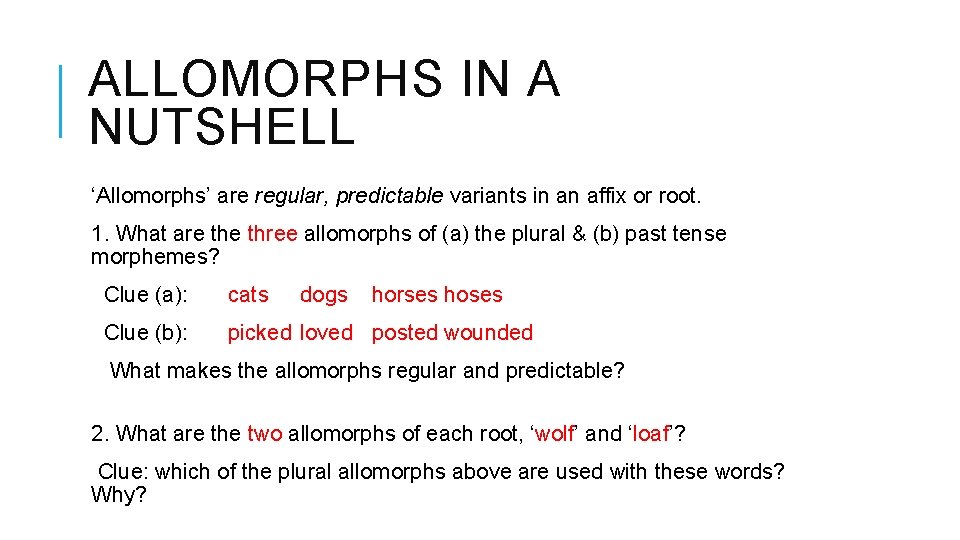
ALLOMORPHS IN A NUTSHELL ‘Allomorphs’ are regular, predictable variants in an affix or root. 1. What are three allomorphs of (a) the plural & (b) past tense morphemes? Clue (a): cats dogs horses hoses Clue (b): picked loved posted wounded What makes the allomorphs regular and predictable? 2. What are the two allomorphs of each root, ‘wolf’ and ‘loaf’? Clue: which of the plural allomorphs above are used with these words? Why?
ALLOMORPHS IN A NUTSHELL ‘Allomorphs’ are regular, predictable variants in an affix or root. 1. What are three allomorphs of (a) the plural & (b) past tense morphemes? Clue (a): cats dogs Clue (b): picked loved horses hoses /s, z, ɪz/ posted wounded /t, d, ɪd/ Q: What makes the allomorphs regular and predictable? A: Phonetic environment: unvoiced consonant + /s, t/: cat/cats, pick/picked voiced consonant/vowel + /z, d/: dog/dogs, love/loved s/z + /ɪz/ (plural): horse/horses, hose/hoses t/d + /ɪd/ (past tense): post/posted, wound/wounded Remember: it’s the sound, not the spelling that matters!
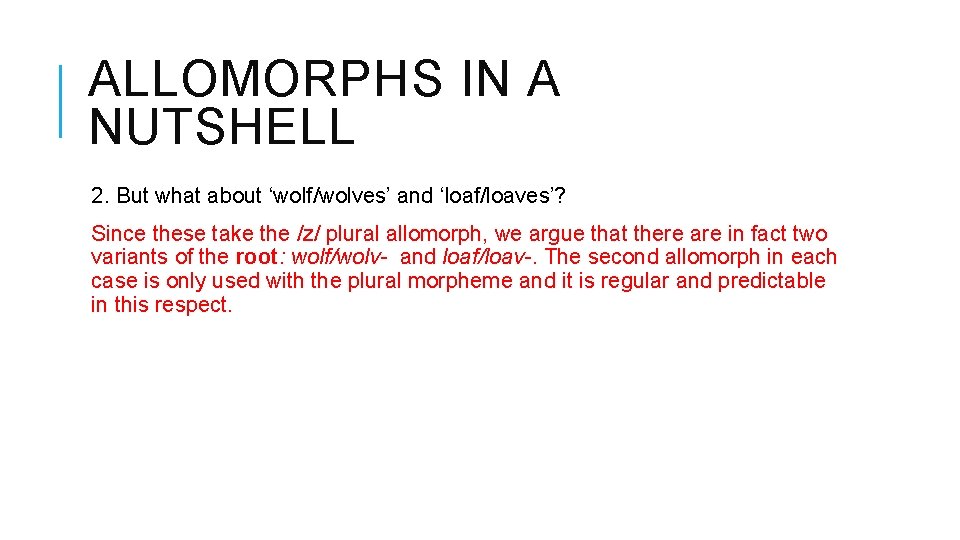
ALLOMORPHS IN A NUTSHELL 2. But what about ‘wolf/wolves’ and ‘loaf/loaves’? Since these take the /z/ plural allomorph, we argue that there are in fact two variants of the root: wolf/wolv- and loaf/loav-. The second allomorph in each case is only used with the plural morpheme and it is regular and predictable in this respect.
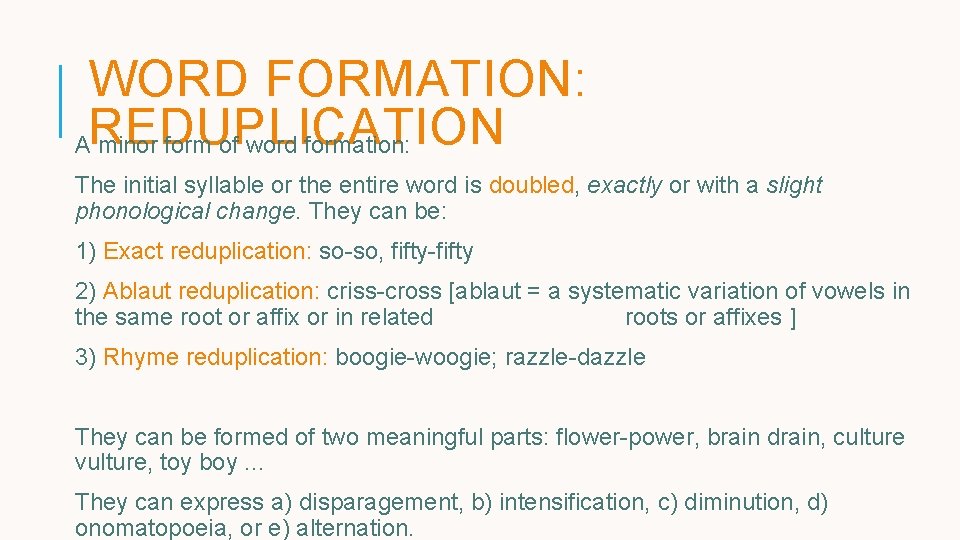
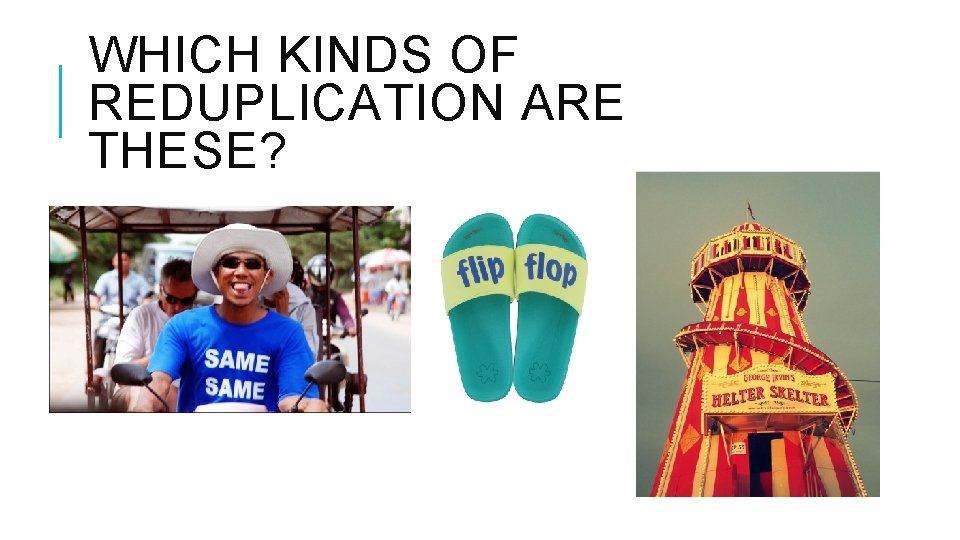
WORD FORMATION: AREDUPLICATION minor form of word formation: The initial syllable or the entire word is doubled, exactly or with a slight phonological change. They can be: 1) Exact reduplication: so-so, fifty-fifty 2) Ablaut reduplication: criss-cross [ablaut = a systematic variation of vowels in the same root or affix or in related roots or affixes ] 3) Rhyme reduplication: boogie-woogie; razzle-dazzle They can be formed of two meaningful parts: flower-power, brain drain, culture vulture, toy boy. . . They can express a) disparagement, b) intensification, c) diminution, d) onomatopoeia, or e) alternation.
WHICH KINDS OF REDUPLICATION ARE THESE?
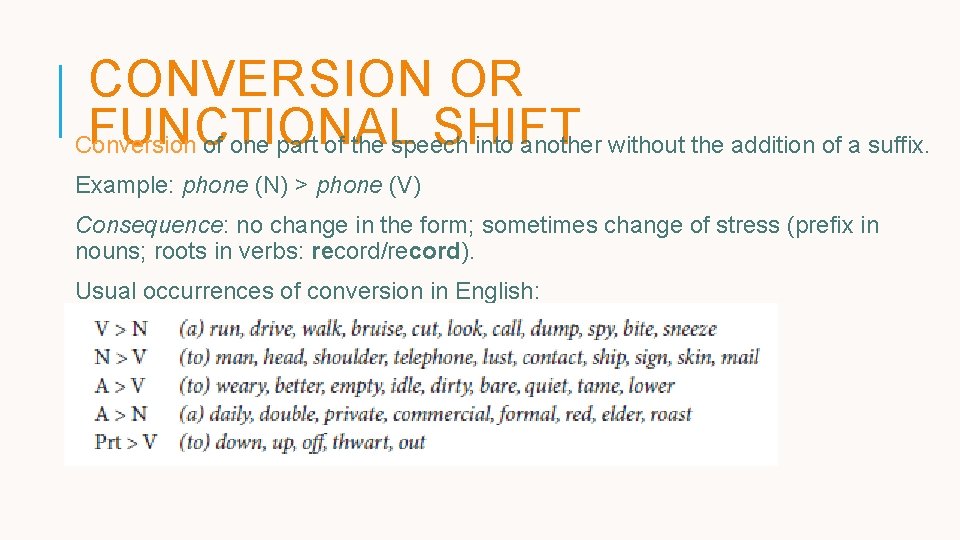
CONVERSION OR FUNCTIONAL SHIFT Conversion of one part of the speech into another without the addition of a suffix. Example: phone (N) > phone (V) Consequence: no change in the form; sometimes change of stress (prefix in nouns; roots in verbs: record/record). Usual occurrences of conversion in English:
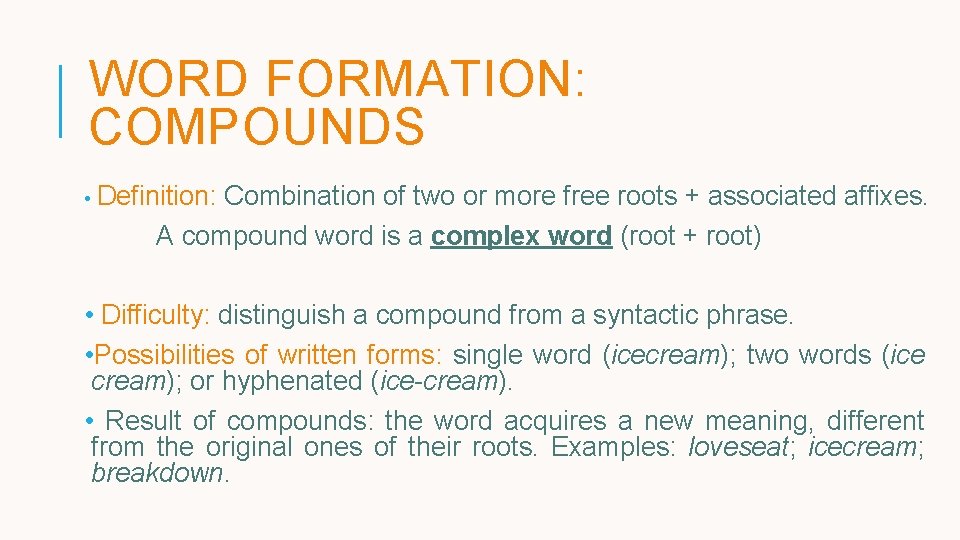
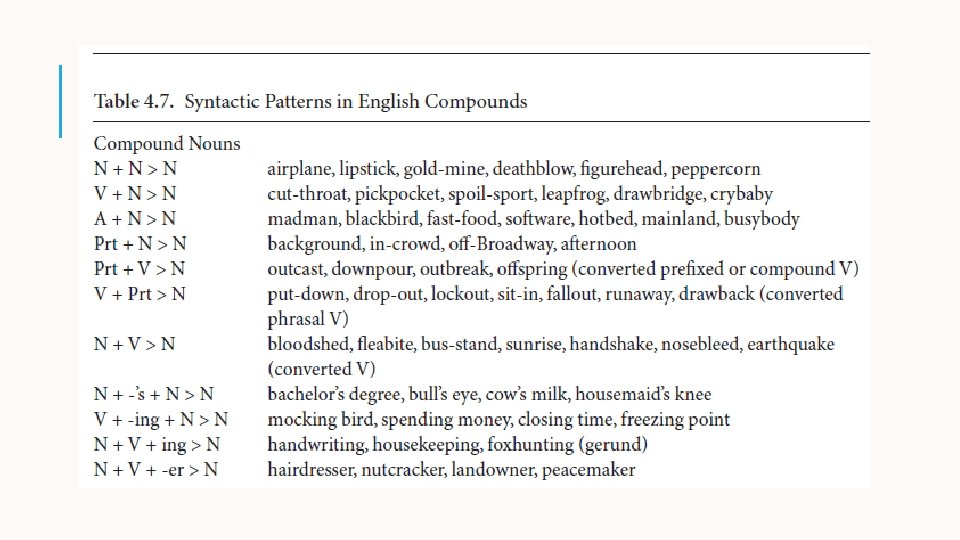
WORD FORMATION: COMPOUNDS • Definition: Combination of two or more free roots + associated affixes. A compound word is a complex word (root + root) • Difficulty: distinguish a compound from a syntactic phrase. • Possibilities of written forms: single word (icecream); two words (ice cream); or hyphenated (ice-cream). • Result of compounds: the word acquires a new meaning, different from the original ones of their roots. Examples: loveseat; icecream; breakdown.
COMPOUNDS VERSUS PHRASES A compound combines 2 or more free roots (+ any affixes). Compounds can sometimes be hard to distinguish from phrases. Are these compound words or phrases for you? How do you make them into plurals? manhole shipyard man-of-war daughter-in-law jack-in-the-box
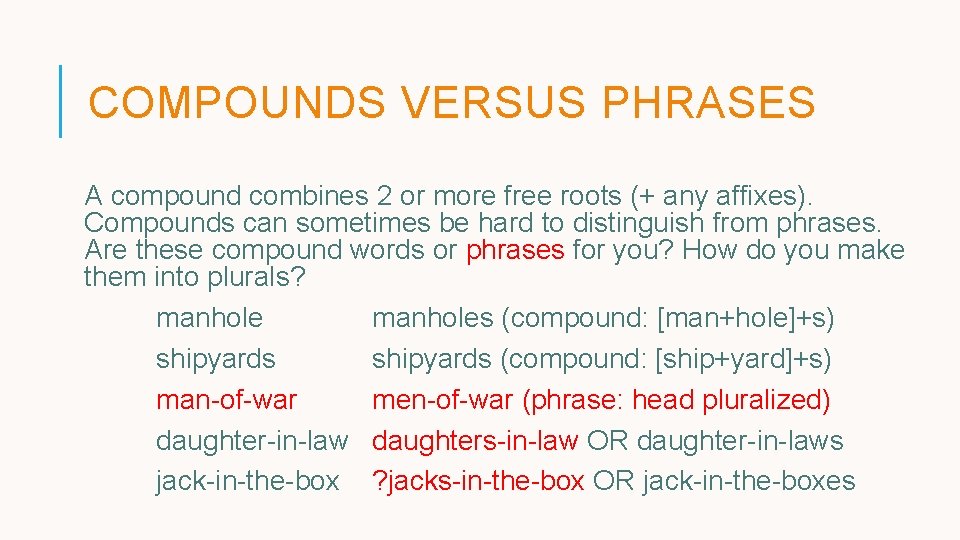
COMPOUNDS VERSUS PHRASES A compound combines 2 or more free roots (+ any affixes). Compounds can sometimes be hard to distinguish from phrases. Are these compound words or phrases for you? How do you make them into plurals? manholes (compound: [man+hole]+s) shipyards (compound: [ship+yard]+s) man-of-war men-of-war (phrase: head pluralized) daughter-in-law daughters-in-law OR daughter-in-laws jack-in-the-box ? jacks-in-the-box OR jack-in-the-boxes
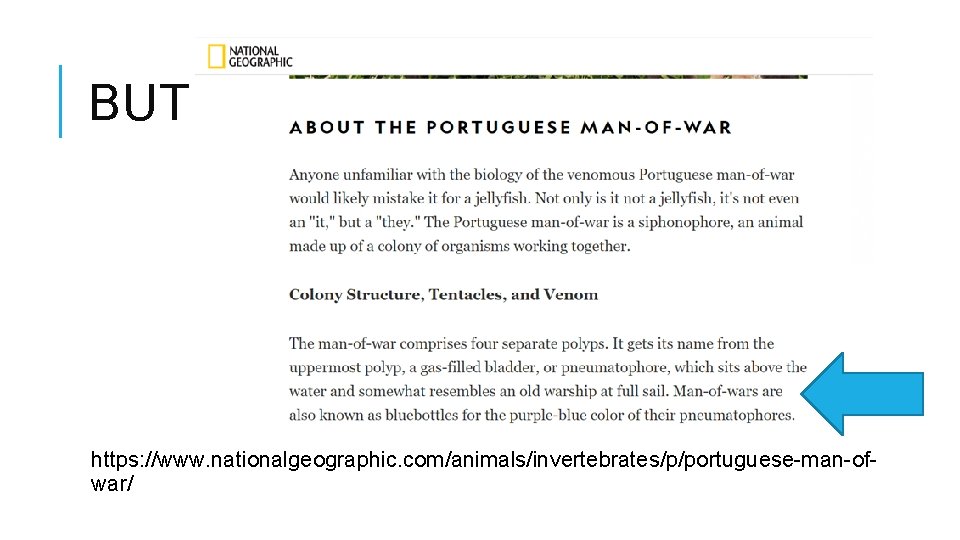
BUT… https: //www. nationalgeographic. com/animals/invertebrates/p/portuguese-man-ofwar/
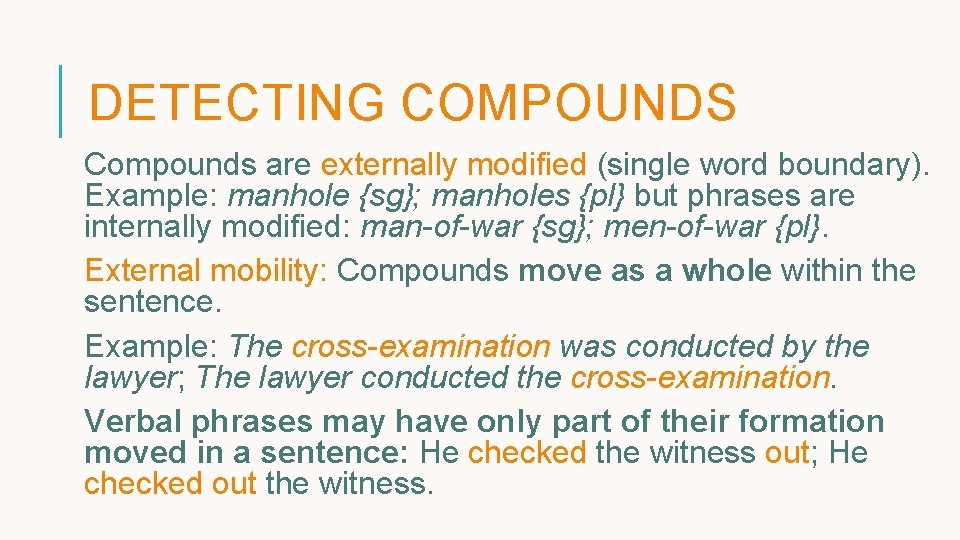
DETECTING COMPOUNDS Compounds are externally modified (single word boundary). Example: manhole {sg}; manholes {pl} but phrases are internally modified: man-of-war {sg}; men-of-war {pl}. External mobility: Compounds move as a whole within the sentence. Example: The cross-examination was conducted by the lawyer; The lawyer conducted the cross-examination. Verbal phrases may have only part of their formation moved in a sentence: He checked the witness out; He checked out the witness.
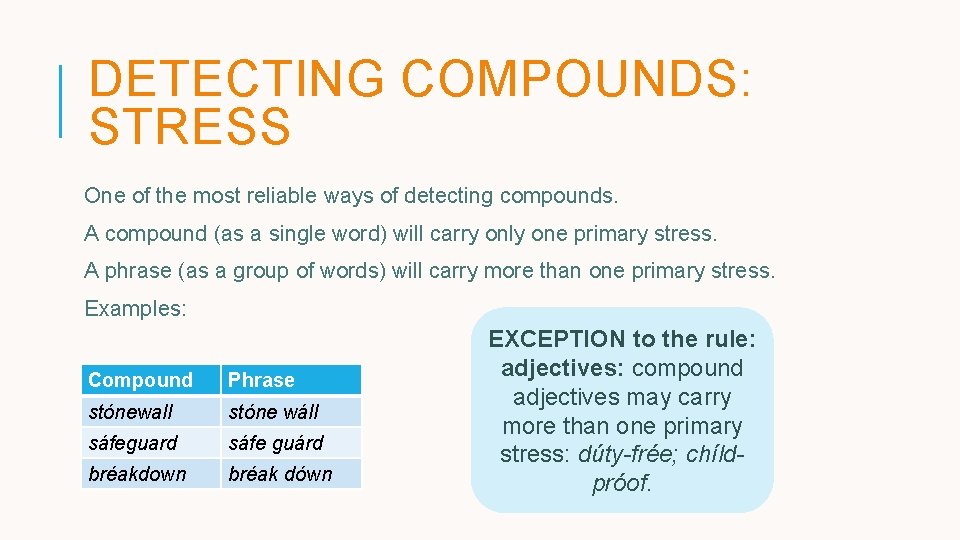
DETECTING COMPOUNDS: STRESS One of the most reliable ways of detecting compounds. A compound (as a single word) will carry only one primary stress. A phrase (as a group of words) will carry more than one primary stress. Examples: Compound Phrase stónewall stóne wáll sáfeguard sáfe guárd bréakdown bréak dówn EXCEPTION to the rule: adjectives: compound adjectives may carry more than one primary stress: dúty-frée; chíldpróof.
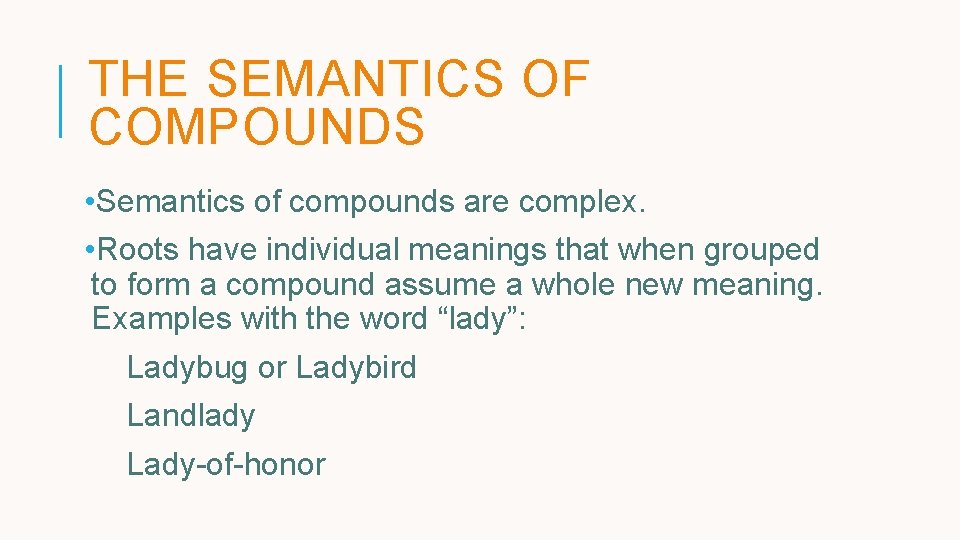
THE SEMANTICS OF COMPOUNDS • Semantics of compounds are complex. • Roots have individual meanings that when grouped to form a compound assume a whole new meaning. Examples with the word “lady”: Ladybug or Ladybird Landlady Lady-of-honor
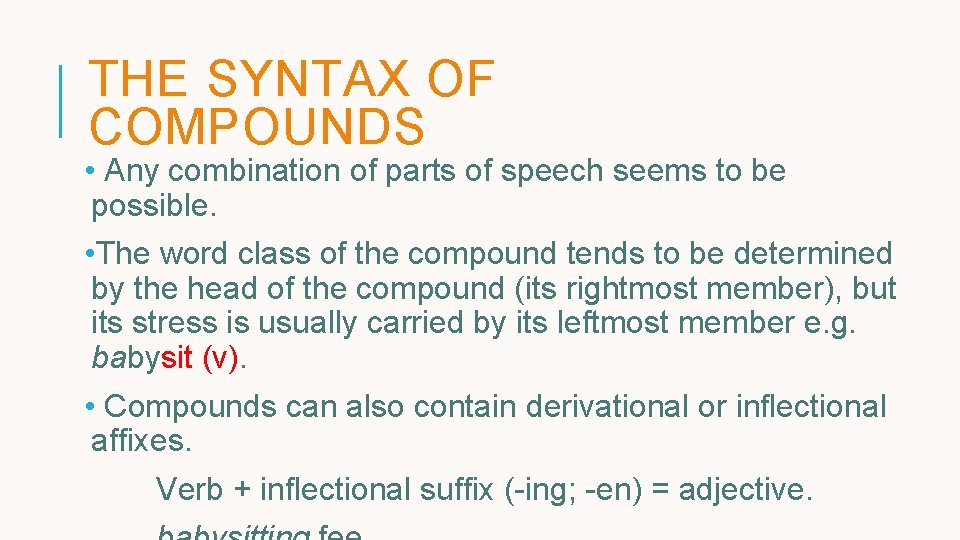
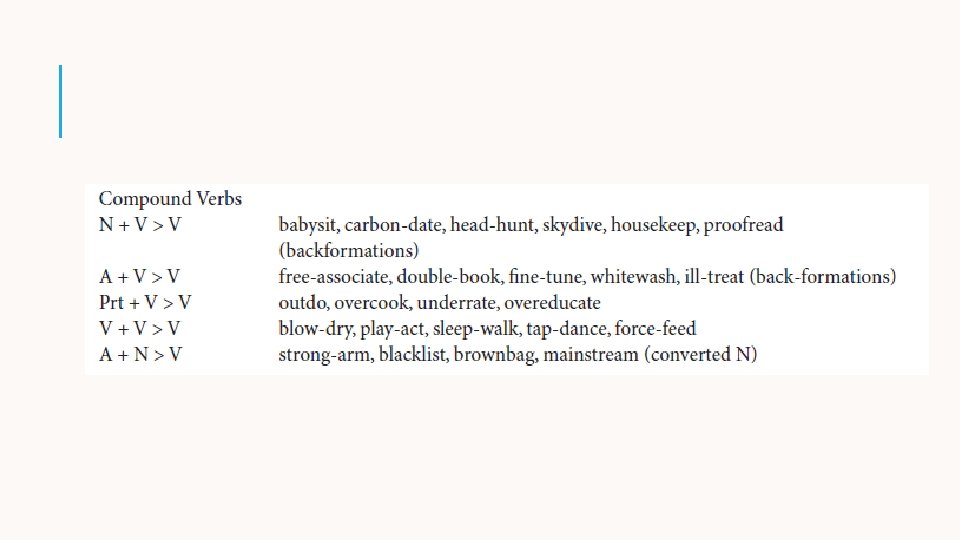
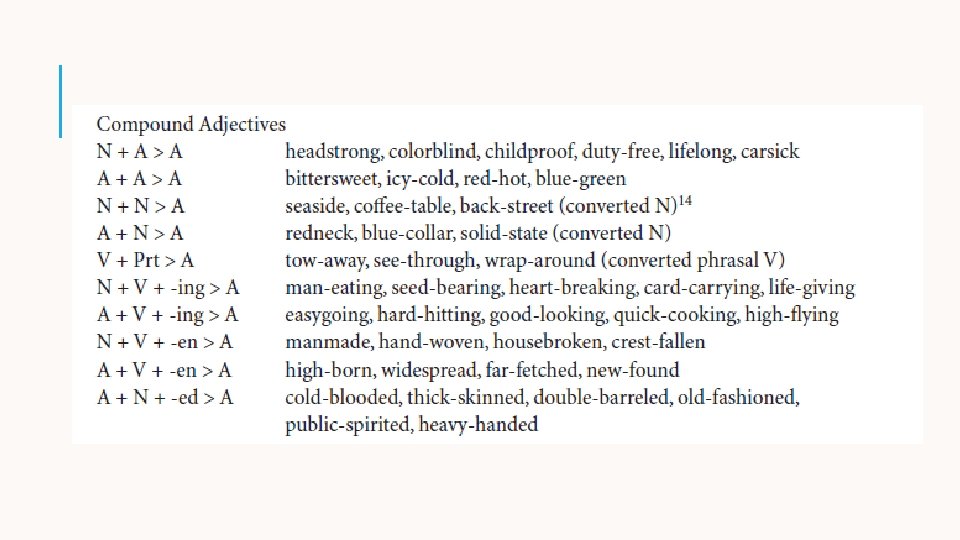
THE SYNTAX OF COMPOUNDS • Any combination of parts of speech seems to be possible. • The word class of the compound tends to be determined by the head of the compound (its rightmost member), but its stress is usually carried by its leftmost member e. g. babysit (v). • Compounds can also contain derivational or inflectional affixes. Verb + inflectional suffix (-ing; -en) = adjective.
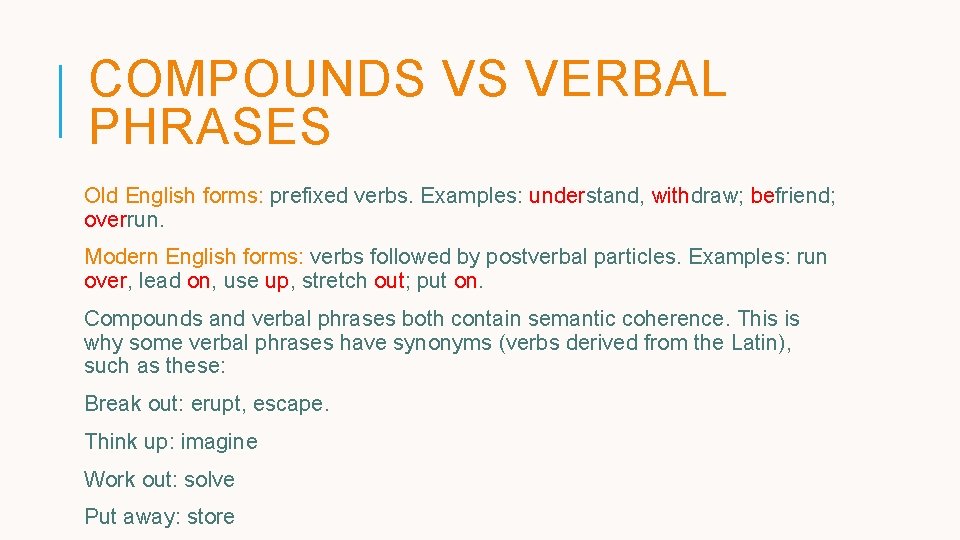
COMPOUNDS VS VERBAL PHRASES Old English forms: prefixed verbs. Examples: understand, withdraw; befriend; overrun. Modern English forms: verbs followed by postverbal particles. Examples: run over, lead on, use up, stretch out; put on. Compounds and verbal phrases both contain semantic coherence. This is why some verbal phrases have synonyms (verbs derived from the Latin), such as these: Break out: erupt, escape. Think up: imagine Work out: solve Put away: store
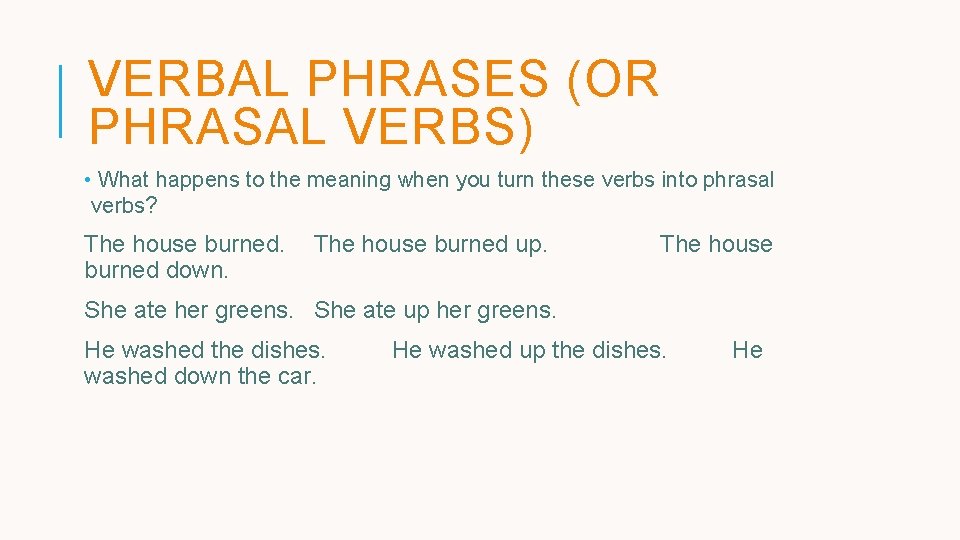
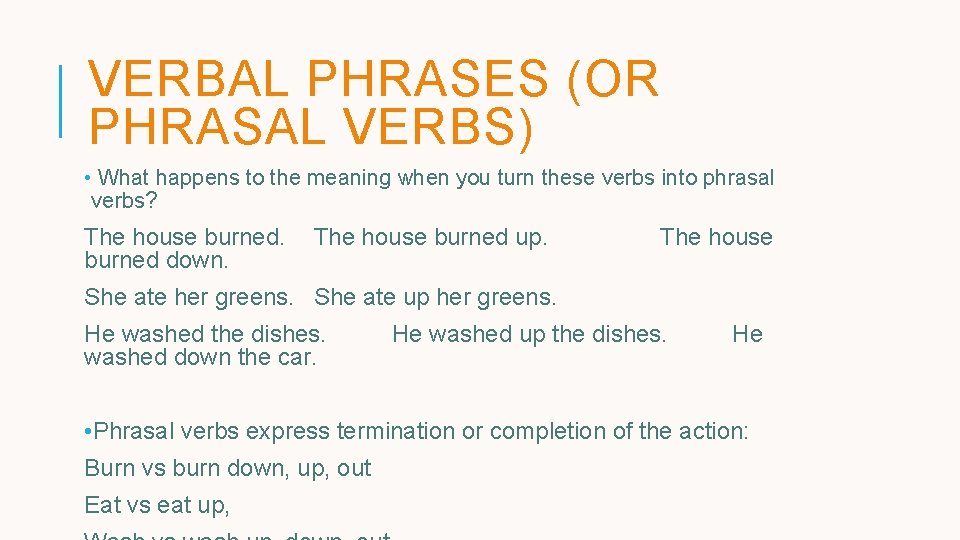
VERBAL PHRASES (OR PHRASAL VERBS) • What happens to the meaning when you turn these verbs into phrasal verbs? The house burned down. The house burned up. The house She ate her greens. She ate up her greens. He washed the dishes. washed down the car. He washed up the dishes. He
VERBAL PHRASES (OR PHRASAL VERBS) • What happens to the meaning when you turn these verbs into phrasal verbs? The house burned down. The house burned up. The house She ate her greens. She ate up her greens. He washed the dishes. washed down the car. He washed up the dishes. He • Phrasal verbs express termination or completion of the action: Burn vs burn down, up, out Eat vs eat up,
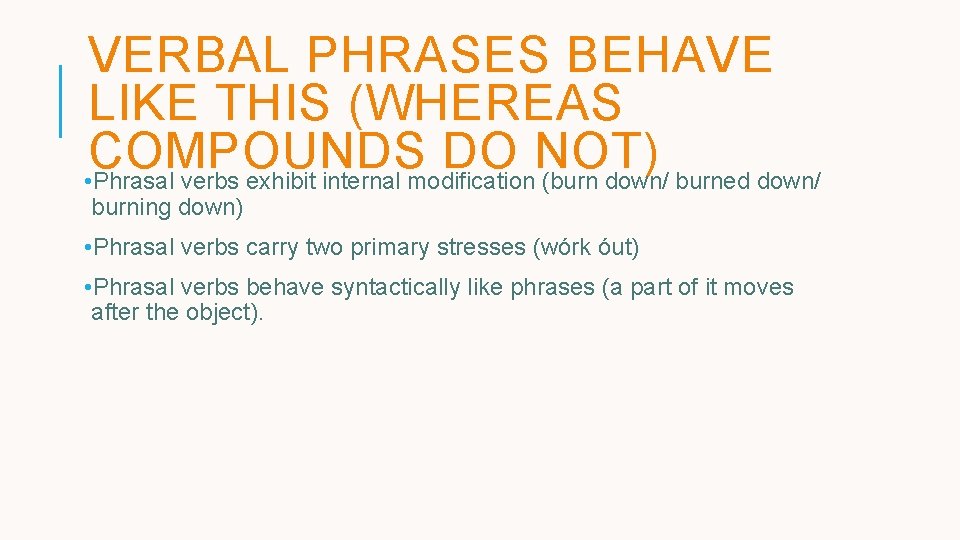
VERBAL PHRASES BEHAVE LIKE THIS (WHEREAS COMPOUNDS DO NOT) • Phrasal verbs exhibit internal modification (burn down/ burned down/ burning down) • Phrasal verbs carry two primary stresses (wórk óut) • Phrasal verbs behave syntactically like phrases (a part of it moves after the object).
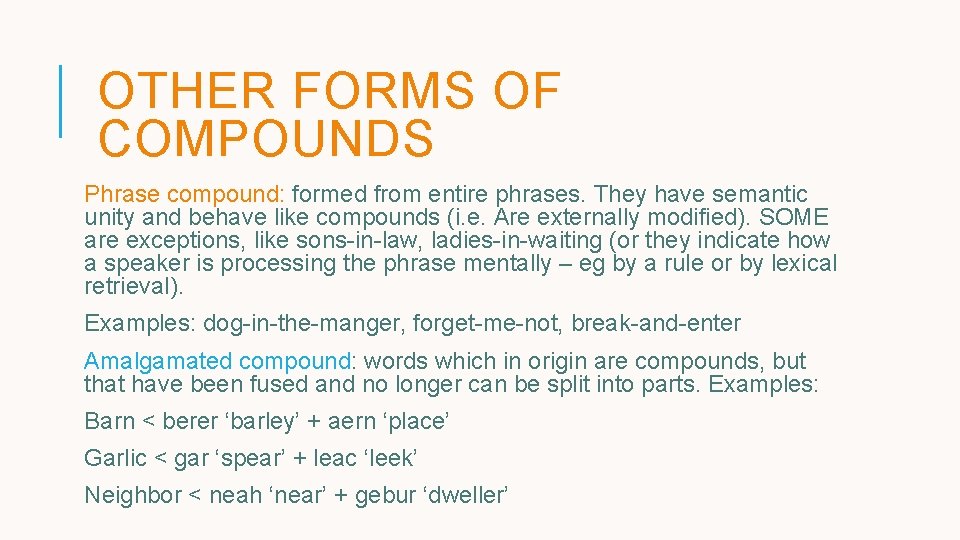
OTHER FORMS OF COMPOUNDS Phrase compound: formed from entire phrases. They have semantic unity and behave like compounds (i. e. Are externally modified). SOME are exceptions, like sons-in-law, ladies-in-waiting (or they indicate how a speaker is processing the phrase mentally – eg by a rule or by lexical retrieval). Examples: dog-in-the-manger, forget-me-not, break-and-enter Amalgamated compound: words which in origin are compounds, but that have been fused and no longer can be split into parts. Examples: Barn < berer ‘barley’ + aern ‘place’ Garlic < gar ‘spear’ + leac ‘leek’ Neighbor < neah ‘near’ + gebur ‘dweller’
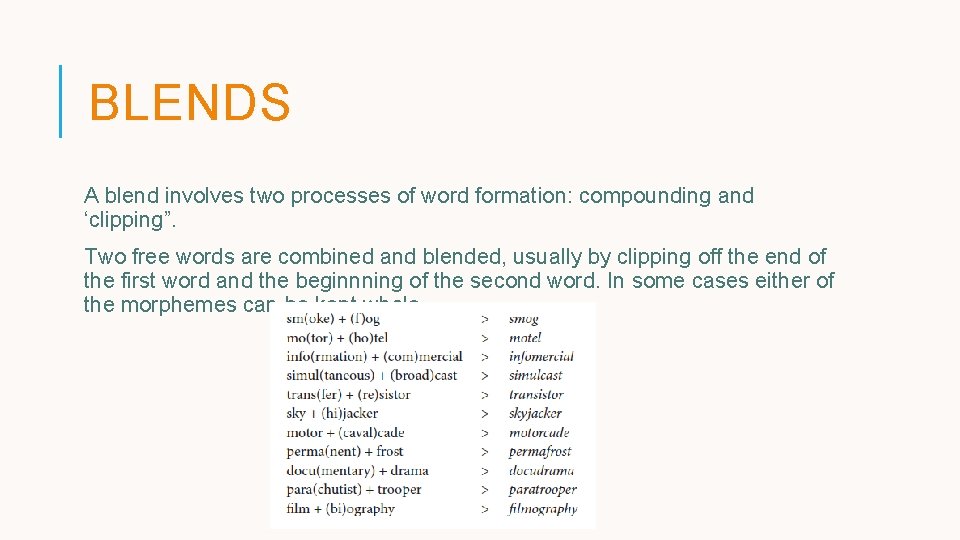
BLENDS A blend involves two processes of word formation: compounding and ‘clipping”. Two free words are combined and blended, usually by clipping off the end of the first word and the beginnning of the second word. In some cases either of the morphemes can be kept whole.
BACK FORMATIONS Usually, simple roots can be extended by adding a derivational affix, often a suffix. Common examples: suffix –er is added to a verb to produce a noun: sightseer; babysitter; typewriter. In some other cases (back formation), a presumed derivational suffix is removed: we remove –ion from “transcription” to create “transcript”, or –ive from “sedative” to create “sedate”, for instance.
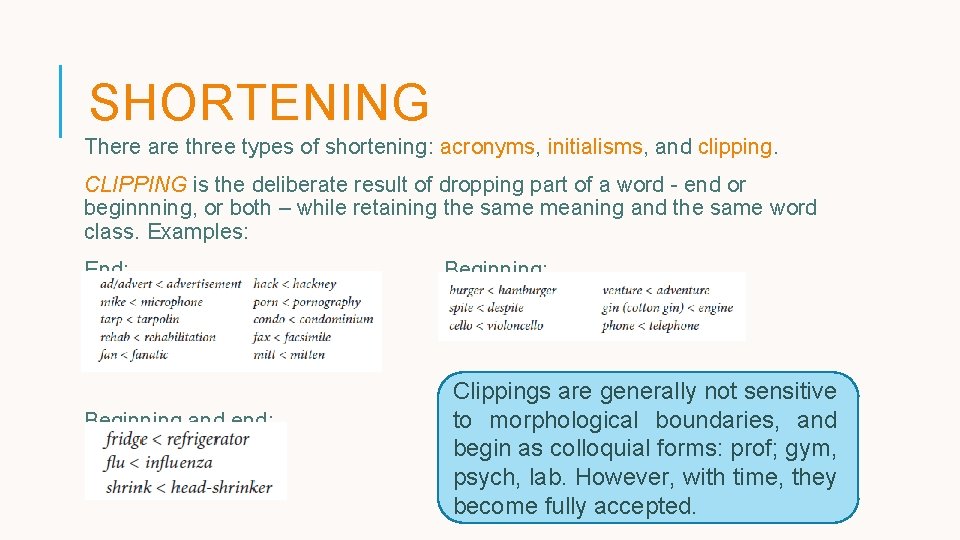
SHORTENING There are three types of shortening: acronyms, initialisms, and clipping. CLIPPING is the deliberate result of dropping part of a word - end or beginnning, or both – while retaining the same meaning and the same word class. Examples: End: Beginning and end: Beginning: Clippings are generally not sensitive to morphological boundaries, and begin as colloquial forms: prof; gym, psych, lab. However, with time, they become fully accepted.
SHORTENING Acronyms and initialisms: extreme forms of clipping. ACRONYMS: initial letters of a phrase are pronounced as a word, as in WASP, NATO, AIDS, radar, laser. INITIALISMS: the initial letters of words in a phrase are pronounced as letters, as in r. s. v. p. , a. m. , p. m. , B. C. , A. D. Spelling and punctuation conventions are somewhat inconsistent, and can be used in some cases but not in others, such as in ok.
ROOT CREATIONS • It is considered the rarest form of word formation in English. • It involves the invention of an entirely new root morpheme. • Brand names may originate new roots, as in Xerox, Harley Davidson, Levis, Mc. Donald’s (commonization) • Initialisms in brand company names, as in HP and IBM, are also considered root creations. • Root creations include blends like multiplex, cineplex, and foreign borrowings, eg karaoke. • Finally, onomatopoeic words that imitate animal sounds are common root creations, as bow-wow, cuckoo, meow (see http: //www. bzzzpeek. com/ for multilingual onomatopoeia)
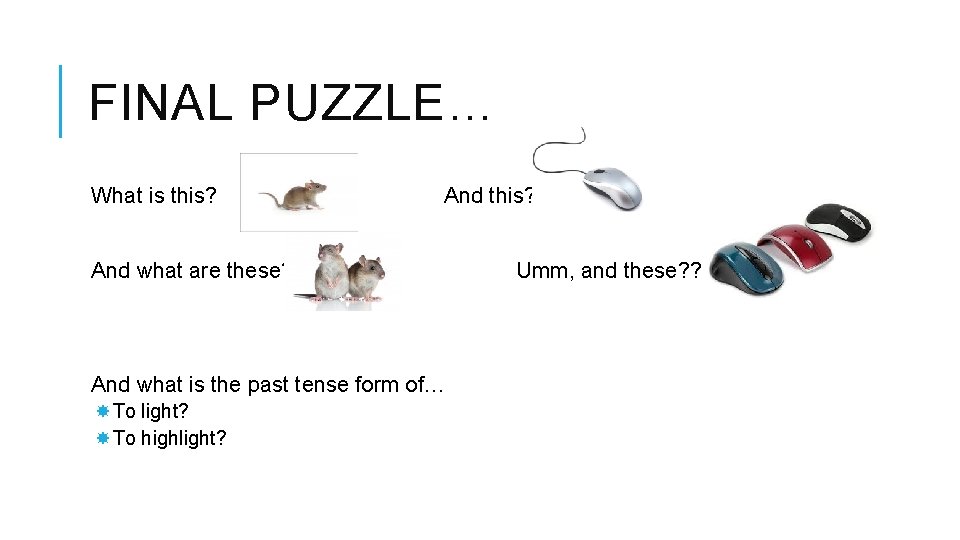
FINAL PUZZLE… What is this? And what are these? And what is the past tense form of… To light? To highlight? Umm, and these? ?
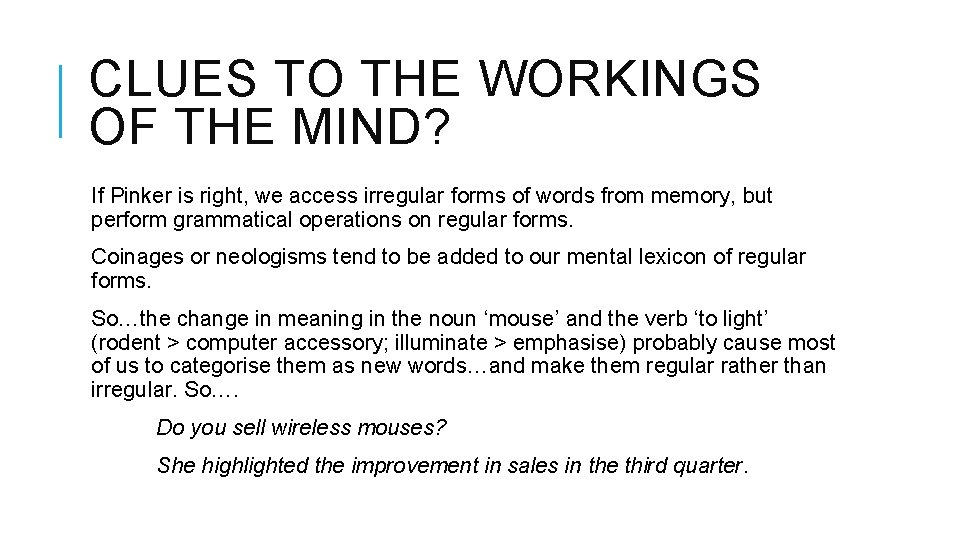
CLUES TO THE WORKINGS OF THE MIND? If Pinker is right, we access irregular forms of words from memory, but perform grammatical operations on regular forms. Coinages or neologisms tend to be added to our mental lexicon of regular forms. So…the change in meaning in the noun ‘mouse’ and the verb ‘to light’ (rodent > computer accessory; illuminate > emphasise) probably cause most of us to categorise them as new words…and make them regular rather than irregular. So…. Do you sell wireless mouses? She highlighted the improvement in sales in the third quarter.