DESCRIO E ANLISE MORFOSSINTTICA DO INGLS Prof John

- Slides: 26
DESCRIÇÃO E ANÁLISE MORFOSSINTÁTICA DO INGLÊS Prof John Corbett USP-CAPES International Fellow
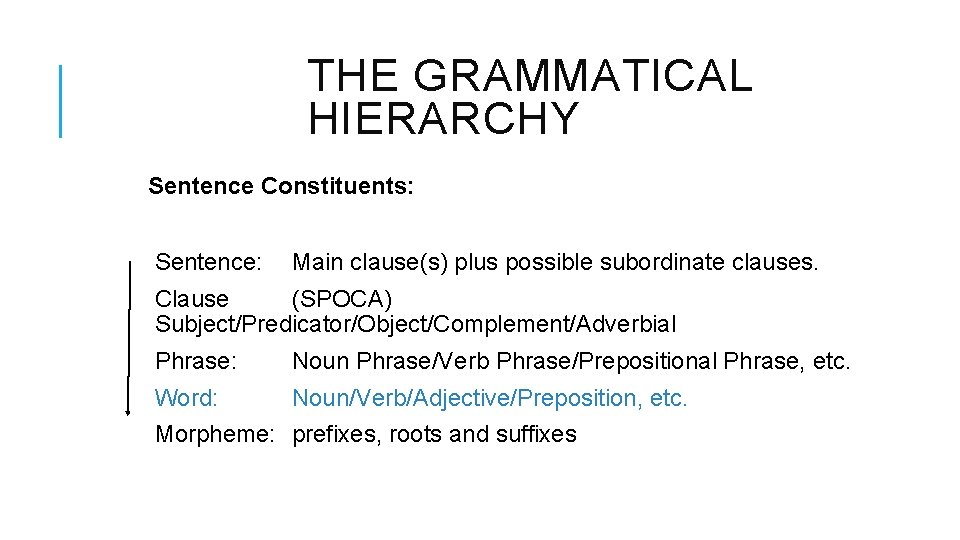
THE GRAMMATICAL HIERARCHY Sentence Constituents: Sentence: Main clause(s) plus possible subordinate clauses. Clause (SPOCA) Subject/Predicator/Object/Complement/Adverbial Phrase: Noun Phrase/Verb Phrase/Prepositional Phrase, etc. Word: Noun/Verb/Adjective/Preposition, etc. Morpheme: prefixes, roots and suffixes
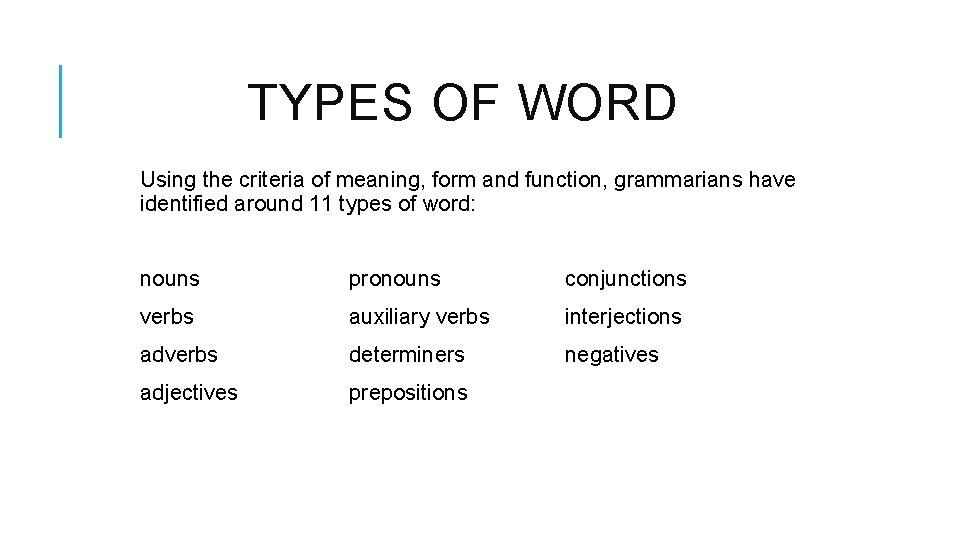
TYPES OF WORD Using the criteria of meaning, form and function, grammarians have identified around 11 types of word: nouns pronouns conjunctions verbs auxiliary verbs interjections adverbs determiners negatives adjectives prepositions
TYPES OF WORD These types of word fall into two main groups): nouns pronouns conjunctions verbs auxiliary verbs interjections adverbs determiners negatives adjectives prepositions
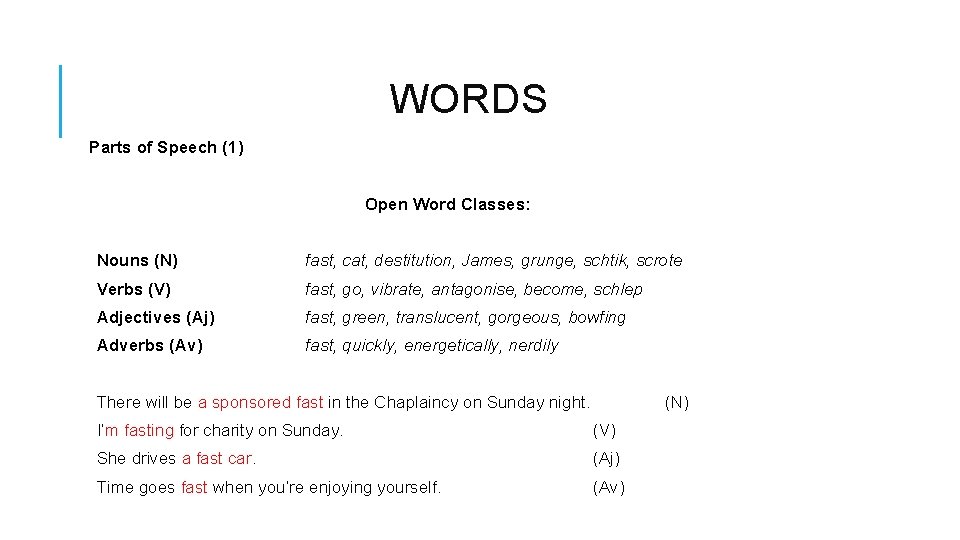
WORDS Parts of Speech (1) Open Word Classes: Nouns (N) fast, cat, destitution, James, grunge, schtik, scrote Verbs (V) fast, go, vibrate, antagonise, become, schlep Adjectives (Aj) fast, green, translucent, gorgeous, bowfing Adverbs (Av) fast, quickly, energetically, nerdily There will be a sponsored fast in the Chaplaincy on Sunday night. (N) I’m fasting for charity on Sunday. (V) She drives a fast car. (Aj) Time goes fast when you’re enjoying yourself. (Av)
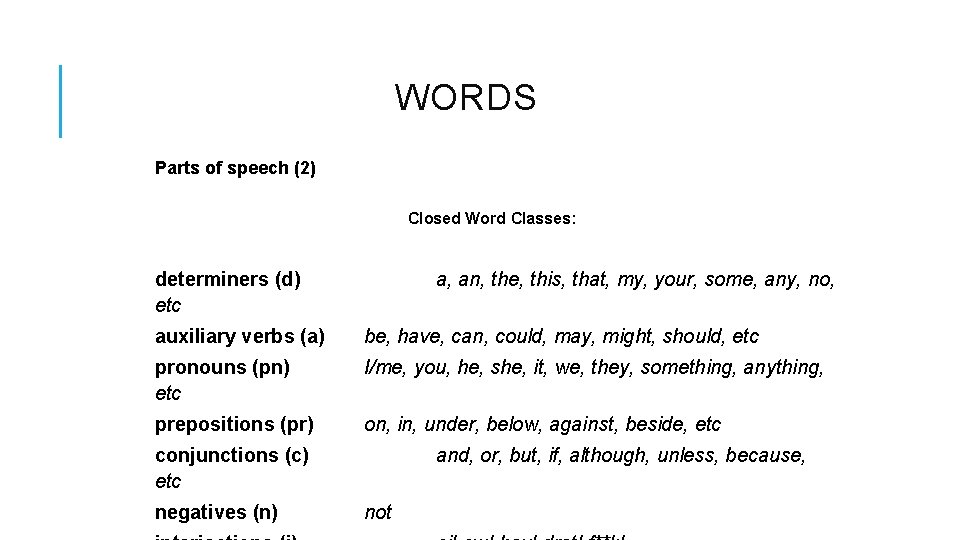
WORDS Parts of speech (2) Closed Word Classes: determiners (d) etc a, an, the, this, that, my, your, some, any, no, auxiliary verbs (a) be, have, can, could, may, might, should, etc pronouns (pn) etc I/me, you, he, she, it, we, they, something, anything, prepositions (pr) on, in, under, below, against, beside, etc conjunctions (c) etc negatives (n) and, or, but, if, although, unless, because, not
OPEN AND CLOSED WORD CLASSES What is the difference between and open and closed word class?
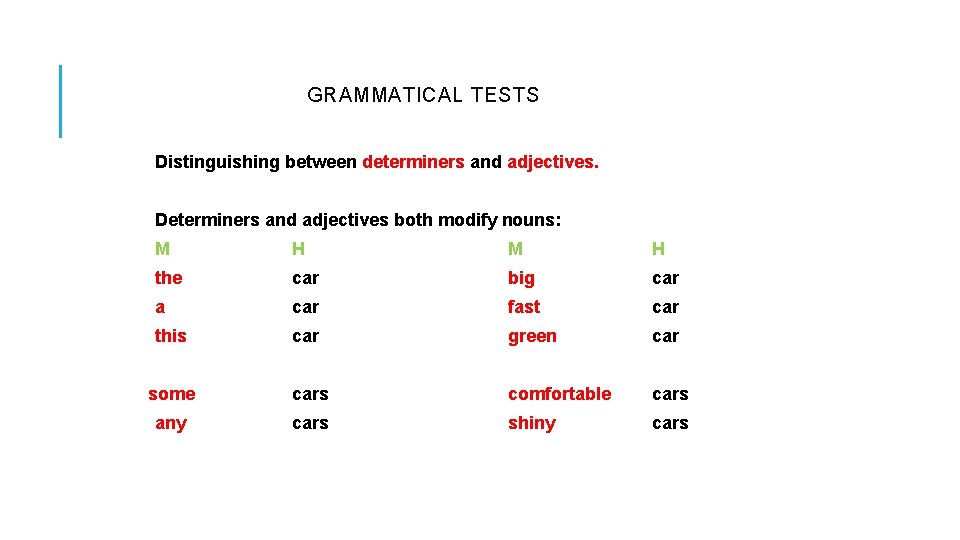
GRAMMATICAL TESTS Distinguishing between determiners and adjectives. Determiners and adjectives both modify nouns: M H the car big car a car fast car this car green car some cars comfortable cars any cars shiny cars
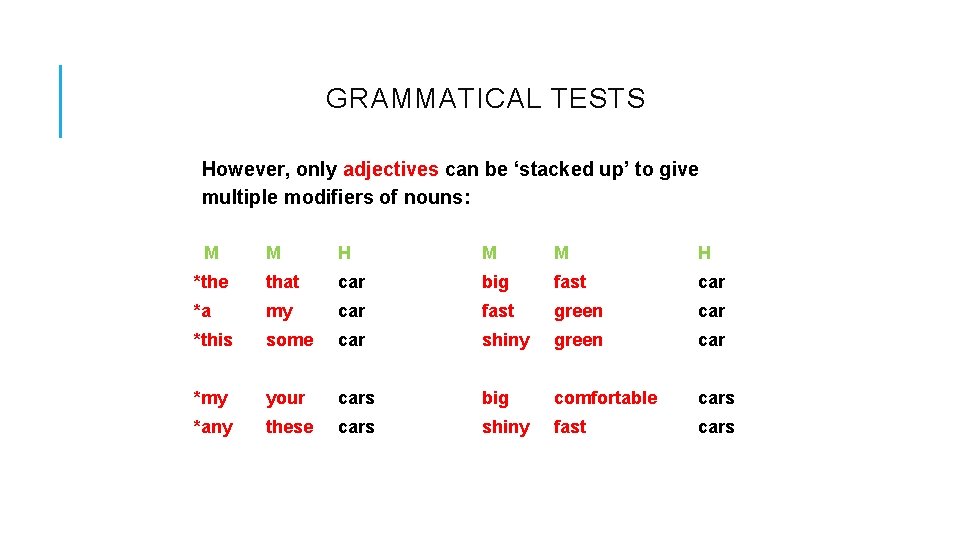
GRAMMATICAL TESTS However, only adjectives can be ‘stacked up’ to give multiple modifiers of nouns: M M H *the that car big fast car *a my car fast green car *this some car shiny green car *my your cars big comfortable cars *any these cars shiny fast cars
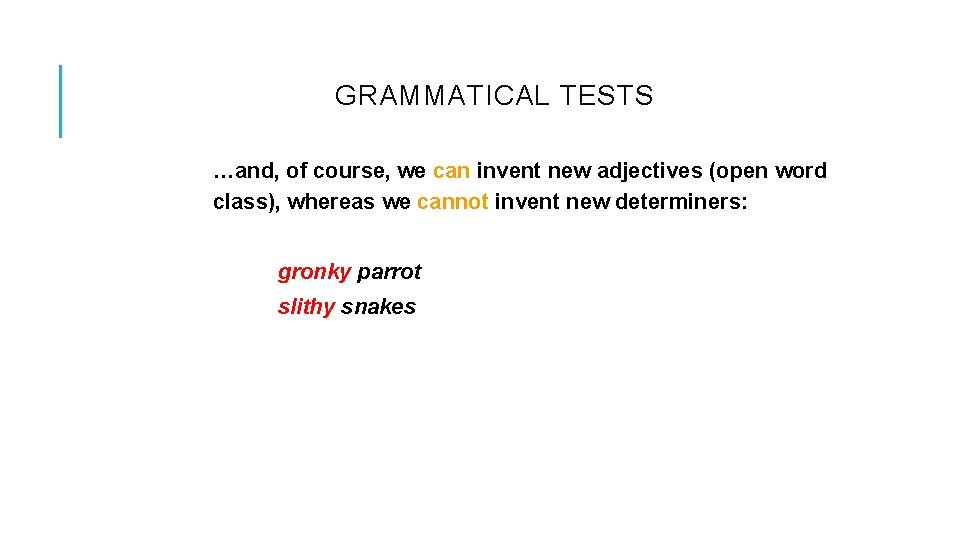
GRAMMATICAL TESTS …and, of course, we can invent new adjectives (open word class), whereas we cannot invent new determiners: gronky parrot slithy snakes
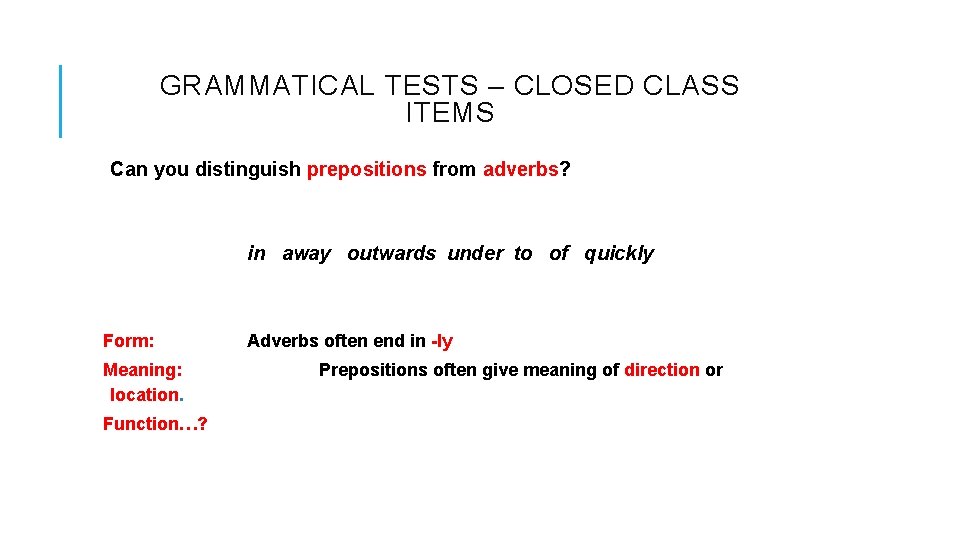
GRAMMATICAL TESTS – CLOSED CLASS ITEMS Can you distinguish prepositions from adverbs? in away outwards under to of quickly Form: Meaning: location. Function…? Adverbs often end in -ly Prepositions often give meaning of direction or
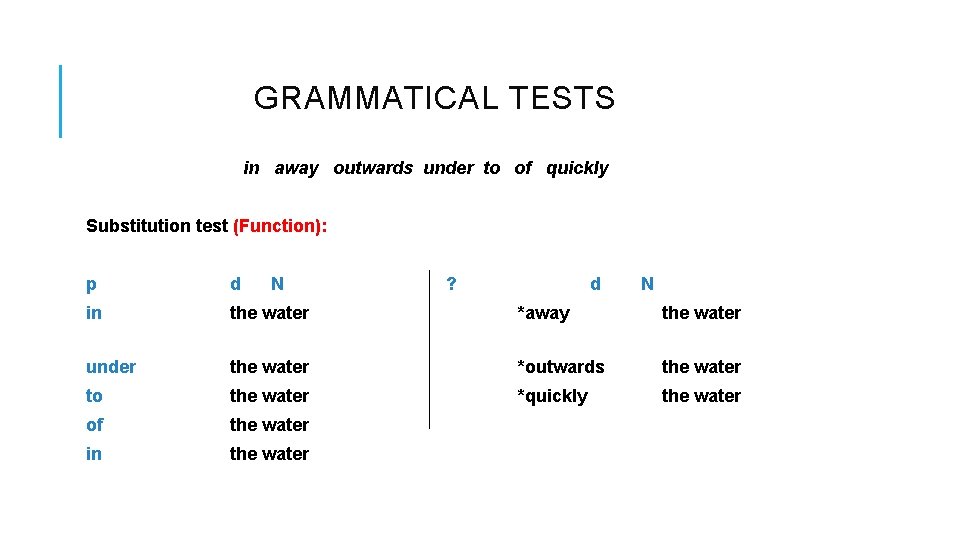
GRAMMATICAL TESTS in away outwards under to of quickly Substitution test (Function): p d N ? d N in the water *away the water under the water *outwards the water to the water *quickly the water of the water in the water
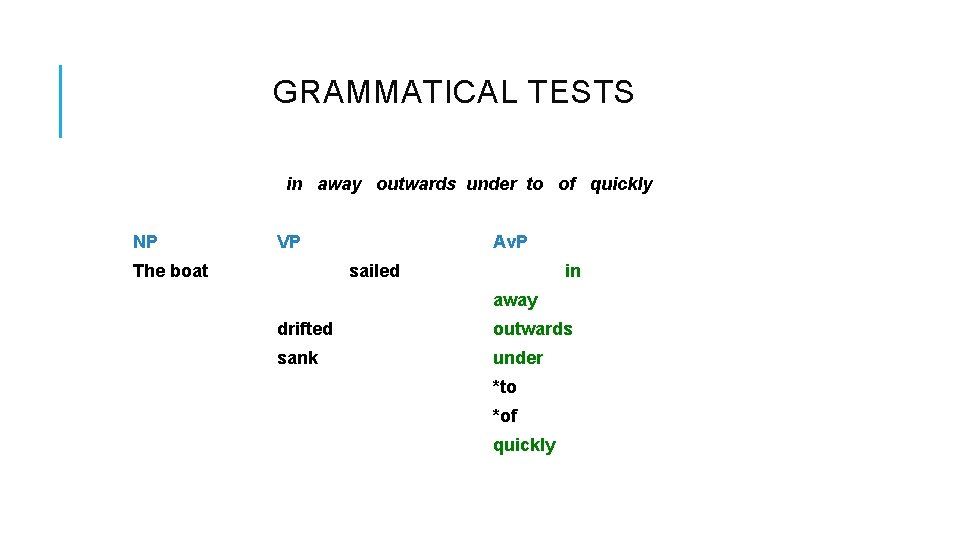
GRAMMATICAL TESTS in away outwards under to of quickly NP VP The boat Av. P sailed in away drifted outwards sank under *to *of quickly
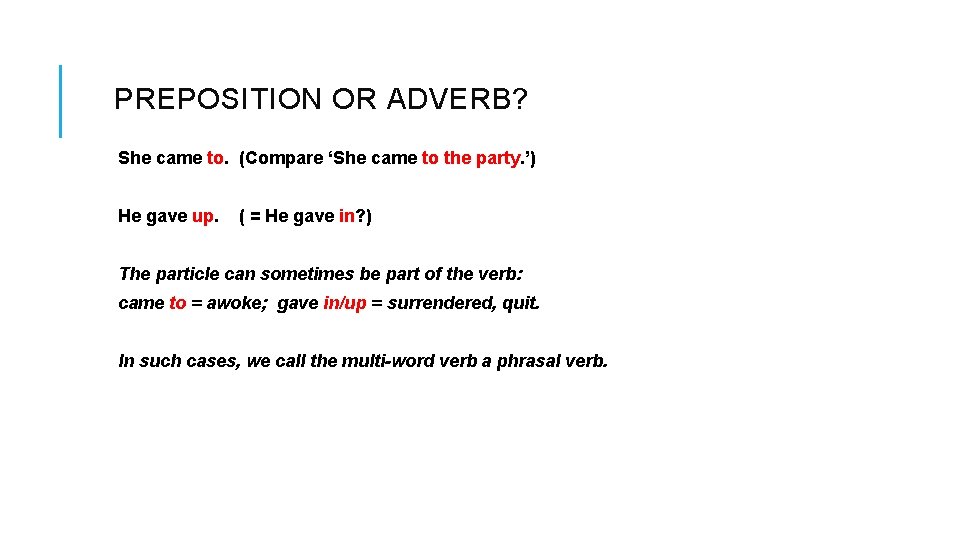
PREPOSITION OR ADVERB? She came to. (Compare ‘She came to the party. ’) He gave up. ( = He gave in? ) The particle can sometimes be part of the verb: came to = awoke; gave in/up = surrendered, quit. In such cases, we call the multi-word verb a phrasal verb.
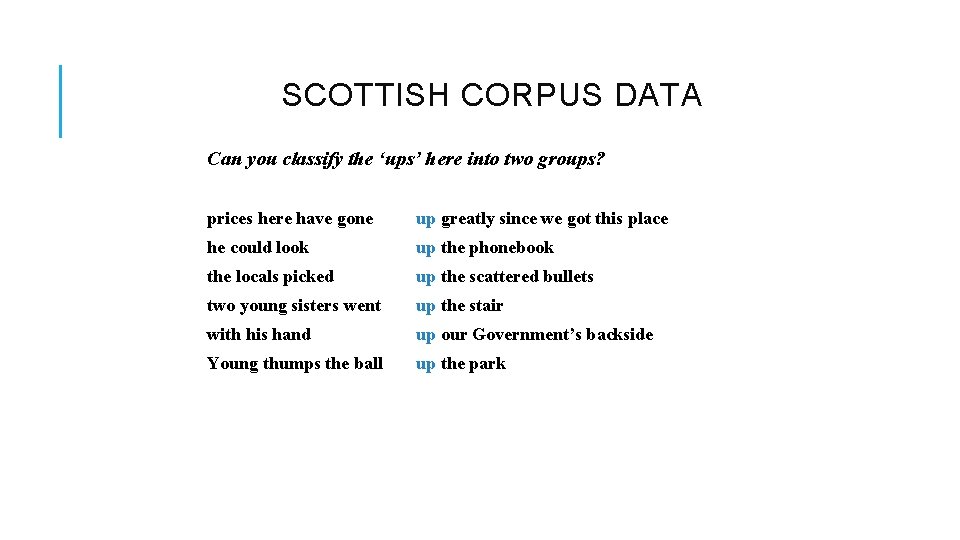
SCOTTISH CORPUS DATA Can you classify the ‘ups’ here into two groups? prices here have gone up greatly since we got this place he could look up the phonebook the locals picked up the scattered bullets two young sisters went up the stair with his hand up our Government’s backside Young thumps the ball up the park
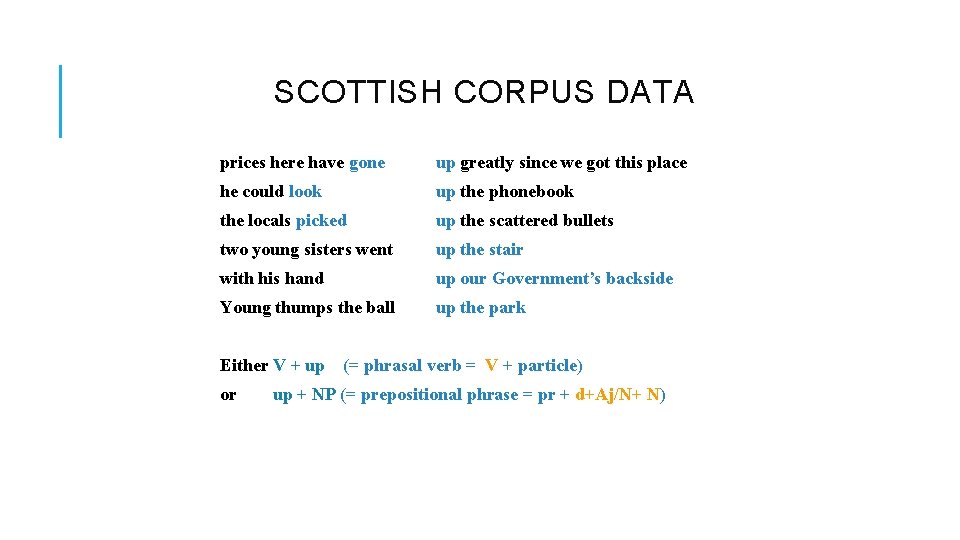
SCOTTISH CORPUS DATA prices here have gone up greatly since we got this place he could look up the phonebook the locals picked up the scattered bullets two young sisters went up the stair with his hand up our Government’s backside Young thumps the ball up the park Either V + up or (= phrasal verb = V + particle) up + NP (= prepositional phrase = pr + d+Aj/N+ N)
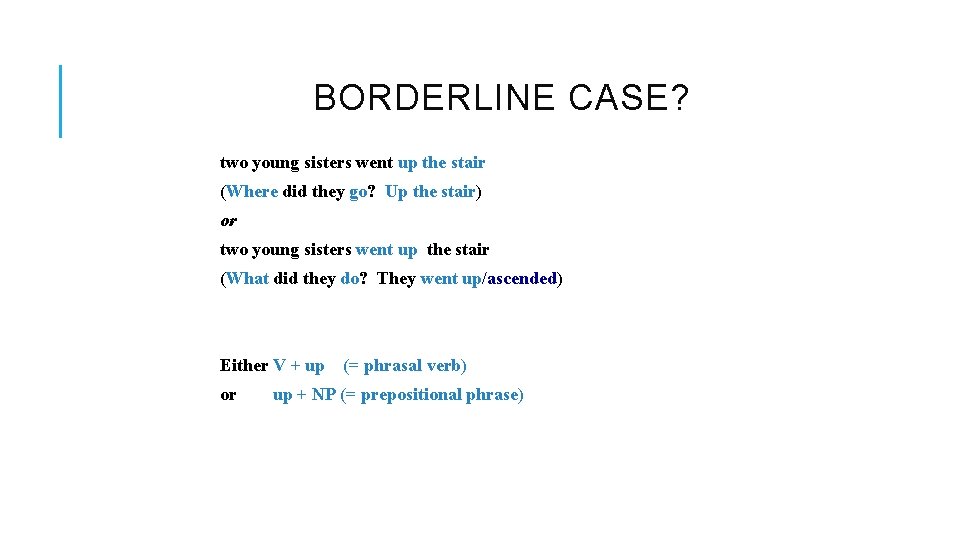
BORDERLINE CASE? two young sisters went up the stair (Where did they go? Up the stair) or two young sisters went up the stair (What did they do? They went up/ascended) Either V + up or (= phrasal verb) up + NP (= prepositional phrase)
MORAL Grammatical tests don’t always give us conclusive evidence for classification. Sometimes we have to acknowledge that different analyses are possible.
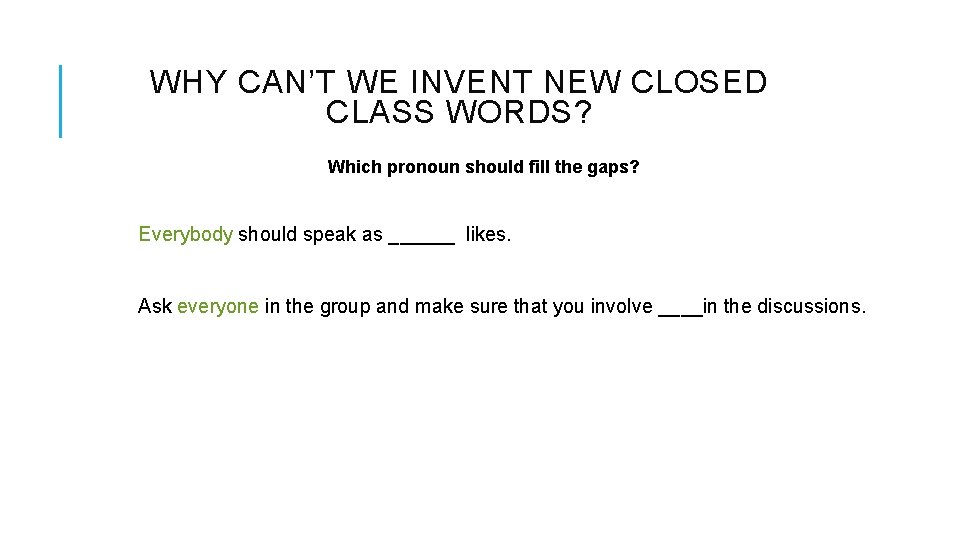
WHY CAN’T WE INVENT NEW CLOSED CLASS WORDS? Which pronoun should fill the gaps? Everybody should speak as ______ likes. Ask everyone in the group and make sure that you involve ____in the discussions.
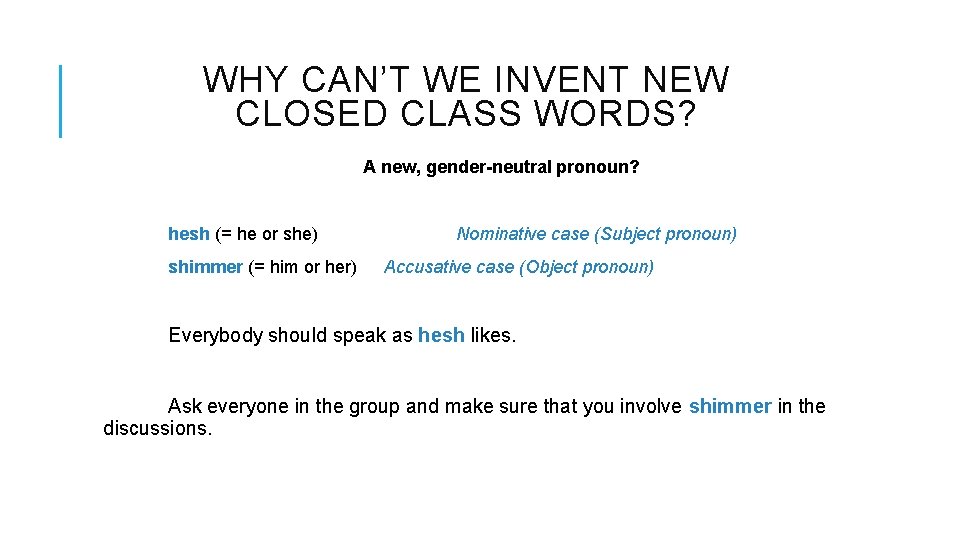
WHY CAN’T WE INVENT NEW CLOSED CLASS WORDS? A new, gender-neutral pronoun? hesh (= he or she) shimmer (= him or her) Nominative case (Subject pronoun) Accusative case (Object pronoun) Everybody should speak as hesh likes. Ask everyone in the group and make sure that you involve shimmer in the discussions.
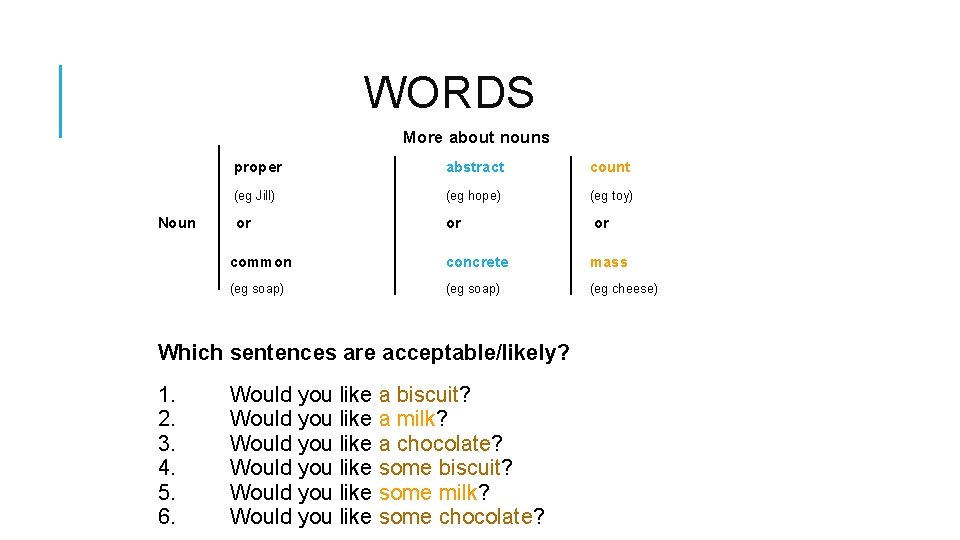
WORDS More about nouns Noun proper abstract count (eg Jill) (eg hope) (eg toy) or or or common concrete mass (eg soap) (eg cheese) Which sentences are acceptable/likely? 1. 2. 3. 4. 5. 6. Would you like a biscuit? Would you like a milk? Would you like a chocolate? Would you like some biscuit? Would you like some milk? Would you like some chocolate?
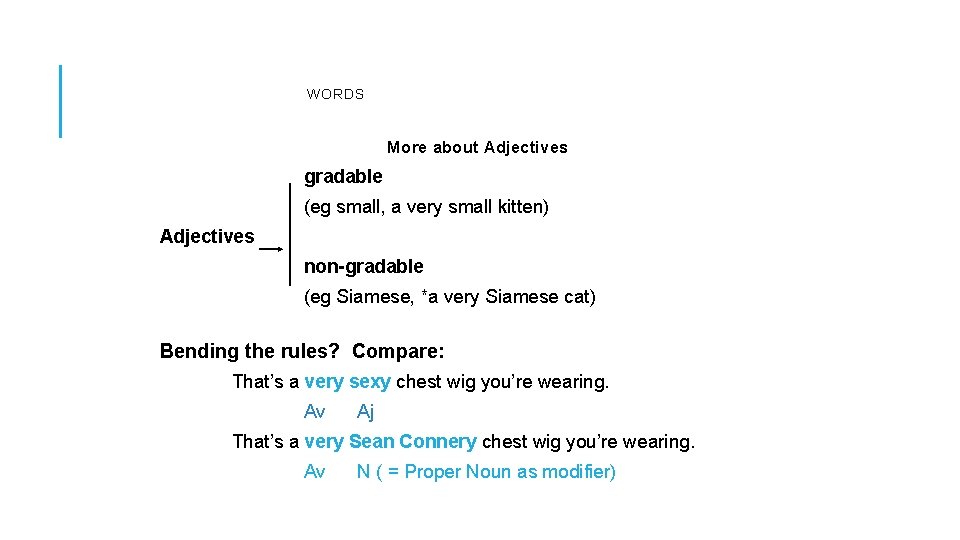
WORDS More about Adjectives gradable (eg small, a very small kitten) Adjectives non-gradable (eg Siamese, *a very Siamese cat) Bending the rules? Compare: That’s a very sexy chest wig you’re wearing. Av Aj That’s a very Sean Connery chest wig you’re wearing. Av N ( = Proper Noun as modifier)
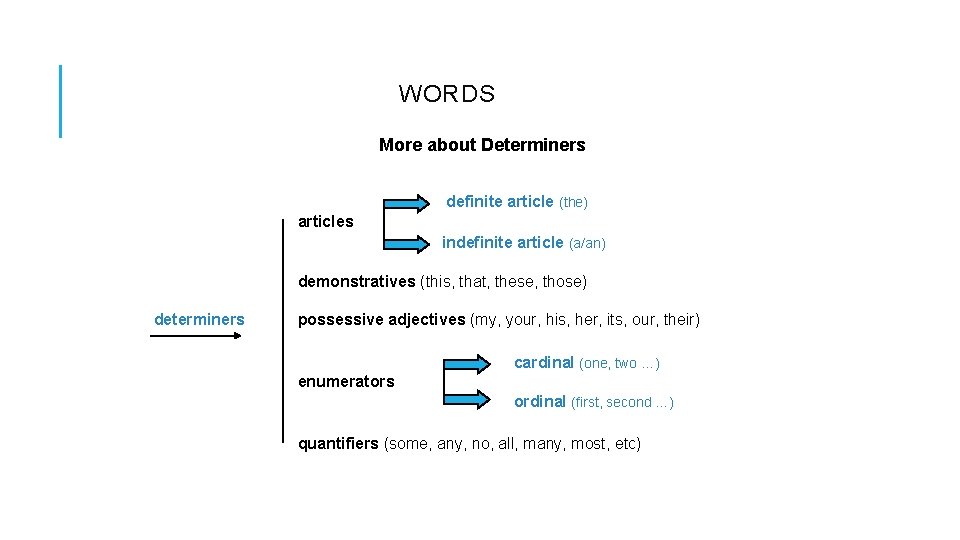
WORDS More about Determiners definite article (the) articles indefinite article (a/an) demonstratives (this, that, these, those) determiners possessive adjectives (my, your, his, her, its, our, their) cardinal (one, two …) enumerators ordinal (first, second …) quantifiers (some, any, no, all, many, most, etc)
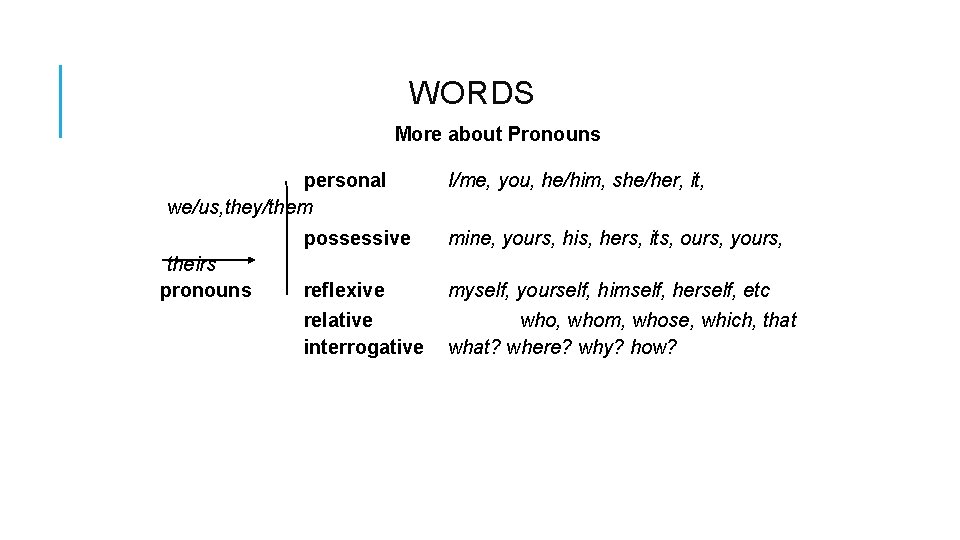
WORDS More about Pronouns personal we/us, they/them theirs pronouns I/me, you, he/him, she/her, it, possessive mine, yours, his, hers, its, ours, yours, reflexive relative interrogative myself, yourself, himself, herself, etc who, whom, whose, which, that what? where? why? how?
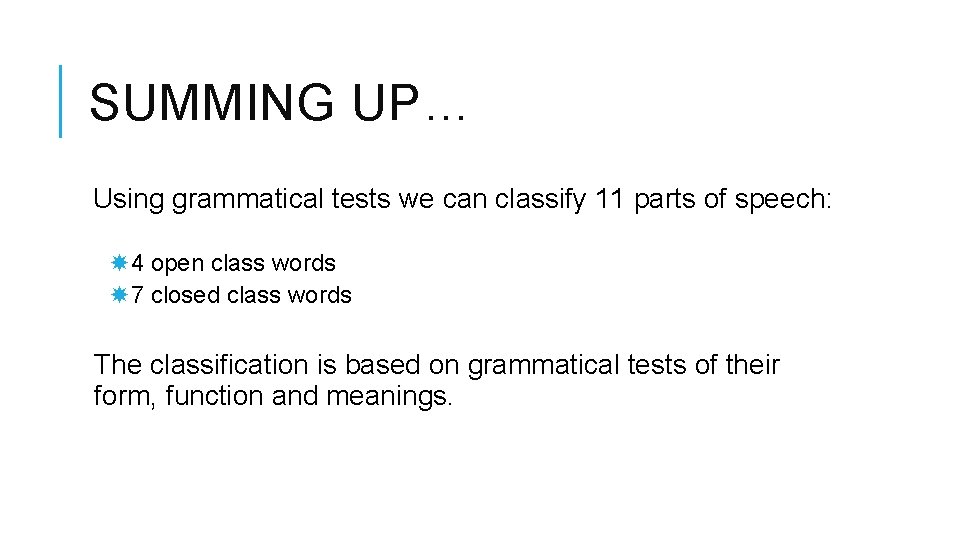
SUMMING UP… Using grammatical tests we can classify 11 parts of speech: 4 open class words 7 closed class words The classification is based on grammatical tests of their form, function and meanings.
THINGS TO DO THIS WEEK Read about parts of speech in a grammar book. Try the practice quiz on moodle. Next week … phrases!