
What does Dark Matter have to do with
- Slides: 40
What does Dark Matter have to do with the Big Bang Theory? Prof. David Toback Texas A&M University Mitchell Institute for Fundamental Physics and Astronomy Pasta and Prof Seminar Series, April 2018
Prologue We live in a time of remarkable scientific understanding Scientists are arrogant/crazy enough to think that it may be possible to solve major problems in Astronomy, Cosmology and Particle Physics with a single discovery that ties all three together Idea: Dark Matter is a particle that was created right after the Big Bang and has had a major impact on the evolution of the Universe and the stuff in it Goal of this talk: To show you how all this might just tie together March 2018 David Toback, Honors/Pasta and Prof 2
Overview Two of the most exciting topics in all of science are Dark Matter and the Big Bang Start with questions: • What IS Dark matter and what is the evidence for it? • What IS the Big Bang Theory? • What does Dark Matter have to do with the Big Bang? • What are scientists doing today to discover Dark Matter? Final Thoughts April 2018 David Toback, Honors/Pasta and Prof 3
What is Dark Matter? April 2018 David Toback, Honors/Pasta and Prof 4
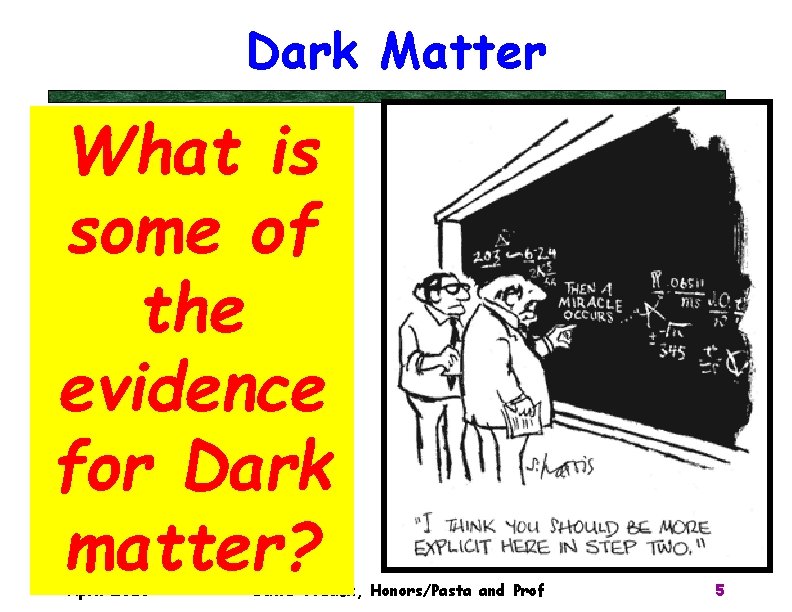
Dark Matter What is some of the evidence for Dark matter? April 2018 David Toback, Honors/Pasta and Prof 5
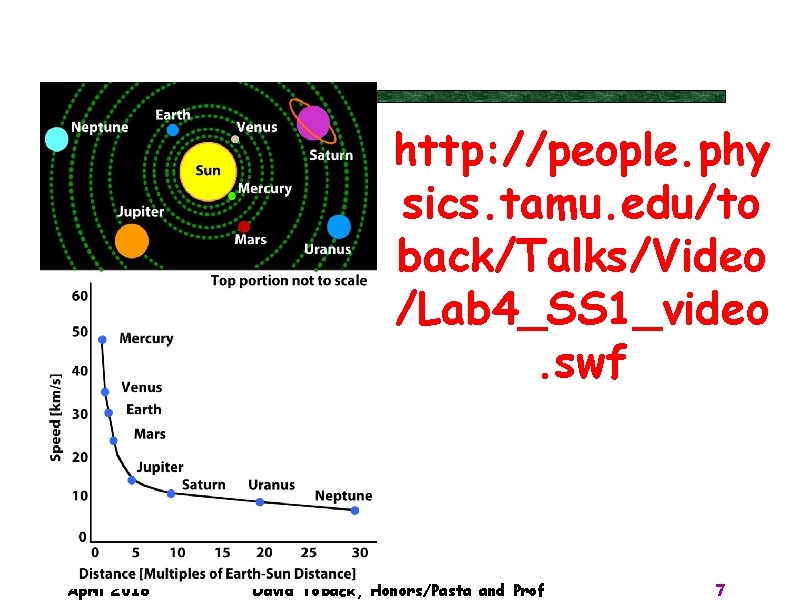
How stars move in galaxies • Start by considering the case that there IS no Dark Matter in galaxies • Can use laws of gravity to predict two things: – 1) The orbits of planets as they move around the solar system and – 2) Stars as they move around a galaxy • Prediction: both have very massive centers so we expect the data to look consistent with that • Data: – For the solar system, the data agree perfectly – For the stars in the outer part of galaxies, the prediction doesn’t work at all April 2018 David Toback, Honors/Pasta and Prof 6
http: //people. phy sics. tamu. edu/to back/Talks/Video /Lab 4_SS 1_video. swf April 2018 David Toback, Honors/Pasta and Prof 7
As the Galaxy Turns http: //faculty. physics. tamu. edu/toback /Talks/Video/Lab 4_GX 1_video_slow. swf April 2018 David Toback, Honors/Pasta and Prof 8
Data well explained by lots of “Dark Matter” we can’t see This is where it gets its name In some sense, the name is a statement of almost all we know about it (it doesn’t interact with light, and it has mass) April 2018 David Toback, Honors/Pasta and Prof 9
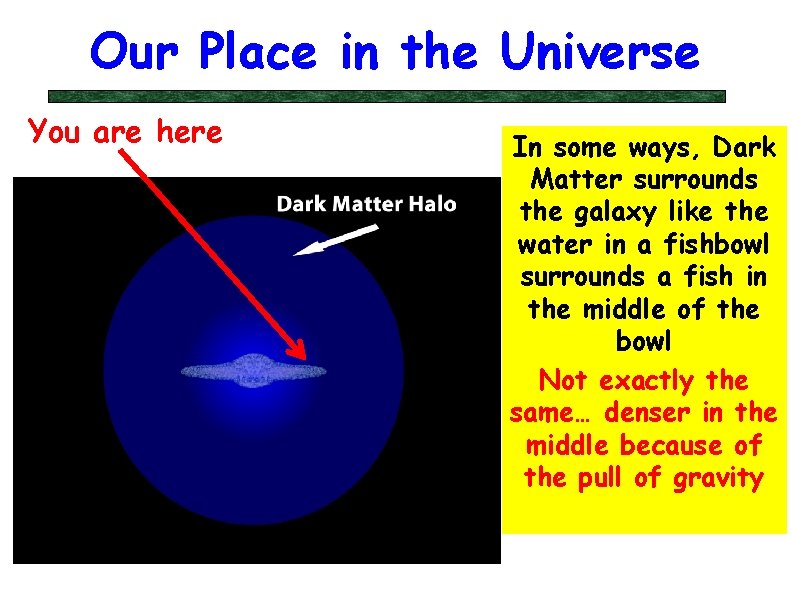
Our Place in the Universe You are here In some ways, Dark Matter surrounds the galaxy like the water in a fishbowl surrounds a fish in the middle of the bowl Not exactly the same… denser in the middle because of the pull of gravity
What is the Big Bang Theory? April 2018 David Toback, Honors/Pasta and Prof 11
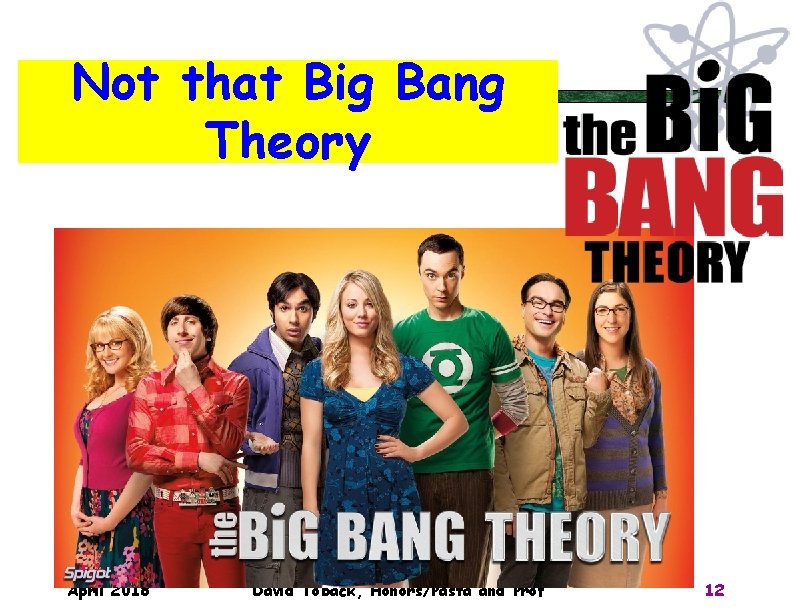
Not that Big Bang Theory April 2018 David Toback, Honors/Pasta and Prof 12
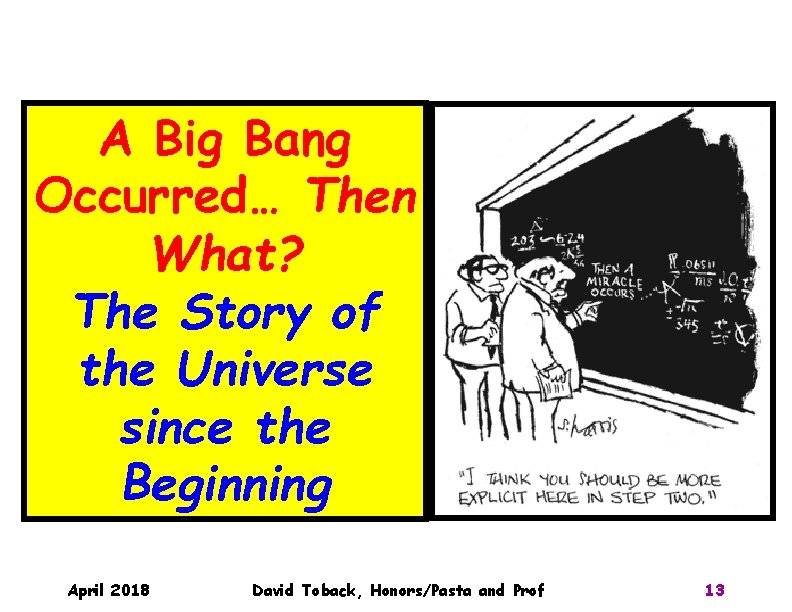
A Big Bang Occurred… Then What? The Story of the Universe since the Beginning April 2018 David Toback, Honors/Pasta and Prof 13
Observe lots of galaxies with the world’s best telescope We notice that All the far away ones are moving away from us VERY quickly April 2018 David Toback, Honors/Pasta and Prof 14
So What? All the stuff in the galaxies appears to have come from a singlehappened point in space What in the~13. 7 past? billion years ago Run the clock backward in time Name this time The Big Bang A moment of Creation April 2018 David Toback, Honors/Pasta and Prof 15
Slightly more complicated than that… • As best as we understand the Universe began with a Big Bang – A REALLY Big Bang • Then what? • How did we get from the bang to the Universe we have today? April 2018 David Toback, Honors/Pasta and Prof 16
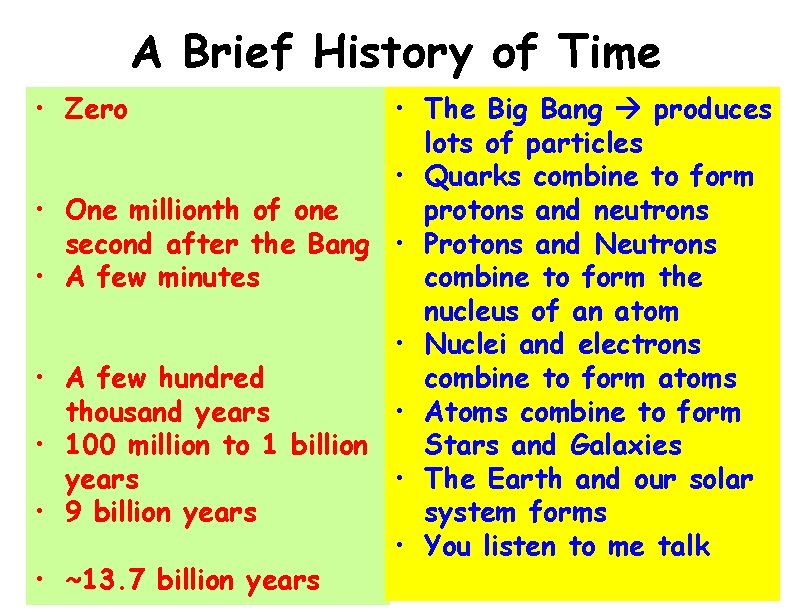
A Brief History of Time • Zero • • The Big Bang produces lots of particles • Quarks combine to form One millionth of one protons and neutrons second after the Bang • Protons and Neutrons A few minutes combine to form the nucleus of an atom • Nuclei and electrons A few hundred combine to form atoms thousand years • Atoms combine to form 100 million to 1 billion Stars and Galaxies years • The Earth and our solar 9 billion years system forms • You listen to me talk David Toback, Texas A&M University ~13. 7 billion years March 2011 17 Davidson Scholars
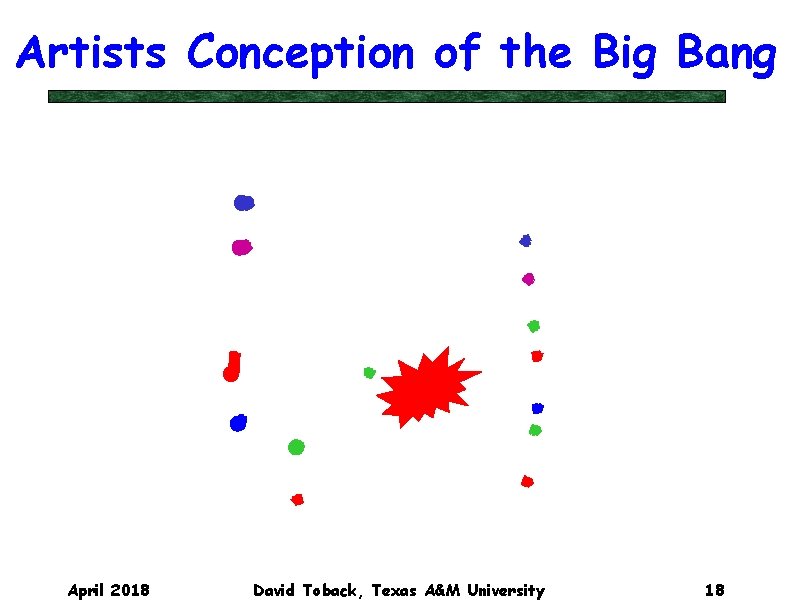
Artists Conception of the Big Bang April 2018 David Toback, Texas A&M University 18
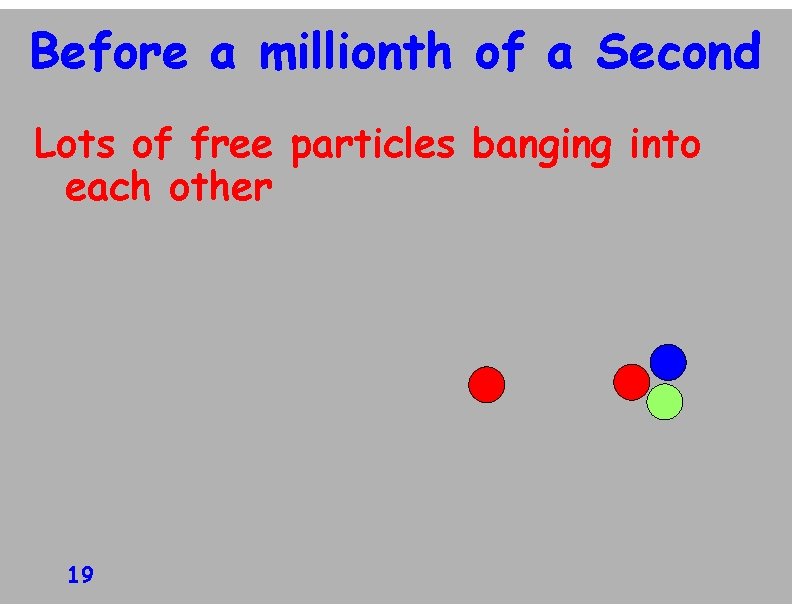
Before a millionth of a Second Lots of free particles banging into each other 19
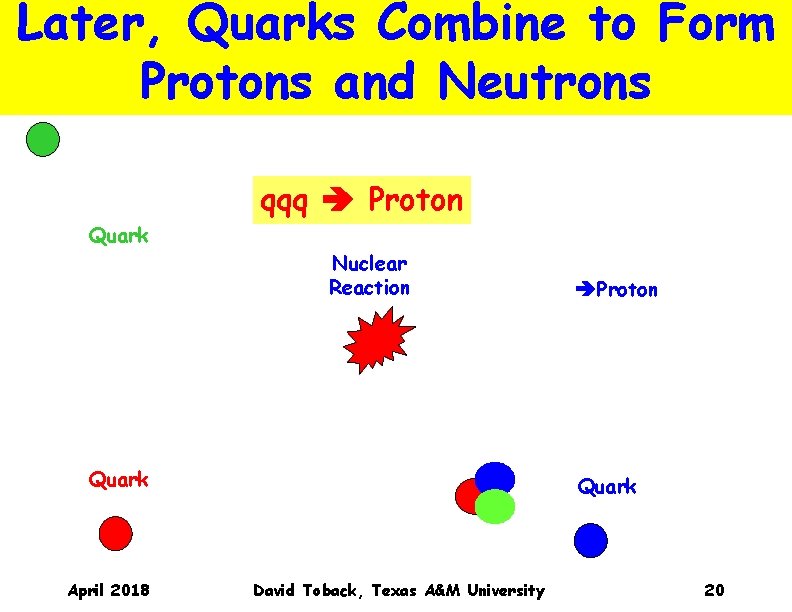
Later, Quarks Combine to Form Protons and Neutrons qqq Proton Quark Nuclear Reaction Quark April 2018 Proton Quark David Toback, Texas A&M University 20
A Millionth of a Second after the Big Bang The quarks have combined to form Protons and Neutrons 21
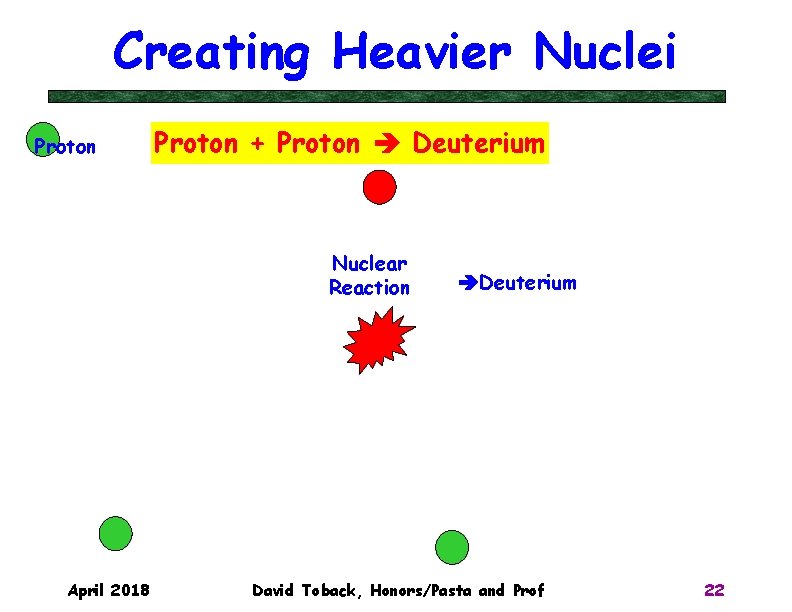
Creating Heavier Nuclei Proton + Proton Deuterium Nuclear Reaction April 2018 Deuterium David Toback, Honors/Pasta and Prof 22
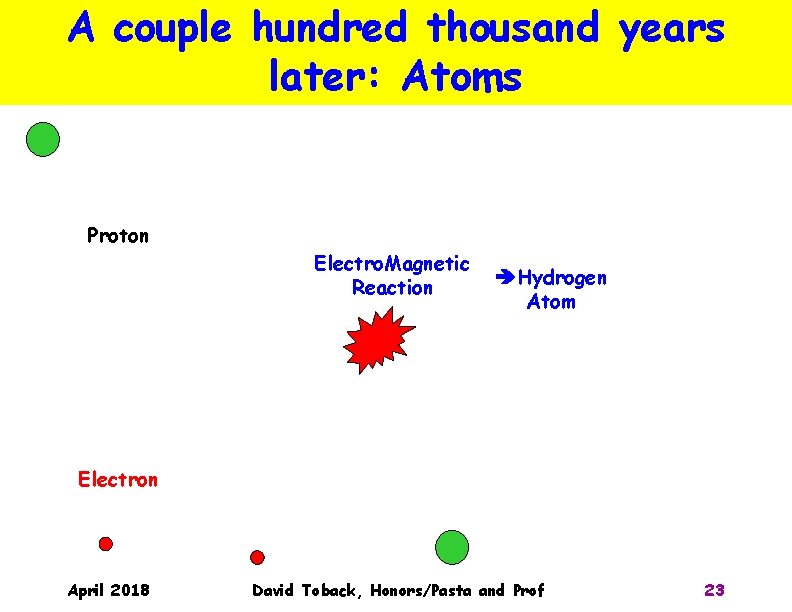
A couple hundred thousand years later: Atoms Proton Electro. Magnetic Reaction Hydrogen Atom Electron April 2018 David Toback, Honors/Pasta and Prof 23
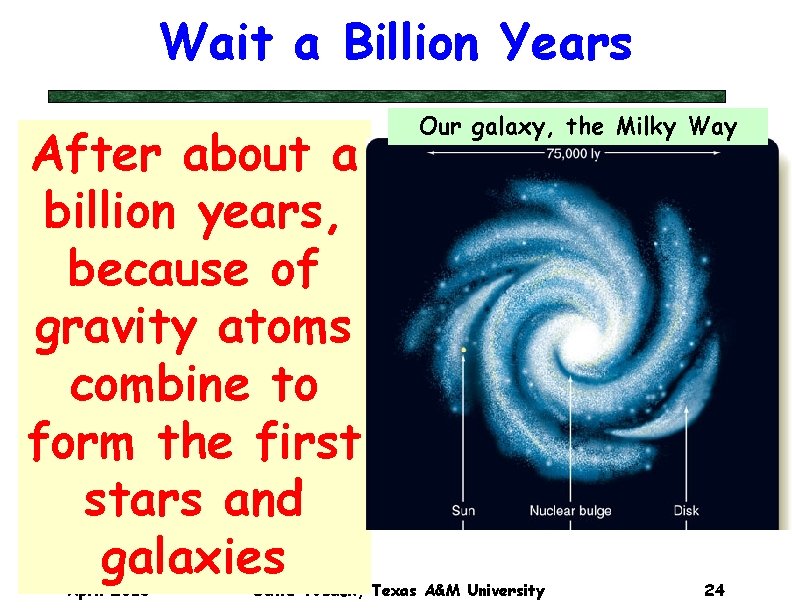
Wait a Billion Years After about a billion years, because of gravity atoms combine to form the first stars and galaxies April 2018 Our galaxy, the Milky Way David Toback, Texas A&M University 24
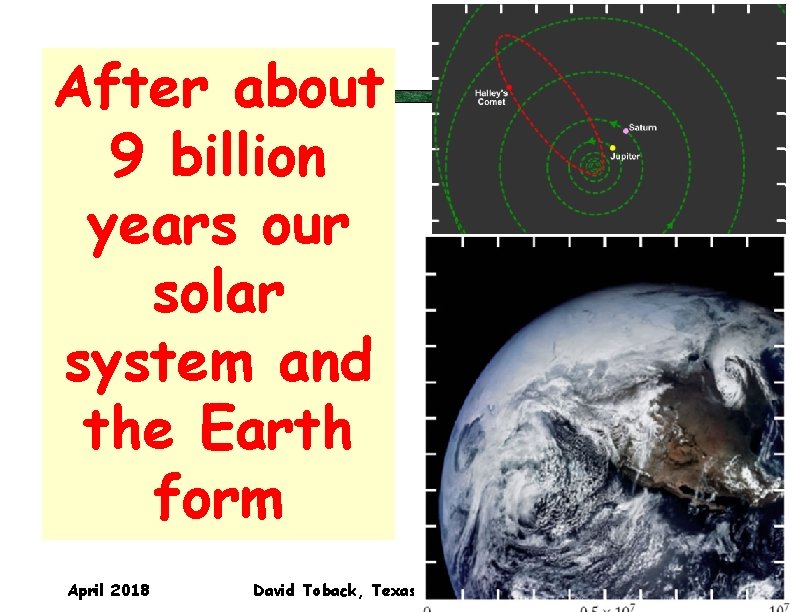
After about 9 billion years our solar system and the Earth form April 2018 David Toback, Texas A&M University 25
Recent History: Life on Earth • Earth is about 4 or 5 billion years old • Evidence that microbial tracings existed on Earth about 3. 5 billion years ago • Humanoids, like “Lucy” existed a mere 3 million years ago • Homo-sapiens at around 100, 000 years ago April 2018 David Toback, Texas A&M University 26
What does Dark Matter have to do with the Big Bang Theory? April 2018 David Toback, Honors/Pasta and Prof 27
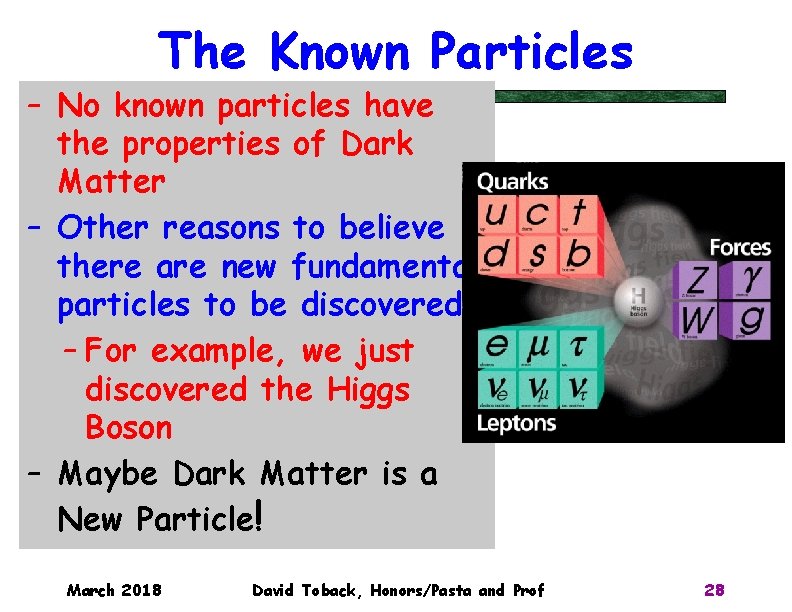
The Known Particles – No known particles have the properties of Dark Matter – Other reasons to believe there are new fundamental particles to be discovered – For example, we just discovered the Higgs Boson – Maybe Dark Matter is a New Particle! March 2018 David Toback, Honors/Pasta and Prof 28
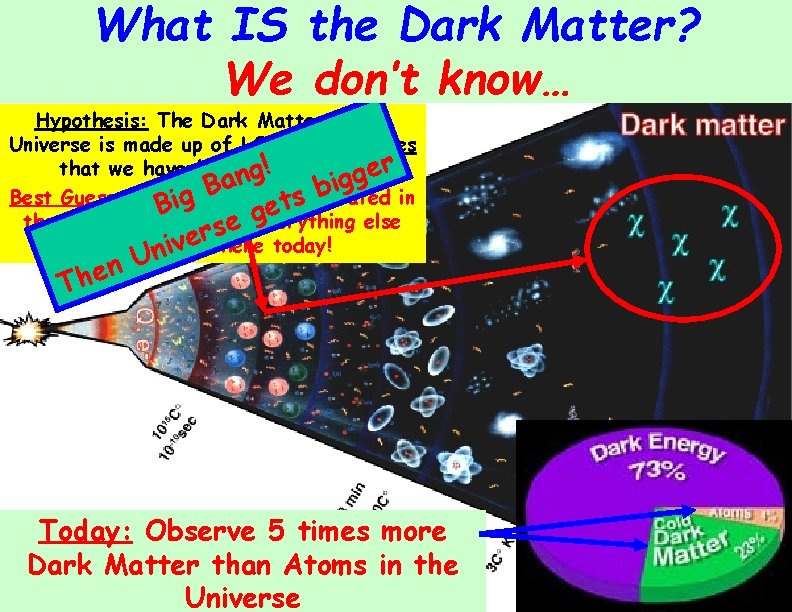
What IS the Dark Matter? We don’t know… Hypothesis: The Dark Matter in the Universe is made up of LOTS of particles r ! that we haven’t discovered yet! e g g n g a i B b Best Guess: Hugeignumbers got s created in t B e geverything else the Early Universe like e s r e v and are ni still here today! U n The Today: Observe 5 times more Dark Matter than Atoms in the April 2018 David Toback, Honors/Pasta and Prof Universe 29
What are scientists doing today to discover Dark Matter? Just mention two of the fun experiments being done here at Texas A&M! April 2018 David Toback, Honors/Pasta and Prof 30
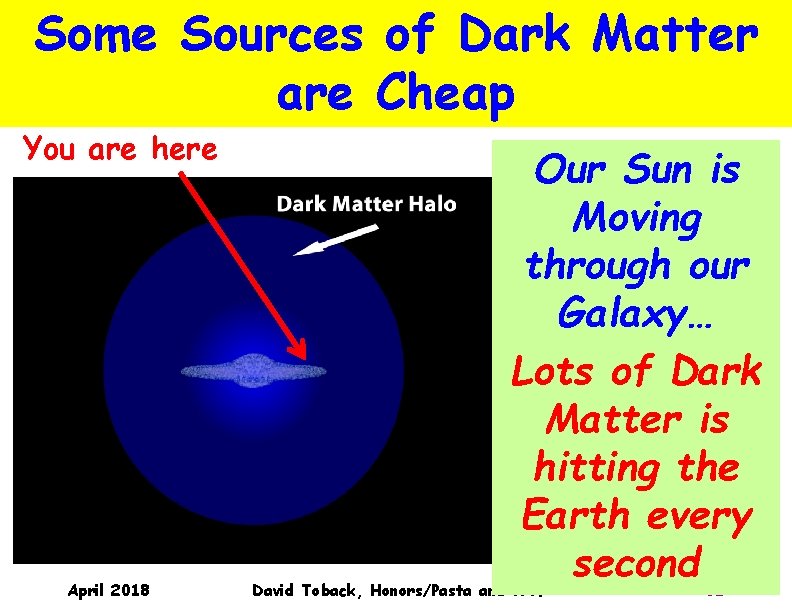
Some Sources of Dark Matter are Cheap You are here April 2018 Our Sun is Moving through our Galaxy… Lots of Dark Matter is hitting the Earth every second David Toback, Honors/Pasta and Prof 31
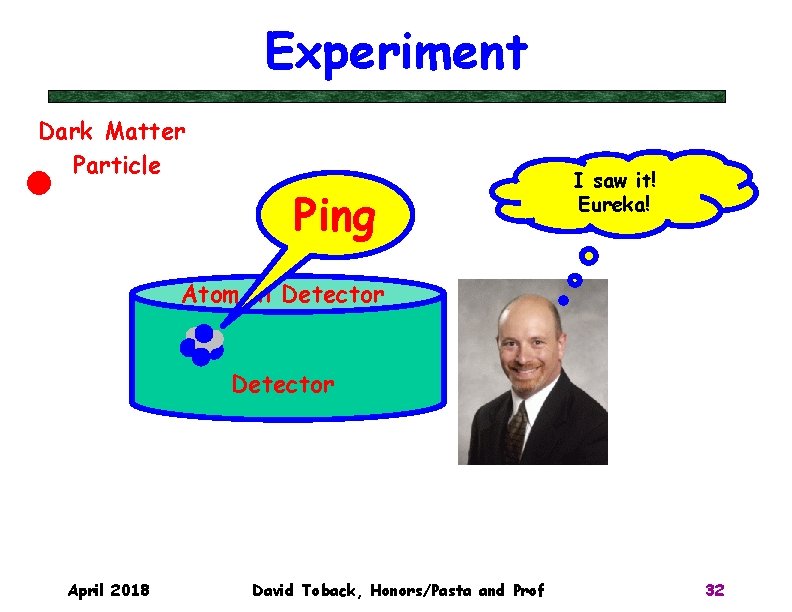
Experiment Dark Matter Particle Ping I saw it! Eureka! Atom in Detector April 2018 David Toback, Honors/Pasta and Prof 32
Can we Make and Discover Dark Matter? • High energy collisions between particles in the Early Universe • Recreate the conditions like they were RIGHT AFTER the Big Bang • If we can produce Dark Matter in a collision then we can STUDY it April 2018 David Toback, Honors/Pasta and Prof 33
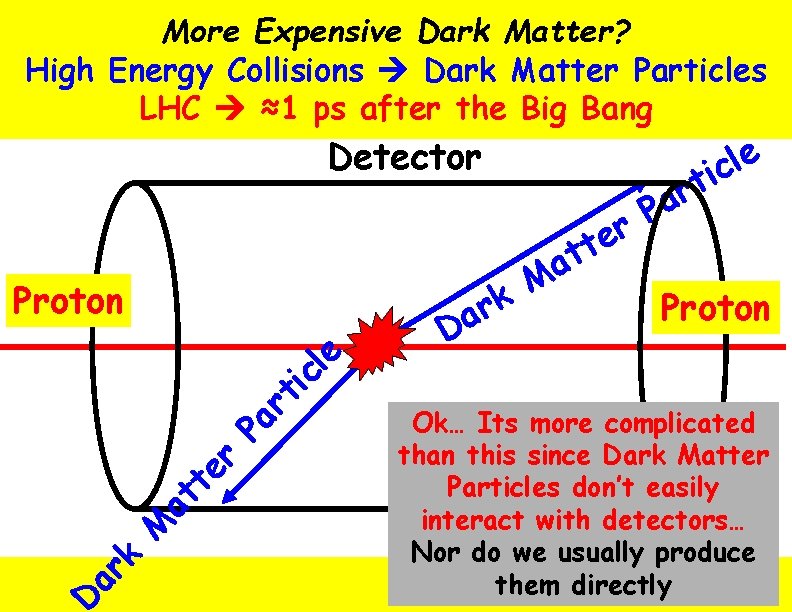
More Expensive Dark Matter? High Energy Collisions Dark Matter Particles LHC ≈1 ps after the Big Bang Detector k r a ti cl e Proton r a P Proton Ok… Its more complicated than this since Dark Matter Particles don’t easily interact with detectors… Nor do we usually produce David Toback, Texas A&M University 34 Research Topics Seminarthem directly Pa r er at t M k ar October 2011 D a M r e tt e l tic
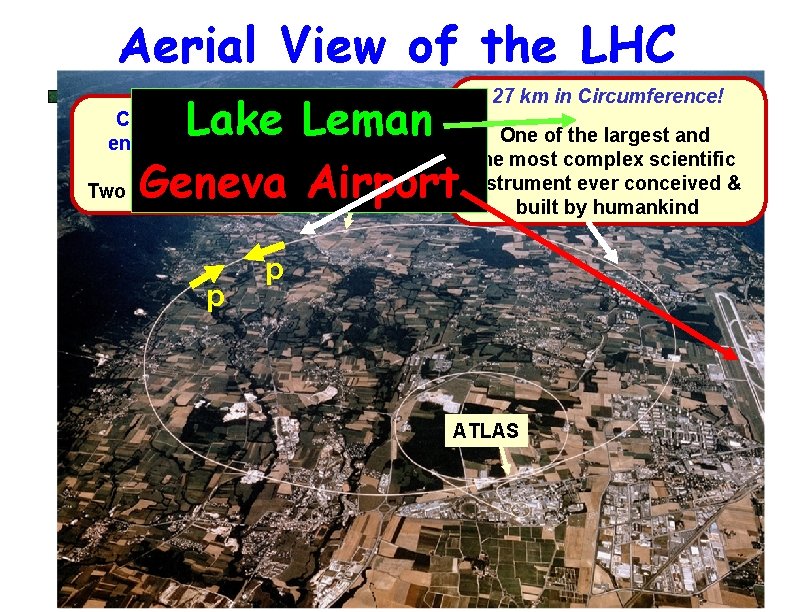
Aerial View of the LHC 27 km in Circumference! Lake Leman One of the largest and the most complex scientific CMS instrument ever conceived & Geneva Airport Two huge detectors built by humankind Collides high energy protons p p ATLAS April 2018 David Toback, Texas A&M University 35
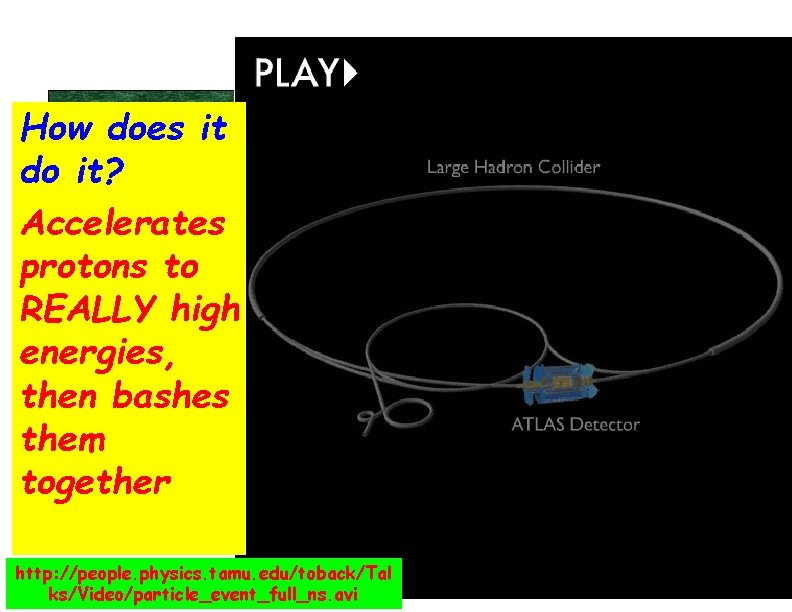
How does it do it? Accelerates protons to REALLY high energies, then bashes them together http: //people. physics. tamu. edu/toback/Tal April 2018 David Toback, Honors/Pasta and Prof ks/Video/particle_event_full_ns. avi 36
Final Thoughts April 2018 David Toback, Honors/Pasta and Prof 37
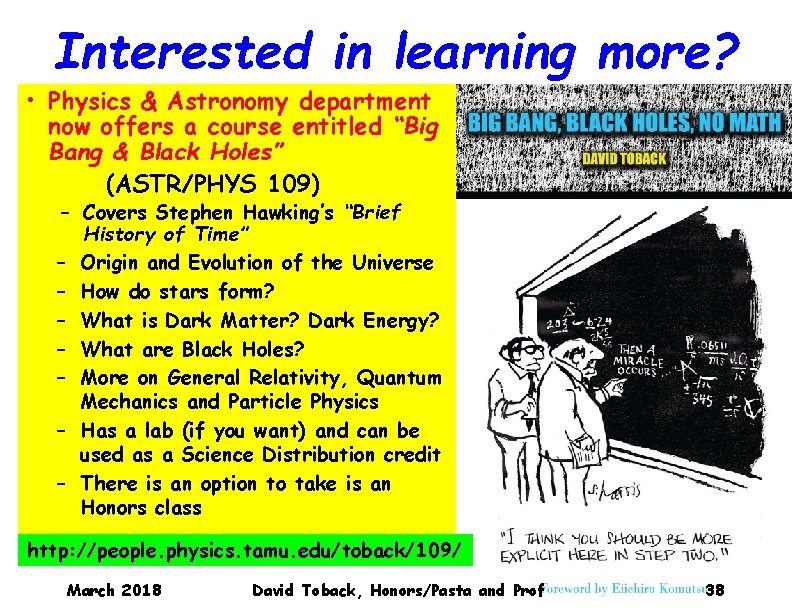
Interested in learning more? • Physics & Astronomy department now offers a course entitled “Big Bang & Black Holes” (ASTR/PHYS 109) – Covers Stephen Hawking’s “Brief History of Time” – Origin and Evolution of the Universe – How do stars form? – What is Dark Matter? Dark Energy? – What are Black Holes? – More on General Relativity, Quantum Mechanics and Particle Physics – Has a lab (if you want) and can be used as a Science Distribution credit – There is an option to take is an Honors class http: //people. physics. tamu. edu/toback/109/ March 2018 David Toback, Honors/Pasta and Prof 38
Conclusions • It’s an incredibly exciting time to be a scientist! • Astronomy, Cosmology and Particle Physics are all coming together! • Starting to understand the role of Dark Matter in the Universe since the Big Bang! • If our understanding is correct, a major discovery may be just around the corner! Wanna join us? We need your help! April 2018 David Toback, Honors/Pasta and Prof 39
April 2018 David Toback, Honors/Pasta and Prof 40