
densityofstates Kurt Langfeld Liverpool University Lattice 2016 conference
![The LLR approach to the density-of-states: calculate instead the slope [of log ] a(E)](https://slidetodoc.com/presentation_image/b42324945dff30bf915c47e118b98040/image-5.jpg "The LLR approach to the density-of-states: calculate instead the slope [of log ] a(E)")
![Window function: Needs to be symmetric around E Historically [Wang-Landau] Also: main advantage: can](https://slidetodoc.com/presentation_image/b42324945dff30bf915c47e118b98040/image-7.jpg "Window function: Needs to be symmetric around E Historically [Wang-Landau] Also: main advantage: can")
![howcase: SU(2) and SU(3) Yang-Mills theory [from Gatringer, Langfeld, ar. Xiv: 1603. 09517] Gaussian](https://slidetodoc.com/presentation_image/b42324945dff30bf915c47e118b98040/image-11.jpg "howcase: SU(2) and SU(3) Yang-Mills theory [from Gatringer, Langfeld, ar. Xiv: 1603. 09517] Gaussian")
![Early objection: [2012] Ergodicity could be an issue…. (we confine configurations to action intervals)](https://slidetodoc.com/presentation_image/b42324945dff30bf915c47e118b98040/image-14.jpg "Early objection: [2012] Ergodicity could be an issue…. (we confine configurations to action intervals)")
![Showcase: q-state Potts model in 2 d [LLR result] Exact solution: R. J. Baxter,](https://slidetodoc.com/presentation_image/b42324945dff30bf915c47e118b98040/image-16.jpg "Showcase: q-state Potts model in 2 d [LLR result] Exact solution: R. J. Baxter,")
![Showcase: q-state Potts model in 2 d [q=20, L=64]](https://slidetodoc.com/presentation_image/b42324945dff30bf915c47e118b98040/image-19.jpg "Showcase: q-state Potts model in 2 d [q=20, L=64]")
![Towards: latent heat specific heats order-disorder interface tension for cross-over! : [KL in preparation]](https://slidetodoc.com/presentation_image/b42324945dff30bf915c47e118b98040/image-22.jpg "Towards: latent heat specific heats order-disorder interface tension for cross-over! : [KL in preparation]")
![Works very well! [Garron, Langfeld, ar. Xiv: 1605. 02709]](https://slidetodoc.com/presentation_image/b42324945dff30bf915c47e118b98040/image-30.jpg "Works very well! [Garron, Langfeld, ar. Xiv: 1605. 02709]")
![Extended cumulant approach: [analysis by N Garron]](https://slidetodoc.com/presentation_image/b42324945dff30bf915c47e118b98040/image-34.jpg "Extended cumulant approach: [analysis by N Garron]")
![Outlook: [immediate LLR projects very likely to succeed] [Lucini, talk! KL] interface tensions in](https://slidetodoc.com/presentation_image/b42324945dff30bf915c47e118b98040/image-37.jpg "Outlook: [immediate LLR projects very likely to succeed] [Lucini, talk! KL] interface tensions in")
- Slides: 37
density-of-states Kurt Langfeld (Liverpool University) Lattice 2016 conference, Southhampton, 24 -30 July 2016
Developments What is the density-of-states method and what is LLR? Theoretical & Algorithmic developments [ergodicity, exponential error suppression] Can we simulate slush? Applications Towards the SU(3) latent heat Finite density QFT The HDQCD showcase What can we learn for other approaches [cumulant, canonical simulations? ]
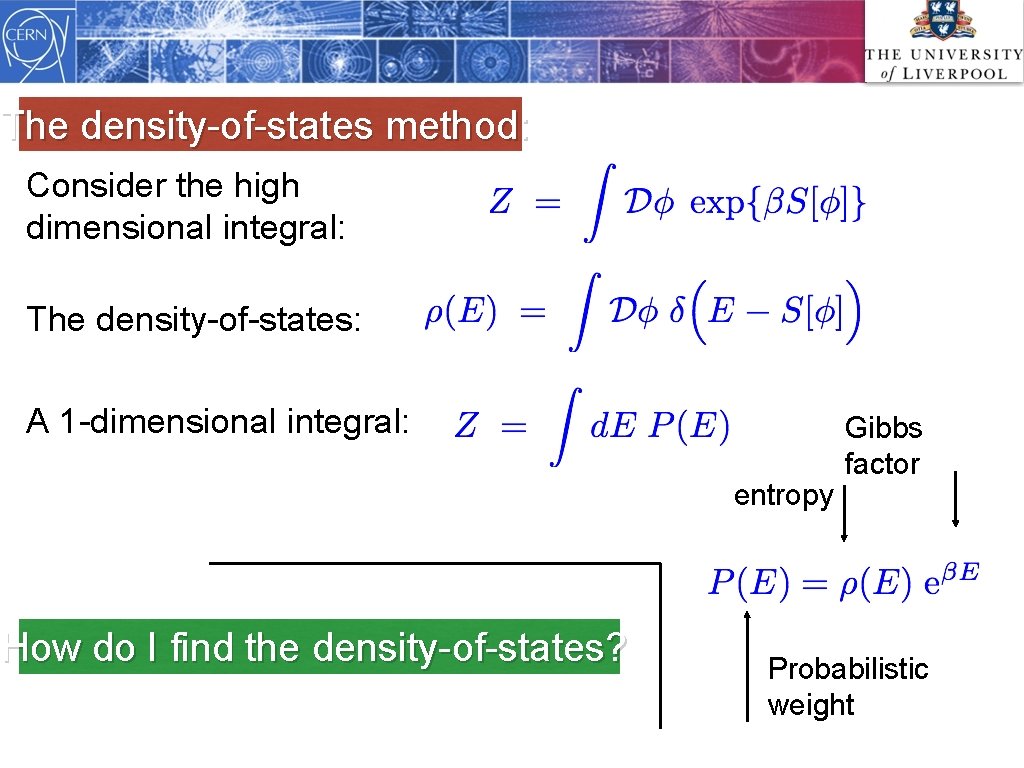
The density-of-states method: Consider the high dimensional integral: The density-of-states: A 1 -dimensional integral: entropy How do I find the density-of-states? Gibbs factor Probabilistic weight
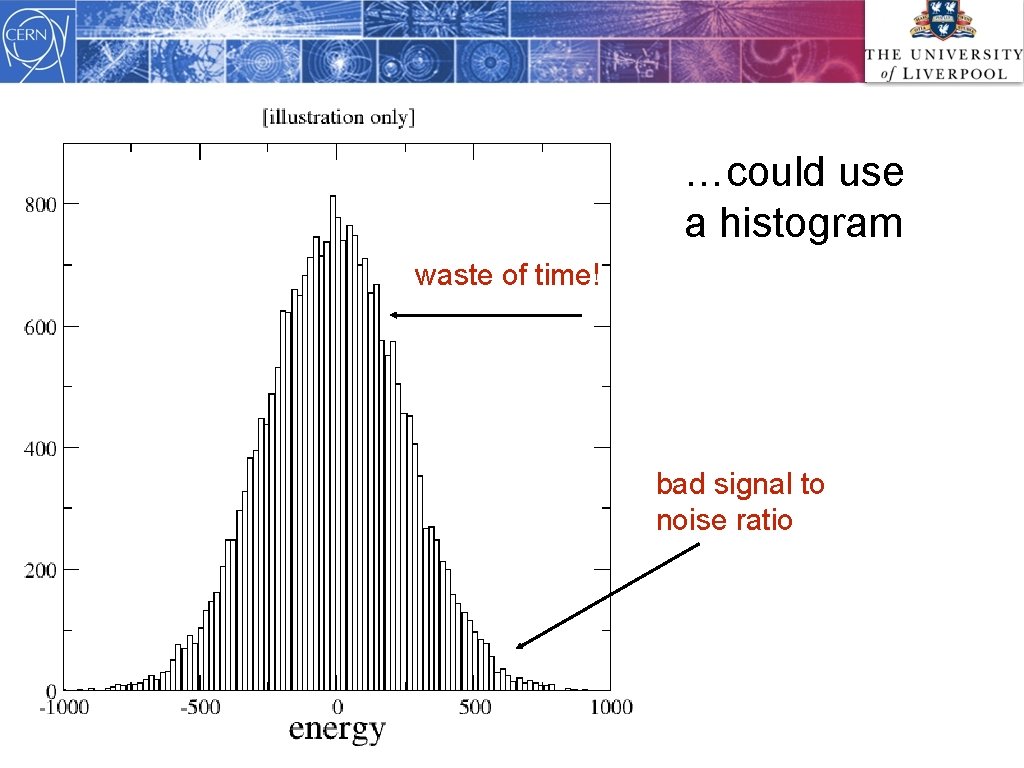
…could use a histogram waste of time! bad signal to noise ratio
The LLR approach to the density-of-states: calculate instead the slope [of log ] a(E) at any point E reconstruct [Langfeld, Lucini, Rago, PRL 109 (2012) 111601]
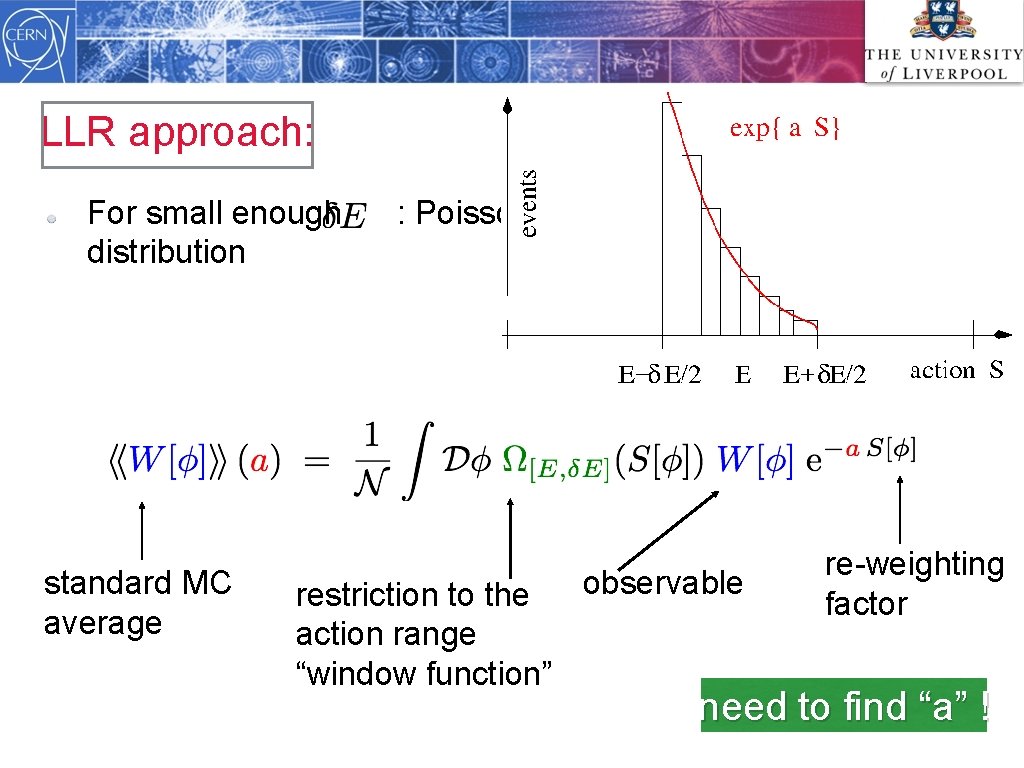
LLR approach: For small enough distribution standard MC average : Poisson observable restriction to the action range “window function” re-weighting factor need to find “a” !
Window function: Needs to be symmetric around E Historically [Wang-Landau] Also: main advantage: can be used in HMC and LHMC algorithms to calculate [see SU(3) latent heat; this talk] [see also talk by R Pellegrini: Tuesday, Alg
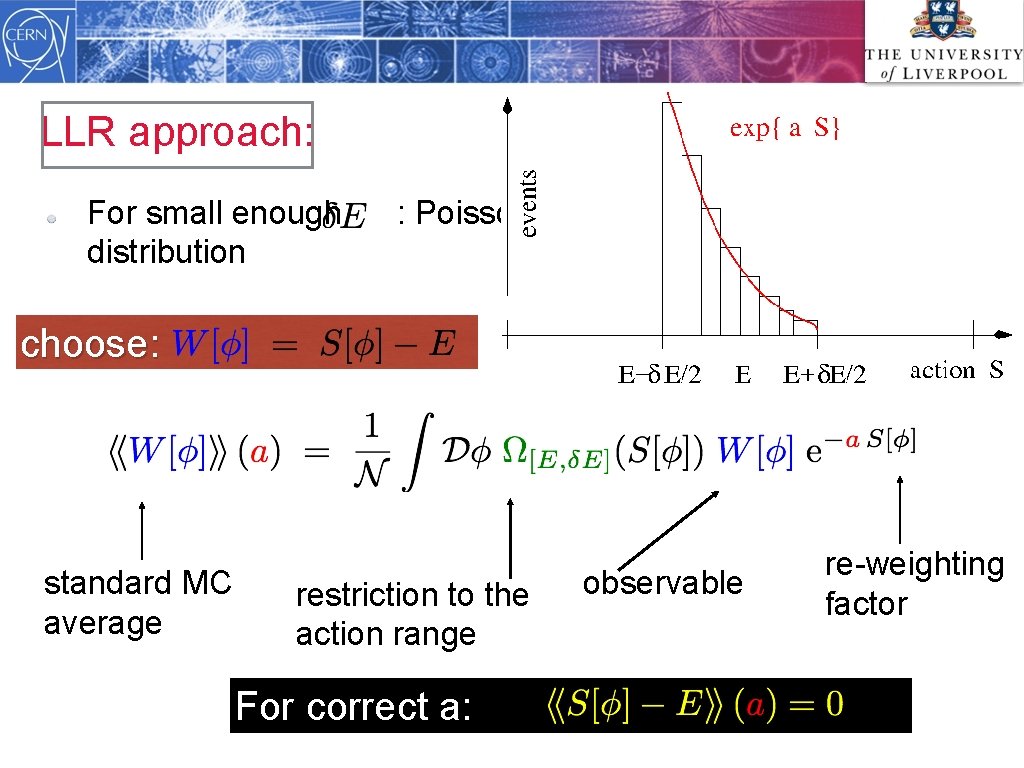
LLR approach: For small enough distribution : Poisson choose: standard MC average restriction to the action range For correct a: observable re-weighting factor
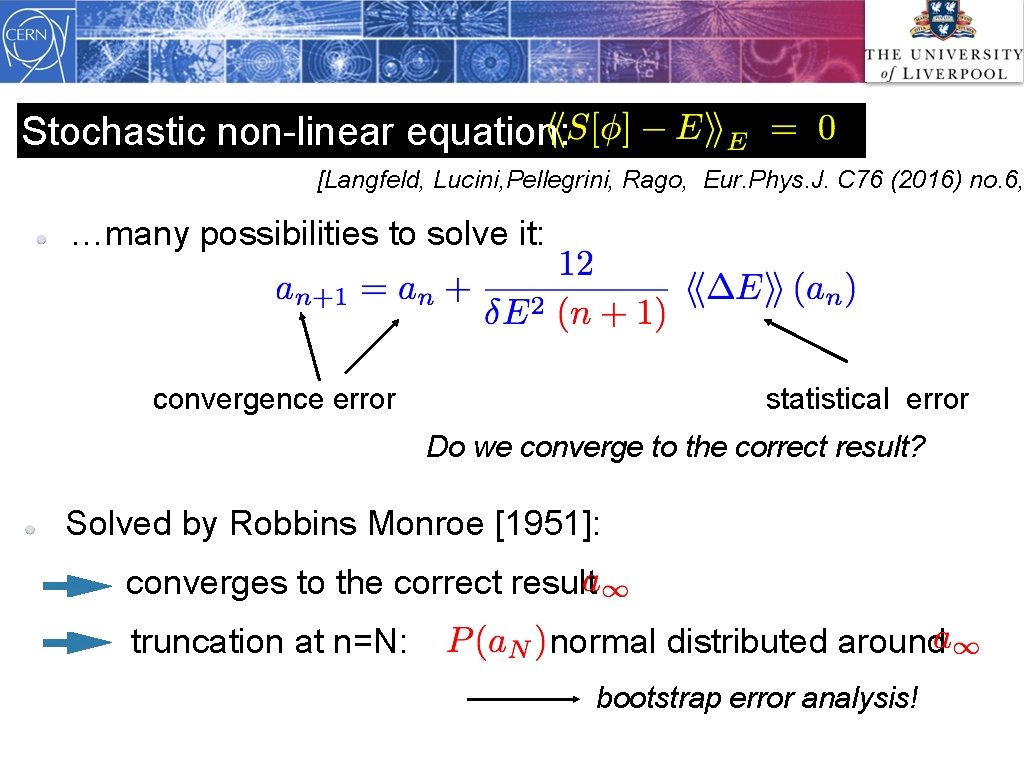
Stochastic non-linear equation: [Langfeld, Lucini, Pellegrini, Rago, Eur. Phys. J. C 76 (2016) no. 6, …many possibilities to solve it: convergence error statistical error Do we converge to the correct result? Solved by Robbins Monroe [1951]: converges to the correct result truncation at n=N: normal distributed around bootstrap error analysis!
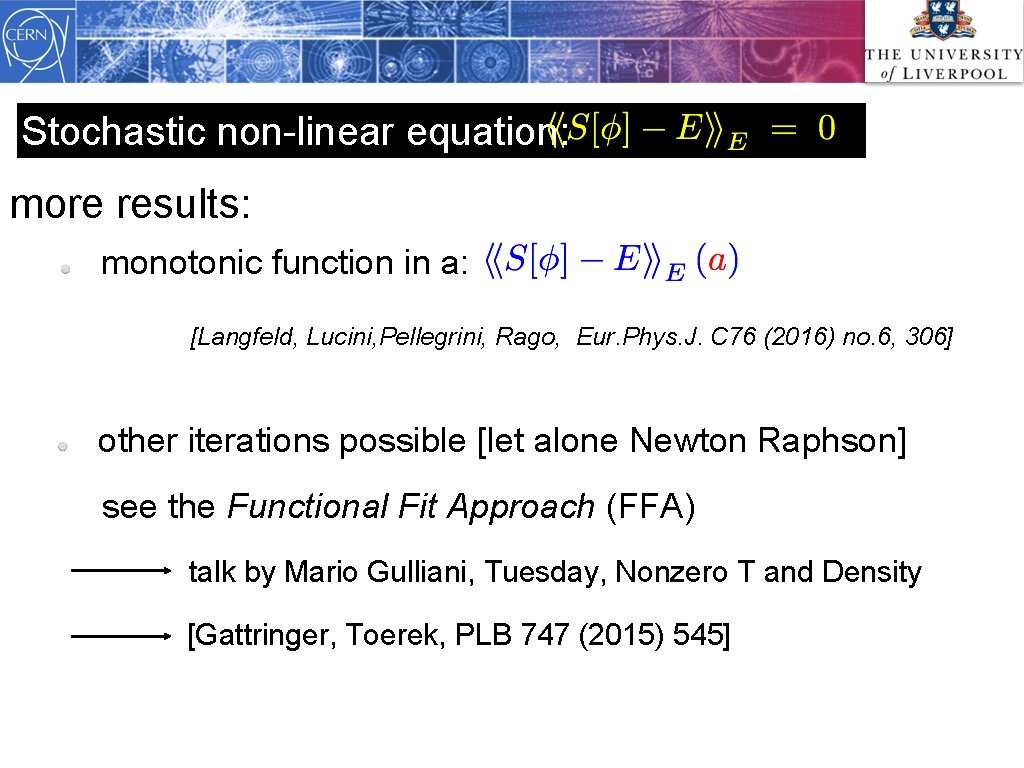
Stochastic non-linear equation: more results: monotonic function in a: [Langfeld, Lucini, Pellegrini, Rago, Eur. Phys. J. C 76 (2016) no. 6, 306] other iterations possible [let alone Newton Raphson] see the Functional Fit Approach (FFA) talk by Mario Gulliani, Tuesday, Nonzero T and Density [Gattringer, Toerek, PLB 747 (2015) 545]
howcase: SU(2) and SU(3) Yang-Mills theory [from Gatringer, Langfeld, ar. Xiv: 1603. 09517] Gaussian Window function LHMC update 20 bootstrap samples
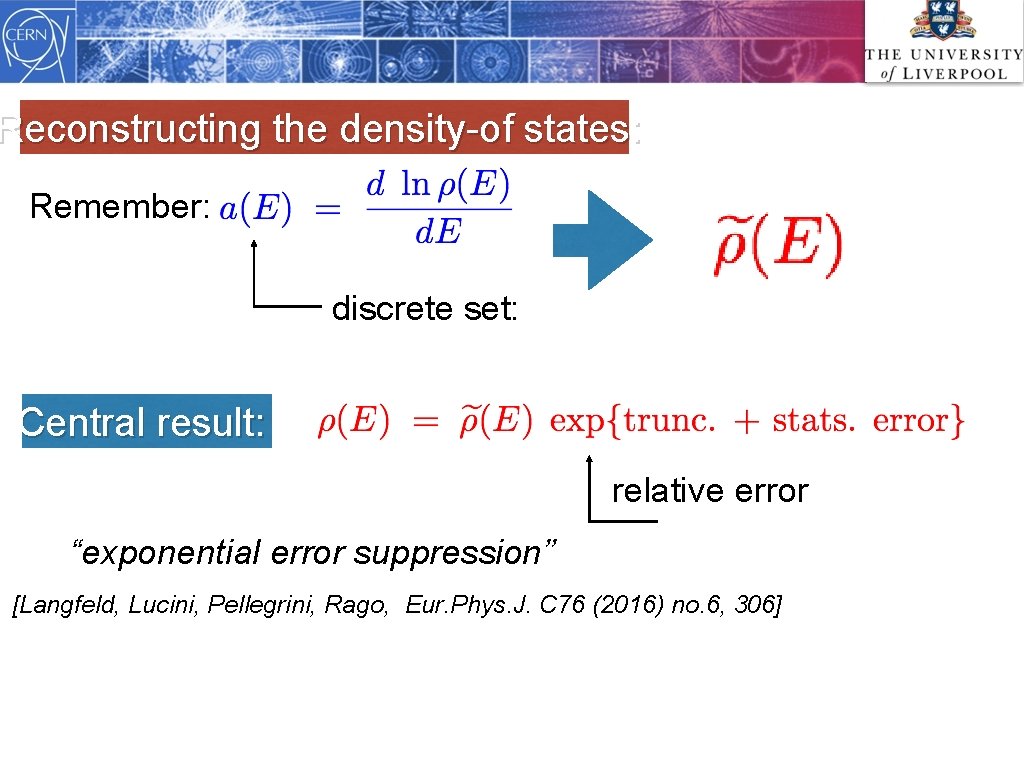
Reconstructing the density-of states: Remember: discrete set: Central result: relative error “exponential error suppression” [Langfeld, Lucini, Pellegrini, Rago, Eur. Phys. J. C 76 (2016) no. 6, 306]
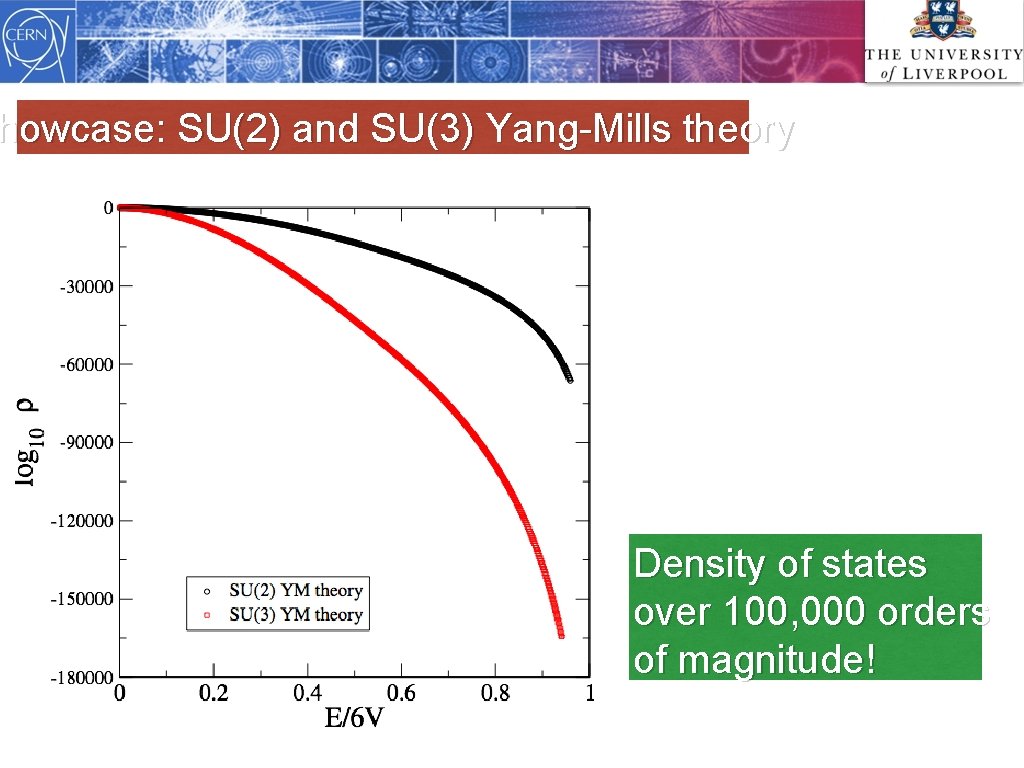
howcase: SU(2) and SU(3) Yang-Mills theory Density of states over 100, 000 orders of magnitude!
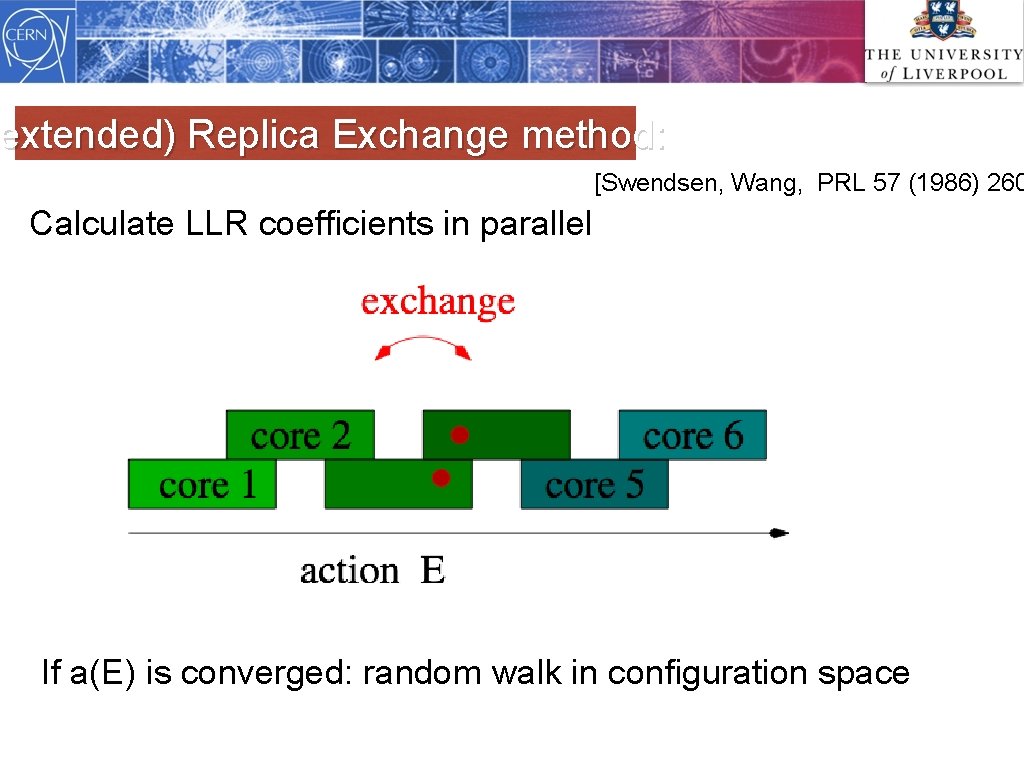
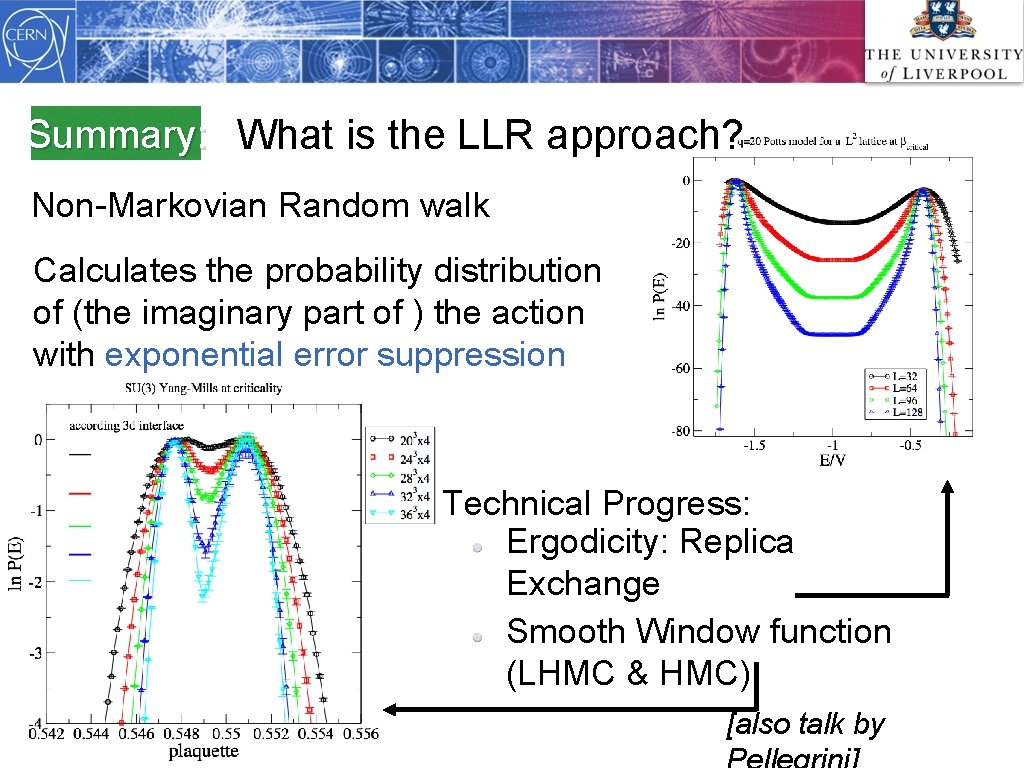
Early objection: [2012] Ergodicity could be an issue…. (we confine configurations to action intervals) use (extended) replica exchange method proposed in [Langfeld, Lucini, Pellegrini, Rago, Eur. Phys. J. C 76 (2016) no. 6, 30 we studied the issue in the Potts model [see talk by B Lucini, Tuesday, 17: 50, Algorithms]
extended) Replica Exchange method: (extended) [Swendsen, Wang, PRL 57 (1986) 260 Calculate LLR coefficients in parallel If a(E) is converged: random walk in configuration space
Showcase: q-state Potts model in 2 d [LLR result] Exact solution: R. J. Baxter, J. Phys. C 6 (1973) L 445 First MC q=20 simulation: interface tension Multi-canonical approach [Berg, Neuhaus, PRL 68 (1992) 9] [Billoire, Neuhaus, Berg, NPB (1994) 795]
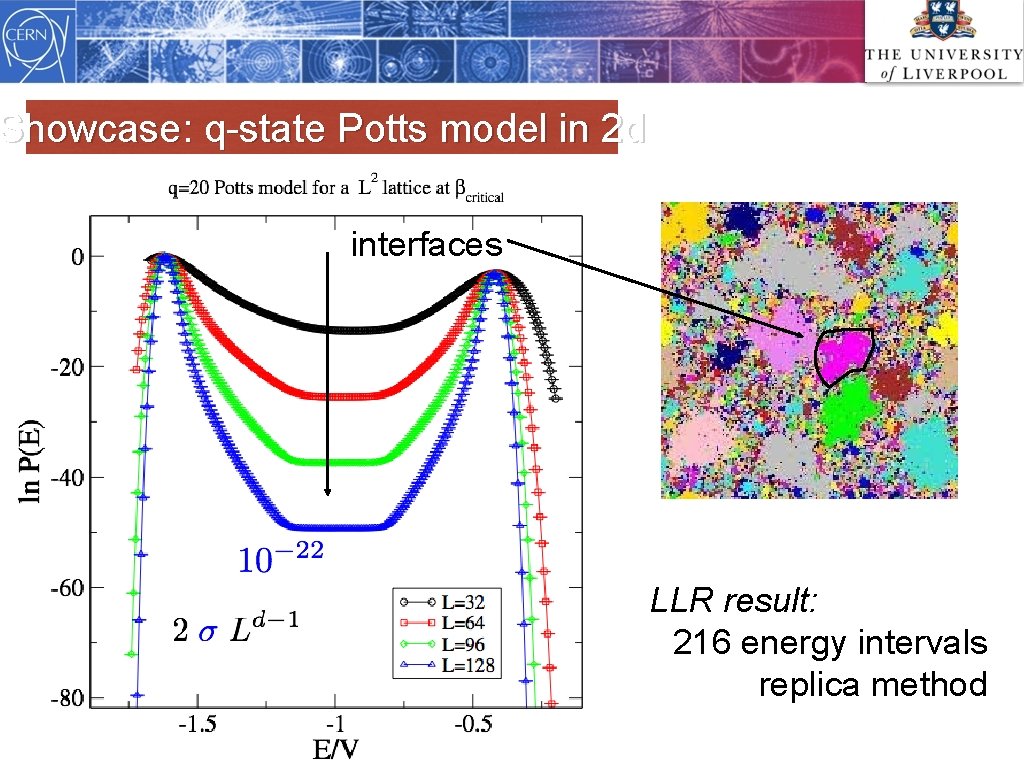
Showcase: q-state Potts model in 2 d interfaces LLR result: 216 energy intervals replica method
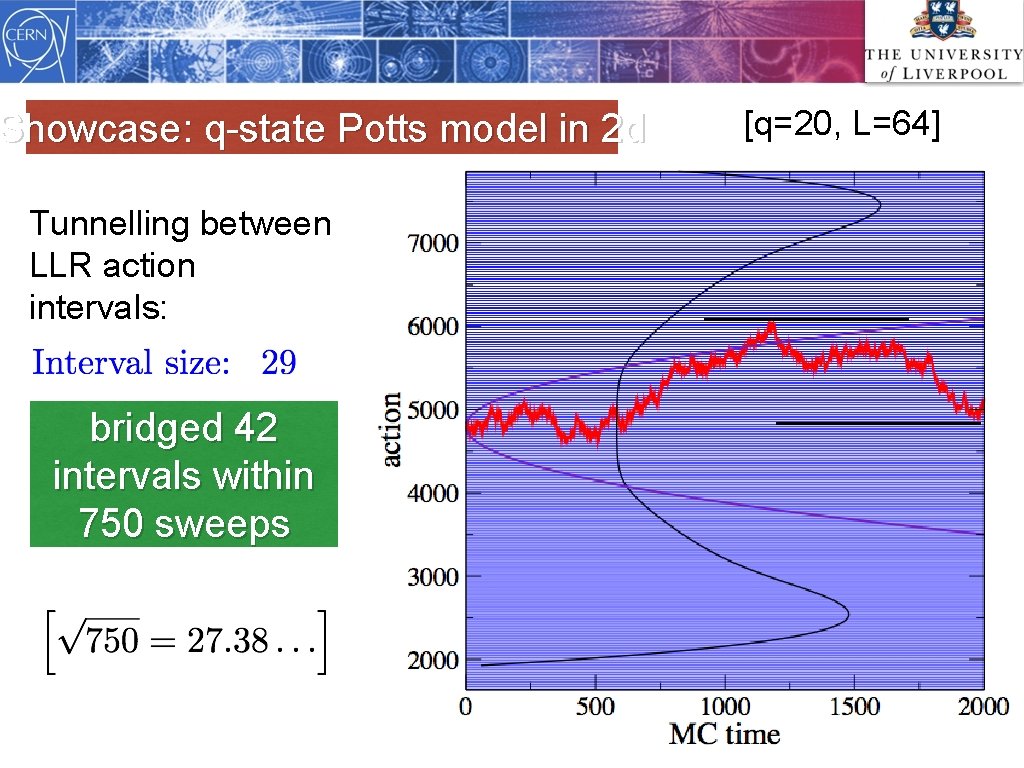
Showcase: q-state Potts model in 2 d Tunnelling between LLR action intervals: bridged 42 intervals within 750 sweeps [q=20, L=64]
Showcase: q-state Potts model in 2 d [q=20, L=64]
Enough theory. We want to see results! Applications
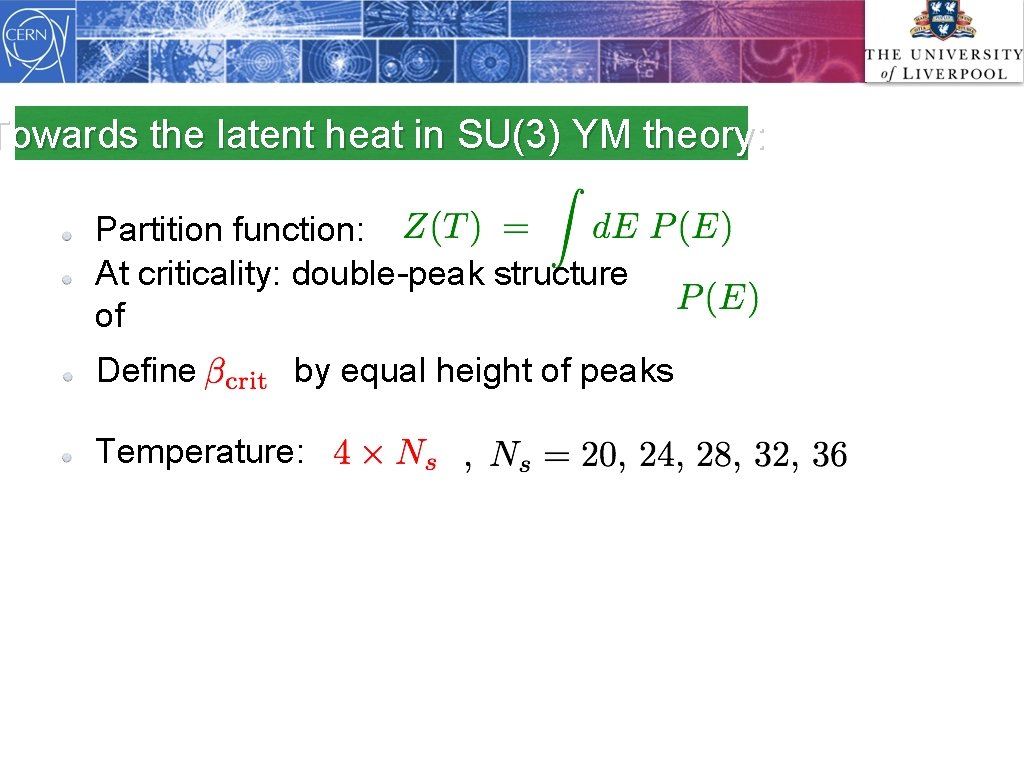
Towards the latent heat in SU(3) YM theory: Partition function: At criticality: double-peak structure of Define by equal height of peaks Temperature:
Towards: latent heat specific heats order-disorder interface tension for cross-over! : [KL in preparation]
Applications What can the LLR approach do for QFT at finite densities?
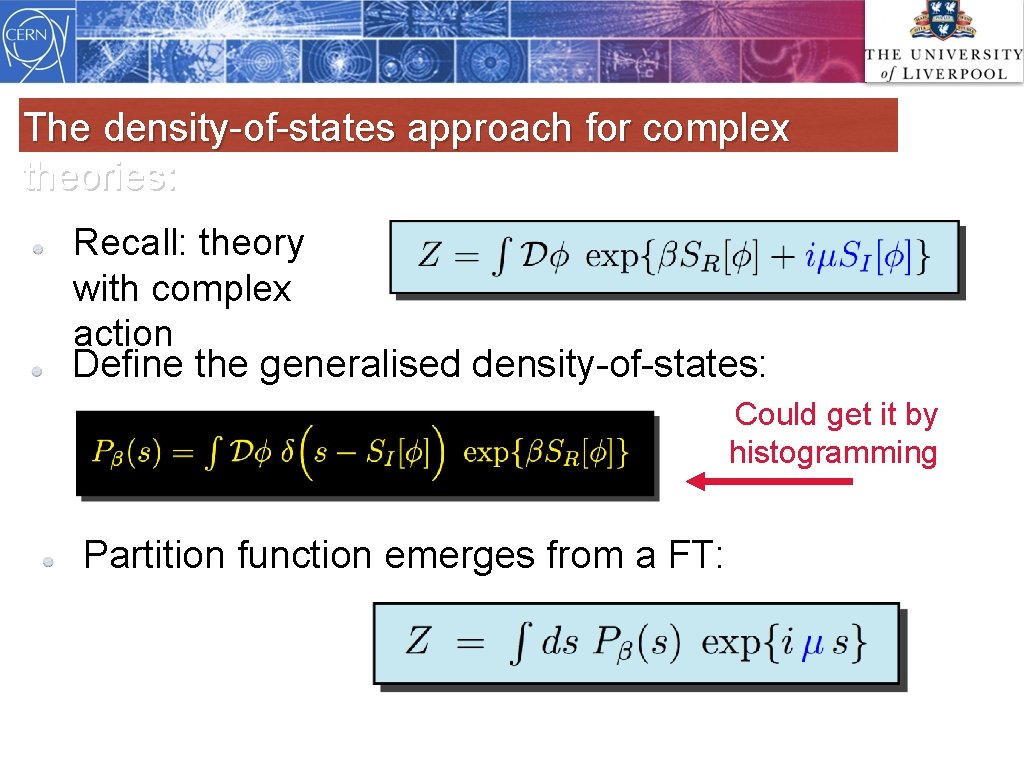
The density-of-states approach for complex theories: Recall: theory with complex action Define the generalised density-of-states: Could get it by histogramming Partition function emerges from a FT:
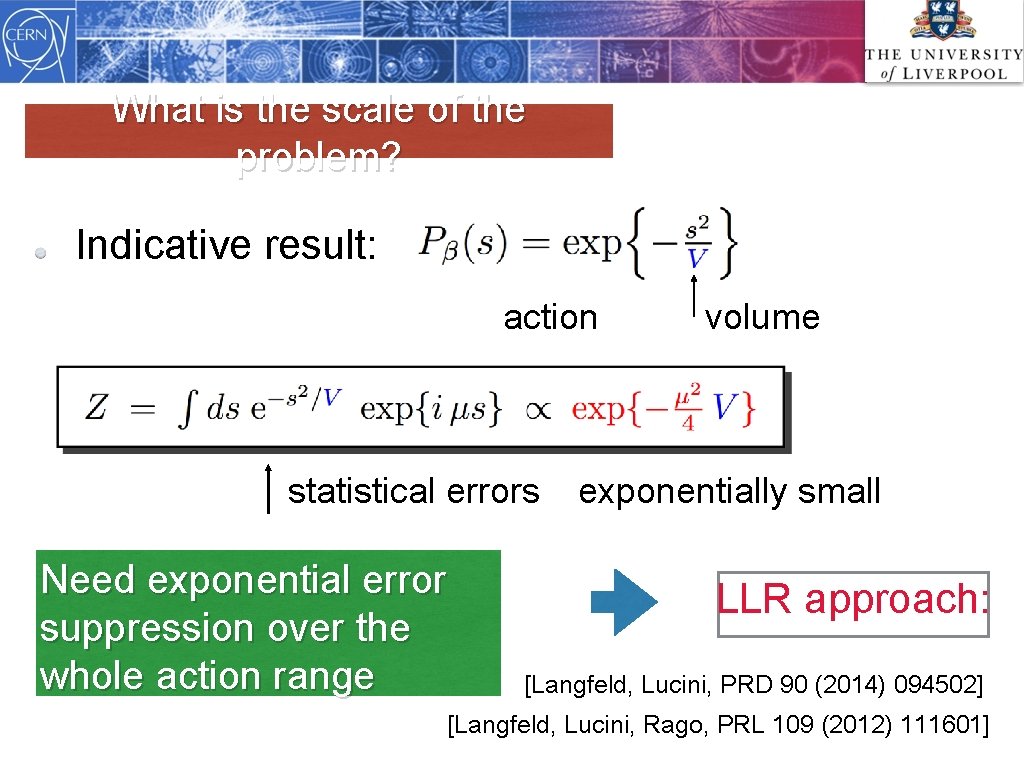
What is the scale of the problem? Indicative result: action statistical errors Need exponential error suppression over the whole action range volume exponentially small LLR approach: [Langfeld, Lucini, PRD 90 (2014) 094502] [Langfeld, Lucini, Rago, PRL 109 (2012) 111601]
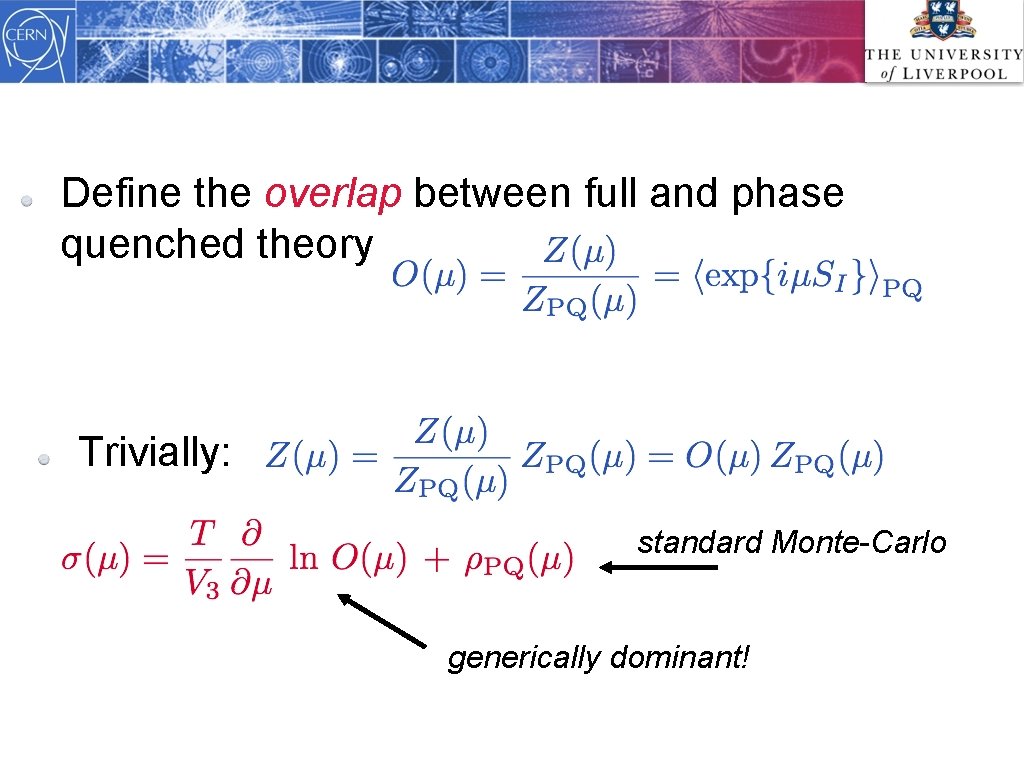
Define the overlap between full and phase quenched theory Trivially: standard Monte-Carlo generically dominant!
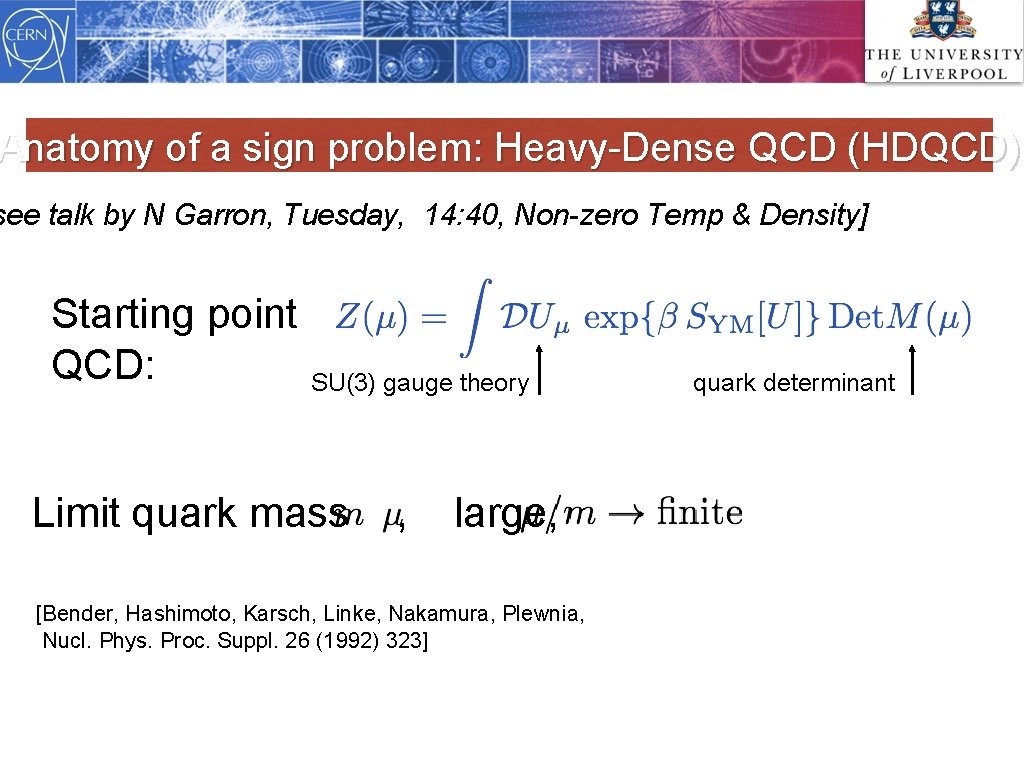
Anatomy of a sign problem: Heavy-Dense QCD (HDQCD) see talk by N Garron, Tuesday, 14: 40, Non-zero Temp & Density] Starting point QCD: SU(3) gauge theory Limit quark mass , large, [Bender, Hashimoto, Karsch, Linke, Nakamura, Plewnia, Nucl. Phys. Proc. Suppl. 26 (1992) 323] quark determinant
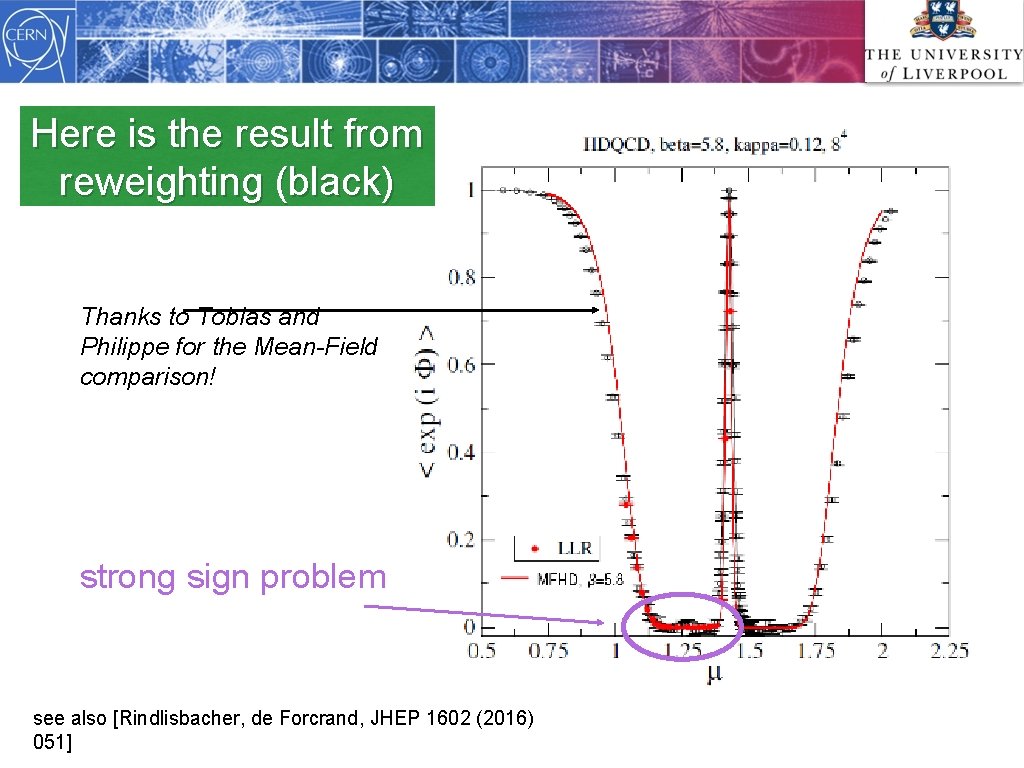
Here is the result from reweighting (black) Thanks to Tobias and Philippe for the Mean-Field comparison! strong sign problem see also [Rindlisbacher, de Forcrand, JHEP 1602 (2016) 051]
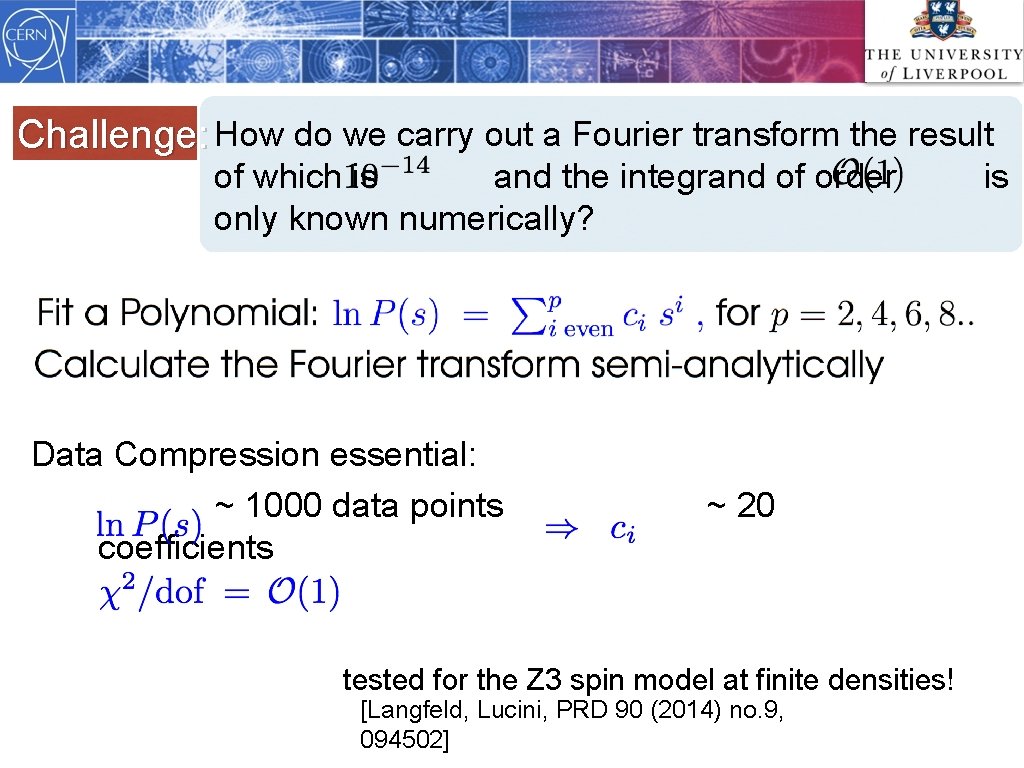
Challenge: How do we carry out a Fourier transform the result of which is and the integrand of order only known numerically? Data Compression essential: ~ 1000 data points coefficients ~ 20 tested for the Z 3 spin model at finite densities! [Langfeld, Lucini, PRD 90 (2014) no. 9, 094502] is
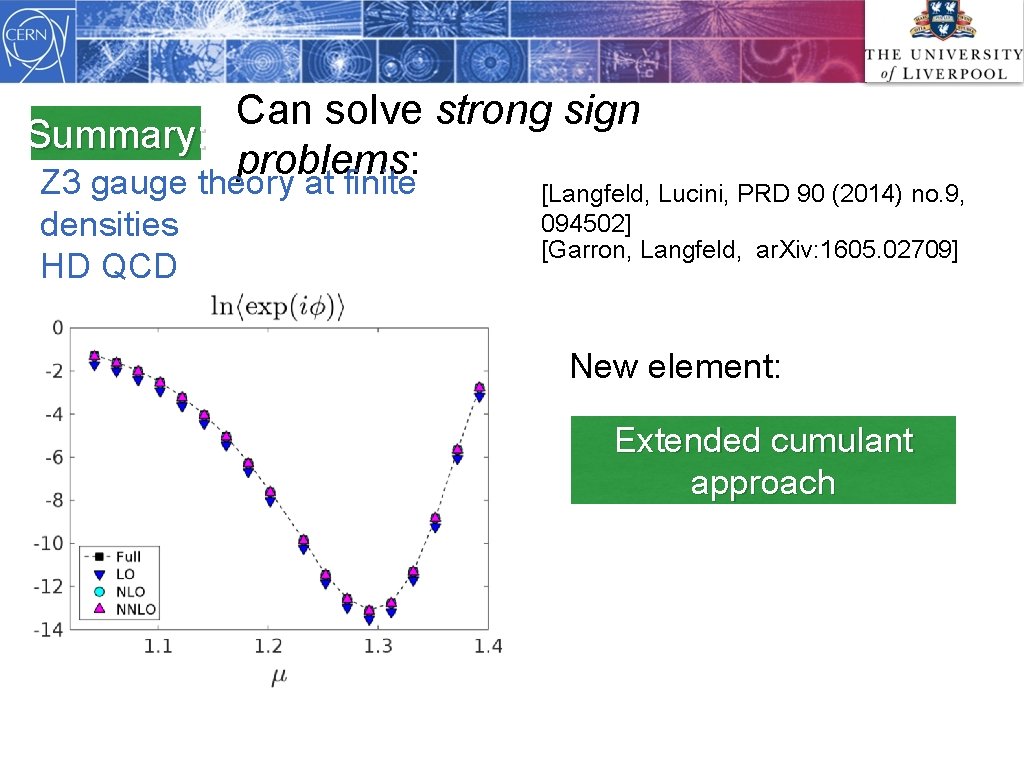
Works very well! [Garron, Langfeld, ar. Xiv: 1605. 02709]
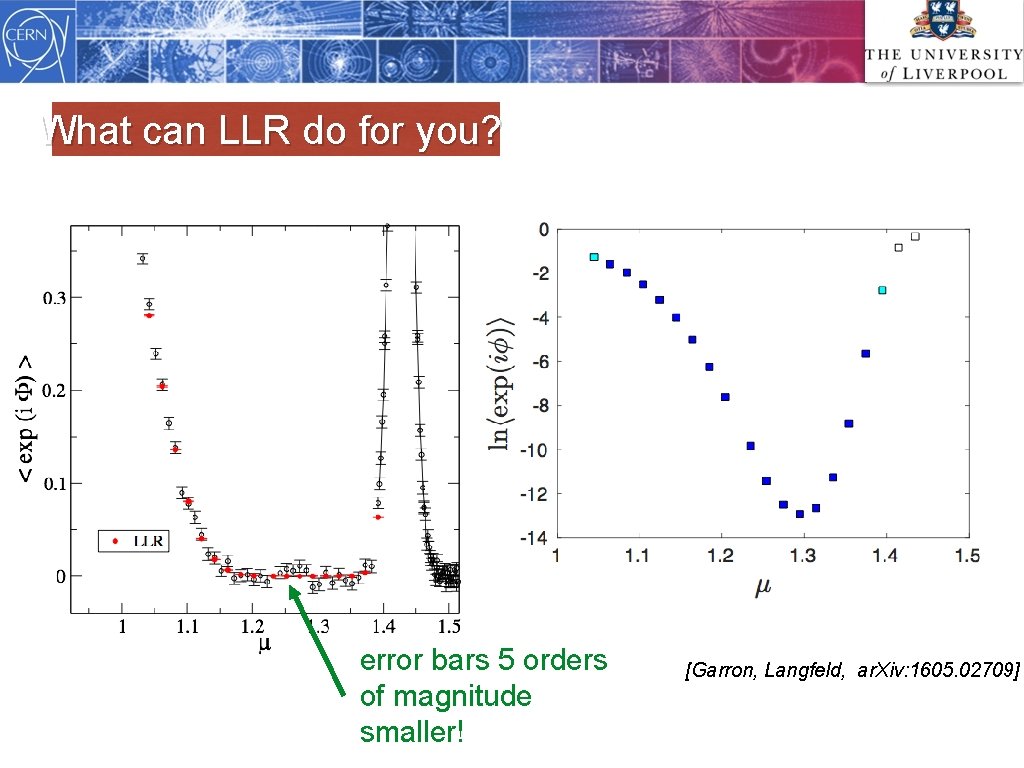
What can LLR do for you? error bars 5 orders of magnitude smaller! [Garron, Langfeld, ar. Xiv: 1605. 02709]
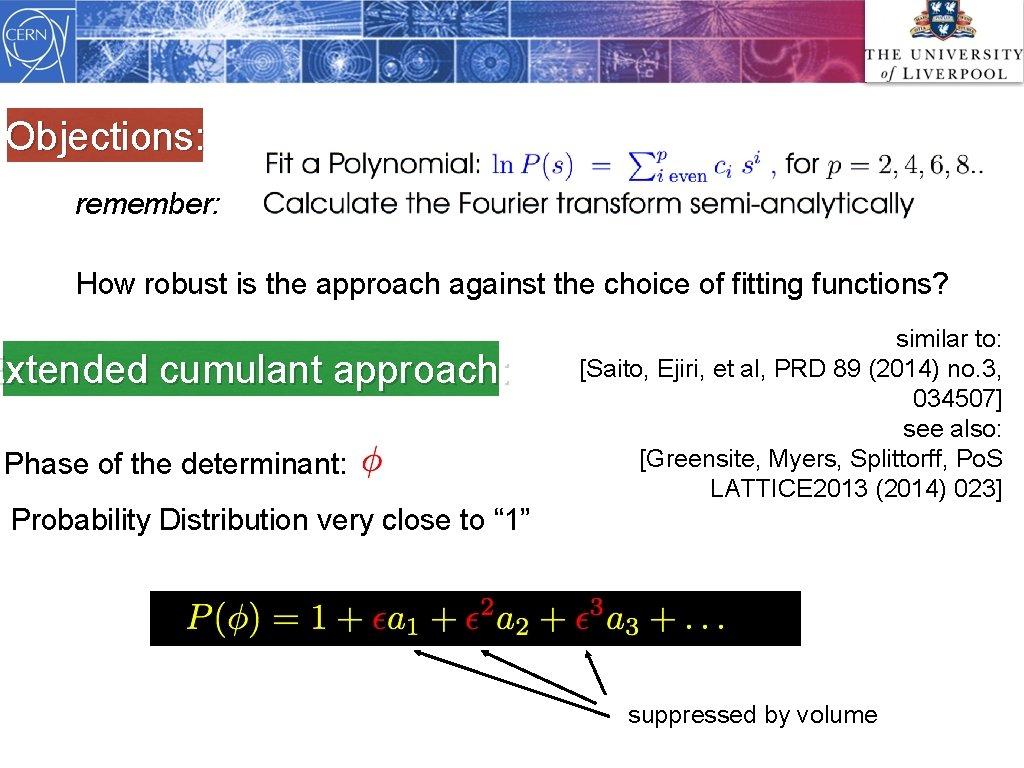
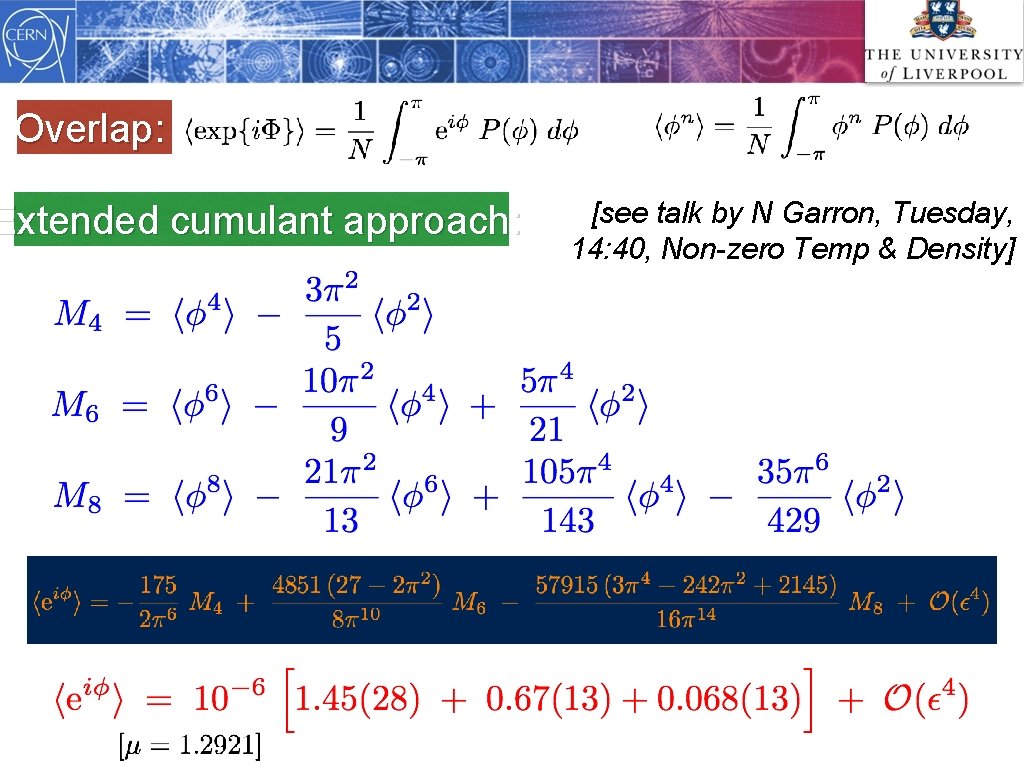
Objections: remember: How robust is the approach against the choice of fitting functions? Extended cumulant approach: Phase of the determinant: Probability Distribution very close to “ 1” similar to: [Saito, Ejiri, et al, PRD 89 (2014) no. 3, 034507] see also: [Greensite, Myers, Splittorff, Po. S LATTICE 2013 (2014) 023] suppressed by volume
Overlap: Extended cumulant approach: [see talk by N Garron, Tuesday, 14: 40, Non-zero Temp & Density]
Extended cumulant approach: [analysis by N Garron]
Summary: What is the LLR approach? Non-Markovian Random walk Calculates the probability distribution of (the imaginary part of ) the action with exponential error suppression Technical Progress: Ergodicity: Replica Exchange Smooth Window function (LHMC & HMC) [also talk by
Can solve strong sign Summary: problems: Z 3 gauge theory at finite densities HD QCD [Langfeld, Lucini, PRD 90 (2014) no. 9, 094502] [Garron, Langfeld, ar. Xiv: 1605. 02709] New element: Extended cumulant approach
Outlook: [immediate LLR projects very likely to succeed] [Lucini, talk! KL] interface tensions in the q=20 Potts model (perfect wetting? ) thermodynamics with shifted BC in SU(2) & …. [Pellegrini, Rago, SU(3) interface tensions, latent heat, etc. Lucini] talk! [KL et al. ] [LLR density projects hopefully to succeed] small volume (finite density) QCD Hubbard model, FG model, [Garron, KL] [von Smekal, KL, et al. ] Graphene talk! [other related projects: ] Topological freezing, CP(n-1): Metadynamics Jarzynski's relation [Sanfilippo, Martinelli, Laio] talk! [Nada, Caselle, Panero, Costagliola, Toniato]