Competition in Contracting Act CICA the Federal Acquisition



- Slides: 69
Competition in Contracting Act (CICA), the Federal Acquisition Regulation (FAR), and the Federal Rulemaking Process Welcome! As you get settled, please respond to the question located on your course agenda handout Release 1. 0 1
Instructor • Name • Agency/Organization • Role • Contact Information – Phone – Email Address 2
Classroom Safety & Procedures • Emergency Procedures • Restroom Location • Class Etiquette – Cell Phones – Breaks – Distractions 3
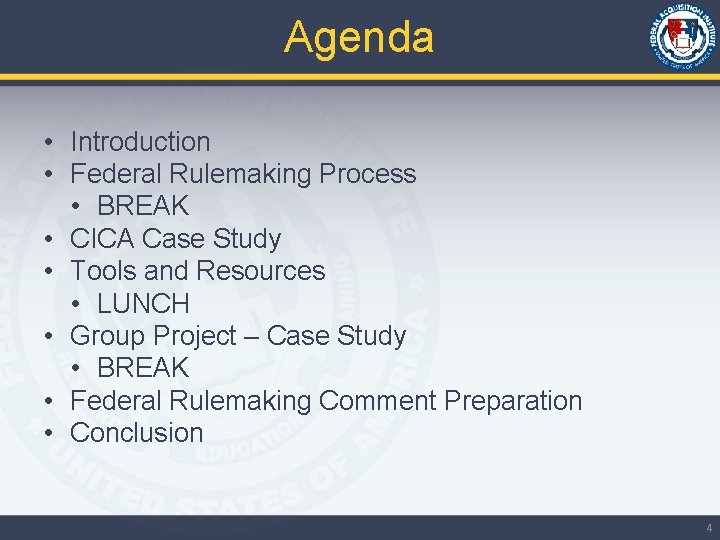
Agenda • Introduction • Federal Rulemaking Process • BREAK • CICA Case Study • Tools and Resources • LUNCH • Group Project – Case Study • BREAK • Federal Rulemaking Comment Preparation • Conclusion 4
Introduce Yourself! Name Job Title Home Agency Question Response 5
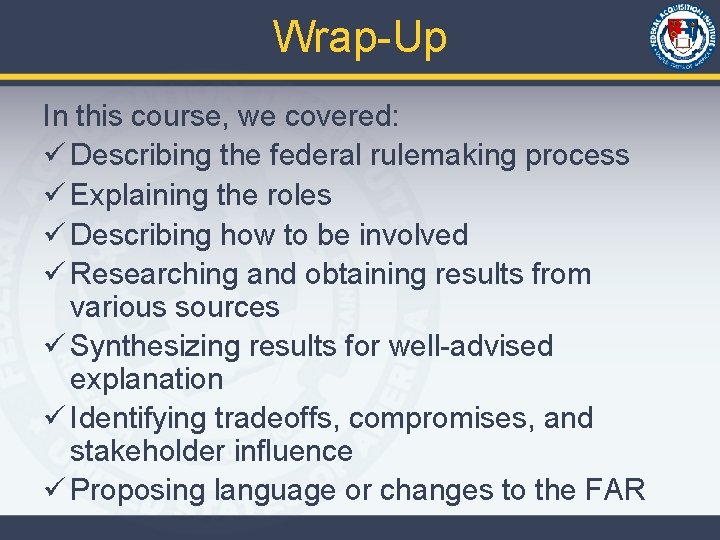
Objectives • • Describe the federal rulemaking process Explain the roles Describe how to be involved Research and obtain results from various sources • Synthesize results for well-advised explanation • Identify tradeoffs, compromises, and stakeholder influence • Propose language or changes to the FAR 6
Materials • Worksheets • Resource List • Source Materials (in class) 7
FEDERAL RULEMAKING PROCESS 8
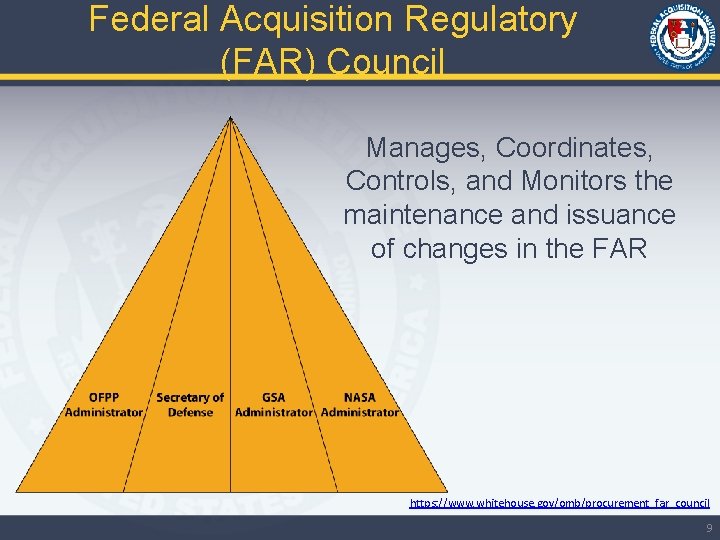
Federal Acquisition Regulatory (FAR) Council Manages, Coordinates, Controls, and Monitors the maintenance and issuance of changes in the FAR https: //www. whitehouse. gov/omb/procurement_far_council 9
Stakeholders A stakeholder could be: • A Government agency/ Government entity • An industry representative • A contractor • A private citizen Stakeholder engagement is key to the rulemaking process
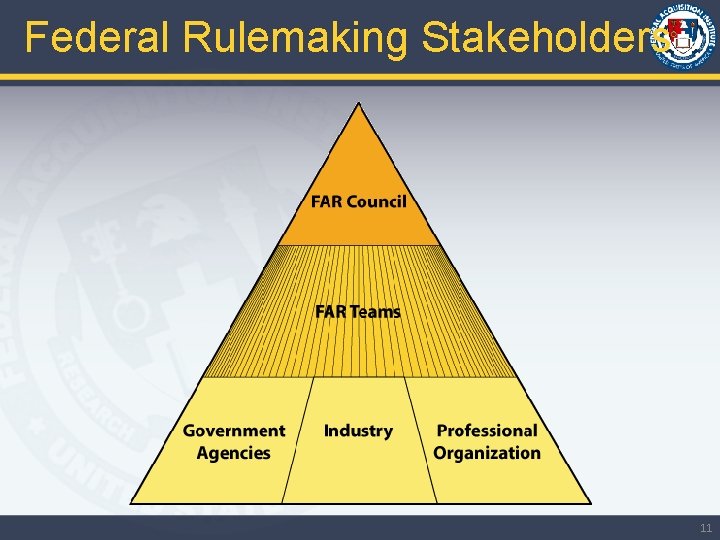
Federal Rulemaking Stakeholders 11
Rulemaking Definitions • Rule – the whole or a part of an agency statement of general or particular applicability and future effect designed to implement, interpret, or prescribe law or policy or describing the organization, procedure, or practice requirements of an agency • Code of Federal Regulations (CFR) – the codification of the general and permanent rules and regulations 12
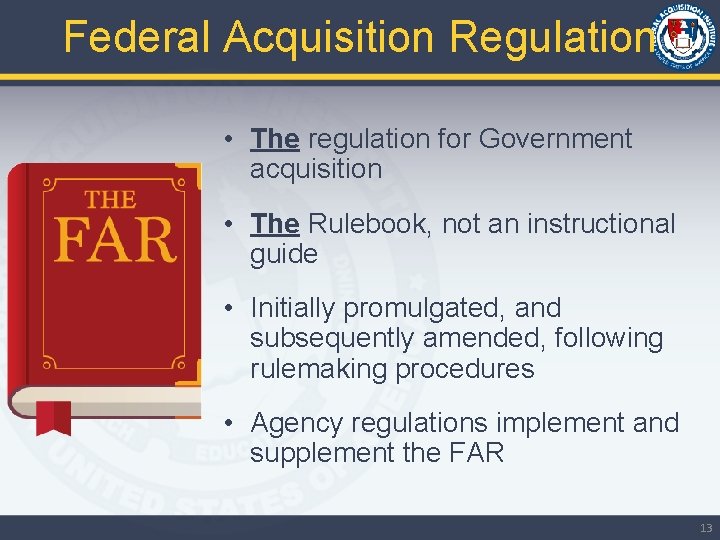
Federal Acquisition Regulation • The regulation for Government acquisition • The Rulebook, not an instructional guide • Initially promulgated, and subsequently amended, following rulemaking procedures • Agency regulations implement and supplement the FAR 13
Types of Rules • Legislative Rule (Substantive) • Non-Legislative Rule (Interpretative) • Management and Procedural Rule 14
Collaborative Exercise 1. Select 9 sign holder volunteers 2. Work as a class 3. Arrange the rulemaking process steps in the correct order 15
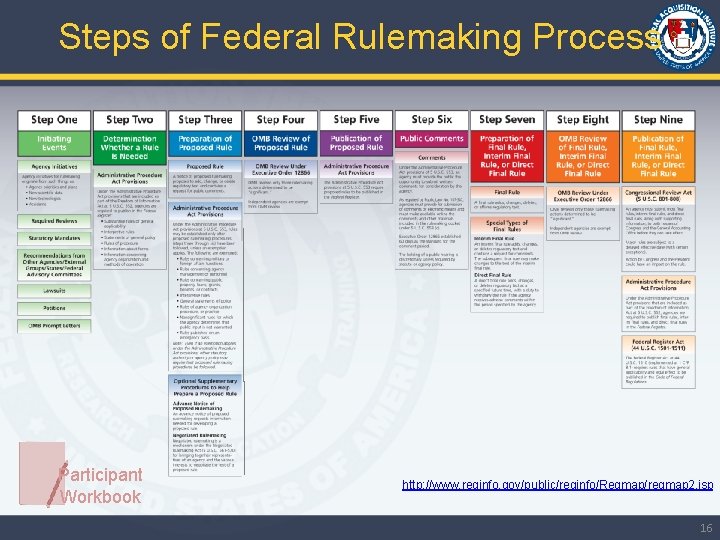
Steps of Federal Rulemaking Process Participant Workbook http: //www. reginfo. gov/public/reginfo/Regmap/regmap 2. jsp 16
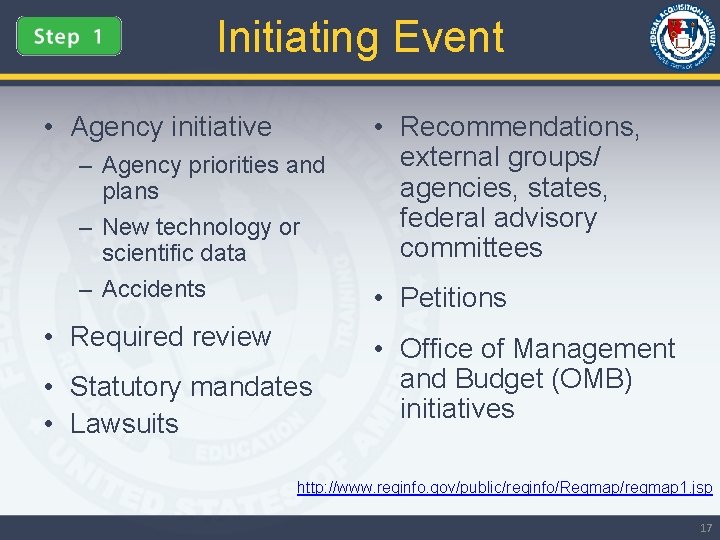
Initiating Event • Agency initiative – Agency priorities and plans – New technology or scientific data – Accidents • Required review • Statutory mandates • Lawsuits • Recommendations, external groups/ agencies, states, federal advisory committees • Petitions • Office of Management and Budget (OMB) initiatives http: //www. reginfo. gov/public/reginfo/Regmap/regmap 1. jsp 17
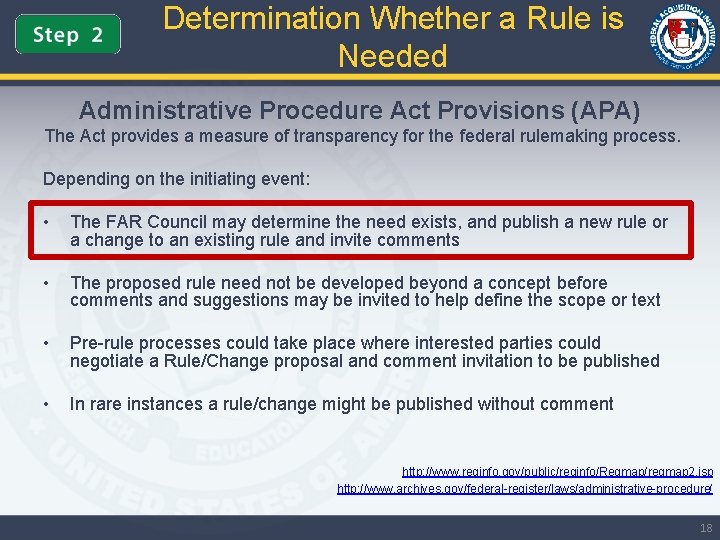
Determination Whether a Rule is Needed Administrative Procedure Act Provisions (APA) The Act provides a measure of transparency for the federal rulemaking process. Depending on the initiating event: • The FAR Council may determine the need exists, and publish a new rule or a change to an existing rule and invite comments • The proposed rule need not be developed beyond a concept before comments and suggestions may be invited to help define the scope or text • Pre-rule processes could take place where interested parties could negotiate a Rule/Change proposal and comment invitation to be published • In rare instances a rule/change might be published without comment http: //www. reginfo. gov/public/reginfo/Regmap/regmap 2. jsp http: //www. archives. gov/federal-register/laws/administrative-procedure/ 18
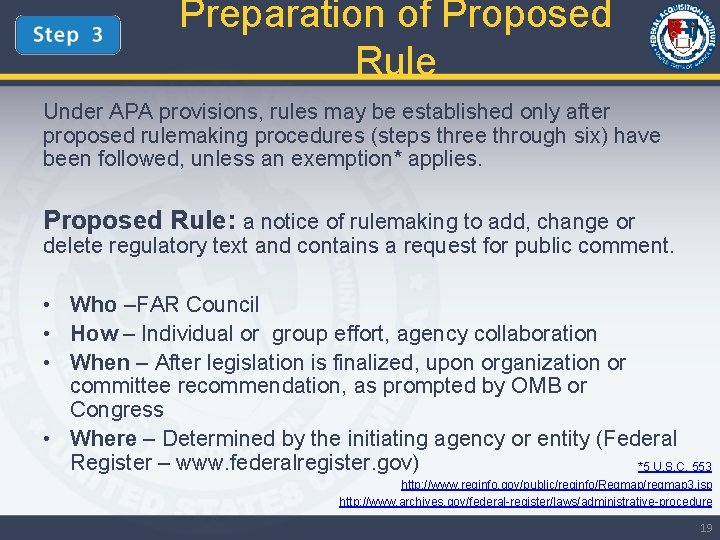
Preparation of Proposed Rule Under APA provisions, rules may be established only after proposed rulemaking procedures (steps three through six) have been followed, unless an exemption* applies. Proposed Rule: a notice of rulemaking to add, change or delete regulatory text and contains a request for public comment. • Who –FAR Council • How – Individual or group effort, agency collaboration • When – After legislation is finalized, upon organization or committee recommendation, as prompted by OMB or Congress • Where – Determined by the initiating agency or entity (Federal Register – www. federalregister. gov) *5 U. S. C. 553 http: //www. reginfo. gov/public/reginfo/Regmap/regmap 3. jsp http: //www. archives. gov/federal-register/laws/administrative-procedure 19
OMB Review of Rule Office of Management and Budget (OMB) Review Under Executive Order 12866 OMB reviews only those rulemaking actions determined to be "significant. " http: //www. reginfo. gov/public/reginfo/Regmap/regmap 4. jsp http: //www. reginfo. gov/public/jsp/EO/eo. Dashboard. jsp 20
Publication of Proposed Rule Administrative Procedure Act (APA) Provisions Under the Act proposed rules are required to be published in the Federal Register. • Substantive rules of general applicability • Interpretive rules • Statements of general policy • Rules of procedure • Information about forms • Information concerning agency organization and method of operation http: //www. reginfo. gov/public/reginfo/Regmap/regmap 5. jsp 21
Public Comment APA provisions, give the public an opportunity to submit written comments • Public Law – – • Executive Order 12866 – – • Electronic comment submission Online access to comments and rulemaking materials 60 days standard comment period Discretionary public hearing unless required by statute or agency policy Comments – – Implementation comments are typical Substantive issues are addressed in the legislative process Regulations. gov http: //www. reginfo. gov/public/reginfo/Regmap/regmap 6. jsp 22
Preparation of Final Rule – Adds, changes, deletes, or affirms regulatory text Special Types of Final Rules: – Interim Final Rule Adds, changes, or deletes regulatory text and contains a request for comments. The subsequent final rule may make changes to the text of the interim final rule. – Direct Final Rule A direct final rule adds, changes, or deletes regulatory text at a specified future time, with a duty to withdraw the rule if the agency receives adverse comments within the period specified by the agency. http: //www. reginfo. gov/public/reginfo/Regmap/regmap 7. jsp 23
OMB Review of Rule Executive Order 12866 – OMB reviews rulemaking actions Reginfo. go v http: //www. reginfo. gov/public/reginfo/Regmap/regmap 8. jsp http: //www. reginfo. gov/public/jsp/EO/eo. Dashboard. jsp 24
Publication of Final Rule • Congressional Review • Federal Register • Federal Acquisition Circular (FAC) Federal Acquisition Circular http: //www. reginfo. gov/public/reginfo/Regmap/regmap 9. jsp 25
Please return on time in 10 minutes 26
CICA CASE STUDY CICA Case Study Packet 27
CICA Case Study Goals • Formulate response to customer’s question “Why do we have to compete? ” • Link question to CICA • Identify CICA text • Identify pre-rule process milestones • Identify rulemaking process milestones • Identify research sources • Identify stakeholders • Identify issues • Identify compromises/trade-offs 28
Link the Question to CICA The steps to connecting the customer's question to the FAR may include referencing the FAR Part and Subparts, Federal Register, and/or rule stimulus (i. e. law, policy, technology change such as CICA). Have you conducted this type of research? If so, how did you start? 29
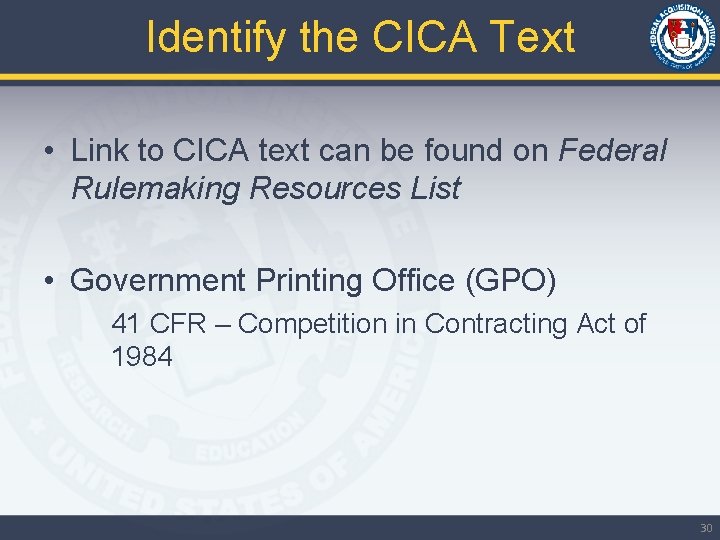
Identify the CICA Text • Link to CICA text can be found on Federal Rulemaking Resources List • Government Printing Office (GPO) 41 CFR – Competition in Contracting Act of 1984 30
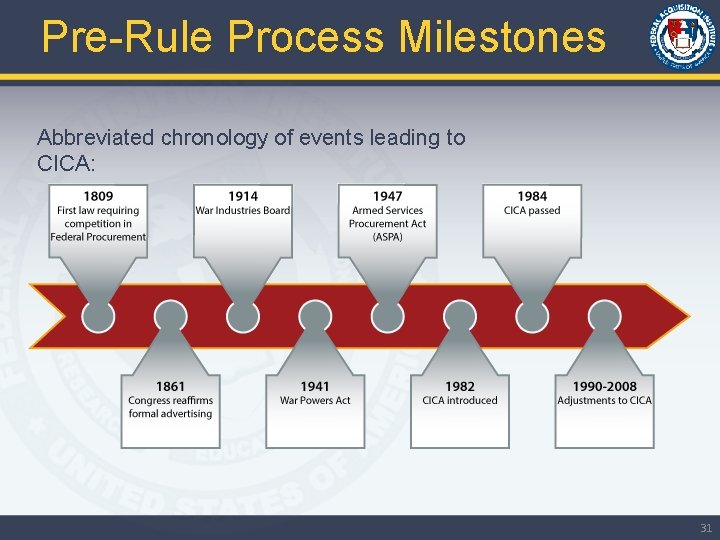
Pre-Rule Process Milestones Abbreviated chronology of events leading to CICA: 31
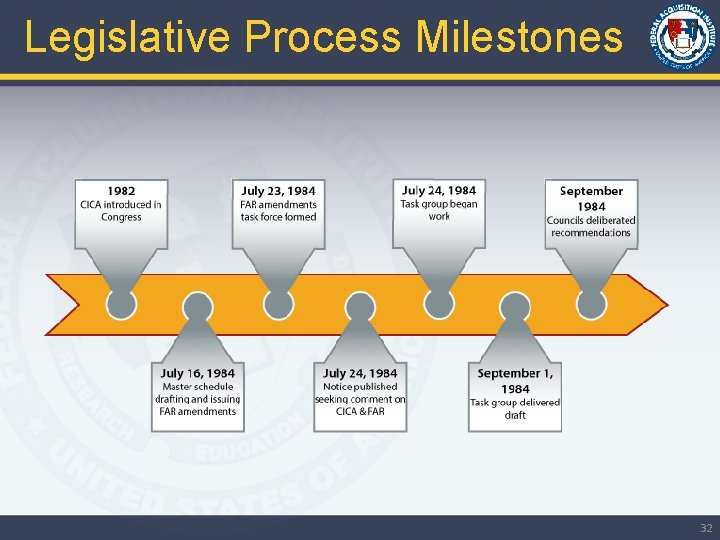
Legislative Process Milestones 32
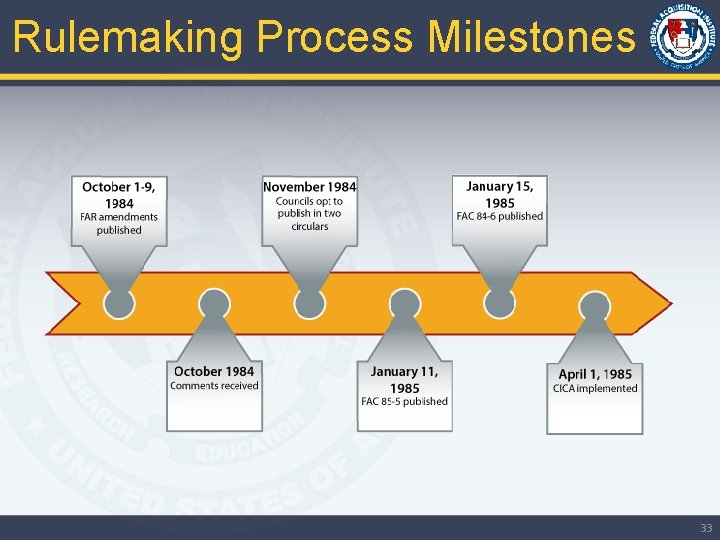
Rulemaking Process Milestones 33
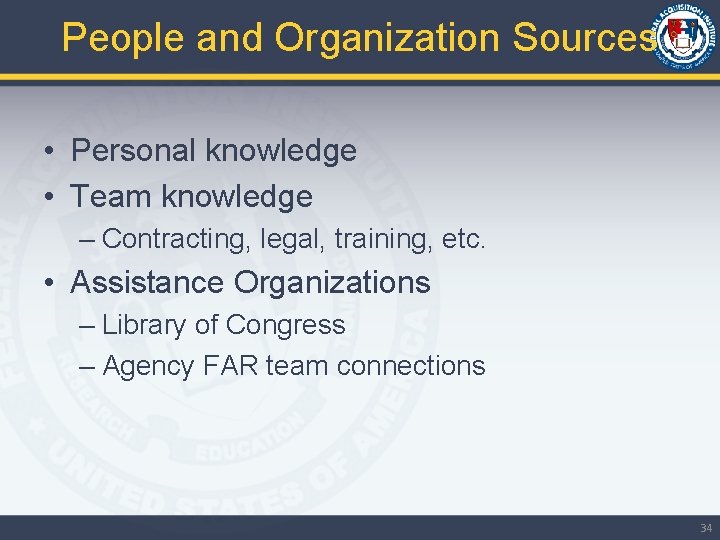
People and Organization Sources • Personal knowledge • Team knowledge – Contracting, legal, training, etc. • Assistance Organizations – Library of Congress – Agency FAR team connections 34
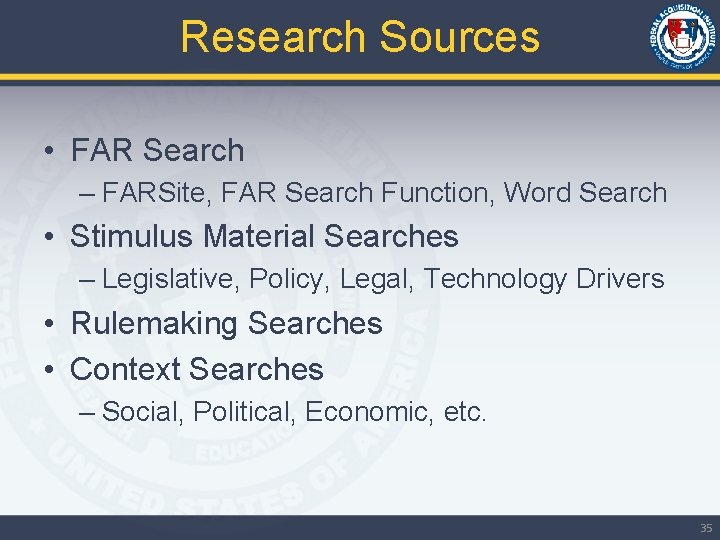
Research Sources • FAR Search – FARSite, FAR Search Function, Word Search • Stimulus Material Searches – Legislative, Policy, Legal, Technology Drivers • Rulemaking Searches • Context Searches – Social, Political, Economic, etc. 35
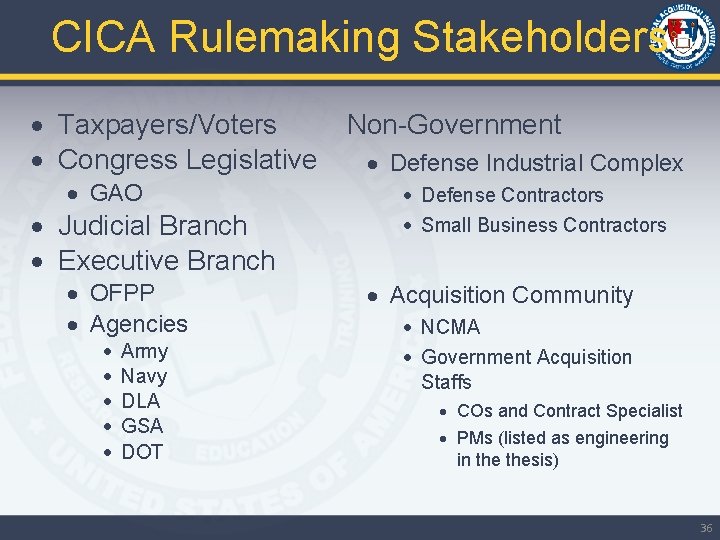
CICA Rulemaking Stakeholders Taxpayers/Voters Congress Legislative GAO Judicial Branch Executive Branch OFPP Agencies Army Navy DLA GSA DOT Non-Government Defense Industrial Complex Defense Contractors Small Business Contractors Acquisition Community NCMA Government Acquisition Staffs COs and Contract Specialist PMs (listed as engineering in thesis) 36
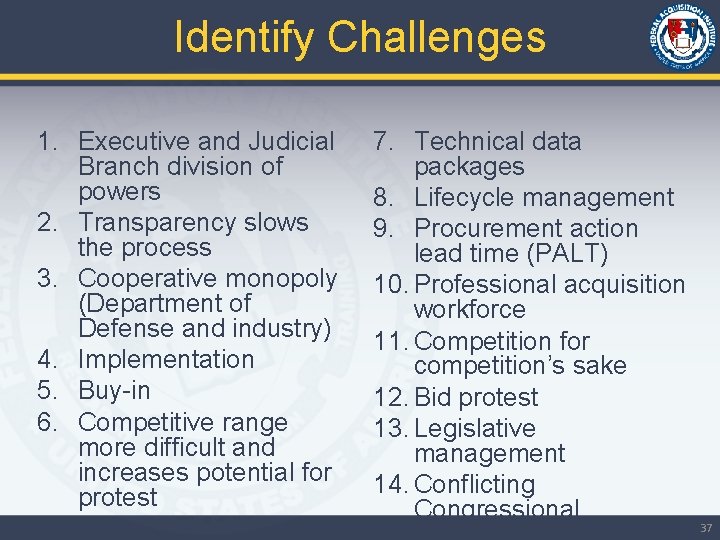
Identify Challenges 1. Executive and Judicial Branch division of powers 2. Transparency slows the process 3. Cooperative monopoly (Department of Defense and industry) 4. Implementation 5. Buy-in 6. Competitive range more difficult and increases potential for protest 7. Technical data packages 8. Lifecycle management 9. Procurement action lead time (PALT) 10. Professional acquisition workforce 11. Competition for competition’s sake 12. Bid protest 13. Legislative management 14. Conflicting Congressional 37
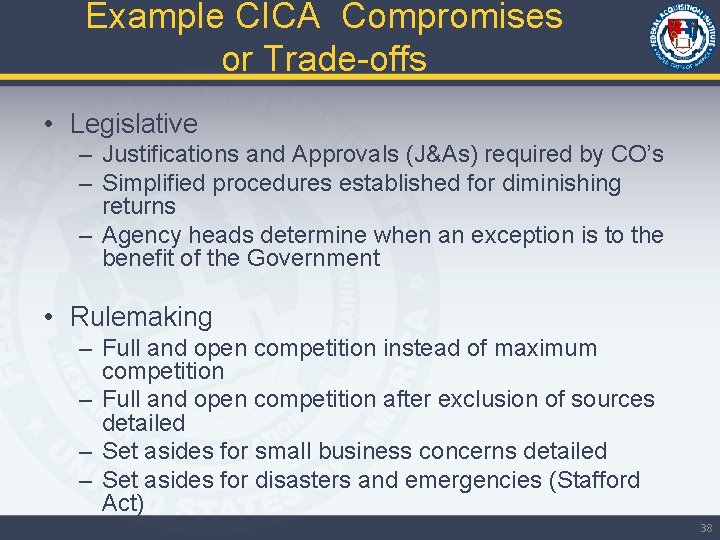
Example CICA Compromises or Trade-offs • Legislative – Justifications and Approvals (J&As) required by CO’s – Simplified procedures established for diminishing returns – Agency heads determine when an exception is to the benefit of the Government • Rulemaking – Full and open competition instead of maximum competition – Full and open competition after exclusion of sources detailed – Set asides for small business concerns detailed – Set asides for disasters and emergencies (Stafford Act) 38
TOOLS AND RESOURCES Federal Rulemaking Research Tool Federal Rulemaking Resources List 39
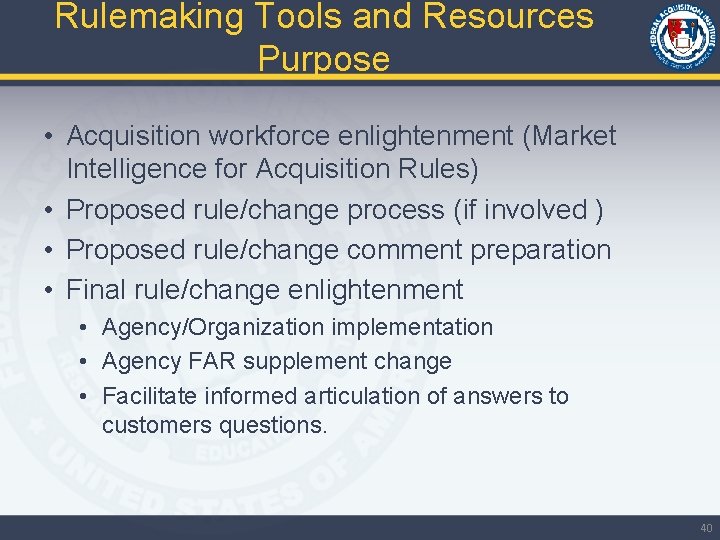
Rulemaking Tools and Resources Purpose • Acquisition workforce enlightenment (Market Intelligence for Acquisition Rules) • Proposed rule/change process (if involved ) • Proposed rule/change comment preparation • Final rule/change enlightenment • Agency/Organization implementation • Agency FAR supplement change • Facilitate informed articulation of answers to customers questions. 40
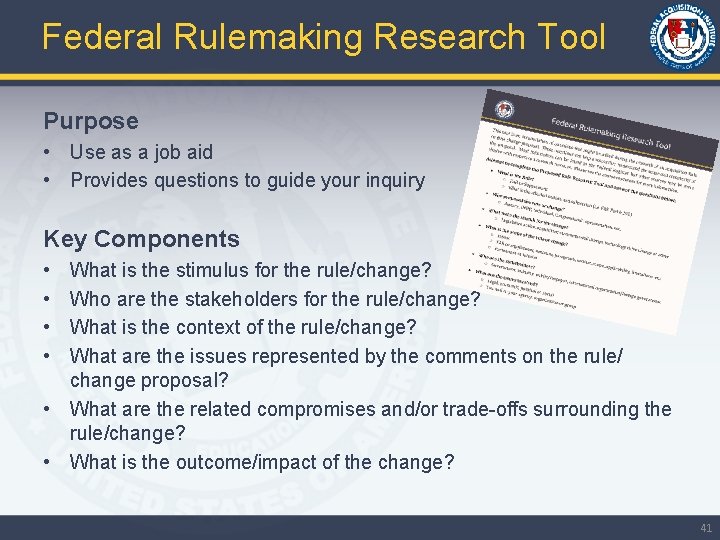
Federal Rulemaking Research Tool Purpose • Use as a job aid • Provides questions to guide your inquiry Key Components • • What is the stimulus for the rule/change? Who are the stakeholders for the rule/change? What is the context of the rule/change? What are the issues represented by the comments on the rule/ change proposal? • What are the related compromises and/or trade-offs surrounding the rule/change? • What is the outcome/impact of the change? 41
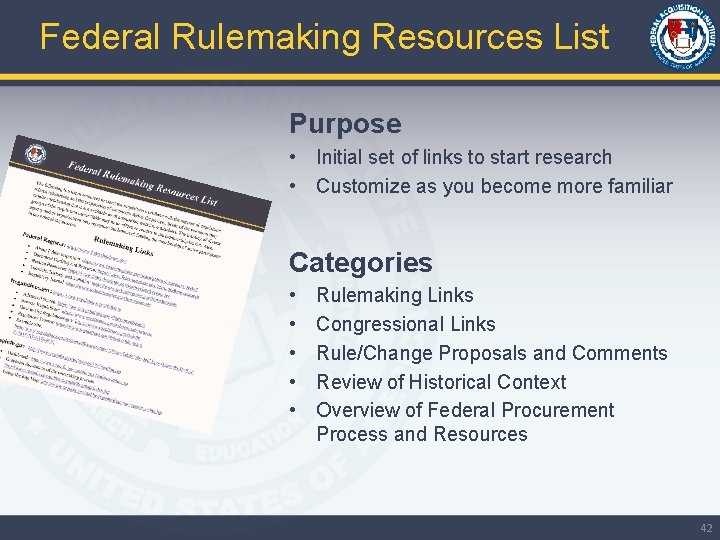
Federal Rulemaking Resources List Purpose • Initial set of links to start research • Customize as you become more familiar Categories • • • Rulemaking Links Congressional Links Rule/Change Proposals and Comments Review of Historical Context Overview of Federal Procurement Process and Resources 42
Your Role: Step One Initiating Event • Identify an error or text • Identify inconsistency or incomplete coverage • Identify industry or technical changes Federal. Register. gov https: //www. federalregister. gov/ 43
Your Role: Step Two Determining Whether a Rule is Needed • Unlikely to have an active role in this step https: //www. federalregister. gov/ 44
Your Role: Step Three Preparation of Proposed Rule • • • Serve as a subject matter expert (SME) Identify niche market variants Identify Contracting Product Line interest (construction, services, Simplified Acquisition Procedures (SAP), research) https: //www. federalregister. gov/ 45
Your Role: Step Four OMB Review • Unlikely to have an active role in this step https: //www. federalregister. gov/ 46
Your Role: Step Five Publication of Proposed Rule • Unlikely to have an active role in this step https: //www. federalregister. gov/ 47
Your Role: Step Six Public Comments • • Review proposed rule Submit comment during the public comment request period Federal. Register. gov https: //www. federalregister. gov/ 48
Your Role: Step Seven Preparation of Final Rule, Interim Rule, or Direct Final Rule • Unlikely to have an active role in this step, unless a FAR committee member or agency sponsor team member https: //www. federalregister. gov/ 49
Your Role: Step Eight OMB Review of Final Rule • Unlikely to have an active role in this step https: //www. federalregister. gov/ 50
Your Role: Step Nine Publication of Final Rule • • • Review final rule text Research discussion and background Research comment response Look for FAC for incorporation into the acquisition process Explore agency supplement or guidance alignment requirements Initiate agency change, as appropriate Federal. Register. gov Federal Acquisition Circulars (FAC) https: //www. federalregister. gov/ 51
Resource List Acquisition Rules • FAR sites • Federal Register – Current site – Historical archives • Agency acquisition notices • Agency policy • Other resources Resource Organizations Mentors / Teaming • Community of practice • Acquisition partnerships – Finance, logistics, etc. • Combined organizational training efforts – Legal databases – Legal archives Historical Context Research Topics • Political • Social • Economic • News 52
Please return from lunch on time 53
GROUP PROJECT – CASE STUDY TWO 54
Case Study Two Packets 55
Please return on time in 10 minutes 56
Case Study Two: Findings Present your findings Each team gets 5 minutes to present your findings. 57
Case Study Two: Conclusion • Collaboration strengthens the process • Networking provides multiple perspectives • Overwhelming volumes of information • Research tool guides the process 58
COMMENT PREPARATION 59
Comment Preparation: Change Notice Review a Case Study change notice: Federal. Register. gov https: //www. federalregister. gov/ 60
Comment Preparation: Exercise • Review the comments • Discuss: – – Which are effective? What makes them effective? Which are not effective? Why not? 61
Comment Preparation: Best Practices • • Read and understand the regulatory document Reach out to the agency with questions Be concise and support your claims Base your justification on sound reasoning, evidence-based facts, and/or how you will be impacted • Address trade-offs and opposing views • There is no minimum or maximum length for an effective comment • The comment process is not a vote https: //www. regulations. gov/docs/Tips_For_Submitting_Effective_Comments. pdf 62
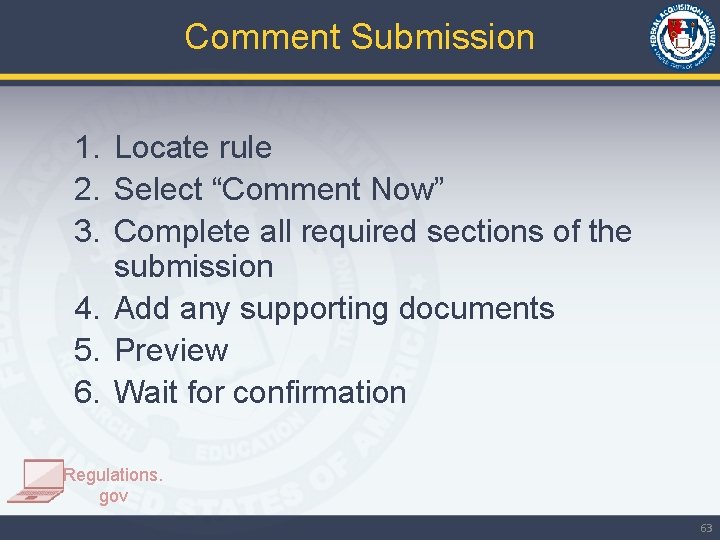
Comment Submission 1. Locate rule 2. Select “Comment Now” 3. Complete all required sections of the submission 4. Add any supporting documents 5. Preview 6. Wait for confirmation Regulations. gov 63
Comment Preparation: Education The Acquisition Team’s Education • • Educating yourself Educating your customer Educating your staff Mentoring 64
SUMMARY AND CONCLUSION 65
Wrap-Up In this course, we covered: ü Describing the federal rulemaking process ü Explaining the roles ü Describing how to be involved ü Researching and obtaining results from various sources ü Synthesizing results for well-advised explanation ü Identifying tradeoffs, compromises, and stakeholder influence ü Proposing language or changes to the FAR
Initial Question When a customer asks, “Why do we have to compete an acquisition when Vendor X is the clear choice? ” • How do you answer? 67
Wrap-Up: Follow On Training Share what you learned! • Mentor: teach your peers, subordinates, and customers about the rulemaking process • Distribute: disseminate the Federal Rulemaking Research Tool to help everyone understand the process
Thank You! CICA, the FAR, and the Federal Rulemaking Process • Instructor Name • Agency/Organization • Role • Contact Information – Phone – Email Address 69