Communicating over the Network Fundamentals Chapter 2 ITE





- Slides: 31
Communicating over the Network Fundamentals – Chapter 2 ITE PC v 4. 0 Chapter 1 © 2007 Cisco Systems, Inc. All rights reserved. Cisco Public 1
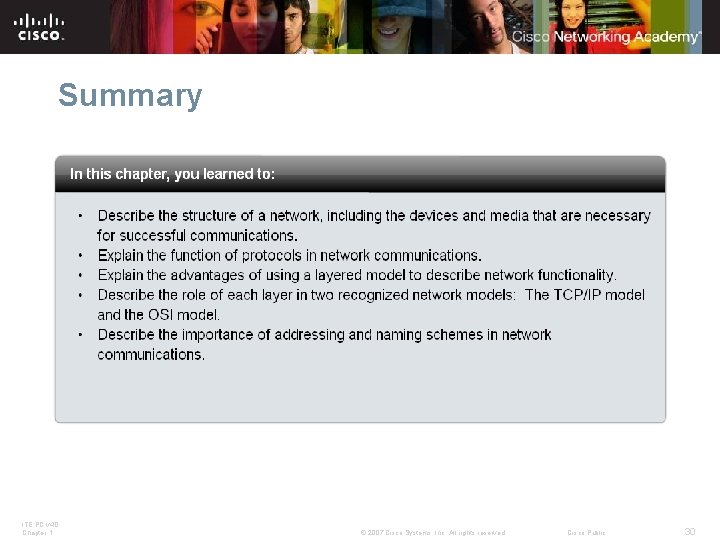
Objectives § Describe the structure of a network, including the devices and media that are necessary for successful communications. § Explain the function of protocols in network communications. § Explain the advantages of using a layered model to describe network functionality. § Describe the role of each layer in two recognized network models: The TCP/IP model and the OSI model. § Describe the importance of addressing and naming schemes in network communications. ITE PC v 4. 0 Chapter 1 © 2007 Cisco Systems, Inc. All rights reserved. Cisco Public 2
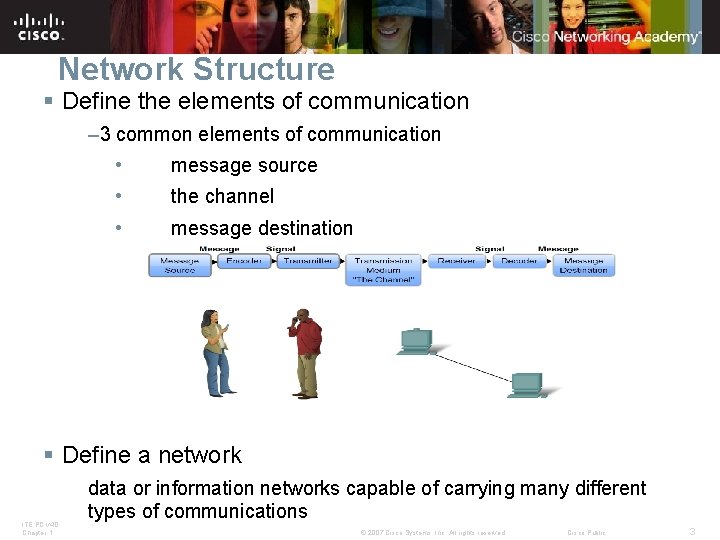
Network Structure § Define the elements of communication – 3 common elements of communication • message source • the channel • message destination § Define a network ITE PC v 4. 0 Chapter 1 data or information networks capable of carrying many different types of communications © 2007 Cisco Systems, Inc. All rights reserved. Cisco Public 3
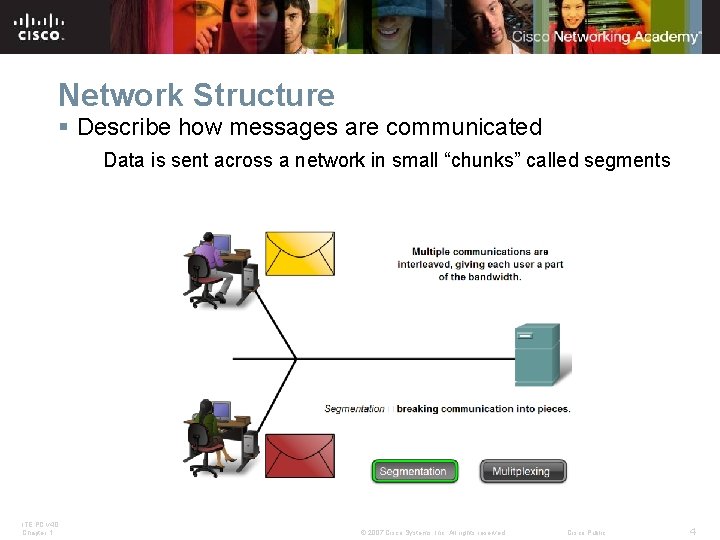
Network Structure § Describe how messages are communicated Data is sent across a network in small “chunks” called segments ITE PC v 4. 0 Chapter 1 © 2007 Cisco Systems, Inc. All rights reserved. Cisco Public 4
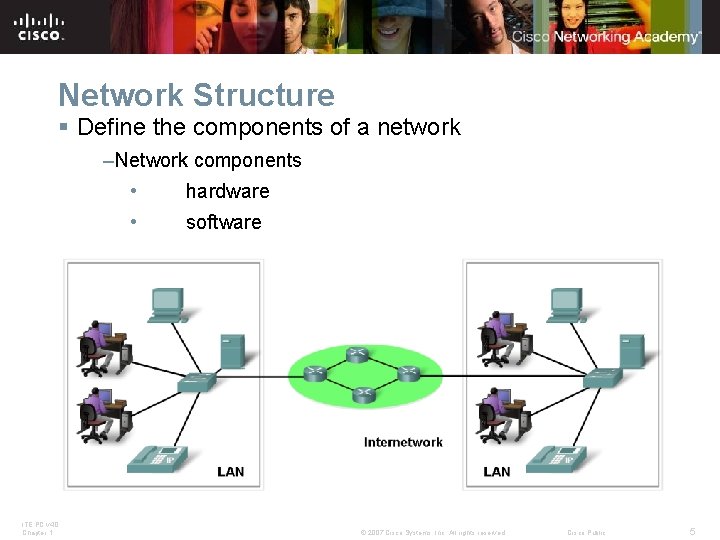
Network Structure § Define the components of a network –Network components ITE PC v 4. 0 Chapter 1 • hardware • software © 2007 Cisco Systems, Inc. All rights reserved. Cisco Public 5
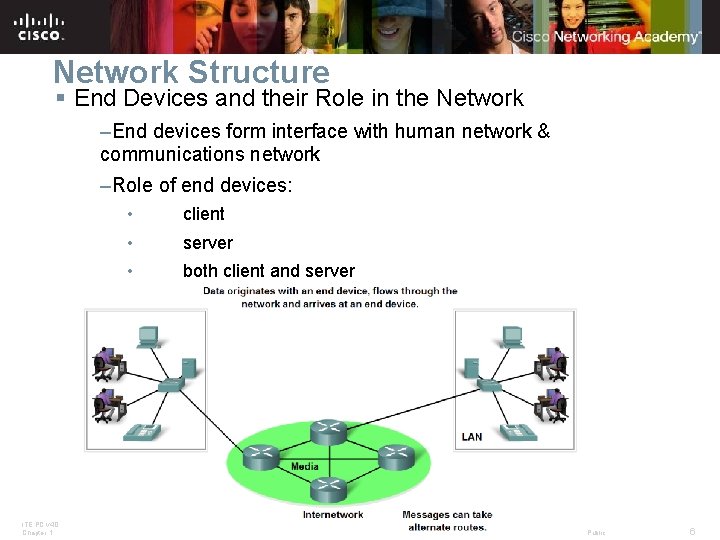
Network Structure § End Devices and their Role in the Network –End devices form interface with human network & communications network –Role of end devices: ITE PC v 4. 0 Chapter 1 • client • server • both client and server © 2007 Cisco Systems, Inc. All rights reserved. Cisco Public 6
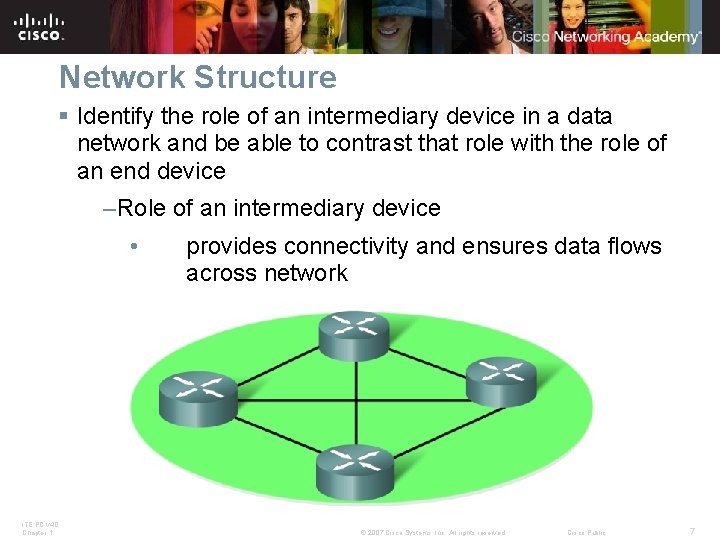
Network Structure § Identify the role of an intermediary device in a data network and be able to contrast that role with the role of an end device –Role of an intermediary device • ITE PC v 4. 0 Chapter 1 provides connectivity and ensures data flows across network © 2007 Cisco Systems, Inc. All rights reserved. Cisco Public 7
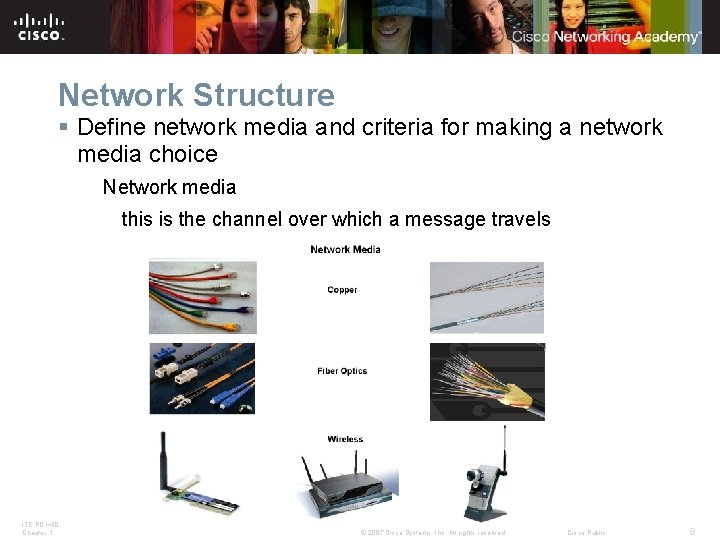
Network Structure § Define network media and criteria for making a network media choice Network media this is the channel over which a message travels ITE PC v 4. 0 Chapter 1 © 2007 Cisco Systems, Inc. All rights reserved. Cisco Public 8
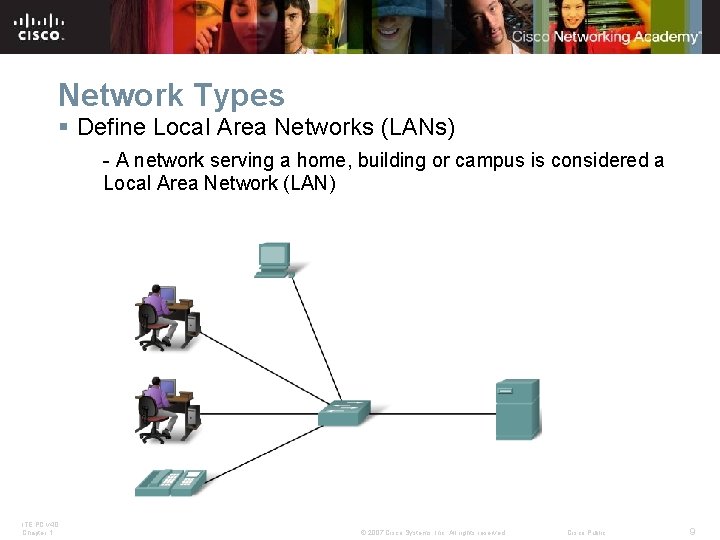
Network Types § Define Local Area Networks (LANs) - A network serving a home, building or campus is considered a Local Area Network (LAN) ITE PC v 4. 0 Chapter 1 © 2007 Cisco Systems, Inc. All rights reserved. Cisco Public 9
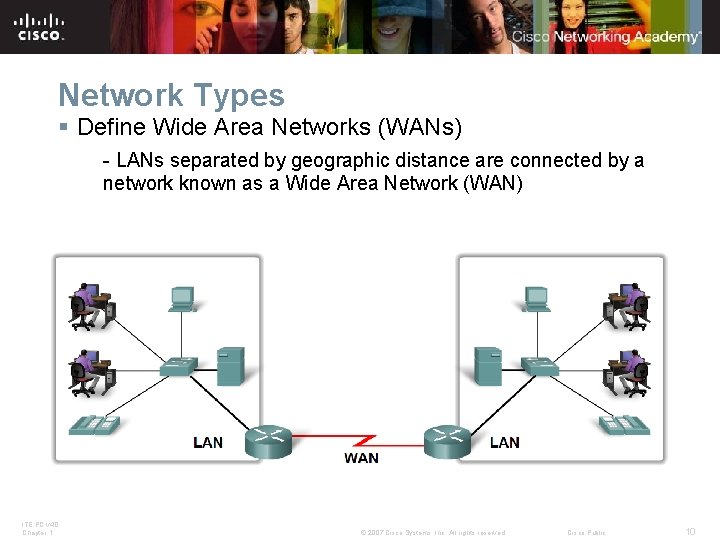
Network Types § Define Wide Area Networks (WANs) - LANs separated by geographic distance are connected by a network known as a Wide Area Network (WAN) ITE PC v 4. 0 Chapter 1 © 2007 Cisco Systems, Inc. All rights reserved. Cisco Public 10
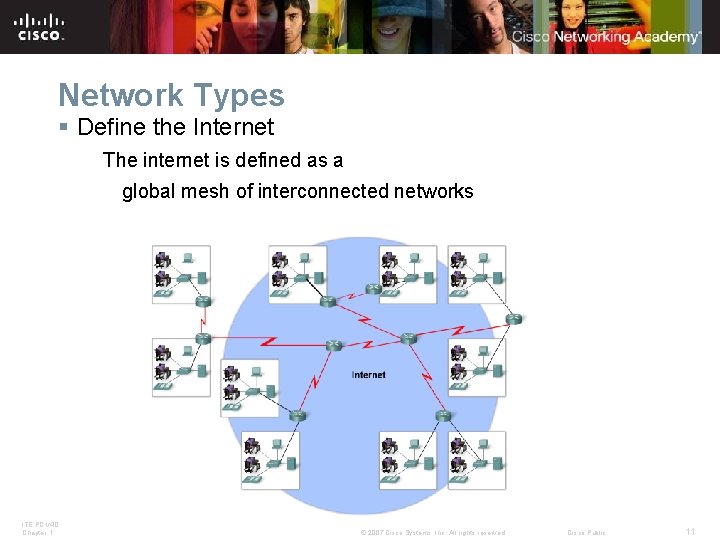
Network Types § Define the Internet The internet is defined as a global mesh of interconnected networks ITE PC v 4. 0 Chapter 1 © 2007 Cisco Systems, Inc. All rights reserved. Cisco Public 11
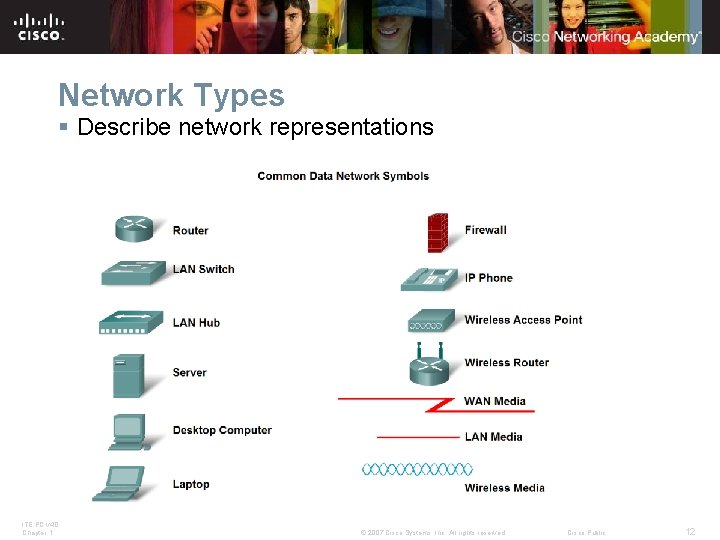
Network Types § Describe network representations ITE PC v 4. 0 Chapter 1 © 2007 Cisco Systems, Inc. All rights reserved. Cisco Public 12
Function of Protocol in Network Communication § The importance of protocols and how they are used to facilitate communication over data networks A protocol is a set of predetermined rules ITE PC v 4. 0 Chapter 1 © 2007 Cisco Systems, Inc. All rights reserved. Cisco Public 13
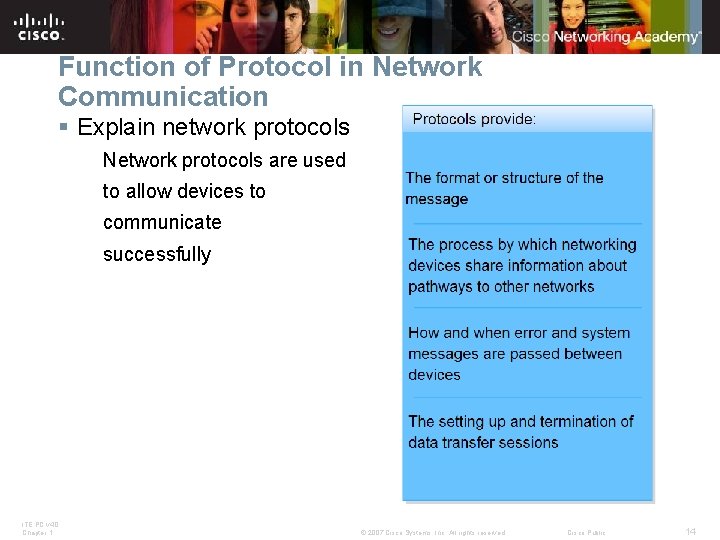
Function of Protocol in Network Communication § Explain network protocols Network protocols are used to allow devices to communicate successfully ITE PC v 4. 0 Chapter 1 © 2007 Cisco Systems, Inc. All rights reserved. Cisco Public 14
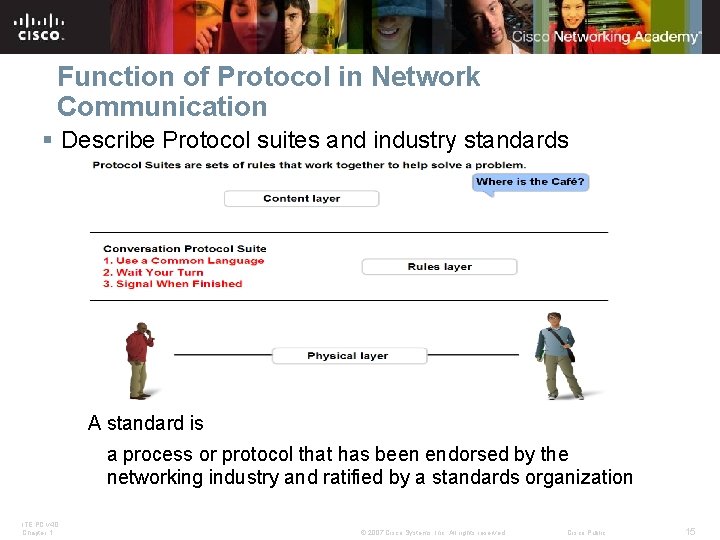
Function of Protocol in Network Communication § Describe Protocol suites and industry standards A standard is a process or protocol that has been endorsed by the networking industry and ratified by a standards organization ITE PC v 4. 0 Chapter 1 © 2007 Cisco Systems, Inc. All rights reserved. Cisco Public 15
Function of Protocol in Network Communication § Define different protocols and how they interact ITE PC v 4. 0 Chapter 1 © 2007 Cisco Systems, Inc. All rights reserved. Cisco Public 16
Function of Protocol in Network Communication § Technology independent Protocols -Many diverse types of devices can communicate using the same sets of protocols. This is because protocols specify network functionality, not the underlying technology to support this functionality. ITE PC v 4. 0 Chapter 1 © 2007 Cisco Systems, Inc. All rights reserved. Cisco Public 17
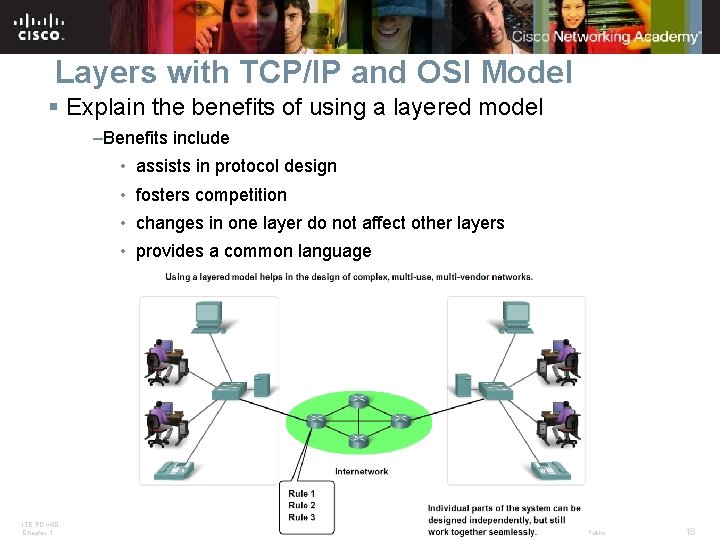
Layers with TCP/IP and OSI Model § Explain the benefits of using a layered model –Benefits include • assists in protocol design • fosters competition • changes in one layer do not affect other layers • provides a common language ITE PC v 4. 0 Chapter 1 © 2007 Cisco Systems, Inc. All rights reserved. Cisco Public 18
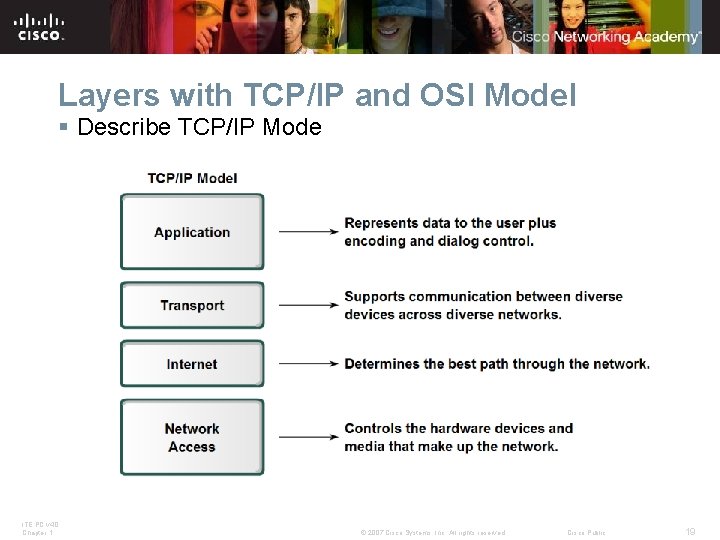
Layers with TCP/IP and OSI Model § Describe TCP/IP Mode ITE PC v 4. 0 Chapter 1 © 2007 Cisco Systems, Inc. All rights reserved. Cisco Public 19
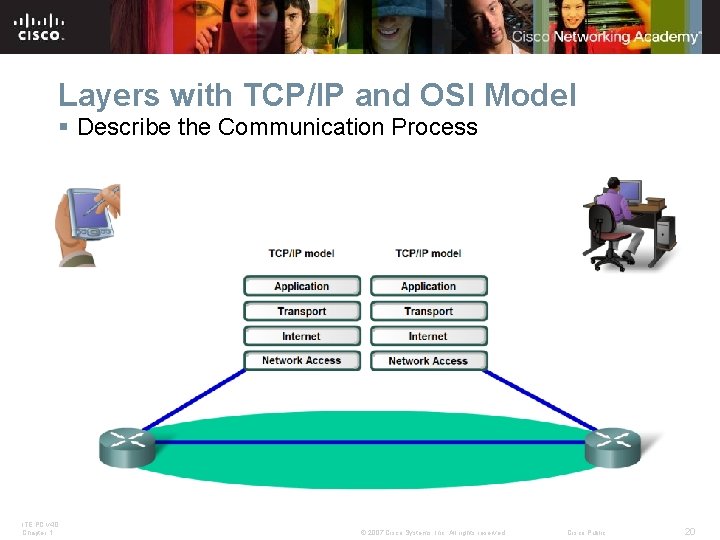
Layers with TCP/IP and OSI Model § Describe the Communication Process ITE PC v 4. 0 Chapter 1 © 2007 Cisco Systems, Inc. All rights reserved. Cisco Public 20
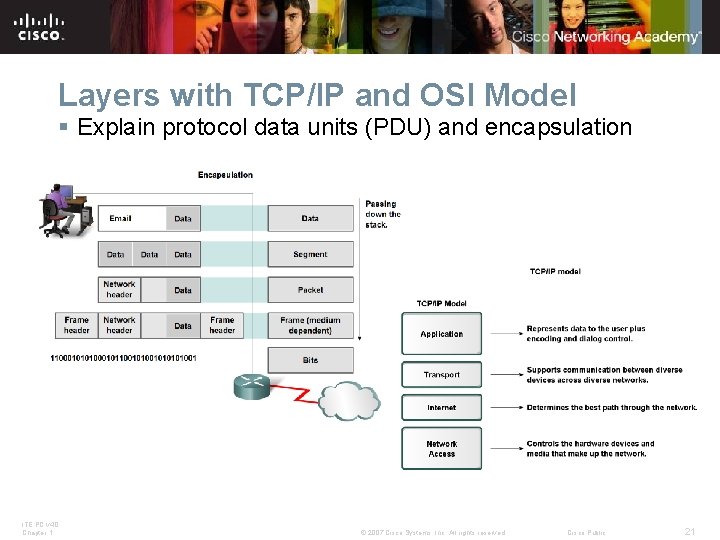
Layers with TCP/IP and OSI Model § Explain protocol data units (PDU) and encapsulation ITE PC v 4. 0 Chapter 1 © 2007 Cisco Systems, Inc. All rights reserved. Cisco Public 21
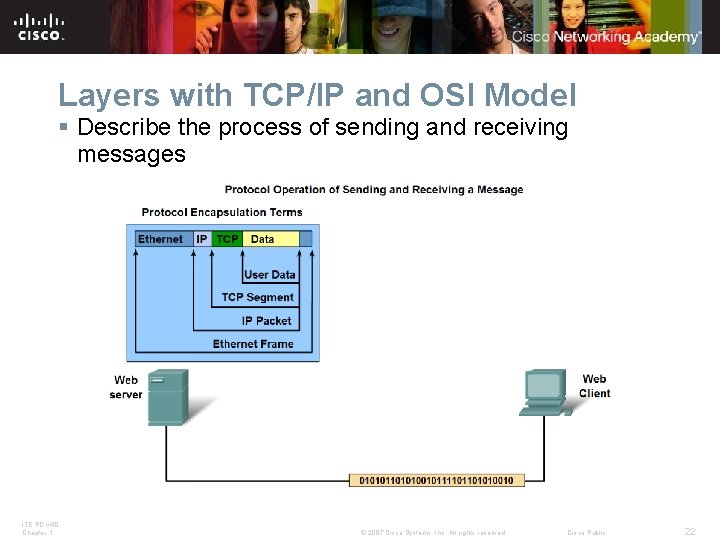
Layers with TCP/IP and OSI Model § Describe the process of sending and receiving messages ITE PC v 4. 0 Chapter 1 © 2007 Cisco Systems, Inc. All rights reserved. Cisco Public 22
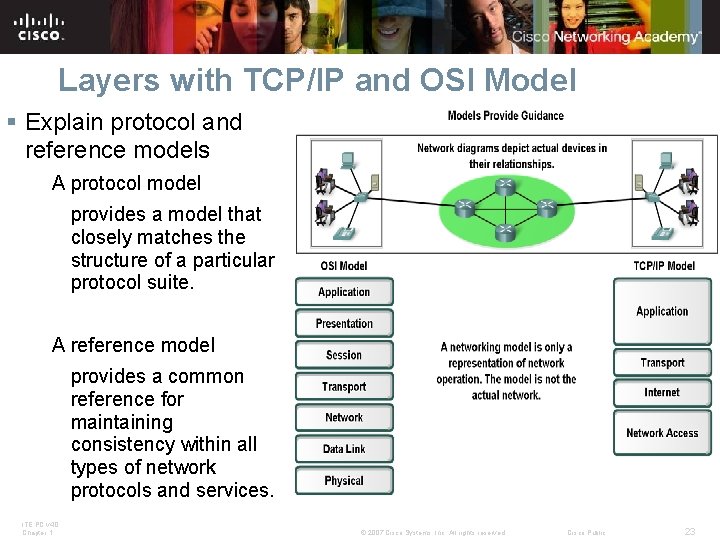
Layers with TCP/IP and OSI Model § Explain protocol and reference models A protocol model provides a model that closely matches the structure of a particular protocol suite. A reference model provides a common reference for maintaining consistency within all types of network protocols and services. ITE PC v 4. 0 Chapter 1 © 2007 Cisco Systems, Inc. All rights reserved. Cisco Public 23
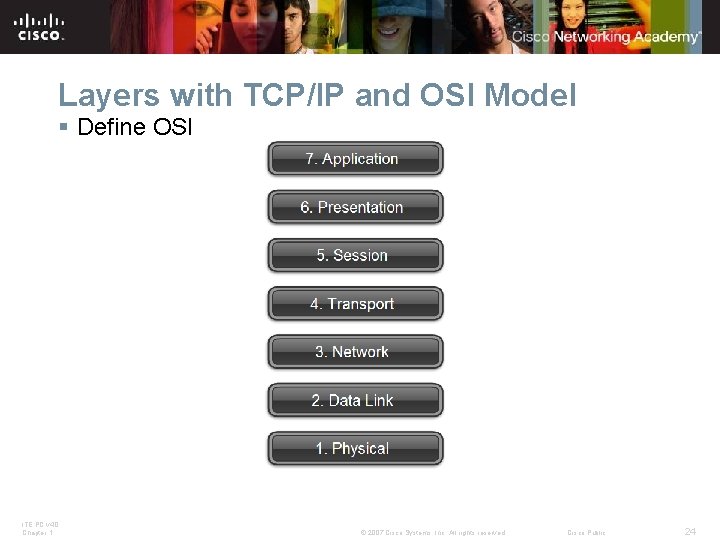
Layers with TCP/IP and OSI Model § Define OSI ITE PC v 4. 0 Chapter 1 © 2007 Cisco Systems, Inc. All rights reserved. Cisco Public 24
Layers with TCP/IP and OSI Model § Compare OSI and TCP/IP model ITE PC v 4. 0 Chapter 1 © 2007 Cisco Systems, Inc. All rights reserved. Cisco Public 25
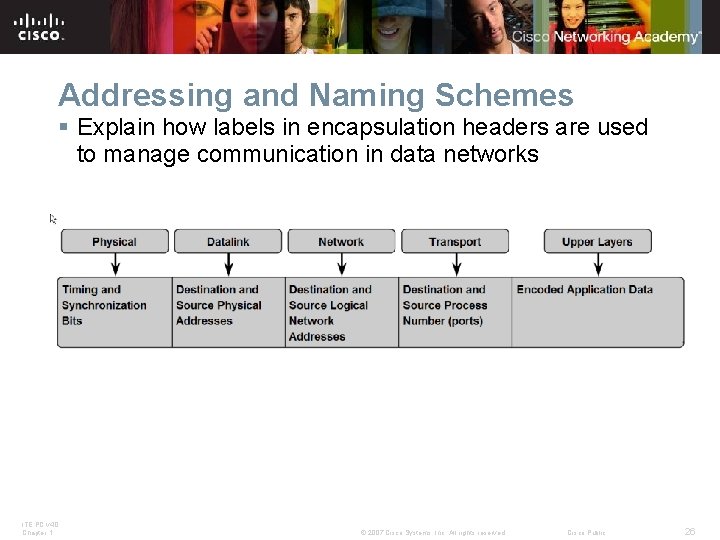
Addressing and Naming Schemes § Explain how labels in encapsulation headers are used to manage communication in data networks ITE PC v 4. 0 Chapter 1 © 2007 Cisco Systems, Inc. All rights reserved. Cisco Public 26
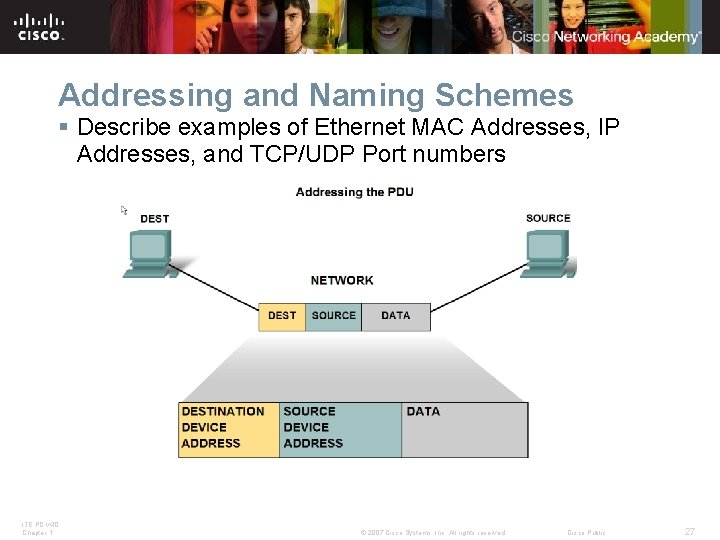
Addressing and Naming Schemes § Describe examples of Ethernet MAC Addresses, IP Addresses, and TCP/UDP Port numbers ITE PC v 4. 0 Chapter 1 © 2007 Cisco Systems, Inc. All rights reserved. Cisco Public 27
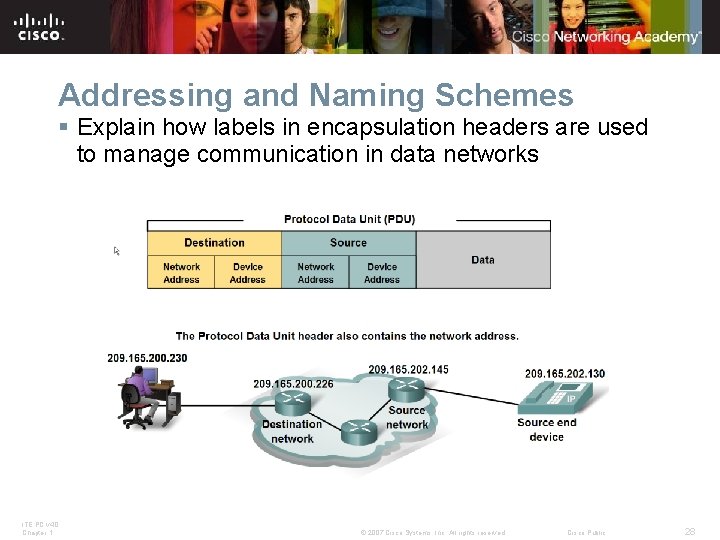
Addressing and Naming Schemes § Explain how labels in encapsulation headers are used to manage communication in data networks ITE PC v 4. 0 Chapter 1 © 2007 Cisco Systems, Inc. All rights reserved. Cisco Public 28
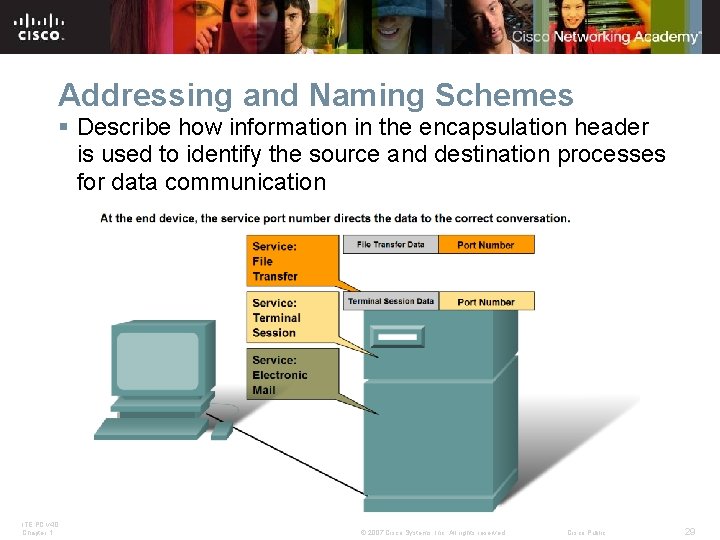
Addressing and Naming Schemes § Describe how information in the encapsulation header is used to identify the source and destination processes for data communication ITE PC v 4. 0 Chapter 1 © 2007 Cisco Systems, Inc. All rights reserved. Cisco Public 29
Summary ITE PC v 4. 0 Chapter 1 © 2007 Cisco Systems, Inc. All rights reserved. Cisco Public 30
ITE PC v 4. 0 Chapter 1 © 2007 Cisco Systems, Inc. All rights reserved. Cisco Public 31