
OSI Network Layer Network Fundamentals Chapter 5 ITE
- Slides: 27
OSI Network Layer Network Fundamentals – Chapter 5 ITE PC v 4. 0 Chapter 1 © 2007 Cisco Systems, Inc. All rights reserved. Cisco Public 1
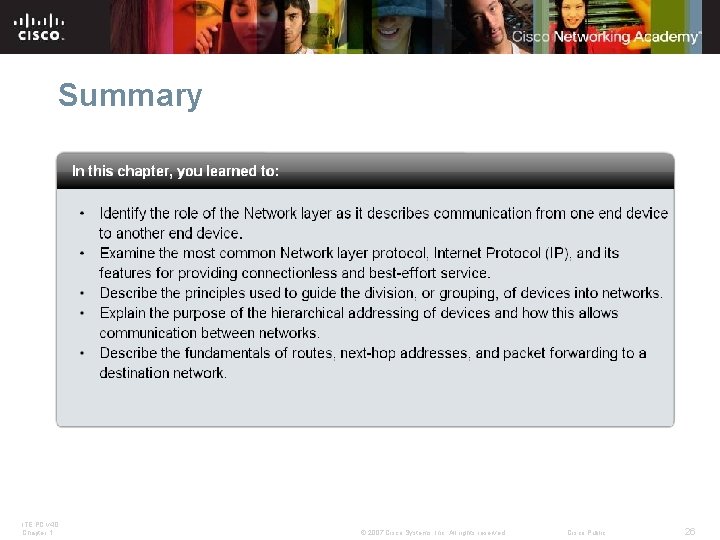
Objectives § Identify the role of the Network Layer, as it describes communication from one end device to another end device § Examine the most common Network Layer protocol, Internet Protocol (IP), and its features for providing connectionless and best-effort service § Understand the principles used to guide the division or grouping of devices into networks § Understand the hierarchical addressing of devices and how this allows communication between networks § Understand the fundamentals of routes, next hop addresses and packet forwarding to a destination network ITE PC v 4. 0 Chapter 1 © 2007 Cisco Systems, Inc. All rights reserved. Cisco Public 2
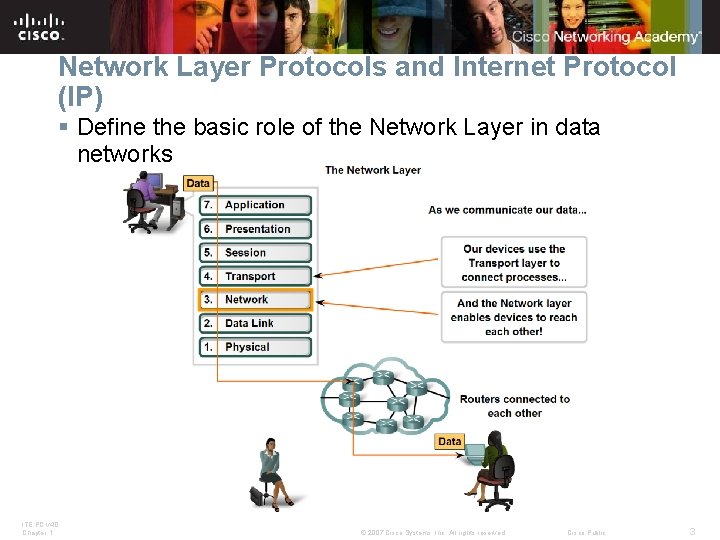
Network Layer Protocols and Internet Protocol (IP) § Define the basic role of the Network Layer in data networks ITE PC v 4. 0 Chapter 1 © 2007 Cisco Systems, Inc. All rights reserved. Cisco Public 3
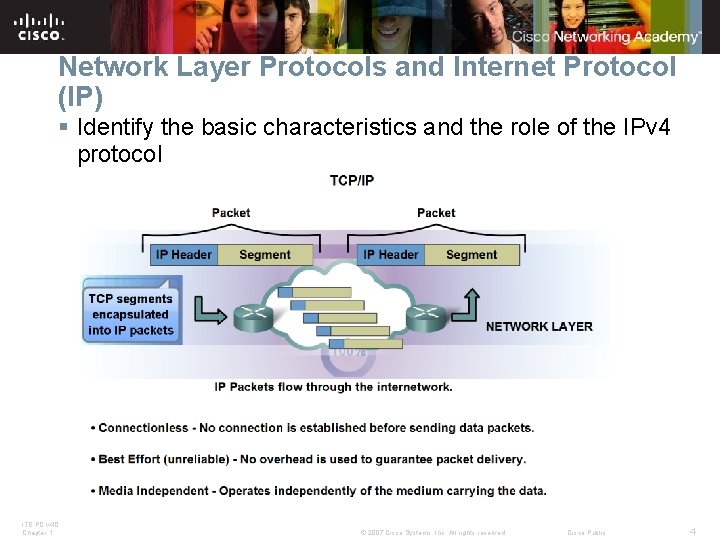
Network Layer Protocols and Internet Protocol (IP) § Identify the basic characteristics and the role of the IPv 4 protocol ITE PC v 4. 0 Chapter 1 © 2007 Cisco Systems, Inc. All rights reserved. Cisco Public 4
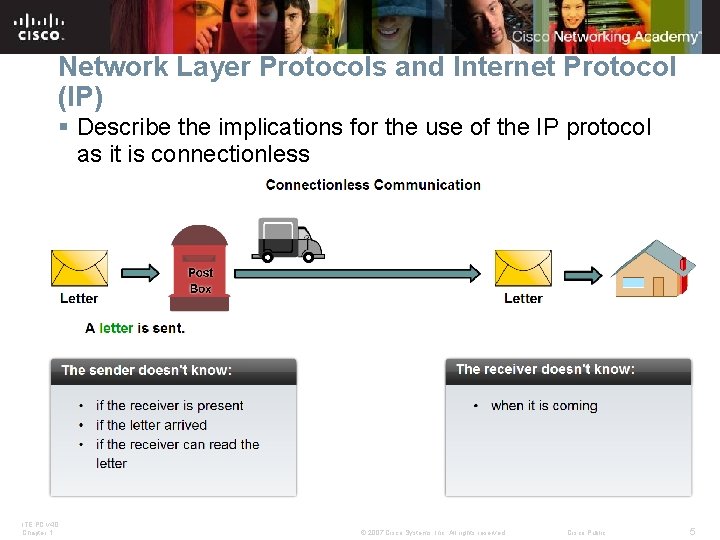
Network Layer Protocols and Internet Protocol (IP) § Describe the implications for the use of the IP protocol as it is connectionless ITE PC v 4. 0 Chapter 1 © 2007 Cisco Systems, Inc. All rights reserved. Cisco Public 5
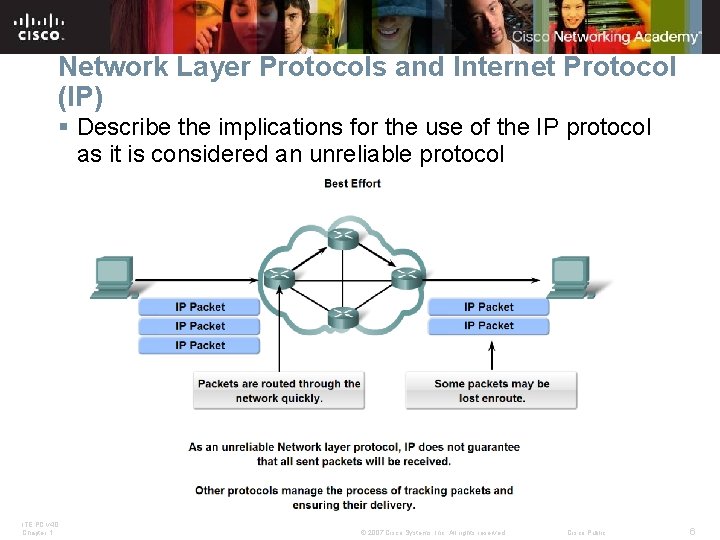
Network Layer Protocols and Internet Protocol (IP) § Describe the implications for the use of the IP protocol as it is considered an unreliable protocol ITE PC v 4. 0 Chapter 1 © 2007 Cisco Systems, Inc. All rights reserved. Cisco Public 6
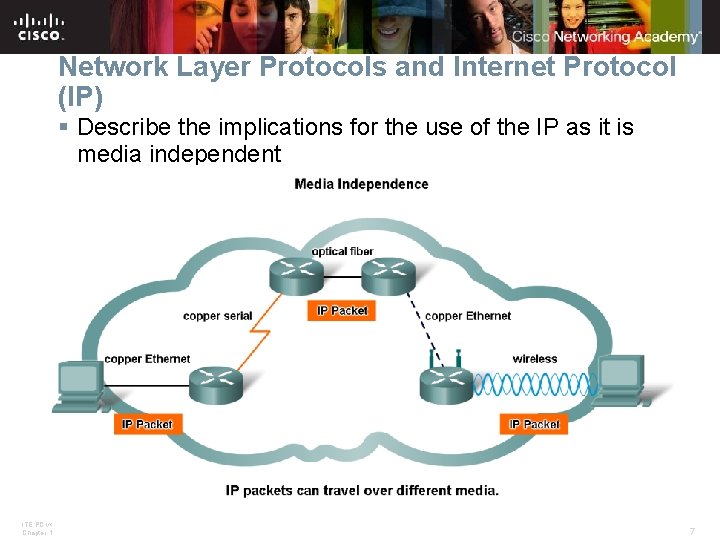
Network Layer Protocols and Internet Protocol (IP) § Describe the implications for the use of the IP as it is media independent ITE PC v 4. 0 Chapter 1 © 2007 Cisco Systems, Inc. All rights reserved. Cisco Public 7
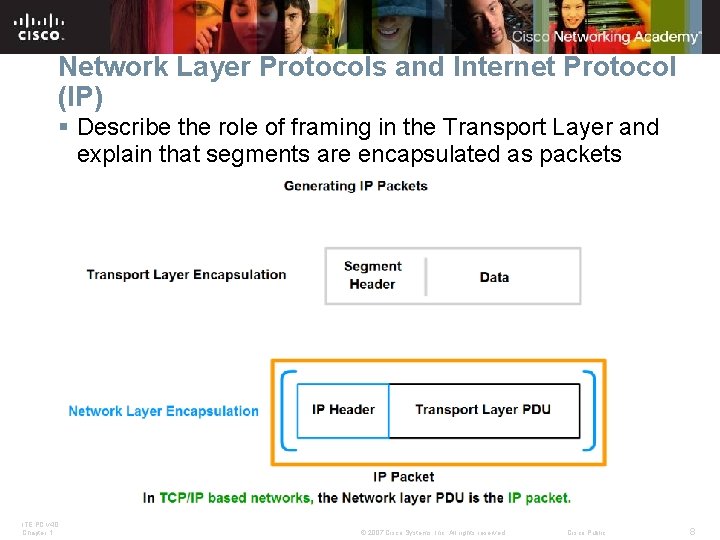
Network Layer Protocols and Internet Protocol (IP) § Describe the role of framing in the Transport Layer and explain that segments are encapsulated as packets ITE PC v 4. 0 Chapter 1 © 2007 Cisco Systems, Inc. All rights reserved. Cisco Public 8
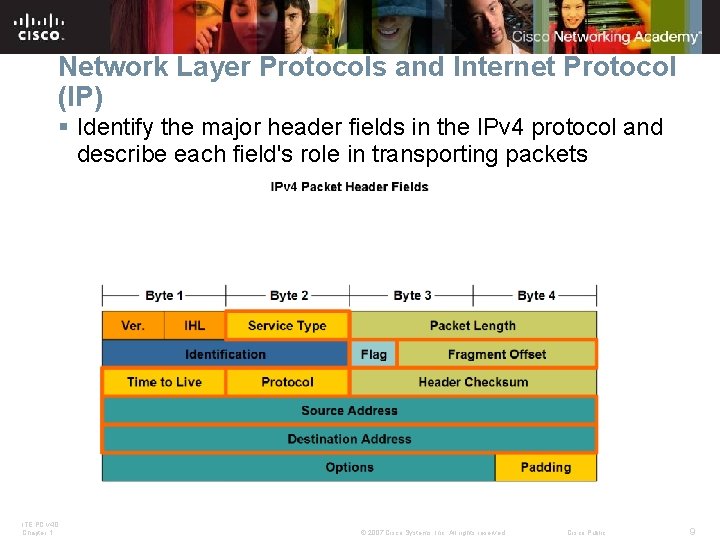
Network Layer Protocols and Internet Protocol (IP) § Identify the major header fields in the IPv 4 protocol and describe each field's role in transporting packets ITE PC v 4. 0 Chapter 1 © 2007 Cisco Systems, Inc. All rights reserved. Cisco Public 9
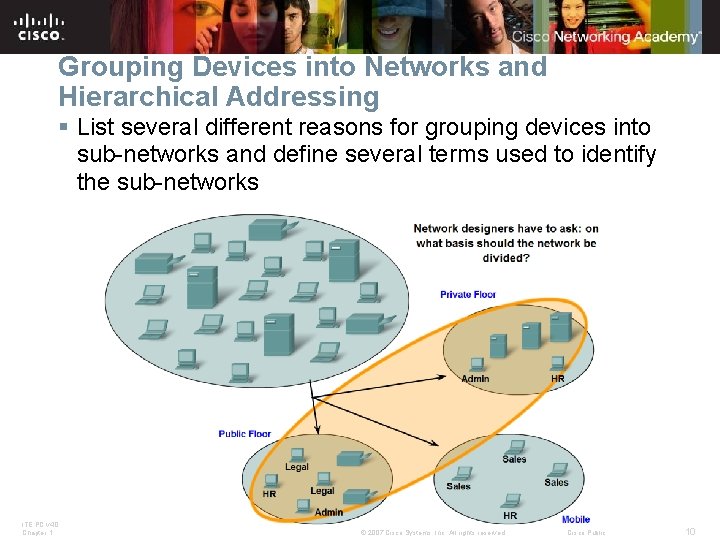
Grouping Devices into Networks and Hierarchical Addressing § List several different reasons for grouping devices into sub-networks and define several terms used to identify the sub-networks ITE PC v 4. 0 Chapter 1 © 2007 Cisco Systems, Inc. All rights reserved. Cisco Public 10
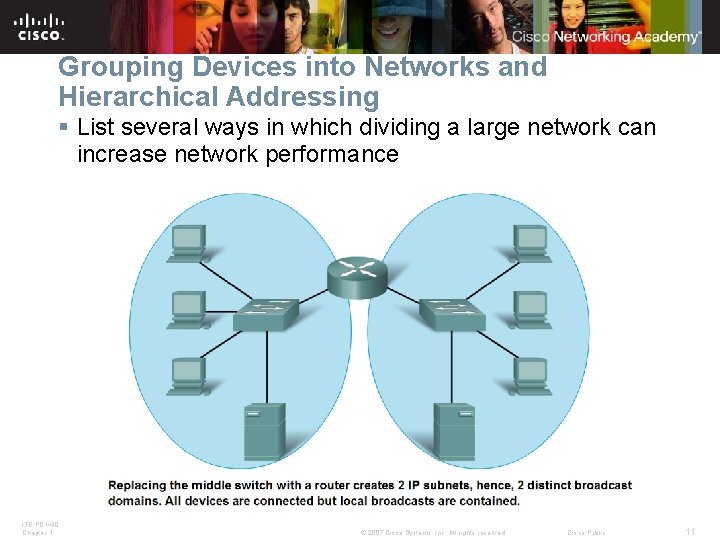
Grouping Devices into Networks and Hierarchical Addressing § List several ways in which dividing a large network can increase network performance ITE PC v 4. 0 Chapter 1 © 2007 Cisco Systems, Inc. All rights reserved. Cisco Public 11
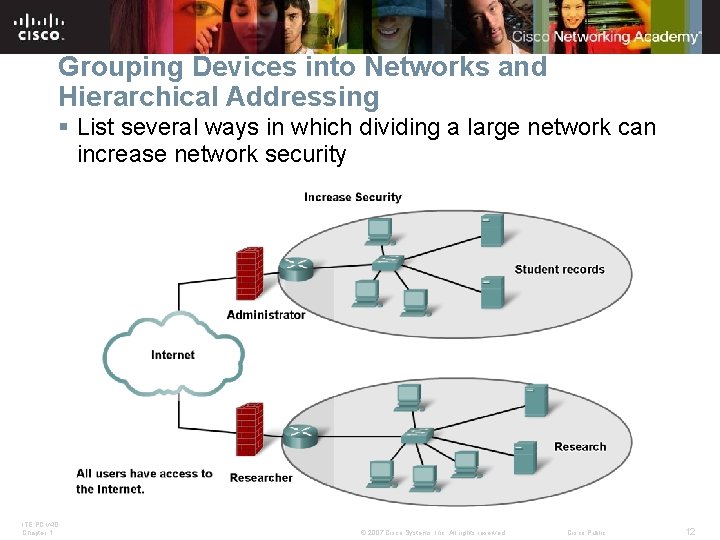
Grouping Devices into Networks and Hierarchical Addressing § List several ways in which dividing a large network can increase network security ITE PC v 4. 0 Chapter 1 © 2007 Cisco Systems, Inc. All rights reserved. Cisco Public 12
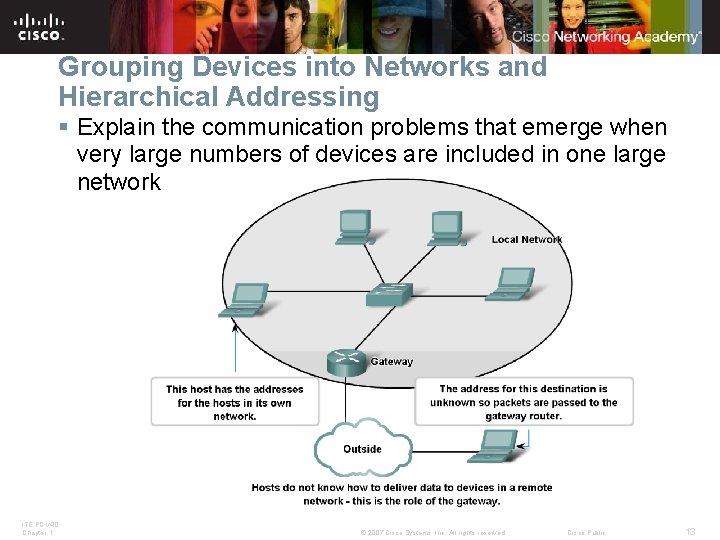
Grouping Devices into Networks and Hierarchical Addressing § Explain the communication problems that emerge when very large numbers of devices are included in one large network ITE PC v 4. 0 Chapter 1 © 2007 Cisco Systems, Inc. All rights reserved. Cisco Public 13
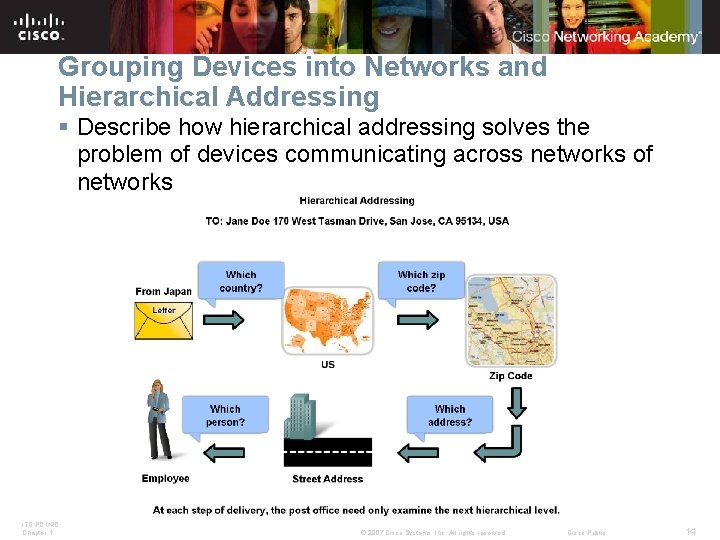
Grouping Devices into Networks and Hierarchical Addressing § Describe how hierarchical addressing solves the problem of devices communicating across networks of networks ITE PC v 4. 0 Chapter 1 © 2007 Cisco Systems, Inc. All rights reserved. Cisco Public 14
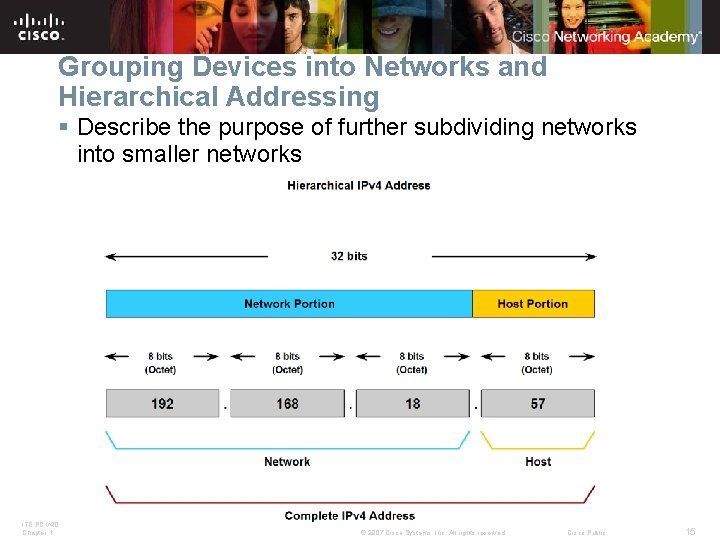
Grouping Devices into Networks and Hierarchical Addressing § Describe the purpose of further subdividing networks into smaller networks ITE PC v 4. 0 Chapter 1 © 2007 Cisco Systems, Inc. All rights reserved. Cisco Public 15
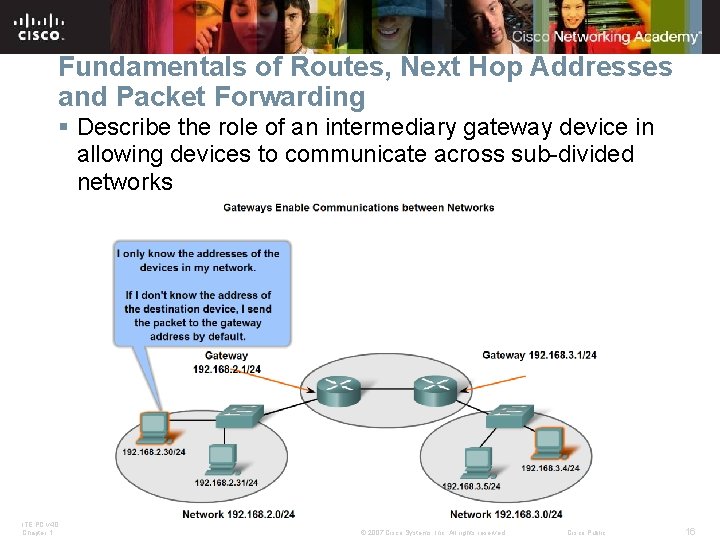
Fundamentals of Routes, Next Hop Addresses and Packet Forwarding § Describe the role of an intermediary gateway device in allowing devices to communicate across sub-divided networks ITE PC v 4. 0 Chapter 1 © 2007 Cisco Systems, Inc. All rights reserved. Cisco Public 16
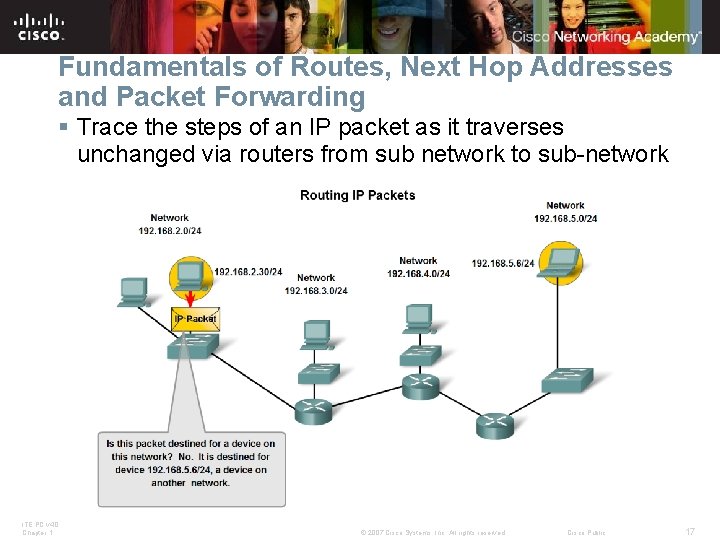
Fundamentals of Routes, Next Hop Addresses and Packet Forwarding § Trace the steps of an IP packet as it traverses unchanged via routers from sub network to sub-network ITE PC v 4. 0 Chapter 1 © 2007 Cisco Systems, Inc. All rights reserved. Cisco Public 17
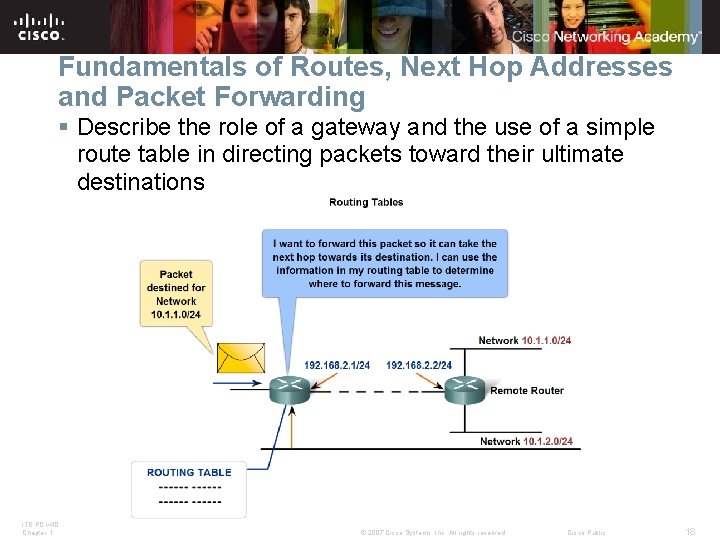
Fundamentals of Routes, Next Hop Addresses and Packet Forwarding § Describe the role of a gateway and the use of a simple route table in directing packets toward their ultimate destinations ITE PC v 4. 0 Chapter 1 © 2007 Cisco Systems, Inc. All rights reserved. Cisco Public 18
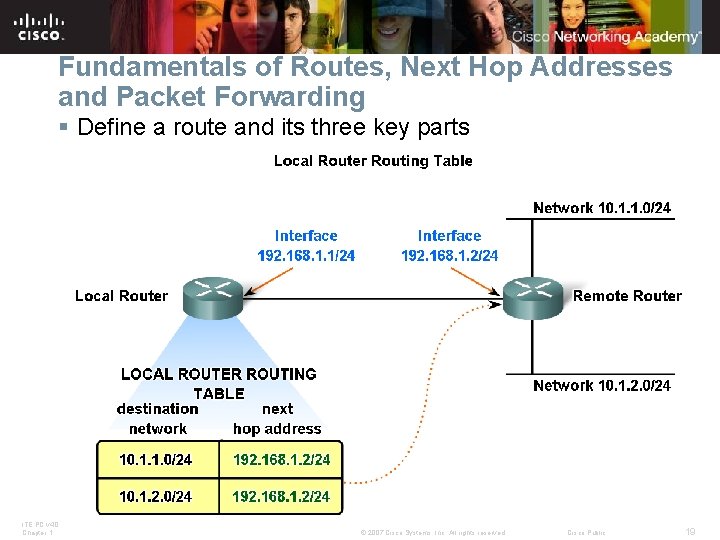
Fundamentals of Routes, Next Hop Addresses and Packet Forwarding § Define a route and its three key parts ITE PC v 4. 0 Chapter 1 © 2007 Cisco Systems, Inc. All rights reserved. Cisco Public 19
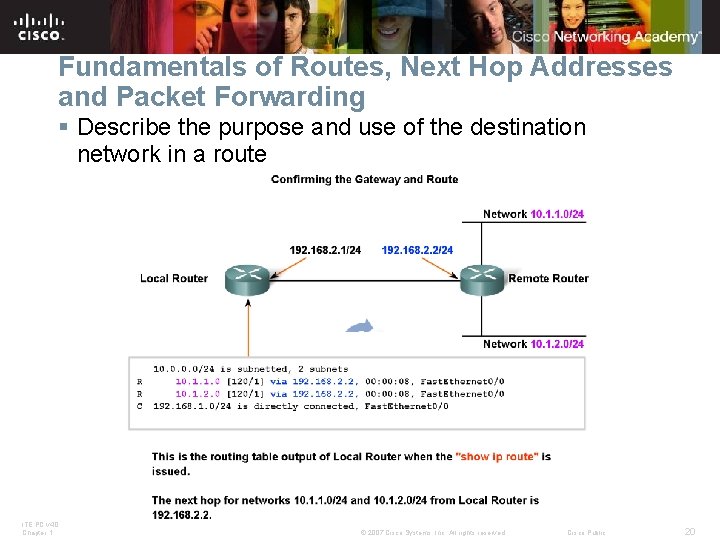
Fundamentals of Routes, Next Hop Addresses and Packet Forwarding § Describe the purpose and use of the destination network in a route ITE PC v 4. 0 Chapter 1 © 2007 Cisco Systems, Inc. All rights reserved. Cisco Public 20
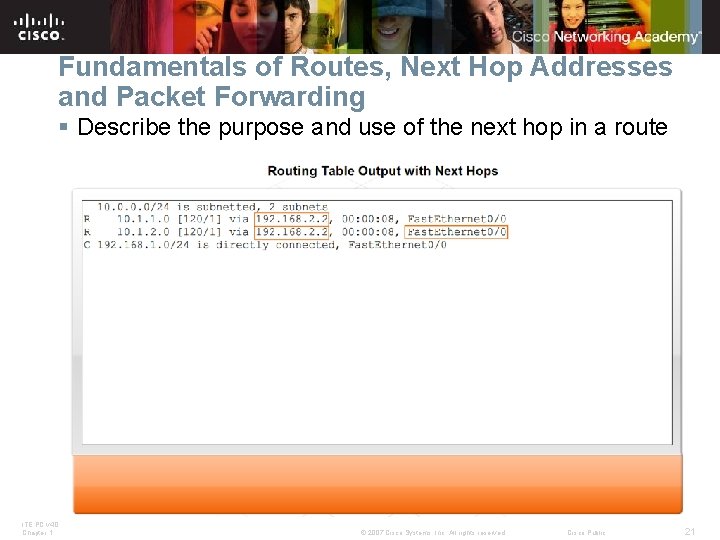
Fundamentals of Routes, Next Hop Addresses and Packet Forwarding § Describe the purpose and use of the next hop in a route ITE PC v 4. 0 Chapter 1 © 2007 Cisco Systems, Inc. All rights reserved. Cisco Public 21
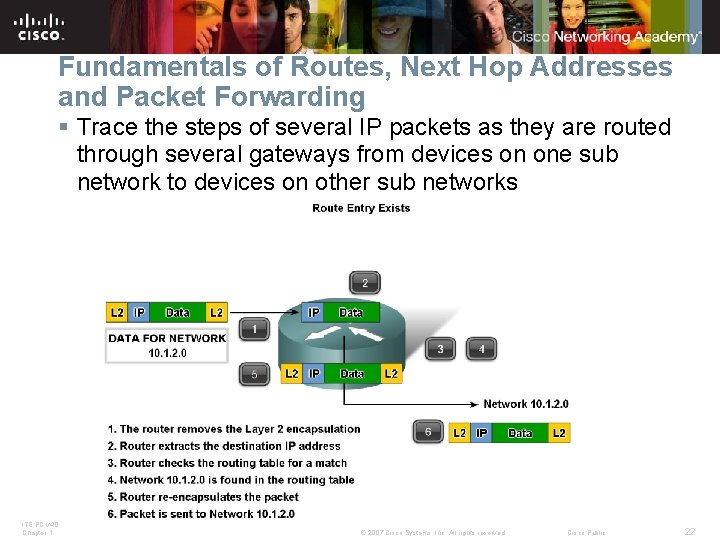
Fundamentals of Routes, Next Hop Addresses and Packet Forwarding § Trace the steps of several IP packets as they are routed through several gateways from devices on one sub network to devices on other sub networks ITE PC v 4. 0 Chapter 1 © 2007 Cisco Systems, Inc. All rights reserved. Cisco Public 22
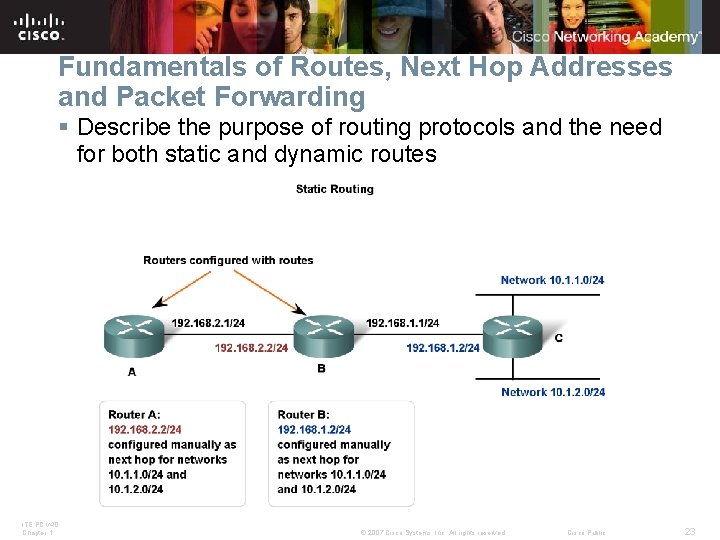
Fundamentals of Routes, Next Hop Addresses and Packet Forwarding § Describe the purpose of routing protocols and the need for both static and dynamic routes ITE PC v 4. 0 Chapter 1 © 2007 Cisco Systems, Inc. All rights reserved. Cisco Public 23
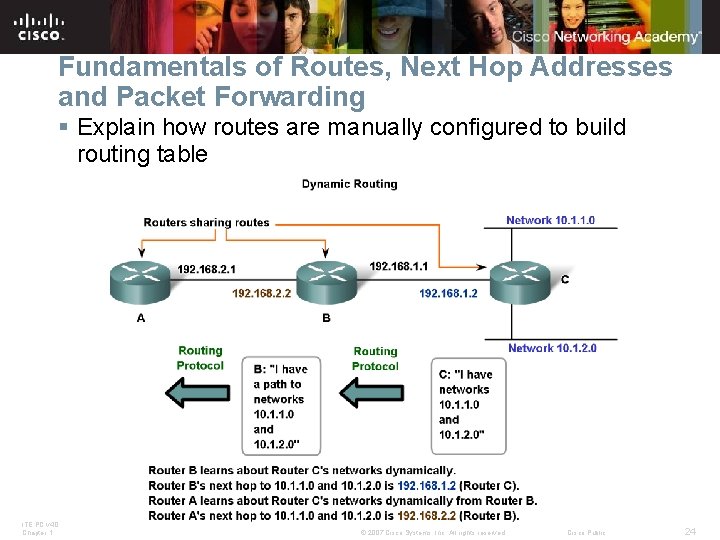
Fundamentals of Routes, Next Hop Addresses and Packet Forwarding § Explain how routes are manually configured to build routing table ITE PC v 4. 0 Chapter 1 © 2007 Cisco Systems, Inc. All rights reserved. Cisco Public 24
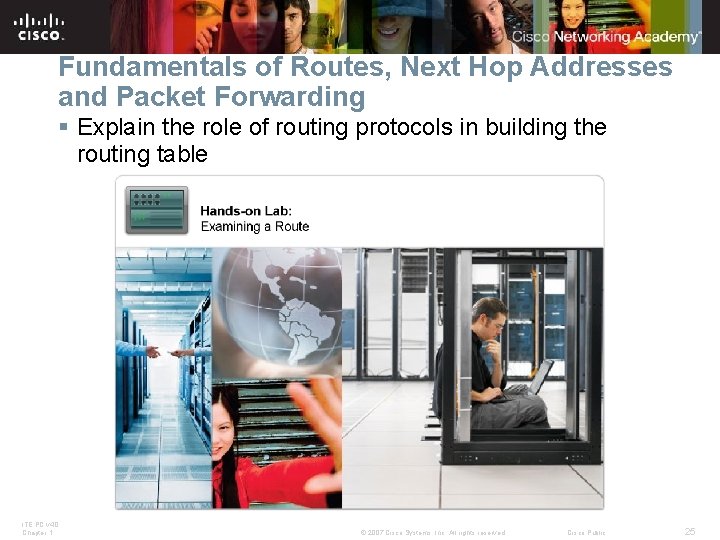
Fundamentals of Routes, Next Hop Addresses and Packet Forwarding § Explain the role of routing protocols in building the routing table ITE PC v 4. 0 Chapter 1 © 2007 Cisco Systems, Inc. All rights reserved. Cisco Public 25
Summary ITE PC v 4. 0 Chapter 1 © 2007 Cisco Systems, Inc. All rights reserved. Cisco Public 26
ITE PC v 4. 0 Chapter 1 © 2007 Cisco Systems, Inc. All rights reserved. Cisco Public 27