
Polyatomic Ions ate and ite NO 3 nitrate
- Slides: 29
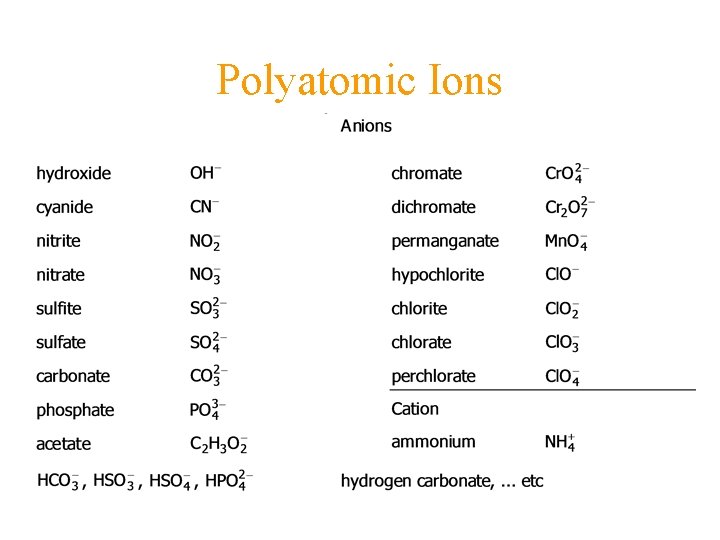
Polyatomic Ions
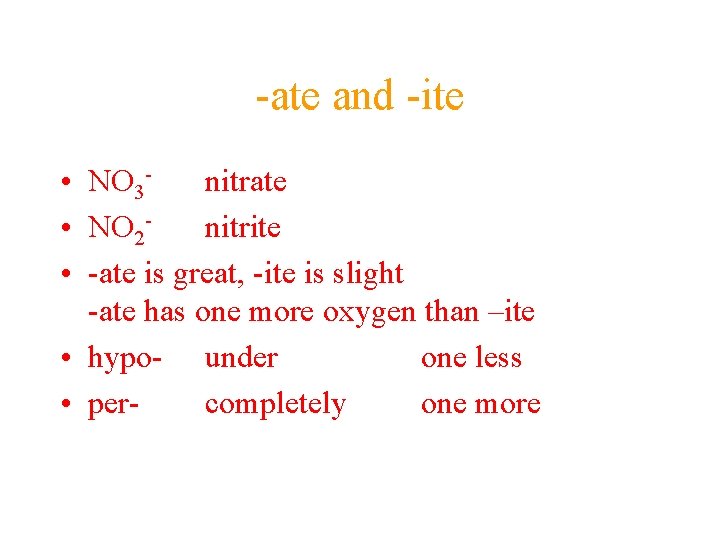
-ate and -ite • NO 3 nitrate • NO 2 nitrite • -ate is great, -ite is slight -ate has one more oxygen than –ite • hypo- under one less • percompletely one more
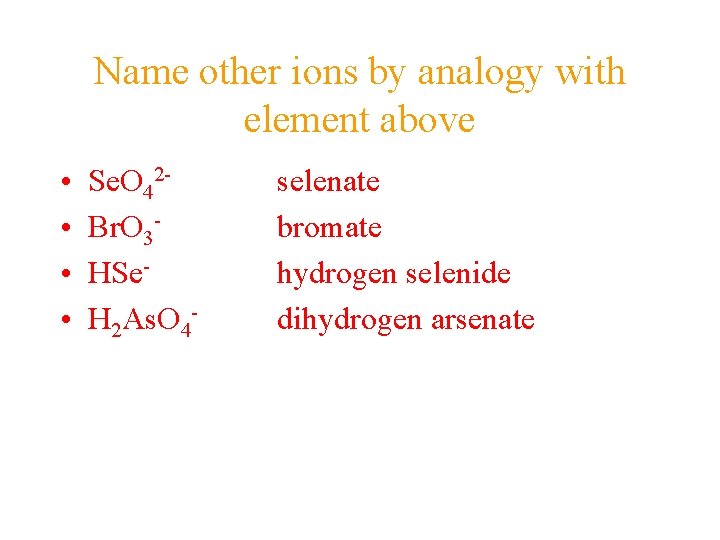
Name other ions by analogy with element above • • Se. O 42 Br. O 3 HSe. H 2 As. O 4 - selenate bromate hydrogen selenide dihydrogen arsenate
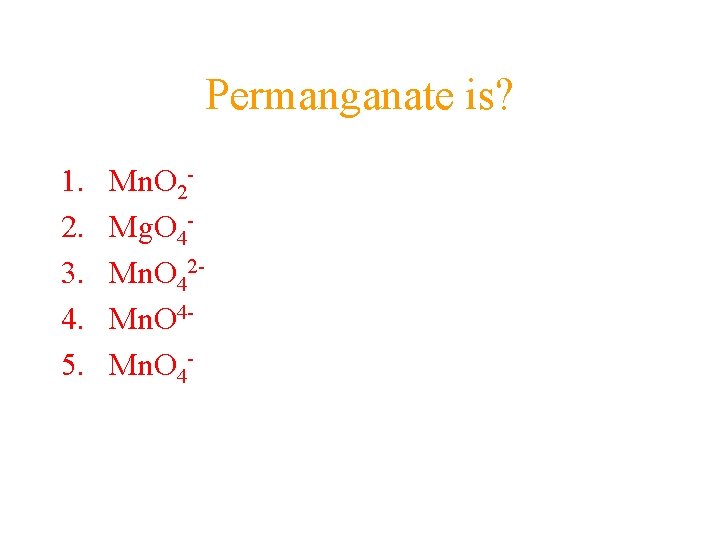
Permanganate is? 1. 2. 3. 4. 5. Mn. O 2 Mg. O 4 Mn. O 42 Mn. O 4 -
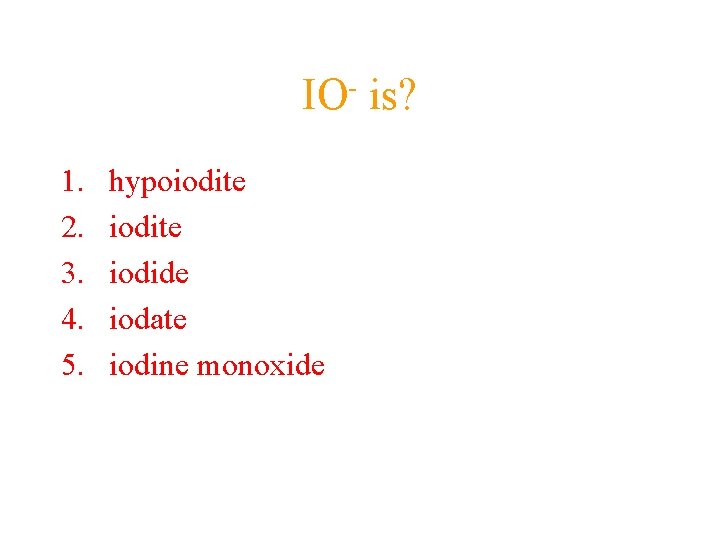
IO 1. 2. 3. 4. 5. hypoiodite iodide iodate iodine monoxide is?
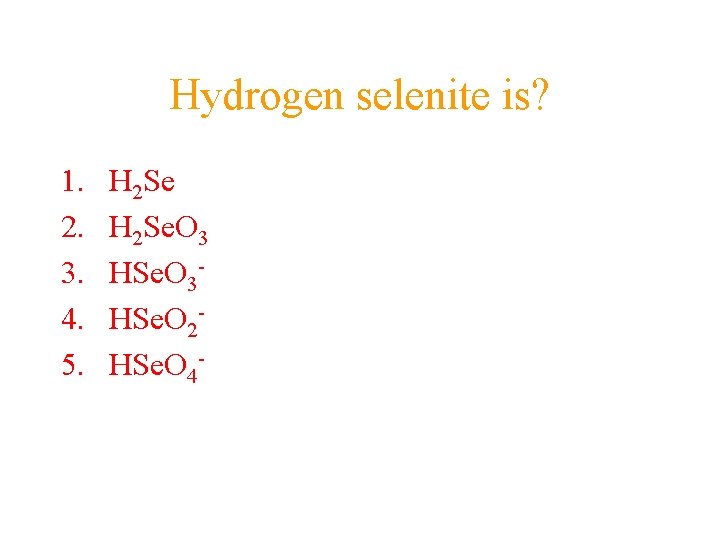
Hydrogen selenite is? 1. 2. 3. 4. 5. H 2 Se. O 3 HSe. O 3 HSe. O 2 HSe. O 4 -
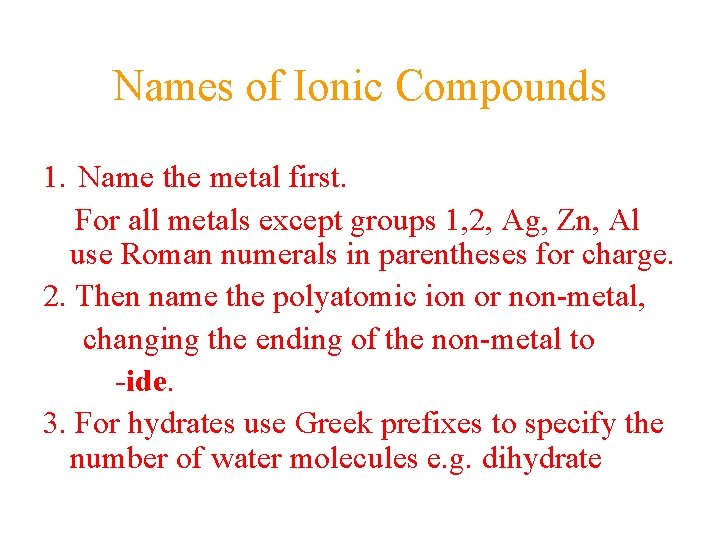
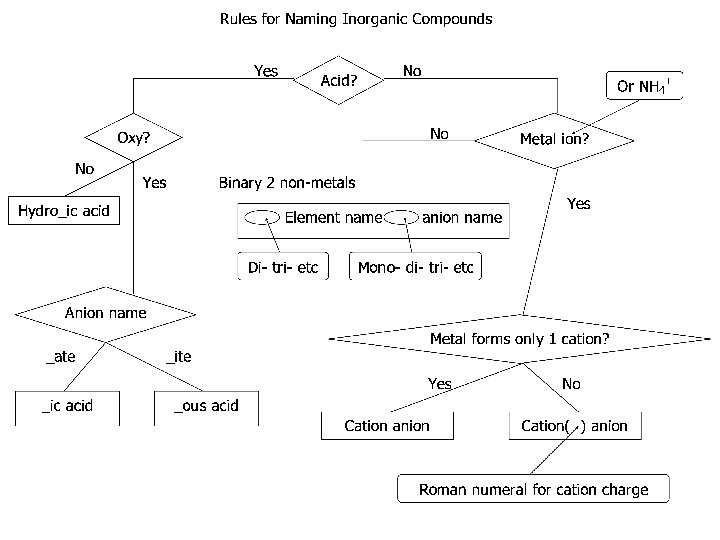
Names of Ionic Compounds 1. Name the metal first. For all metals except groups 1, 2, Ag, Zn, Al use Roman numerals in parentheses for charge. 2. Then name the polyatomic ion or non-metal, changing the ending of the non-metal to -ide. 3. For hydrates use Greek prefixes to specify the number of water molecules e. g. dihydrate
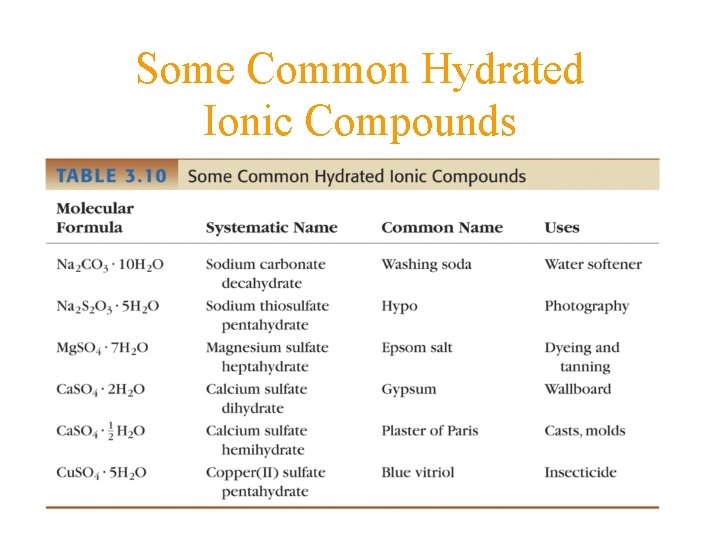
Some Common Hydrated Ionic Compounds
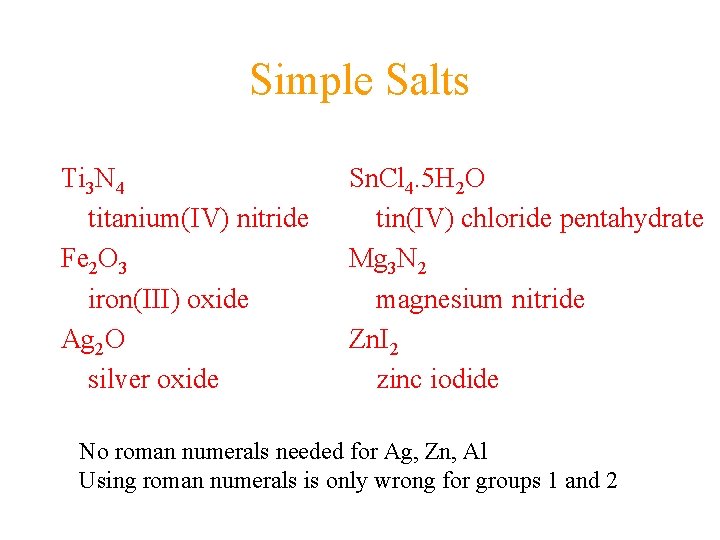
Simple Salts Ti 3 N 4 titanium(IV) nitride Fe 2 O 3 iron(III) oxide Ag 2 O silver oxide Sn. Cl 4. 5 H 2 O tin(IV) chloride pentahydrate Mg 3 N 2 magnesium nitride Zn. I 2 zinc iodide No roman numerals needed for Ag, Zn, Al Using roman numerals is only wrong for groups 1 and 2
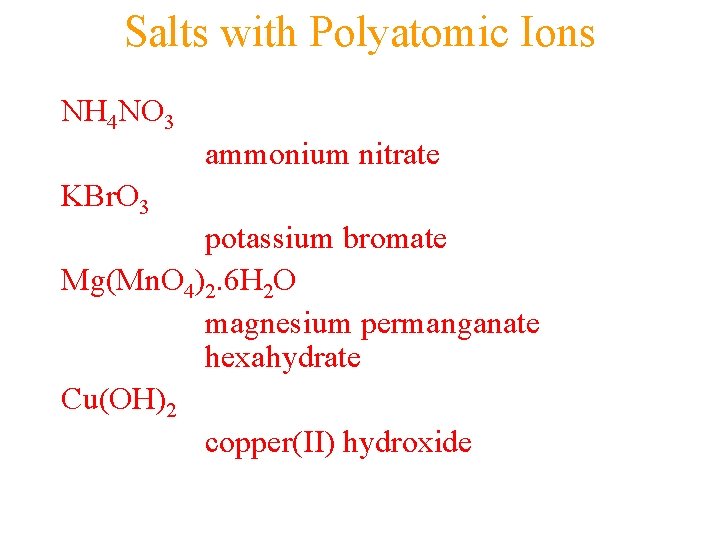
Salts with Polyatomic Ions NH 4 NO 3 ammonium nitrate KBr. O 3 potassium bromate Mg(Mn. O 4)2. 6 H 2 O magnesium permanganate hexahydrate Cu(OH)2 copper(II) hydroxide
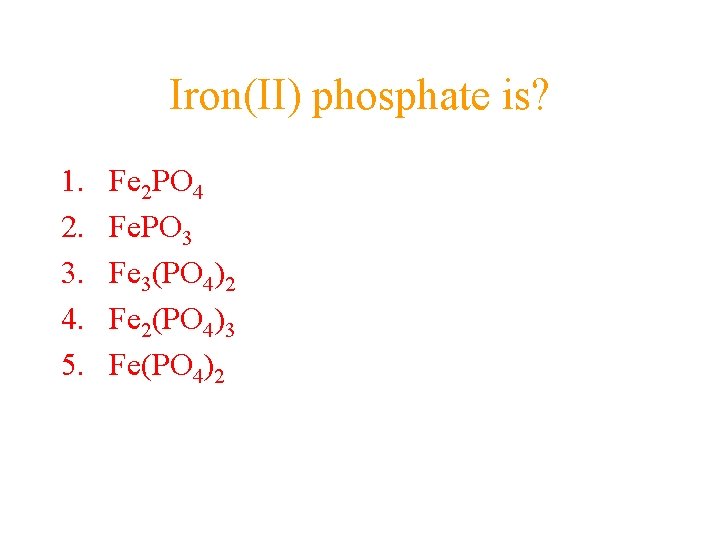
Iron(II) phosphate is? 1. 2. 3. 4. 5. Fe 2 PO 4 Fe. PO 3 Fe 3(PO 4)2 Fe 2(PO 4)3 Fe(PO 4)2
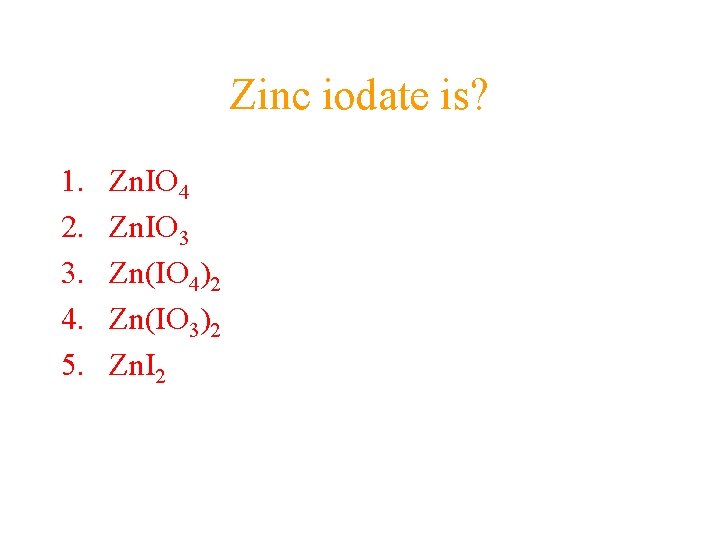
Zinc iodate is? 1. 2. 3. 4. 5. Zn. IO 4 Zn. IO 3 Zn(IO 4)2 Zn(IO 3)2 Zn. I 2
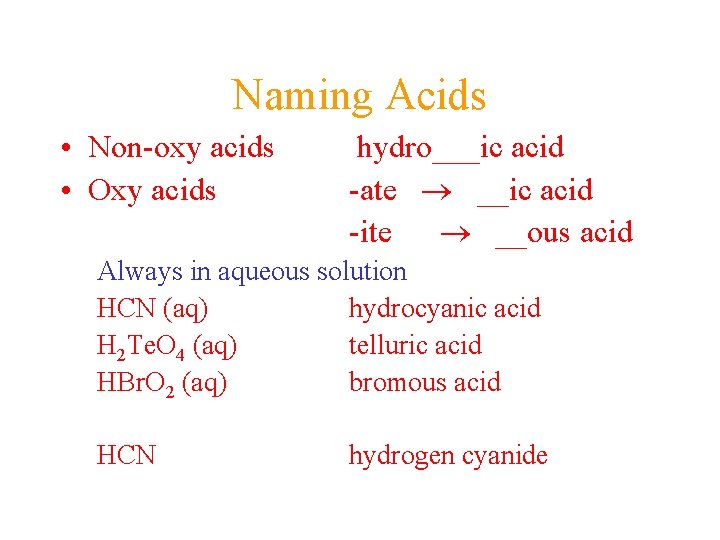
Naming Acids • Non-oxy acids • Oxy acids hydro___ic acid -ate __ic acid -ite __ous acid Always in aqueous solution HCN (aq) hydrocyanic acid H 2 Te. O 4 (aq) telluric acid HBr. O 2 (aq) bromous acid HCN hydrogen cyanide
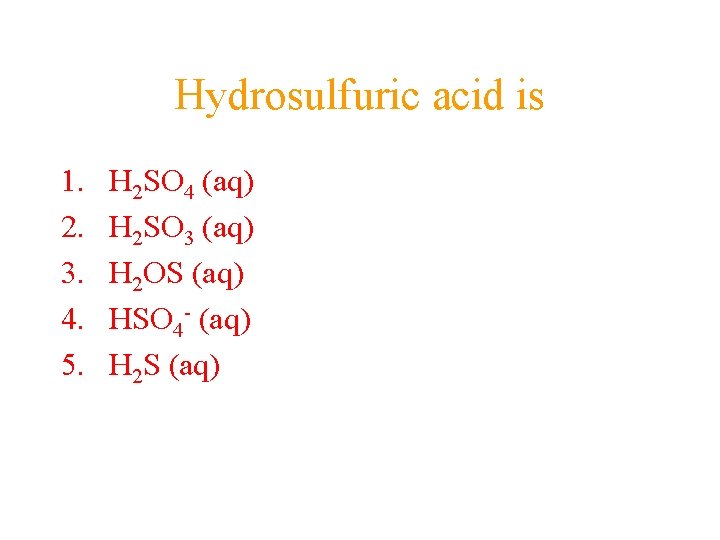
Hydrosulfuric acid is 1. 2. 3. 4. 5. H 2 SO 4 (aq) H 2 SO 3 (aq) H 2 OS (aq) HSO 4 - (aq) H 2 S (aq)
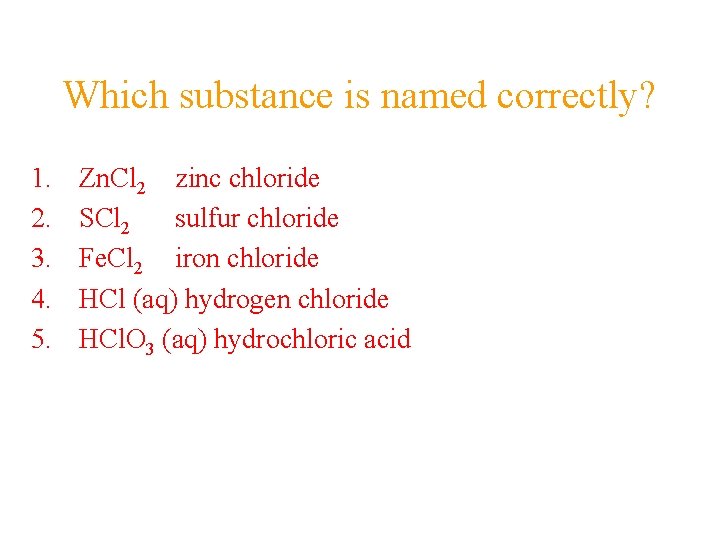
Which substance is named correctly? 1. 2. 3. 4. 5. Zn. Cl 2 zinc chloride SCl 2 sulfur chloride Fe. Cl 2 iron chloride HCl (aq) hydrogen chloride HCl. O 3 (aq) hydrochloric acid
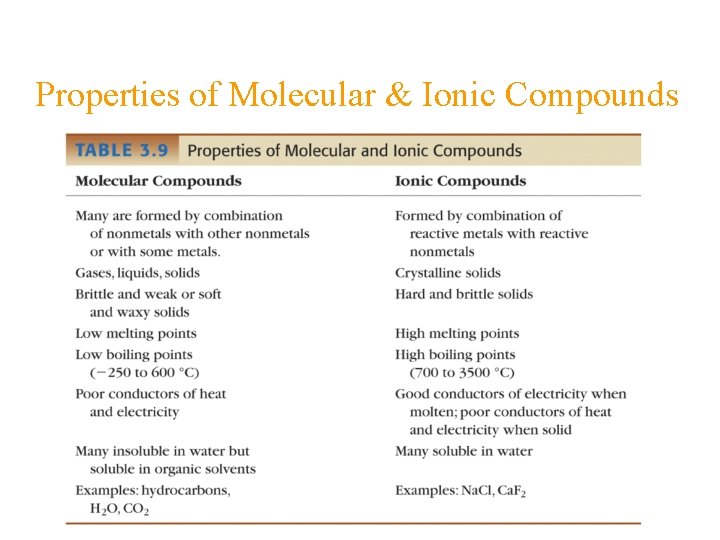
Properties of Molecular & Ionic Compounds
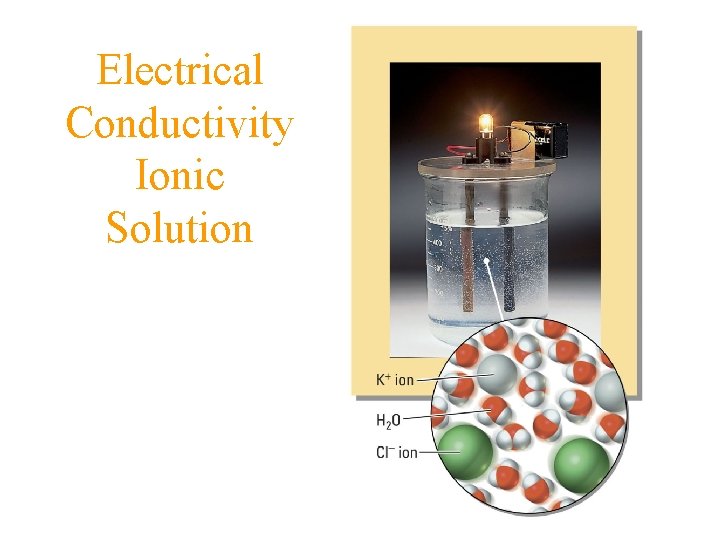
Electrical Conductivity Ionic Solution
Molar Mass Sum atomic masses represented by formula atomic masses in amu molecular mass in amu element molar masses in g/mol compound molar mass in g/mol Numerical values are the same
Percentage Composition Chemical formula gives the relative proportions by atom or mole Percentage composition gives the relative proportions by g (out of 100 g total)
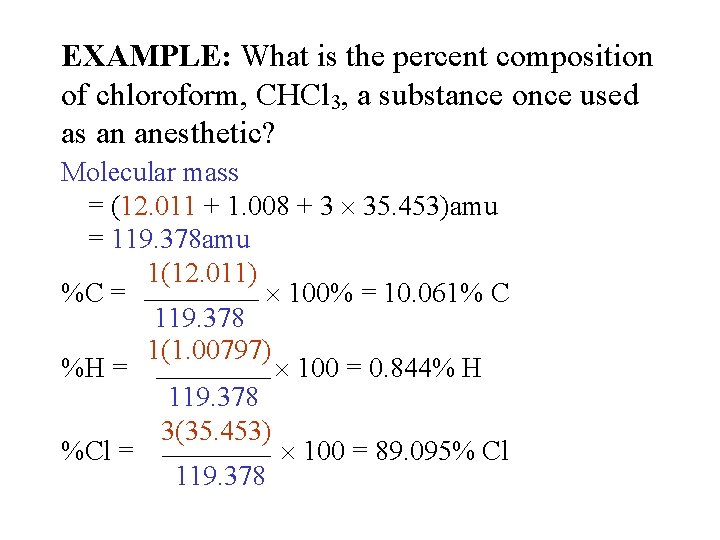
EXAMPLE: What is the percent composition of chloroform, CHCl 3, a substance once used as an anesthetic? Molecular mass = (12. 011 + 1. 008 + 3 35. 453)amu = 119. 378 amu 1(12. 011) %C = 100% = 10. 061% C 119. 378 1(1. 00797) %H = 100 = 0. 844% H 119. 378 3(35. 453) %Cl = 100 = 89. 095% Cl 119. 378
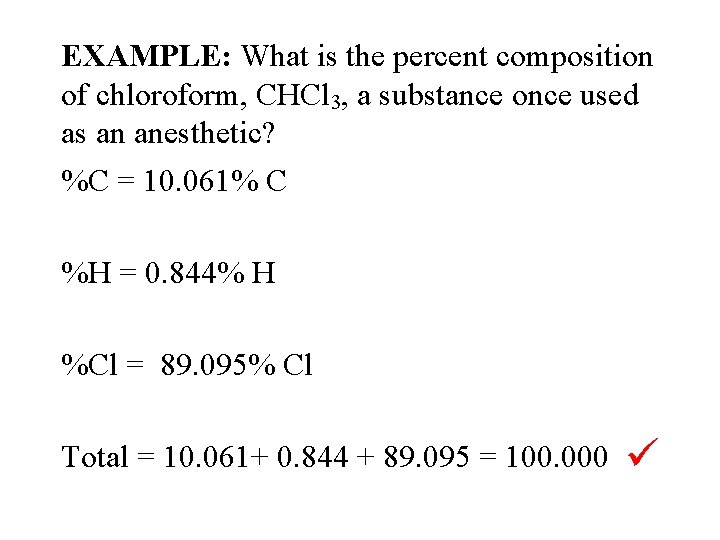
EXAMPLE: What is the percent composition of chloroform, CHCl 3, a substance once used as an anesthetic? %C = 10. 061% C %H = 0. 844% H %Cl = 89. 095% Cl Total = 10. 061+ 0. 844 + 89. 095 = 100. 000
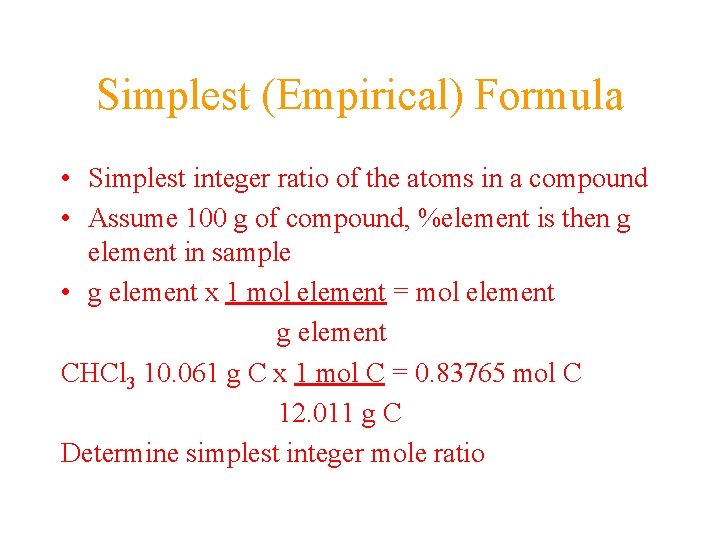
Simplest (Empirical) Formula • Simplest integer ratio of the atoms in a compound • Assume 100 g of compound, %element is then g element in sample • g element x 1 mol element = mol element g element CHCl 3 10. 061 g C x 1 mol C = 0. 83765 mol C 12. 011 g C Determine simplest integer mole ratio
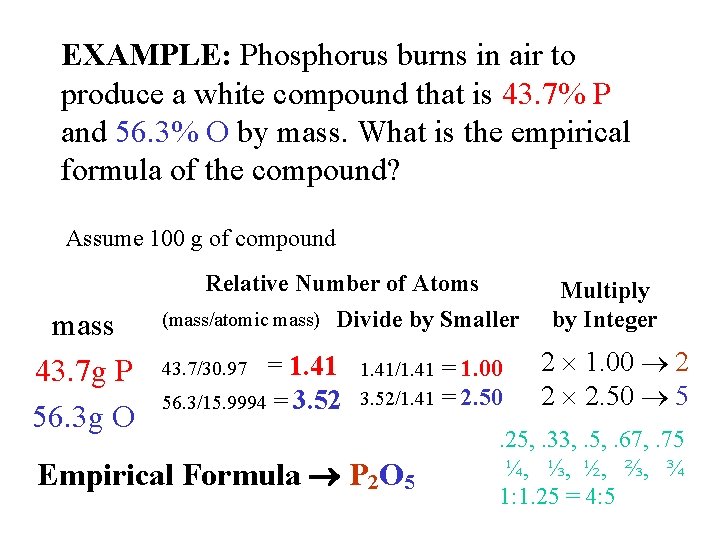
EXAMPLE: Phosphorus burns in air to produce a white compound that is 43. 7% P and 56. 3% O by mass. What is the empirical formula of the compound? Assume 100 g of compound mass 43. 7 g P 56. 3 g O Relative Number of Atoms (mass/atomic mass) Divide by Smaller = 1. 41 56. 3/15. 9994 = 3. 52 43. 7/30. 97 1. 41/1. 41 3. 52/1. 41 Empirical Formula P 2 O 5 = 1. 00 = 2. 50 Multiply by Integer 2 1. 00 2 2 2. 50 5 . 25, . 33, . 5, . 67, . 75 ¼, ⅓, ½, ⅔, ¾ 1: 1. 25 = 4: 5
Molecular Formula • The exact proportions of the elements that are contained in a molecule • An integer multiple (X) of the empirical formula
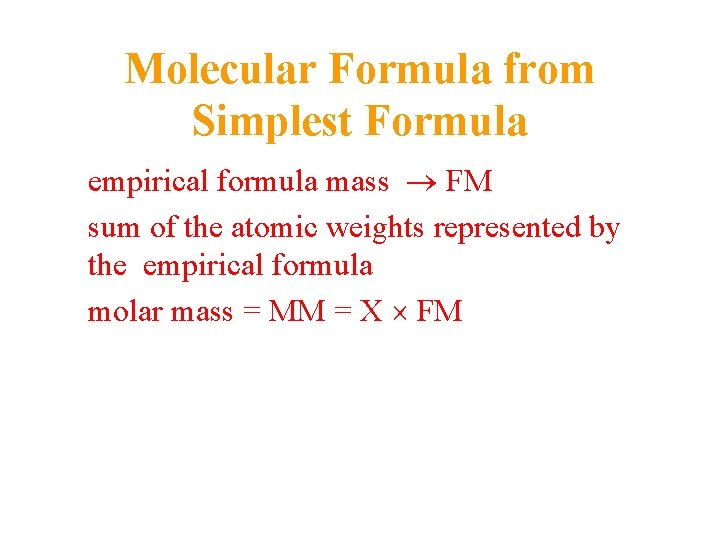
Molecular Formula from Simplest Formula empirical formula mass FM sum of the atomic weights represented by the empirical formula molar mass = MM = X FM
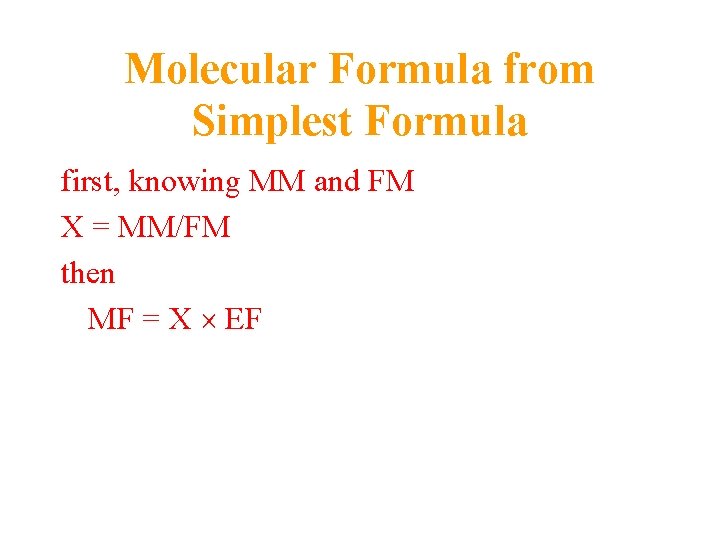
Molecular Formula from Simplest Formula first, knowing MM and FM X = MM/FM then MF = X EF
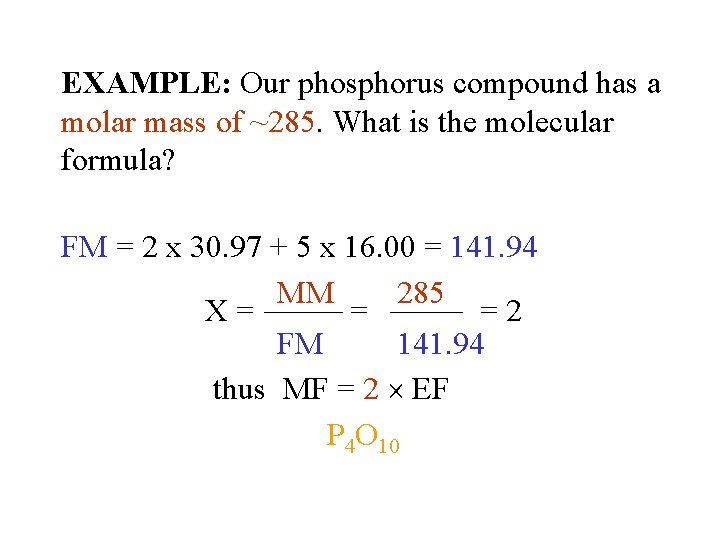
EXAMPLE: Our phosphorus compound has a molar mass of ~285. What is the molecular formula? FM = 2 x 30. 97 + 5 x 16. 00 = 141. 94 MM 285 X= = =2 FM 141. 94 thus MF = 2 EF P 4 O 10
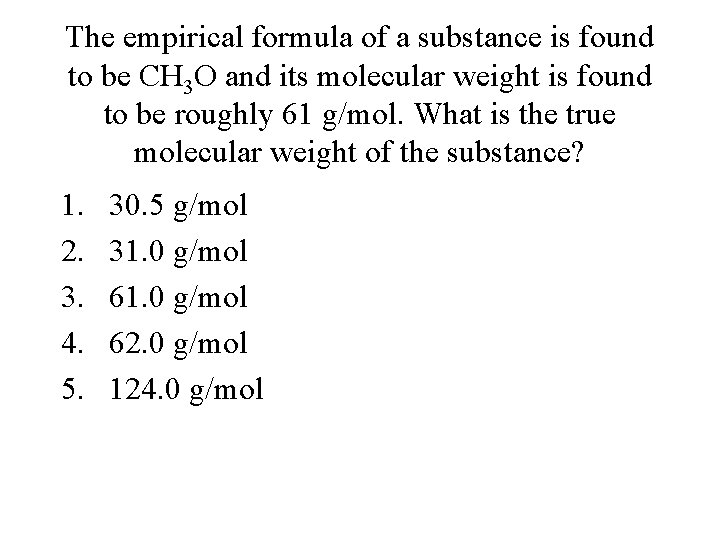
The empirical formula of a substance is found to be CH 3 O and its molecular weight is found to be roughly 61 g/mol. What is the true molecular weight of the substance? 1. 2. 3. 4. 5. 30. 5 g/mol 31. 0 g/mol 62. 0 g/mol 124. 0 g/mol