College Making It Happen A Guide for California


- Slides: 38
College: Making It Happen A Guide for California Middle School Families and Educators
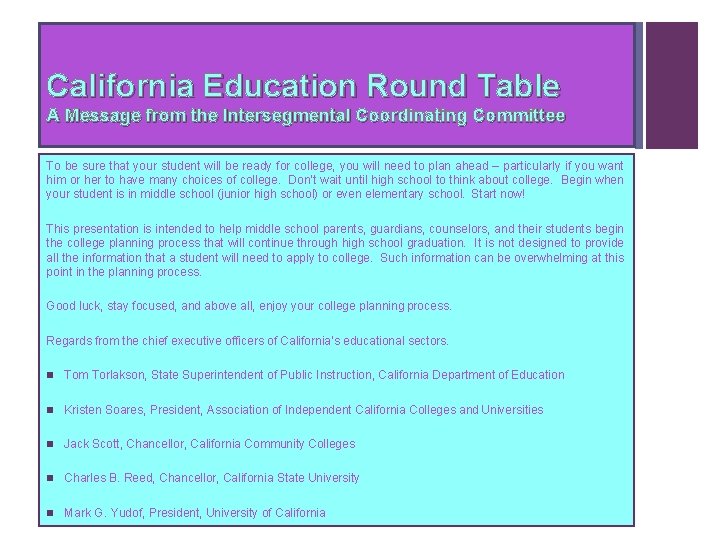
California Education Round Table A Message from the Intersegmental Coordinating Committee To be sure that your student will be ready for college, you will need to plan ahead – particularly if you want him or her to have many choices of college. Don’t wait until high school to think about college. Begin when your student is in middle school (junior high school) or even elementary school. Start now! This presentation is intended to help middle school parents, guardians, counselors, and their students begin the college planning process that will continue through high school graduation. It is not designed to provide all the information that a student will need to apply to college. Such information can be overwhelming at this point in the planning process. Good luck, stay focused, and above all, enjoy your college planning process. Regards from the chief executive officers of California’s educational sectors. n Tom Torlakson, State Superintendent of Public Instruction, California Department of Education n Kristen Soares, President, Association of Independent California Colleges and Universities n Jack Scott, Chancellor, California Community Colleges n Charles B. Reed, Chancellor, California State University n Mark G. Yudof, President, University of California
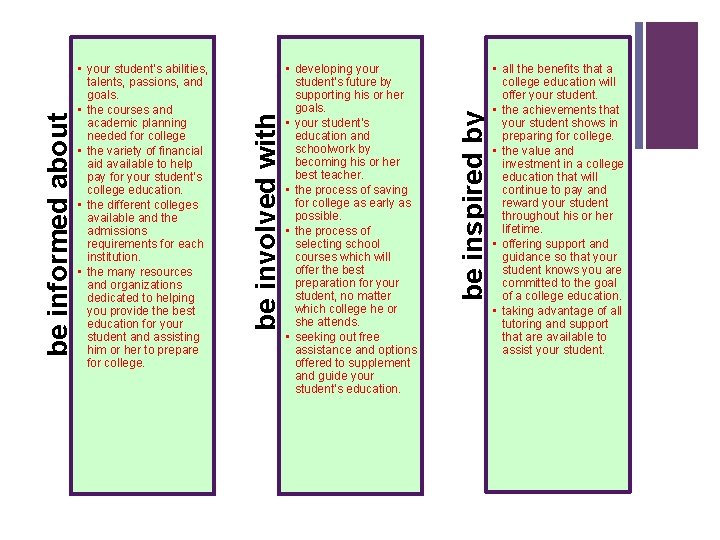
• developing your student’s future by supporting his or her goals. • your student’s education and schoolwork by becoming his or her best teacher. • the process of saving for college as early as possible. • the process of selecting school courses which will offer the best preparation for your student, no matter which college he or she attends. • seeking out free assistance and options offered to supplement and guide your student’s education. be inspired by be involved with be informed about • your student’s abilities, talents, passions, and goals. • the courses and academic planning needed for college • the variety of financial aid available to help pay for your student’s college education. • the different colleges available and the admissions requirements for each institution. • the many resources and organizations dedicated to helping you provide the best education for your student and assisting him or her to prepare for college. • all the benefits that a college education will offer your student. • the achievements that your student shows in preparing for college. • the value and investment in a college education that will continue to pay and reward your student throughout his or her lifetime. • offering support and guidance so that your student knows you are committed to the goal of a college education. • taking advantage of all tutoring and support that are available to assist your student.
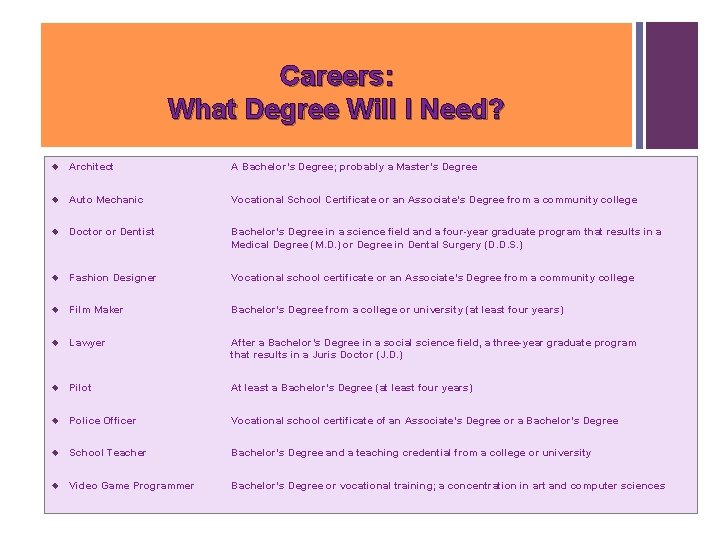
Careers: What Degree Will I Need? u Architect A Bachelor’s Degree; probably a Master’s Degree u Auto Mechanic Vocational School Certificate or an Associate’s Degree from a community college u Doctor or Dentist Bachelor’s Degree in a science field and a four-year graduate program that results in a Medical Degree (M. D. ) or Degree in Dental Surgery (D. D. S. ) u Fashion Designer Vocational school certificate or an Associate’s Degree from a community college u Film Maker Bachelor’s Degree from a college or university (at least four years) u Lawyer After a Bachelor’s Degree in a social science field, a three-year graduate program that results in a Juris Doctor (J. D. ) u Pilot At least a Bachelor’s Degree (at least four years) u Police Officer Vocational school certificate of an Associate’s Degree or a Bachelor’s Degree u School Teacher Bachelor’s Degree and a teaching credential from a college or university u Video Game Programmer Bachelor’s Degree or vocational training; a concentration in art and computer sciences
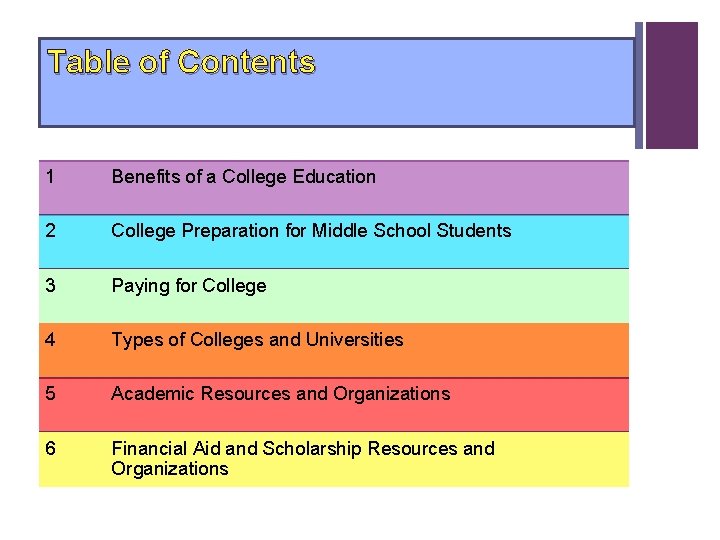
Table of Contents 1 Benefits of a College Education 2 College Preparation for Middle School Students 3 Paying for College 4 Types of Colleges and Universities 5 Academic Resources and Organizations 6 Financial Aid and Scholarship Resources and Organizations
Chapter 1 Benefits of a College Education
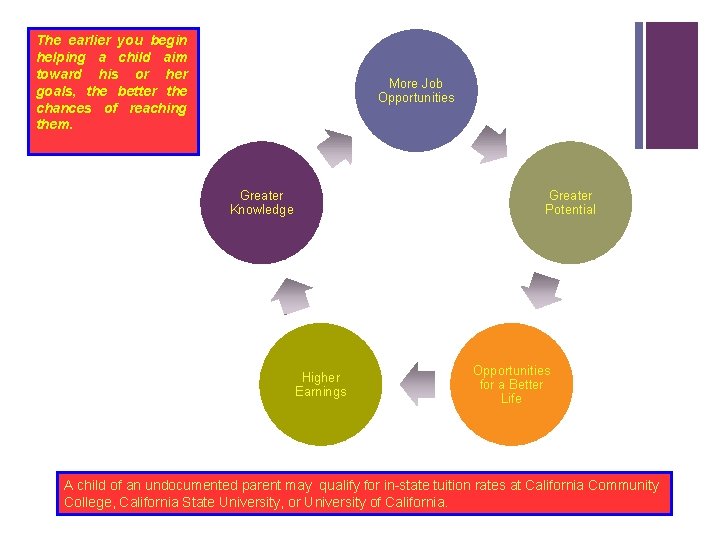
The earlier you begin helping a child aim toward his or her goals, the better the chances of reaching them. More Job Opportunities Greater Knowledge Greater Potential Higher Earnings Opportunities for a Better Life A child of an undocumented parent may qualify for in-state tuition rates at California Community College, California State University, or University of California.
Chapter 2 College Preparation for Middle School Students
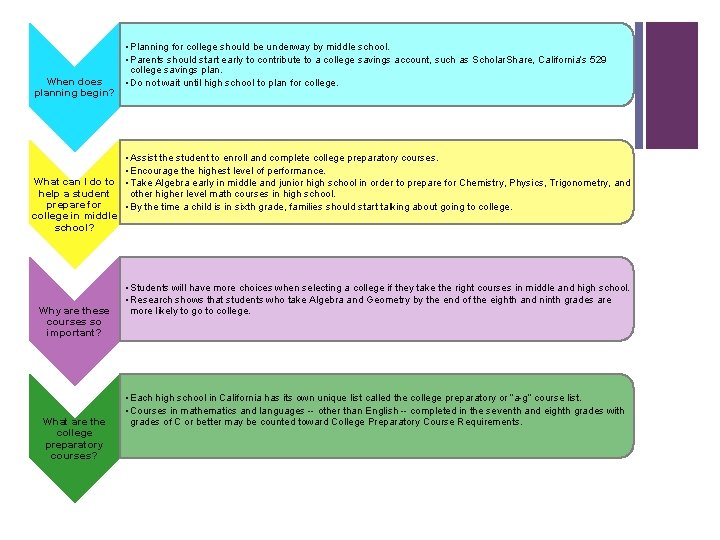
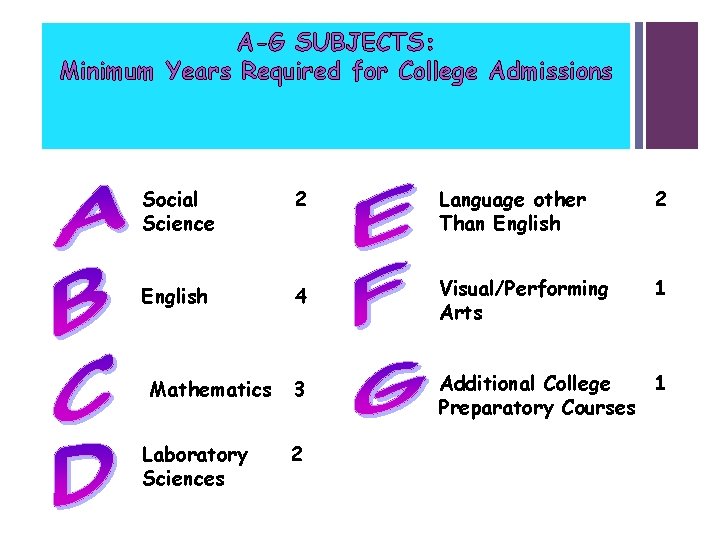
When does planning begin? • Planning for college should be underway by middle school. • Parents should start early to contribute to a college savings account, such as Scholar. Share, California’s 529 college savings plan. • Do not wait until high school to plan for college. • Assist the student to enroll and complete college preparatory courses. • Encourage the highest level of performance. What can I do to • Take Algebra early in middle and junior high school in order to prepare for Chemistry, Physics, Trigonometry, and help a student other higher level math courses in high school. prepare for • By the time a child is in sixth grade, families should start talking about going to college in middle school? Why are these courses so important? What are the college preparatory courses? • Students will have more choices when selecting a college if they take the right courses in middle and high school. • Research shows that students who take Algebra and Geometry by the end of the eighth and ninth grades are more likely to go to college. • Each high school in California has its own unique list called the college preparatory or “a-g” course list. • Courses in mathematics and languages -- other than English -- completed in the seventh and eighth grades with grades of C or better may be counted toward College Preparatory Course Requirements.
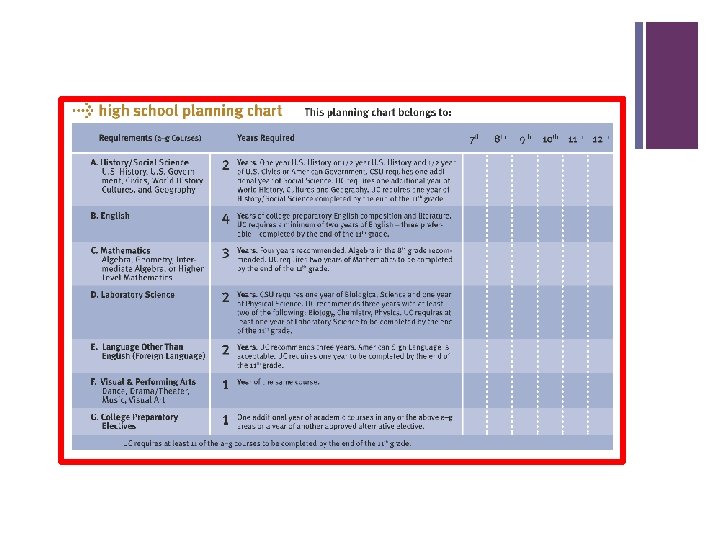
A-G SUBJECTS: Minimum Years Required for College Admissions Social Science 2 Language other Than English 2 English 4 Visual/Performing Arts 1 3 Additional College 1 Preparatory Courses Mathematics Laboratory Sciences 2
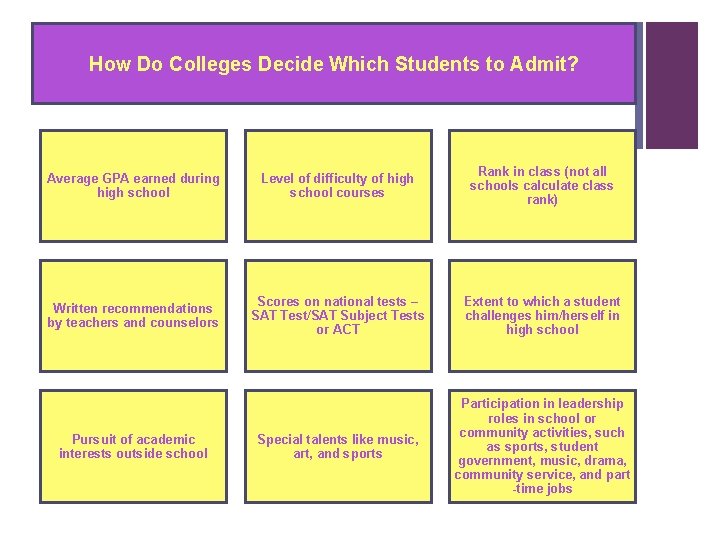
How Do Colleges Decide Which Students to Admit? Average GPA earned during high school Level of difficulty of high school courses Rank in class (not all schools calculate class rank) Written recommendations by teachers and counselors Scores on national tests – SAT Test/SAT Subject Tests or ACT Extent to which a student challenges him/herself in high school Special talents like music, art, and sports Participation in leadership roles in school or community activities, such as sports, student government, music, drama, community service, and part -time jobs Pursuit of academic interests outside school
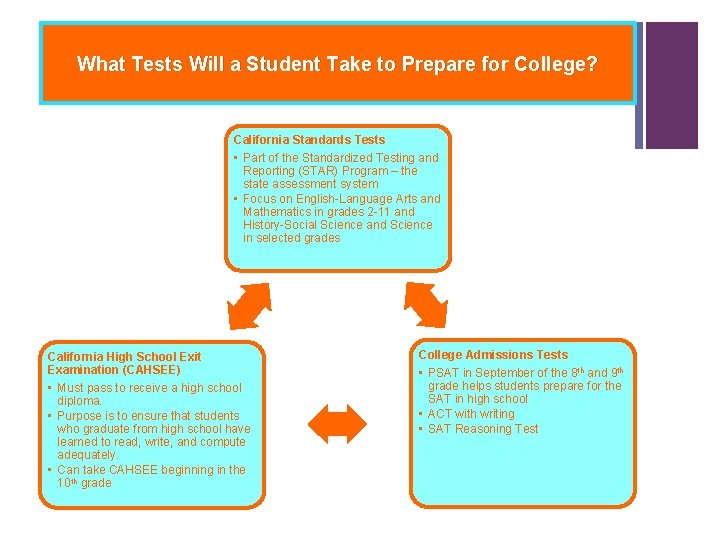
What Tests Will a Student Take to Prepare for College? California Standards Tests • Part of the Standardized Testing and Reporting (STAR) Program – the state assessment system • Focus on English-Language Arts and Mathematics in grades 2 -11 and History-Social Science and Science in selected grades California High School Exit Examination (CAHSEE) • Must pass to receive a high school diploma. • Purpose is to ensure that students who graduate from high school have learned to read, write, and compute adequately. • Can take CAHSEE beginning in the 10 th grade College Admissions Tests • PSAT in September of the 8 th and 9 th grade helps students prepare for the SAT in high school • ACT with writing • SAT Reasoning Test
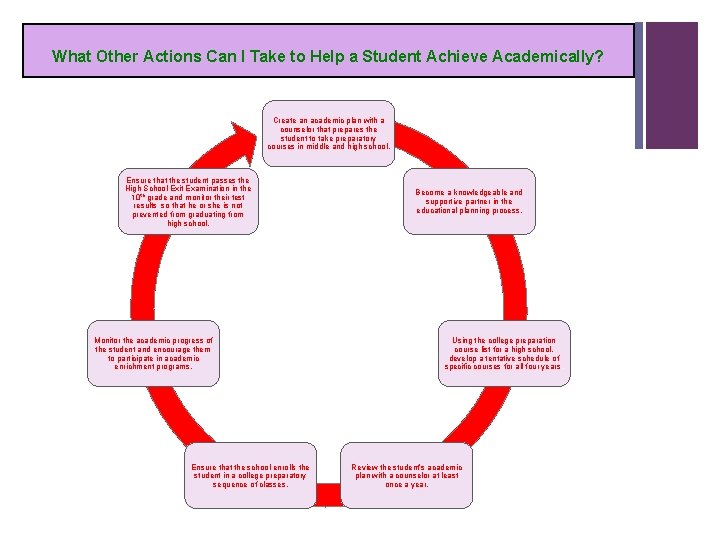
What Other Actions Can I Take to Help a Student Achieve Academically? Create an academic plan with a counselor that prepares the student to take preparatory courses in middle and high school. Ensure that the student passes the High School Exit Examination in the 10 th grade and monitor their test results so that he or she is not prevented from graduating from high school. Monitor the academic progress of the student and encourage them to participate in academic enrichment programs. Ensure that the school enrolls the student in a college preparatory sequence of classes. Become a knowledgeable and supportive partner in the educational planning process. Using the college preparation course list for a high school, develop a tentative schedule of specific courses for all four years. Review the student’s academic plan with a counselor at least once a year.
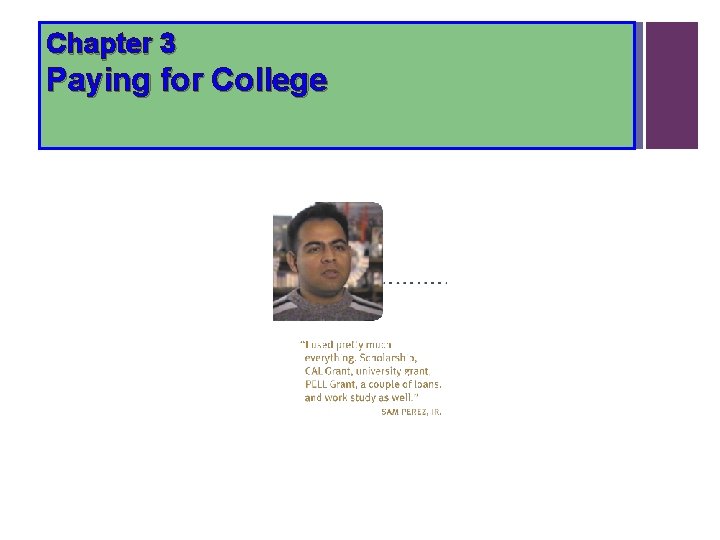
Chapter 3 Paying for College
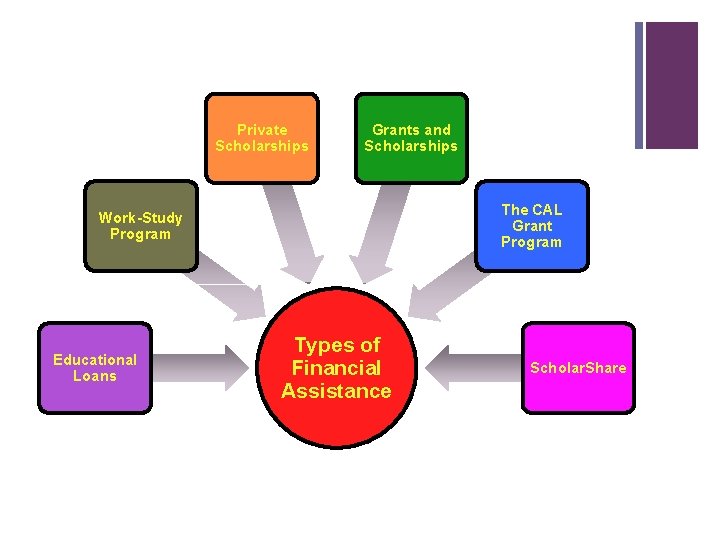
Private Scholarships Grants and Scholarships The CAL Grant Program Work-Study Program Educational Loans Types of Financial Assistance Scholar. Share
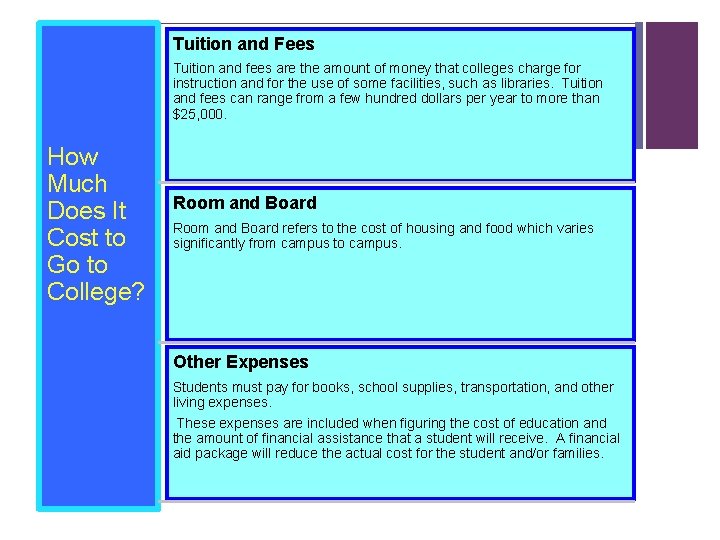
Tuition and Fees Tuition and fees are the amount of money that colleges charge for instruction and for the use of some facilities, such as libraries. Tuition and fees can range from a few hundred dollars per year to more than $25, 000. How Much Does It Cost to Go to College? Room and Board refers to the cost of housing and food which varies significantly from campus to campus. Other Expenses Students must pay for books, school supplies, transportation, and other living expenses. These expenses are included when figuring the cost of education and the amount of financial assistance that a student will receive. A financial aid package will reduce the actual cost for the student and/or families.
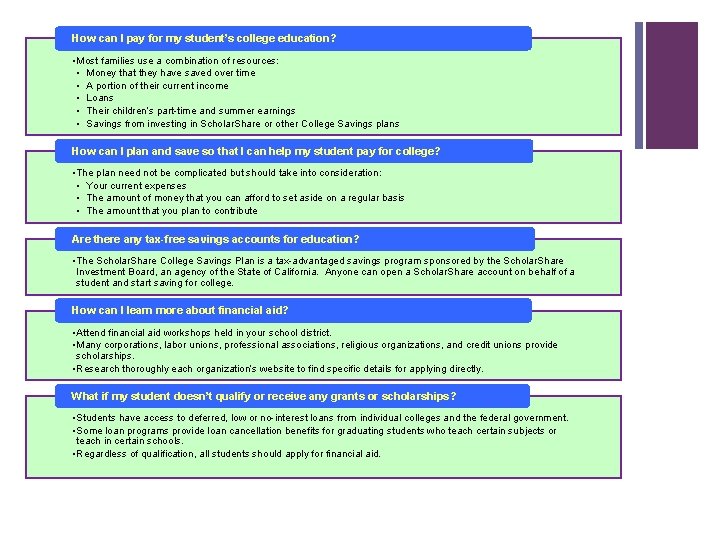
How can I pay for my student’s college education? • Most families use a combination of resources: • Money that they have saved over time • A portion of their current income • Loans • Their children’s part-time and summer earnings • Savings from investing in Scholar. Share or other College Savings plans How can I plan and save so that I can help my student pay for college? • The plan need not be complicated but should take into consideration: • Your current expenses • The amount of money that you can afford to set aside on a regular basis • The amount that you plan to contribute Are there any tax-free savings accounts for education? • The Scholar. Share College Savings Plan is a tax-advantaged savings program sponsored by the Scholar. Share Investment Board, an agency of the State of California. Anyone can open a Scholar. Share account on behalf of a student and start saving for college. How can I learn more about financial aid? • Attend financial aid workshops held in your school district. • Many corporations, labor unions, professional associations, religious organizations, and credit unions provide scholarships. • Research thoroughly each organization’s website to find specific details for applying directly. What if my student doesn’t qualify or receive any grants or scholarships? • Students have access to deferred, low or no-interest loans from individual colleges and the federal government. • Some loan programs provide loan cancellation benefits for graduating students who teach certain subjects or teach in certain schools. • Regardless of qualification, all students should apply for financial aid.
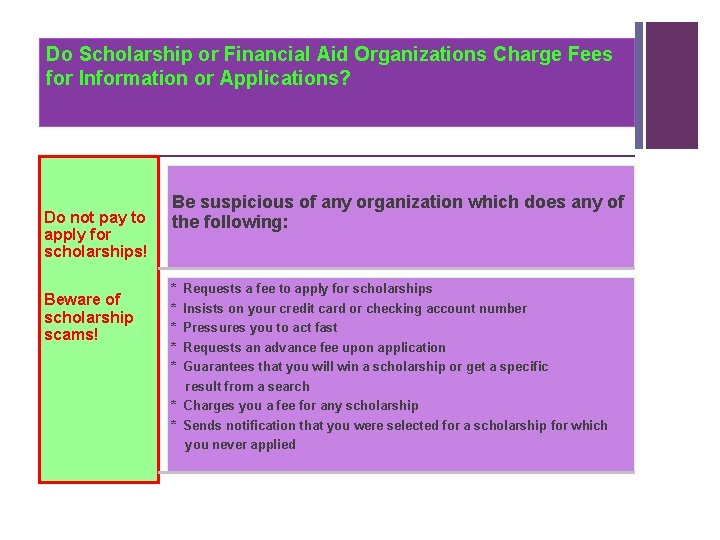
Do Scholarship or Financial Aid Organizations Charge Fees for Information or Applications? Do not pay to apply for scholarships! Beware of scholarship scams! Be suspicious of any organization which does any of the following: * * * Requests a fee to apply for scholarships Insists on your credit card or checking account number Pressures you to act fast Requests an advance fee upon application Guarantees that you will win a scholarship or get a specific result from a search * Charges you a fee for any scholarship * Sends notification that you were selected for a scholarship for which you never applied
Chapter 4 Types of Colleges and Universities
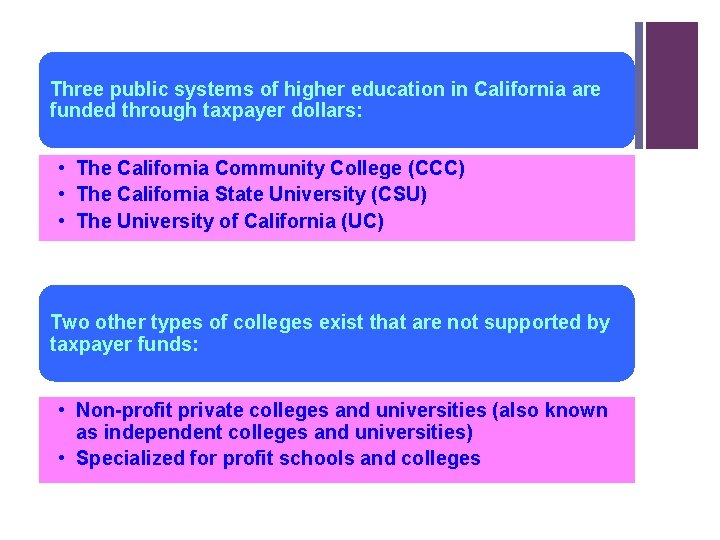
Three public systems of higher education in California are funded through taxpayer dollars: • The California Community College (CCC) • The California State University (CSU) • The University of California (UC) Two other types of colleges exist that are not supported by taxpayer funds: • Non-profit private colleges and universities (also known as independent colleges and universities) • Specialized for profit schools and colleges
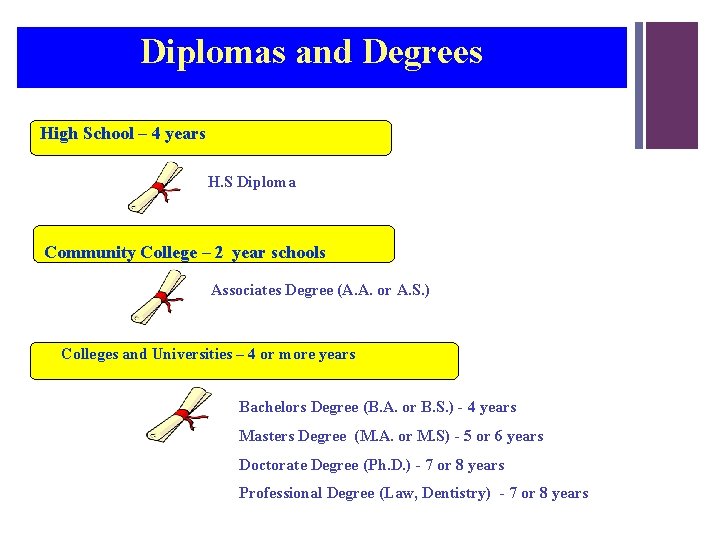
Diplomas and Degrees High School – 4 years H. S Diploma Community College – 2 year schools Associates Degree (A. A. or A. S. ) Colleges and Universities – 4 or more years Bachelors Degree (B. A. or B. S. ) - 4 years Masters Degree (M. A. or M. S) - 5 or 6 years Doctorate Degree (Ph. D. ) - 7 or 8 years Professional Degree (Law, Dentistry) - 7 or 8 years
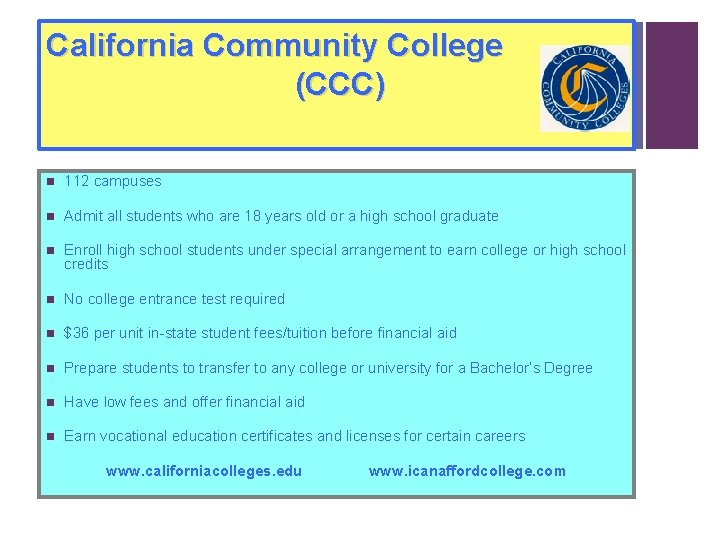
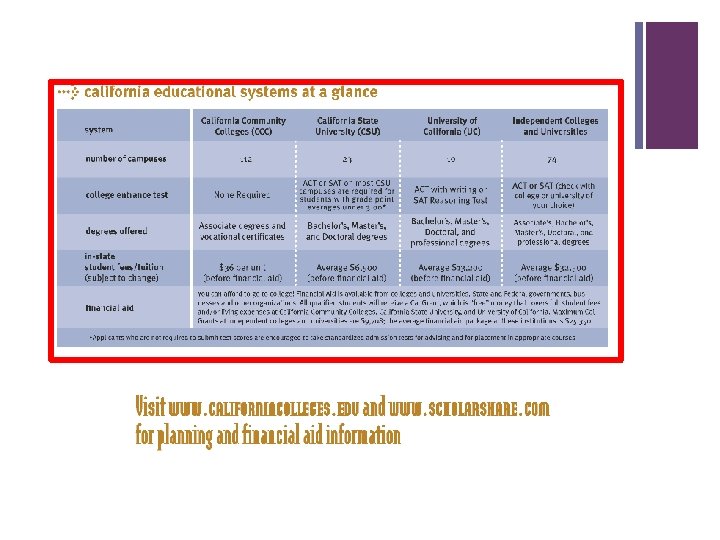
California Community College (CCC) n 112 campuses n Admit all students who are 18 years old or a high school graduate n Enroll high school students under special arrangement to earn college or high school credits n No college entrance test required n $36 per unit in-state student fees/tuition before financial aid n Prepare students to transfer to any college or university for a Bachelor’s Degree n Have low fees and offer financial aid n Earn vocational education certificates and licenses for certain careers www. californiacolleges. edu www. icanaffordcollege. com
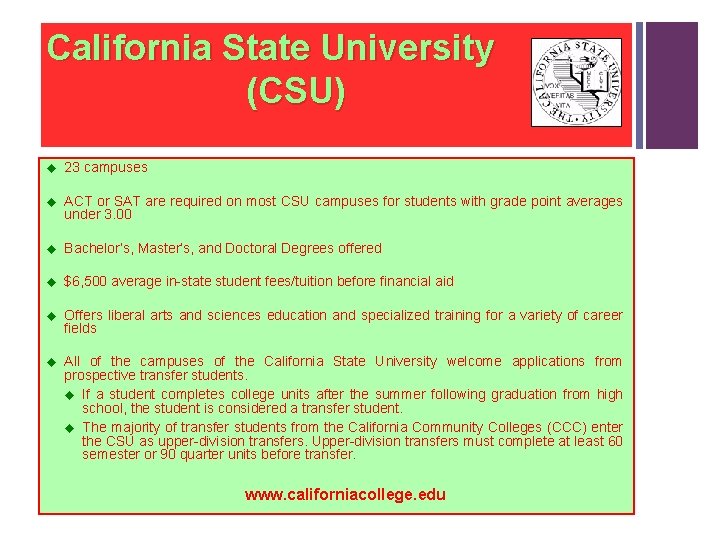
California State University (CSU) u 23 campuses u ACT or SAT are required on most CSU campuses for students with grade point averages under 3. 00 u Bachelor’s, Master’s, and Doctoral Degrees offered u $6, 500 average in-state student fees/tuition before financial aid u Offers liberal arts and sciences education and specialized training for a variety of career fields u All of the campuses of the California State University welcome applications from prospective transfer students. u If a student completes college units after the summer following graduation from high school, the student is considered a transfer student. u The majority of transfer students from the California Community Colleges (CCC) enter the CSU as upper-division transfers. Upper-division transfers must complete at least 60 semester or 90 quarter units before transfer. www. californiacollege. edu
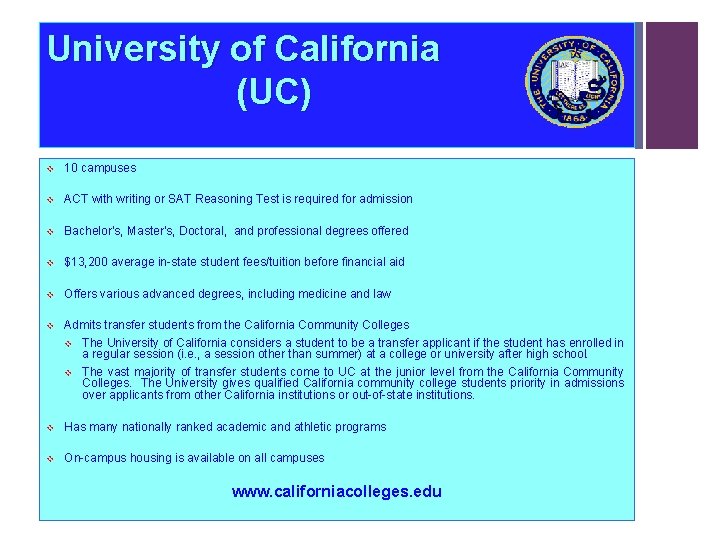
University of California (UC) v 10 campuses v ACT with writing or SAT Reasoning Test is required for admission v Bachelor’s, Master’s, Doctoral, and professional degrees offered v $13, 200 average in-state student fees/tuition before financial aid v Offers various advanced degrees, including medicine and law v Admits transfer students from the California Community Colleges v The University of California considers a student to be a transfer applicant if the student has enrolled in a regular session (i. e. , a session other than summer) at a college or university after high school. v The vast majority of transfer students come to UC at the junior level from the California Community Colleges. The University gives qualified California community college students priority in admissions over applicants from other California institutions or out-of-state institutions. v Has many nationally ranked academic and athletic programs v On-campus housing is available on all campuses www. californiacolleges. edu
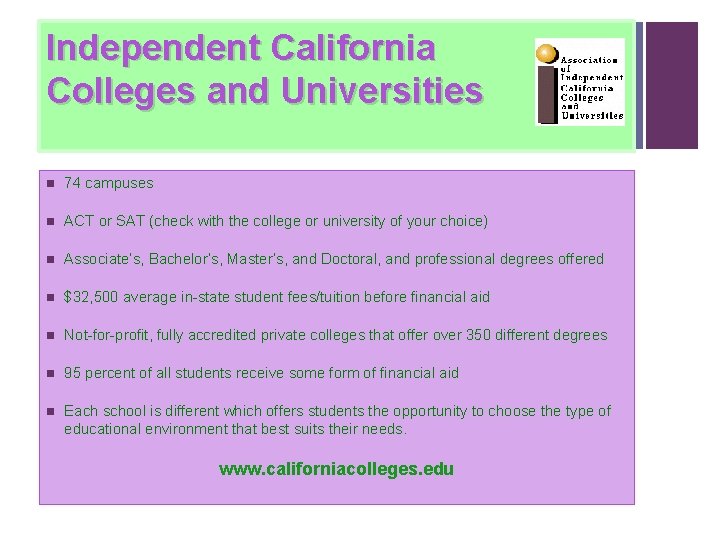
Independent California Colleges and Universities n 74 campuses n ACT or SAT (check with the college or university of your choice) n Associate’s, Bachelor’s, Master’s, and Doctoral, and professional degrees offered n $32, 500 average in-state student fees/tuition before financial aid n Not-for-profit, fully accredited private colleges that offer over 350 different degrees n 95 percent of all students receive some form of financial aid n Each school is different which offers students the opportunity to choose the type of educational environment that best suits their needs. www. californiacolleges. edu
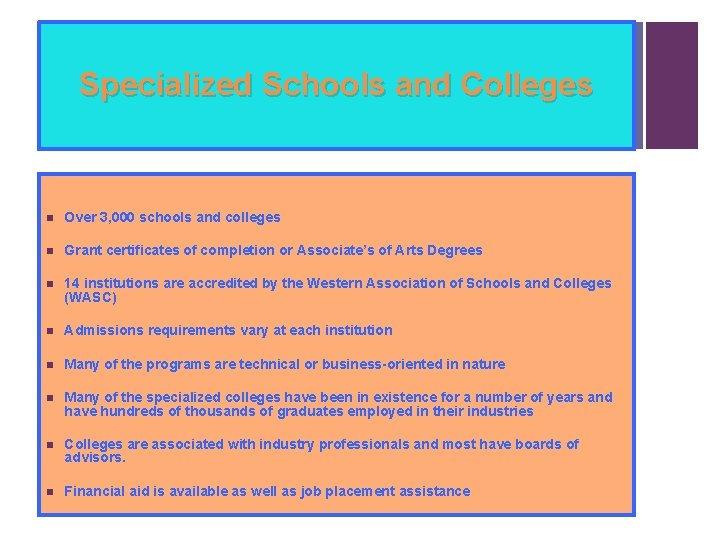
Specialized Schools and Colleges n Over 3, 000 schools and colleges n Grant certificates of completion or Associate’s of Arts Degrees n 14 institutions are accredited by the Western Association of Schools and Colleges (WASC) n Admissions requirements vary at each institution n Many of the programs are technical or business-oriented in nature n Many of the specialized colleges have been in existence for a number of years and have hundreds of thousands of graduates employed in their industries n Colleges are associated with industry professionals and most have boards of advisors. n Financial aid is available as well as job placement assistance
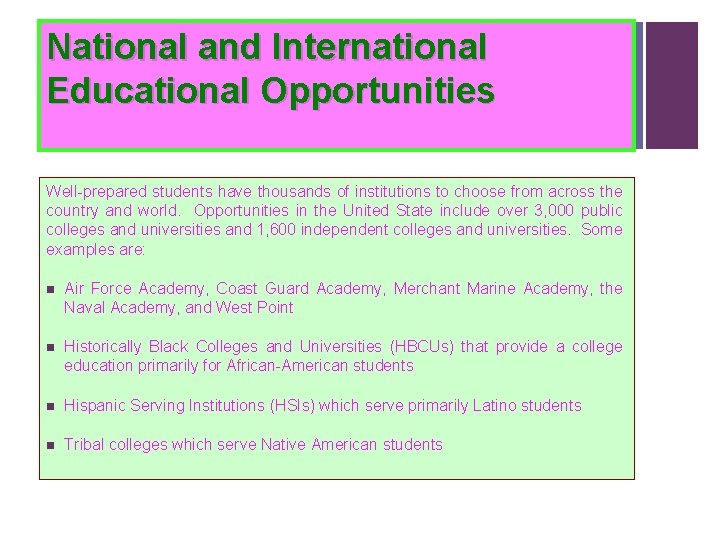
National and International Educational Opportunities Well-prepared students have thousands of institutions to choose from across the country and world. Opportunities in the United State include over 3, 000 public colleges and universities and 1, 600 independent colleges and universities. Some examples are: n Air Force Academy, Coast Guard Academy, Merchant Marine Academy, the Naval Academy, and West Point n Historically Black Colleges and Universities (HBCUs) that provide a college education primarily for African-American students n Hispanic Serving Institutions (HSIs) which serve primarily Latino students n Tribal colleges which serve Native American students
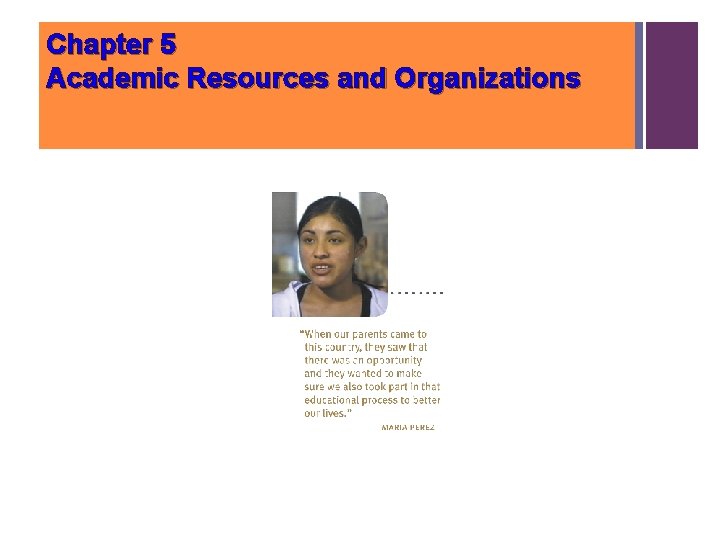
Chapter 5 Academic Resources and Organizations
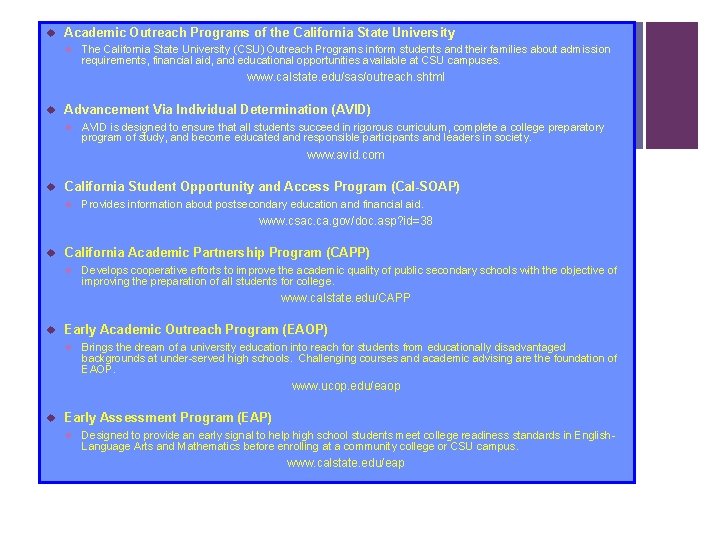
u Academic Outreach Programs of the California State University u The California State University (CSU) Outreach Programs inform students and their families about admission requirements, financial aid, and educational opportunities available at CSU campuses. www. calstate. edu/sas/outreach. shtml u Advancement Via Individual Determination (AVID) u AVID is designed to ensure that all students succeed in rigorous curriculum, complete a college preparatory program of study, and become educated and responsible participants and leaders in society. www. avid. com u California Student Opportunity and Access Program (Cal-SOAP) u Provides information about postsecondary education and financial aid. www. csac. ca. gov/doc. asp? id=38 u California Academic Partnership Program (CAPP) u Develops cooperative efforts to improve the academic quality of public secondary schools with the objective of improving the preparation of all students for college. www. calstate. edu/CAPP u Early Academic Outreach Program (EAOP) u Brings the dream of a university education into reach for students from educationally disadvantaged backgrounds at under-served high schools. Challenging courses and academic advising are the foundation of EAOP. www. ucop. edu/eaop u Early Assessment Program (EAP) u Designed to provide an early signal to help high school students meet college readiness standards in English. Language Arts and Mathematics before enrolling at a community college or CSU campus. www. calstate. edu/eap
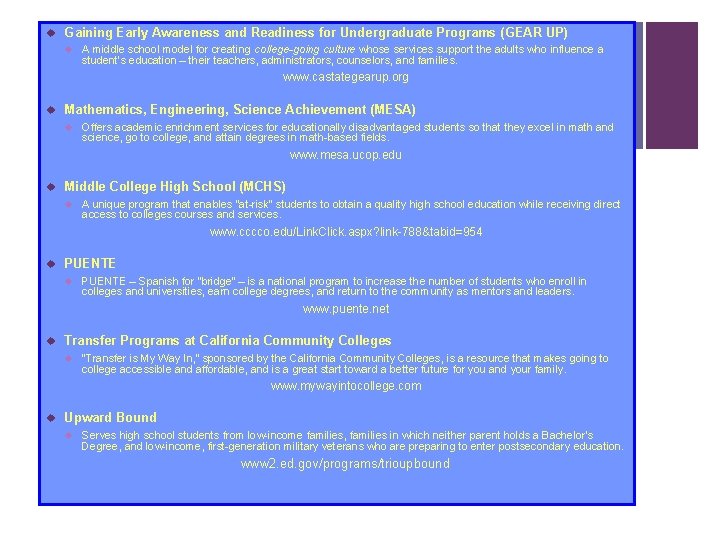
u Gaining Early Awareness and Readiness for Undergraduate Programs (GEAR UP) u A middle school model for creating college-going culture whose services support the adults who influence a student’s education – their teachers, administrators, counselors, and families. www. castategearup. org u Mathematics, Engineering, Science Achievement (MESA) u Offers academic enrichment services for educationally disadvantaged students so that they excel in math and science, go to college, and attain degrees in math-based fields. www. mesa. ucop. edu u Middle College High School (MCHS) u A unique program that enables “at-risk” students to obtain a quality high school education while receiving direct access to colleges courses and services. www. cccco. edu/Link. Click. aspx? link-788&tabid=954 u PUENTE – Spanish for “bridge” – is a national program to increase the number of students who enroll in colleges and universities, earn college degrees, and return to the community as mentors and leaders. www. puente. net u Transfer Programs at California Community Colleges u “Transfer is My Way In, ” sponsored by the California Community Colleges, is a resource that makes going to college accessible and affordable, and is a great start toward a better future for you and your family. www. mywayintocollege. com u Upward Bound u Serves high school students from low-income families, families in which neither parent holds a Bachelor’s Degree, and low-income, first-generation military veterans who are preparing to enter postsecondary education. www 2. ed. gov/programs/trioupbound
6. Financial Aid & Scholarship Resources and Organizations
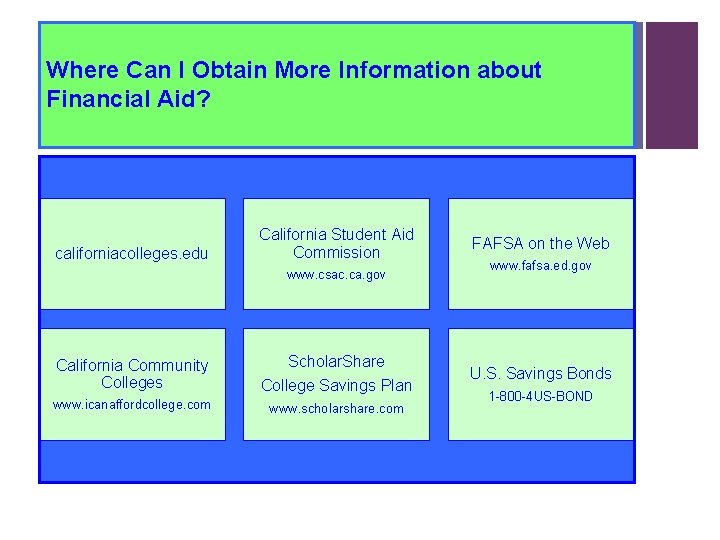
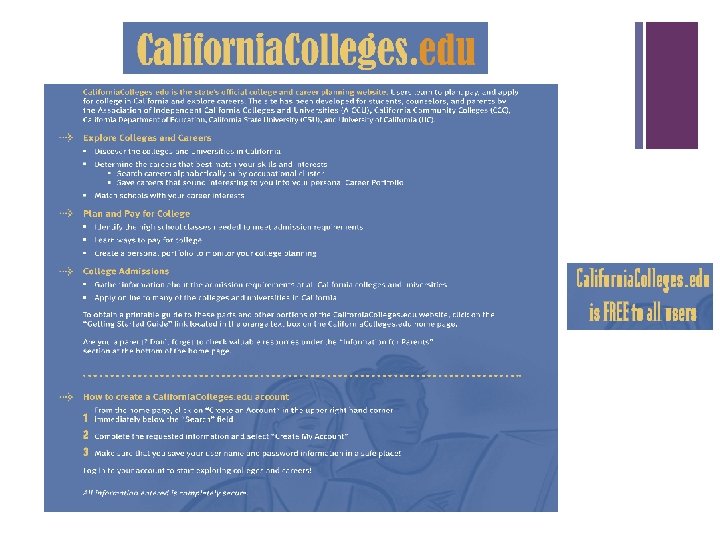
Where Can I Obtain More Information about Financial Aid? californiacolleges. edu California Student Aid Commission www. csac. ca. gov Scholar. Share California Community Colleges College Savings Plan www. icanaffordcollege. com www. scholarshare. com FAFSA on the Web www. fafsa. ed. gov U. S. Savings Bonds 1 -800 -4 US-BOND
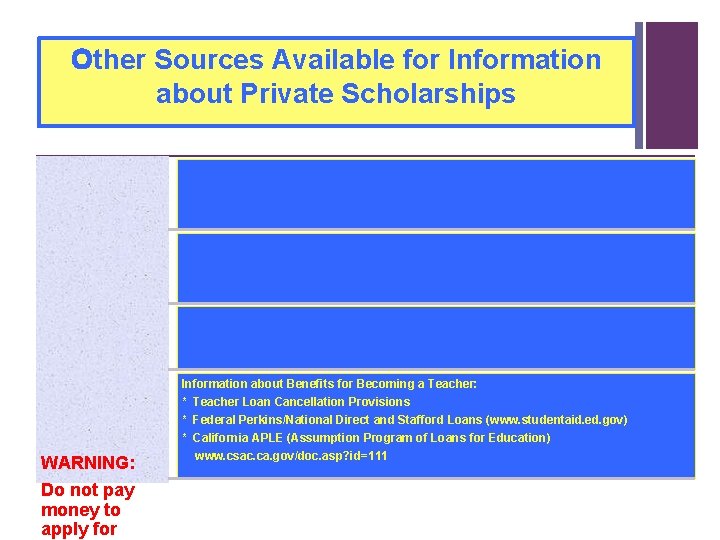
Other Sources Available for Information about Private Scholarships Check with a librarian to find books about private sources of financial aid. School counselor may have information about scholarship programs. The Internet provides several free Scholarship Search programs. A Scholarship Search Program called Fast. Web lists awards worth over $3. 4 billion. Information about Benefits for Becoming a Teacher: WARNING: Do not pay money to apply for * Teacher Loan Cancellation Provisions A good site for several sources isand the Stafford Financial. Loans Aid Information Page at www. finaid. org. * Federal Perkins/National Direct (www. studentaid. ed. gov) * California APLE (Assumption Program of Loans for Education) www. csac. ca. gov/doc. asp? id=111
This presentation and the collateral materials, available through the California Education Round Table Intersegmental Coordinating Committee, have been sponsored, in part, by Scholar. Share, California’s College Savings Program. Copies of the College: Making It Happen booklet are available from: California Education Round Table Intersegmental Coordinating Committee 560 J Street, Suite 290 Sacramento, CA 95814 Phone: 916 -324 -8593 Fax: 916 -327 -9172 www. certicc. org