CHESS LEPP USPAS Course on 4 th Generation




- Slides: 50
CHESS / LEPP USPAS Course on 4 th Generation Light Sources II ERLs and Thomson Scattering G. A. Krafft and I. Bazarov Jefferson Lab and Cornell University Introduction to Thomson Scattering USPAS 4 th Generation Light Sources II Krafft/Bazarov Thomas Jefferson National Accelerator Facility 14 January 2003
Lecture: Introduction to Thomson Scattering CHESS / LEPP 1. Thomson Scattering 1. Process 2. Simple Kinematics 3. Finite Pulse Effects 2. Hamilton-Jacobi Solution of an Electron in a Plane Wave 1. Hamilton-Jacobi Method 2. Application to Orbits 3. Exact Solution for Classical Electron in a Plane Wave 3. Applications to Scattered Spectrum 1. Displacement Spectrum 2. General Solution for Small a 3. Finite a Effects 4. Finite Emittance Effects 5. Brilliance Scaling USPAS 4 th Generation Light Sources II Krafft/Bazarov Thomas Jefferson National Accelerator Facility 14 January 2003
Thomson Scattering. . . CHESS / LEPP Purely “classical” scattering of photons by electrons Thomson regime defined by the photon energy in the electron rest frame being small compared to the rest energy of the electron In this case electron radiates at the same frequency (elastic scattering!) as incident photon for small field strengths Dipole radiation pattern is generated in beam frame, as for undulators Therefore radiation patterns can be largely copied from our previous undulator work Note on terminology: Some authors call any scattering of photons by free electrons Compton Scattering. Compton observed (the so-called Compton effect) frequency shifts in X-ray scattering off (resting!) electrons that depended on scattering angle. Such frequency shifts arise only when the energy of the photon in the rest frame becomes comparable with 0. 511 Me. V. We will reserve the words “Compton Scattering”, only for such higher energy scattering. We will talk about only one experiment in the “Compton regime”. USPAS 4 th Generation Light Sources II Krafft/Bazarov Thomas Jefferson National Accelerator Facility 14 January 2003
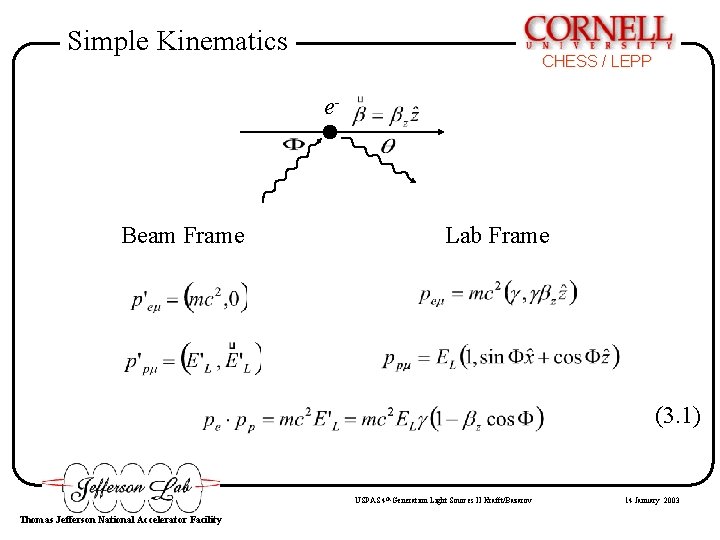
Simple Kinematics CHESS / LEPP e- Beam Frame Lab Frame (3. 1) USPAS 4 th Generation Light Sources II Krafft/Bazarov Thomas Jefferson National Accelerator Facility 14 January 2003
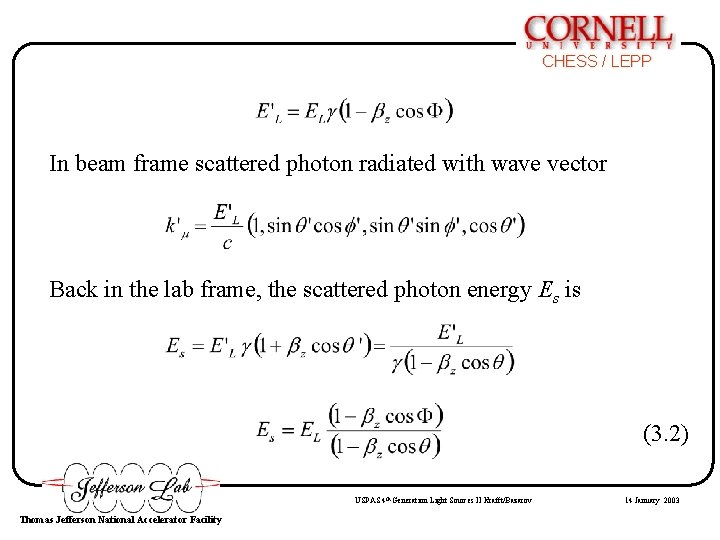
CHESS / LEPP In beam frame scattered photon radiated with wave vector Back in the lab frame, the scattered photon energy Es is (3. 2) USPAS 4 th Generation Light Sources II Krafft/Bazarov Thomas Jefferson National Accelerator Facility 14 January 2003
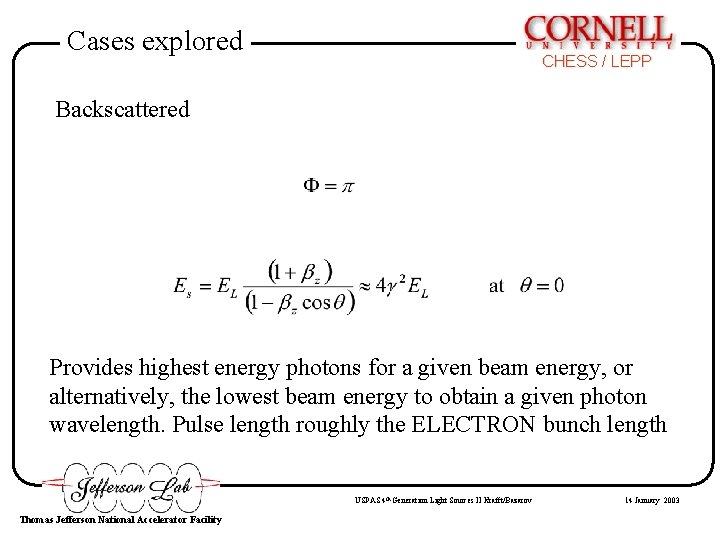
Cases explored CHESS / LEPP Backscattered Provides highest energy photons for a given beam energy, or alternatively, the lowest beam energy to obtain a given photon wavelength. Pulse length roughly the ELECTRON bunch length USPAS 4 th Generation Light Sources II Krafft/Bazarov Thomas Jefferson National Accelerator Facility 14 January 2003
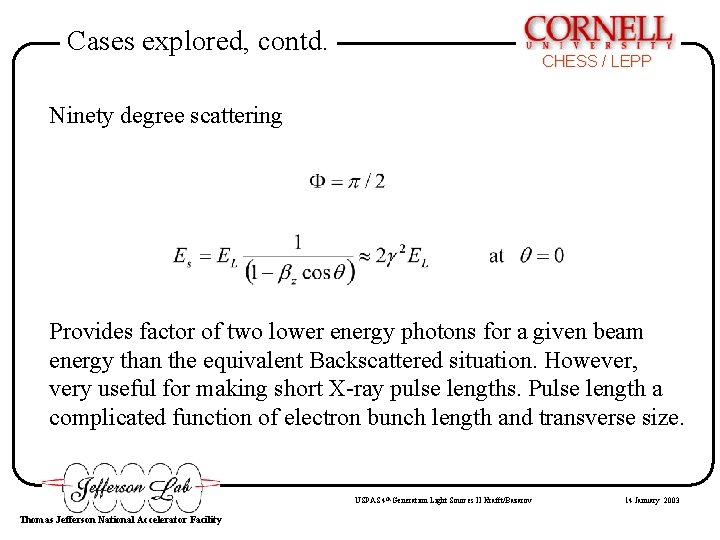
Cases explored, contd. CHESS / LEPP Ninety degree scattering Provides factor of two lower energy photons for a given beam energy than the equivalent Backscattered situation. However, very useful for making short X-ray pulse lengths. Pulse length a complicated function of electron bunch length and transverse size. USPAS 4 th Generation Light Sources II Krafft/Bazarov Thomas Jefferson National Accelerator Facility 14 January 2003
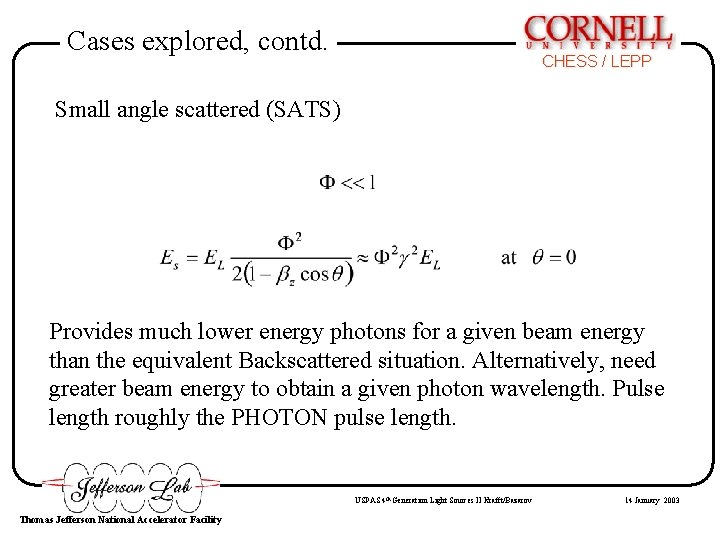
Cases explored, contd. CHESS / LEPP Small angle scattered (SATS) Provides much lower energy photons for a given beam energy than the equivalent Backscattered situation. Alternatively, need greater beam energy to obtain a given photon wavelength. Pulse length roughly the PHOTON pulse length. USPAS 4 th Generation Light Sources II Krafft/Bazarov Thomas Jefferson National Accelerator Facility 14 January 2003
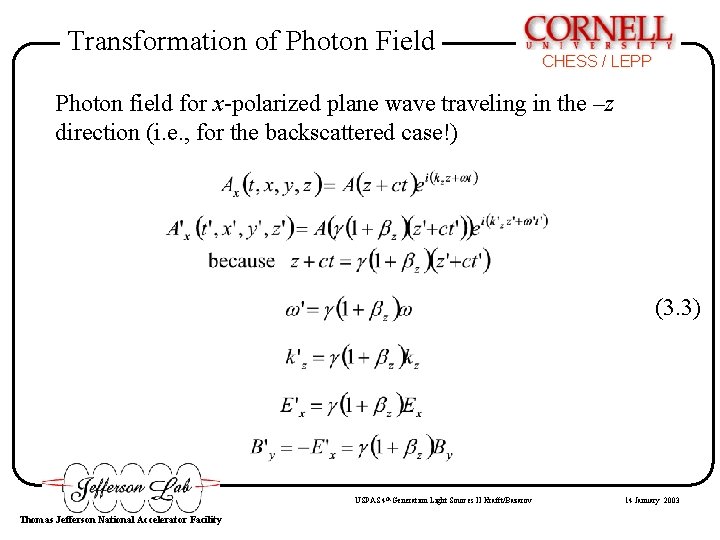
Transformation of Photon Field CHESS / LEPP Photon field for x-polarized plane wave traveling in the –z direction (i. e. , for the backscattered case!) (3. 3) USPAS 4 th Generation Light Sources II Krafft/Bazarov Thomas Jefferson National Accelerator Facility 14 January 2003
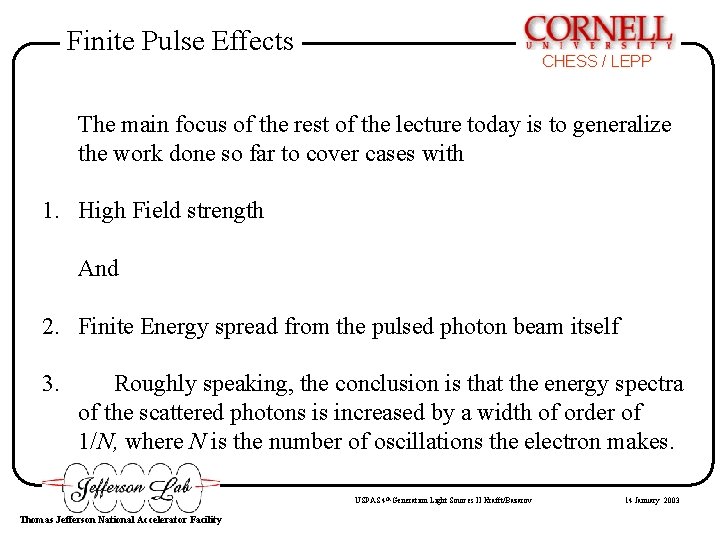
Finite Pulse Effects CHESS / LEPP The main focus of the rest of the lecture today is to generalize the work done so far to cover cases with 1. High Field strength And 2. Finite Energy spread from the pulsed photon beam itself 3. Roughly speaking, the conclusion is that the energy spectra of the scattered photons is increased by a width of order of 1/N, where N is the number of oscillations the electron makes. USPAS 4 th Generation Light Sources II Krafft/Bazarov Thomas Jefferson National Accelerator Facility 14 January 2003
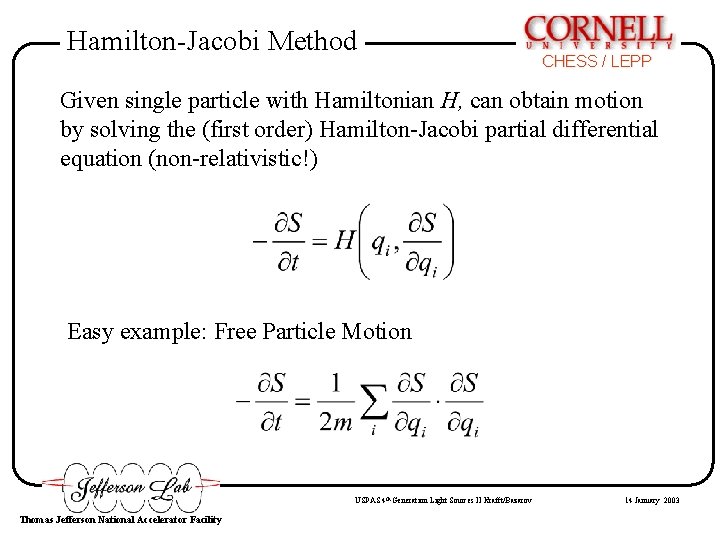
Hamilton-Jacobi Method CHESS / LEPP Given single particle with Hamiltonian H, can obtain motion by solving the (first order) Hamilton-Jacobi partial differential equation (non-relativistic!) Easy example: Free Particle Motion USPAS 4 th Generation Light Sources II Krafft/Bazarov Thomas Jefferson National Accelerator Facility 14 January 2003
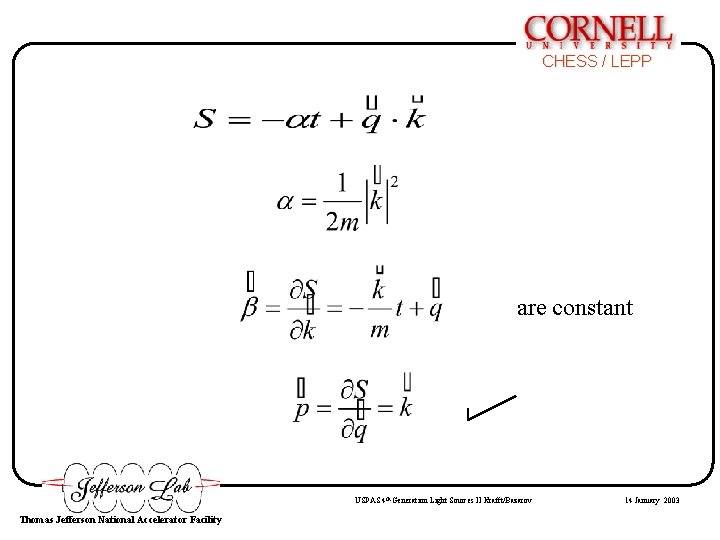
CHESS / LEPP are constant USPAS 4 th Generation Light Sources II Krafft/Bazarov Thomas Jefferson National Accelerator Facility 14 January 2003
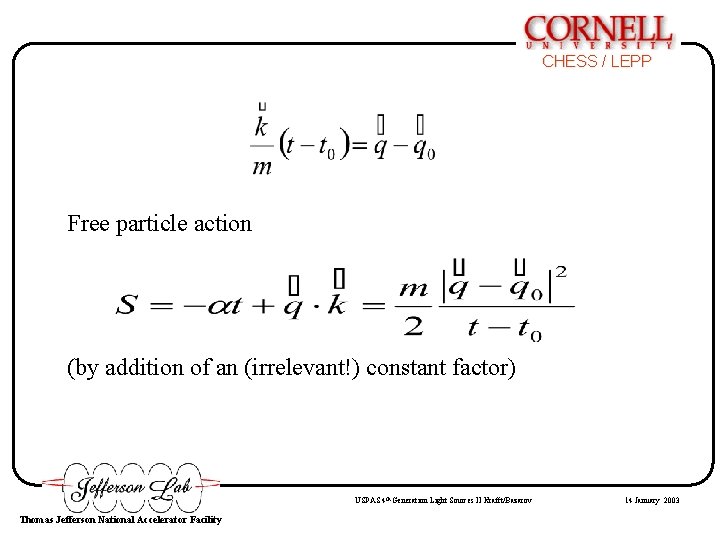
CHESS / LEPP Free particle action (by addition of an (irrelevant!) constant factor) USPAS 4 th Generation Light Sources II Krafft/Bazarov Thomas Jefferson National Accelerator Facility 14 January 2003
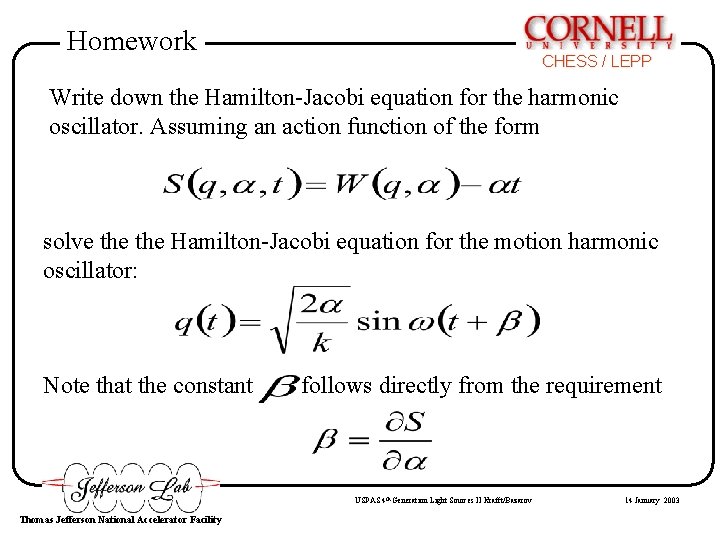
Homework CHESS / LEPP Write down the Hamilton-Jacobi equation for the harmonic oscillator. Assuming an action function of the form solve the Hamilton-Jacobi equation for the motion harmonic oscillator: Note that the constant follows directly from the requirement USPAS 4 th Generation Light Sources II Krafft/Bazarov Thomas Jefferson National Accelerator Facility 14 January 2003
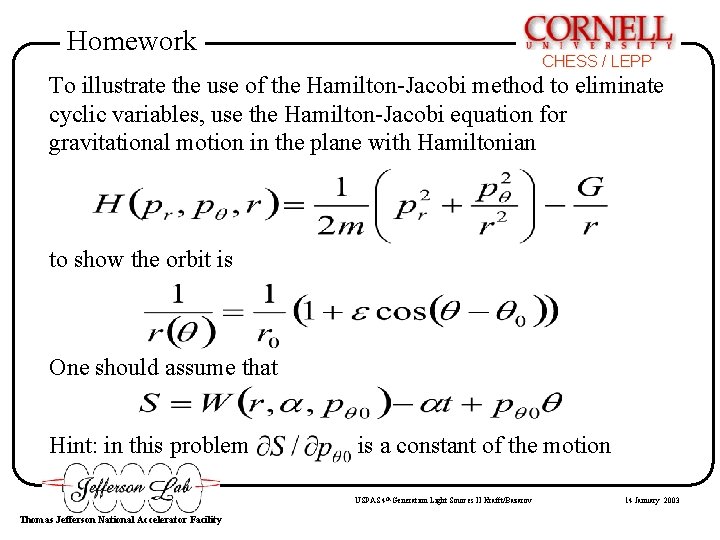
Homework CHESS / LEPP To illustrate the use of the Hamilton-Jacobi method to eliminate cyclic variables, use the Hamilton-Jacobi equation for gravitational motion in the plane with Hamiltonian to show the orbit is One should assume that Hint: in this problem is a constant of the motion USPAS 4 th Generation Light Sources II Krafft/Bazarov Thomas Jefferson National Accelerator Facility 14 January 2003
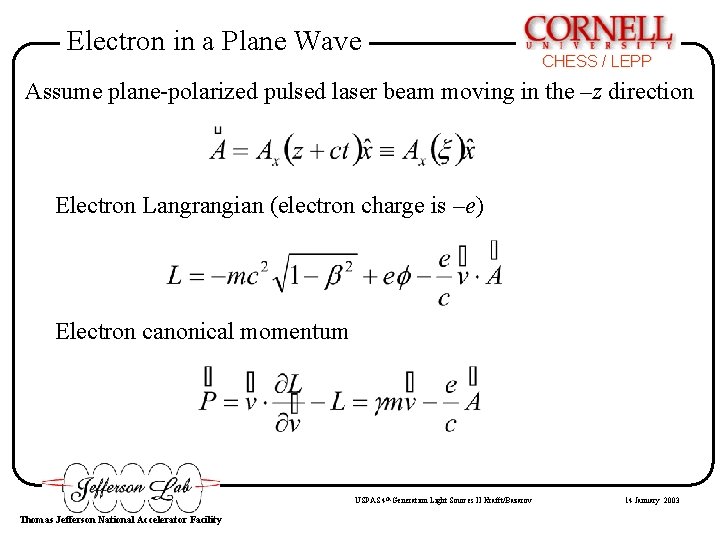
Electron in a Plane Wave CHESS / LEPP Assume plane-polarized pulsed laser beam moving in the –z direction Electron Langrangian (electron charge is –e) Electron canonical momentum USPAS 4 th Generation Light Sources II Krafft/Bazarov Thomas Jefferson National Accelerator Facility 14 January 2003
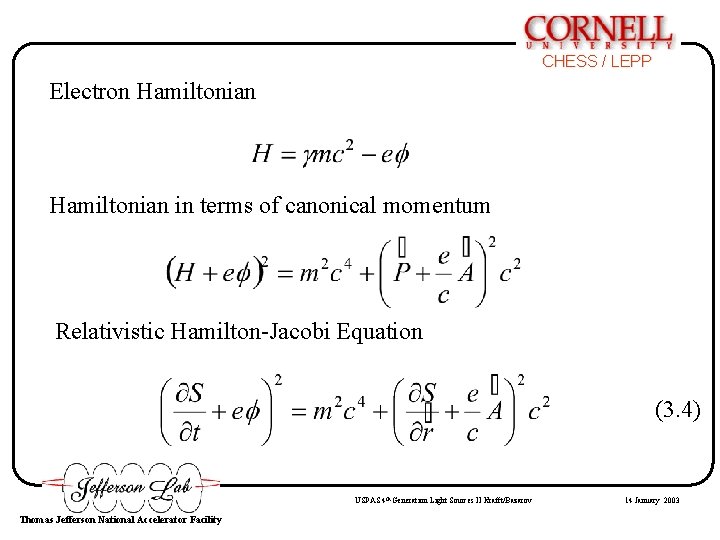
CHESS / LEPP Electron Hamiltonian in terms of canonical momentum Relativistic Hamilton-Jacobi Equation (3. 4) USPAS 4 th Generation Light Sources II Krafft/Bazarov Thomas Jefferson National Accelerator Facility 14 January 2003
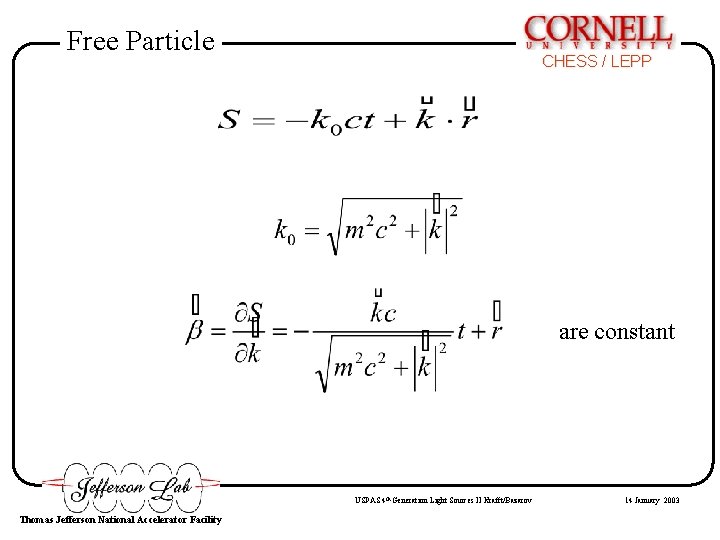
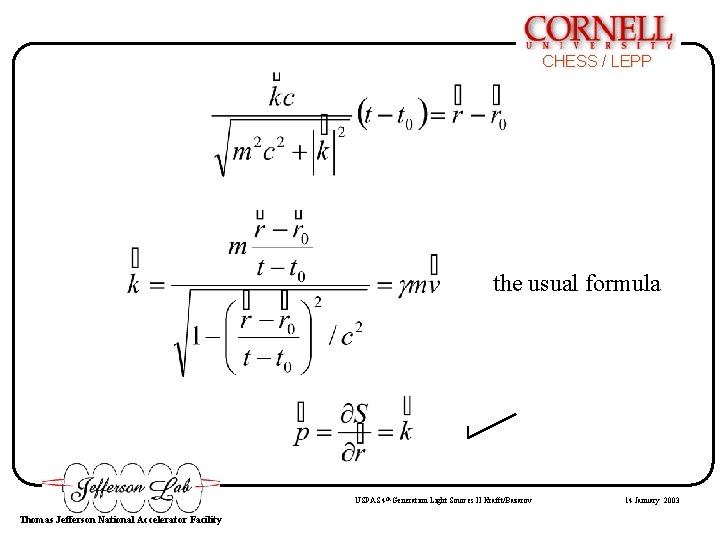
Free Particle CHESS / LEPP are constant USPAS 4 th Generation Light Sources II Krafft/Bazarov Thomas Jefferson National Accelerator Facility 14 January 2003
CHESS / LEPP the usual formula USPAS 4 th Generation Light Sources II Krafft/Bazarov Thomas Jefferson National Accelerator Facility 14 January 2003
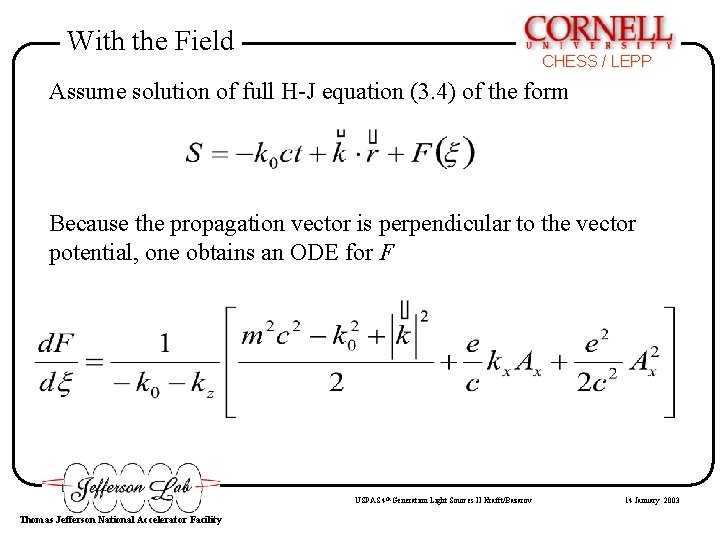
With the Field CHESS / LEPP Assume solution of full H-J equation (3. 4) of the form Because the propagation vector is perpendicular to the vector potential, one obtains an ODE for F USPAS 4 th Generation Light Sources II Krafft/Bazarov Thomas Jefferson National Accelerator Facility 14 January 2003
CHESS / LEPP Obtain the energy and momentum by differentiation (3. 5) USPAS 4 th Generation Light Sources II Krafft/Bazarov Thomas Jefferson National Accelerator Facility 14 January 2003
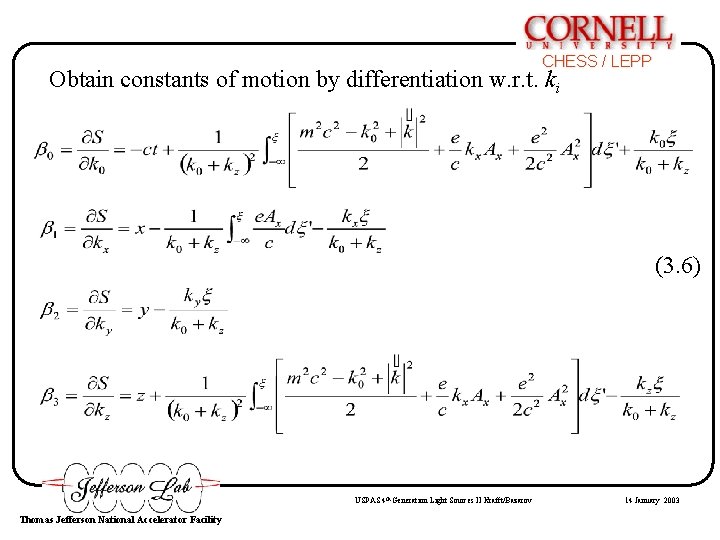
CHESS / LEPP Obtain constants of motion by differentiation w. r. t. ki (3. 6) USPAS 4 th Generation Light Sources II Krafft/Bazarov Thomas Jefferson National Accelerator Facility 14 January 2003
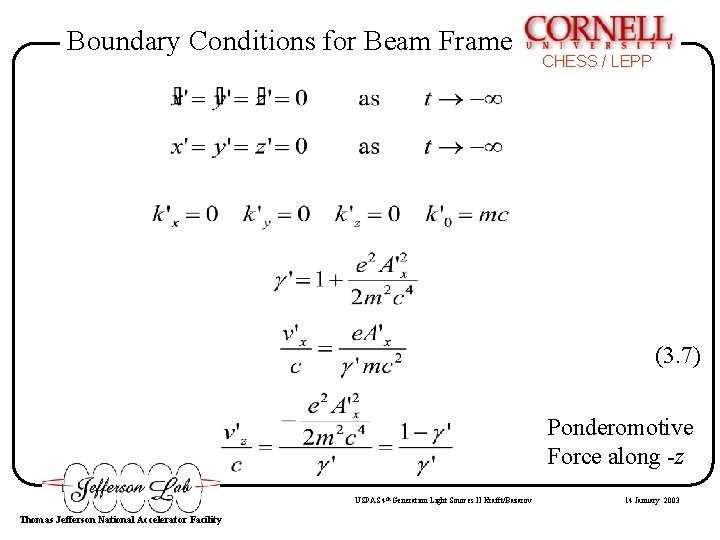
Boundary Conditions for Beam Frame CHESS / LEPP (3. 7) Ponderomotive Force along -z USPAS 4 th Generation Light Sources II Krafft/Bazarov Thomas Jefferson National Accelerator Facility 14 January 2003
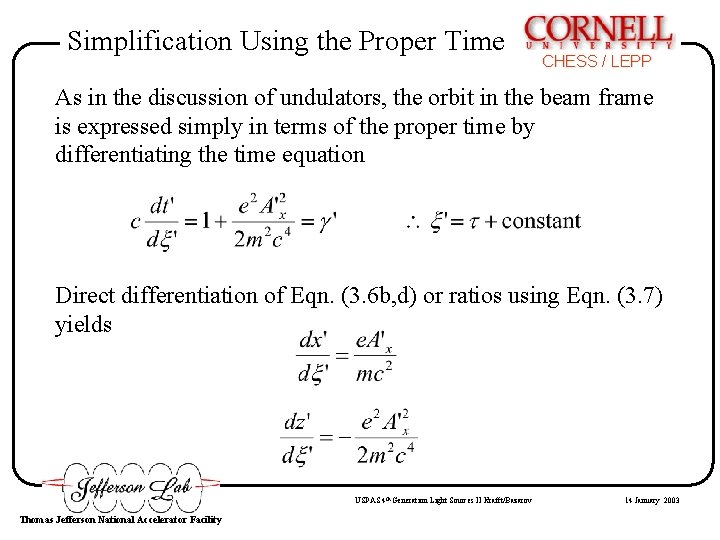
Simplification Using the Proper Time CHESS / LEPP As in the discussion of undulators, the orbit in the beam frame is expressed simply in terms of the proper time by differentiating the time equation Direct differentiation of Eqn. (3. 6 b, d) or ratios using Eqn. (3. 7) yields USPAS 4 th Generation Light Sources II Krafft/Bazarov Thomas Jefferson National Accelerator Facility 14 January 2003
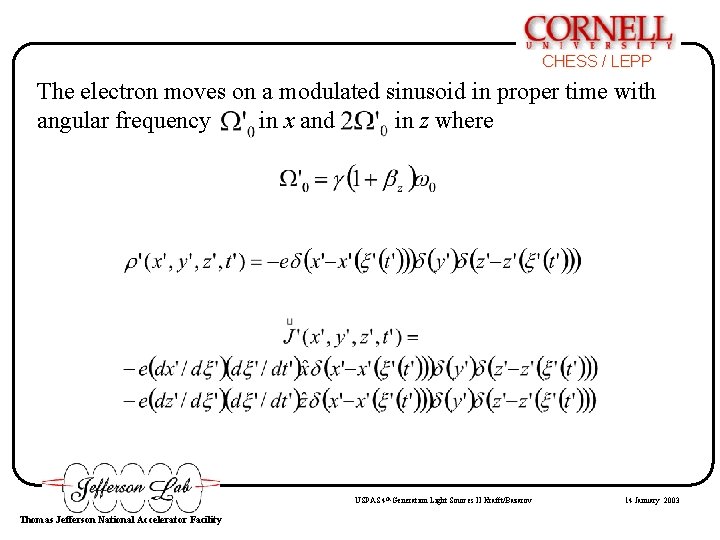
CHESS / LEPP The electron moves on a modulated sinusoid in proper time with angular frequency in x and in z where USPAS 4 th Generation Light Sources II Krafft/Bazarov Thomas Jefferson National Accelerator Facility 14 January 2003
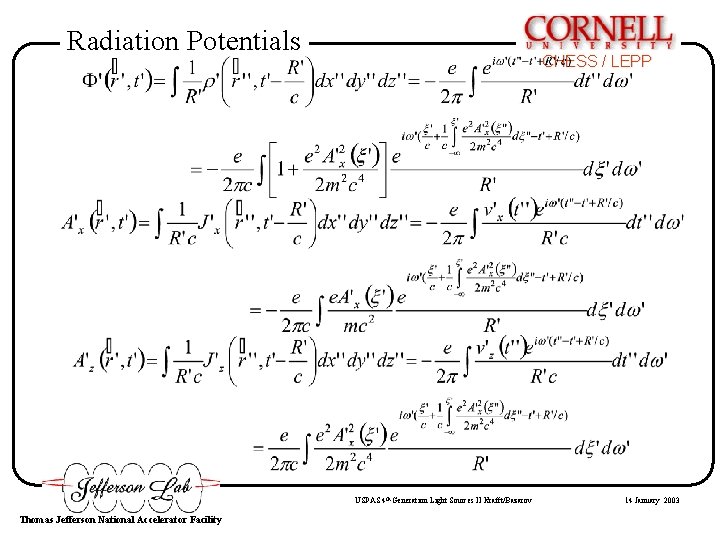
Radiation Potentials CHESS / LEPP USPAS 4 th Generation Light Sources II Krafft/Bazarov Thomas Jefferson National Accelerator Facility 14 January 2003
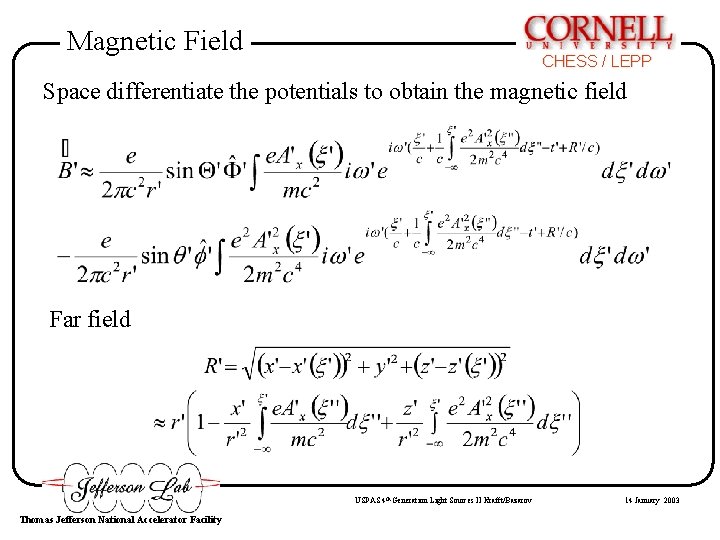
Magnetic Field CHESS / LEPP Space differentiate the potentials to obtain the magnetic field Far field USPAS 4 th Generation Light Sources II Krafft/Bazarov Thomas Jefferson National Accelerator Facility 14 January 2003
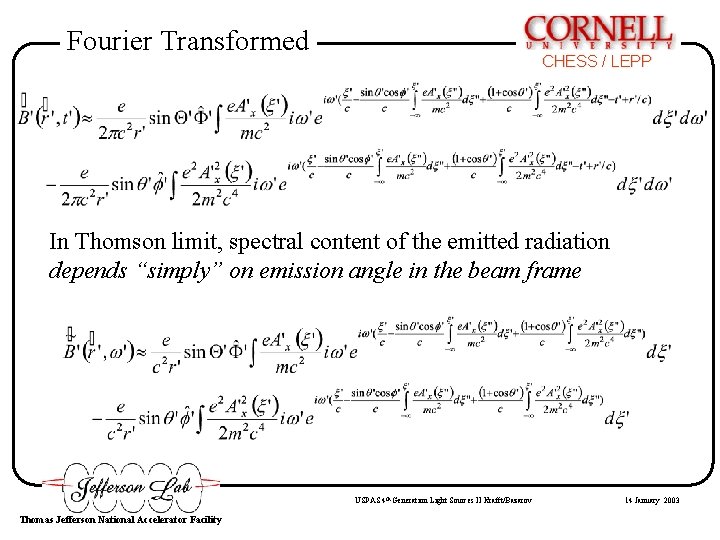
Fourier Transformed CHESS / LEPP In Thomson limit, spectral content of the emitted radiation depends “simply” on emission angle in the beam frame USPAS 4 th Generation Light Sources II Krafft/Bazarov Thomas Jefferson National Accelerator Facility 14 January 2003
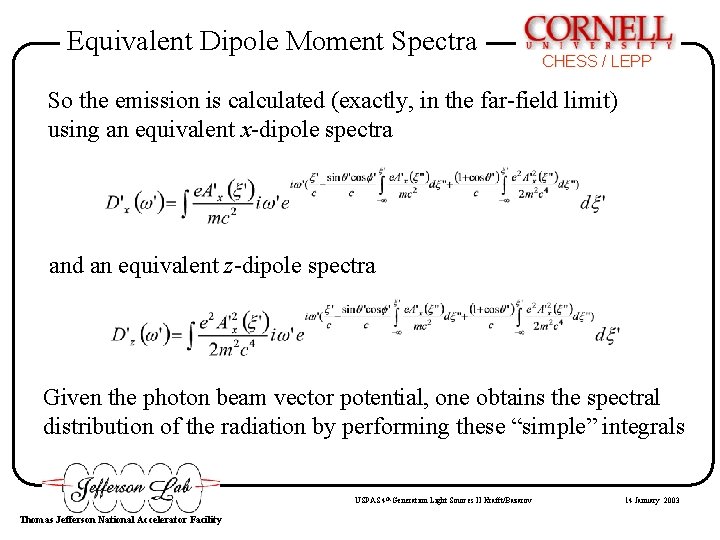
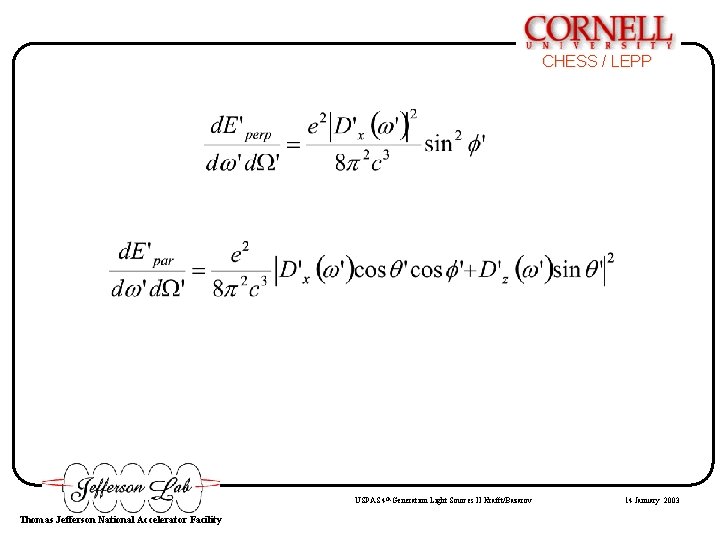
Equivalent Dipole Moment Spectra CHESS / LEPP So the emission is calculated (exactly, in the far-field limit) using an equivalent x-dipole spectra and an equivalent z-dipole spectra Given the photon beam vector potential, one obtains the spectral distribution of the radiation by performing these “simple” integrals USPAS 4 th Generation Light Sources II Krafft/Bazarov Thomas Jefferson National Accelerator Facility 14 January 2003
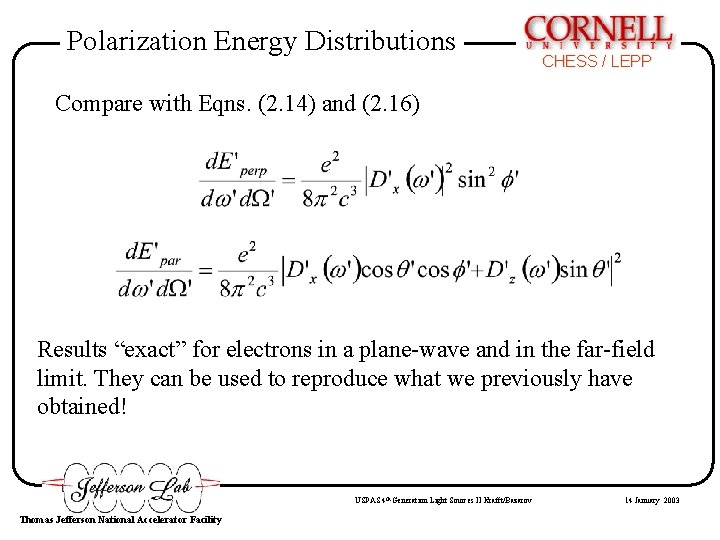
Polarization Energy Distributions CHESS / LEPP Compare with Eqns. (2. 14) and (2. 16) Results “exact” for electrons in a plane-wave and in the far-field limit. They can be used to reproduce what we previously have obtained! USPAS 4 th Generation Light Sources II Krafft/Bazarov Thomas Jefferson National Accelerator Facility 14 January 2003
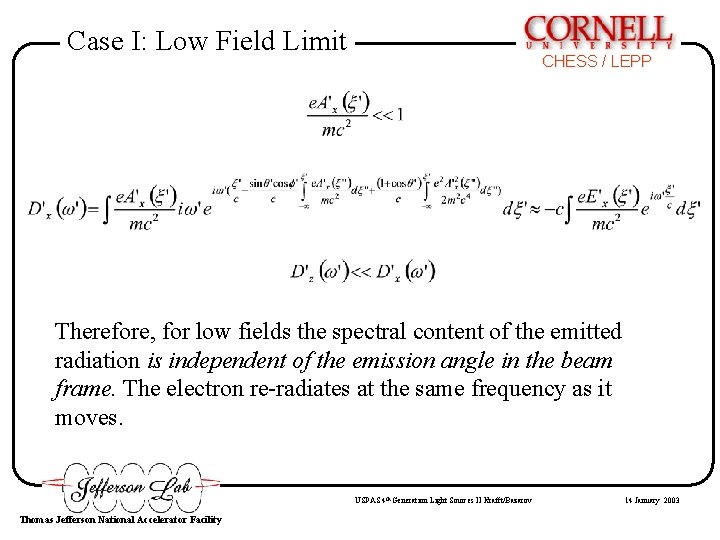
Case I: Low Field Limit CHESS / LEPP Therefore, for low fields the spectral content of the emitted radiation is independent of the emission angle in the beam frame. The electron re-radiates at the same frequency as it moves. USPAS 4 th Generation Light Sources II Krafft/Bazarov Thomas Jefferson National Accelerator Facility 14 January 2003
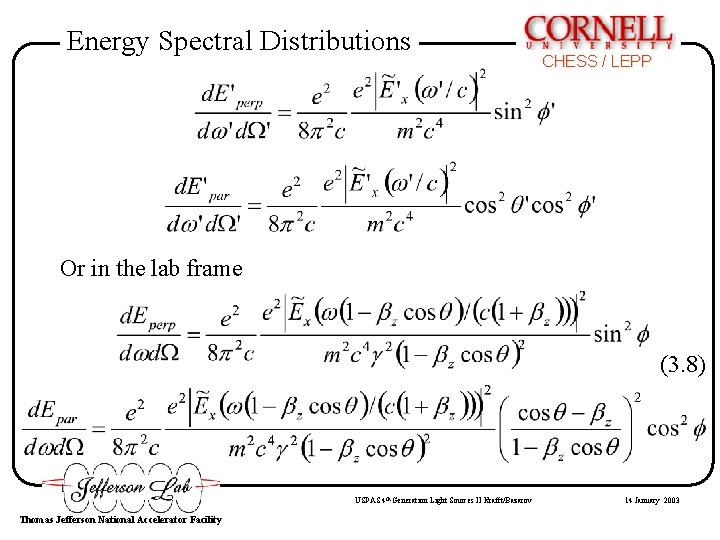
Energy Spectral Distributions CHESS / LEPP Or in the lab frame (3. 8) USPAS 4 th Generation Light Sources II Krafft/Bazarov Thomas Jefferson National Accelerator Facility 14 January 2003
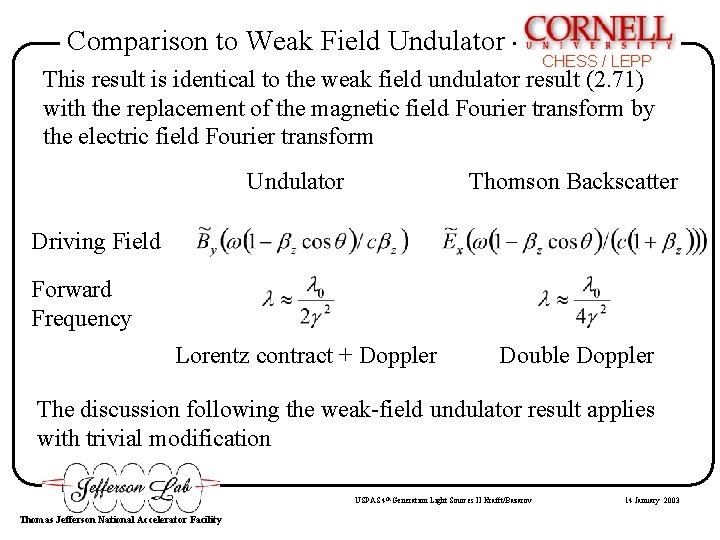
Comparison to Weak Field Undulator CHESS / LEPP This result is identical to the weak field undulator result (2. 71) with the replacement of the magnetic field Fourier transform by the electric field Fourier transform Undulator Thomson Backscatter Driving Field Forward Frequency Lorentz contract + Doppler Double Doppler The discussion following the weak-field undulator result applies with trivial modification USPAS 4 th Generation Light Sources II Krafft/Bazarov Thomas Jefferson National Accelerator Facility 14 January 2003
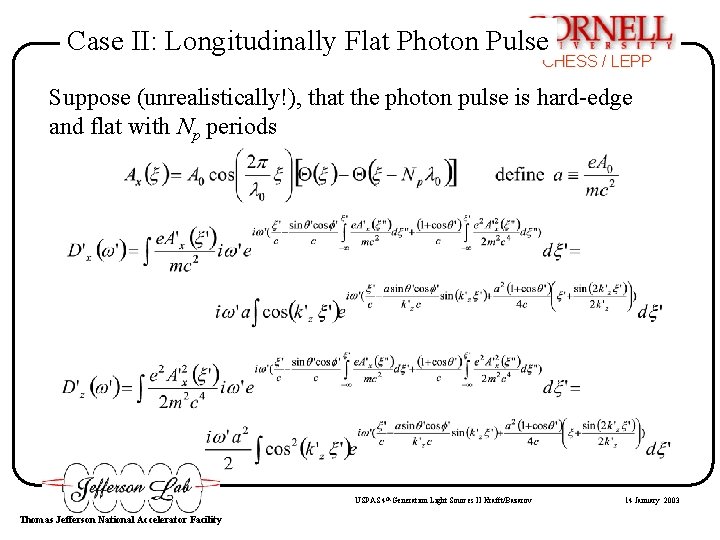
Case II: Longitudinally Flat Photon Pulse CHESS / LEPP Suppose (unrealistically!), that the photon pulse is hard-edge and flat with Np periods USPAS 4 th Generation Light Sources II Krafft/Bazarov Thomas Jefferson National Accelerator Facility 14 January 2003
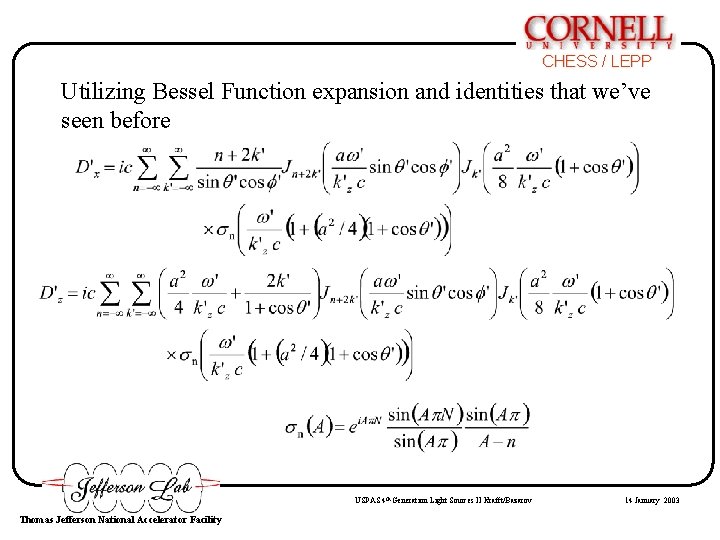
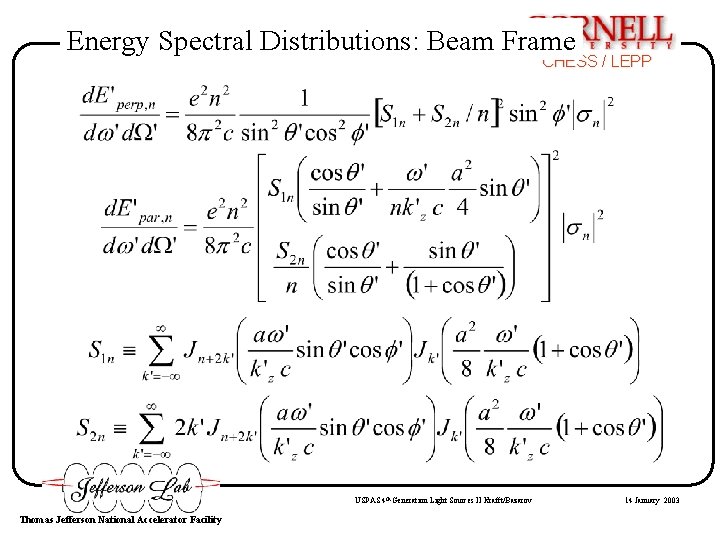
CHESS / LEPP Utilizing Bessel Function expansion and identities that we’ve seen before USPAS 4 th Generation Light Sources II Krafft/Bazarov Thomas Jefferson National Accelerator Facility 14 January 2003
CHESS / LEPP USPAS 4 th Generation Light Sources II Krafft/Bazarov Thomas Jefferson National Accelerator Facility 14 January 2003
Energy Spectral Distributions: Beam Frame CHESS / LEPP USPAS 4 th Generation Light Sources II Krafft/Bazarov Thomas Jefferson National Accelerator Facility 14 January 2003
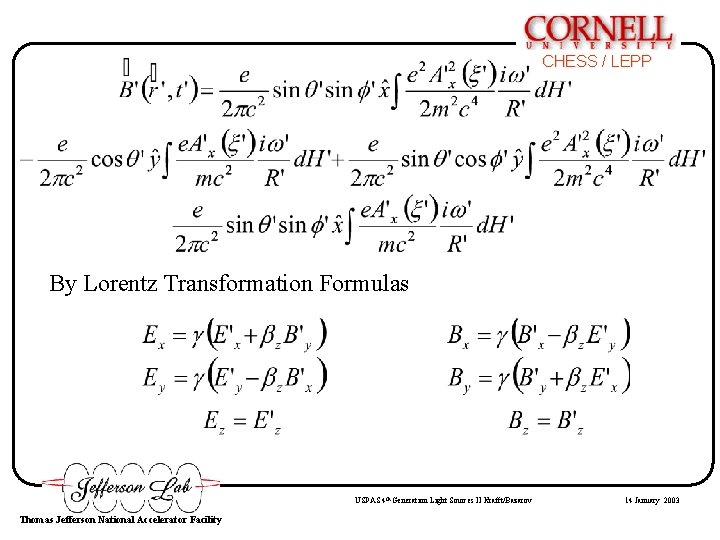
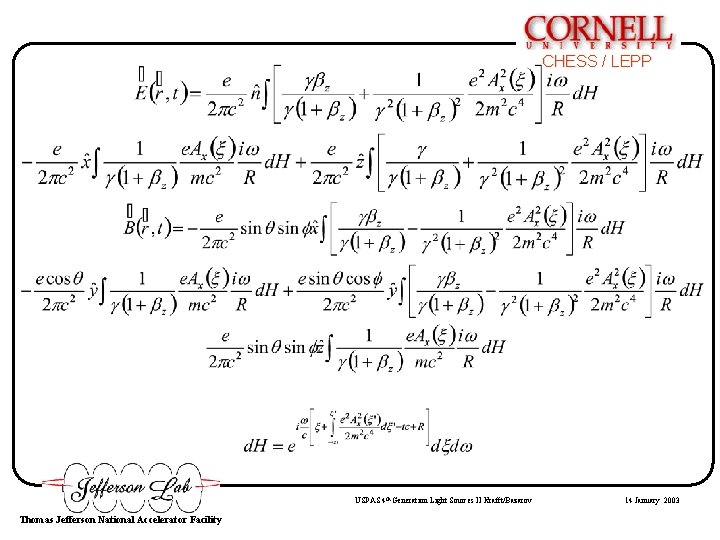
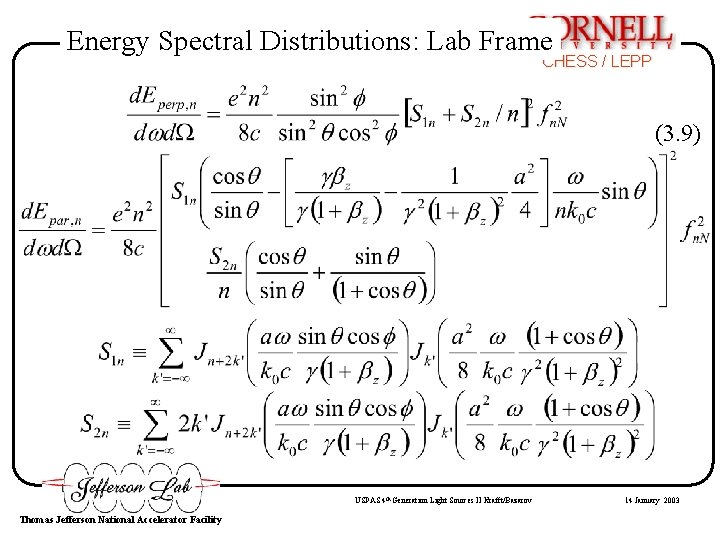
Energy Spectral Distributions: Lab Frame CHESS / LEPP For the general distribution at high a, due to the non-trivial transformation properties of the polarization vectors, it is easier and makes sense to first transform the electromagnetic field into the lab frame, and then perform the polarization dot product. In general, where USPAS 4 th Generation Light Sources II Krafft/Bazarov Thomas Jefferson National Accelerator Facility 14 January 2003
CHESS / LEPP By Lorentz Transformation Formulas USPAS 4 th Generation Light Sources II Krafft/Bazarov Thomas Jefferson National Accelerator Facility 14 January 2003
CHESS / LEPP USPAS 4 th Generation Light Sources II Krafft/Bazarov Thomas Jefferson National Accelerator Facility 14 January 2003
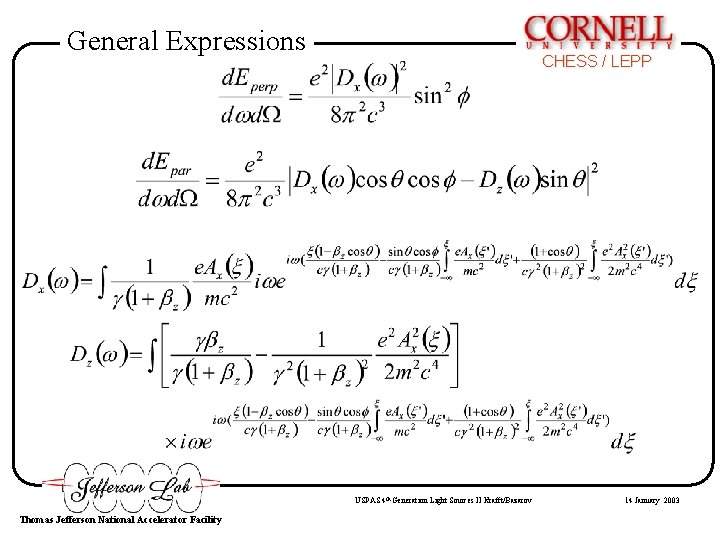
General Expressions CHESS / LEPP USPAS 4 th Generation Light Sources II Krafft/Bazarov Thomas Jefferson National Accelerator Facility 14 January 2003
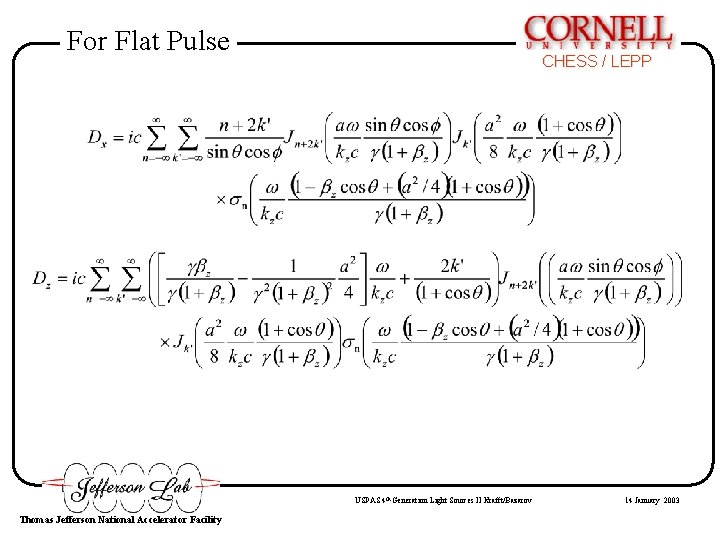
For Flat Pulse CHESS / LEPP USPAS 4 th Generation Light Sources II Krafft/Bazarov Thomas Jefferson National Accelerator Facility 14 January 2003
Energy Spectral Distributions: Lab Frame CHESS / LEPP (3. 9) USPAS 4 th Generation Light Sources II Krafft/Bazarov Thomas Jefferson National Accelerator Facility 14 January 2003
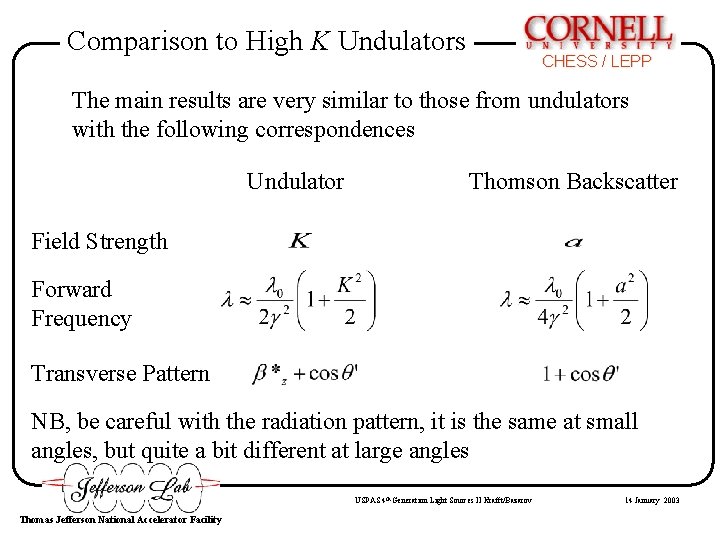
Comparison to High K Undulators CHESS / LEPP The main results are very similar to those from undulators with the following correspondences Undulator Thomson Backscatter Field Strength Forward Frequency Transverse Pattern NB, be careful with the radiation pattern, it is the same at small angles, but quite a bit different at large angles USPAS 4 th Generation Light Sources II Krafft/Bazarov Thomas Jefferson National Accelerator Facility 14 January 2003
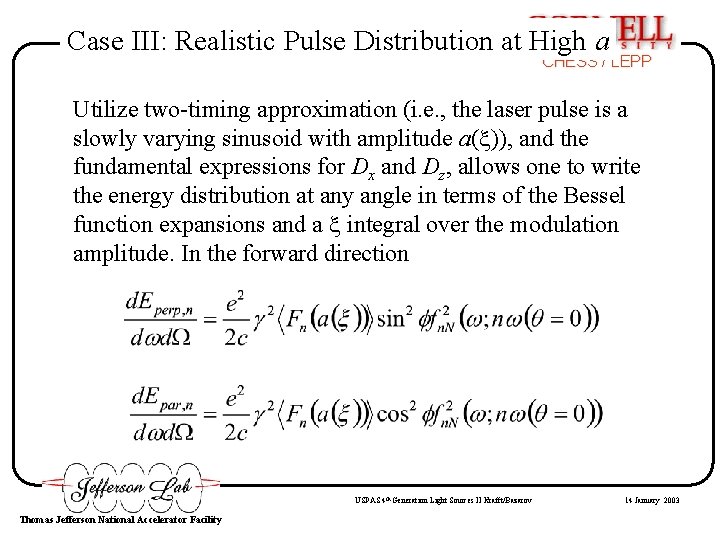
Case III: Realistic Pulse Distribution at High a CHESS / LEPP Utilize two-timing approximation (i. e. , the laser pulse is a slowly varying sinusoid with amplitude a( )), and the fundamental expressions for Dx and Dz, allows one to write the energy distribution at any angle in terms of the Bessel function expansions and a integral over the modulation amplitude. In the forward direction USPAS 4 th Generation Light Sources II Krafft/Bazarov Thomas Jefferson National Accelerator Facility 14 January 2003
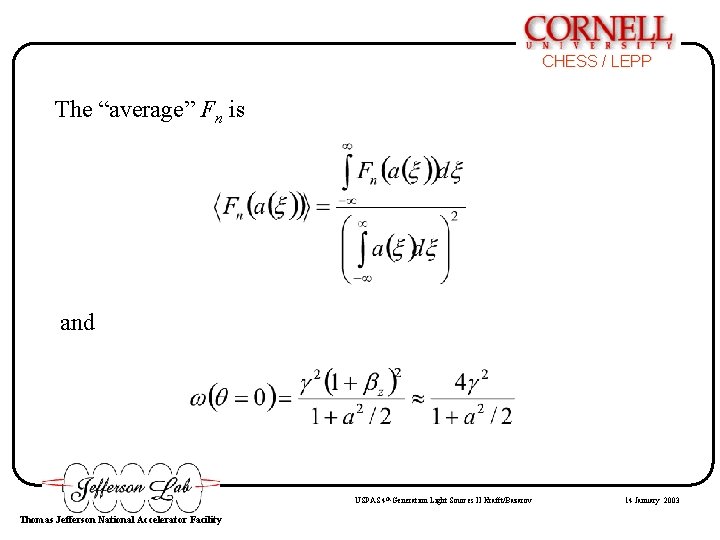
CHESS / LEPP The “average” Fn is and USPAS 4 th Generation Light Sources II Krafft/Bazarov Thomas Jefferson National Accelerator Facility 14 January 2003
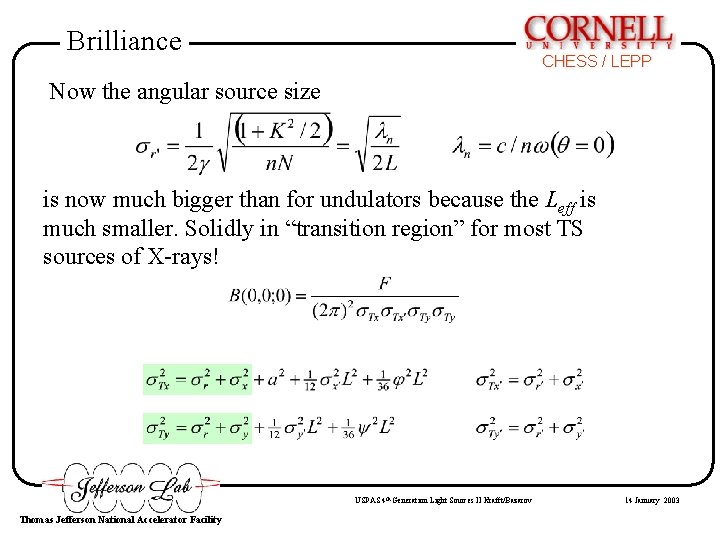
Brilliance CHESS / LEPP Now the angular source size is now much bigger than for undulators because the Leff is much smaller. Solidly in “transition region” for most TS sources of X-rays! USPAS 4 th Generation Light Sources II Krafft/Bazarov Thomas Jefferson National Accelerator Facility 14 January 2003
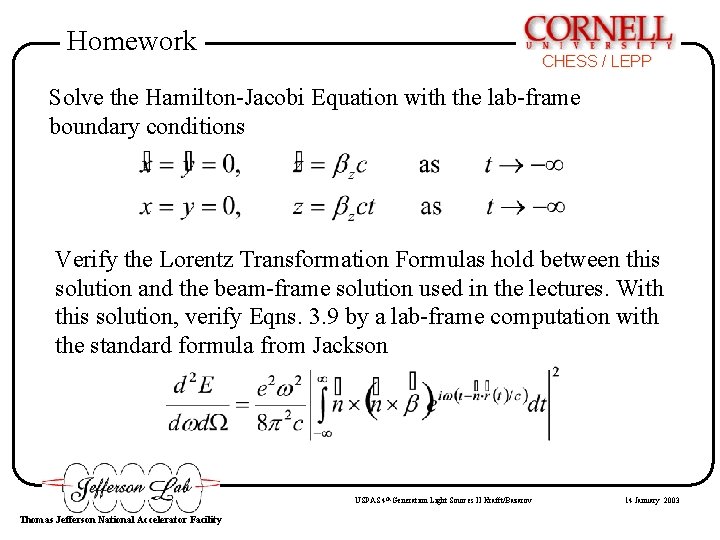
Homework CHESS / LEPP Solve the Hamilton-Jacobi Equation with the lab-frame boundary conditions Verify the Lorentz Transformation Formulas hold between this solution and the beam-frame solution used in the lectures. With this solution, verify Eqns. 3. 9 by a lab-frame computation with the standard formula from Jackson USPAS 4 th Generation Light Sources II Krafft/Bazarov Thomas Jefferson National Accelerator Facility 14 January 2003
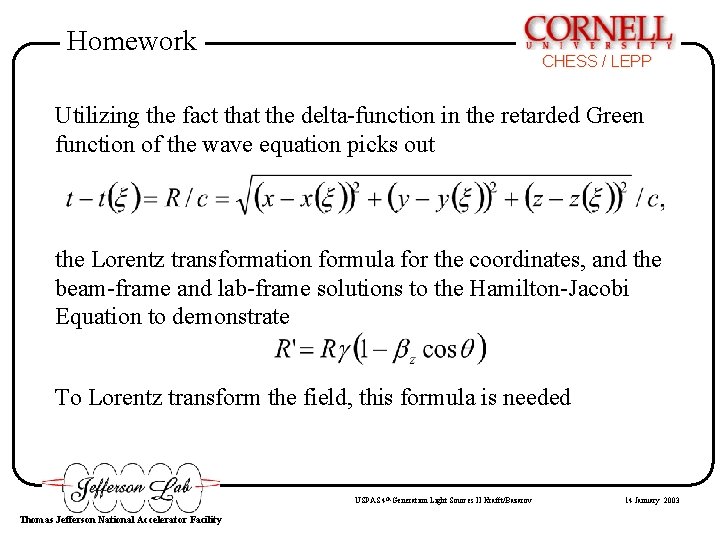
Homework CHESS / LEPP Utilizing the fact that the delta-function in the retarded Green function of the wave equation picks out the Lorentz transformation formula for the coordinates, and the beam-frame and lab-frame solutions to the Hamilton-Jacobi Equation to demonstrate To Lorentz transform the field, this formula is needed USPAS 4 th Generation Light Sources II Krafft/Bazarov Thomas Jefferson National Accelerator Facility 14 January 2003
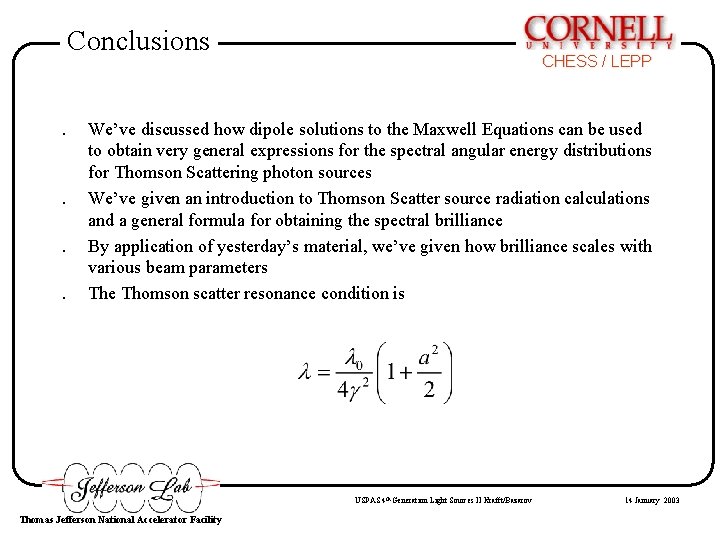
Conclusions. . CHESS / LEPP We’ve discussed how dipole solutions to the Maxwell Equations can be used to obtain very general expressions for the spectral angular energy distributions for Thomson Scattering photon sources We’ve given an introduction to Thomson Scatter source radiation calculations and a general formula for obtaining the spectral brilliance By application of yesterday’s material, we’ve given how brilliance scales with various beam parameters The Thomson scatter resonance condition is USPAS 4 th Generation Light Sources II Krafft/Bazarov Thomas Jefferson National Accelerator Facility 14 January 2003