
USPAS Course on Recirculated and Energy Recovered Linear




- Slides: 53
USPAS Course on Recirculated and Energy Recovered Linear Accelerators G. A. Krafft and L. Merminga Jefferson Lab and Ivan Bazarov Cornell University Lecture 11 USPAS Recirculated and Energy Recovered Linacs Thomas Jefferson National Accelerator Facility Operated by the Southeastern Universities Research Association for the U. S. Department of Energy 9 June 2005
Multipass Beam Breakup. . . Multibunch Stability – BBU/Wakes – Multipass BBU – Single Cavity Formula – Instability Threshold – General Analysis – Transfer Function Measurement Simulations – TDBBU – Single Bunch Recent Work (Pozdeyev and Tennant) – Theoretical Generalization of Single Pass BBU Threshold – Measurement Techniques and Results – Comparison of the Experimental Data to Simulations and the Analytical Formula USPAS Recirculated and Energy Recovered Linacs Thomas Jefferson National Accelerator Facility Operated by the Southeastern Universities Research Association for the U. S. Department of Energy 9 June 2005
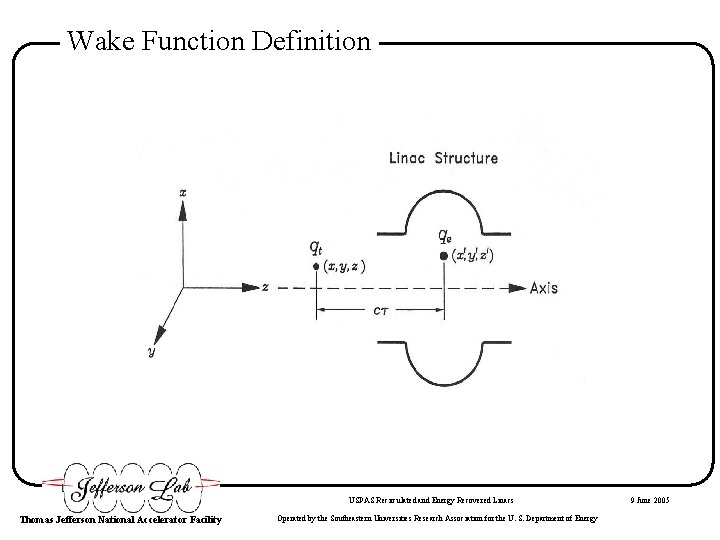
Wake Function Definition USPAS Recirculated and Energy Recovered Linacs Thomas Jefferson National Accelerator Facility Operated by the Southeastern Universities Research Association for the U. S. Department of Energy 9 June 2005
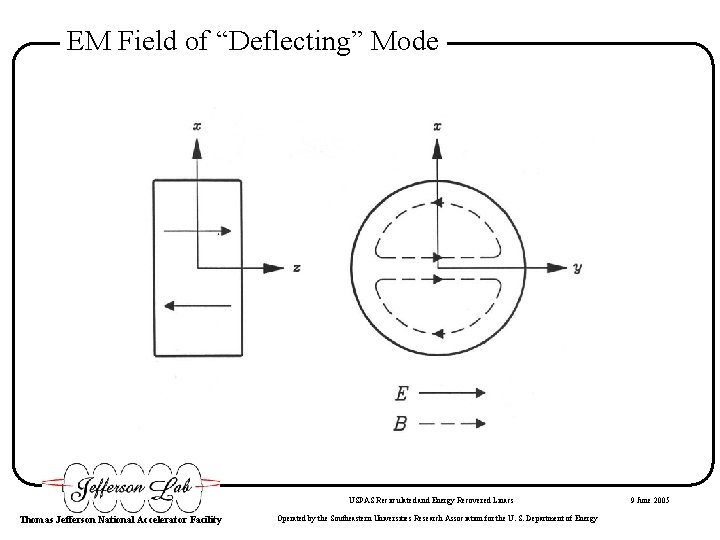
EM Field of “Deflecting” Mode USPAS Recirculated and Energy Recovered Linacs Thomas Jefferson National Accelerator Facility Operated by the Southeastern Universities Research Association for the U. S. Department of Energy 9 June 2005
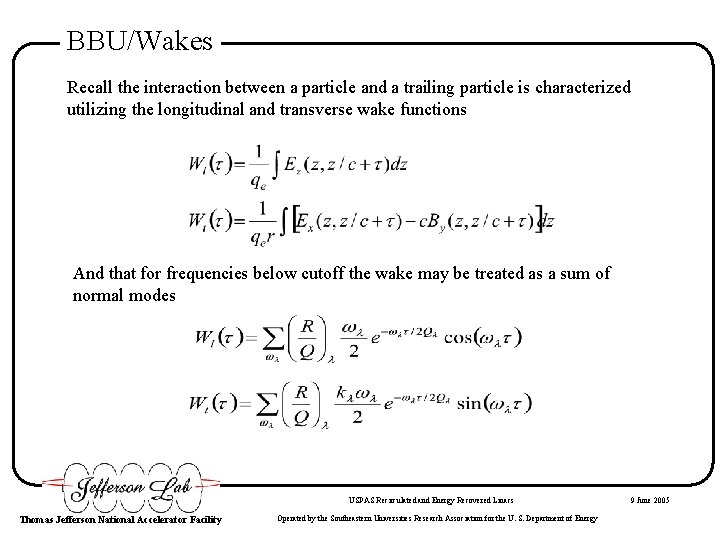
BBU/Wakes Recall the interaction between a particle and a trailing particle is characterized utilizing the longitudinal and transverse wake functions And that for frequencies below cutoff the wake may be treated as a sum of normal modes USPAS Recirculated and Energy Recovered Linacs Thomas Jefferson National Accelerator Facility Operated by the Southeastern Universities Research Association for the U. S. Department of Energy 9 June 2005
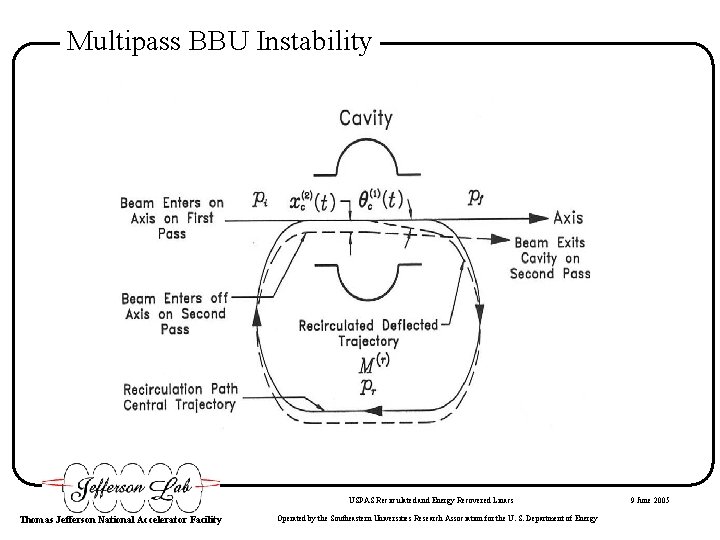
Multipass BBU Instability USPAS Recirculated and Energy Recovered Linacs Thomas Jefferson National Accelerator Facility Operated by the Southeastern Universities Research Association for the U. S. Department of Energy 9 June 2005
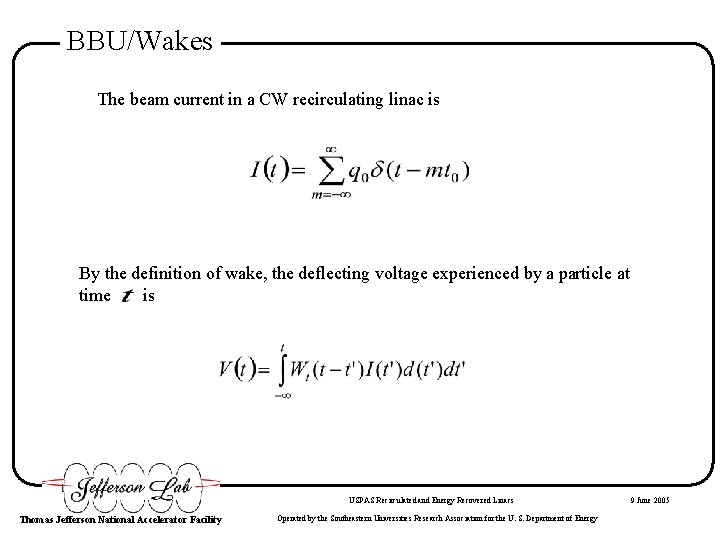
BBU/Wakes The beam current in a CW recirculating linac is By the definition of wake, the deflecting voltage experienced by a particle at time is USPAS Recirculated and Energy Recovered Linacs Thomas Jefferson National Accelerator Facility Operated by the Southeastern Universities Research Association for the U. S. Department of Energy 9 June 2005
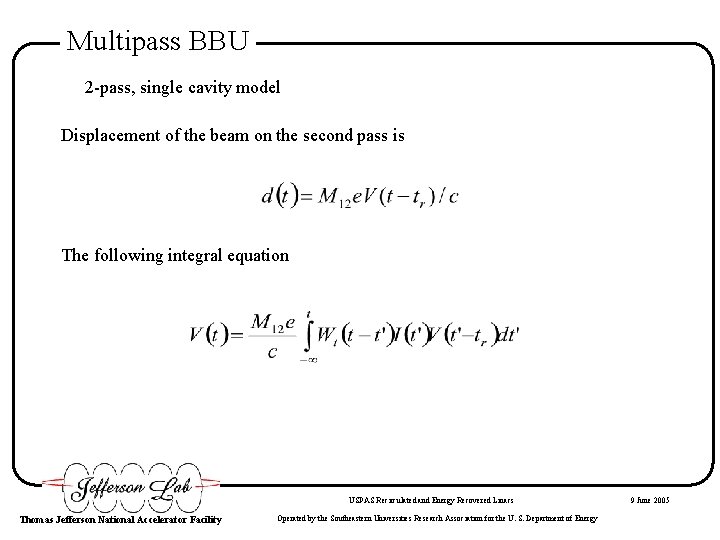
Multipass BBU 2 -pass, single cavity model Displacement of the beam on the second pass is The following integral equation USPAS Recirculated and Energy Recovered Linacs Thomas Jefferson National Accelerator Facility Operated by the Southeastern Universities Research Association for the U. S. Department of Energy 9 June 2005
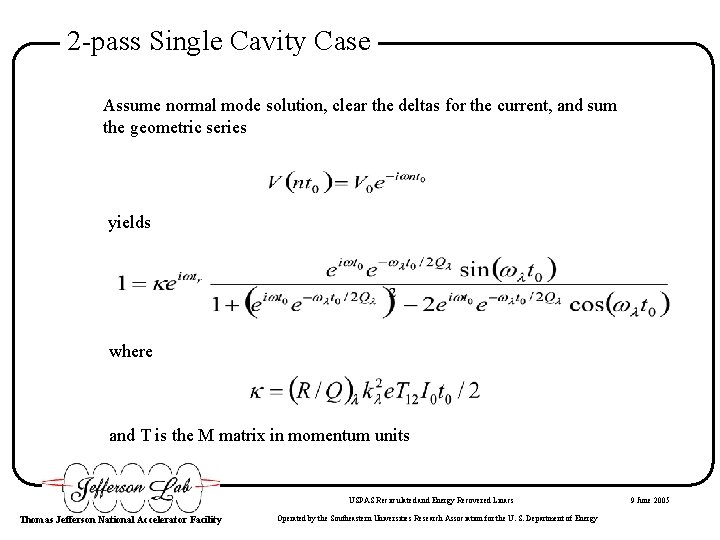
2 -pass Single Cavity Case Assume normal mode solution, clear the deltas for the current, and sum the geometric series yields where and T is the M matrix in momentum units USPAS Recirculated and Energy Recovered Linacs Thomas Jefferson National Accelerator Facility Operated by the Southeastern Universities Research Association for the U. S. Department of Energy 9 June 2005
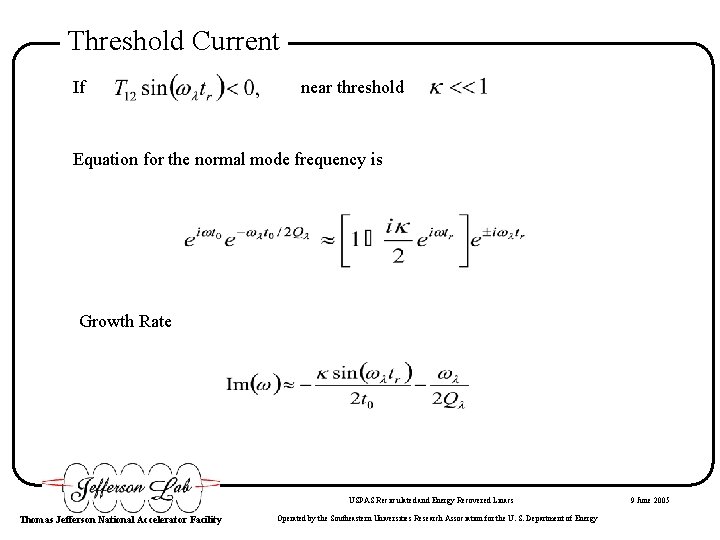
Threshold Current If near threshold Equation for the normal mode frequency is Growth Rate USPAS Recirculated and Energy Recovered Linacs Thomas Jefferson National Accelerator Facility Operated by the Southeastern Universities Research Association for the U. S. Department of Energy 9 June 2005
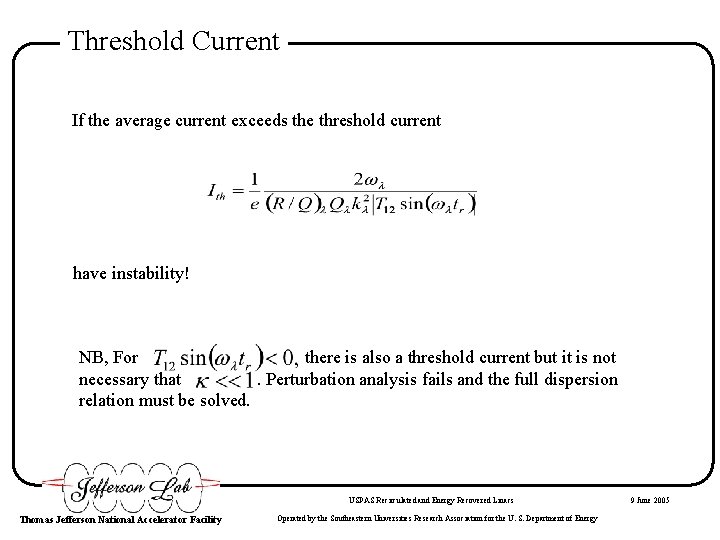
Threshold Current If the average current exceeds the threshold current have instability! NB, For there is also a threshold current but it is not necessary that. Perturbation analysis fails and the full dispersion relation must be solved. USPAS Recirculated and Energy Recovered Linacs Thomas Jefferson National Accelerator Facility Operated by the Southeastern Universities Research Association for the U. S. Department of Energy 9 June 2005
Generalization to Multiple Passes Merminga result and Reference USPAS Recirculated and Energy Recovered Linacs Thomas Jefferson National Accelerator Facility Operated by the Southeastern Universities Research Association for the U. S. Department of Energy 9 June 2005
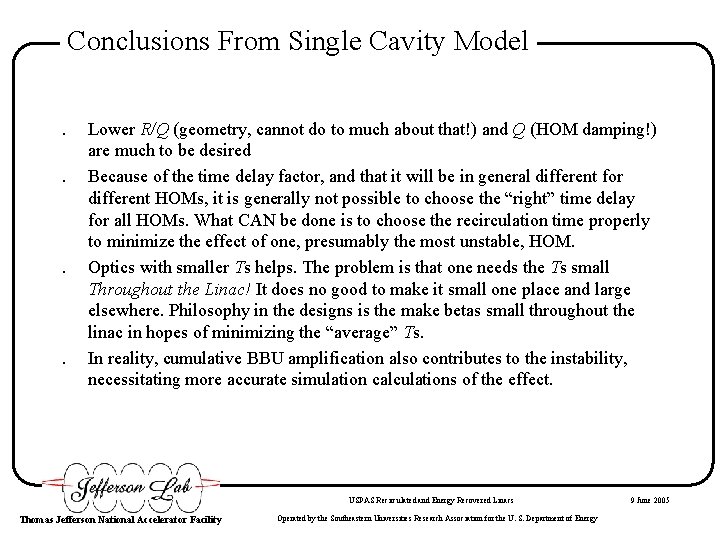
Conclusions From Single Cavity Model. . Lower R/Q (geometry, cannot do to much about that!) and Q (HOM damping!) are much to be desired Because of the time delay factor, and that it will be in general different for different HOMs, it is generally not possible to choose the “right” time delay for all HOMs. What CAN be done is to choose the recirculation time properly to minimize the effect of one, presumably the most unstable, HOM. Optics with smaller Ts helps. The problem is that one needs the Ts small Throughout the Linac! It does no good to make it small one place and large elsewhere. Philosophy in the designs is the make betas small throughout the linac in hopes of minimizing the “average” Ts. In reality, cumulative BBU amplification also contributes to the instability, necessitating more accurate simulation calculations of the effect. USPAS Recirculated and Energy Recovered Linacs Thomas Jefferson National Accelerator Facility Operated by the Southeastern Universities Research Association for the U. S. Department of Energy 9 June 2005
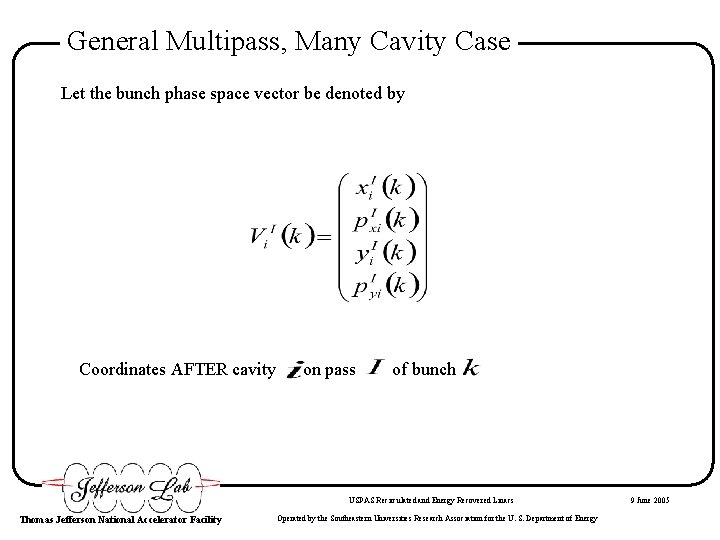
General Multipass, Many Cavity Case Let the bunch phase space vector be denoted by Coordinates AFTER cavity on pass of bunch USPAS Recirculated and Energy Recovered Linacs Thomas Jefferson National Accelerator Facility Operated by the Southeastern Universities Research Association for the U. S. Department of Energy 9 June 2005
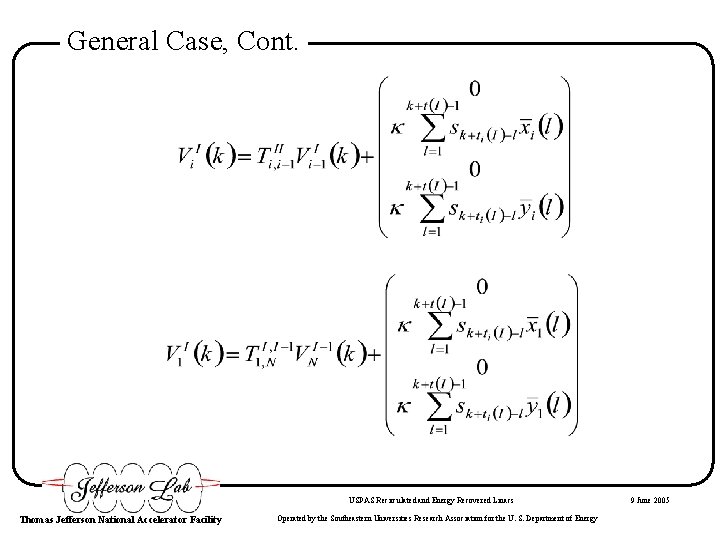
General Case, Cont. USPAS Recirculated and Energy Recovered Linacs Thomas Jefferson National Accelerator Facility Operated by the Southeastern Universities Research Association for the U. S. Department of Energy 9 June 2005
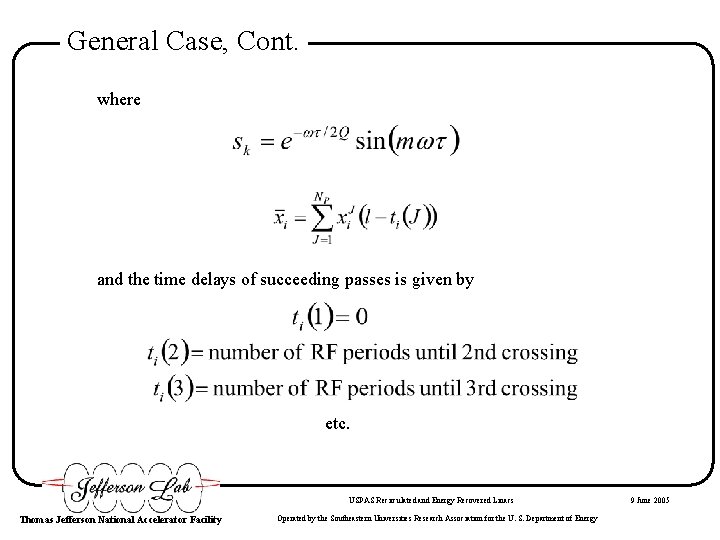
General Case, Cont. where and the time delays of succeeding passes is given by etc. USPAS Recirculated and Energy Recovered Linacs Thomas Jefferson National Accelerator Facility Operated by the Southeastern Universities Research Association for the U. S. Department of Energy 9 June 2005
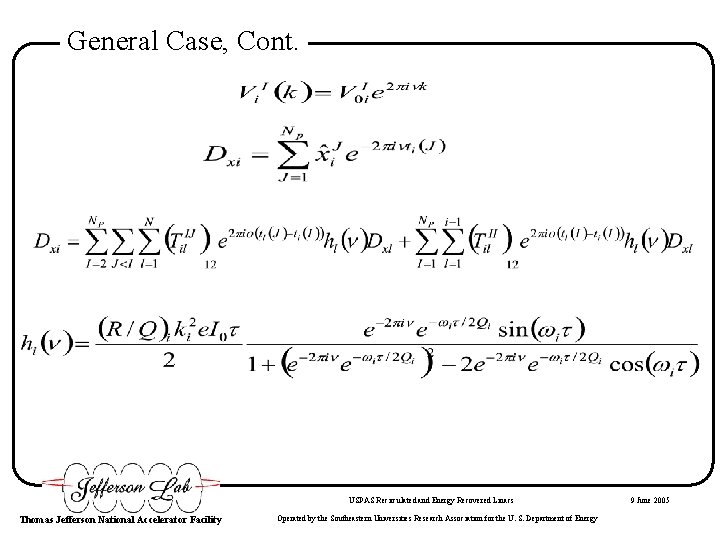
General Case, Cont. USPAS Recirculated and Energy Recovered Linacs Thomas Jefferson National Accelerator Facility Operated by the Southeastern Universities Research Association for the U. S. Department of Energy 9 June 2005
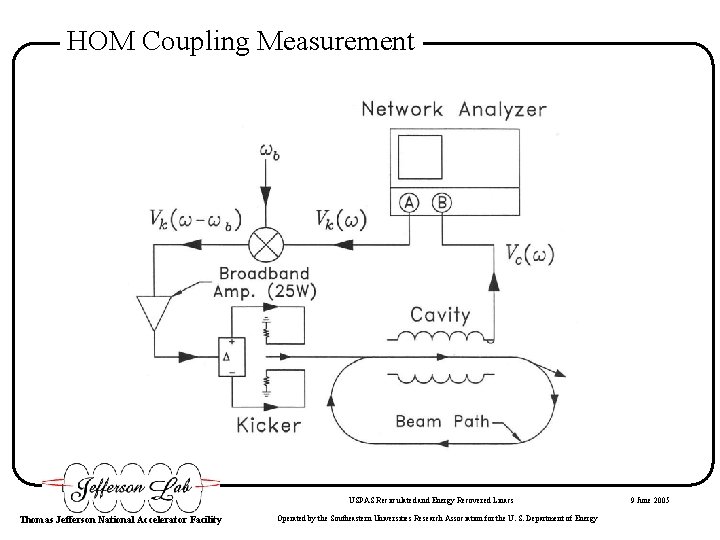
HOM Coupling Measurement USPAS Recirculated and Energy Recovered Linacs Thomas Jefferson National Accelerator Facility Operated by the Southeastern Universities Research Association for the U. S. Department of Energy 9 June 2005
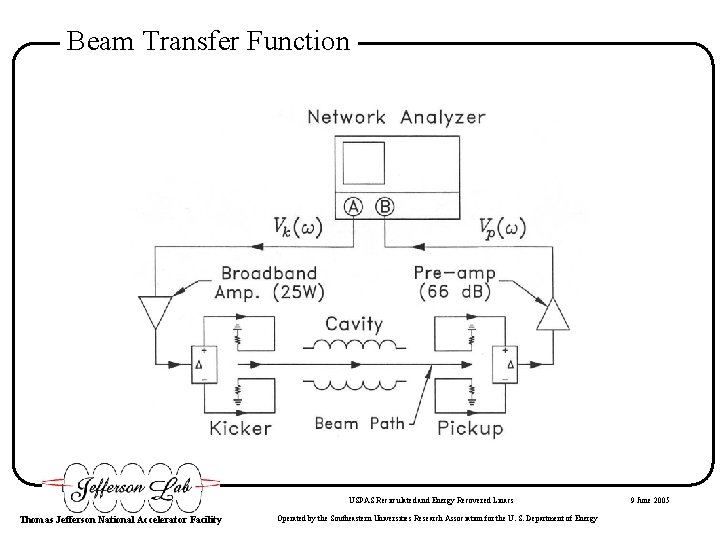
Beam Transfer Function USPAS Recirculated and Energy Recovered Linacs Thomas Jefferson National Accelerator Facility Operated by the Southeastern Universities Research Association for the U. S. Department of Energy 9 June 2005
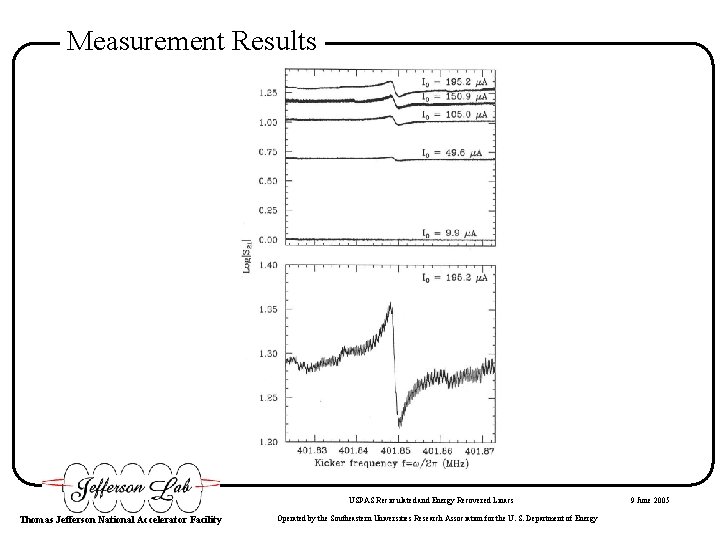
Measurement Results USPAS Recirculated and Energy Recovered Linacs Thomas Jefferson National Accelerator Facility Operated by the Southeastern Universities Research Association for the U. S. Department of Energy 9 June 2005
Current Dependence of Measurement Results USPAS Recirculated and Energy Recovered Linacs Thomas Jefferson National Accelerator Facility Operated by the Southeastern Universities Research Association for the U. S. Department of Energy 9 June 2005
TDBBU Simulation. . . Short bunch simulation of Multibunch BBU assuming multiple cavity deflecting modes Multipass accelerators may be simulated Accelerators with several linac segments may be simulated Accelerators with accelerating passes and decelerating passes may be simulated Simulations include effects of differing path lengths from differing linac segments The current in successive bunches may be varied in a programmed manner One iteration of code corresponds to one fundamental RF period USPAS Recirculated and Energy Recovered Linacs Thomas Jefferson National Accelerator Facility Operated by the Southeastern Universities Research Association for the U. S. Department of Energy 9 June 2005
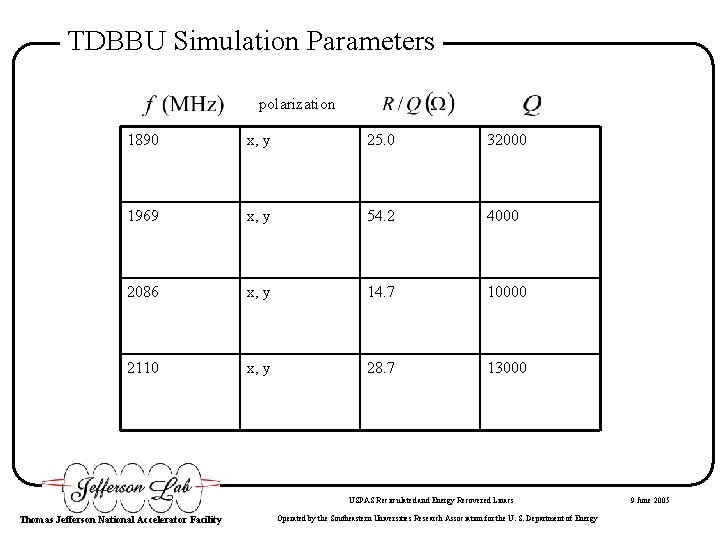
TDBBU Simulation Parameters polarization 1890 x, y 25. 0 32000 1969 x, y 54. 2 4000 2086 x, y 14. 7 10000 2110 x, y 28. 7 13000 USPAS Recirculated and Energy Recovered Linacs Thomas Jefferson National Accelerator Facility Operated by the Southeastern Universities Research Association for the U. S. Department of Energy 9 June 2005
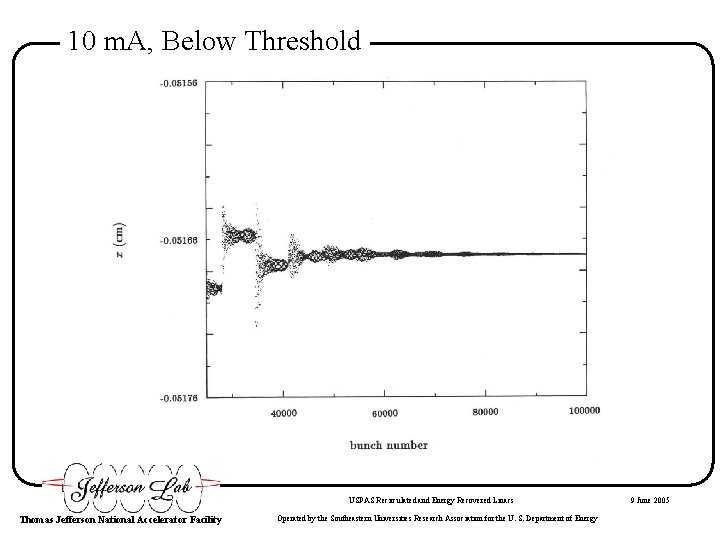
10 m. A, Below Threshold USPAS Recirculated and Energy Recovered Linacs Thomas Jefferson National Accelerator Facility Operated by the Southeastern Universities Research Association for the U. S. Department of Energy 9 June 2005
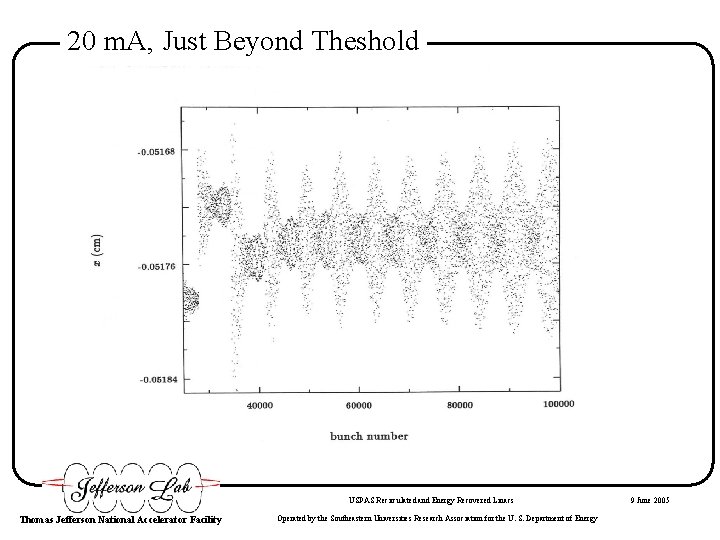
20 m. A, Just Beyond Theshold USPAS Recirculated and Energy Recovered Linacs Thomas Jefferson National Accelerator Facility Operated by the Southeastern Universities Research Association for the U. S. Department of Energy 9 June 2005
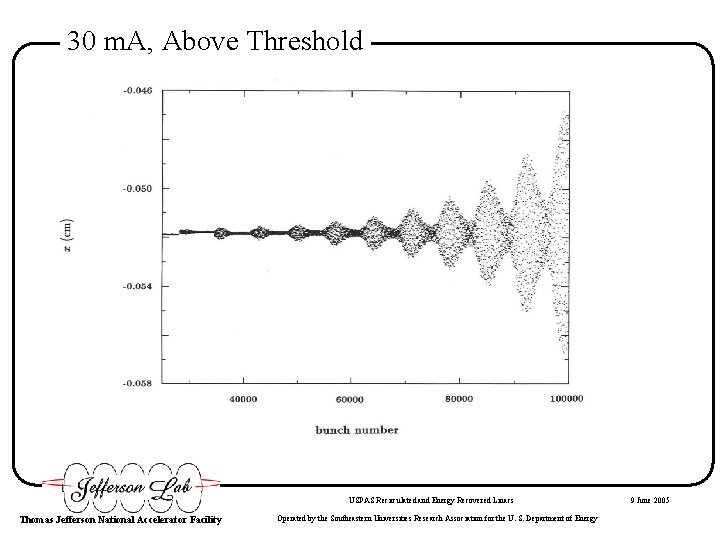
30 m. A, Above Threshold USPAS Recirculated and Energy Recovered Linacs Thomas Jefferson National Accelerator Facility Operated by the Southeastern Universities Research Association for the U. S. Department of Energy 9 June 2005
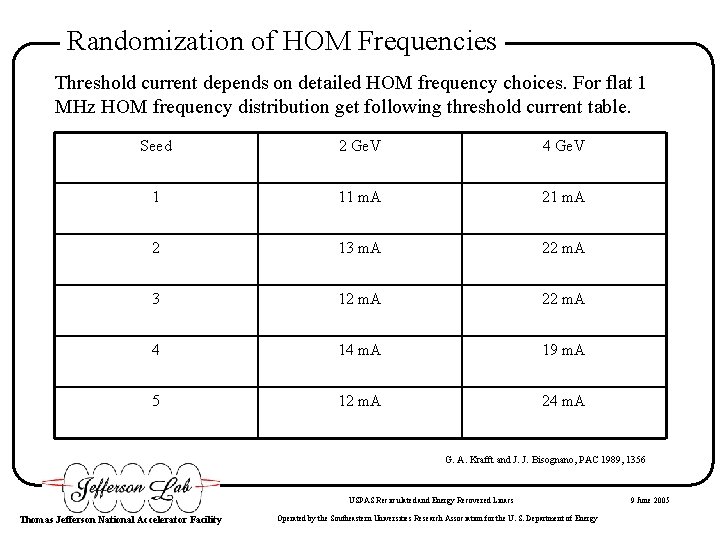
Randomization of HOM Frequencies Threshold current depends on detailed HOM frequency choices. For flat 1 MHz HOM frequency distribution get following threshold current table. Seed 2 Ge. V 4 Ge. V 1 11 m. A 2 13 m. A 22 m. A 3 12 m. A 22 m. A 4 14 m. A 19 m. A 5 12 m. A 24 m. A G. A. Krafft and J. J. Bisognano, PAC 1989, 1356 USPAS Recirculated and Energy Recovered Linacs Thomas Jefferson National Accelerator Facility Operated by the Southeastern Universities Research Association for the U. S. Department of Energy 9 June 2005
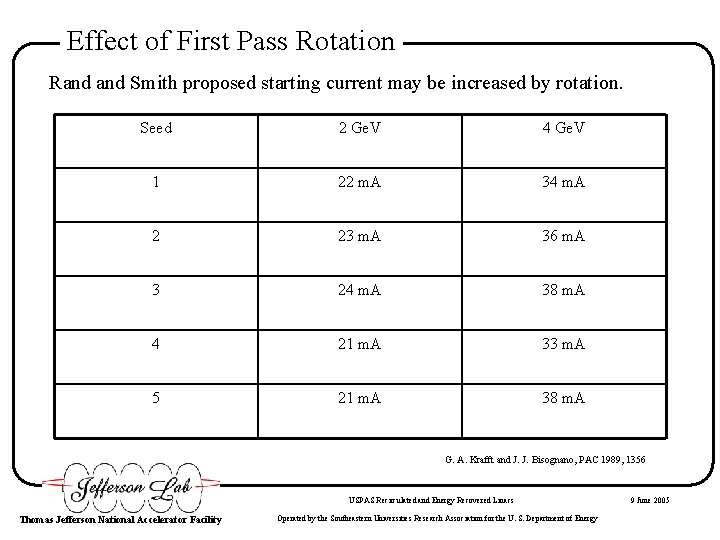
Effect of First Pass Rotation Rand Smith proposed starting current may be increased by rotation. Seed 2 Ge. V 4 Ge. V 1 22 m. A 34 m. A 2 23 m. A 36 m. A 3 24 m. A 38 m. A 4 21 m. A 33 m. A 5 21 m. A 38 m. A G. A. Krafft and J. J. Bisognano, PAC 1989, 1356 USPAS Recirculated and Energy Recovered Linacs Thomas Jefferson National Accelerator Facility Operated by the Southeastern Universities Research Association for the U. S. Department of Energy 9 June 2005
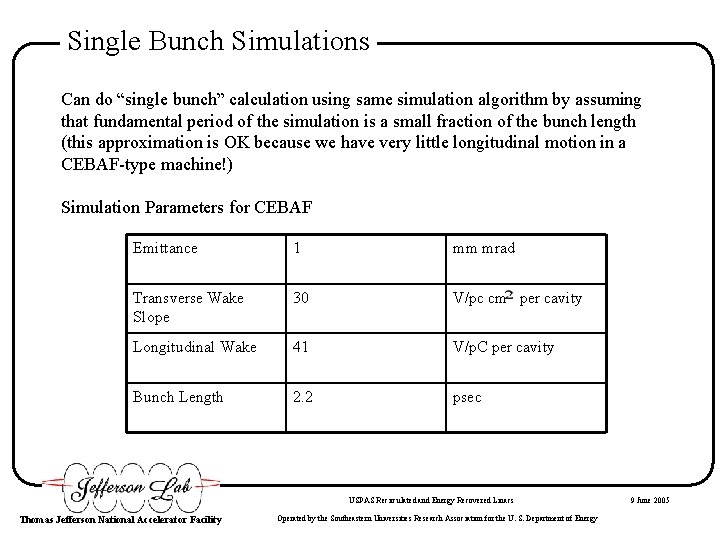
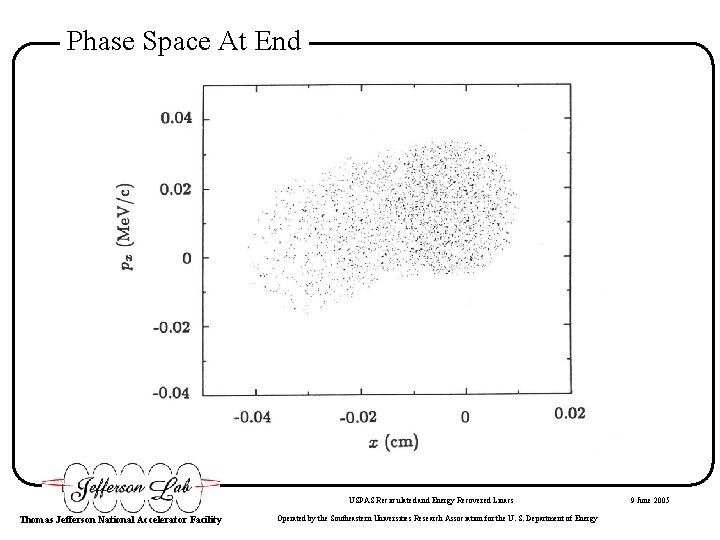
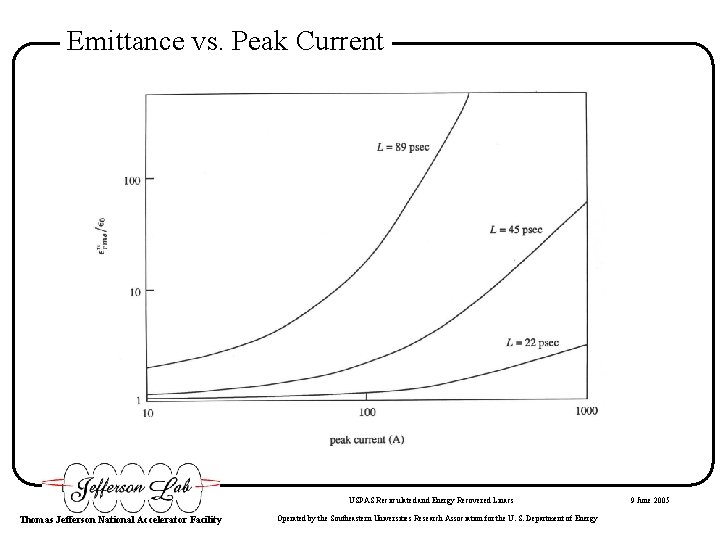
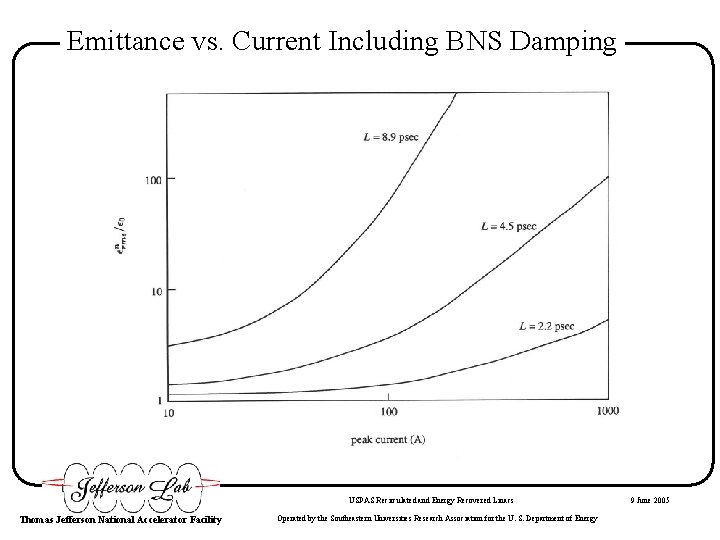
Single Bunch Simulations Can do “single bunch” calculation using same simulation algorithm by assuming that fundamental period of the simulation is a small fraction of the bunch length (this approximation is OK because we have very little longitudinal motion in a CEBAF-type machine!) Simulation Parameters for CEBAF Emittance 1 mm mrad Transverse Wake Slope 30 V/pc cm per cavity Longitudinal Wake 41 V/p. C per cavity Bunch Length 2. 2 psec USPAS Recirculated and Energy Recovered Linacs Thomas Jefferson National Accelerator Facility Operated by the Southeastern Universities Research Association for the U. S. Department of Energy 9 June 2005
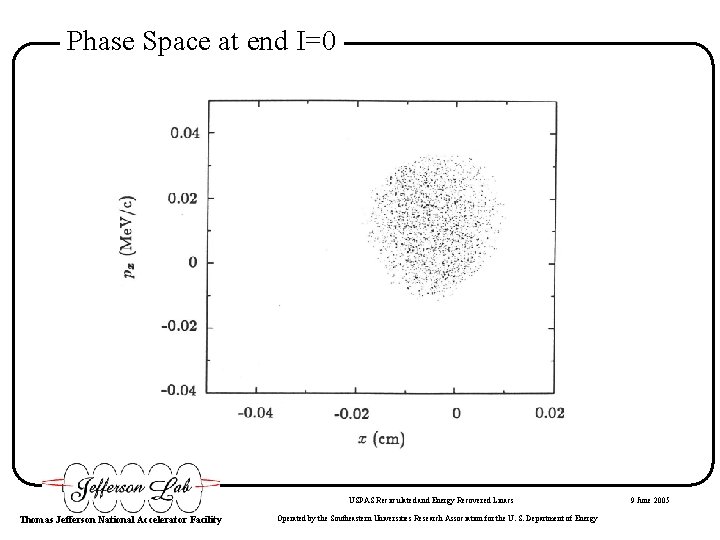
Phase Space at end I=0 USPAS Recirculated and Energy Recovered Linacs Thomas Jefferson National Accelerator Facility Operated by the Southeastern Universities Research Association for the U. S. Department of Energy 9 June 2005
Phase Space At End USPAS Recirculated and Energy Recovered Linacs Thomas Jefferson National Accelerator Facility Operated by the Southeastern Universities Research Association for the U. S. Department of Energy 9 June 2005
Emittance vs. Peak Current USPAS Recirculated and Energy Recovered Linacs Thomas Jefferson National Accelerator Facility Operated by the Southeastern Universities Research Association for the U. S. Department of Energy 9 June 2005
Emittance vs. Current Including BNS Damping USPAS Recirculated and Energy Recovered Linacs Thomas Jefferson National Accelerator Facility Operated by the Southeastern Universities Research Association for the U. S. Department of Energy 9 June 2005
Studies of the regenerative BBU at the JLab FEL Upgrade Eduard Pozdeyev, Chris Tennant USPAS Recirculated and Energy Recovered Linacs Thomas Jefferson National Accelerator Facility Operated by the Southeastern Universities Research Association for the U. S. Department of Energy 9 June 2005
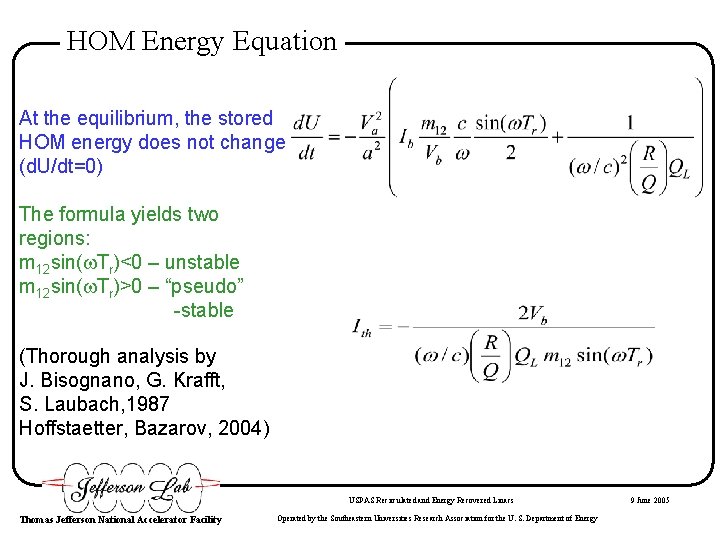
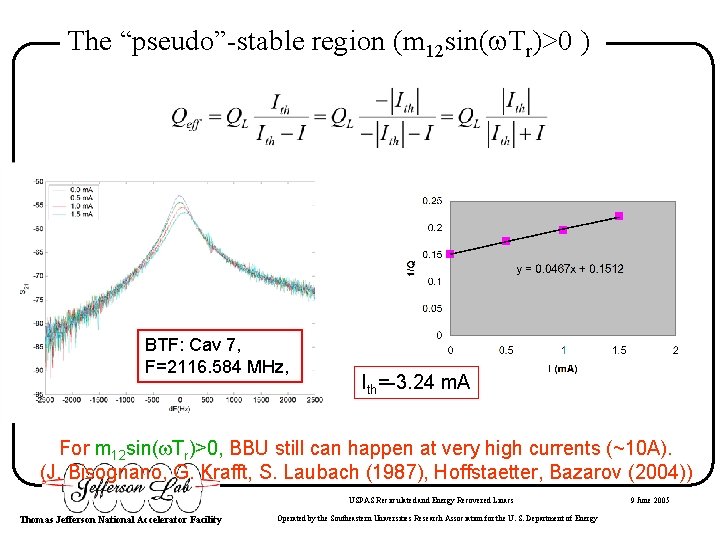
HOM Energy Equation At the equilibrium, the stored HOM energy does not change (d. U/dt=0) The formula yields two regions: m 12 sin( Tr)<0 – unstable m 12 sin( Tr)>0 – “pseudo” -stable (Thorough analysis by J. Bisognano, G. Krafft, S. Laubach, 1987 Hoffstaetter, Bazarov, 2004) USPAS Recirculated and Energy Recovered Linacs Thomas Jefferson National Accelerator Facility Operated by the Southeastern Universities Research Association for the U. S. Department of Energy 9 June 2005
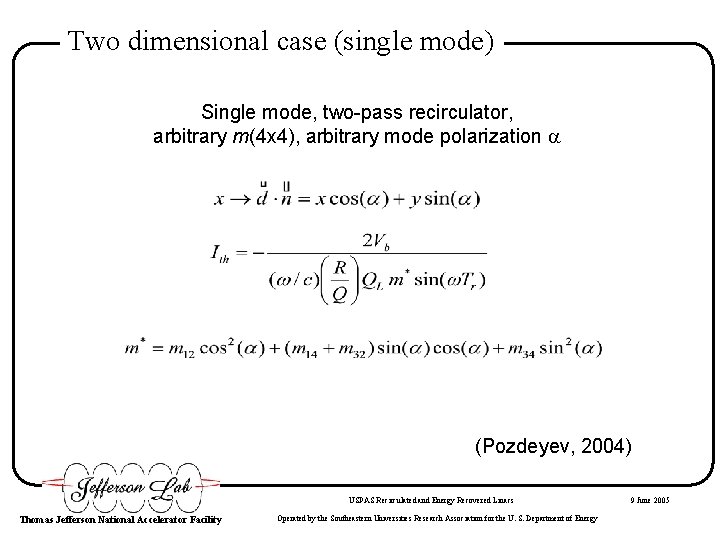
Two dimensional case (single mode) Single mode, two-pass recirculator, arbitrary m(4 x 4), arbitrary mode polarization (Pozdeyev, 2004) USPAS Recirculated and Energy Recovered Linacs Thomas Jefferson National Accelerator Facility Operated by the Southeastern Universities Research Association for the U. S. Department of Energy 9 June 2005
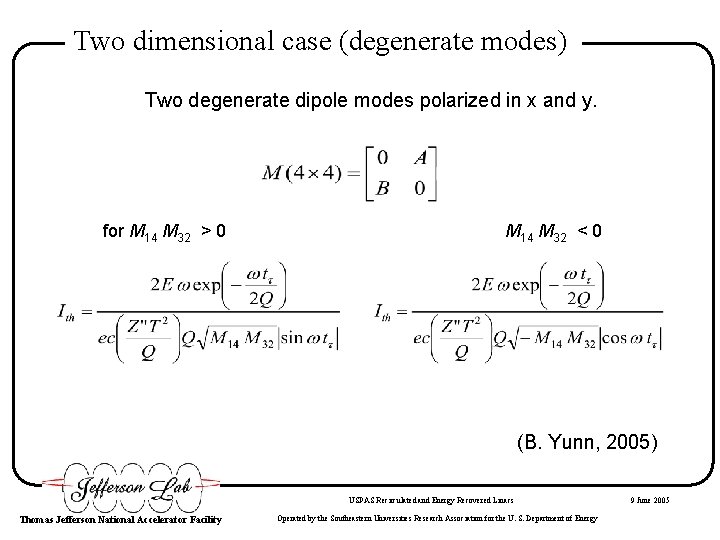
Two dimensional case (degenerate modes) Two degenerate dipole modes polarized in x and y. for M 14 M 32 > 0 M 14 M 32 < 0 (B. Yunn, 2005) USPAS Recirculated and Energy Recovered Linacs Thomas Jefferson National Accelerator Facility Operated by the Southeastern Universities Research Association for the U. S. Department of Energy 9 June 2005
Splitting degenerate modes for effective BBU suppression by 90 -rotation/reflection 20 MHz b a b S 21 a f S 21 f Frequency separation can be estimated using formula for a square cavity where ± d is the variation of the cavity transverse size USPAS Recirculated and Energy Recovered Linacs Thomas Jefferson National Accelerator Facility Operated by the Southeastern Universities Research Association for the U. S. Department of Energy 9 June 2005
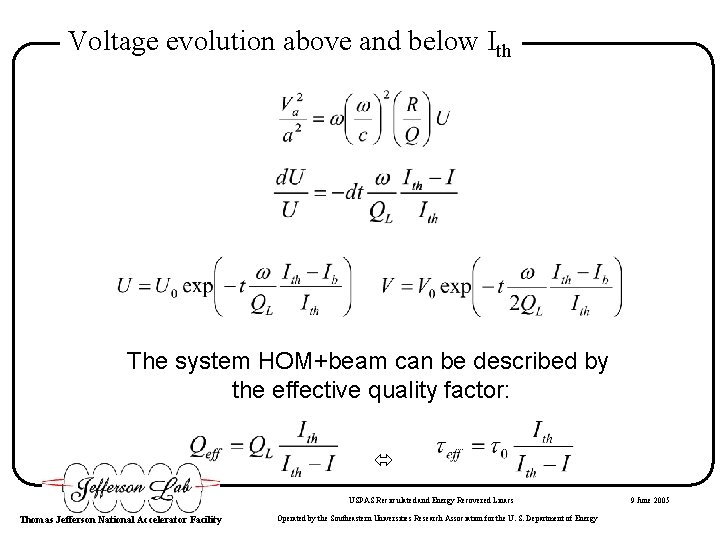
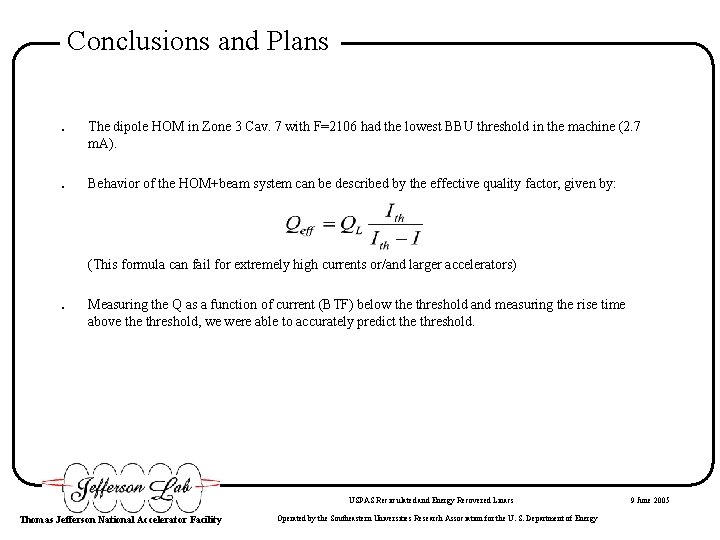
Voltage evolution above and below Ith The system HOM+beam can be described by the effective quality factor: USPAS Recirculated and Energy Recovered Linacs Thomas Jefferson National Accelerator Facility Operated by the Southeastern Universities Research Association for the U. S. Department of Energy 9 June 2005
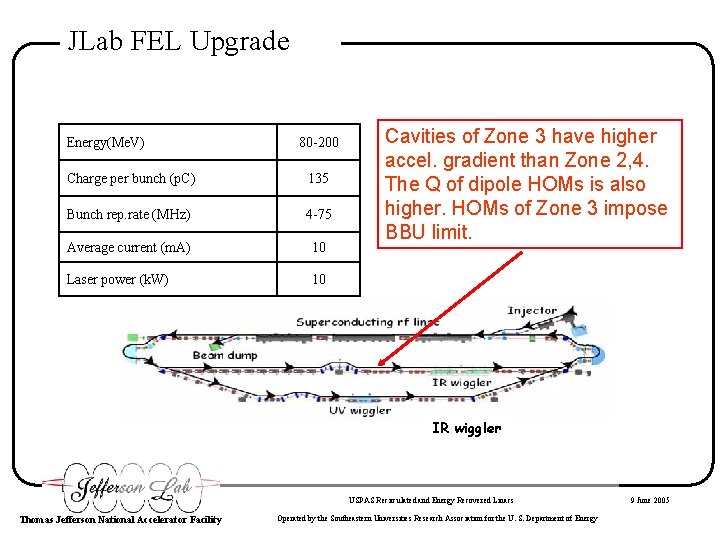
JLab FEL Upgrade Energy(Me. V) 80 -200 Charge per bunch (p. C) 135 Bunch rep. rate (MHz) 4 -75 Average current (m. A) 10 Laser power (k. W) 10 Cavities of Zone 3 have higher accel. gradient than Zone 2, 4. The Q of dipole HOMs is also higher. HOMs of Zone 3 impose BBU limit. IR wiggler USPAS Recirculated and Energy Recovered Linacs Thomas Jefferson National Accelerator Facility Operated by the Southeastern Universities Research Association for the U. S. Department of Energy 9 June 2005
Questions we tried to answer. How well do the model and simulations describe the BBU and the beam behavior . Can we experimentally measure (predict) the BBU threshold doing measurements below the threshold . Can we suppress BBU (C. Tennant, next talk) USPAS Recirculated and Energy Recovered Linacs Thomas Jefferson National Accelerator Facility Operated by the Southeastern Universities Research Association for the U. S. Department of Energy 9 June 2005
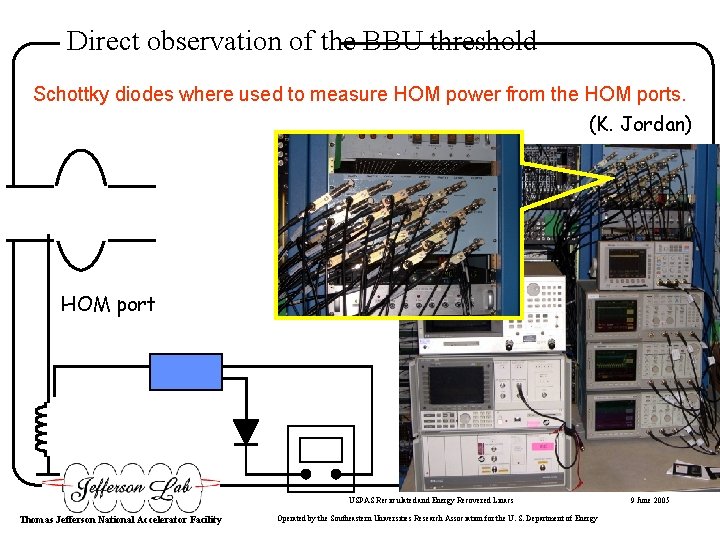
Direct observation of the BBU threshold Schottky diodes where used to measure HOM power from the HOM ports. (K. Jordan) HOM port USPAS Recirculated and Energy Recovered Linacs Thomas Jefferson National Accelerator Facility Operated by the Southeastern Universities Research Association for the U. S. Department of Energy 9 June 2005
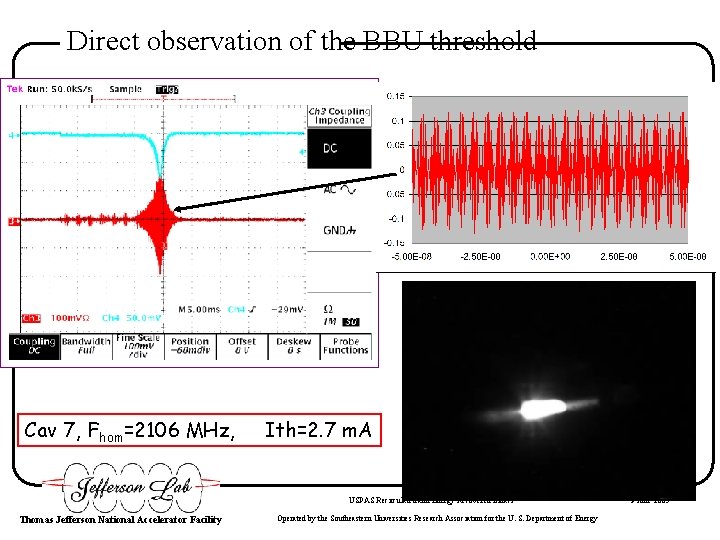
Direct observation of the BBU threshold Cav 7, Fhom=2106 MHz, Ith=2. 7 m. A USPAS Recirculated and Energy Recovered Linacs Thomas Jefferson National Accelerator Facility Operated by the Southeastern Universities Research Association for the U. S. Department of Energy 9 June 2005
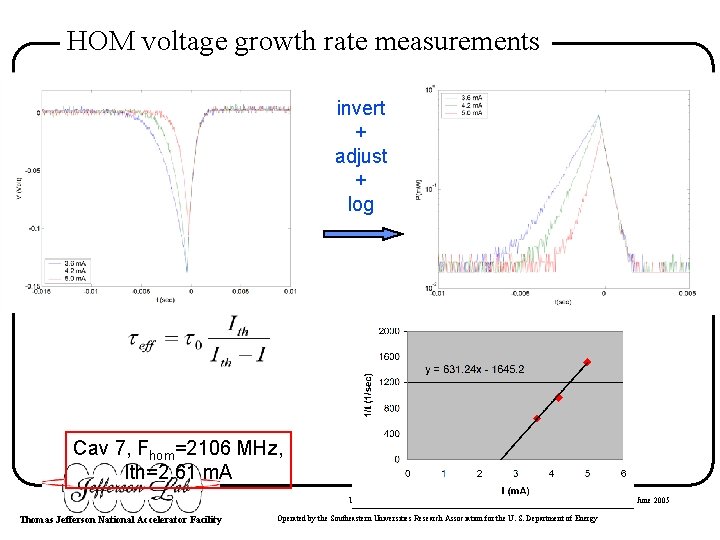
HOM voltage growth rate measurements invert + adjust + log Cav 7, Fhom=2106 MHz, Ith=2. 61 m. A USPAS Recirculated and Energy Recovered Linacs Thomas Jefferson National Accelerator Facility Operated by the Southeastern Universities Research Association for the U. S. Department of Energy 9 June 2005
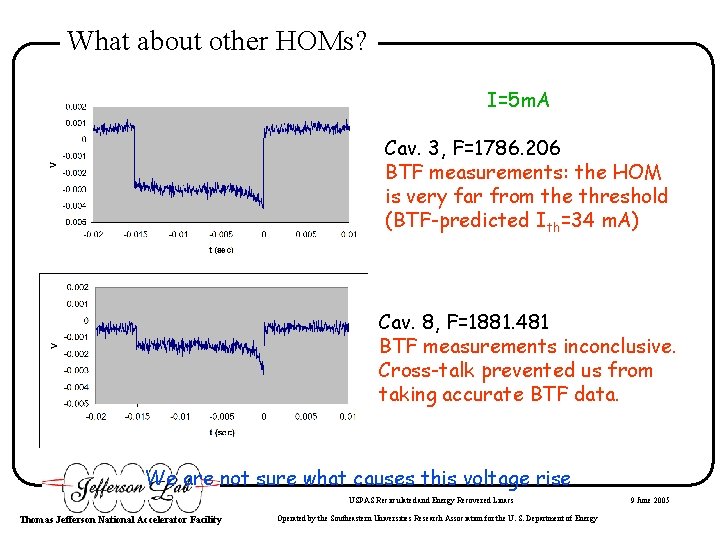
What about other HOMs? I=5 m. A Cav. 3, F=1786. 206 BTF measurements: the HOM is very far from the threshold (BTF-predicted Ith=34 m. A) Cav. 8, F=1881. 481 BTF measurements inconclusive. Cross-talk prevented us from taking accurate BTF data. We are not sure what causes this voltage rise USPAS Recirculated and Energy Recovered Linacs Thomas Jefferson National Accelerator Facility Operated by the Southeastern Universities Research Association for the U. S. Department of Energy 9 June 2005
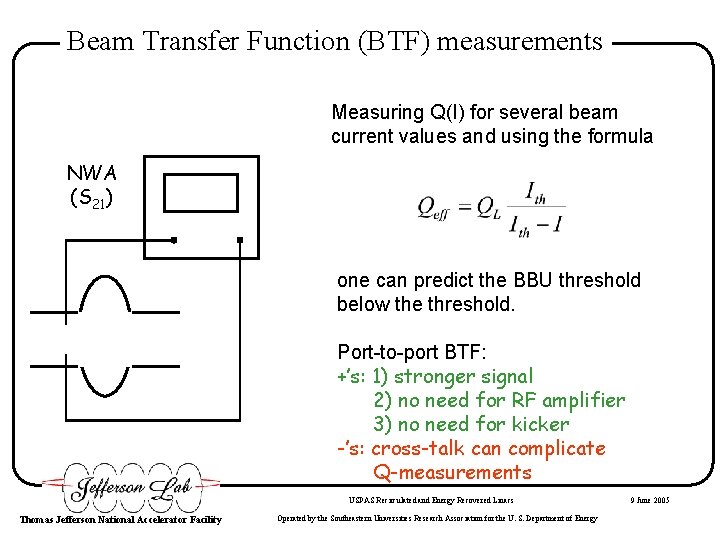
Beam Transfer Function (BTF) measurements Measuring Q(I) for several beam current values and using the formula NWA (S 21) one can predict the BBU threshold below the threshold. Port-to-port BTF: +’s: 1) stronger signal 2) no need for RF amplifier 3) no need for kicker -’s: cross-talk can complicate Q-measurements USPAS Recirculated and Energy Recovered Linacs Thomas Jefferson National Accelerator Facility Operated by the Southeastern Universities Research Association for the U. S. Department of Energy 9 June 2005
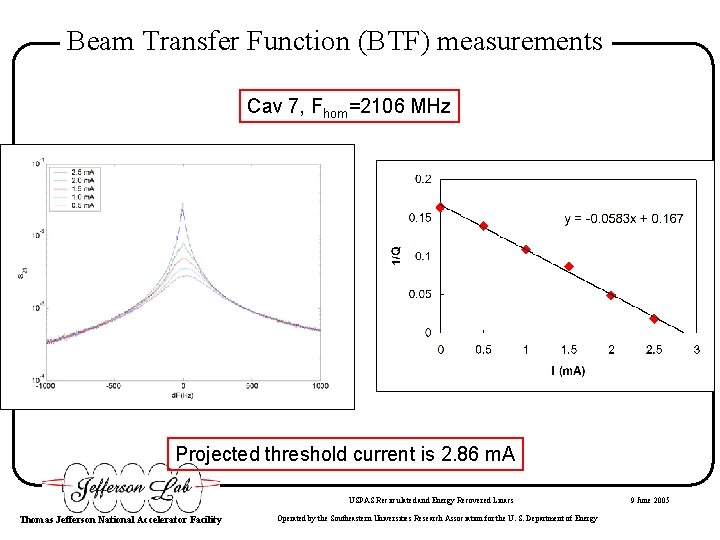
Beam Transfer Function (BTF) measurements Cav 7, Fhom=2106 MHz Projected threshold current is 2. 86 m. A USPAS Recirculated and Energy Recovered Linacs Thomas Jefferson National Accelerator Facility Operated by the Southeastern Universities Research Association for the U. S. Department of Energy 9 June 2005
The “pseudo”-stable region (m 12 sin( Tr)>0 ) BTF: Cav 7, F=2116. 584 MHz, Ith=-3. 24 m. A For m 12 sin( Tr)>0, BBU still can happen at very high currents (~10 A). (J. Bisognano, G. Krafft, S. Laubach (1987), Hoffstaetter, Bazarov (2004)) USPAS Recirculated and Energy Recovered Linacs Thomas Jefferson National Accelerator Facility Operated by the Southeastern Universities Research Association for the U. S. Department of Energy 9 June 2005
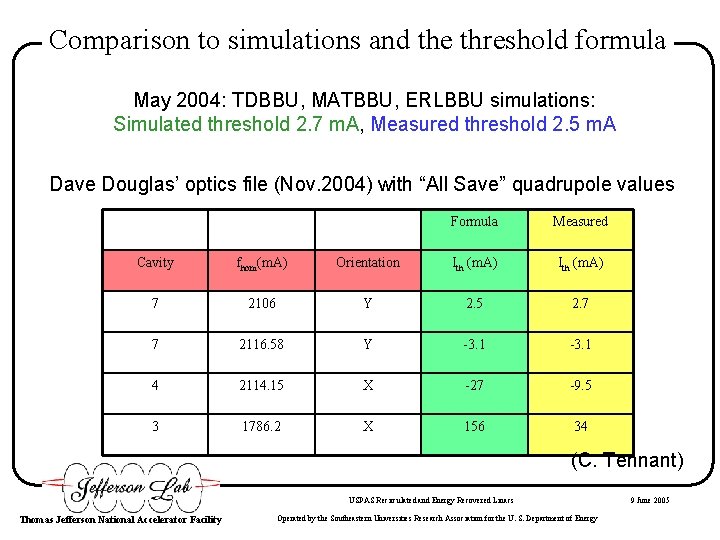
Comparison to simulations and the threshold formula May 2004: TDBBU, MATBBU, ERLBBU simulations: Simulated threshold 2. 7 m. A, Measured threshold 2. 5 m. A Dave Douglas’ optics file (Nov. 2004) with “All Save” quadrupole values Formula Measured Cavity fhom(m. A) Orientation Ith (m. A) 7 2106 Y 2. 5 2. 7 7 2116. 58 Y -3. 1 4 2114. 15 X -27 -9. 5 3 1786. 2 X 156 34 (C. Tennant) USPAS Recirculated and Energy Recovered Linacs Thomas Jefferson National Accelerator Facility Operated by the Southeastern Universities Research Association for the U. S. Department of Energy 9 June 2005
Conclusions and Plans. The dipole HOM in Zone 3 Cav. 7 with F=2106 had the lowest BBU threshold in the machine (2. 7 m. A). . Behavior of the HOM+beam system can be described by the effective quality factor, given by: (This formula can fail for extremely high currents or/and larger accelerators) . Measuring the Q as a function of current (BTF) below the threshold and measuring the rise time above threshold, we were able to accurately predict the threshold. USPAS Recirculated and Energy Recovered Linacs Thomas Jefferson National Accelerator Facility Operated by the Southeastern Universities Research Association for the U. S. Department of Energy 9 June 2005
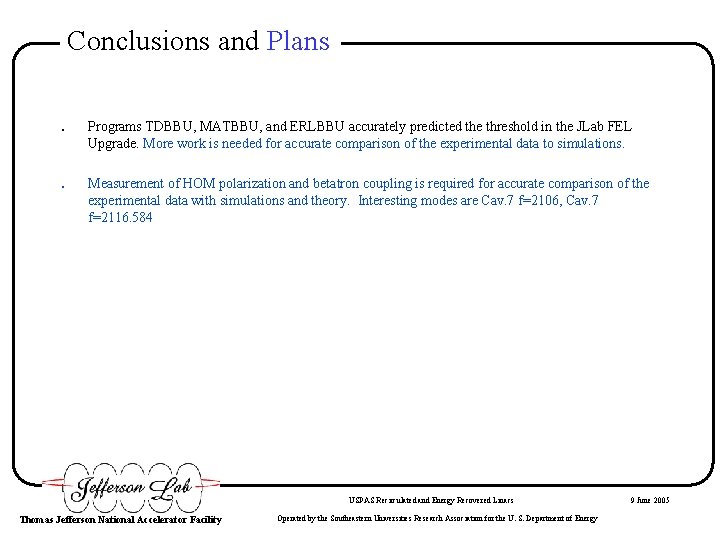
Conclusions and Plans. Programs TDBBU, MATBBU, and ERLBBU accurately predicted the threshold in the JLab FEL Upgrade. More work is needed for accurate comparison of the experimental data to simulations. . Measurement of HOM polarization and betatron coupling is required for accurate comparison of the experimental data with simulations and theory. Interesting modes are Cav. 7 f=2106, Cav. 7 f=2116. 584 USPAS Recirculated and Energy Recovered Linacs Thomas Jefferson National Accelerator Facility Operated by the Southeastern Universities Research Association for the U. S. Department of Energy 9 June 2005
Acknowledgements. . . . L. Merminga, G. Krafft, B. Yunn (JLab) S. Benson , D. Douglas, K. Jordan, G. Neil, FEL team (JLab) Haipeng Wang (JLab) Curt Hovater (JLab) Todd Smith (Stanford) I. Bazarov, G. Hoffstaetter, C. Sinclair (Cornell) Stefan Simrock (DESY) USPAS Recirculated and Energy Recovered Linacs Thomas Jefferson National Accelerator Facility Operated by the Southeastern Universities Research Association for the U. S. Department of Energy 9 June 2005
CONCLUSIONS • Described Multipass Multibunch BBU Instability • Described Analytical Techniques and Simulation Techniques for studying this instability • Discussed Some Recent Measurements at the Jefferson Lab FEL on this Instability • Reviewed where we are in understanding this instability USPAS Recirculated and Energy Recovered Linacs Thomas Jefferson National Accelerator Facility Operated by the Southeastern Universities Research Association for the U. S. Department of Energy 9 June 2005