
Chess for Beginners Every chess master was once
Chess for Beginners Every chess master was once a beginner. Irving Chernev Liam Murray 2019 primary. chess. workshop@gmail. com
How to Set Up the Board and Pieces Basic rules of chess: � White � One always starts square – one piece � Players shake hands before and after games. Liam Murray 2019 primary. chess. workshop@gmail. com
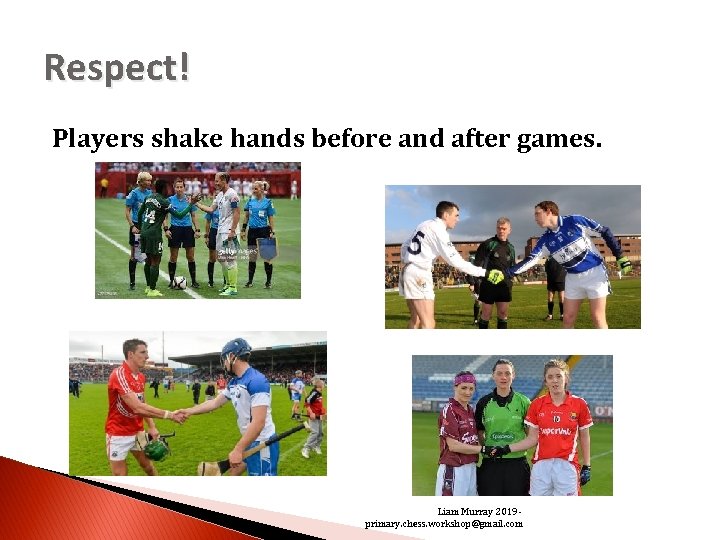
Respect! Players shake hands before and after games. Liam Murray 2019 primary. chess. workshop@gmail. com
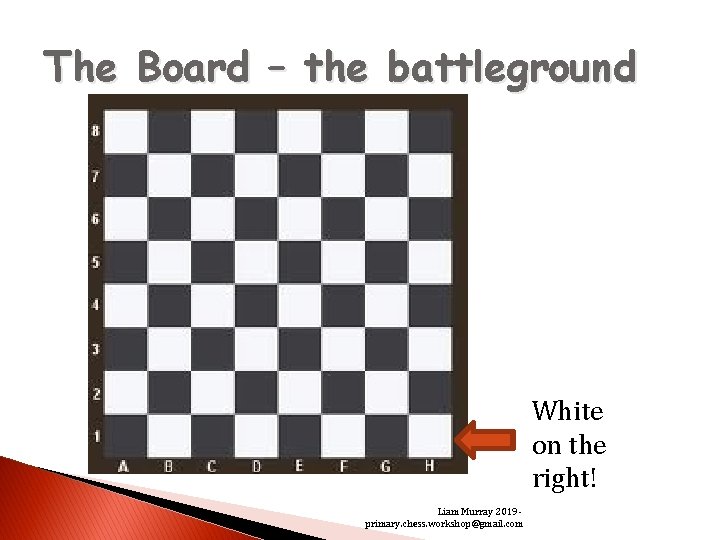
The Board – the battleground White on the right! Liam Murray 2019 primary. chess. workshop@gmail. com
The Pieces It is useful to remember that each piece has 3 main operations: 1. 2. 3. Starting position Moving rules Capture moves If you can recall these 3 rules for each piece you’re on the right track! Liam Murray 2019 primary. chess. workshop@gmail. com
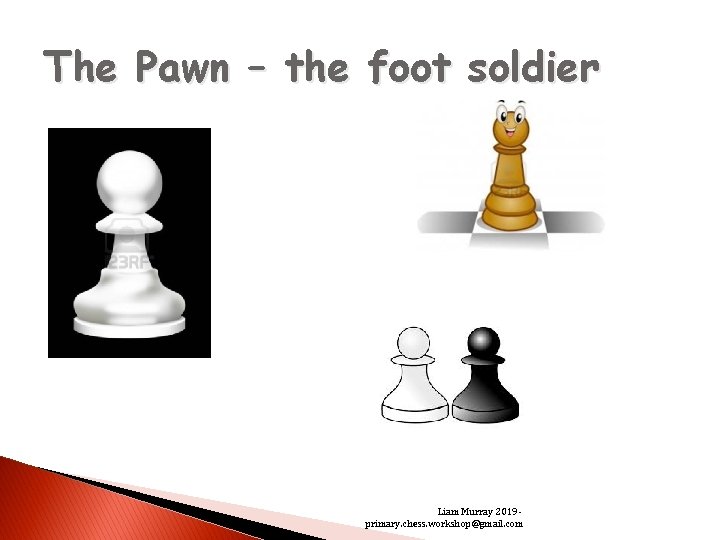
The Pawn – the foot soldier Liam Murray 2019 primary. chess. workshop@gmail. com
The Pawn � White pawns start on rank 2, black pawns on rank 7. � Pawns can move only one space forward at any time except for their first move when each pawn has the choice of moving one or two spaces forward. � Pawns can capture other pieces by moving one space diagonally forward to the left or right. Liam Murray 2019 primary. chess. workshop@gmail. com
*Chess Toss* To decide colours of each player 1. Place a black and white piece behind your back 2. Mix pieces up 3. Keeping the pieces covered by your fists, show to opponent (opponent cannot see pieces) 4. Opponent chooses a fist and plays with revealed colour � When colours are decided, white always moves first. Liam Murray 2019 primary. chess. workshop@gmail. com
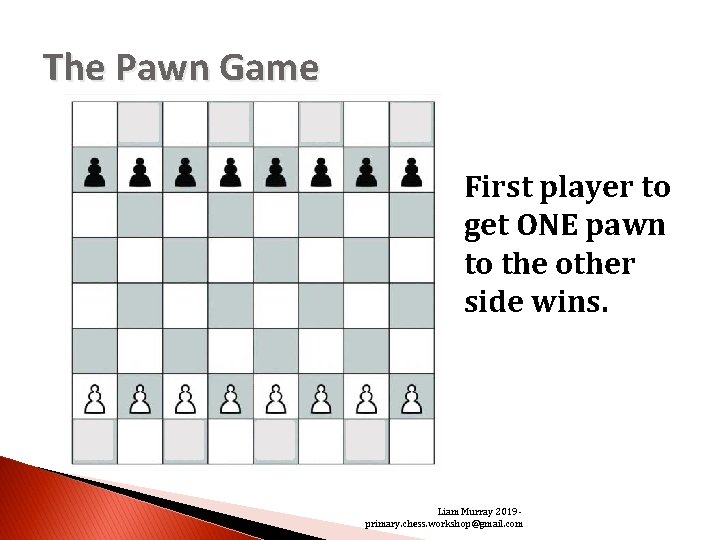
The Pawn Game First player to get ONE pawn to the other side wins. Liam Murray 2019 primary. chess. workshop@gmail. com
The Pawn Game You win the game: a) if your opponent gives up; or b) if you are the first to capture all your opponent's pawns; or c) if you are the first to reach the last rank (i. e. your opponent's first rank) with one of your pawns; or d) if it is your opponent's turn to move but all her pawns are blocked and do not have any moves, while yourself can make at least one move. The game is a draw: a) if the two players agree to call it a draw; or b) if both sides pawns are blocked up so that neither side can make any moves. Other rules: a) If you touch one of your own men when it is your turn to move, you must move it. b) If you touch one of your opponent's men, you must capture it if you can. c) Once you make a move, you cannot change it so think carefully. Liam Murray 2019 primary. chess. workshop@gmail. com

*Touch Move Rule* � If a player touches one of their own pieces they must move that piece as long as it is a legal move. � If a player touches an opponent’s piece, they must capture that piece. �A player who wishes to touch a piece only to adjust it on the board must first announce the intention, usually by saying “adjust”. Liam Murray 2019 primary. chess. workshop@gmail. com

The Rook – the catapult Liam Murray 2019 primary. chess. workshop@gmail. com
The Rook � The Rooks begin on the extreme corners of the board. � The rook moves horizontally and vertically any number of squares, forwards or backwards. �A Rook cannot move through or jump pieces but can capture opposition pieces in its way (but only one at a time!). Liam Murray 2019 primary. chess. workshop@gmail. com
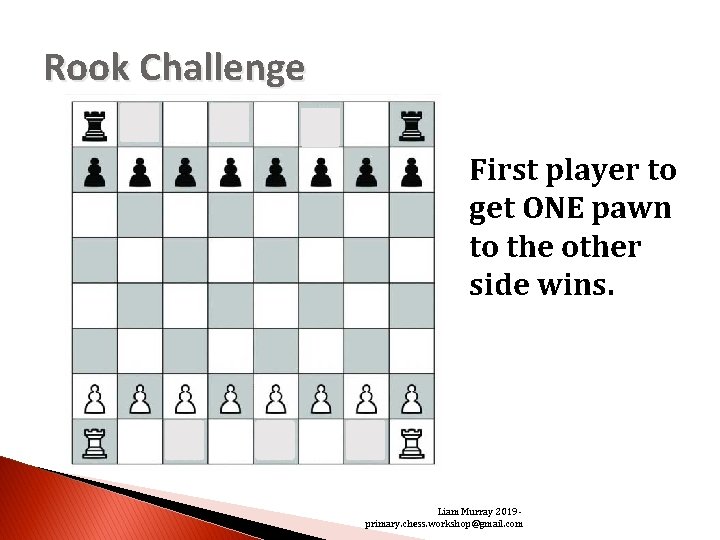
Rook Challenge First player to get ONE pawn to the other side wins. Liam Murray 2019 primary. chess. workshop@gmail. com
Rook Challenge � 8 white pawns v’s one black rook � Chess toss for colour � White moves first as always � White or black wins if it gets one of its pawns to the other side of the board � Switch sides after first game � Incorporate time or remove pawns to differentiate Liam Murray 2019 primary. chess. workshop@gmail. com
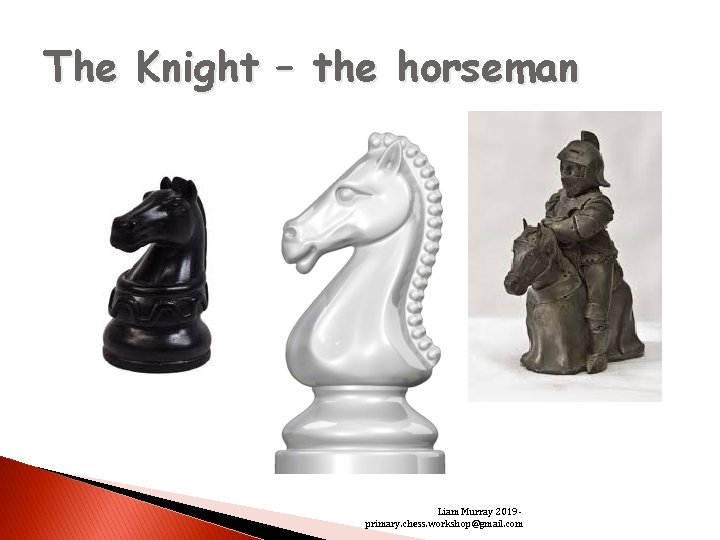
The Knight – the horseman Liam Murray 2019 primary. chess. workshop@gmail. com
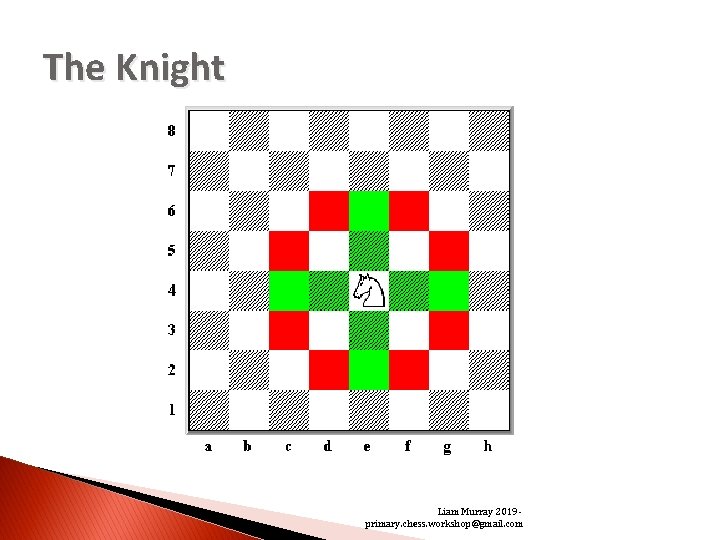
The Knight � The knights start next to the rooks. � The knight moves using “hippoty, hop” � The knight moves in an L shape in any direction. So it can move 2 squares sideways (2 hippoties) and one square up or down (1 hop) or one square sideways and 2 squares up or down. � Just like a real horse, the knight can jump other pieces to get where it wants to go. � The knight only captures on it’s finishing square (hop square) Liam Murray 2019 primary. chess. workshop@gmail. com
The Knight Liam Murray 2019 primary. chess. workshop@gmail. com
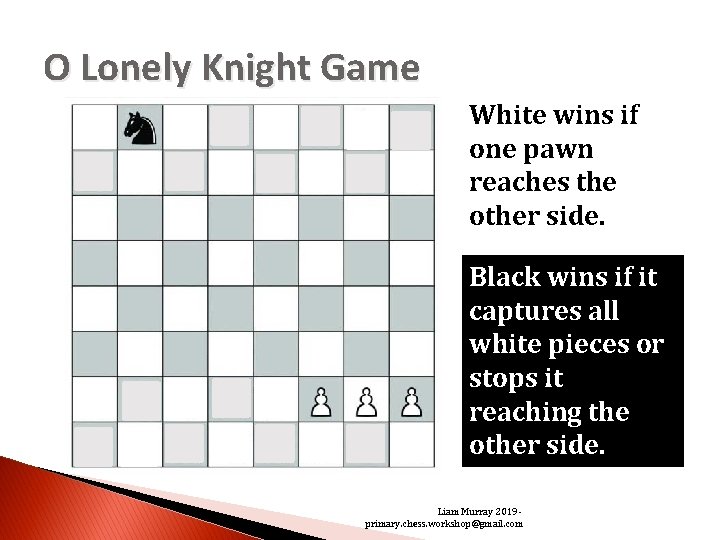
O Lonely Knight Game White wins if one pawn reaches the other side. Black wins if it captures all white pieces or stops it reaching the other side. Liam Murray 2019 primary. chess. workshop@gmail. com
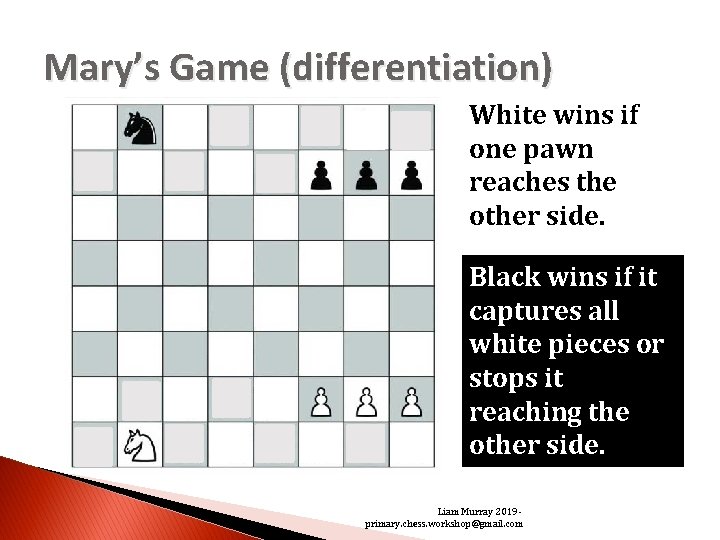
Mary’s Game (differentiation) White wins if one pawn reaches the other side. Black wins if it captures all white pieces or stops it reaching the other side. Liam Murray 2019 primary. chess. workshop@gmail. com
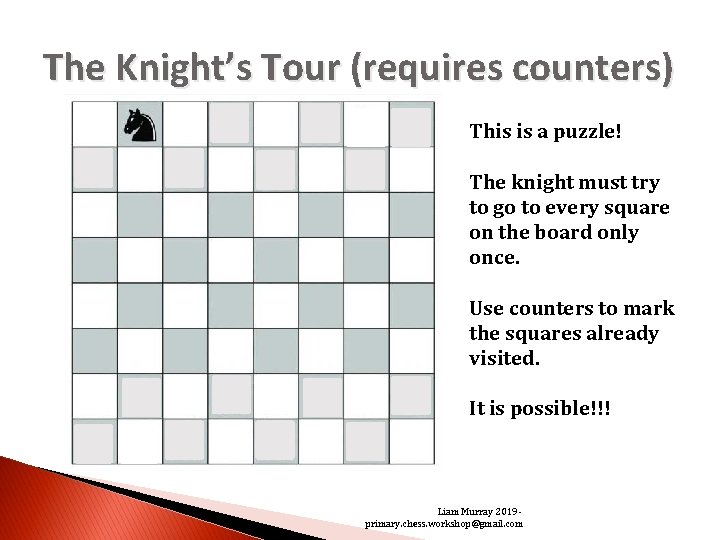
The Knight’s Tour (requires counters) This is a puzzle! The knight must try to go to every square on the board only once. Use counters to mark the squares already visited. It is possible!!! Liam Murray 2019 primary. chess. workshop@gmail. com
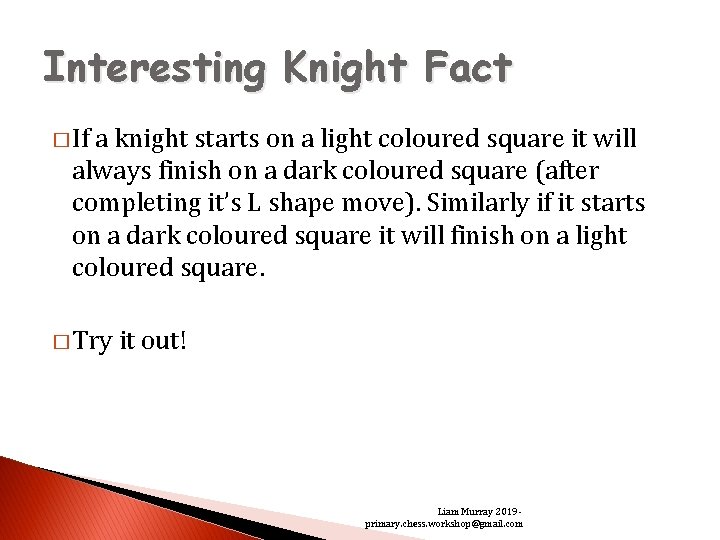
Interesting Knight Fact � If a knight starts on a light coloured square it will always finish on a dark coloured square (after completing it’s L shape move). Similarly if it starts on a dark coloured square it will finish on a light coloured square. � Try it out! Liam Murray 2019 primary. chess. workshop@gmail. com
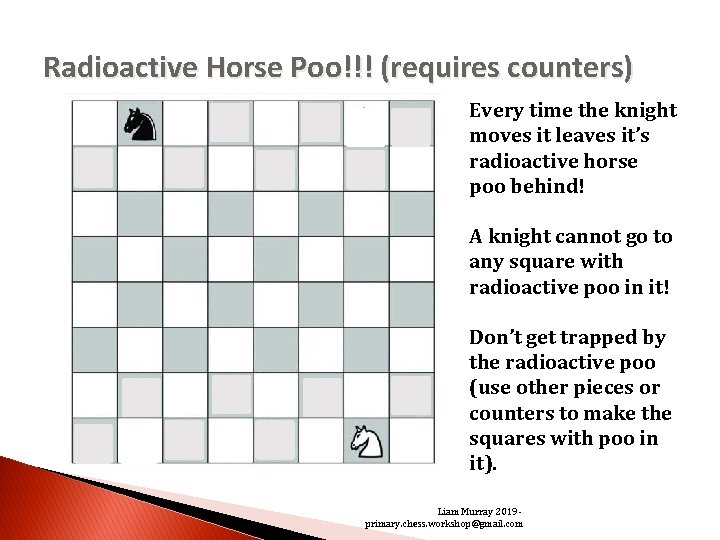
Radioactive Horse Poo!!! (requires counters) Every time the knight moves it leaves it’s radioactive horse poo behind! A knight cannot go to any square with radioactive poo in it! Don’t get trapped by the radioactive poo (use other pieces or counters to make the squares with poo in it). Liam Murray 2019 primary. chess. workshop@gmail. com
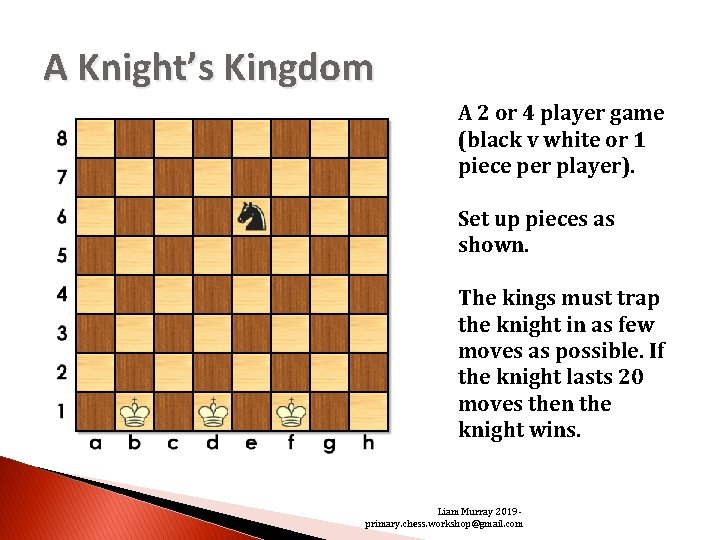
A Knight’s Kingdom A 2 or 4 player game (black v white or 1 piece per player). Set up pieces as shown. The kings must trap the knight in as few moves as possible. If the knight lasts 20 moves then the knight wins. Liam Murray 2019 primary. chess. workshop@gmail. com
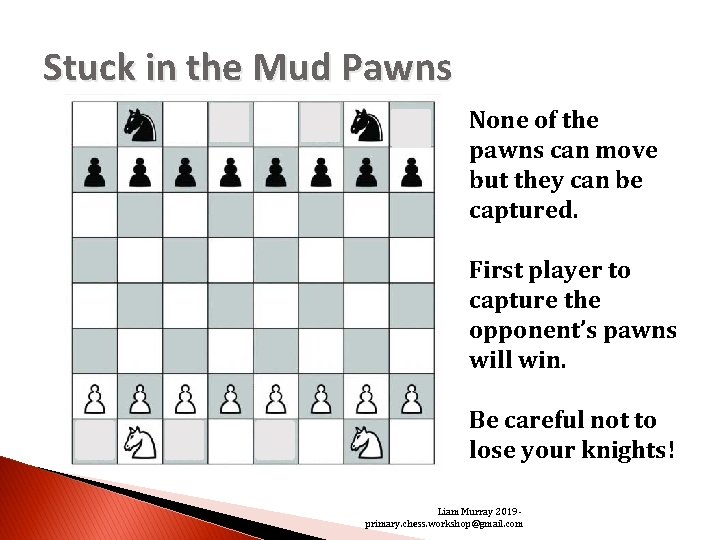
Stuck in the Mud Pawns None of the pawns can move but they can be captured. First player to capture the opponent’s pawns will win. Be careful not to lose your knights! Liam Murray 2019 primary. chess. workshop@gmail. com
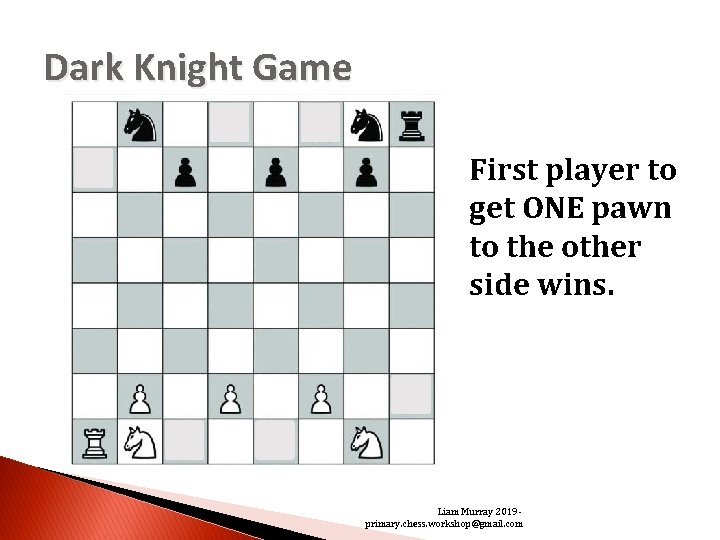
Dark Knight Game First player to get ONE pawn to the other side wins. Liam Murray 2019 primary. chess. workshop@gmail. com
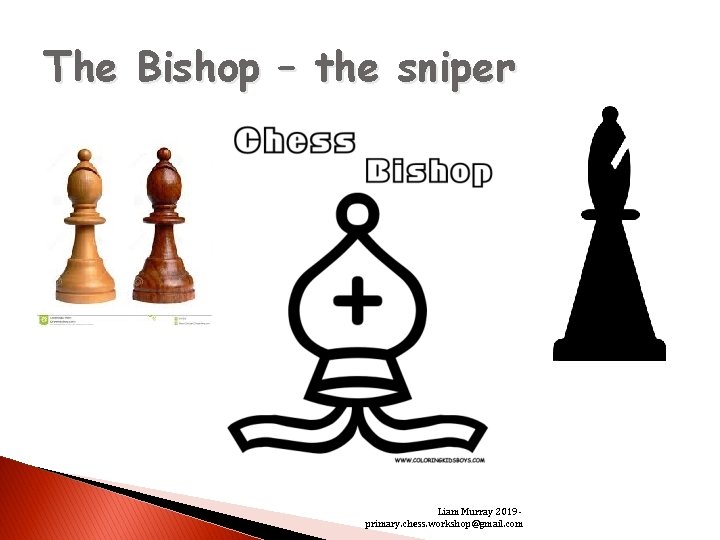
The Bishop – the sniper Liam Murray 2019 primary. chess. workshop@gmail. com
The Bishop � The bishop begins next to the knight � The bishop moves diagonally any number of spaces, forwards or backwards � Bishops will only ever move on their starting colour � The bishop can be blocked by other pieces – the bishop cannot jump over other pieces Liam Murray 2019 primary. chess. workshop@gmail. com
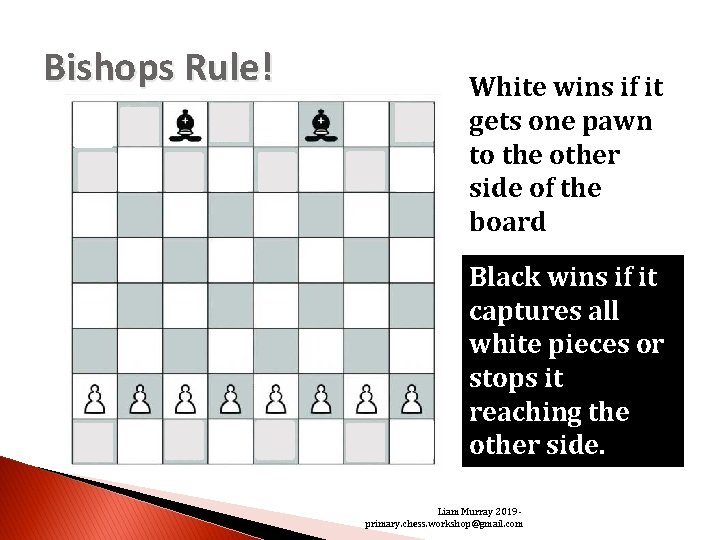
Bishops Rule! White wins if it gets one pawn to the other side of the board Black wins if it captures all white pieces or stops it reaching the other side. Liam Murray 2019 primary. chess. workshop@gmail. com
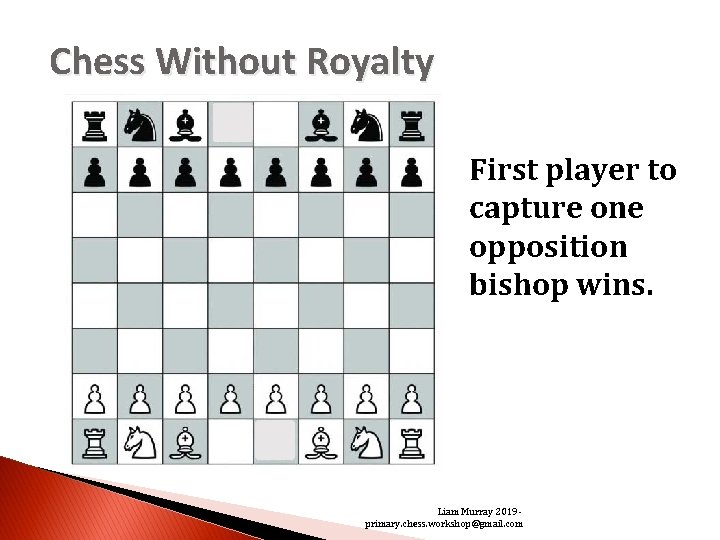
Chess Without Royalty First player to capture one opposition bishop wins. Liam Murray 2019 primary. chess. workshop@gmail. com
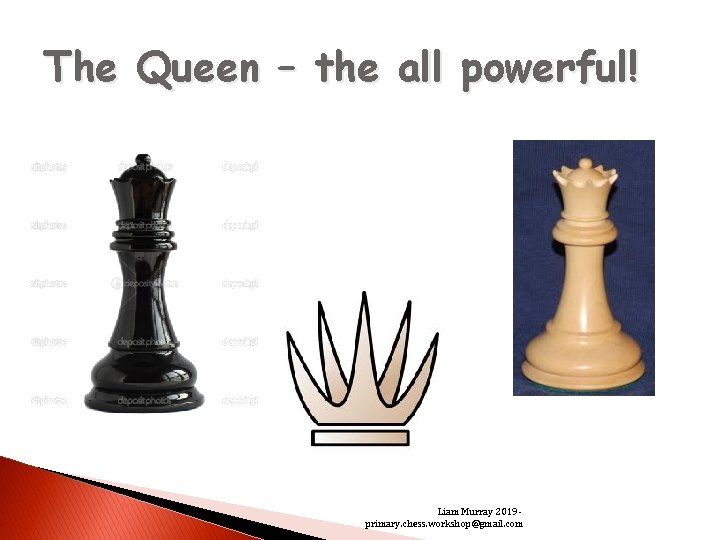
The Queen – the all powerful! Liam Murray 2019 primary. chess. workshop@gmail. com
The Queen � The queen starts next on its own colour (white – D 1, black – D 8) � The queen is the most powerful piece on the board. � She can move straight or diagonally any number of squares. � The queen cannot jump over other pieces (only the knight can jump other pieces). � The queen is like two other pieces combined. What are these two pieces? Liam Murray 2019 primary. chess. workshop@gmail. com
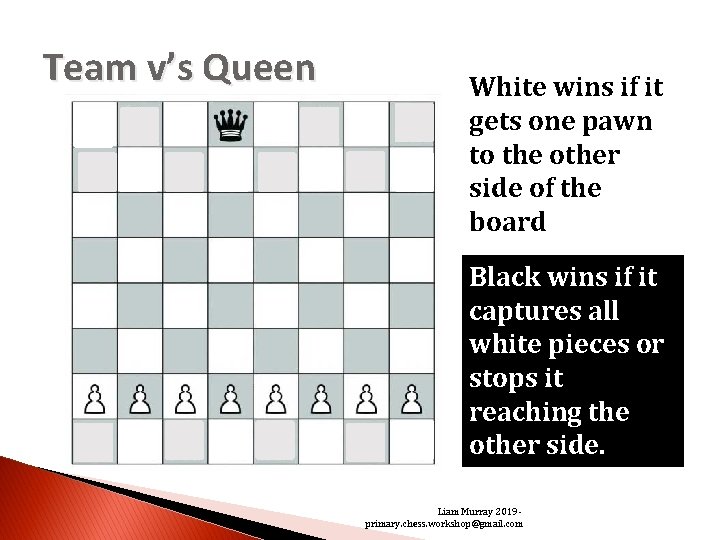
Team v’s Queen White wins if it gets one pawn to the other side of the board Black wins if it captures all white pieces or stops it reaching the other side. Liam Murray 2019 primary. chess. workshop@gmail. com
The 8 Queen Conundrum � This is a puzzle to be solved. � Imagine you have 8 queens of the same colour and a blank board. � Your challenge is to place the 8 queens on the board in such a way that no two queens intersect each other � Remember a queen moves horizontally, vertically and diagonally. Liam Murray 2019 primary. chess. workshop@gmail. com
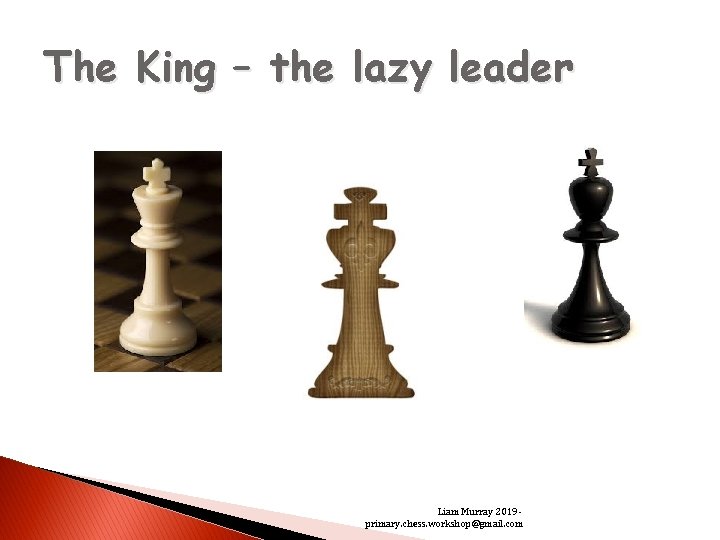
The King – the lazy leader Liam Murray 2019 primary. chess. workshop@gmail. com
The King � The � It king starts next to the queen. is the most important piece on the chessboard! � The king can move one space in any direction. � The king can never move onto a square that is being attacked (the king can never move into check). � The king can capture other pieces. � The kings don’t like each other and can never stand next to one another. Liam Murray 2019 primary. chess. workshop@gmail. com
The Lazy Egocentric King � Kings long ago were very wealthy! However they had loads of feasts and parties and became overweight. They are always out of breath and very lazy so the only move one space at a time. � Kings have massive egos and so cannot bear to be next to another King so they always stay one square distance away from each other. Liam Murray 2019 primary. chess. workshop@gmail. com
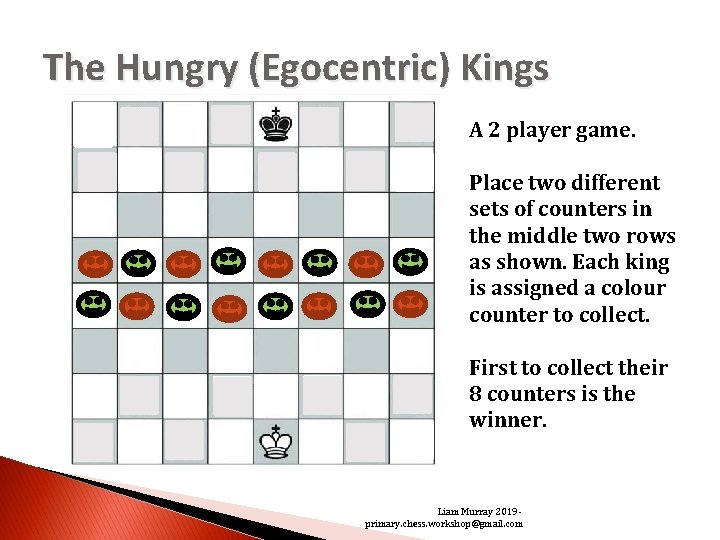
The Hungry (Egocentric) Kings A 2 player game. Place two different sets of counters in the middle two rows as shown. Each king is assigned a colour counter to collect. First to collect their 8 counters is the winner. Liam Murray 2019 primary. chess. workshop@gmail. com
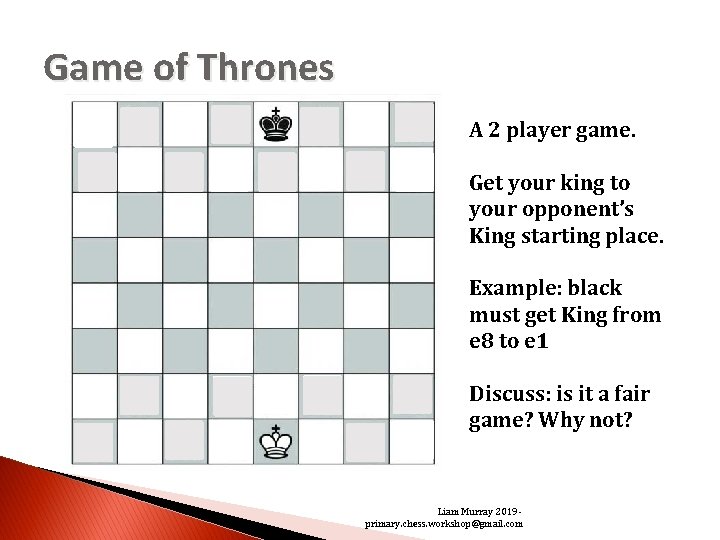
Game of Thrones A 2 player game. Get your king to your opponent’s King starting place. Example: black must get King from e 8 to e 1 Discuss: is it a fair game? Why not? Liam Murray 2019 primary. chess. workshop@gmail. com
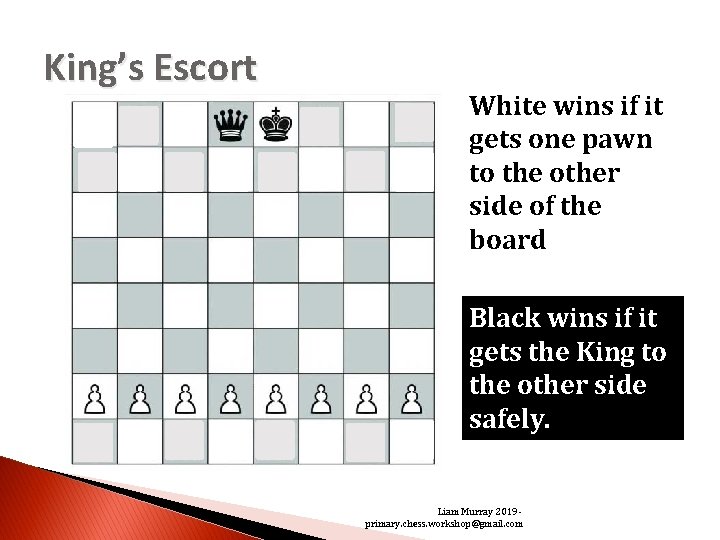
King’s Escort White wins if it gets one pawn to the other side of the board Black wins if it gets the King to the other side safely. Liam Murray 2019 primary. chess. workshop@gmail. com
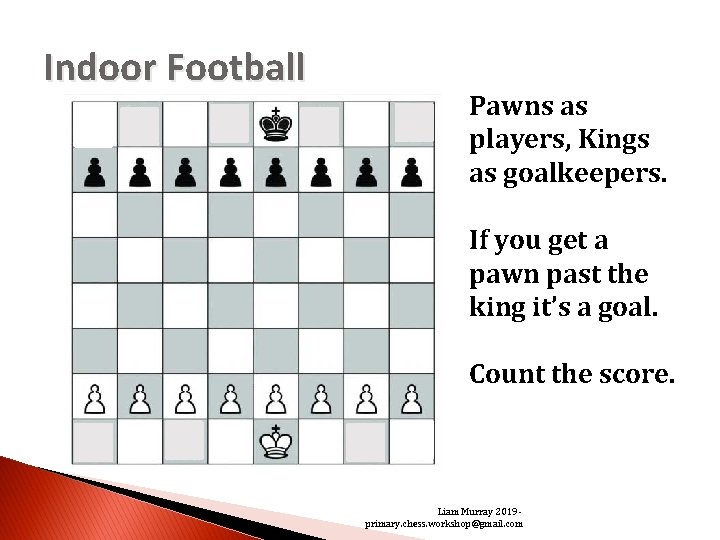
Indoor Football Pawns as players, Kings as goalkeepers. If you get a pawn past the king it’s a goal. Count the score. Liam Murray 2019 primary. chess. workshop@gmail. com
Remember the 5 Steps � The board – letters close to you, white on the right � Pawns – ranks 2 and 7 � Rooks, knights and bishops � Queen – on its own colour (light or dark) � King – next to queen Liam Murray 2019 primary. chess. workshop@gmail. com
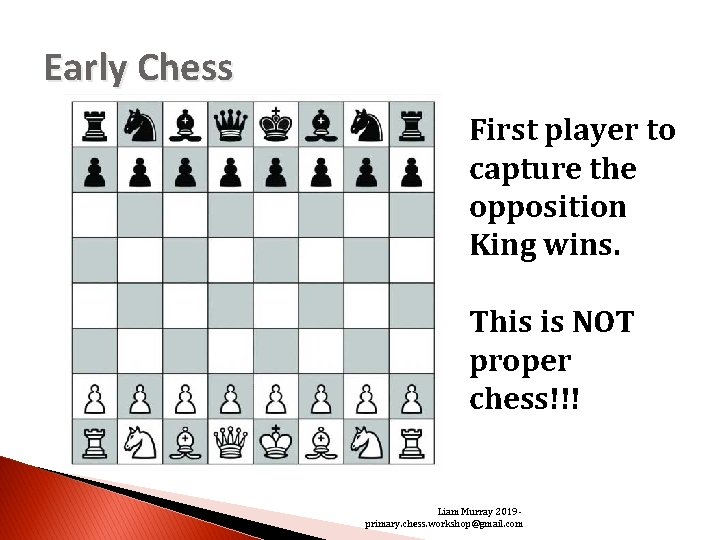
Early Chess First player to capture the opposition King wins. This is NOT proper chess!!! Liam Murray 2019 primary. chess. workshop@gmail. com
- Slides: 43