Lecture 2 Intelligent Agents Vikas Ashok Department of


- Slides: 32
Lecture 2 Intelligent Agents Vikas Ashok Department of Computer Science Old Dominion University Reading for Next Class: Chapter 3, Russell and Norvig Syllabus Special thanks to Dr. Yaohang Li for contributing the slides Artificial Intelligence
Review of Intelligent Agents Motivation Objectives Introduction Agents and Environments Rationality Agent Structure Agent Types Simple reflex agent Model-based reflex agent Goal-based agent Utility-based agent Learning agent Artificial Intelligence
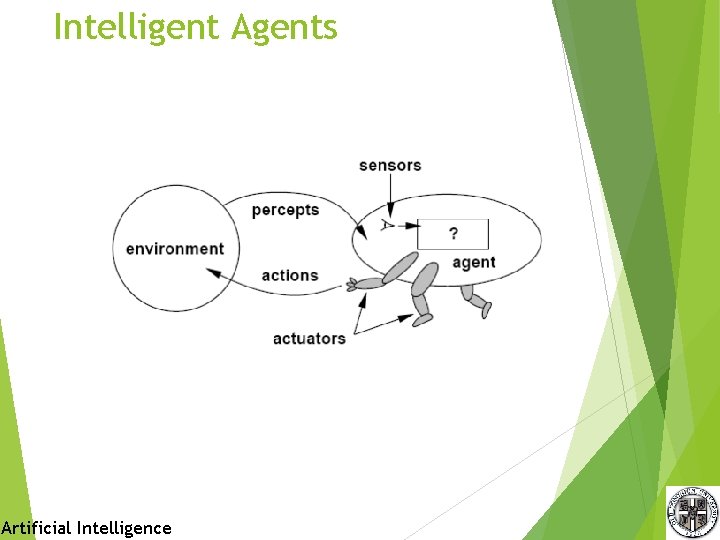
Introduction to Intelligent Agents Motivation Agents are used to provide a consistent viewpoint on various topics in AI Agents require essential skills to perform tasks that require intelligence Intelligent agents use methods and techniques from the field of AI What is an agent? In general, an entity that interacts with its environment Perception through sensors Actions through effectors or actuators Agent and its environment An agent perceives its environment through sensors The complete set of inputs at a given time is called a percept The current percept, or a sequence of percepts may influence the actions of an agent It can change the environment through actuators An operation involving an actuator is called an action Actions can be grouped into action sequences Artificial Intelligence
Intelligent Agents Artificial Intelligence
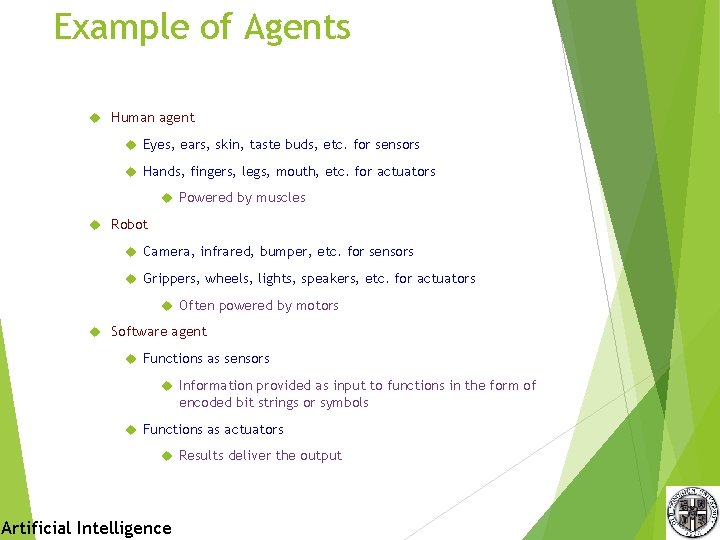
Example of Agents Human agent Eyes, ears, skin, taste buds, etc. for sensors Hands, fingers, legs, mouth, etc. for actuators Powered by muscles Robot Camera, infrared, bumper, etc. for sensors Grippers, wheels, lights, speakers, etc. for actuators Often powered by motors Software agent Functions as sensors Information provided as input to functions in the form of encoded bit strings or symbols Functions as actuators Results deliver the output Artificial Intelligence
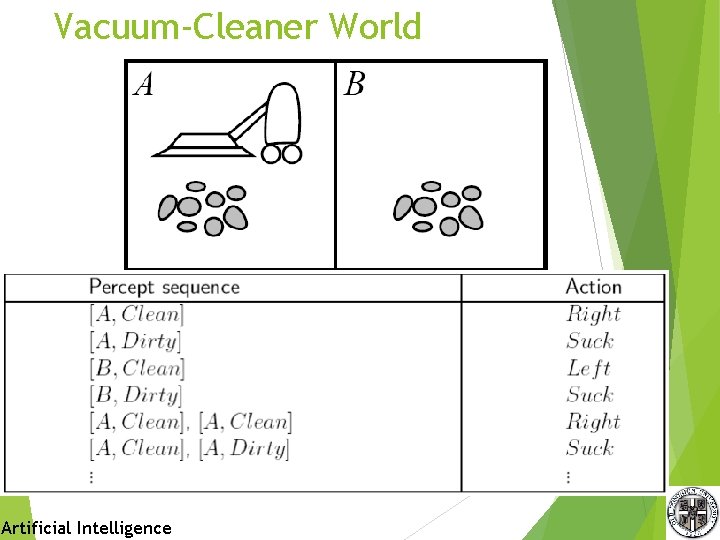
Vacuum-Cleaner World Artificial Intelligence
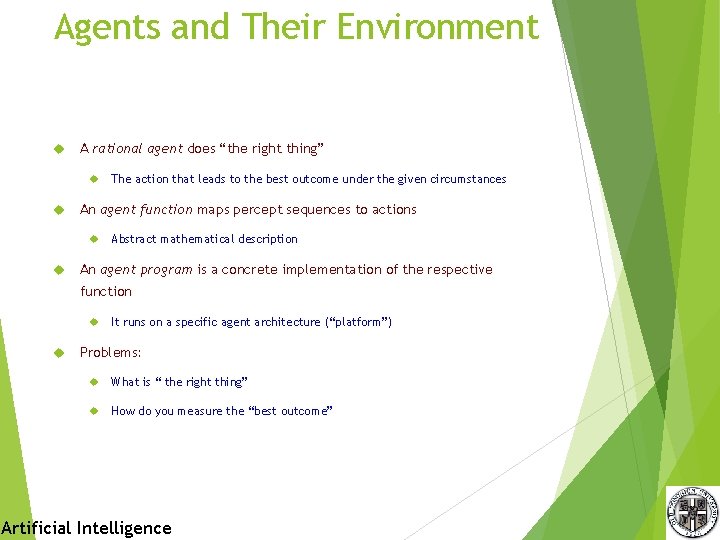
Agents and Their Environment A rational agent does “the right thing” An agent function maps percept sequences to actions The action that leads to the best outcome under the given circumstances Abstract mathematical description An agent program is a concrete implementation of the respective function It runs on a specific agent architecture (“platform”) Problems: What is “ the right thing” How do you measure the “best outcome” Artificial Intelligence
The Concept of Rationality Rational omniscient Percepts may not supply all relevant information Rational clairvoyant Action outcomes may not be as expected Rational successful Rationality vs Perfection Rationality maximizes expected performance Perfection maximizes actual performance Rational exploration, learning, autonomy Artificial Intelligence
Performance Measure Performance of Agents Criteria for measuring the outcome and the expenses of the agent Often subjective, but should be objective Task dependent Time may be important Performance measure example Vacuum agent Performance Measure: number of tiles cleaned during a certain period Based on the agent’s report, or validated by an objective authority Doesn’t consider expenses of the agent, side effects Energy, noise, loss of useful objects, damaged furniture, scratched floor Might lead to unwanted activities Agent re-cleans clean tiles, covers only part of the room, drops dirt on tiles to have more tiles to clean, etc. Alternative Performance Measure: One point per square cleaned up in time T? One point per clean square per time step, minus one per move Penalize for > k dirty squares? Artificial Intelligence
Rational Agents Rationality: selects the action that is expected to maximize its performance Based on a performance measure Depends on the percept sequence, background knowledge, and feasible actions Performance measure for the successful completion of a task Complete perceptual history (percept sequence) Background knowledge Especially about the environment Dimensions, structure, basic “laws” Task, user, other agents Feasible actions Capabilities of the agent Definition of a Rational Agent For each possible percept sequence, a rational agent should select an action that is expected to maximize its performance measure, given the evidence provided by the percept sequence and whatever built-in knowledge the agent has. Artificial Intelligence
The Nature of Environments Environment Determine to a large degree the interaction between the “outside world” and the agent The “outside world” is not necessarily the “real world” as we perceive it In many cases, environments are implemented within computers They may or may not have a close correspondence to the “real world” Environment Properties Fully observable vs. partially observable Sensors capture all relevant information from the environment Deterministic vs. stochastic (non-deterministic) Changes in the environment are predictable Episodic vs. sequential (non-episodic) Independent perceiving-acting episodes Static vs. dynamic No changes while the agent is “thinking” Discrete vs. continuous Limited number of distinct percepts/actions Single vs. multiple agents Interaction and collaboration among agents Competitive, cooperative Artificial Intelligence
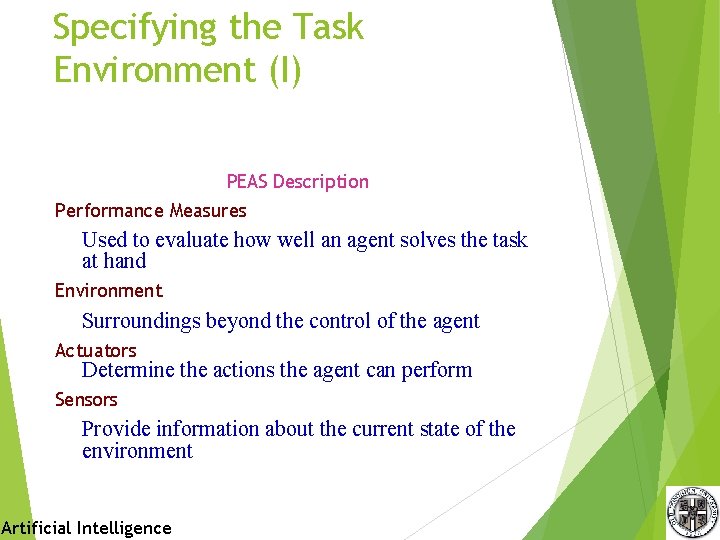
Specifying the Task Environment (I) PEAS Description Performance Measures Used to evaluate how well an agent solves the task at hand Environment Surroundings beyond the control of the agent Actuators Determine the actions the agent can perform Sensors Provide information about the current state of the environment Artificial Intelligence
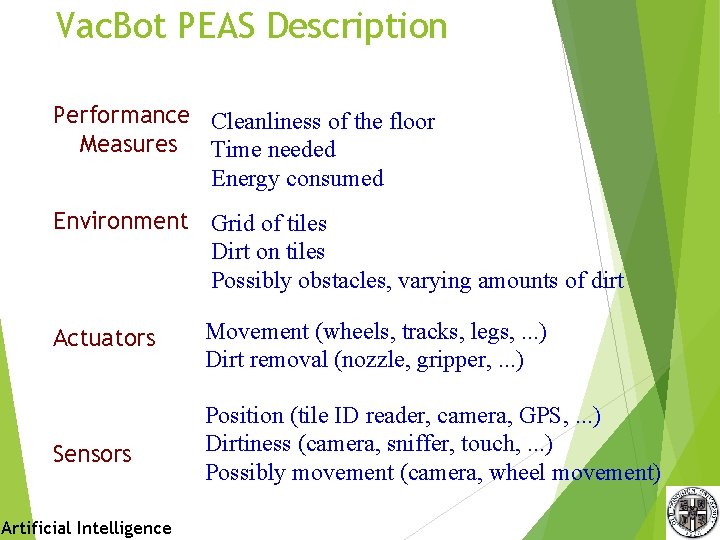
Vac. Bot PEAS Description Performance Cleanliness of the floor Measures Time needed Energy consumed Environment Grid of tiles Dirt on tiles Possibly obstacles, varying amounts of dirt Actuators Movement (wheels, tracks, legs, . . . ) Dirt removal (nozzle, gripper, . . . ) Sensors Position (tile ID reader, camera, GPS, . . . ) Dirtiness (camera, sniffer, touch, . . . ) Possibly movement (camera, wheel movement) Artificial Intelligence
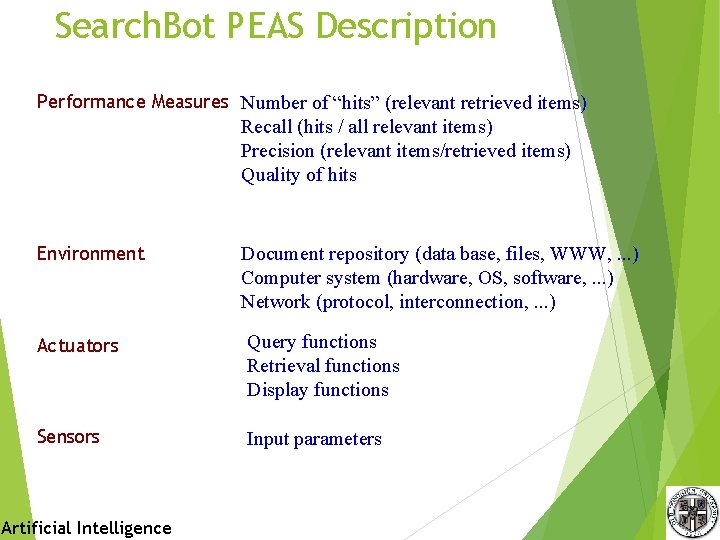
Search. Bot PEAS Description Performance Measures Number of “hits” (relevant retrieved items) Recall (hits / all relevant items) Precision (relevant items/retrieved items) Quality of hits Environment Document repository (data base, files, WWW, . . . ) Computer system (hardware, OS, software, . . . ) Network (protocol, interconnection, . . . ) Actuators Query functions Retrieval functions Display functions Sensors Input parameters Artificial Intelligence
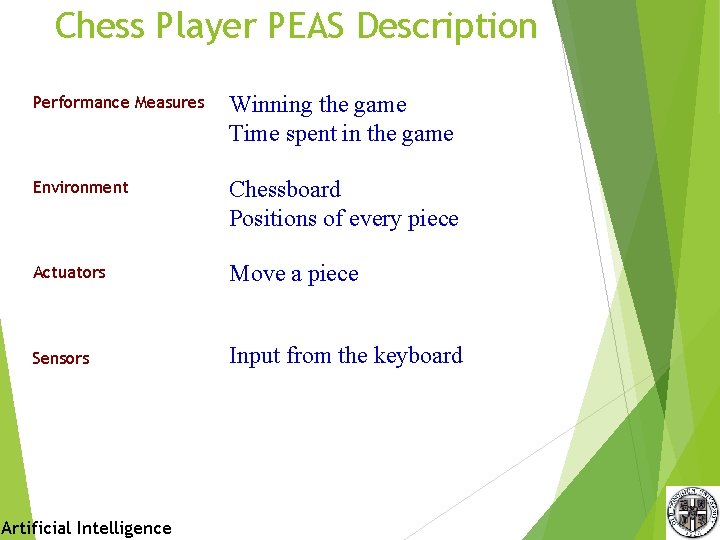
Chess Player PEAS Description Performance Measures Winning the game Time spent in the game Environment Chessboard Positions of every piece Actuators Move a piece Sensors Input from the keyboard Artificial Intelligence
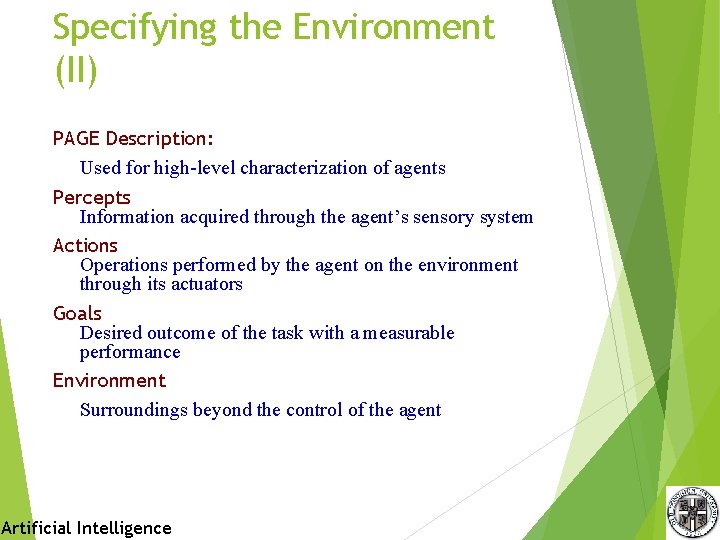
Specifying the Environment (II) PAGE Description: Used for high-level characterization of agents Percepts Information acquired through the agent’s sensory system Actions Operations performed by the agent on the environment through its actuators Goals Desired outcome of the task with a measurable performance Environment Surroundings beyond the control of the agent Artificial Intelligence
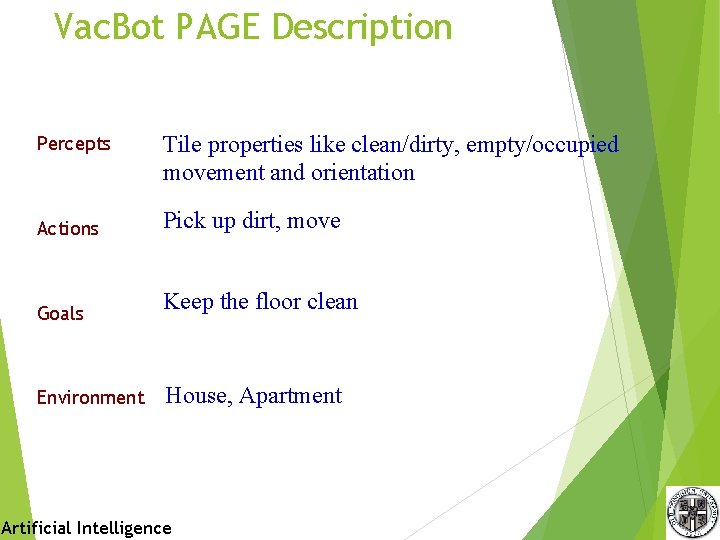
Vac. Bot PAGE Description Percepts Actions Goals Environment Tile properties like clean/dirty, empty/occupied movement and orientation Pick up dirt, move Keep the floor clean House, Apartment Artificial Intelligence
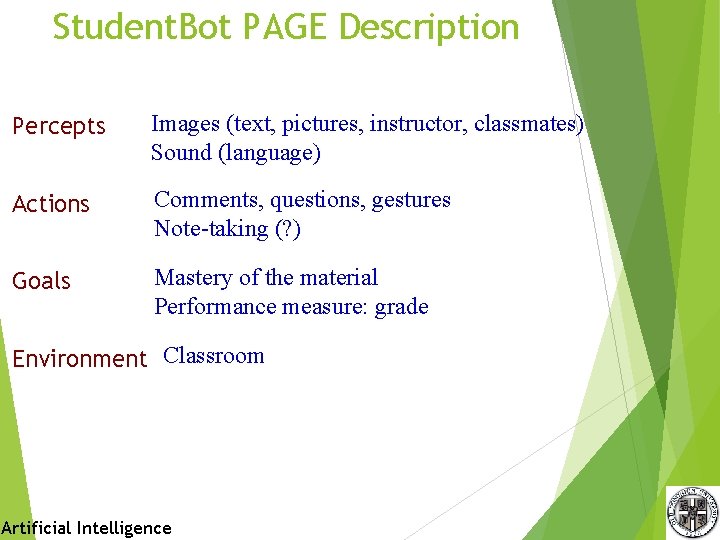
Student. Bot PAGE Description Percepts Images (text, pictures, instructor, classmates) Sound (language) Actions Comments, questions, gestures Note-taking (? ) Goals Mastery of the material Performance measure: grade Environment Classroom Artificial Intelligence
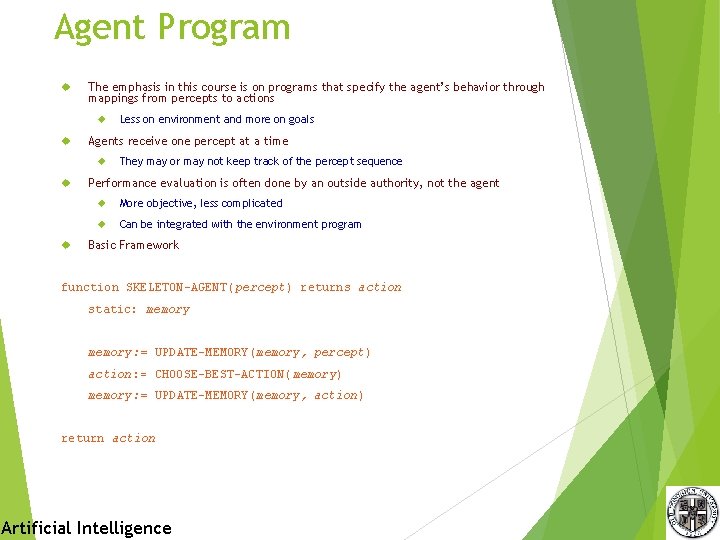
Agent Program The emphasis in this course is on programs that specify the agent’s behavior through mappings from percepts to actions Agents receive one percept at a time Less on environment and more on goals They may or may not keep track of the percept sequence Performance evaluation is often done by an outside authority, not the agent More objective, less complicated Can be integrated with the environment program Basic Framework function SKELETON-AGENT( percept) returns action static: memory : = UPDATE-MEMORY(memory, percept) action : = CHOOSE-BEST-ACTION(memory) memory : = UPDATE-MEMORY(memory, action) return action Artificial Intelligence
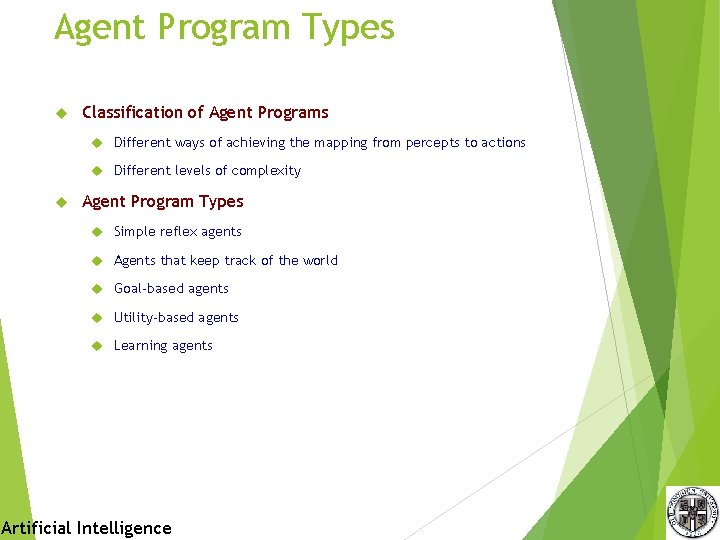
Agent Program Types Classification of Agent Programs Different ways of achieving the mapping from percepts to actions Different levels of complexity Agent Program Types Simple reflex agents Agents that keep track of the world Goal-based agents Utility-based agents Learning agents Artificial Intelligence
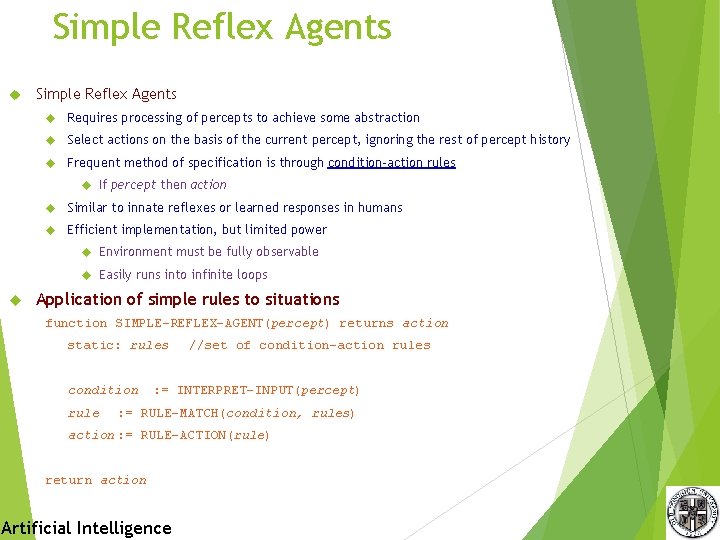
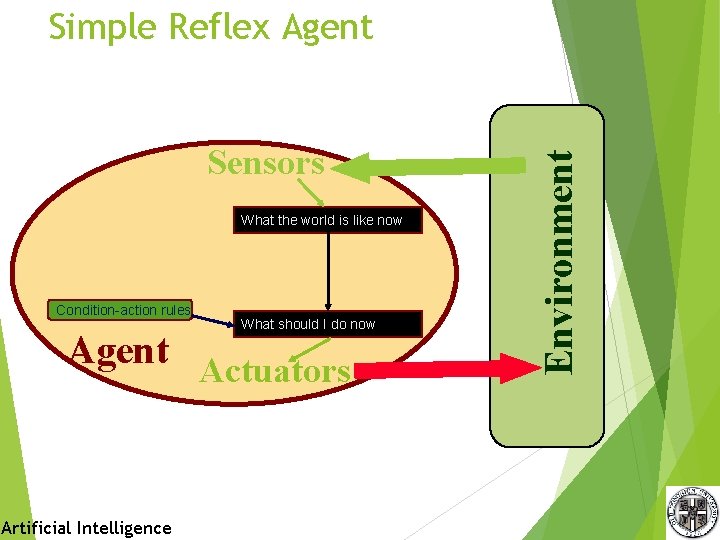
Simple Reflex Agents Requires processing of percepts to achieve some abstraction Select actions on the basis of the current percept, ignoring the rest of percept history Frequent method of specification is through condition-action rules If percept then action Similar to innate reflexes or learned responses in humans Efficient implementation, but limited power Environment must be fully observable Easily runs into infinite loops Application of simple rules to situations function SIMPLE-REFLEX-AGENT(percept) returns action static: rules condition rule //set of condition-action rules : = INTERPRET-INPUT(percept) : = RULE-MATCH(condition, rules) action : = RULE-ACTION(rule) return action Artificial Intelligence
Sensors What the world is like now Condition-action rules What should I do now Agent Actuators Artificial Intelligence Environment Simple Reflex Agent
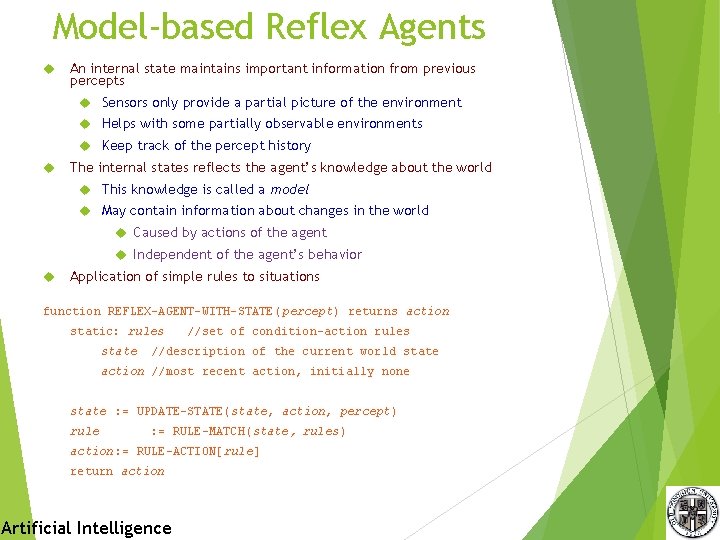
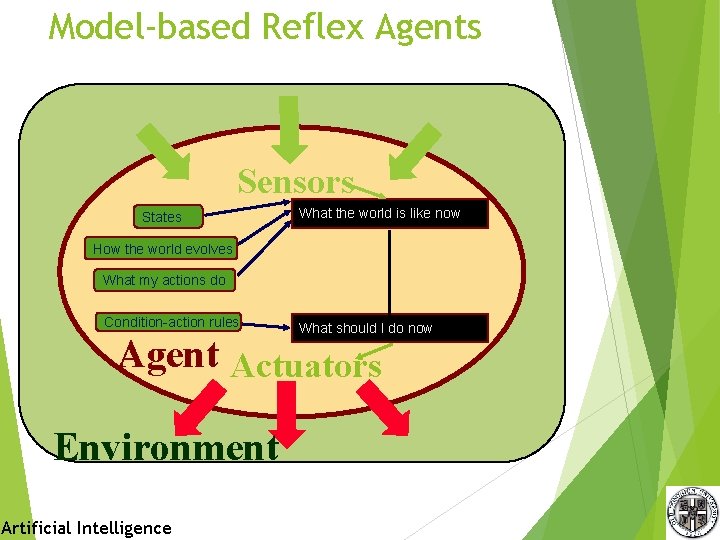
Model-based Reflex Agents An internal state maintains important information from previous percepts Sensors only provide a partial picture of the environment Helps with some partially observable environments Keep track of the percept history The internal states reflects the agent’s knowledge about the world This knowledge is called a model May contain information about changes in the world Caused by actions of the agent Independent of the agent’s behavior Application of simple rules to situations function REFLEX-AGENT-WITH-STATE( percept) returns action static: rules state //set of condition-action rules //description of the current world state action //most recent action, initially none state : = UPDATE-STATE(state, action, percept) rule : = RULE-MATCH(state, rules) action : = RULE-ACTION[rule] return action Artificial Intelligence
Model-based Reflex Agents Sensors States What the world is like now How the world evolves What my actions do Condition-action rules What should I do now Agent Actuators Environment Artificial Intelligence
Goal-based Agent The agent tries to reach a desirable state, the goal May be provided from the outside (user, designer, environment), or inherent to the agent itself Results of possible actions are considered with respect to the goal Easy when the results can be related to the goal after each action In general, it can be difficult to attribute goal satisfaction results to individual actions May require consideration of the future What-if scenarios Search, reasoning or planning Very flexible, but not very efficient Artificial Intelligence
Goal-based Agent Sensors State How the world evolves What the world is like now What happens if I do an action What my actions do Goals What should I do now Agent Actuators Environment Artificial Intelligence
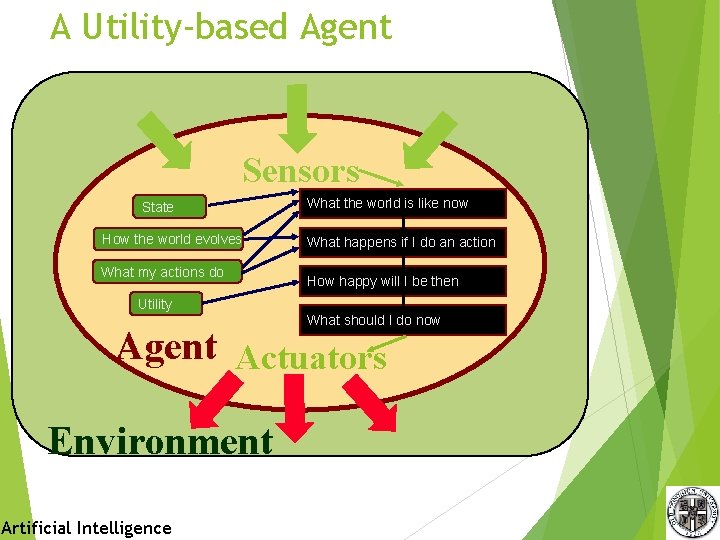
A Utility-based Agent More sophisticated distinction between different world states A utility function maps states onto a real number May be interpreted as “degree of happiness” Permits rational actions for more complex tasks Resolution of conflicts between goals (tradeoff) Multiple goals (likelihood of success, importance) A utility function is necessary for rational behavior, but sometimes it is not made explicit Artificial Intelligence
A Utility-based Agent Sensors State How the world evolves What my actions do What the world is like now What happens if I do an action How happy will I be then Utility What should I do now Agent Actuators Environment Artificial Intelligence
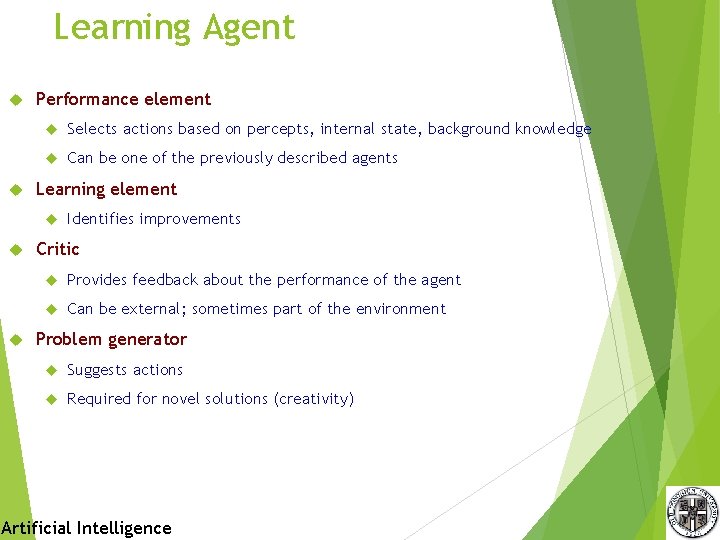
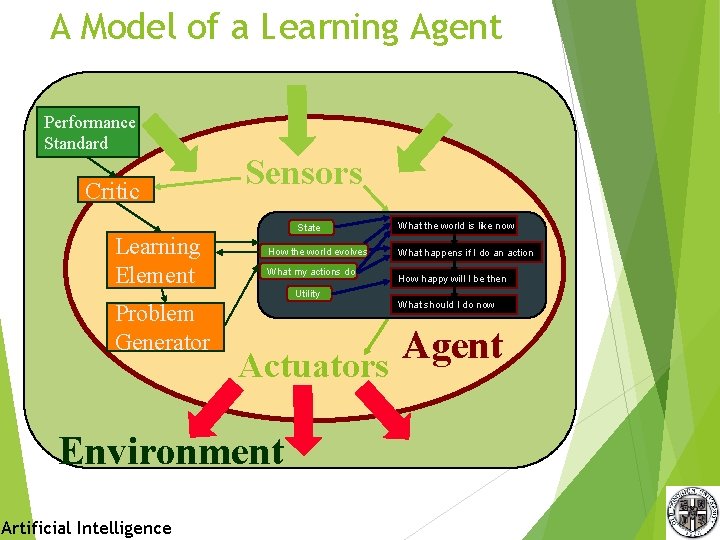
Learning Agent Performance element Selects actions based on percepts, internal state, background knowledge Can be one of the previously described agents Learning element Identifies improvements Critic Provides feedback about the performance of the agent Can be external; sometimes part of the environment Problem generator Suggests actions Required for novel solutions (creativity) Artificial Intelligence
A Model of a Learning Agent Performance Standard Critic Learning Element Problem Generator Sensors State How the world evolves What my actions do Utility What happens if I do an action How happy will I be then What should I do now Agent Actuators Environment Artificial Intelligence What the world is like now
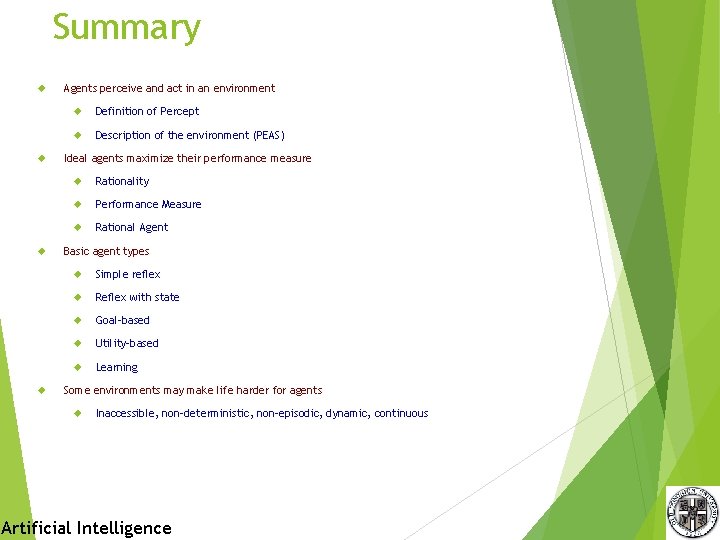
Summary Agents perceive and act in an environment Definition of Percept Description of the environment (PEAS) Ideal agents maximize their performance measure Rationality Performance Measure Rational Agent Basic agent types Simple reflex Reflex with state Goal-based Utility-based Learning Some environments may make life harder for agents Inaccessible, non-deterministic, non-episodic, dynamic, continuous Artificial Intelligence
What I want you to do Review Chapter 2 Review Class Notes Artificial Intelligence