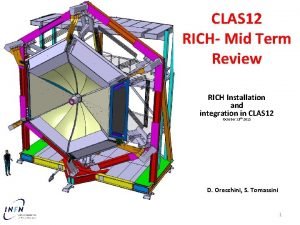
Charged Particle Tracking for CLAS 12 Physics a

- Slides: 53
Charged Particle Tracking for CLAS 12 Physics a tracking requirements a detector specifications Detector Design Barrel Vertex Tracker (BVT) Forward Vertex Tracker (FVT) Drift Chambers (DC) Optimizing the Design BVT (mixed Si/MM? ) FVT (stereo angle? ) December 2, 2009 CLAS 12 Detector Review Basic overview Design options Simulation results Technology reviews Maximizing efficiency and resolution at high rates Key decision points Mac Mestayer
Tracking: physics a design spec’s Experiment Characteristics • electron beam • small cross-sections (exclusive reactions, Q 2 -dep. ) • measure hadronic state – establish exclusivity (missing mass) – other cuts: co-planarity, etc. • forward-going particles – small laboratory angles • broad coverage in center-of-mass December 2, 2009 CLAS 12 Detector Review Mac Mestayer
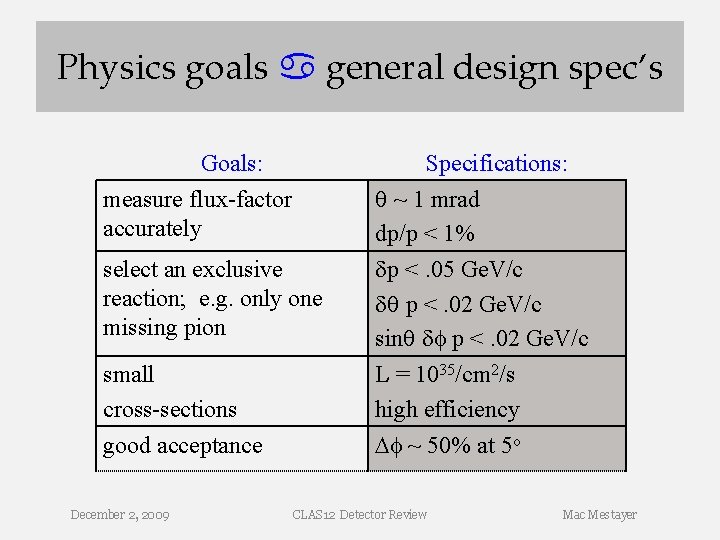
Physics goals a general design spec’s Goals: measure flux-factor accurately Specifications: ~ 1 mrad dp/p < 1% select an exclusive reaction; e. g. only one missing pion small cross-sections dp <. 05 Ge. V/c d p <. 02 Ge. V/c sin df p <. 02 Ge. V/c L = 1035/cm 2/s high efficiency good acceptance Df ~ 50% at 5 o December 2, 2009 CLAS 12 Detector Review Mac Mestayer
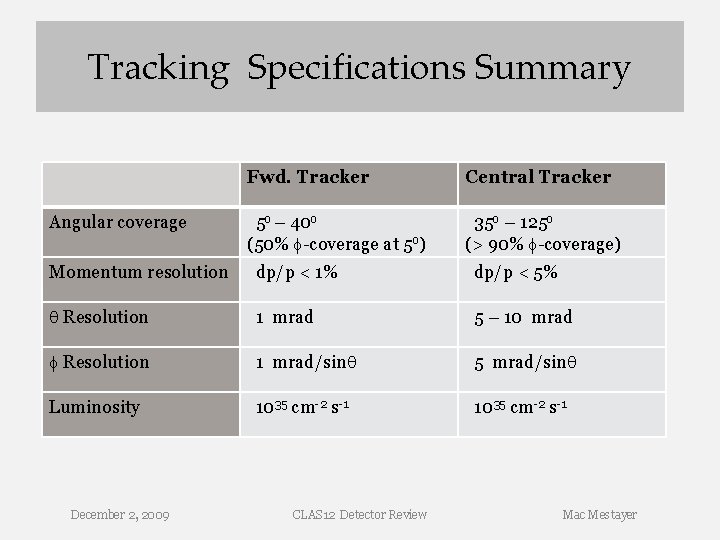
Tracking Specifications Summary Angular coverage Fwd. Tracker Central Tracker 5 o – 40 o (50% f-coverage at 5 o) 35 o – 125 o (> 90% f-coverage) Momentum resolution dp/p < 1% dp/p < 5% Resolution 1 mrad 5 – 10 mrad f Resolution 1 mrad/sin 5 mrad/sin Luminosity 1035 cm-2 s-1 December 2, 2009 CLAS 12 Detector Review Mac Mestayer
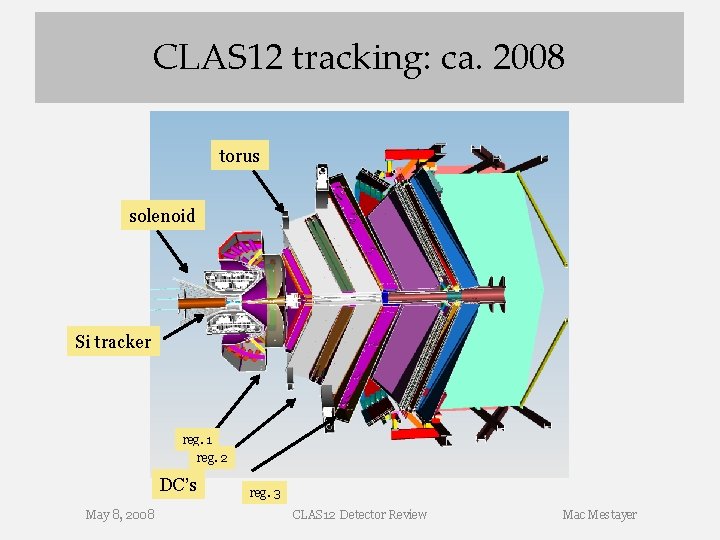
CLAS 12 tracking: ca. 2008 torus solenoid Si tracker reg. 1 reg. 2 DC’s May 8, 2008 reg. 3 CLAS 12 Detector Review Mac Mestayer
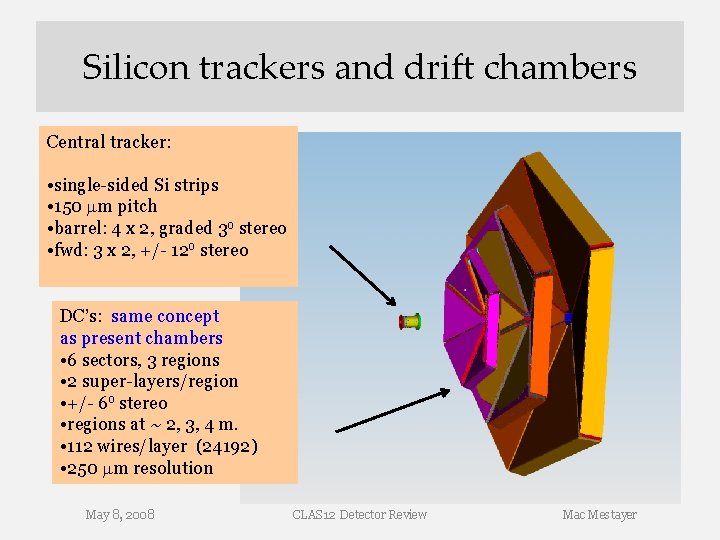
Silicon trackers and drift chambers Central tracker: • single-sided Si strips • 150 m pitch • barrel: 4 x 2, graded 3 o stereo • fwd: 3 x 2, +/- 12 o stereo DC’s: same concept as present chambers • 6 sectors, 3 regions • 2 super-layers/region • +/- 6 o stereo • regions at ~ 2, 3, 4 m. • 112 wires/layer (24192) • 250 m resolution May 8, 2008 CLAS 12 Detector Review Mac Mestayer
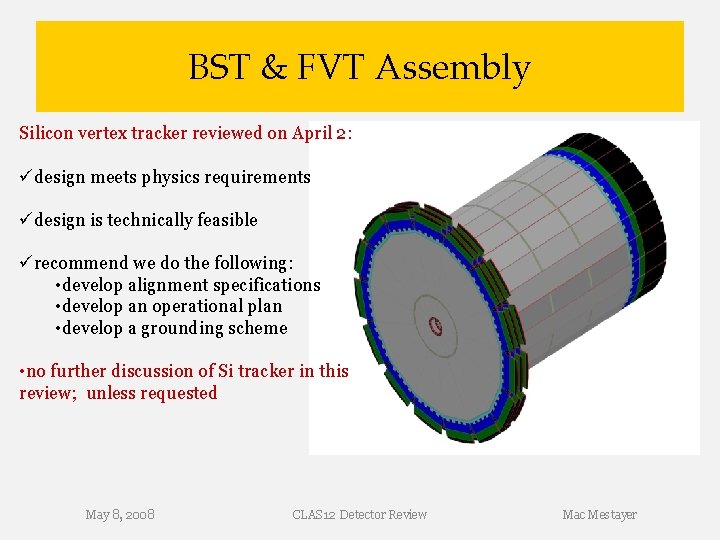
BST & FVT Assembly Silicon vertex tracker reviewed on April 2: üdesign meets physics requirements üdesign is technically feasible ürecommend we do the following: • develop alignment specifications • develop an operational plan • develop a grounding scheme • no further discussion of Si tracker in this review; unless requested May 8, 2008 CLAS 12 Detector Review Mac Mestayer
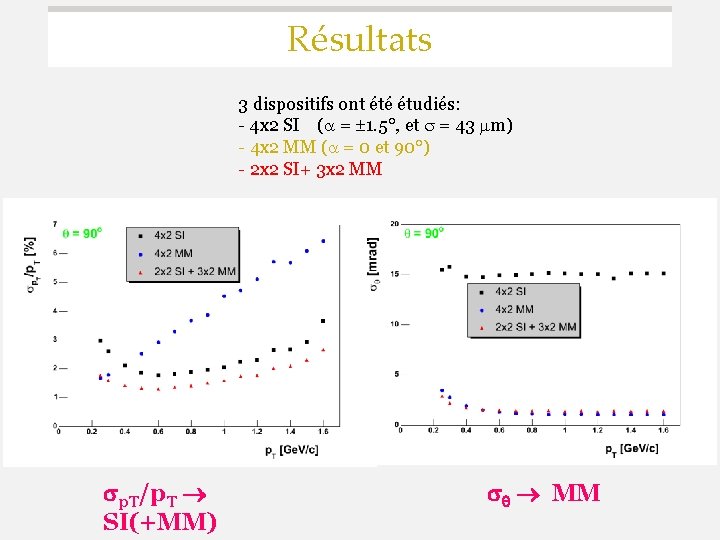
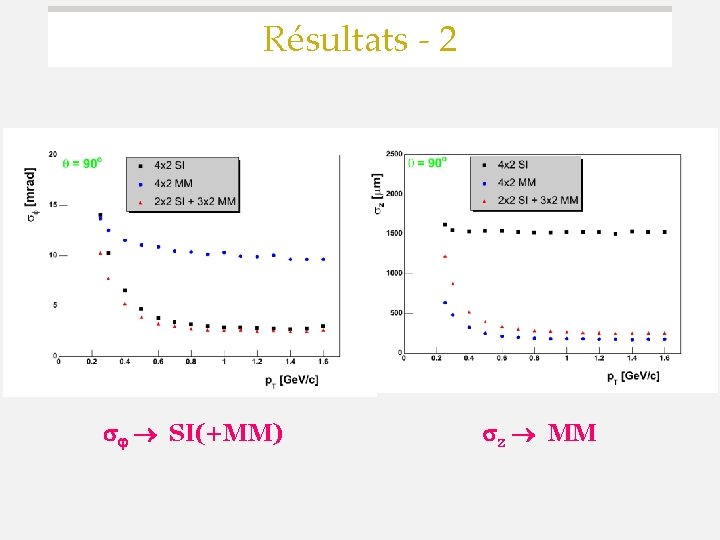
Central vertex tracking • Central or “barrel” vertex detector (BVT) – mixed: inner - Silicon, outer – Micromegas – Silicon: • better position resolution • but, more multiple scattering • and, very small stereo angle – all-Si design good for dp/p, df; bad for d , dz December 2, 2009 CLAS 12 Detector Review Mac Mestayer
Résultats 3 dispositifs ont été étudiés: - 4 x 2 SI ( = 1. 5°, et = 43 m) - 4 x 2 MM ( = 0 et 90°) - 2 x 2 SI+ 3 x 2 MM p. T/p. T SI(+MM) MM
Résultats - 2 SI(+MM) z MM
Silicon + Micromegas ? • simulations show mixed solution best, but – can Micromegas work with a cylindrical geometry? – can Micromegas work in a high, transverse B -field ? • Review the technology December 2, 2009 CLAS 12 Detector Review Mac Mestayer
Review of Micromegas Tracking Detectors for CLAS 12 – May 7, 2009 • Reviewers: Madhu Dixit, Mac Mestayer • Presentations covered the following topics: – – – detector overview: layers, strip pitch, segmentation for central & forward regions fabrication overview: principles and prototype testing of “bulk” technology detector simulation: GARFIELD results on drift, diffusion, gain tracking simulation: particle backgrounds, tracking efficiency and resolution acceptance and quality assurance: methods to validate component performance prototype testing: measurements of position resolution, Lorentz angle, gain times transmission and tracking efficiency for minimum-ionizing tracks; including tests of curved detectors and tests in magnetic fields – electronics: overview of requirements for charge and time measurements; options for an integrated system: amplification/discrimination/digitization/ readout. • Impressive new pioneering work on curved Micromegas technology and operation in transverse magnetic fields
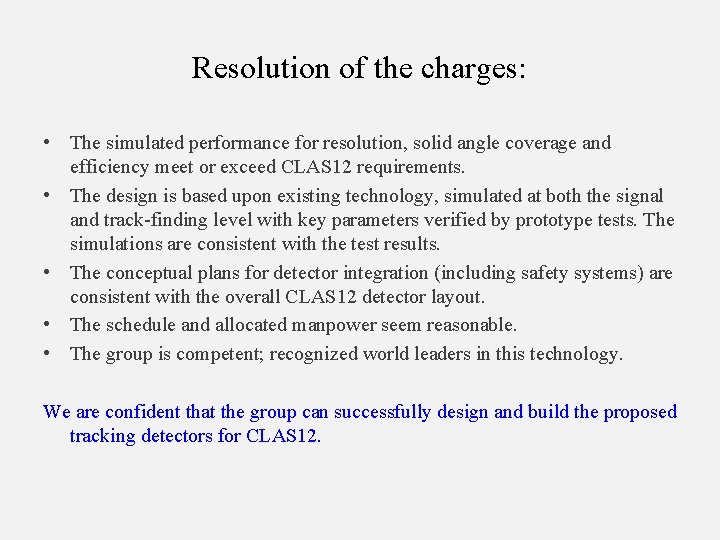
Resolution of the charges: • The simulated performance for resolution, solid angle coverage and efficiency meet or exceed CLAS 12 requirements. • The design is based upon existing technology, simulated at both the signal and track-finding level with key parameters verified by prototype tests. The simulations are consistent with the test results. • The conceptual plans for detector integration (including safety systems) are consistent with the overall CLAS 12 detector layout. • The schedule and allocated manpower seem reasonable. • The group is competent; recognized world leaders in this technology. We are confident that the group can successfully design and build the proposed tracking detectors for CLAS 12.
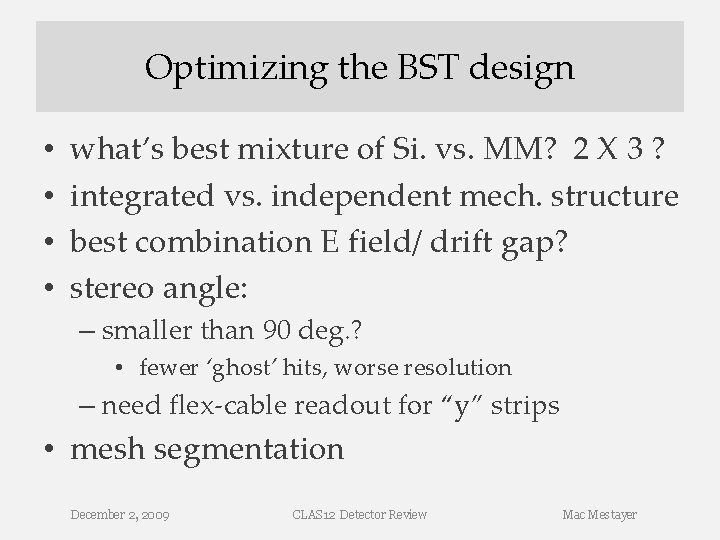
Optimizing the BST design • • what’s best mixture of Si. vs. MM? 2 X 3 ? integrated vs. independent mech. structure best combination E field/ drift gap? stereo angle: – smaller than 90 deg. ? • fewer ‘ghost’ hits, worse resolution – need flex-cable readout for “y” strips • mesh segmentation December 2, 2009 CLAS 12 Detector Review Mac Mestayer
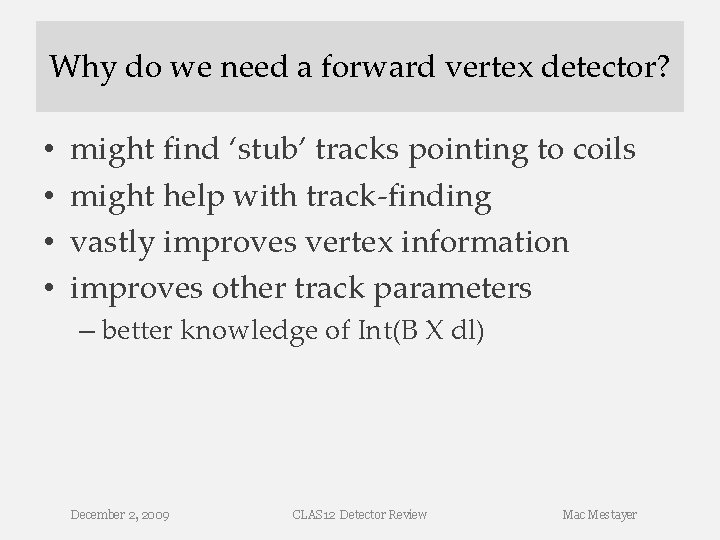
Why do we need a forward vertex detector? • • might find ‘stub’ tracks pointing to coils might help with track-finding vastly improves vertex information improves other track parameters – better knowledge of Int(B X dl) December 2, 2009 CLAS 12 Detector Review Mac Mestayer
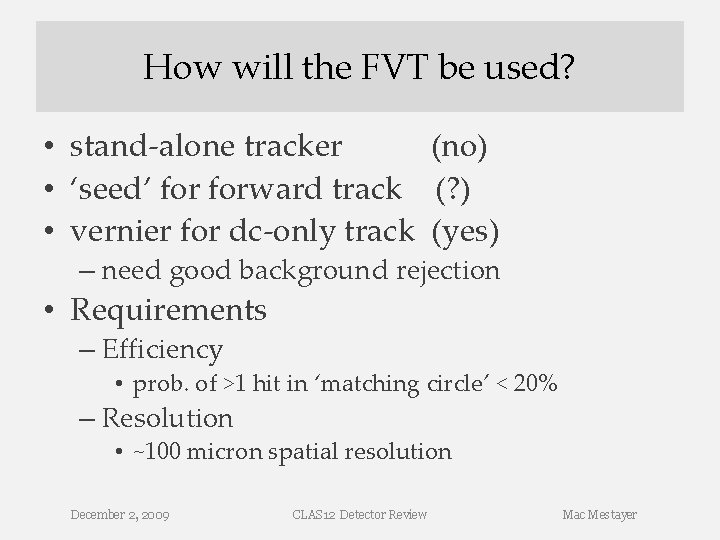
How will the FVT be used? • stand-alone tracker (no) • ‘seed’ forward track (? ) • vernier for dc-only track (yes) – need good background rejection • Requirements – Efficiency • prob. of >1 hit in ‘matching circle’ < 20% – Resolution • ~100 micron spatial resolution December 2, 2009 CLAS 12 Detector Review Mac Mestayer
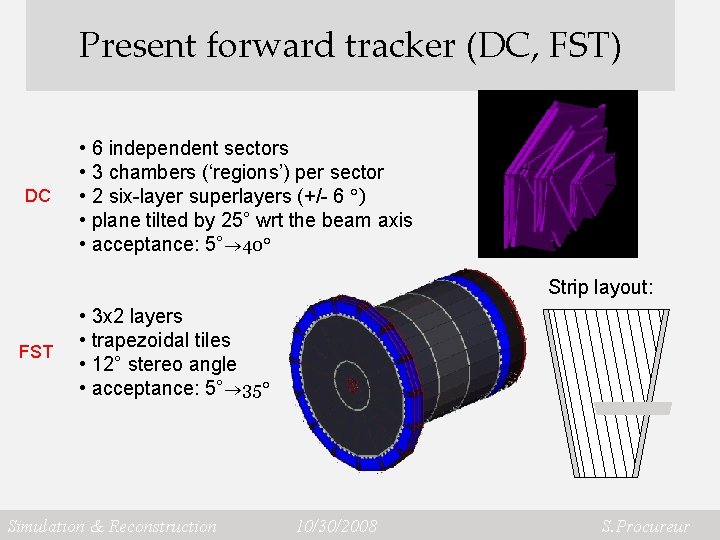
Present forward tracker (DC, FST) DC • 6 independent sectors • 3 chambers (‘regions’) per sector • 2 six-layer superlayers (+/- 6 °) • plane tilted by 25° wrt the beam axis • acceptance: 5° 40° Strip layout: FST • 3 x 2 layers • trapezoidal tiles • 12° stereo angle • acceptance: 5° 35° Simulation & Reconstruction 10/30/2008 S. Procureur
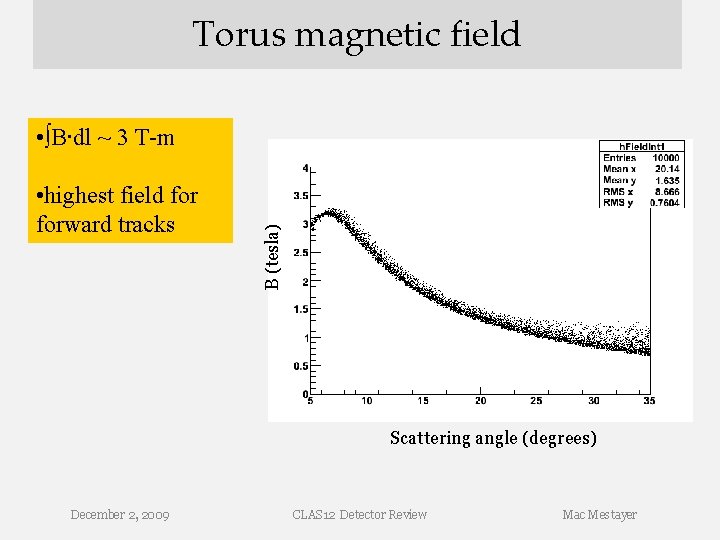
Torus magnetic field • highest field forward tracks B (tesla) • ∫B∙dl ~ 3 T-m Scattering angle (degrees) December 2, 2009 CLAS 12 Detector Review Mac Mestayer
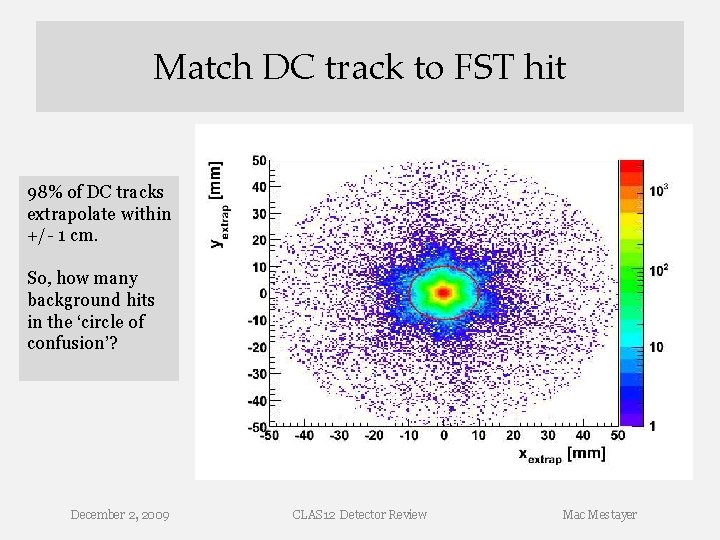
Match DC track to FST hit 98% of DC tracks extrapolate within +/- 1 cm. So, how many background hits in the ‘circle of confusion’? December 2, 2009 CLAS 12 Detector Review Mac Mestayer
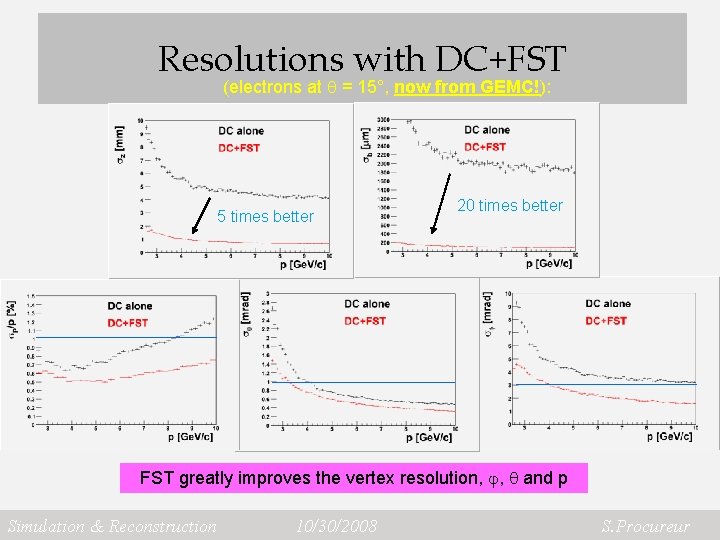
Resolutions with DC+FST (electrons at = 15°, now from GEMC!): 5 times better 20 times better FST greatly improves the vertex resolution, , and p Simulation & Reconstruction 10/30/2008 S. Procureur
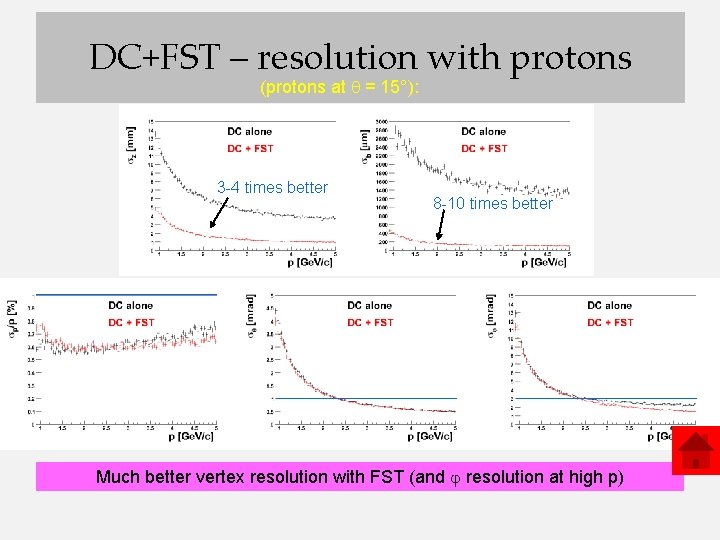
DC+FST – resolution with protons (protons at = 15°): 3 -4 times better 8 -10 times better Much better vertex resolution with FST (and resolution at high p)
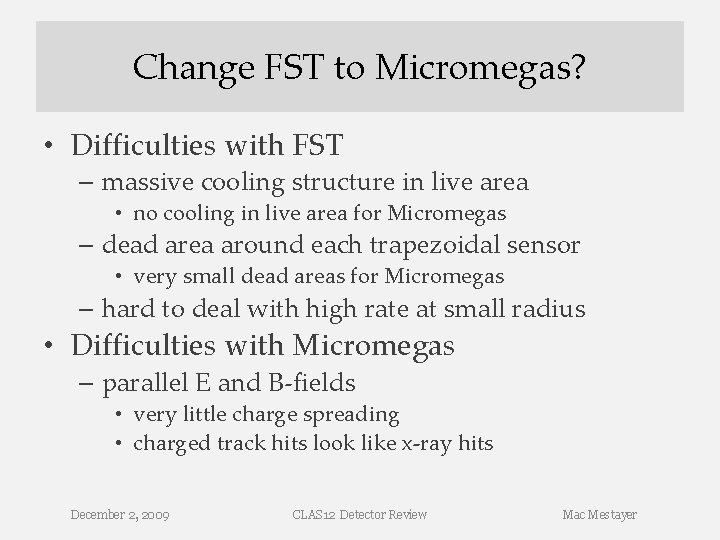
Change FST to Micromegas? • Difficulties with FST – massive cooling structure in live area • no cooling in live area for Micromegas – dead area around each trapezoidal sensor • very small dead areas for Micromegas – hard to deal with high rate at small radius • Difficulties with Micromegas – parallel E and B-fields • very little charge spreading • charged track hits look like x-ray hits December 2, 2009 CLAS 12 Detector Review Mac Mestayer
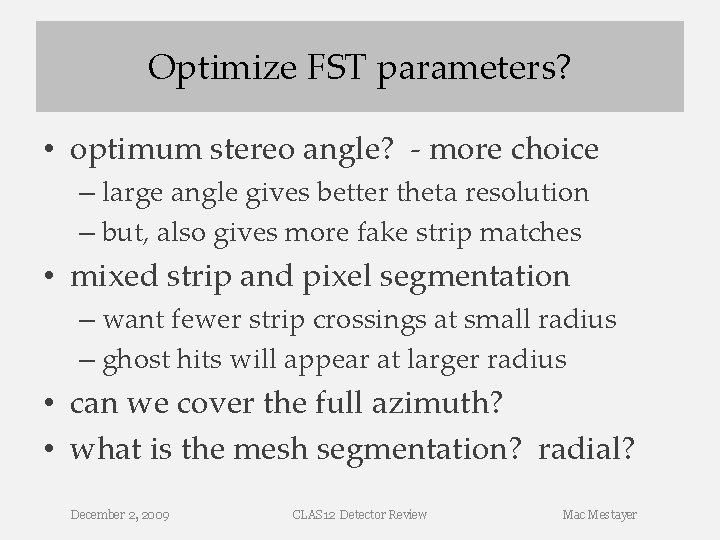
Optimize FST parameters? • optimum stereo angle? - more choice – large angle gives better theta resolution – but, also gives more fake strip matches • mixed strip and pixel segmentation – want fewer strip crossings at small radius – ghost hits will appear at larger radius • can we cover the full azimuth? • what is the mesh segmentation? radial? December 2, 2009 CLAS 12 Detector Review Mac Mestayer
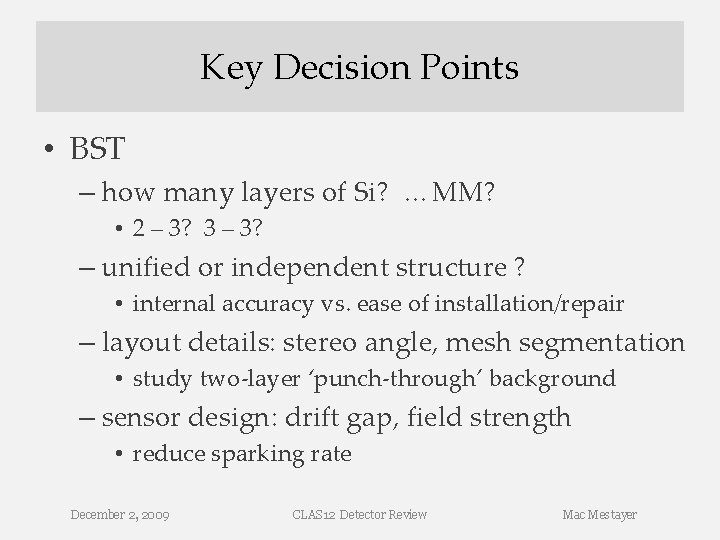
Key Decision Points • BST – how many layers of Si? …MM? • 2 – 3? 3 – 3? – unified or independent structure ? • internal accuracy vs. ease of installation/repair – layout details: stereo angle, mesh segmentation • study two-layer ‘punch-through’ background – sensor design: drift gap, field strength • reduce sparking rate December 2, 2009 CLAS 12 Detector Review Mac Mestayer
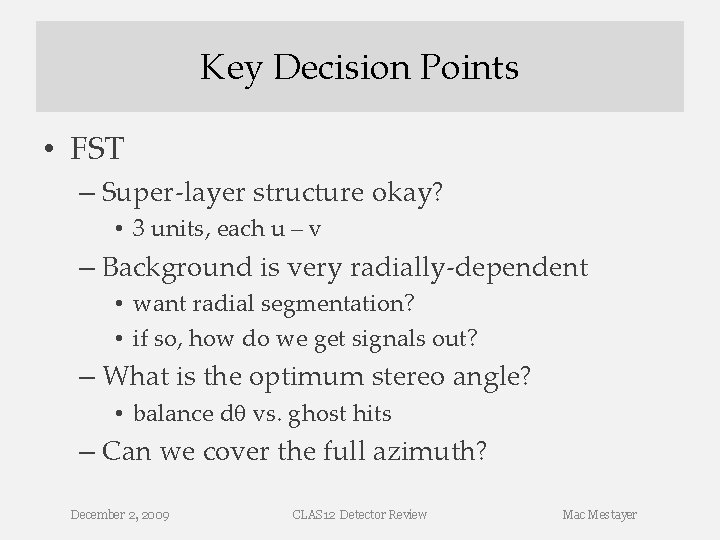
Key Decision Points • FST – Super-layer structure okay? • 3 units, each u – v – Background is very radially-dependent • want radial segmentation? • if so, how do we get signals out? – What is the optimum stereo angle? • balance d vs. ghost hits – Can we cover the full azimuth? December 2, 2009 CLAS 12 Detector Review Mac Mestayer
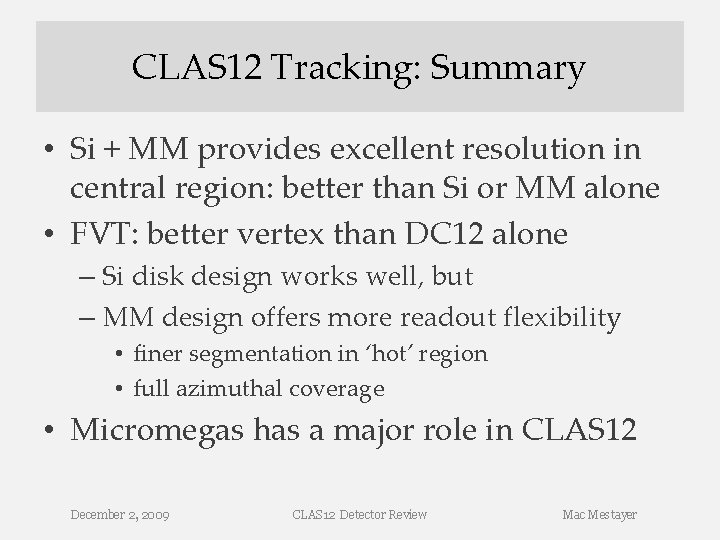
CLAS 12 Tracking: Summary • Si + MM provides excellent resolution in central region: better than Si or MM alone • FVT: better vertex than DC 12 alone – Si disk design works well, but – MM design offers more readout flexibility • finer segmentation in ‘hot’ region • full azimuthal coverage • Micromegas has a major role in CLAS 12 December 2, 2009 CLAS 12 Detector Review Mac Mestayer
Backup slides on DC 12 December 2, 2009 CLAS 12 Detector Review Mac Mestayer
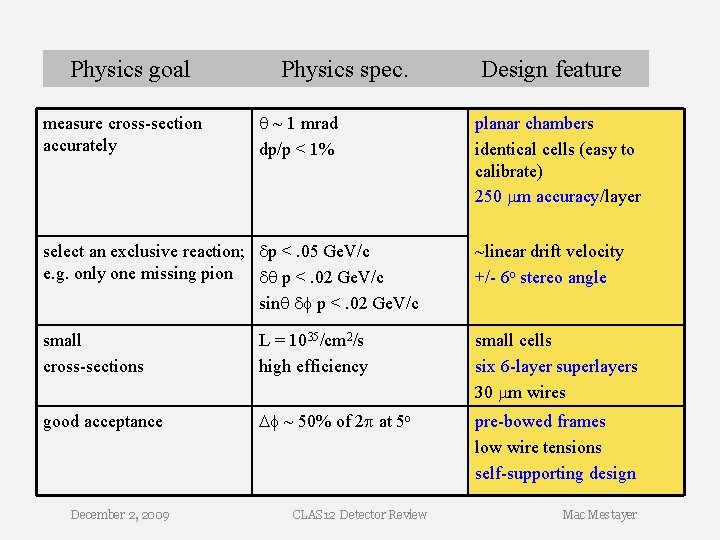
Physics goal measure cross-section accurately Physics spec. ~ 1 mrad dp/p < 1% Design feature planar chambers identical cells (easy to calibrate) 250 m accuracy/layer select an exclusive reaction; dp <. 05 Ge. V/c e. g. only one missing pion d p <. 02 Ge. V/c sin df p <. 02 Ge. V/c ~linear drift velocity +/- 6 o stereo angle small cross-sections L = 1035/cm 2/s high efficiency small cells six 6 -layer superlayers 30 m wires good acceptance Df ~ 50% of 2 p at 5 o pre-bowed frames low wire tensions self-supporting design December 2, 2009 CLAS 12 Detector Review Mac Mestayer
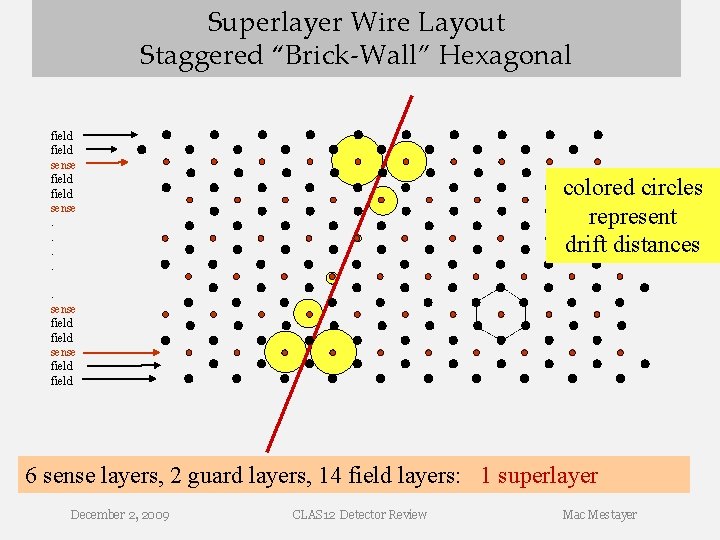
Superlayer Wire Layout Staggered “Brick-Wall” Hexagonal field sense. . colored circles represent drift distances . sense field 6 sense layers, 2 guard layers, 14 field layers: 1 superlayer December 2, 2009 CLAS 12 Detector Review Mac Mestayer
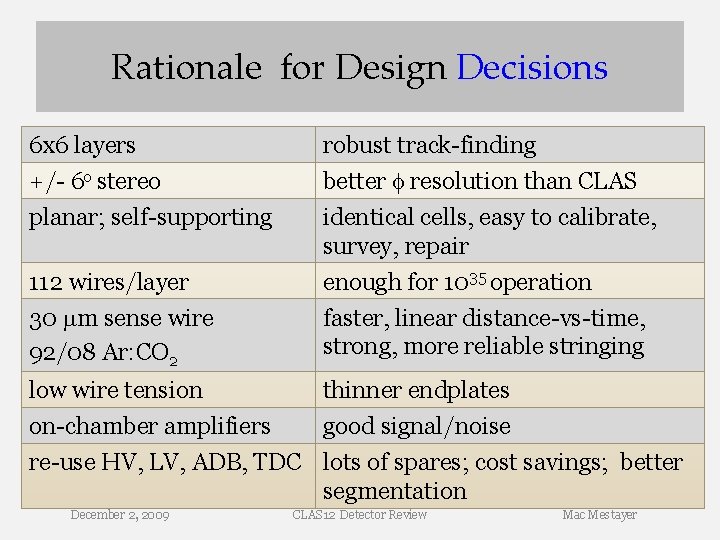
Rationale for Design Decisions 6 x 6 layers +/- 6 o stereo planar; self-supporting robust track-finding better f resolution than CLAS identical cells, easy to calibrate, survey, repair 112 wires/layer 30 m sense wire 92/08 Ar: CO 2 enough for 1035 operation faster, linear distance-vs-time, strong, more reliable stringing low wire tension thinner endplates on-chamber amplifiers good signal/noise re-use HV, LV, ADB, TDC lots of spares; cost savings; better segmentation December 2, 2009 CLAS 12 Detector Review Mac Mestayer
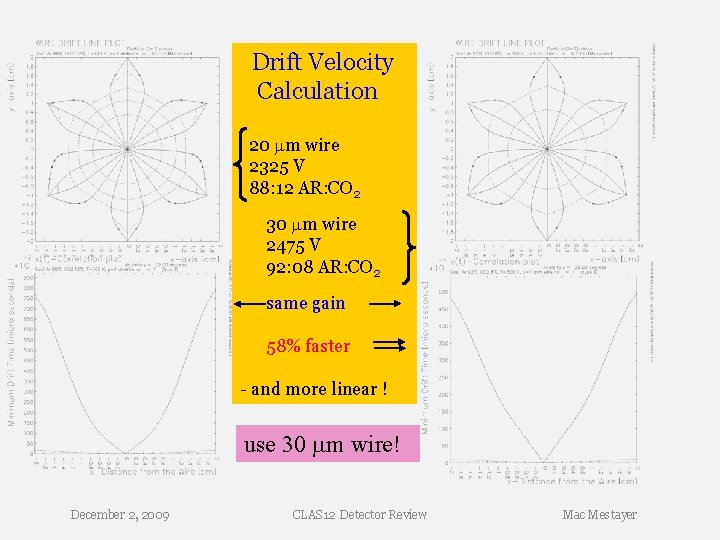
Drift Velocity Calculation 20 m wire 2325 V 88: 12 AR: CO 2 30 m wire 2475 V 92: 08 AR: CO 2 same gain 58% faster - and more linear ! use 30 m wire! December 2, 2009 CLAS 12 Detector Review Mac Mestayer
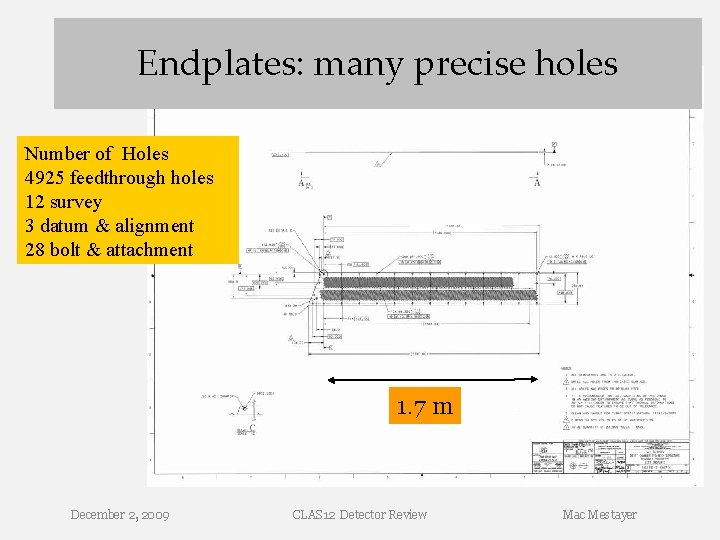
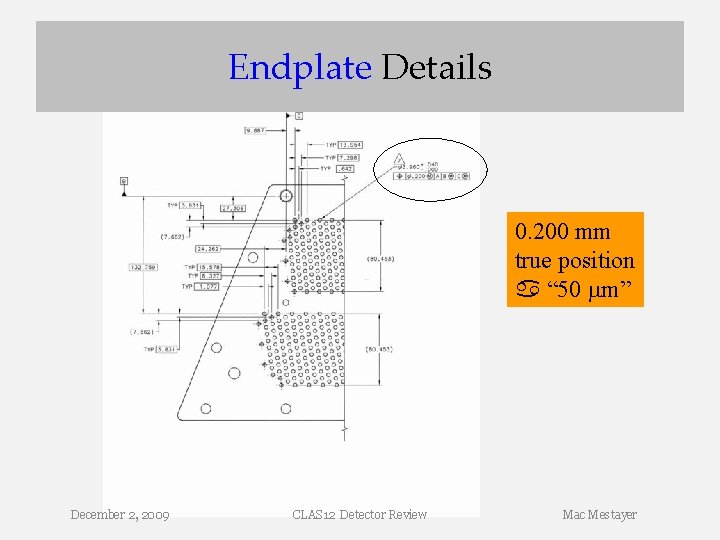
Endplates: many precise holes Number of Holes 4925 feedthrough holes 12 survey 3 datum & alignment 28 bolt & attachment 1. 7 m December 2, 2009 CLAS 12 Detector Review Mac Mestayer
Endplate Details 0. 200 mm true position a “ 50 m” December 2, 2009 CLAS 12 Detector Review Mac Mestayer
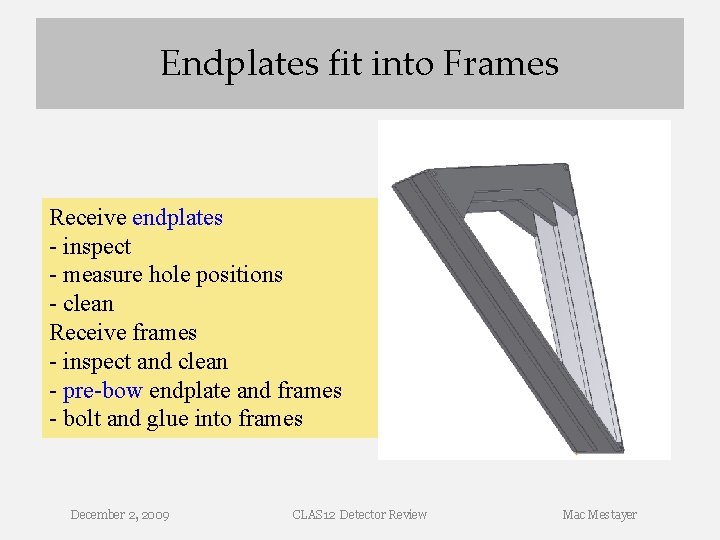
Endplates fit into Frames Receive endplates - inspect - measure hole positions - clean Receive frames - inspect and clean - pre-bow endplate and frames - bolt and glue into frames December 2, 2009 CLAS 12 Detector Review Mac Mestayer
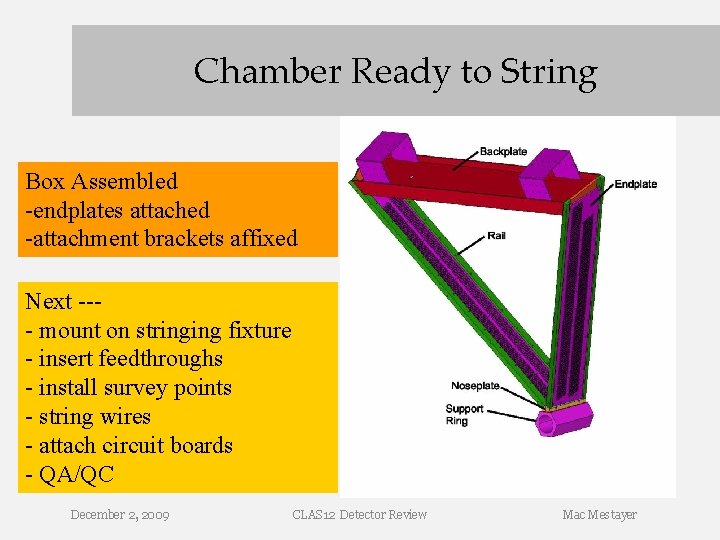
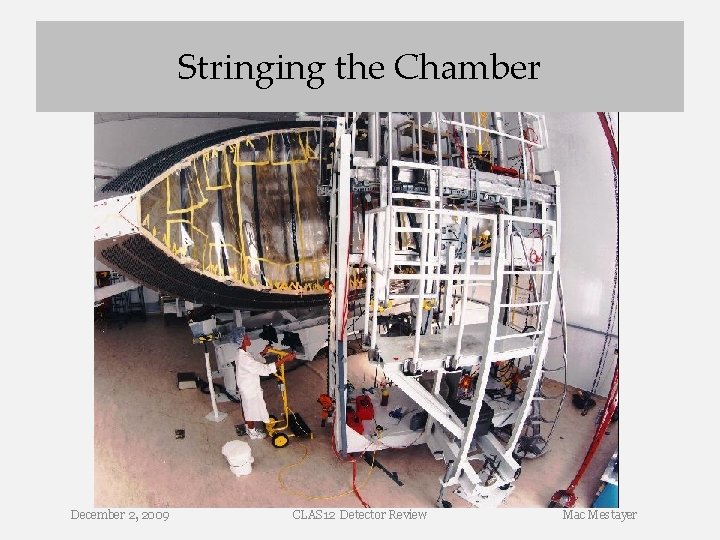
Chamber Ready to String Box Assembled -endplates attached -attachment brackets affixed Next --- mount on stringing fixture - insert feedthroughs - install survey points - string wires - attach circuit boards - QA/QC December 2, 2009 CLAS 12 Detector Review Mac Mestayer
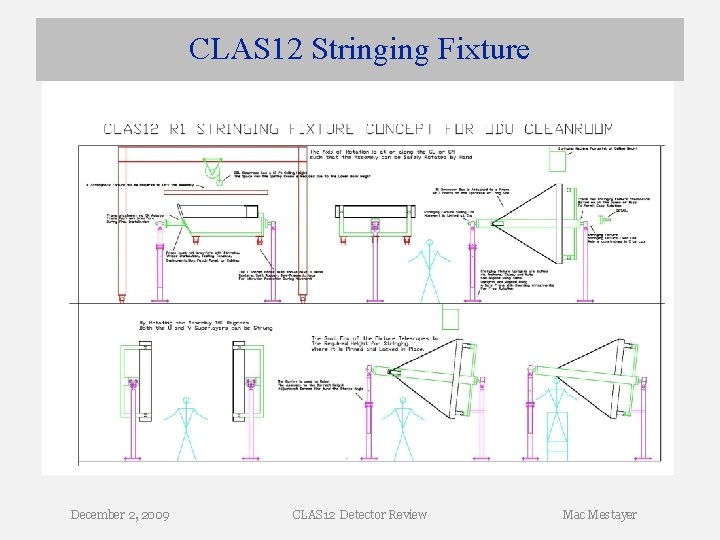
CLAS 12 Stringing Fixture December 2, 2009 CLAS 12 Detector Review Mac Mestayer
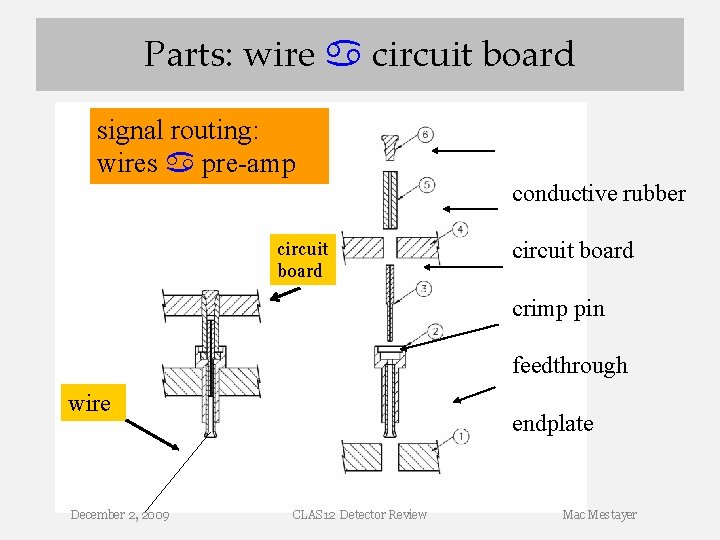
Parts: wire a circuit board signal routing: wires a pre-amp conductive rubber circuit board crimp pin feedthrough wire December 2, 2009 endplate CLAS 12 Detector Review Mac Mestayer
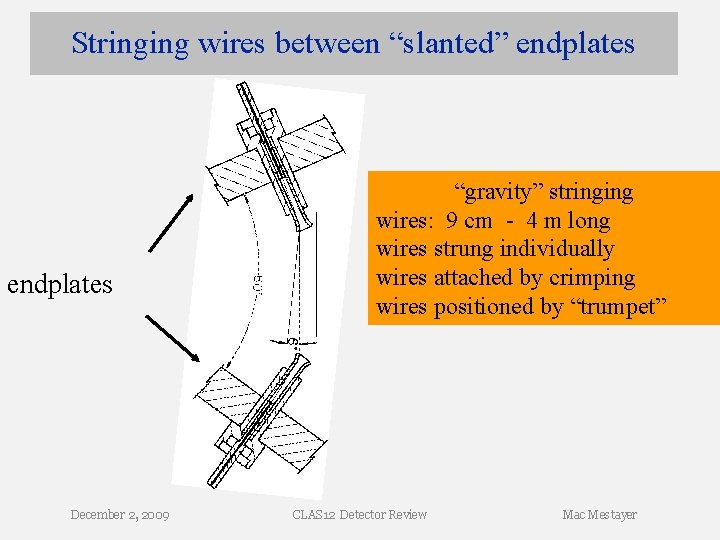
Stringing wires between “slanted” endplates December 2, 2009 “gravity” stringing wires: 9 cm - 4 m long wires strung individually wires attached by crimping wires positioned by “trumpet” CLAS 12 Detector Review Mac Mestayer
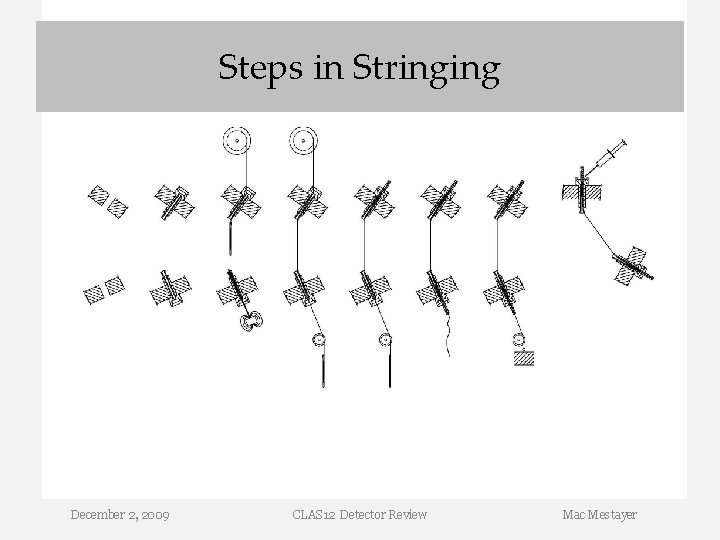
Steps in Stringing December 2, 2009 CLAS 12 Detector Review Mac Mestayer
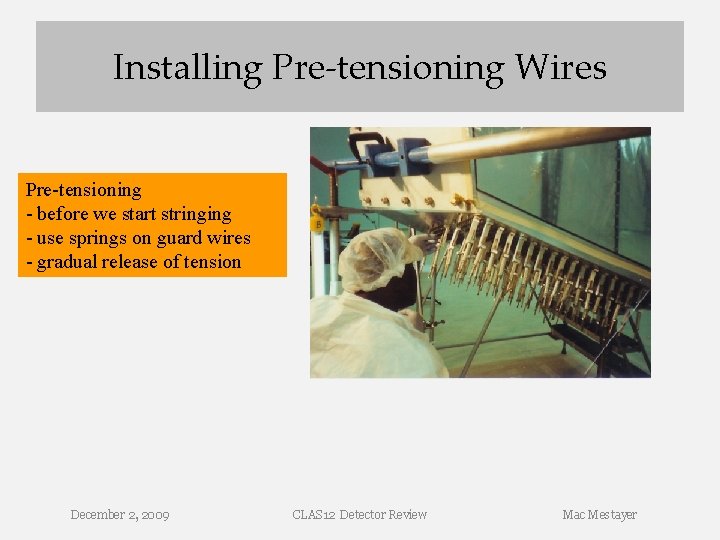
Installing Pre-tensioning Wires Pre-tensioning - before we start stringing - use springs on guard wires - gradual release of tension December 2, 2009 CLAS 12 Detector Review Mac Mestayer
Stringing the Chamber December 2, 2009 CLAS 12 Detector Review Mac Mestayer
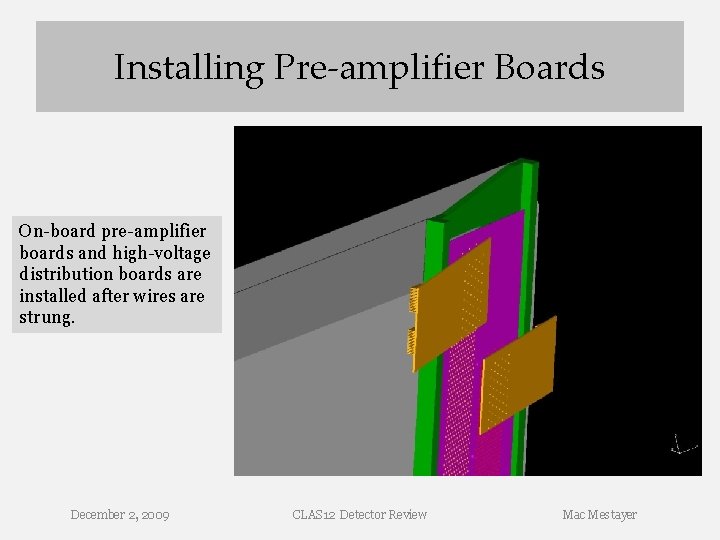
Installing Pre-amplifier Boards On-board pre-amplifier boards and high-voltage distribution boards are installed after wires are strung. December 2, 2009 CLAS 12 Detector Review Mac Mestayer
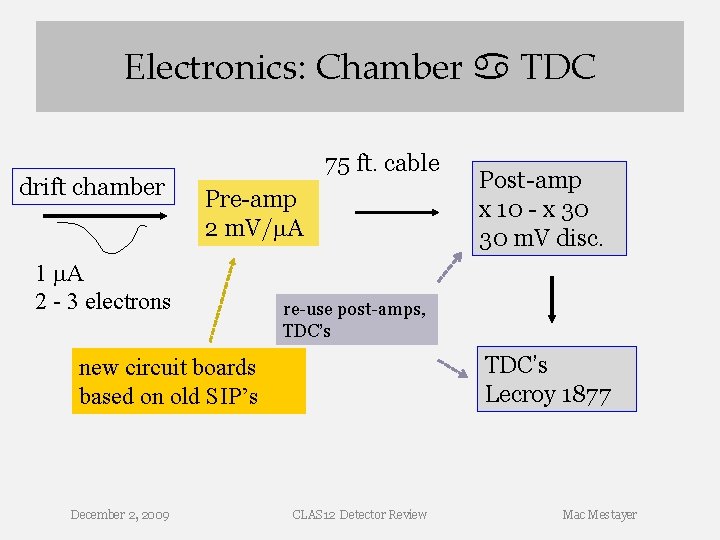
Electronics: Chamber a TDC drift chamber 75 ft. cable Pre-amp 2 m. V/ A 1 A 2 - 3 electrons re-use post-amps, TDC’s Lecroy 1877 new circuit boards based on old SIP’s December 2, 2009 Post-amp x 10 - x 30 30 m. V disc. CLAS 12 Detector Review Mac Mestayer
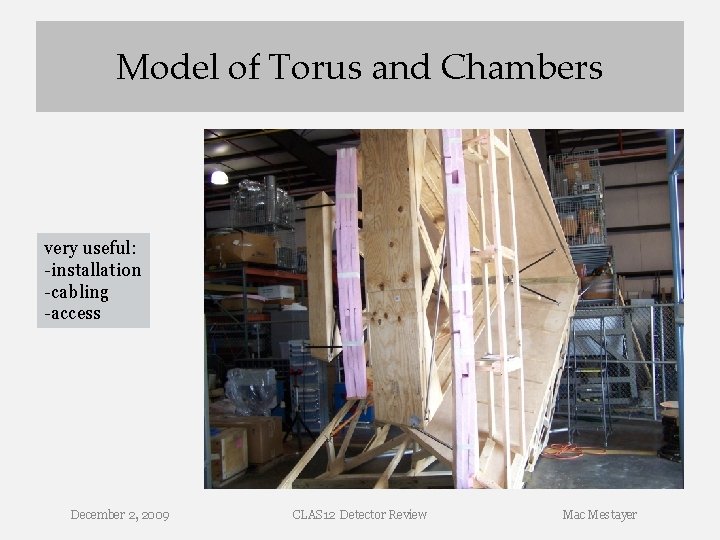
Model of Torus and Chambers very useful: -installation -cabling -access December 2, 2009 CLAS 12 Detector Review Mac Mestayer
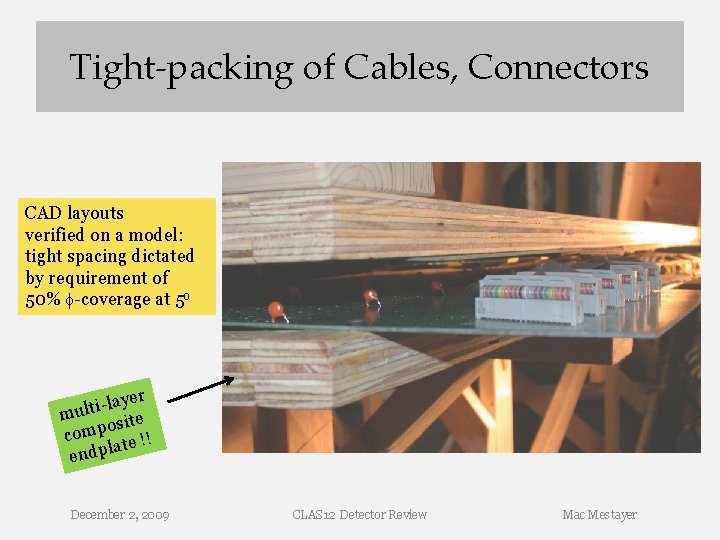
Tight-packing of Cables, Connectors CAD layouts verified on a model: tight spacing dictated by requirement of 50% f-coverage at 5 o ayer l i t l mu site o p m co te !! a l p d en December 2, 2009 CLAS 12 Detector Review Mac Mestayer
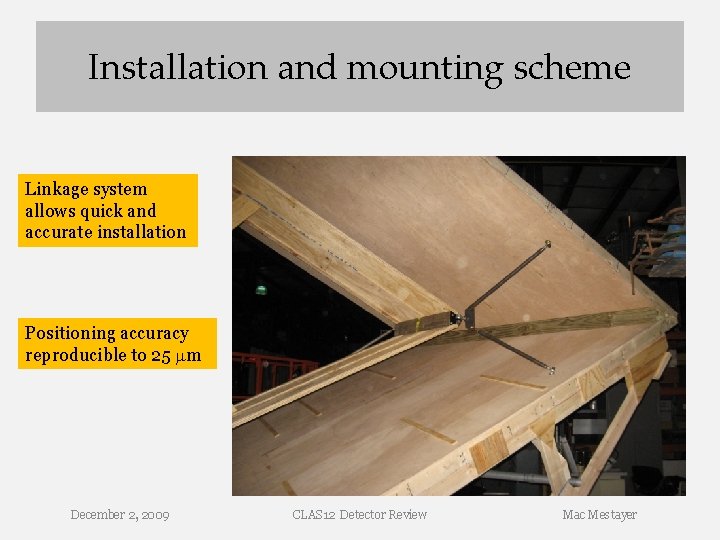
Installation and mounting scheme Linkage system allows quick and accurate installation Positioning accuracy reproducible to 25 m December 2, 2009 CLAS 12 Detector Review Mac Mestayer
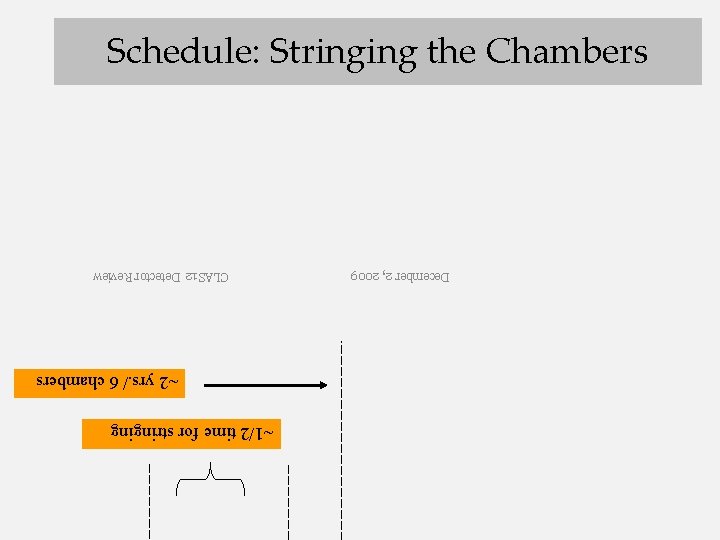
December 2, 2009 ~1/2 time for stringing ~2 yrs. / 6 chambers CLAS 12 Detector Review Schedule: Stringing the Chambers
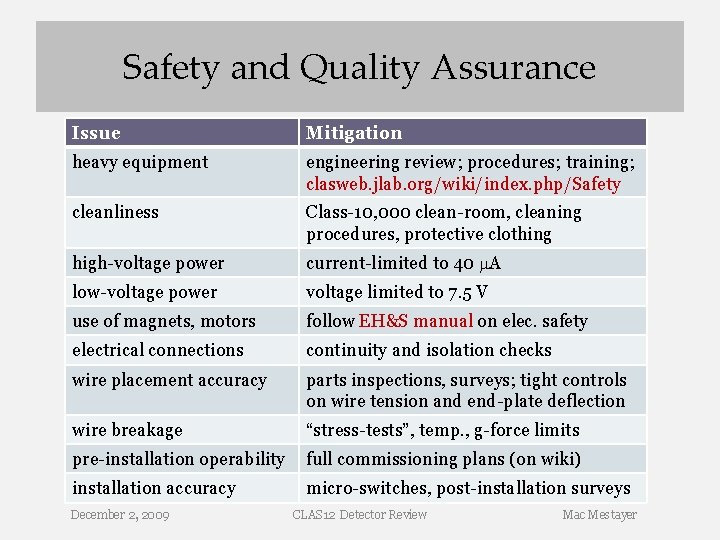
Safety and Quality Assurance Issue Mitigation heavy equipment engineering review; procedures; training; clasweb. jlab. org/wiki/index. php/Safety cleanliness Class-10, 000 clean-room, cleaning procedures, protective clothing high-voltage power current-limited to 40 A low-voltage power voltage limited to 7. 5 V use of magnets, motors follow EH&S manual on elec. safety electrical connections continuity and isolation checks wire placement accuracy parts inspections, surveys; tight controls on wire tension and end-plate deflection wire breakage “stress-tests”, temp. , g-force limits pre-installation operability full commissioning plans (on wiki) installation accuracy micro-switches, post-installation surveys December 2, 2009 CLAS 12 Detector Review Mac Mestayer
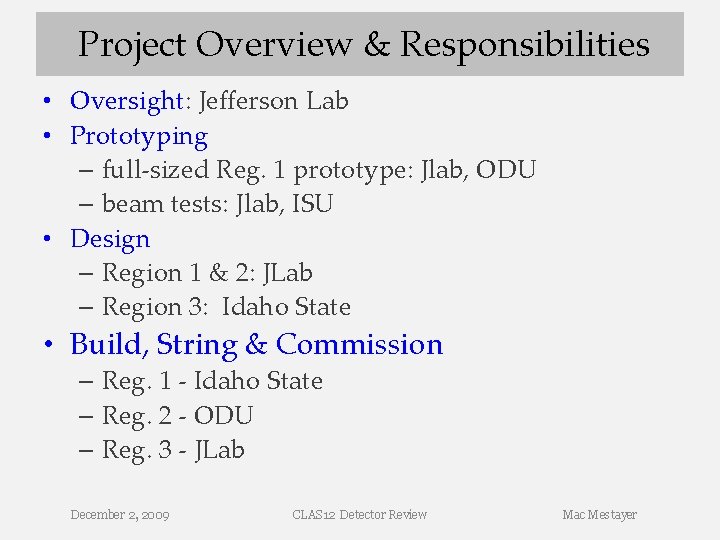
Project Overview & Responsibilities • Oversight: Jefferson Lab • Prototyping – full-sized Reg. 1 prototype: Jlab, ODU – beam tests: Jlab, ISU • Design – Region 1 & 2: JLab – Region 3: Idaho State • Build, String & Commission – Reg. 1 - Idaho State – Reg. 2 - ODU – Reg. 3 - JLab December 2, 2009 CLAS 12 Detector Review Mac Mestayer
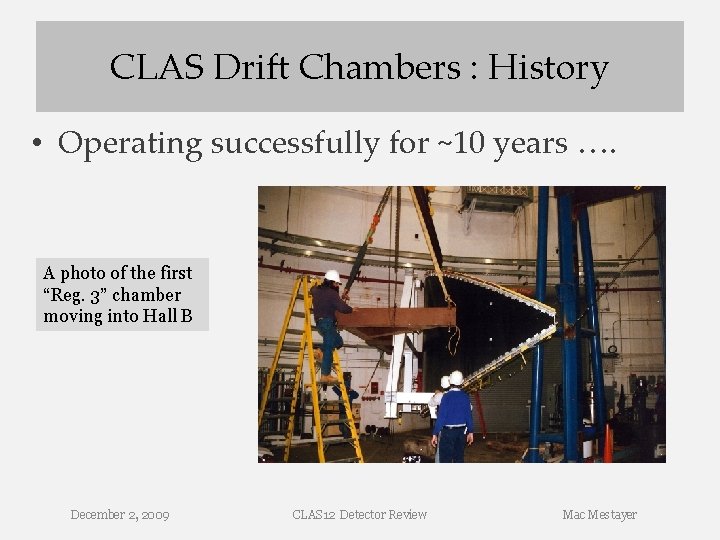
CLAS Drift Chambers : History • Operating successfully for ~10 years …. A photo of the first “Reg. 3” chamber moving into Hall B December 2, 2009 CLAS 12 Detector Review Mac Mestayer
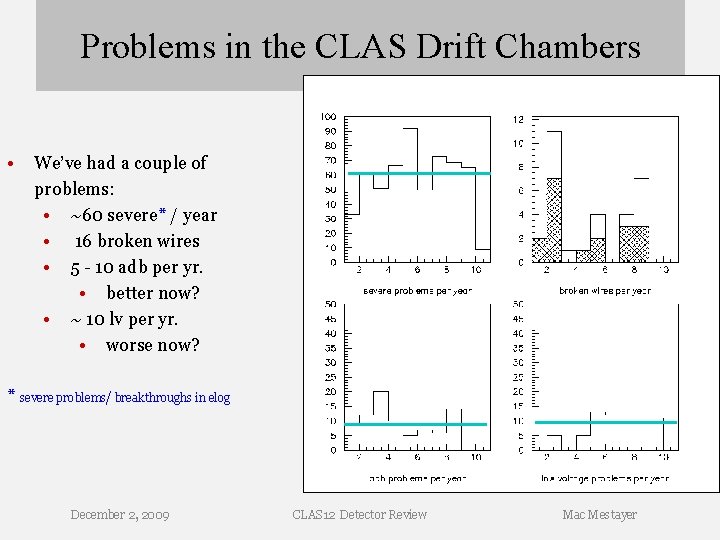
Problems in the CLAS Drift Chambers • We’ve had a couple of problems: • ~60 severe* / year • 16 broken wires • 5 - 10 adb per yr. • better now? • ~ 10 lv per yr. • worse now? * severe problems/ breakthroughs in elog December 2, 2009 CLAS 12 Detector Review Mac Mestayer
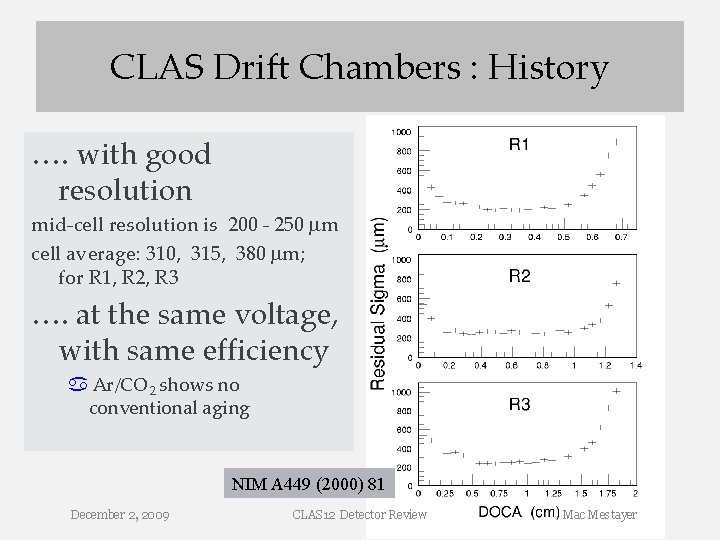
CLAS Drift Chambers : History …. with good resolution mid-cell resolution is 200 - 250 m cell average: 310, 315, 380 m; for R 1, R 2, R 3 …. at the same voltage, with same efficiency a Ar/CO 2 shows no conventional aging NIM A 449 (2000) 81 December 2, 2009 CLAS 12 Detector Review Mac Mestayer
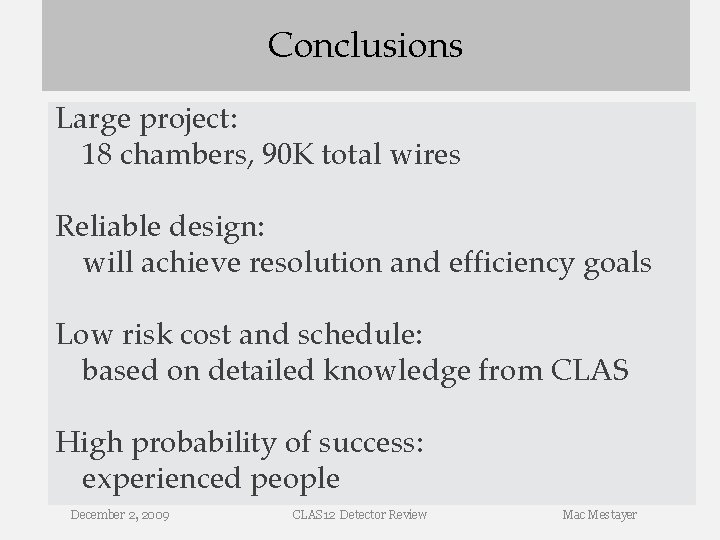
Conclusions Large project: 18 chambers, 90 K total wires Reliable design: will achieve resolution and efficiency goals Low risk cost and schedule: based on detailed knowledge from CLAS High probability of success: experienced people December 2, 2009 CLAS 12 Detector Review Mac Mestayer