
Jefferson Lab CLAS 12 Superconducting Solenoid magnet Requirements
Jefferson Lab CLAS 12 Superconducting Solenoid magnet Requirements and Design Evolution Renuka Rajput Ghoshal John Hogan Ruben J. Fair Probir K. Ghoshal Cesar Luongo Latifa Elouadrhiri Jefferson Lab Thomas Jefferson National Accelerator Facility Pg. 1
Outline • • Introduction Physics requirements Magnet Design Constraints Conductor Decision Cooling choice Design meets specifications Design iterations Path forward Thomas Jefferson National Accelerator Facility Pg. 2
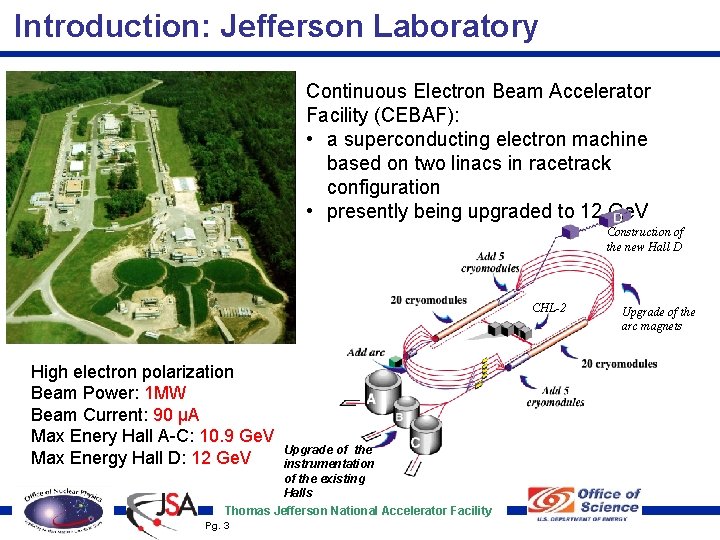
Introduction: Jefferson Laboratory Continuous Electron Beam Accelerator Facility (CEBAF): • a superconducting electron machine based on two linacs in racetrack configuration • presently being upgraded to 12 Ge. V Construction of the new Hall D CHL-2 High electron polarization Beam Power: 1 MW Beam Current: 90 µA Max Enery Hall A-C: 10. 9 Ge. V Max Energy Hall D: 12 Ge. V Upgrade of the instrumentation of the existing Halls Thomas Jefferson National Accelerator Facility Pg. 3 Upgrade of the arc magnets
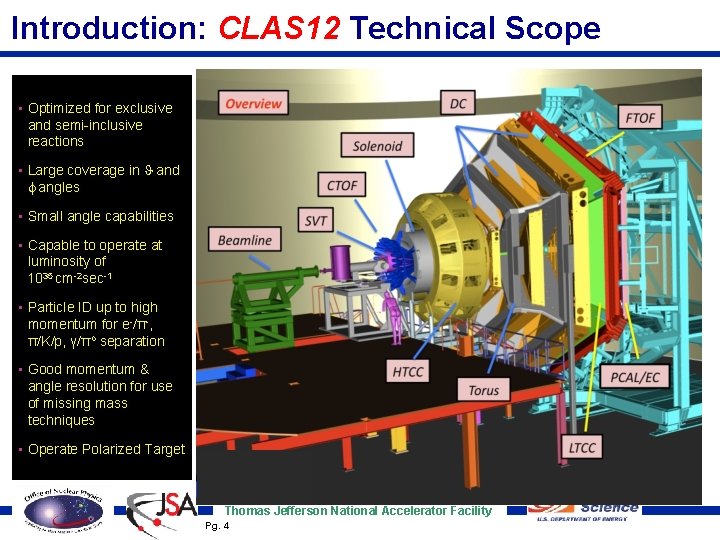
Introduction: CLAS 12 Technical Scope • Optimized for exclusive and semi-inclusive reactions • Large coverage in J and f angles • Small angle capabilities • Capable to operate at luminosity of 1035 cm-2 sec-1 • Particle ID up to high momentum for e-/π-, π/K/p, γ/πo separation • Good momentum & angle resolution for use of missing mass techniques • Operate Polarized Target Thomas Jefferson National Accelerator Facility Pg. 4
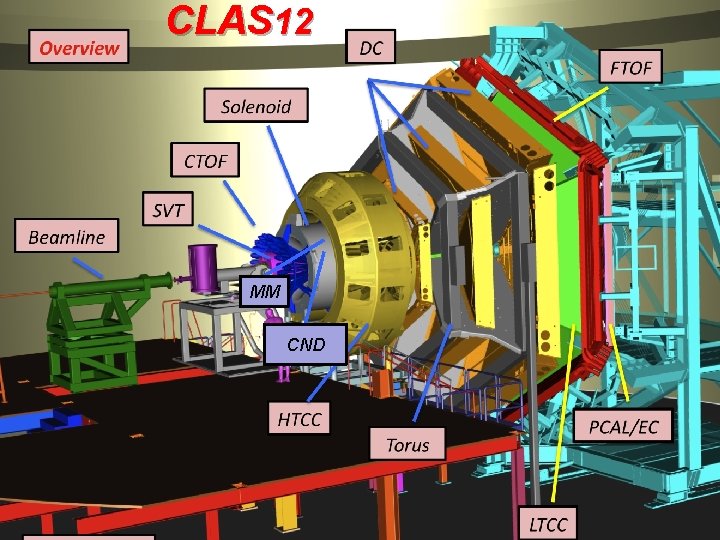
CLAS 12 MM CND Thomas Jefferson National Accelerator Facility Pg. 5
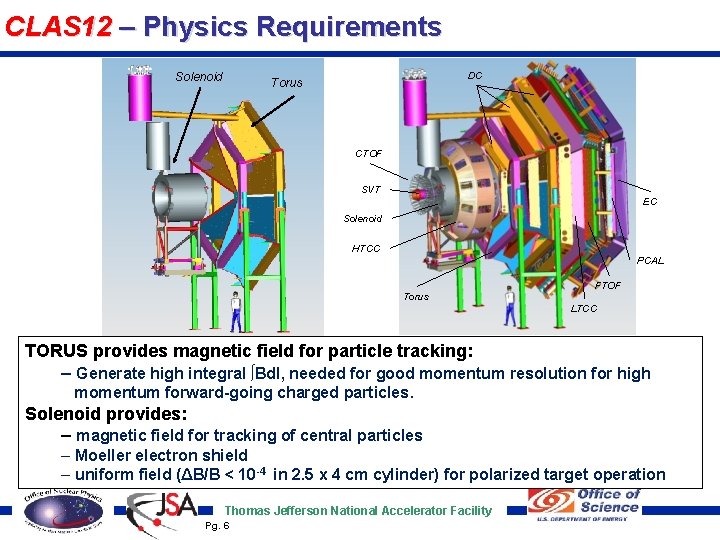
CLAS 12 – Physics Requirements Solenoid DC Torus CTOF SVT EC Solenoid HTCC PCAL Torus FTOF LTCC TORUS provides magnetic field for particle tracking: – Generate high integral ∫Bdl, needed for good momentum resolution for high momentum forward-going charged particles. Solenoid provides: – magnetic field for tracking of central particles – Moeller electron shield – uniform field (ΔB/B < 10 -4 in 2. 5 x 4 cm cylinder) for polarized target operation Thomas Jefferson National Accelerator Facility Pg. 6
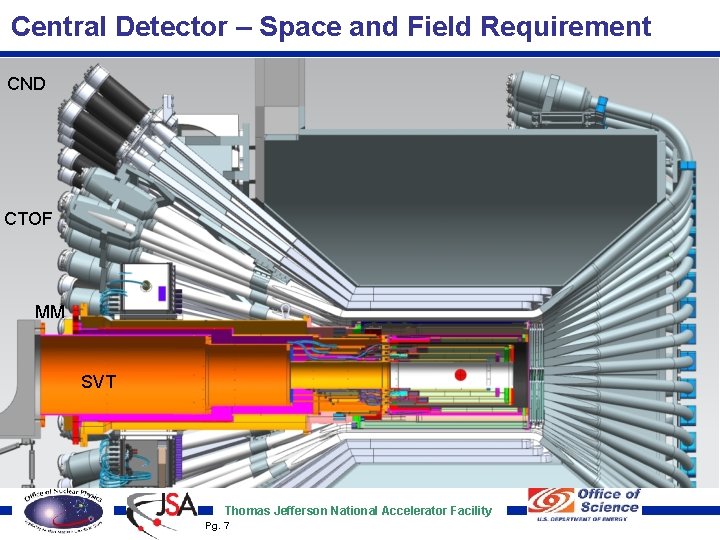
Central Detector – Space and Field Requirement CND CTOF MM SVT Thomas Jefferson National Accelerator Facility Pg. 7
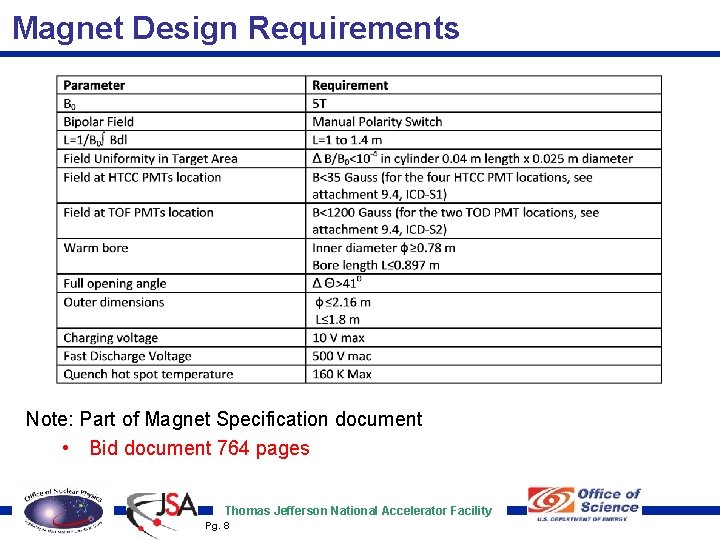
Magnet Design Requirements Note: Part of Magnet Specification document • Bid document 764 pages Thomas Jefferson National Accelerator Facility Pg. 8
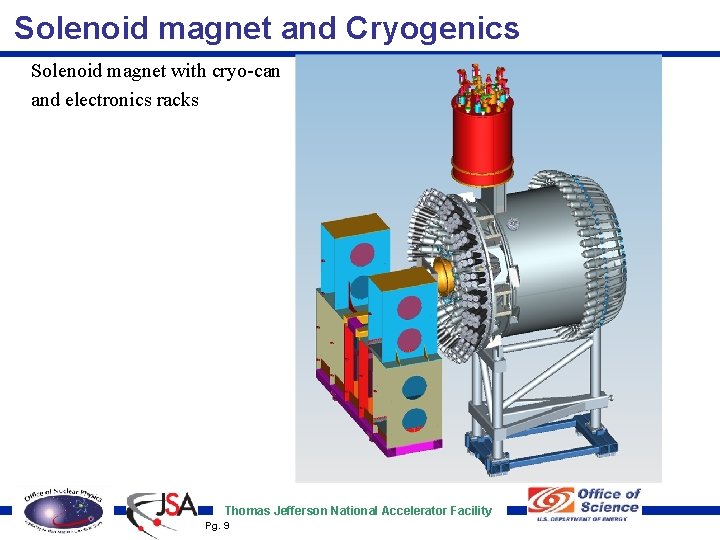
Solenoid magnet and Cryogenics Solenoid magnet with cryo-can and electronics racks Thomas Jefferson National Accelerator Facility Pg. 9
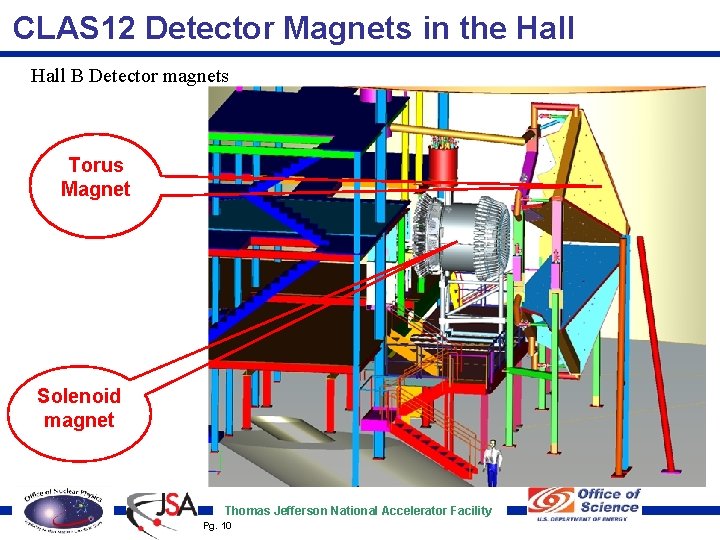
CLAS 12 Detector Magnets in the Hall B Detector magnets Torus Magnet Solenoid magnet Thomas Jefferson National Accelerator Facility Pg. 10
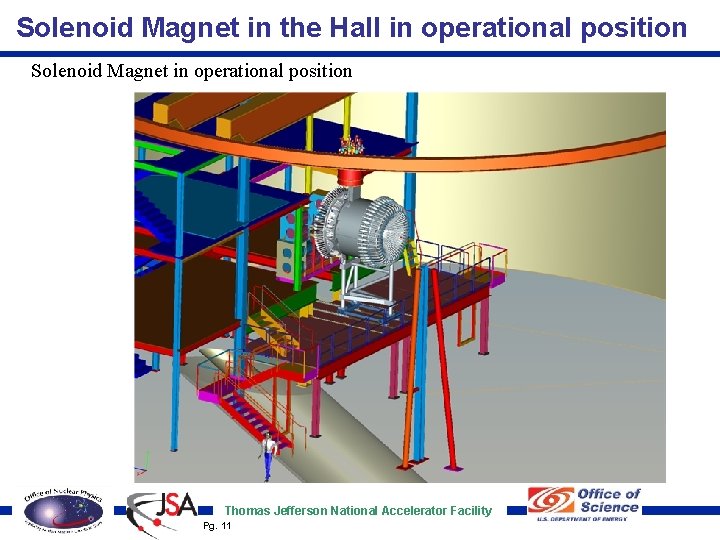
Solenoid Magnet in the Hall in operational position Solenoid Magnet in operational position Thomas Jefferson National Accelerator Facility Pg. 11
Magnet Concept and design from various perspectives • Magnets from various perspectives • Magnet User/Physicist: • Maximum field strength, • Very high field homogeneity over a larger volume • minimum space, fastest ramping, no quenching, … • Magnet Manufacturer/Industry: • • • Maximum margin (low field), No space Constraint Low Homogeneity requirement Minimum cost/ Maximum profit Maximize probability of success on 1 st ramp (90% of nominal is “Good Enough”) • Biggest problem: Missing links between the above 2 perspectives Thomas Jefferson National Accelerator Facility Pg. 12
Magnet Concept and design from various perspectives • Magnets from various perspectives • Magnet Engineer-3 rd perspective: • Somewhere between the 2 perspectives above! • The most rational agent in the equation that can bring together both sides, • Making the Physicist as happy as possible , while building a magnet with reasonable budgets for money and risk. Thomas Jefferson National Accelerator Facility Pg. 13
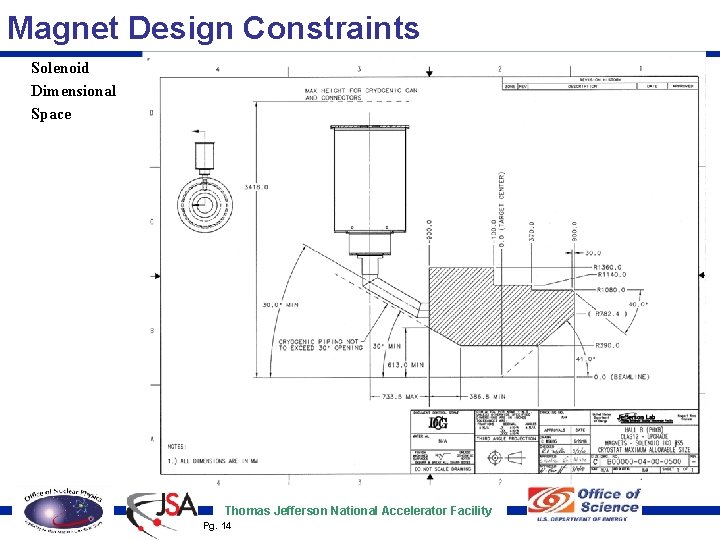
Magnet Design Constraints Solenoid Dimensional Space Thomas Jefferson National Accelerator Facility Pg. 14
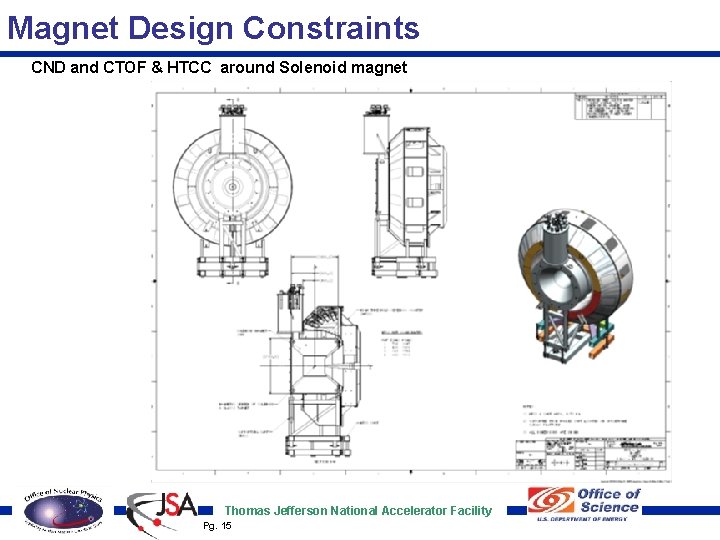
Magnet Design Constraints CND and CTOF & HTCC around Solenoid magnet Thomas Jefferson National Accelerator Facility Pg. 15
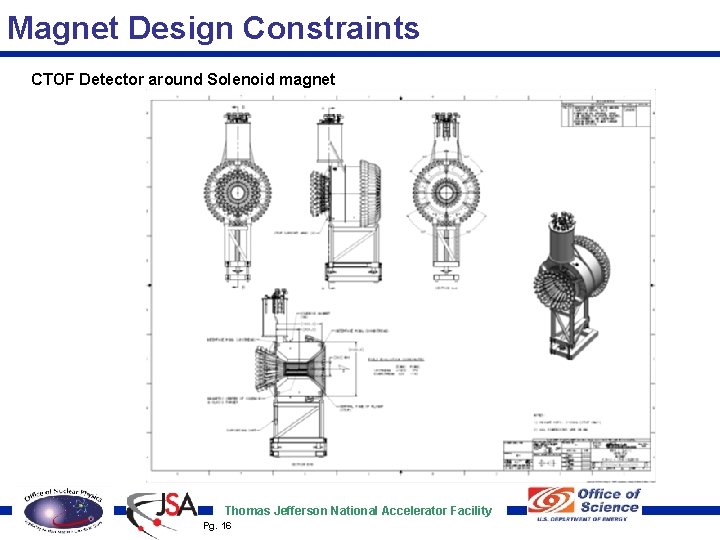
Magnet Design Constraints CTOF Detector around Solenoid magnet Thomas Jefferson National Accelerator Facility Pg. 16
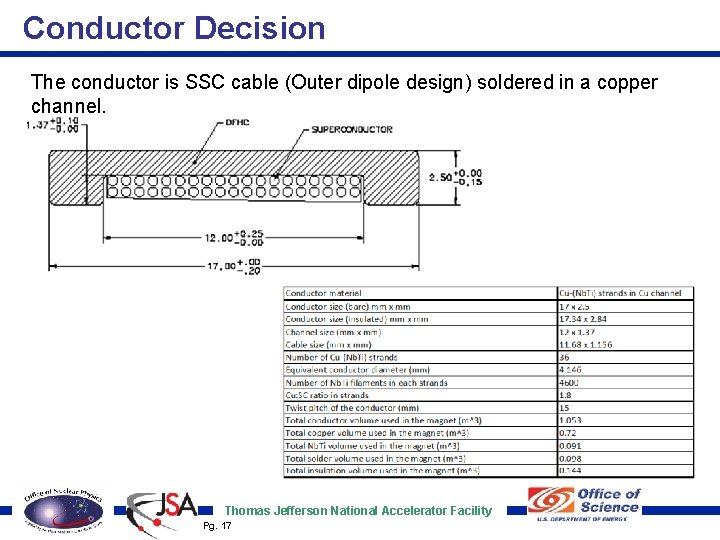
Conductor Decision The conductor is SSC cable (Outer dipole design) soldered in a copper channel. Thomas Jefferson National Accelerator Facility Pg. 17
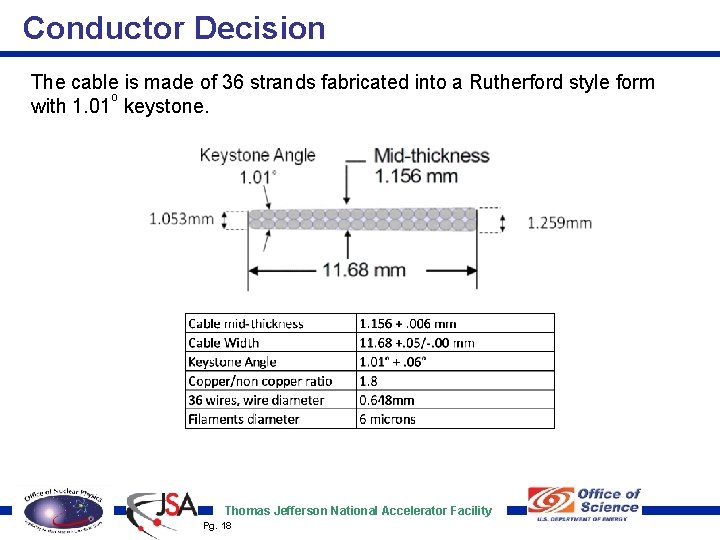
Conductor Decision The cable is made of 36 strands fabricated into a Rutherford style form o with 1. 01 keystone. Thomas Jefferson National Accelerator Facility Pg. 18
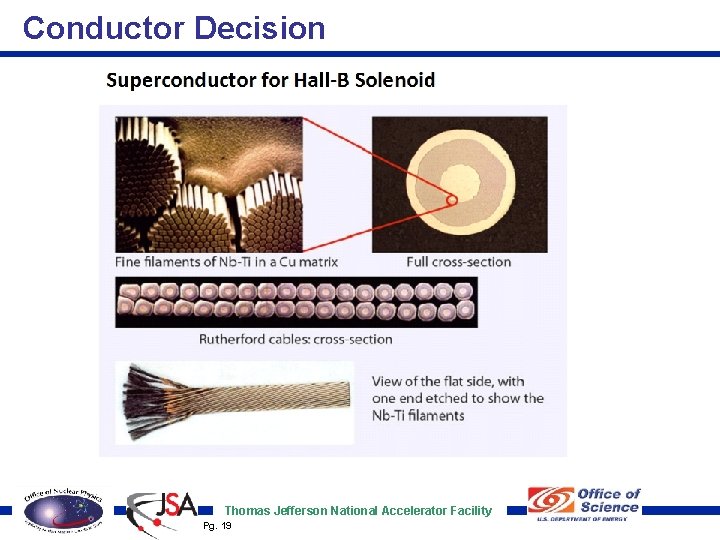
Conductor Decision Thomas Jefferson National Accelerator Facility Pg. 19
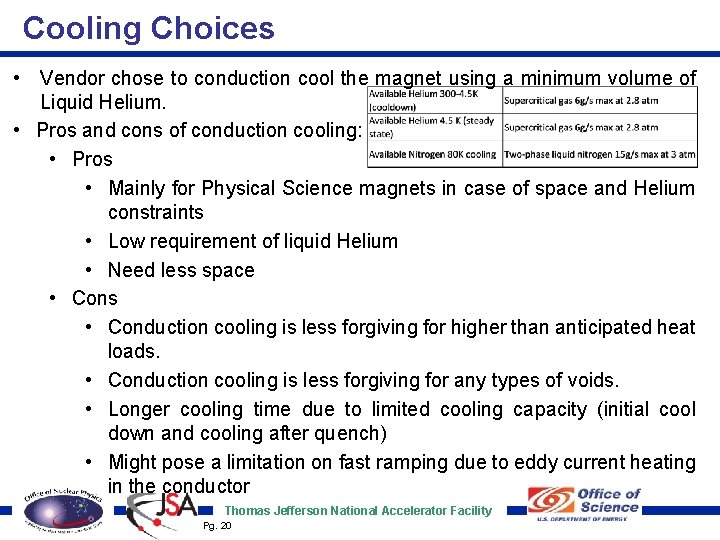
Cooling Choices • Vendor chose to conduction cool the magnet using a minimum volume of Liquid Helium. • Pros and cons of conduction cooling: • Pros • Mainly for Physical Science magnets in case of space and Helium constraints • Low requirement of liquid Helium • Need less space • Cons • Conduction cooling is less forgiving for higher than anticipated heat loads. • Conduction cooling is less forgiving for any types of voids. • Longer cooling time due to limited cooling capacity (initial cool down and cooling after quench) • Might pose a limitation on fast ramping due to eddy current heating in the conductor Thomas Jefferson National Accelerator Facility Pg. 20
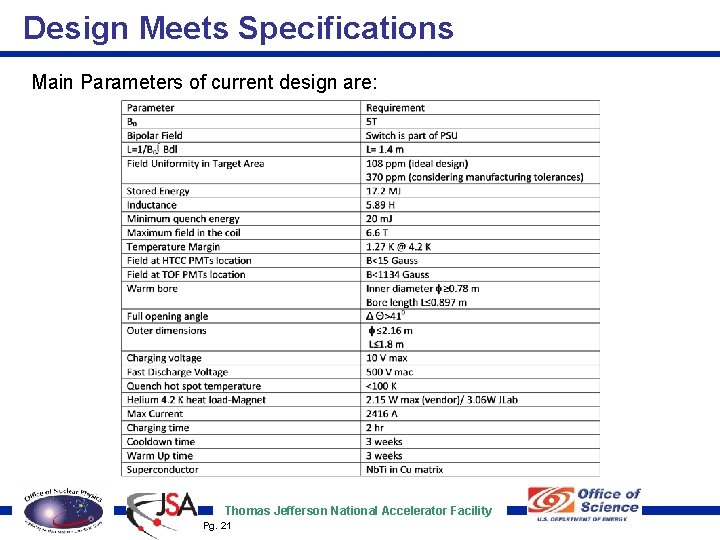
Design Meets Specifications Main Parameters of current design are: Thomas Jefferson National Accelerator Facility Pg. 21
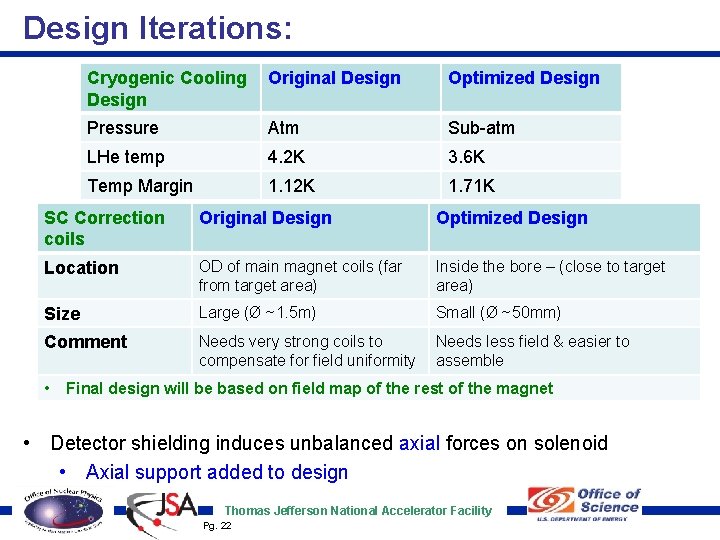
Design Iterations: Cryogenic Cooling Original Design Optimized Design Pressure Atm Sub-atm LHe temp 4. 2 K 3. 6 K Temp Margin 1. 12 K 1. 71 K SC Correction coils Original Design Optimized Design Location OD of main magnet coils (far from target area) Inside the bore – (close to target area) Size Large (Ø ~1. 5 m) Small (Ø ~50 mm) Comment Needs very strong coils to compensate for field uniformity Needs less field & easier to assemble • Final design will be based on field map of the rest of the magnet • Detector shielding induces unbalanced axial forces on solenoid • Axial support added to design Thomas Jefferson National Accelerator Facility Pg. 22
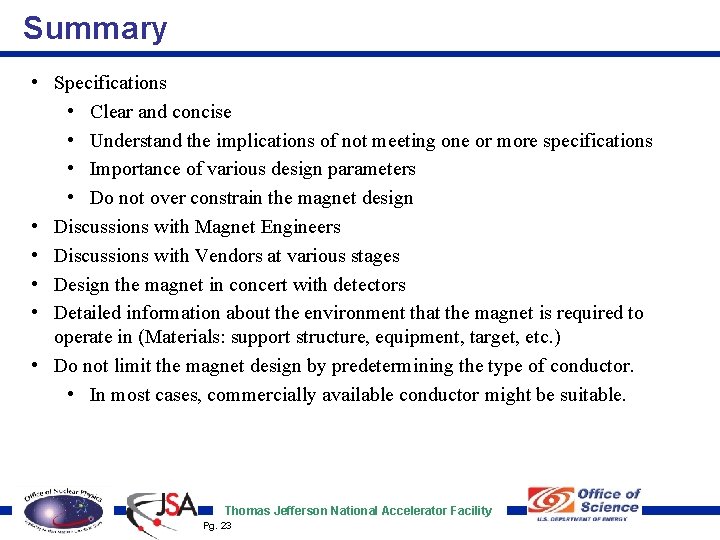
Summary • Specifications • Clear and concise • Understand the implications of not meeting one or more specifications • Importance of various design parameters • Do not over constrain the magnet design • Discussions with Magnet Engineers • Discussions with Vendors at various stages • Design the magnet in concert with detectors • Detailed information about the environment that the magnet is required to operate in (Materials: support structure, equipment, target, etc. ) • Do not limit the magnet design by predetermining the type of conductor. • In most cases, commercially available conductor might be suitable. Thomas Jefferson National Accelerator Facility Pg. 23
Back-up Slide Thomas Jefferson National Accelerator Facility Pg. 24
Abstract As part of the Jefferson Lab 12 Ge. V accelerator upgrade project, one of the experimental halls (Hall B) requires two superconducting magnets. One is a magnet system consisting of six superconducting trapezoidal racetracktype coils assembled in a toroidal configuration and the second is an actively shielded solenoidal magnet system consisting of 5 coils. In this presentation the physics requirements for the 5 T solenoid magnet, design constraints, conductor decision, and cooling choice will be discussed. The various design iterations to meet the specification will also be discussed in this presentation. Thomas Jefferson National Accelerator Facility Pg. 25
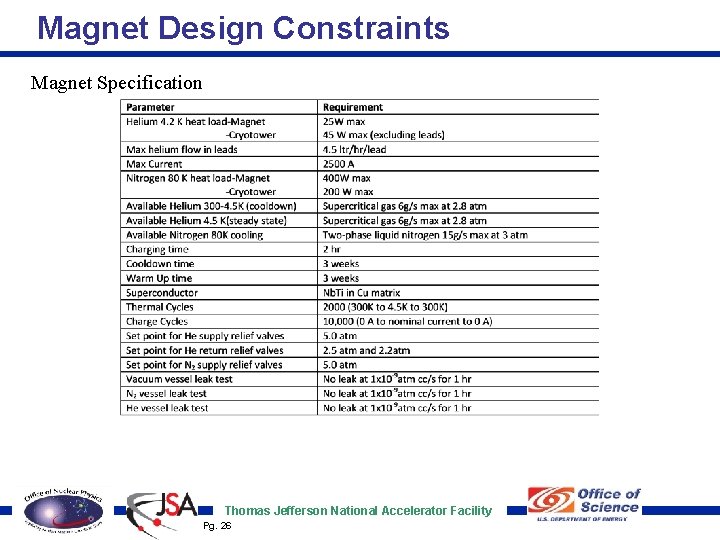
Magnet Design Constraints Magnet Specification Thomas Jefferson National Accelerator Facility Pg. 26
- Slides: 26