CHAPTER 9 Definitions A Solid Solution Consists of


- Slides: 37
CHAPTER 9: Definitions A. Solid Solution • Consists of atoms of at least 2 different types • Solute (minority) and Solvent (majority) • Substitutional vs. Interstitial • Components vs. System Components – pure metals or compounds that compose an alloy System – series of possible alloys of different composition
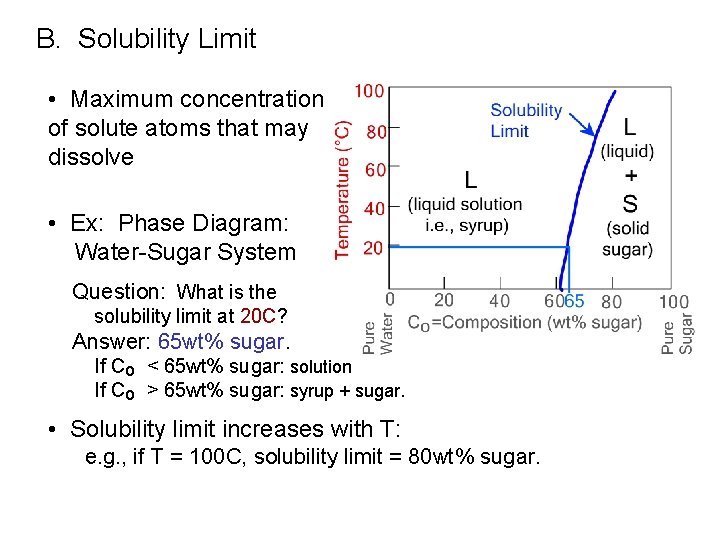
B. Solubility Limit • Maximum concentration of solute atoms that may dissolve • Ex: Phase Diagram: Water-Sugar System Question: What is the solubility limit at 20 C? Answer: 65 wt% sugar. If Co < 65 wt% sugar: solution If Co > 65 wt% sugar: syrup + sugar. • Solubility limit increases with T: e. g. , if T = 100 C, solubility limit = 80 wt% sugar.
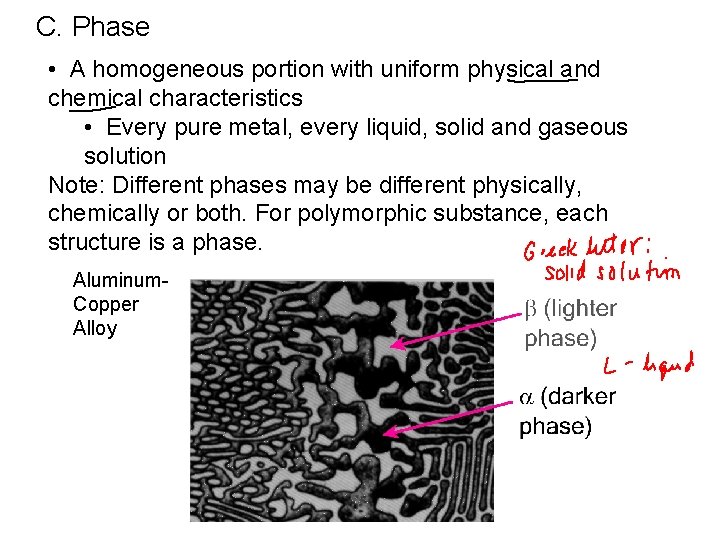
C. Phase • A homogeneous portion with uniform physical and chemical characteristics • Every pure metal, every liquid, solid and gaseous solution Note: Different phases may be different physically, chemically or both. For polymorphic substance, each structure is a phase. Aluminum. Copper Alloy
D. Equilibrium • At a specified condition (temperature, pressure and composition), free energy (internal energy & entropy) is minimum. E. Phase Equilibrium • Constant phase characteristics • In solids, rate of approach to equilibrium is extremely slow; sometimes take metastable state.
Equilibrium Phase Diagram • Represent relationship between temperature, and composition and quantities of phases at equilibrium. • Assume: – P is constant – Variables are T and composition – Only binary alloys (2 components)
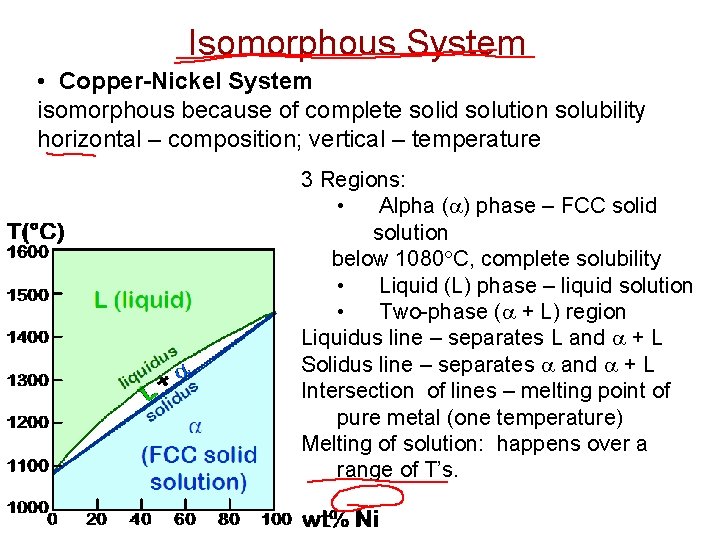
Isomorphous System • Copper-Nickel System isomorphous because of complete solid solution solubility horizontal – composition; vertical – temperature 3 Regions: • Alpha ( ) phase – FCC solid solution below 1080 C, complete solubility • Liquid (L) phase – liquid solution • Two-phase ( + L) region Liquidus line – separates L and + L Solidus line – separates and + L Intersection of lines – melting point of pure metal (one temperature) Melting of solution: happens over a range of T’s.
A. Finding phases present Given know T and Co, locate T-Co point on the graph. • Examples: A(60, 1100): 1 phase: B(35, 1250): 2 phases: L + Cu-Ni phase diagram
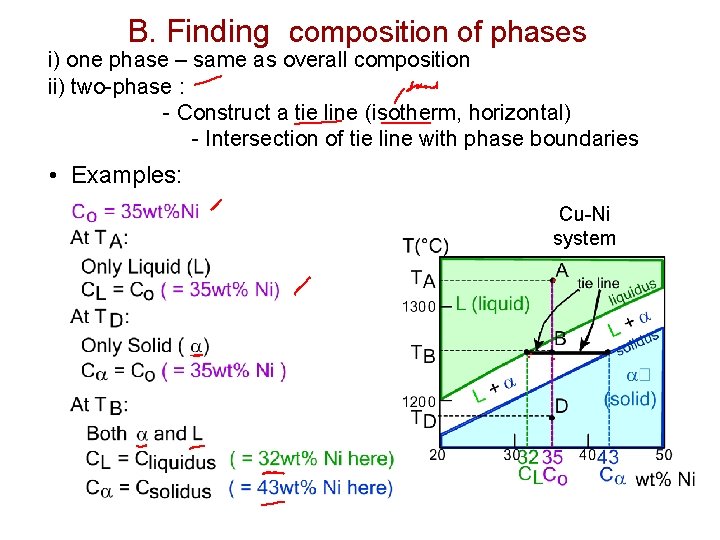
B. Finding composition of phases i) one phase – same as overall composition ii) two-phase : - Construct a tie line (isotherm, horizontal) - Intersection of tie line with phase boundaries • Examples: Cu-Ni system
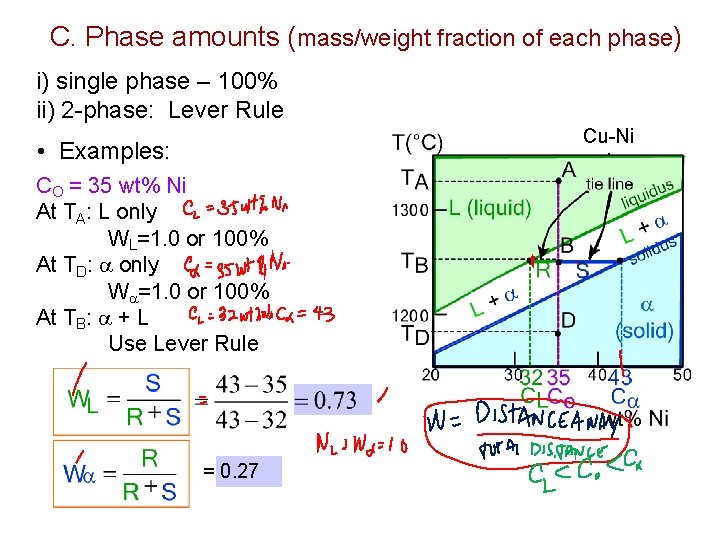
C. Phase amounts (mass/weight fraction of each phase) i) single phase – 100% ii) 2 -phase: Lever Rule Cu-Ni system • Examples: CO = 35 wt% Ni At TA: L only WL=1. 0 or 100% At TD: only W =1. 0 or 100% At TB: + L Use Lever Rule = 0. 27
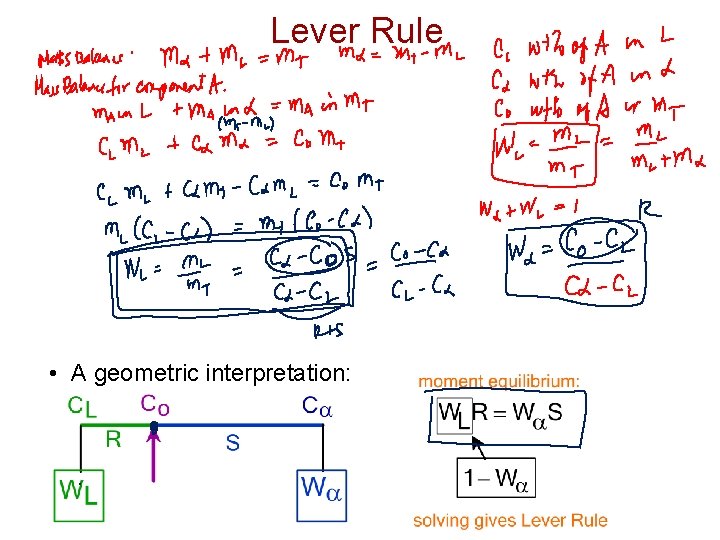
Lever Rule • A geometric interpretation:
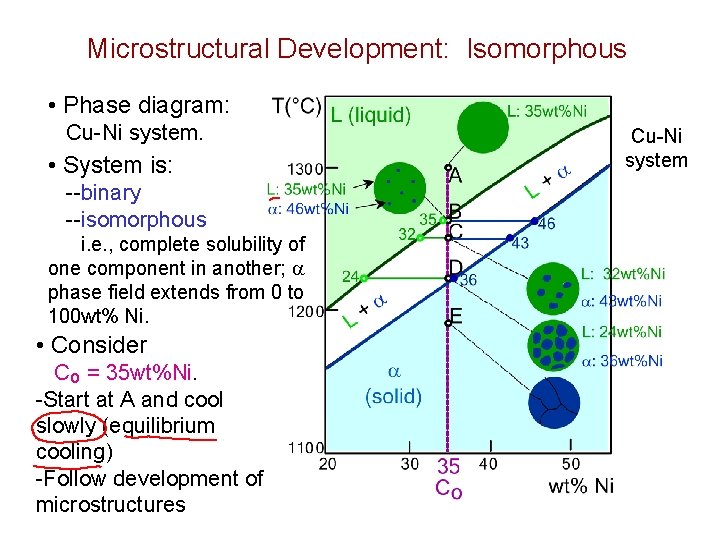
Microstructural Development: Isomorphous • Phase diagram: Cu-Ni system. • System is: --binary --isomorphous i. e. , complete solubility of one component in another; phase field extends from 0 to 100 wt% Ni. • Consider Co = 35 wt%Ni. -Start at A and cool slowly (equilibrium cooling) -Follow development of microstructures Cu-Ni system
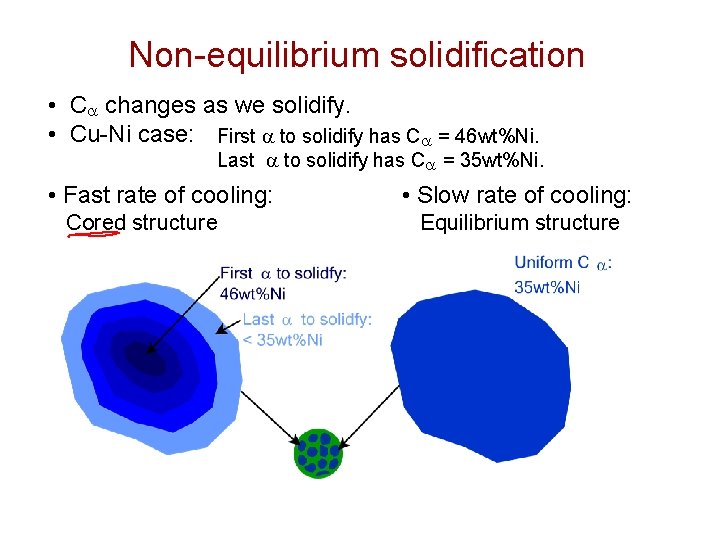
Non-equilibrium solidification • C changes as we solidify. • Cu-Ni case: First to solidify has C = 46 wt%Ni. Last to solidify has C = 35 wt%Ni. • Fast rate of cooling: • Slow rate of cooling: Cored structure Equilibrium structure
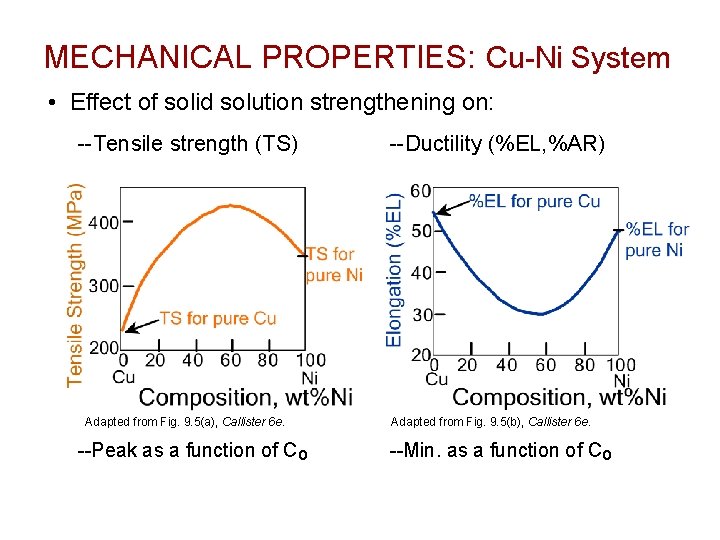
MECHANICAL PROPERTIES: Cu-Ni System • Effect of solid solution strengthening on: --Tensile strength (TS) Adapted from Fig. 9. 5(a), Callister 6 e. --Peak as a function of Co --Ductility (%EL, %AR) Adapted from Fig. 9. 5(b), Callister 6 e. --Min. as a function of Co
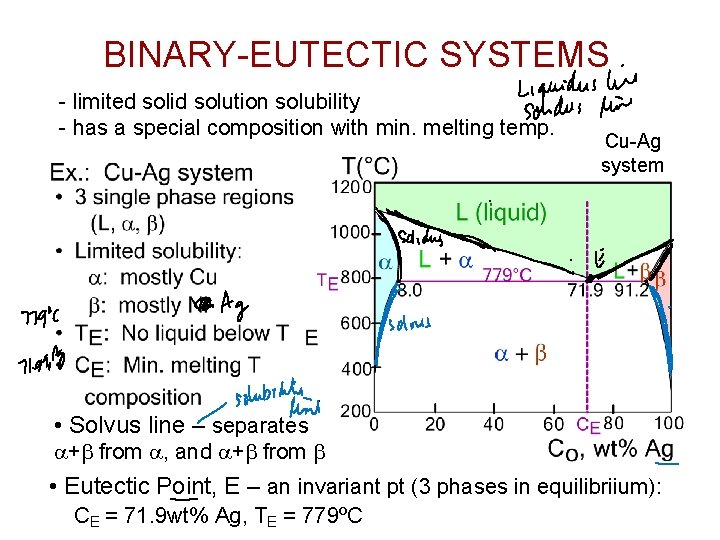
BINARY-EUTECTIC SYSTEMS - limited solid solution solubility - has a special composition with min. melting temp. Cu-Ag system • Solvus line – separates + from , and + from • Eutectic Point, E – an invariant pt (3 phases in equilibriium): CE = 71. 9 wt% Ag, TE = 779ºC
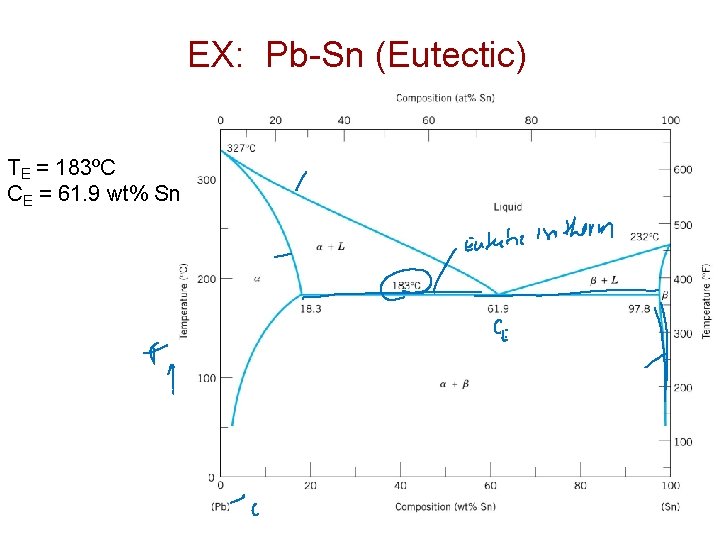
EX: Pb-Sn (Eutectic) TE = 183ºC CE = 61. 9 wt% Sn
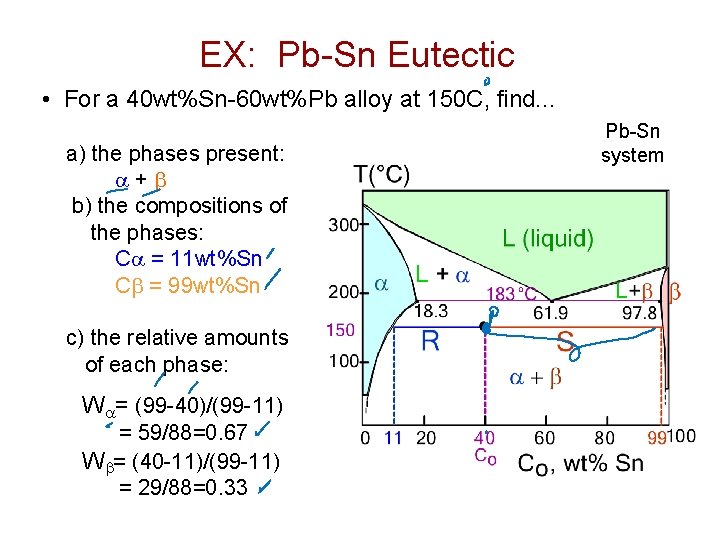
EX: Pb-Sn Eutectic • For a 40 wt%Sn-60 wt%Pb alloy at 150 C, find. . . a) the phases present: + b) the compositions of the phases: C = 11 wt%Sn C = 99 wt%Sn c) the relative amounts of each phase: W = (99 -40)/(99 -11) = 59/88=0. 67 W = (40 -11)/(99 -11) = 29/88=0. 33 Pb-Sn system
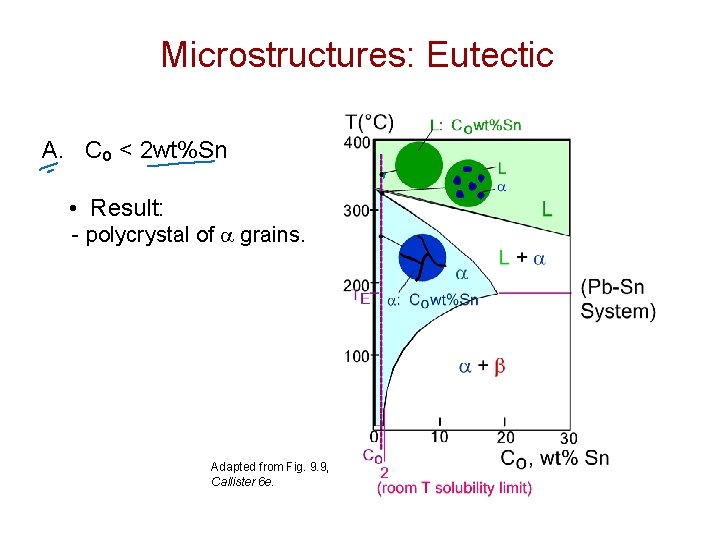
Microstructures: Eutectic A. Co < 2 wt%Sn • Result: - polycrystal of grains. Adapted from Fig. 9. 9, Callister 6 e.
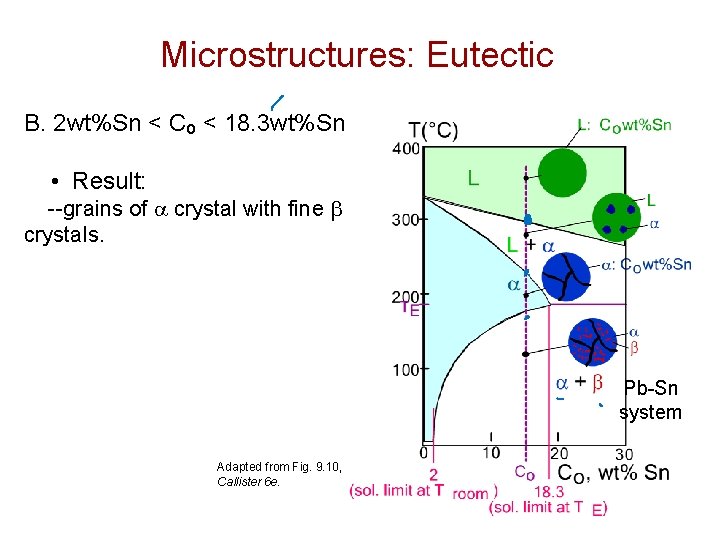
Microstructures: Eutectic B. 2 wt%Sn < Co < 18. 3 wt%Sn • Result: --grains of crystal with fine crystals. Pb-Sn system Adapted from Fig. 9. 10, Callister 6 e.
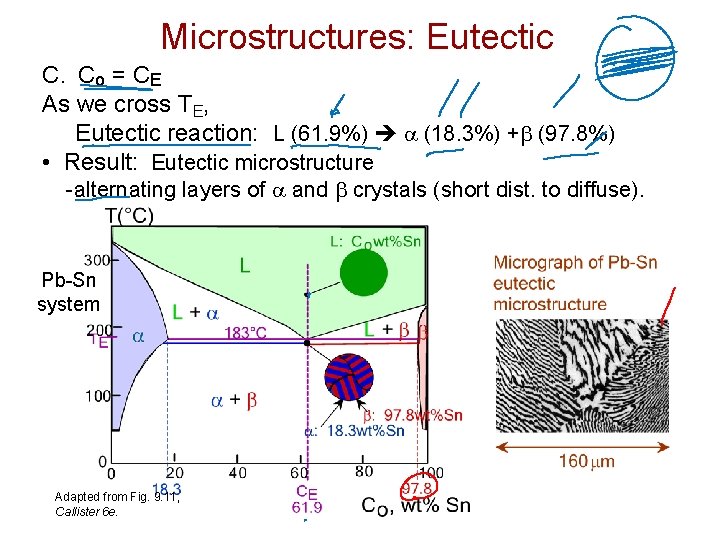
Microstructures: Eutectic C. Co = CE As we cross TE, Eutectic reaction: L (61. 9%) (18. 3%) + (97. 8%) • Result: Eutectic microstructure -alternating layers of and crystals (short dist. to diffuse). Pb-Sn system Adapted from Fig. 9. 11, Callister 6 e.
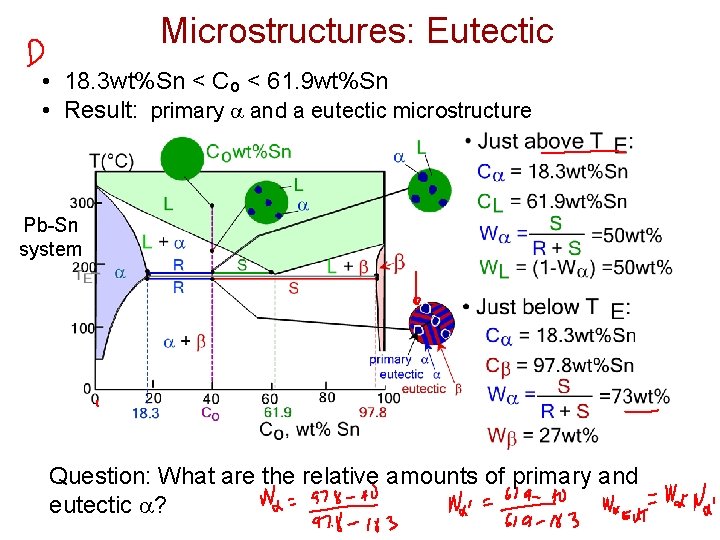
Microstructures: Eutectic • 18. 3 wt%Sn < Co < 61. 9 wt%Sn • Result: primary and a eutectic microstructure Pb-Sn system Question: What are the relative amounts of primary and eutectic ?
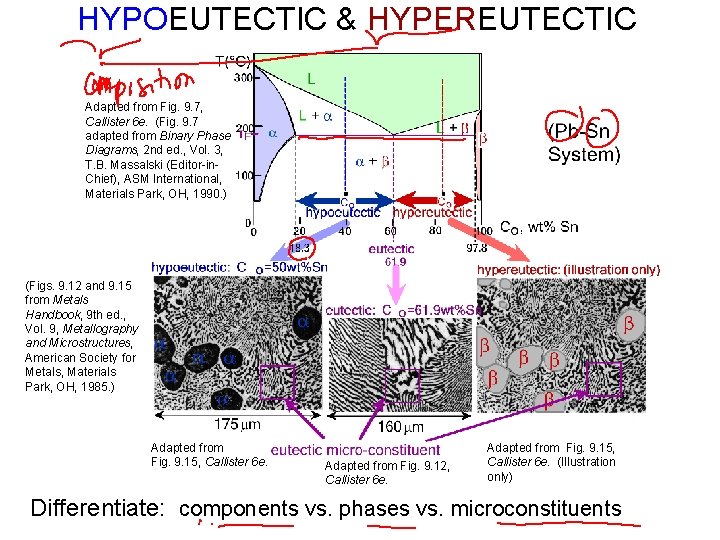
HYPOEUTECTIC & HYPEREUTECTIC Adapted from Fig. 9. 7, Callister 6 e. (Fig. 9. 7 adapted from Binary Phase Diagrams, 2 nd ed. , Vol. 3, T. B. Massalski (Editor-in. Chief), ASM International, Materials Park, OH, 1990. ) (Figs. 9. 12 and 9. 15 from Metals Handbook, 9 th ed. , Vol. 9, Metallography and Microstructures, American Society for Metals, Materials Park, OH, 1985. ) Adapted from Fig. 9. 15, Callister 6 e. Adapted from Fig. 9. 12, Callister 6 e. Adapted from Fig. 9. 15, Callister 6 e. (Illustration only) Differentiate: components vs. phases vs. microconstituents
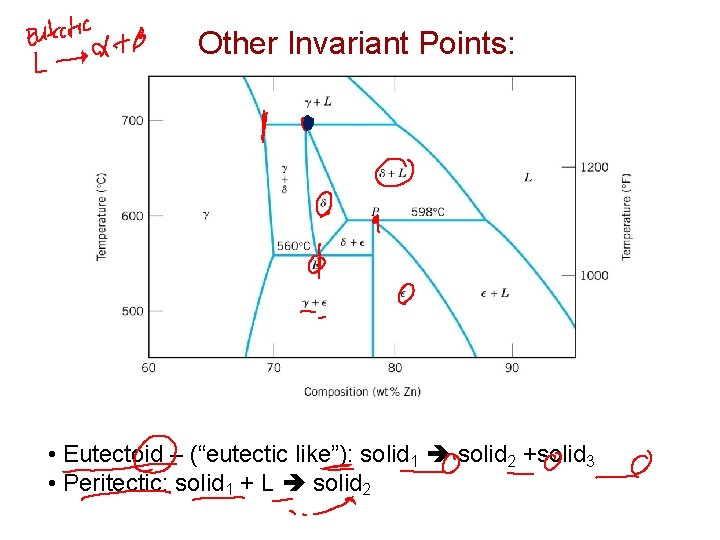
Other Invariant Points: • Eutectoid – (“eutectic like”): solid 1 solid 2 +solid 3 • Peritectic: solid 1 + L solid 2
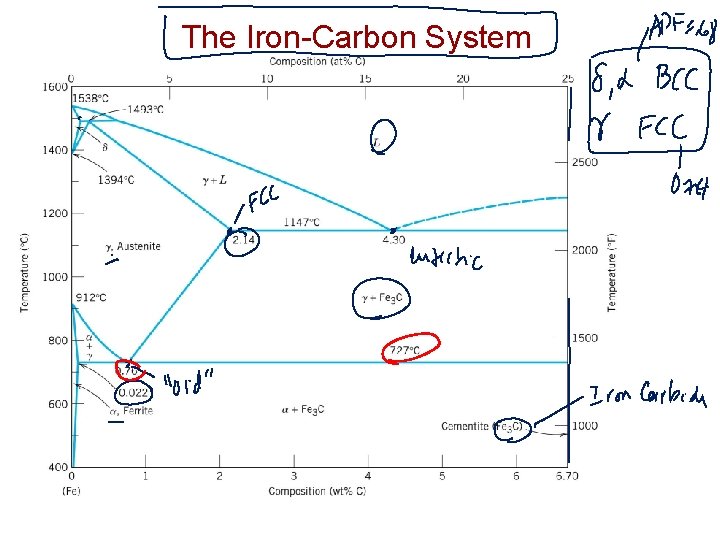
The Iron-Carbon System
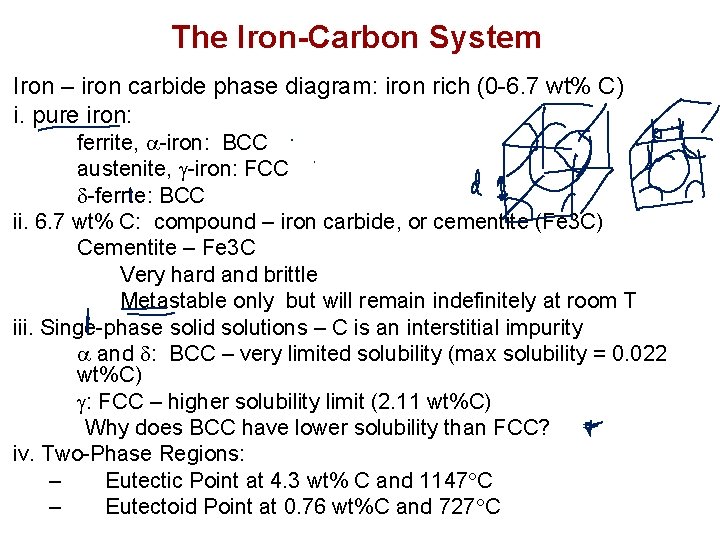
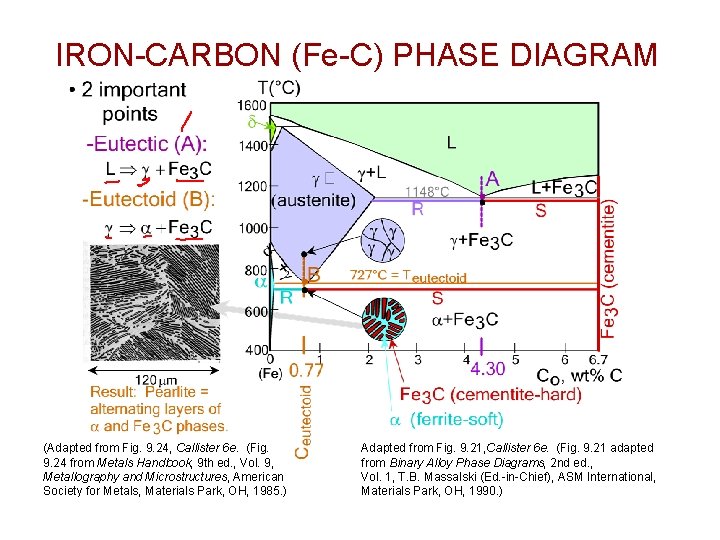
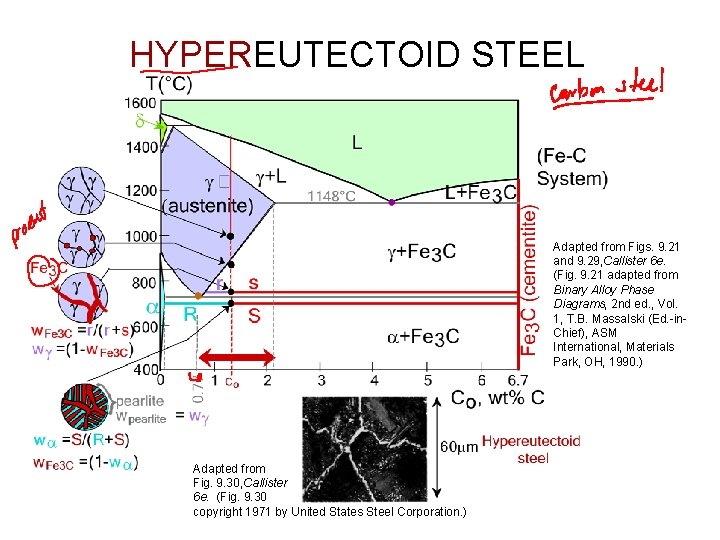
The Iron-Carbon System Iron – iron carbide phase diagram: iron rich (0 -6. 7 wt% C) i. pure iron: ferrite, -iron: BCC austenite, -iron: FCC -ferrte: BCC ii. 6. 7 wt% C: compound – iron carbide, or cementite (Fe 3 C) Cementite – Fe 3 C Very hard and brittle Metastable only but will remain indefinitely at room T iii. Singe-phase solid solutions – C is an interstitial impurity and : BCC – very limited solubility (max solubility = 0. 022 wt%C) : FCC – higher solubility limit (2. 11 wt%C) Why does BCC have lower solubility than FCC? iv. Two-Phase Regions: – Eutectic Point at 4. 3 wt% C and 1147 C – Eutectoid Point at 0. 76 wt%C and 727 C
IRON-CARBON (Fe-C) PHASE DIAGRAM (Adapted from Fig. 9. 24, Callister 6 e. (Fig. 9. 24 from Metals Handbook, 9 th ed. , Vol. 9, Metallography and Microstructures, American Society for Metals, Materials Park, OH, 1985. ) Adapted from Fig. 9. 21, Callister 6 e. (Fig. 9. 21 adapted from Binary Alloy Phase Diagrams, 2 nd ed. , Vol. 1, T. B. Massalski (Ed. -in-Chief), ASM International, Materials Park, OH, 1990. )
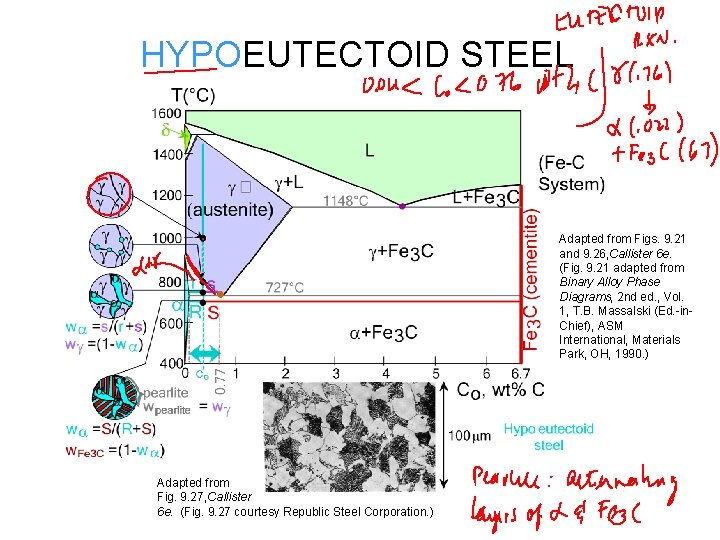
HYPOEUTECTOID STEEL Adapted from Figs. 9. 21 and 9. 26, Callister 6 e. (Fig. 9. 21 adapted from Binary Alloy Phase Diagrams, 2 nd ed. , Vol. 1, T. B. Massalski (Ed. -in. Chief), ASM International, Materials Park, OH, 1990. ) Adapted from Fig. 9. 27, Callister 6 e. (Fig. 9. 27 courtesy Republic Steel Corporation. )
HYPEREUTECTOID STEEL Adapted from Figs. 9. 21 and 9. 29, Callister 6 e. (Fig. 9. 21 adapted from Binary Alloy Phase Diagrams, 2 nd ed. , Vol. 1, T. B. Massalski (Ed. -in. Chief), ASM International, Materials Park, OH, 1990. ) Adapted from Fig. 9. 30, Callister 6 e. (Fig. 9. 30 copyright 1971 by United States Steel Corporation. )
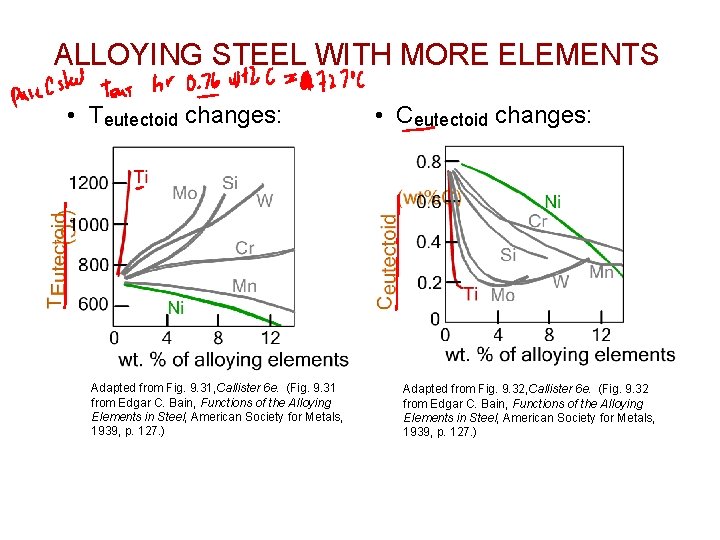
ALLOYING STEEL WITH MORE ELEMENTS • Teutectoid changes: Adapted from Fig. 9. 31, Callister 6 e. (Fig. 9. 31 from Edgar C. Bain, Functions of the Alloying Elements in Steel, American Society for Metals, 1939, p. 127. ) • Ceutectoid changes: Adapted from Fig. 9. 32, Callister 6 e. (Fig. 9. 32 from Edgar C. Bain, Functions of the Alloying Elements in Steel, American Society for Metals, 1939, p. 127. )
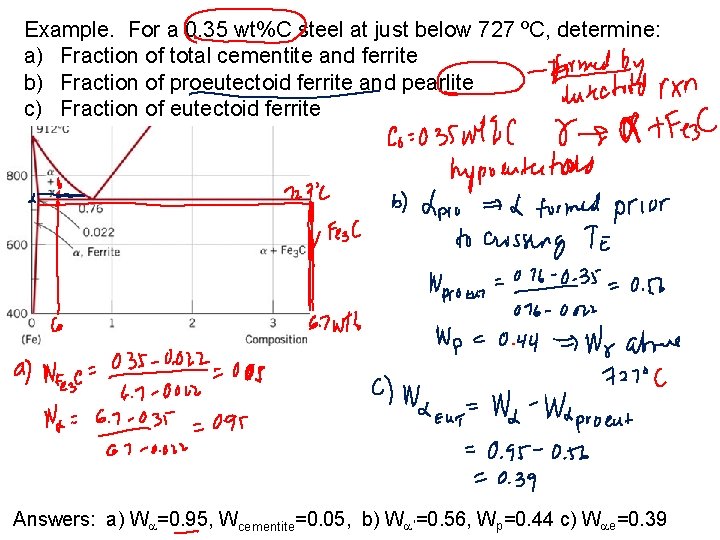
Example. For a 0. 35 wt%C steel at just below 727 ºC, determine: a) Fraction of total cementite and ferrite b) Fraction of proeutectoid ferrite and pearlite c) Fraction of eutectoid ferrite Answers: a) W =0. 95, Wcementite=0. 05, b) W ’=0. 56, Wp=0. 44 c) W e=0. 39
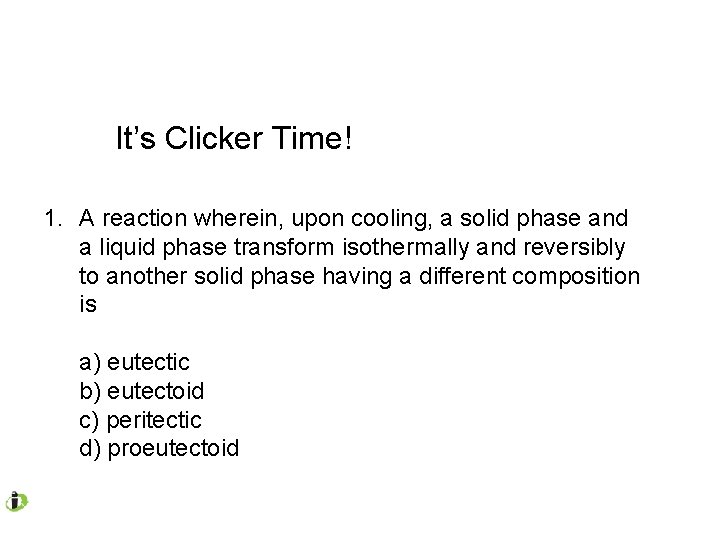
It’s Clicker Time! 1. A reaction wherein, upon cooling, a solid phase and a liquid phase transform isothermally and reversibly to another solid phase having a different composition is a) eutectic b) eutectoid c) peritectic d) proeutectoid
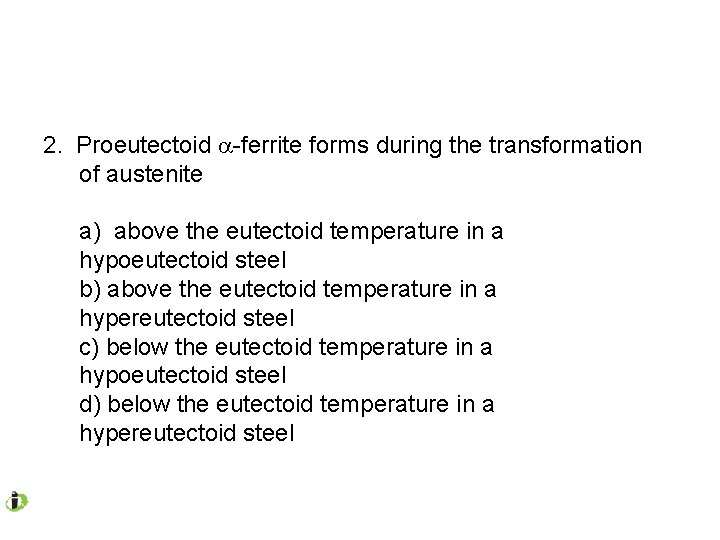
2. Proeutectoid -ferrite forms during the transformation of austenite a) above the eutectoid temperature in a hypoeutectoid steel b) above the eutectoid temperature in a hypereutectoid steel c) below the eutectoid temperature in a hypoeutectoid steel d) below the eutectoid temperature in a hypereutectoid steel
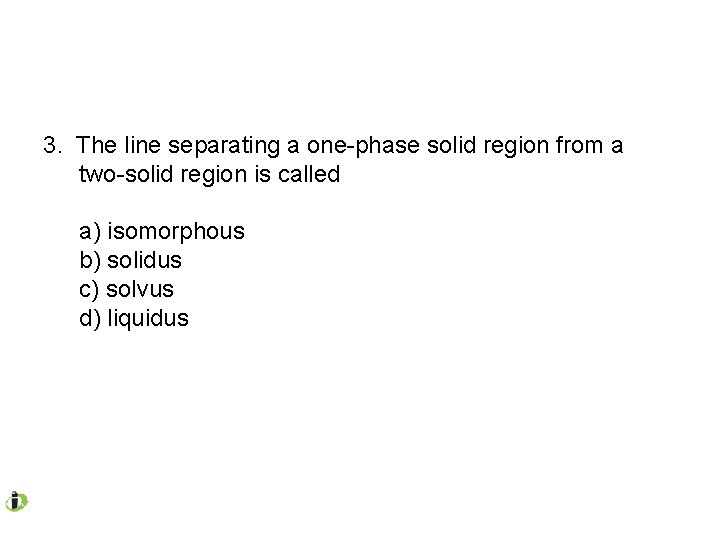
3. The line separating a one-phase solid region from a two-solid region is called a) isomorphous b) solidus c) solvus d) liquidus
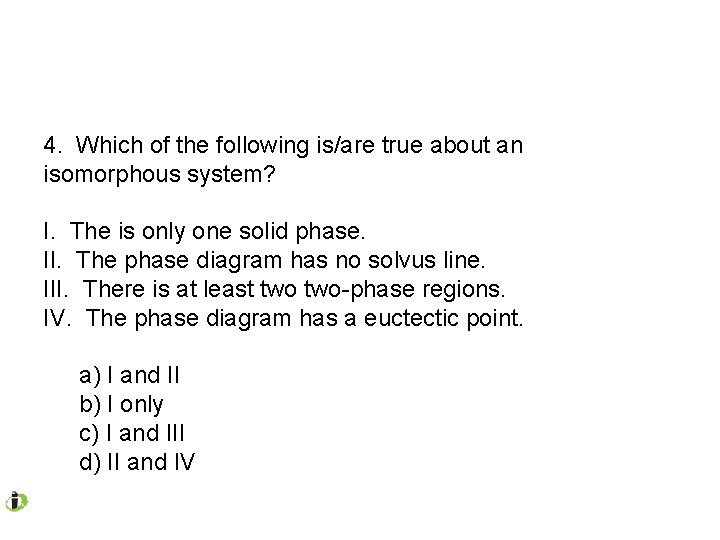
4. Which of the following is/are true about an isomorphous system? I. The is only one solid phase. II. The phase diagram has no solvus line. III. There is at least two-phase regions. IV. The phase diagram has a euctectic point. a) I and II b) I only c) I and III d) II and IV
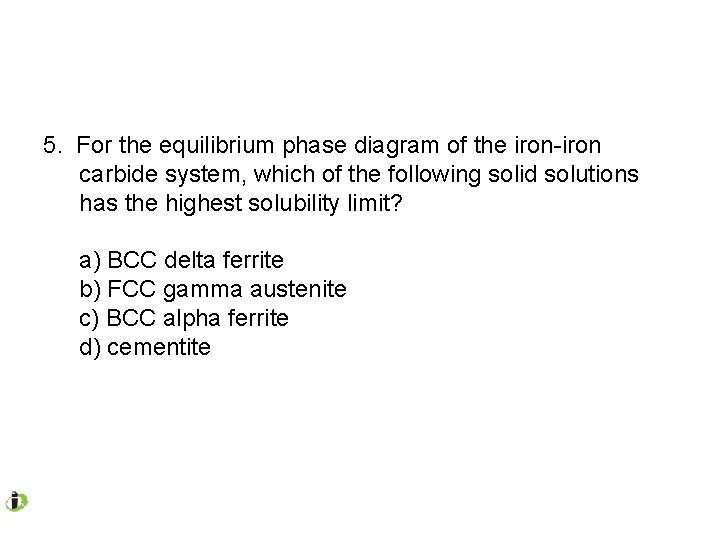
5. For the equilibrium phase diagram of the iron-iron carbide system, which of the following solid solutions has the highest solubility limit? a) BCC delta ferrite b) FCC gamma austenite c) BCC alpha ferrite d) cementite
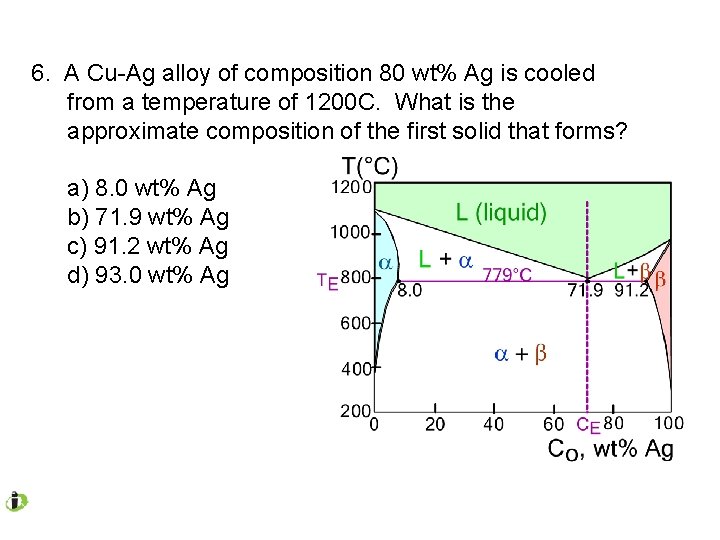
6. A Cu-Ag alloy of composition 80 wt% Ag is cooled from a temperature of 1200 C. What is the approximate composition of the first solid that forms? a) 8. 0 wt% Ag b) 71. 9 wt% Ag c) 91. 2 wt% Ag d) 93. 0 wt% Ag
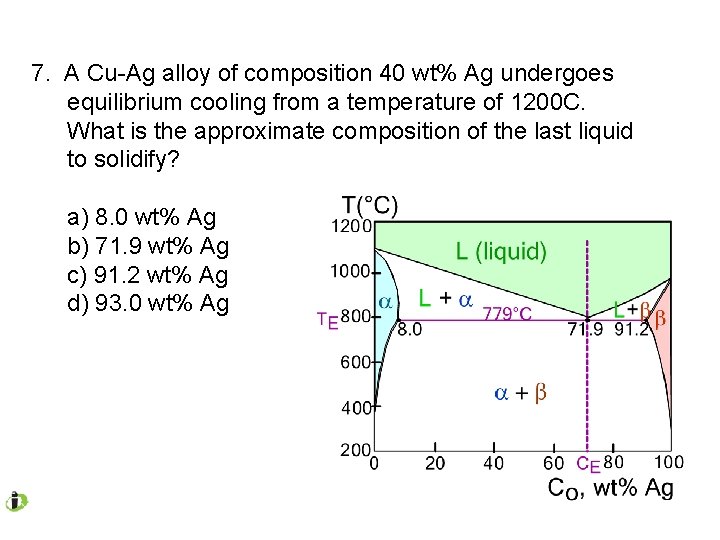
7. A Cu-Ag alloy of composition 40 wt% Ag undergoes equilibrium cooling from a temperature of 1200 C. What is the approximate composition of the last liquid to solidify? a) 8. 0 wt% Ag b) 71. 9 wt% Ag c) 91. 2 wt% Ag d) 93. 0 wt% Ag
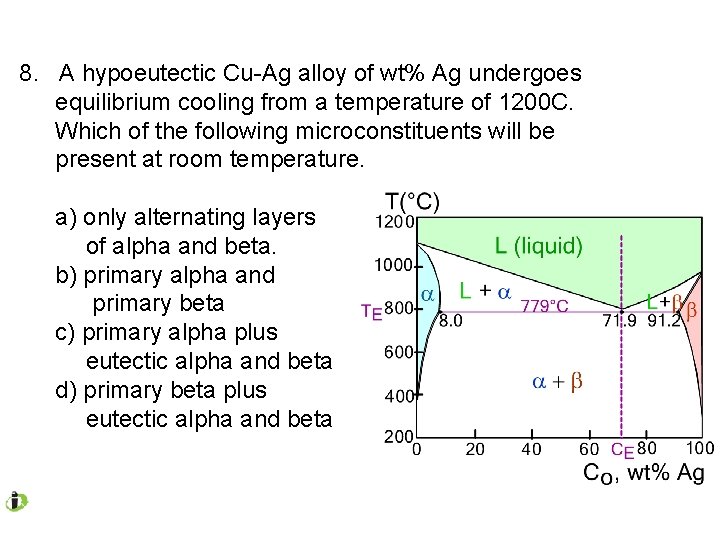
8. A hypoeutectic Cu-Ag alloy of wt% Ag undergoes equilibrium cooling from a temperature of 1200 C. Which of the following microconstituents will be present at room temperature. a) only alternating layers of alpha and beta. b) primary alpha and primary beta c) primary alpha plus eutectic alpha and beta d) primary beta plus eutectic alpha and beta