Chapter 30 Inductance Electromagnetic Oscillations and AC Circuits

- Slides: 68
Chapter 30 Inductance, Electromagnetic Oscillations, and AC Circuits Copyright © 2009 Pearson Education, Inc.
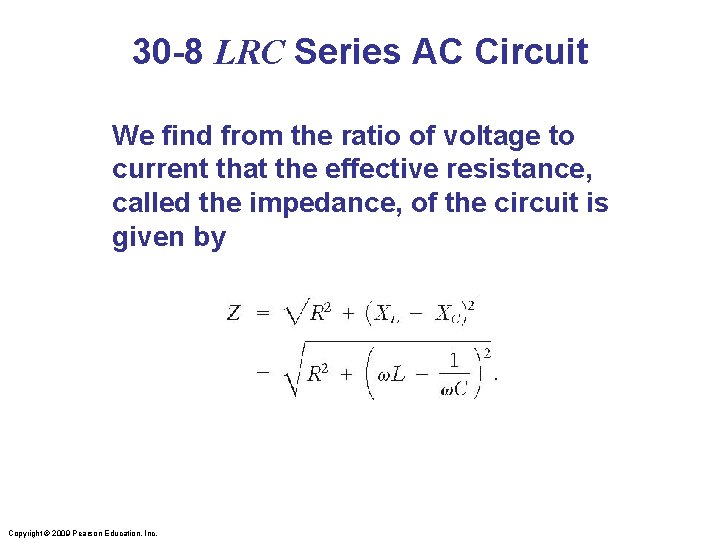
30 -8 LRC Series AC Circuit We find from the ratio of voltage to current that the effective resistance, called the impedance, of the circuit is given by Copyright © 2009 Pearson Education, Inc.
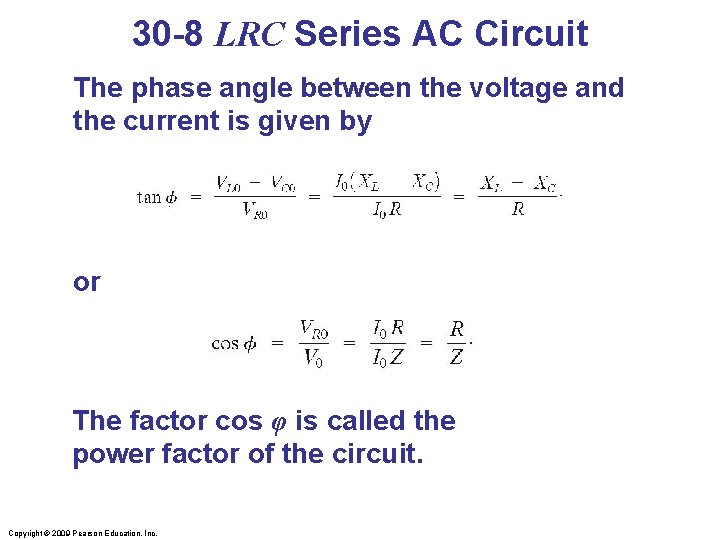
30 -8 LRC Series AC Circuit The phase angle between the voltage and the current is given by or The factor cos φ is called the power factor of the circuit. Copyright © 2009 Pearson Education, Inc.
30 -8 LRC Series AC Circuit Example 30 -11: LRC circuit. Suppose R = 25. 0 Ω, L = 30. 0 m. H, and C = 12. 0 μF, and they are connected in series to a 90. 0 -V ac (rms) 500 -Hz source. Calculate (a) the current in the circuit, (b) the voltmeter readings (rms) across each element, (c) the phase angle , and (d) the power dissipated in the circuit. Copyright © 2009 Pearson Education, Inc.
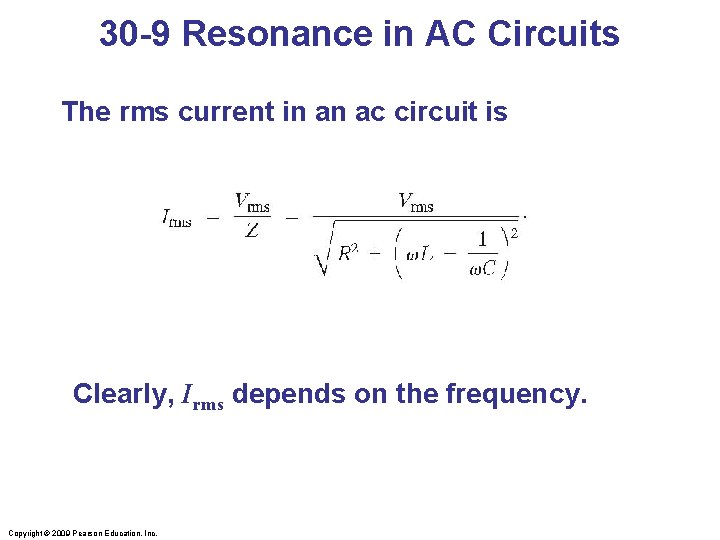
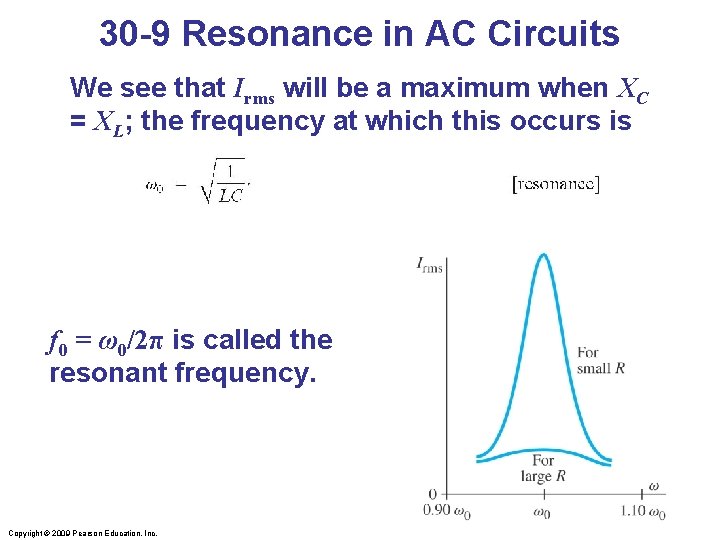
30 -9 Resonance in AC Circuits The rms current in an ac circuit is Clearly, Irms depends on the frequency. Copyright © 2009 Pearson Education, Inc.
30 -9 Resonance in AC Circuits We see that Irms will be a maximum when XC = XL; the frequency at which this occurs is f 0 = ω0/2π is called the resonant frequency. Copyright © 2009 Pearson Education, Inc.
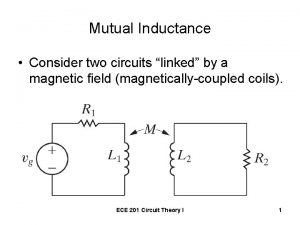
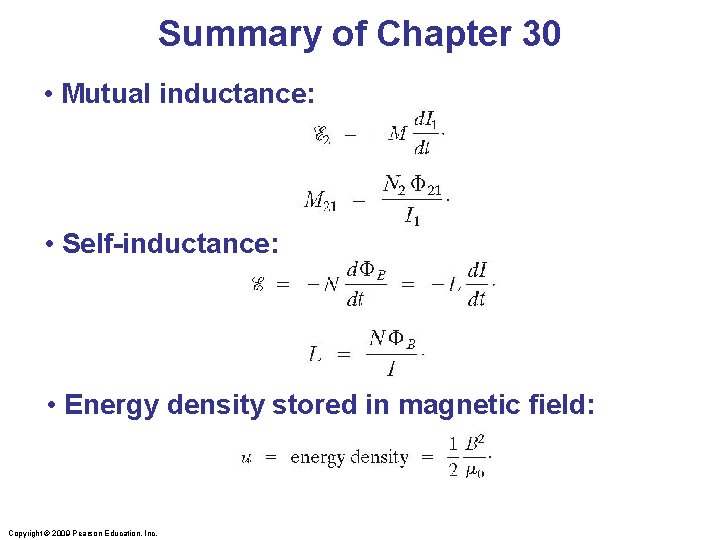
Summary of Chapter 30 • Mutual inductance: • Self-inductance: • Energy density stored in magnetic field: Copyright © 2009 Pearson Education, Inc.
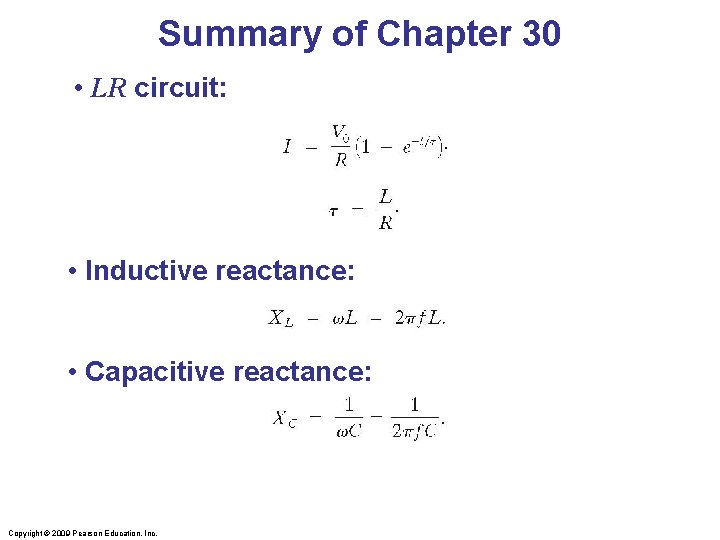
Summary of Chapter 30 • LR circuit: . . • Inductive reactance: • Capacitive reactance: Copyright © 2009 Pearson Education, Inc.
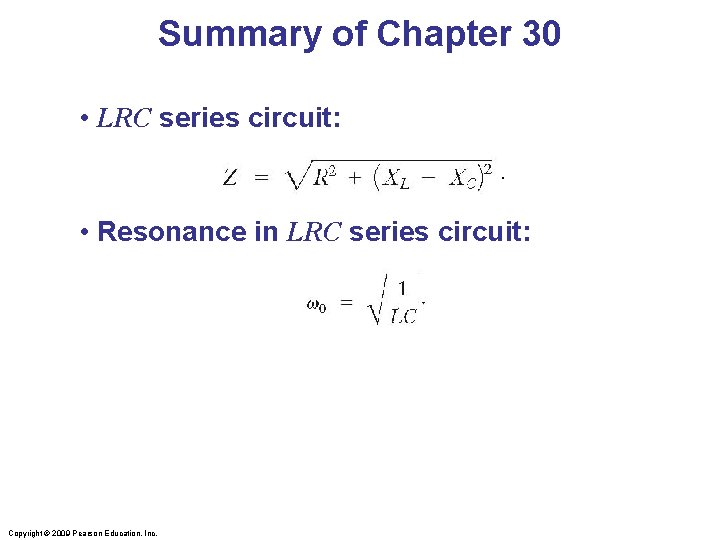
Summary of Chapter 30 • LRC series circuit: . • Resonance in LRC series circuit: Copyright © 2009 Pearson Education, Inc.
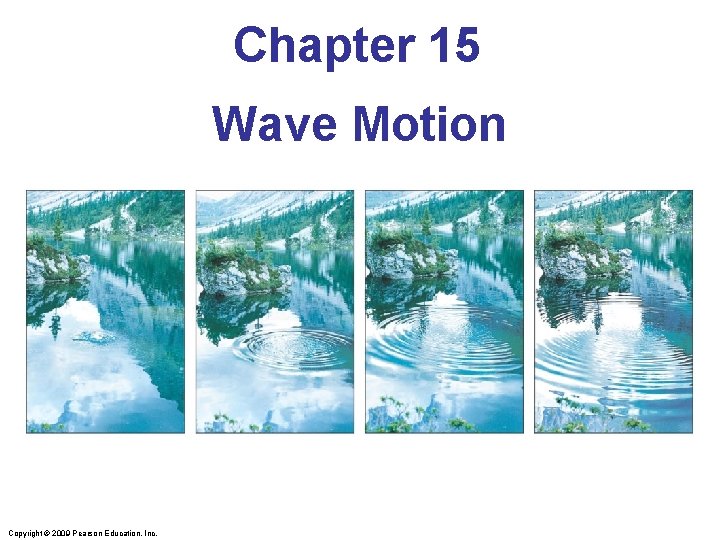
Chapter 15 Wave Motion Copyright © 2009 Pearson Education, Inc.
Units of Chapter 15 • Characteristics of Wave Motion • Types of Waves: Transverse and Longitudinal • Energy Transported by Waves • Mathematical Representation of a Traveling Wave • The Wave Equation • The Principle of Superposition • Reflection and Transmission Copyright © 2009 Pearson Education, Inc.
Units of Chapter 15 • Interference • Standing Waves; Resonance • Refraction • Diffraction Copyright © 2009 Pearson Education, Inc.
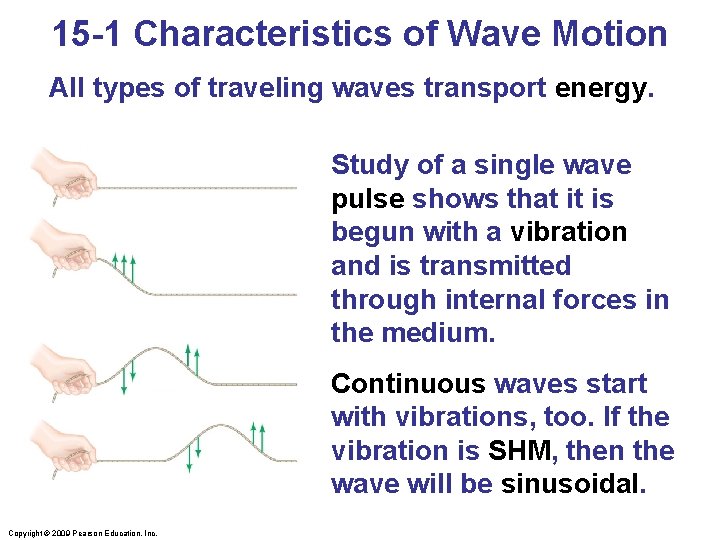
15 -1 Characteristics of Wave Motion All types of traveling waves transport energy. Study of a single wave pulse shows that it is begun with a vibration and is transmitted through internal forces in the medium. Continuous waves start with vibrations, too. If the vibration is SHM, then the wave will be sinusoidal. Copyright © 2009 Pearson Education, Inc.
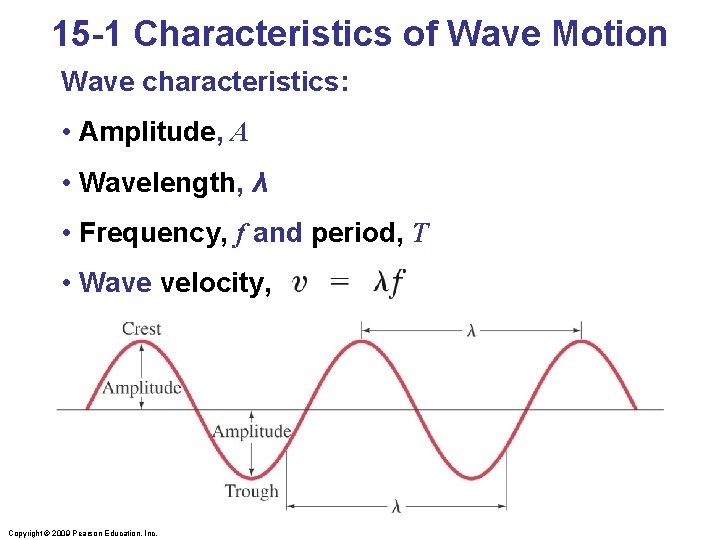
15 -1 Characteristics of Wave Motion Wave characteristics: • Amplitude, A • Wavelength, λ • Frequency, f and period, T • Wave velocity, Copyright © 2009 Pearson Education, Inc.
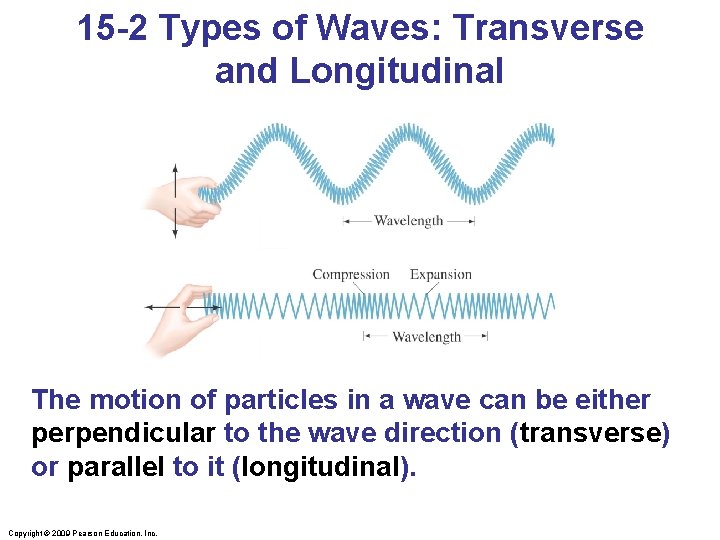
15 -2 Types of Waves: Transverse and Longitudinal The motion of particles in a wave can be either perpendicular to the wave direction (transverse) or parallel to it (longitudinal). Copyright © 2009 Pearson Education, Inc.
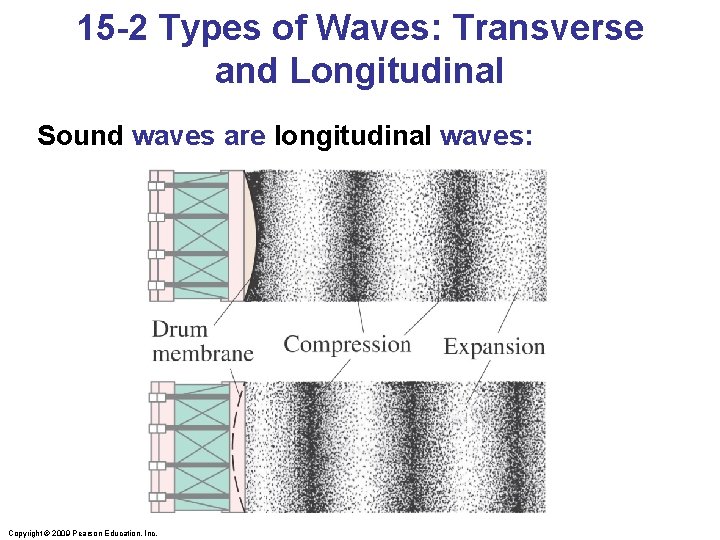
15 -2 Types of Waves: Transverse and Longitudinal Sound waves are longitudinal waves: Copyright © 2009 Pearson Education, Inc.
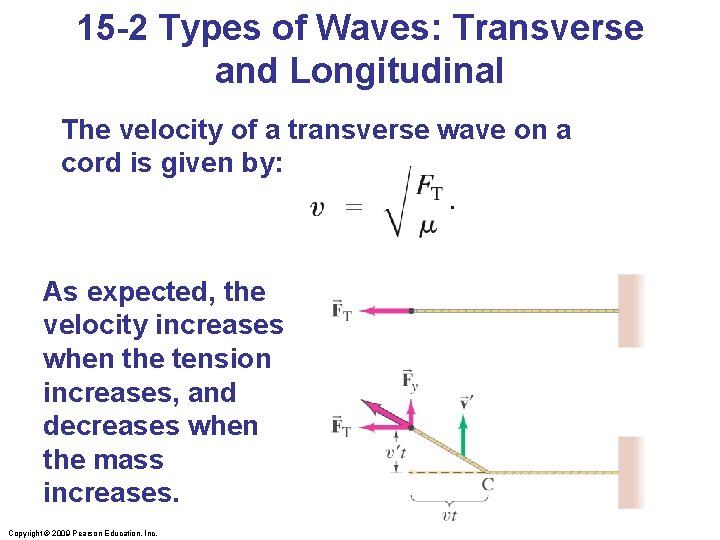
15 -2 Types of Waves: Transverse and Longitudinal The velocity of a transverse wave on a cord is given by: As expected, the velocity increases when the tension increases, and decreases when the mass increases. Copyright © 2009 Pearson Education, Inc.
15 -2 Types of Waves: Transverse and Longitudinal Example 15 -2: Pulse on a wire. An 80. 0 -m-long, 2. 10 -mm-diameter copper wire is stretched between two poles. A bird lands at the center point of the wire, sending a small wave pulse out in both directions. The pulses reflect at the ends and arrive back at the bird’s location 0. 750 seconds after it landed. Determine the tension in the wire. Copyright © 2009 Pearson Education, Inc.
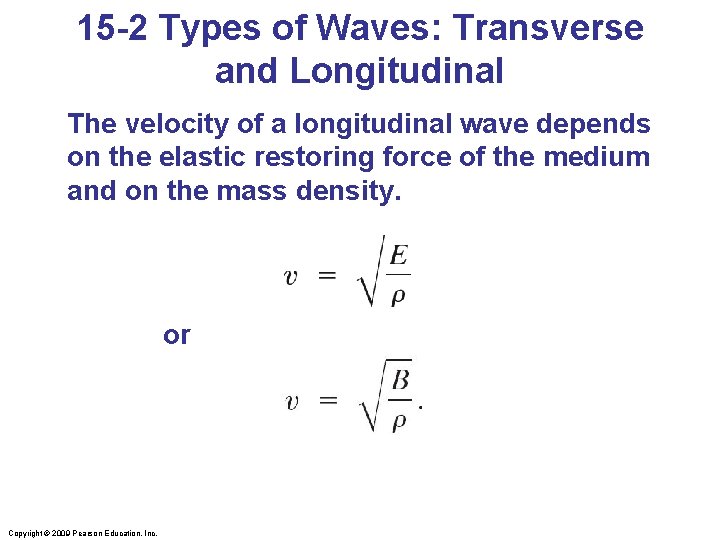
15 -2 Types of Waves: Transverse and Longitudinal The velocity of a longitudinal wave depends on the elastic restoring force of the medium and on the mass density. or Copyright © 2009 Pearson Education, Inc.
15 -2 Types of Waves: Transverse and Longitudinal Example 15 -3: Echolocation is a form of sensory perception used by animals such as bats, toothed whales, and dolphins. The animal emits a pulse of sound (a longitudinal wave) which, after reflection from objects, returns and is detected by the animal. Echolocation waves can have frequencies of about 100, 000 Hz. (a) Estimate the wavelength of a sea animal’s echolocation wave. (b) If an obstacle is 100 m from the animal, how long after the animal emits a wave is its reflection detected? Copyright © 2009 Pearson Education, Inc.
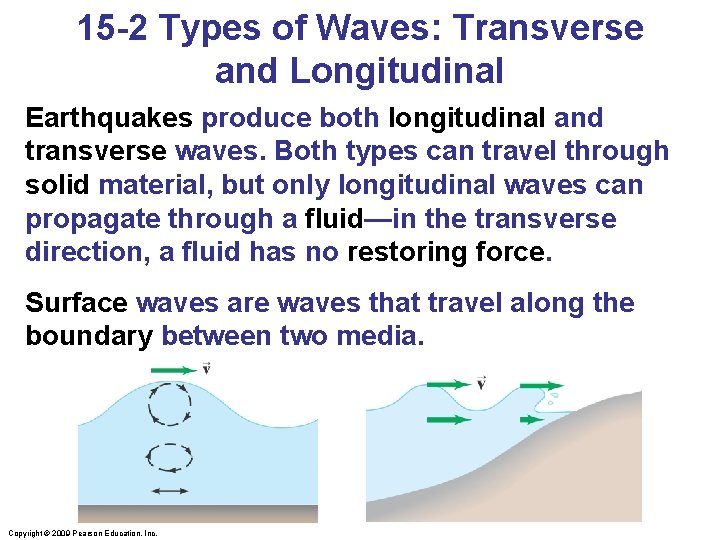
15 -2 Types of Waves: Transverse and Longitudinal Earthquakes produce both longitudinal and transverse waves. Both types can travel through solid material, but only longitudinal waves can propagate through a fluid—in the transverse direction, a fluid has no restoring force. Surface waves are waves that travel along the boundary between two media. Copyright © 2009 Pearson Education, Inc.
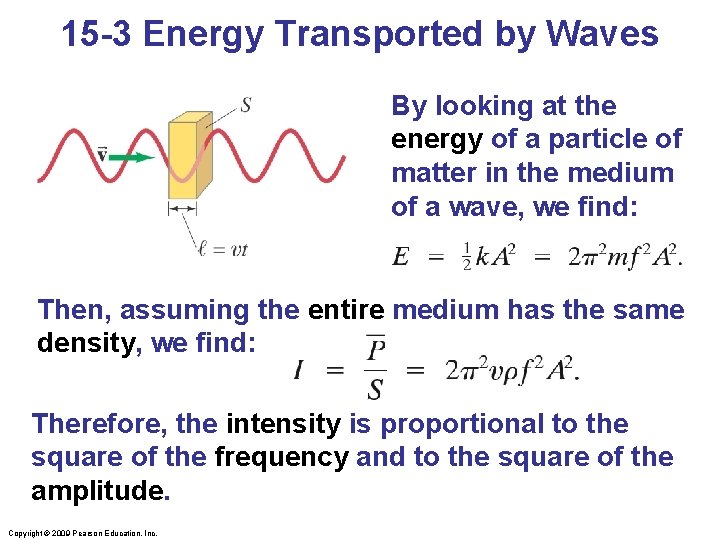
15 -3 Energy Transported by Waves By looking at the energy of a particle of matter in the medium of a wave, we find: Then, assuming the entire medium has the same density, we find: Therefore, the intensity is proportional to the square of the frequency and to the square of the amplitude. Copyright © 2009 Pearson Education, Inc.
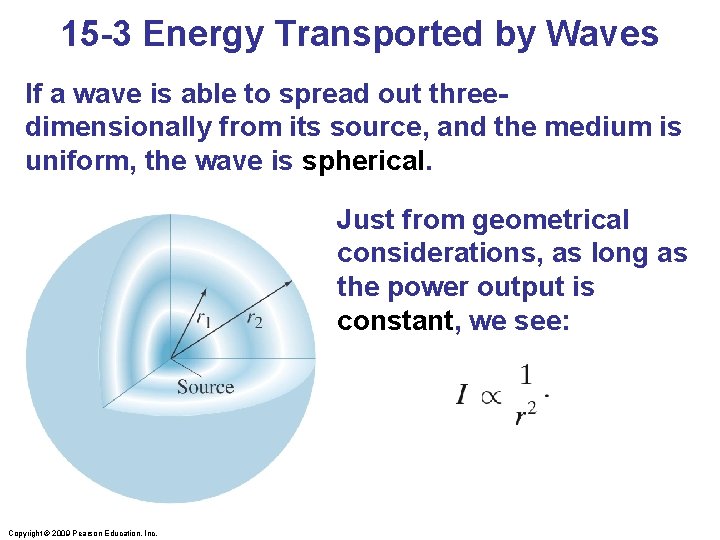
15 -3 Energy Transported by Waves If a wave is able to spread out threedimensionally from its source, and the medium is uniform, the wave is spherical. Just from geometrical considerations, as long as the power output is constant, we see: Copyright © 2009 Pearson Education, Inc.
15 -3 Energy Transported by Waves. Example 15 -4: Earthquake intensity. The intensity of an earthquake P wave traveling through the Earth and detected 100 km from the source is 1. 0 x 106 W/m 2. What is the intensity of that wave if detected 400 km from the source? Copyright © 2009 Pearson Education, Inc.
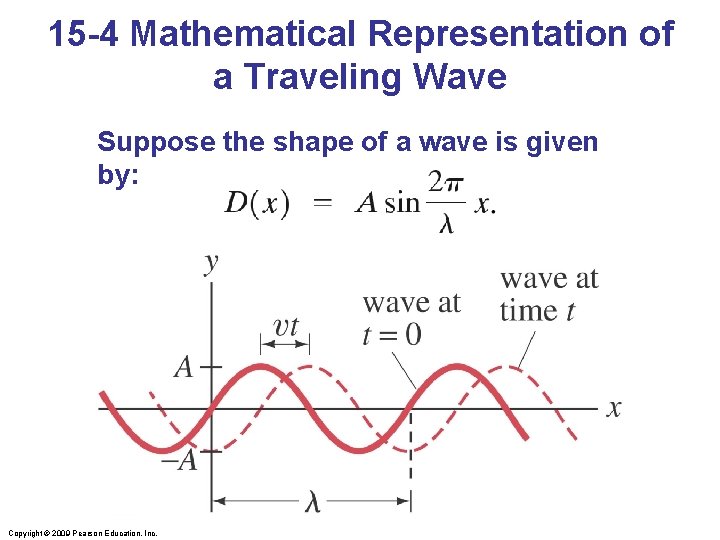
15 -4 Mathematical Representation of a Traveling Wave Suppose the shape of a wave is given by: Copyright © 2009 Pearson Education, Inc.
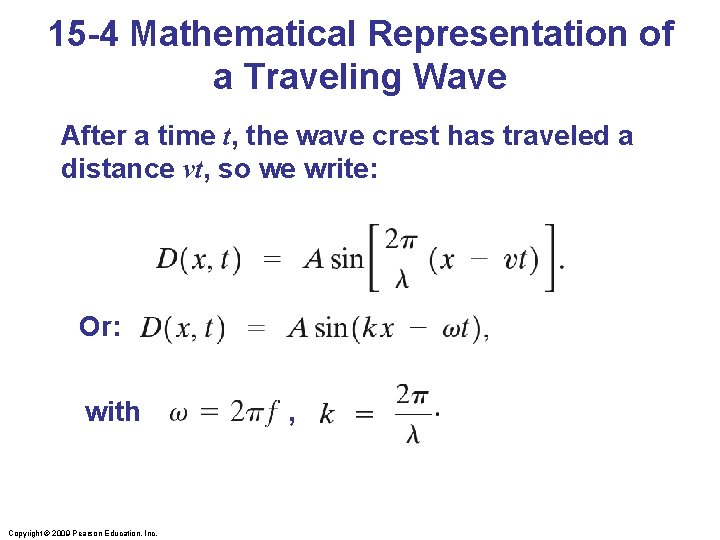
15 -4 Mathematical Representation of a Traveling Wave After a time t, the wave crest has traveled a distance vt, so we write: Or: with Copyright © 2009 Pearson Education, Inc. ,
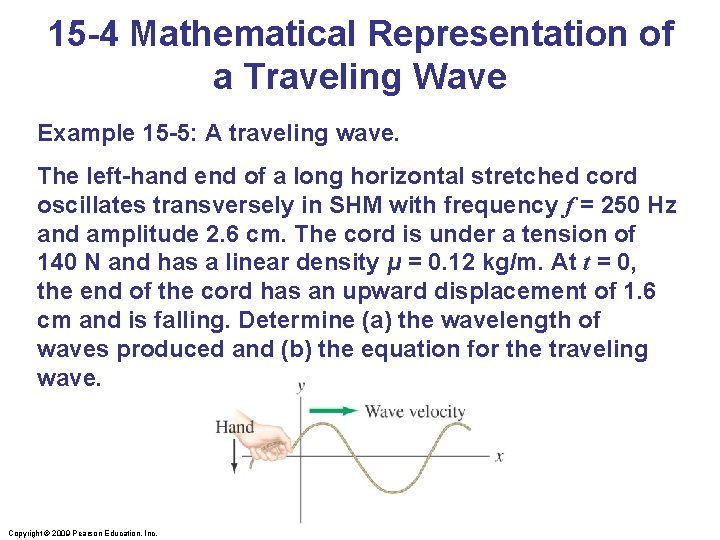
15 -4 Mathematical Representation of a Traveling Wave Example 15 -5: A traveling wave. The left-hand end of a long horizontal stretched cord oscillates transversely in SHM with frequency f = 250 Hz and amplitude 2. 6 cm. The cord is under a tension of 140 N and has a linear density μ = 0. 12 kg/m. At t = 0, the end of the cord has an upward displacement of 1. 6 cm and is falling. Determine (a) the wavelength of waves produced and (b) the equation for the traveling wave. Copyright © 2009 Pearson Education, Inc.
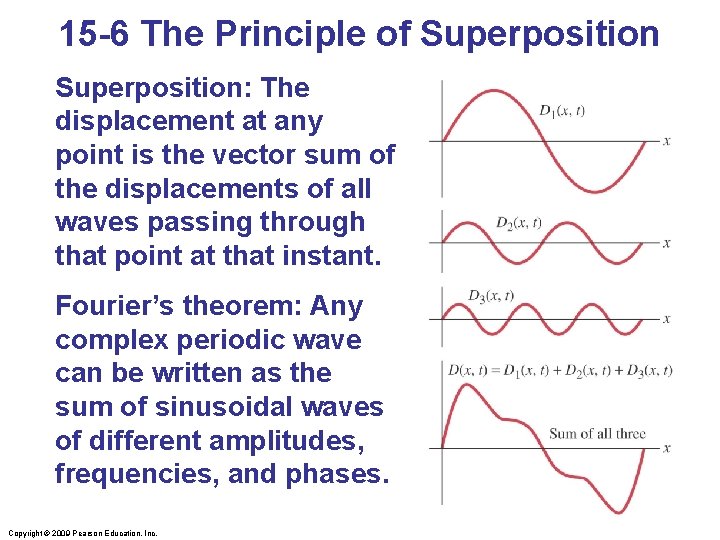
15 -6 The Principle of Superposition: The displacement at any point is the vector sum of the displacements of all waves passing through that point at that instant. Fourier’s theorem: Any complex periodic wave can be written as the sum of sinusoidal waves of different amplitudes, frequencies, and phases. Copyright © 2009 Pearson Education, Inc.
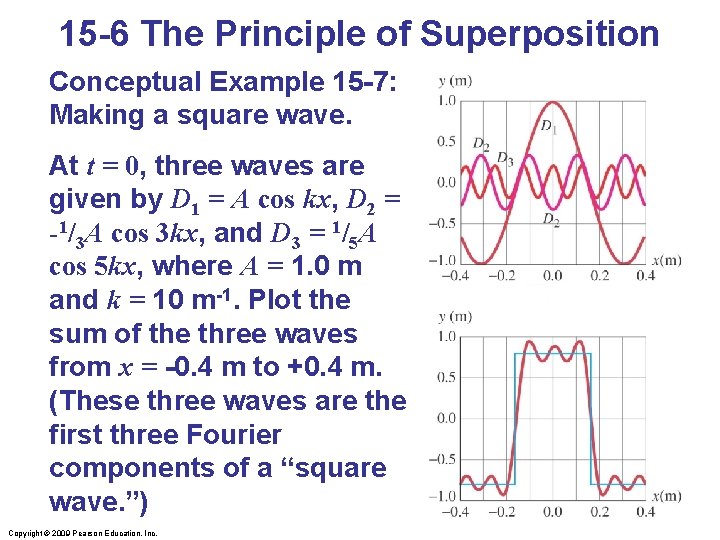
15 -6 The Principle of Superposition Conceptual Example 15 -7: Making a square wave. At t = 0, three waves are given by D 1 = A cos kx, D 2 = -1/3 A cos 3 kx, and D 3 = 1/5 A cos 5 kx, where A = 1. 0 m and k = 10 m-1. Plot the sum of the three waves from x = -0. 4 m to +0. 4 m. (These three waves are the first three Fourier components of a “square wave. ”) Copyright © 2009 Pearson Education, Inc.
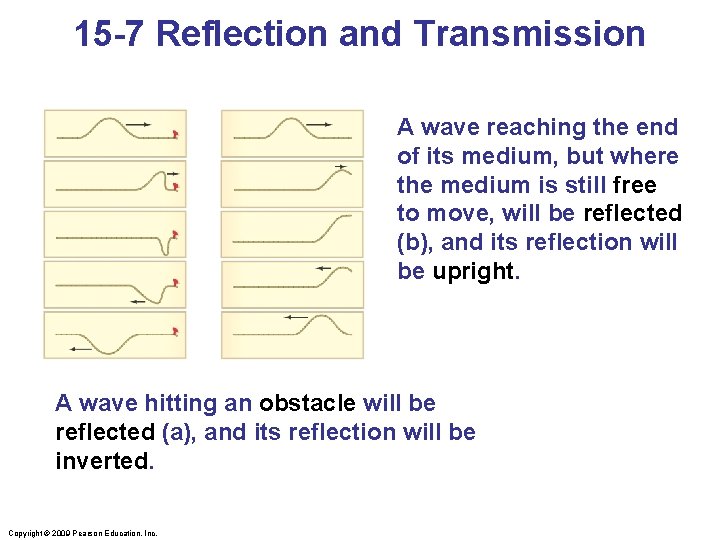
15 -7 Reflection and Transmission A wave reaching the end of its medium, but where the medium is still free to move, will be reflected (b), and its reflection will be upright. A wave hitting an obstacle will be reflected (a), and its reflection will be inverted. Copyright © 2009 Pearson Education, Inc.
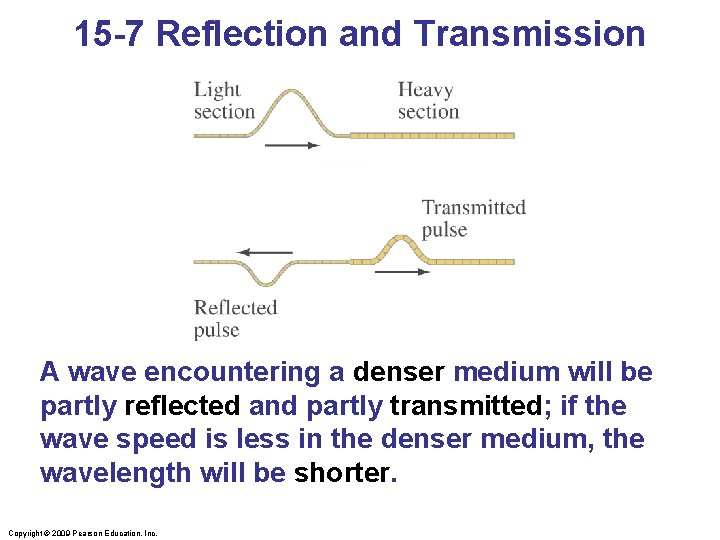
15 -7 Reflection and Transmission A wave encountering a denser medium will be partly reflected and partly transmitted; if the wave speed is less in the denser medium, the wavelength will be shorter. Copyright © 2009 Pearson Education, Inc.
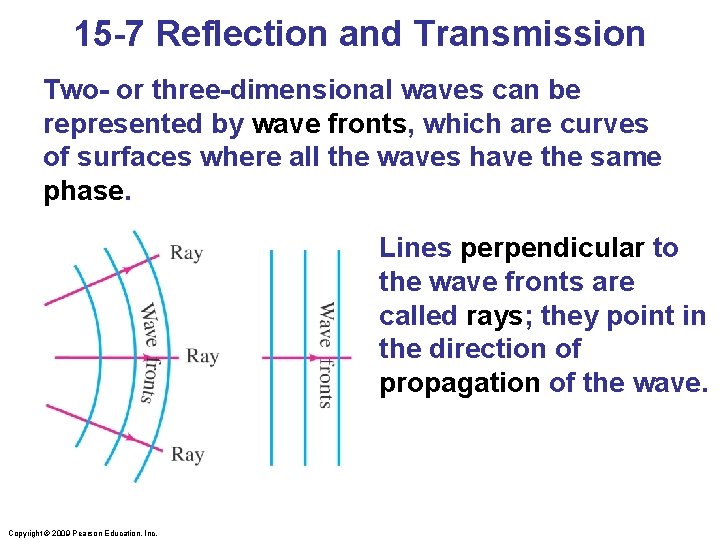
15 -7 Reflection and Transmission Two- or three-dimensional waves can be represented by wave fronts, which are curves of surfaces where all the waves have the same phase. Lines perpendicular to the wave fronts are called rays; they point in the direction of propagation of the wave. Copyright © 2009 Pearson Education, Inc.
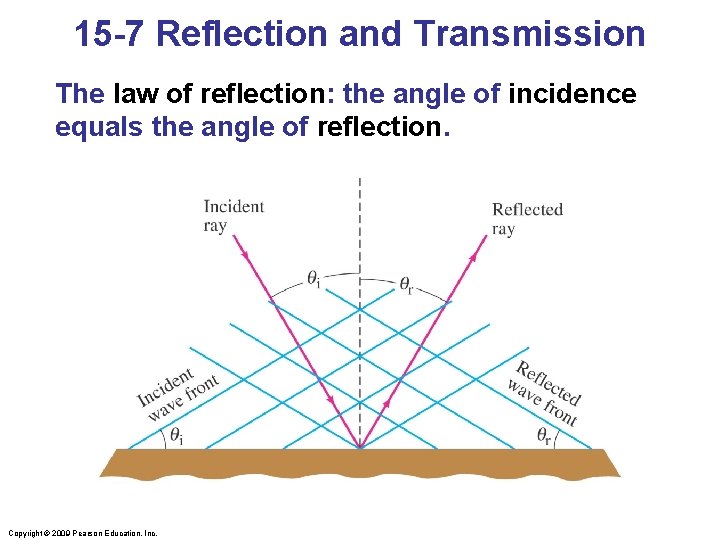
15 -7 Reflection and Transmission The law of reflection: the angle of incidence equals the angle of reflection. Copyright © 2009 Pearson Education, Inc.
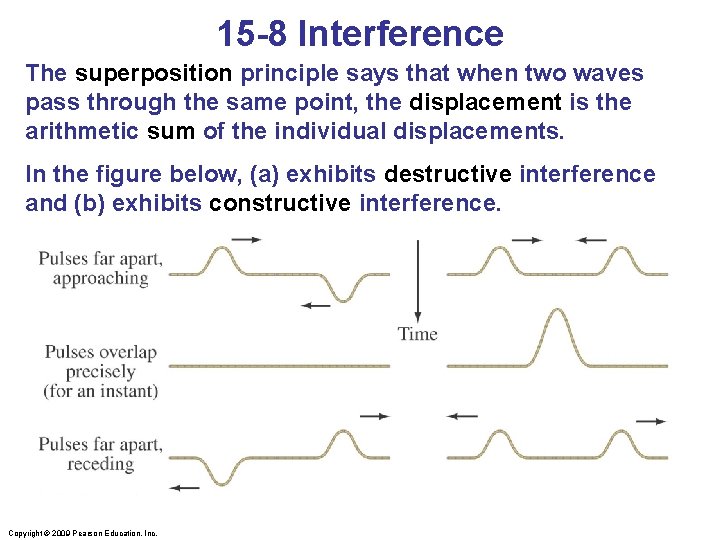
15 -8 Interference The superposition principle says that when two waves pass through the same point, the displacement is the arithmetic sum of the individual displacements. In the figure below, (a) exhibits destructive interference and (b) exhibits constructive interference. Copyright © 2009 Pearson Education, Inc.
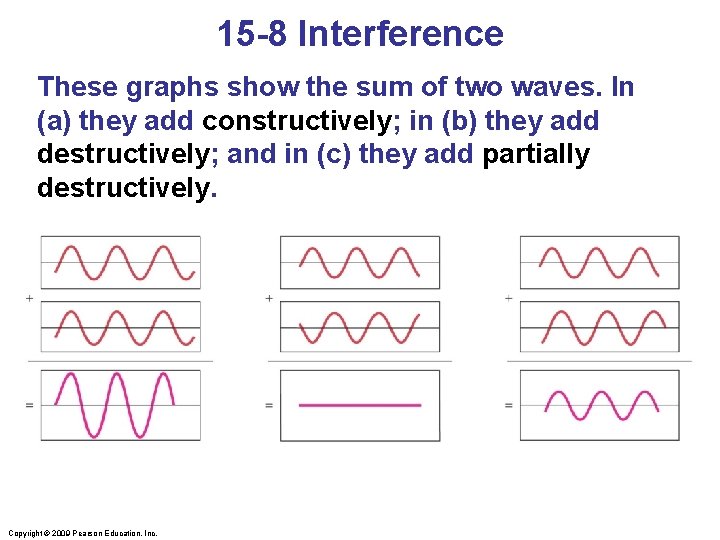
15 -8 Interference These graphs show the sum of two waves. In (a) they add constructively; in (b) they add destructively; and in (c) they add partially destructively. Copyright © 2009 Pearson Education, Inc.
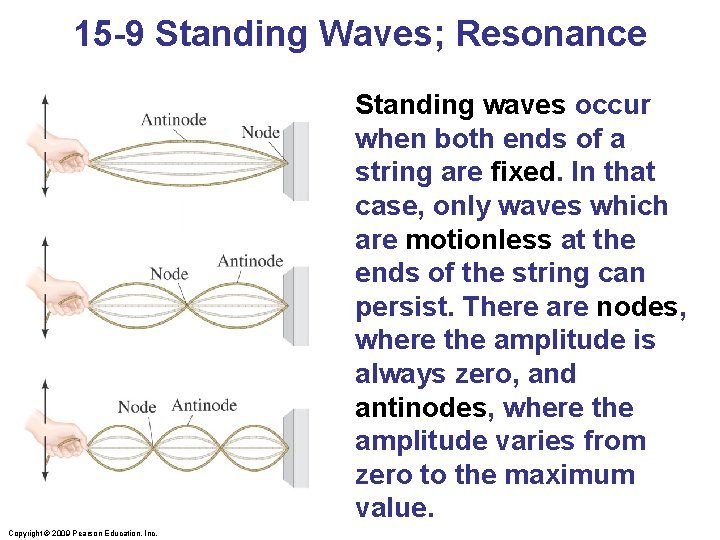
15 -9 Standing Waves; Resonance Standing waves occur when both ends of a string are fixed. In that case, only waves which are motionless at the ends of the string can persist. There are nodes, where the amplitude is always zero, and antinodes, where the amplitude varies from zero to the maximum value. Copyright © 2009 Pearson Education, Inc.
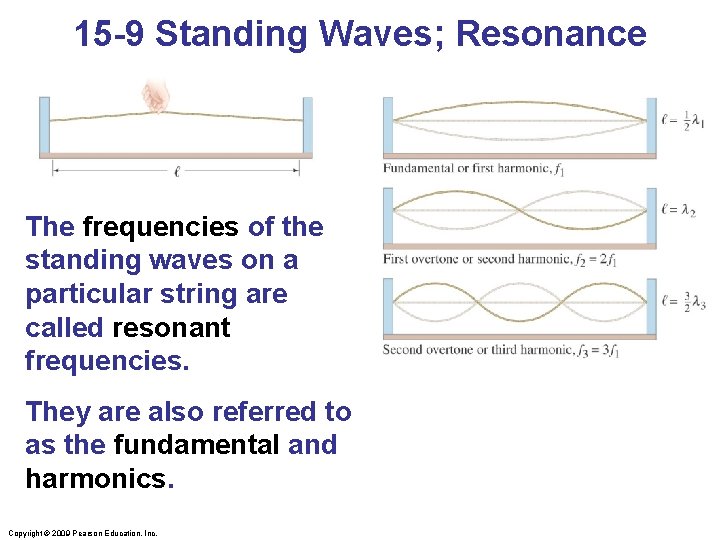
15 -9 Standing Waves; Resonance The frequencies of the standing waves on a particular string are called resonant frequencies. They are also referred to as the fundamental and harmonics. Copyright © 2009 Pearson Education, Inc.
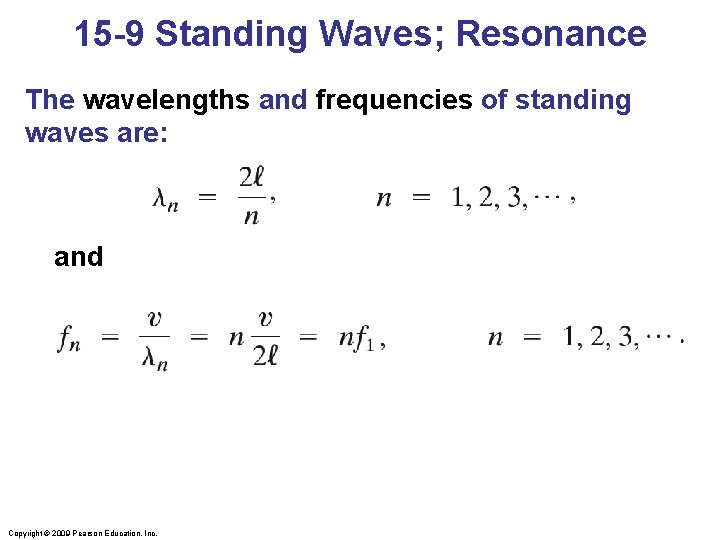
15 -9 Standing Waves; Resonance The wavelengths and frequencies of standing waves are: and Copyright © 2009 Pearson Education, Inc.
15 -9 Standing Waves; Resonance Example 15 -8: Piano string. A piano string is 1. 10 m long and has a mass of 9. 00 g. (a) How much tension must the string be under if it is to vibrate at a fundamental frequency of 131 Hz? (b) What are the frequencies of the first four harmonics? Copyright © 2009 Pearson Education, Inc.
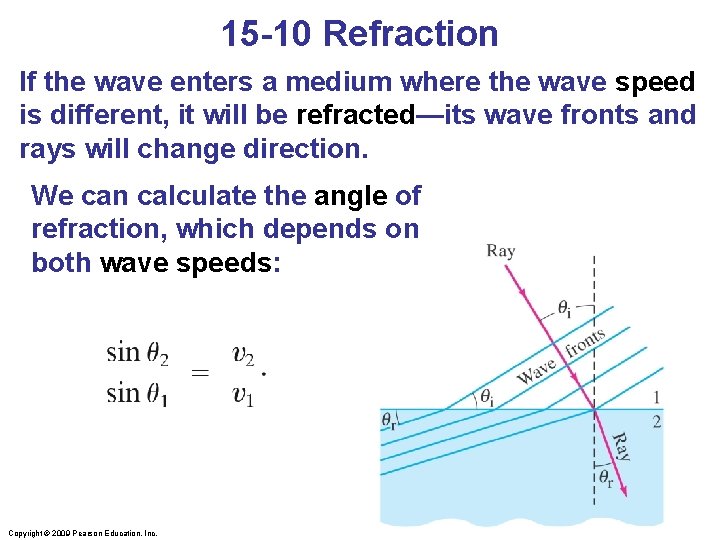
15 -10 Refraction If the wave enters a medium where the wave speed is different, it will be refracted—its wave fronts and rays will change direction. We can calculate the angle of refraction, which depends on both wave speeds: Copyright © 2009 Pearson Education, Inc.
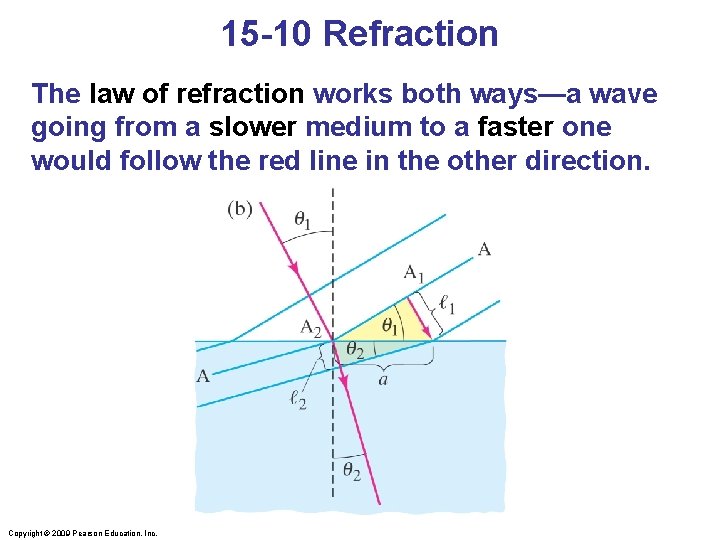
15 -10 Refraction The law of refraction works both ways—a wave going from a slower medium to a faster one would follow the red line in the other direction. Copyright © 2009 Pearson Education, Inc.
15 -10 Refraction Example 15 -10: Refraction of an earthquake wave. An earthquake P wave passes across a boundary in rock where its velocity increases from 6. 5 km/s to 8. 0 km/s. If it strikes this boundary at 30°, what is the angle of refraction? Copyright © 2009 Pearson Education, Inc.
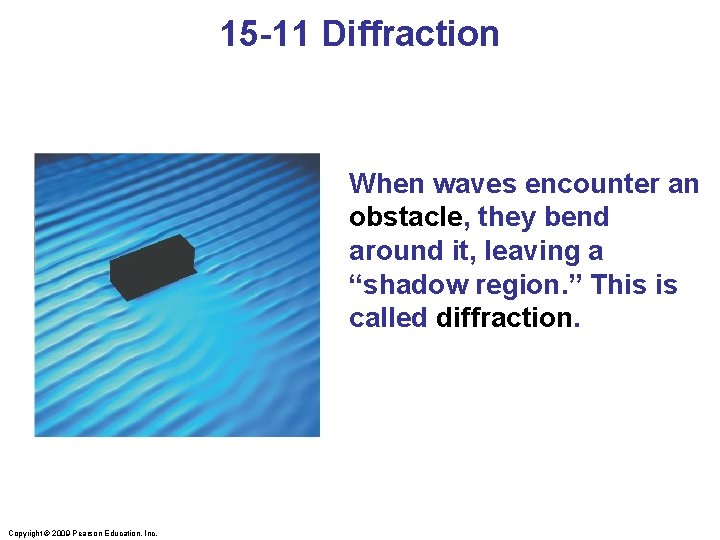
15 -11 Diffraction When waves encounter an obstacle, they bend around it, leaving a “shadow region. ” This is called diffraction. Copyright © 2009 Pearson Education, Inc.
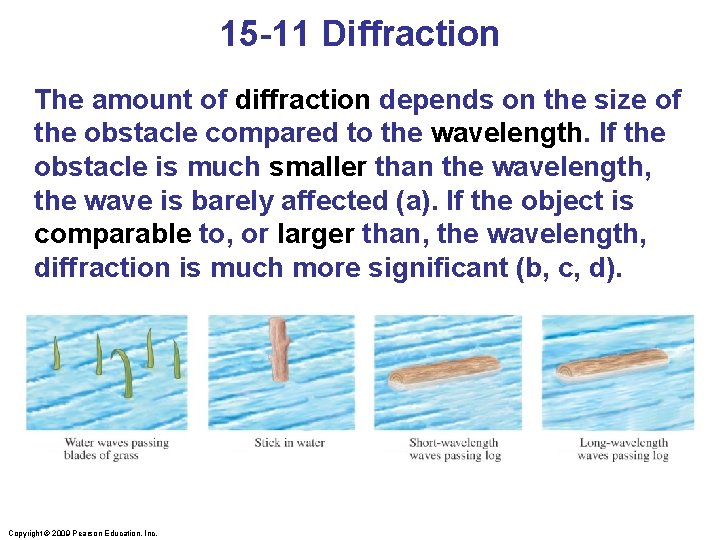
15 -11 Diffraction The amount of diffraction depends on the size of the obstacle compared to the wavelength. If the obstacle is much smaller than the wavelength, the wave is barely affected (a). If the object is comparable to, or larger than, the wavelength, diffraction is much more significant (b, c, d). Copyright © 2009 Pearson Education, Inc.
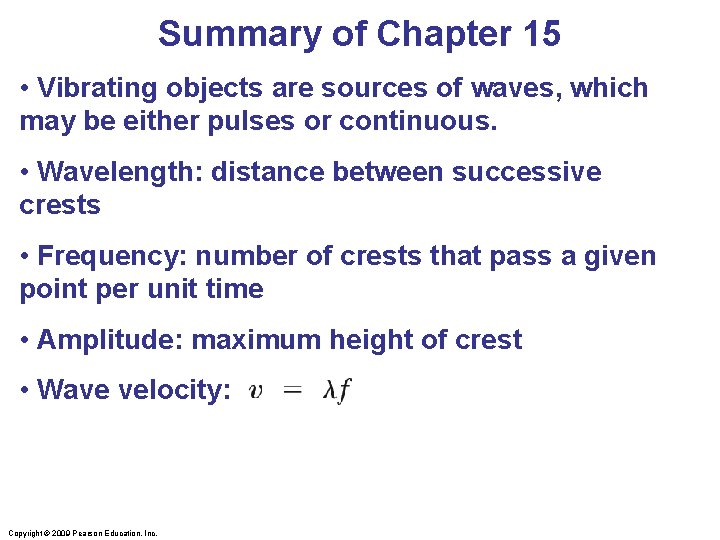
Summary of Chapter 15 • Vibrating objects are sources of waves, which may be either pulses or continuous. • Wavelength: distance between successive crests • Frequency: number of crests that pass a given point per unit time • Amplitude: maximum height of crest • Wave velocity: Copyright © 2009 Pearson Education, Inc.
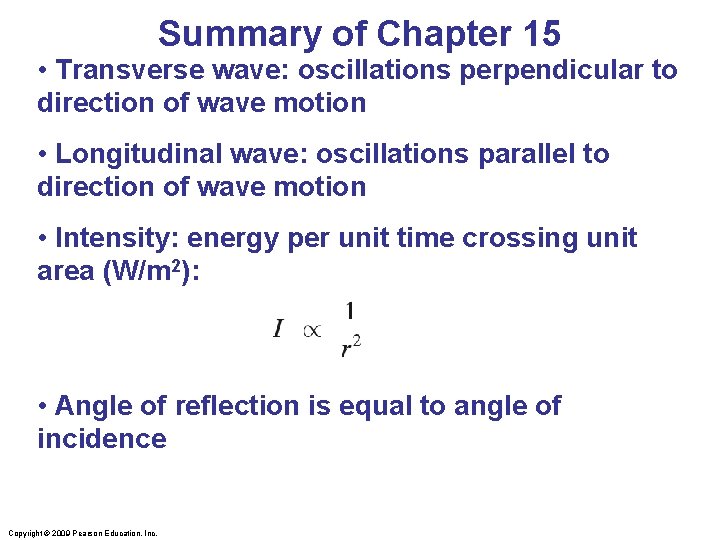
Summary of Chapter 15 • Transverse wave: oscillations perpendicular to direction of wave motion • Longitudinal wave: oscillations parallel to direction of wave motion • Intensity: energy per unit time crossing unit area (W/m 2): • Angle of reflection is equal to angle of incidence Copyright © 2009 Pearson Education, Inc.
Summary of Chapter 15 • When two waves pass through the same region of space, they interfere. Interference may be either constructive or destructive. • Standing waves can be produced on a string with both ends fixed. The waves that persist are at the resonant frequencies. • Nodes occur where there is no motion; antinodes where the amplitude is maximum. • Waves refract when entering a medium of different wave speed, and diffract around obstacles. Copyright © 2009 Pearson Education, Inc.
Chapter 16 Sound Copyright © 2009 Pearson Education, Inc.
Units of Chapter 16 Sections – 2, 4, 6, 7 only • Mathematical Representation of Longitudinal Waves • Sources of Sound: Vibrating Strings • Quality of Sound, and Noise; Superposition • Interference of Sound Waves; Beats • Doppler Effect Copyright © 2009 Pearson Education, Inc.
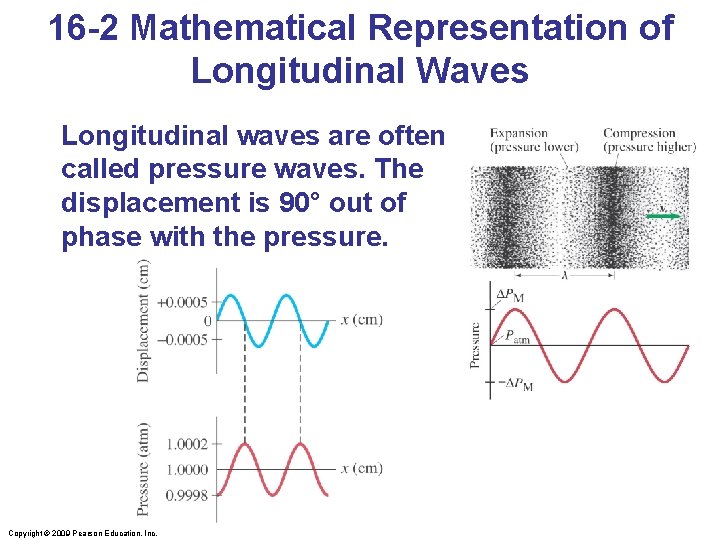
16 -2 Mathematical Representation of Longitudinal Waves Longitudinal waves are often called pressure waves. The displacement is 90° out of phase with the pressure. Copyright © 2009 Pearson Education, Inc.
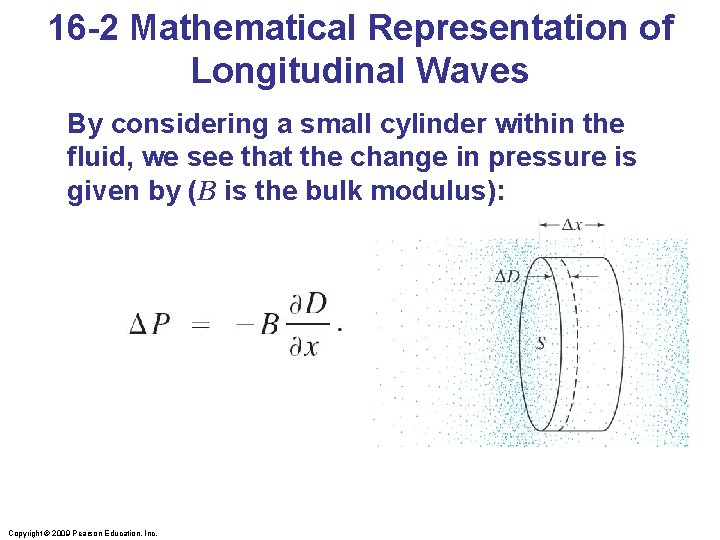
16 -2 Mathematical Representation of Longitudinal Waves By considering a small cylinder within the fluid, we see that the change in pressure is given by (B is the bulk modulus): Copyright © 2009 Pearson Education, Inc.
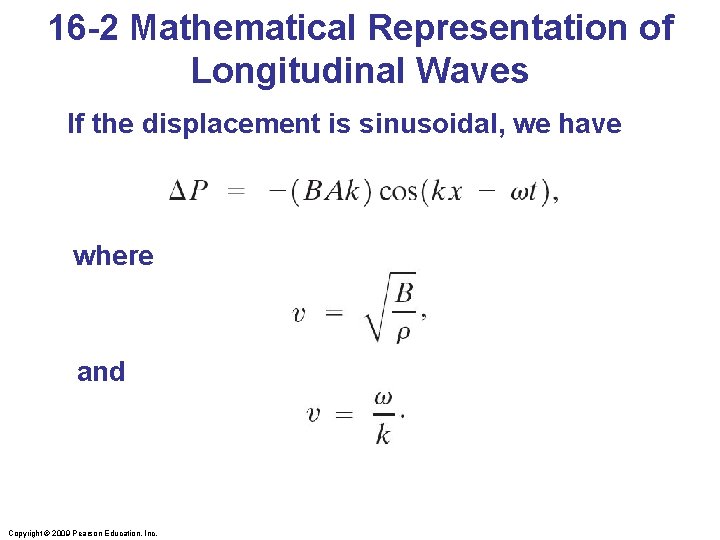
16 -2 Mathematical Representation of Longitudinal Waves If the displacement is sinusoidal, we have where and Copyright © 2009 Pearson Education, Inc.
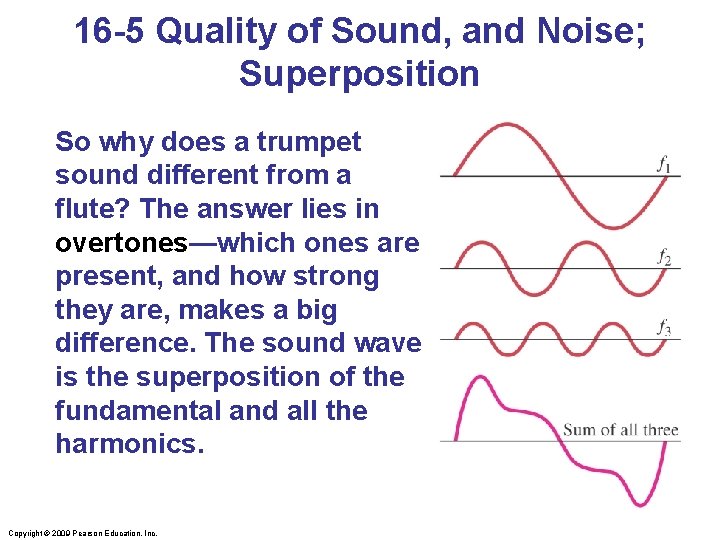
16 -5 Quality of Sound, and Noise; Superposition So why does a trumpet sound different from a flute? The answer lies in overtones—which ones are present, and how strong they are, makes a big difference. The sound wave is the superposition of the fundamental and all the harmonics. Copyright © 2009 Pearson Education, Inc.
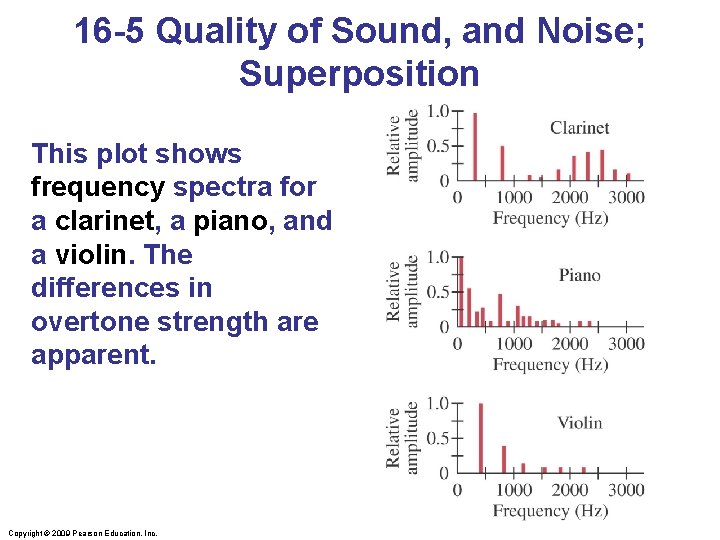
16 -5 Quality of Sound, and Noise; Superposition This plot shows frequency spectra for a clarinet, a piano, and a violin. The differences in overtone strength are apparent. Copyright © 2009 Pearson Education, Inc.
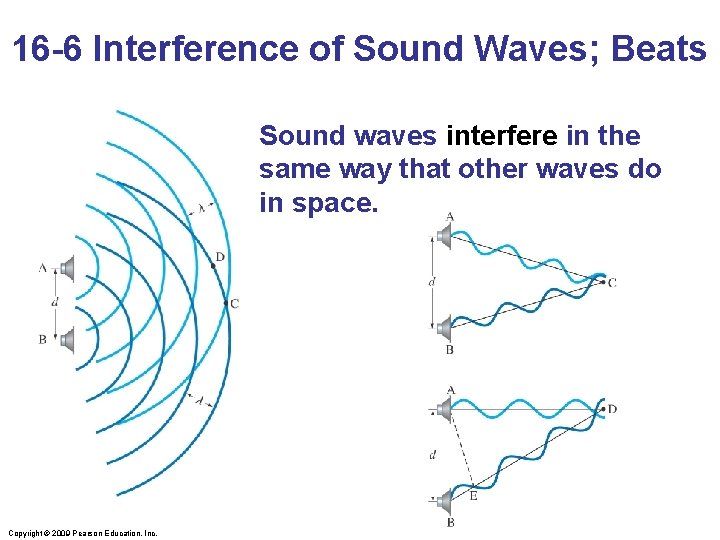
16 -6 Interference of Sound Waves; Beats Sound waves interfere in the same way that other waves do in space. Copyright © 2009 Pearson Education, Inc.
16 -6 Interference of Sound Waves; Beats Example 16 -12: Loudspeakers’ interference. Two loudspeakers are 1. 00 m apart. A person stands 4. 00 m from one speaker. How far must this person be from the second speaker to detect destructive interference when the speakers emit an 1150 -Hz sound? Assume the temperature is 20°C. Copyright © 2009 Pearson Education, Inc.
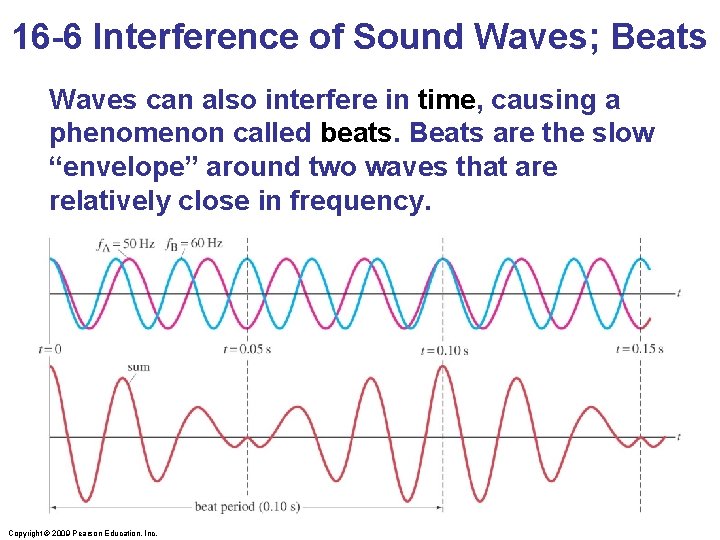
16 -6 Interference of Sound Waves; Beats Waves can also interfere in time, causing a phenomenon called beats. Beats are the slow “envelope” around two waves that are relatively close in frequency. Copyright © 2009 Pearson Education, Inc.
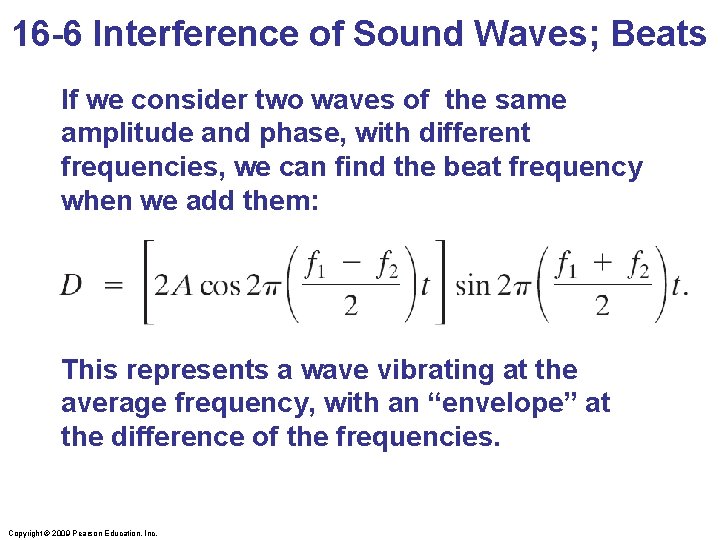
16 -6 Interference of Sound Waves; Beats If we consider two waves of the same amplitude and phase, with different frequencies, we can find the beat frequency when we add them: This represents a wave vibrating at the average frequency, with an “envelope” at the difference of the frequencies. Copyright © 2009 Pearson Education, Inc.
16 -6 Interference of Sound Waves; Beats Example 16 -13: Beats. A tuning fork produces a steady 400 -Hz tone. When this tuning fork is struck and held near a vibrating guitar string, twenty beats are counted in five seconds. What are the possible frequencies produced by the guitar string? Copyright © 2009 Pearson Education, Inc.
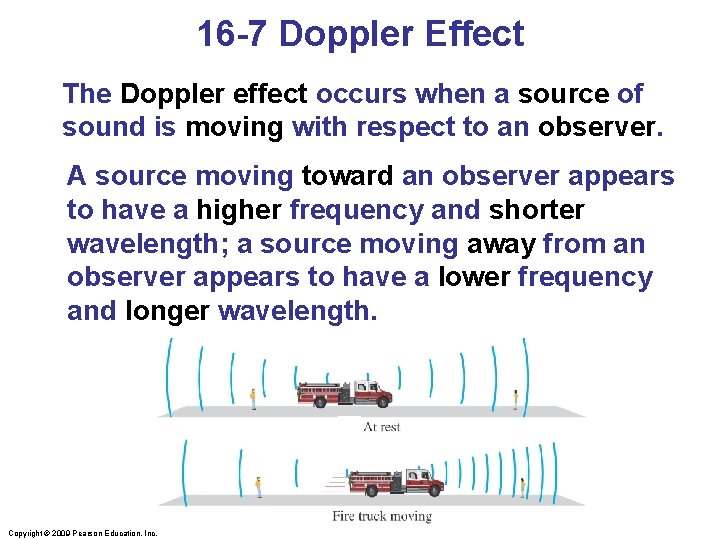
16 -7 Doppler Effect The Doppler effect occurs when a source of sound is moving with respect to an observer. A source moving toward an observer appears to have a higher frequency and shorter wavelength; a source moving away from an observer appears to have a lower frequency and longer wavelength. Copyright © 2009 Pearson Education, Inc.
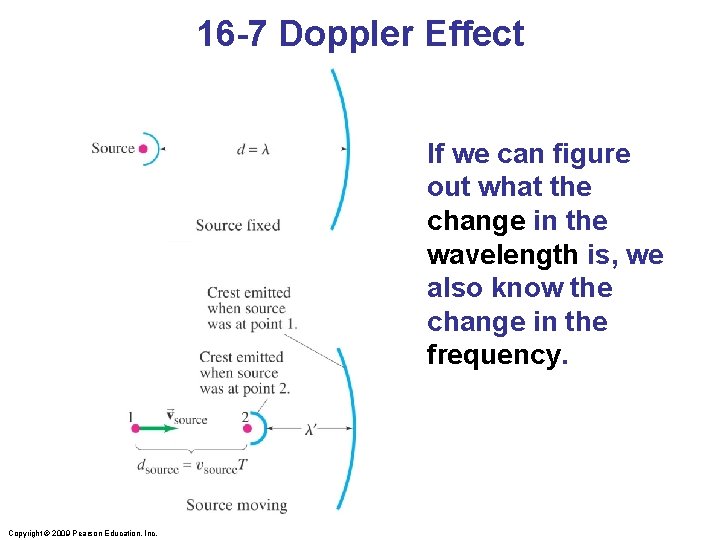
16 -7 Doppler Effect If we can figure out what the change in the wavelength is, we also know the change in the frequency. Copyright © 2009 Pearson Education, Inc.
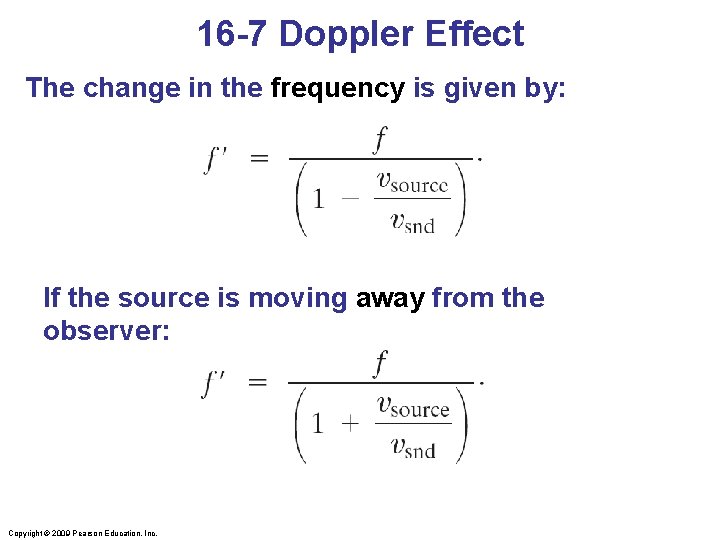
16 -7 Doppler Effect The change in the frequency is given by: If the source is moving away from the observer: Copyright © 2009 Pearson Education, Inc.
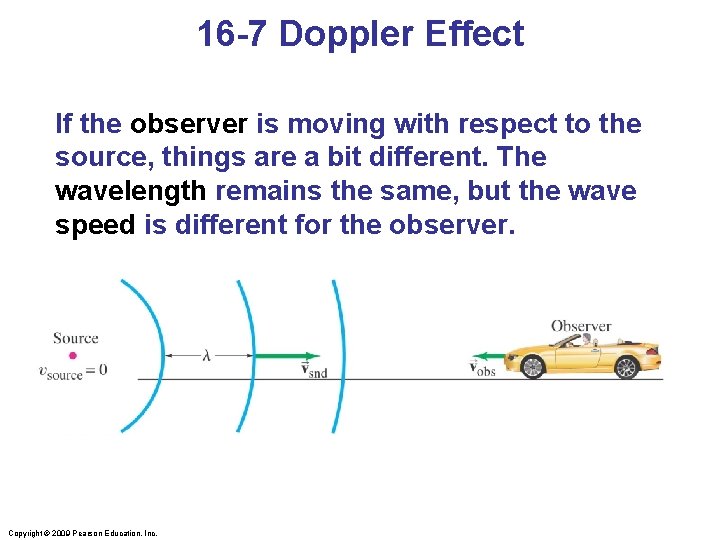
16 -7 Doppler Effect If the observer is moving with respect to the source, things are a bit different. The wavelength remains the same, but the wave speed is different for the observer. Copyright © 2009 Pearson Education, Inc.
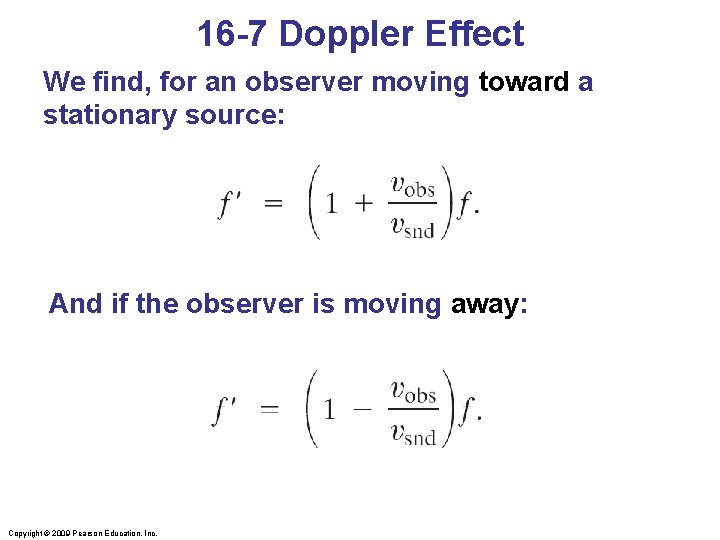
16 -7 Doppler Effect We find, for an observer moving toward a stationary source: And if the observer is moving away: Copyright © 2009 Pearson Education, Inc.
16 -7 Doppler Effect Example 16 -14: A moving siren. The siren of a police car at rest emits at a predominant frequency of 1600 Hz. What frequency will you hear if you are at rest and the police car moves at 25. 0 m/s (a) toward you, and (b) away from you? Copyright © 2009 Pearson Education, Inc.
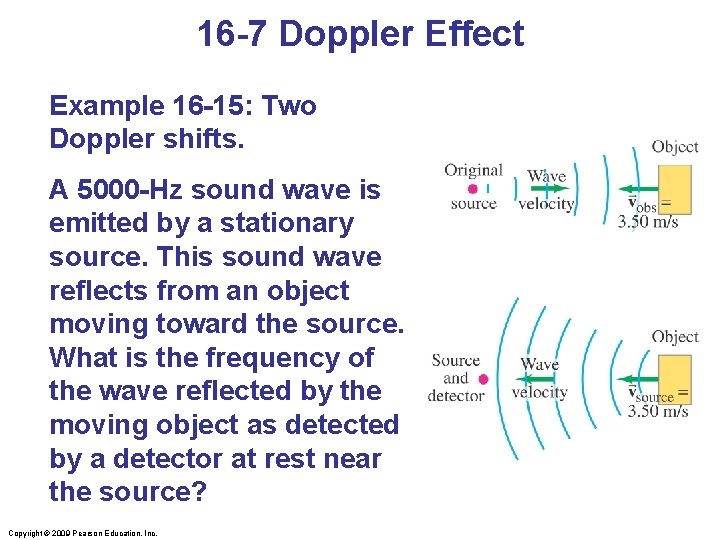
16 -7 Doppler Effect Example 16 -15: Two Doppler shifts. A 5000 -Hz sound wave is emitted by a stationary source. This sound wave reflects from an object moving toward the source. What is the frequency of the wave reflected by the moving object as detected by a detector at rest near the source? Copyright © 2009 Pearson Education, Inc.
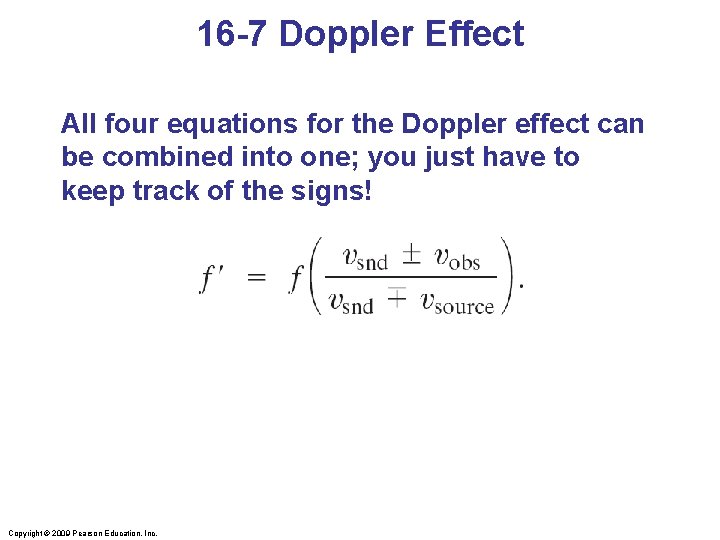
16 -7 Doppler Effect All four equations for the Doppler effect can be combined into one; you just have to keep track of the signs! Copyright © 2009 Pearson Education, Inc.
Summary of Chapter 16 • Sound is a longitudinal wave in a medium. • The strings on stringed instruments produce a fundamental tone whose wavelength is twice the length of the string; there also various harmonics present. • Sound waves exhibit interference; if two sounds are at slightly different frequencies they produce beats. • The Doppler effect is the shift in frequency of a sound due to motion of the source or the observer. Copyright © 2009 Pearson Education, Inc.