Ch 31 Self Inductance A l Consider a
- Slides: 29
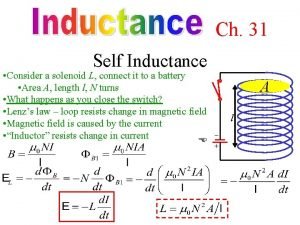
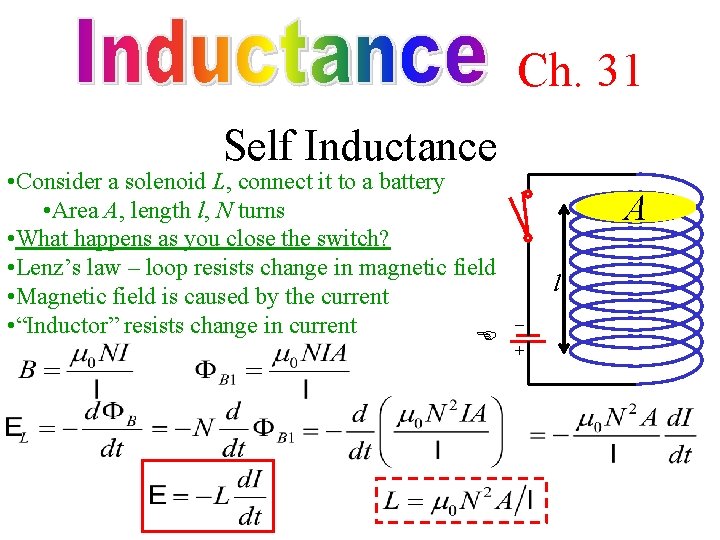
Ch. 31 Self Inductance A l + – • Consider a solenoid L, connect it to a battery • Area A, length l, N turns • What happens as you close the switch? • Lenz’s law – loop resists change in magnetic field • Magnetic field is caused by the current • “Inductor” resists change in current E
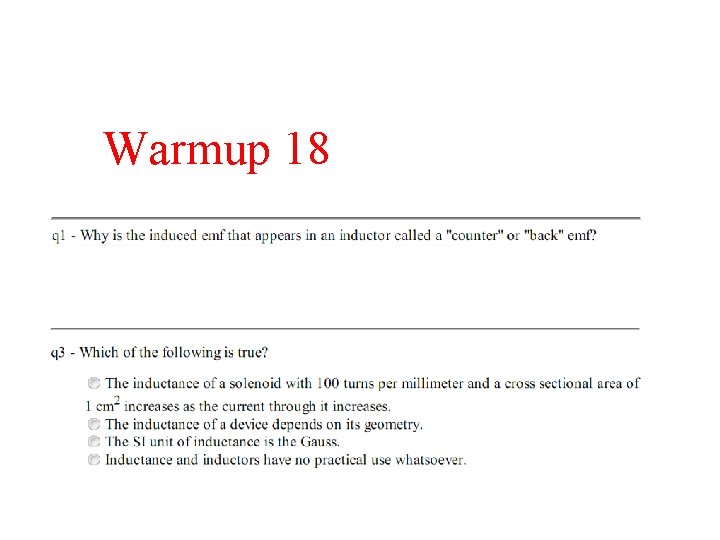
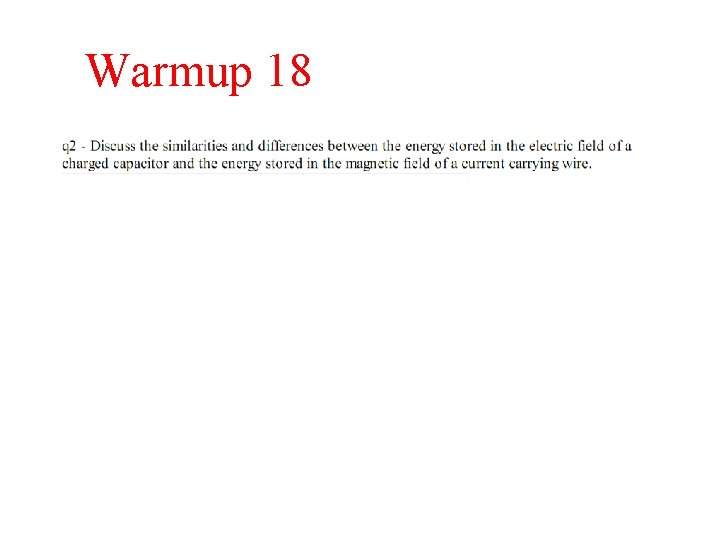
Warmup 18
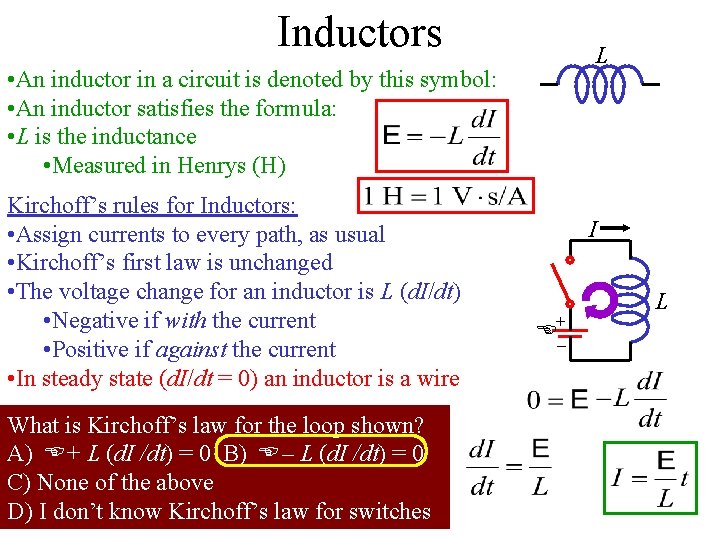
Inductors L • An inductor in a circuit is denoted by this symbol: • An inductor satisfies the formula: • L is the inductance • Measured in Henrys (H) Kirchoff’s rules for Inductors: • Assign currents to every path, as usual • Kirchoff’s first law is unchanged • The voltage change for an inductor is L (d. I/dt) • Negative if with the current • Positive if against the current • In steady state (d. I/dt = 0) an inductor is a wire What is Kirchoff’s law for the loop shown? A) E + L (d. I /dt) = 0 B) E – L (d. I /dt) = 0 C) None of the above D) I don’t know Kirchoff’s law for switches I E+ – L
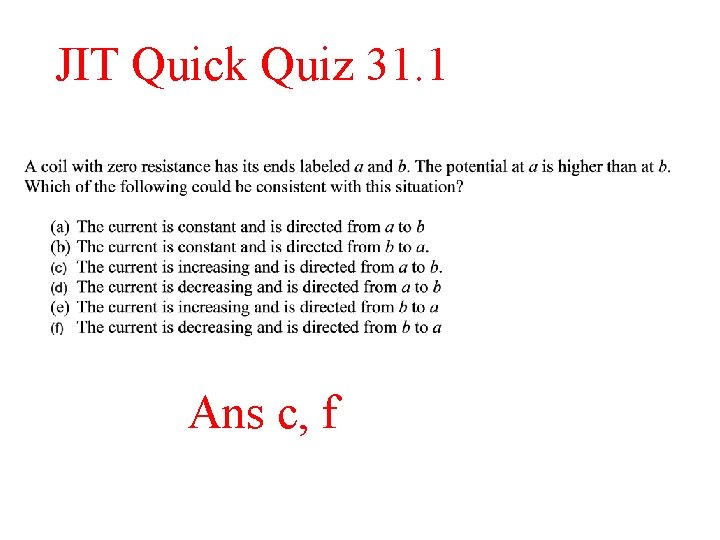
JIT Quick Quiz 31. 1 Ans c, f
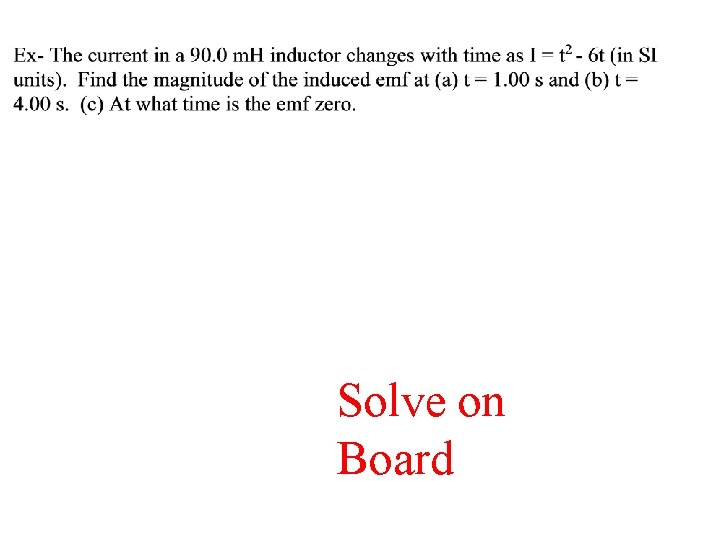
Solve on Board
Warmup 18
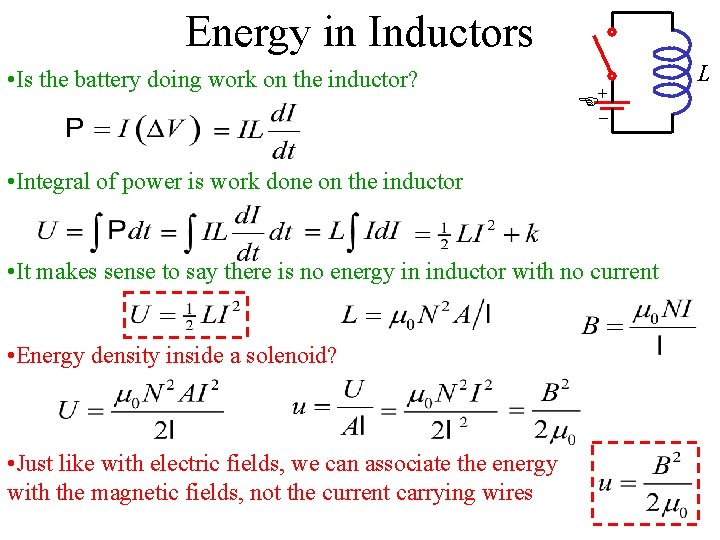
Energy in Inductors • Is the battery doing work on the inductor? E+ – • Integral of power is work done on the inductor • It makes sense to say there is no energy in inductor with no current • Energy density inside a solenoid? • Just like with electric fields, we can associate the energy with the magnetic fields, not the current carrying wires L
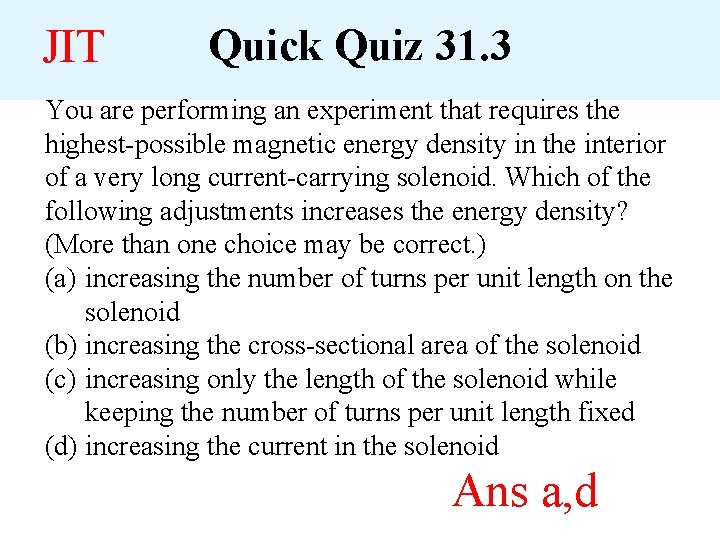
JIT Quick Quiz 31. 3 You are performing an experiment that requires the highest-possible magnetic energy density in the interior of a very long current-carrying solenoid. Which of the following adjustments increases the energy density? (More than one choice may be correct. ) (a) increasing the number of turns per unit length on the solenoid (b) increasing the cross-sectional area of the solenoid (c) increasing only the length of the solenoid while keeping the number of turns per unit length fixed (d) increasing the current in the solenoid Ans a, d
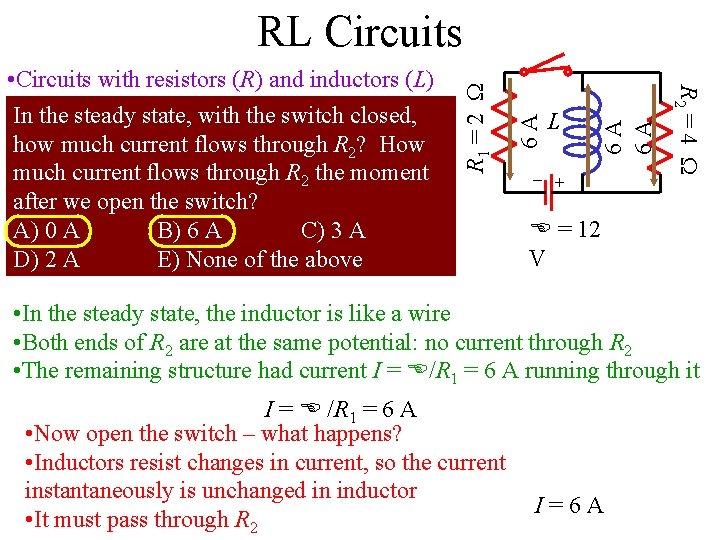
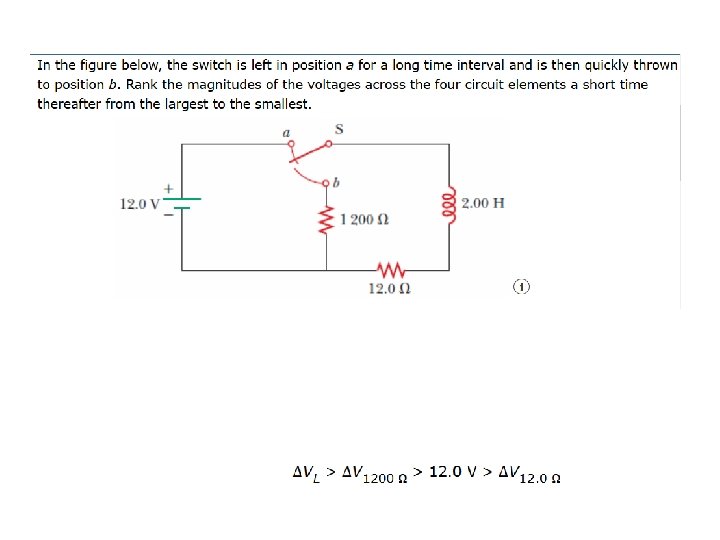
6 A 6 A 6 A R 2 = 4 L + – • Circuits with resistors (R) and inductors (L) In the steady state, with the switch closed, how much current flows through R 2? How much current flows through R 2 the moment after we open the switch? A) 0 A B) 6 A C) 3 A D) 2 A E) None of the above R 1 = 2 RL Circuits E = 12 V • In the steady state, the inductor is like a wire • Both ends of R 2 are at the same potential: no current through R 2 • The remaining structure had current I = E/R 1 = 6 A running through it I = E /R 1 = 6 A • Now open the switch – what happens? • Inductors resist changes in current, so the current instantaneously is unchanged in inductor • It must pass through R 2 I=6 A
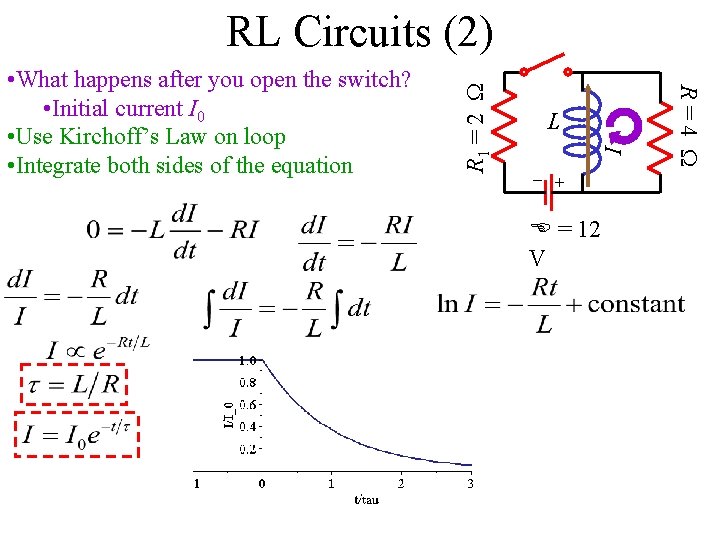
I – E = 12 V R = 4 L + • What happens after you open the switch? • Initial current I 0 • Use Kirchoff’s Law on loop • Integrate both sides of the equation R 1 = 2 RL Circuits (2)
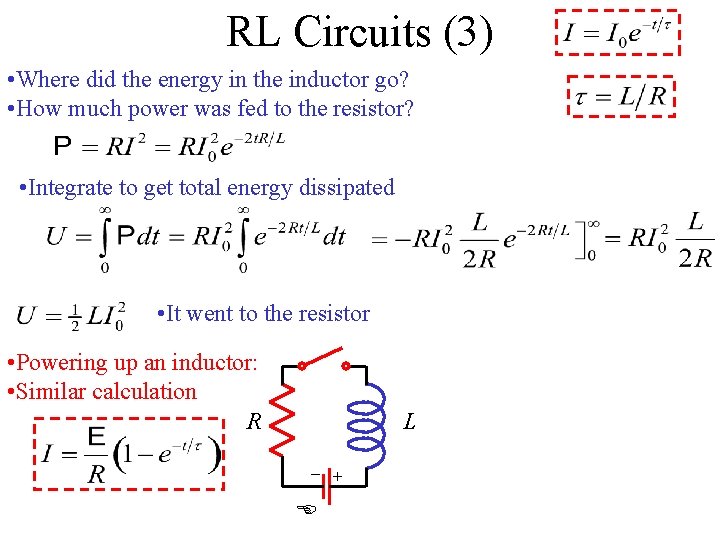
RL Circuits (3) • Where did the energy in the inductor go? • How much power was fed to the resistor? • Integrate to get total energy dissipated • It went to the resistor • Powering up an inductor: • Similar calculation R L + – E
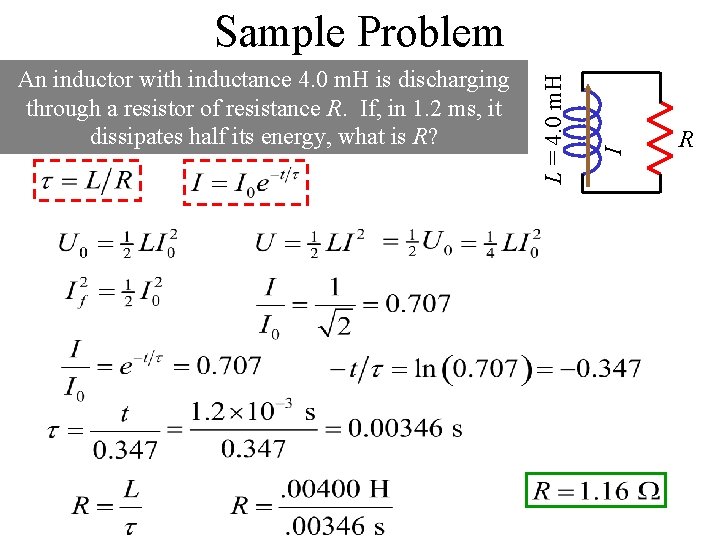
I An inductor with inductance 4. 0 m. H is discharging through a resistor of resistance R. If, in 1. 2 ms, it dissipates half its energy, what is R? L = 4. 0 m. H Sample Problem R
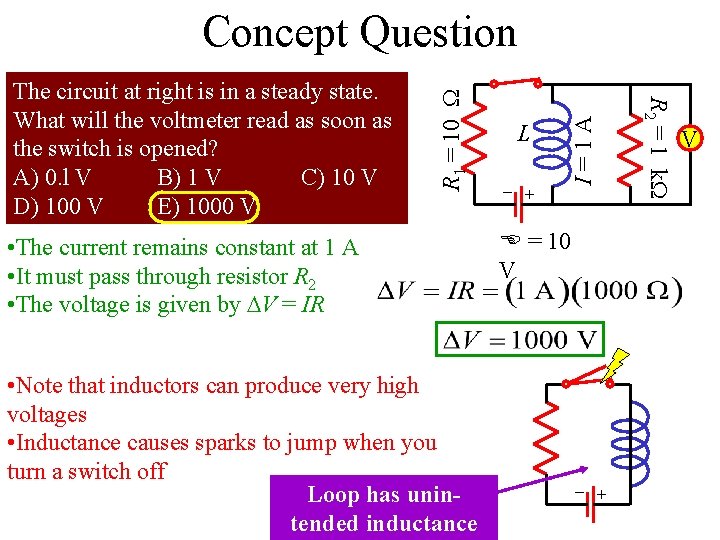
I=1 A + – – • Note that inductors can produce very high voltages • Inductance causes sparks to jump when you turn a switch off Loop has unintended inductance E = 10 V R 2 = 1 k • The current remains constant at 1 A • It must pass through resistor R 2 • The voltage is given by V = IR L + The circuit at right is in a steady state. What will the voltmeter read as soon as the switch is opened? A) 0. l V B) 1 V C) 10 V D) 100 V E) 1000 V R 1 = 10 Concept Question V
JIT Quick Quiz 31. 2 Ans b Ans d
Ans A
Assume inductor has no resistance Ans A
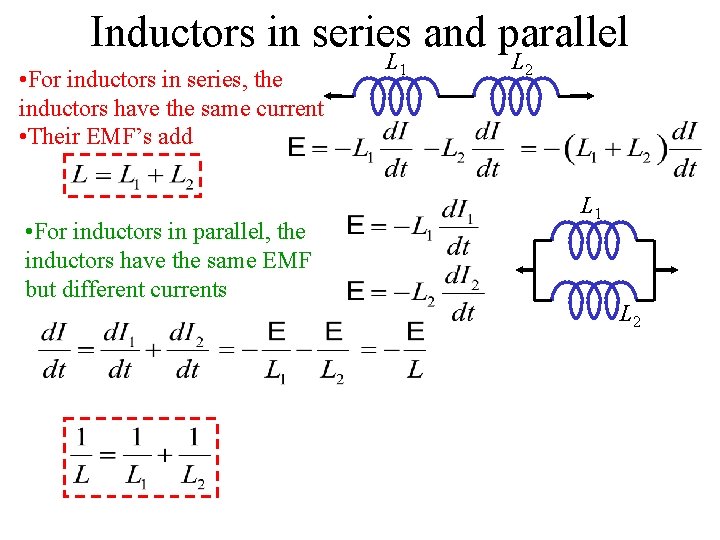
Inductors in series and parallel • For inductors in series, the inductors have the same current • Their EMF’s add • For inductors in parallel, the inductors have the same EMF but different currents L 1 L 2
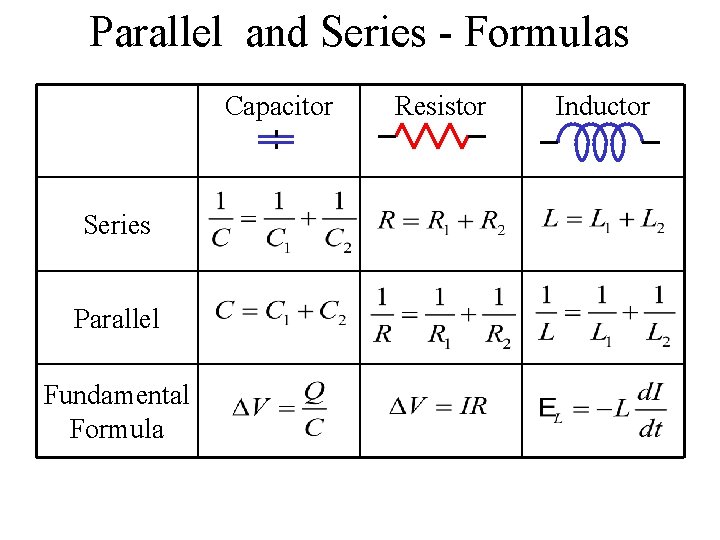
Parallel and Series - Formulas Capacitor Series Parallel Fundamental Formula Resistor Inductor
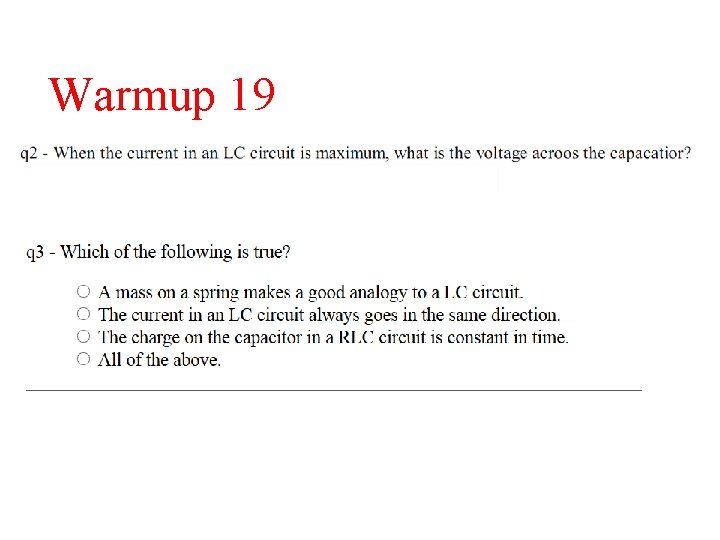
Warmup 19
Ans B
Warmup 19
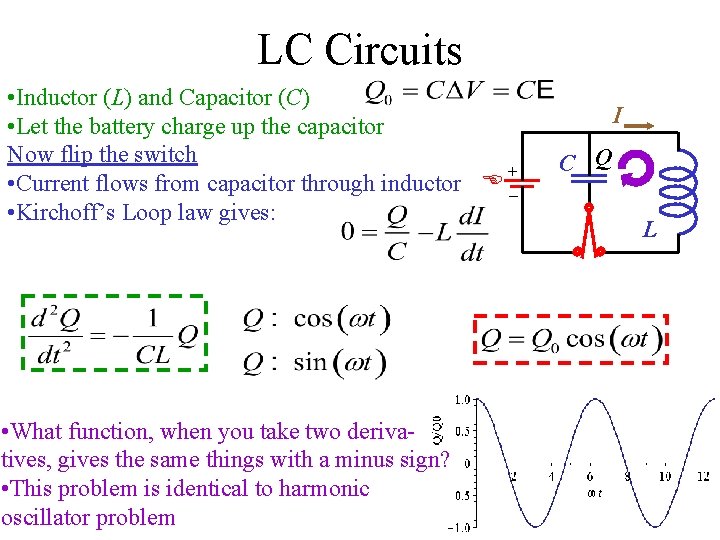
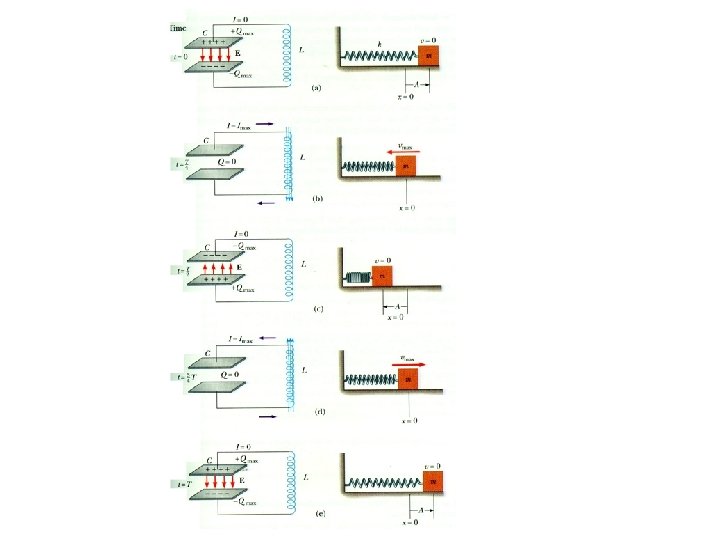
LC Circuits • Inductor (L) and Capacitor (C) • Let the battery charge up the capacitor Now flip the switch + • Current flows from capacitor through inductor E – • Kirchoff’s Loop law gives: • What function, when you take two derivatives, gives the same things with a minus sign? • This problem is identical to harmonic oscillator problem I C Q L
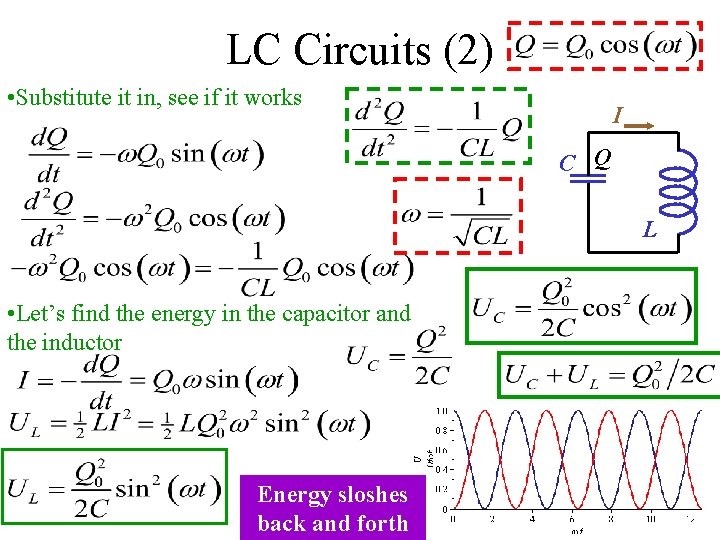
LC Circuits (2) • Substitute it in, see if it works I C Q L • Let’s find the energy in the capacitor and the inductor Energy sloshes back and forth
Warmup 19
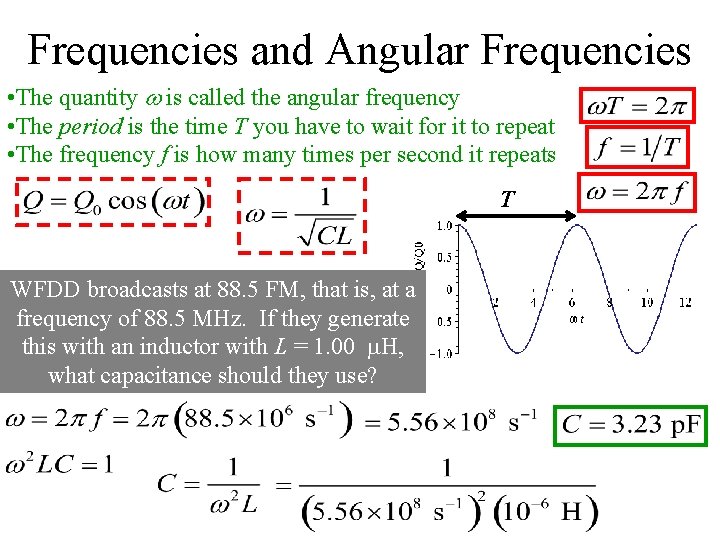
Frequencies and Angular Frequencies • The quantity is called the angular frequency • The period is the time T you have to wait for it to repeat • The frequency f is how many times per second it repeats T WFDD broadcasts at 88. 5 FM, that is, at a frequency of 88. 5 MHz. If they generate this with an inductor with L = 1. 00 H, what capacitance should they use?
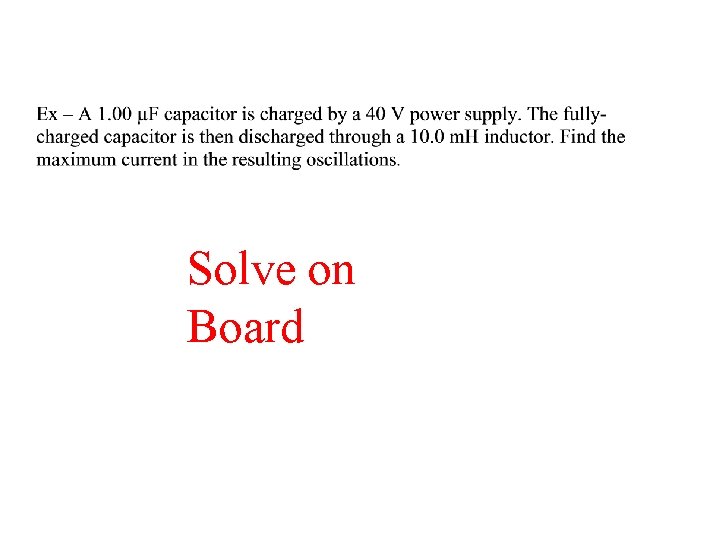
Solve on Board
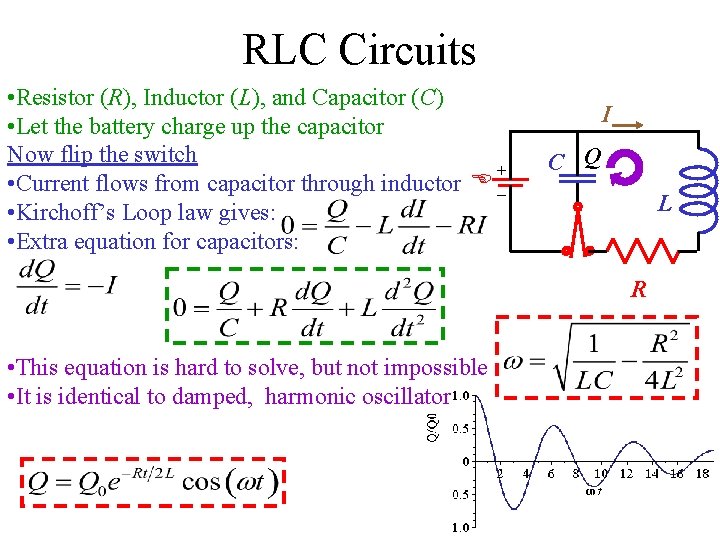
RLC Circuits • Resistor (R), Inductor (L), and Capacitor (C) • Let the battery charge up the capacitor Now flip the switch + • Current flows from capacitor through inductor E – • Kirchoff’s Loop law gives: • Extra equation for capacitors: I C Q L R • This equation is hard to solve, but not impossible • It is identical to damped, harmonic oscillator