Chapter 3 Understanding the Role of Culture 3


- Slides: 40
Chapter 3: Understanding the Role of Culture 3 -1 Copyright © 2014 Pearson Education, Inc.
Chapter Learning Goals To understand how culture affects all aspects of international management 2. To emphasize the need for international managers to have cultural intelligence in order to interact successfully in host countries 3. To be able to distinguish the major dimensions which define cultural differences among societies or groups 4. To recognize the critical value differences which frequently affect job behaviors 1. 3 -2 Copyright © 2014 Pearson Education, Inc.
Chapter Learning Goals To understand the interaction between culture and the use of internet 6. To be able to develop a working “cultural profile” typical of many people within a certain society, as an aid to expected attitudes toward work, negotiations, etc. 5. 3 -3 Copyright © 2014 Pearson Education, Inc.
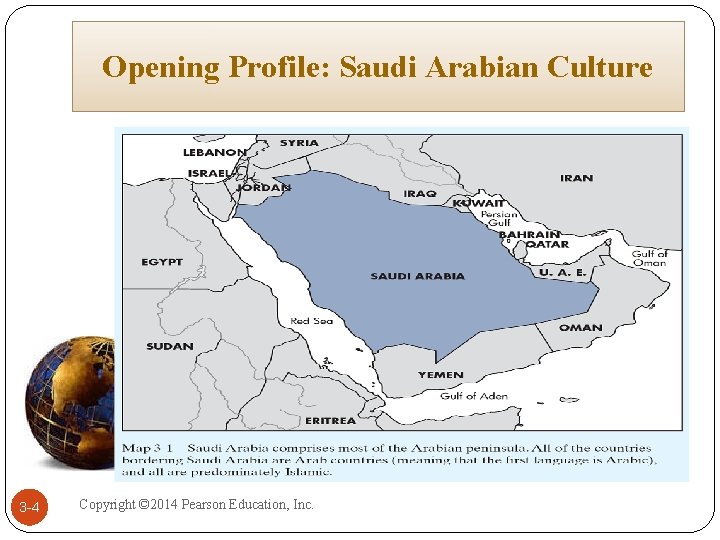
Opening Profile: Saudi Arabian Culture 3 -4 Copyright © 2014 Pearson Education, Inc.
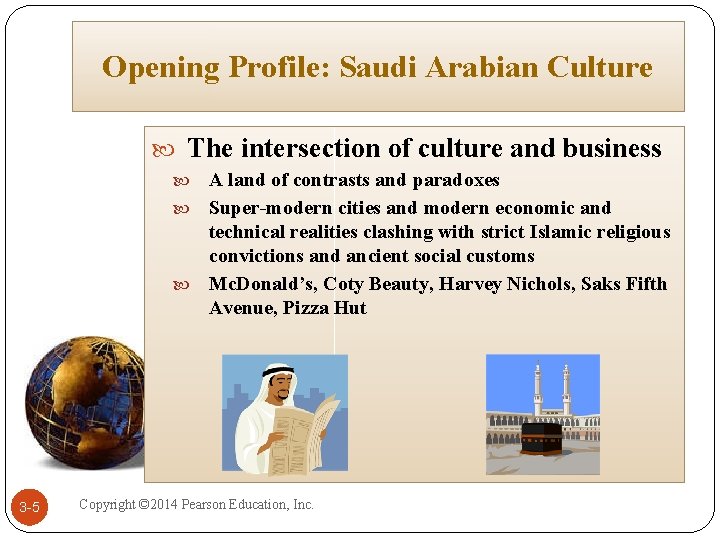
Opening Profile: Saudi Arabian Culture The intersection of culture and business A land of contrasts and paradoxes Super-modern cities and modern economic and technical realities clashing with strict Islamic religious convictions and ancient social customs Mc. Donald’s, Coty Beauty, Harvey Nichols, Saks Fifth Avenue, Pizza Hut 3 -5 Copyright © 2014 Pearson Education, Inc.
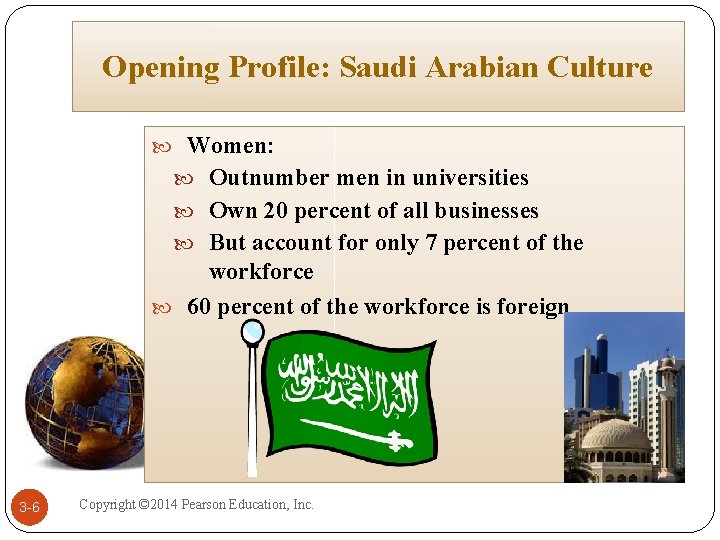
Opening Profile: Saudi Arabian Culture Women: Outnumber men in universities Own 20 percent of all businesses But account for only 7 percent of the workforce 60 percent of the workforce is foreign 3 -6 Copyright © 2014 Pearson Education, Inc.
Chapter Learning Goals To understand how culture affects all aspects of international management 3 -7 Copyright © 2014 Pearson Education, Inc.
Culture and its Effects on Organizations Culture A set of shared values, understandings, assumptions, and goals that are learned from earlier generations, imposed by present members of a society, and passed on to succeeding generations 3 -8 Copyright © 2014 Pearson Education, Inc.
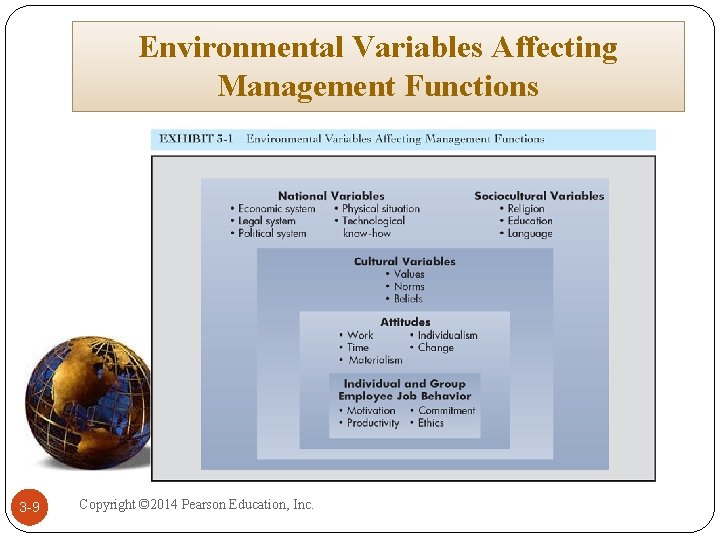
Environmental Variables Affecting Management Functions 3 -9 Copyright © 2014 Pearson Education, Inc.
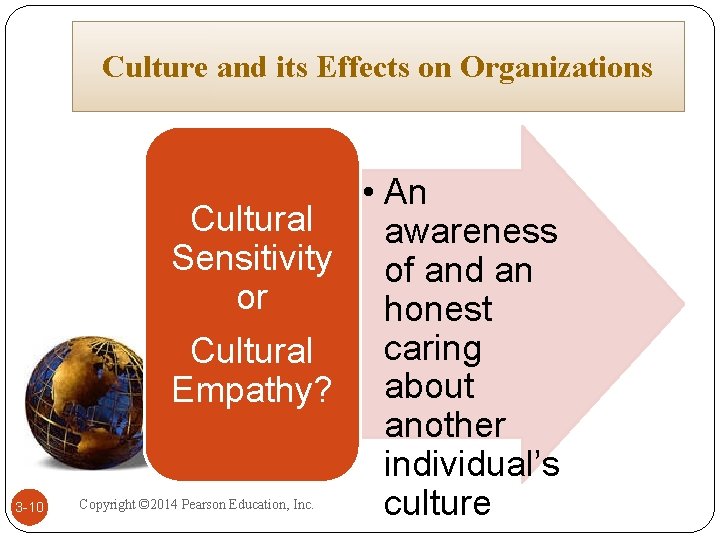
Culture and its Effects on Organizations 3 -10 • An Cultural awareness Sensitivity of and an or honest caring Cultural Empathy? about another individual’s culture Copyright © 2014 Pearson Education, Inc.
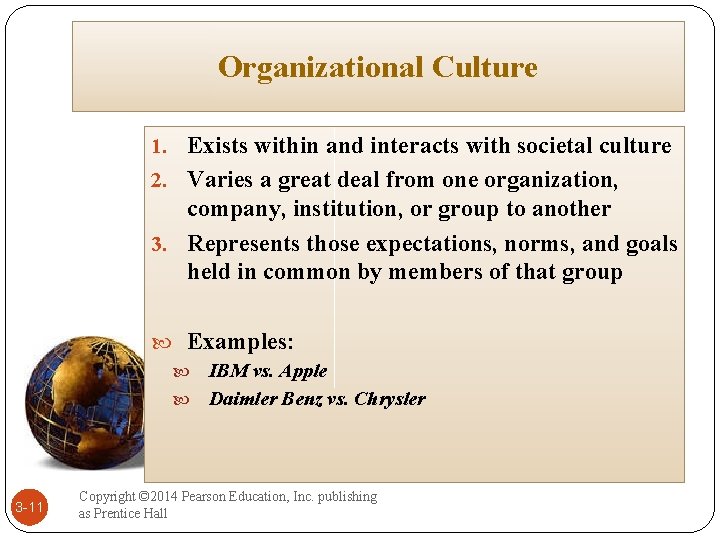
Organizational Culture 1. Exists within and interacts with societal culture 2. Varies a great deal from one organization, company, institution, or group to another 3. Represents those expectations, norms, and goals held in common by members of that group Examples: IBM vs. Apple Daimler Benz vs. Chrysler 3 -11 Copyright © 2014 Pearson Education, Inc. publishing as Prentice Hall
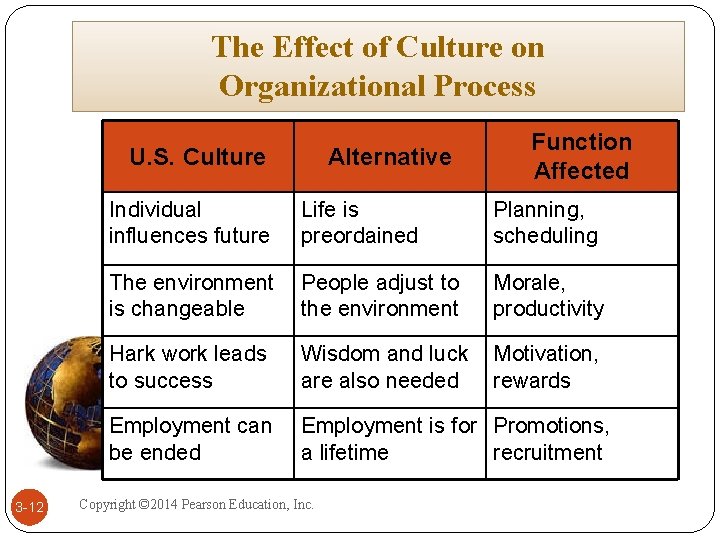
The Effect of Culture on Organizational Process U. S. Culture 3 -12 Alternative Function Affected Individual influences future Life is preordained Planning, scheduling The environment is changeable People adjust to the environment Morale, productivity Hark work leads to success Wisdom and luck are also needed Motivation, rewards Employment can be ended Employment is for Promotions, a lifetime recruitment Copyright © 2014 Pearson Education, Inc.
Chapter Learning Goals To emphasize the need for international managers to have cultural intelligence in order to interact successfully in host countries 3 -13 Copyright © 2014 Pearson Education, Inc.
Culture’s Effects on Management Convergence—the phenomenon of the shifting of individual management styles to become similar to one another Self-Reference Criterion—the subconscious reference point of one’s own cultural values. Many people in the world understand relate to others only in terms of their own cultures. Parochialism—occurs, for example, when a Frenchman expects those from or in another country to automatically fall into patterns of behavior common in France Ethnocentrism—describes the attitude of those who operate from the assumption that their ways of doing things are best—no matter where or under what conditions they are applied 3 -14 Copyright © 2014 Pearson Education, Inc.
Influences on National Culture Subcultures � Many countries comprise diverse subcultures whose constituents conform only in varying degrees to the national character. Example: Canada 3 -15 Copyright © 2014 Pearson Education, Inc. Stereotyping A cultural profile that tends to develop some tentative expectations—some cultural context—as a backdrop to managing in a specific international setting
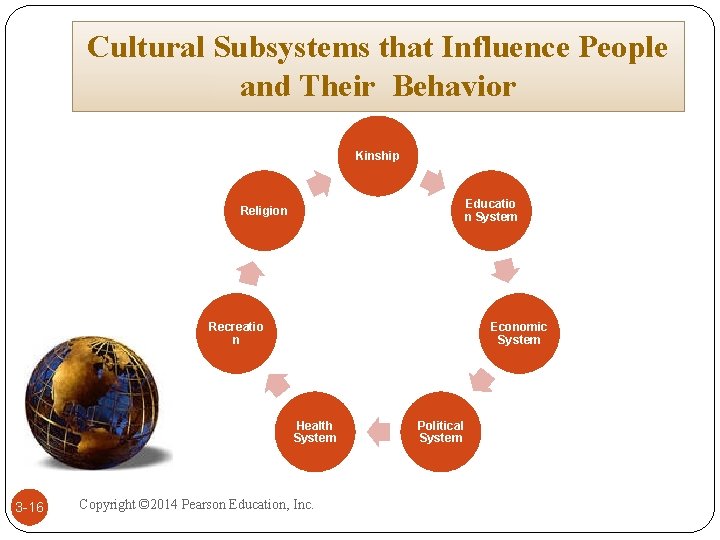
Cultural Subsystems that Influence People and Their Behavior Kinship Educatio n System Religion Recreatio n Economic System Health System 3 -16 Copyright © 2014 Pearson Education, Inc. Political System
Chapter Learning Goals To be able to distinguish the major dimensions which define cultural differences among societies or groups 3 -17 Copyright © 2014 Pearson Education, Inc.
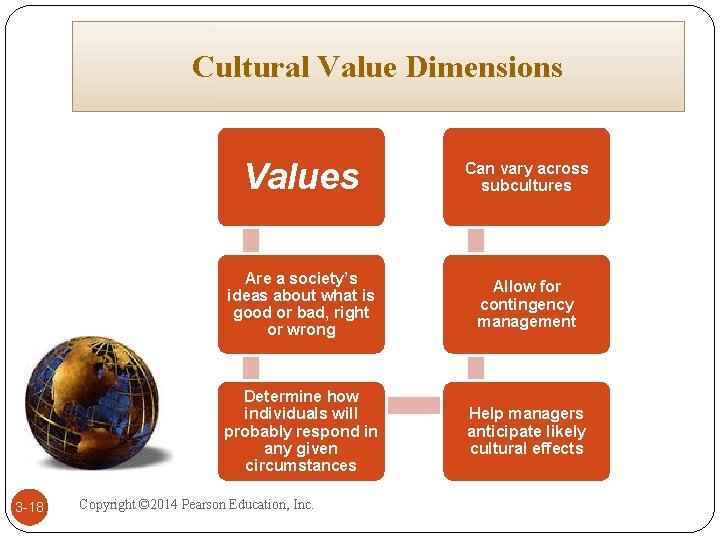
Cultural Value Dimensions 3 -18 Values Can vary across subcultures Are a society’s ideas about what is good or bad, right or wrong Allow for contingency management Determine how individuals will probably respond in any given circumstances Help managers anticipate likely cultural effects Copyright © 2014 Pearson Education, Inc.
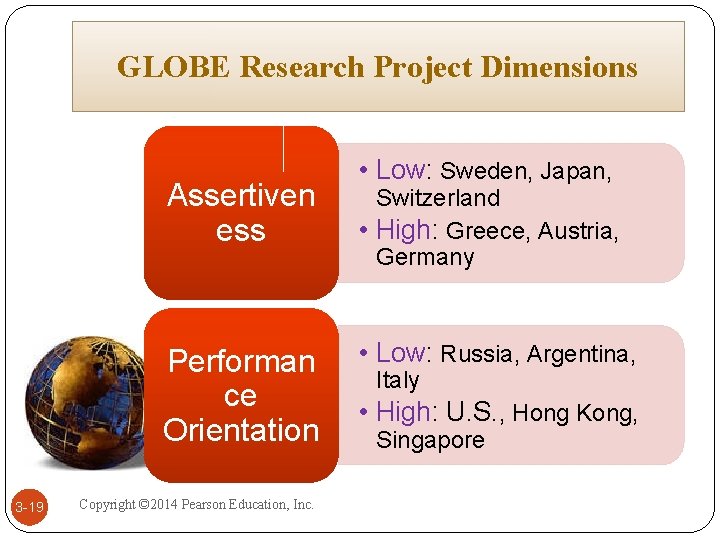
GLOBE Research Project Dimensions Assertiven ess Performan ce Orientation 3 -19 Copyright © 2014 Pearson Education, Inc. • Low: Sweden, Japan, Switzerland • High: Greece, Austria, Germany • Low: Russia, Argentina, Italy • High: U. S. , Hong Kong, Singapore
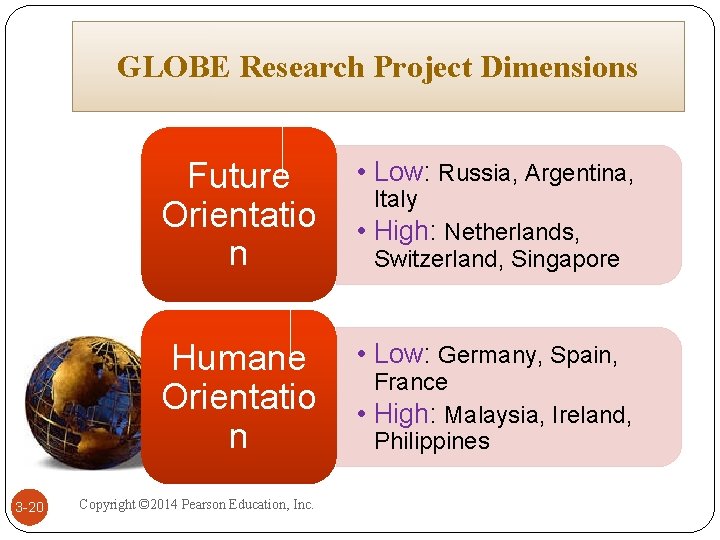
GLOBE Research Project Dimensions 3 -20 Future Orientatio n • Low: Russia, Argentina, Humane Orientatio n • Low: Germany, Spain, Copyright © 2014 Pearson Education, Inc. Italy • High: Netherlands, Switzerland, Singapore France • High: Malaysia, Ireland, Philippines
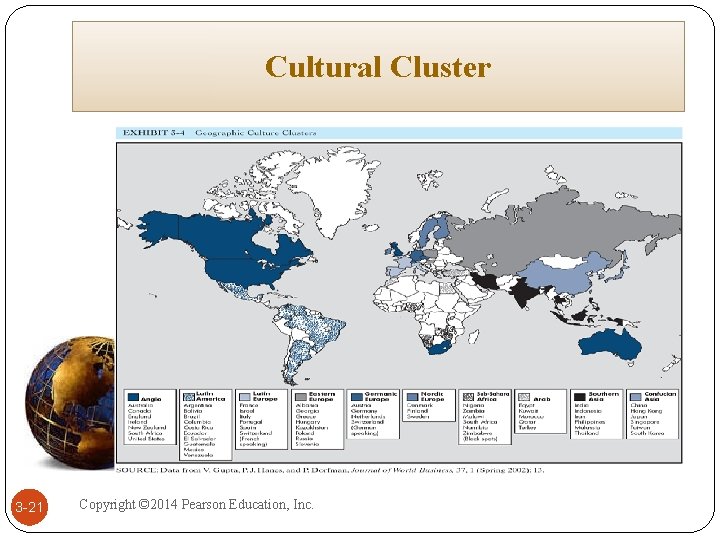
Cultural Cluster 3 -21 Copyright © 2014 Pearson Education, Inc.
Chapter Learning Goals To recognize the critical value differences which frequently affect job behaviors 3 -22 Copyright © 2014 Pearson Education, Inc.
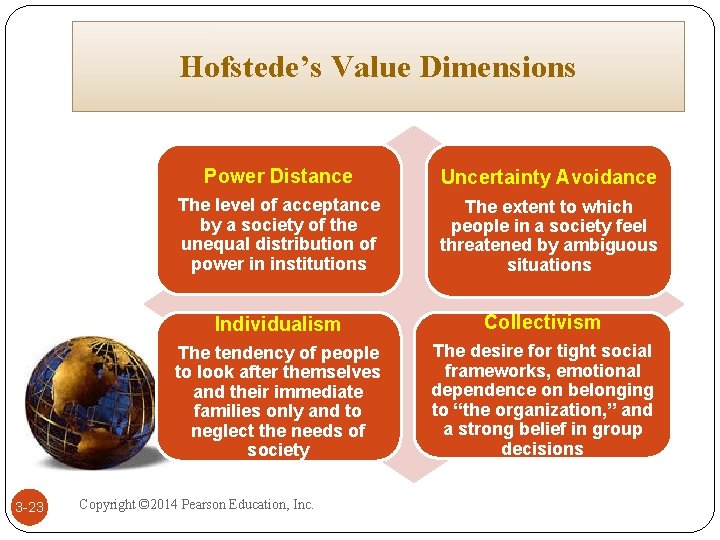
Hofstede’s Value Dimensions 3 -23 Power Distance Uncertainty Avoidance The level of acceptance by a society of the unequal distribution of power in institutions The extent to which people in a society feel threatened by ambiguous situations Individualism Collectivism The tendency of people to look after themselves and their immediate families only and to neglect the needs of society The desire for tight social frameworks, emotional dependence on belonging to “the organization, ” and a strong belief in group decisions Copyright © 2014 Pearson Education, Inc.
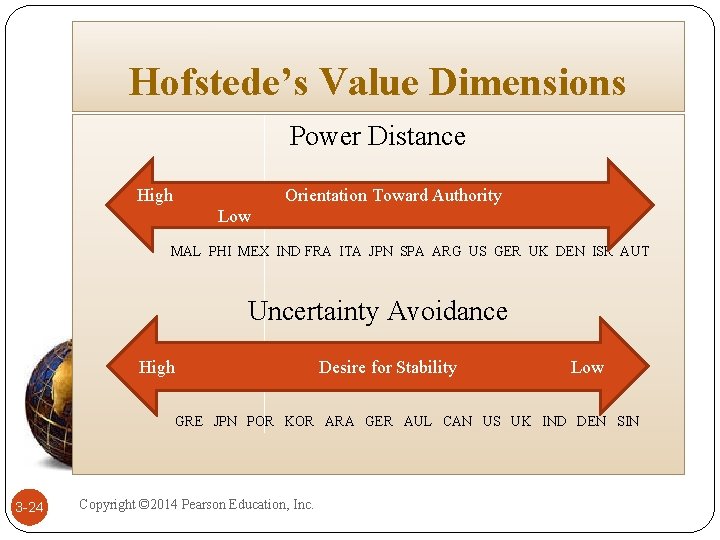
Hofstede’s Value Dimensions Power Distance High Orientation Toward Authority Low MAL PHI MEX IND FRA ITA JPN SPA ARG US GER UK DEN ISR AUT Uncertainty Avoidance High Desire for Stability Low GRE JPN POR KOR ARA GER AUL CAN US UK IND DEN SIN 3 -24 Copyright © 2014 Pearson Education, Inc.
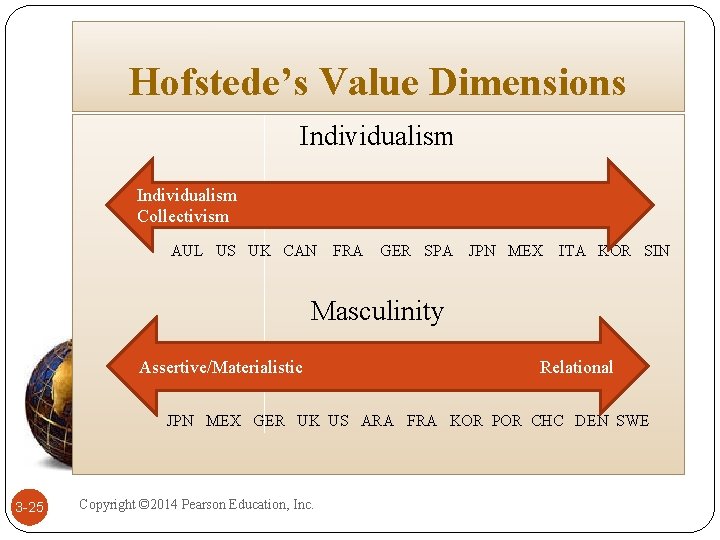
Hofstede’s Value Dimensions Individualism Collectivism AUL US UK CAN FRA GER SPA JPN MEX ITA KOR SIN Masculinity Assertive/Materialistic Relational JPN MEX GER UK US ARA FRA KOR POR CHC DEN SWE 3 -25 Copyright © 2014 Pearson Education, Inc.
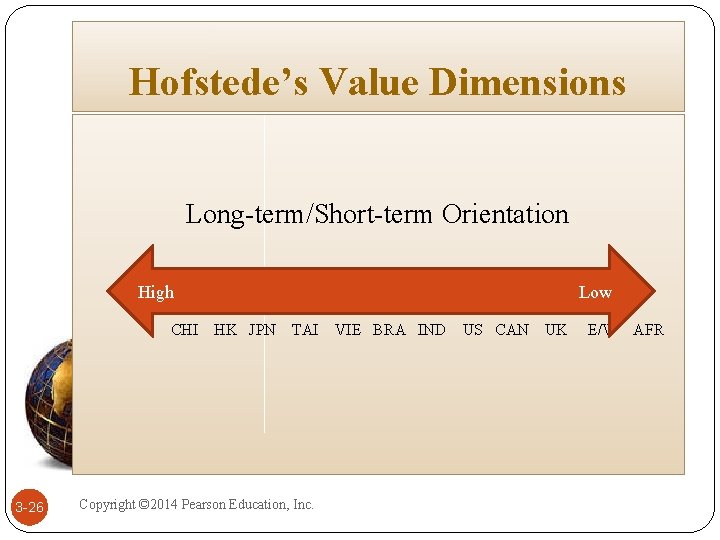
Hofstede’s Value Dimensions Long-term/Short-term Orientation High CHI 3 -26 Low HK JPN TAI Copyright © 2014 Pearson Education, Inc. VIE BRA IND US CAN UK E/W AFR
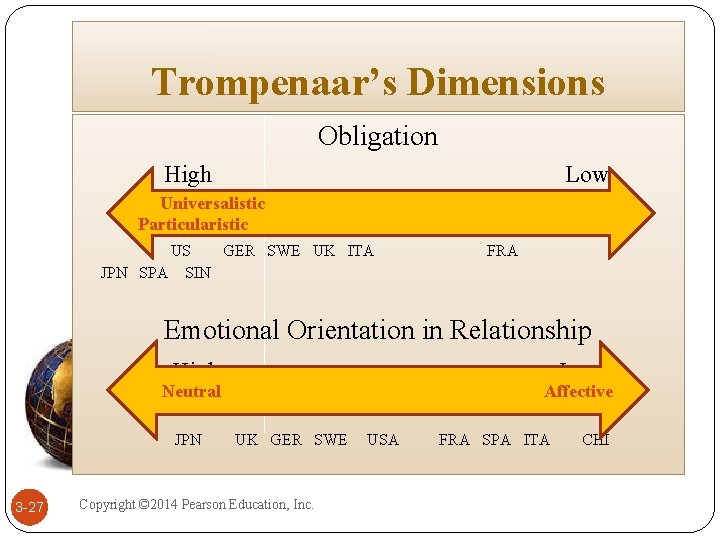
Trompenaar’s Dimensions Obligation High Low Universalistic Particularistic US GER SWE UK ITA JPN SPA SIN FRA Emotional Orientation in Relationship High Low Neutral JPN 3 -27 Affective UK GER SWE Copyright © 2014 Pearson Education, Inc. USA FRA SPA ITA CHI
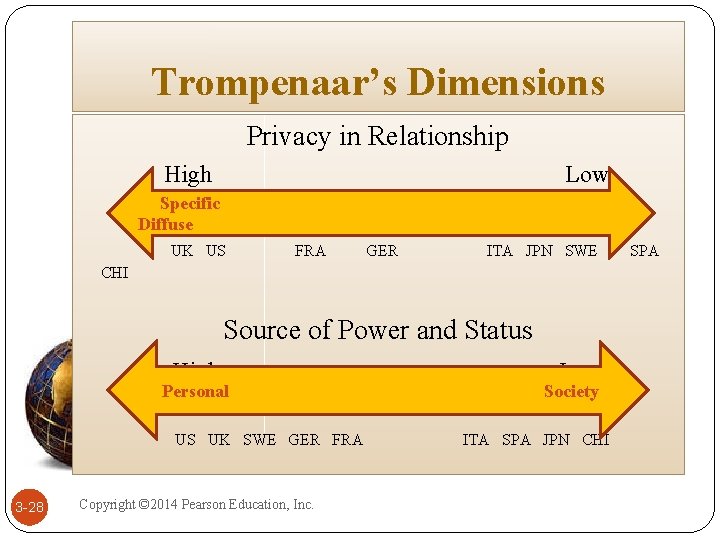
Trompenaar’s Dimensions Privacy in Relationship High Low Specific Diffuse UK US FRA GER ITA JPN SWE CHI Source of Power and Status High Personal US UK SWE GER FRA 3 -28 Copyright © 2014 Pearson Education, Inc. Low Society ITA SPA JPN CHI SPA
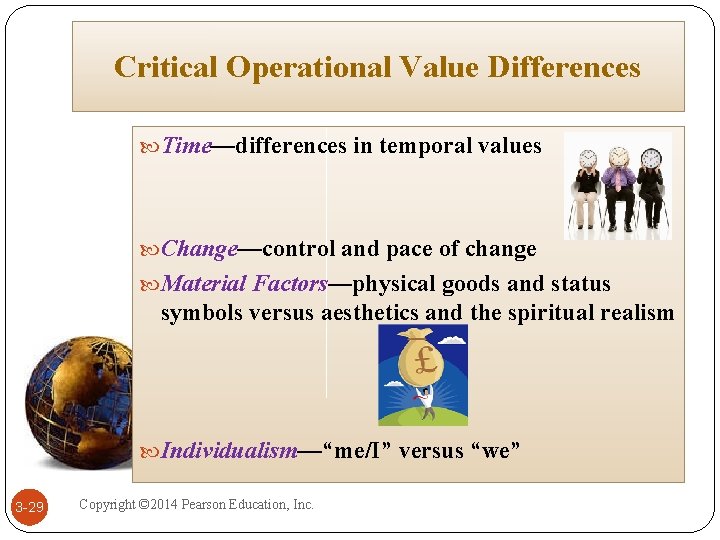
Critical Operational Value Differences Time—differences in temporal values Change—control and pace of change Material Factors—physical goods and status symbols versus aesthetics and the spiritual realism Individualism—“me/I” versus “we” 3 -29 Copyright © 2014 Pearson Education, Inc.
Chapter Learning Goals To understand the interaction between culture and the use of internet 3 -30 Copyright © 2014 Pearson Education, Inc.
The Internet and Culture Over 81 percent of Korean homes have high-speed Internet service. Sweden requires all databases of personal information to be registered with the Data Inspection Board, their federal regulatory agency About 75 percent of the world’s Internet market lives outside the United States: websites must reflect local markets, customs, languages and currencies 3 -31 Copyright © 2014 Pearson Education, Inc.
Chapter Learning Goals To be able to develop a working “cultural profile” typical of many people within a certain society, as an aid to expected attitudes toward work, negotiations, etc. 3 -32 Copyright © 2014 Pearson Education, Inc.
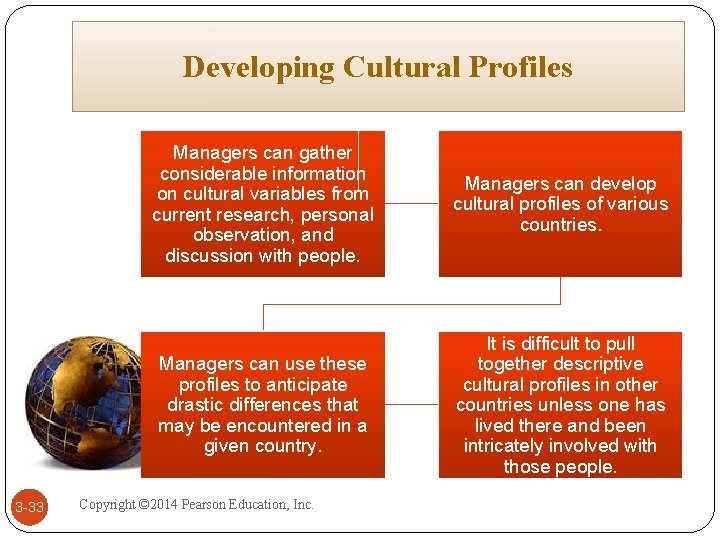
Developing Cultural Profiles 3 -33 Managers can gather considerable information on cultural variables from current research, personal observation, and discussion with people. Managers can develop cultural profiles of various countries. Managers can use these profiles to anticipate drastic differences that may be encountered in a given country. It is difficult to pull together descriptive cultural profiles in other countries unless one has lived there and been intricately involved with those people. Copyright © 2014 Pearson Education, Inc.
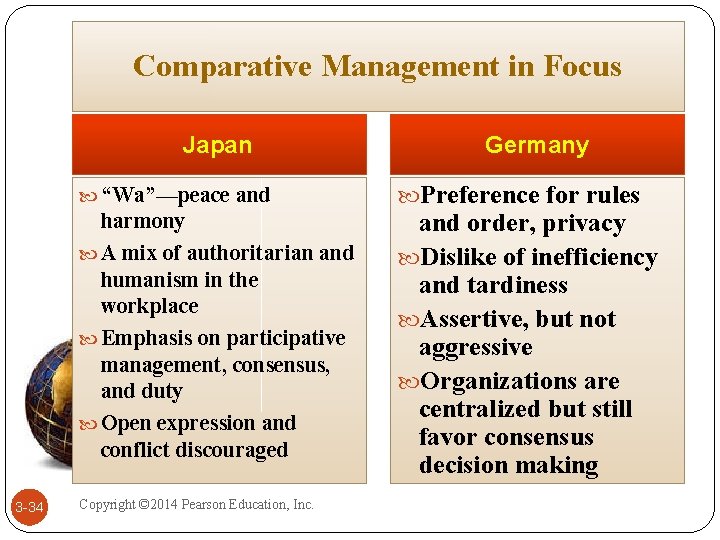
Comparative Management in Focus Japan “Wa”—peace and harmony A mix of authoritarian and humanism in the workplace Emphasis on participative management, consensus, and duty Open expression and conflict discouraged 3 -34 Copyright © 2014 Pearson Education, Inc. Germany Preference for rules and order, privacy Dislike of inefficiency and tardiness Assertive, but not aggressive Organizations are centralized but still favor consensus decision making
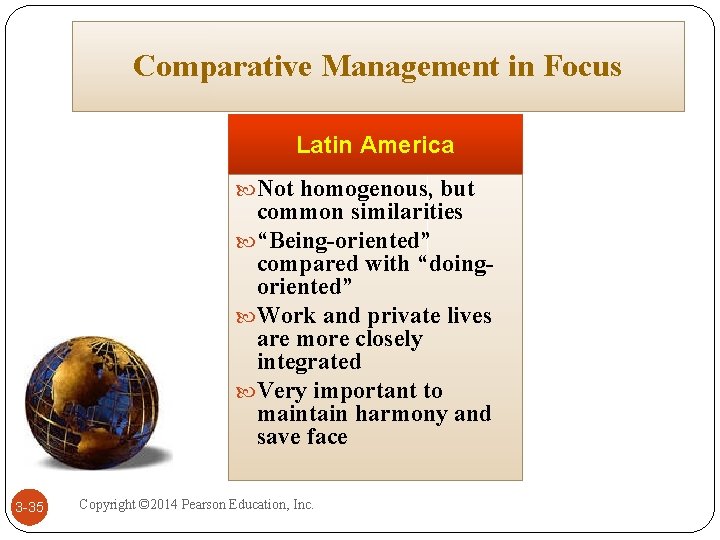
Comparative Management in Focus Latin America Not homogenous, but common similarities “Being-oriented” compared with “doingoriented” Work and private lives are more closely integrated Very important to maintain harmony and save face 3 -35 Copyright © 2014 Pearson Education, Inc.
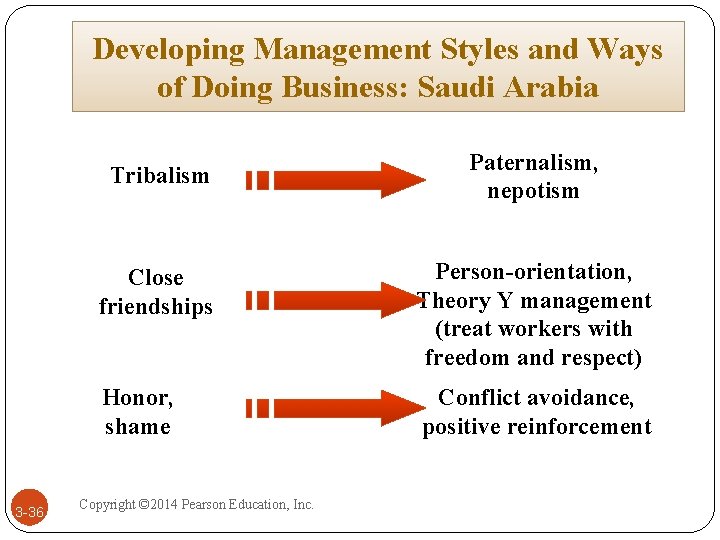
Developing Management Styles and Ways of Doing Business: Saudi Arabia Tribalism 3 -36 Paternalism, nepotism Close friendships Person-orientation, Theory Y management (treat workers with freedom and respect) Honor, shame Conflict avoidance, positive reinforcement Copyright © 2014 Pearson Education, Inc.
Developing Management Styles and Ways of Doing Business: Chinese Family Business Small, family businesses predominate “Guanxi” connections People are put ahead of business – human centered management style Globalization has resulted in more competitive management styles: the new generation manager is more individualistic, more independent and takes more risks 3 -37 Copyright © 2014 Pearson Education, Inc.
Under the Lens: Doing Business in Brazil Almost everyone has a combination of European, African, and indigenous ancestry Individual relationships are important Brazilians take time when negotiating Brazilian business is hierarchical, and meetings are required Avoid confrontations Dress well and conservatively Business cards are exchanged Having your business card printed in Portuguese on the obverse side is a good idea. 3 -38 Copyright © 2014 Pearson Education, Inc.
Summary of Key Points Each society has its own unique culture Managers must develop cultural sensitivity Researchers such as Hofstede and Trompenaar have created studies which help describe cultural profiles; GLOBE study created a body of data on cultural dimensions Managers can use research results and personal observations to develop cultural profiles of countries 3 -39 Copyright © 2014 Pearson Education, Inc.
All rights reserved. No part of this publication may be reproduced, stored in a retrieval system, or transmitted, in any form or by any means, electronic, mechanical, photocopying, recording, or otherwise, without the prior written permission of the publisher. Printed in the United States of America. Copyright © 2014 Pearson Education, Inc. 40