Changing the Conversation Taking Trauma Into Account When



- Slides: 33
Changing the Conversation: Taking Trauma Into Account When Representing Children in Foster Care -Kristen Bell, JD, M. Ed Texas Lawyers for Children © 2019 Texas Lawyers for Children
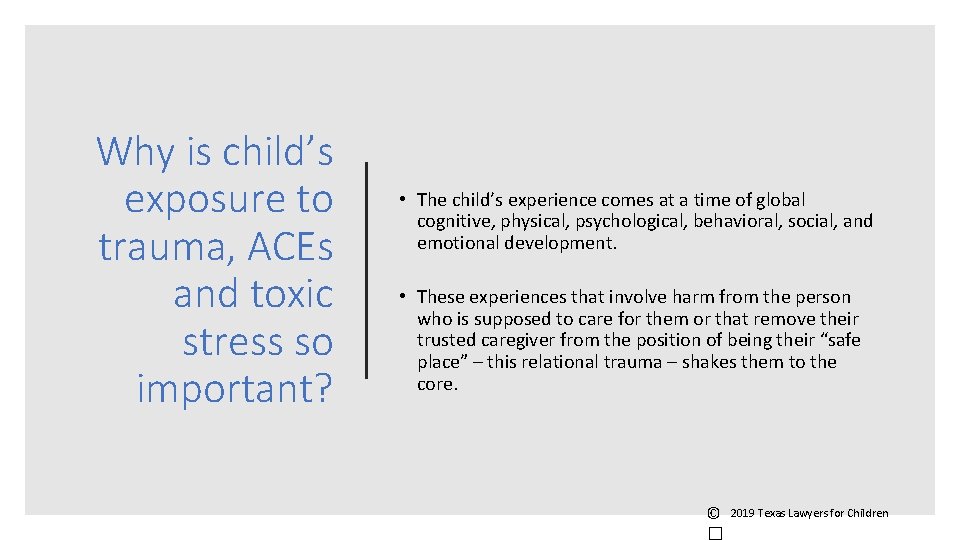
Why is child’s exposure to trauma, ACEs and toxic stress so important? • The child’s experience comes at a time of global cognitive, physical, psychological, behavioral, social, and emotional development. • These experiences that involve harm from the person who is supposed to care for them or that remove their trusted caregiver from the position of being their “safe place” – this relational trauma – shakes them to the core. © 2019 Texas Lawyers for Children
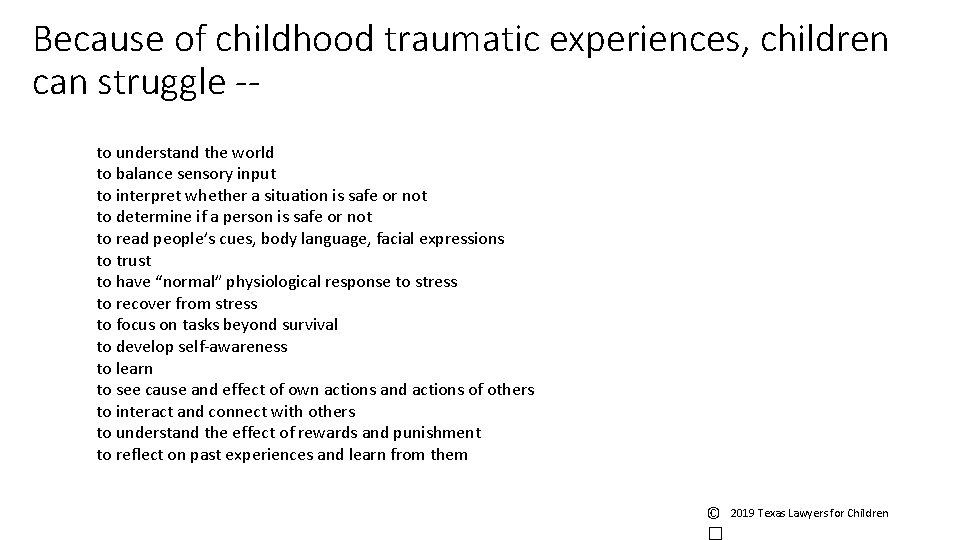
Because of childhood traumatic experiences, children can struggle -to understand the world to balance sensory input to interpret whether a situation is safe or not to determine if a person is safe or not to read people’s cues, body language, facial expressions to trust to have “normal” physiological response to stress to recover from stress to focus on tasks beyond survival to develop self-awareness to learn to see cause and effect of own actions and actions of others to interact and connect with others to understand the effect of rewards and punishment to reflect on past experiences and learn from them © 2019 Texas Lawyers for Children
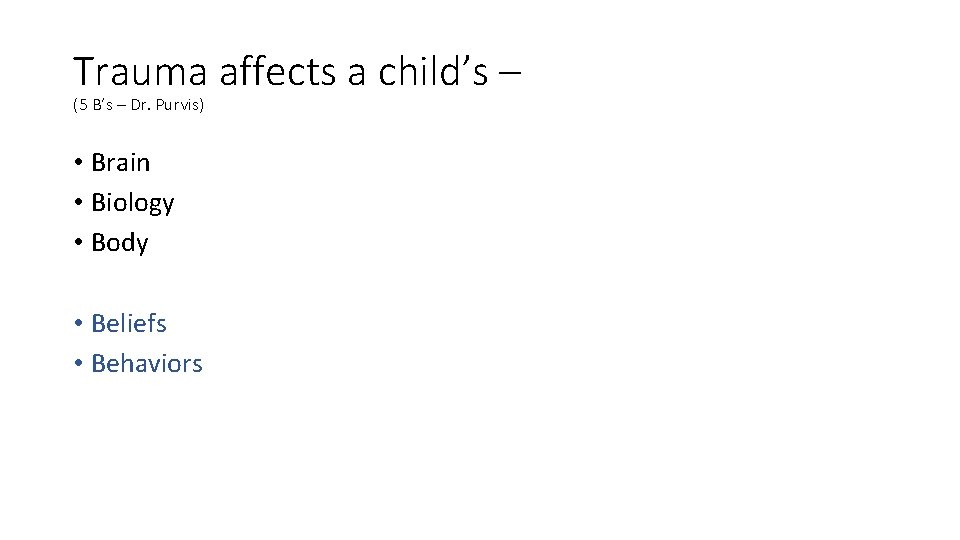
Trauma affects a child’s – (5 B’s – Dr. Purvis) • Brain • Biology • Body • Beliefs • Behaviors
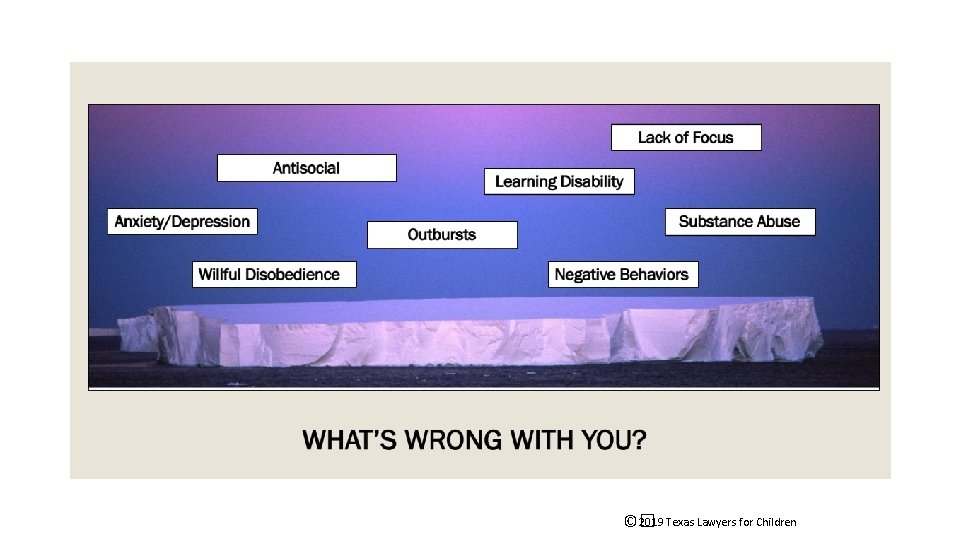
How Do We Misunderstand the Behaviors of Children Who Have Suffered the Trauma of Abuse and Neglect?
DOWNWARD SPIRAL OF HARM 2019 Texas Lawyers for Children ©�
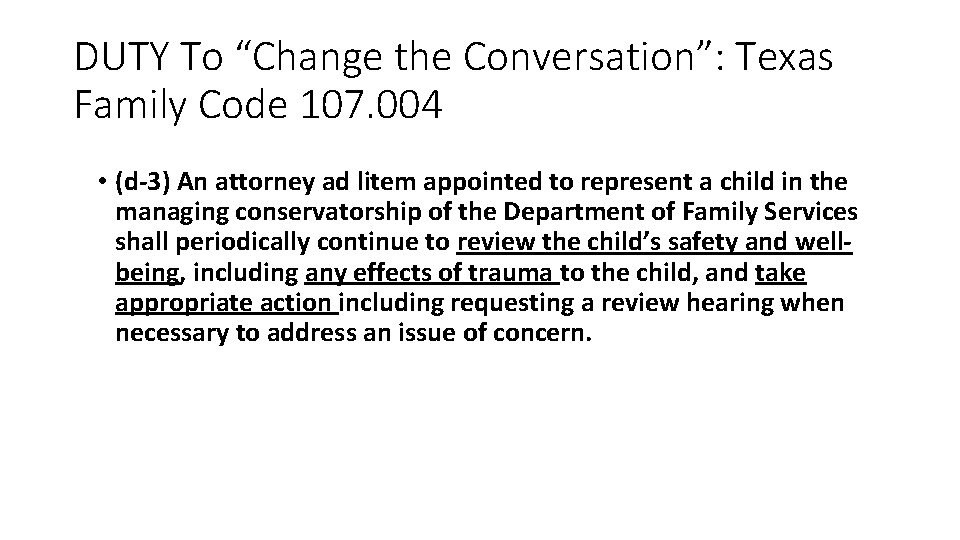
DUTY To “Change the Conversation”: Texas Family Code 107. 004 • (d-3) An attorney ad litem appointed to represent a child in the managing conservatorship of the Department of Family Services shall periodically continue to review the child’s safety and wellbeing, including any effects of trauma to the child, and take appropriate action including requesting a review hearing when necessary to address an issue of concern.
2019 Texas Lawyers for Children ©�
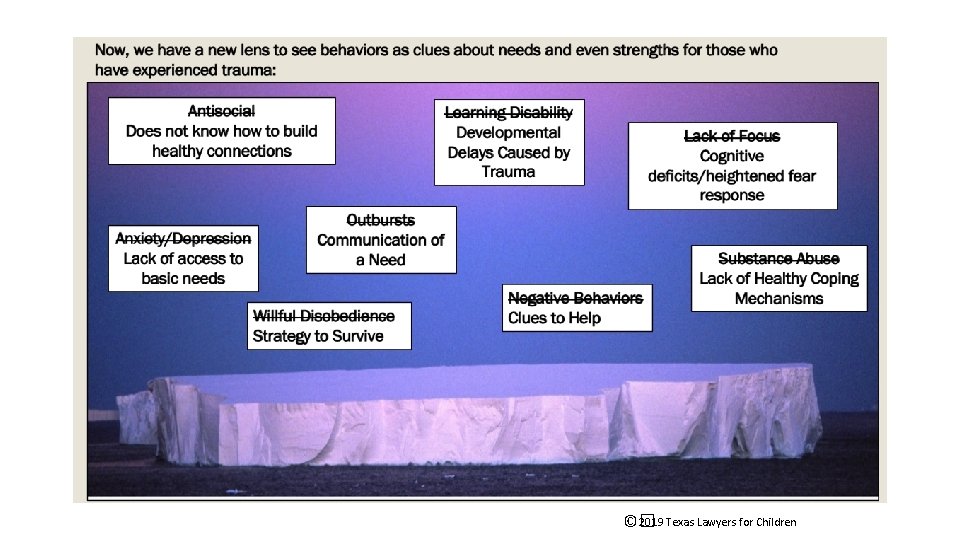
When looking to help the child heal and to prevent further harm, we have to change the questions. Instead of seeing behavior as something to “Fix”, we need to see behavior as a – *CLUE *COMMUNICATION *COPING STRATEGY 2019 Texas Lawyers for Children ©�
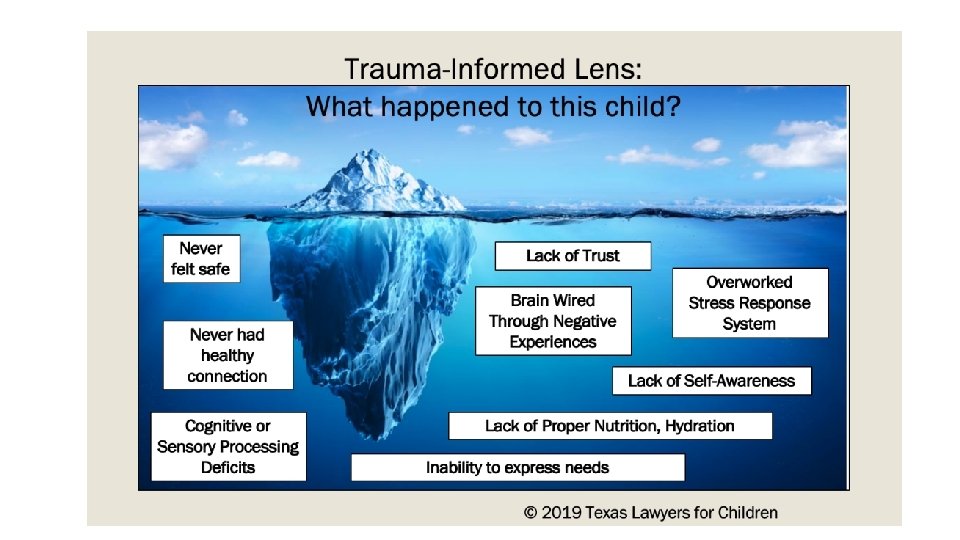
2019 Texas Lawyers for Children ©�
What IF. . .
What Does This Child Need? Connection Prerequisite to Connection: Safety Effect of Connection: Opportunity to Rewire © 2019 Texas Lawyers for Children
IMPORTANCE OF CONNECTION
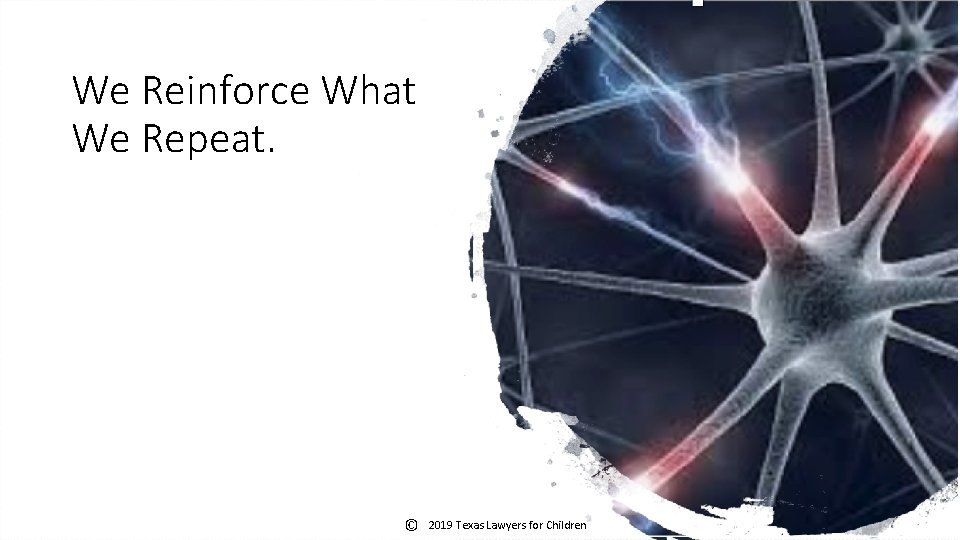
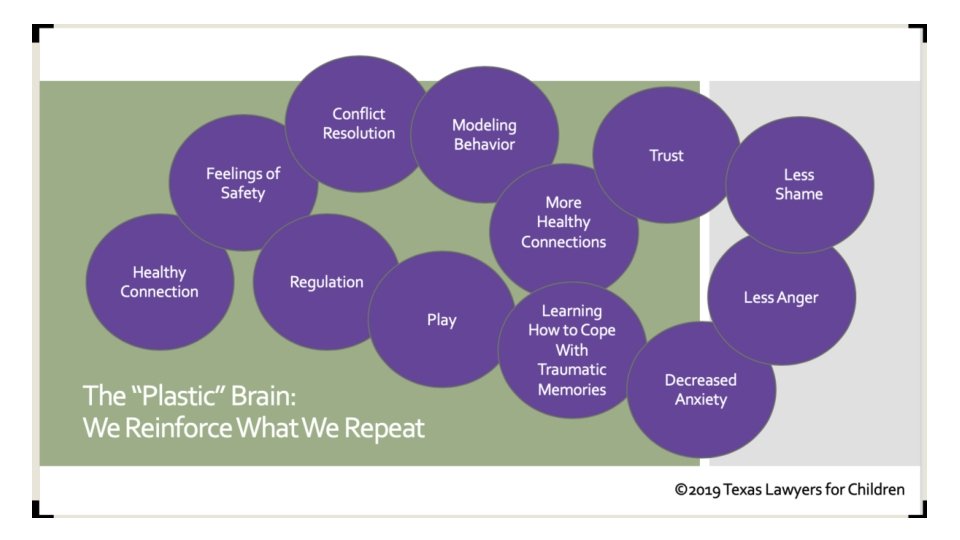
We Reinforce What We Repeat. © 2019 Texas Lawyers for Children
“Change the Conversation” • In Informal Advocacy Efforts • In Interactions with Client • In Oral/Written Advocacy in Court © 2019 Texas Lawyers for Children
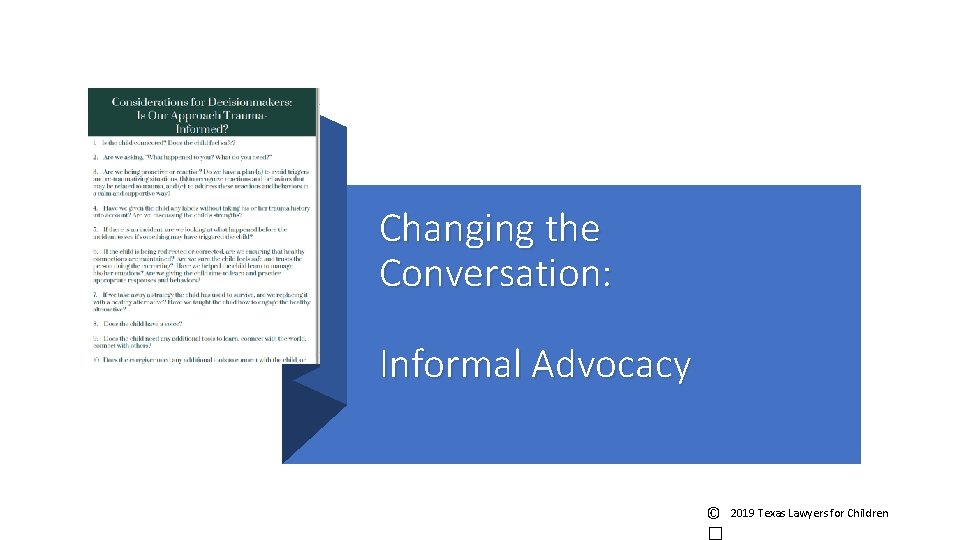
Changing the Conversation: Informal Advocacy © 2019 Texas Lawyers for Children
1. Is the child connected? Does the child feel safe? © 2019 Texas Lawyers for Children
2. Are we asking, “What happened to this child? What does this child need? ” © 2019 Texas Lawyers for Children
3. Are we being PROACTIVE or REACTIVE? Do we have a plan to prevent and/or address behaviors? © 2019 Texas Lawyers for Children
4. Have we given the child any labels without taking his or her trauma into account? © 2019 Texas Lawyers for Children
5. If there is an incident, are we looking at what happened before the incident to see if anything triggered the child? © 2019 Texas Lawyers for Children
6 A. If the child is being redirected or corrected, are we ensuring that healthy connections are maintained? © 2019 Texas Lawyers for Children
6 B. Are we giving the child time – in a safe environment – to practice appropriate behaviors and responses? © 2019 Texas Lawyers for Children
7. If we take away a strategy a child has used to survive, are we replacing it with a healthy alternative? © 2019 Texas Lawyers for Children
8. Does the child have a voice? © 2019 Texas Lawyers for Children
9. Does the child need any additional tools to learn, connect with the world, connect with others? © 2019 Texas Lawyers for Children
10. Does the caregiver need any additional tools to connect with the child or help the child manage his or her emotions? © 2019 Texas Lawyers for Children
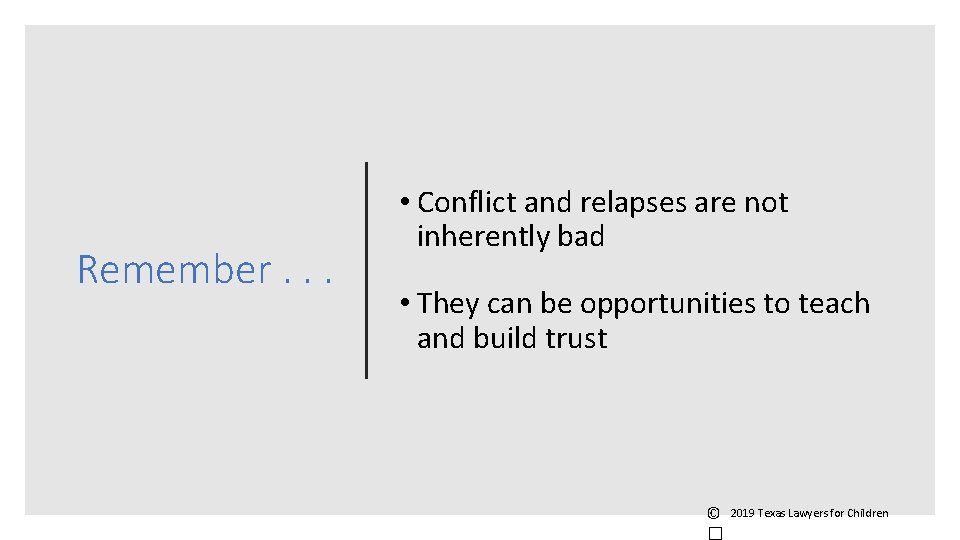
Remember. . . • Conflict and relapses are not inherently bad • They can be opportunities to teach and build trust © 2019 Texas Lawyers for Children
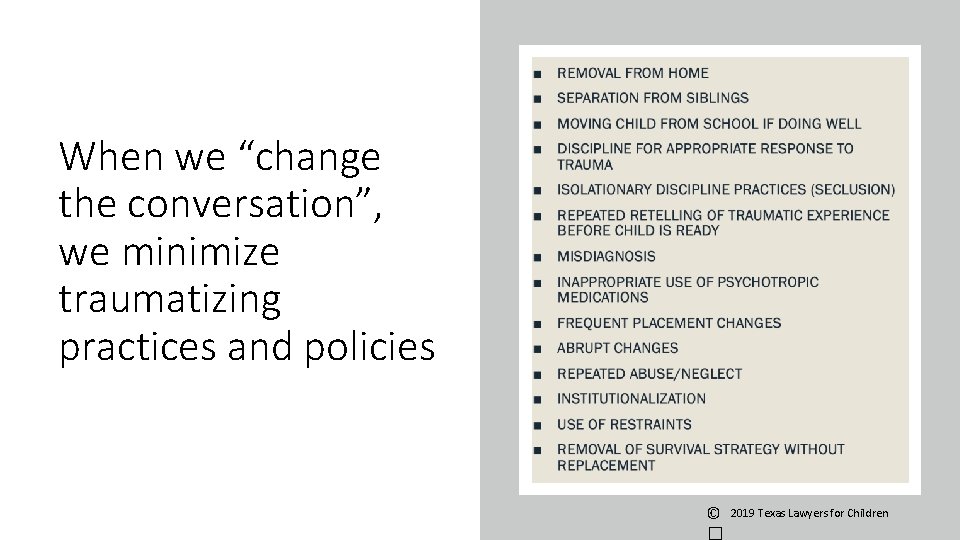
When we “change the conversation”, we minimize traumatizing practices and policies © 2019 Texas Lawyers for Children