ATOMIC THEORY Set up Cornell Notes Write G
- Slides: 60
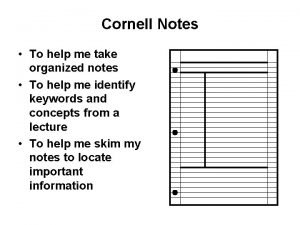
ATOMIC THEORY Set up Cornell Notes Write G 3 in upper right corner 1
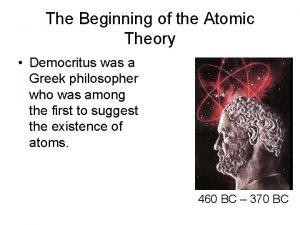
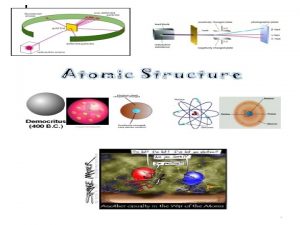
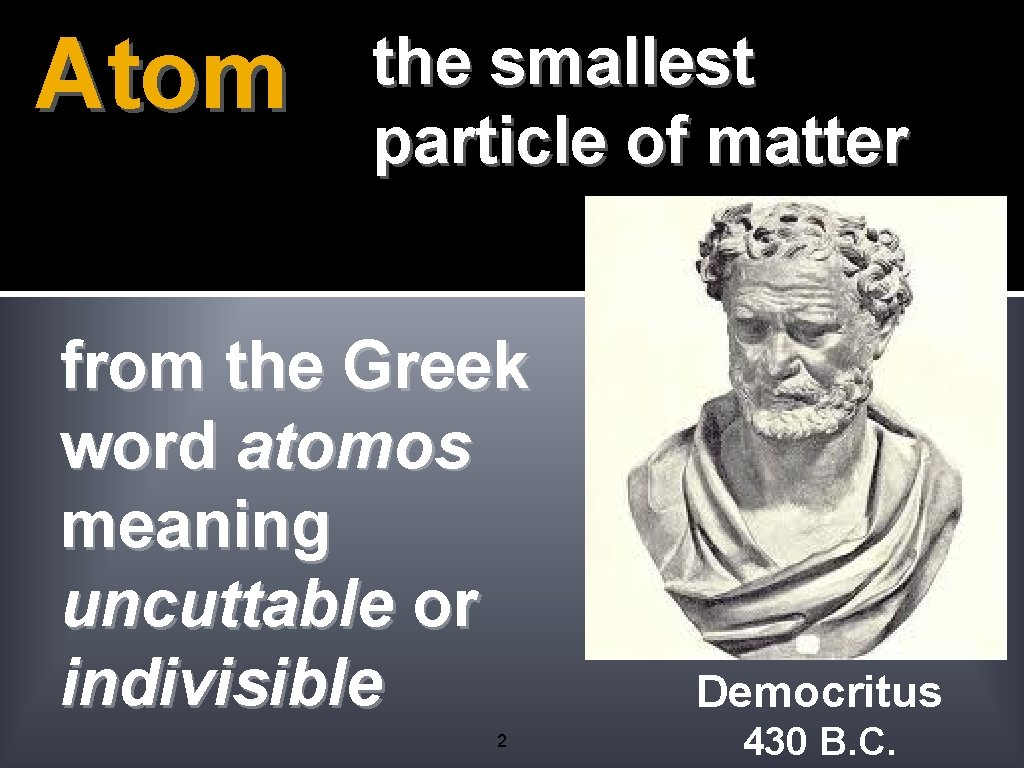
Atom the smallest particle of matter from the Greek word atomos meaning uncuttable or indivisible 2 Democritus 430 B. C.
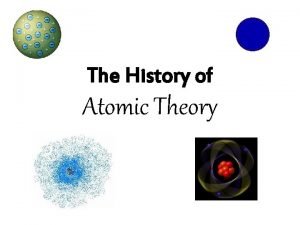
Atomic Theory …in 1600 s …grew as a series of models that developed from experimental evidence. As more evidence was collected, theory and models were revised. 3
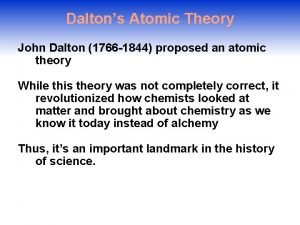
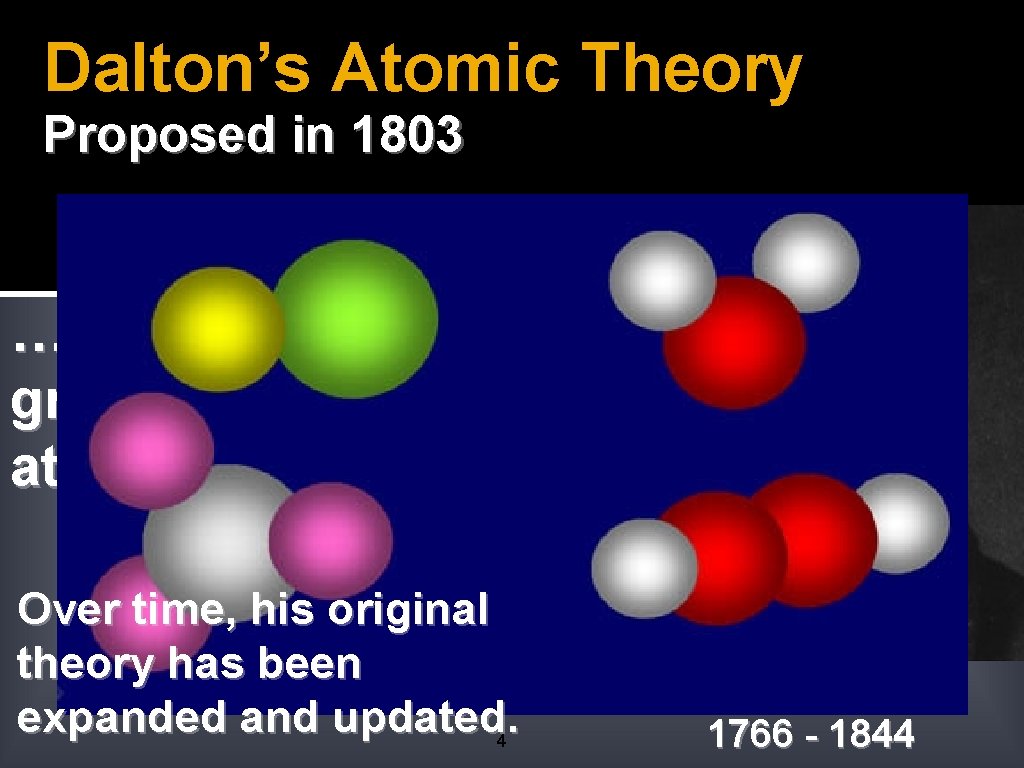
Dalton’s Atomic Theory Proposed in 1803 …laid the groundwork for later atomic models. Over time, his original theory has been expanded and updated. 4 John Dalton 1766 - 1844
Dalton’s Atomic Theory 1. 2. 3. 4. Atoms can’t be divided. Atoms of the same element are exactly alike with the same mass. Atom of one element can’t be changed into an atom of a different element. Atoms can’t be created or destroyed, only rearranged. Compounds are composed of atoms of different elements in specific ratios. 5
Dalton’s Atomic Theory With a few exceptions, Dalton’s theory is used TODAY! 6
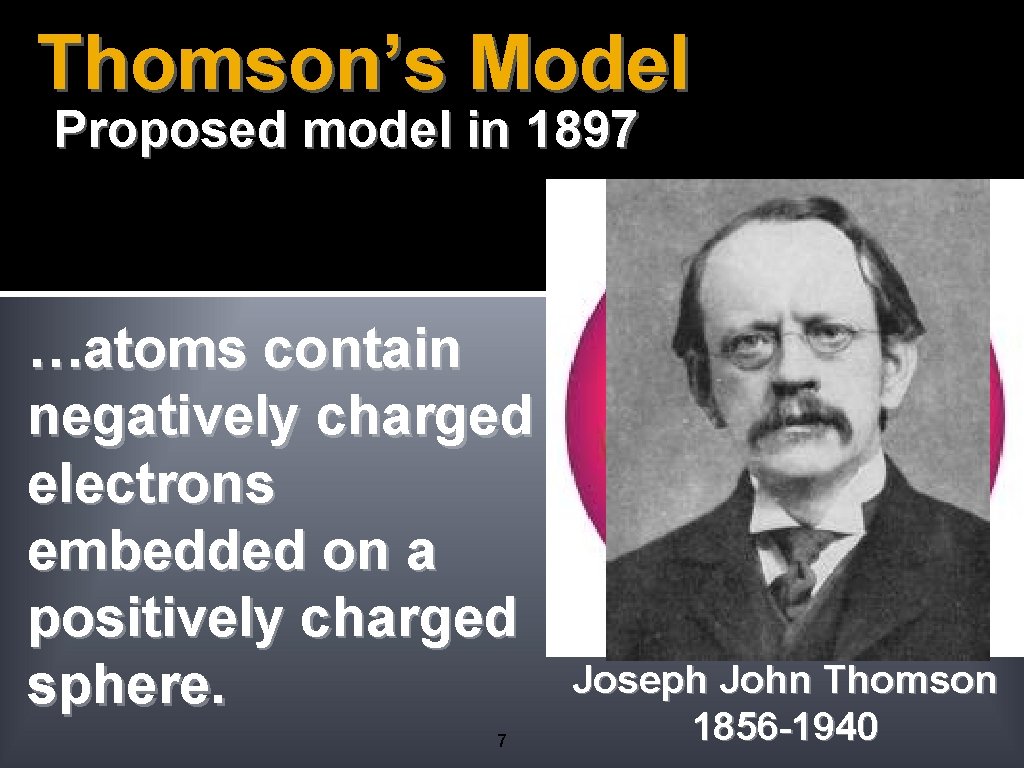
Thomson’s Model Proposed model in 1897 …atoms contain negatively charged electrons embedded on a positively charged sphere. 7 Joseph John Thomson 1856 -1940
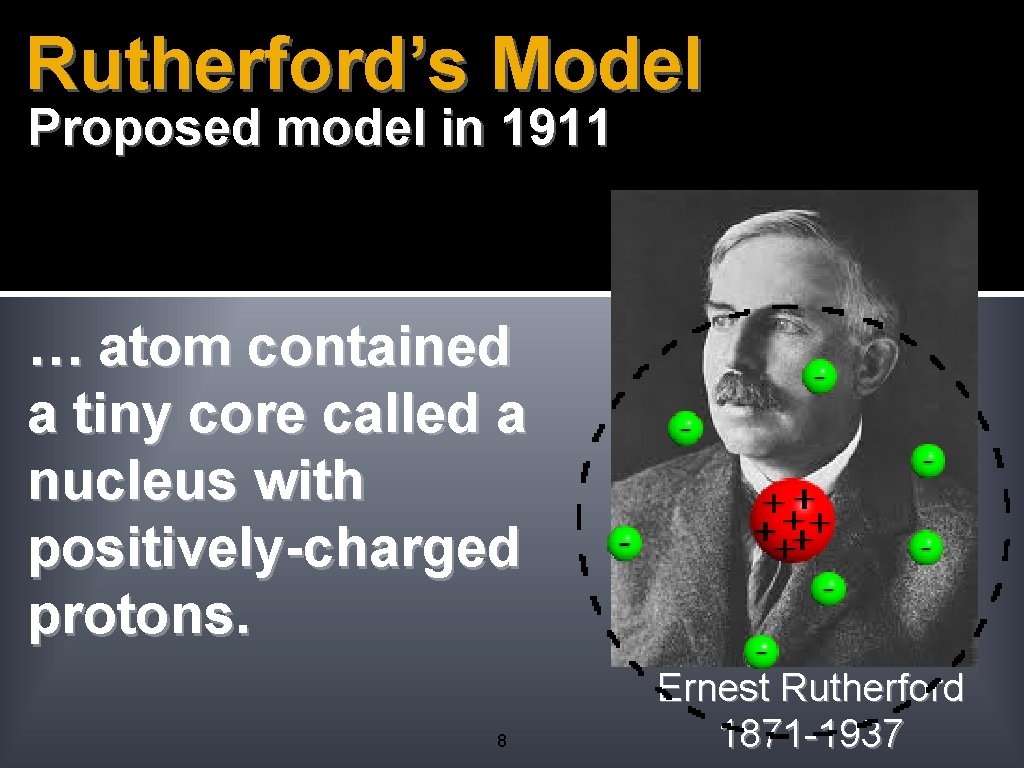
Rutherford’s Model Proposed model in 1911 … atom contained a tiny core called a nucleus with positively-charged protons. 8 Ernest Rutherford 1871 -1937
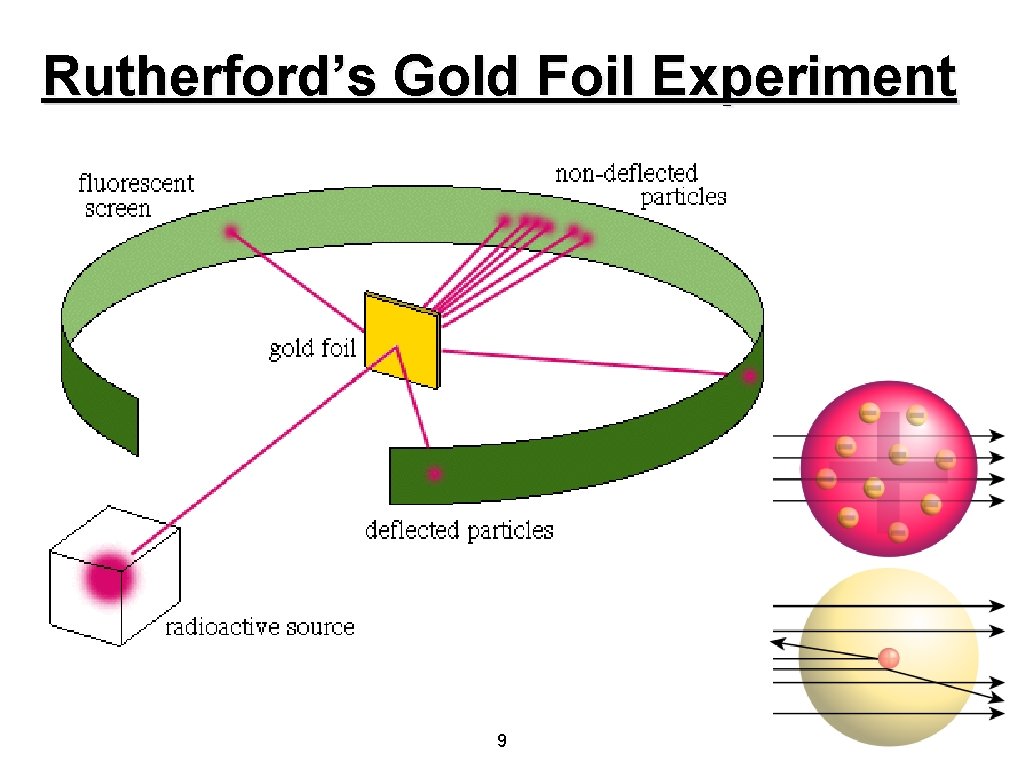
Rutherford’s Gold Foil Experiment 9
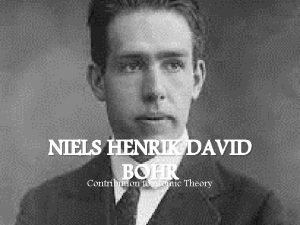
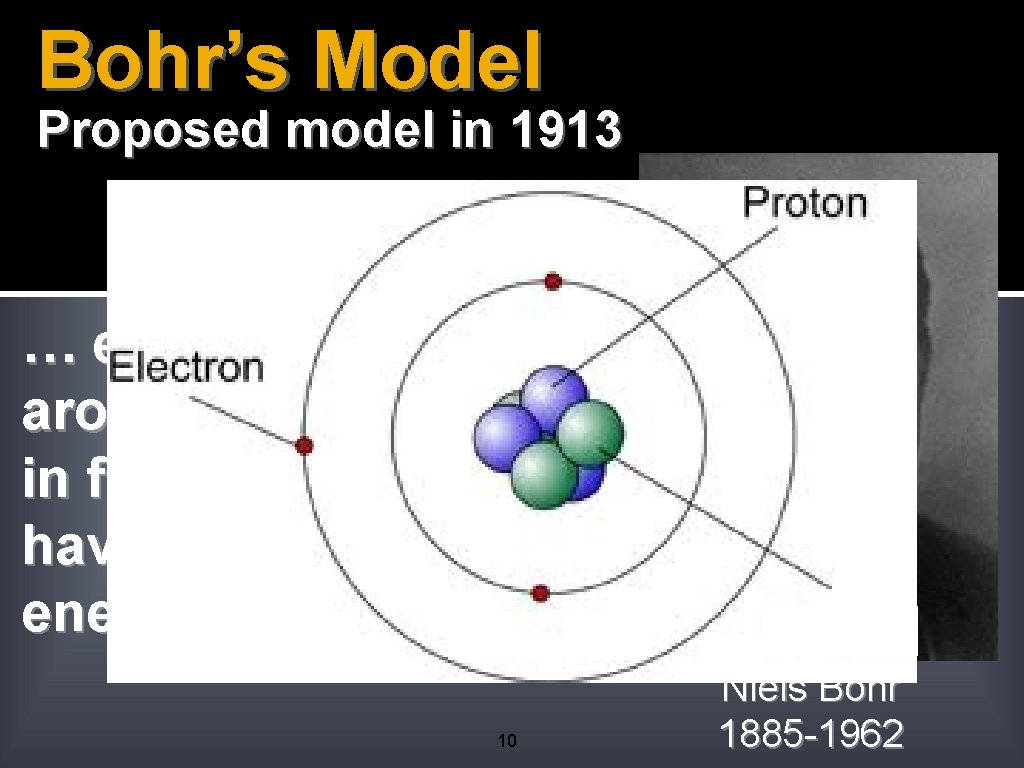
Bohr’s Model Proposed model in 1913 … electrons moving around the nucleus in fixed orbits that have a set amount of energy. 10 Niels Bohr 1885 -1962
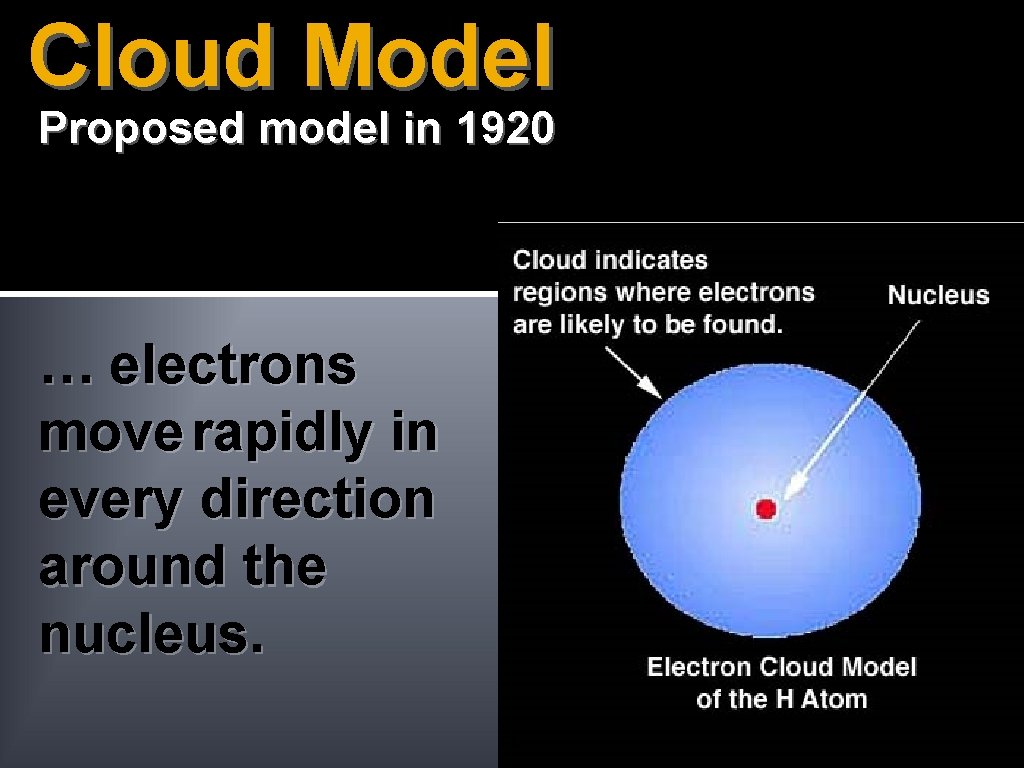
Cloud Model Proposed model in 1920 … electrons move rapidly in every direction around the nucleus. 11
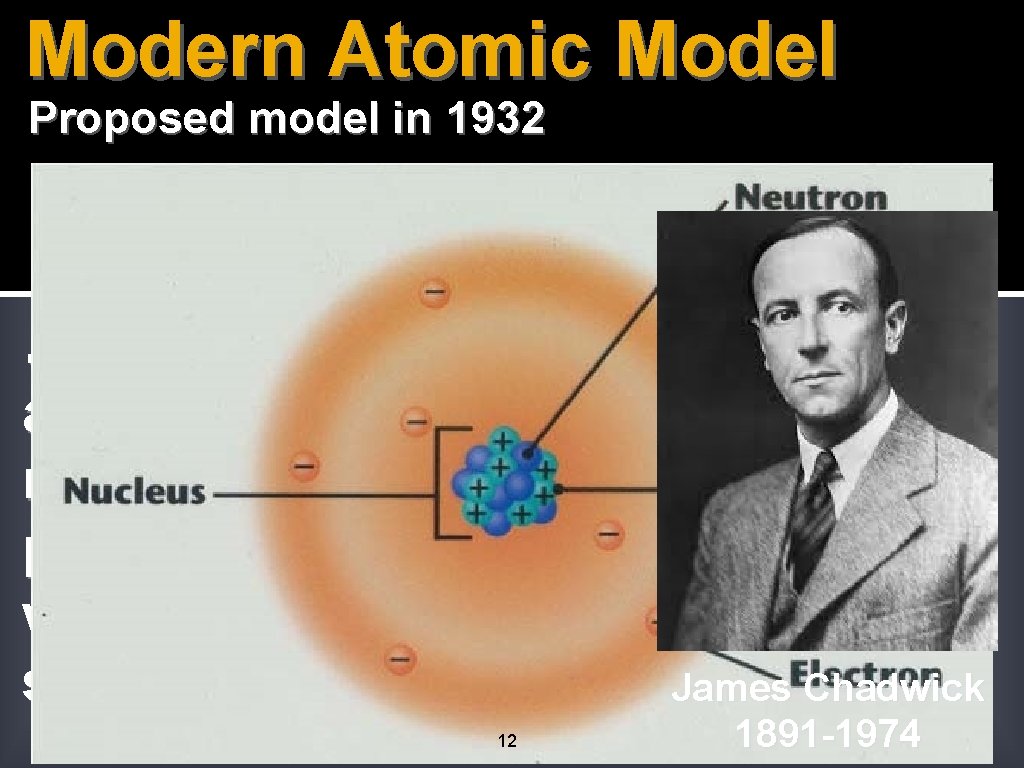
Modern Atomic Model Proposed model in 1932 … at the center of the atom is a massive nucleus made of protons and neutrons with a cloudlike region surrounding it. 12 James Chadwick 1891 -1974
ATOMIC THEORY TIMELINE On a piece of notebook paper (attached to your Cornell Notes), create a timeline of the development of the atomic theory from 430 BC through 1932. Include the following on your timeline: • year of the proposed model, idea, or advancement • name of the scientist responsible for the idea or model (if there is one) • sketch of the model with labels for each part (if there is a model) 13
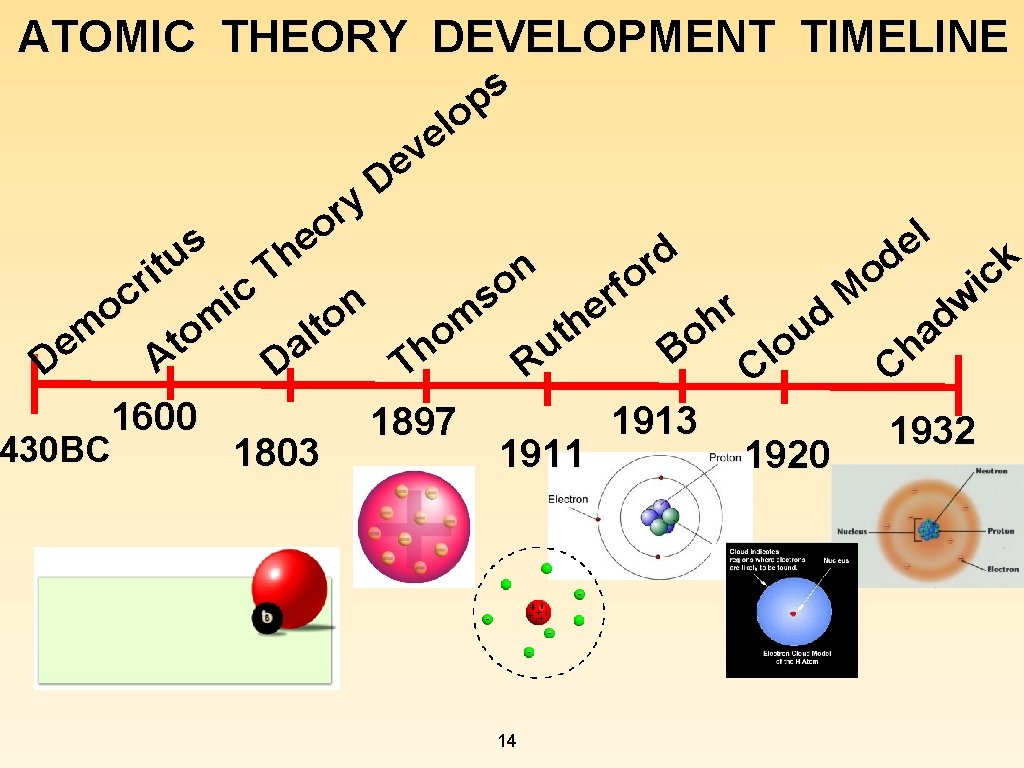
ATOMIC THEORY DEVELOPMENT TIMELINE s p o l e v e D y r o l e s e d h u d k r t n T i o c o r i o f c M c r i s w n r e o d m h t u m t l a o o o t e o a u h h B l A D D T R C C 1600 1913 1897 1932 430 BC 1803 1911 1920 14
Check for comprehension: • Review • Reinforce • Assess 15
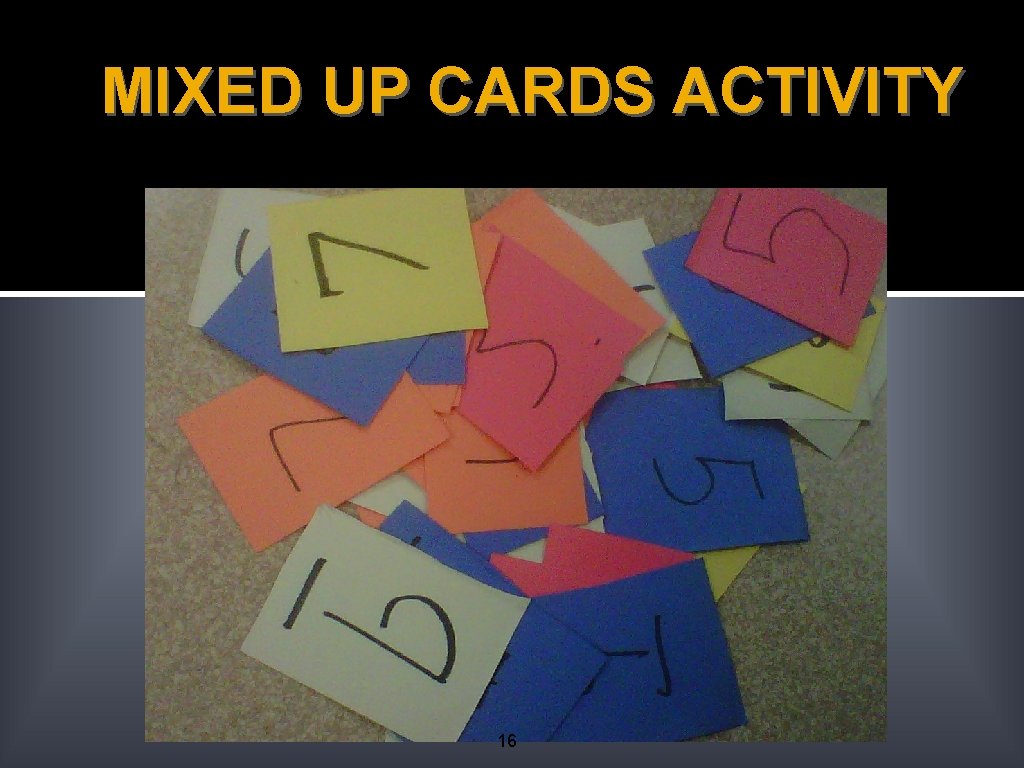
MIXED UP CARDS ACTIVITY 16
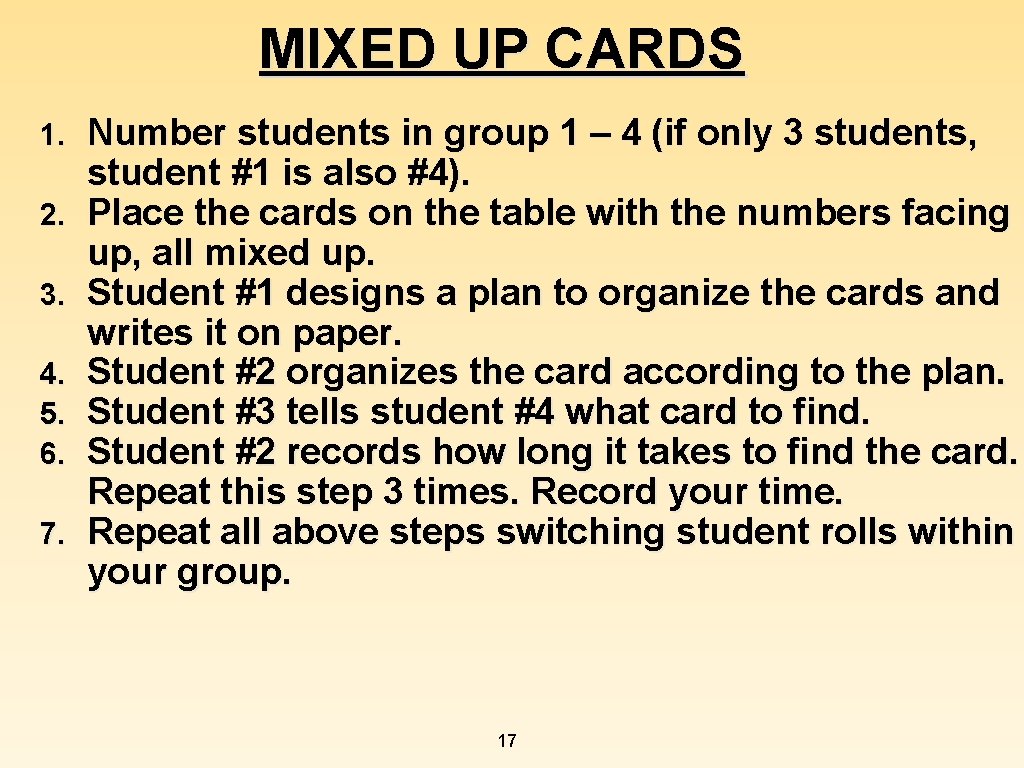
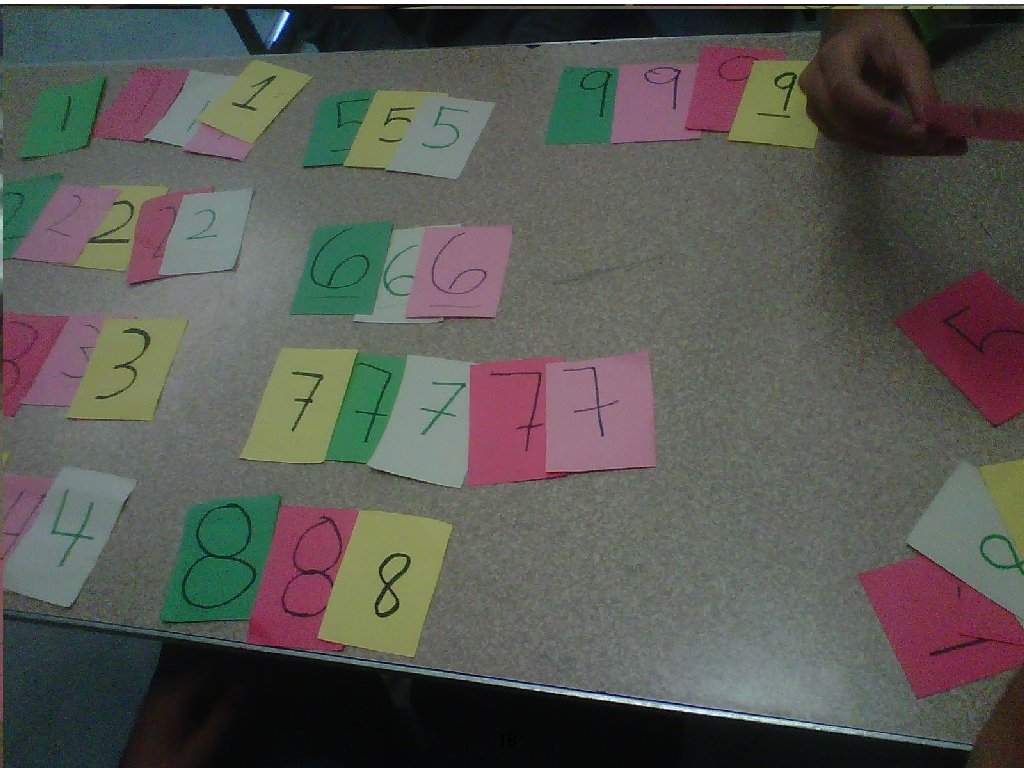
MIXED UP CARDS 1. 2. 3. 4. 5. 6. 7. Number students in group 1 – 4 (if only 3 students, student #1 is also #4). Place the cards on the table with the numbers facing up, all mixed up. Student #1 designs a plan to organize the cards and writes it on paper. Student #2 organizes the card according to the plan. Student #3 tells student #4 what card to find. Student #2 records how long it takes to find the card. Repeat this step 3 times. Record your time. Repeat all above steps switching student rolls within your group. 17
18
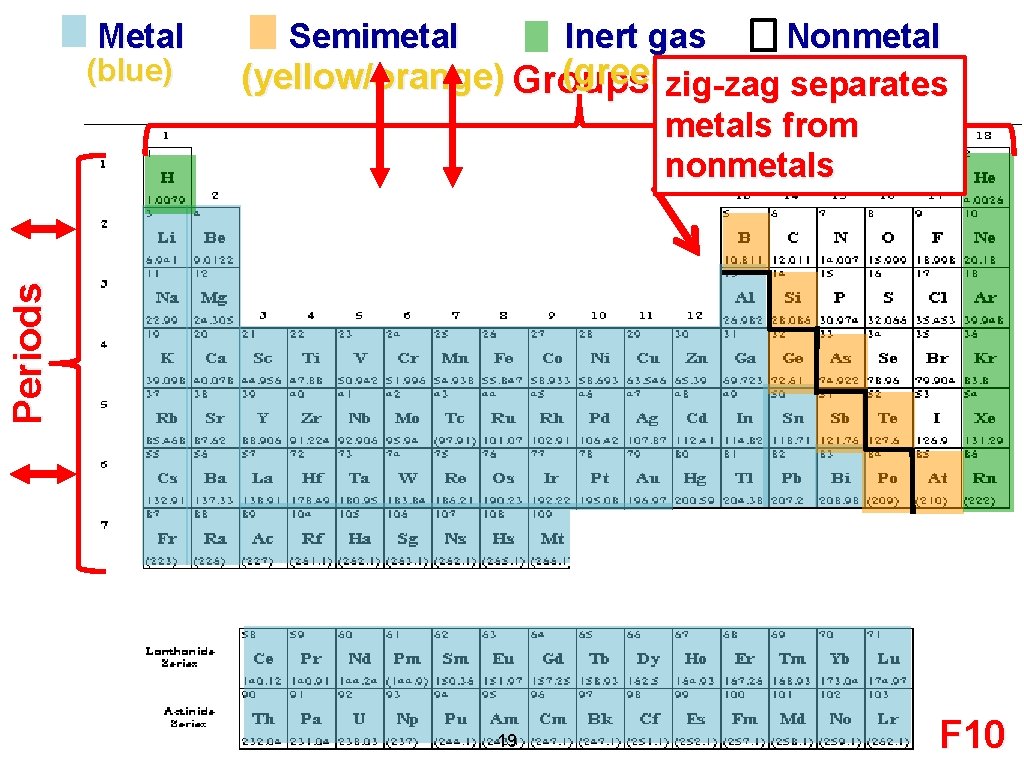
Metal Inert gas Nonmetal (green) (yellow/orange) Groups (Families) zig-zag (white) separates metals from nonmetals Periods (blue) Semimetal 19 F 10
Periodic Table of Elements 1. 2. Set up Cornell Notes Page G 6 20
Periodic Table Organization • Mendeleev organized the first periodic table by increasing atomic mass. • Modern periodic table is organized by increasing atomic number (number of p+). 21
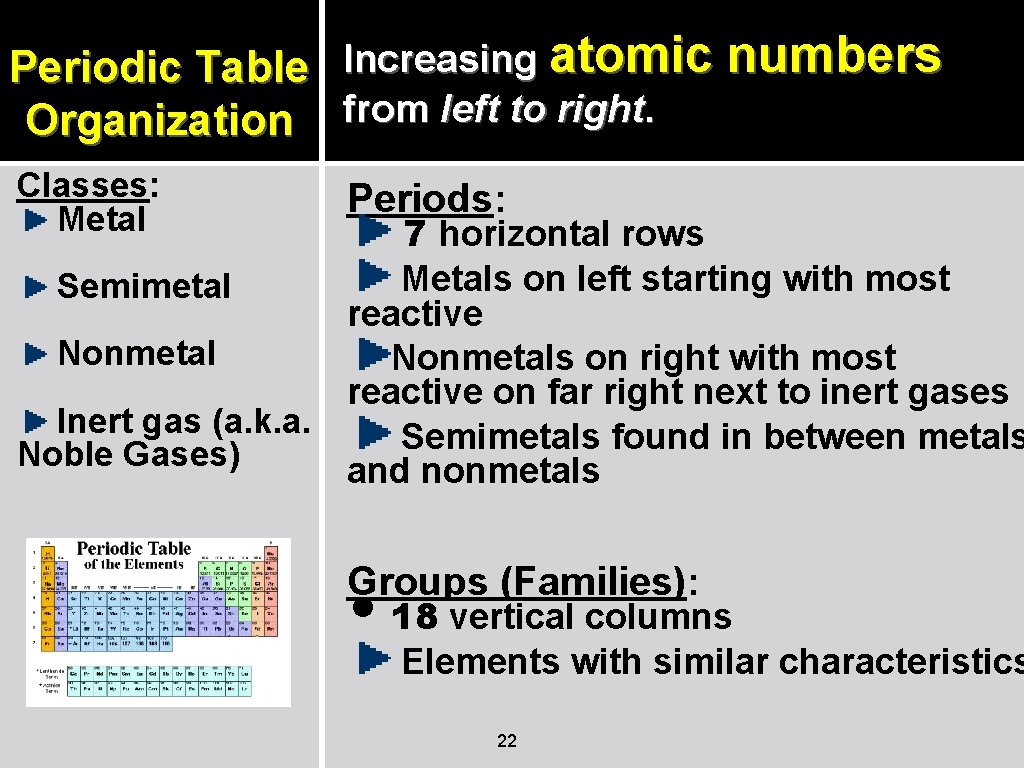
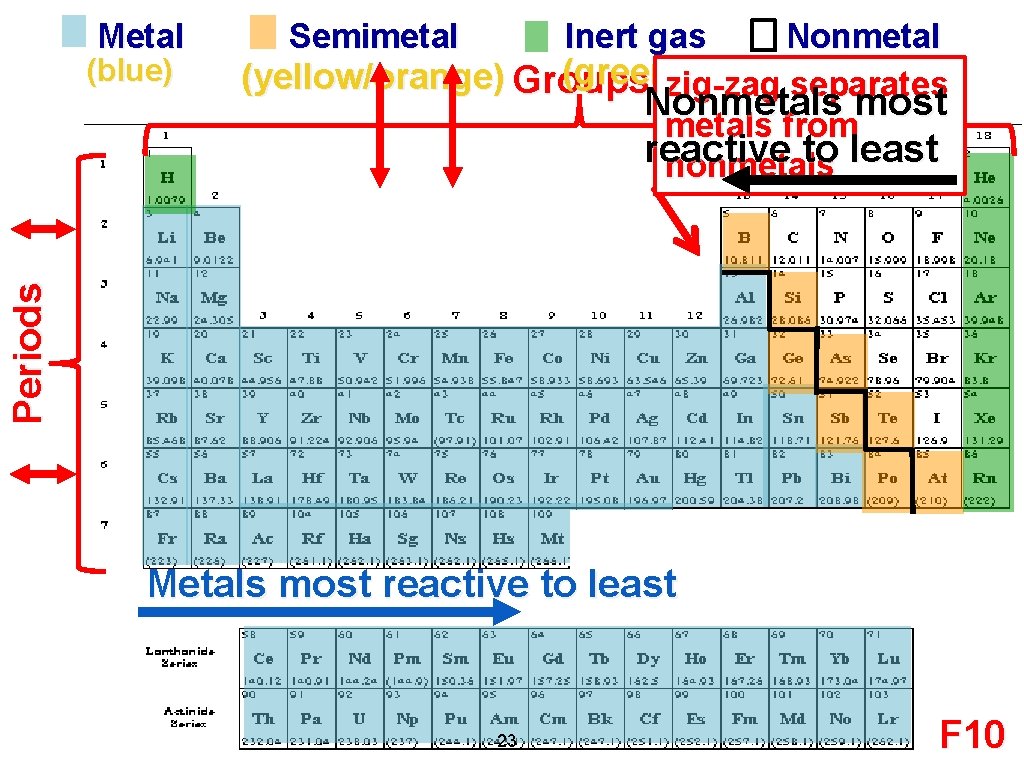
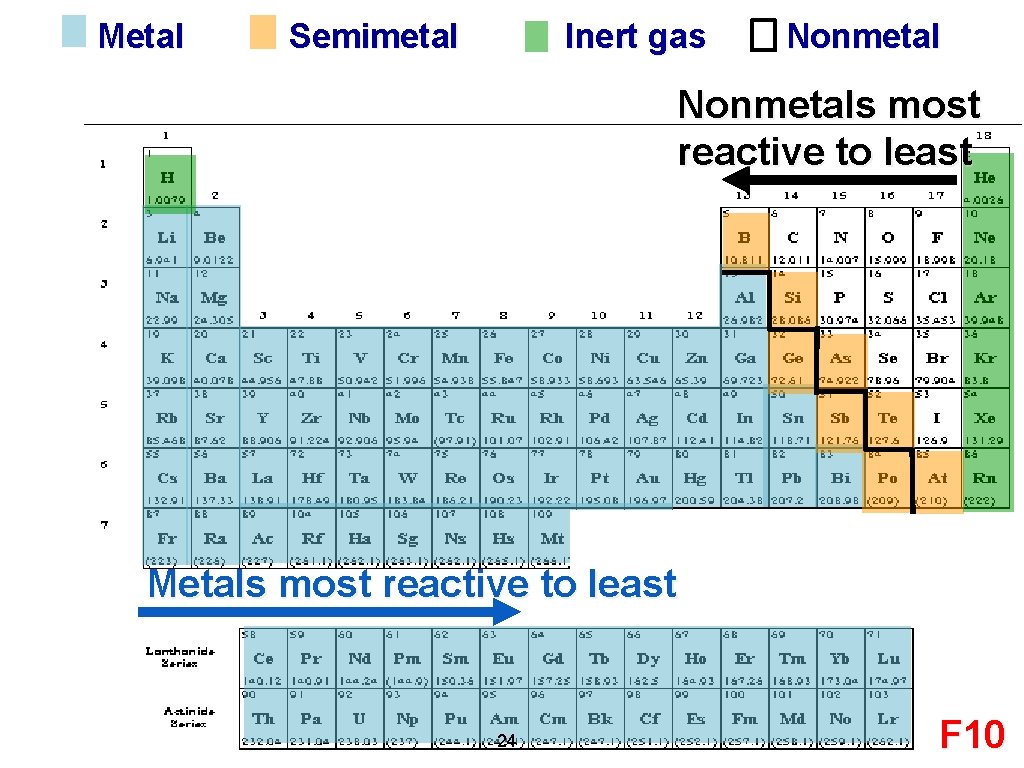
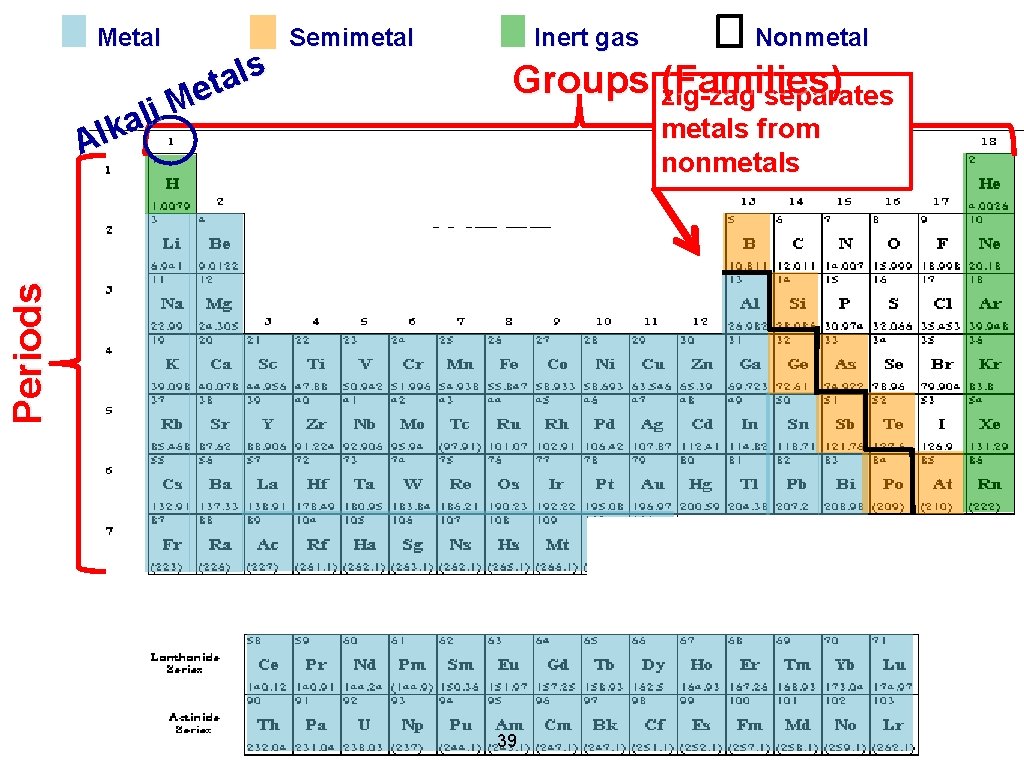
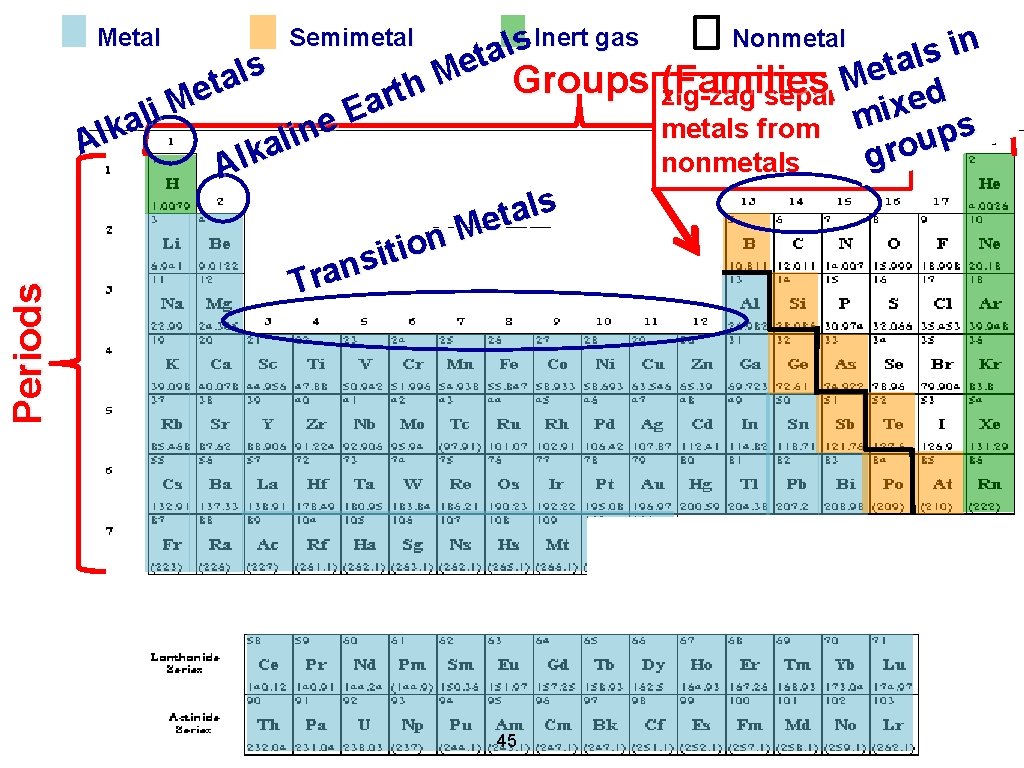
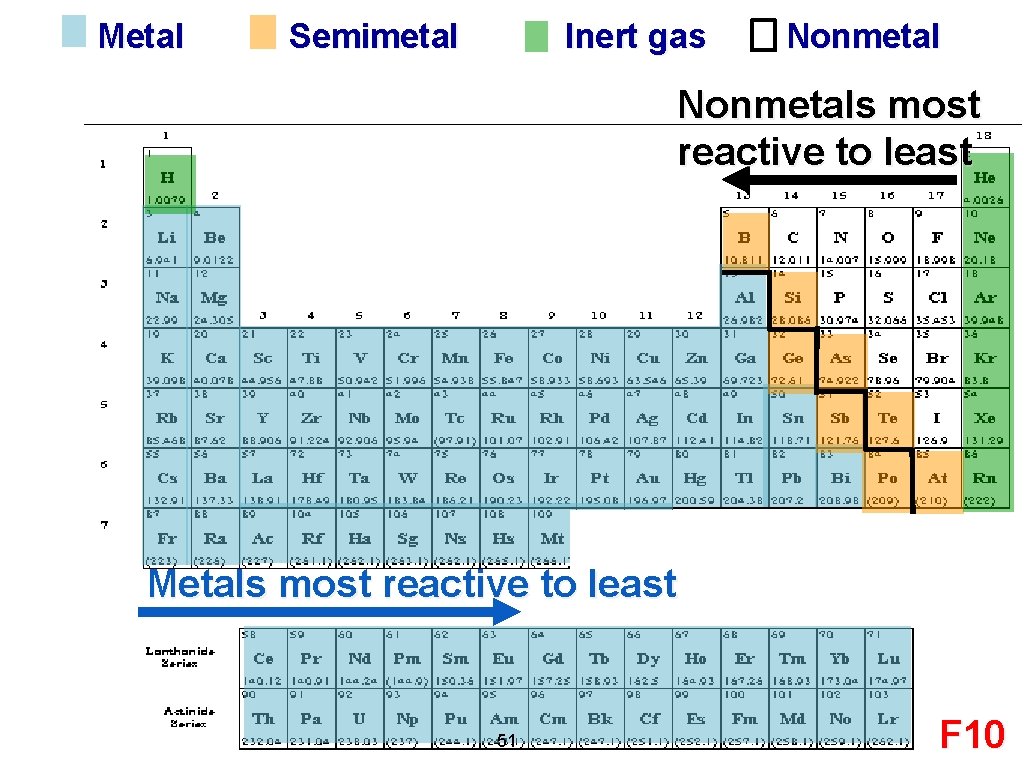
Periodic Table Increasing atomic numbers Organization from left to right. Classes: Metal Periods: 7 horizontal rows Metals on left starting with most Semimetal reactive Nonmetals on right with most reactive on far right next to inert gases Inert gas (a. k. a. Semimetals found in between metals Noble Gases) and nonmetals Groups (Families): • 18 vertical columns Elements with similar characteristics 22
Metal Inert gas Nonmetal (green) (yellow/orange) Groups (Families) zig-zag (white) separates Nonmetals most metals from reactive to least nonmetals Periods (blue) Semimetal Metals most reactive to least 23 F 10
Metal Semimetal Inert gas Nonmetals most reactive to least Metals most reactive to least 24 F 10
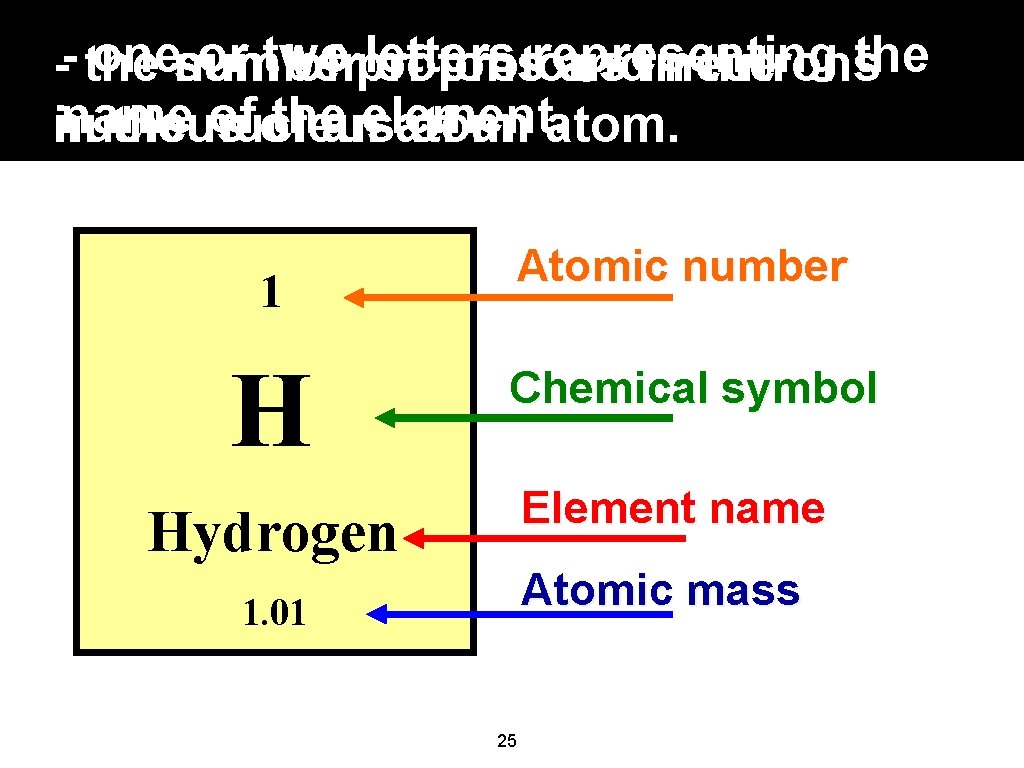
onesum or two letters representing the -- the number of protons andinneutrons the name of of the nucleus in the nucleus anelement. atom. of an atom. 1 H Atomic number Chemical symbol Element name Hydrogen Atomic mass 1. 01 25
Periodic Table Search On scratch paper, create two questions that require searching the periodic table for the answers. Make your questions challenging! Example: What nonmetal is highly reactive and has the lowest mass? Answer: Fluorine B ***Write the answers in the margin of your CN. 26
Check for comprehension: • Review • Reinforce • Assess 27
Properties of Metals 1. 2. Set up Cornell Notes Page G 8 28
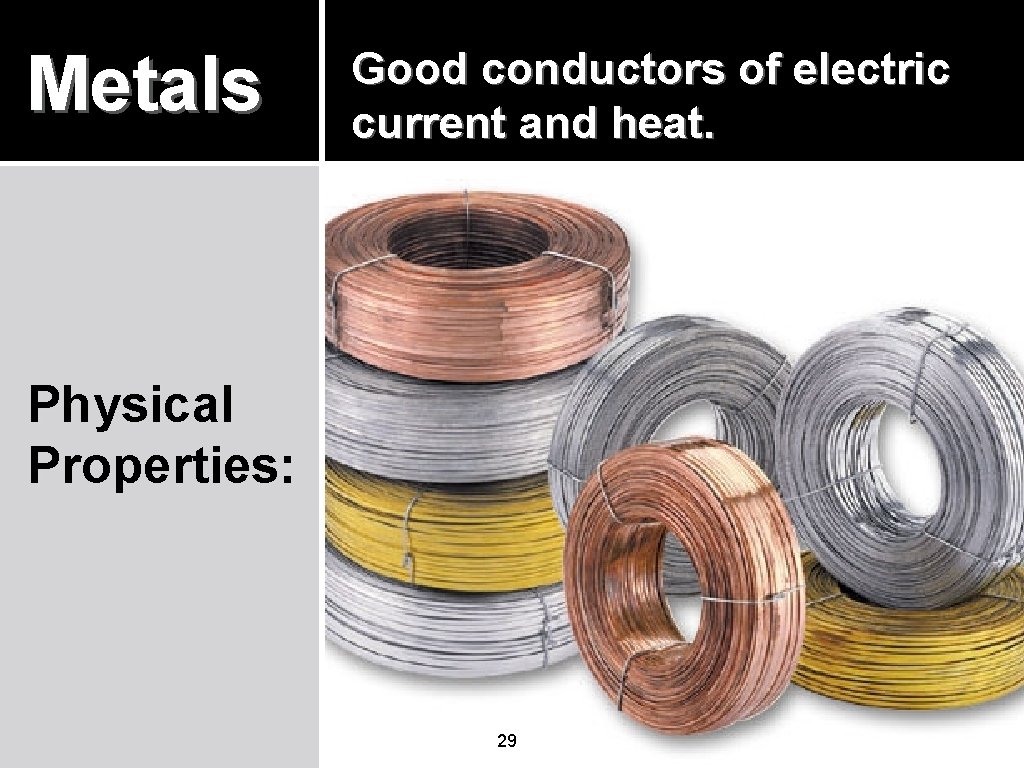
Metals Good conductors of electric current and heat. Physical Properties: 29
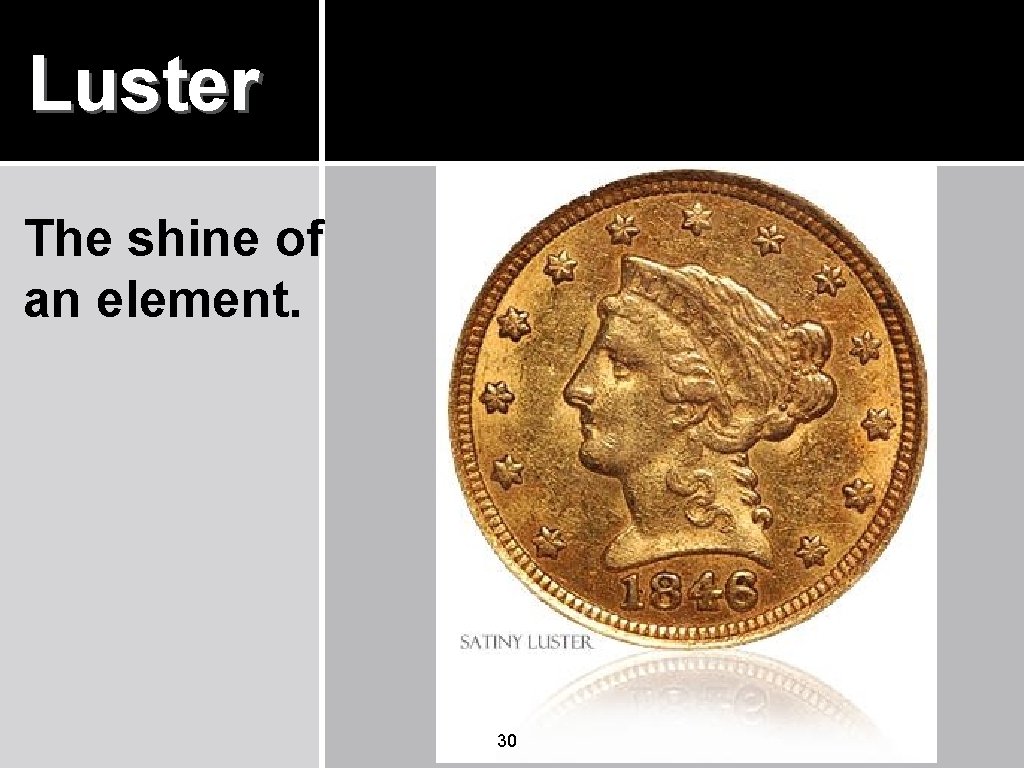
Luster The shine of an element. 30
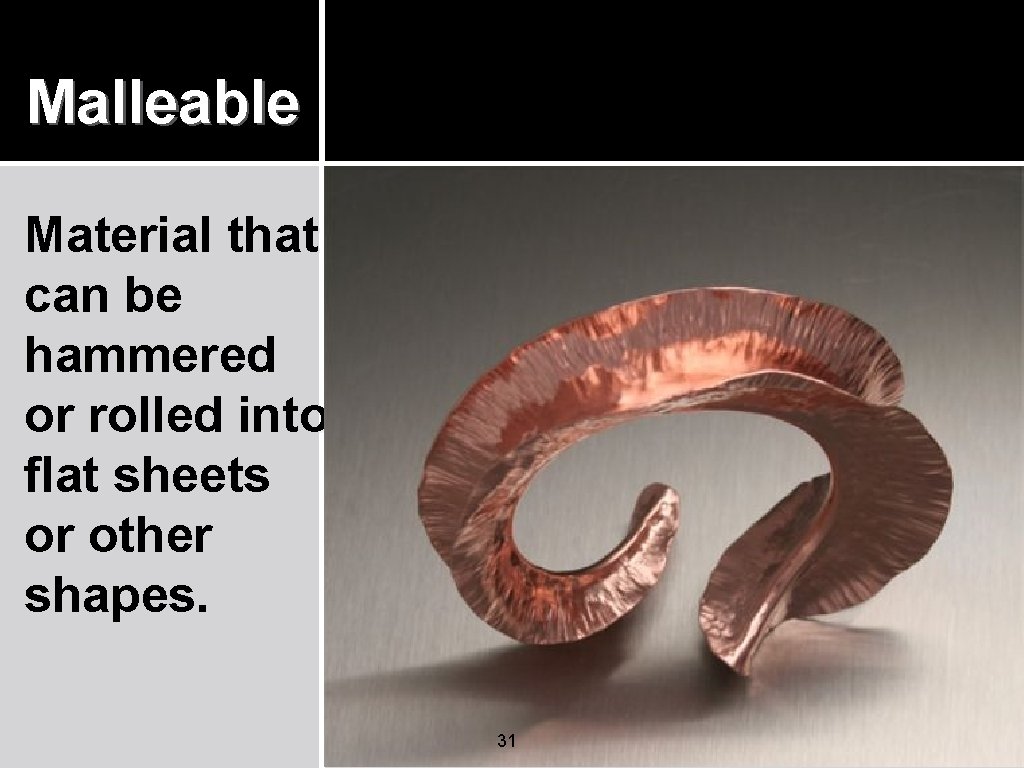
Malleable Material that can be hammered or rolled into flat sheets or other shapes. 31
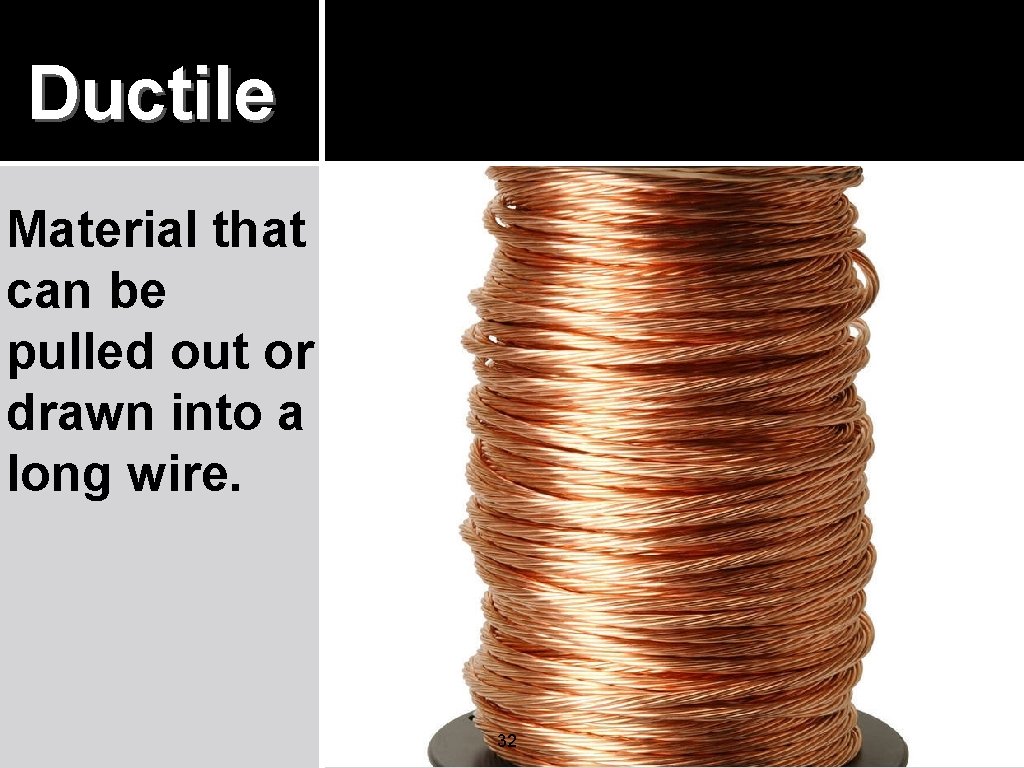
Ductile Material that can be pulled out or drawn into a long wire. 32
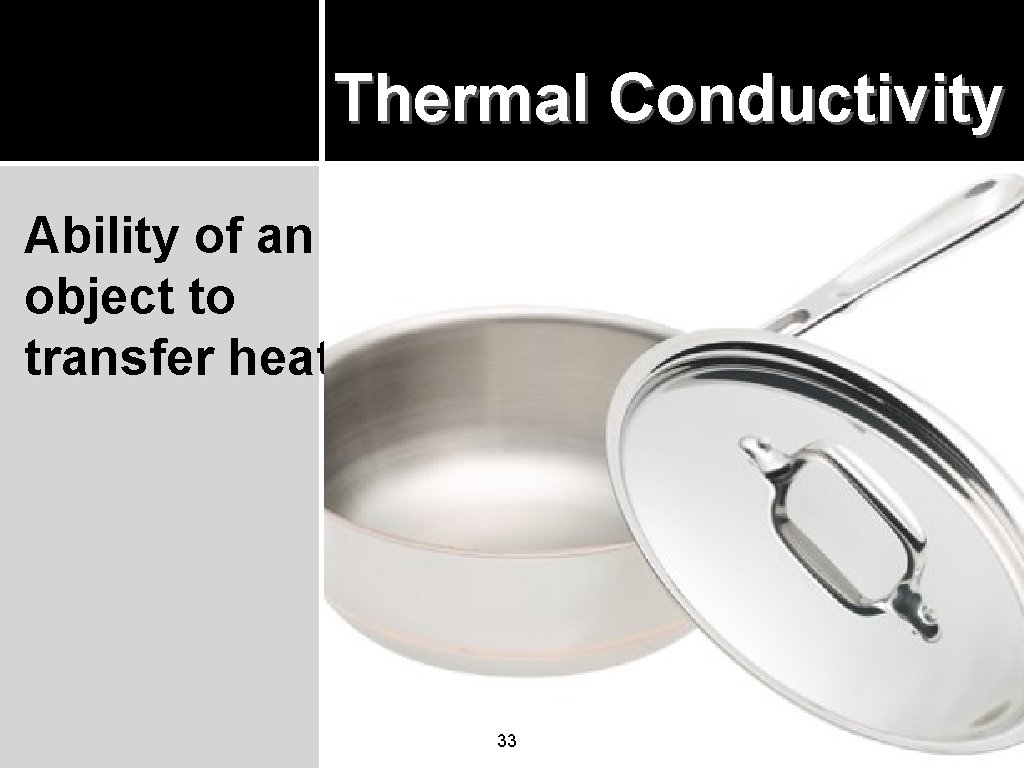
Thermal Conductivity Ability of an object to transfer heat. 33
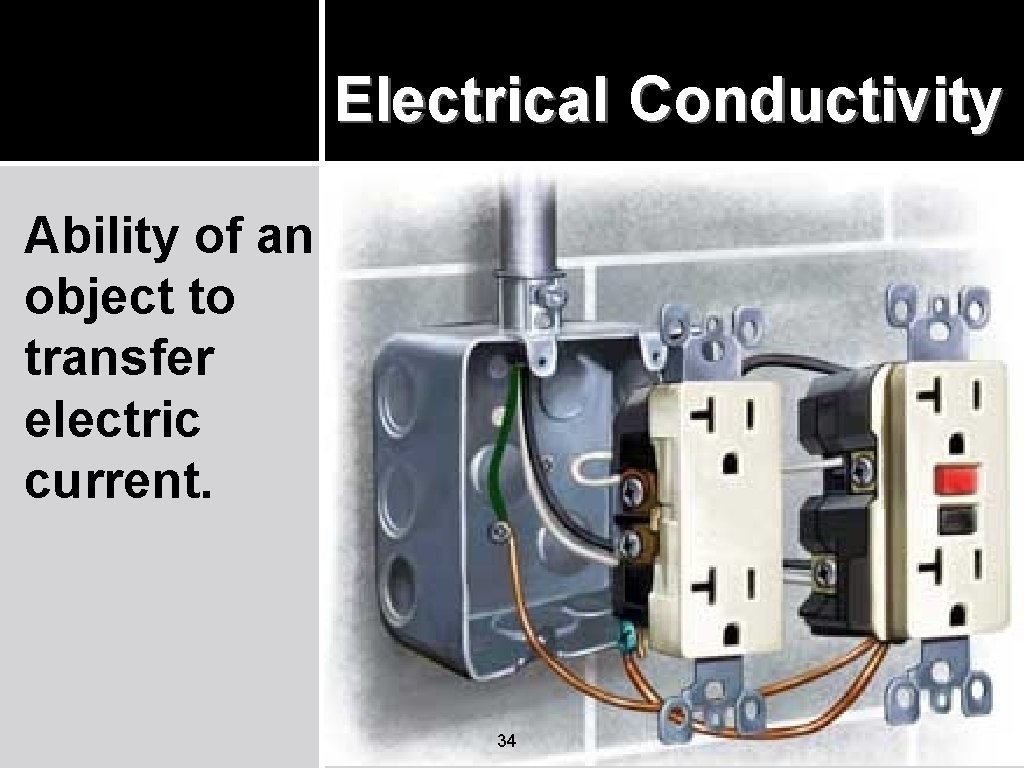
Electrical Conductivity Ability of an object to transfer electric current. 34
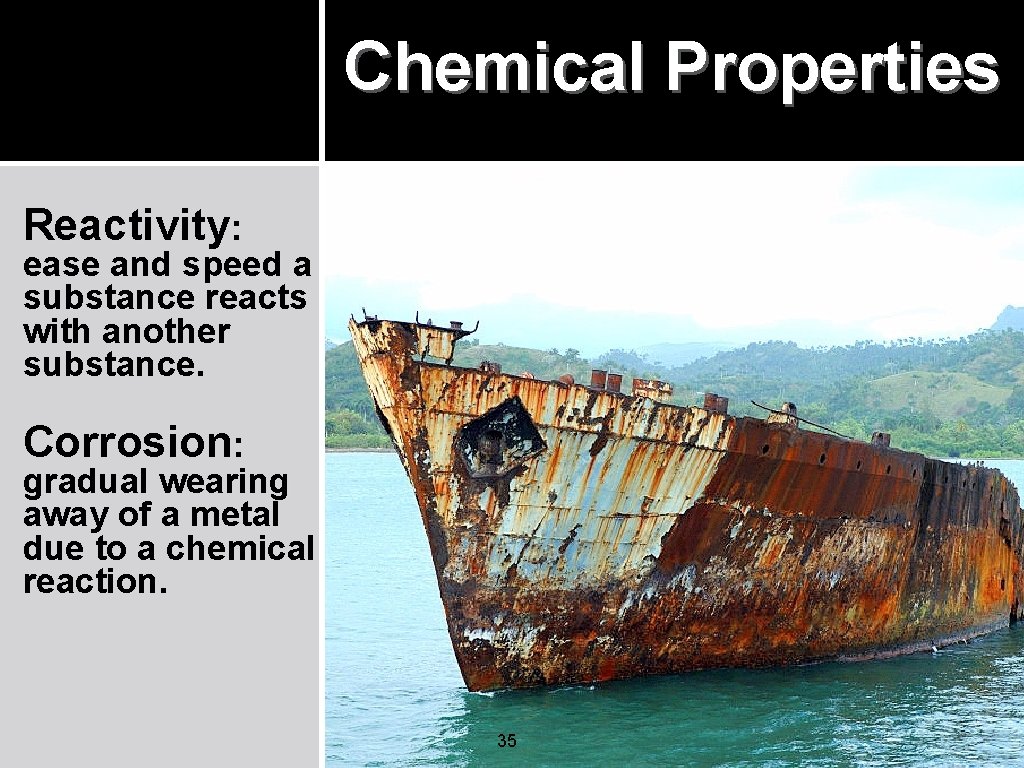
Chemical Properties Reactivity: ease and speed a substance reacts with another substance. Corrosion: gradual wearing away of a metal due to a chemical reaction. 35
Check for comprehension: • Review • Reinforce • Assess 36
Periodic Table Groups 1. 2. Set up Cornell Notes page Write G? ? in upper right corner of notes page 37
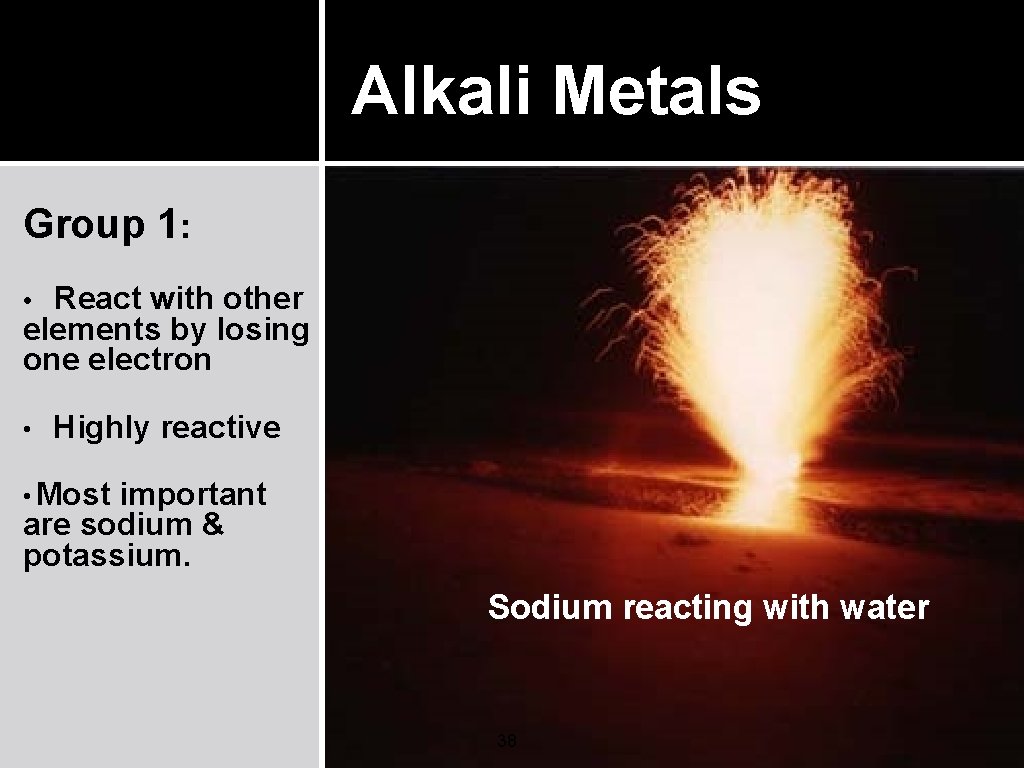
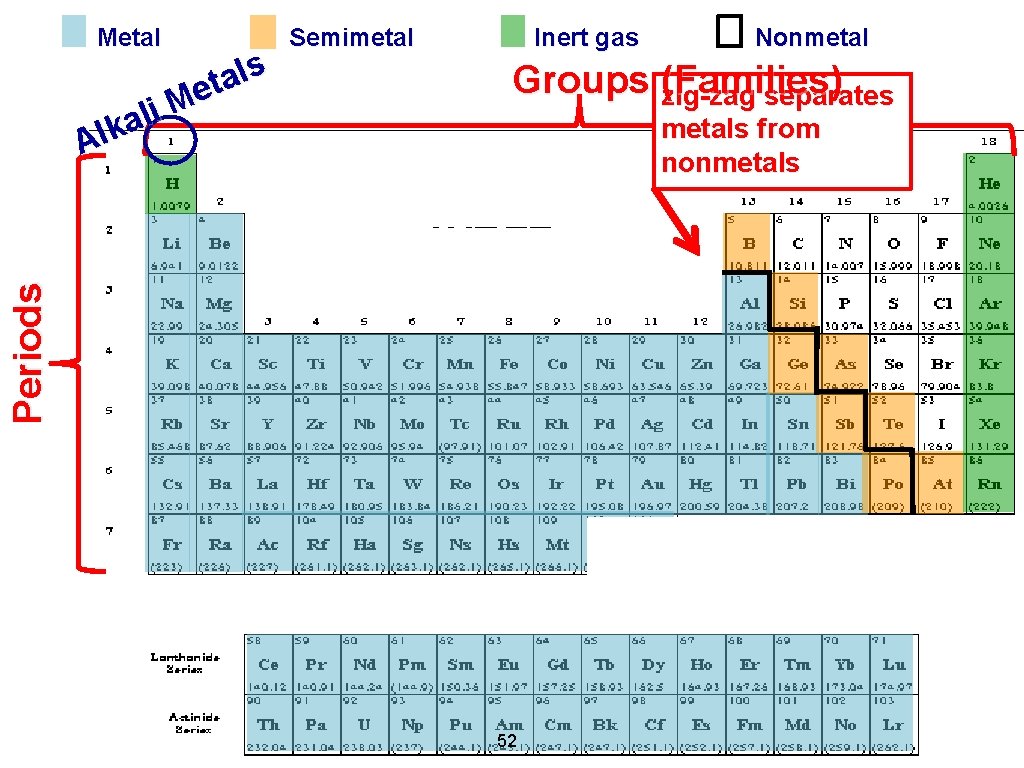
Alkali Metals Group 1: • React with other elements by losing one electron • Highly reactive • Most important are sodium & potassium. Sodium reacting with water 38
Metal Inert gas Nonmetal Groups (Families) zig-zag separates metals from nonmetals Periods s l a t e M i l a k l A Semimetal 39
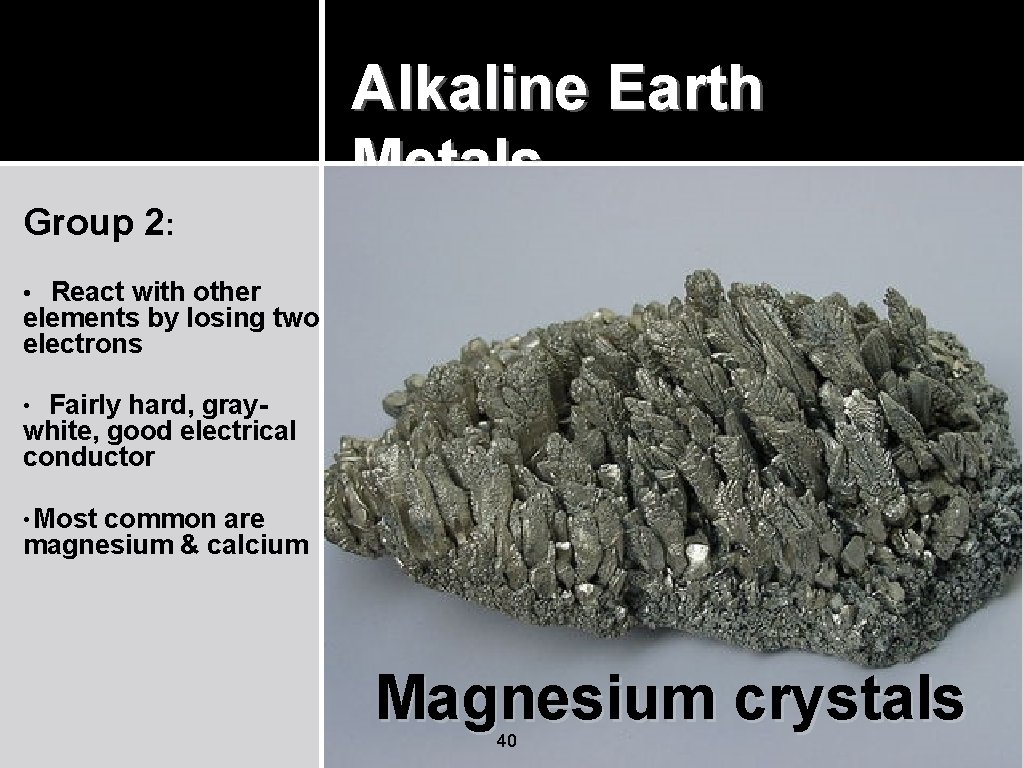
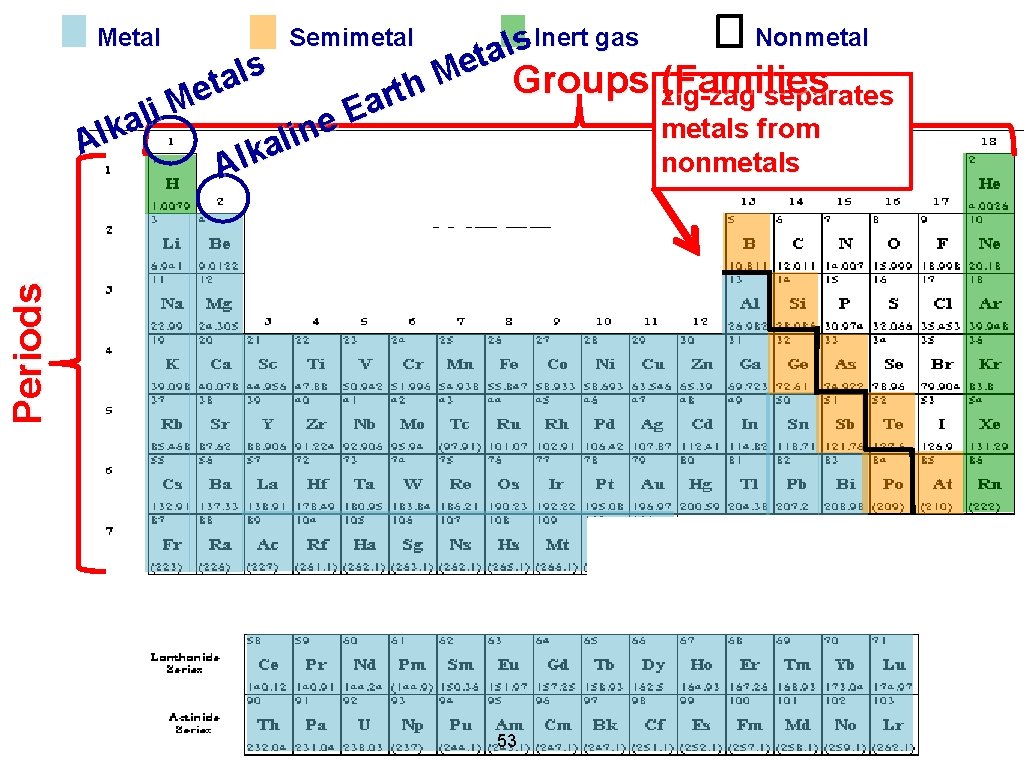
Alkaline Earth Metals Group 2: • React with other elements by losing two electrons Fairly hard, graywhite, good electrical conductor • • Most common are magnesium & calcium Magnesium crystals 40
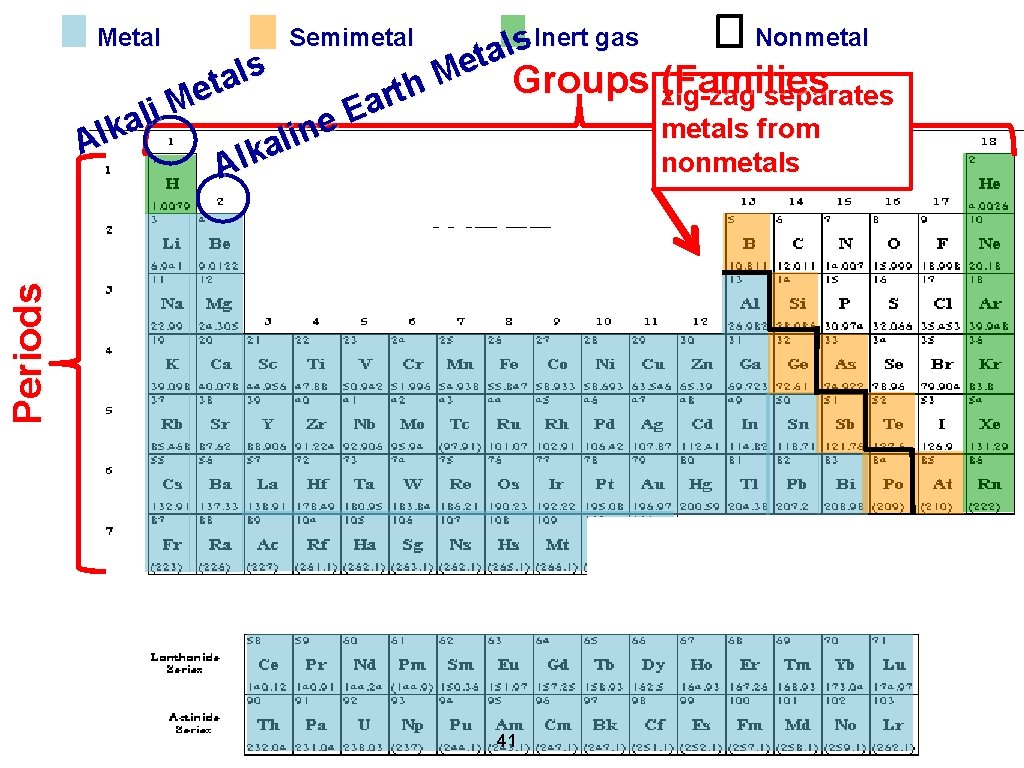
Metal Inert gas Nonmetal s l ta e M Groups (Families h t zig-zag separates r a E Semimetals from nonmetals Periods s l a t e M i l a e k n l i l A a Alk 41
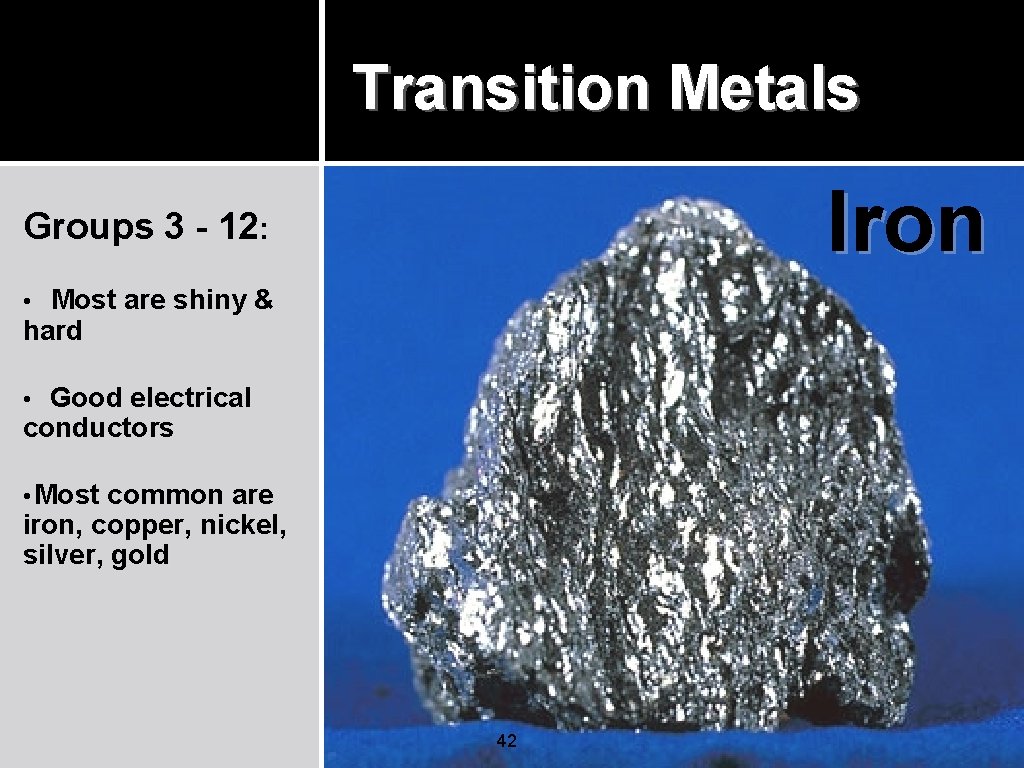
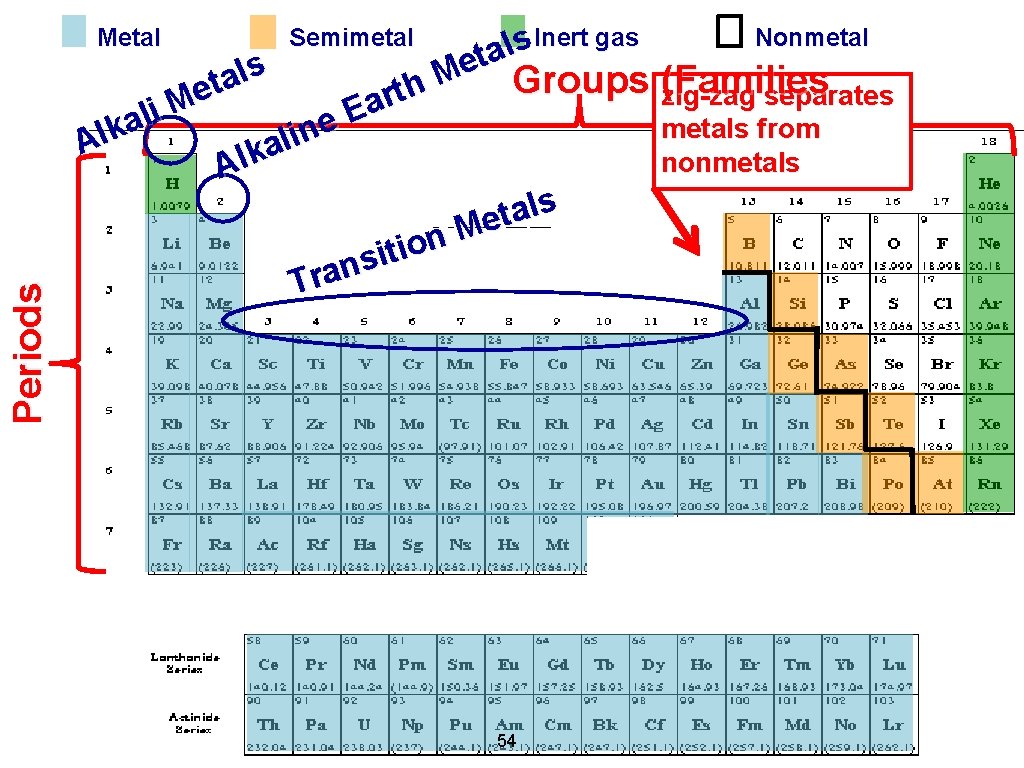
Transition Metals Iron Groups 3 - 12: • Most are shiny & hard Good electrical conductors • • Most common are iron, copper, nickel, silver, gold 42
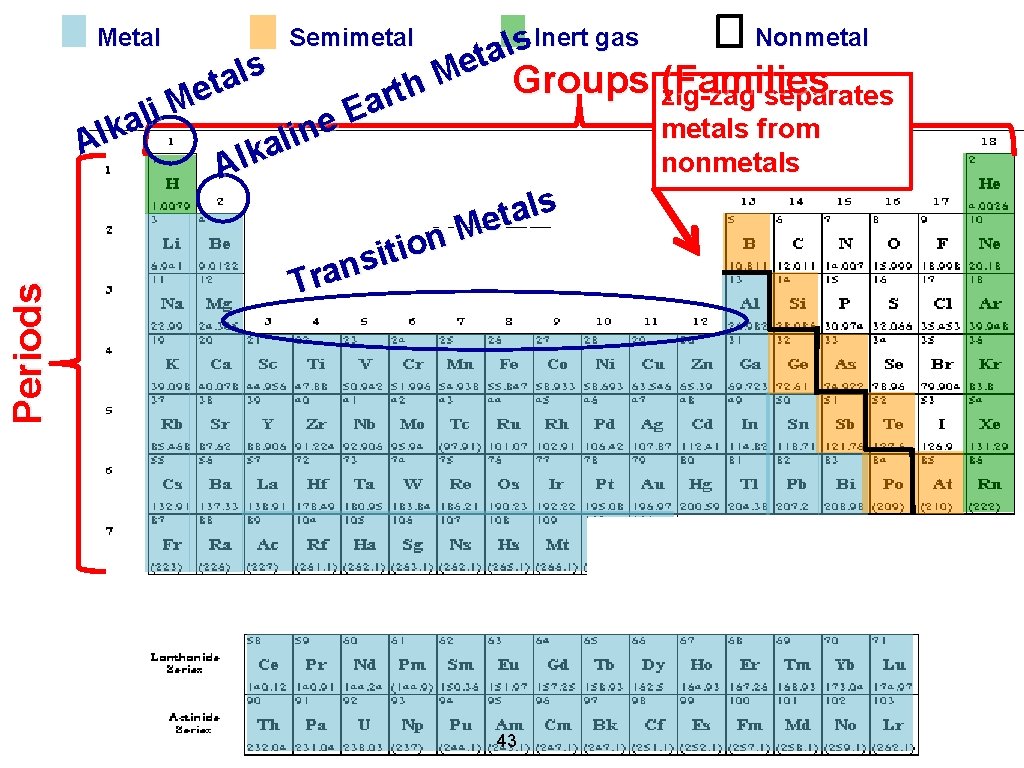
Metal s l a t e M i l a e k n l i l A a Alk Periods Inert gas Nonmetal s l ta e M Groups (Families h t zig-zag separates r a E Semimetals from nonmetals s l a t e M n o i t i s n Tra 43
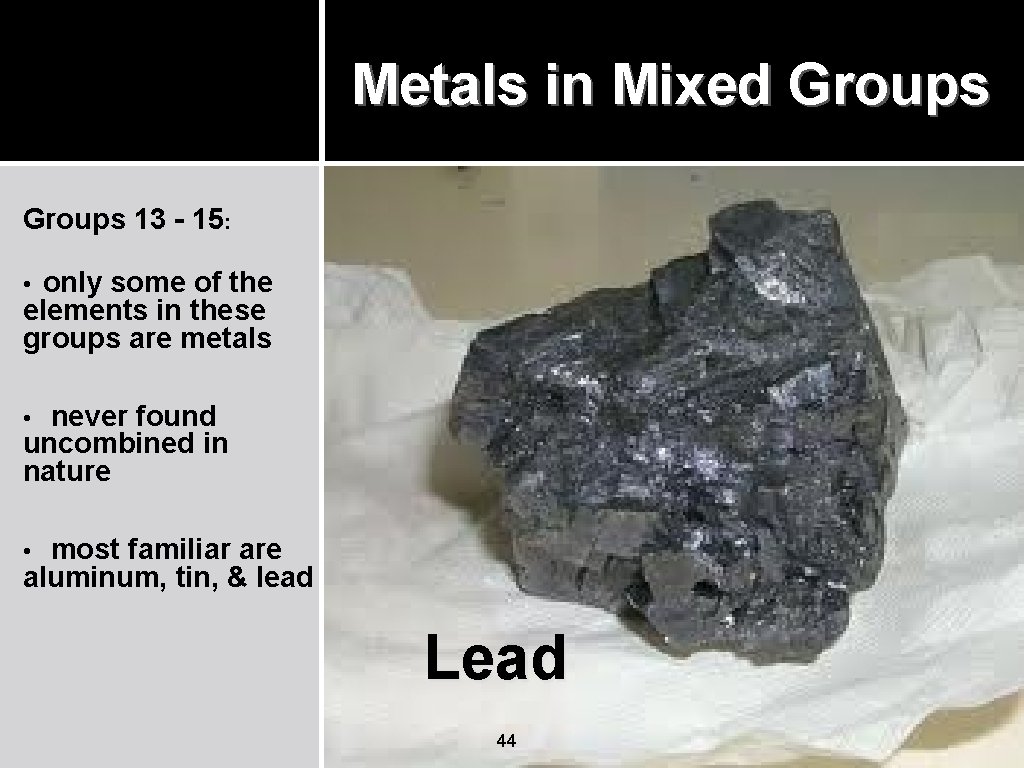
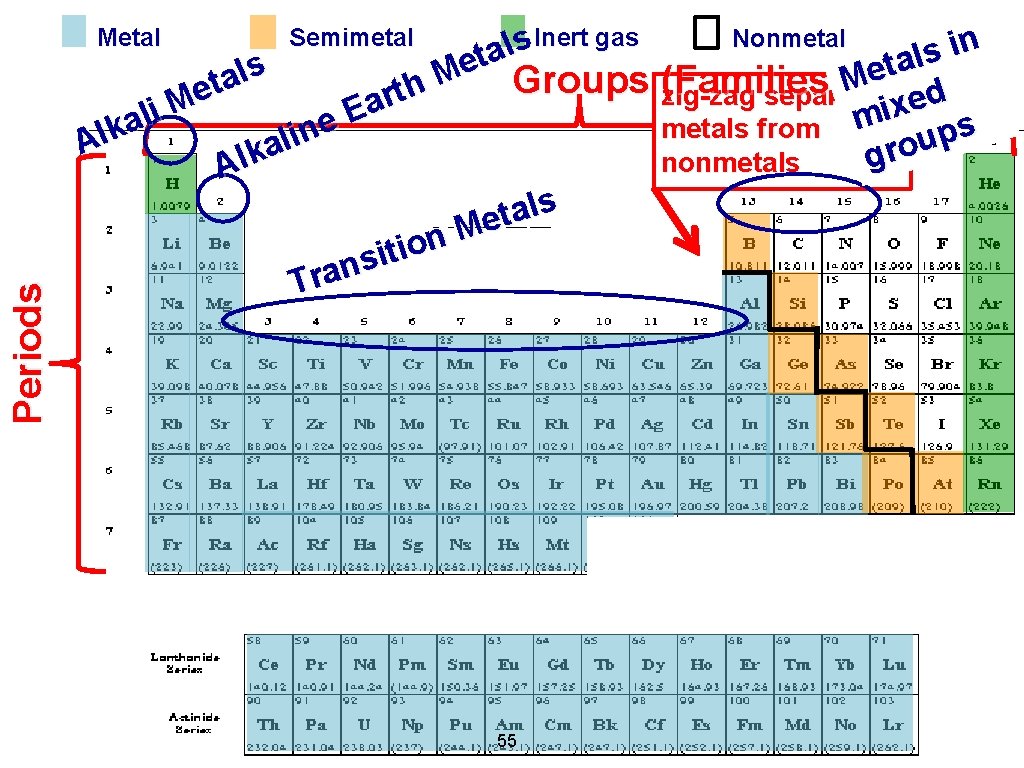
Metals in Mixed Groups 13 - 15: only some of the elements in these groups are metals • never found uncombined in nature • most familiar are aluminum, tin, & lead • Lead 44
Inert gas Nonmetal s n i l a s l t a e t s e l M M Groups (Families) ta h t e zig-zag separatesxed r M a i i E l m a e metals from s k n l p i l u A a o r k g nonmetals Al s l a t e M n o i t i s n Tra Periods Metal Semimetal 45
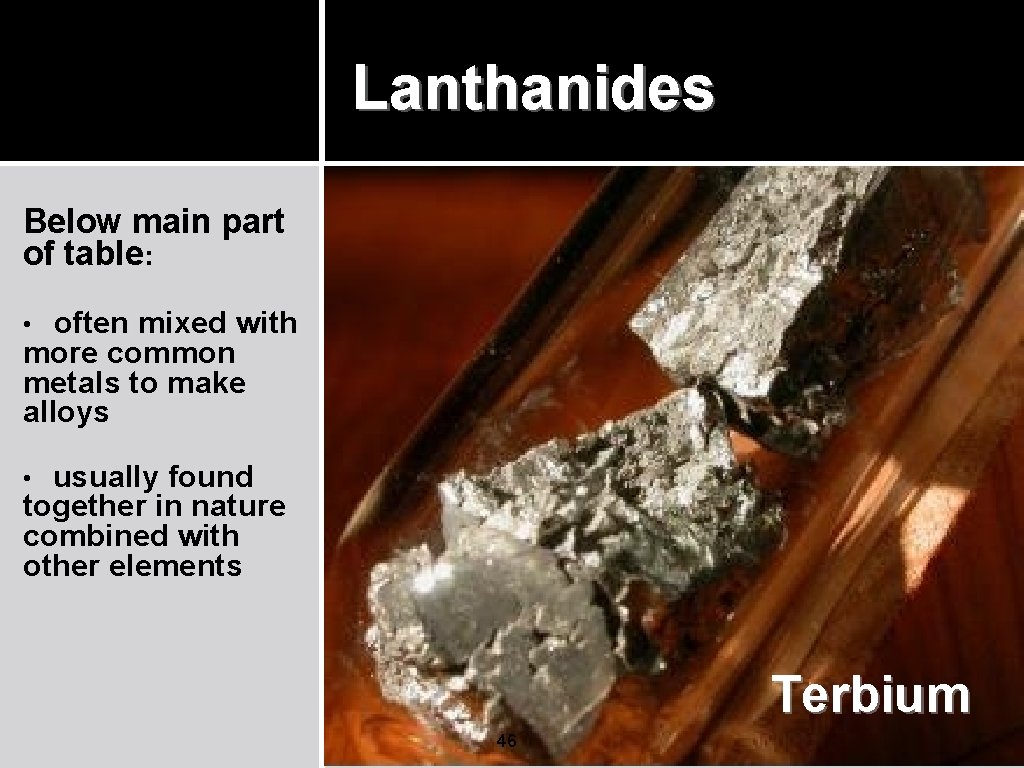
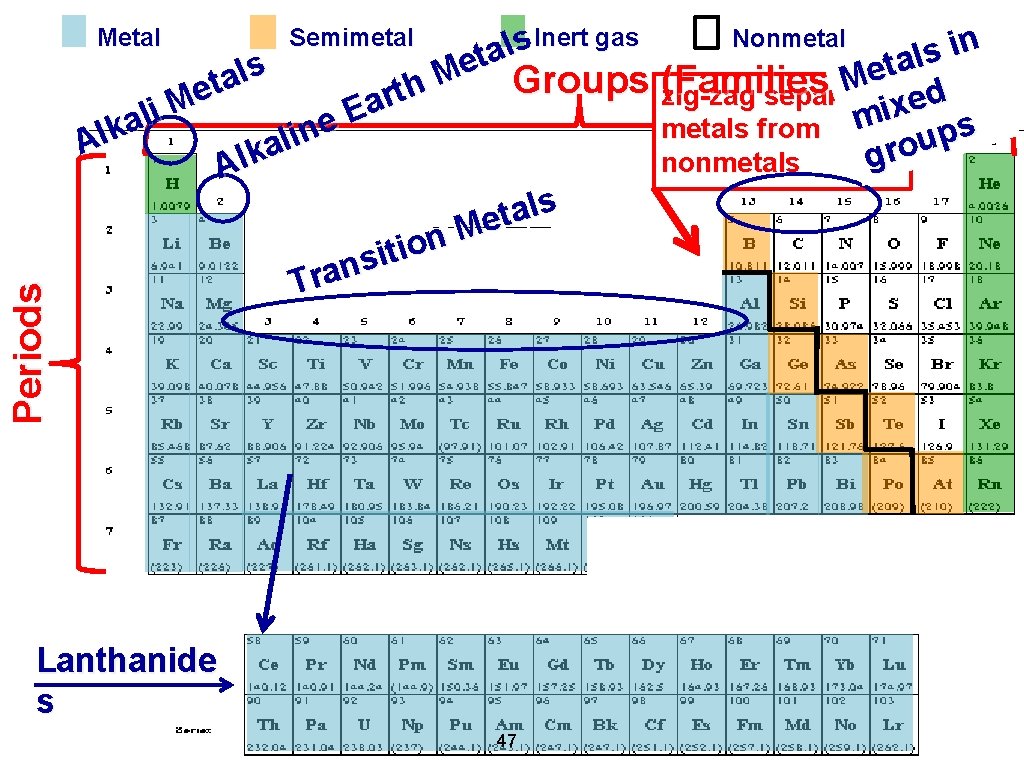
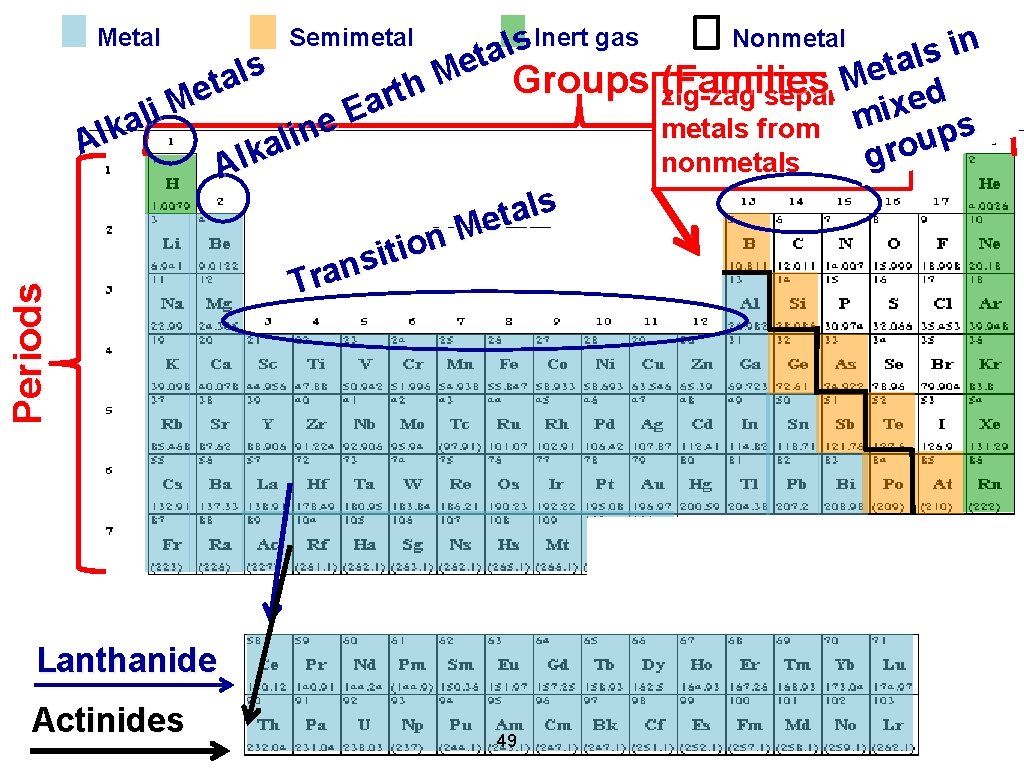
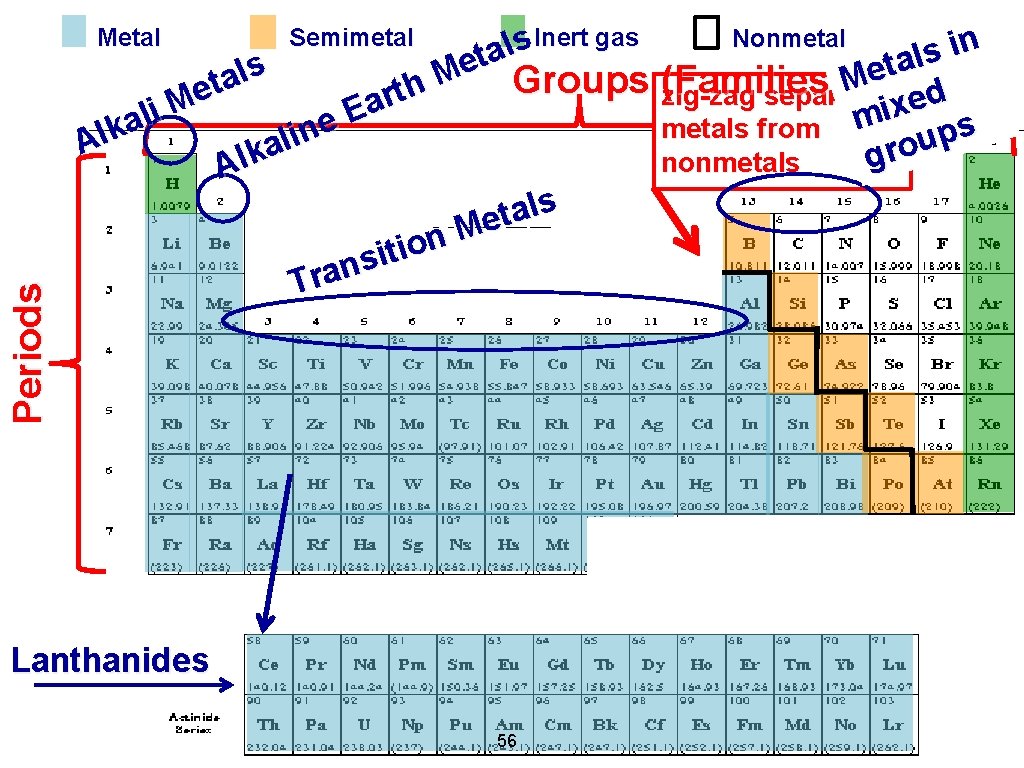
Lanthanides Below main part of table: • often mixed with more common metals to make alloys usually found together in nature combined with other elements • Terbium 46
Inert gas Nonmetal s n i l a s l t a e t s e l M M Groups (Families) ta h t e zig-zag separatesxed r M a i i E l m a e metals from s k n l p i l u A a o r k g nonmetals Al s l a t e M n o i t i s n Tra Periods Metal Semimetal Lanthanide s 47
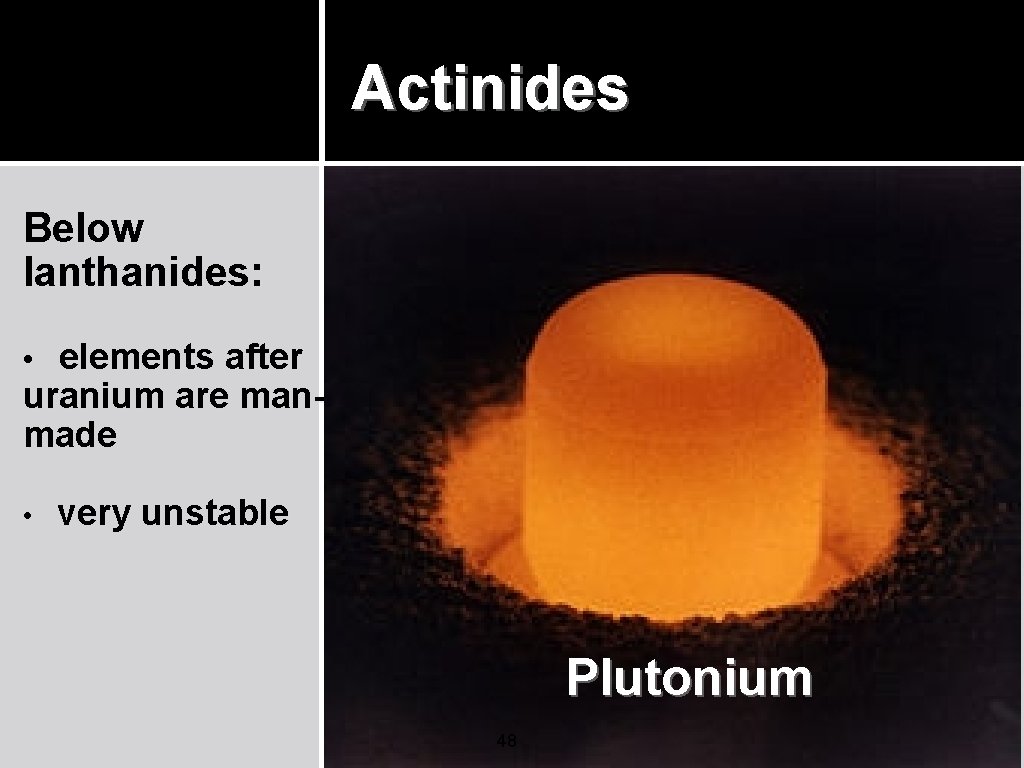
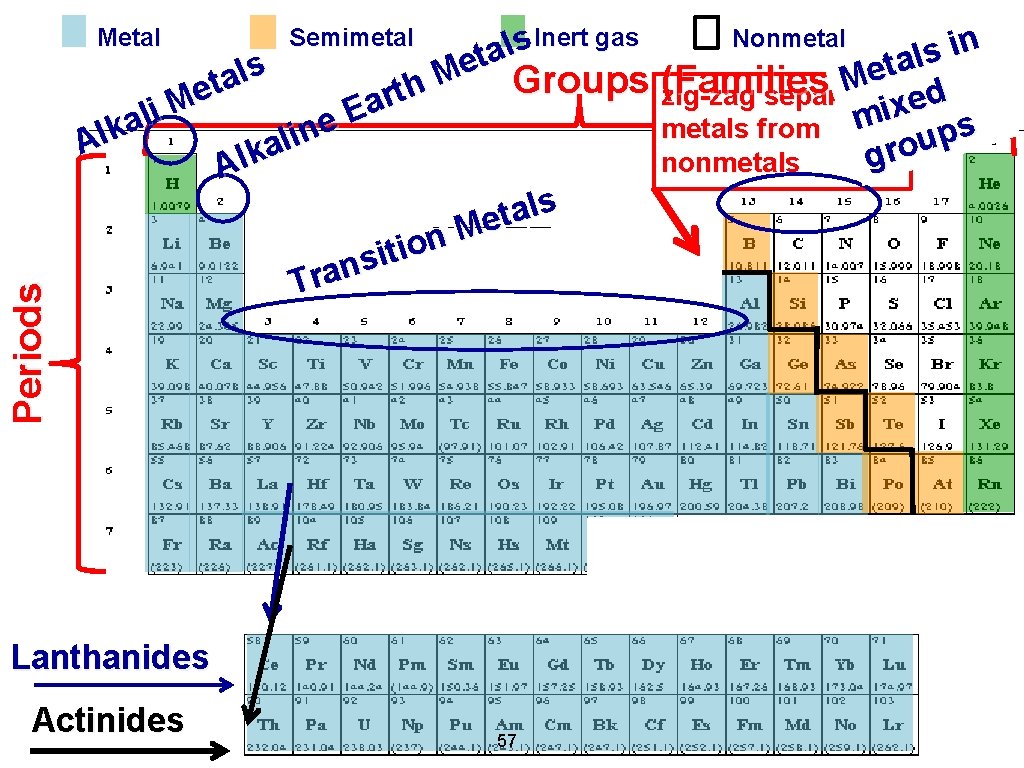
Actinides Below lanthanides: • elements after uranium are manmade • very unstable Plutonium 48
Inert gas Nonmetal s n i l a s l t a e t s e l M M Groups (Families) ta h t e zig-zag separatesxed r M a i i E l m a e metals from s k n l p i l u A a o r k g nonmetals Al s l a t e M n o i t i s n Tra Periods Metal Lanthanide s Actinides Semimetal 49
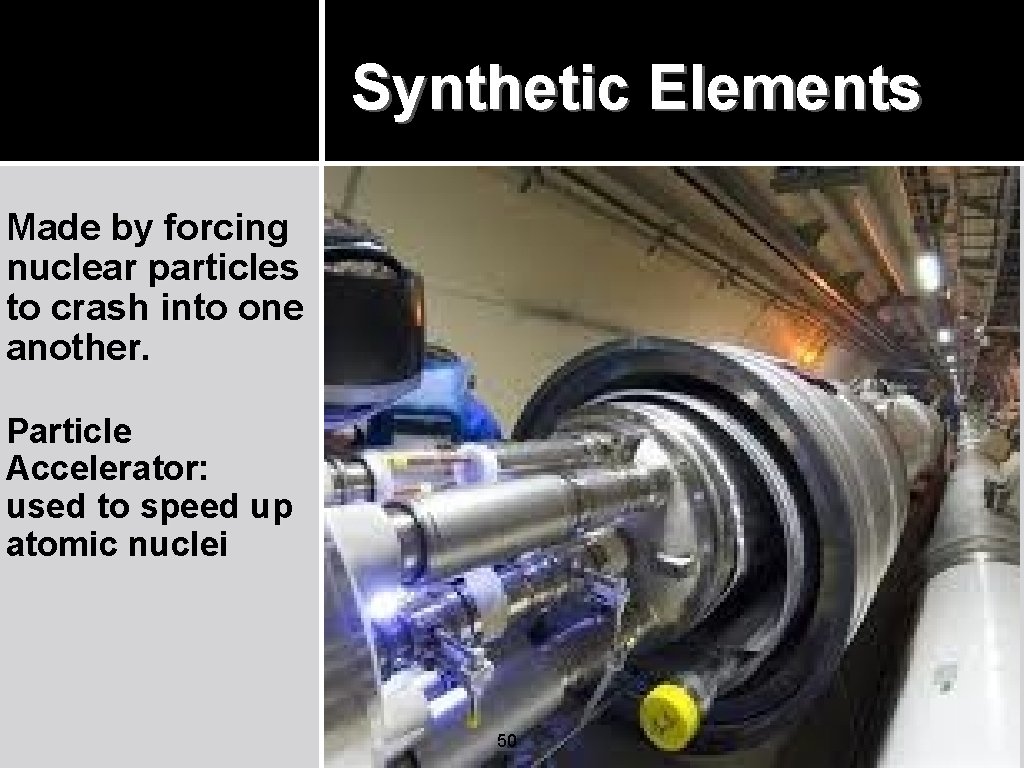
Synthetic Elements Made by forcing nuclear particles to crash into one another. Particle Accelerator: used to speed up atomic nuclei 50
Metal Semimetal Inert gas Nonmetals most reactive to least Metals most reactive to least 51 F 10
Metal Inert gas Nonmetal Groups (Families) zig-zag separates metals from nonmetals Periods s l a t e M i l a k l A Semimetal 52
Metal Inert gas Nonmetal s l ta e M Groups (Families h t zig-zag separates r a E Semimetals from nonmetals Periods s l a t e M i l a e k n l i l A a Alk 53
Metal s l a t e M i l a e k n l i l A a Alk Periods Inert gas Nonmetal s l ta e M Groups (Families h t zig-zag separates r a E Semimetals from nonmetals s l a t e M n o i t i s n Tra 54
Inert gas Nonmetal s n i l a s l t a e t s e l M M Groups (Families) ta h t e zig-zag separatesxed r M a i i E l m a e metals from s k n l p i l u A a o r k g nonmetals Al s l a t e M n o i t i s n Tra Periods Metal Semimetal 55
Inert gas Nonmetal s n i l a s l t a e t s e l M M Groups (Families) ta h t e zig-zag separatesxed r M a i i E l m a e metals from s k n l p i l u A a o r k g nonmetals Al s l a t e M n o i t i s n Tra Periods Metal Semimetal Lanthanides 56
Inert gas Nonmetal s n i l a s l t a e t s e l M M Groups (Families) ta h t e zig-zag separatesxed r M a i i E l m a e metals from s k n l p i l u A a o r k g nonmetals Al s l a t e M n o i t i s n Tra Periods Metal Semimetal Lanthanides Actinides 57
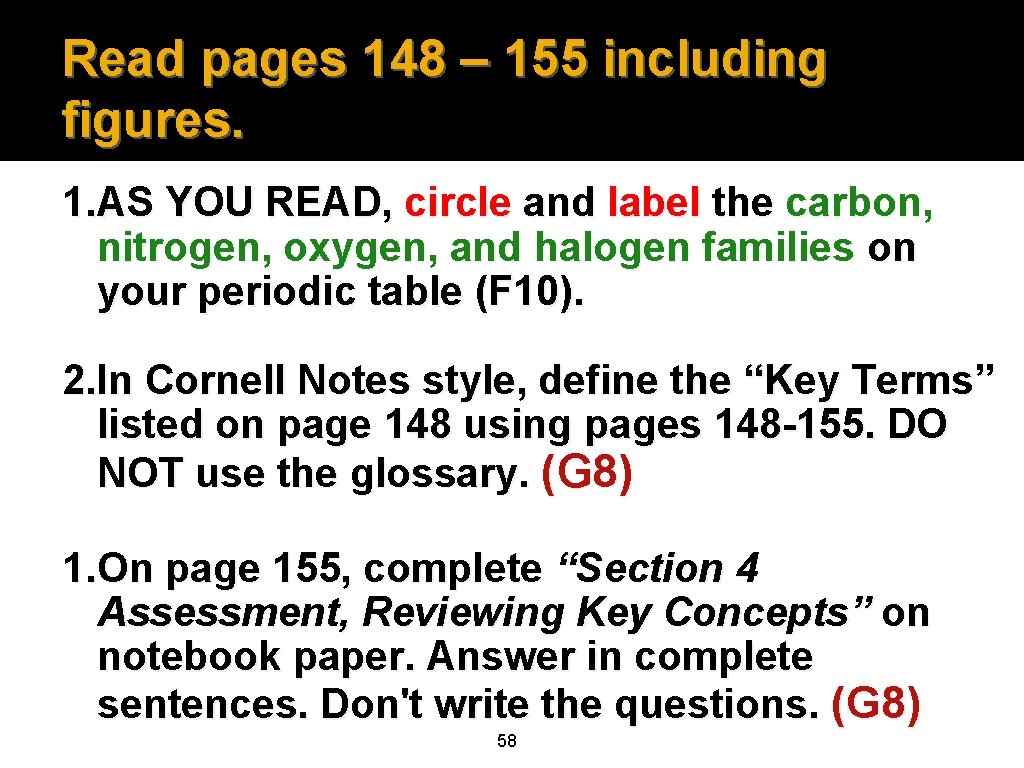
Read pages 148 – 155 including figures. 1. AS YOU READ, circle and label the carbon, nitrogen, oxygen, and halogen families on your periodic table (F 10). 2. In Cornell Notes style, define the “Key Terms” listed on page 148 using pages 148 -155. DO NOT use the glossary. (G 8) 1. On page 155, complete “Section 4 Assessment, Reviewing Key Concepts” on notebook paper. Answer in complete sentences. Don't write the questions. (G 8) 58
QUIZ 1. Atomic structure: subatomic particles, their charges, location, & mass. 2. How periodic table was organized & how chemists changed it to what we use today. 3. Organization of periodic table: groups & periods, reactivity of metals & nonmetals. 59
ADD SECTION 4. 4 SECTION 4. 5 – USE READING/NOTETAKING PACKET Check for comprehension: • Review • Reinforce • Assess 60