
Argument Writing Introduction with Cornell notes and INB
Argument Writing Introduction with Cornell notes and INB instruction slides added
Argument Writing: Pre-Test (OUTPUT) Write a short definition for each: 1. Definition 2. Expert Testimony 3. Witness Statements 4. Counterargument 5. Repetition 6. Authoritative Quotations 7. Facts/Statistics 8. Textual Evidence

Prepare your notebook for Cornell notetaking on the INPUT (right) side of your notebook.
Argument Writing: Take Notes EQ: How can presenting evidence and providing warrants strengthen my arguments?

Argument Writing: Structure • Informational Recap – Topic Sentence, EELFNCCO x 2 -3, Red Bow Conclusion Example • Argument Structure • What? Don’t eat that mushroom. – Claim • Why? Mushrooms are – Evidence poisonous. – Warrant • So what? Eating poisono things is dangerous, possibly fatal.
Argument Writing: Strong Claims • Clear – strong; avoid I think, In my opinion, I agree/disagree; introduce topic • Arguable – some people would disagree; taking a side • Supportable – can think of reasons and evidence why you feel the way you do
Argument Writing: Strong Claims Write down only the statements that are clear, arguable, and supportable: • Pollution is bad for the environment. • At least 25 percent of the federal budget should be spent on limiting pollution. • Drug use is detrimental. • Illegal drug use is detrimental to society because it encourages other criminal behaviors.
Info Writing: Make Notes 1. Review your notes and highlight the main idea. 2. Confer with a partner to make sure you have the same ideas noted and highlighted: – Add information as needed – Change information as needed – Delete information as needed 3. Write one higher-level question in the left column of your notes. Focus on open-ended “how” and “why” questions if possible.
Argument Writing: Definitions Definition - Explain unfamiliar words or content area terms. YES: Institutional racism is racism that is structured into political and social institutions. It occurs when organizations, institutions or governments discriminate, either deliberately or indirectly, against certain groups of people to limit their rights. NO: Racism is the belief that all members of each race possess characteristics or abilities specific to that race, especially so as to distinguish it as inferior or superior to another race or races. • Only when necessary
Argument Writing: Expert Testimony Definition - Find an expert in the field and explain their support. YES: Dr. Robert Marzano researched the factors that impact vocabulary retention. NO: My English teacher says vocabulary is important. • Not everyone is an expert
Argument Writing: Witness Statements Definition - Use when someone has seen an action occur. YES: Three witnesses corroborated that the victim did not have a weapon. NO: I saw a video of the incident and you can’t see a weapon in the victim’s hand. • Reliable
Argument Writing: Counterargument Definition - Recognize the other side of your argument. YES: Parents and teachers will tout the importance of earning good grades, saying that high marks are the key to success after high school. However…. NO: Some might say that earning good grades is important, but they are wrong. • Be specific
Argument Writing: Repetition Definition Use for convincing effect, not just to fill space. YES: I have a dream… NO: Dr. Martin Luther King’s dream is being realized. His dream is coming true because people are changing and these changes are fulfilling his dream.
Argument Writing: Authoritative Quotes Definition - Use a source with credibility. YES: According to a Consumer Report study from May 29, 2016, the Honda Accord is the most reliable vehicle on the market. NO: My dad says the Honda Accord is the most reliable vehicle on the market. • Credible
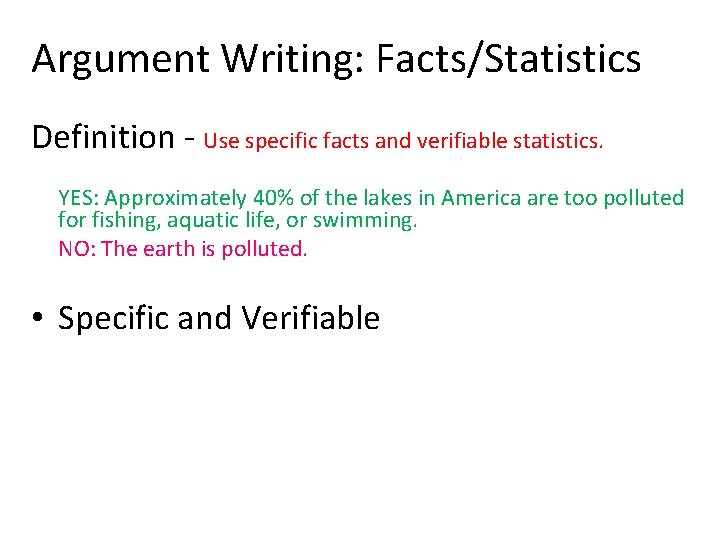
Argument Writing: Facts/Statistics Definition - Use specific facts and verifiable statistics. YES: Approximately 40% of the lakes in America are too polluted for fishing, aquatic life, or swimming. NO: The earth is polluted. • Specific and Verifiable
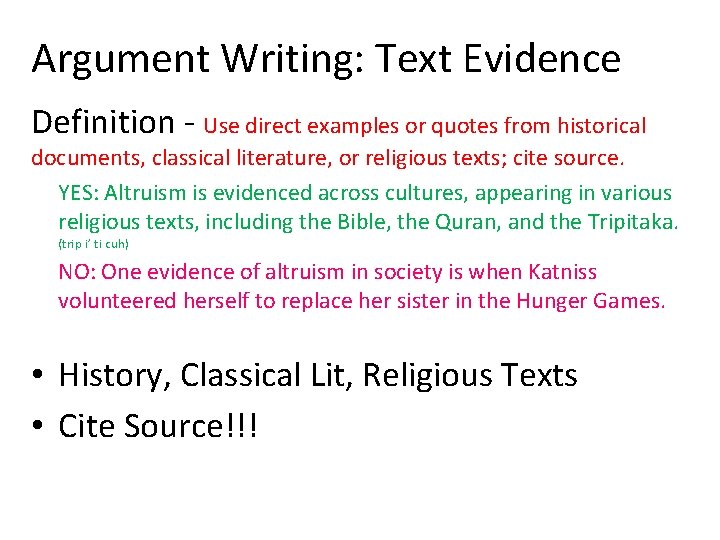
Argument Writing: Text Evidence Definition - Use direct examples or quotes from historical documents, classical literature, or religious texts; cite source. YES: Altruism is evidenced across cultures, appearing in various religious texts, including the Bible, the Quran, and the Tripitaka. (trip i’ ti cuh) NO: One evidence of altruism in society is when Katniss volunteered herself to replace her sister in the Hunger Games. • History, Classical Lit, Religious Texts • Cite Source!!!
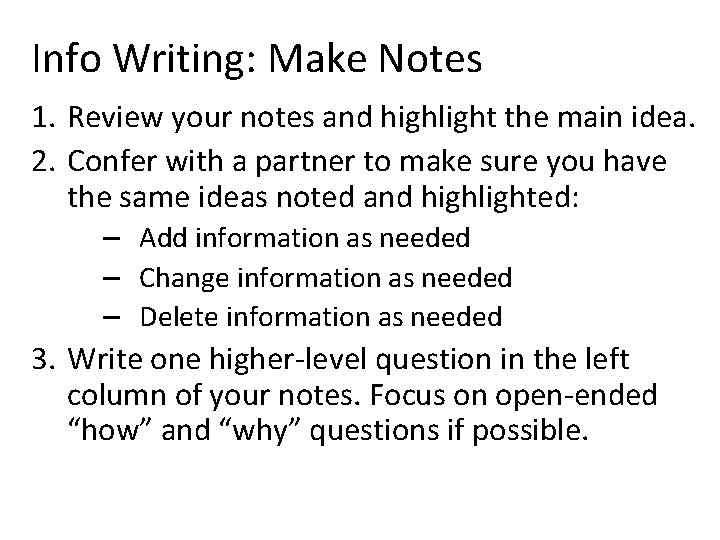
Info Writing: Make Notes 1. Review your notes and highlight the main idea. 2. Confer with a partner to make sure you have the same ideas noted and highlighted: – Add information as needed – Change information as needed – Delete information as needed 3. Write one higher-level question in the left column of your notes. Focus on open-ended “how” and “why” questions if possible.
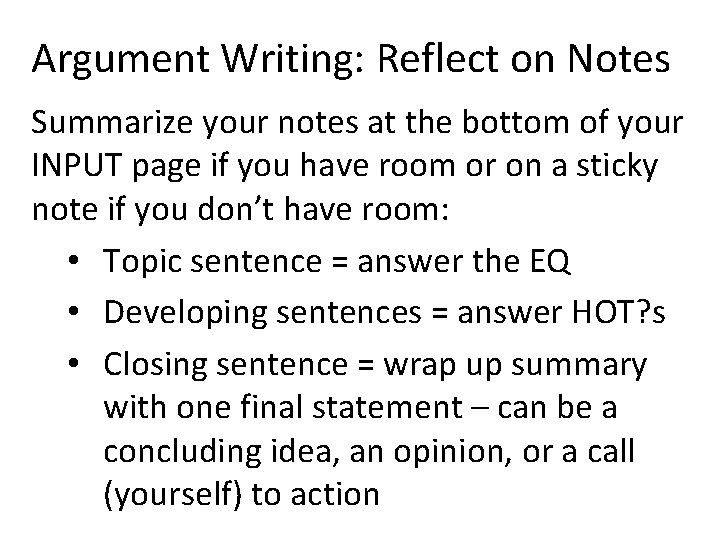
Argument Writing: Reflect on Notes Summarize your notes at the bottom of your INPUT page if you have room or on a sticky note if you don’t have room: • Topic sentence = answer the EQ • Developing sentences = answer HOT? s • Closing sentence = wrap up summary with one final statement – can be a concluding idea, an opinion, or a call (yourself) to action
- Slides: 18