
Cornell notes pg 17 in your INB CHEMISTRY
Cornell notes pg 17 in your INB CHEMISTRY OF LIFE THE ESSENTIAL INGREDIENTS FOR LIFE
INGREDIENTS FOR LIFE 1. 2. 3. 4. 5. Water Carbohydrates Lipids Proteins Nucleic Acids
PROPERTIES OF WATER Living organisms are made mostly of water Adhesive (adhere to other surfaces) Cohesive (adhere to each other) The universal solvent Why does water have these special properties? ? ?
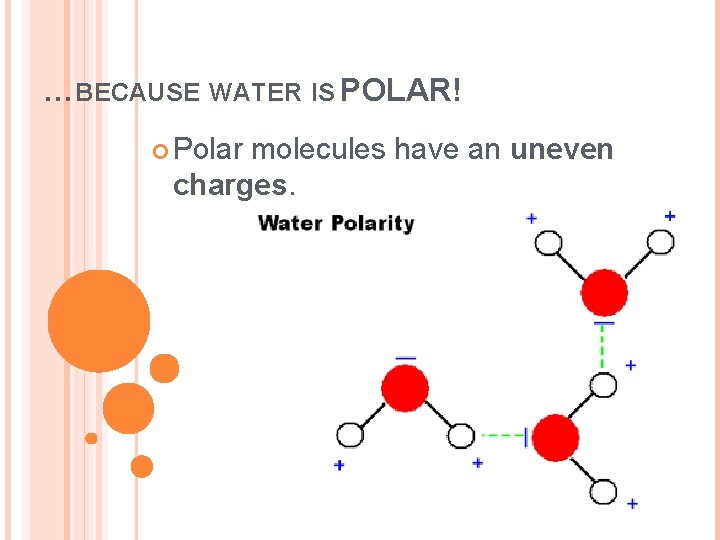
…BECAUSE WATER IS POLAR! Polar molecules have an uneven charges
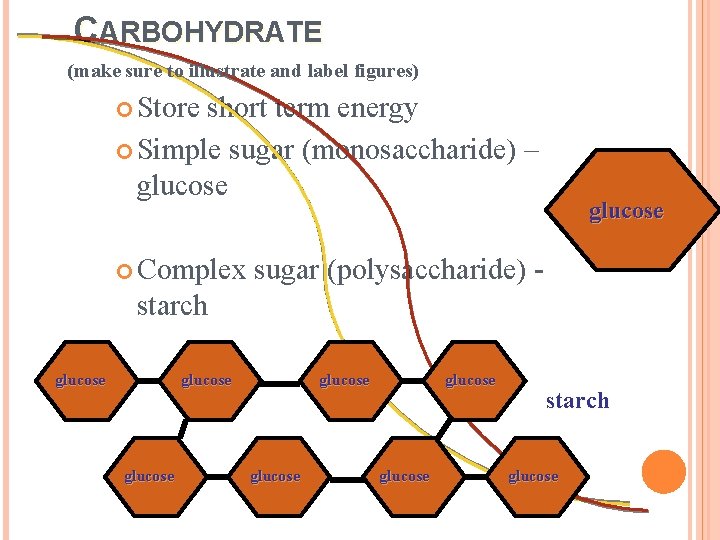
CARBOHYDRATE (make sure to illustrate and label figures) Store short term energy Simple sugar (monosaccharide) – glucose Complex glucose sugar (polysaccharide) - starch glucose glucose starch glucose
LIPIDS insoluble (do not dissolve) in water “stores the most energy” Ex: 1. Fats 2. Oils 3. Cholesterol Some functions of lipids: 1. Long term energy storage 2. Insulation 3. Major component of membranes (phospholipids)
PROTEINS Amino acids (20 different kinds) Amino Acids bonded together form a chain called a polypeptide chain A polypeptide chain folds into a protein. Some 1. 2. 3. 4. functions of proteins: Transport: hemoglobin in red blood cells Movement: muscles Structural: membranes, hair, nails Enzymes: cellular reactions
NUCLEIC ACIDS Two types: a. DNA (deoxyribonucleic acid)genetic material b. RNA (ribonucleic acid)-copy of genetic material Nucleic acids are composed of long chains of nucleotides
IDENTIFYING ORGANIC COMPOUNDS LAB
PRE-LAB QUESTIONS How do you know if a food contains protein? How do you know if a food contains starch? What Why is the difference between starch and sugar? should you be careful of biuret solution? What should you do if you spill some on yourself?
INTRODUCTION The most common organic compounds found in living organisms are lipids, lipids carbohydrates, carbohydrates proteins, proteins and nucleic acids Common foods, which often consist of plant materials or substances derived from animals, are also combinations these organic compounds. Substances called indicators can be used to test for the presence of organic compounds. An indicator is a substance that changes color in the presence of a particular compound. In this investigation, you will use several indicators to test for the presence of lipids, lipids carbohydrates and proteins in various foods.
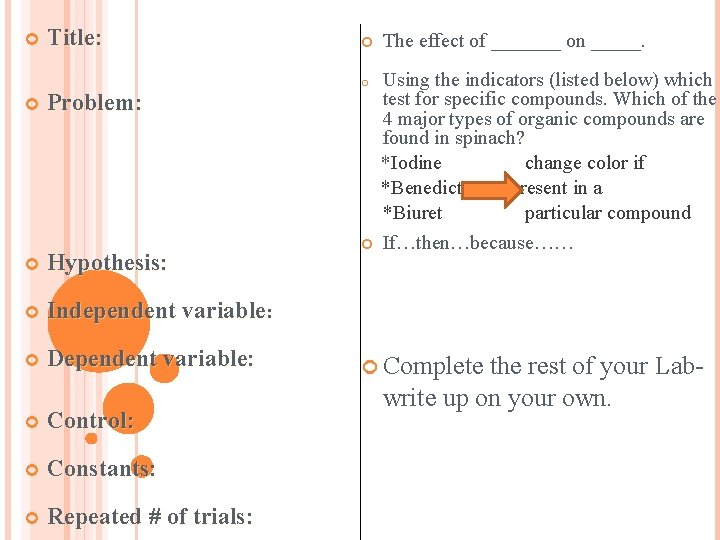
Title: Problem: Hypothesis: Independent variable: Dependent variable: Control: Constants: Repeated # of trials: The effect of _______ on _____. o Using the indicators (listed below) which test for specific compounds. Which of the 4 major types of organic compounds are found in spinach? *Iodine change color if *Benedicts present in a *Biuret particular compound If…then…because…… Complete the rest of your Labwrite up on your own.
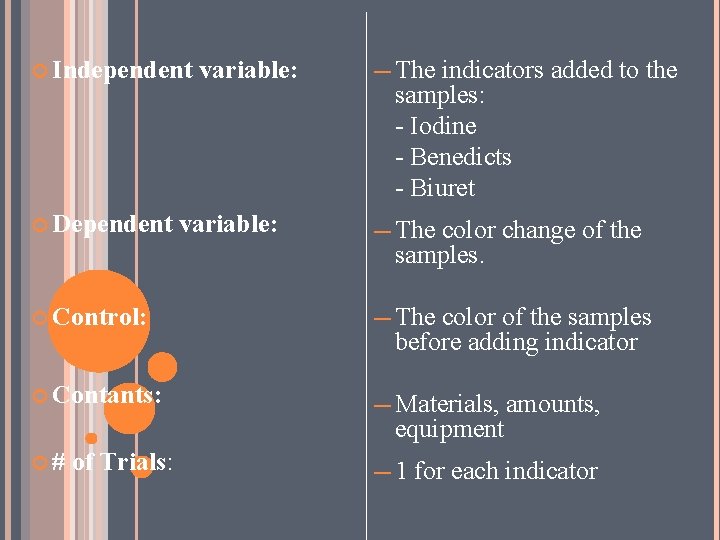
Independent Dependent variable: — The indicators added to the samples: - Iodine - Benedicts - Biuret — The color change of the samples. Control: — The color of the samples before adding indicator Contants: — Materials, equipment # of Trials: — 1 amounts, for each indicator
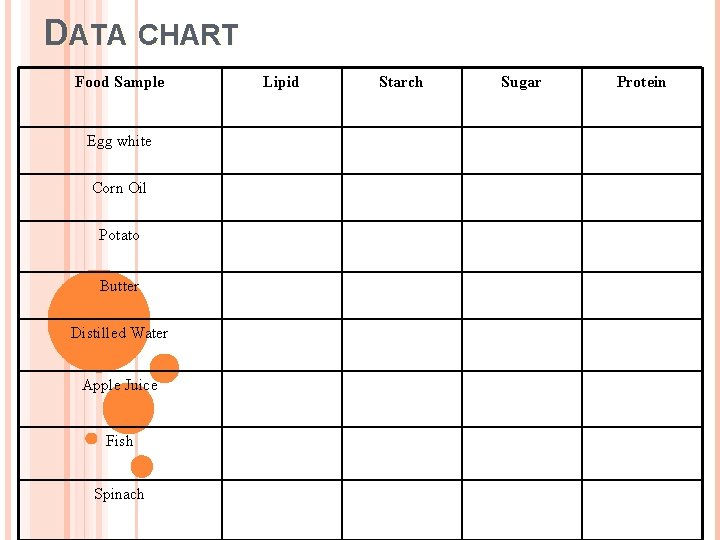
DATA CHART Food Sample Egg white Corn Oil Potato Butter Distilled Water Apple Juice Fish Spinach Lipid Starch Sugar Protein
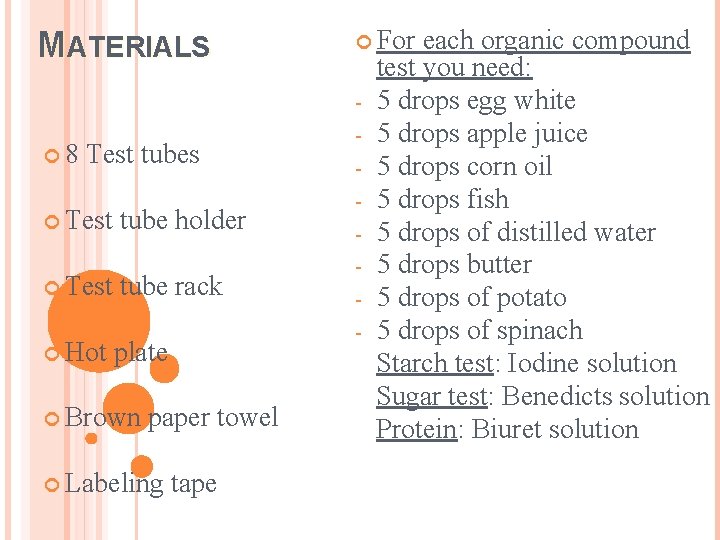
MATERIALS For - 8 Test tubes Test Hot tube holder tube rack paper towel Labeling - plate Brown - tape each organic compound test you need: 5 drops egg white 5 drops apple juice 5 drops corn oil 5 drops fish 5 drops of distilled water 5 drops butter 5 drops of potato 5 drops of spinach Starch test: Iodine solution Sugar test: Benedicts solution Protein: Biuret solution
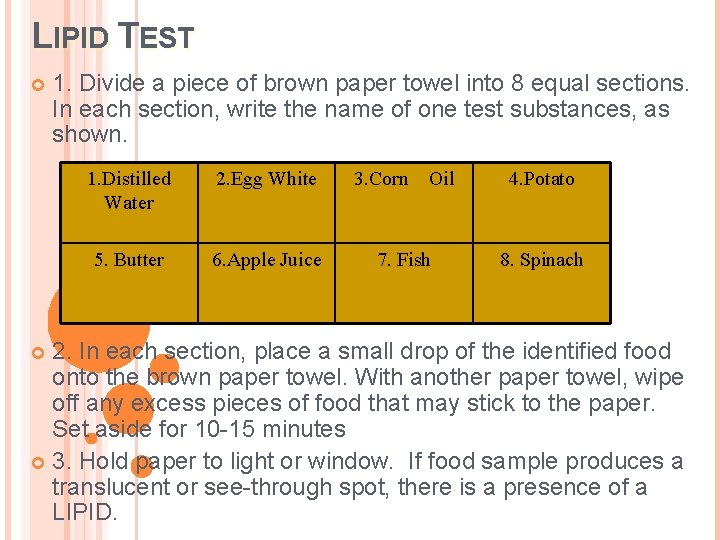
LIPID TEST 1. Divide a piece of brown paper towel into 8 equal sections. In each section, write the name of one test substances, as shown. 1. Distilled Water 2. Egg White 5. Butter 6. Apple Juice 3. Corn Oil 7. Fish 4. Potato 8. Spinach 2. In each section, place a small drop of the identified food onto the brown paper towel. With another paper towel, wipe off any excess pieces of food that may stick to the paper. Set aside for 10 -15 minutes 3. Hold paper to light or window. If food sample produces a translucent or see-through spot, there is a presence of a LIPID.
CARBOHYDRATE TEST - STARCH 1. Label test tubes: distilled water, egg, oil, butter, apple juice, potato, spinach, fish 2. Add 5 drops of each food sample to its proper test tube. 3. Add 2 -3 drops of iodine solution to each test tube and shake. *Iodine will change color from yellow brown →blue black in presence of STARCH. 4. Record data on table. 5. Wash test tubes thoroughly!
CARBOHYDRATE TEST - SUGAR 1. Set up hot water bath: Fill half the beaker with tap water and heat to a gentle boil. 2. While water bath is heating, fill each cleaned test tube with 5 full drops of the appropriate food sample. 3. Add 2 -3 drops of Benedicts solution and shake. 4. Place test tubes in hot water bath and heat for 3 -5 minutes. 5. Caution: Remove test tubes from water bath with test tube holder! *When heated, Benedicts solution will change color from blue → green, yellow, orange, or red in the presence of SUGAR. 6. Record any color changes on data table. 7. Wash test tubes thoroughly!
PROTEIN TEST 1. Put 5 drops of appropriate food samples in each labeled test tube. 2. Add 2 -3 drops of Biuret solution to each test tube and gently shake. Caution: Biuret contains Na. OH, a strong base. If you splash any on yourself, wash with water and notify your teacher immediately! *Biuret changes color from light blue→blue-violet in the presence of PROTEIN. 3. Record any color change on data table. 4. Wash test tubes thoroughly!
POST LAB QUESTIONS Which foods come from plants? What biomolecule is most common in these foods? Which foods come from animals? What biomolecule is most common in these foods? Does water contain any of the macromolecules that you tested for? Explain why water is used as a control.
FILL OUT THE FOLLOWING TABLE BY LISTING THE FOODS THAT YOU TESTED. High in Carbohydrates High in Protein High in Lipids
- Slides: 21