Atomic Models Chemistry Why is Lego the most


- Slides: 29
Atomic Models Chemistry
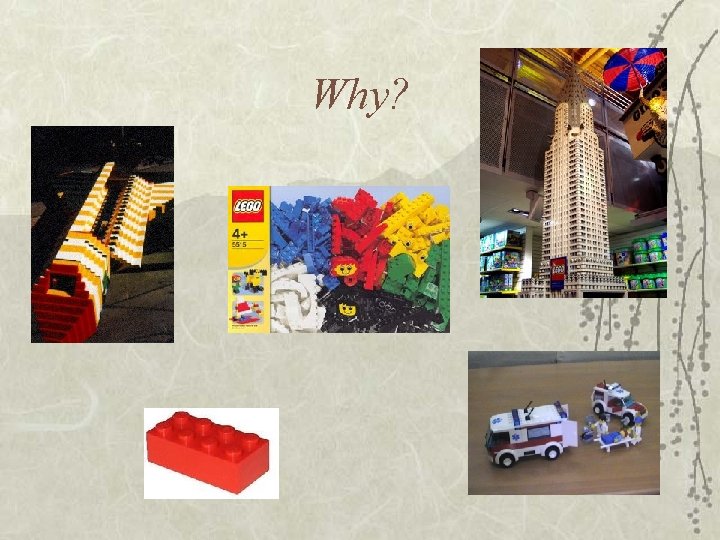
Why is Lego™ the most ingenious toy in the world? Excerpt from Sophie’s World© By Jostein Gaarder
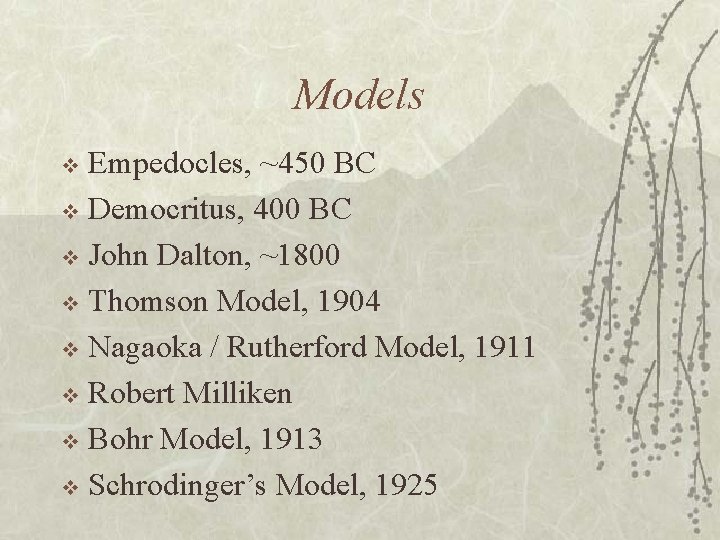
Models v v v v Empedocles, ~450 BC Democritus, 400 BC John Dalton, ~1800 Thomson Model, 1904 Nagaoka / Rutherford Model, 1911 Robert Milliken Bohr Model, 1913 Schrodinger’s Model, 1925 v v v Louis De. Broglie Lise Meitner James Chadwick Linus Pauling Peter Higgs/Francois Englert
Why?
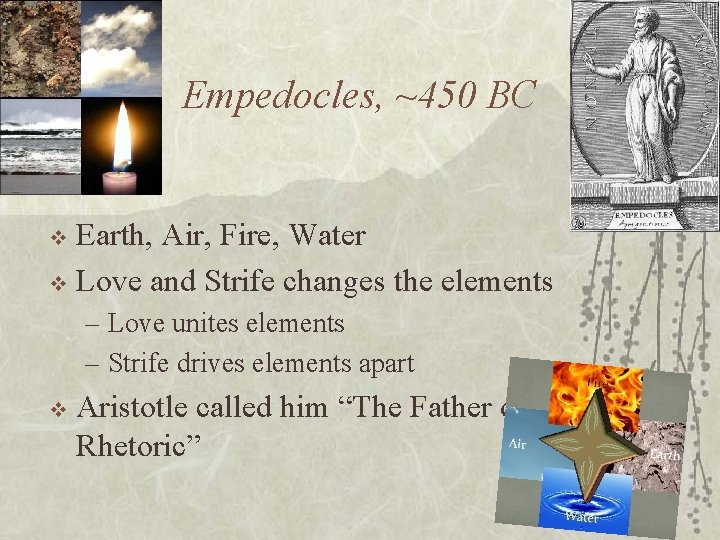
Empedocles, ~450 BC Earth, Air, Fire, Water v Love and Strife changes the elements v – Love unites elements – Strife drives elements apart v Aristotle called him “The Father of Rhetoric”
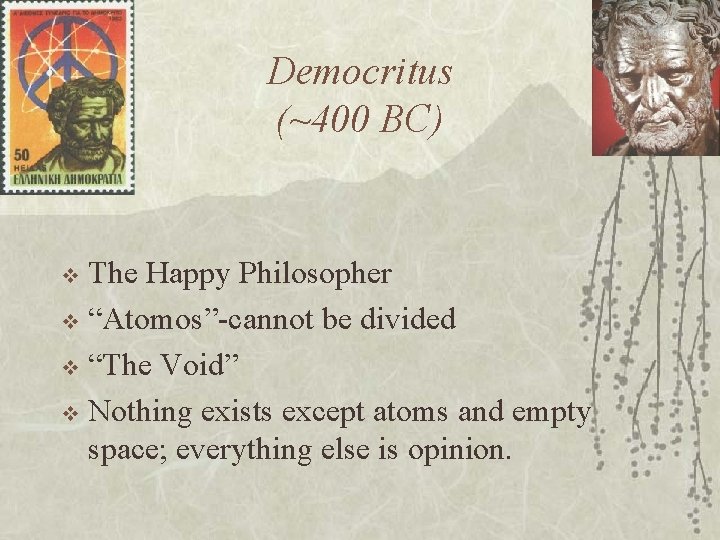
Democritus (~400 BC) The Happy Philosopher v “Atomos”-cannot be divided v “The Void” v Nothing exists except atoms and empty space; everything else is opinion. v
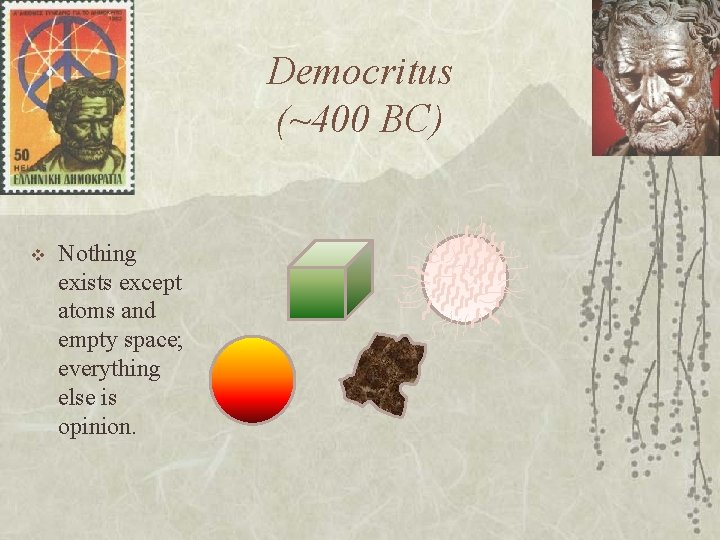
Democritus (~400 BC) v Nothing exists except atoms and empty space; everything else is opinion.
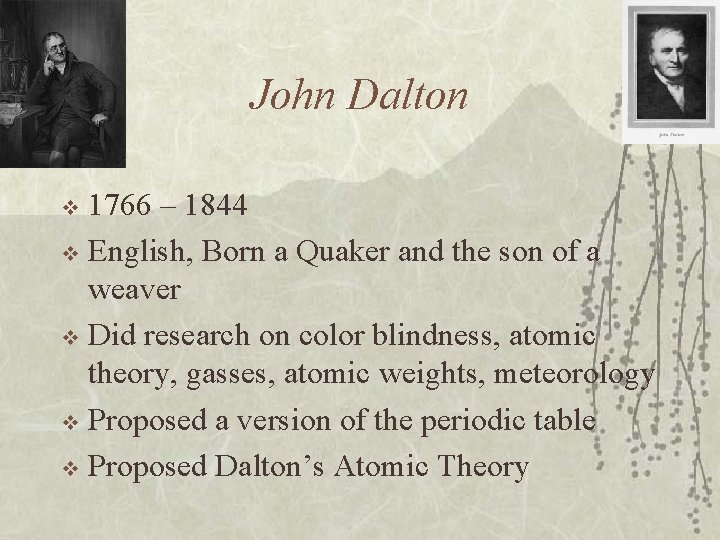
John Dalton 1766 – 1844 v English, Born a Quaker and the son of a weaver v Did research on color blindness, atomic theory, gasses, atomic weights, meteorology v Proposed a version of the periodic table v Proposed Dalton’s Atomic Theory v
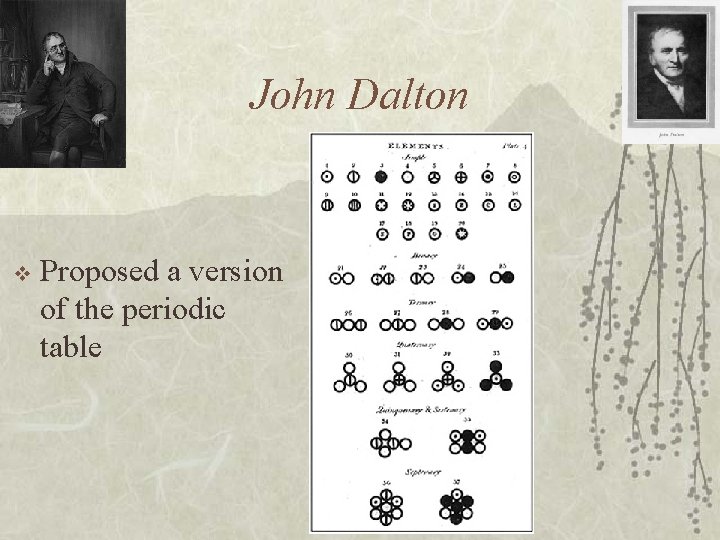
John Dalton v Proposed a version of the periodic table
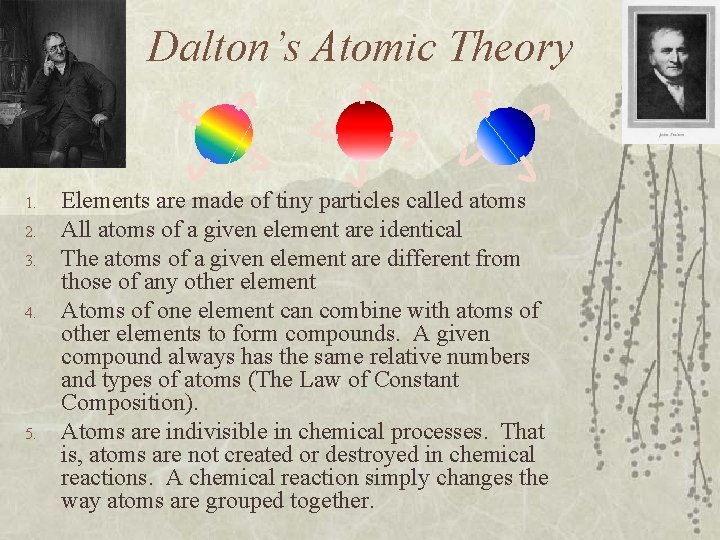
Dalton’s Atomic Theory 1. 2. 3. 4. 5. Elements are made of tiny particles called atoms All atoms of a given element are identical The atoms of a given element are different from those of any other element Atoms of one element can combine with atoms of other elements to form compounds. A given compound always has the same relative numbers and types of atoms (The Law of Constant Composition). Atoms are indivisible in chemical processes. That is, atoms are not created or destroyed in chemical reactions. A chemical reaction simply changes the way atoms are grouped together.
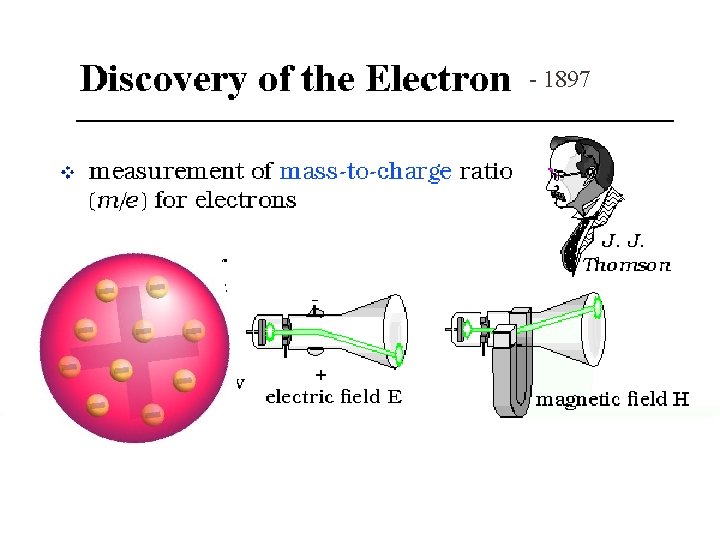
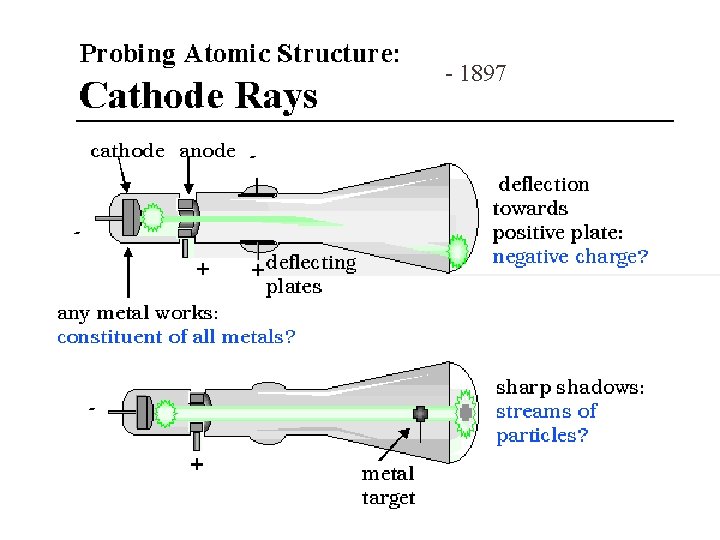
- 1897
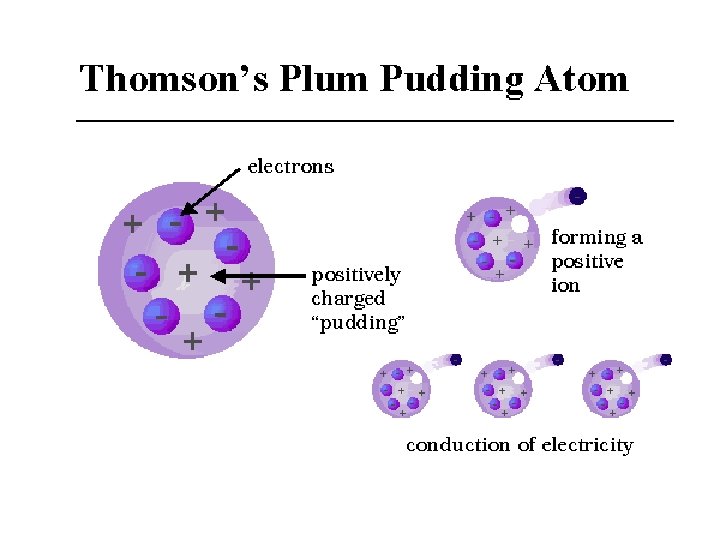
- 1897
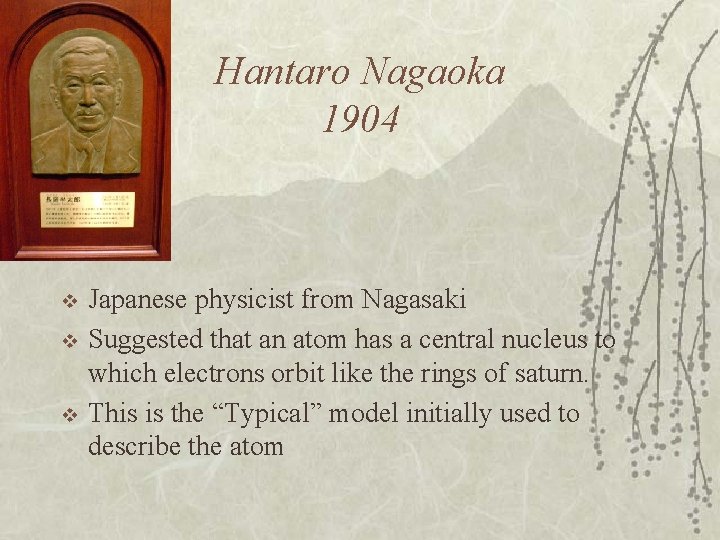
Hantaro Nagaoka 1904 v v v Japanese physicist from Nagasaki Suggested that an atom has a central nucleus to which electrons orbit like the rings of saturn. This is the “Typical” model initially used to describe the atom
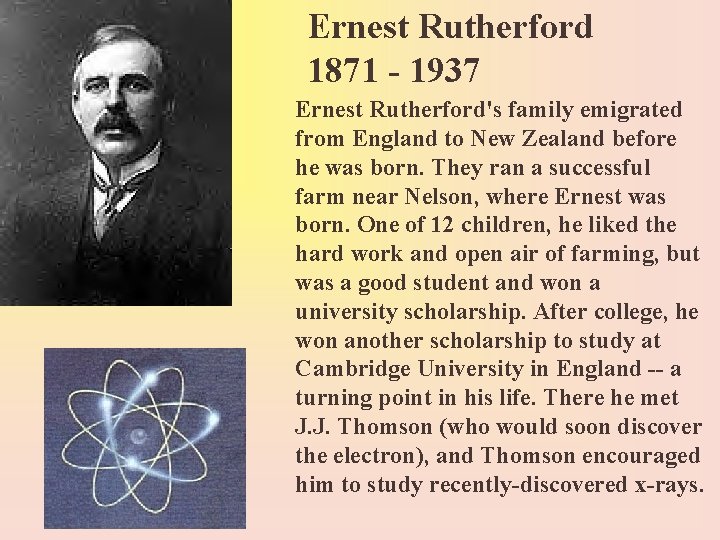
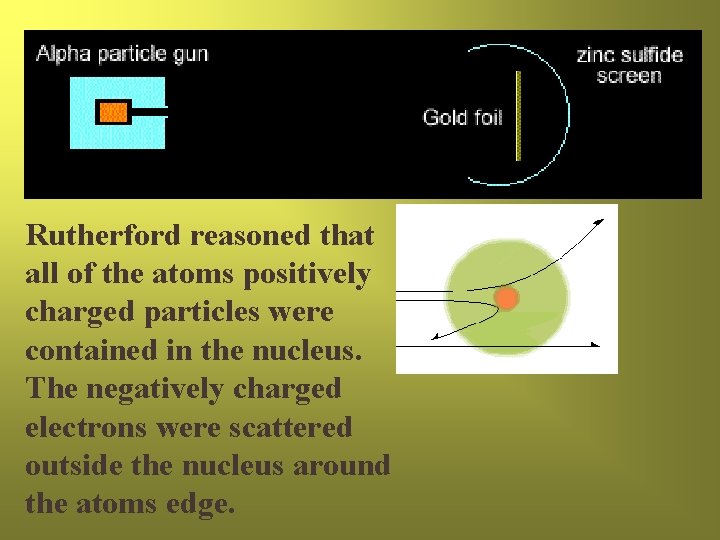
Ernest Rutherford 1871 - 1937 Ernest Rutherford's family emigrated from England to New Zealand before he was born. They ran a successful farm near Nelson, where Ernest was born. One of 12 children, he liked the hard work and open air of farming, but was a good student and won a university scholarship. After college, he won another scholarship to study at Cambridge University in England -- a turning point in his life. There he met J. J. Thomson (who would soon discover the electron), and Thomson encouraged him to study recently-discovered x-rays.
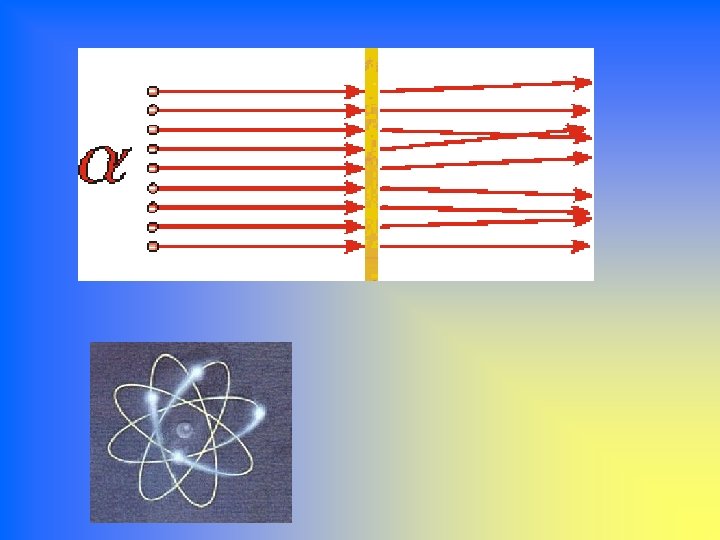
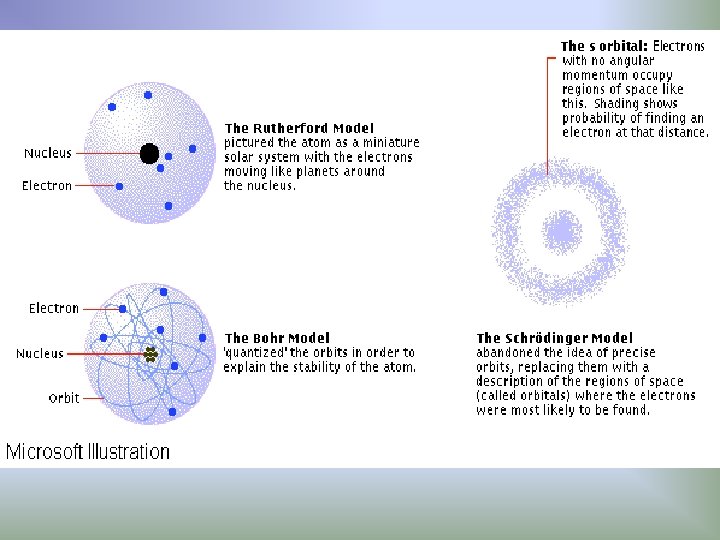
Rutherford reasoned that all of the atoms positively charged particles were contained in the nucleus. The negatively charged electrons were scattered outside the nucleus around the atoms edge.
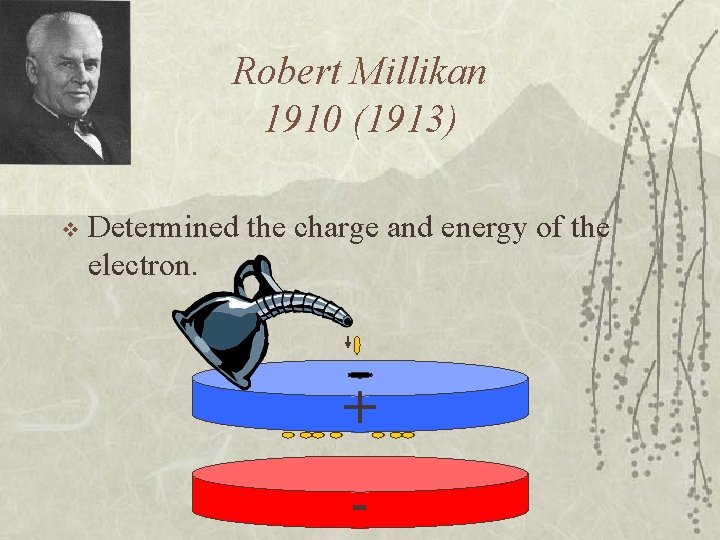
Robert Millikan 1910 (1913) v Determined the charge and energy of the electron. + -
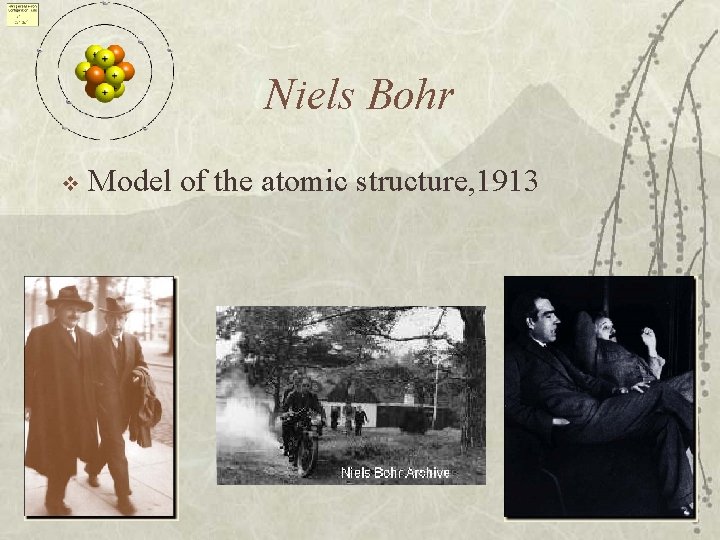
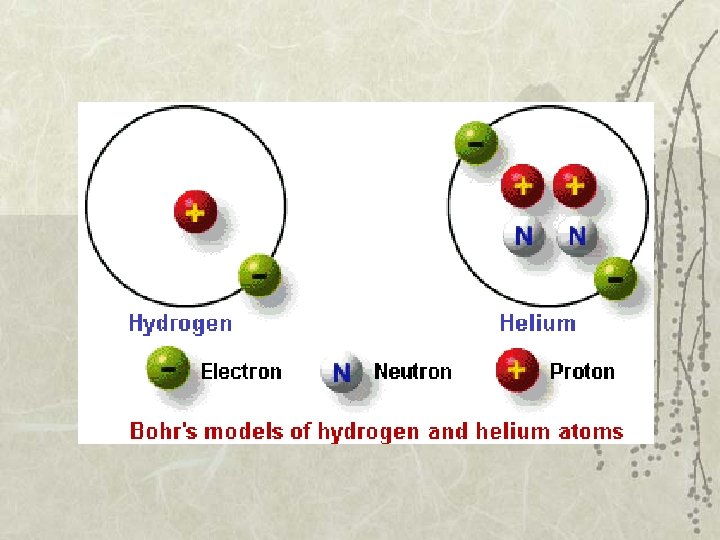
Niels Bohr v Model of the atomic structure, 1913
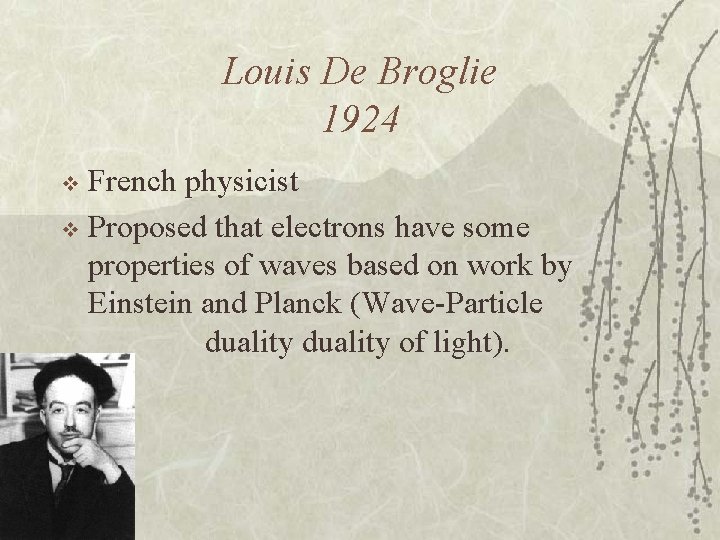
Louis De Broglie 1924 French physicist v Proposed that electrons have some properties of waves based on work by Einstein and Planck (Wave-Particle duality of light). v
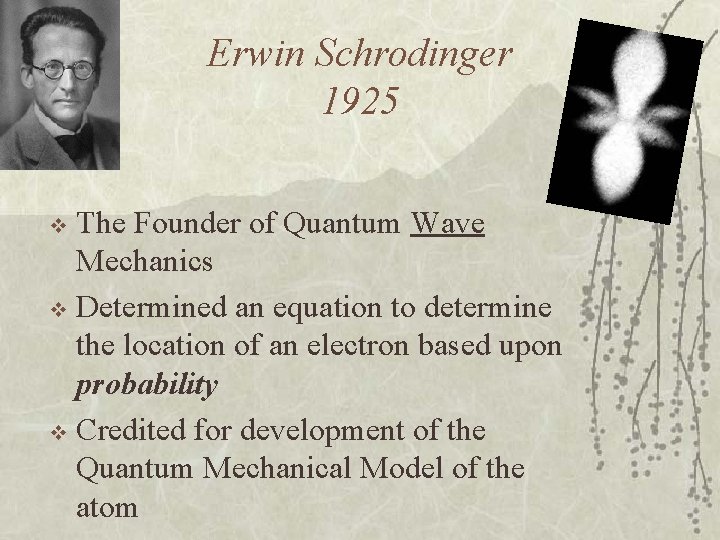
Erwin Schrodinger 1925 The Founder of Quantum Wave Mechanics v Determined an equation to determine the location of an electron based upon probability v Credited for development of the Quantum Mechanical Model of the atom v
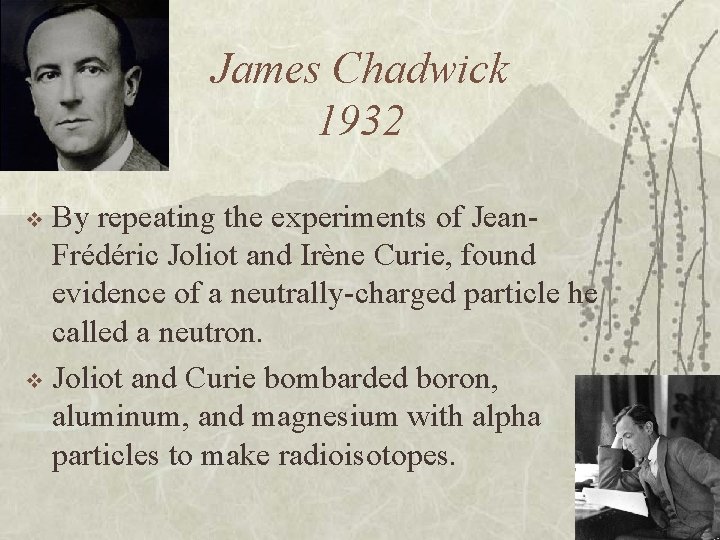
James Chadwick 1932 By repeating the experiments of Jean. Frédéric Joliot and Irène Curie, found evidence of a neutrally-charged particle he called a neutron. v Joliot and Curie bombarded boron, aluminum, and magnesium with alpha particles to make radioisotopes. v
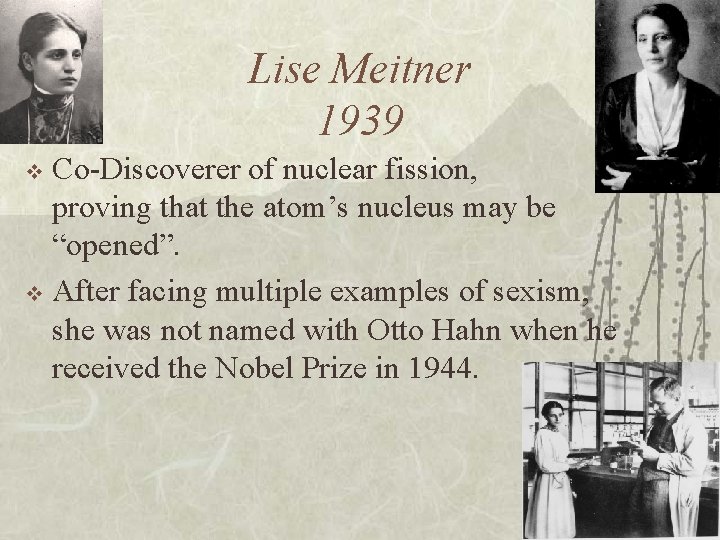
Lise Meitner 1939 Co-Discoverer of nuclear fission, proving that the atom’s nucleus may be “opened”. v After facing multiple examples of sexism, she was not named with Otto Hahn when he received the Nobel Prize in 1944. v
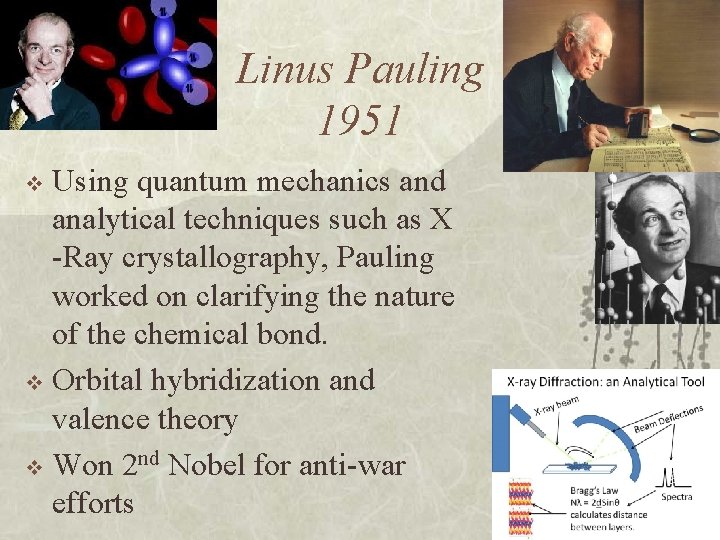
Linus Pauling 1951 Using quantum mechanics and analytical techniques such as X -Ray crystallography, Pauling worked on clarifying the nature of the chemical bond. v Orbital hybridization and valence theory v Won 2 nd Nobel for anti-war efforts v
Peter Higgs/Francois Englert
Models Empedocles, ~450 BC v Democritus, 400 BC v John Dalton, ~1800 v Thomson Model, 1904 v Nagaoka / Rutherford Model, 1911 v Robert Milliken v Bohr Model, 1913 v Schrodinger’s Model, 1925 v