
Atomic Theory p 154 159 Early Greeks The
- Slides: 22
Atomic Theory (p. 154 – 159)
Early Greeks • The ancient Greeks were interested in figuring out what matter is made up of. There were two competing theories: Democritus Aristotle Matter is made up of tiny particles Everything is made up of 4 major elements: called atomos (“uncuttable”) earth, water, air, fire because they could not be created, Criticized Democritus’ theory because it destroyed or divided. could not explain the various properties This idea was based on a thought matter can possess. experiment (philosophical), and not Also, it could not explain chemical changes. backed up by experiments. • Denial of existence of atoms lasted for 2000+ years!!
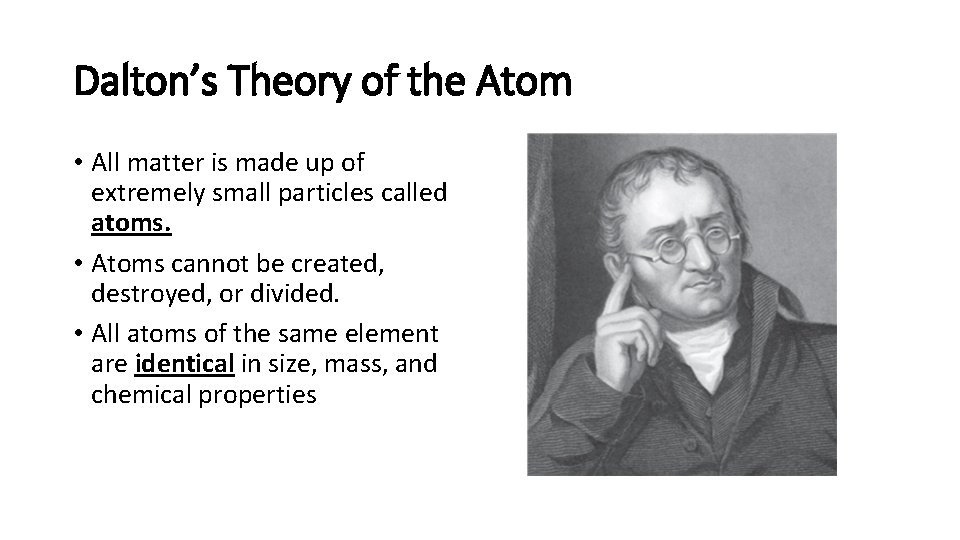
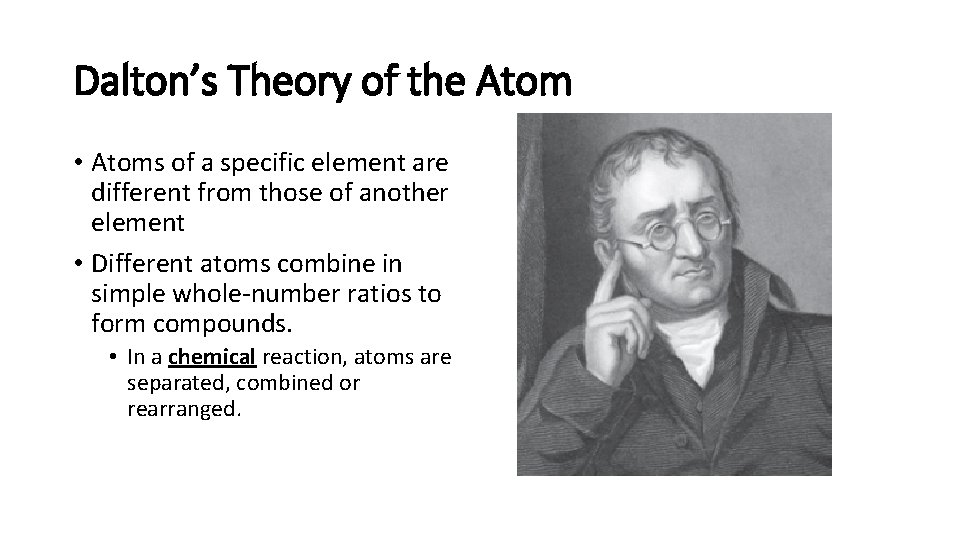
Dalton’s Theory of the Atom • All matter is made up of extremely small particles called atoms. • Atoms cannot be created, destroyed, or divided. • All atoms of the same element are identical in size, mass, and chemical properties
Dalton’s Theory of the Atom • Atoms of a specific element are different from those of another element • Different atoms combine in simple whole-number ratios to form compounds. • In a chemical reaction, atoms are separated, combined or rearranged.
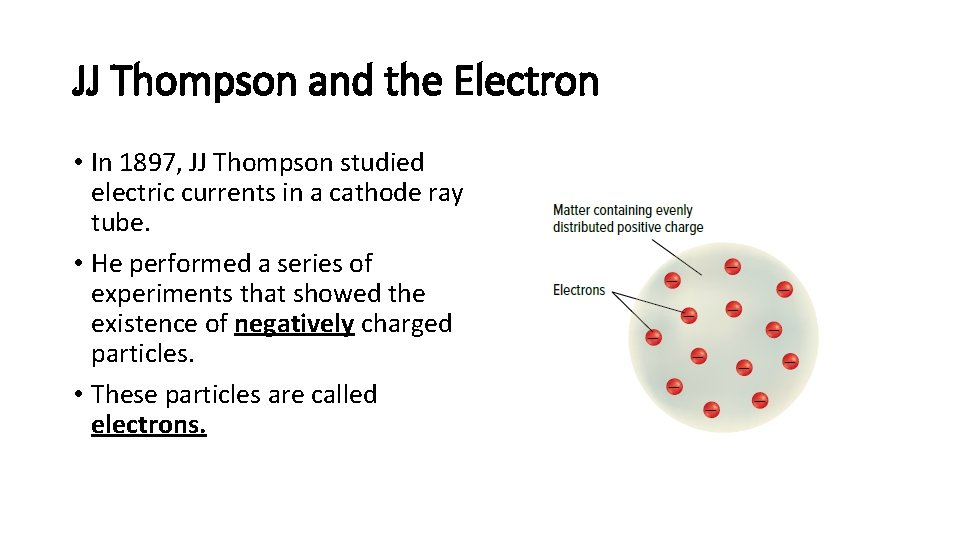
JJ Thompson and the Electron • In 1897, JJ Thompson studied electric currents in a cathode ray tube. • He performed a series of experiments that showed the existence of negatively charged particles. • These particles are called electrons.
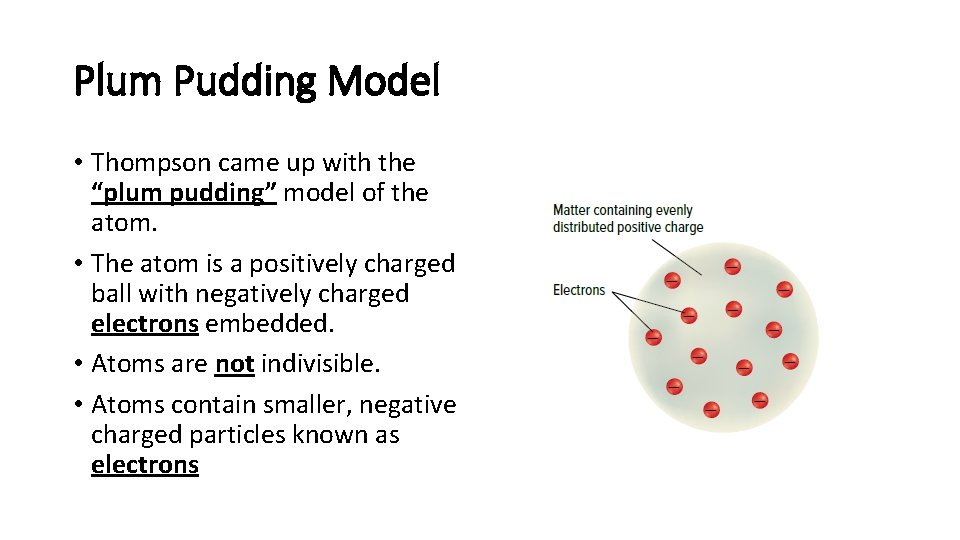
Plum Pudding Model • Thompson came up with the “plum pudding” model of the atom. • The atom is a positively charged ball with negatively charged electrons embedded. • Atoms are not indivisible. • Atoms contain smaller, negative charged particles known as electrons
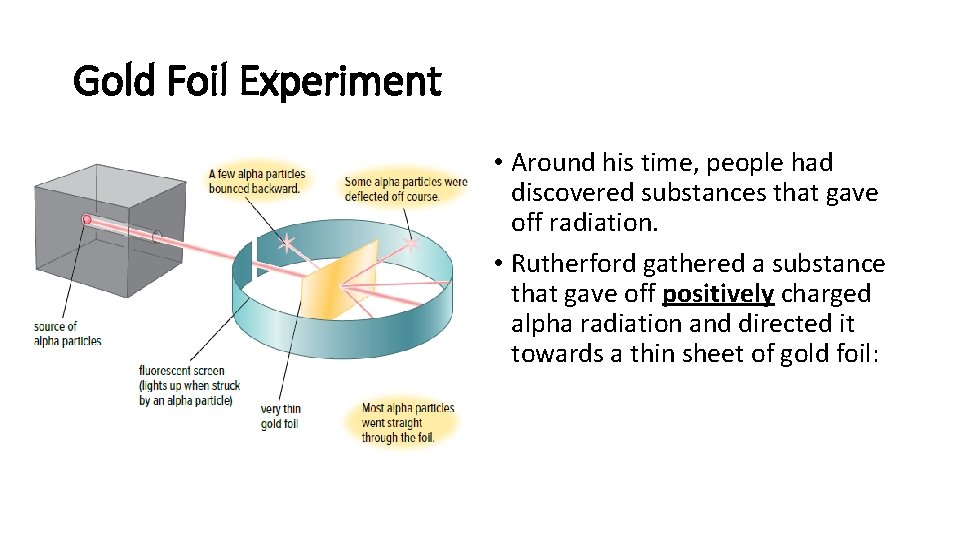
Ernest Rutherford and the Nucleus • In 1909, Ernest Rutherford designed an experiment to find out more about the structure of the atom. • Rutherford’s Gold Foil Experiment led to the discovery of the atom’s nucleus.
Gold Foil Experiment • Around his time, people had discovered substances that gave off radiation. • Rutherford gathered a substance that gave off positively charged alpha radiation and directed it towards a thin sheet of gold foil:
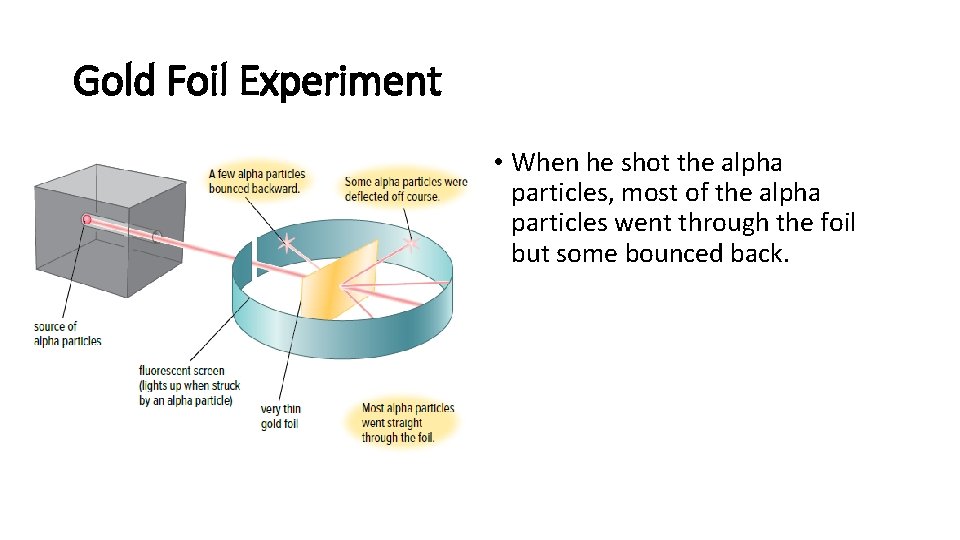
Gold Foil Experiment • When he shot the alpha particles, most of the alpha particles went through the foil but some bounced back.
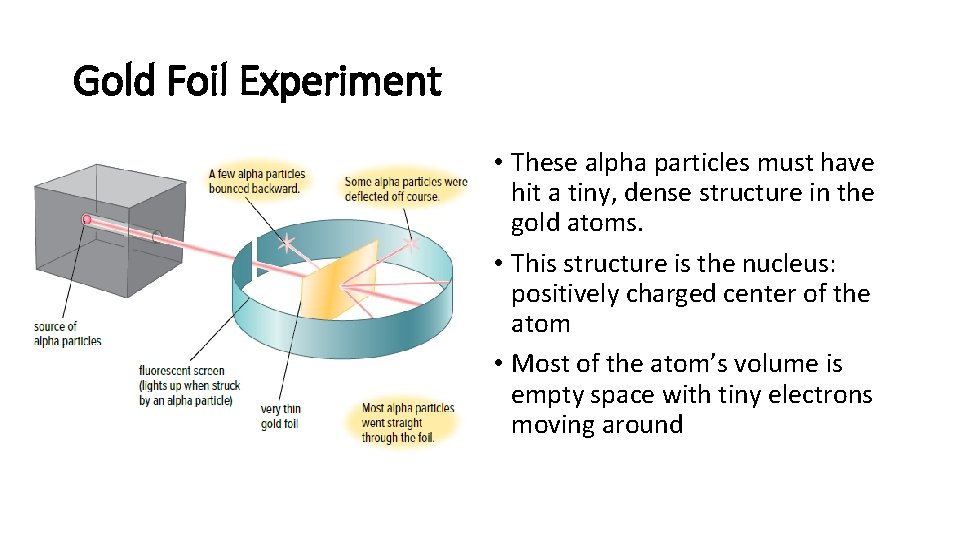
Gold Foil Experiment • These alpha particles must have hit a tiny, dense structure in the gold atoms. • This structure is the nucleus: positively charged center of the atom • Most of the atom’s volume is empty space with tiny electrons moving around
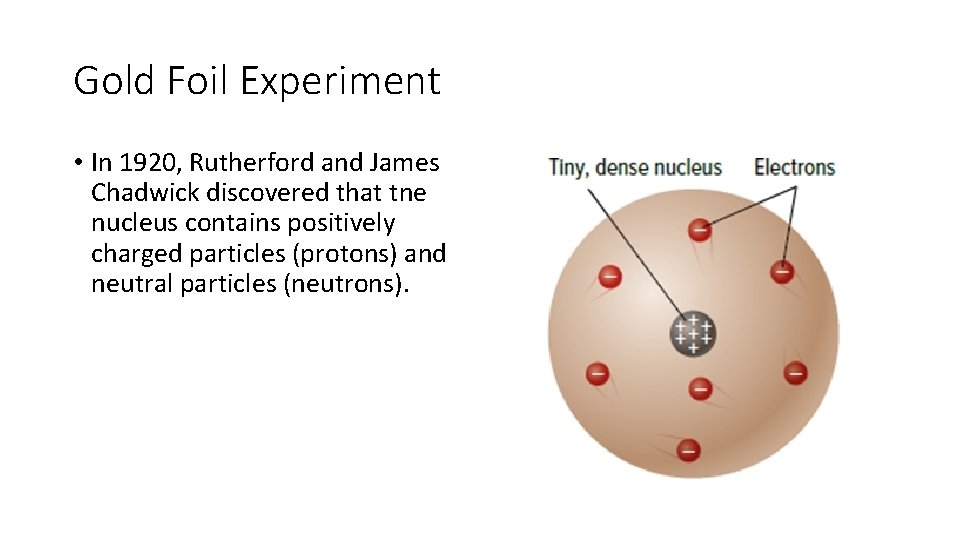
Gold Foil Experiment • In 1920, Rutherford and James Chadwick discovered that tne nucleus contains positively charged particles (protons) and neutral particles (neutrons).
Atomic Theory and the Bohr Model
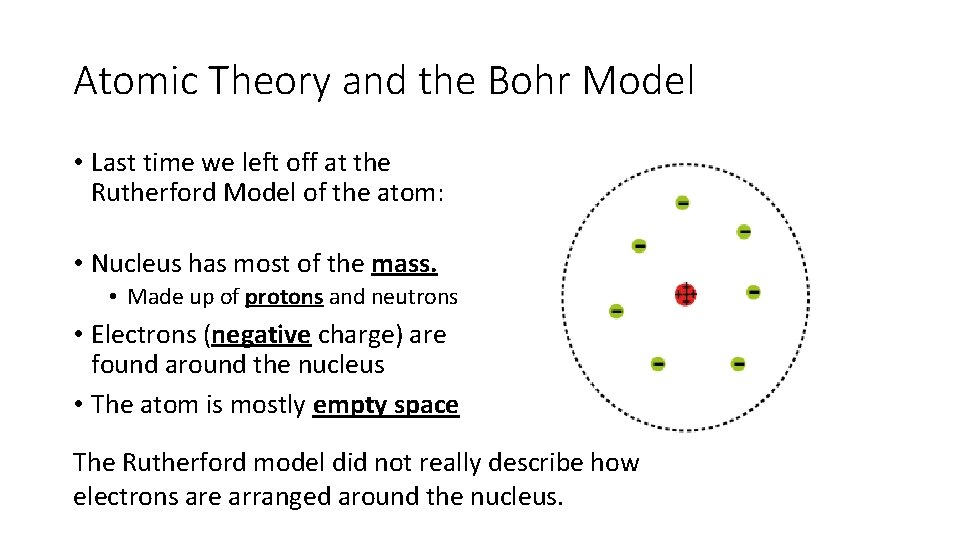
Atomic Theory and the Bohr Model • Last time we left off at the Rutherford Model of the atom: • Nucleus has most of the mass. • Made up of protons and neutrons • Electrons (negative charge) are found around the nucleus • The atom is mostly empty space The Rutherford model did not really describe how electrons are arranged around the nucleus.
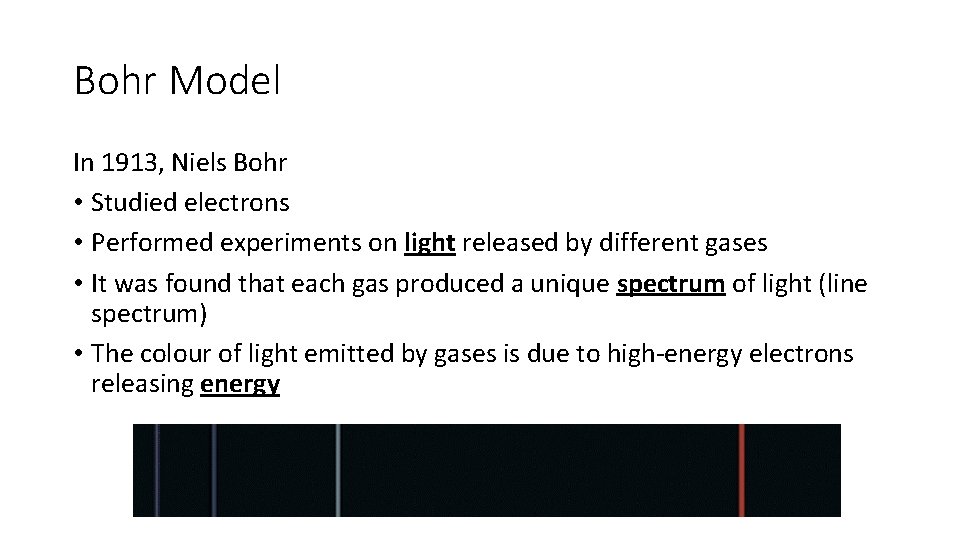
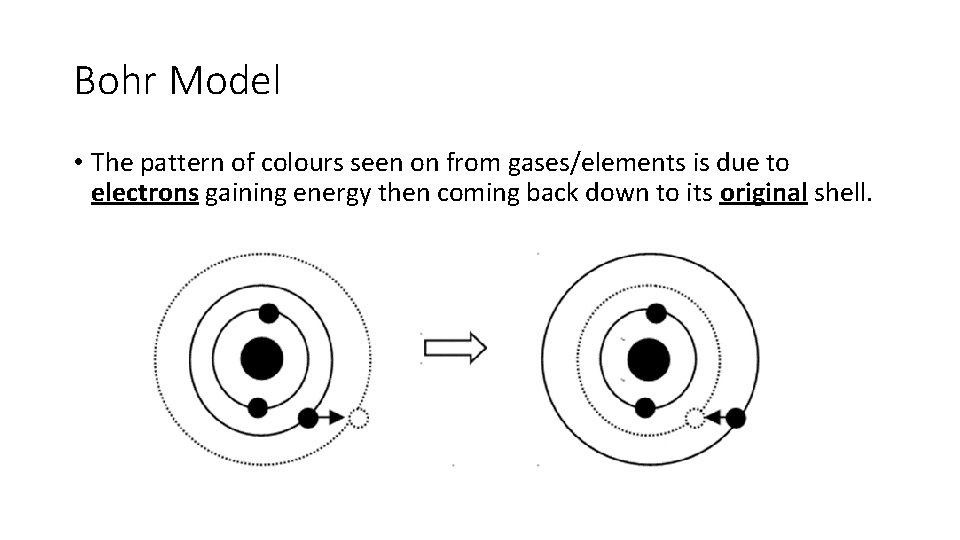
Bohr Model In 1913, Niels Bohr • Studied electrons • Performed experiments on light released by different gases • It was found that each gas produced a unique spectrum of light (line spectrum) • The colour of light emitted by gases is due to high-energy electrons releasing energy
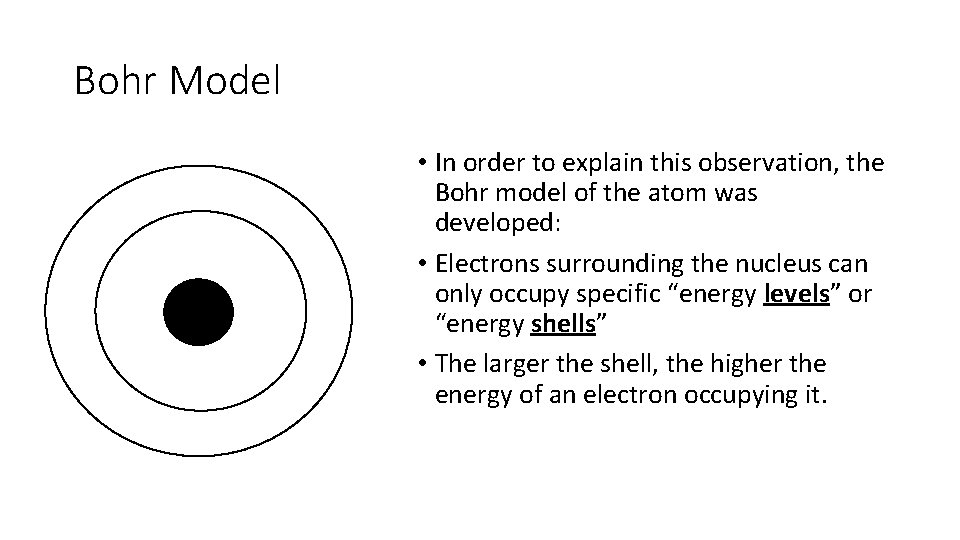
Bohr Model • In order to explain this observation, the Bohr model of the atom was developed: • Electrons surrounding the nucleus can only occupy specific “energy levels” or “energy shells” • The larger the shell, the higher the energy of an electron occupying it.
Bohr Model • The pattern of colours seen on from gases/elements is due to electrons gaining energy then coming back down to its original shell.
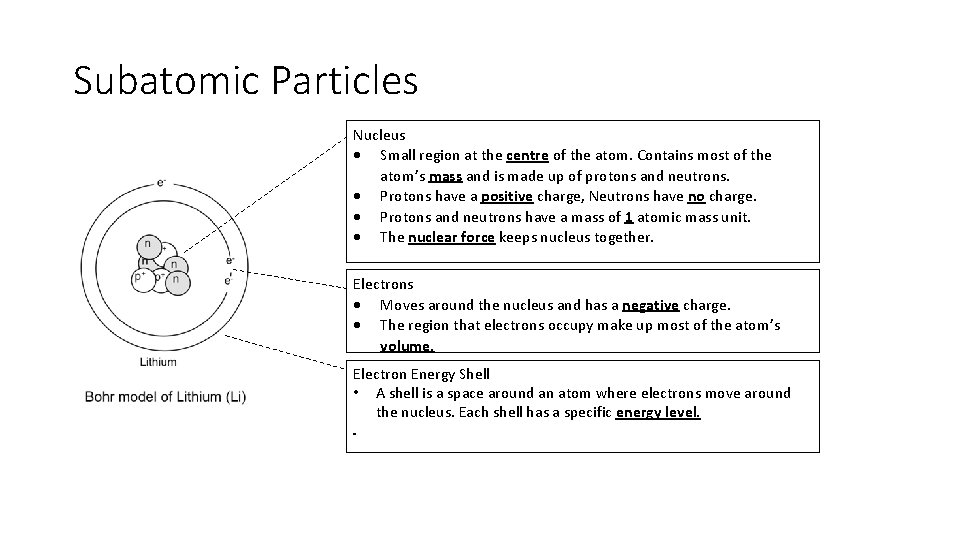
Subatomic Particles Nucleus Small region at the centre of the atom. Contains most of the atom’s mass and is made up of protons and neutrons. Protons have a positive charge, Neutrons have no charge. Protons and neutrons have a mass of 1 atomic mass unit. The nuclear force keeps nucleus together. Electrons Moves around the nucleus and has a negative charge. The region that electrons occupy make up most of the atom’s volume. Electron Energy Shell • A shell is a space around an atom where electrons move around the nucleus. Each shell has a specific energy level.
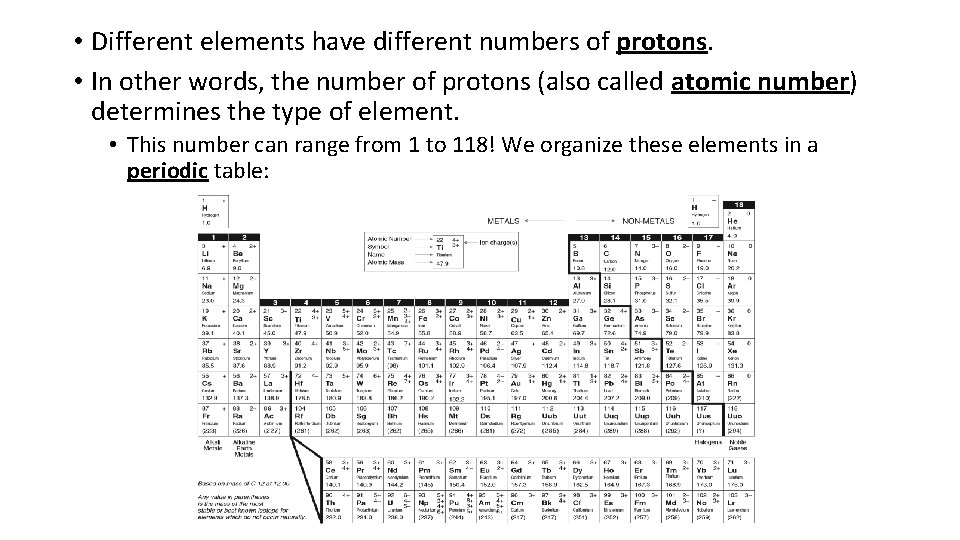
• Different elements have different numbers of protons. • In other words, the number of protons (also called atomic number) determines the type of element. • This number can range from 1 to 118! We organize these elements in a periodic table:
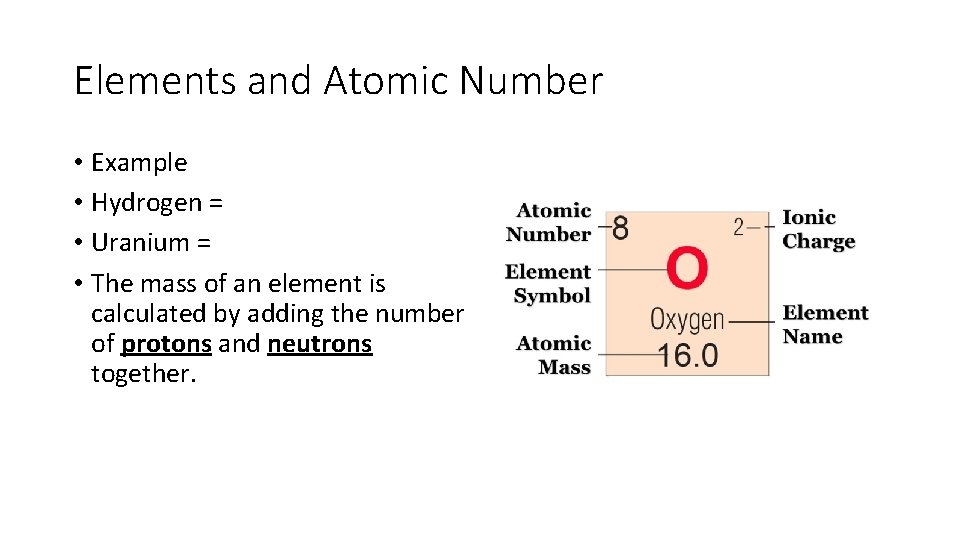
Elements and Atomic Number • Example • Hydrogen = • Uranium = • The mass of an element is calculated by adding the number of protons and neutrons together.
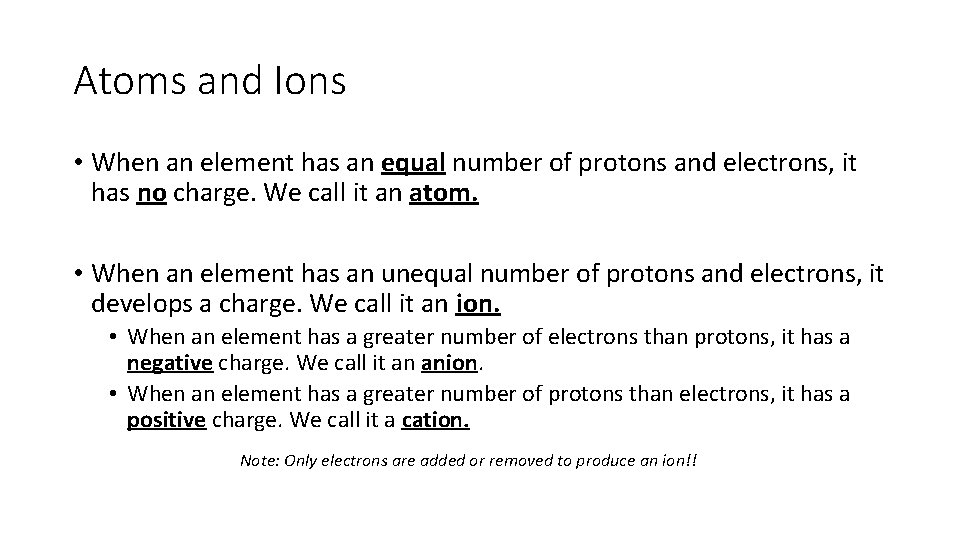
Atoms and Ions • When an element has an equal number of protons and electrons, it has no charge. We call it an atom. • When an element has an unequal number of protons and electrons, it develops a charge. We call it an ion. • When an element has a greater number of electrons than protons, it has a negative charge. We call it an anion. • When an element has a greater number of protons than electrons, it has a positive charge. We call it a cation. Note: Only electrons are added or removed to produce an ion!!
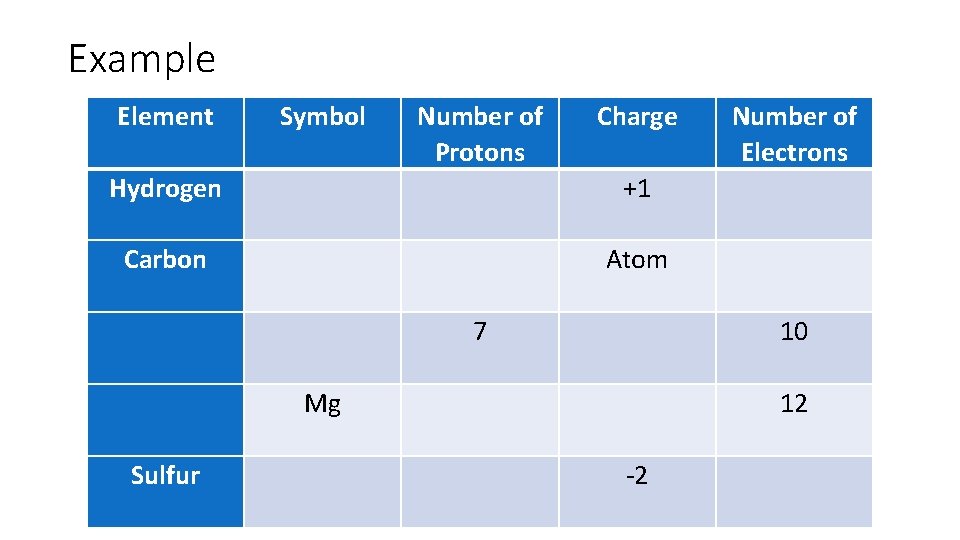
Example Element Symbol Hydrogen Carbon Sulfur Number of Protons Charge +1 Number of Electrons Atom 7 10 Mg 12 -2