
Atomic Structure Chemistry The Greeks History of the

- Slides: 62
Atomic Structure Chemistry
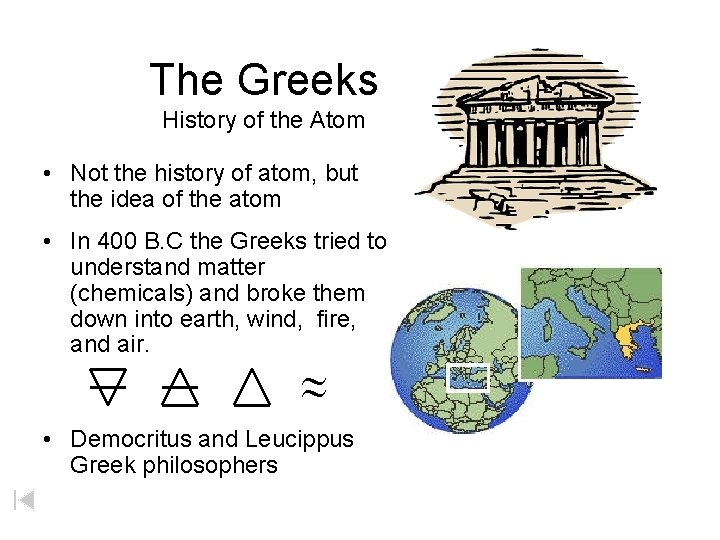
The Greeks History of the Atom • Not the history of atom, but the idea of the atom • In 400 B. C the Greeks tried to understand matter (chemicals) and broke them down into earth, wind, fire, and air. ~ ~ • Democritus and Leucippus Greek philosophers
~400 BC Democritus l First suggested the existence of atoms. l Name atom - atomos l All matter is made up of small indestructible particles called atoms
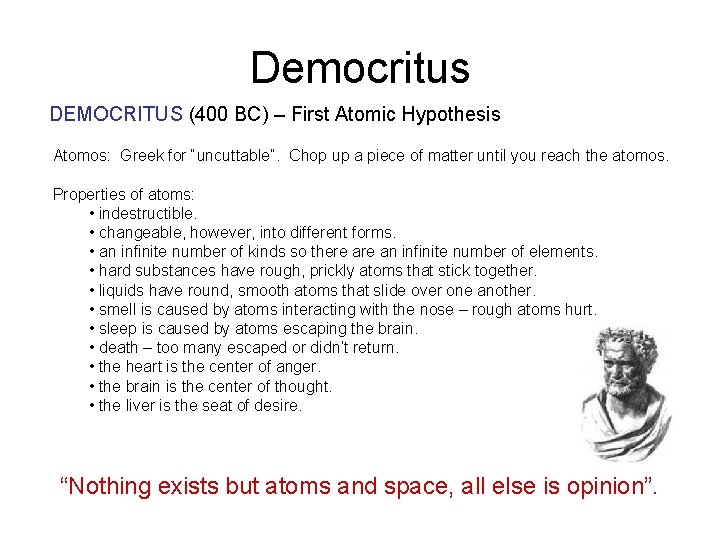
Democritus DEMOCRITUS (400 BC) – First Atomic Hypothesis Atomos: Greek for “uncuttable”. Chop up a piece of matter until you reach the atomos. Properties of atoms: • indestructible. • changeable, however, into different forms. • an infinite number of kinds so there an infinite number of elements. • hard substances have rough, prickly atoms that stick together. • liquids have round, smooth atoms that slide over one another. • smell is caused by atoms interacting with the nose – rough atoms hurt. • sleep is caused by atoms escaping the brain. • death – too many escaped or didn’t return. • the heart is the center of anger. • the brain is the center of thought. • the liver is the seat of desire. “Nothing exists but atoms and space, all else is opinion”.
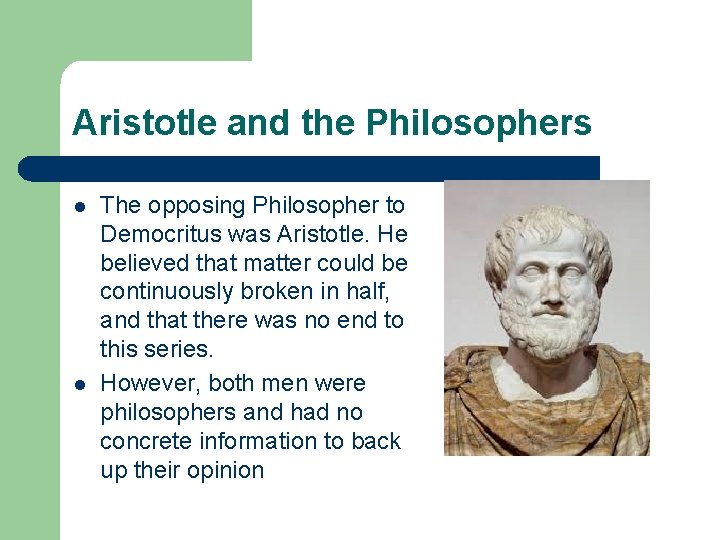
Aristotle and the Philosophers l l The opposing Philosopher to Democritus was Aristotle. He believed that matter could be continuously broken in half, and that there was no end to this series. However, both men were philosophers and had no concrete information to back up their opinion
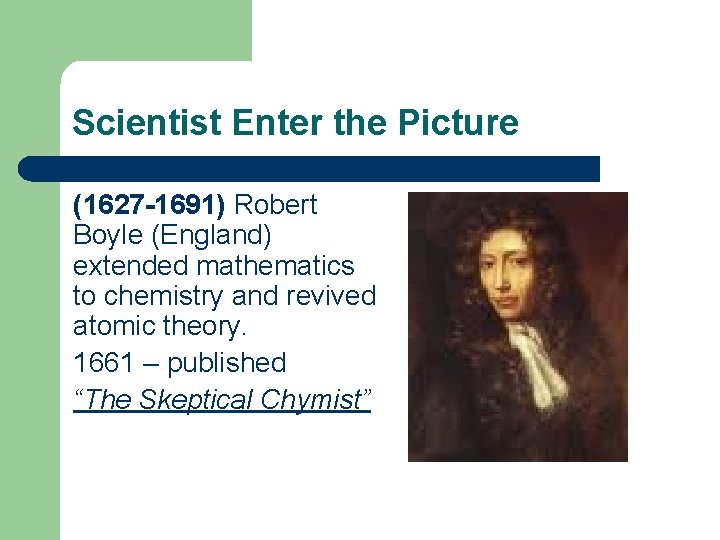
Scientist Enter the Picture (1627 -1691) Robert Boyle (England) extended mathematics to chemistry and revived atomic theory. 1661 – published “The Skeptical Chymist”
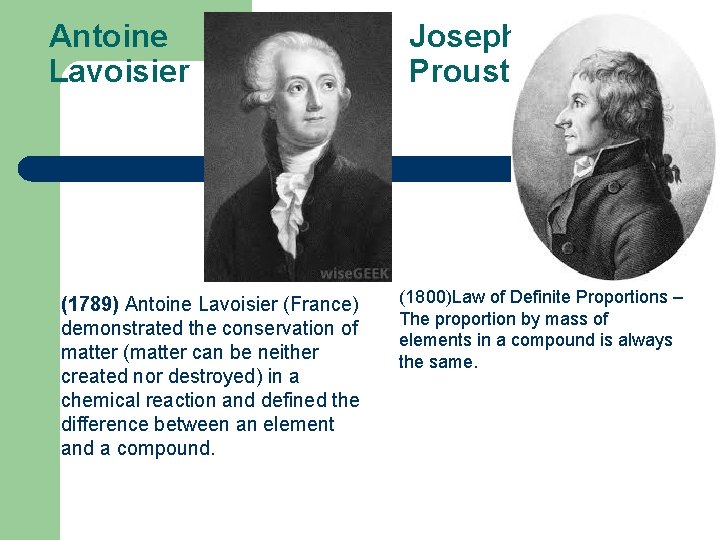
Antoine Lavoisier (1789) Antoine Lavoisier (France) demonstrated the conservation of matter (matter can be neither created nor destroyed) in a chemical reaction and defined the difference between an element and a compound. Joseph Proust (1800)Law of Definite Proportions – The proportion by mass of elements in a compound is always the same.
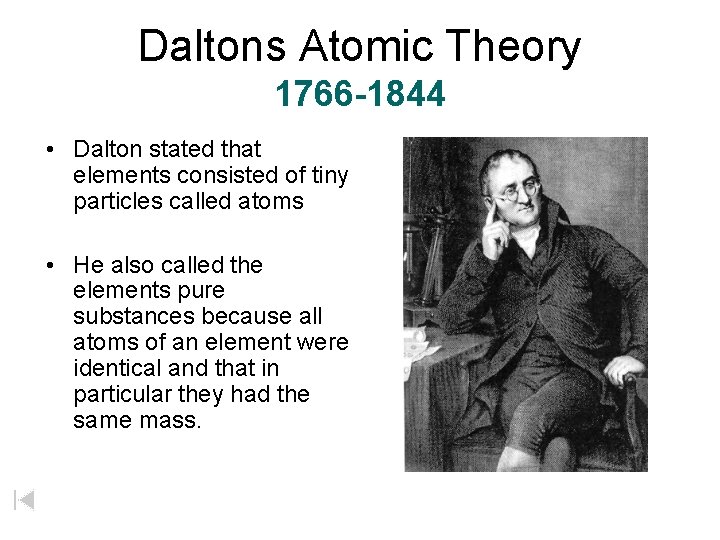
Daltons Atomic Theory 1766 -1844 • Dalton stated that elements consisted of tiny particles called atoms • He also called the elements pure substances because all atoms of an element were identical and that in particular they had the same mass.
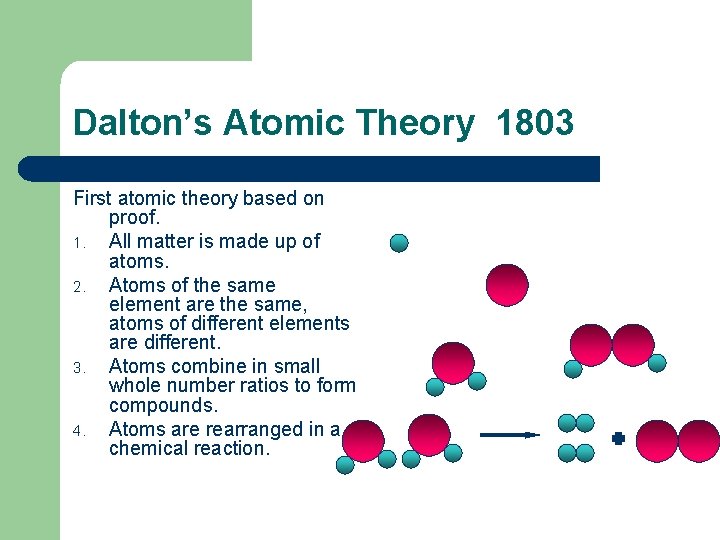
Dalton’s Atomic Theory 1803 First atomic theory based on proof. 1. All matter is made up of atoms. 2. Atoms of the same element are the same, atoms of different elements are different. 3. Atoms combine in small whole number ratios to form compounds. 4. Atoms are rearranged in a chemical reaction.
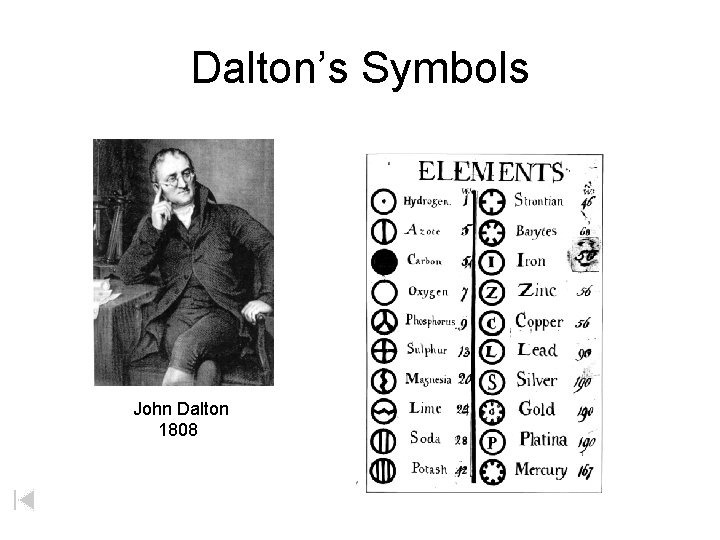
Dalton’s Symbols John Dalton 1808
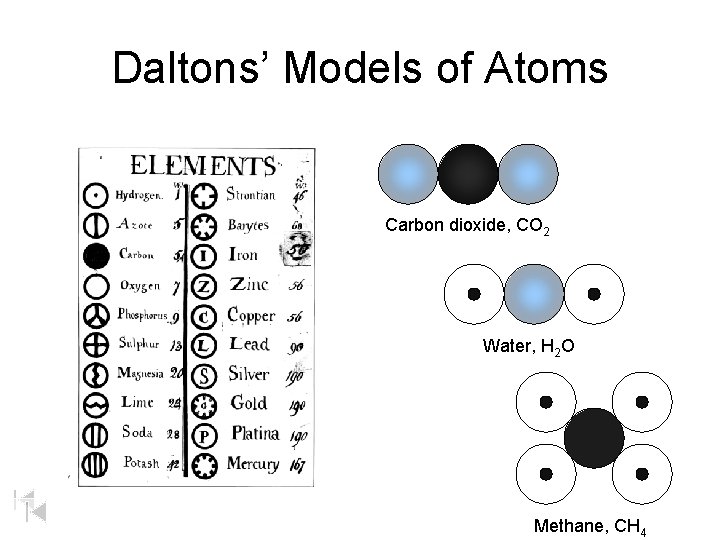
Daltons’ Models of Atoms Carbon dioxide, CO 2 Water, H 2 O Methane, CH 4
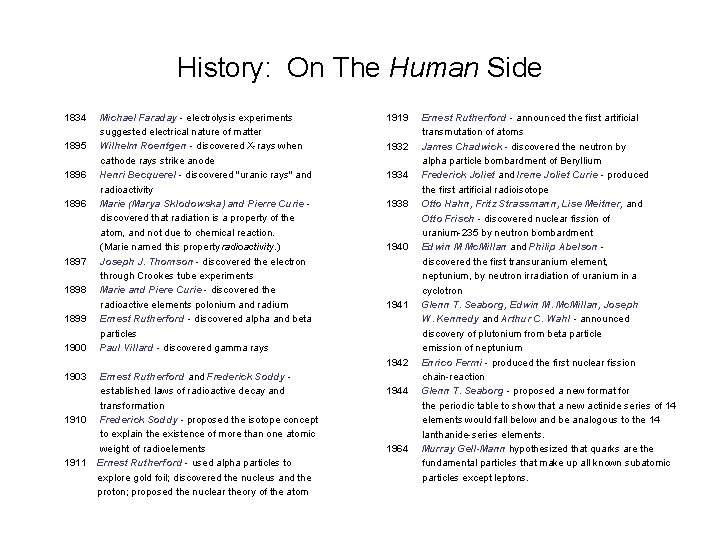
History: On The Human Side 1834 Michael Faraday - electrolysis experiments suggested electrical nature of matter 1895 Wilhelm Roentgen - discovered X-rays when cathode rays strike anode 1896 Henri Becquerel - discovered "uranic rays" and radioactivity 1896 Marie (Marya Sklodowska) and Pierre Curie - discovered that radiation is a property of the atom, and not due to chemical reaction. (Marie named this property radioactivity. ) 1897 Joseph J. Thomson - discovered the electron through Crookes tube experiments 1898 Marie and Piere Curie - discovered the radioactive elements polonium and radium 1899 Ernest Rutherford - discovered alpha and beta particles 1900 Paul Villard - discovered gamma rays 1903 Ernest Rutherford and Frederick Soddy - established laws of radioactive decay and transformation 1910 Frederick Soddy - proposed the isotope concept to explain the existence of more than one atomic weight of radioelements 1911 Ernest Rutherford - used alpha particles to explore gold foil; discovered the nucleus and the proton; proposed the nuclear theory of the atom 1919 Ernest Rutherford - announced the first artificial transmutation of atoms 1932 James Chadwick - discovered the neutron by alpha particle bombardment of Beryllium 1934 Frederick Joliet and Irene Joliet Curie - produced the first artificial radioisotope 1938 Otto Hahn, Fritz Strassmann, Lise Meitner, and Otto Frisch - discovered nuclear fission of uranium-235 by neutron bombardment 1940 Edwin M Mc. Millan and Philip Abelson - discovered the first transuranium element, neptunium, by neutron irradiation of uranium in a cyclotron 1941 Glenn T. Seaborg, Edwin M. Mc. Millan, Joseph W. Kennedy and Arthur C. Wahl - announced discovery of plutonium from beta particle emission of neptunium 1942 Enrico Fermi - produced the first nuclear fission chain-reaction 1944 Glenn T. Seaborg - proposed a new format for the periodic table to show that a new actinide series of 14 elements would fall below and be analogous to the 14 lanthanide-series elements. 1964 Murray Gell-Mann hypothesized that quarks are the fundamental particles that make up all known subatomic particles except leptons.
Subatomic Particles § Today… Dalton’s Atomic Theory has one important change § Atoms are divisible… § 3 types of subatomic particles • Protons • Neutrons • Electrons
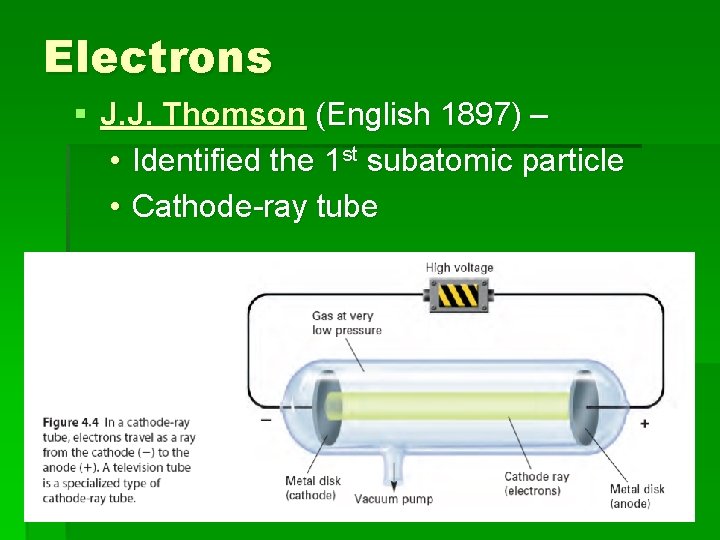
Electrons § J. J. Thomson (English 1897) – • Identified the 1 st subatomic particle • Cathode-ray tube
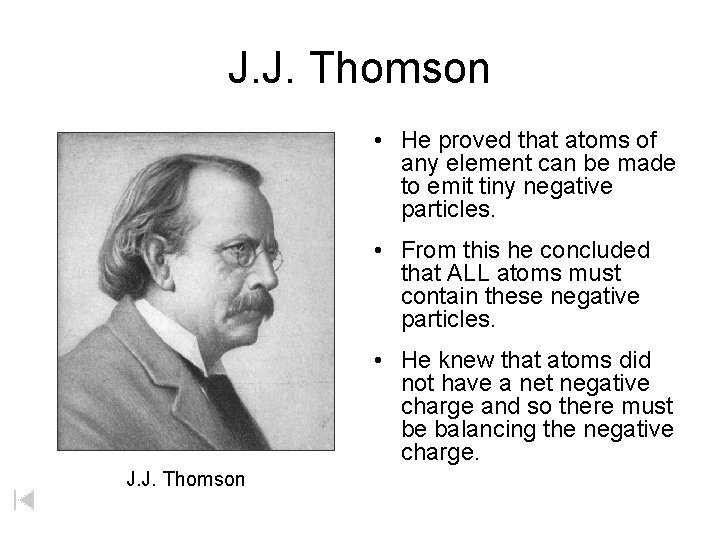
J. J. Thomson • He proved that atoms of any element can be made to emit tiny negative particles. • From this he concluded that ALL atoms must contain these negative particles. • He knew that atoms did not have a net negative charge and so there must be balancing the negative charge. J. J. Thomson
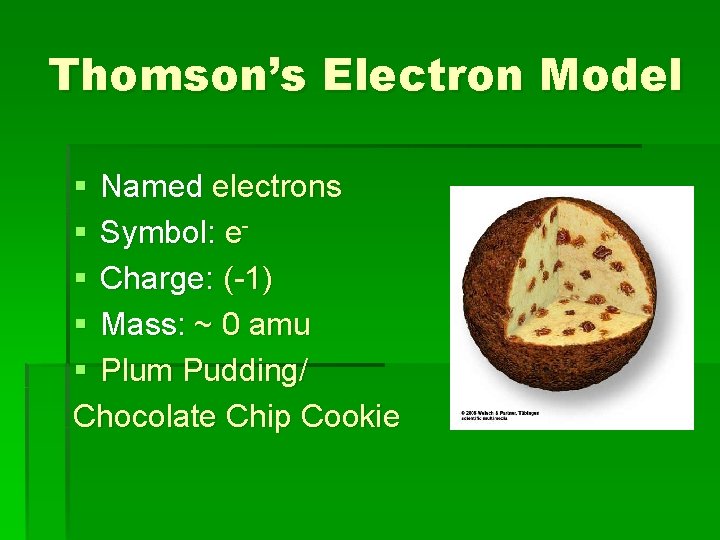
Thomson’s Electron Model § Named electrons § Symbol: e§ Charge: (-1) § Mass: ~ 0 amu § Plum Pudding/ Chocolate Chip Cookie
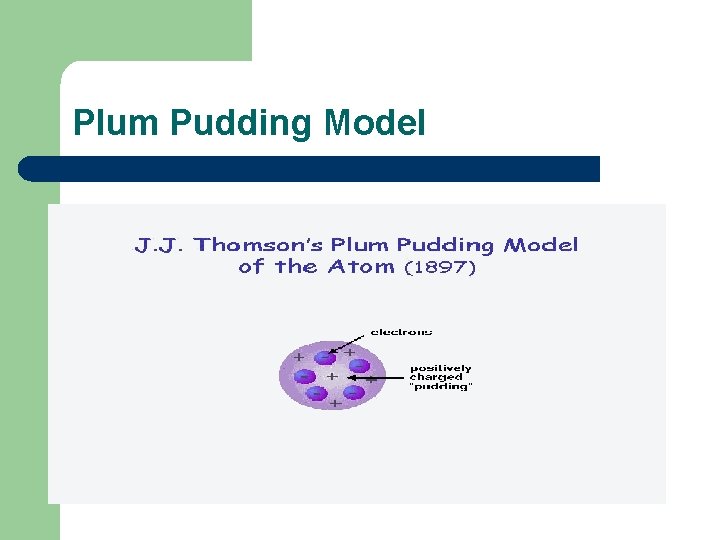
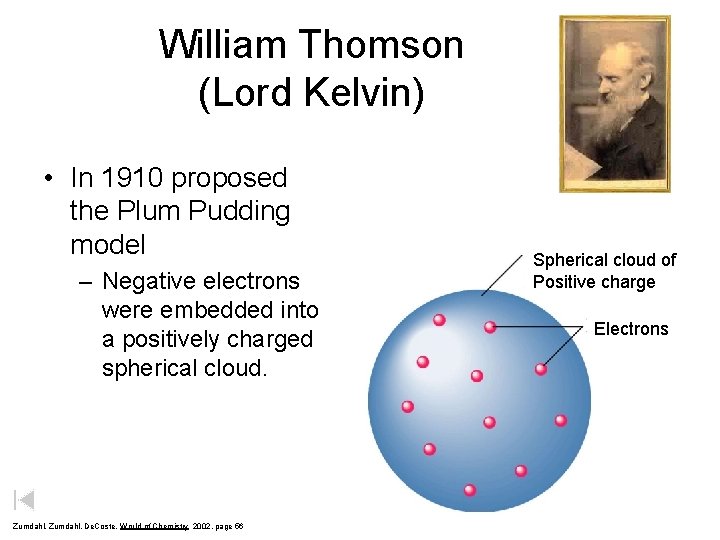
Plum Pudding Model.
William Thomson (Lord Kelvin) • In 1910 proposed the Plum Pudding model – Negative electrons were embedded into a positively charged spherical cloud. Zumdahl, De. Coste, World of Chemistry 2002, page 56 Spherical cloud of Positive charge Electrons
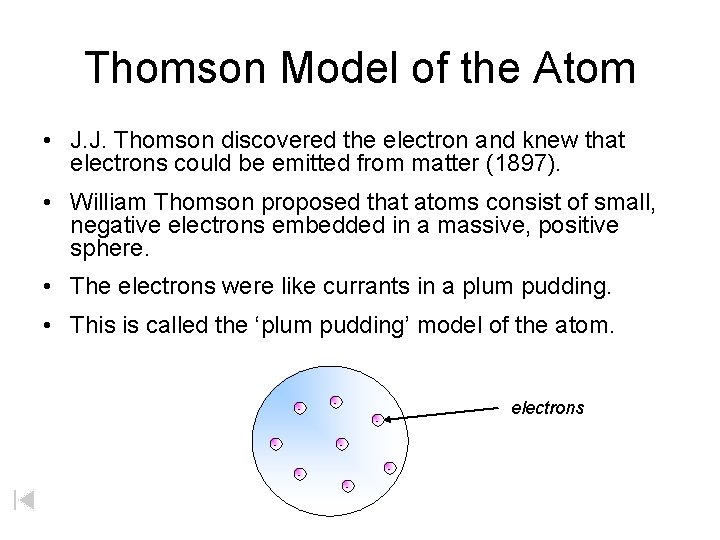
Thomson Model of the Atom • J. J. Thomson discovered the electron and knew that electrons could be emitted from matter (1897). • William Thomson proposed that atoms consist of small, negative electrons embedded in a massive, positive sphere. • The electrons were like currants in a plum pudding. • This is called the ‘plum pudding’ model of the atom. - - electrons - - -
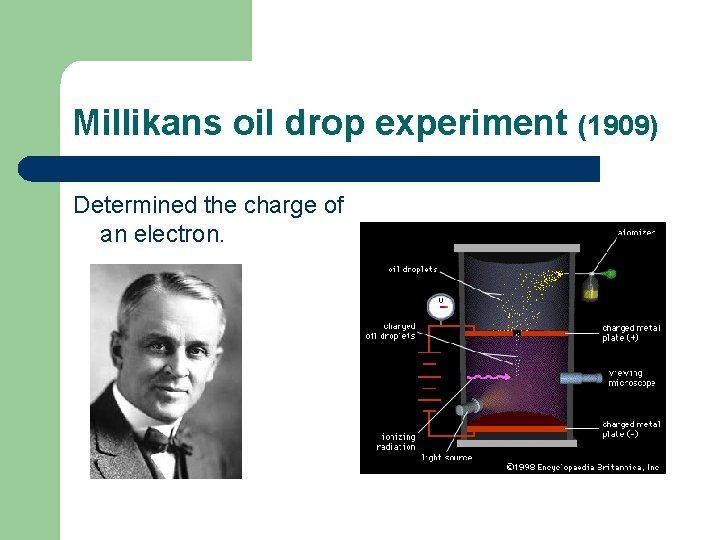
Millikans oil drop experiment (1909) Determined the charge of an electron.
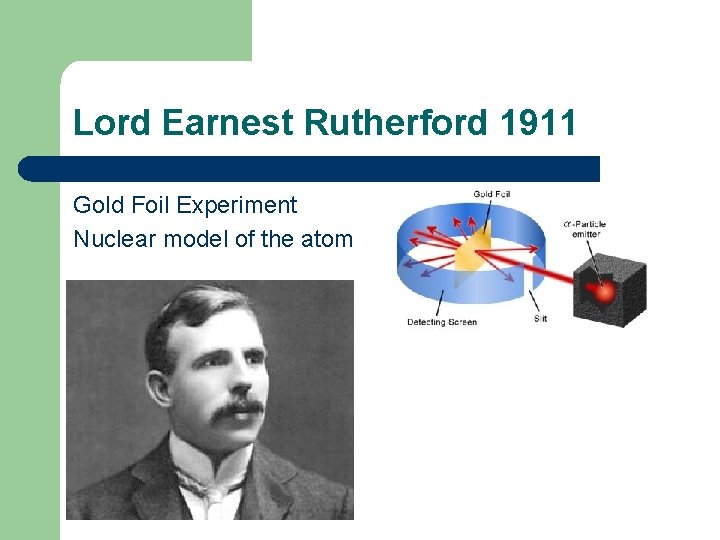
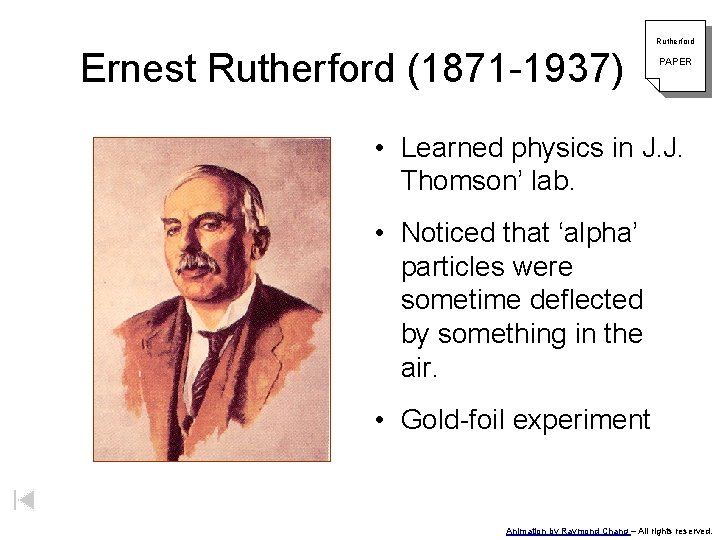
Lord Earnest Rutherford 1911 Gold Foil Experiment Nuclear model of the atom
Ernest Rutherford (1871 -1937) Rutherford PAPER • Learned physics in J. J. Thomson’ lab. • Noticed that ‘alpha’ particles were sometime deflected by something in the air. • Gold-foil experiment Animation by Raymond Chang – All rights reserved.
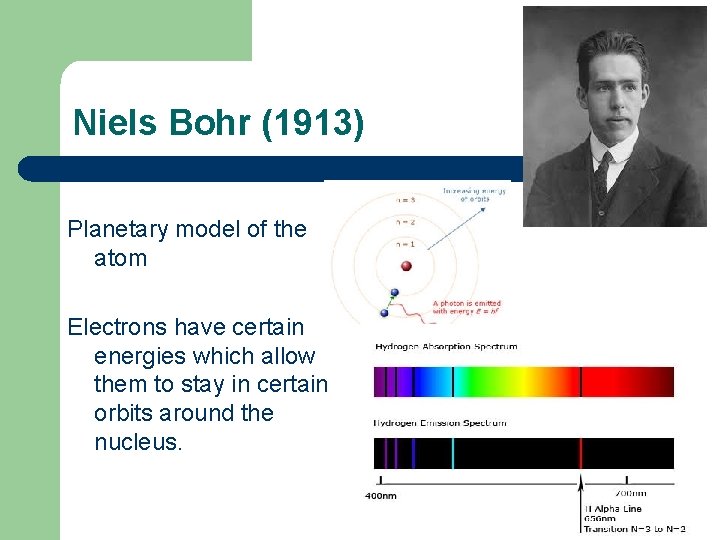
Niels Bohr (1913) Planetary model of the atom Electrons have certain energies which allow them to stay in certain orbits around the nucleus.
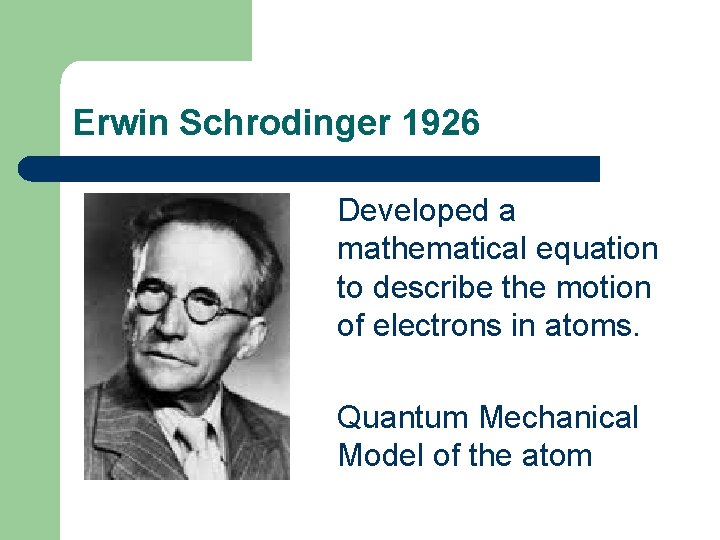
Erwin Schrodinger 1926 Developed a mathematical equation to describe the motion of electrons in atoms. Quantum Mechanical Model of the atom
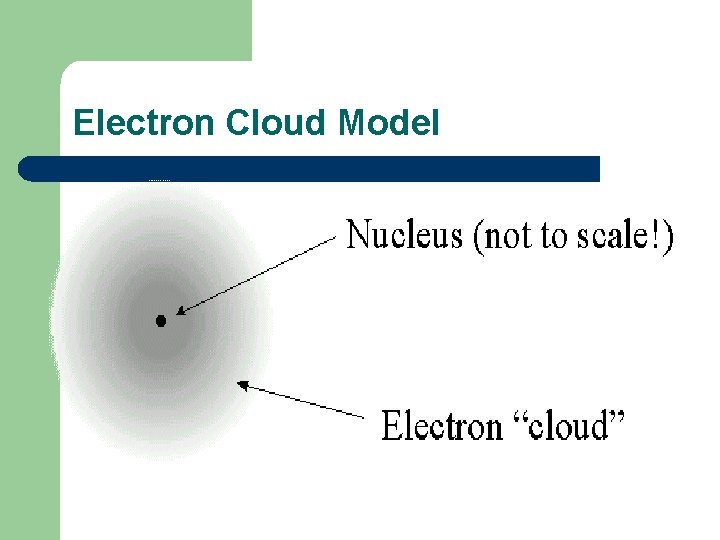
Electron Cloud Model
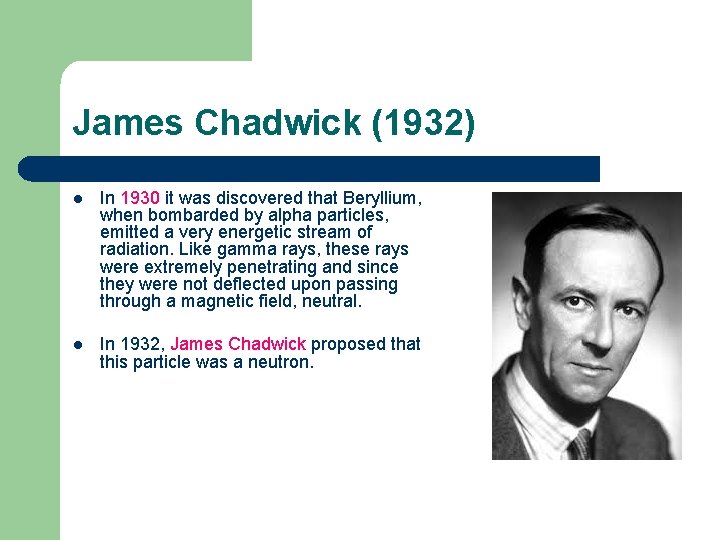
James Chadwick (1932) l In 1930 it was discovered that Beryllium, when bombarded by alpha particles, emitted a very energetic stream of radiation. Like gamma rays, these rays were extremely penetrating and since they were not deflected upon passing through a magnetic field, neutral. l In 1932, James Chadwick proposed that this particle was a neutron.
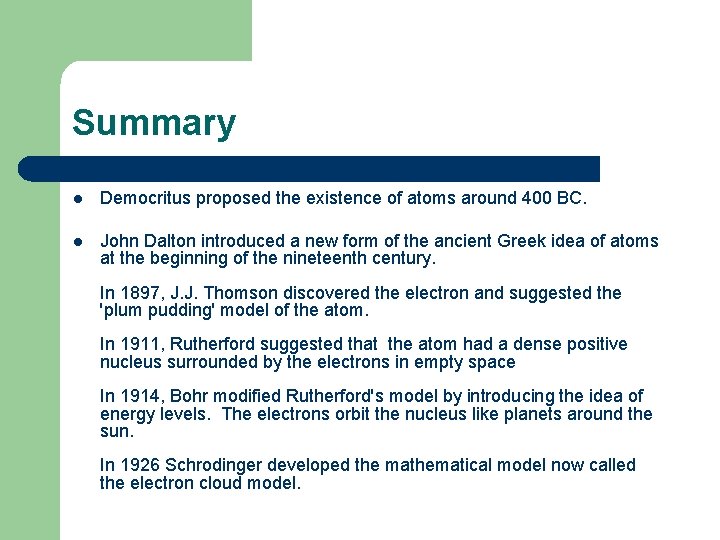
Summary l Democritus proposed the existence of atoms around 400 BC. l John Dalton introduced a new form of the ancient Greek idea of atoms at the beginning of the nineteenth century. In 1897, J. J. Thomson discovered the electron and suggested the 'plum pudding' model of the atom. In 1911, Rutherford suggested that the atom had a dense positive nucleus surrounded by the electrons in empty space In 1914, Bohr modified Rutherford's model by introducing the idea of energy levels. The electrons orbit the nucleus like planets around the sun. In 1926 Schrodinger developed the mathematical model now called the electron cloud model.
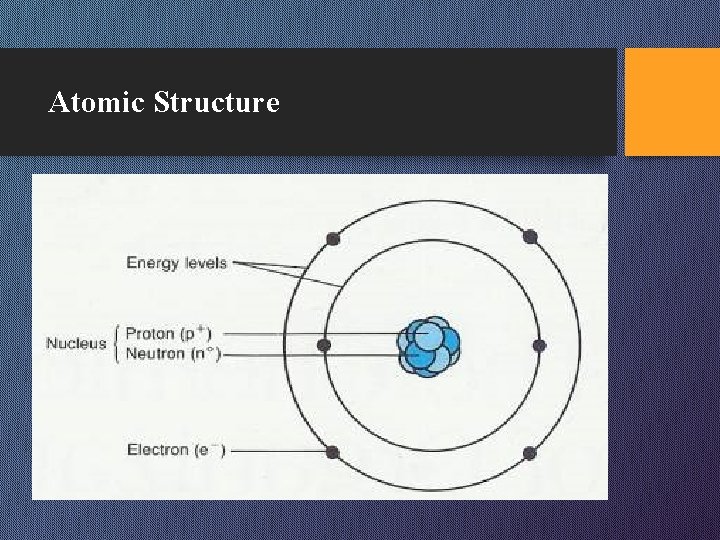
Atomic Structure
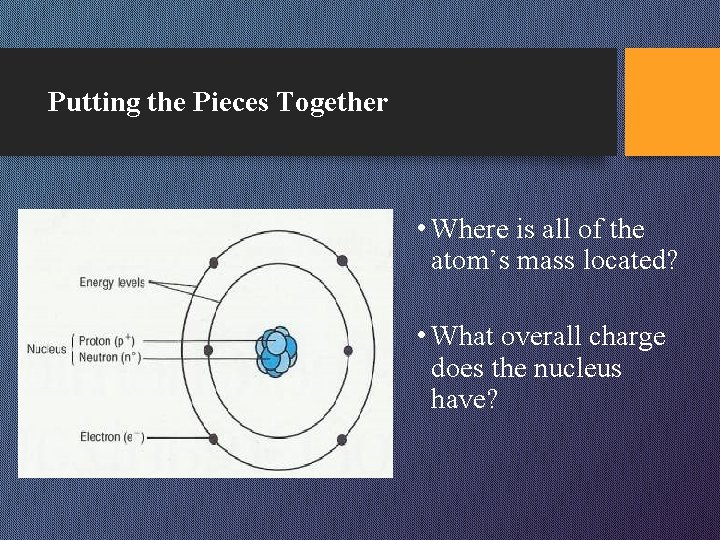
Putting the Pieces Together • Where is all of the atom’s mass located? • What overall charge does the nucleus have?
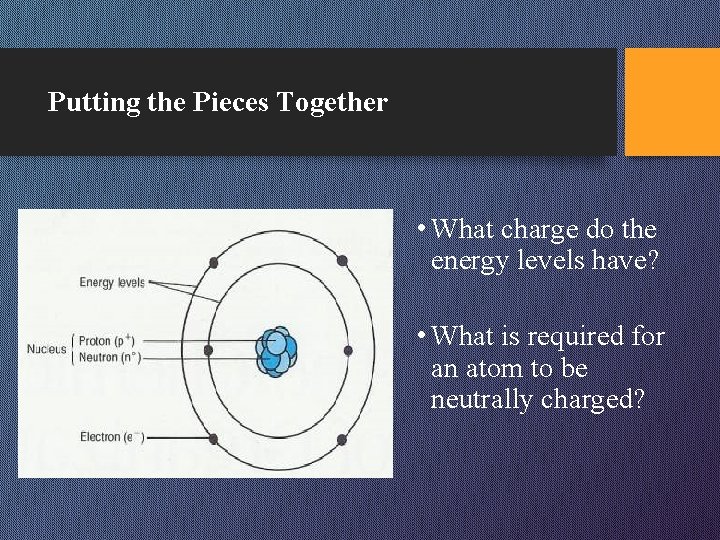
Putting the Pieces Together • What charge do the energy levels have? • What is required for an atom to be neutrally charged?
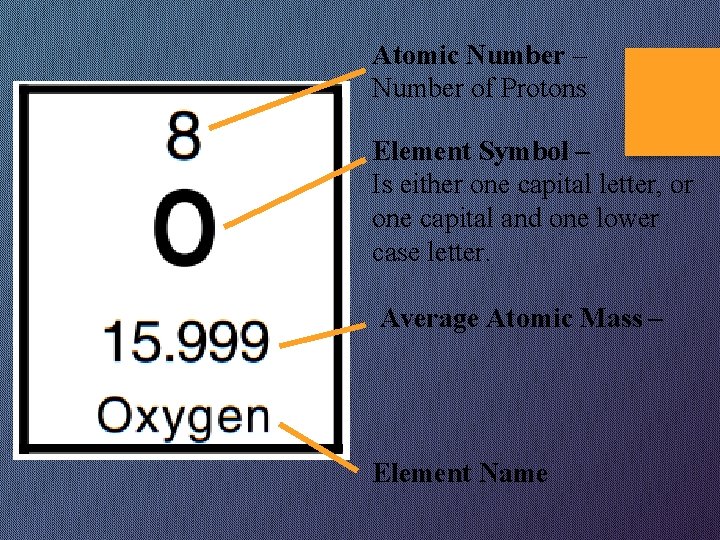
Atomic Number – Number of Protons Element Symbol – Is either one capital letter, or one capital and one lower case letter. Average Atomic Mass – Element Name
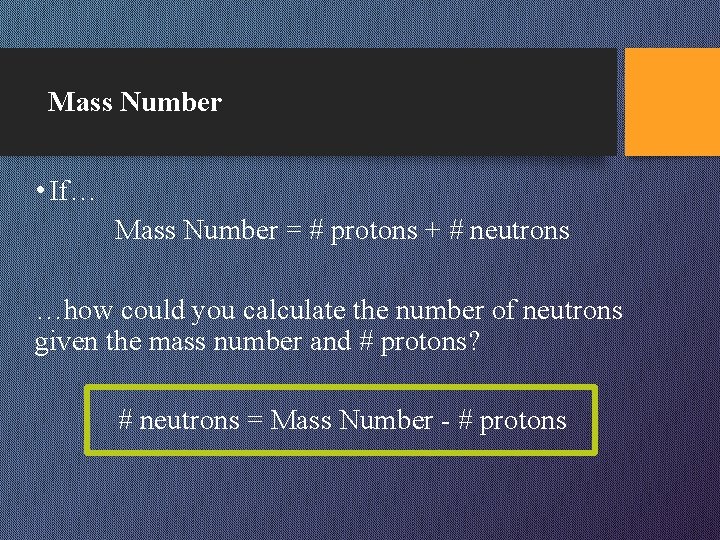
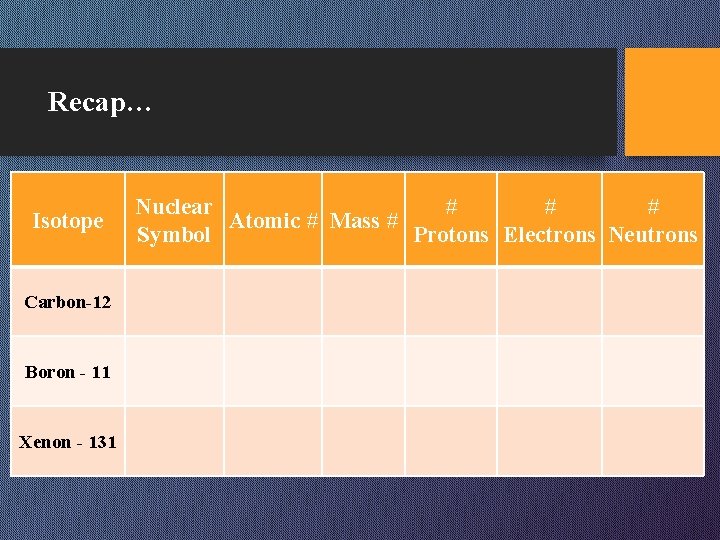
Mass Number • If… Mass Number = # protons + # neutrons …how could you calculate the number of neutrons given the mass number and # protons? # neutrons = Mass Number - # protons
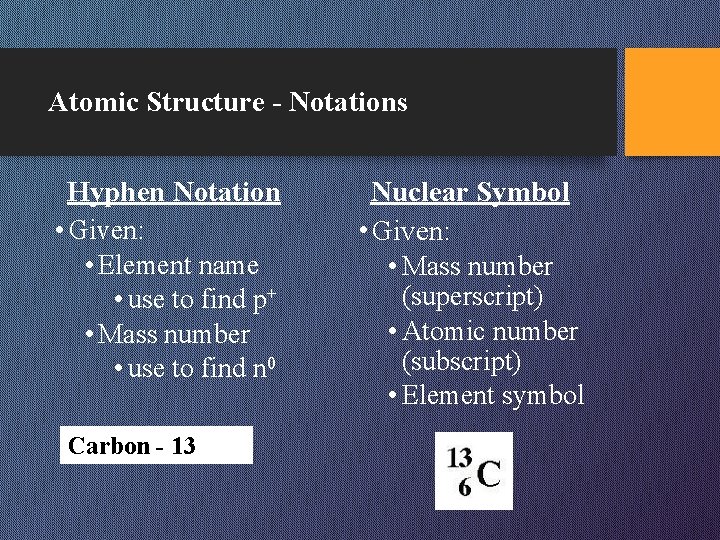
Atomic Structure - Notations Hyphen Notation • Given: • Element name • use to find p+ • Mass number • use to find n 0 Carbon - 13 Nuclear Symbol • Given: • Mass number (superscript) • Atomic number (subscript) • Element symbol
Recap… Isotope Carbon-12 Boron - 11 Xenon - 131 Nuclear # # # Atomic # Mass # Symbol Protons Electrons Neutrons
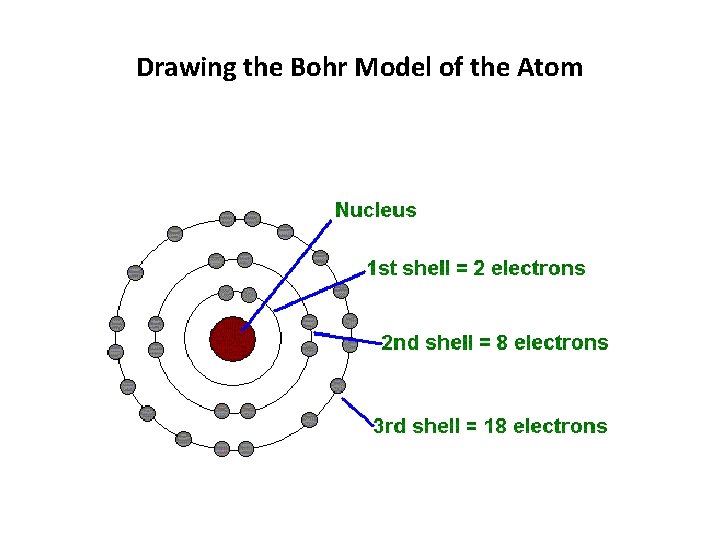
Drawing the Bohr Model of the Atom
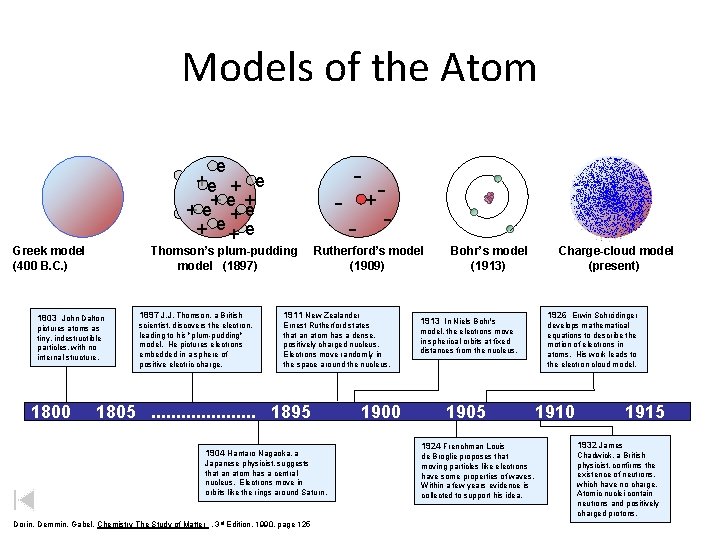
Models of the Atom e e +e + + e e +e + e+ e - e+ Dalton’s Greek model (1803) (400 B. C. ) 1803 John Dalton pictures atoms as tiny, indestructible particles, with no internal structure. 1800 - Thomson’s plum-pudding model (1897) +- - - Rutherford’s model (1909) 1897 J. J. Thomson, a British 1911 New Zealander scientist, discovers the electron, leading to his "plum-pudding" model. He pictures electrons embedded in a sphere of positive electric charge. Ernest Rutherford states that an atom has a dense, positively charged nucleus. Electrons move randomly in the space around the nucleus. 1805. . . . . 1895 1904 Hantaro Nagaoka, a Japanese physicist, suggests that an atom has a central nucleus. Electrons move in orbits like the rings around Saturn. Dorin, Demmin, Gabel, Chemistry The Study of Matter , 3 rd Edition, 1990, page 125 1900 Bohr’s model (1913) Charge-cloud model (present) 1926 Erwin Schrödinger 1913 In Niels Bohr's develops mathematical equations to describe the motion of electrons in atoms. His work leads to the electron cloud model, the electrons move in spherical orbits at fixed distances from the nucleus. 1905 1910 1924 Frenchman Louis de Broglie proposes that moving particles like electrons have some properties of waves. Within a few years evidence is collected to support his idea. 1915 1932 James Chadwick, a British physicist, confirms the existence of neutrons, which have no charge. Atomic nuclei contain neutrons and positively charged protons. 1
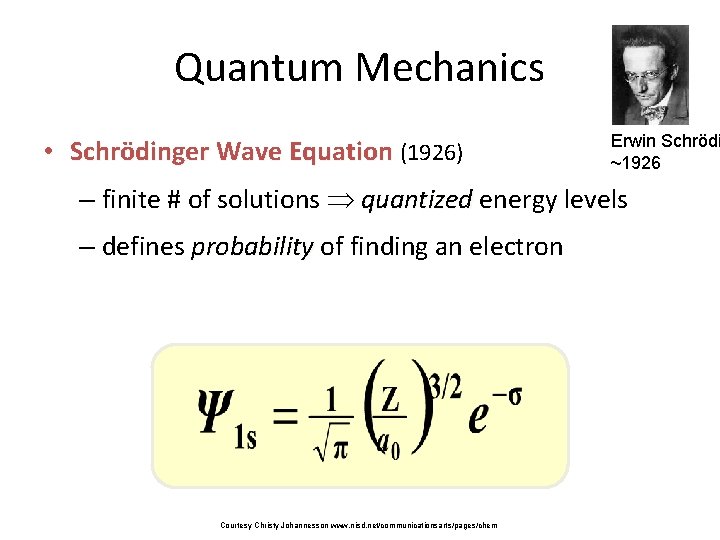
Quantum Mechanics • Schrödinger Wave Equation (1926) Erwin Schrödi ~1926 – finite # of solutions quantized energy levels – defines probability of finding an electron Courtesy Christy Johannesson www. nisd. net/communicationsarts/pages/chem
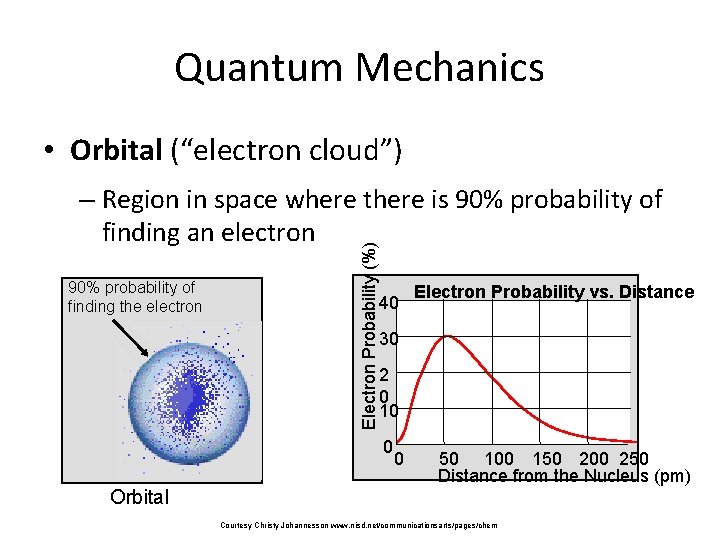
Quantum Mechanics • Orbital (“electron cloud”) 90% probability of finding the electron Electron Probability (%) – Region in space where there is 90% probability of finding an electron 40 Electron Probability vs. Distance 30 2 0 10 0 0 50 100 150 200 250 Distance from the Nucleus (pm) Orbital Courtesy Christy Johannesson www. nisd. net/communicationsarts/pages/chem
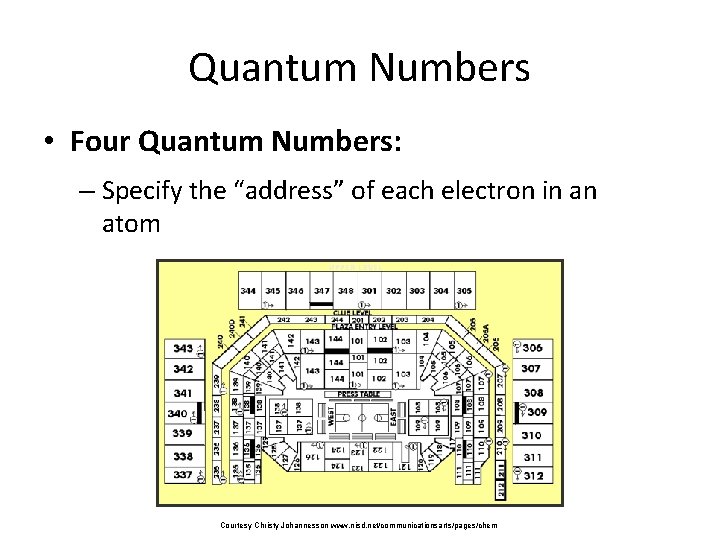
Quantum Numbers • Four Quantum Numbers: – Specify the “address” of each electron in an atom UPPER LEVEL Courtesy Christy Johannesson www. nisd. net/communicationsarts/pages/chem
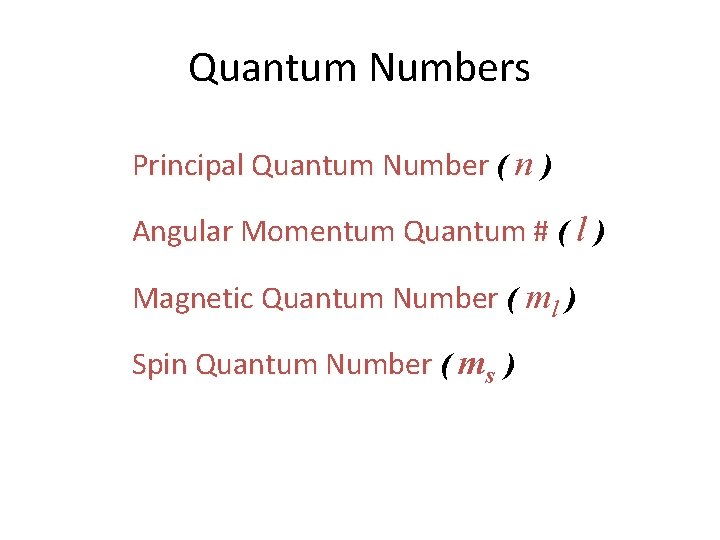
Quantum Numbers Principal Quantum Number ( n ) Angular Momentum Quantum # ( l ) Magnetic Quantum Number ( ml ) Spin Quantum Number ( ms )
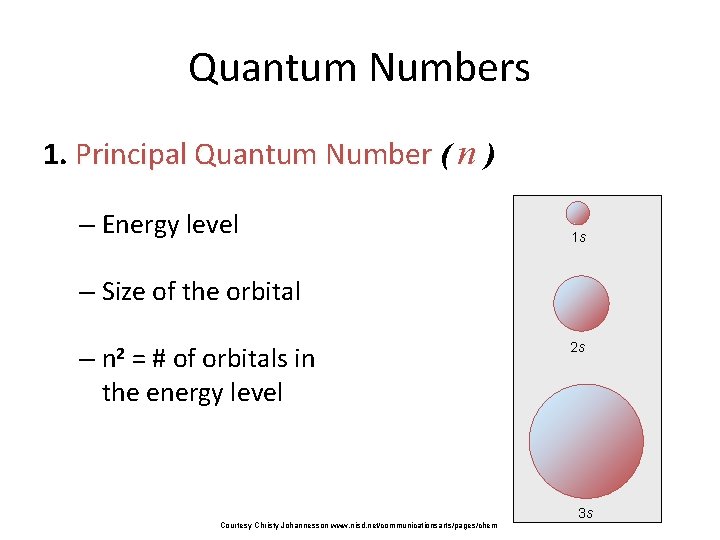
Quantum Numbers 1. Principal Quantum Number ( n ) – Energy level 1 s – Size of the orbital – n 2 = # of orbitals in the energy level Courtesy Christy Johannesson www. nisd. net/communicationsarts/pages/chem 2 s 3 s
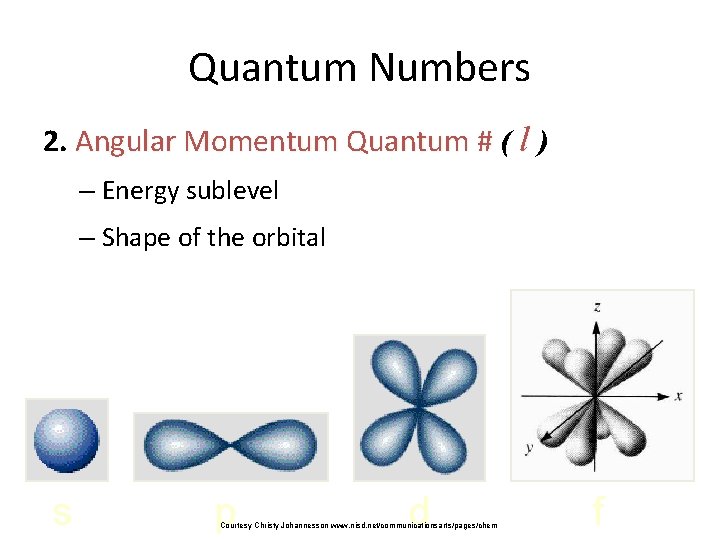
Quantum Numbers 2. Angular Momentum Quantum # ( l ) – Energy sublevel – Shape of the orbital s p d Courtesy Christy Johannesson www. nisd. net/communicationsarts/pages/chem f
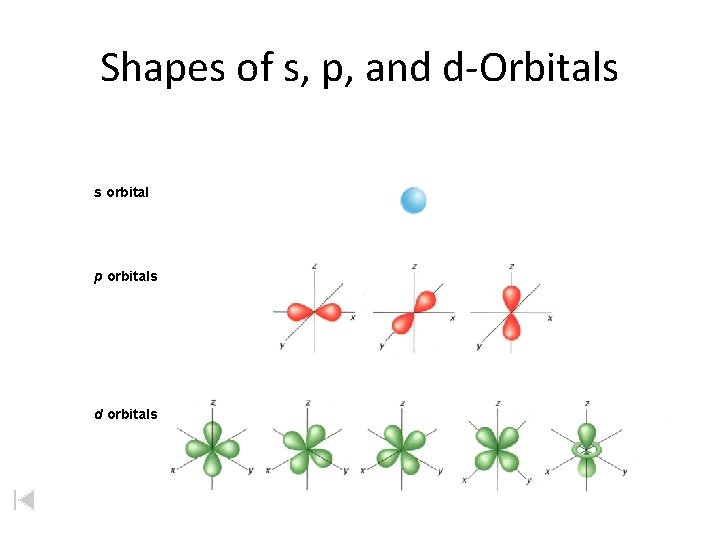
Shapes of s, p, and d-Orbitals s orbital p orbitals d orbitals
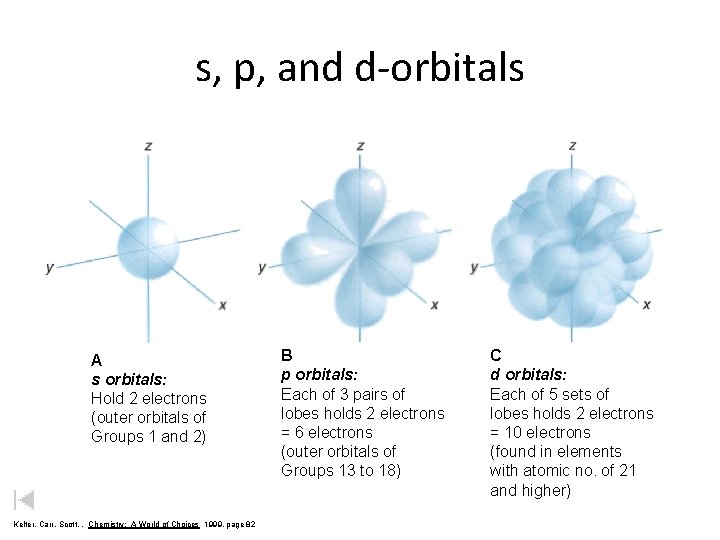
s, p, and d-orbitals A s orbitals: Hold 2 electrons (outer orbitals of Groups 1 and 2) Kelter, Carr, Scott, , Chemistry: A World of Choices 1999, page 82 B p orbitals: Each of 3 pairs of lobes holds 2 electrons = 6 electrons (outer orbitals of Groups 13 to 18) C d orbitals: Each of 5 sets of lobes holds 2 electrons = 10 electrons (found in elements with atomic no. of 21 and higher)
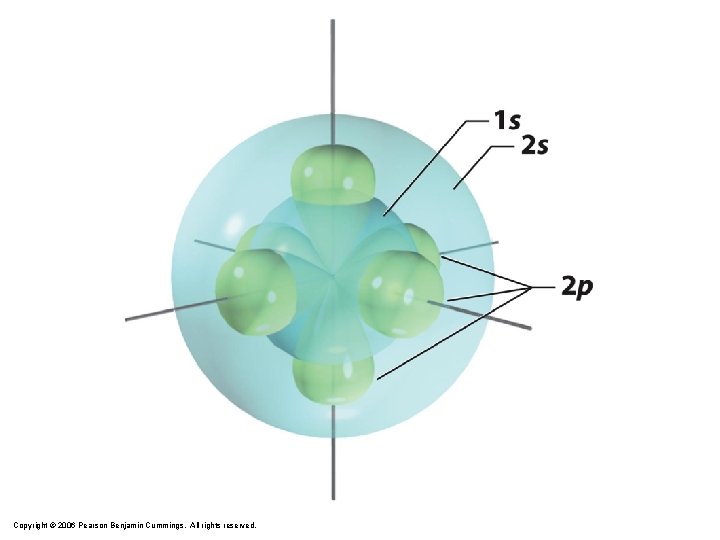
Copyright © 2006 Pearson Benjamin Cummings. All rights reserved.
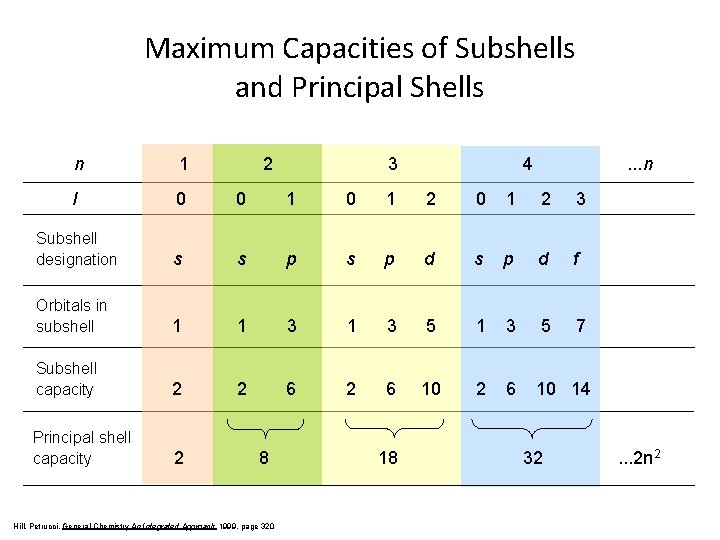
Maximum Capacities of Subshells and Principal Shells n 1 2 3 4 . . . n l 0 1 0 1 2 0 1 2 3 Subshell designation s Orbitals in subshell 1 1 3 1 3 5 1 3 5 7 Subshell capacity 2 2 6 2 6 10 2 6 10 14 Principal shell capacity 2 8 18 32 . . . 2 n 2 s Hill, Petrucci, General Chemistry An Integrated Approach 1999, page 320 p s p d f
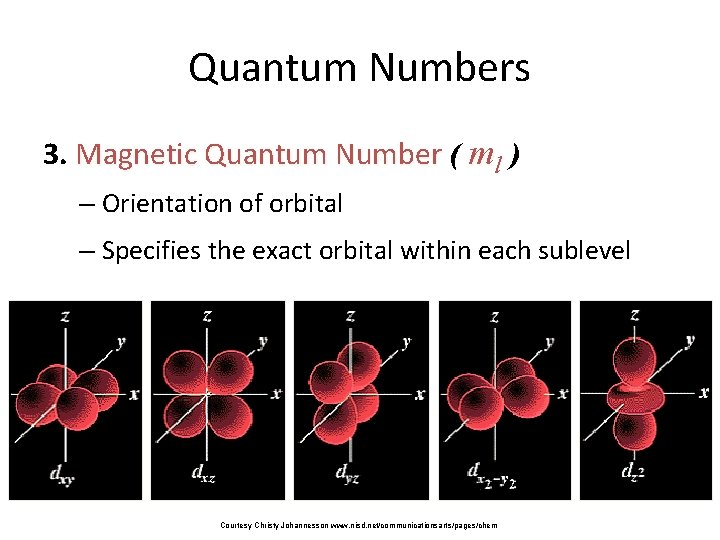
Quantum Numbers 3. Magnetic Quantum Number ( ml ) – Orientation of orbital – Specifies the exact orbital within each sublevel Courtesy Christy Johannesson www. nisd. net/communicationsarts/pages/chem
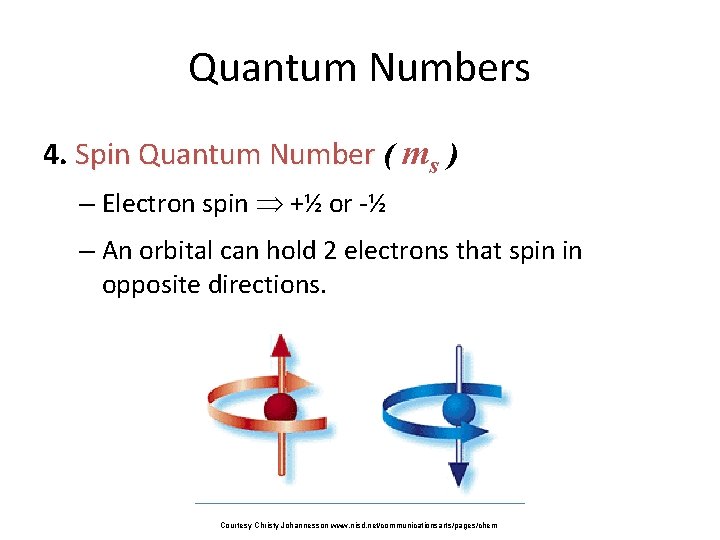
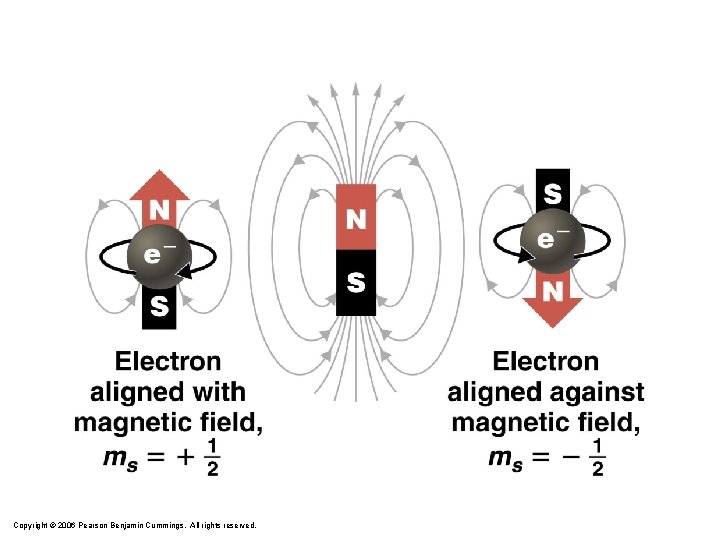
Quantum Numbers 4. Spin Quantum Number ( ms ) – Electron spin +½ or -½ – An orbital can hold 2 electrons that spin in opposite directions. Courtesy Christy Johannesson www. nisd. net/communicationsarts/pages/chem
Copyright © 2006 Pearson Benjamin Cummings. All rights reserved.
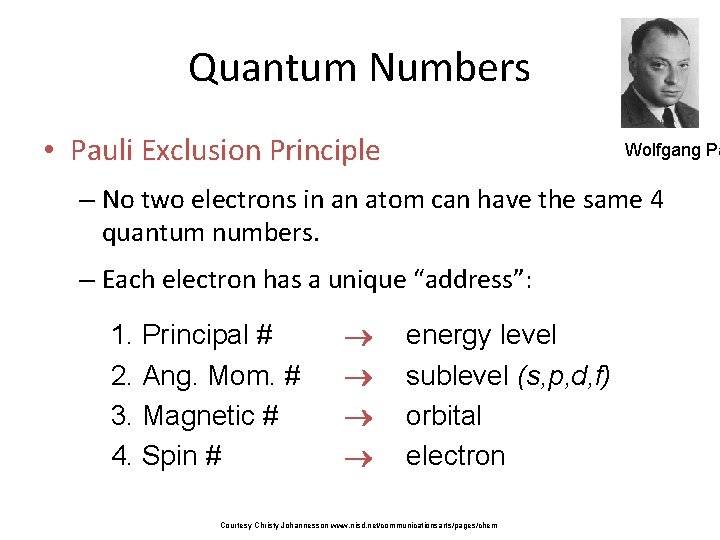
Quantum Numbers • Pauli Exclusion Principle Wolfgang Pa – No two electrons in an atom can have the same 4 quantum numbers. – Each electron has a unique “address”: 1. Principal # 2. Ang. Mom. # 3. Magnetic # 4. Spin # energy level sublevel (s, p, d, f) orbital electron Courtesy Christy Johannesson www. nisd. net/communicationsarts/pages/chem
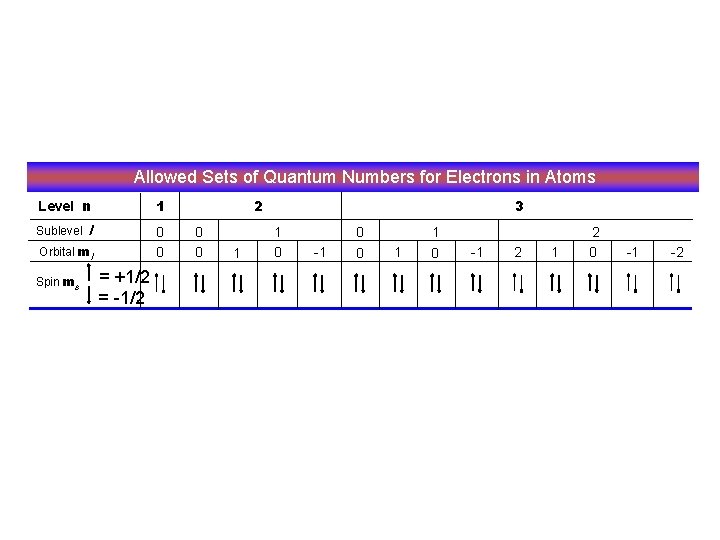
Allowed Sets of Quantum Numbers for Electrons in Atoms Level n 1 Sublevel l 0 0 Orbital ml Spin ms = +1/2 = -1/2 2 0 0 1 3 1 0 -1 0 0 1 1 0 -1 2 0 -1 -2
Feeling overwhelmed? Read Section 5. 10 - 5. 11! Chemis try "Teacher, may I be excused? My brain is full. " Courtesy Christy Johannesson www. nisd. net/communicationsarts/pages/chem
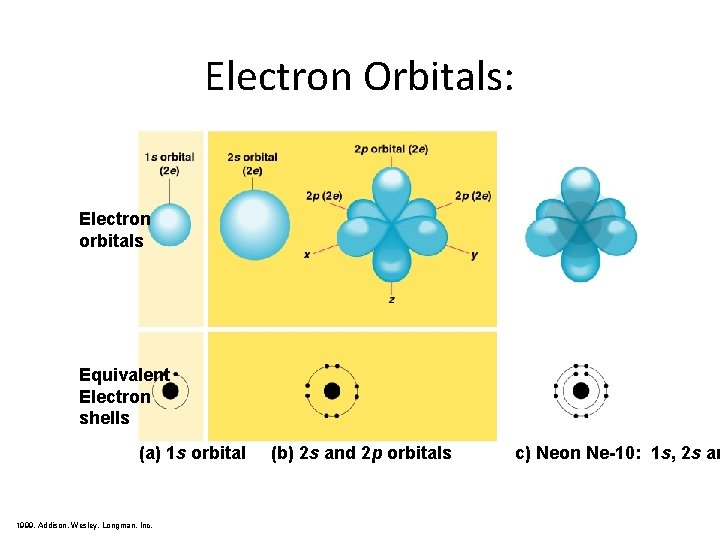
Electron Orbitals: Electron orbitals Equivalent Electron shells (a) 1 s orbital 1999, Addison, Wesley, Longman, Inc. (b) 2 s and 2 p orbitals c) Neon Ne-10: 1 s, 2 s an
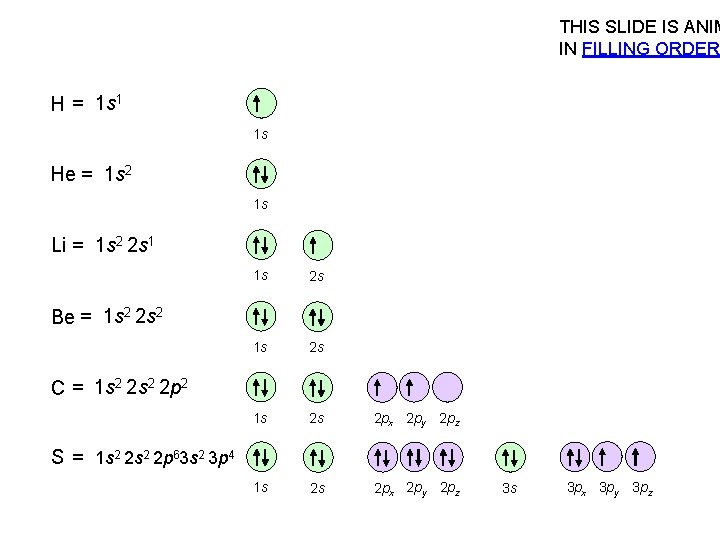
THIS SLIDE IS ANIM IN FILLING ORDER = 1 s 1 H 1 s = 1 s 2 He 1 s = 1 s 2 2 s 1 Li 1 s 2 s 2 px 2 py 2 pz = 1 s 2 2 s 2 Be = 1 s 2 2 p 2 C S = 1 s 2 2 p 63 s 2 3 p 4 3 s 3 px 3 py 3 pz
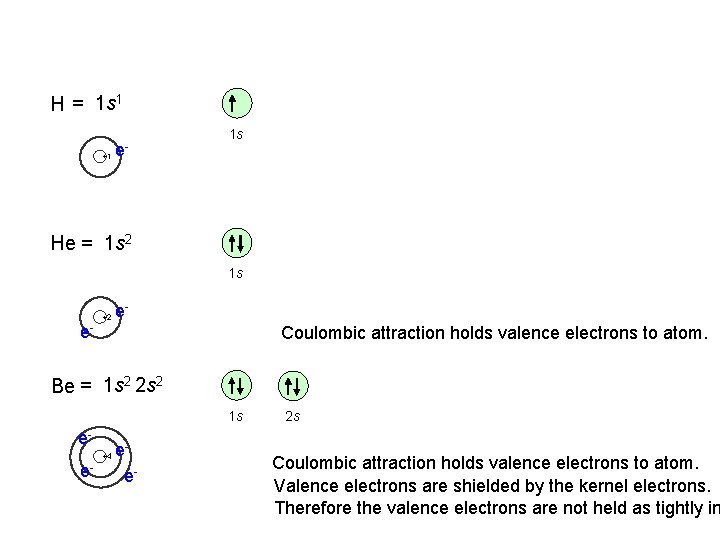
= 1 s 1 H +1 e- 1 s = 1 s 2 He 1 s e- +2 e. Coulombic attraction holds valence electrons to atom. = 1 s 2 2 s 2 Be 1 s ee- +4 ee- 2 s Coulombic attraction holds valence electrons to atom. Valence electrons are shielded by the kernel electrons. Therefore the valence electrons are not held as tightly in
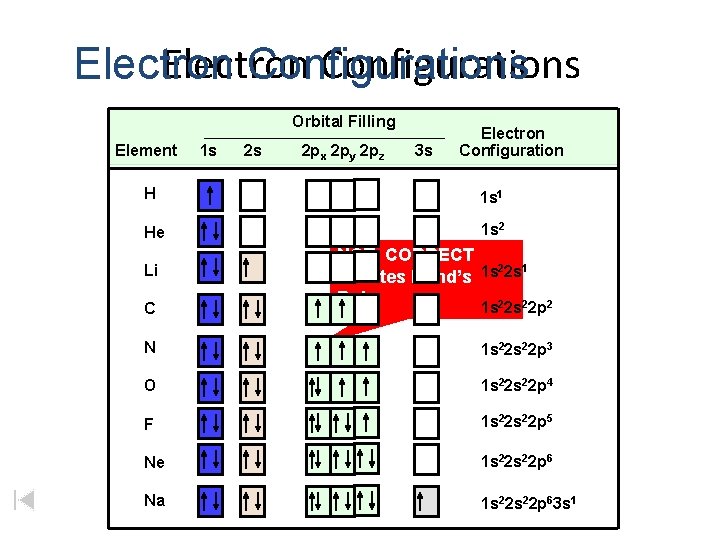
Electron Configurations Orbital Filling Element 1 s 2 s 2 px 2 py 2 pz 3 s Electron Configuration H 1 s 1 He 1 s 2 C NOT CORRECT 2 1 Violates Hund’s 1 s 2 s Rule 1 s 22 p 2 N 1 s 22 p 3 O 1 s 22 p 4 F 1 s 22 p 5 Ne 1 s 22 p 6 Na 1 s 22 p 63 s 1 Li
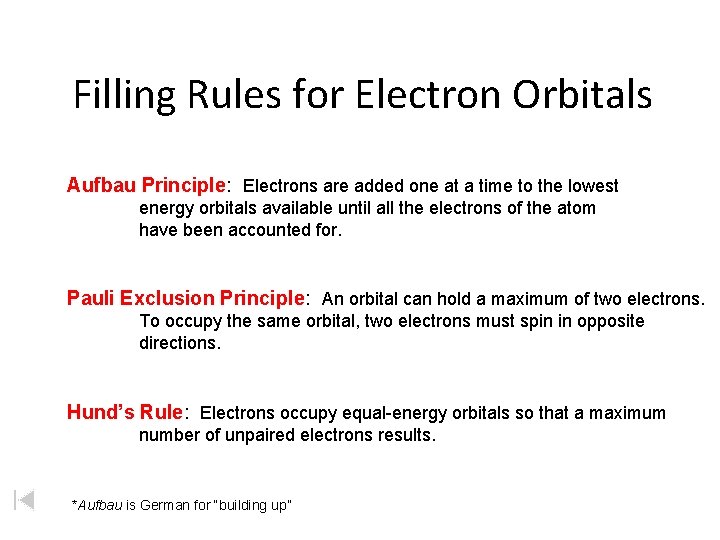
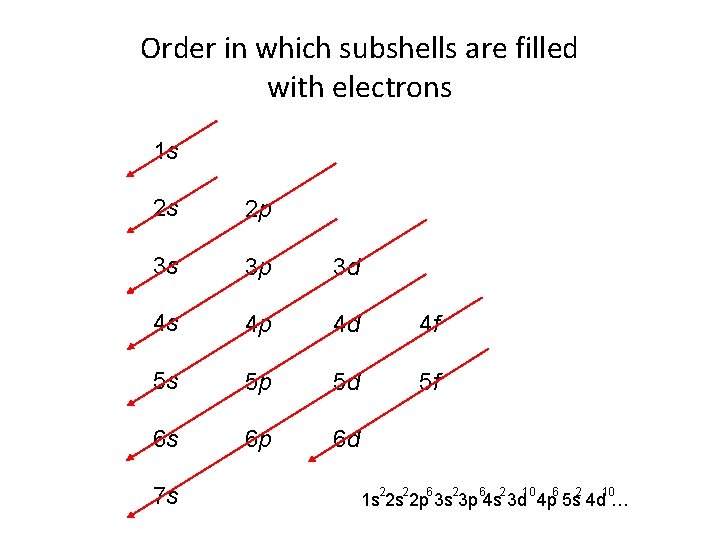
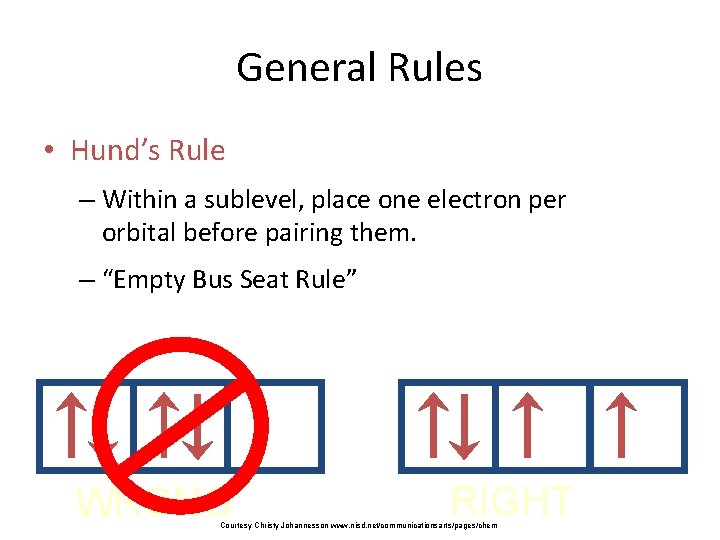
Filling Rules for Electron Orbitals Aufbau Principle: Electrons are added one at a time to the lowest energy orbitals available until all the electrons of the atom have been accounted for. Pauli Exclusion Principle: An orbital can hold a maximum of two electrons. To occupy the same orbital, two electrons must spin in opposite directions. Hund’s Rule: Electrons occupy equal-energy orbitals so that a maximum number of unpaired electrons results. *Aufbau is German for “building up”
Order in which subshells are filled with electrons 1 s 2 s 2 p 3 s 3 p 3 d 4 s 4 p 4 d 4 f 5 s 5 p 5 d 5 f 6 s 6 p 6 d 7 s 2 2 6 2 10 6 2 10 1 s 2 s 2 p 3 s 3 p 4 s 3 d 4 p 5 s 4 d …
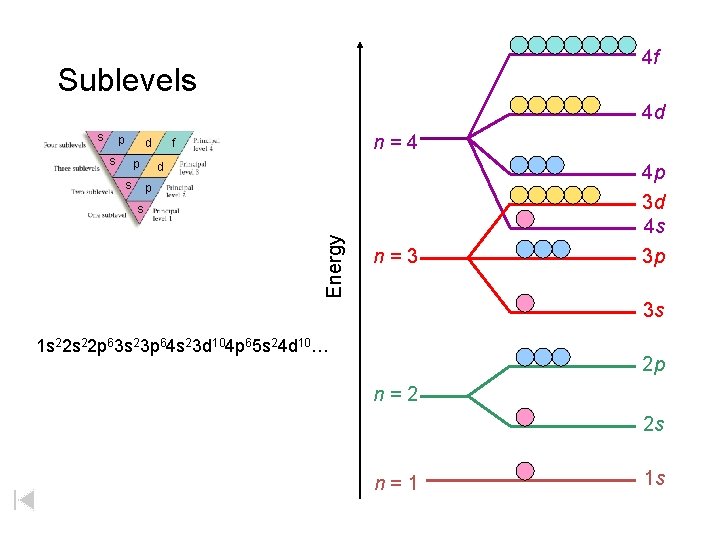
4 f Sublevels 4 d s p s d p s n = 4 f d p Energy s n = 3 4 p 3 d 4 s 3 p 3 s 1 s 22 p 63 s 23 p 64 s 23 d 104 p 65 s 24 d 10… 2 p n = 2 2 s n = 1 1 s
General Rules • Hund’s Rule – Within a sublevel, place one electron per orbital before pairing them. – “Empty Bus Seat Rule” WRONG RIGHT Courtesy Christy Johannesson www. nisd. net/communicationsarts/pages/chem
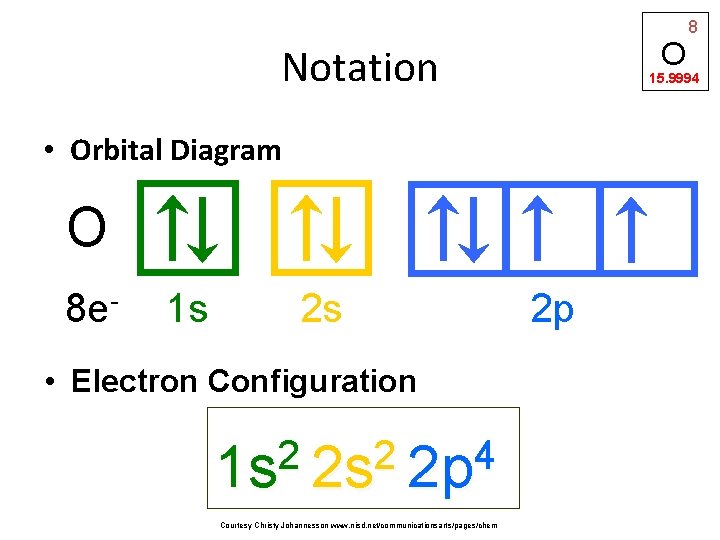
O Notation 15. 9994 • Orbital Diagram O 8 e- 1 s 2 s • Electron Configuration 2 2 4 1 s 2 s 2 p Courtesy Christy Johannesson www. nisd. net/communicationsarts/pages/chem 8 2 p
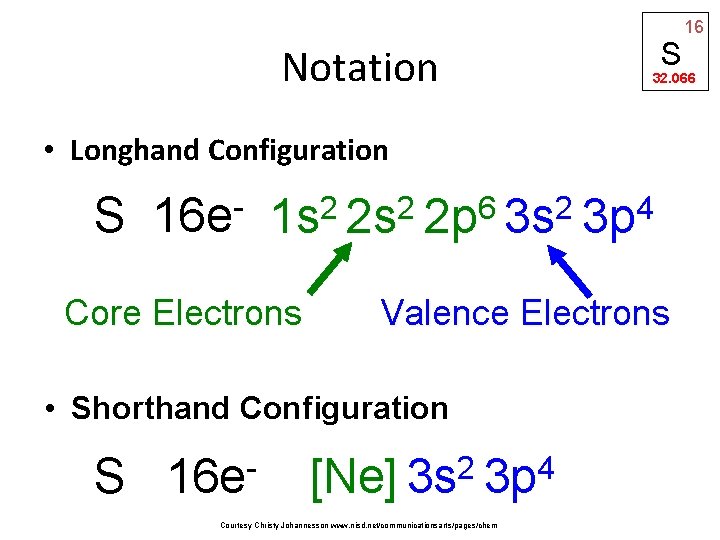
Notation S 32. 066 • Longhand Configuration S 16 e 6 2 2 2 1 s 2 s 2 p 3 s Core Electrons S 16 e 4 3 p Valence Electrons • Shorthand Configuration 2 4 [Ne] 3 s 3 p Courtesy Christy Johannesson www. nisd. net/communicationsarts/pages/chem 16