
Electrons in the Atom l Thomson discovered the
- Slides: 60
Electrons in the Atom l Thomson: discovered the electron l Rutherford: electrons like planets around the sun l Experiments: the elements bright – line spectra of
Atomic Spectrum The colors tell us about the structure of electrons in atoms
Electromagnetic Spectrum l Complete range of wavelengths and frequencies (gamma to radio) l Mostly invisible to human eye l Substances can either absorb or emit different radiations
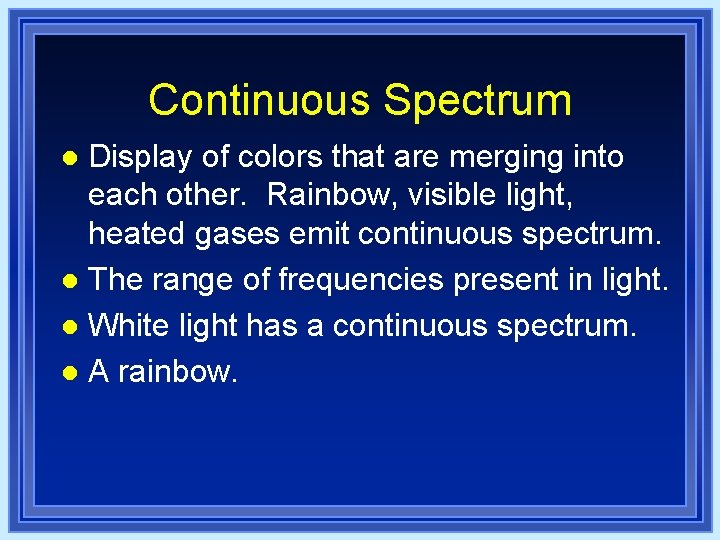
Continuous Spectrum Display of colors that are merging into each other. Rainbow, visible light, heated gases emit continuous spectrum. l The range of frequencies present in light. l White light has a continuous spectrum. l A rainbow. l
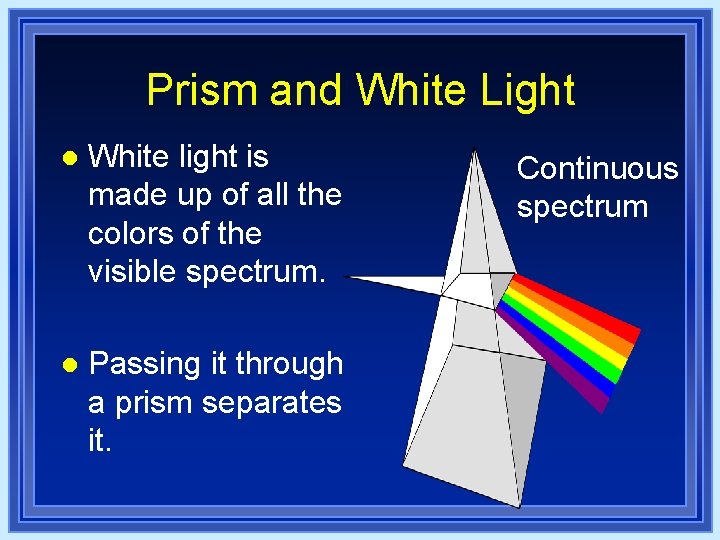
Prism and White Light l White light is made up of all the colors of the visible spectrum. l Passing it through a prism separates it. Continuous spectrum
Line Spectrum (Discontinuous) l Images appear as narrow colored lines separated by dark regions. Bright Line Spectra: gases at low temperature emit lines of colors. l Each line corresponds to a particular wavelength emitted by the atom. l
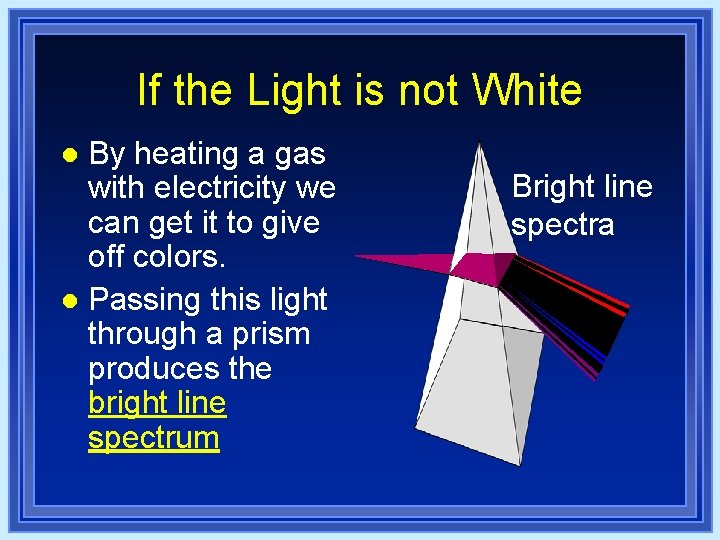
If the Light is not White By heating a gas with electricity we can get it to give off colors. l Passing this light through a prism produces the bright line spectrum l Bright line spectra
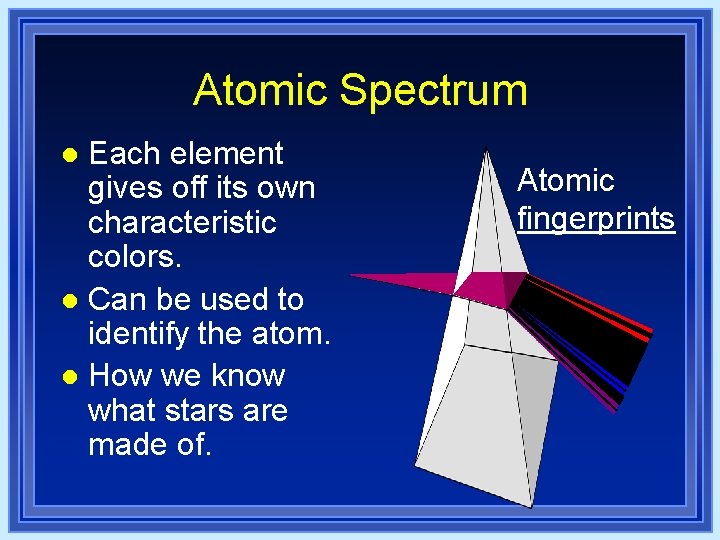
Atomic Spectrum Each element gives off its own characteristic colors. l Can be used to identify the atom. l How we know what stars are made of. l Atomic fingerprints
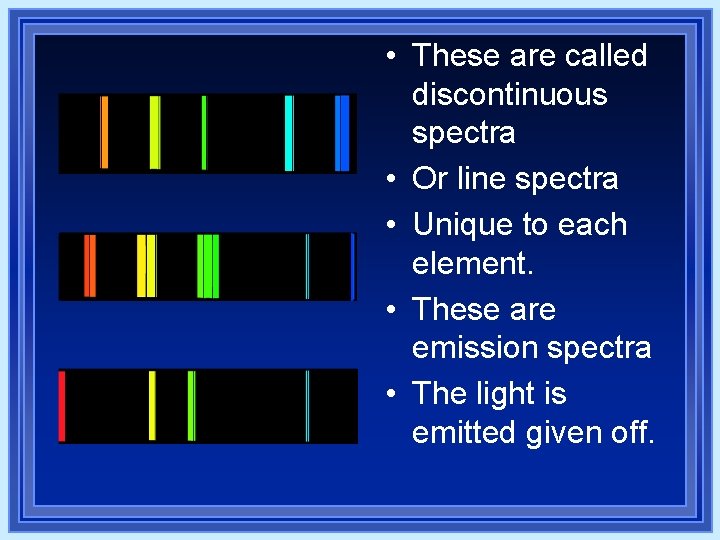
• These are called discontinuous spectra • Or line spectra • Unique to each element. • These are emission spectra • The light is emitted given off.
An Explanation of Atomic Spectra NIELS BOHR explained only the Hydrogen Spectra
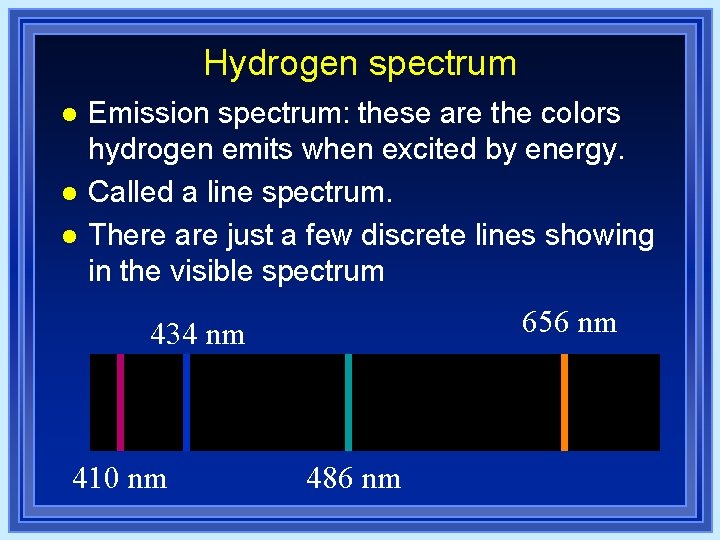
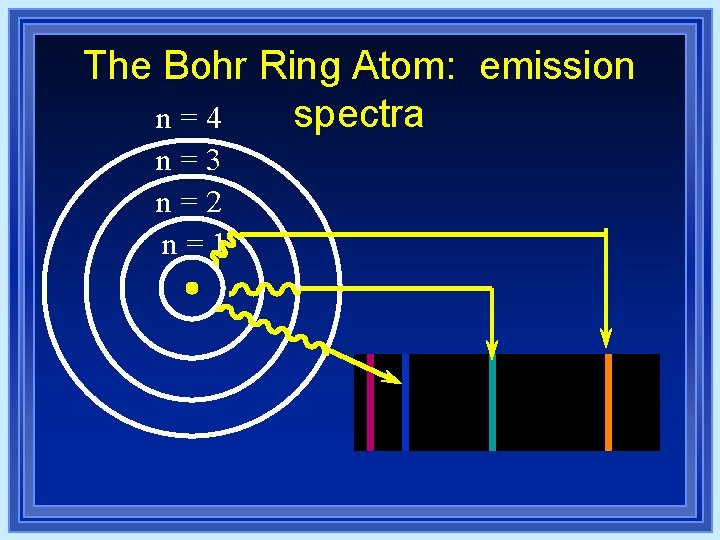
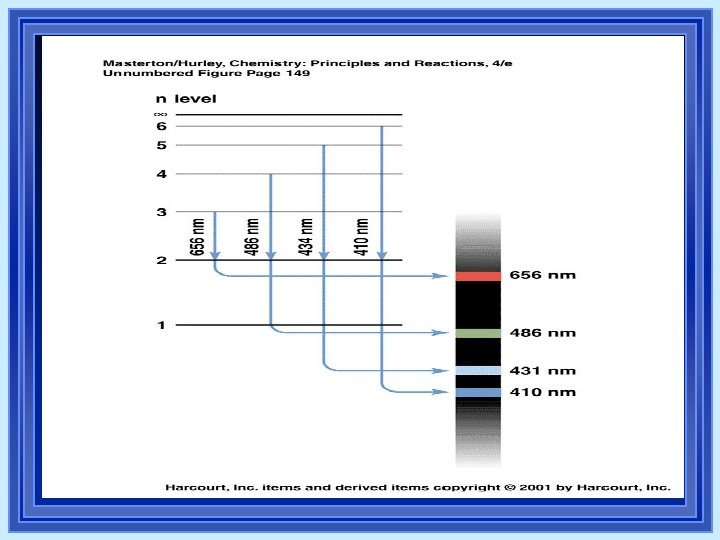
Hydrogen spectrum l l l Emission spectrum: these are the colors hydrogen emits when excited by energy. Called a line spectrum. There are just a few discrete lines showing in the visible spectrum 656 nm 434 nm 410 nm 486 nm
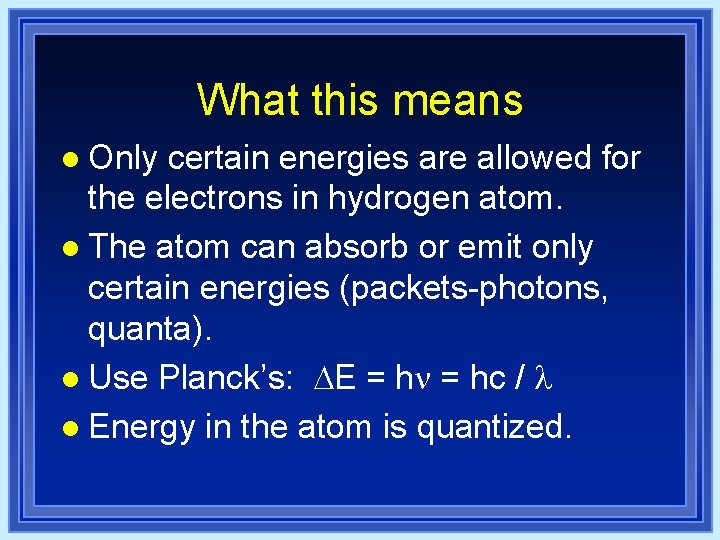
What this means l Only certain energies are allowed for the electrons in hydrogen atom. l The atom can absorb or emit only certain energies (packets-photons, quanta). l Use Planck’s: DE = hn = hc / l l Energy in the atom is quantized.
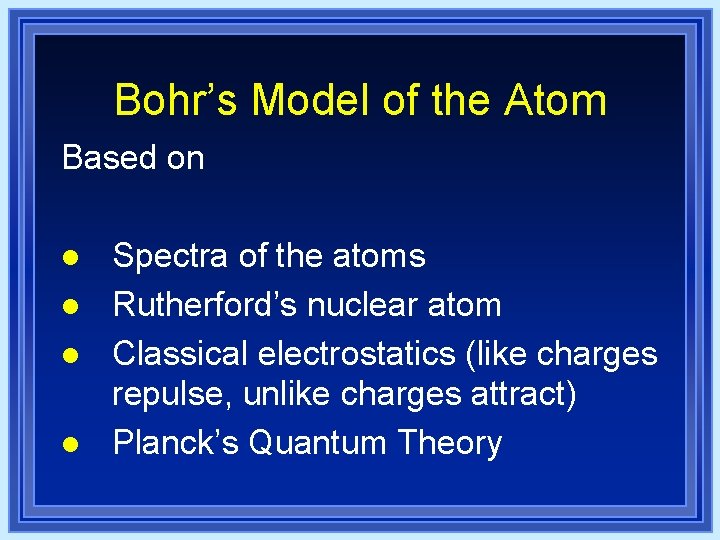
Bohr’s Model of the Atom Based on l l Spectra of the atoms Rutherford’s nuclear atom Classical electrostatics (like charges repulse, unlike charges attract) Planck’s Quantum Theory
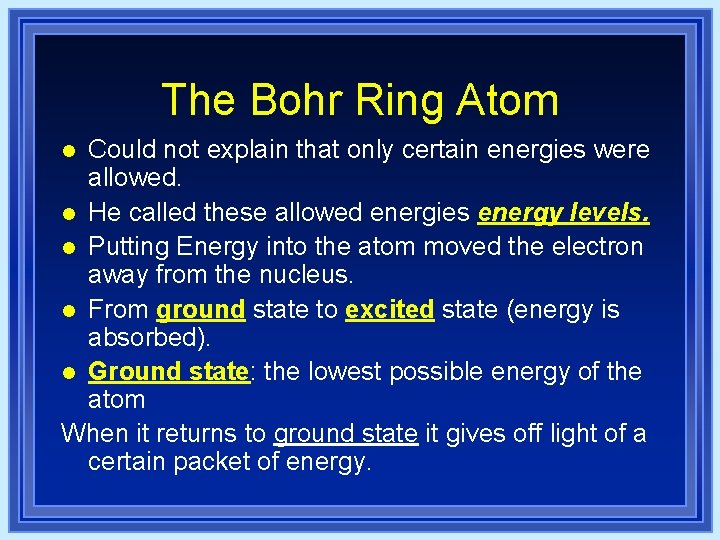
The Bohr Ring Atom Could not explain that only certain energies were allowed. l He called these allowed energies energy levels. l Putting Energy into the atom moved the electron away from the nucleus. l From ground state to excited state (energy is absorbed). l Ground state: the lowest possible energy of the atom When it returns to ground state it gives off light of a certain packet of energy. l
The Bohr Ring Atom: emission spectra n=4 n=3 n=2 n=1
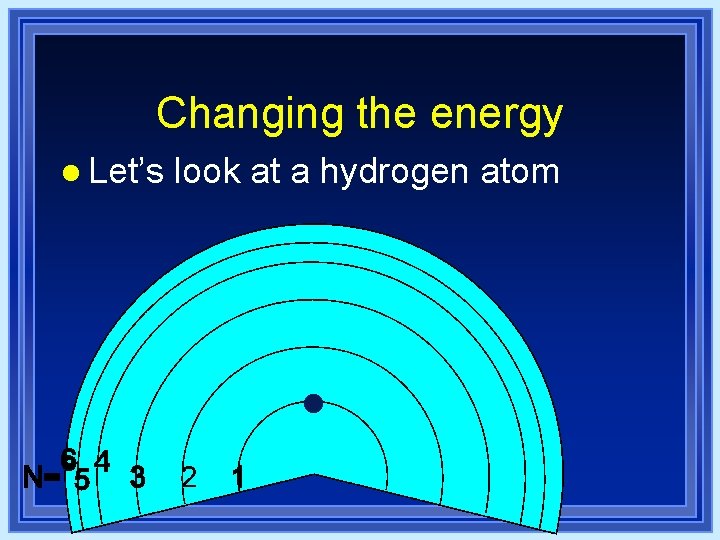
Changing the energy l Let’s look at a hydrogen atom
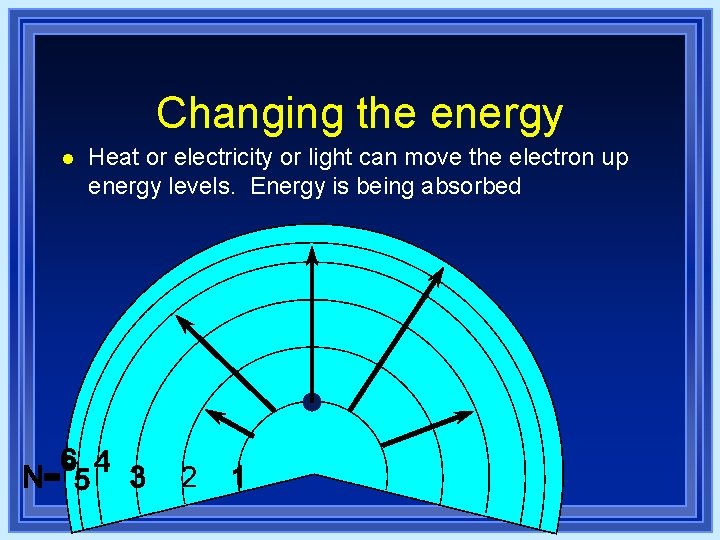
Changing the energy l Heat or electricity or light can move the electron up energy levels. Energy is being absorbed
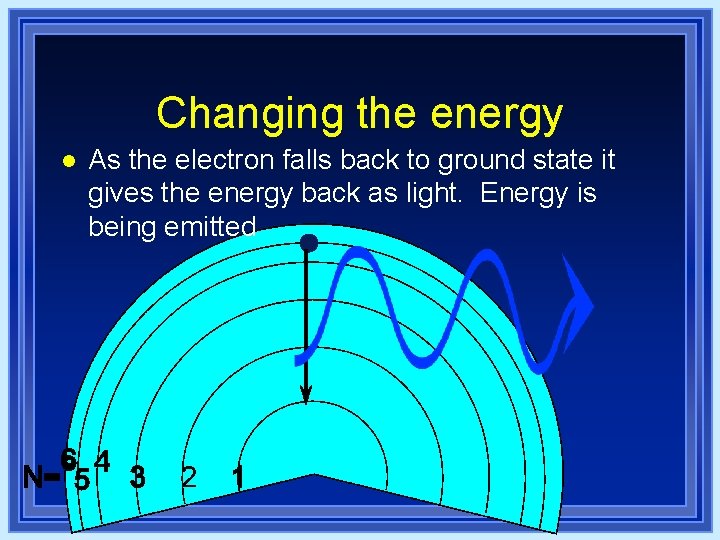
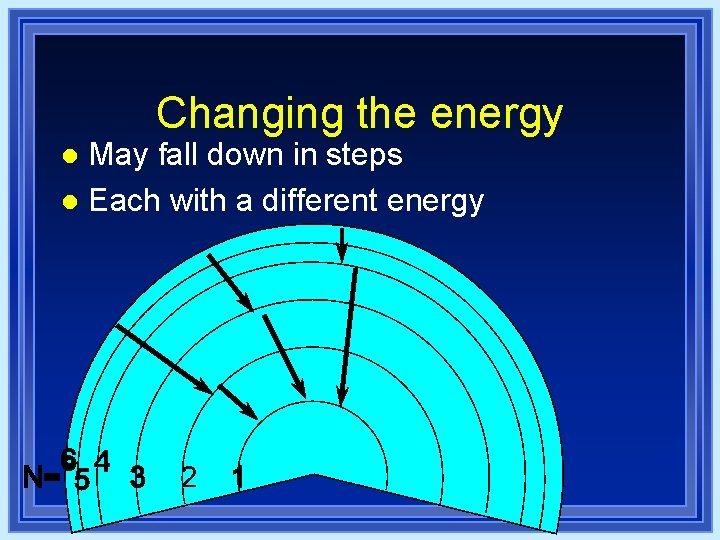
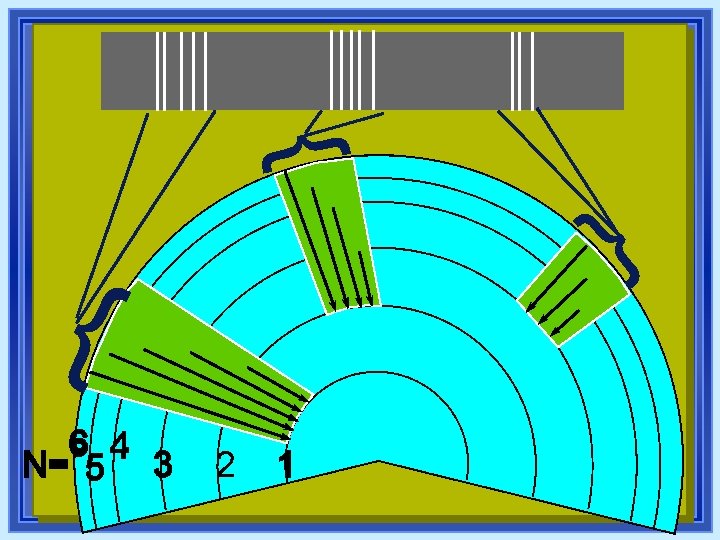
Changing the energy l As the electron falls back to ground state it gives the energy back as light. Energy is being emitted
Changing the energy May fall down in steps l Each with a different energy l
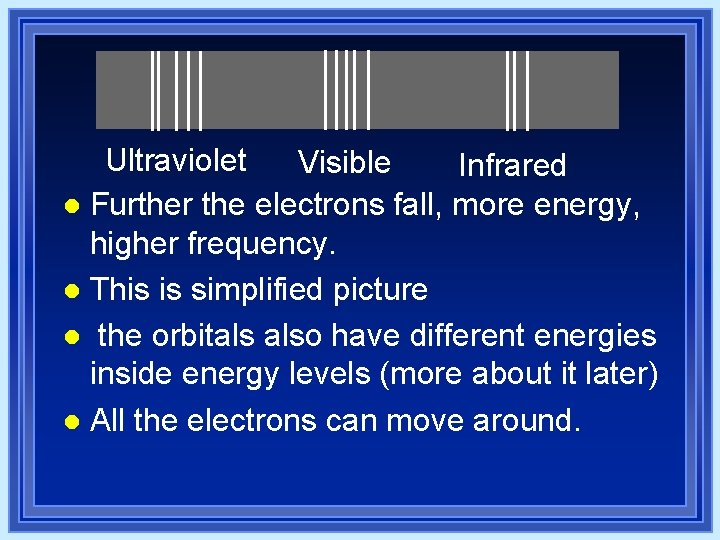
Ultraviolet Visible Infrared l Further the electrons fall, more energy, higher frequency. l This is simplified picture l the orbitals also have different energies inside energy levels (more about it later) l All the electrons can move around.
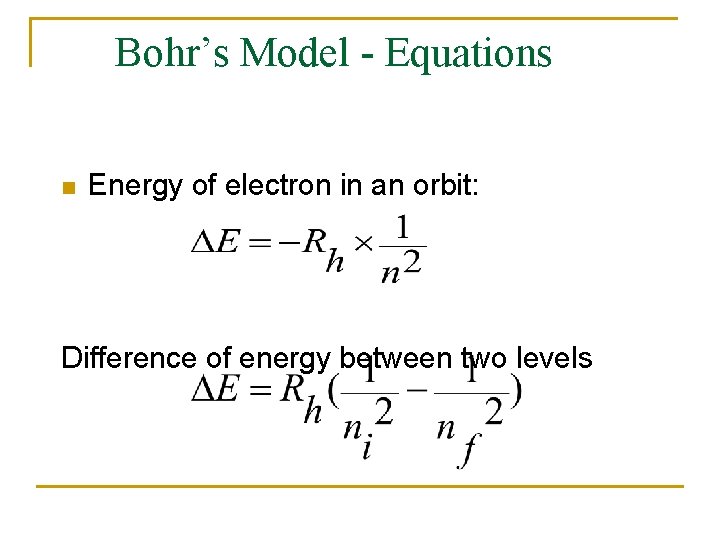
Bohr’s Model - Equations n Energy of electron in an orbit: Difference of energy between two levels
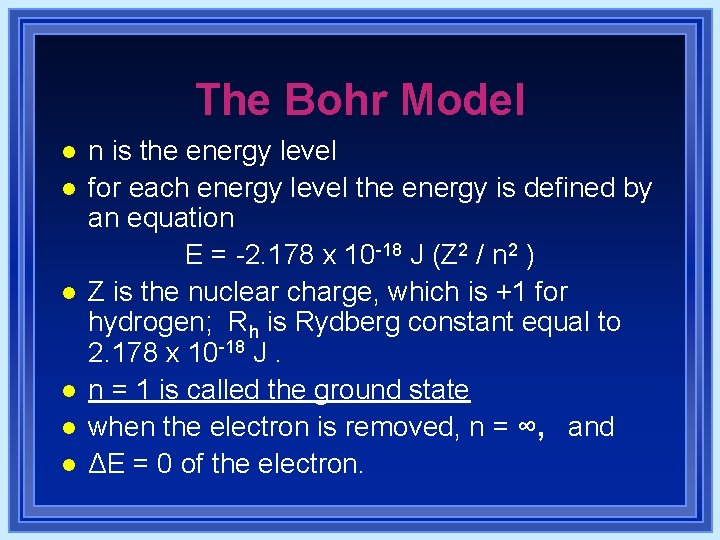
The Bohr Model l l l n is the energy level for each energy level the energy is defined by an equation E = -2. 178 x 10 -18 J (Z 2 / n 2 ) Z is the nuclear charge, which is +1 for hydrogen; Rh is Rydberg constant equal to 2. 178 x 10 -18 J. n = 1 is called the ground state when the electron is removed, n = ∞, and ΔE = 0 of the electron.
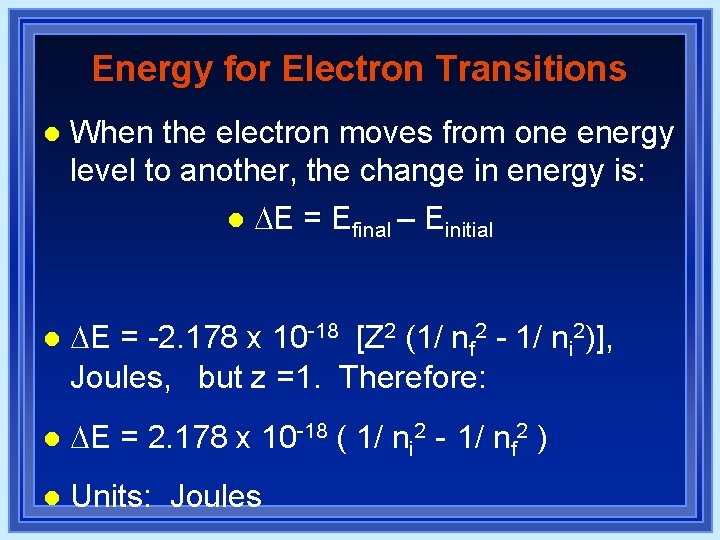
Energy for Electron Transitions l When the electron moves from one energy level to another, the change in energy is: l DE = Efinal – Einitial l DE = -2. 178 x 10 -18 [Z 2 (1/ nf 2 - 1/ ni 2)], Joules, but z =1. Therefore: l DE = 2. 178 x 10 -18 ( 1/ ni 2 - 1/ nf 2 ) l Units: Joules
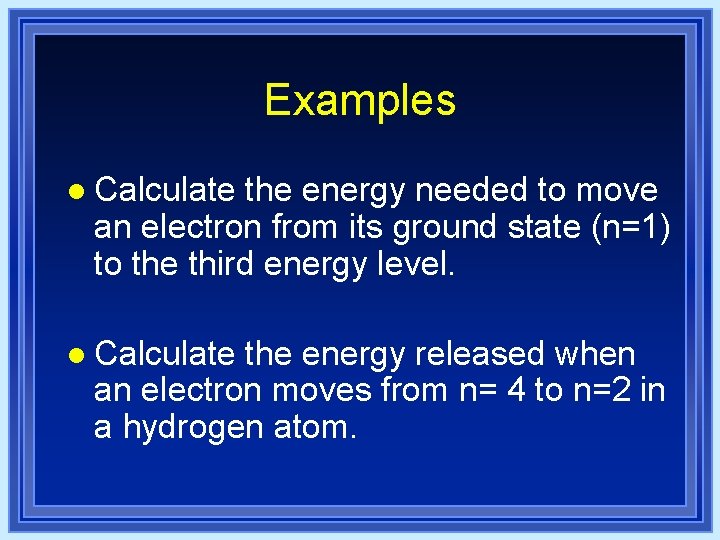
Examples l Calculate the energy needed to move an electron from its ground state (n=1) to the third energy level. l Calculate the energy released when an electron moves from n= 4 to n=2 in a hydrogen atom.
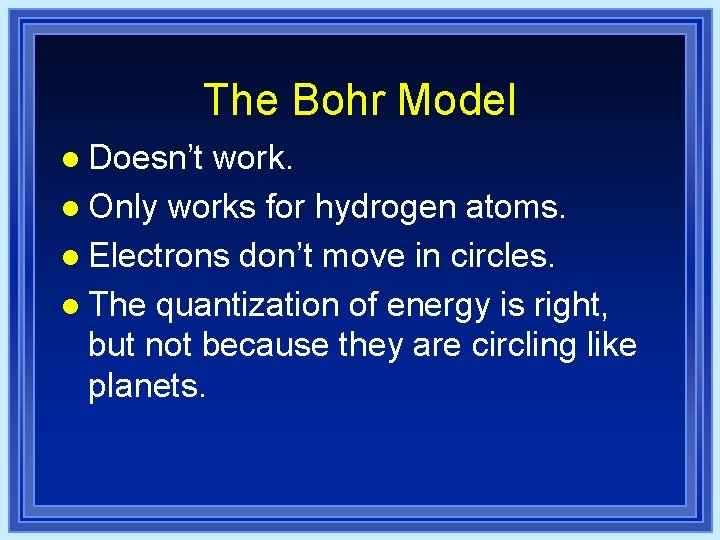
The Bohr Model l Doesn’t work. l Only works for hydrogen atoms. l Electrons don’t move in circles. l The quantization of energy is right, but not because they are circling like planets.
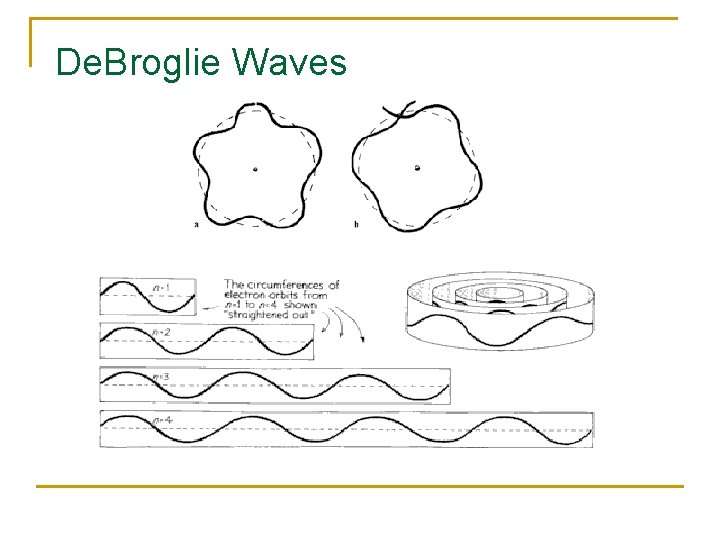
The Quantum Mechanical Model of the Atom l. A totally new approach. l De Broglie (1892 -1987) said: Ø matter could be like a wave. ØMatter waves are standing waves. ØThe vibrations of the wave are like of a stringed instrument.
De. Broglie Waves
De Broglie Waves Simulations l http: //www. launc. tased. edu. au/online/ sciences/physics/debrhydr. html
What’s possible? l You can only have a standing wave if you have complete waves. l There are only certain allowed waves. l In the atom there are certain allowed waves called electrons. l 1925 Erwin Schrödinger described the wave function of the electron. l Much math but what is important are the solutions.
The Quantum Mechanical Model Things that are very small behave differently from things big enough to see. l The quantum mechanical model is a mathematical solution l It is not like anything you can see. l
The physics of the very small l Quantum mechanics explains how the very small behaves. Classic physics is what you get when you add up the effects of millions of packages (Newtonian Physics). Quantum mechanics is based on probability because we cannot see the particles and they are many of them moving randomly.
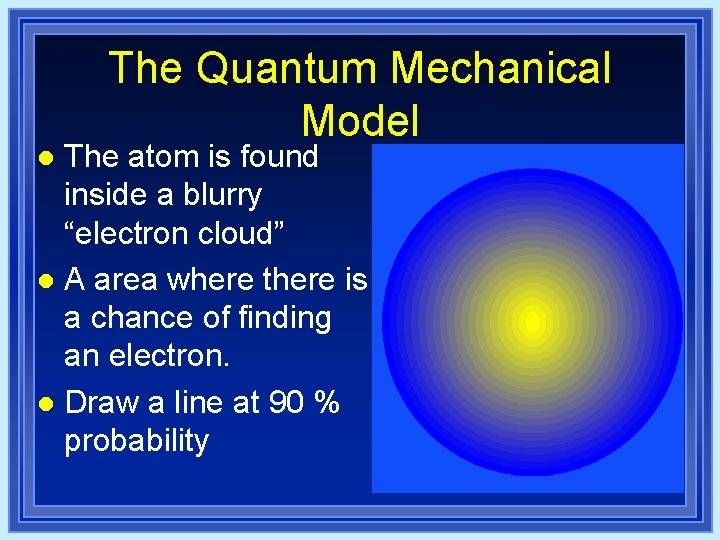
The Quantum Mechanical Model Has energy levels for electrons. l Orbits are not circular. They are not uniquely defined. There is no definite path for the motion of the electron. l The model predicts the probability of finding an electron a certain distance from the nucleus. The space is defined by the solution of Schrödinger equation. l Orbitals are found in energy levels. l
The Quantum Mechanical Model The atom is found inside a blurry “electron cloud” l A area where there is a chance of finding an electron. l Draw a line at 90 % probability l
Heisenberg Uncertainty Principle l It is impossible to know exactly the speed and velocity of a particle. l The better we know one, the less we know the other. l The act of measuring changes the properties.
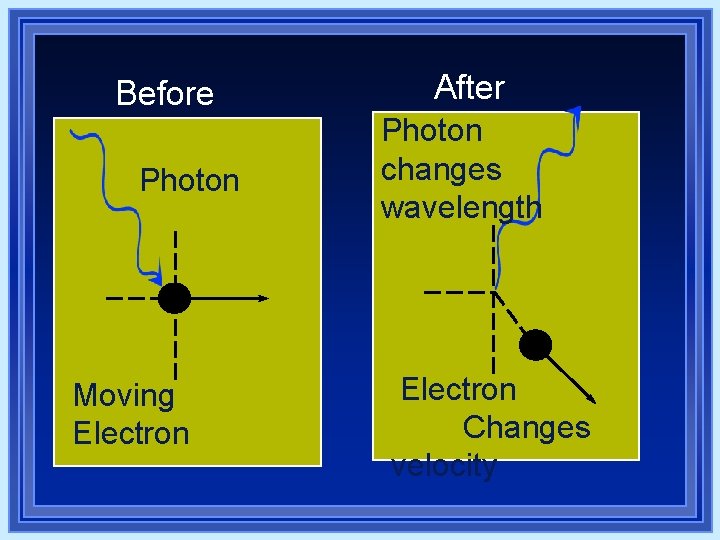
Heisnberg Unceratinty Principle Introduces the Unknown Factor l To measure where a electron is, we use light. l But the light moves the electron l And hitting the electron changes the frequency of the light. l Therefore we are never sure where the electron is.
Before Photon Moving Electron After Photon changes wavelength Electron Changes velocity
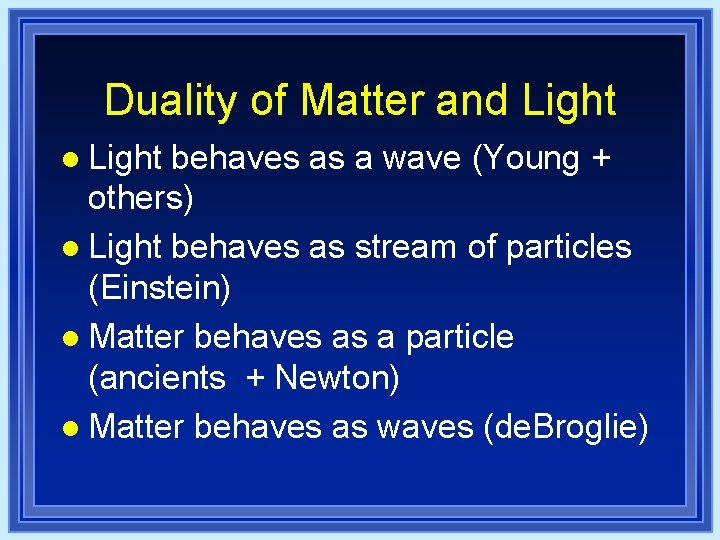
Duality of Matter and Light l Light behaves as a wave (Young + others) l Light behaves as stream of particles (Einstein) l Matter behaves as a particle (ancients + Newton) l Matter behaves as waves (de. Broglie)
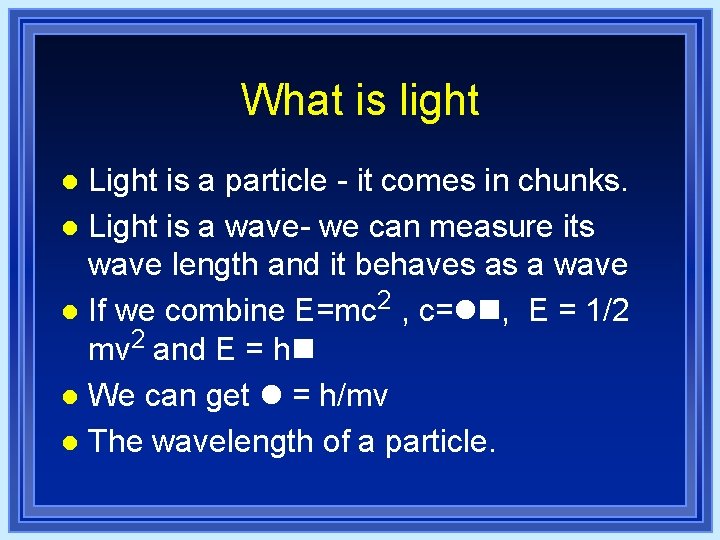
What is light Light is a particle - it comes in chunks. l Light is a wave- we can measure its wave length and it behaves as a wave l If we combine E=mc 2 , c=ln, E = 1/2 mv 2 and E = hn l We can get l = h/mv l The wavelength of a particle. l
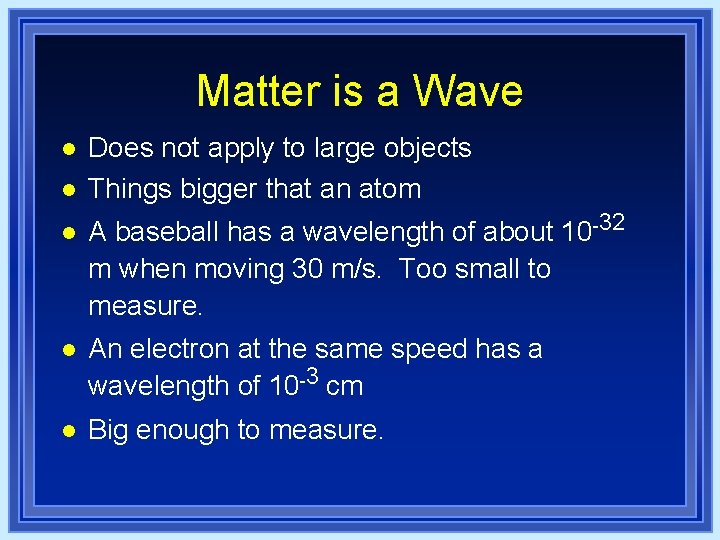
Matter is a Wave l l l Does not apply to large objects Things bigger that an atom A baseball has a wavelength of about 10 -32 m when moving 30 m/s. Too small to measure. l An electron at the same speed has a wavelength of 10 -3 cm l Big enough to measure.
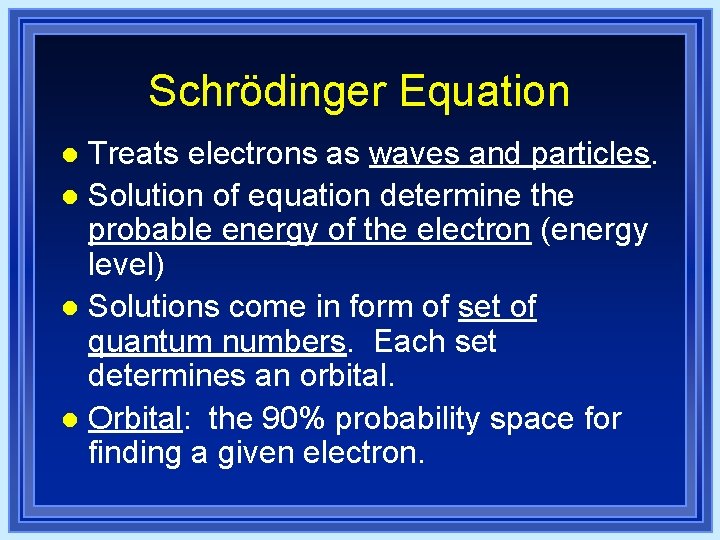
Schrödinger Equation Treats electrons as waves and particles. l Solution of equation determine the probable energy of the electron (energy level) l Solutions come in form of set of quantum numbers. Each set determines an orbital. l Orbital: the 90% probability space for finding a given electron. l
Atomic Orbitals Wave function corresponding to a particular set of three quantum numbers (n, l, and ml) l Within each energy level the complex math of Schrödinger's equation describes several shapes. l Regions where there is a high probability of finding an electron. l
The Wave Mechanical Model of the Atom The atom has two parts: l A dense nucleus in which most of the mass is concentrated l Energy levels that contain orbitals in which electrons are placed l Each electron is described by four quantum numbers: (n, l, m, s) l The quantum numbers (n, l, m) are solutions of Schrödinger equation l The quantum number (s) added for the spin of the electron.
Solutions of the Schrödinger Equation l The solution of Schrödinger euation yield three quantum numbers: l N, principal quantum number l l, orbital quantum number l ml, magnetic quantum number
Quantum Numbers: the Principal Quantum Number n n, Principal quantum number ln values = 1, 2, 3, . . whole numbers l Designates the radial distance of the electron cloud and the probability where the electron can be found. l In plain language: it is the size of the electron cloud.
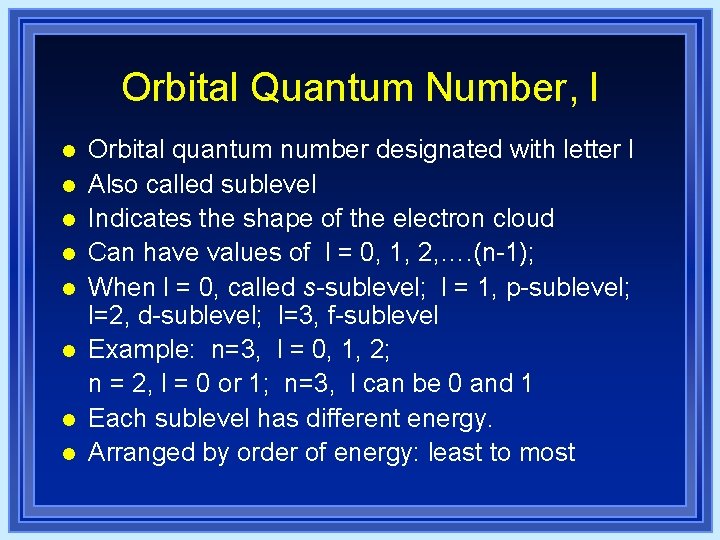
Orbital Quantum Number, l l l l l Orbital quantum number designated with letter l Also called sublevel Indicates the shape of the electron cloud Can have values of l = 0, 1, 2, …. (n-1); When l = 0, called s-sublevel; l = 1, p-sublevel; l=2, d-sublevel; l=3, f-sublevel Example: n=3, l = 0, 1, 2; n = 2, l = 0 or 1; n=3, l can be 0 and 1 Each sublevel has different energy. Arranged by order of energy: least to most
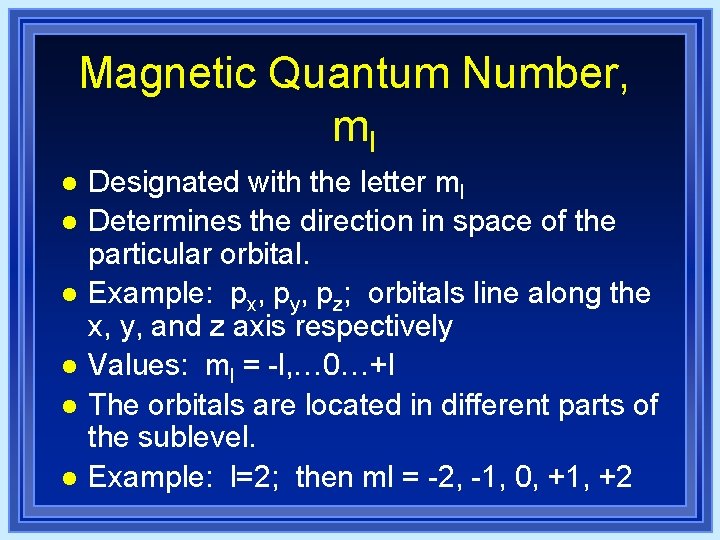
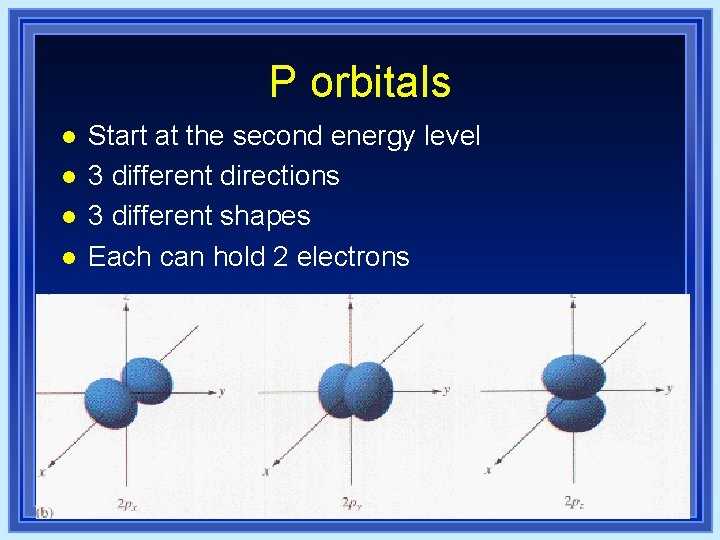
Magnetic Quantum Number, ml l l l Designated with the letter ml Determines the direction in space of the particular orbital. Example: px, py, pz; orbitals line along the x, y, and z axis respectively Values: ml = -l, … 0…+l The orbitals are located in different parts of the sublevel. Example: l=2; then ml = -2, -1, 0, +1, +2
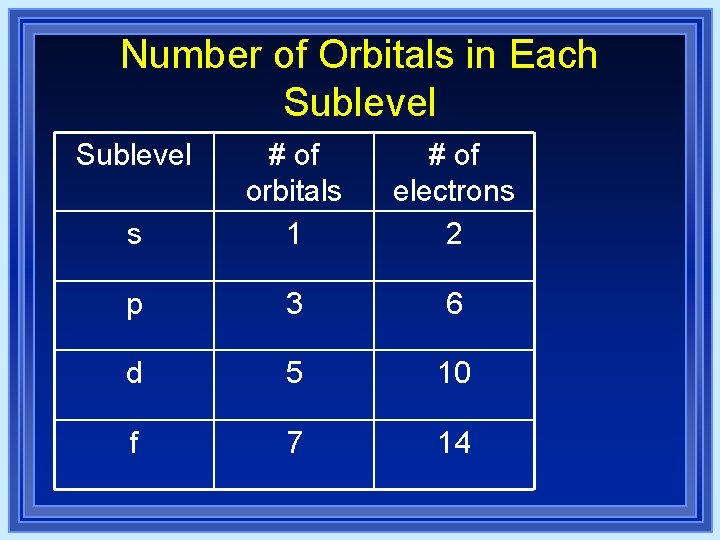
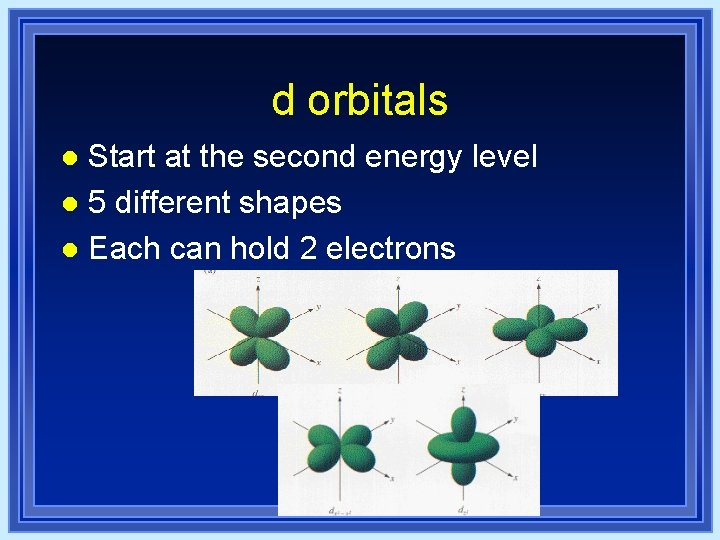
Number of Orbitals in Each Sublevel s # of orbitals 1 # of electrons 2 p 3 6 d 5 10 f 7 14
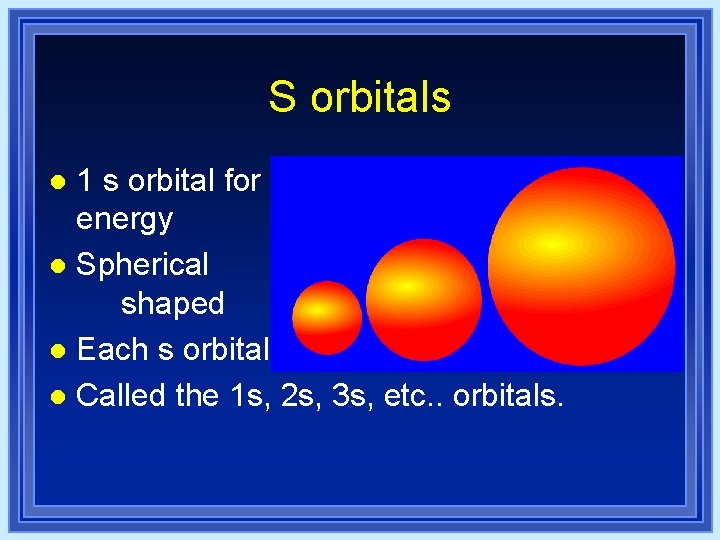
S orbitals 1 s orbital for every energy level l Spherical shaped l Each s orbital can hold 2 electrons l Called the 1 s, 2 s, 3 s, etc. . orbitals. l
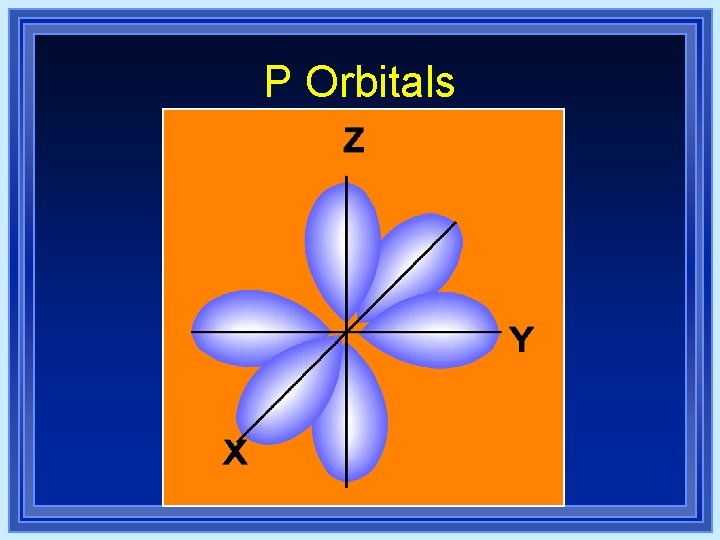
P orbitals l l Start at the second energy level 3 different directions 3 different shapes Each can hold 2 electrons
P Orbitals
d orbitals Start at the second energy level l 5 different shapes l Each can hold 2 electrons l
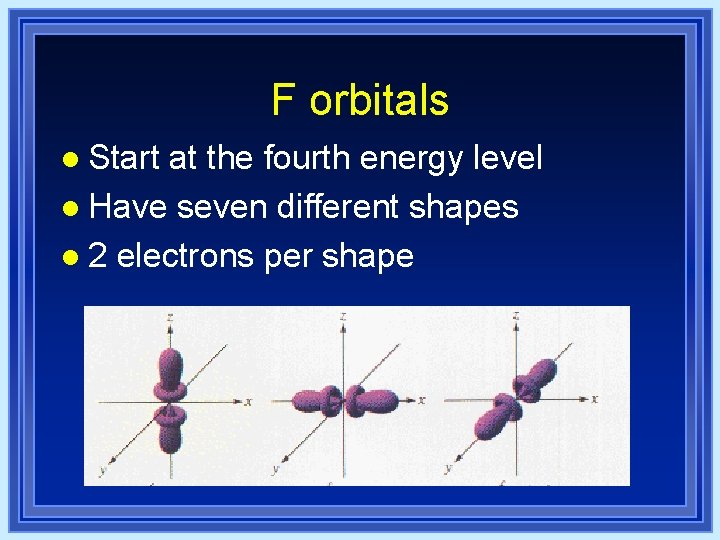
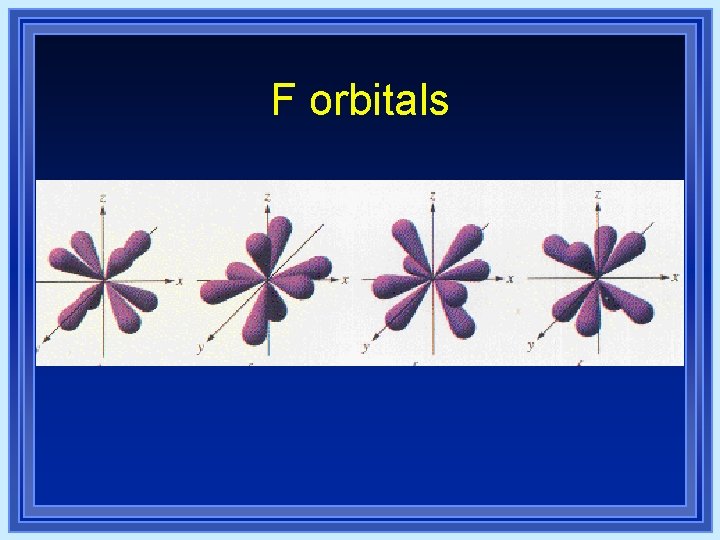
F orbitals l Start at the fourth energy level l Have seven different shapes l 2 electrons per shape
F orbitals
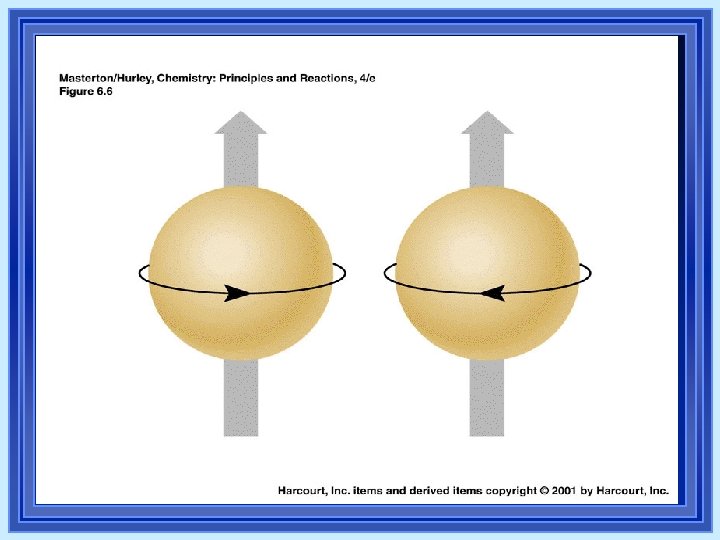
Quantum Spin Number l Designated also by letter s. (Can be confusing) l Values +1/2 or -1/2 l Each electron can spin clockwise and counterclockwise.
The Solution of Schrödinger Equation Summary: Number of sublevels in principal energy level: n Energy of sublevels: s<p<d<f Number of orbitals in principal energy level: n 2 Number of electrons in any principal energy level: 2 n 2 Each orbital can have only 2 electrons