ASYMPTOTES An asymptote of a curve is a














- Slides: 70
ASYMPTOTES
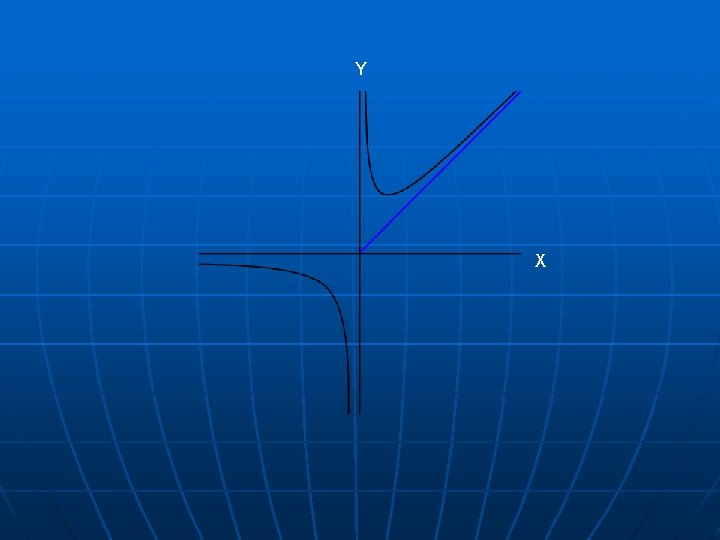
An asymptote of a curve is a line such that the distance between the curve and the line approaches zero as they tend to infinity
Y X
TYPES OF ASYMPTOTES
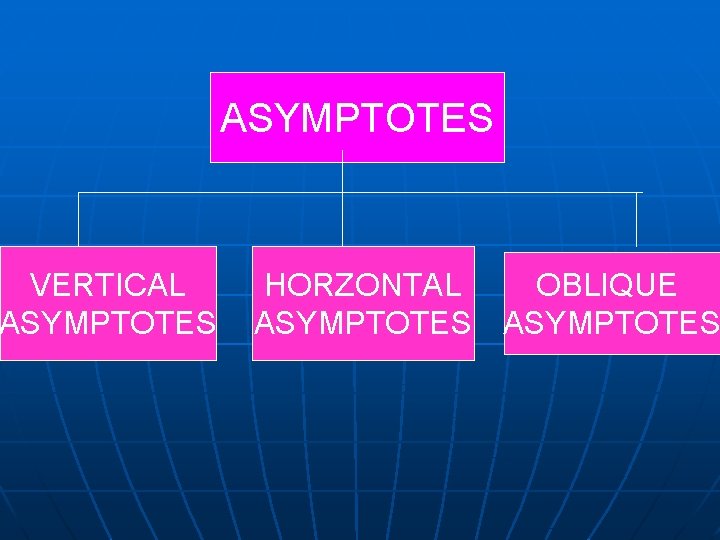
VERTICAL ASYMPTOTES HORZONTAL OBLIQUE ASYMPTOTES
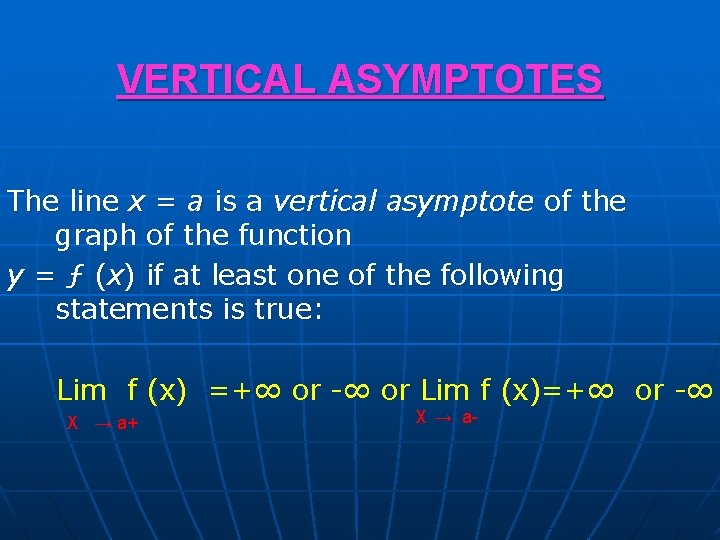
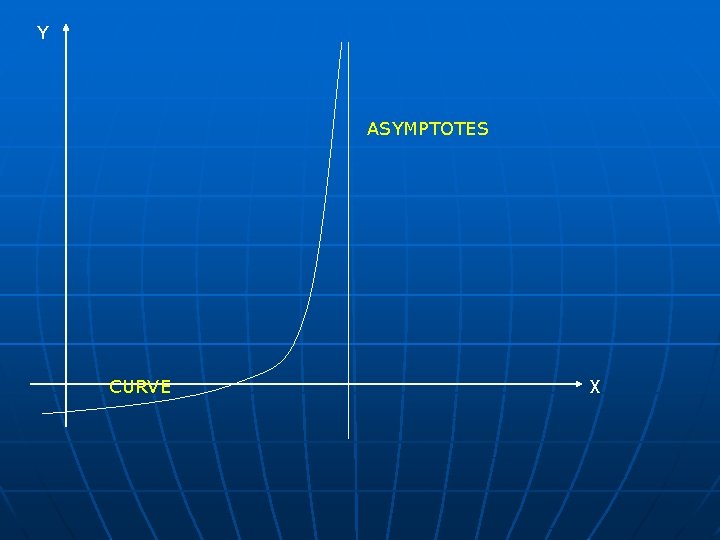
VERTICAL ASYMPTOTES The line x = a is a vertical asymptote of the graph of the function y = ƒ (x) if at least one of the following statements is true: Lim f (x) =+∞ or -∞ or Lim f (x)=+∞ or -∞ X → a+ X → a-
Y ASYMPTOTES CURVE X
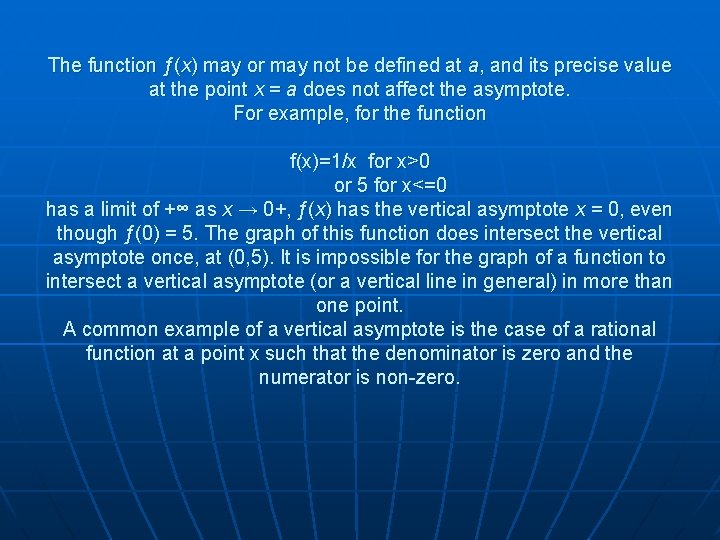
The function ƒ(x) may or may not be defined at a, and its precise value at the point x = a does not affect the asymptote. For example, for the function f(x)=1/x for x>0 or 5 for x<=0 has a limit of +∞ as x → 0+, ƒ(x) has the vertical asymptote x = 0, even though ƒ(0) = 5. The graph of this function does intersect the vertical asymptote once, at (0, 5). It is impossible for the graph of a function to intersect a vertical asymptote (or a vertical line in general) in more than one point. A common example of a vertical asymptote is the case of a rational function at a point x such that the denominator is zero and the numerator is non-zero.
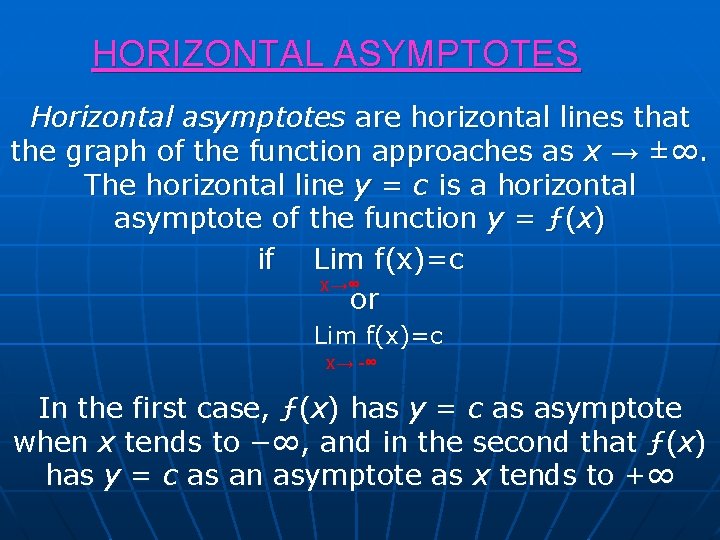
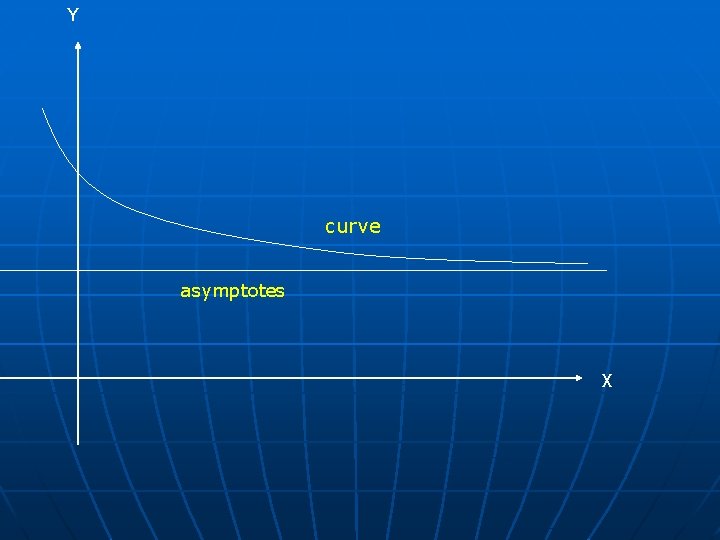
HORIZONTAL ASYMPTOTES Horizontal asymptotes are horizontal lines that the graph of the function approaches as x → ±∞. The horizontal line y = c is a horizontal asymptote of the function y = ƒ(x) if Lim f(x)=c x→∞ or Lim f(x)=c x→ -∞ In the first case, ƒ(x) has y = c as asymptote when x tends to −∞, and in the second that ƒ(x) has y = c as an asymptote as x tends to +∞
Y curve asymptotes X
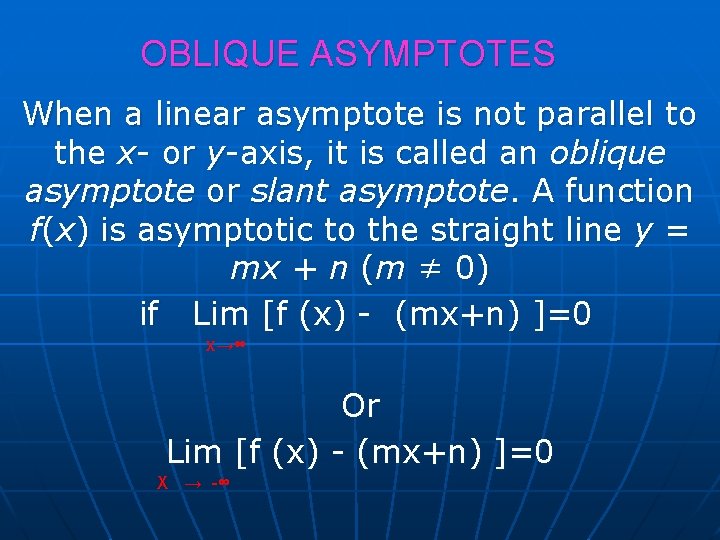
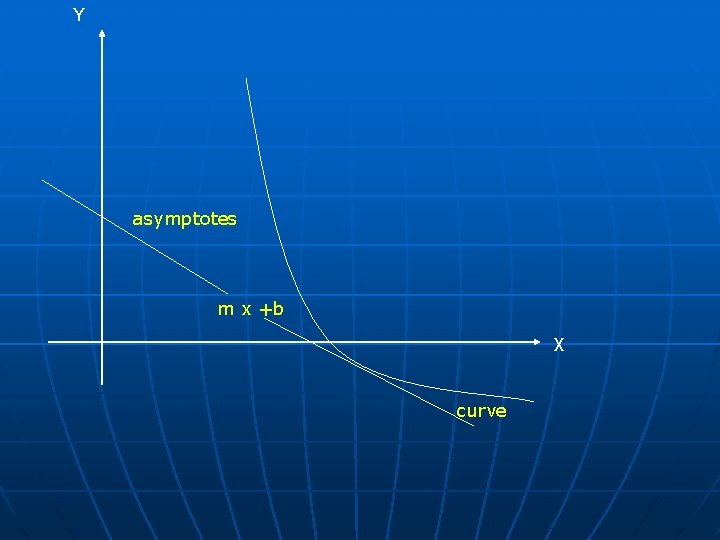
OBLIQUE ASYMPTOTES When a linear asymptote is not parallel to the x- or y-axis, it is called an oblique asymptote or slant asymptote. A function f(x) is asymptotic to the straight line y = mx + n (m ≠ 0) if Lim [f (x) - (mx+n) ]=0 x→∞ Or Lim [f (x) - (mx+n) ]=0 X → -∞
Y asymptotes m x +b X curve
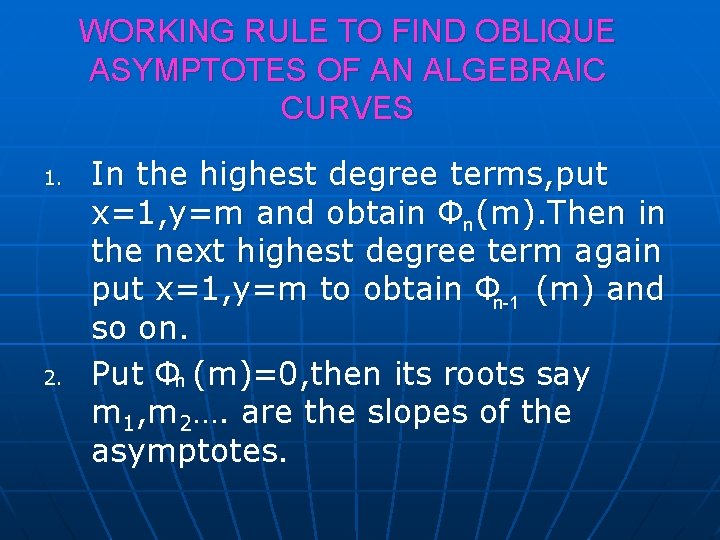
WORKING RULE TO FIND OBLIQUE ASYMPTOTES OF AN ALGEBRAIC CURVES 1. 2. In the highest degree terms, put x=1, y=m and obtain Φn (m). Then in the next highest degree term again put x=1, y=m to obtain Φn-1 (m) and so on. Put Φn (m)=0, then its roots say m 1, m 2…. are the slopes of the asymptotes.
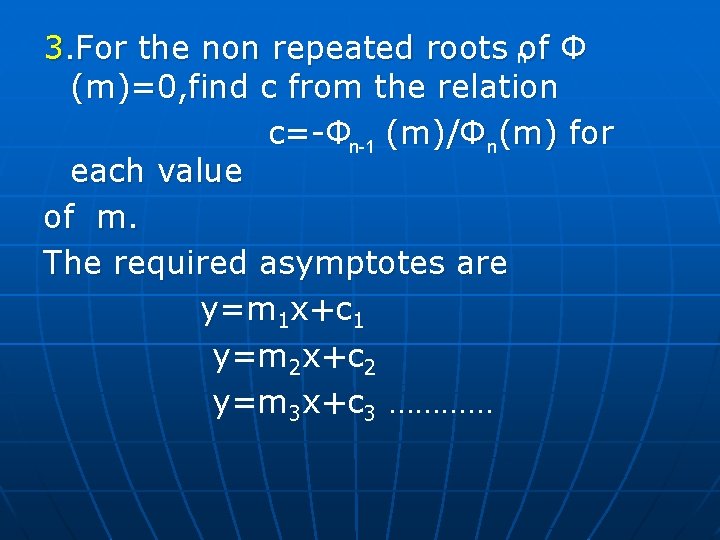
3. For the non repeated roots of Φ n (m)=0, find c from the relation c=-Φn-1 (m)/Φ (m) for n each value of m. The required asymptotes are y=m 1 x+c 1 y=m 2 x+c 2 y=m 3 x+c 3 …………
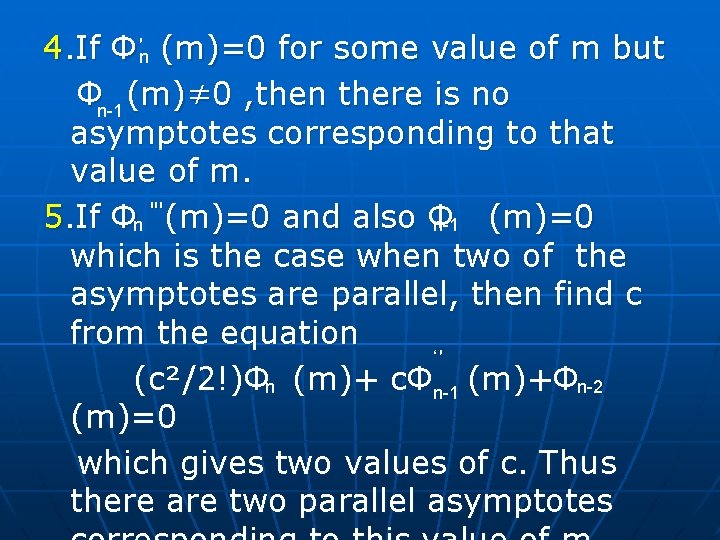
′ 4. If Φ (m)=0 for some value of m but n Φn-1 (m)≠ 0 , then there is no asymptotes corresponding to that value of m. ‘ 5. If Φn "'(m)=0 and also Φ n-1 (m)=0 which is the case when two of the ″ asymptotes are parallel, then find c from the equation ‘′ (c²/2!)Φn (m)+ cΦ (m)+ Φn-2 n-1 (m)=0 which gives two values of c. Thus there are two parallel asymptotes
′ 6. If Φ (m)=0, then n-1 n-2 n the values of c corresponding to this value of m are determined from the equation ″ ″′ ’ (c³/3!)Φn (m)+(c²/2!)Φn-1 (m)+cΦn-1 (m)=0. ″
EXAMPLE TO FIND ASYMPTOTES OF ALGEBRAIC CURVE
Find the asymptotes of the curve x³+3 x²y-4 y³-x+y+3=0? SOLUTION: The given curve is x³+3 x²y-4 y³-x+y+3=0 To find the oblique asymptotes Putting x=1, y=m in the third, second and first degree terms one by one, we get
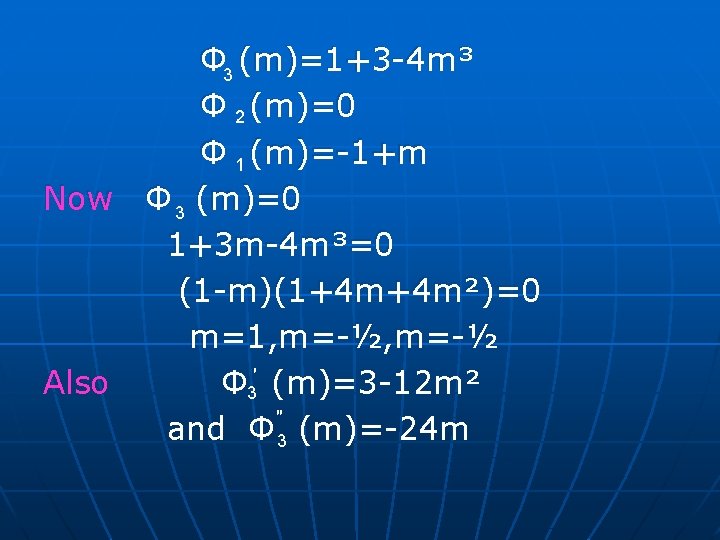
Φ 3 (m)=1+3 -4 m³ Φ (m)=0 2 Φ (m)=-1+m 1 Now Φ (m)=0 3 1+3 m-4 m³=0 (1 -m)(1+4 m+4 m²)=0 m=1, m=-½ ′ Also Φ 3 (m)=3 -12 m² ″ and Φ (m)=-24 m 3
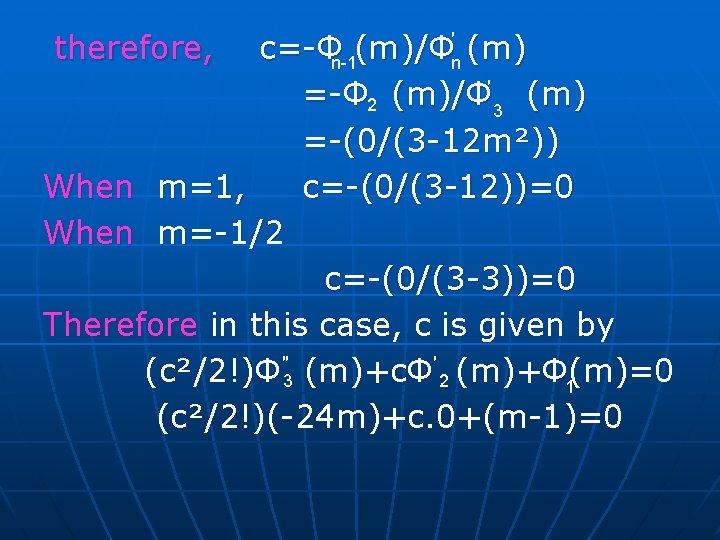
therefore, c=-Φn-1 (m)/Φ′n (m) =-Φ 2 (m)/Φ′ (m) 3 =-(0/(3 -12 m²)) When m=1, c=-(0/(3 -12))=0 When m=-1/2 c=-(0/(3 -3))=0 Therefore in this case, c is given by ″ ′ (c²/2!)Φ ( m)+c Φ (m)+ Φ 1(m)=0 3 2 (c²/2!)(-24 m)+c. 0+(m-1)=0
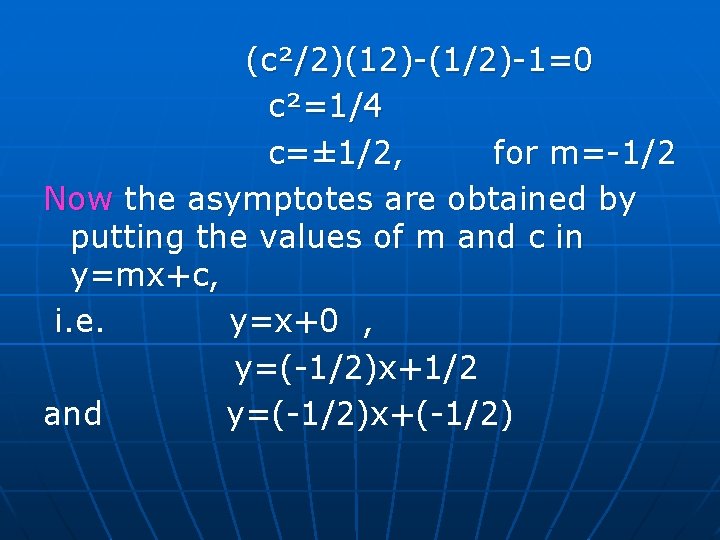
(c²/2)(12)-(1/2)-1=0 c²=1/4 c=± 1/2, for m=-1/2 Now the asymptotes are obtained by putting the values of m and c in y=mx+c, i. e. y=x+0 , y=(-1/2)x+1/2 and y=(-1/2)x+(-1/2)
WORKING RULE FOR FINDING ASYMPTOTES OF POLAR CURVES
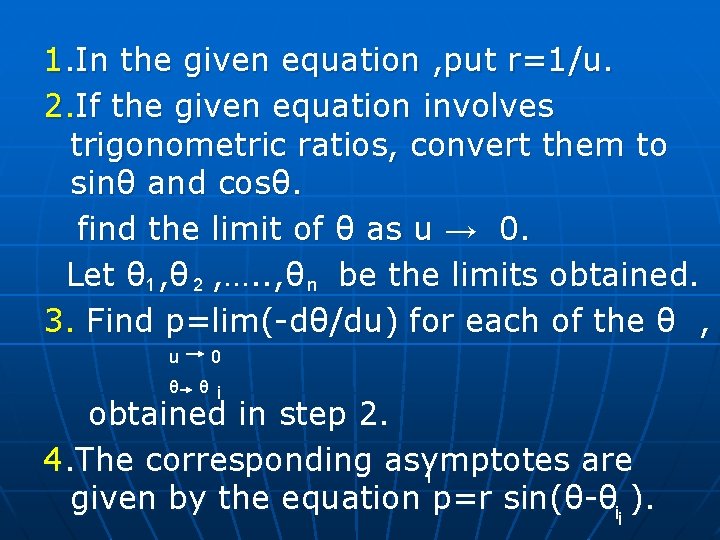
1. In the given equation , put r=1/u. 2. If the given equation involves trigonometric ratios, convert them to sinθ and cosθ. find the limit of θ as u → 0. Let θ 1 , θ , …. . , θ be the limits obtained. 2 n 3. Find p=lim(-dθ/du) for each of the θ , u 0 θ θ i obtained in step 2. 4. The corresponding asymptotes are i given by the equation p=r sin(θ-θi ). i
EXAMPLE TO FIND ASYMPTOTES OF POLAR CURVE
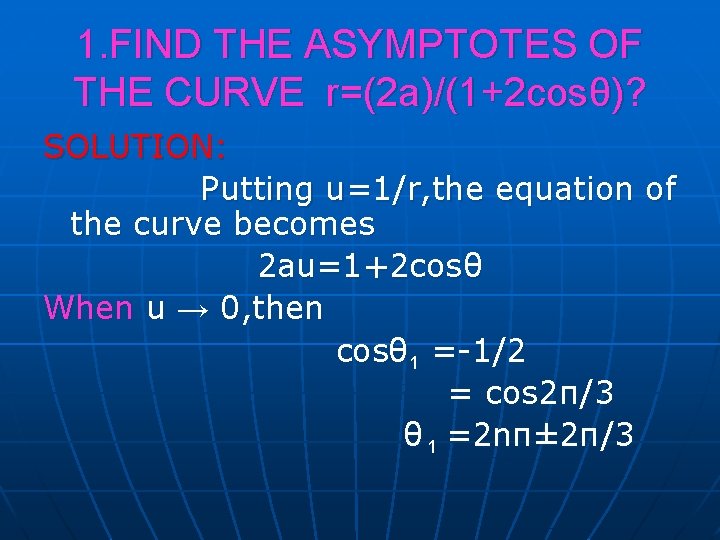
1. FIND THE ASYMPTOTES OF THE CURVE r=(2 a)/(1+2 cosθ)? SOLUTION: Putting u=1/r, the equation of the curve becomes 2 au=1+2 cosθ When u → 0, then cosθ =-1/2 1 = cos 2π/3 θ =2 n π± 2π/3 1
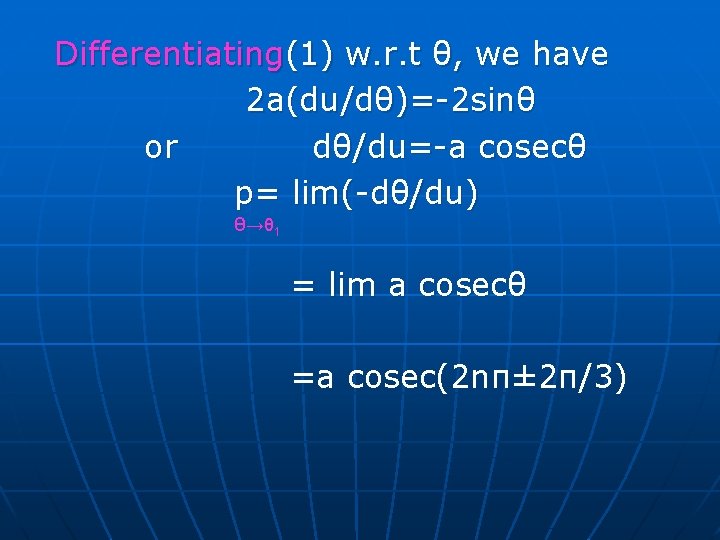
Differentiating(1) w. r. t θ, we have 2 a(du/dθ)=-2 sinθ or dθ/du=-a cosecθ p= lim(-dθ/du) θ→θ 1 = lim a cosecθ =a cosec(2 nπ± 2π/3)
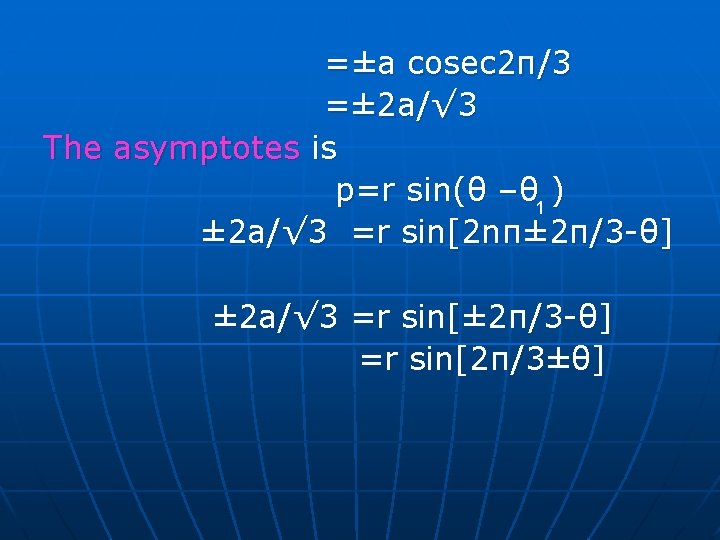
=±a cosec 2π/3 =± 2 a/√ 3 The asymptotes is p=r sin(θ –θ 1 ) ± 2 a/√ 3 =r sin[2 nπ± 2π/3 -θ] ± 2 a/√ 3 =r sin[± 2π/3 -θ] =r sin[2π/3±θ]
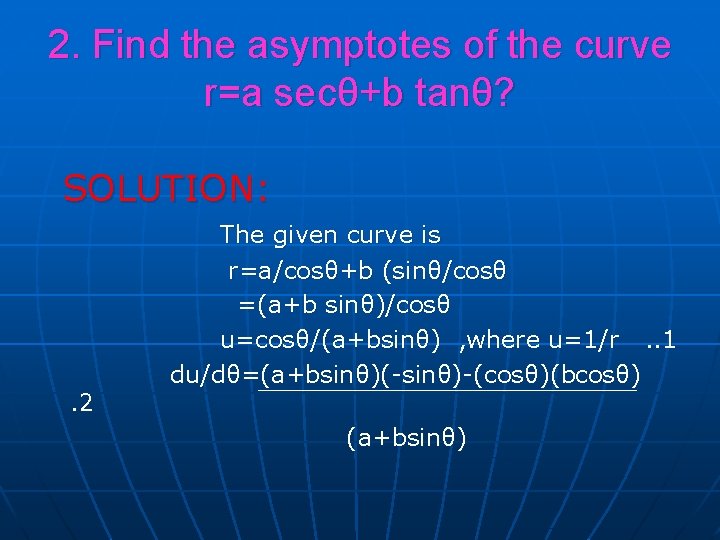
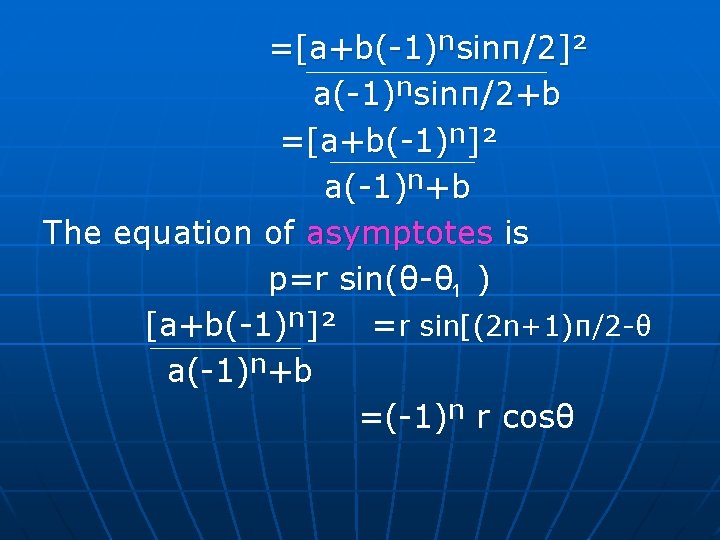
2. Find the asymptotes of the curve r=a secθ+b tanθ? SOLUTION: The given curve is r=a/cosθ+b (sinθ/cosθ =(a+b sinθ)/cosθ u=cosθ/(a+bsinθ) , where u=1/r . . 1 du/dθ=(a+bsinθ)(-sinθ)-(cosθ)(bcosθ) . 2 (a+bsinθ)
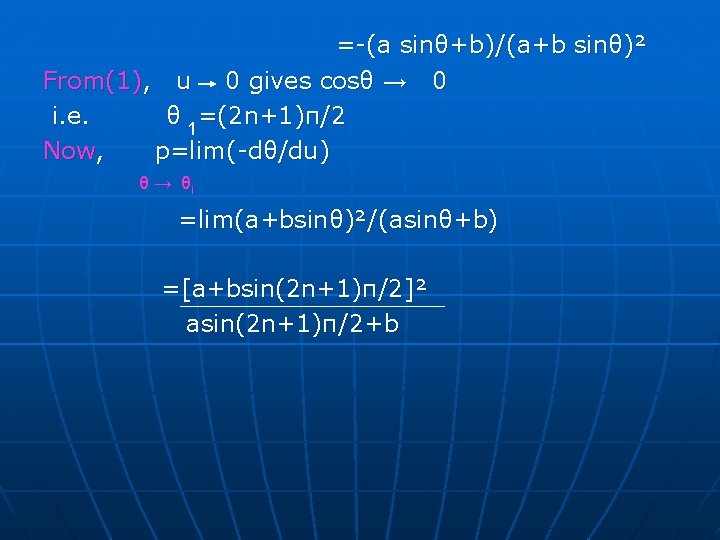
=-(a sinθ+b)/(a+b sinθ)² From(1), u 0 gives cosθ → 0 i. e. θ =(2 n+1) π/2 1 Now, p=lim(-dθ/du) θ → θi =lim(a+bsinθ)²/(asinθ+b) =[a+bsin(2 n+1)π/2]² asin(2 n+1)π/2+b
=[a+b(-1)ⁿsinπ/2]² a(-1)ⁿsinπ/2+b =[a+b(-1)ⁿ]² a(-1)ⁿ+b The equation of asymptotes is p=r sin(θ-θ 1 ) [a+b(-1)ⁿ]² =r sin[(2 n+1)π/2 -θ a(-1)ⁿ+b =(-1)ⁿ r cosθ
CURVE TRACING
METHOD OF TRACING A CURVE
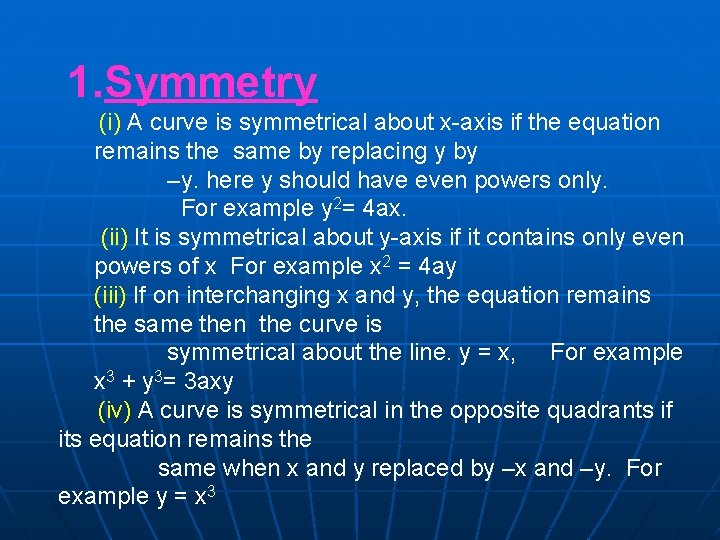
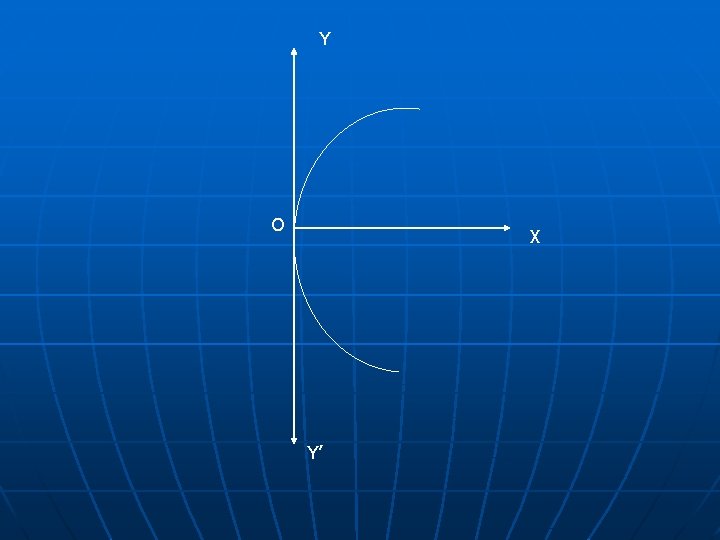
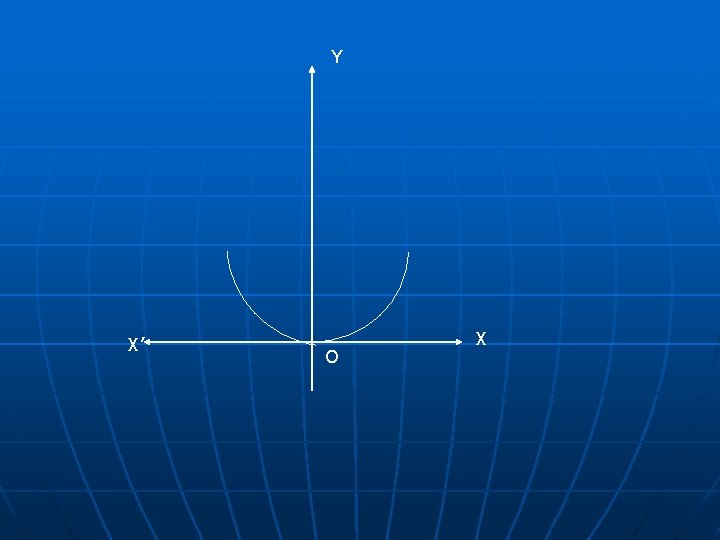
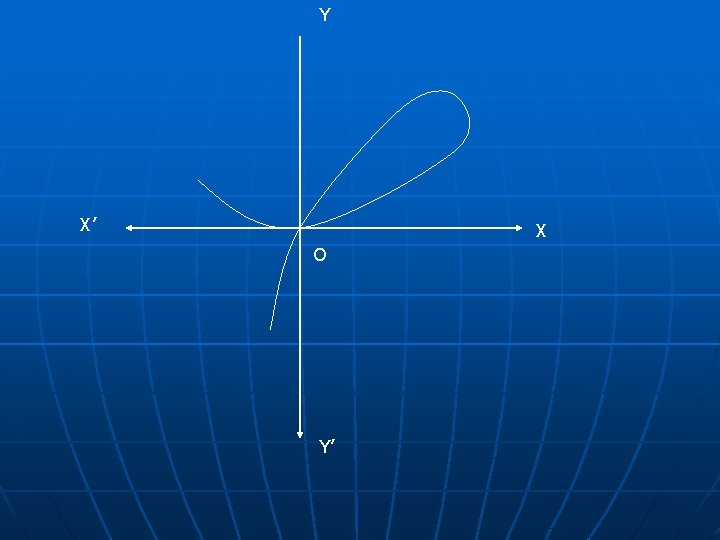
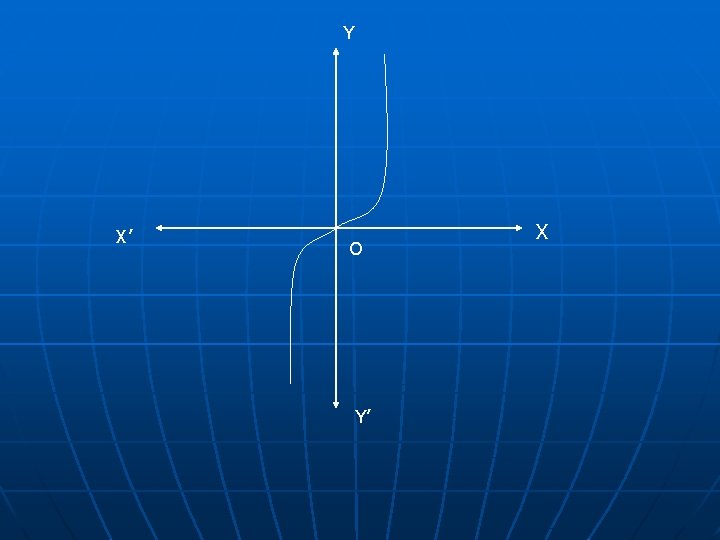
1. Symmetry (i) A curve is symmetrical about x-axis if the equation remains the same by replacing y by –y. here y should have even powers only. For example y 2= 4 ax. (ii) It is symmetrical about y-axis if it contains only even powers of x For example x 2 = 4 ay (iii) If on interchanging x and y, the equation remains the same then the curve is symmetrical about the line. y = x, For example x 3 + y 3= 3 axy (iv) A curve is symmetrical in the opposite quadrants if its equation remains the same when x and y replaced by –x and –y. For example y = x 3
Y O X Y’
Y X’ O X
Y X’ X O Y’
Y X’ O Y’ X
2. (a) Origin The curve passes through the origin, if the equation does not contain constant term. For example the curve y 2 = 4 ax passes through the origin.
(b) Tangents at the origin: To know the nature of a multiple point it necessary to find the tangent at that point. The equation of the tangent at the origin can be obtained by equating to zero, the lowest degree term in the equation of the curve.
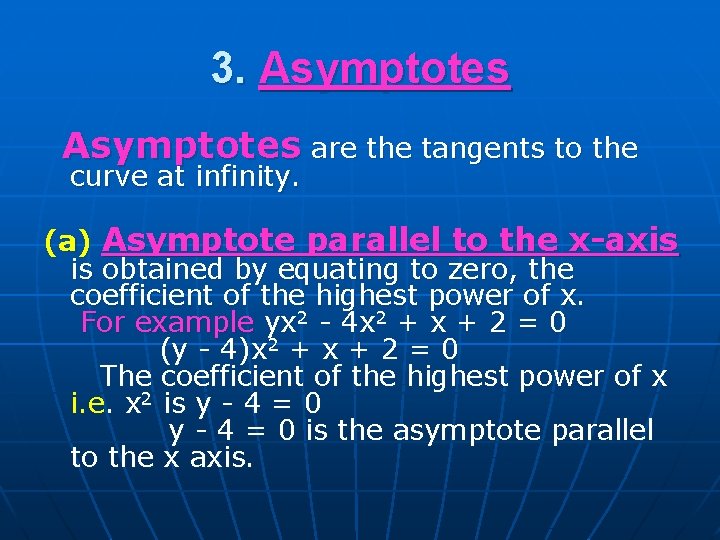
3. Asymptotes are the tangents to the curve at infinity. (a) Asymptote parallel to the x-axis is obtained by equating to zero, the coefficient of the highest power of x. For example yx 2 - 4 x 2 + x + 2 = 0 (y - 4)x 2 + x + 2 = 0 The coefficient of the highest power of x i. e. x 2 is y - 4 = 0 is the asymptote parallel to the x axis.
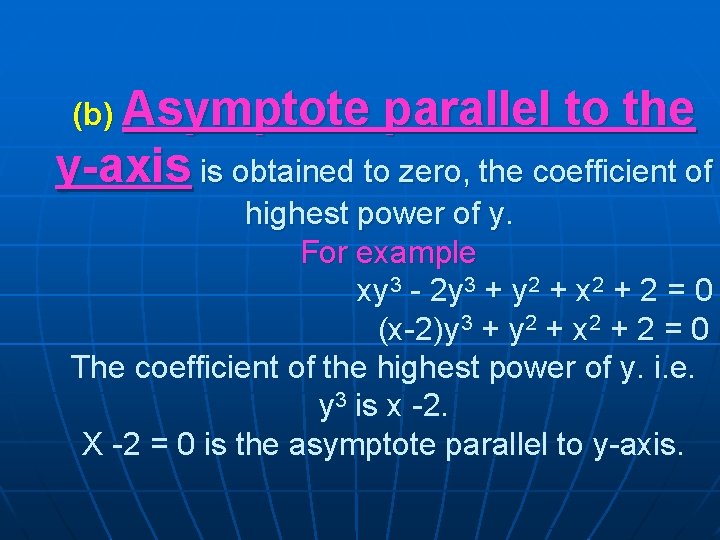
(b) Asymptote parallel to the y-axis is obtained to zero, the coefficient of highest power of y. For example xy 3 - 2 y 3 + y 2 + x 2 + 2 = 0 (x-2)y 3 + y 2 + x 2 + 2 = 0 The coefficient of the highest power of y. i. e. y 3 is x -2. X -2 = 0 is the asymptote parallel to y-axis.
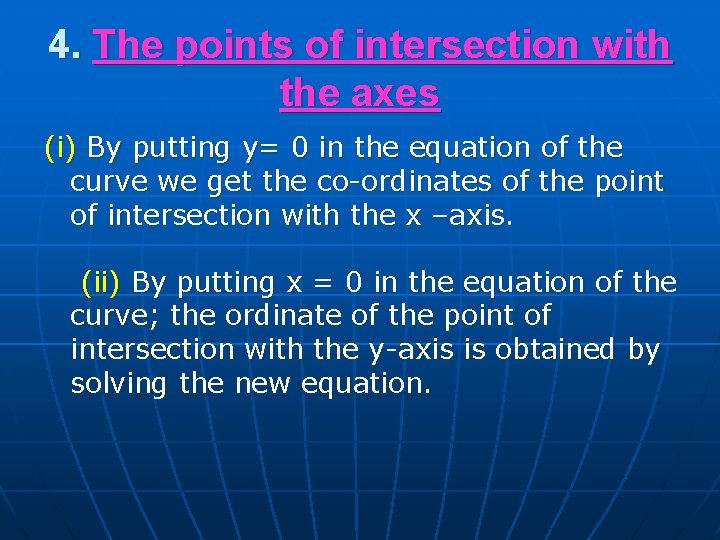
4. The points of intersection with the axes (i) By putting y= 0 in the equation of the curve we get the co-ordinates of the point of intersection with the x –axis. (ii) By putting x = 0 in the equation of the curve; the ordinate of the point of intersection with the y-axis is obtained by solving the new equation.
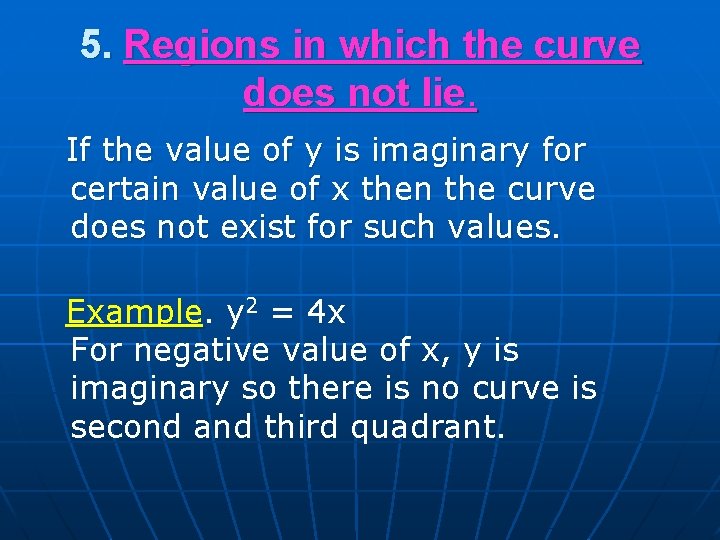
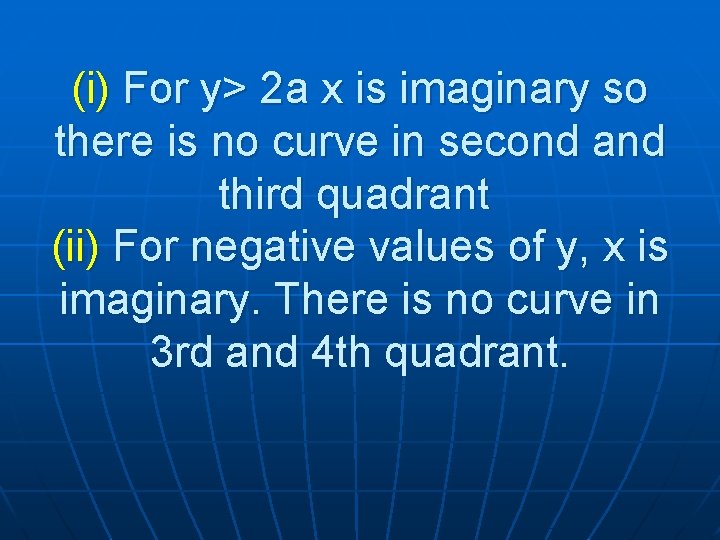
5. Regions in which the curve does not lie. If the value of y is imaginary for certain value of x then the curve does not exist for such values. Example. y 2 = 4 x For negative value of x, y is imaginary so there is no curve is second and third quadrant.
(i) For y> 2 a x is imaginary so there is no curve in second and third quadrant (ii) For negative values of y, x is imaginary. There is no curve in 3 rd and 4 th quadrant.
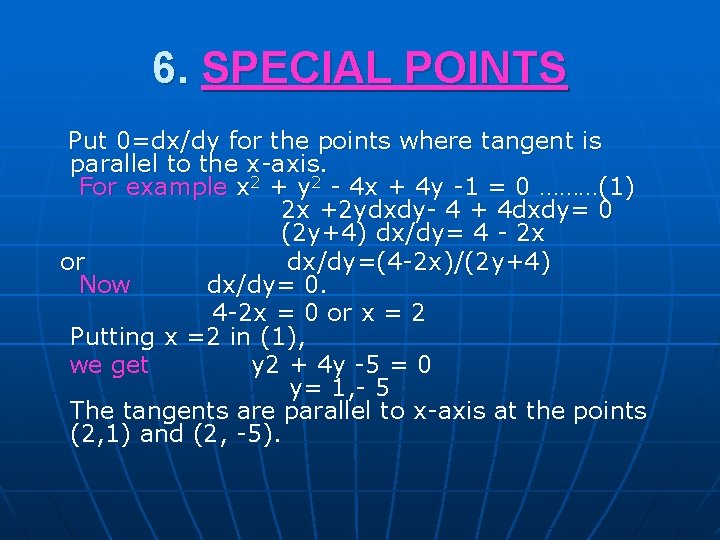
6. SPECIAL POINTS Put 0=dx/dy for the points where tangent is parallel to the x-axis. For example x 2 + y 2 - 4 x + 4 y -1 = 0 ………(1) 2 x +2 ydxdy- 4 + 4 dxdy= 0 (2 y+4) dx/dy= 4 - 2 x or dx/dy=(4 -2 x)/(2 y+4) Now dx/dy= 0. 4 -2 x = 0 or x = 2 Putting x =2 in (1), we get y 2 + 4 y -5 = 0 y= 1, - 5 The tangents are parallel to x-axis at the points (2, 1) and (2, -5).
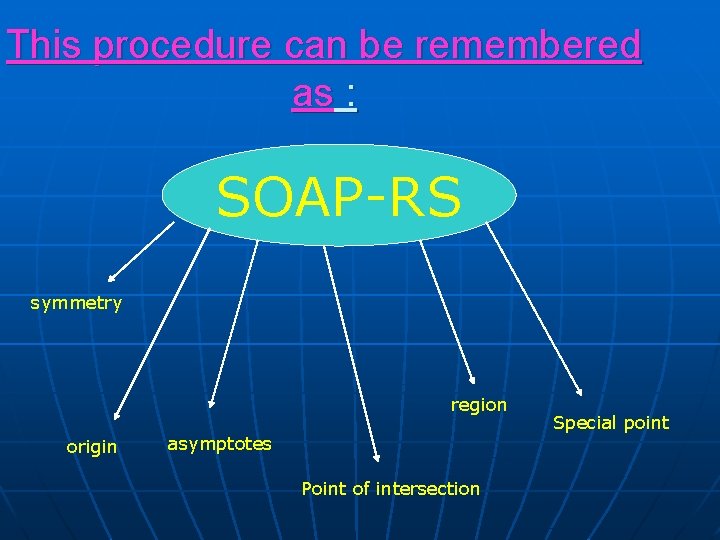
This procedure can be remembered as : SOAP-RS symmetry region origin asymptotes Point of intersection Special point
EXAMPLE
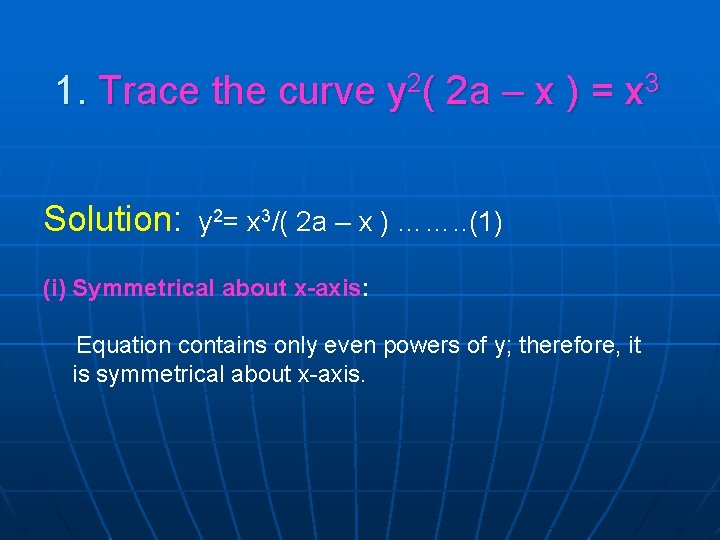
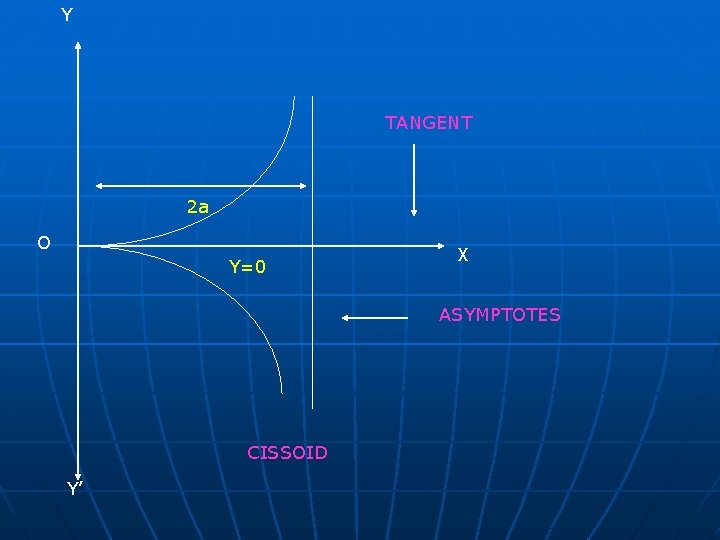
1. Trace the curve y 2( 2 a – x ) = x 3 Solution: y 2= x 3/( 2 a – x ) ……. . (1) (i) Symmetrical about x-axis: Equation contains only even powers of y; therefore, it is symmetrical about x-axis.
Y TANGENT 2 a O Y=0 X ASYMPTOTES CISSOID Y’
(ii) Origin: Equation does not contain any constant term; therefore, it passes through origin.
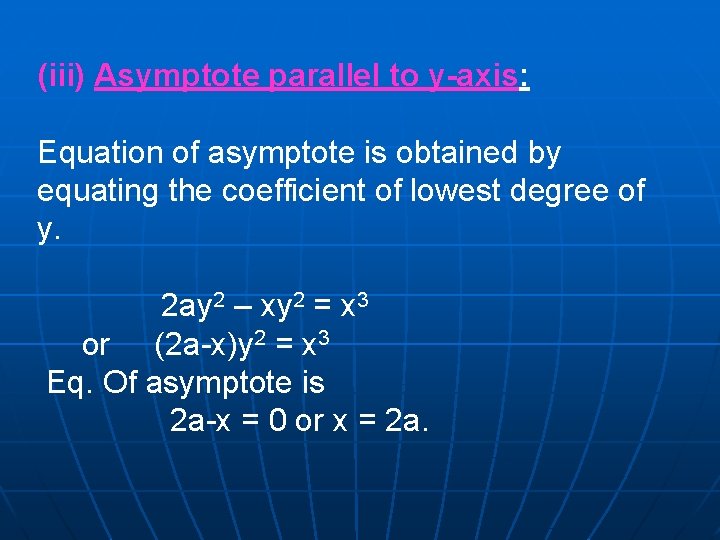
(iii) Asymptote parallel to y-axis: Equation of asymptote is obtained by equating the coefficient of lowest degree of y. 2 ay 2 – xy 2 = x 3 or (2 a-x)y 2 = x 3 Eq. Of asymptote is 2 a-x = 0 or x = 2 a.
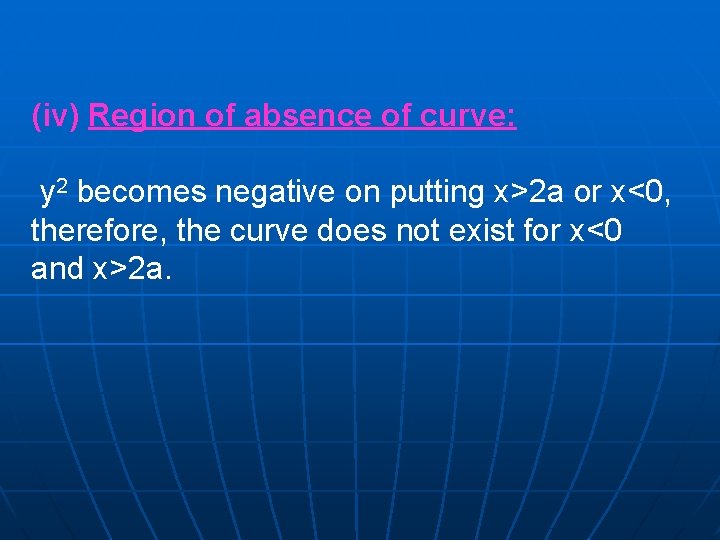
(iv) Region of absence of curve: y 2 becomes negative on putting x>2 a or x<0, therefore, the curve does not exist for x<0 and x>2 a.
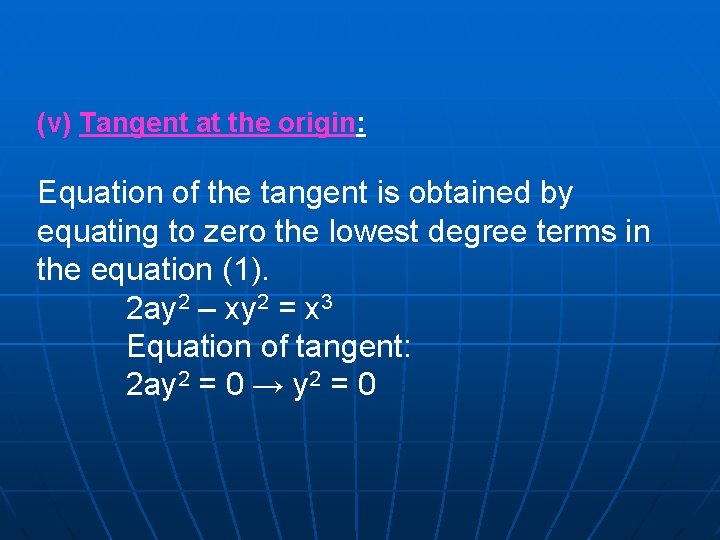
(v) Tangent at the origin: Equation of the tangent is obtained by equating to zero the lowest degree terms in the equation (1). 2 ay 2 – xy 2 = x 3 Equation of tangent: 2 ay 2 = 0 → y 2 = 0
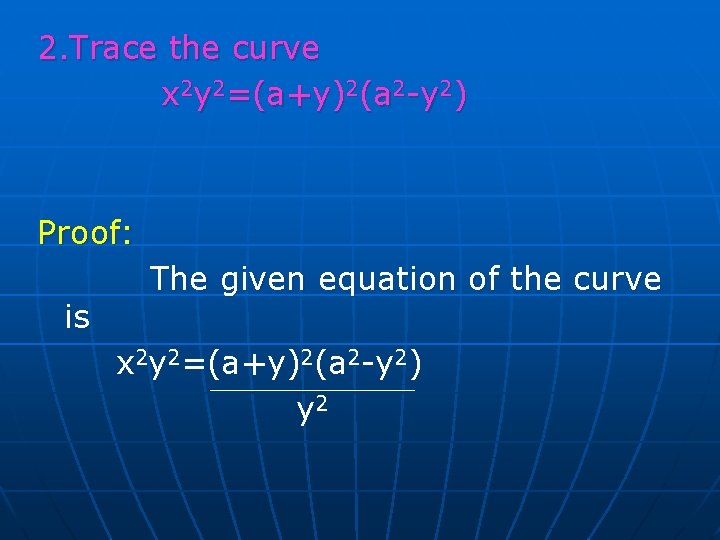
2. Trace the curve x 2 y 2=(a+y)2(a 2 -y 2) Proof: The given equation of the curve is x 2 y 2=(a+y)2(a 2 -y 2) y 2
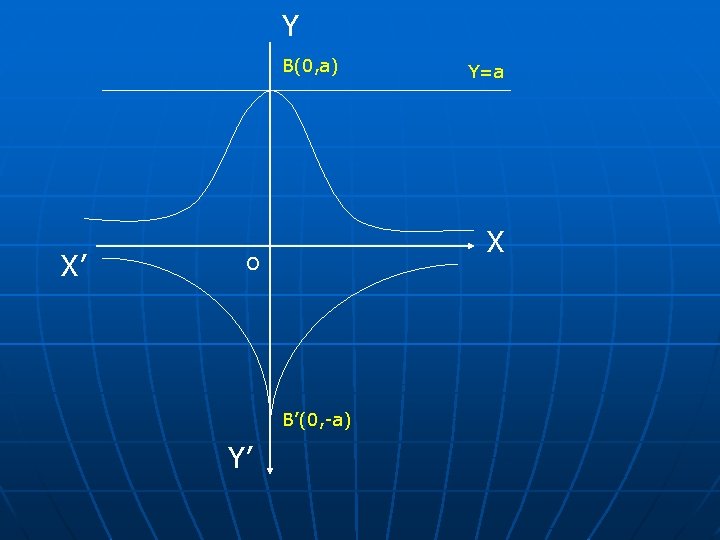
Y B(0, a) X’ X O B’(0, -a) Y’ Y=a
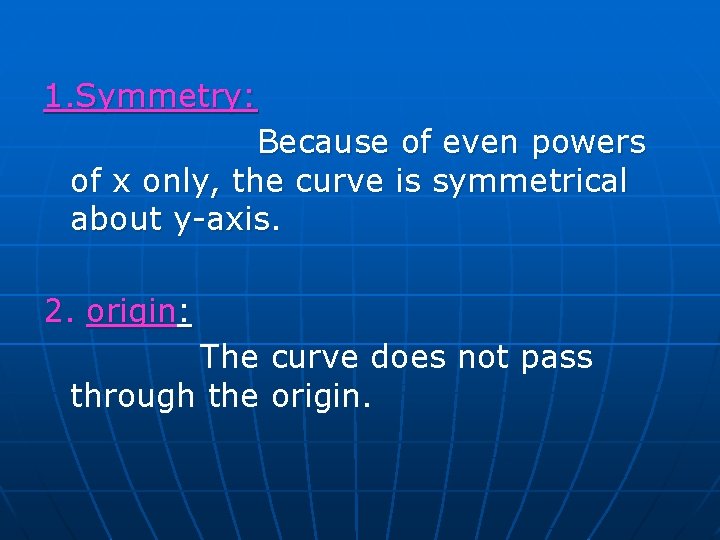
1. Symmetry: Because of even powers of x only, the curve is symmetrical about y-axis. 2. origin: The curve does not pass through the origin.
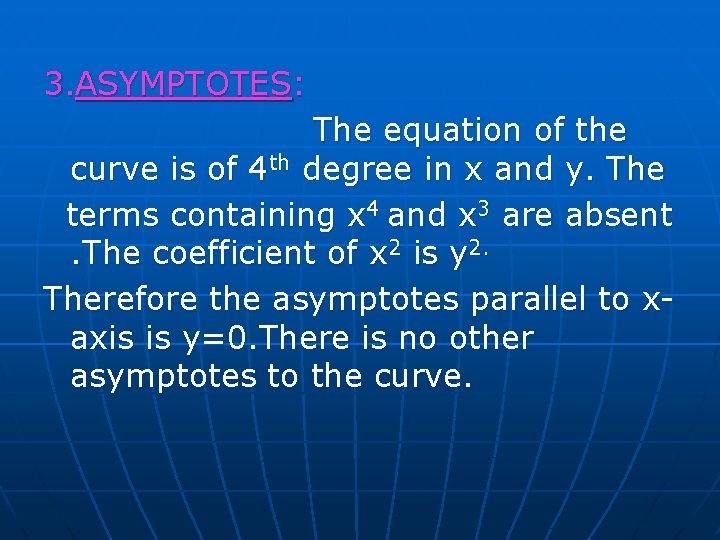
3. ASYMPTOTES: The equation of the curve is of 4 th degree in x and y. The terms containing x 4 and x 3 are absent . The coefficient of x 2 is y 2. Therefore the asymptotes parallel to xaxis is y=0. There is no other asymptotes to the curve.
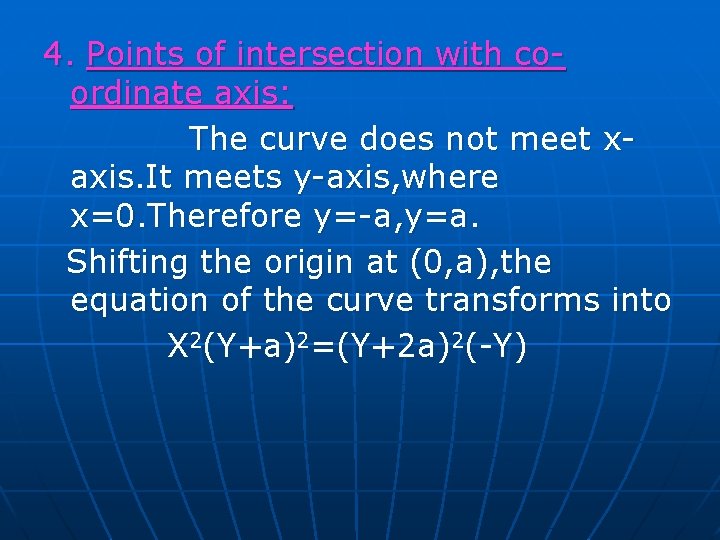
4. Points of intersection with coordinate axis: The curve does not meet xaxis. It meets y-axis, where x=0. Therefore y=-a, y=a. Shifting the origin at (0, a), the equation of the curve transforms into X 2(Y+a)2=(Y+2 a)2(-Y)
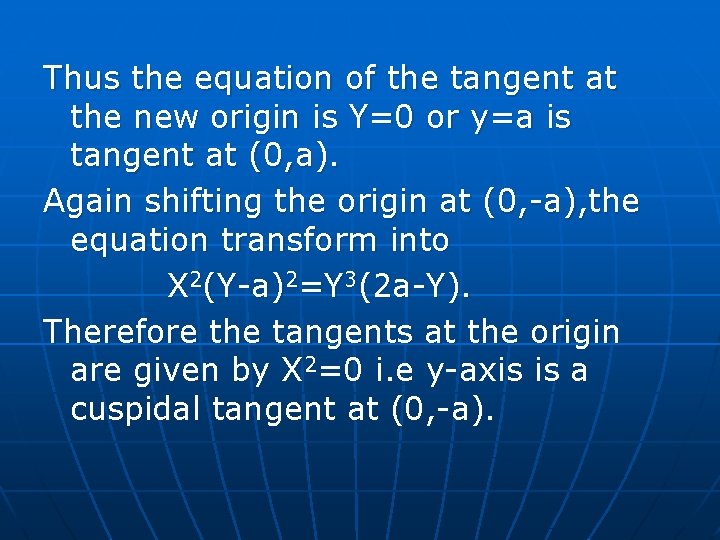
Thus the equation of the tangent at the new origin is Y=0 or y=a is tangent at (0, a). Again shifting the origin at (0, -a), the equation transform into X 2(Y-a)2=Y 3(2 a-Y). Therefore the tangents at the origin are given by X 2=0 i. e y-axis is a cuspidal tangent at (0, -a).
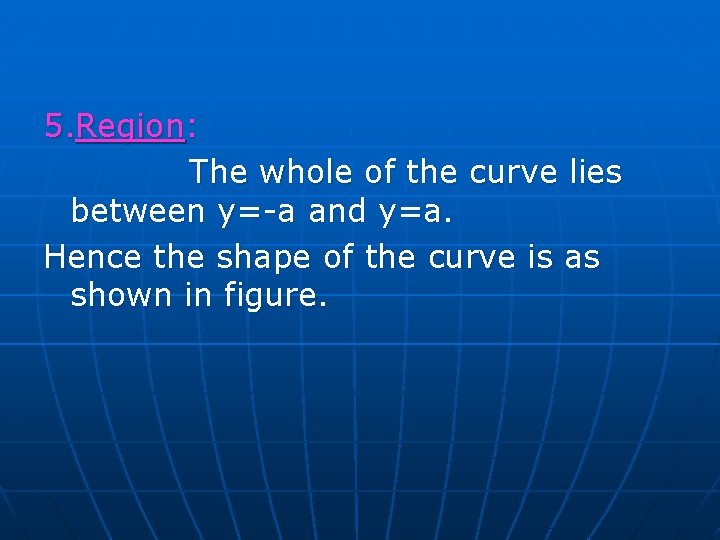
5. Region: The whole of the curve lies between y=-a and y=a. Hence the shape of the curve is as shown in figure.
ASSIGNMENT
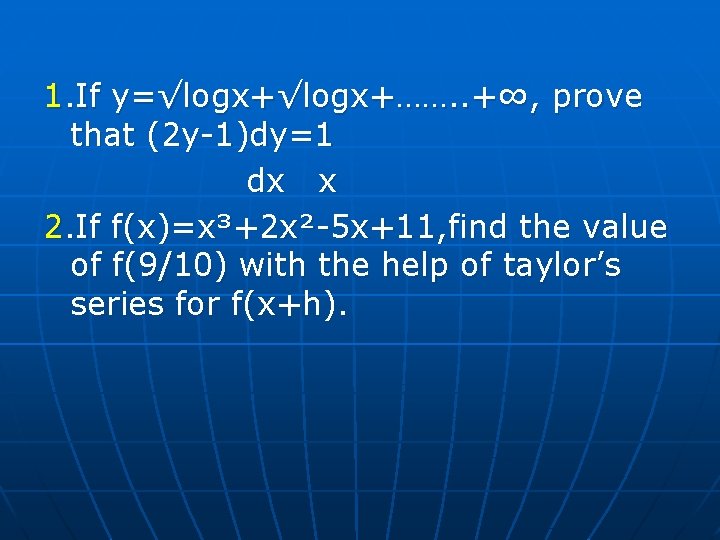
1. If y=√logx+……. . +∞, prove that (2 y-1)dy=1 dx x 2. If f(x)=x³+2 x²-5 x+11, find the value of f(9/10) with the help of taylor’s series for f(x+h).
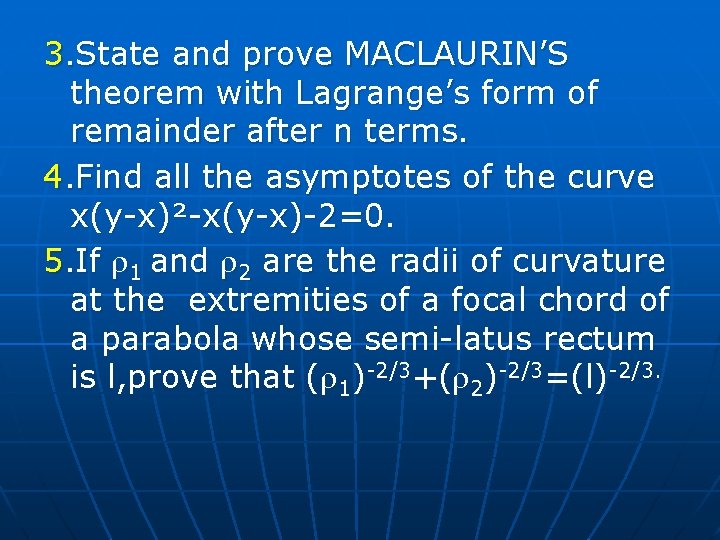
3. State and prove MACLAURIN’S theorem with Lagrange’s form of remainder after n terms. 4. Find all the asymptotes of the curve x(y-x)²-x(y-x)-2=0. 5. If 1 and 2 are the radii of curvature at the extremities of a focal chord of a parabola whose semi-latus rectum is l, prove that ( 1)-2/3+( 2)-2/3=(l)-2/3.
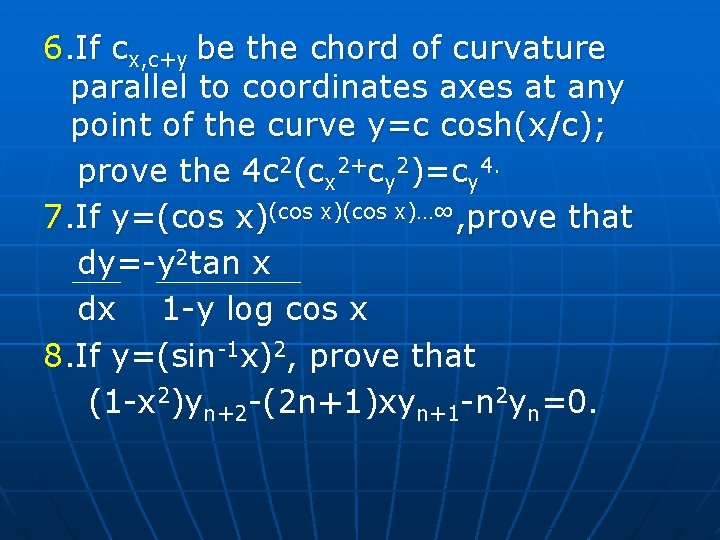
6. If cx, c+y be the chord of curvature parallel to coordinates axes at any point of the curve y=c cosh(x/c); prove the 4 c 2(cx 2+cy 2)=cy 4. 7. If y=(cos x)(cos x)…∞, prove that dy=-y 2 tan x dx 1 -y log cos x 8. If y=(sin-1 x)2, prove that (1 -x 2)yn+2 -(2 n+1)xyn+1 -n 2 yn=0.
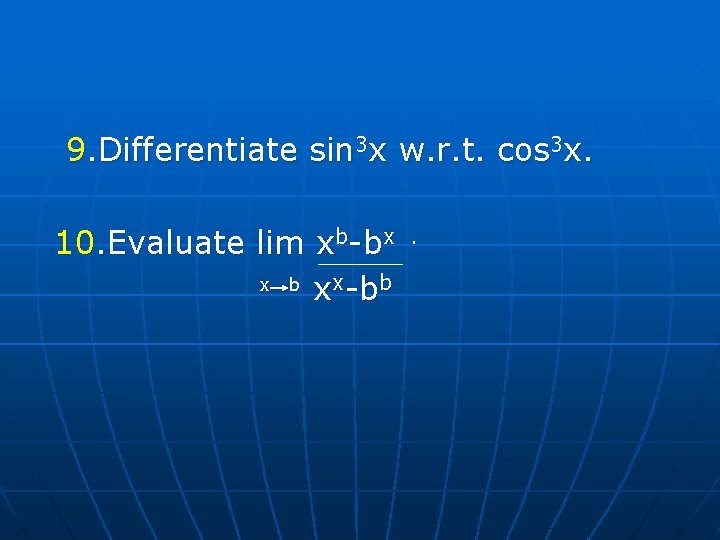
9. Differentiate sin 3 x w. r. t. cos 3 x. 10. Evaluate lim xb-bx . x-bb x b x
TEST
SET-A
Attempt any two 1. Find the asymptotes of the hyperbola x 2 -y 2 =1 9 4 2. Find all the asymptotes of the following curves x(y-x)2 -x(y-x)=2 3. Find the asymptotes of curve r cos 2θ=a sin 3θ
SET-B
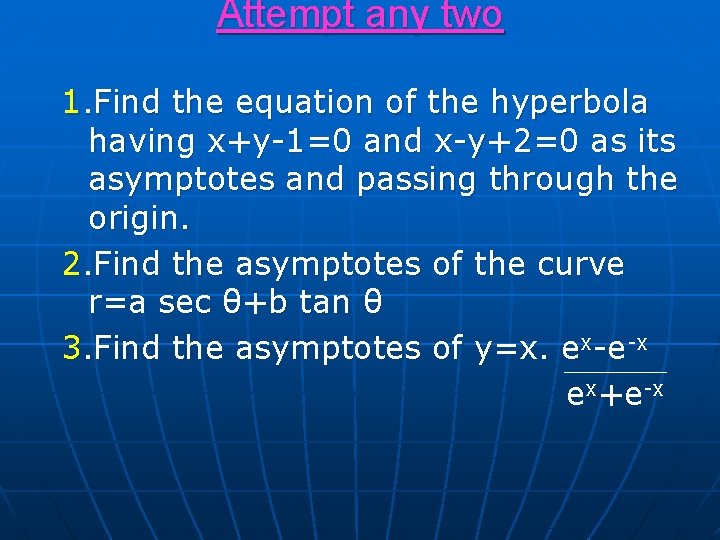
Attempt any two 1. Find the equation of the hyperbola having x+y-1=0 and x-y+2=0 as its asymptotes and passing through the origin. 2. Find the asymptotes of the curve r=a sec θ+b tan θ 3. Find the asymptotes of y=x. ex-e-x ex+e-x