Advanced Navigation Training and Pilot Decision Making Flying






- Slides: 108
Advanced Navigation & Training and Pilot Decision Making Flying without the Six Pack: Garmin GPS and TAA (Technically Advanced Aircraft) Presented to: FAA Safety Seminar Attendees By: W. J. Doyle, Jr. , CFI A&I, AGI, IGI, FAAST Rep Date: 09/01/2011 – 08/31/2011 Federal Aviation Administration
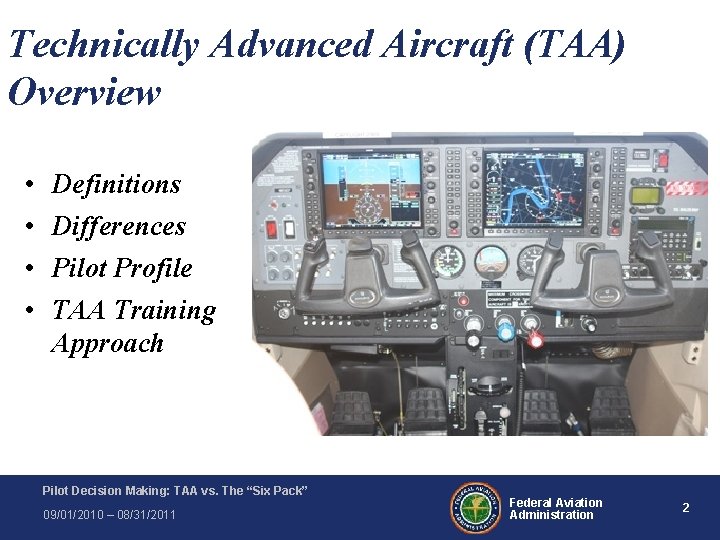
Technically Advanced Aircraft (TAA) Overview • • Definitions Differences Pilot Profile TAA Training Approach Pilot Decision Making: TAA vs. The “Six Pack” 09/01/2010 – 08/31/2011 Federal Aviation Administration 2
Technically Advanced Aircraft (TAA) • A general aviation aircraft that combines some or all of the following design features*: – Advanced cockpit automation system (moving map GPS/ Glass Cockpit) for IFR/VFR flight operations – Automated engine and systems management – Integrated flight and autopilot systems * Source: FITS Master Instructor Syllabus, TAA Scenario Based Instructor Guide, Version 1. 0, prepared by Embry-Riddle University, University of North Dakota, and the FITS Launch Partners: Eclipse Aviation, Inc. , Cirrus Design Corporation, and Airshares Elite, Inc. Pilot Decision Making: TAA vs. The “Six Pack” 09/01/2010 – 08/31/2011 Federal Aviation Administration 3
TAA Differences • Travel faster and further than their predecessors – Flights routinely span diverse weather systems and topography requiring advanced flight planning and operational skills – Newly certified pilots are no longer likely to remain in local area until aviation skills are refined • Require flight management and decision-making skills normally expected from ATP-level pilots • May be flown by pilots with significantly less (than ATP) experience and training Pilot Decision Making: TAA vs. The “Six Pack” 09/01/2010 – 08/31/2011 Federal Aviation Administration 4
TAA Pilot Profile • Advanced cockpits and avionics require a higher level of technical knowledge and finely-tuned automation competence – Single Pilot Resource Management (SRM) Skills – Dealing with “automation surprises” – Complexity without training = confusion, loss of situation awareness, net loss of performance • Paradigm shift from “operator” to “systems manager” • Pilots flying both conventional (steam gauge) and glass cockpit need to maintain proficiency in both • How strong are your computer skills? Pilot Decision Making: TAA vs. The “Six Pack” 09/01/2010 – 08/31/2011 Federal Aviation Administration 5
TAA Advanced Technology • Enhances Situational Awareness – Moving Map, Traffic Information Service • Reduces Risk of Controlled Flight Into Terrain (CFIT) – Terrain Awareness • Flight Safety through Automation – Automated navigation (autopilot) • Increases Cockpit Resource Management (CRM) Skills & Decision Making – Use all Available Resources – Especially important for Single Pilot Resource Management (SRM) Pilot Decision Making: TAA vs. The “Six Pack” 09/01/2010 – 08/31/2011 Federal Aviation Administration 6
TAA Training Philosophy • Should be based on FAA Industry Training Standards (FITS) – Joint project of the FAA-sponsored Center for General Aviation Research (CGAR), Embry-Riddle Aeronautical University, The University of North Dakota, and the General Aviation Industry – Goal is accelerated acquisition of higher-level decision making skills needed to prevent pilot-induced accidents in TAA’s – Scenario-Based rather than task-based – Emphasis given to development of critical thinking and flight management skills Pilot Decision Making: TAA vs. The “Six Pack” 09/01/2010 – 08/31/2011 Federal Aviation Administration 7
TAA Scenario-Based Training • Enhances – Aeronautical Decision Making (ADM) – Risk Management (RM) – Cockpit Resource Management (CRM)/ Single Pilot Resource Management (SRM) • CRM/SRM Integrates – – – Aeronautical Decision Making Risk Management Automation Management Task Management Situational Awareness Pilot Decision Making: TAA vs. The “Six Pack” 09/01/2010 – 08/31/2011 Federal Aviation Administration 8
TAA Displays Pilot Decision Making: TAA vs. The “Six Pack” 09/01/2010 – 08/31/2011 Federal Aviation Administration 9
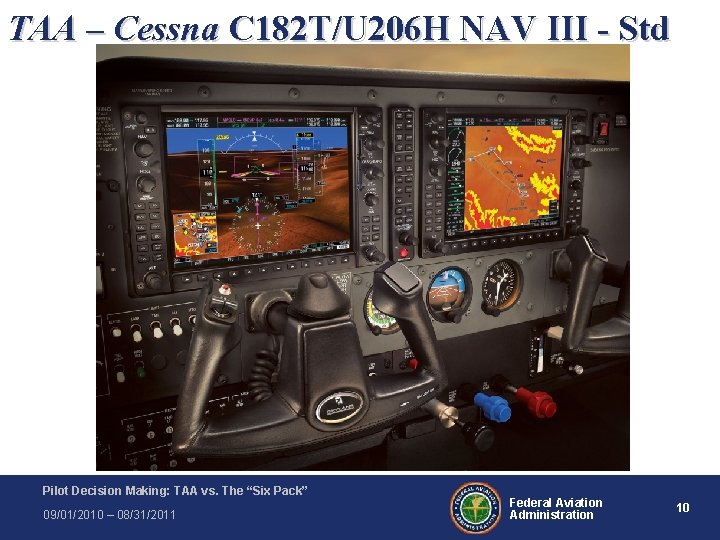
TAA – Cessna C 182 T/U 206 H NAV III - Std Pilot Decision Making: TAA vs. The “Six Pack” 09/01/2010 – 08/31/2011 Federal Aviation Administration 10
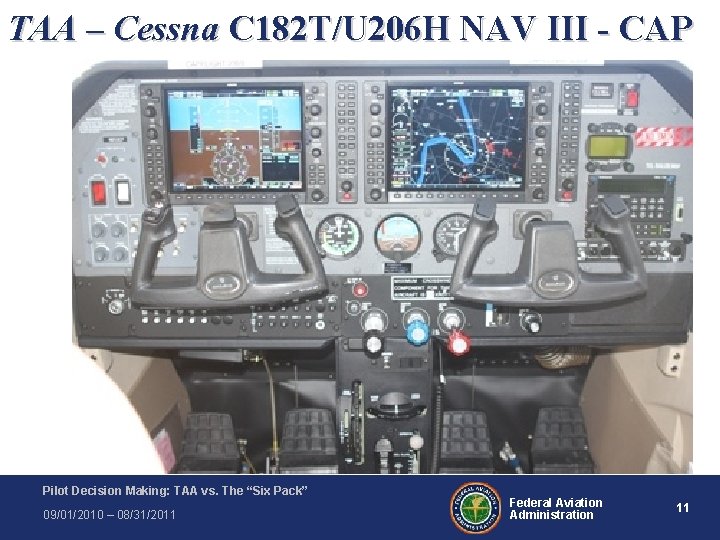
TAA – Cessna C 182 T/U 206 H NAV III - CAP Pilot Decision Making: TAA vs. The “Six Pack” 09/01/2010 – 08/31/2011 Federal Aviation Administration 11
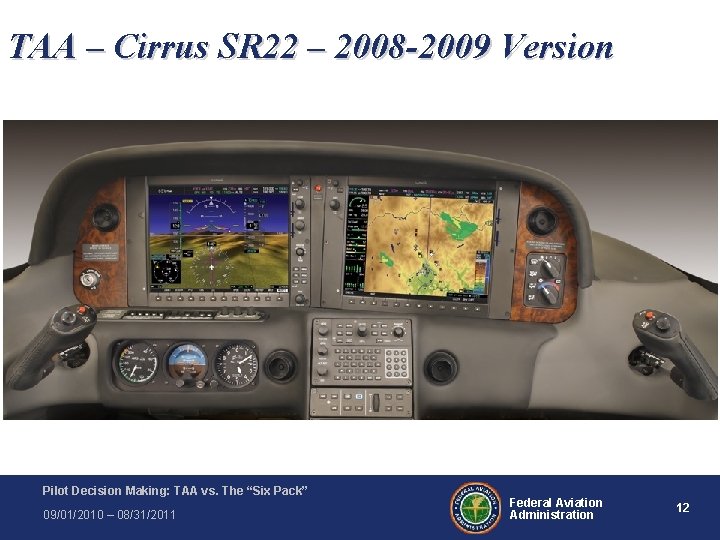
TAA – Cirrus SR 22 – 2008 -2009 Version Pilot Decision Making: TAA vs. The “Six Pack” 09/01/2010 – 08/31/2011 Federal Aviation Administration 12
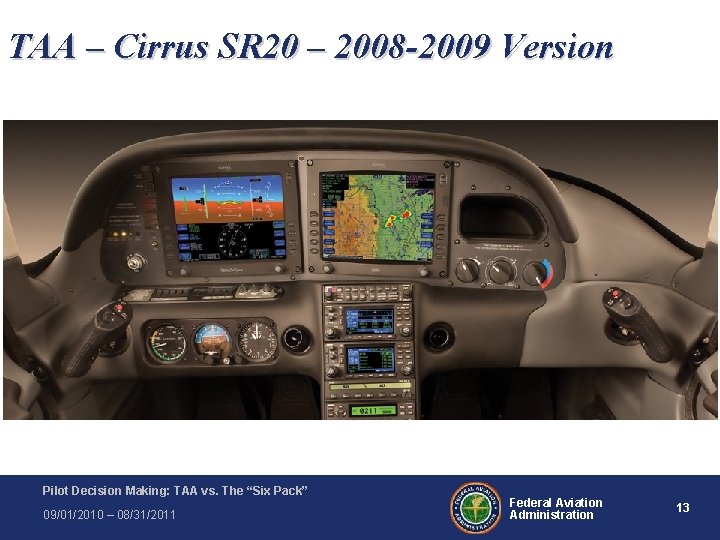
TAA – Cirrus SR 20 – 2008 -2009 Version Pilot Decision Making: TAA vs. The “Six Pack” 09/01/2010 – 08/31/2011 Federal Aviation Administration 13
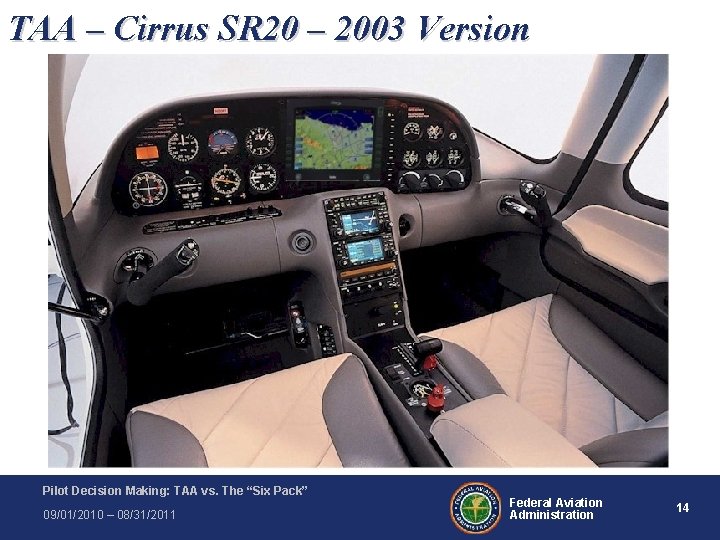
TAA – Cirrus SR 20 – 2003 Version Pilot Decision Making: TAA vs. The “Six Pack” 09/01/2010 – 08/31/2011 Federal Aviation Administration 14
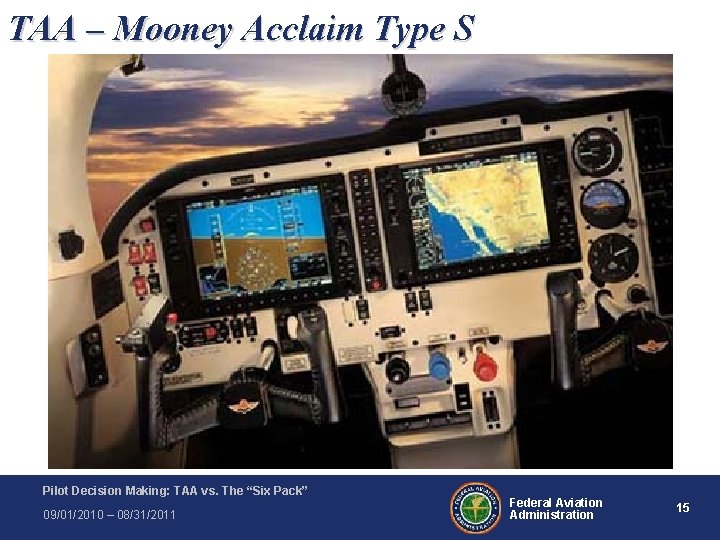
TAA – Mooney Acclaim Type S Pilot Decision Making: TAA vs. The “Six Pack” 09/01/2010 – 08/31/2011 Federal Aviation Administration 15
TAA vs. “The Six Pack” Pilot Decision Making: TAA vs. The “Six Pack” 09/01/2010 – 08/31/2011 Federal Aviation Administration 16
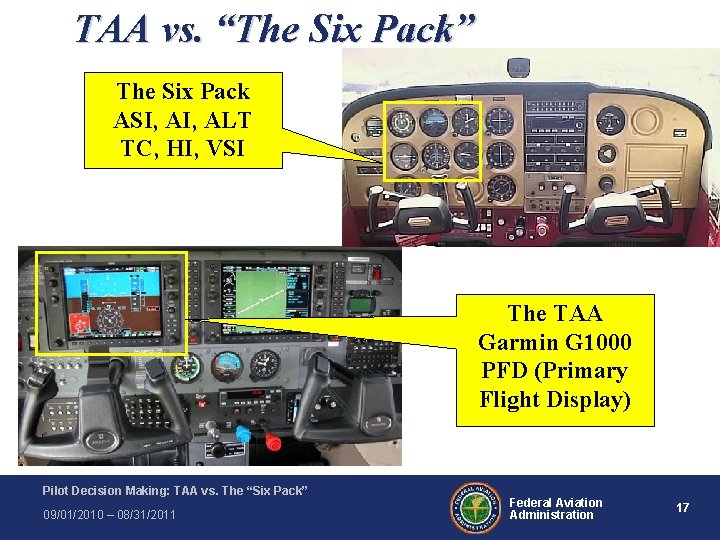
TAA vs. “The Six Pack” The Six Pack ASI, ALT TC, HI, VSI The TAA Garmin G 1000 PFD (Primary Flight Display) Pilot Decision Making: TAA vs. The “Six Pack” 09/01/2010 – 08/31/2011 Federal Aviation Administration 17
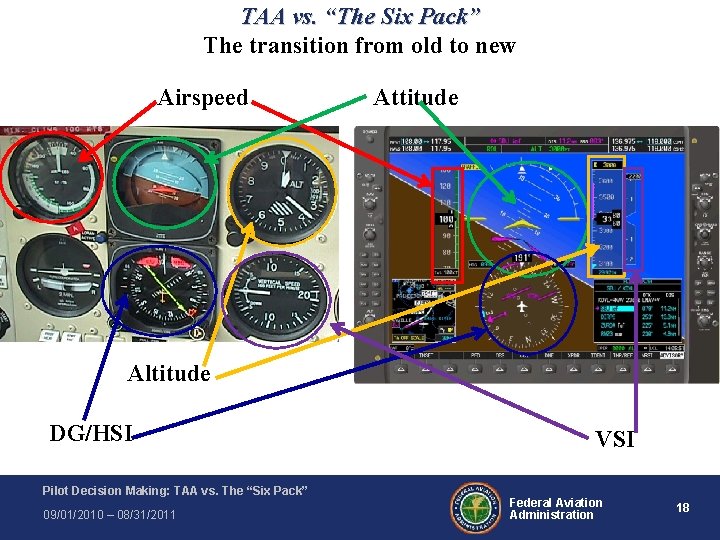
TAA vs. “The Six Pack” The transition from old to new Airspeed Attitude Altitude DG/HSI Pilot Decision Making: TAA vs. The “Six Pack” 09/01/2010 – 08/31/2011 VSI Federal Aviation Administration 18
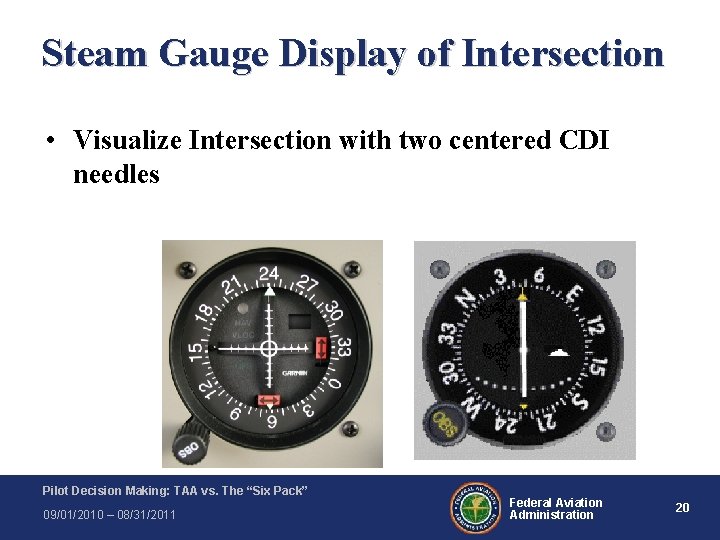
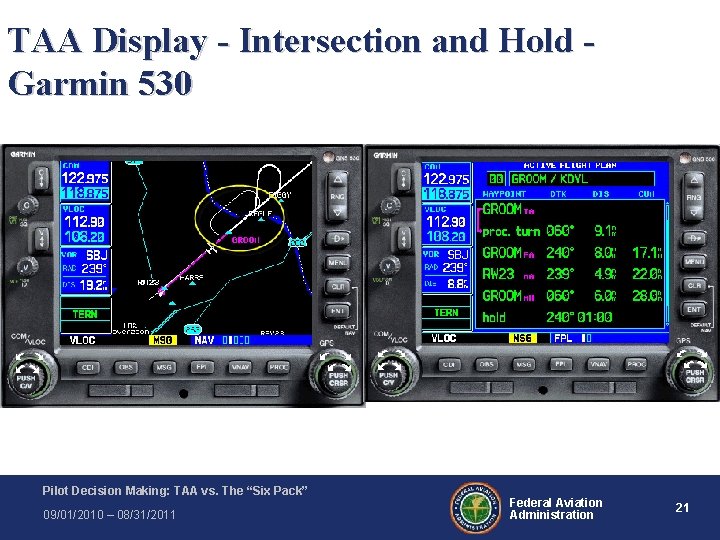
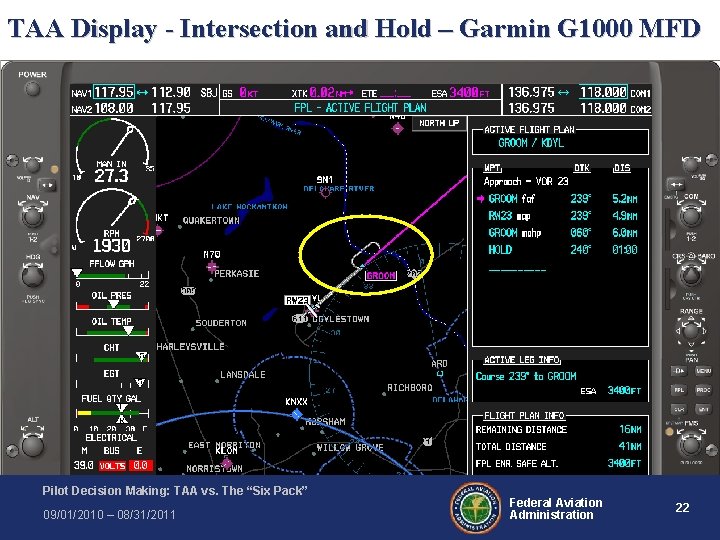
Steam Gauges vs. TAA Intersections and Holds • Steam Gauges – You need to visualize the Intersection or Hold • TAA – You can see the Intersection or Hold on the MFD Pilot Decision Making: TAA vs. The “Six Pack” 09/01/2010 – 08/31/2011 Federal Aviation Administration 19
Steam Gauge Display of Intersection • Visualize Intersection with two centered CDI needles Pilot Decision Making: TAA vs. The “Six Pack” 09/01/2010 – 08/31/2011 Federal Aviation Administration 20
TAA Display - Intersection and Hold Garmin 530 Pilot Decision Making: TAA vs. The “Six Pack” 09/01/2010 – 08/31/2011 Federal Aviation Administration 21
TAA Display - Intersection and Hold – Garmin G 1000 MFD Pilot Decision Making: TAA vs. The “Six Pack” 09/01/2010 – 08/31/2011 Federal Aviation Administration 22
TAA vs. “The Six Pack” for Cross Country Flight Planning Pilot Decision Making: TAA vs. The “Six Pack” 09/01/2010 – 08/31/2011 Federal Aviation Administration 23
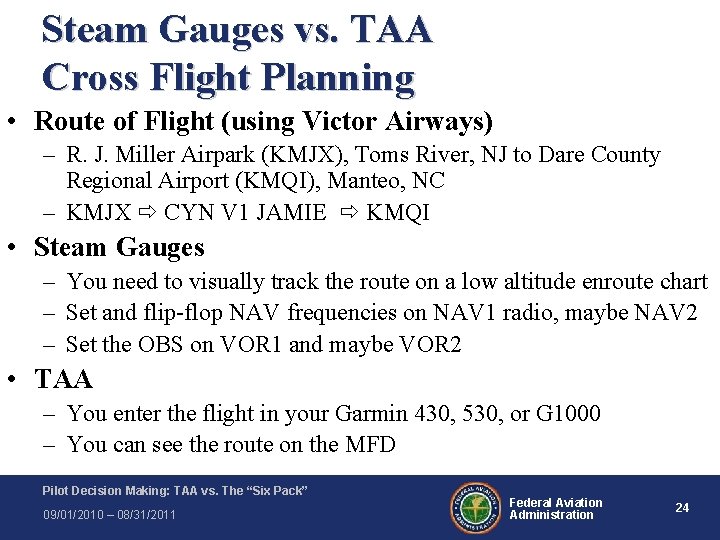
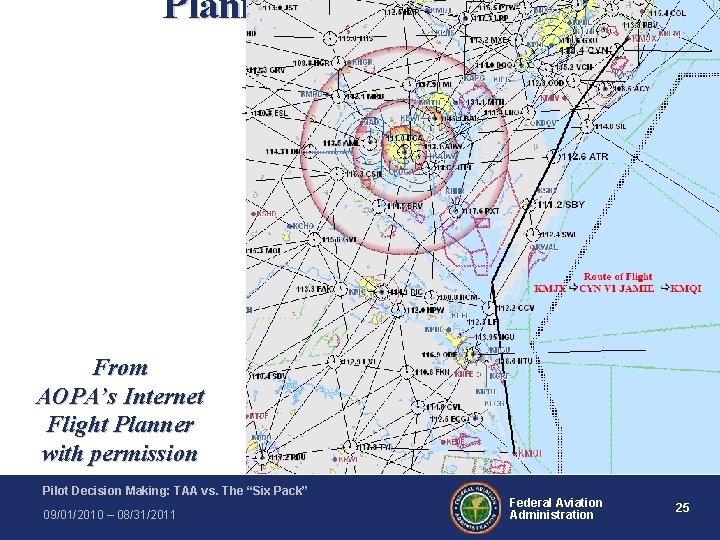
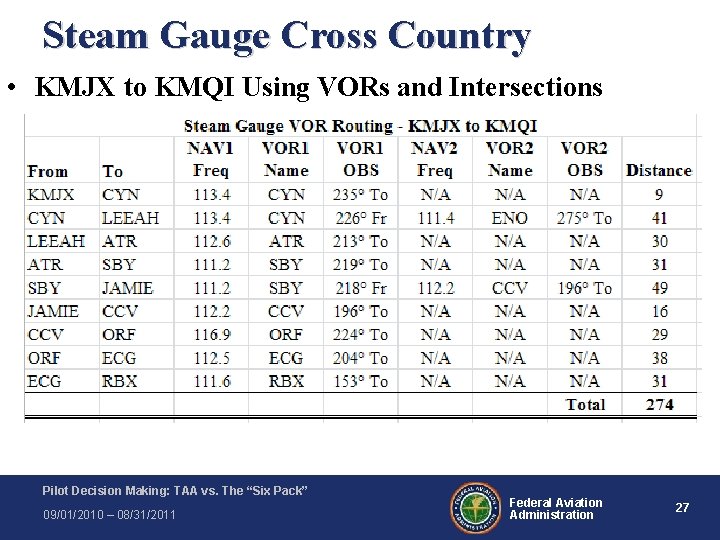
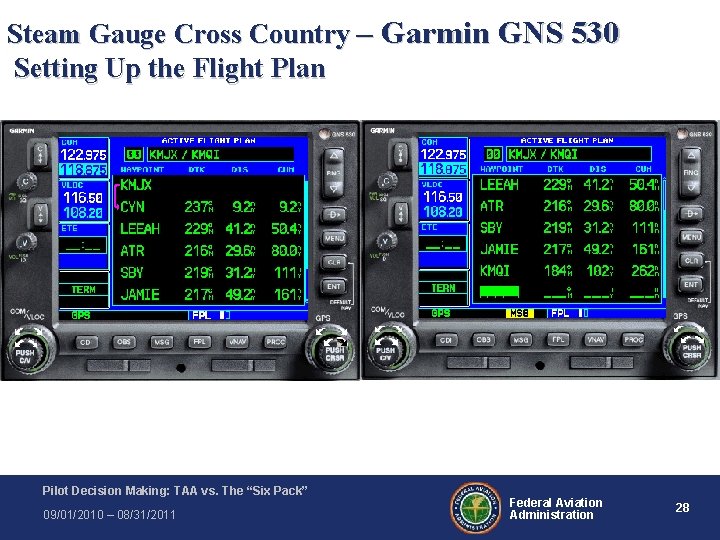
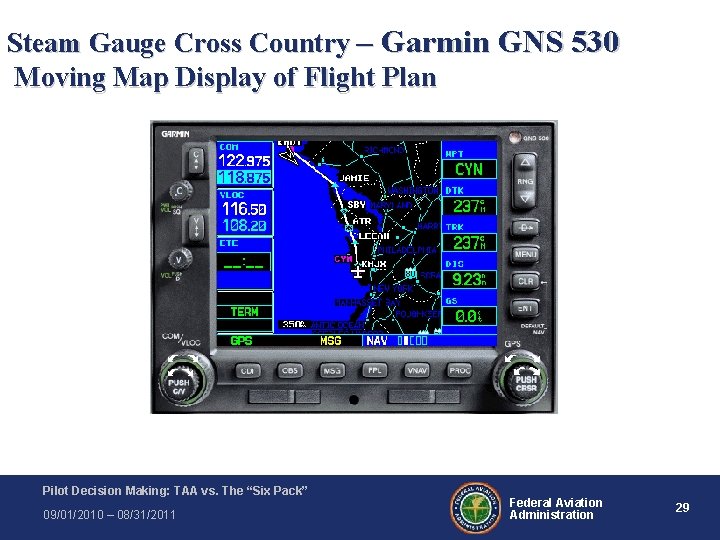
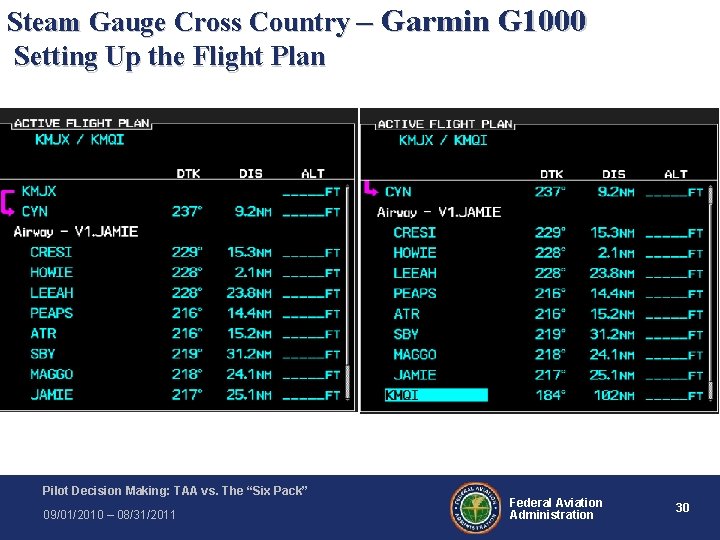
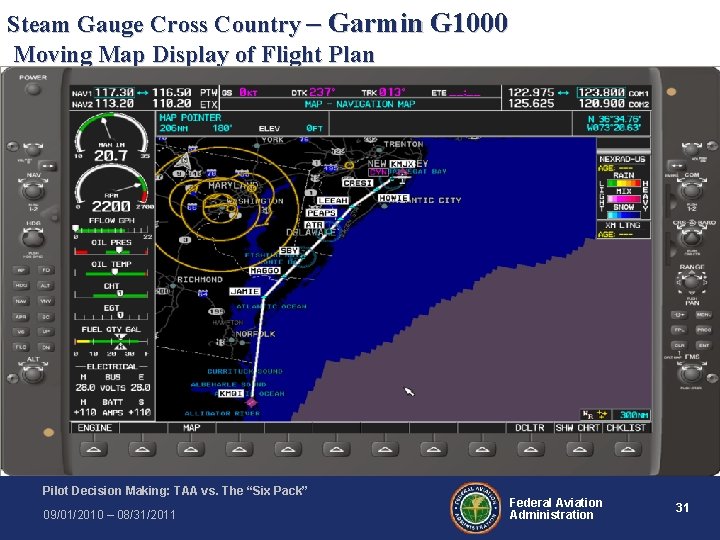
Steam Gauges vs. TAA Cross Flight Planning • Route of Flight (using Victor Airways) – R. J. Miller Airpark (KMJX), Toms River, NJ to Dare County Regional Airport (KMQI), Manteo, NC – KMJX CYN V 1 JAMIE KMQI • Steam Gauges – You need to visually track the route on a low altitude enroute chart – Set and flip-flop NAV frequencies on NAV 1 radio, maybe NAV 2 – Set the OBS on VOR 1 and maybe VOR 2 • TAA – You enter the flight in your Garmin 430, 530, or G 1000 – You can see the route on the MFD Pilot Decision Making: TAA vs. The “Six Pack” 09/01/2010 – 08/31/2011 Federal Aviation Administration 24
Planned Route of Flight Enroute Chart From AOPA’s Internet Flight Planner with permission Pilot Decision Making: TAA vs. The “Six Pack” 09/01/2010 – 08/31/2011 Federal Aviation Administration 25
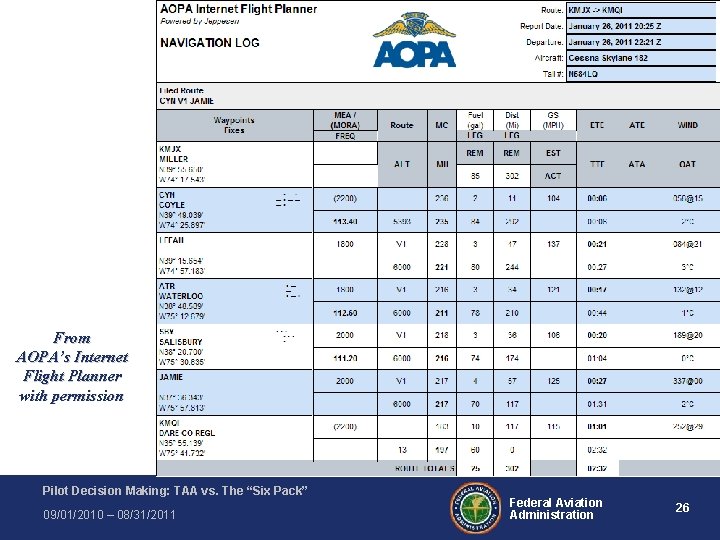
Planned Route of Flight Navigation Log From AOPA’s Internet Flight Planner with permission Pilot Decision Making: TAA vs. The “Six Pack” 09/01/2010 – 08/31/2011 Federal Aviation Administration 26
Steam Gauge Cross Country • KMJX to KMQI Using VORs and Intersections Pilot Decision Making: TAA vs. The “Six Pack” 09/01/2010 – 08/31/2011 Federal Aviation Administration 27
Steam Gauge Cross Country – Garmin GNS 530 Setting Up the Flight Plan Pilot Decision Making: TAA vs. The “Six Pack” 09/01/2010 – 08/31/2011 Federal Aviation Administration 28
Steam Gauge Cross Country – Garmin GNS 530 Moving Map Display of Flight Plan Pilot Decision Making: TAA vs. The “Six Pack” 09/01/2010 – 08/31/2011 Federal Aviation Administration 29
Steam Gauge Cross Country – Garmin G 1000 Setting Up the Flight Plan Pilot Decision Making: TAA vs. The “Six Pack” 09/01/2010 – 08/31/2011 Federal Aviation Administration 30
Steam Gauge Cross Country – Garmin G 1000 Moving Map Display of Flight Plan Pilot Decision Making: TAA vs. The “Six Pack” 09/01/2010 – 08/31/2011 Federal Aviation Administration 31
TAA vs. “The Six Pack” for ILS Approach Pilot Decision Making: TAA vs. The “Six Pack” 09/01/2010 – 08/31/2011 Federal Aviation Administration 32
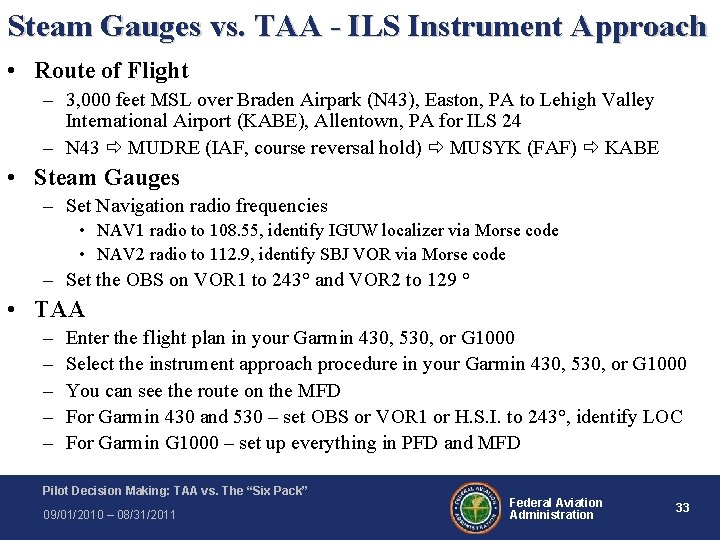
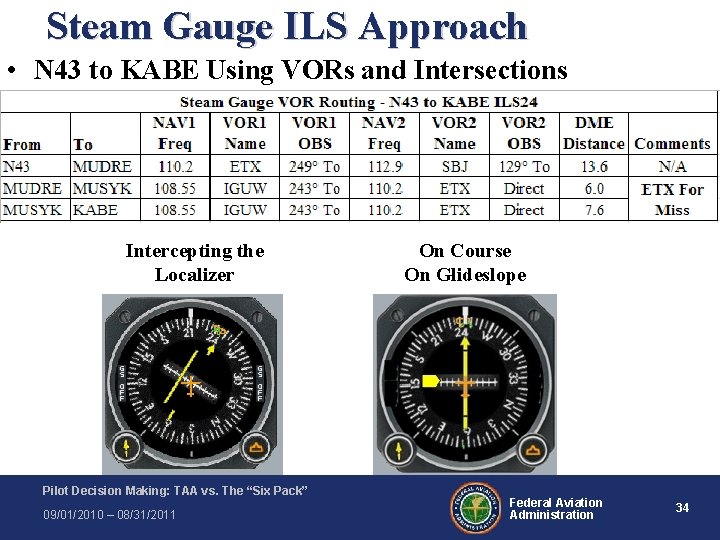
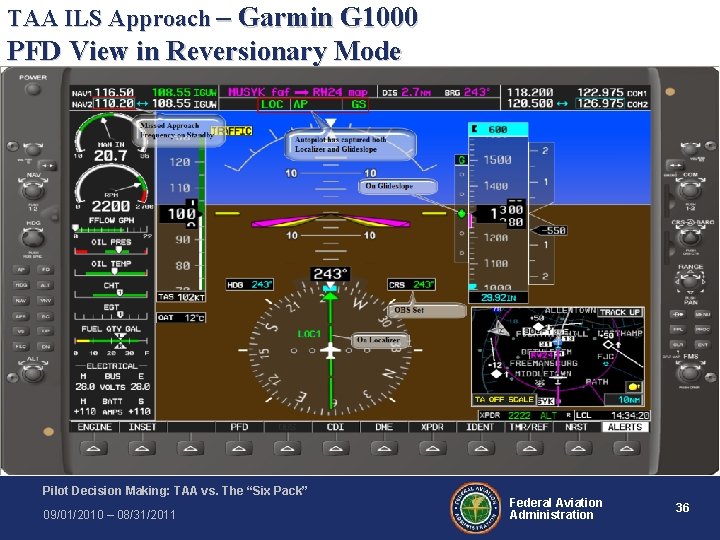
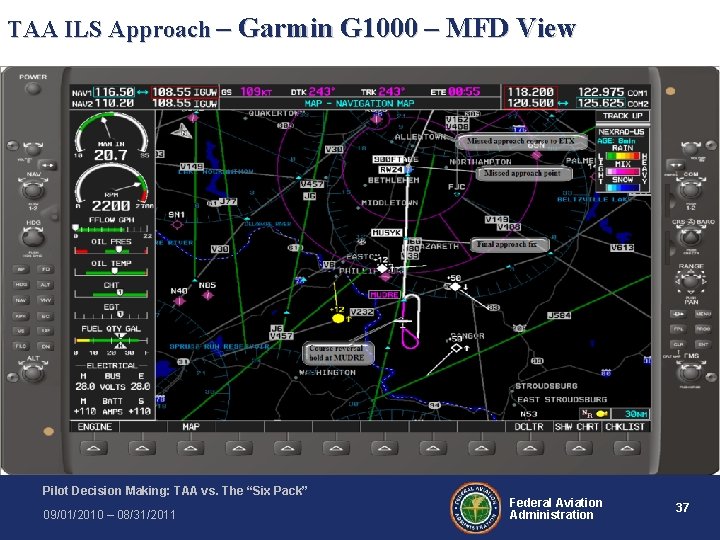
Steam Gauges vs. TAA - ILS Instrument Approach • Route of Flight – 3, 000 feet MSL over Braden Airpark (N 43), Easton, PA to Lehigh Valley International Airport (KABE), Allentown, PA for ILS 24 – N 43 MUDRE (IAF, course reversal hold) MUSYK (FAF) KABE • Steam Gauges – Set Navigation radio frequencies • NAV 1 radio to 108. 55, identify IGUW localizer via Morse code • NAV 2 radio to 112. 9, identify SBJ VOR via Morse code – Set the OBS on VOR 1 to 243° and VOR 2 to 129 ° • TAA – – – Enter the flight plan in your Garmin 430, 530, or G 1000 Select the instrument approach procedure in your Garmin 430, 530, or G 1000 You can see the route on the MFD For Garmin 430 and 530 – set OBS or VOR 1 or H. S. I. to 243°, identify LOC For Garmin G 1000 – set up everything in PFD and MFD Pilot Decision Making: TAA vs. The “Six Pack” 09/01/2010 – 08/31/2011 Federal Aviation Administration 33
Steam Gauge ILS Approach • N 43 to KABE Using VORs and Intersections Intercepting the Localizer Pilot Decision Making: TAA vs. The “Six Pack” 09/01/2010 – 08/31/2011 On Course On Glideslope Federal Aviation Administration 34
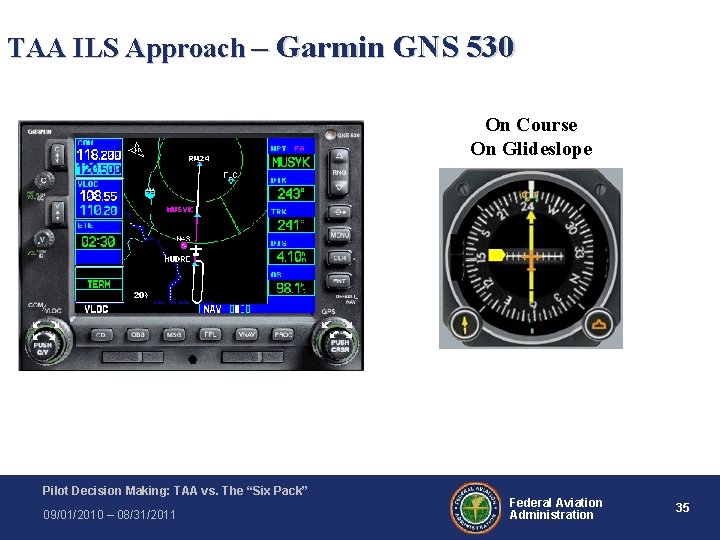
TAA ILS Approach – Garmin GNS 530 On Course On Glideslope Pilot Decision Making: TAA vs. The “Six Pack” 09/01/2010 – 08/31/2011 Federal Aviation Administration 35
TAA ILS Approach – Garmin G 1000 PFD View in Reversionary Mode Pilot Decision Making: TAA vs. The “Six Pack” 09/01/2010 – 08/31/2011 Federal Aviation Administration 36
TAA ILS Approach – Garmin G 1000 – MFD View Pilot Decision Making: TAA vs. The “Six Pack” 09/01/2010 – 08/31/2011 Federal Aviation Administration 37
“Gotchas” with Garmin 530/420 Units Pilot Decision Making: TAA vs. The “Six Pack” 09/01/2010 – 08/31/2011 Federal Aviation Administration 38
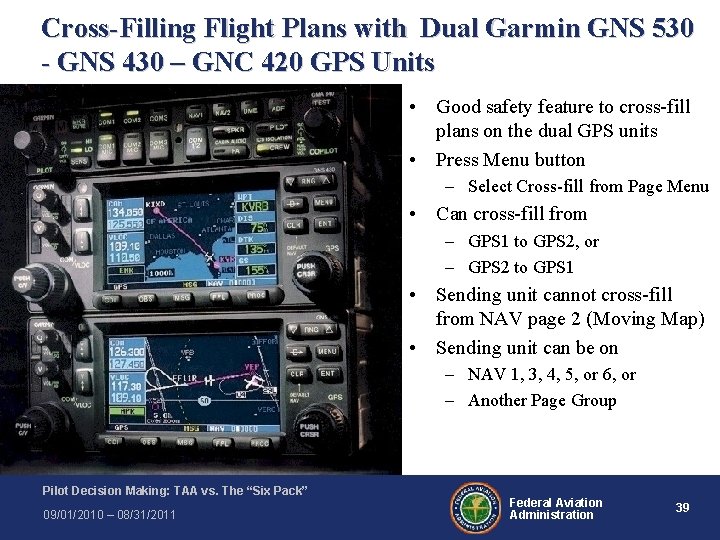
Cross-Filling Flight Plans with Dual Garmin GNS 530 - GNS 430 – GNC 420 GPS Units • Good safety feature to cross-fill plans on the dual GPS units • Press Menu button – Select Cross-fill from Page Menu • Can cross-fill from – GPS 1 to GPS 2, or – GPS 2 to GPS 1 • Sending unit cannot cross-fill from NAV page 2 (Moving Map) • Sending unit can be on – NAV 1, 3, 4, 5, or 6, or – Another Page Group Pilot Decision Making: TAA vs. The “Six Pack” 09/01/2010 – 08/31/2011 Federal Aviation Administration 39
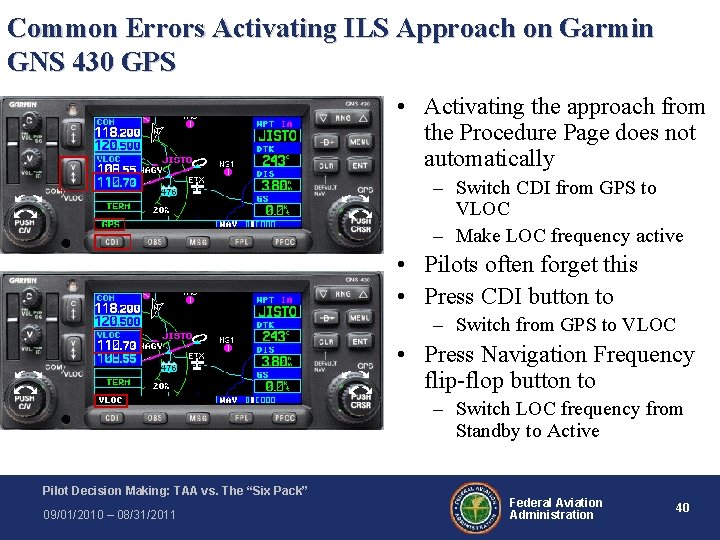
Common Errors Activating ILS Approach on Garmin GNS 430 GPS • Activating the approach from the Procedure Page does not automatically – Switch CDI from GPS to VLOC – Make LOC frequency active • Pilots often forget this • Press CDI button to – Switch from GPS to VLOC • Press Navigation Frequency flip-flop button to – Switch LOC frequency from Standby to Active Pilot Decision Making: TAA vs. The “Six Pack” 09/01/2010 – 08/31/2011 Federal Aviation Administration 40
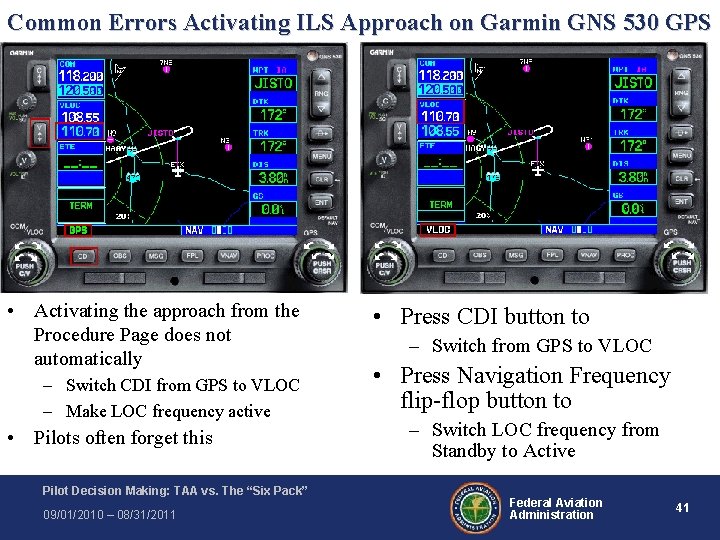
Common Errors Activating ILS Approach on Garmin GNS 530 GPS • Activating the approach from the Procedure Page does not automatically – Switch CDI from GPS to VLOC – Make LOC frequency active • Pilots often forget this Pilot Decision Making: TAA vs. The “Six Pack” 09/01/2010 – 08/31/2011 • Press CDI button to – Switch from GPS to VLOC • Press Navigation Frequency flip-flop button to – Switch LOC frequency from Standby to Active Federal Aviation Administration 41
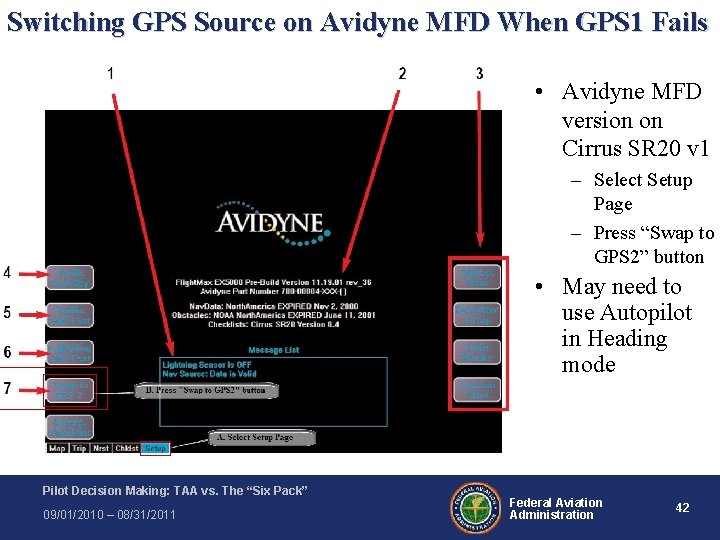
Switching GPS Source on Avidyne MFD When GPS 1 Fails • Avidyne MFD version on Cirrus SR 20 v 1 – Select Setup Page – Press “Swap to GPS 2” button • May need to use Autopilot in Heading mode Pilot Decision Making: TAA vs. The “Six Pack” 09/01/2010 – 08/31/2011 Federal Aviation Administration 42
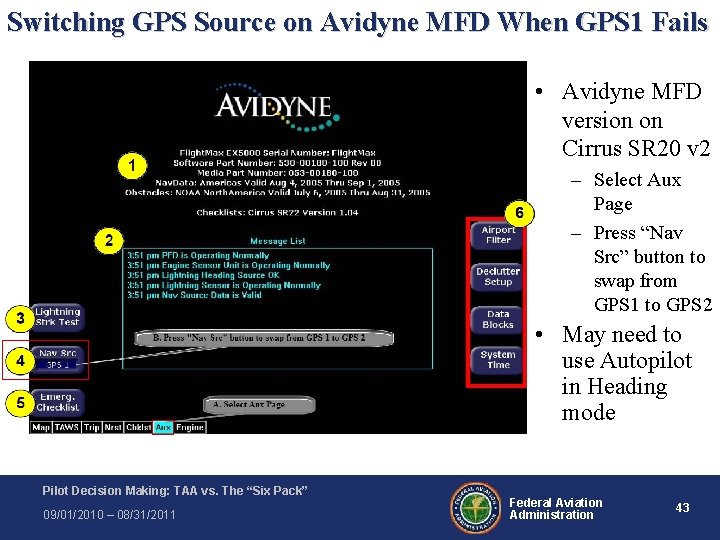
Switching GPS Source on Avidyne MFD When GPS 1 Fails • Avidyne MFD version on Cirrus SR 20 v 2 – Select Aux Page – Press “Nav Src” button to swap from GPS 1 to GPS 2 • May need to use Autopilot in Heading mode Pilot Decision Making: TAA vs. The “Six Pack” 09/01/2010 – 08/31/2011 Federal Aviation Administration 43
What Are the Risks with Flying TAA? Pilot Decision Making: TAA vs. The “Six Pack” 09/01/2010 – 08/31/2011 Federal Aviation Administration 44
What Are the Risks with Flying TAA? • Risk: Lack of Pilot Proficiency – Mitigation: study, study then practice, practice • Get the simulator for whatever GPS you have – E. g. : Garmin GNS 430, Garmin GNS 530, Garmin G 1000 • Download training videos, manuals (PDF), flight planning lessons • Get some ground instruction and flight instruction from your CFI Pilot Decision Making: TAA vs. The “Six Pack” 09/01/2010 – 08/31/2011 Federal Aviation Administration 45
What Are the Risks with Flying TAA? • Risk: Head in the Cockpit Instead of Outside – Mitigation: Set up as much as possible on the ground • Do your flight planning at home before coming to the airport – File an FAA flight plan (consider IFR even if VMC) – Print a navigation log (consider AOPA Internet Flight Planner) • Set up flight plan in GPS after preflight and engine start but before taxi – Contact Clearance Delivery on radio or cell phone – Set up clearance route in your GPS Pilot Decision Making: TAA vs. The “Six Pack” 09/01/2010 – 08/31/2011 Federal Aviation Administration 46
What Are the Risks with Flying TAA? • Risk: Single Pilot IFR – Mitigation: Take an experienced pilot or CFI • Establish personal minimums, don’t deviate from them – Consider establishing a risk management matrix – Refer to next section on personal minimums • Build experience – When appropriate, appropriate revise your personal minimums Pilot Decision Making: TAA vs. The “Six Pack” 09/01/2010 – 08/31/2011 Federal Aviation Administration 47
What Are the Risks with Flying TAA? • Risk: Thunderstorm Penetration – Mitigation: Avoid thunderstorms • Do not use Nex. Rad or Strike Finder features to penetrate T-Storms • Use Nex. Rad or Strike Finder features to avoid TStorms – Preferably by putting the T-Storms at your six o’clock Pilot Decision Making: TAA vs. The “Six Pack” 09/01/2010 – 08/31/2011 Federal Aviation Administration 48
What Are the Risks with Flying TAA? • Other Things You Should Consider – If possible, upgrade your GPS to WAAS – If possible, upgrade/subscribe to Nex. Rad • Near real-time weather (6 minute lag) • Near real-time TFR (6 minute lag on published TFRs) – Keep your databases up to date • Subscriptions are available for downloads from the Internet Pilot Decision Making: TAA vs. The “Six Pack” 09/01/2010 – 08/31/2011 Federal Aviation Administration 49
What Are the Risks with Flying TAA? • Other Things You Should Consider – Foster/practice continuing pilot education • Get an IPC every 6 – 12 months whether you need it or not • Engage in self-study – FAA Advanced Avionics Handbook » https: //www. faa. gov/regulations_policies/handbooks_manuals/aviat ion/advanced_avionics_handbook/ – FAA Risk Management Handbook - See Appendix A for Personal Minimums » https: //www. faa. gov/regulations_policies/handbooks_manuals/aviat ion/media/risk_management_hb_change_1. pdf Pilot Decision Making: TAA vs. The “Six Pack” 09/01/2010 – 08/31/2011 Federal Aviation Administration 50
What are your Personal Minimums? FAA Risk Management Handbook https: //www. faa. gov/regulations_policies/handbooks_manuals/aviation/medi a/risk_management_hb_change_1. pdf See Appendix A for Personal Minimums Pilot Decision Making: TAA vs. The “Six Pack” 09/01/2010 – 08/31/2011 Federal Aviation Administration 51
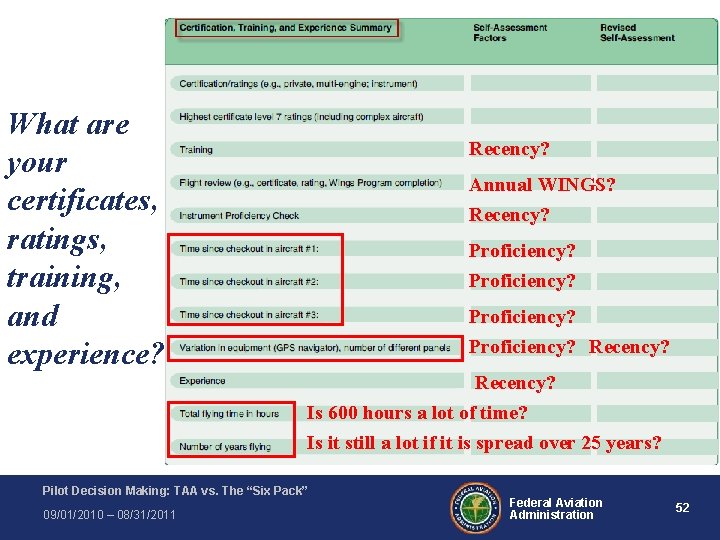
What are your certificates, ratings, training, and experience? Recency? Annual WINGS? Recency? Proficiency? Recency? Is 600 hours a lot of time? Is it still a lot if it is spread over 25 years? Pilot Decision Making: TAA vs. The “Six Pack” 09/01/2010 – 08/31/2011 Federal Aviation Administration 52
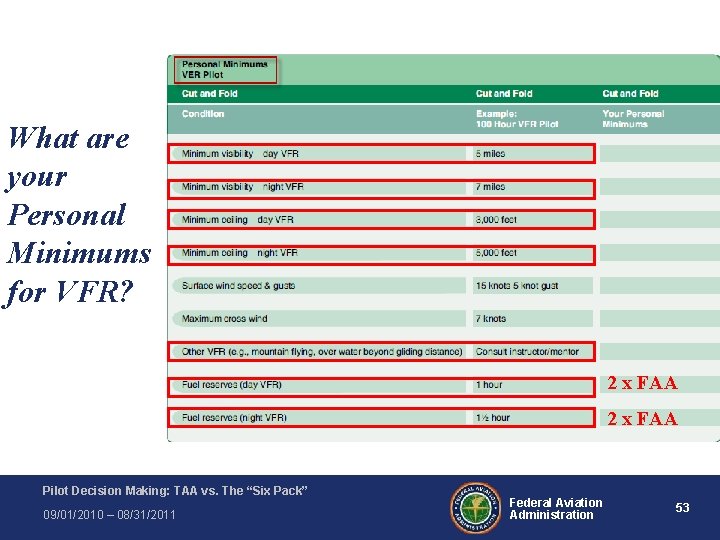
What are your Personal Minimums for VFR? 2 x FAA Pilot Decision Making: TAA vs. The “Six Pack” 09/01/2010 – 08/31/2011 Federal Aviation Administration 53
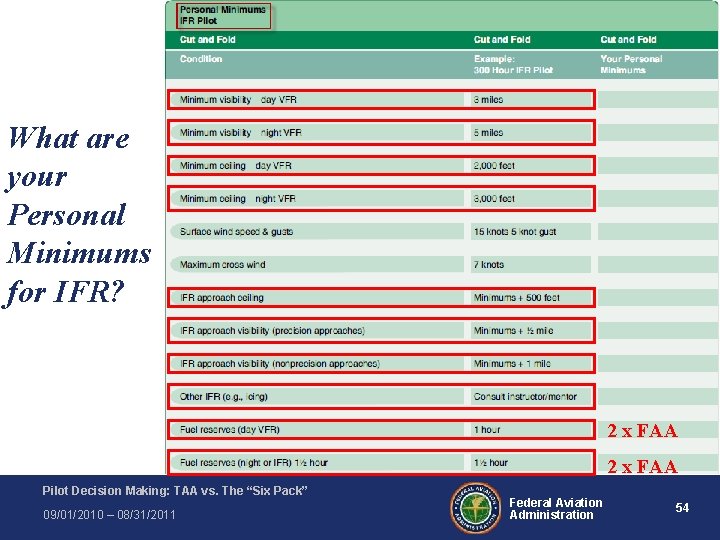
What are your Personal Minimums for IFR? 2 x FAA Pilot Decision Making: TAA vs. The “Six Pack” 09/01/2010 – 08/31/2011 Federal Aviation Administration 54
AOPA Air Safety Foundation Statistics on TAA Accidents Pilot Decision Making: TAA vs. The “Six Pack” 09/01/2010 – 08/31/2011 Federal Aviation Administration 55
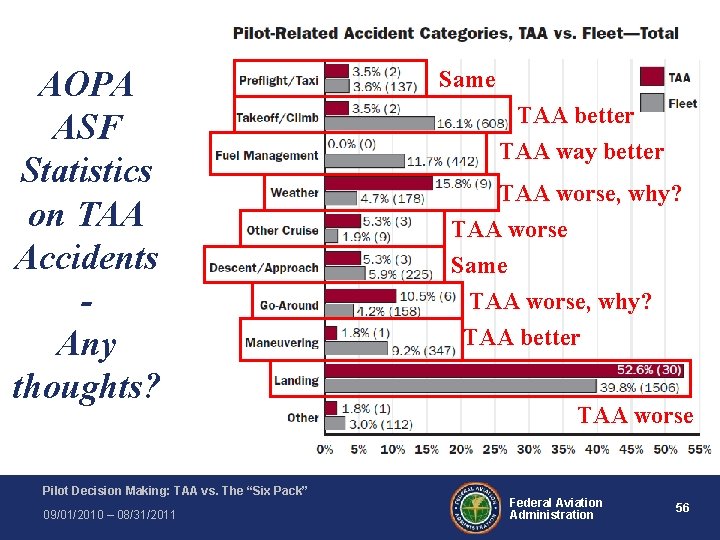
AOPA ASF Statistics on TAA Accidents Any thoughts? Pilot Decision Making: TAA vs. The “Six Pack” 09/01/2010 – 08/31/2011 Same TAA better TAA way better TAA worse, why? TAA worse Same TAA worse, why? TAA better TAA worse Federal Aviation Administration 56
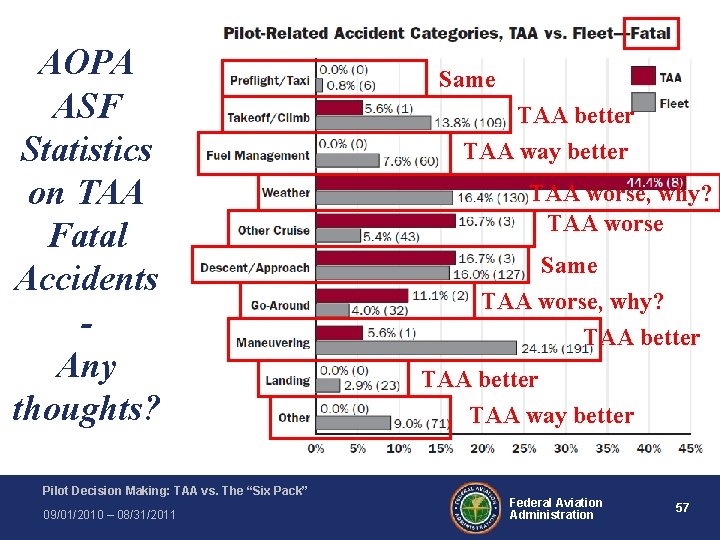
AOPA ASF Statistics on TAA Fatal Accidents Any thoughts? Pilot Decision Making: TAA vs. The “Six Pack” 09/01/2010 – 08/31/2011 Same TAA better TAA way better TAA worse, why? TAA worse Same TAA worse, why? TAA better TAA way better Federal Aviation Administration 57
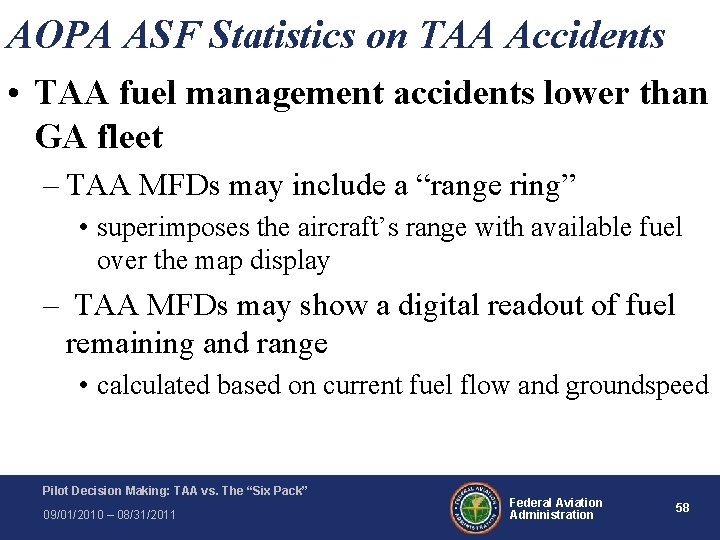
AOPA ASF Statistics on TAA Accidents • TAA fuel management accidents lower than GA fleet – TAA MFDs may include a “range ring” • superimposes the aircraft’s range with available fuel over the map display – TAA MFDs may show a digital readout of fuel remaining and range • calculated based on current fuel flow and groundspeed Pilot Decision Making: TAA vs. The “Six Pack” 09/01/2010 – 08/31/2011 Federal Aviation Administration 58
AOPA ASF Statistics on TAA Accidents • TAA maneuvering accidents lower than GA fleet – ASF speculates that higher levels of transportation use of these aircraft could be a factor • pilots are flying to some place • Pilots not spending so much time in the practice/local area or traffic pattern – where maneuvering accidents are prone to occur Pilot Decision Making: TAA vs. The “Six Pack” 09/01/2010 – 08/31/2011 Federal Aviation Administration 59
AOPA ASF Statistics on TAA Accidents • TAA weather-related accidents higher than GA fleet – TAAs have a higher percentage of use in transportation role, increasing exposure to adverse weather compared to those whose primary use is for training. – Pilots may have believed that access to near real-time weather improved their chances of dealing with adverse weather • Possible over-reliance on hardware • May have neglected to ask ATC about developing weather • May not understand TAF and METAR text format Pilot Decision Making: TAA vs. The “Six Pack” 09/01/2010 – 08/31/2011 Federal Aviation Administration 60
AOPA ASF Statistics on TAA Accidents • TAA landing/go-around accidents higher than GA fleet – New design TAAs with slick composite fuselages and wings can be difficult to slow to desired approach speed • May lead to porpoising during flare or long landings – While trying to correct the situation, or when initiating a go around, • torque from high-powered engine can lead to directional control problems Pilot Decision Making: TAA vs. The “Six Pack” 09/01/2010 – 08/31/2011 Federal Aviation Administration 61
The TAA Summary Pilot Decision Making: TAA vs. The “Six Pack” 09/01/2010 – 08/31/2011 Federal Aviation Administration 62
Summary • Advanced cockpits and avionics require a higher level of technical knowledge and finely-tuned automation competence • Transitioning to a Technically Advanced Aircraft requires specialized training • TAA Transition Training should be scenariobased and follow FITS guidelines • G 1000 Technology can enhance situational awareness, increase flight safety and increase CRM/SRM skills and decision making Pilot Decision Making: TAA vs. The “Six Pack” 09/01/2010 – 08/31/2011 Federal Aviation Administration 63
The Three Most Useless Things to a Pilot • The runway behind you – Moral: know your aircraft’s take-off minimums and cross-wind component, your airport’s runway length, density altitude, any obstacles to be cleared • The altitude above you – Moral: know your aircraft’s power settings for climb, cruise, and descent • The fuel on the ground below you – Moral: know your aircraft’s fuel capacity, fuel system, GPH burn rate, and winds aloft for the route of flight. • Utilize superior judgment to avoid needing to use superior skill Pilot Decision Making: TAA vs. The “Six Pack” 09/01/2010 – 08/31/2011 Federal Aviation Administration 64
Quick Guide to Decision Making • If you’re not sure it is within the capabilities of the airplane – Don’t do it! • If you’re not sure it is within your capabilities – Don’t do it! • Initially this will not be a Single Pilot IFR System for you – Do not attempt Single Pilot IFR until you have at least 50 – 100 hours in the G 1000 or comparable Technically Advanced Airplanes! • Establish personal minimums for yourself – Stay with them! Pilot Decision Making: TAA vs. The “Six Pack” 09/01/2010 – 08/31/2011 Federal Aviation Administration 65
Credits and Information Pilot Decision Making: TAA vs. The “Six Pack” 09/01/2010 – 08/31/2011 Federal Aviation Administration 66
References and Information • FAA FITS Program – http: //www. faa. gov/training_testing/training/fits/presentations/ – http: //www. faa. gov/training_testing/training/fits/guidance/ Pilot Decision Making: TAA vs. The “Six Pack” 09/01/2010 – 08/31/2011 Federal Aviation Administration 67
References and Information • Berlin, J. (2005, August). Features: Hello Gauges, My Old Friends. AOPA Pilot. • Berlin, J. (2004, August). Features: The Next-Generation Instrument Rating: An all-glass cockpit is an alternative center for learning. AOPA Pilot. • G 1000 Cockpit Reference Guide for Cessna Nav III. Garmin International, Olathe, KS. 2004. • G 1000 Integrated Cockpit System: Pilot’s Guide and Reference. Garmin International, Olathe, KS. 2004. • Portions of this presentation have been derived from material created by COL Bob Mc. Cabe, Civil Air Patrol, New Jersey Wing. Pilot Decision Making: TAA vs. The “Six Pack” 09/01/2010 – 08/31/2011 Federal Aviation Administration 68
References and Information • Author of Presentation – William J. Doyle, Jr. , CFI A&I, AGI, IGI, Cessna CFAI • FAAST Team Representative, PHL FSDO • Downloading This Presentation – http: //williamjdoylejr. net/FAAST/TAA. ppt • Uses Power. Point 2003 and later • Password-protected, so click on the “Read Only” button – http: //williamjdoylejr. net/FAAST • Entire collection of FAAST presentations by W. J. Doyle, CFI A&I Pilot Decision Making: TAA vs. The “Six Pack” 09/01/2010 – 08/31/2011 Federal Aviation Administration 69
Just a Real Nice Picture Pilot Decision Making: TAA vs. The “Six Pack” 09/01/2010 – 08/31/2011 Federal Aviation Administration 70
FAASTeam TAA and G 1000 Questions? Comments? Ideas? Pilot Decision Making: TAA vs. The “Six Pack” 09/01/2010 – 08/31/2011 Federal Aviation Administration 71
This Completes Garmin G 1000 and Technically Advanced Aircraft Be sure to have your attendance record validated! Pilot Decision Making: TAA vs. The “Six Pack” 09/01/2010 – 08/31/2011 Federal Aviation Administration 72
FAASTeam TAA and G 1000 Take a Break! Pilot Decision Making: TAA vs. The “Six Pack” 09/01/2010 – 08/31/2011 Federal Aviation Administration 73
Appendix on the Garmin G 1000 Pilot Decision Making: TAA vs. The “Six Pack” 09/01/2010 – 08/31/2011 Federal Aviation Administration 74
G 1000 Flight Displays Pilot Decision Making: TAA vs. The “Six Pack” 09/01/2010 – 08/31/2011 Federal Aviation Administration 75
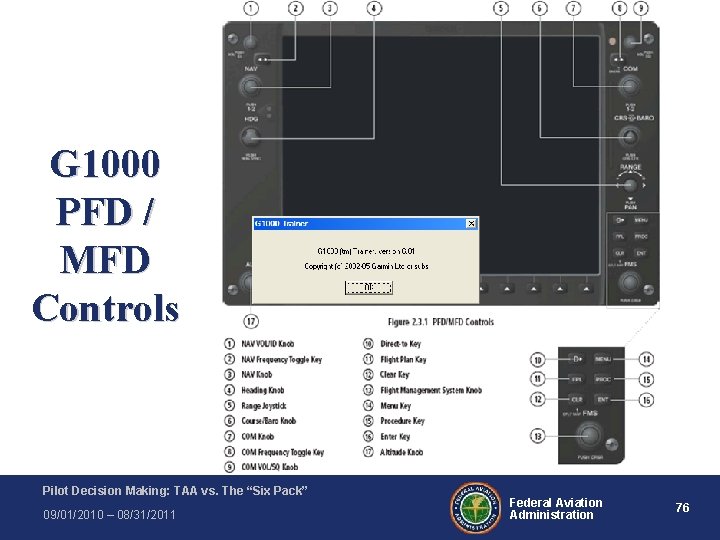
G 1000 PFD / MFD Controls Pilot Decision Making: TAA vs. The “Six Pack” 09/01/2010 – 08/31/2011 Federal Aviation Administration 76
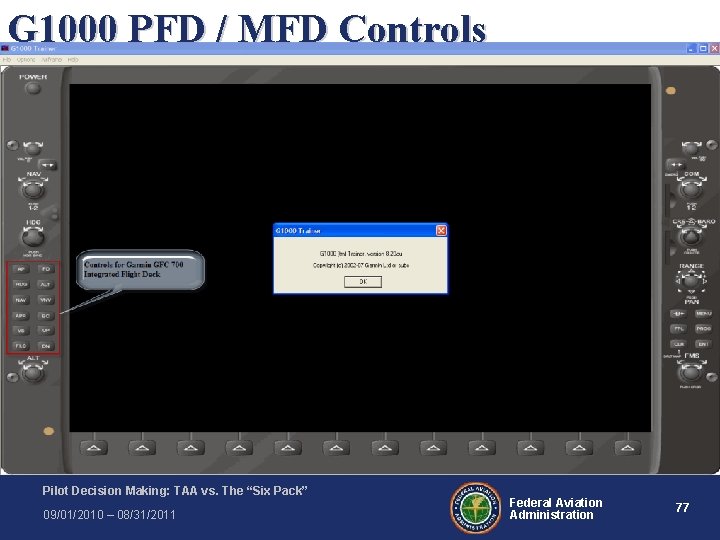
G 1000 PFD / MFD Controls Pilot Decision Making: TAA vs. The “Six Pack” 09/01/2010 – 08/31/2011 Federal Aviation Administration 77
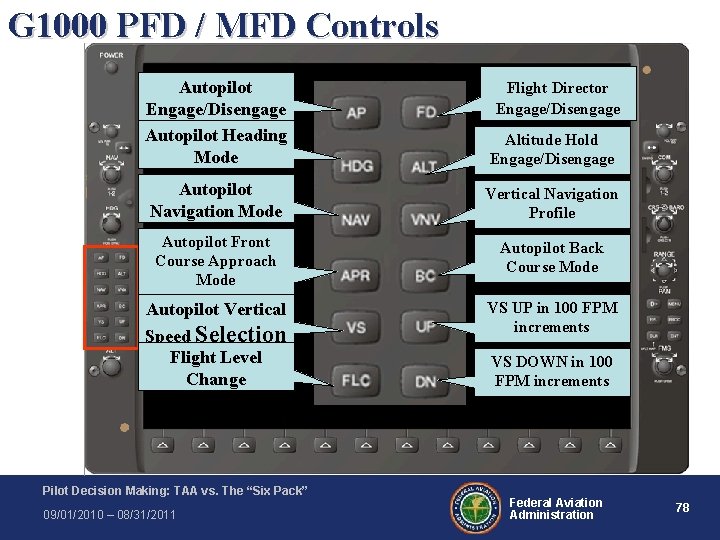
G 1000 PFD / MFD Controls Autopilot Engage/Disengage Autopilot Heading Mode Altitude Hold Engage/Disengage Autopilot Navigation Mode Vertical Navigation Profile Autopilot Front Course Approach Mode Autopilot Back Course Mode Autopilot Vertical VS UP in 100 FPM increments Speed Selection Flight Level Change Pilot Decision Making: TAA vs. The “Six Pack” 09/01/2010 – 08/31/2011 Flight Director Engage/Disengage VS DOWN in 100 FPM increments Federal Aviation Administration 78
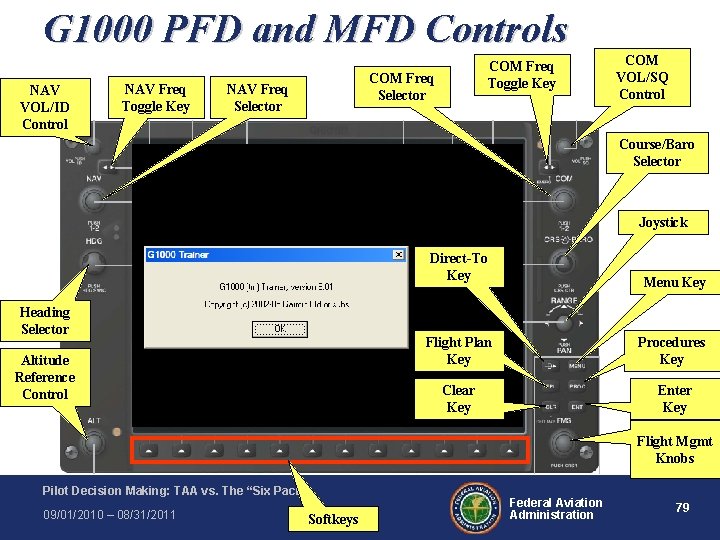
G 1000 PFD and MFD Controls NAV VOL/ID Control NAV Freq Toggle Key COM Freq Selector NAV Freq Selector COM VOL/SQ Control Course/Baro Selector Joystick Direct-To Key Heading Selector Altitude Reference Control Menu Key Flight Plan Key Procedures Key Clear Key Enter Key Flight Mgmt Knobs Pilot Decision Making: TAA vs. The “Six Pack” 09/01/2010 – 08/31/2011 Softkeys Federal Aviation Administration 79
Garmin G 1000 Primary Flight Display (PFD) Pilot Decision Making: TAA vs. The “Six Pack” 09/01/2010 – 08/31/2011 Federal Aviation Administration 80
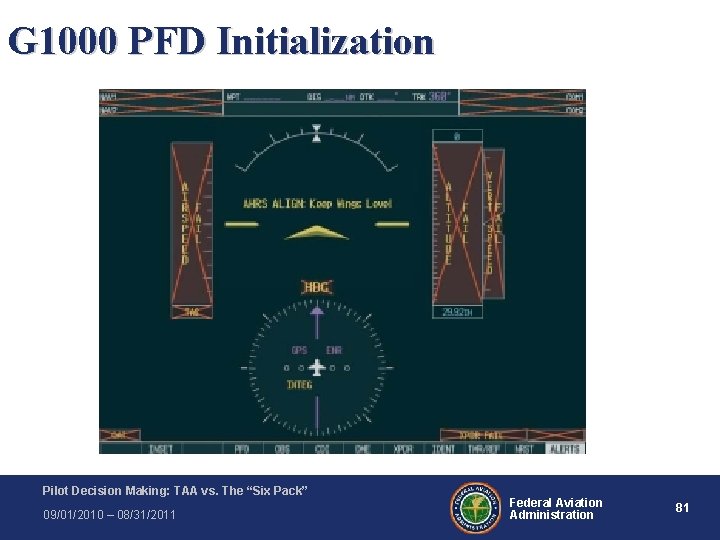
G 1000 PFD Initialization Pilot Decision Making: TAA vs. The “Six Pack” 09/01/2010 – 08/31/2011 Federal Aviation Administration 81
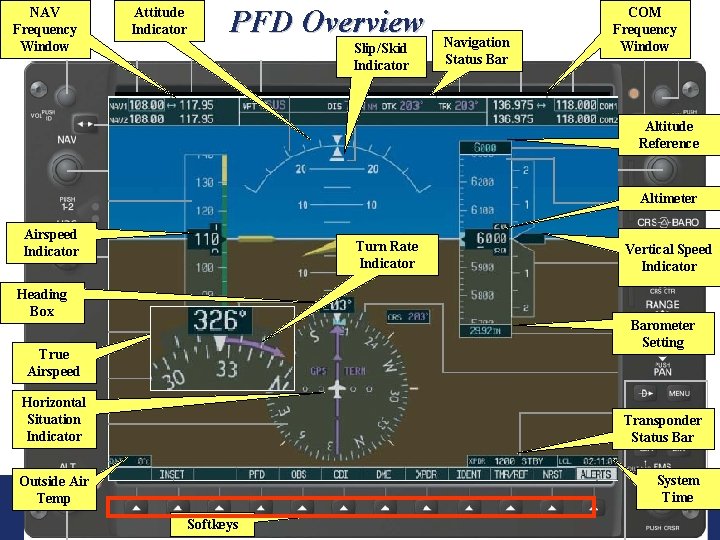
NAV Frequency Window Attitude Indicator PFD Overview Slip/Skid Indicator COM Frequency Window Navigation Status Bar Altitude Reference Altimeter Airspeed Indicator Turn Rate Indicator Vertical Speed Indicator Heading Box Barometer Setting True Airspeed Horizontal Situation Indicator Transponder Status Bar Outside Air Pilot Decision Making: TAA vs. The “Six Pack” Temp 09/01/2010 – 08/31/2011 Softkeys Federal Aviation Administration System Time 82
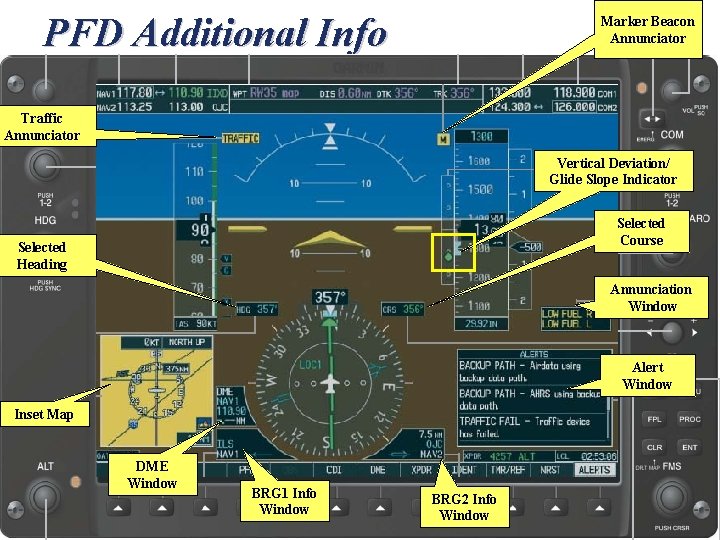
PFD Additional Info Marker Beacon Annunciator Traffic Annunciator Vertical Deviation/ Glide Slope Indicator Selected Course Selected Heading Annunciation Window Alert Window Inset Map DME Window Pilot Decision Making: TAA vs. The “Six Pack” BRG 1 Info 09/01/2010 – 08/31/2011 Window BRG 2 Info Federal Aviation Window Administration 83
Garmin G 1000 Multi-Function Display (MFD) Pilot Decision Making: TAA vs. The “Six Pack” 09/01/2010 – 08/31/2011 Federal Aviation Administration 84
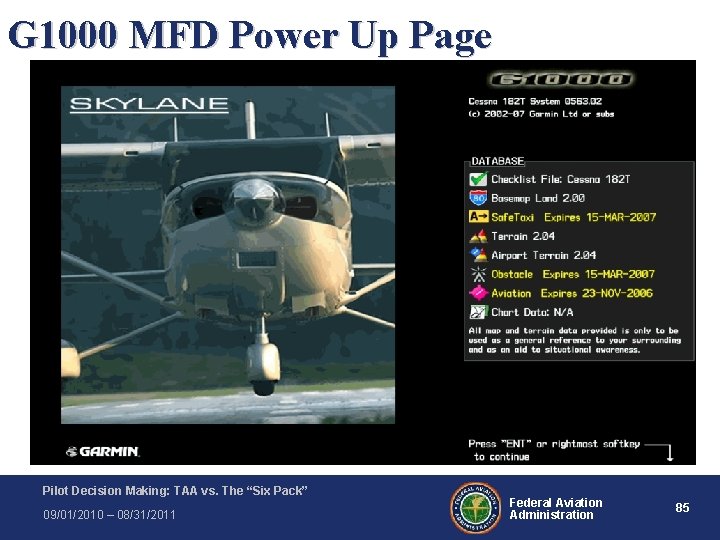
G 1000 MFD Power Up Page Pilot Decision Making: TAA vs. The “Six Pack” 09/01/2010 – 08/31/2011 Federal Aviation Administration 85
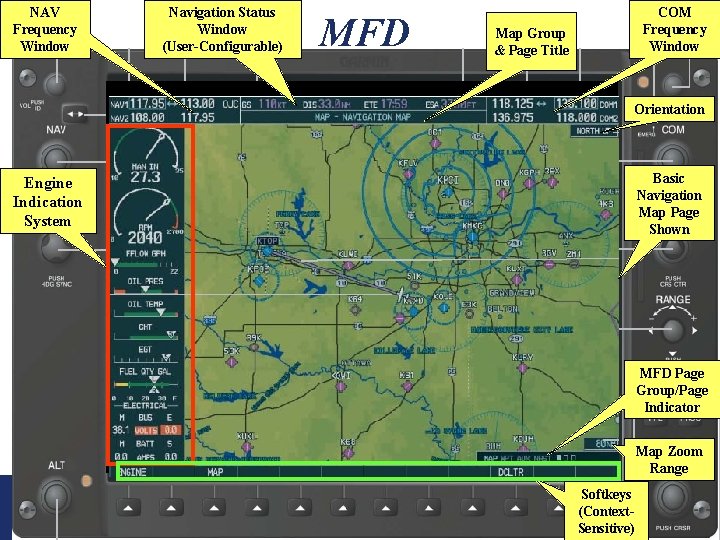
NAV Frequency Window Navigation Status Window (User-Configurable) MFD COM Frequency Window Map Group & Page Title Orientation Basic Navigation Map Page Shown Engine Indication System MFD Page Group/Page Indicator Map Zoom Range Pilot Decision Making: TAA vs. The “Six Pack” 09/01/2010 – 08/31/2011 Softkeys Federal Aviation (Context. Administration Sensitive) 86
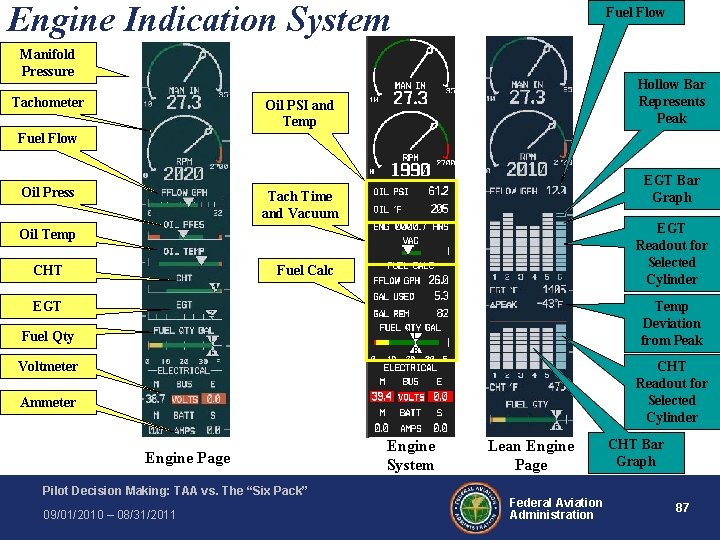
Engine Indication System Fuel Flow Manifold Pressure Tachometer Hollow Bar Represents Peak Oil PSI and Temp Fuel Flow Oil Press EGT Bar Graph Tach Time and Vacuum EGT Readout for Selected Cylinder Oil Temp CHT Fuel Calc Temp Deviation from Peak EGT Fuel Qty CHT Readout for Selected Cylinder Voltmeter Ammeter Engine Page Pilot Decision Making: TAA vs. The “Six Pack” 09/01/2010 – 08/31/2011 Engine System Lean Engine Page Federal Aviation Administration CHT Bar Graph 87
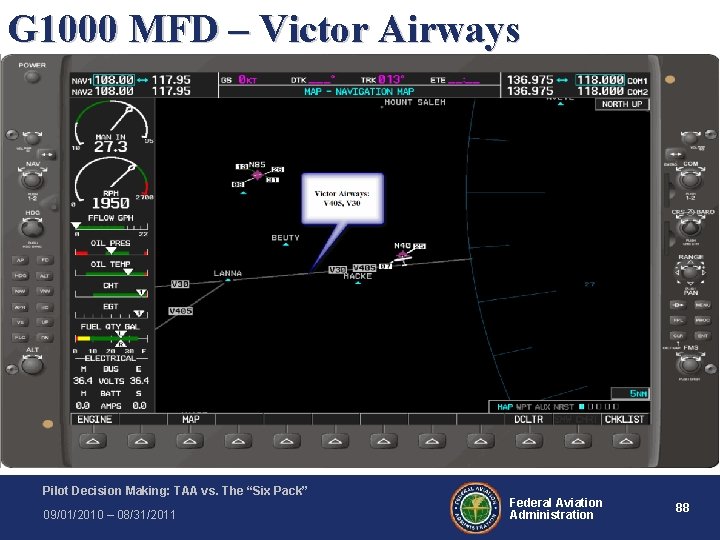
G 1000 MFD – Victor Airways Pilot Decision Making: TAA vs. The “Six Pack” 09/01/2010 – 08/31/2011 Federal Aviation Administration 88
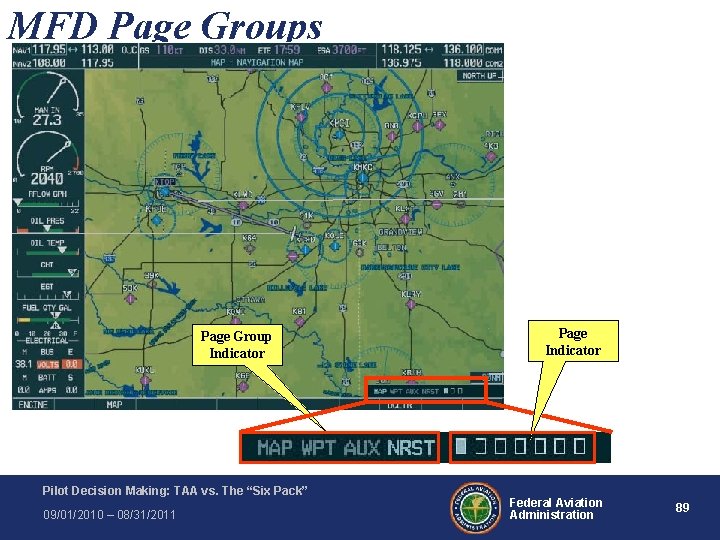
MFD Page Groups Page Group Indicator Pilot Decision Making: TAA vs. The “Six Pack” 09/01/2010 – 08/31/2011 Page Indicator Federal Aviation Administration 89
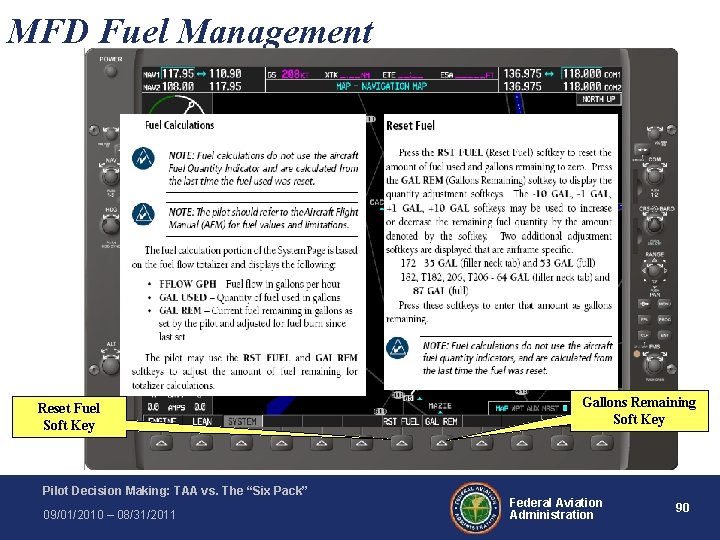
MFD Fuel Management Reset Fuel Soft Key Pilot Decision Making: TAA vs. The “Six Pack” 09/01/2010 – 08/31/2011 Gallons Remaining Soft Key Federal Aviation Administration 90
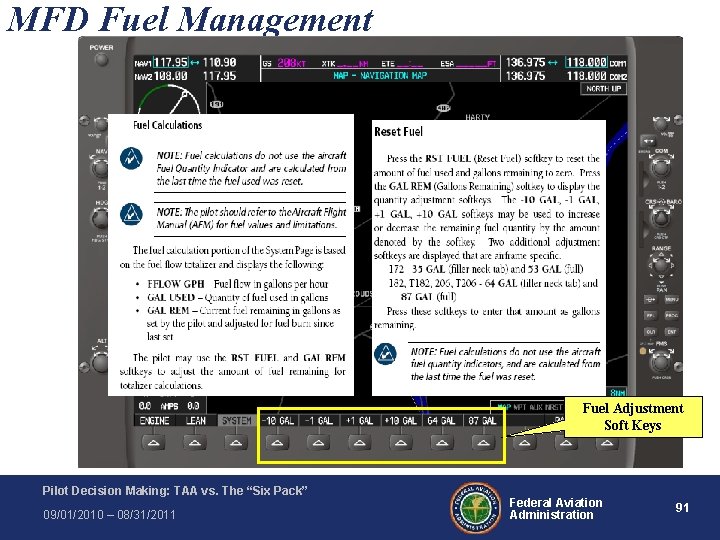
MFD Fuel Management Fuel Adjustment Soft Keys Pilot Decision Making: TAA vs. The “Six Pack” 09/01/2010 – 08/31/2011 Federal Aviation Administration 91
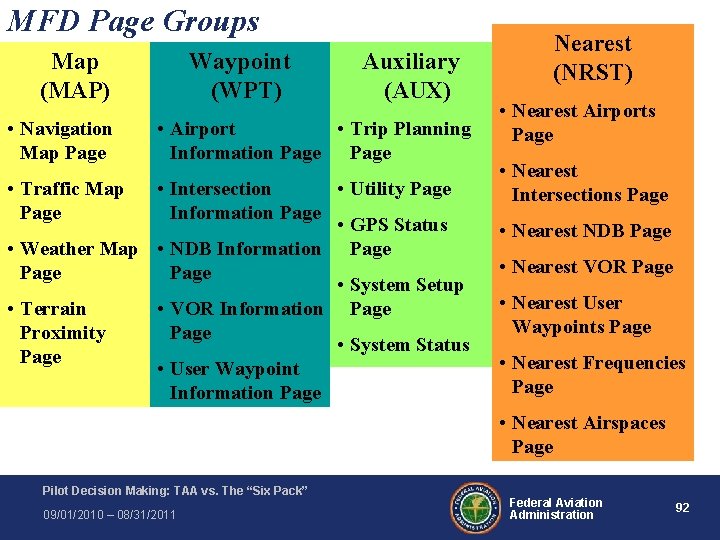
MFD Page Groups Map (MAP) • Navigation Map Page Waypoint (WPT) Auxiliary (AUX) • Airport • Trip Planning Information Page • Traffic Map Page • Intersection • Utility Page Information Page • GPS Status • Weather Map • NDB Information Page • System Setup • Terrain • VOR Information Page Proximity Page • System Status Page • User Waypoint Information Page Nearest (NRST) • Nearest Airports Page • Nearest Intersections Page • Nearest NDB Page • Nearest VOR Page • Nearest User Waypoints Page • Nearest Frequencies Page • Nearest Airspaces Page Pilot Decision Making: TAA vs. The “Six Pack” 09/01/2010 – 08/31/2011 Federal Aviation Administration 92
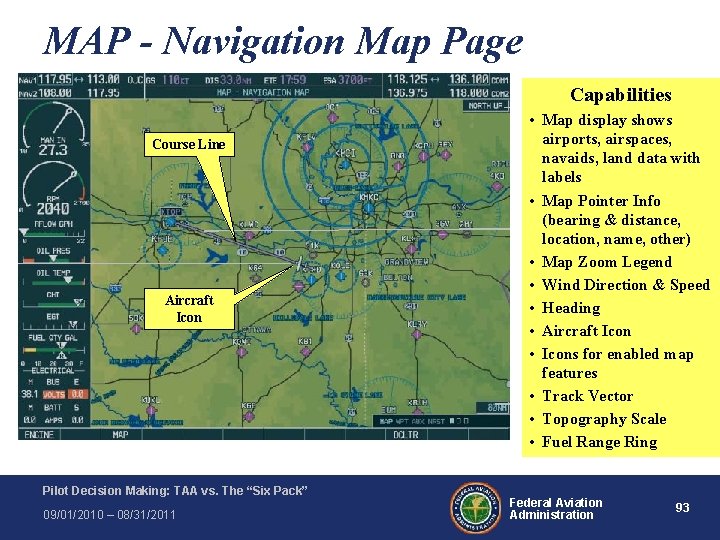
MAP - Navigation Map Page Capabilities Course Line Aircraft Icon Pilot Decision Making: TAA vs. The “Six Pack” 09/01/2010 – 08/31/2011 • Map display shows airports, airspaces, navaids, land data with labels • Map Pointer Info (bearing & distance, location, name, other) • Map Zoom Legend • Wind Direction & Speed • Heading • Aircraft Icon • Icons for enabled map features • Track Vector • Topography Scale • Fuel Range Ring Federal Aviation Administration 93
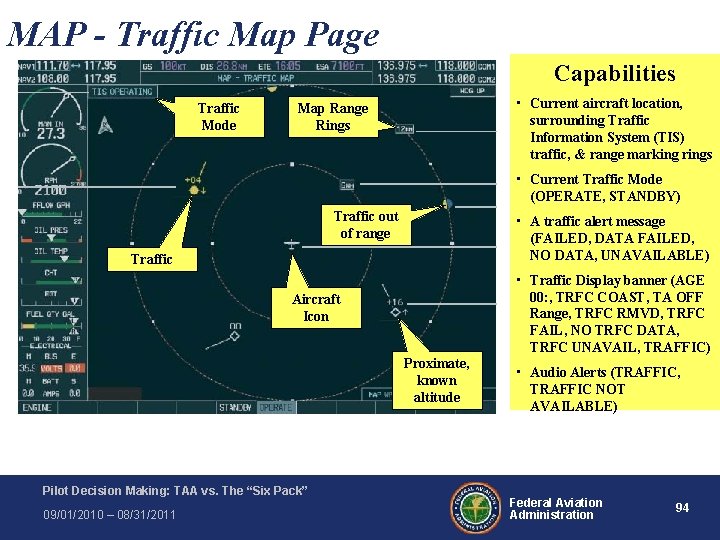
MAP - Traffic Map Page Capabilities Traffic Mode • Current aircraft location, surrounding Traffic Information System (TIS) traffic, & range marking rings Map Range Rings • Current Traffic Mode (OPERATE, STANDBY) Traffic out of range • A traffic alert message (FAILED, DATA FAILED, NO DATA, UNAVAILABLE) Traffic • Traffic Display banner (AGE 00: , TRFC COAST, TA OFF Range, TRFC RMVD, TRFC FAIL, NO TRFC DATA, TRFC UNAVAIL, TRAFFIC) Aircraft Icon Proximate, known altitude Pilot Decision Making: TAA vs. The “Six Pack” 09/01/2010 – 08/31/2011 • Audio Alerts (TRAFFIC, TRAFFIC NOT AVAILABLE) Federal Aviation Administration 94
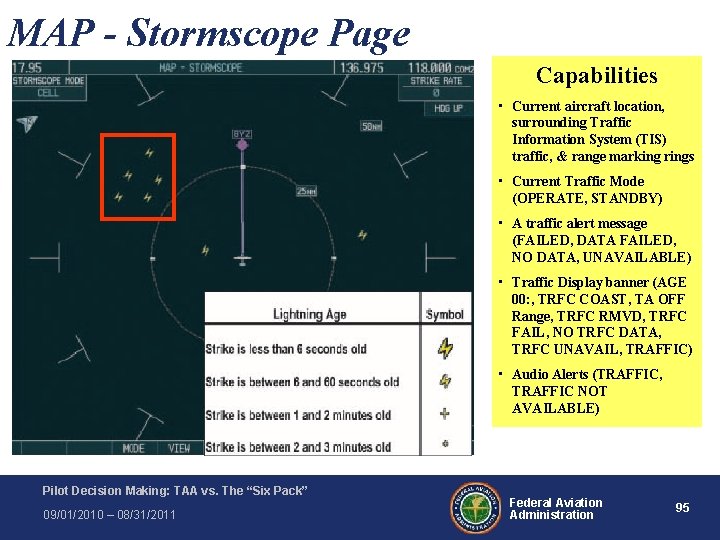
MAP - Stormscope Page Capabilities • Current aircraft location, surrounding Traffic Information System (TIS) traffic, & range marking rings • Current Traffic Mode (OPERATE, STANDBY) • A traffic alert message (FAILED, DATA FAILED, NO DATA, UNAVAILABLE) • Traffic Display banner (AGE 00: , TRFC COAST, TA OFF Range, TRFC RMVD, TRFC FAIL, NO TRFC DATA, TRFC UNAVAIL, TRAFFIC) • Audio Alerts (TRAFFIC, TRAFFIC NOT AVAILABLE) Pilot Decision Making: TAA vs. The “Six Pack” 09/01/2010 – 08/31/2011 Federal Aviation Administration 95
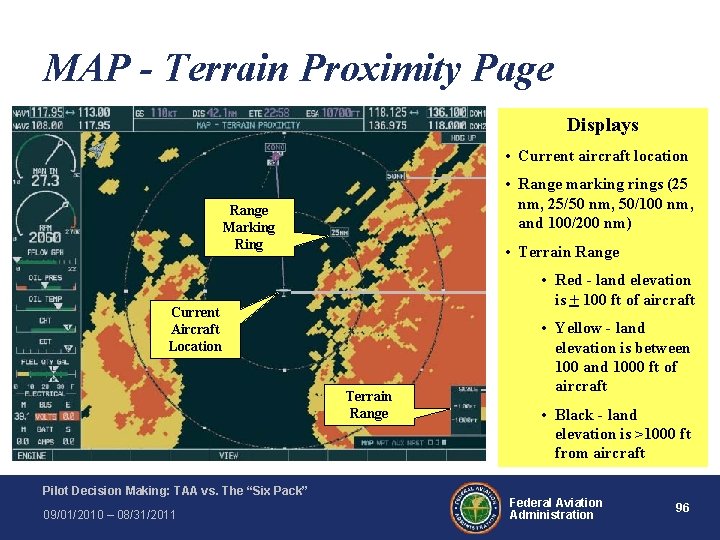
MAP - Terrain Proximity Page Displays • Current aircraft location • Range marking rings (25 nm, 25/50 nm, 50/100 nm, and 100/200 nm) Range Marking Ring • Terrain Range • Red - land elevation is + 100 ft of aircraft Current Aircraft Location Terrain Range Pilot Decision Making: TAA vs. The “Six Pack” 09/01/2010 – 08/31/2011 • Yellow - land elevation is between 100 and 1000 ft of aircraft • Black - land elevation is >1000 ft from aircraft Federal Aviation Administration 96
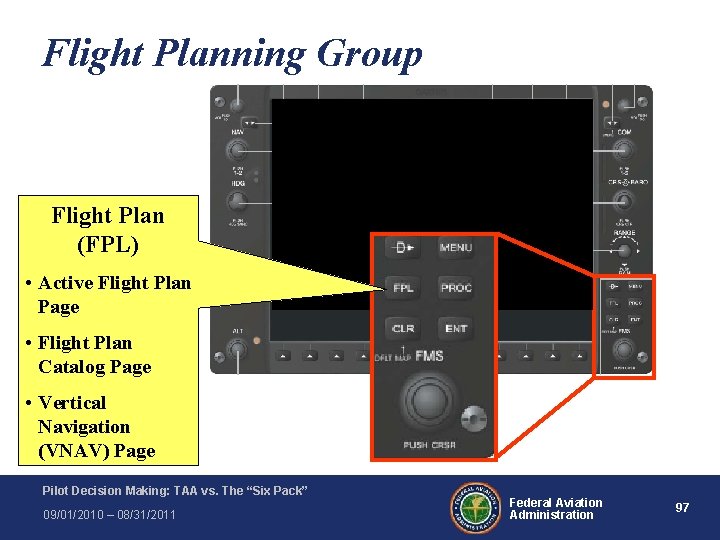
Flight Planning Group Flight Plan (FPL) • Active Flight Plan Page • Flight Plan Catalog Page • Vertical Navigation (VNAV) Page Pilot Decision Making: TAA vs. The “Six Pack” 09/01/2010 – 08/31/2011 Federal Aviation Administration 97
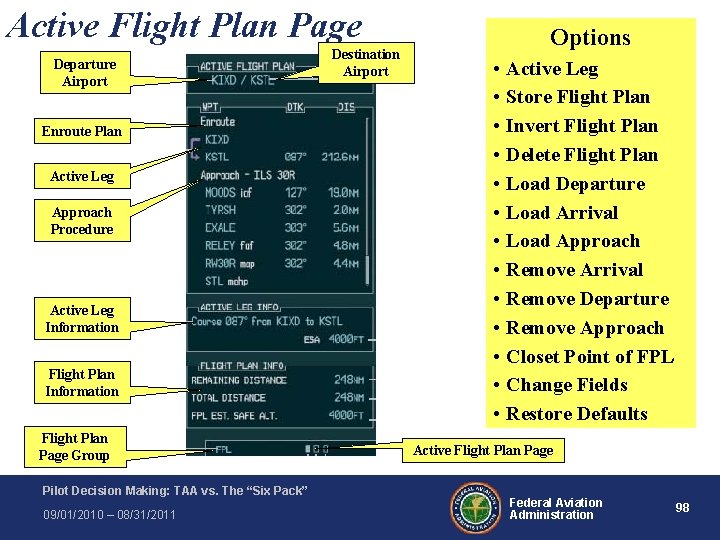
Active Flight Plan Page Departure Airport Enroute Plan Active Leg Approach Procedure Active Leg Information Flight Plan Page Group Pilot Decision Making: TAA vs. The “Six Pack” 09/01/2010 – 08/31/2011 Destination Airport Options • Active Leg • Store Flight Plan • Invert Flight Plan • Delete Flight Plan • Load Departure • Load Arrival • Load Approach • Remove Arrival • Remove Departure • Remove Approach • Closet Point of FPL • Change Fields • Restore Defaults Active Flight Plan Page Federal Aviation Administration 98
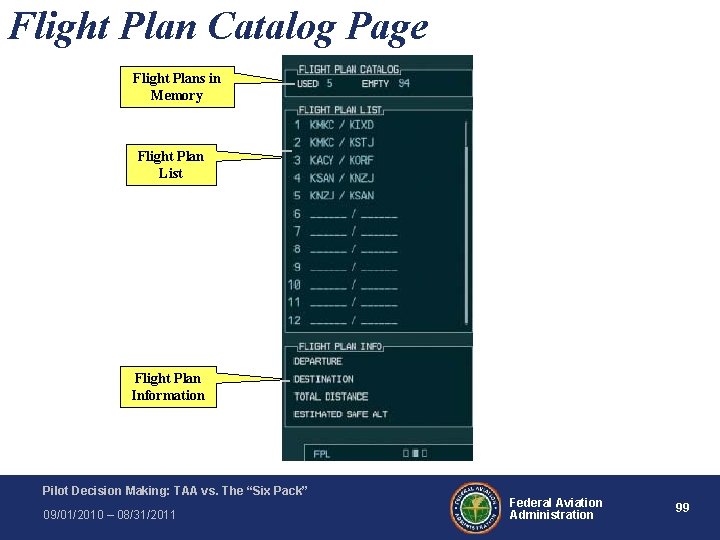
Flight Plan Catalog Page Flight Plans in Memory Flight Plan List Flight Plan Information Pilot Decision Making: TAA vs. The “Six Pack” 09/01/2010 – 08/31/2011 Federal Aviation Administration 99
Garmin G 1000 Audio Panel Pilot Decision Making: TAA vs. The “Six Pack” 09/01/2010 – 08/31/2011 Federal Aviation Administration 100
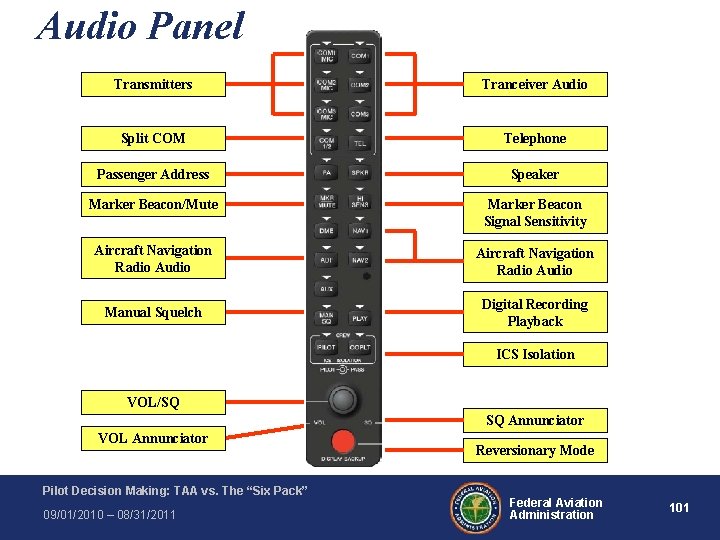
Audio Panel Transmitters Tranceiver Audio Split COM Telephone Passenger Address Speaker Marker Beacon/Mute Marker Beacon Signal Sensitivity Aircraft Navigation Radio Audio Manual Squelch Digital Recording Playback ICS Isolation VOL/SQ SQ Annunciator VOL Annunciator Pilot Decision Making: TAA vs. The “Six Pack” 09/01/2010 – 08/31/2011 Reversionary Mode Federal Aviation Administration 101
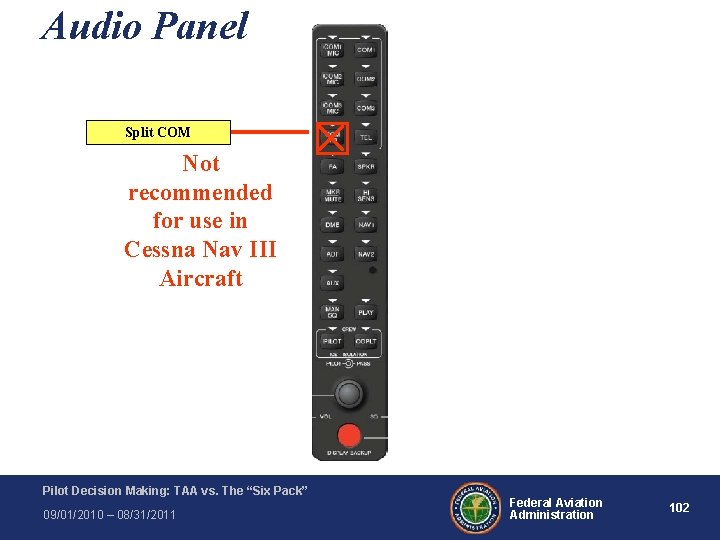
Audio Panel Split COM Not recommended for use in Cessna Nav III Aircraft Pilot Decision Making: TAA vs. The “Six Pack” 09/01/2010 – 08/31/2011 Federal Aviation Administration 102
Garmin G 1000 System Failures Pilot Decision Making: TAA vs. The “Six Pack” 09/01/2010 – 08/31/2011 Federal Aviation Administration 103
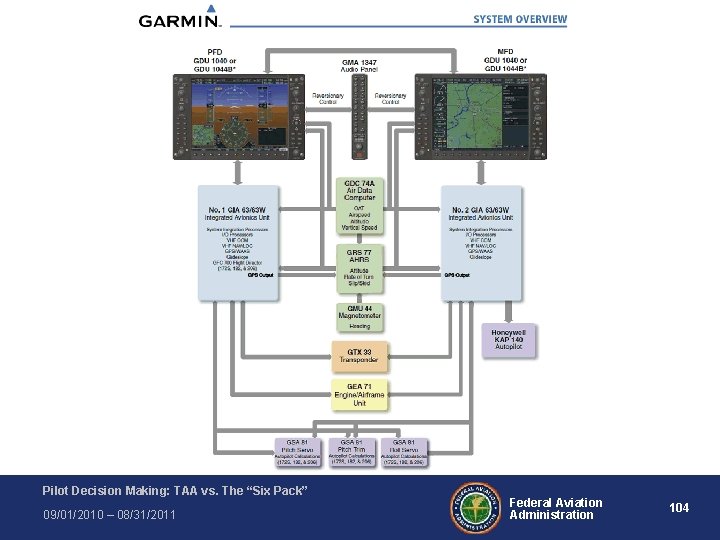
Pilot Decision Making: TAA vs. The “Six Pack” 09/01/2010 – 08/31/2011 Federal Aviation Administration 104
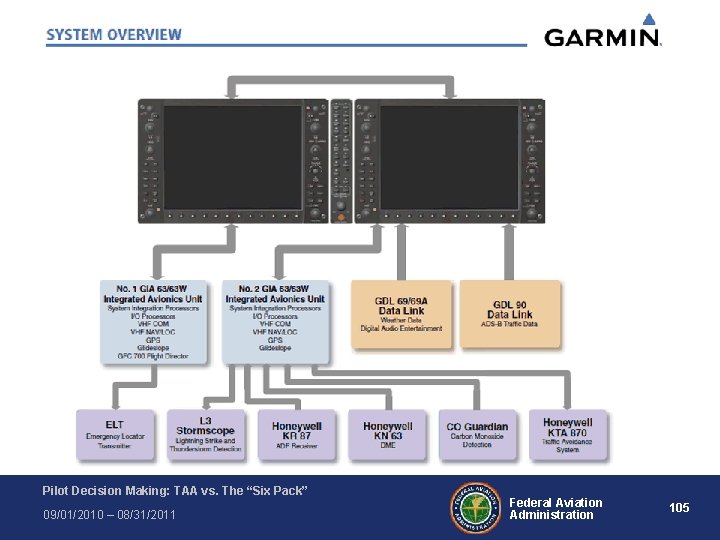
Pilot Decision Making: TAA vs. The “Six Pack” 09/01/2010 – 08/31/2011 Federal Aviation Administration 105
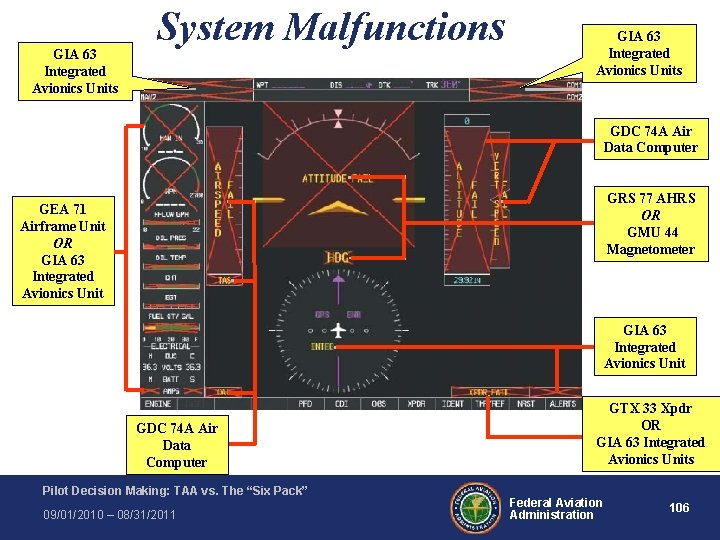
GIA 63 Integrated Avionics Units System Malfunctions GIA 63 Integrated Avionics Units GDC 74 A Air Data Computer GRS 77 AHRS OR GMU 44 Magnetometer GEA 71 Airframe Unit OR GIA 63 Integrated Avionics Unit GDC 74 A Air Data Computer Pilot Decision Making: TAA vs. The “Six Pack” 09/01/2010 – 08/31/2011 GTX 33 Xpdr OR GIA 63 Integrated Avionics Units Federal Aviation Administration 106
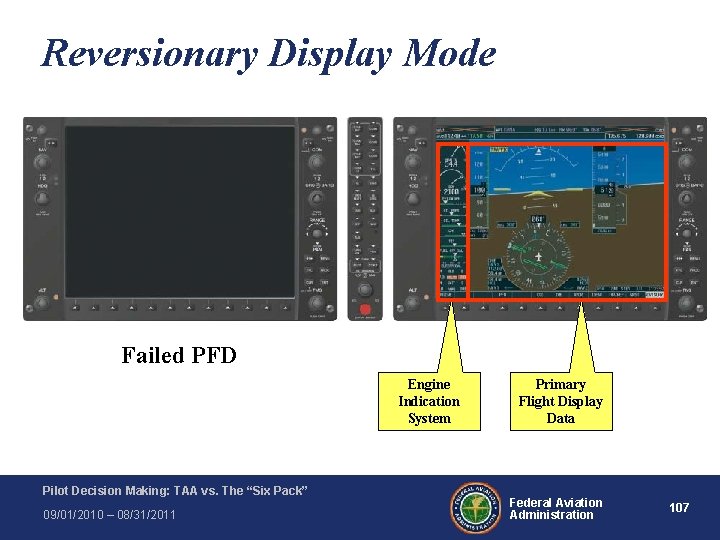
Reversionary Display Mode Failed PFD Engine Indication System Pilot Decision Making: TAA vs. The “Six Pack” 09/01/2010 – 08/31/2011 Primary Flight Display Data Federal Aviation Administration 107
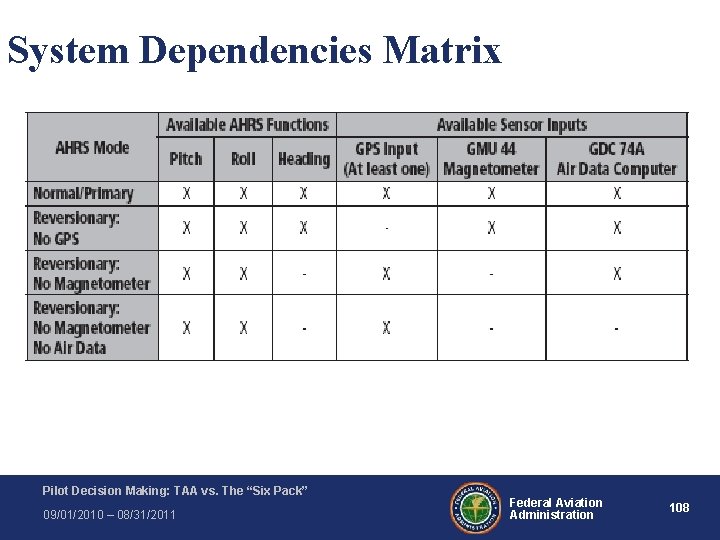
System Dependencies Matrix Pilot Decision Making: TAA vs. The “Six Pack” 09/01/2010 – 08/31/2011 Federal Aviation Administration 108