
Decision Making under Uncertainty and Risk Milo Fiar

- Slides: 30
Decision Making under Uncertainty and Risk Miloš Fišar BPV_IEBE Introduction to Experimental and Behavioral Economics 10. 3. 2016
Structure of the lecture A. Decision-making and Theory § Decision Theory vs. Game Theory § Decision Theory § Rational Choice Theory § Behavioral Decision Theory (BDT) B. Risk or Uncertainty § Decision Making Under Uncertainty § Expected Utility Theorem § Lottery § Decision Making Under Risk § Risk Aversion C. Application in Experimental Economics BPV_IEBE Introduction to Experimental and Behavioral Economics 1
Decision-making and Theory § What for do or why we need a theory of decisionmaking? § Economics, psychology, sociology and other science fields are looking forward to identify issues relevant to any decision made by a human being. § All theories aim to explain parameters of an optimal choice. § We may sum up many theories under a term Theory of Choice (or Decision Theory) BPV_IEBE Introduction to Experimental and Behavioral Economics 2
Decision Theory vs. Game Theory § There is other theory, that deals with decision making – Game Theory. § Game Theory is concerned with interaction between agents (individuals) and how decisions influences the other agent. § Decision Theory focuses on the choices of individual agents only. Want to know more about Game Theory? BINMORE, K. Game theory: a very short introduction. Oxford: Oxford University Press, c 2007. ISBN 978 -0 -19 -921846 -2. BPV_IEBE Introduction to Experimental and Behavioral Economics 3
Decision Theory § Normative § To identify the best decision to make for an ideal fully rational decision maker. § Positive § To describe observed behaviors with assumption that the agents behave according to some rule. § Traditional Decision Theory does not take into account other influences on the decision but only theoretical predictions and assumptions Behavioral Decision Theory BPV_IEBE Introduction to Experimental and Behavioral Economics 4
Rational Choice Theory (RCT) § Based on methodological individualism § Neo-classical economics accepts individual preferences as given. § The rational agent bases his/her action on all available information, probabilities and cost/benefits § In microeconomics models (as well as in experimental models) we assume that individuals are rational agents. Want to know more about Rational Choice Theory in 60 seconds? The Open University You. Tube Channel: Rational Choice Theory - 60 Second Adventures in Economics. https: //youtu. be/Ja. KMim. JPxy. A BPV_IEBE Introduction to Experimental and Behavioral Economics 5
Behavioral Decision Theory (BDT) § Humans tend no to make only rational decisions and therefore RCT might fail to explain real-world behavior. § BDT extends the traditional RCT by § beliefs, § values, § framing, § under or overweighting of probabilities/costs/benefits § and other aspects that influence the decision making BPV_IEBE Introduction to Experimental and Behavioral Economics 6
Risk or Uncertainty § What is a difference between Risk and Uncertainty? § prof. Frank H. Knight: § Uncertainty = randomness with unknowable probability § Risk = randomness with knowable probability BPV_IEBE Introduction to Experimental and Behavioral Economics 7
Decision Making Under Uncertainty § is a disciplined, methodical approach to decision-making, with probabilistic analysis and logical reasoning. § Key stone of the decision theory and modern economics. § Closely connected to Expected Utility Theorem. BPV_IEBE Introduction to Experimental and Behavioral Economics 8
Expected Utility Theorem § by professors John Von Neumann and Oskar Morgenstern § It is a theory of how people should make decisions. § The individual decision is an act when average utilities of each possible outcome are weighted according to its probability. BPV_IEBE Introduction to Experimental and Behavioral Economics 9
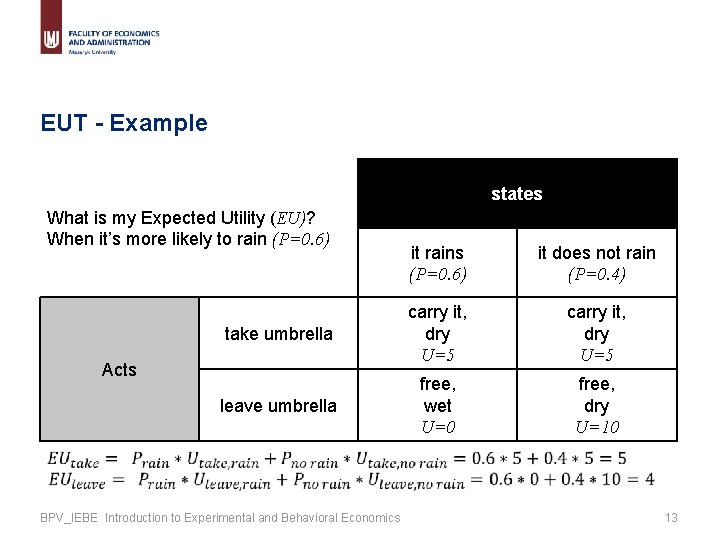
EUT - Example • I want to go for a walk. • there is always a question: to take the umbrella or leave it at home? • What are the outcomes? BPV_IEBE Introduction to Experimental and Behavioral Economics 10
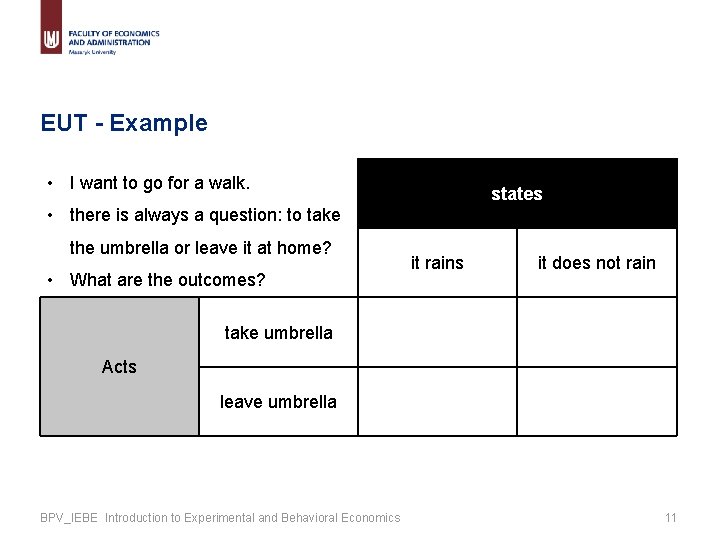
EUT - Example • I want to go for a walk. states • there is always a question: to take the umbrella or leave it at home? • What are the outcomes? it rains it does not rain take umbrella Acts leave umbrella BPV_IEBE Introduction to Experimental and Behavioral Economics 11
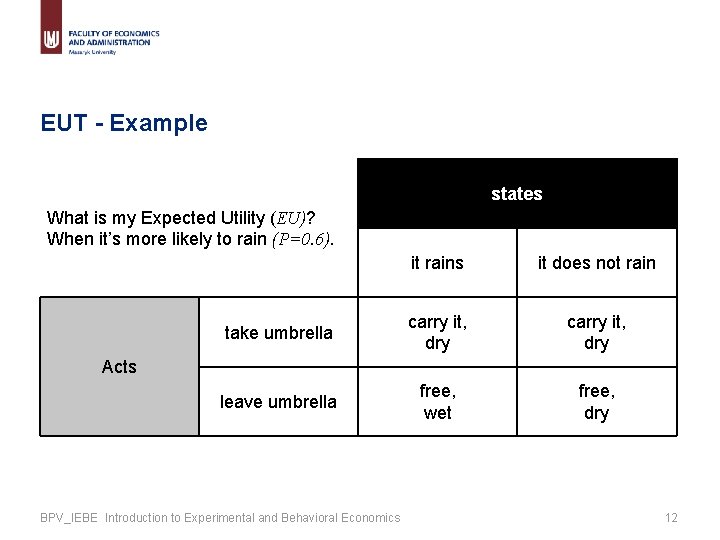
EUT - Example states What is my Expected Utility (EU)? When it’s more likely to rain (P=0. 6). it rains it does not rain take umbrella carry it, dry carry it, dry leave umbrella free, wet free, dry Acts BPV_IEBE Introduction to Experimental and Behavioral Economics 12
EUT - Example states What is my Expected Utility (EU)? When it’s more likely to rain (P=0. 6) it rains (P=0. 6) it does not rain (P=0. 4) take umbrella carry it, dry U=5 carry it, dry U=5 leave umbrella free, wet U=0 free, dry U=10 Acts BPV_IEBE Introduction to Experimental and Behavioral Economics 13
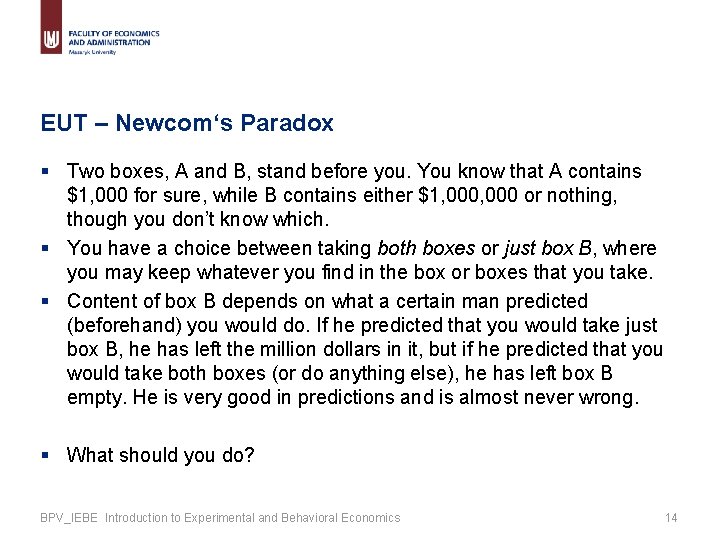
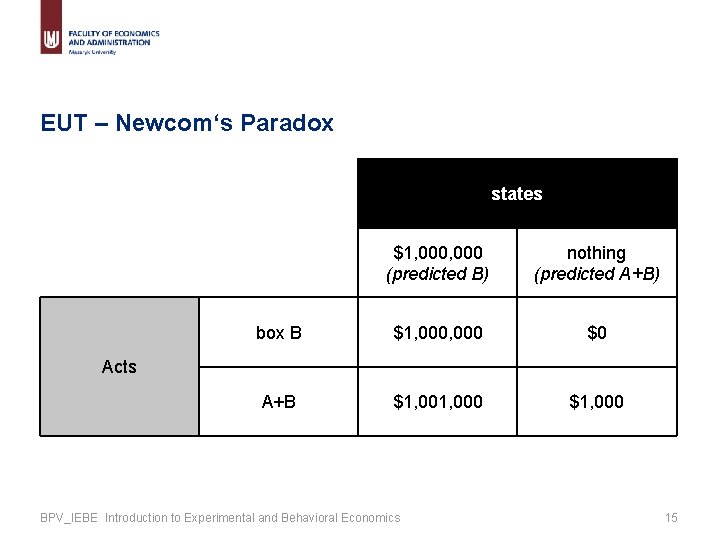
EUT – Newcom‘s Paradox § Two boxes, A and B, stand before you. You know that A contains $1, 000 for sure, while B contains either $1, 000 or nothing, though you don’t know which. § You have a choice between taking both boxes or just box B, where you may keep whatever you find in the box or boxes that you take. § Content of box B depends on what a certain man predicted (beforehand) you would do. If he predicted that you would take just box B, he has left the million dollars in it, but if he predicted that you would take both boxes (or do anything else), he has left box B empty. He is very good in predictions and is almost never wrong. § What should you do? BPV_IEBE Introduction to Experimental and Behavioral Economics 14
EUT – Newcom‘s Paradox states $1, 000 (predicted B) nothing (predicted A+B) box B $1, 000 $0 A+B $1, 000 Acts BPV_IEBE Introduction to Experimental and Behavioral Economics 15
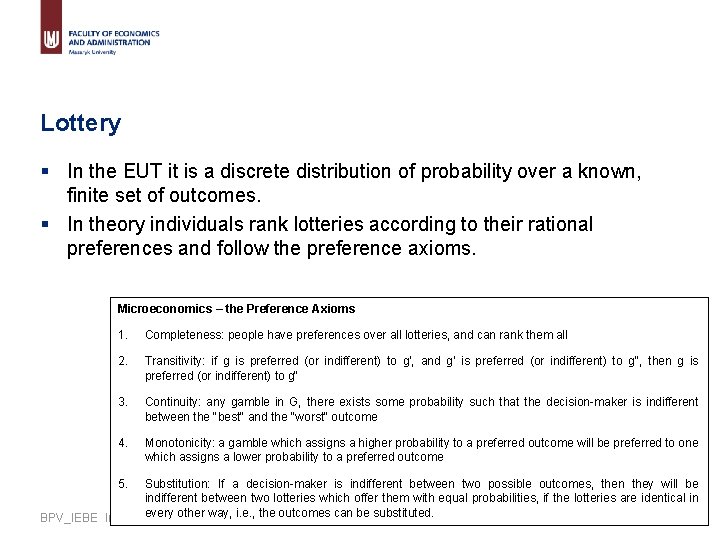
Lottery § In the EUT it is a discrete distribution of probability over a known, finite set of outcomes. § In theory individuals rank lotteries according to their rational preferences and follow the preference axioms. Microeconomics – the Preference Axioms 1. Completeness: people have preferences over all lotteries, and can rank them all 2. Transitivity: if g is preferred (or indifferent) to g', and g' is preferred (or indifferent) to g", then g is preferred (or indifferent) to g" 3. Continuity: any gamble in G, there exists some probability such that the decision-maker is indifferent between the "best" and the "worst" outcome 4. Monotonicity: a gamble which assigns a higher probability to a preferred outcome will be preferred to one which assigns a lower probability to a preferred outcome 5. Substitution: If a decision-maker is indifferent between two possible outcomes, then they will be indifferent between two lotteries which offer them with equal probabilities, if the lotteries are identical in every other way, i. e. , the outcomes can be substituted. BPV_IEBE Introduction to Experimental and Behavioral Economics 16
Risk § What is risk? 1. an unwanted event which may or may not occur. 2. the cause of an unwanted event which may or may not occur. 3. the probability of an unwanted event which may or may not occur. 4. the statistical expectation value of an unwanted event which may or may not occur. 5. the fact that a decision is made under conditions of known probabilities (“decision under risk” as opposed to “decision under uncertainty”) BPV_IEBE Introduction to Experimental and Behavioral Economics 17
Decision Making Under Risk § Any entrepreneur, investor, policy maker or you make decisions under risk. § Modern economic theory provides several models of risk taking and measures risk. § Michael Rothschild and Joseph Stiglitz: § if we move probability mass from the center to the tails of a probability distribution, while keeping its mean unchanged, then we increase the risk associated with the distribution. A measure based on this principle (mean preserving spread) can be constructed that has more attractive mathematical properties than those of the older standard deviation measure. § In other words: a person is risk-averse if he/she prefers a certain outcome to a risky outcome with the same expected utility BPV_IEBE Introduction to Experimental and Behavioral Economics 18
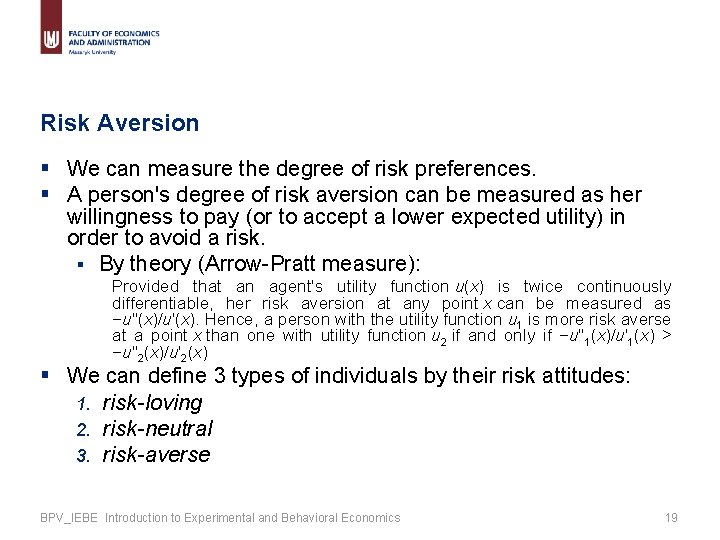
Risk Aversion § We can measure the degree of risk preferences. § A person's degree of risk aversion can be measured as her willingness to pay (or to accept a lower expected utility) in order to avoid a risk. § By theory (Arrow-Pratt measure): Provided that an agent's utility function u(x) is twice continuously differentiable, her risk aversion at any point x can be measured as −u′′(x)/u′(x). Hence, a person with the utility function u 1 is more risk averse at a point x than one with utility function u 2 if and only if −u′′ 1(x)/u′ 1(x) > −u′′ 2(x)/u′ 2(x) § We can define 3 types of individuals by their risk attitudes: 1. risk-loving 2. risk-neutral 3. risk-averse BPV_IEBE Introduction to Experimental and Behavioral Economics 19
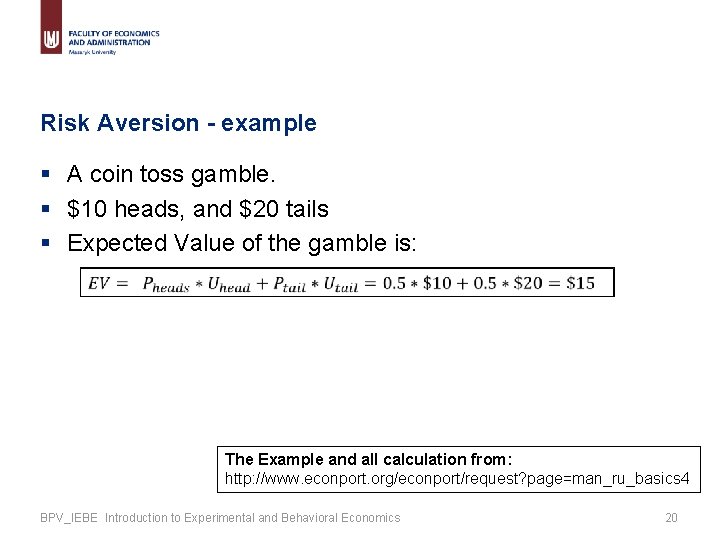
Risk Aversion - example § A coin toss gamble. § $10 heads, and $20 tails § Expected Value of the gamble is: The Example and all calculation from: http: //www. econport. org/econport/request? page=man_ru_basics 4 BPV_IEBE Introduction to Experimental and Behavioral Economics 20
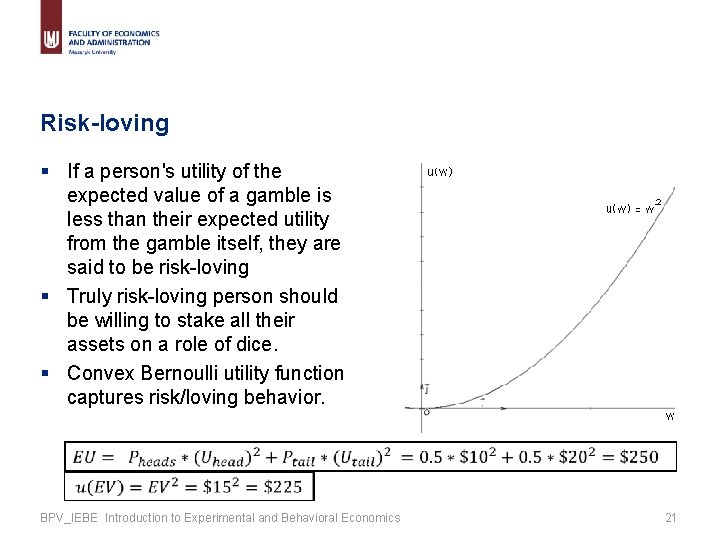
Risk-loving § If a person's utility of the expected value of a gamble is less than their expected utility from the gamble itself, they are said to be risk-loving § Truly risk-loving person should be willing to stake all their assets on a role of dice. § Convex Bernoulli utility function captures risk/loving behavior. BPV_IEBE Introduction to Experimental and Behavioral Economics 21
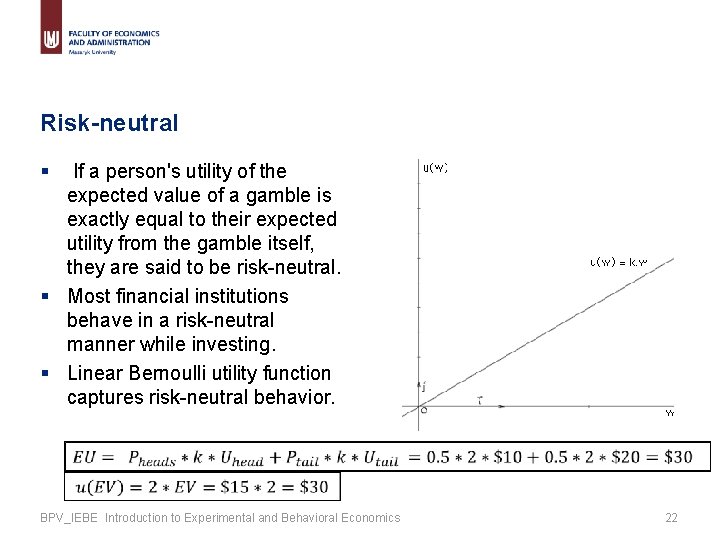
Risk-neutral § If a person's utility of the expected value of a gamble is exactly equal to their expected utility from the gamble itself, they are said to be risk-neutral. § Most financial institutions behave in a risk-neutral manner while investing. § Linear Bernoulli utility function captures risk-neutral behavior. BPV_IEBE Introduction to Experimental and Behavioral Economics 22
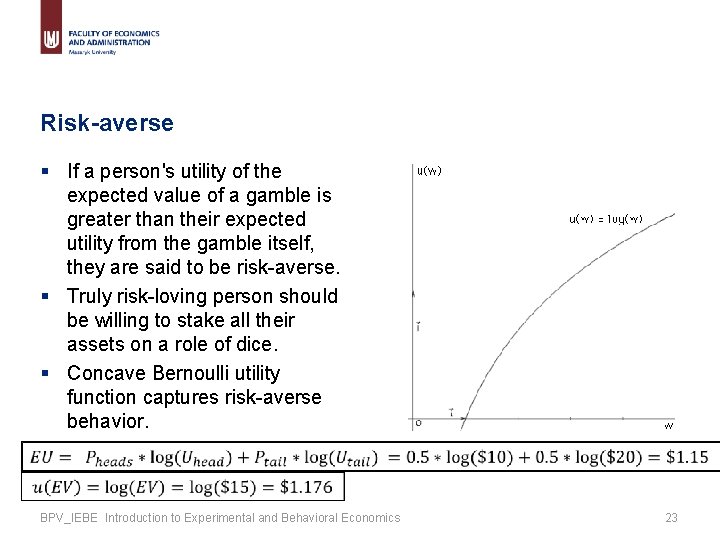
Risk-averse § If a person's utility of the expected value of a gamble is greater than their expected utility from the gamble itself, they are said to be risk-averse. § Truly risk-loving person should be willing to stake all their assets on a role of dice. § Concave Bernoulli utility function captures risk-averse behavior. BPV_IEBE Introduction to Experimental and Behavioral Economics 23
Application in Experimental Economics § The experiments focus on decision making an therefore the knowledge of decision making theory is necessary. § To design the experiment you need to model the situation beforehand by the experiment to verify or disconfirm. § Many existing theoretical models assume that the rational agent is a risk neutral Risk Elicitation in the experiment. BPV_IEBE Introduction to Experimental and Behavioral Economics 24
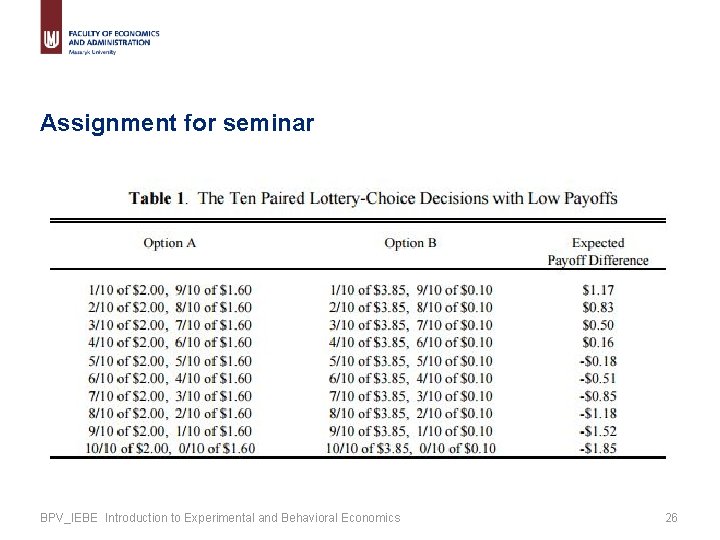
Assignment for seminar § Take a look on a paper § Holt, Charles A. , and Susan K. Laury. "Risk aversion and incentive effects. " American Economic Review 92. 5 (2002) (http: //www. nber. org/~rosenbla/econ 31104/syllabus/holtlaury. pdf) § And collect data… BPV_IEBE Introduction to Experimental and Behavioral Economics 25
Assignment for seminar BPV_IEBE Introduction to Experimental and Behavioral Economics 26
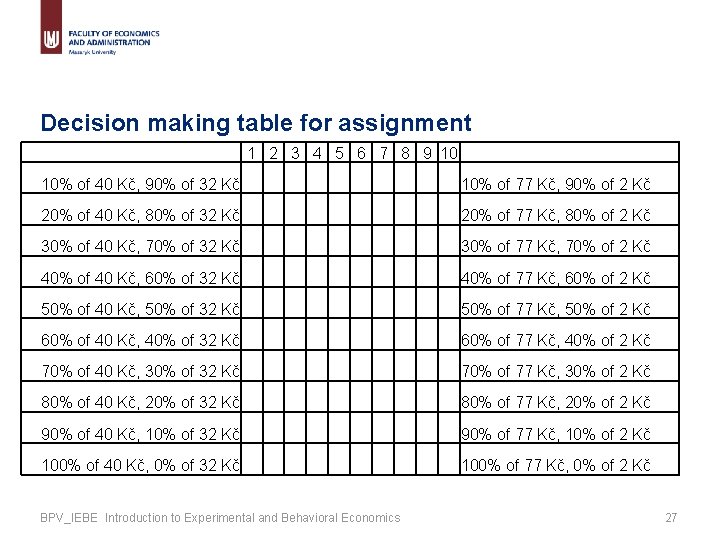
Decision making table for assignment 1 2 3 4 5 6 7 8 9 10 10% of 40 Kč, 90% of 32 Kč 10% of 77 Kč, 90% of 2 Kč 20% of 40 Kč, 80% of 32 Kč 20% of 77 Kč, 80% of 2 Kč 30% of 40 Kč, 70% of 32 Kč 30% of 77 Kč, 70% of 2 Kč 40% of 40 Kč, 60% of 32 Kč 40% of 77 Kč, 60% of 2 Kč 50% of 40 Kč, 50% of 32 Kč 50% of 77 Kč, 50% of 2 Kč 60% of 40 Kč, 40% of 32 Kč 60% of 77 Kč, 40% of 2 Kč 70% of 40 Kč, 30% of 32 Kč 70% of 77 Kč, 30% of 2 Kč 80% of 40 Kč, 20% of 32 Kč 80% of 77 Kč, 20% of 2 Kč 90% of 40 Kč, 10% of 32 Kč 90% of 77 Kč, 10% of 2 Kč 100% of 40 Kč, 0% of 32 Kč 100% of 77 Kč, 0% of 2 Kč BPV_IEBE Introduction to Experimental and Behavioral Economics 27
Assignment for seminar - requirements § At least 5 subjects § Classify their risk preferences § Add demographic information about the subjects (gender is mandatory, other are up to you) § Submit it as a Word and Excel with data BPV_IEBE Introduction to Experimental and Behavioral Economics 28
Literature § Johnatan Levin: Choice under Uncertainity (http: //web. stanford. edu/~jdlevin/Econ%20202/Uncertaint y. pdf) § VON NEUMANN, John; MORGENSTERN, Oskar. Theory of games and economic behavior. Princeton university press, 2007. § Newcomb’s Paradox: http: //barang. sg/index. php? view=newcomb BPV_IEBE Introduction to Experimental and Behavioral Economics 29