Decision Making and Relevant Information Chapter 11 2009


- Slides: 24
Decision Making and Relevant Information Chapter 11 2009 Foster School of Business Cost Accounting L. Du. Charme 1
Overview • • Decisions Relevant information Examples of common decisions Opportunity costs Capacity constraints Replace equipment Comprehensive example 2009 Foster School of Business Cost Accounting L. Du. Charme 2
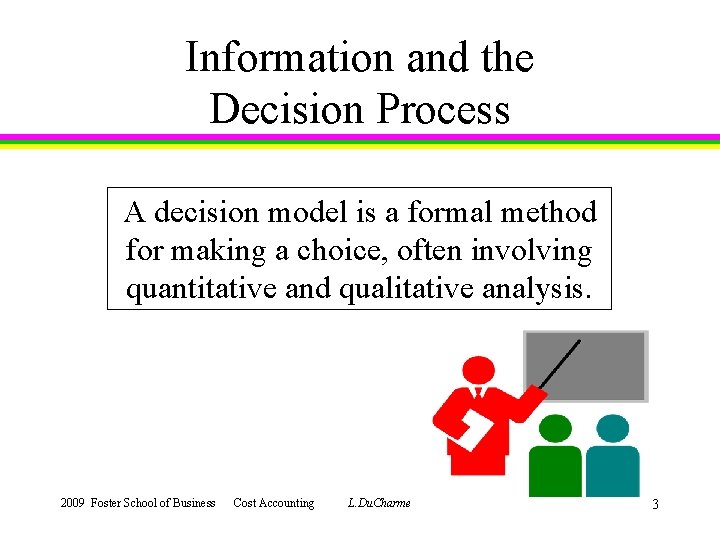
Information and the Decision Process A decision model is a formal method for making a choice, often involving quantitative and qualitative analysis. 2009 Foster School of Business Cost Accounting L. Du. Charme 3
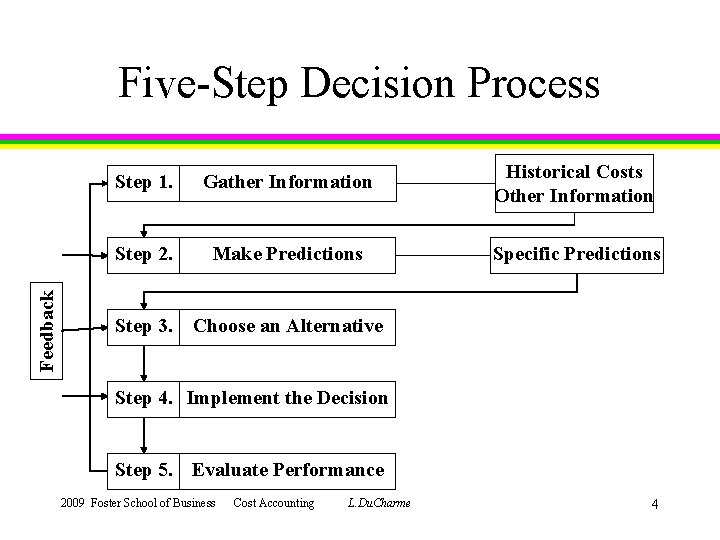
Feedback Five-Step Decision Process Step 1. Gather Information Historical Costs Other Information Step 2. Make Predictions Specific Predictions Step 3. Choose an Alternative Step 4. Implement the Decision Step 5. Evaluate Performance 2009 Foster School of Business Cost Accounting L. Du. Charme 4
Differentiate relevant from irrelevant costs and revenues in decision situations. 2009 Foster School of Business Cost Accounting L. Du. Charme 5
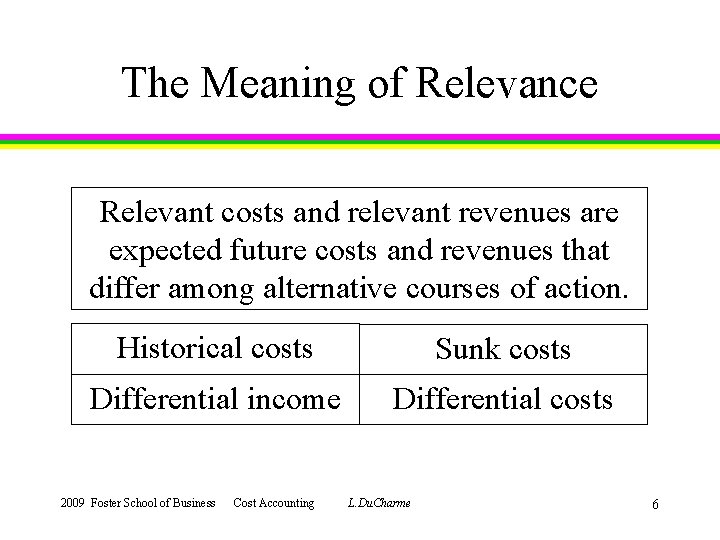
The Meaning of Relevance Relevant costs and relevant revenues are expected future costs and revenues that differ among alternative courses of action. Historical costs Sunk costs Differential income Differential costs 2009 Foster School of Business Cost Accounting L. Du. Charme 6
Quantitative and Qualitative Relevant Information Quantitative factors Financial Nonfinancial Qualitative factors 2009 Foster School of Business Cost Accounting L. Du. Charme 7
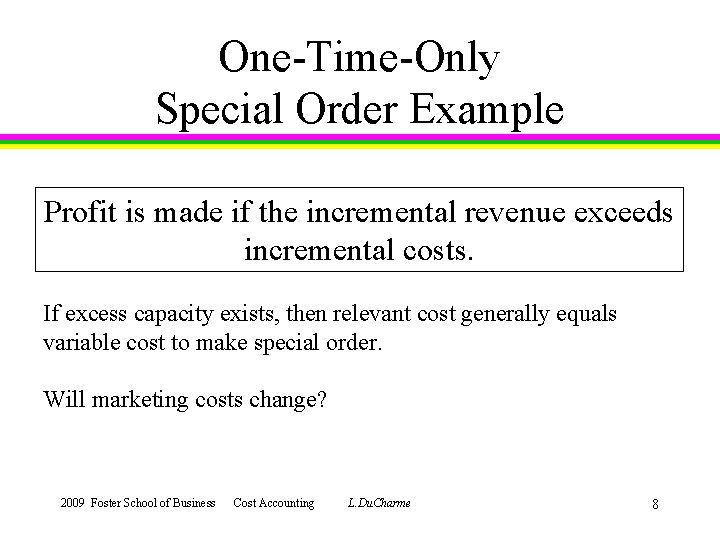
One-Time-Only Special Order Example Profit is made if the incremental revenue exceeds incremental costs. If excess capacity exists, then relevant cost generally equals variable cost to make special order. Will marketing costs change? 2009 Foster School of Business Cost Accounting L. Du. Charme 8
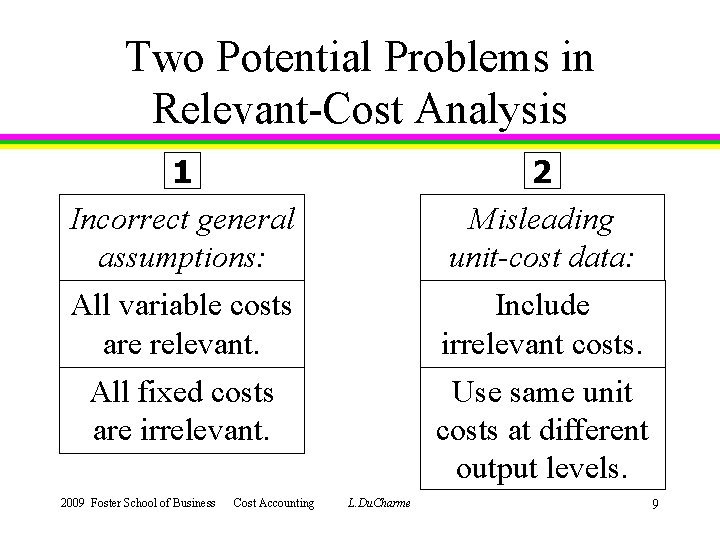
Two Potential Problems in Relevant-Cost Analysis 1 Incorrect general assumptions: All variable costs are relevant. All fixed costs are irrelevant. 2009 Foster School of Business Cost Accounting 2 Misleading unit-cost data: Include irrelevant costs. Use same unit costs at different output levels. L. Du. Charme 9
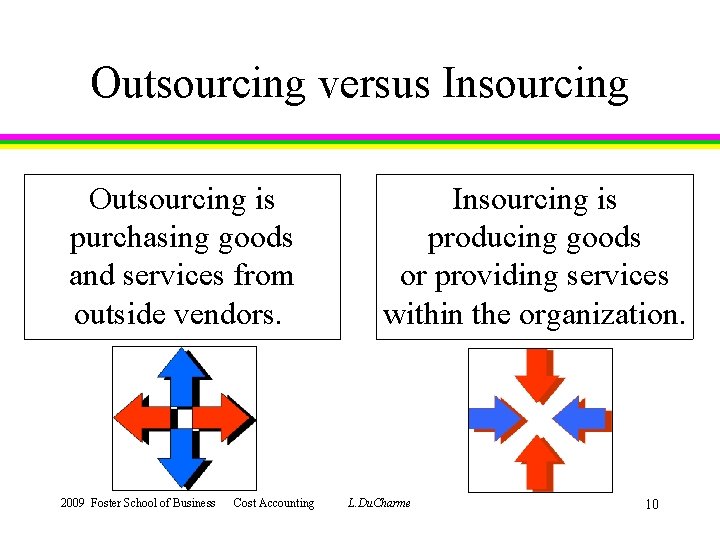
Outsourcing versus Insourcing Outsourcing is purchasing goods and services from outside vendors. 2009 Foster School of Business Cost Accounting Insourcing is producing goods or providing services within the organization. L. Du. Charme 10
Make-or-Buy Decisions This is a very common (frequent) decision made by most organizations. Purchase managers report three important factors: (1) Quality (2) Supplier dependability (3) Cost 2009 Foster School of Business Cost Accounting L. Du. Charme 11
Make-or-Buy Decisions In making a “make-or-buy” decision it is often times useful and quick to compare the cost to outsource versus the costs saved if you outsource. 2009 Foster School of Business Cost Accounting L. Du. Charme 12
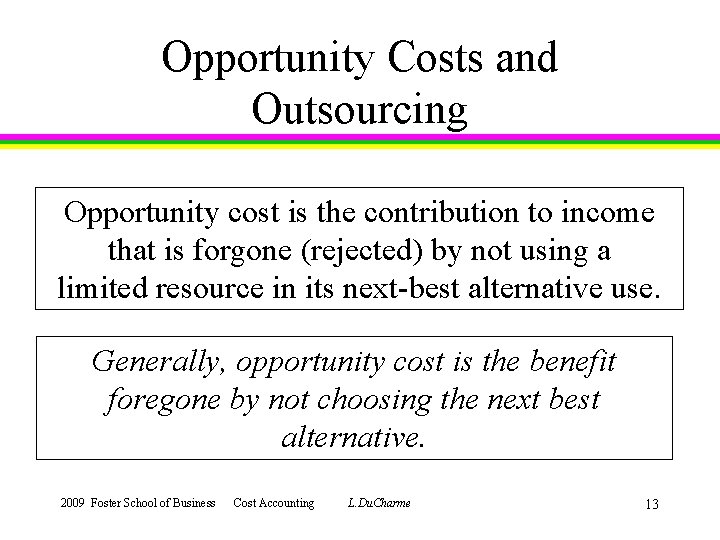
Opportunity Costs and Outsourcing Opportunity cost is the contribution to income that is forgone (rejected) by not using a limited resource in its next-best alternative use. Generally, opportunity cost is the benefit foregone by not choosing the next best alternative. 2009 Foster School of Business Cost Accounting L. Du. Charme 13
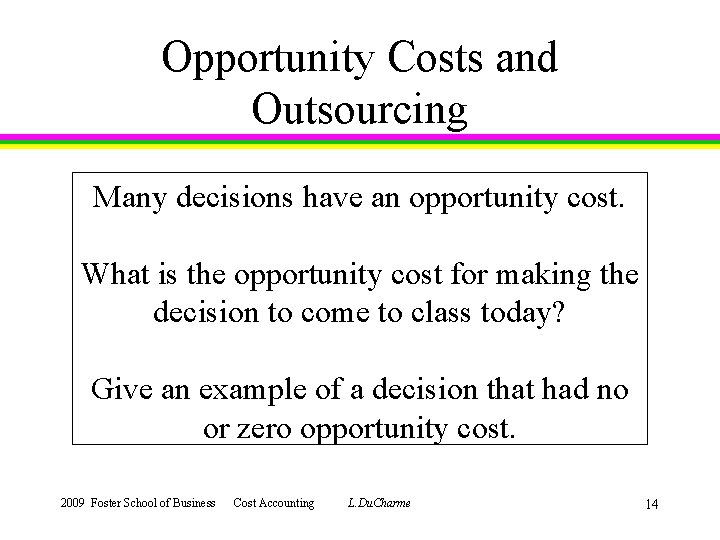
Opportunity Costs and Outsourcing Many decisions have an opportunity cost. What is the opportunity cost for making the decision to come to class today? Give an example of a decision that had no or zero opportunity cost. 2009 Foster School of Business Cost Accounting L. Du. Charme 14
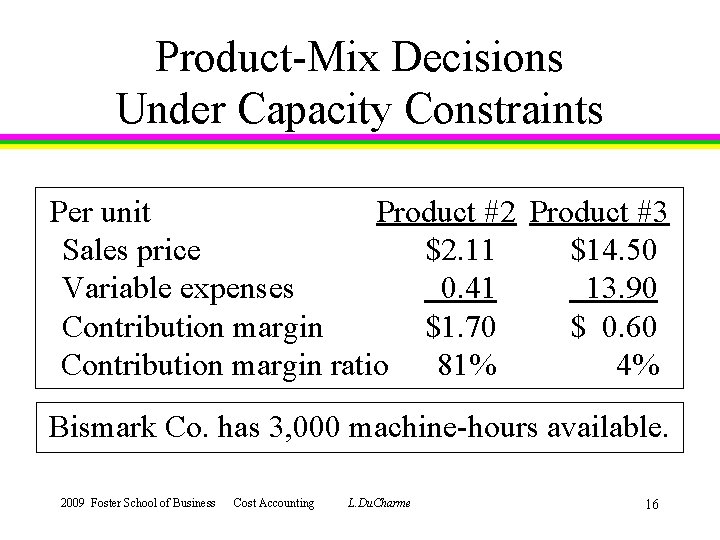
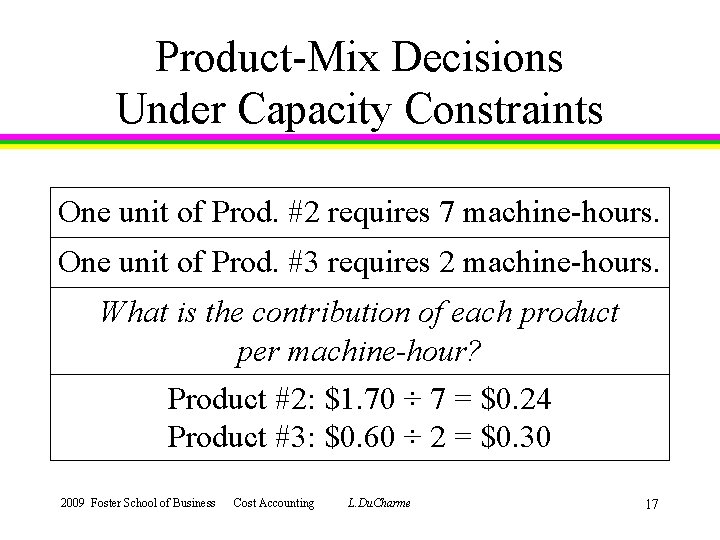
Capacity Constraints Deciding which products to produce when there are capacity constraints. Answer: Produce/sell product(s) with the highest CM/unit of constraint! 2009 Foster School of Business Cost Accounting L. Du. Charme 15
Product-Mix Decisions Under Capacity Constraints Per unit Product #2 Product #3 Sales price $2. 11 $14. 50 Variable expenses 0. 41 13. 90 Contribution margin $1. 70 $ 0. 60 Contribution margin ratio 81% 4% Bismark Co. has 3, 000 machine-hours available. 2009 Foster School of Business Cost Accounting L. Du. Charme 16
Product-Mix Decisions Under Capacity Constraints One unit of Prod. #2 requires 7 machine-hours. One unit of Prod. #3 requires 2 machine-hours. What is the contribution of each product per machine-hour? Product #2: $1. 70 ÷ 7 = $0. 24 Product #3: $0. 60 ÷ 2 = $0. 30 2009 Foster School of Business Cost Accounting L. Du. Charme 17
From a company economic Perspective, the book value of equipment is irrelevant in equipment-replacement decisions. 2009 Foster School of Business Cost Accounting L. Du. Charme 18
Conflicts can arise between the decision model used by a manager and the performance evaluation model used to evaluate the manager. 2009 Foster School of Business Cost Accounting L. Du. Charme 19
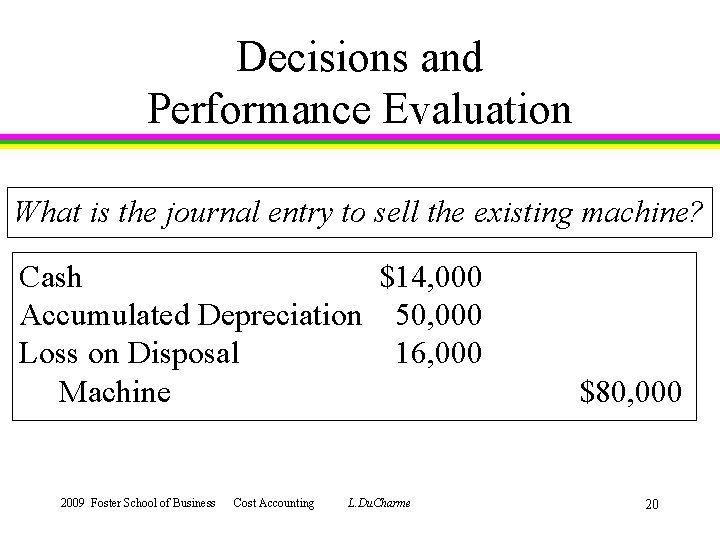
Decisions and Performance Evaluation What is the journal entry to sell the existing machine? Cash $14, 000 Accumulated Depreciation 50, 000 Loss on Disposal 16, 000 Machine 2009 Foster School of Business Cost Accounting L. Du. Charme $80, 000 20
Decisions and Performance Evaluation In the real world would the manager replace the machine? An important factor in replacement decisions is the manager’s perceptions of whether the decision model is consistent with how the manager’s performance is judged. 2009 Foster School of Business Cost Accounting L. Du. Charme 21
Decisions and Performance Evaluation Top management faces a challenge – that is, making sure that the performance-evaluation model of subordinate managers is consistent with the decision model. 2009 Foster School of Business Cost Accounting L. Du. Charme 22
Anatomy of a Decision: Buy a used versus lease a new car • Example of decision--See spread sheet analysis. • Quantitative and qualitative analysis—you are only part way done with analysis after the quantitative analysis. Use this as a benchmark against the qualitative factors. • What qualitative factors have I missed (left out of) in my quantitative analysis? 2009 Foster School of Business Cost Accounting L. Du. Charme 23
End of Chapter 11 2009 Foster School of Business Cost Accounting L. Du. Charme 24