
Quality Management Building Blocks Quality Management A way

Quality Management Building Blocks Quality Management A way of doing business that ensures continuous improvement of products and services to achieve better performance. (General Definition) 2/24/2021 Mohammed Alnaif Ph. D.
Quality Management Building Blocks Quality Management According to the American Society for Quality (2012), the goal of quality management in any industry is to achieve maximum customer satisfaction at the lowest overall cost to the organization while continuing to improve the process. 2/24/2021 Mohammed Alnaif Ph. D.
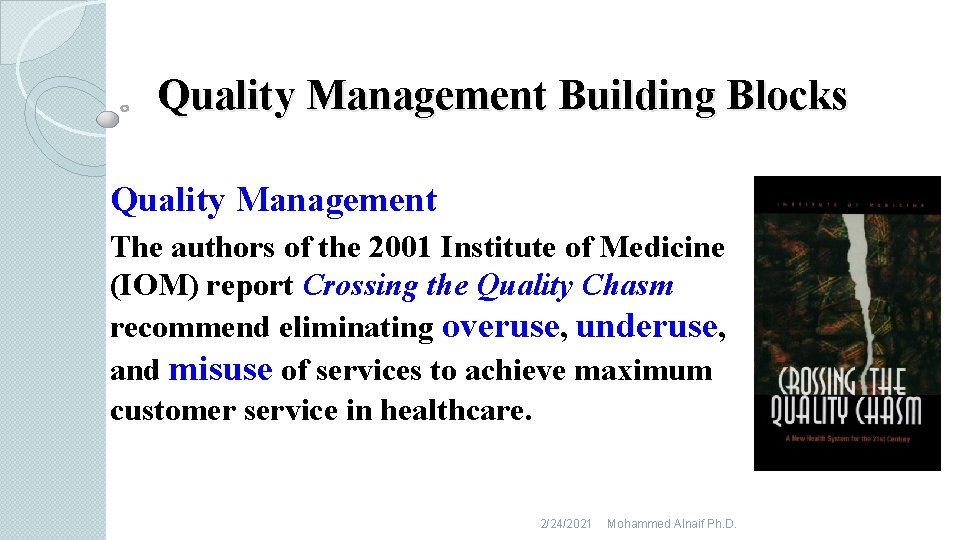
Quality Management Building Blocks Quality Management The authors of the 2001 Institute of Medicine (IOM) report Crossing the Quality Chasm recommend eliminating overuse, underuse, and misuse of services to achieve maximum customer service in healthcare. 2/24/2021 Mohammed Alnaif Ph. D.

Quality Management Building Blocks Quality Management Overuse occurs when a service is provided even though no evidence indicates it will help the patient—for example, prescribing antibiotics for patients with viral infections. § Underuse occurs when a service that would have been medically beneficial to the patient is not provided—for example, performing a necessary diagnostic test. § Misuse occurs when a service is not carried out properly—for example, operating on the wrong part of the patient’s body. § 2/24/2021 Mohammed Alnaif Ph. D.

Quality Management Building Blocks Quality Management Activities Quality management involves measurement, assessment, and improvement of activities people perform almost every day. § Measurement is a collection of information for the purpose of understanding current performance and seeing how performance changes or improves over time. 2/24/2021 Mohammed Alnaif Ph. D.
Quality Management Building Blocks Quality Management Activities Assessment is the use of performance information to determine whether an acceptable level of quality has been achieved. § Improvement is planning and making changes to current practices to achieve better performance. § 2/24/2021 Mohammed Alnaif Ph. D.
Quality Management Building Blocks Quality Management Activities Measure, Assess, and Improve § Healthcare organizations track performance through various measurement activities to gather information about the quality of patient care and support functions. § Results are evaluated in the assessment step by comparing measurement data with performance expectations. 2/24/2021 Mohammed Alnaif Ph. D.
Quality Management Building Blocks Quality Management Activities Measure, Assess, and Improve § If expectations are met, organizations continue to measure and assess performance. § If expectations are not met, they proceed to the improvement phase to investigate reasons for the performance gap and implement changes on the basis of their findings. 2/24/2021 Mohammed Alnaif Ph. D.
Quality Management Building Blocks Quality Management Activities Measure, Assess, and Improve § The quality management cycle does not end at this point, however. § Performance continues to be evaluated through measurement activities. 2/24/2021 Mohammed Alnaif Ph. D.
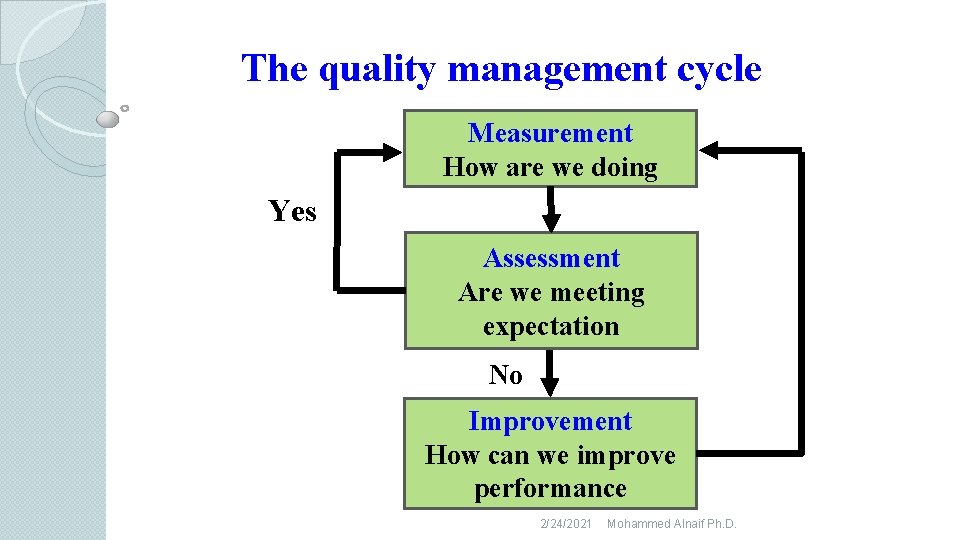
The quality management cycle Measurement How are we doing Yes Assessment Are we meeting expectation No Improvement How can we improve performance 2/24/2021 Mohammed Alnaif Ph. D.
Measuring Performance Measurement How are we doing LEARNING POINT Measurement and Quality Management § Measurement is an element of all quality management activities. § Performance is measured to determine current levels of quality, identify improvement opportunities, and evaluate whether changes have improved performance. 2/24/2021 Mohammed Alnaif Ph. D.
Measuring Performance Measurement How are we doing § Measurement is a tool usually in the form of a number or statistic used to monitor the quality of some aspect of healthcare services. § Performance measures are quantitative tools used to evaluate an element of patient care. § Quality indicators are measures used to determine the organization’s performance over time; also called Performance measures. 2/24/2021 Mohammed Alnaif Ph. D.
Measuring Performance Measurement How are we doing Measurement § The construction of quality measures in HSO’s follows two dimensions; one statistical and the other is conceptual. § The statistical dimension deals with whether the assessment of an individual piece of work results in a count or a score. § A simple example, there might be pass or fail attributes for several elements of a meal tray (diet is as ordered, all items present, neatness okay, etc. ) 2/24/2021 Mohammed Alnaif Ph. D.
Measuring Performance Measurement How are we doing Measurement § Attributes measures are counts of the number of output units processing a certain characteristic divided by the total output count. Typically attributes are “good, ” “survived, ” “accepted, ” “on time, ” “ Appropriate, ” and their opposites. § Attributes counts can be constructed from occurrences of desirable outcomes, example, kilos of clean laundry, discharges by diagnoses. 2/24/2021 Mohammed Alnaif Ph. D.
Measuring Performance Measurement How are we doing Measurement § Variables measures are interval or ratio scores applicable to each unit of output. Typical scores are dimensions (weight of a newborns) and multi-item evaluations (professional examination scores of personnel). § Variables measures yield both a mean and a standard deviation for a given application, introducing the possibility of assessing the variability of a product or a service. 2/24/2021 Mohammed Alnaif Ph. D.
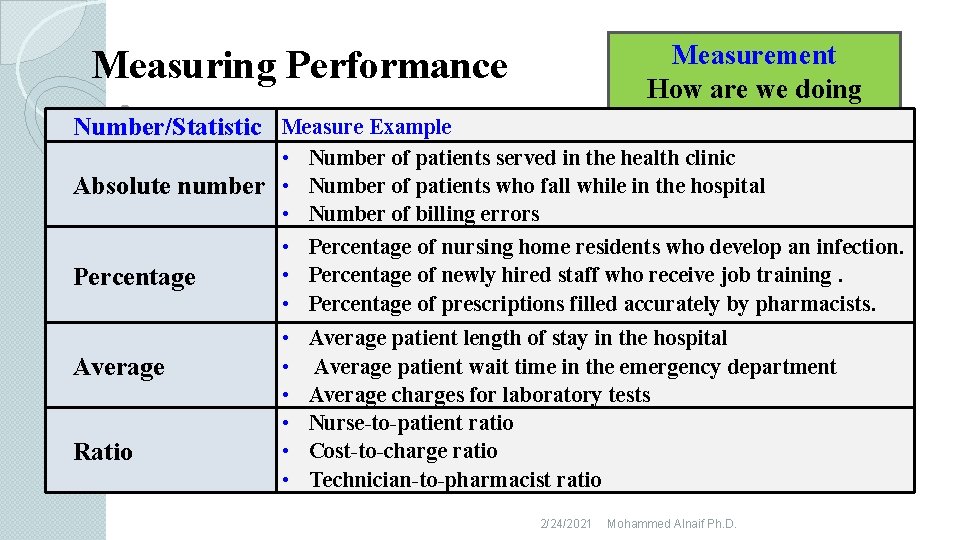
Measurement How are we doing Measuring Performance Number/Statistic Measure Example • Absolute number • • Percentage • Average Ratio • • • Number of patients served in the health clinic Number of patients who fall while in the hospital Number of billing errors Percentage of nursing home residents who develop an infection. Percentage of newly hired staff who receive job training. Percentage of prescriptions filled accurately by pharmacists. Average patient length of stay in the hospital Average patient wait time in the emergency department Average charges for laboratory tests Nurse-to-patient ratio Cost-to-charge ratio Technician-to-pharmacist ratio 2/24/2021 Mohammed Alnaif Ph. D.
Measuring Performance Measurement How are we doing LEARNING POINT Effective Use of Measures § Measurement provides information for quality management purposes. § For the measures to be used effectively, they must be accurate, useful, easy to interpret, and reported consistently. 2/24/2021 Mohammed Alnaif Ph. D.
Measurement How are we doing Measuring Performance Accuracy § Performance measures must be accurate. Accuracy relates to the correctness of the numbers. § For example, in the case study, the time the patient entered the clinic must be precisely recorded on the registration sign-in sheet. Otherwise, the wait time calculation will be wrong. 2/24/2021 Mohammed Alnaif Ph. D.
Measuring Performance Measurement How are we doing § Accuracy also relates to the validity of the measure. Is the measure gathering the information it is supposed to be gathering? § For example, the clinic asks patients to provide feedback on its performance. One question on the feedback form is, “How would you rate the quality of the customer service you’ve received? ” 2/24/2021 Mohammed Alnaif Ph. D.
Measuring Performance Measurement How are we doing Accuracy Each patient who rates the clinic’s customer service may have something different in mind when answering the question. Because of these differences, the feedback is not a valid measure of just one aspect of clinic performance, for example, just the patient registration process. § However, the average customer service rating is a good measure of patients’ satisfaction with overall clinic performance. § 2/24/2021 Mohammed Alnaif Ph. D.
Measuring Performance Measurement How are we doing Usefulness § Performance measures must be useful. Measurement information must tell people something they want to know. § Computers have made data collection easier, but volume and variety do not necessarily translate to relevance. § For instance, the computerized billing system of a health clinic contains patient demographic information (e. g. , age, address, next of kin, insurance coverage). 2/24/2021 Mohammed Alnaif Ph. D.
Measuring Performance Measurement How are we doing Usefulness § The clinic manager could use this information to report several performance measures, such as the percentage of patients with prescription drug insurance benefits or the percentage of patients who live more than 20 miles from the clinic. § Although this information might be interesting, it won’t be helpful for evaluating performance unless it is important or relevant to those using the information. 2/24/2021 Mohammed Alnaif Ph. D.
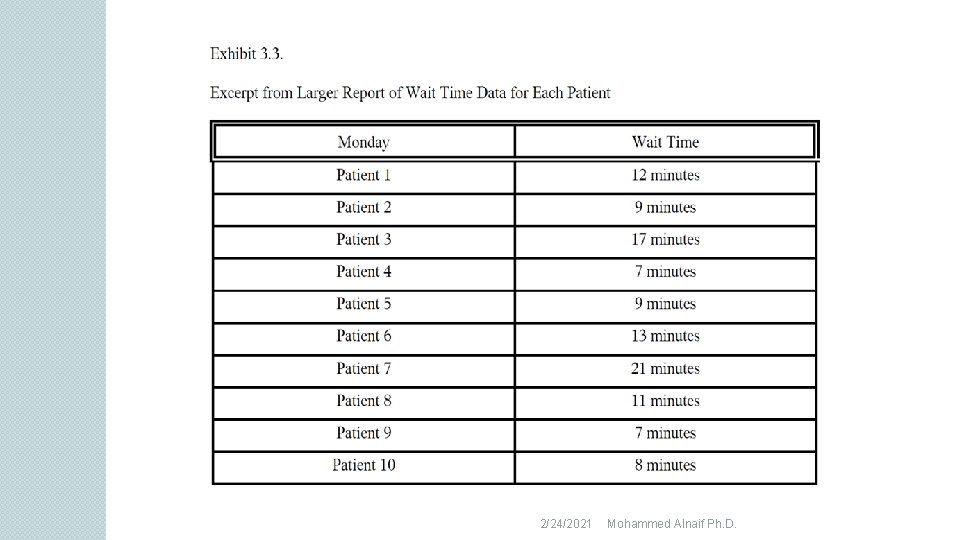
Measurement How are we doing Measuring Performance Ease of Interpretation § Performance measures must be easy to interpret. § Suppose the clinic manager in the case study reported the wait times for each patient on each day of the week. An extract from the report for one day is shown in Exhibit 3. 3. (refer to PDF file PA 509_3) 2/24/2021 Mohammed Alnaif Ph. D.
2/24/2021 Mohammed Alnaif Ph. D.
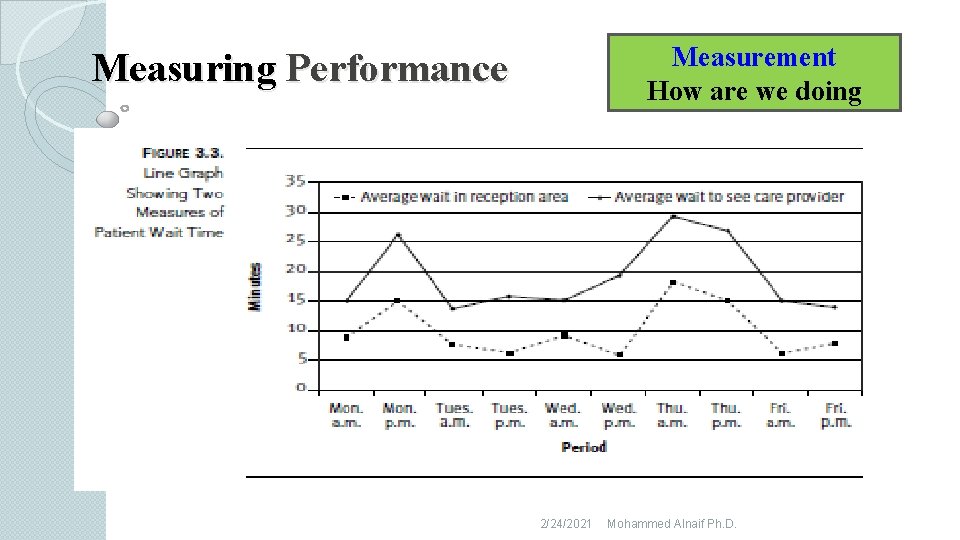
Measurement How are we doing Measuring Performance Ease of Interpretation § The purpose of performance measurement is to provide information, not to make people sort through lots of data to find what they want to know. § For example, using a line graph, the clinic manager can displays the average wait times for the morning and afternoon of each day of the week. § The clinic’s providers can easily identify trends and improvement opportunities from the graph. 2/24/2021 Mohammed Alnaif Ph. D.
Measurement How are we doing Measuring Performance 2/24/2021 Mohammed Alnaif Ph. D.
Measurement How are we doing Measuring Performance Consistent Reporting § Performance measures must be uniformly reported to make meaningful comparisons between the results from one period and the results from another period. § For example, suppose the clinic manager starts calculating patient wait time information differently. A slight change in the way wait times are calculated could dramatically affect performance results. 2/24/2021 Mohammed Alnaif Ph. D.
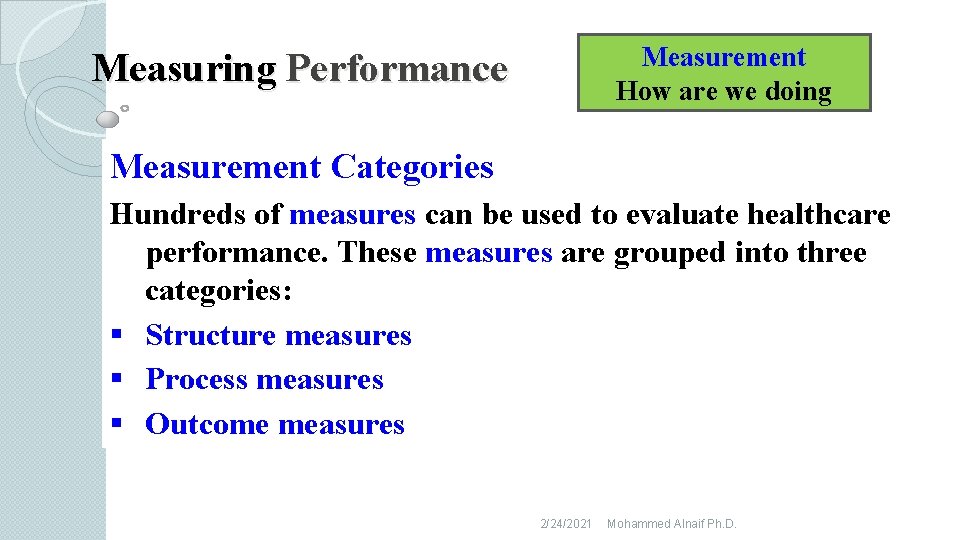
Measurement How are we doing Measuring Performance Measurement Categories Hundreds of measures can be used to evaluate healthcare performance. These measures are grouped into three categories: § Structure measures § Process measures § Outcome measures 2/24/2021 Mohammed Alnaif Ph. D.
Measurement How are we doing Measuring Performance Measurement Categories § Structure refers to characteristics of the individuals who provide care and of the settings where the care is delivered. § These characteristics include the education, training, and certification of professionals who provide care and the adequacy of the facility’s staffing, equipment, and overall organization. 2/24/2021 Mohammed Alnaif Ph. D.
Measurement How are we doing Measuring Performance Measurement Categories § Process is the series of events that takes place during the delivery of care, also can be a basis for evaluating the quality of care. The quality of the process can vary on three aspects: 1. appropriateness, whether the right actions were taken, 2. skill, the proficiency with which actions were carried out, and 3. timeliness of the care. 2/24/2021 Mohammed Alnaif Ph. D.
Measurement How are we doing Measuring Performance Measurement Categories § Outcome measures capture whether healthcare goals were achieved. Because the goals of care can be defined broadly, outcome measures have come to include the costs of care as well as patients’ satisfaction with their care. § In formulations that stress the technical aspects of care, however, outcomes typically refer to indicators of health status, such as whether a patient’s pain subsided or condition cleared up or whether the patient regained full function. 2/24/2021 Mohammed Alnaif Ph. D.
Measurement How are we doing Measuring Performance Measurement Categories Efficacy § A clinical intervention is efficacious if it has been shown to produce a given outcome reliably when other potentially confounding factors are held constant. § Formal clinical trials or similarly systematic, controlled studies typically establish the efficacy of a clinical intervention. § Knowledge about efficacy is crucial to making valid judgments about the quality of care when process or outcome measures are used. 2/24/2021 Mohammed Alnaif Ph. D.
Measurement How are we doing Measuring Performance Measurement Categories Efficacy § If a given clinical intervention was undertaken in circumstances that match those under which the intervention has been shown to be efficacious, one can be confident that the care was appropriate and, to that extent, of good quality. § Conversely, if the outcome of a particular episode of care was poor, one can find out whether it resulted from an inappropriate clinical intervention by determining whether the circumstances under which it took place conformed to those under which the intervention’s efficacy has been demonstrated. 2/24/2021 Mohammed Alnaif Ph. D.
Measurement How are we doing Measuring Performance Measurement Categories § These measurement categories were first conceptualized in 1966 by Avedis Donabedian, MD (1980). His research in quality assessment resulted in a widely accepted health- care measurement model that is still used today. § Donabedian contended that the three measurement categories structure, process, and outcome represent different characteristics of healthcare service. § To fully evaluate healthcare performance, Donabedian recommended that performance in each dimension be measured. 2/24/2021 Mohammed Alnaif Ph. D.
Measurement How are we doing Measuring Performance Measurement Categories v The structure of healthcare is measured to judge the adequacy of the environment in which patient care is provided. v The process of healthcare is measured to judge whether patient care and support functions are properly performed. v Healthcare outcomes are measured to judge the results of patient care and support functions. Performance measures for most products and services would fall into these same categories. 2/24/2021 Mohammed Alnaif Ph. D.
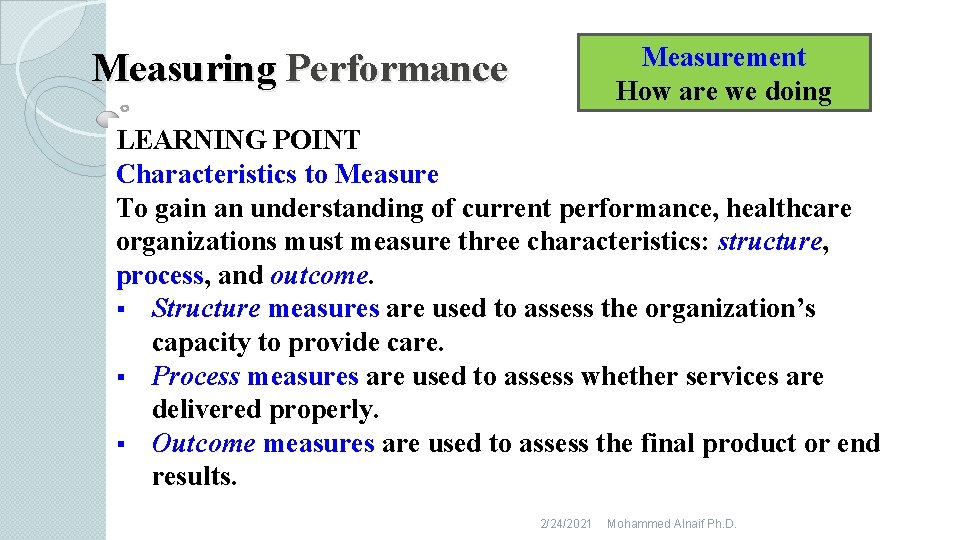
Measurement How are we doing Measuring Performance LEARNING POINT Characteristics to Measure To gain an understanding of current performance, healthcare organizations must measure three characteristics: structure, process, and outcome. § Structure measures are used to assess the organization’s capacity to provide care. § Process measures are used to assess whether services are delivered properly. § Outcome measures are used to assess the final product or end results. 2/24/2021 Mohammed Alnaif Ph. D.
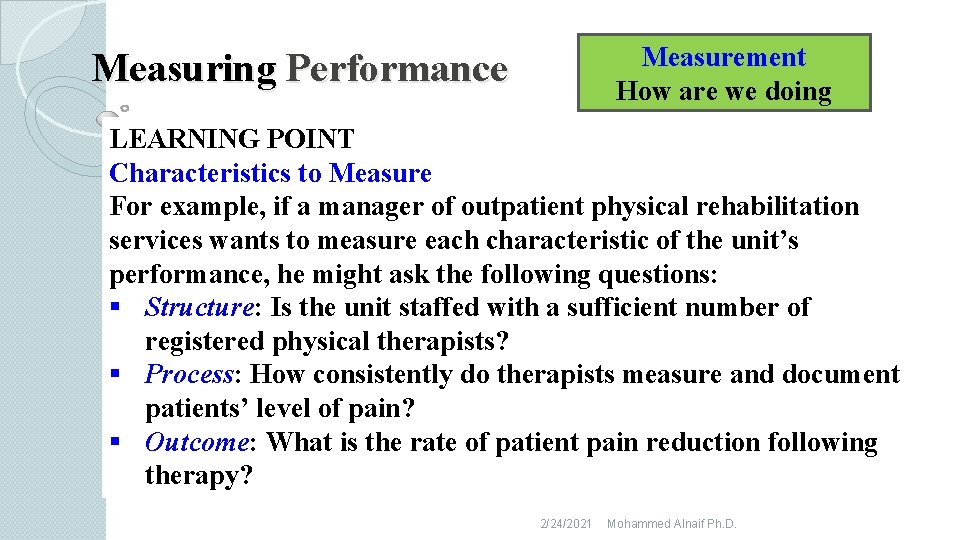
Measurement How are we doing Measuring Performance LEARNING POINT Characteristics to Measure For example, if a manager of outpatient physical rehabilitation services wants to measure each characteristic of the unit’s performance, he might ask the following questions: § Structure: Is the unit staffed with a sufficient number of registered physical therapists? § Process: How consistently do therapists measure and document patients’ level of pain? § Outcome: What is the rate of patient pain reduction following therapy? 2/24/2021 Mohammed Alnaif Ph. D.
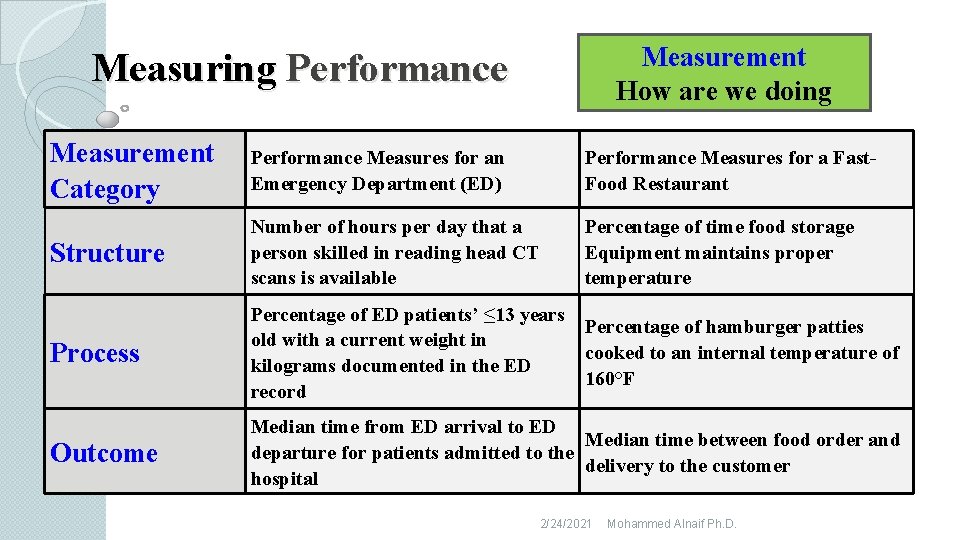
Measurement How are we doing Measuring Performance Measurement Category Performance Measures for an Emergency Department (ED) Performance Measures for a Fast. Food Restaurant Structure Number of hours per day that a person skilled in reading head CT scans is available Percentage of time food storage Equipment maintains proper temperature Process Percentage of ED patients’ ≤ 13 years Percentage of hamburger patties old with a current weight in cooked to an internal temperature of kilograms documented in the ED 160°F record Outcome Median time from ED arrival to ED Median time between food order and departure for patients admitted to the delivery to the customer hospital 2/24/2021 Mohammed Alnaif Ph. D.
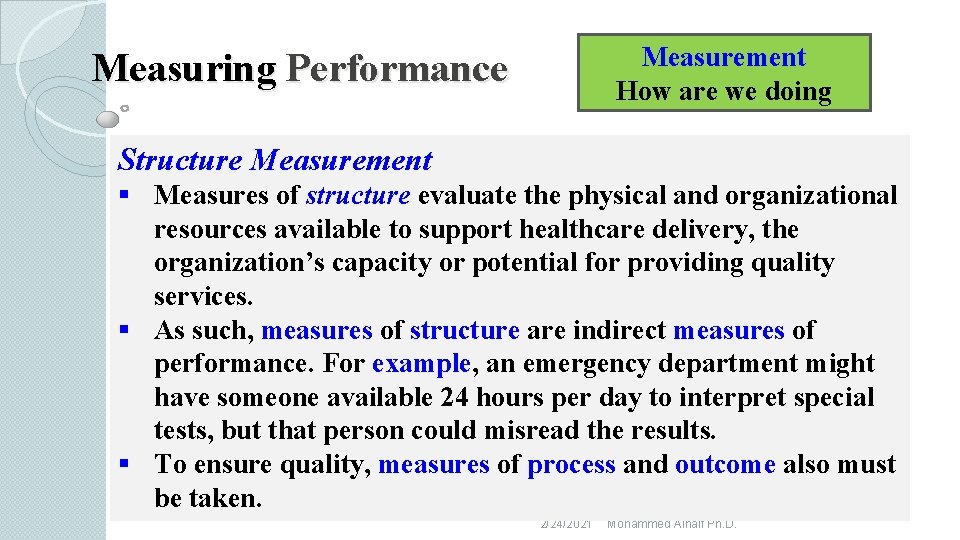
Measurement How are we doing Measuring Performance Structure Measurement § Measures of structure evaluate the physical and organizational resources available to support healthcare delivery, the organization’s capacity or potential for providing quality services. § As such, measures of structure are indirect measures of performance. For example, an emergency department might have someone available 24 hours per day to interpret special tests, but that person could misread the results. § To ensure quality, measures of process and outcome also must be taken. 2/24/2021 Mohammed Alnaif Ph. D.
Measurement How are we doing Measuring Performance Process Measurement § Measures of process evaluate whether activities performed during the delivery of healthcare services are delivered satisfactorily. § For example, if an emergency department has a policy that all patients with confirmed pneumonia receive an antibiotic within two hours of arrival, we would measure caregivers’ compliance with the policy to determine whether their performance is acceptable. 2/24/2021 Mohammed Alnaif Ph. D.
Measurement How are we doing Measuring Performance Process Measurement § In healthcare quality management, process measures are the most commonly used category of metrics. § They provide important information about performance at all levels in the organization. § However, good performance does not automatically translate to good results. § In the previous example, even if all patients with pneumonia receive antibiotics within two hours of arrival in the emergency department, some may not recover. For this reason, another dimension of healthcare quality must be measured. 2/24/2021 Mohammed Alnaif Ph. D.
Measurement How are we doing Measuring Performance Process Measurement § Process measures of quality represent assessments of components of care short of identifiable outcomes. § They can be either variables or attributes measures. § Process measures are defined by establishing a standard of practice; each new patient should have height, weight, and blood pressure recorded; a plan for nursing care should be developed for every patient within 24 hours of admission; all trash cans should be emptied by 3 P. M. 2/24/2021 Mohammed Alnaif Ph. D.
Measurement How are we doing Measuring Performance Outcome Measurement § Measures of outcome evaluate the results of healthcare services, the effects of structure and process. § A common outcome measure is patients’ health status following treatment to determine whether the interventions were successful. § Healthcare facilities also measure patient mortality (death) and complication rates to identify opportunities for improvement. 2/24/2021 Mohammed Alnaif Ph. D.
Measurement How are we doing Measuring Performance Outcome Measurement § In addition, outcome measures are used to evaluate the use of healthcare services. Average length of hospital stay and average cost of treatment are two examples of outcome measures that examine the use of services. § Although measuring health service outcomes is important, the results can be affected by factors beyond providers’ control. 2/24/2021 Mohammed Alnaif Ph. D.
Measurement How are we doing Measuring Performance Outcome Measurement § For example, patient mortality rates at one hospital may be higher than rates at other hospitals because the hospital cares for more terminally ill cancer patients than the others do. This healthcare organization may do all the right things but appears to be an underperformer because of the population it serves. § When evaluating measurement data, many factors affecting patient outcomes must be considered. 2/24/2021 Mohammed Alnaif Ph. D.
Measurement How are we doing Measuring Performance Outcome Measurement § Conceptually the output of a HSO’s unit should be measured in terms of its contribution to the larger goal. § Outcome is an evaluative term, involving some judgement of the utility or contribution of the output to the final output. § They can be either variables or attributes measures, and they tend to have an inherent validity problems. Whenever validity can be reasonably assured, they are the preferred measures. 2/24/2021 Mohammed Alnaif Ph. D.
Measurement How are we doing Measuring Performance Patient experience Measures § Donabedian classified patient satisfaction into the outcome category. § Increased attention to patient-centered healthcare has placed greater emphasis on measuring a wider range of patient experiences. § Patient experience measures are often considered a fourth type of measure, rather than a subset of one of the Donabedian measurement categories. § Measures of patient experience are a combination of process and outcome measures. 2/24/2021 Mohammed Alnaif Ph. D.
Measurement How are we doing Measuring Performance Patient experience Measures § For instance, a survey of hospitalized patients asks if staff always explained medicines before giving them. § The task of explaining medicines to patients is part of the hospital’s medication administration process. § In answering this survey question, patients are providing their perspective on whether this process is working well. § An outcome - related measure on this survey asks if the patient’s pain was always well controlled. 2/24/2021 Mohammed Alnaif Ph. D.
Measurement How are we doing Measuring Performance Selecting Performance Measures § Healthcare organizations use two tiers of measures to evaluate performance: system level measures and activity level measures. § The percentage of health clinic patients who are satisfied with the quality of customer services is an example of a system-level measure. § This measure is a snapshot of overall clinic performance. 2/24/2021 Mohammed Alnaif Ph. D.
Measurement How are we doing Measuring Performance Selecting Performance Measures § Because many activities in a health clinic influence the quality of customer service, performance also needs to be evaluated at the activity level to assess patient satisfaction. § The percentage of time reception staff telephones patients to remind them of upcoming clinic appointments is an example of an activity-level measure. 2/24/2021 Mohammed Alnaif Ph. D.
Measurement How are we doing Measuring Performance Selecting Performance Measures § System-level measures, data describing the overall performance of several interdependent processes or activities. § Activity-level measures, data describing the performance of one process or activity. § A mix of system- and activity-level measures allows a healthcare organization to judge whether overall performance goals are being met and where frontline improvements may be needed. 2/24/2021 Mohammed Alnaif Ph. D.
Measurement How are we doing Measuring Performance Measurement Priorities § The system- and activity-level measures used by a healthcare organization for quality management purposes are influenced by external and internal factors. § On the external side, numerous government regulations, accreditation standards, and purchaser requirements directly affect measurement activities. § The number and type of measures used to evaluate performance vary in proportion to the number of external requirements the organization must meet. 2/24/2021 Mohammed Alnaif Ph. D.
Measurement How are we doing Measuring Performance Measurement Priorities § Externally mandated measurement requirements do not always address all of the organization’s internal quality priorities. § The elements of service an organization wants to measure and the measurement priorities of external groups may differ. 2/24/2021 Mohammed Alnaif Ph. D.
Measurement How are we doing Measuring Performance LEARNING POINT Choosing Measures § Healthcare organizations measure many aspects of performance. § Some of the measures are mandated by external regulatory, licensing, and accreditation groups. § Some are chosen to evaluate performance issues important to the organization. § Some measures serve both purposes; the measure is required by an external group and provides performance information important to the organization. 2/24/2021 Mohammed Alnaif Ph. D.
Measurement How are we doing Measuring Performance Constructing Measures § Creation of performance measures should follow three steps to ensure each measure yields information that is accurate, useful, easy to interpret, and consistently reported: § Identify the topic of interest. § Develop the measure. § Design the data collection system. § These steps can be time consuming but are essential to ensuring that the measures are useful for quality management purposes. 2/24/2021 Mohammed Alnaif Ph. D.
Measurement How are we doing Measuring Performance Identify the Topic of Interest § The first step to constructing a performance measure is to determine what you want to know. Consider just one function for example, taking patient X-rays in the radiology department. This function involves several steps: 1. The patient’s doctor orders the X-ray exam. 2. The radiology department schedules the exam. 3. The patient registers on arrival in the radiology department. 4. The X-ray exam is performed. 5. The radiologist interprets the X-rays. 6. The radiologist informs the patient’s doctor of the X-ray results 2/24/2021 Mohammed Alnaif Ph. D.
Measurement How are we doing Measuring Performance Develop the Measure § To select performance measures for X-ray procedures, consider IOM’s (2001) six dimensions of healthcare quality and the corresponding performance questions listed in Exhibit 3. 9. § Answers to these questions can help the radiology department gauge it’s performance in each quality dimension. § The department will determine which quality characteristics it will need to measure regularly and which questions will provide the most useful answers for measurement purposes. 2/24/2021 Mohammed Alnaif Ph. D.
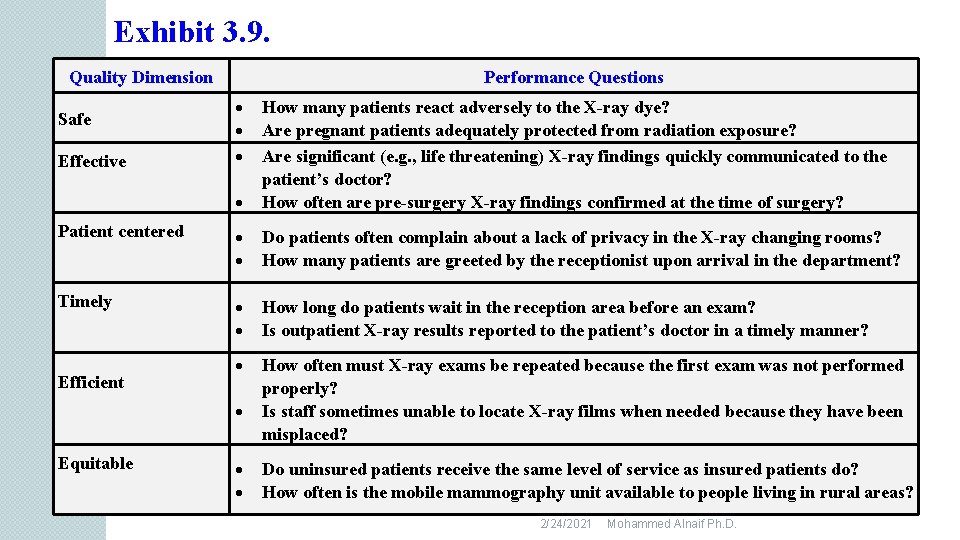
Exhibit 3. 9. Quality Dimension Performance Questions Effective How many patients react adversely to the X-ray dye? Are pregnant patients adequately protected from radiation exposure? Are significant (e. g. , life threatening) X-ray findings quickly communicated to the patient’s doctor? How often are pre-surgery X-ray findings confirmed at the time of surgery? Patient centered Do patients often complain about a lack of privacy in the X-ray changing rooms? How many patients are greeted by the receptionist upon arrival in the department? How long do patients wait in the reception area before an exam? Is outpatient X-ray results reported to the patient’s doctor in a timely manner? How often must X-ray exams be repeated because the first exam was not performed properly? Is staff sometimes unable to locate X-ray films when needed because they have been misplaced? Safe Timely Efficient Equitable Do uninsured patients receive the same level of service as insured patients do? How often is the mobile mammography unit available to people living in rural areas? 2/24/2021 Mohammed Alnaif Ph. D.
Measurement How are we doing Measuring Performance Develop the Measure § Once performance questions have been identified, the next step is to define the measures that will be used to answer the questions. § The performance measure should be written in fundamental measurement units, the manager is able to identify the data she needs to generate the measure. 2/24/2021 Mohammed Alnaif Ph. D.
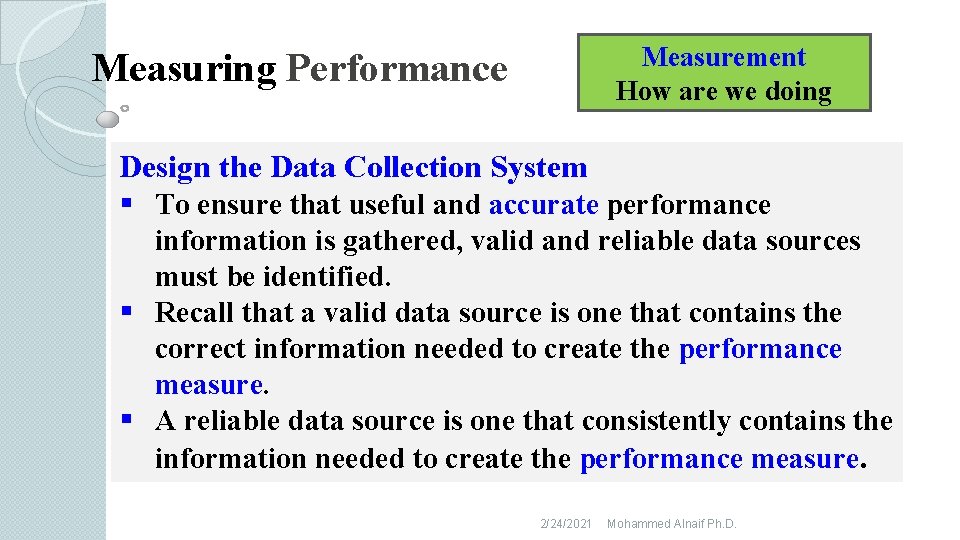
Measurement How are we doing Measuring Performance Design the Data Collection System § To ensure that useful and accurate performance information is gathered, valid and reliable data sources must be identified. § Recall that a valid data source is one that contains the correct information needed to create the performance measure. § A reliable data source is one that consistently contains the information needed to create the performance measure. 2/24/2021 Mohammed Alnaif Ph. D.
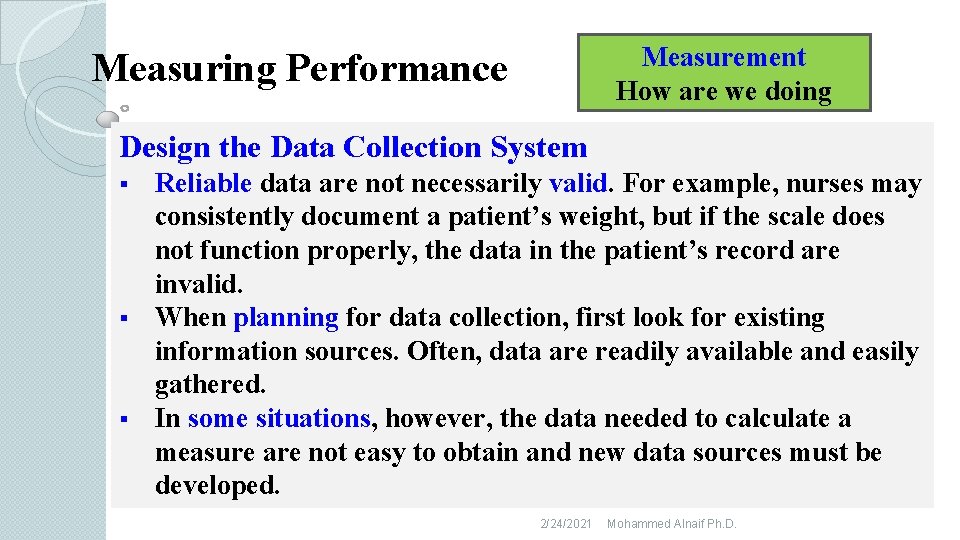
Measurement How are we doing Measuring Performance Design the Data Collection System § § § Reliable data are not necessarily valid. For example, nurses may consistently document a patient’s weight, but if the scale does not function properly, the data in the patient’s record are invalid. When planning for data collection, first look for existing information sources. Often, data are readily available and easily gathered. In some situations, however, the data needed to calculate a measure are not easy to obtain and new data sources must be developed. 2/24/2021 Mohammed Alnaif Ph. D.
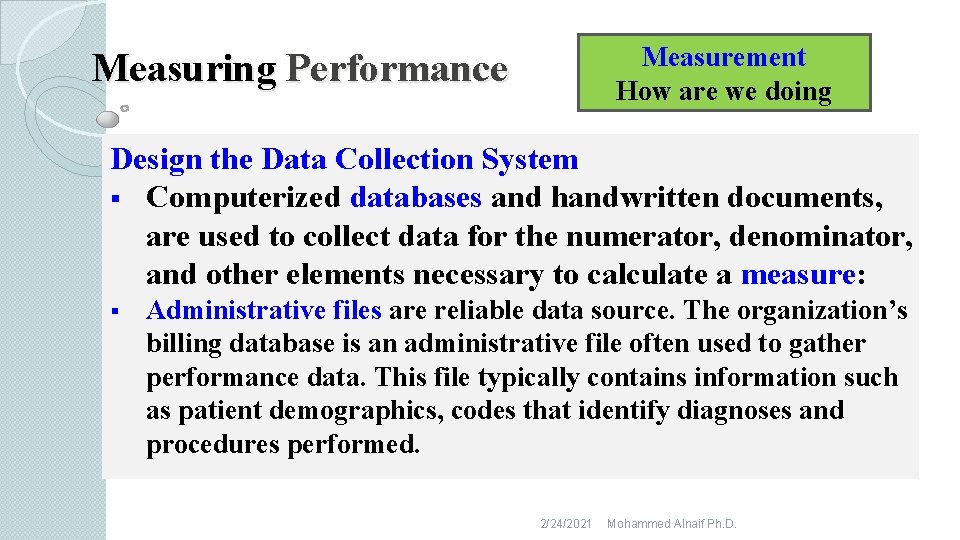
Measurement How are we doing Measuring Performance Design the Data Collection System § Computerized databases and handwritten documents, are used to collect data for the numerator, denominator, and other elements necessary to calculate a measure: § Administrative files are reliable data source. The organization’s billing database is an administrative file often used to gather performance data. This file typically contains information such as patient demographics, codes that identify diagnoses and procedures performed. 2/24/2021 Mohammed Alnaif Ph. D.
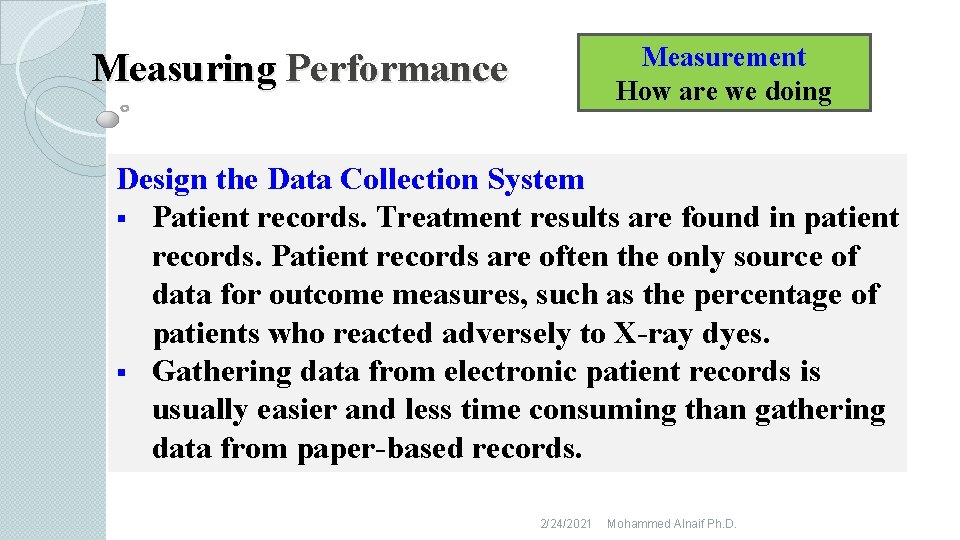
Measurement How are we doing Measuring Performance Design the Data Collection System § Patient records. Treatment results are found in patient records. Patient records are often the only source of data for outcome measures, such as the percentage of patients who reacted adversely to X-ray dyes. § Gathering data from electronic patient records is usually easier and less time consuming than gathering data from paper-based records. 2/24/2021 Mohammed Alnaif Ph. D.
Measurement How are we doing Measuring Performance Design the Data Collection System § Miscellaneous business and clinical information. Performance measurement data may also be available from patient and employee surveys; patient care logs maintained by clinics and emergency departments; and the results of special studies, such as observation reviews that evaluate compliance with patient care requirements. 2/24/2021 Mohammed Alnaif Ph. D.
Measurement How are we doing Measuring Performance Design the Data Collection System § § Any data source has advantages and drawbacks to its use. For example, patient databases used by pharmacies and health insurance companies may lack pertinent clinical details. Patient records may also lack information needed to measure quality. For instance, patient records used by clinics usually include the names of prescribed medications but do not include documentation confirming that the physician counseled the patient about the medication’s side effects. 2/24/2021 Mohammed Alnaif Ph. D.
Measurement How are we doing Measuring Performance Design the Data Collection System The data-gathering process must be carefully planned so that the information derived will be accurate and useful. § To design the data collection system, a manager must make four more decisions, addressing the what, who, when, and how of data collection. § What refers to the population that will be measured. Will the denominator represent a sample of the population to be measured or the entire population? § 2/24/2021 Mohammed Alnaif Ph. D.
Measurement How are we doing Measuring Performance Design the Data Collection System § Who refers to the data collectors. Will the manager gather all data needed for performance measurement purposes? Will employees be asked to collect some data? Will information specialists in the organization be asked to retrieve data from clinical or administrative databases? § If more than one person is responsible for data collection, how will the collectors ensure they are gathering data consistently (i. e. , demonstrating interrater reliability)? 2/24/2021 Mohammed Alnaif Ph. D.
Measurement How are we doing Measuring Performance Design the Data Collection System Interrater Reliability § Probability that a measurement is free from random error and yields consistent results regardless of the individuals gathering the data. § For example, a measure with high interrater reliability means that two or more people working independently will gather similar data. 2/24/2021 Mohammed Alnaif Ph. D.
Measurement How are we doing Measuring Performance Design the Data Collection System § When refers to the frequency of data collection and reporting. § How often will information be gathered? § How frequently will performance measure results be reported? § What are the cost implications of different data collection and reporting intervals? 2/24/2021 Mohammed Alnaif Ph. D.
Measurement How are we doing Measuring Performance Design the Data Collection System § How refers to the process used to gather data. § Several methods can be used to retrieve information for performance measures, including questionnaires, observations, electronic database queries, reviews of paper documents, and check sheets. 2/24/2021 Mohammed Alnaif Ph. D.
Measurement How are we doing Measuring Performance LEARNING POINT Evidence-Based Clinical Measures § Many performance measures that healthcare organizations use for quality management purposes are similar to those found in other service industries. § One aspect of healthcare not found in most service industries is the clinical decision-making process, which must be evaluated with performance measures derived from clinical practice guidelines developed by medical professional groups. These measures are referred to as evidence-based measures. 2/24/2021 Mohammed Alnaif Ph. D.
Measurement How are we doing Measuring Performance Measures of Clinical Decision Making § Healthcare organizations measure both the service aspects of performance and the quality of clinical decision making. § The same principles of measurement applicable to the service aspects of healthcare also apply to clinical decision making. § Process measures are used to determine whether clinicians are making the right patient management choices. § Outcome measures are used to evaluate the results of those choices. 2/24/2021 Mohammed Alnaif Ph. D.

Thank you 2/24/2021 Mohammed Alnaif Ph. D.
- Slides: 73