9262020 STUDYING SOCIAL LIFE Introductory Sociology Instructor Ed




- Slides: 126
9/26/2020 STUDYING SOCIAL LIFE Introductory Sociology Instructor: Ed Brent Copyright (c) 2000, Edward Brent 1
9/26/2020 DEVIANCE & SOCIAL CONTROL Introductory Sociology Instructor: Ablo Bah Copyright (c), 2016 Ablo 2
OVERVIEW Types of Crime Social Control 9/26/2020 Deviance The Criminal Justice System Theories of Deviance 3
• Salt Lake City, Utah. January 26, 1996. Shortly after midnight, John Taylor was taken at gunpoint to a large enclosed courtyard and forced to sit in a chair. His hands were handcuffed behind his back and a blindfold was placed over his eyes. Then, just a few minutes past midnight, five men aimed their rifles at a target placed just over his heart and fired. Taylor was dead within minutes. • Half a world away in Singapore it is about 5 PM as a visiting American female tourist is hurrying to complete a day of shopping. At the last store she visits, she uses the public restroom and fails to flush the toilet. • Which of these acts is a crime? Who should receive the most severe punishment: the men who killed John Taylor or the untidy tourist? 9/26/2020 Where’s the Crime? 4
Q 1: Which is the crime 1 - The killing of John Turner 2 - Not flushing a public toilet 9/26/2020 Which act is more of a criminal offense? 5
• If you said the men, you were wrong. The tourist gets fined; the five men go home without punishment, either that night or any other, because they committed no crime. 9/26/2020 “Killed” but not “Murdered” • John Taylor was “killed” but he was not “murdered. ” Killing is an act. Murder is a crime. Executing a convicted murder is not a crime, which is precisely what happened to John Taylor had been convicted in 1989 of killing and 11 -year-old child, Charla King. He is one of only two people executed in the United States by firing squad since the reinstatement of the death penalty in 1976. 6
• Singapore has very strict laws regarding deviance and stiff fines for things we would think of as minor annoyances, such as chewing gum or littering. • 1994, an American teenager was caned in Singapore for vandalizing cars. 9/26/2020 And what of the Singapore tourist? • Caning is what many in the United States regard as a barbaric punishment—slashing someone with a cane that breaks the skin and raises huge welts requiring days or weeks to heal and usually leaving permanent scars. • She should learn to read. • Just above the toilet was 7
These examples raise a number of important themes we will consider in this chapter, including • Deviance is Relative • Deviance is Socially constructed • How do we exercise social control? • How do we decide when an act is deviant? • Who decides what is a crime, and how severely it should be punished? 9/26/2020 Themes 8
DEVIANCE a group, society, or one's peers. • Since norms vary with the situation, deviance also varies • • • 9/26/2020 • Deviance is behavior violating the norms or standards of By culture Over time With the situation 9
• Appropriate sexual behavior • The Pokot people in northwest Kenya expect both husband wife will reach orgasm and if husband fails to please wife he may be punished. 9/26/2020 Deviance Varies by Culture • If failure to please the wife is thought to be due to adultery (a common event) the wife will enlist the help of women friends to tie the husband up while he is sleeping, then shout obscenities at him, beat him, and slaughter and eat his favorite ox before releasing him. • Suicide • In most societies suicide is considered deviant. But in traditional Japanese society, hari-kiri (ritual disembowelment) is expected of disgraced leaders or noblemen. - Edgerton (1976) 10
Deviance Varies Over Time • • • banned as deviant behavior in 14 states in the early 1900 s Regarded positively in the 1950 s when those laws were rescinded Now smoking is once again regarded as deviant behavior and is banned in many circumstances • homosexuality • • 9/26/2020 • Smoking once considered a mental disorder Now a lifestyle choice, no longer considered a mental disorder by most official policies of psychological and psychiatric associations • Sex outside of marriage • • considered deviant in the first half of the 20 th century 1960 s sexual revolution changed our views AIDs scare since the 1980 s once again discouraged it Now more common than ever 11
• Nudity 9/26/2020 Deviance Varies with Situation most of us would probably feel rather uncomfortable and embarrassed to be nude in public or semi-public settings. • Yet, people in nudist camps not only appear nude in front of unrelated people of both sexes but carry on otherwise normal daily activities such as having meals, playing games, and even discussing the weather (Weinberg, 1976). • Drunkenness • • • in some societies, violence is common after alcohol consumption, while in other societies, lewdness and fun is more likely. Even when violence occurs it varies from one culture to the next. In one society drunken aggression is directed only at carefully chosen victims, while in another society, violence only occurs after any potentially fatal weapons have been set aside. 12
CRIME AND CRIME STATISTICS crime • A is a violation of criminal law for which formal sanctions may be applied by some governmental authority. • To understand the significance of crime in the United States today, we’ll examine • • • 9/26/2020 • The most serious kinds of deviance are crimes. common crime statistics Types of crime The criminal justice system 13
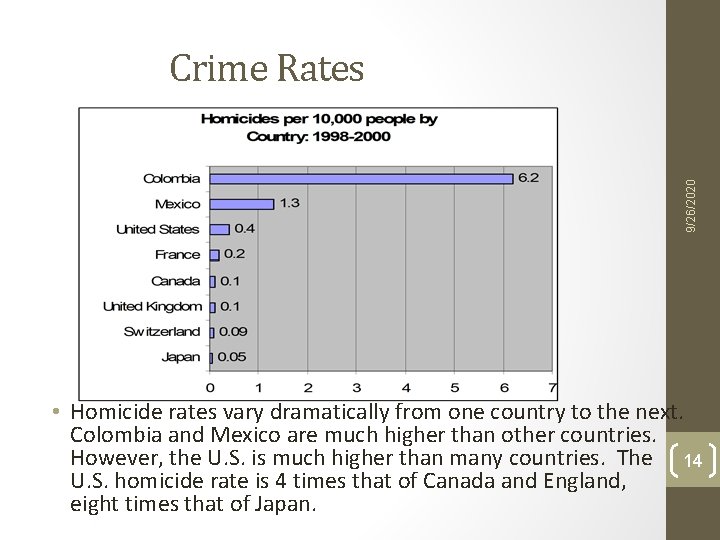
9/26/2020 Crime Rates • Homicide rates vary dramatically from one country to the next. Colombia and Mexico are much higher than other countries. However, the U. S. is much higher than many countries. The 14 U. S. homicide rate is 4 times that of Canada and England, eight times that of Japan.
• The Federal Bureau of Investigation provides annual statistics on only 29 categories of crimes and focuses on eight "index crimes—crimes used by the FBI as summary measures of overall crime rates. " • Index crimes – eight crimes FBI uses to summarize crime rates 9/26/2020 Types of Crimes • crimes against persons - the threat of injury or force against people, including aggravated assault, robbery, forcible rape, and murder; and • crimes against property - stealing or damaging property, including larceny/theft, burglary, motor vehicle theft, and arson. 15
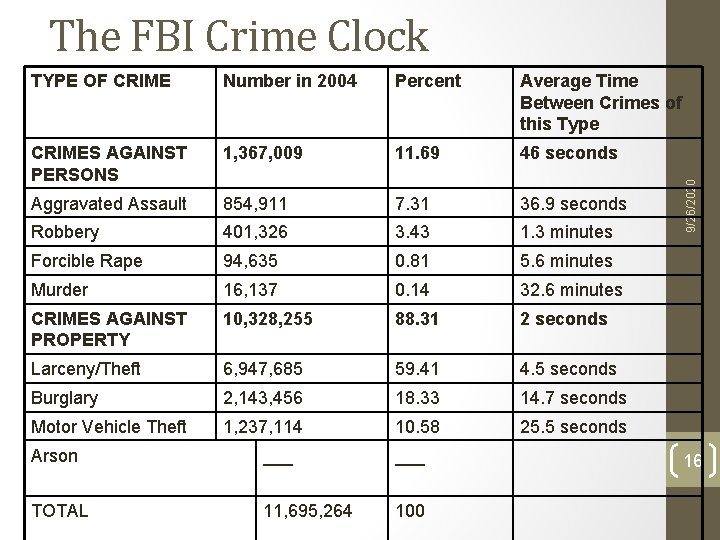
TYPE OF CRIME Number in 2004 Percent Average Time Between Crimes of this Type CRIMES AGAINST PERSONS 1, 367, 009 11. 69 46 seconds Aggravated Assault 854, 911 7. 31 36. 9 seconds Robbery 401, 326 3. 43 1. 3 minutes Forcible Rape 94, 635 0. 81 5. 6 minutes Murder 16, 137 0. 14 32. 6 minutes CRIMES AGAINST PROPERTY 10, 328, 255 88. 31 2 seconds Larceny/Theft 6, 947, 685 59. 41 4. 5 seconds Burglary 2, 143, 456 18. 33 14. 7 seconds Motor Vehicle Theft 1, 237, 114 10. 58 25. 5 seconds Arson ___ TOTAL 11, 695, 264 100 9/26/2020 The FBI Crime Clock 16
• Felonies - more serious crimes punishable by a year or more imprisonment • E. g. , rape, murder, or assault 9/26/2020 More Types of Crimes • Misdemeanors - less serious crimes punishable by imprisonment for less than a year • E. g. , public drunkenness, speeding, or shoplifting • Street crimes - crimes that often occur in public settings. Street crimes are routinely reported by the Federal Bureau of Investigation and often given attention in the media 17
White-Collar Crimes collar workers usually in the course of conducting their daily business activities and are usually possible only because of the social statuses (particularly occupations) they occupy. 9/26/2020 • white-collar crimes - crimes committed by relatively affluent white- • E. g. , price fixing, illegal rebates, embezzlement, bribery of a corporate customer, insider trading, toxic pollution, false advertising, fraud, and tax evasion. • White-collar crimes also include permitting hazardous working conditions leading to the death of employees (Chambliss, 1988). • White-collar criminals are extremely harmful to society. Yet, due to their favorable class position, compared to other criminals, white-collar criminals are treated far more leniently. 18
• Status offenses are crimes only because of the “status” of the people who commit them. • illegal aliens who work without the proper visa • Blacks Under segregationist Jim Crow laws in the South • Juveniles who engage in underage drinking, driving, or breaking a curfew 9/26/2020 Status Offenses 19
• Organized crime - crimes committed by a collection of criminals who regulate criminal behavior among themselves 9/26/2020 Organized Crime & Political Crimes • They sometimes allocate particular geographic regions or particular types of criminal activities (e. g. , gambling, prostitution, drugs, pornography, or loan-sharking) to specific groups • Political crimes are crimes committed within or direct against a political system • Terrorism • Voter fraud • Violations of campaign laws 20
• Crimes against social order or crimes against morality are actions viewed as immoral acts. These include gambling, prostitution, illegal drug use, and public drunkenness. • These are sometimes called victimless crimes because they may not impose suffering on others. 9/26/2020 Victimless Crimes 21
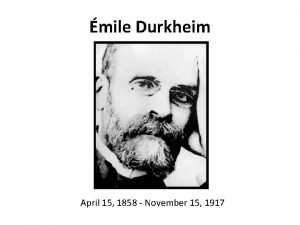
• Social control - the methods used for regulating human behavior in a society • There are several common types of social control. The most pervasive and most effective form of social control in a society, surprisingly, is internalized social control. • Internalized social control is exerted on the individual in terms of the norms, values, and beliefs that they adopt as they are socialized into a society. • Durkheim argued that much of the social control that occurs in societies becomes almost invisible because it takes the form of internalized social control in which members of the society behave in a manner consistent with the norms of the larger society. 9/26/2020 REACTIONS TO DEVIANCE: SOCIAL CONTROL 22
• Durkheim believed society is both something that exists apart from us as individuals and is also within us (Durkheim, 1924). • Collective consciousness - the shared norms, values, and beliefs of a society 9/26/2020 Collective Consciousness • Individuals internalize the norms, values, and beliefs of society and those shape the individual’s personality and constrain their behavior. • People within the same society come to share many ideas, often agreeing on what they should do in various circumstances and on what is important and right. • This is what you experienced when you violated a norm earlier. 23
• When internal social control fails, a wide range of informal negative sanctions serve to remind the individual of societal expectations and reinforce those norms. • Negative sanctions are actions directed at a person with the intent of punishing him or her for some deviant behavior. 9/26/2020 Informal Social Control: Negative Sanctions • A glare from your mother when you use your hands for eating • the honk of a horn from the motorist you just cut off, • the “shhhh” from others when you talk in a theater • Two of the more severe forms of informal negative sanctions are ostracism and stigmatization. 24
Ostracism and Stigmatization • Ostracism —the exclusion or banning of a person from the normal activities of a group. • An ostracized person may be ignored, forbidden to talk, eat, or in other ways interact with group members. • Some religious subcultures such as the Amish use this form of negative sanction. 9/26/2020 Two examples of negative sanctions • Stigmatization -- the person is viewed as somehow socially unacceptable or disgraced. • For example, at different times in some parts of the United States people might be stigmatized because of their religion or race, because of a physical deformity or limitation such blindness, or because of a mental disorder or disease such as AIDS. 25
• Richard Lee (1969) describes how informal mechanisms of social control used by the !Kung Bushmen in the Kalahari Desert can be very effective even with no written laws and no formal punishment. 9/26/2020 Social Control in the Kalahari Desert • Lee describes how, as a gesture of friendship to the people he was studying, several days in advance, he purchased an ox to be slaughtered and shared at the Christmas feast. • How do you think they responded to this act? 26
• He immediately found himself belittled and insulted as one Bushman after another commented on how old and bony the ox was and how it would be inadequate for the feast. • This kept up for days, practically ruining the feast for him. • At one point he became so discouraged he almost left the camp to spend Christmas alone. • It was only after the ox was butchered and the people obviously enjoyed it immensely that Lee had the courage to ask why people were insulting the ox and him so viciously. 9/26/2020 Their Response. . . • What do you think they said? 27
• Because theirs is a hunting-and-gathering society in which people depend for their subsistence everyday on the food killed by hunters, it is important for their society both that the hunters share the meat with everyone and that individual hunters not become so arrogant and prideful. 9/26/2020 Why? • As one of Lee’s informants put it, • “. . . when a young man kills much meat he comes to think of himself as a chief or a big man, and he thinks of the rest of us as his servants or inferiors. We can’t accept this. We refuse one who boasts, for someday his pride will make him kill somebody. So we always speak of his meat as worthless” (Lee, 1969). 28
• Many of us might expect that social control has completely broken down in a place where people of both sexes and all ages run around with no clothes on. • However, nothing could be further from the truth. • Martin Weinberg (1976) describes strategies of informal social control used in nudist camps, portraying a situation in which, if anything, there is greater social control than normal rather than less social control. • Though violating a taboo of the larger culture, nudists generally see themselves as respectable people who just happen to reject one antiquated and useless tradition. 9/26/2020 Social Control in Nudist Camps 29
Situated Morality 9/26/2020 • Weinberg shows how nudists use a rigid system of rules regarding behavior to create, sustain, and enforce a situated morality. • situated morality —a view of what is morally correct that they recognize is limited to people in that situation and is widely rejected by the larger society. • This situated morality holds that nudity should be neither shameful nor erotic, but a routine and unremarkable event hardly worthy of notice. • Although people are naked, everyone goes to great lengths to act as though everyone had their clothes on. • To maintain and preserve the separation of nudity and sexuality, nudists only permit people to enter and stay in nudist camps who share this view, and they have strict rules forbidding staring, talking about sex, body contact, dancing while nude, and alcoholic beverages. • The norm is to act as though other people are not nude and not pay any more attention to them than normal. 30
• Sunglasses are usually not worn because people may think you are hiding behind them to stare. • Cameras are usually not permitted, and if allowed (such as for nudist magazine photographers) the photographer is expected to take pictures only with people’s permission and to photograph people in a manner that deemphasizes sexuality. • For example, one nudist magazine photographer would not let women look into the camera (“It looks too suggestive”). • None of these norms are expressed as laws requiring formal sanctions • Rather they are enforced through a combination of informal and formal means, with other camp members teasing, criticizing, and cajoling violators, and with serious violations reported to the camp authorities who can exercise the ultimate penalty of forcing the offender to leave the camp. 9/26/2020 How to Be a Nudist 31
• As Inciarti reached up in the dark to get something from the hat rack he was startled as a dismembered human hand brushed his cheek. Did he rush away in panic? Did he call the police? Did he cry out in terror to his sleeping friends only footsteps away? No, he merely concluded that someone was sneaking the hand in as a late-night snack. He silently put it back in place and went back to bed. 9/26/2020 Give the Man a Hand 32
• Inciarti was one of the surviving members of an amateur rugby team from Uruguay that had been in a plane crash in the Andes and would eventually survive 70 days in the frozen mountains before help would arrive. • They crashed with little food on board, it was clear they were not going to be rescued soon, and their only hope of survival was to eat the bodies of the dead. • They had argued for days about whether it was more immoral to eat the dead or to die perhaps without need. 9/26/2020 Why on Earth? 33
How to Eat a Dead Body. . . 9/26/2020 • That they finally began to eat the dead bodies and the manner in which they did so tell us a lot about social life. • They did not just abandon all norms of behavior, but instead substituted different norms that would govern their behavior in this admittedly very difficult and trying circumstance. For example, their rules included · · No one had to eat human flesh if they did not want to. They would not eat the women. They first ate the crew who were strangers to them. Some bodies, such as those of a sister or brother, were off limits. No one had to eat a friend or relative. 34
More Rules for Eating Dead Bodies 9/26/2020 · Meat was rationed, with limited amounts allocated to each person and more to people who performed important tasks such as carving up the bodies (a distasteful task) or those preparing to set out on foot to find help. · One corpse would always be finished before another was started. · Certain parts of the body were not to be eaten—such as the head, the skin, and the genitals. (Read, 1974; 35 Henslin, 1991).
So What Does This Mean? 9/26/2020 • Admittedly, these rules seem bizarre and grotesque to us, and clearly they were troubling to the survivors. • But they were, after all, rules for behavior for a uniquely unfortunate situation. These rules represent a situated morality, providing guidance for appropriate and moral behavior in very difficult circumstances, and a morality not intended to be applied elsewhere. • These survivors were no longer surprised to see their friends eat human flesh in front of them, but would probably have thought their friends ill or mad if they had suddenly taken off all their clothes and walked around as if nothing was unusual. • Yet just the reverse would have occurred in a nudist camp, where walking around nude and acting as though you have your clothes on is perfectly natural, but eating human flesh would certainly have given people pause. 36
• Both situations have their own set of norms for what is appropriate in that situation, but they differ dramatically. • In each situation there are some things which are defined as deviant acts that will generally not be tolerated, while other actions are not considered deviant. • The fact that acts defined as deviant vary so dramatically from one situation to the next highlights the amazing extent to which social reality is constructed and defined by the people in the situation rather than an objective reality independent of people and circumstances. 9/26/2020 The Social Construction of Reality 37
9/26/2020 CRIMINAL JUSTICE SYSTEM 38
THE CRIMINAL JUSTICE SYSTEM • passing laws forbidding or requiring certain forms of action • specifying penalties for people who do not comply. 9/26/2020 • The criminal justice system is a formal method of social control. • Formal methods of social control include • the criminal justice system is influenced by the broader society • The public and news media respond to events and influence • whether crime is seen as an important problem • which kinds of crimes are of greatest concern 39
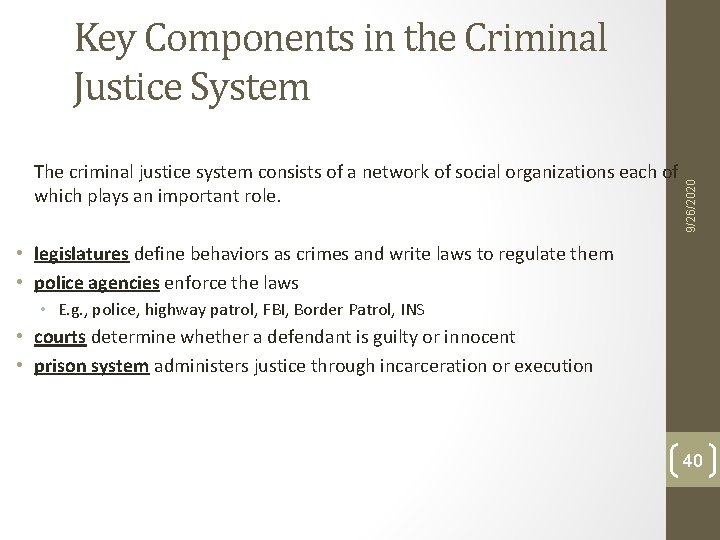
The criminal justice system consists of a network of social organizations each of which plays an important role. 9/26/2020 Key Components in the Criminal Justice System • legislatures define behaviors as crimes and write laws to regulate them • police agencies enforce the laws • E. g. , police, highway patrol, FBI, Border Patrol, INS • courts determine whether a defendant is guilty or innocent • prison system administers justice through incarceration or execution 40
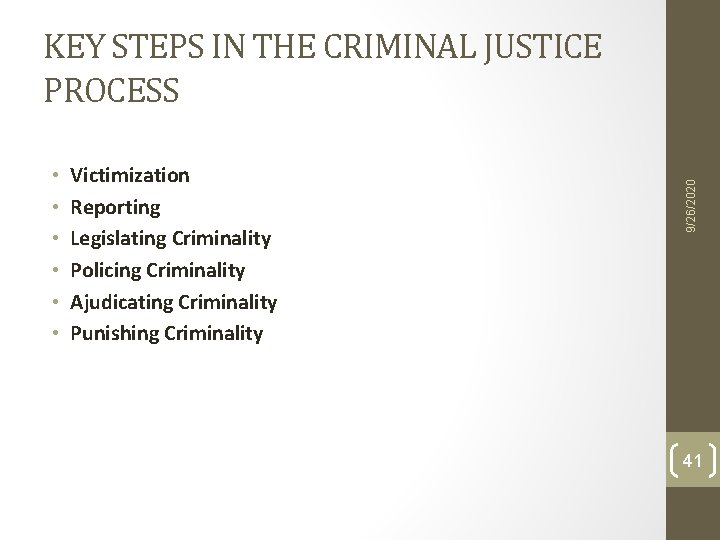
• • • Victimization Reporting Legislating Criminality Policing Criminality Ajudicating Criminality Punishing Criminality 9/26/2020 KEY STEPS IN THE CRIMINAL JUSTICE PROCESS 41
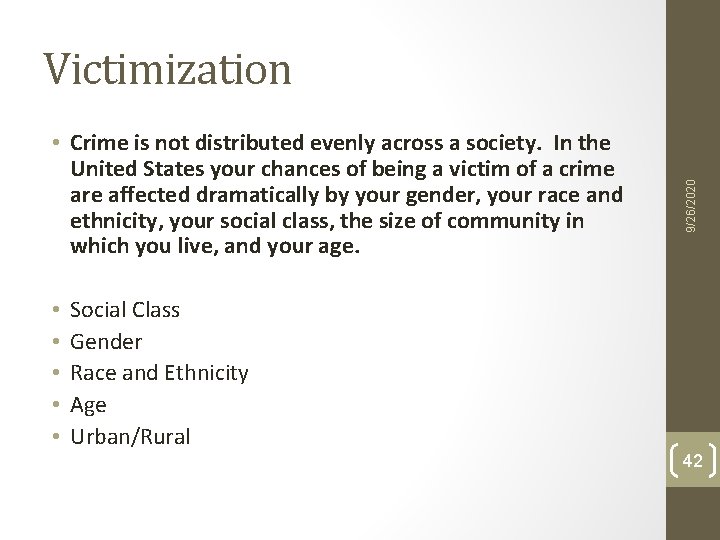
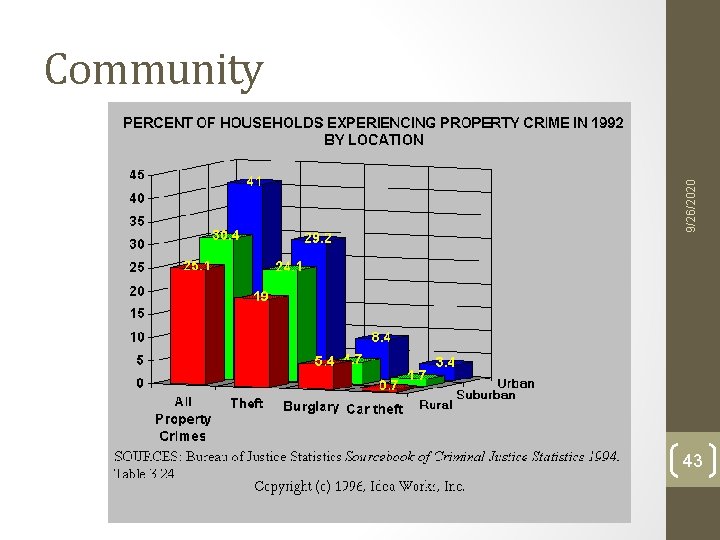
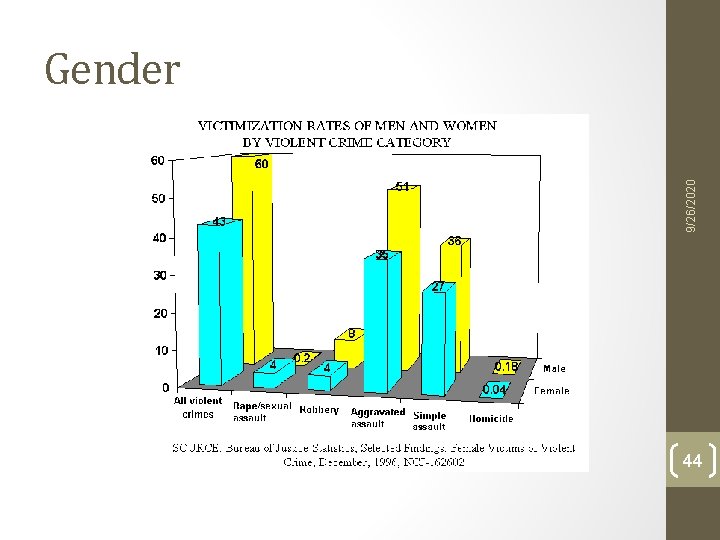
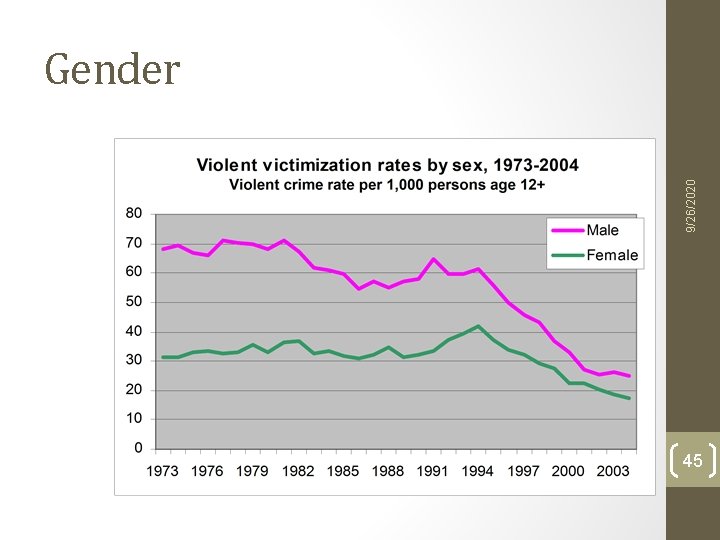
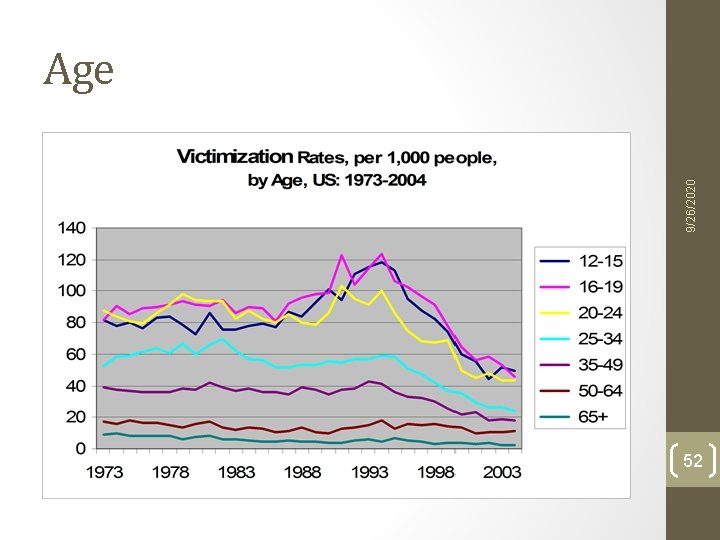
• Crime is not distributed evenly across a society. In the United States your chances of being a victim of a crime are affected dramatically by your gender, your race and ethnicity, your social class, the size of community in which you live, and your age. • • • 9/26/2020 Victimization Social Class Gender Race and Ethnicity Age Urban/Rural 42
9/26/2020 Community 43
9/26/2020 Gender 44
9/26/2020 Gender 45
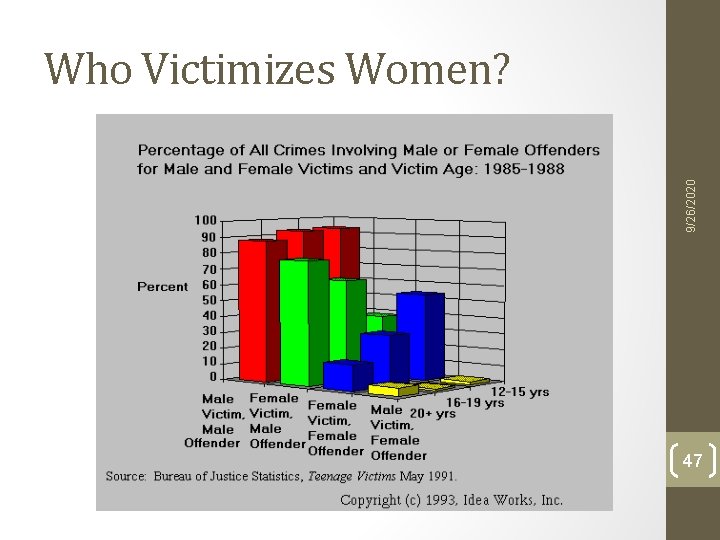
Victimization of Women 9/26/2020 • Women are more likely to be victimized by an intimate (e. g. , a boyfriend, ex-husband, or husband) or someone they know (78%) than by a stranger (22%). • Men, on the other hand, are about as likely to be victimized by a stranger (49%) as by an intimate or someone they know (51%) • Bureau of Justice Statistics, Selected Findings: Female Victims of Violent Crime, December, 1996, NCJ-162602). 46
9/26/2020 Who Victimizes Women? 47
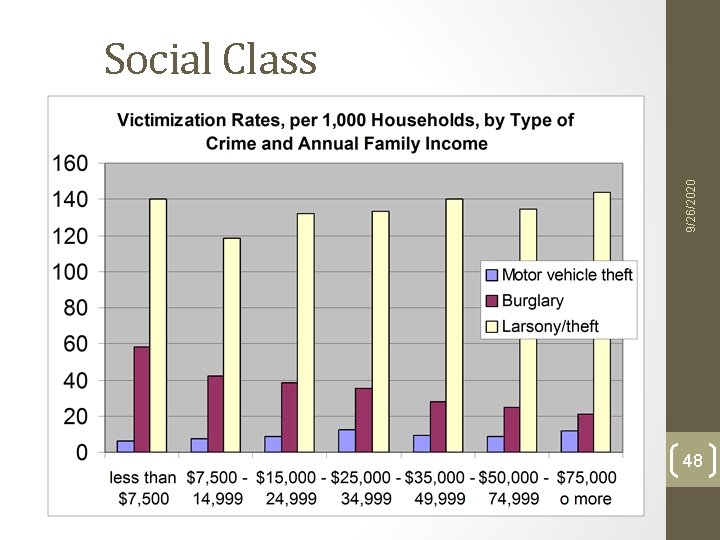
9/26/2020 Social Class 48
• People in different social classes have substantially different experiences of crime. • For crimes of violence against women, the higher one’s social class, as measured by family income, the lower the victimization rate. • Women whose families have incomes below $10, 000 are more than twice as likely to be the victims of violent crime than women from families whose income is $50, 000 or more 9/26/2020 Social Class --Bureau of Justice Statistics, Selected Findings: Female Victims of Violent Crime, Dec. 1996, NCJ-162602). 49
• Minorities are more likely to be victimized by crime than whites, with Hispanics 20% more likely than whites and Blacks 40% more likely than whites to be victims of crime. 9/26/2020 Race and Ethnicity • In 1993 the victimization rate for whites was 51. 7 per 1, 000 persons, for Hispanics, it was 62. 5% and for Blacks it was 71. 7 • Bureau of Justice Statistics. Sourcebook of Criminal Justice Statistics. Tables 3. 5 and 3. 6. 50
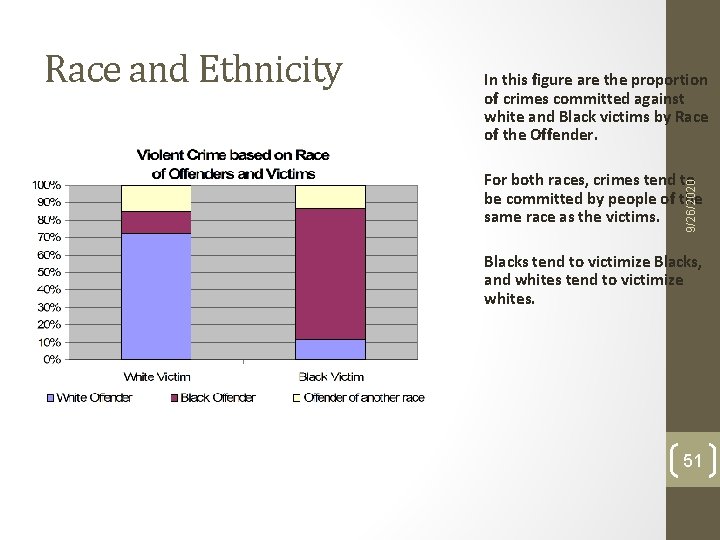
In this figure are the proportion of crimes committed against white and Black victims by Race of the Offender. For both races, crimes tend to be committed by people of the same race as the victims. 9/26/2020 Race and Ethnicity Blacks tend to victimize Blacks, and whites tend to victimize whites. 51
9/26/2020 Age 52
• The pattern of arrests by age mirrors the pattern of victimization by age. • With the exception of very young children, younger people are more likely to be arrested for crimes than their older counterparts. • Over two-thirds of all arrests are of people between 13 and 34 years old; one-half are of people between 16 and 29 • Bureau of Justice Statistics, Sourcebook of Criminal Justice Statistics 1995. Table 4. 4. 9/26/2020 Arrests by Age 53
Reporting Crimes “The Crime Problem: ” Public Opinion Regarding Crime 9/26/2020 Why are Crimes Not Reported? 54
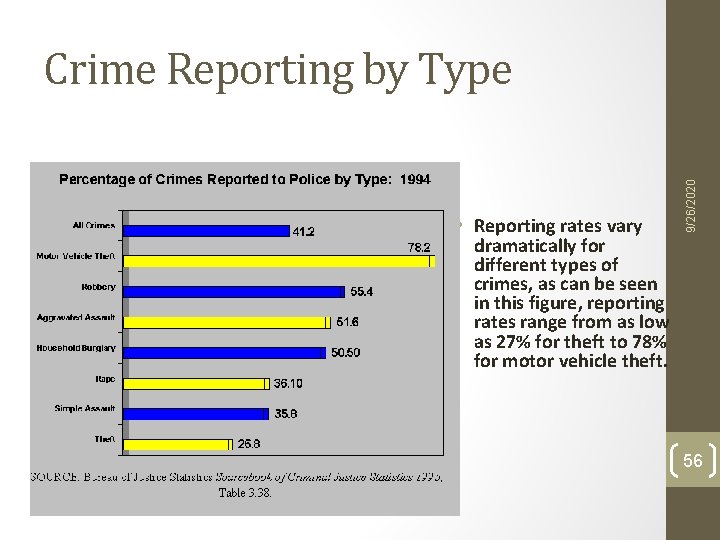
Crime Reports 9/26/2020 • The Criminal Justice System cannot address crimes if people do not report them. Yet, only about forty-one percent of all crimes are reported to police, with some crimes being reported as little as 27% of the time. • In general, reported crime rates are thought to be considerably less than actual rates, perhaps as much as 2 to 3 times less, because many crimes are never detected, less serious crimes are often not reported, and even serious crimes such as rape and arson often go unreported. 55
• Reporting rates vary dramatically for different types of crimes, as can be seen in this figure, reporting rates range from as low as 27% for theft to 78% for motor vehicle theft. 9/26/2020 Crime Reporting by Type 56
• How do we know about crimes that aren’t reported? This information comes from one of the two major sources of crime data in the United States, the National Crime Victimization Survey. • This is a national survey of households asking about victimization. Each year the study surveys 47, 000 households about victim experiences during the past six months. • Unlike the FBI Crime Reporting Program (the other major source of information about crimes), this survey collects information about crimes that are not reported as well as those that are reported. • Data from this study indicate there is a surprisingly low rate of reporting even for many serious crimes. 9/26/2020 The National Crime Victimization Survey 57
• The National Crime Victimization Survey includes within it questions asking why people did or did not report a crime. • In 1994, for example, the primary reasons people reported personal crimes were 9/26/2020 Why are Crimes Reported? • because it was a crime (22%), • to prevent further crimes by the offender against the victim (15. 8%), or • to stop or prevent the incident itself (13. 4%). • The primary reasons for reporting property crimes were • because it was a crime (25. 8%) or • to collect insurance (20. 1%). 58
Why Are Crimes Not Reported? • because it was a private or personal matter (18. 2%), • the offender was unsuccessful (17. 6%), or • the crime was reported to another official (10. 7%). 9/26/2020 • The most common reasons for not reporting personal crimes to the police were • The most common reasons for not reporting property crimes were • the object was recovered (25. 9%), • a lack of proof (9. 6%), or • the crime was reported to another official (9. 3%). • Sourcebook of Criminal Justice Statistics 1995, U. S. Department of Justice, Tables 3. 39 and 3. 40. 59
• Legislatures play an important role in defining what behaviors constitute a crime. • The legislative process offers an opportunity for different interest groups and social actors to influence the definition of crimes. • Powerful segments of society have a great deal more to say about the outcome than the disadvantaged and the disenfranchised. • Laws identifying and establishing the punishments for crimes don’t just happen. People have to identify some behavior as a problem and persuade others that laws should be passed to regulate or prohibit such behavior. 9/26/2020 Legislation: The Social Construction of Criminality 60
• The passing of laws defining acts as criminal behavior provide opportunities for sociologists to examine the processes through which society comes to define some act as a crime. • William Chambliss (1964) studied the origin and uses of vagrancy laws. • Nicola Beisel (1992) studied the passage of obscenity laws in 19 th century America. • Joseph Schneider (1978) studied the development of a medical definition of alcoholism that has largely replaced the earlier legal definition of alcohol consumption as a crime. • Peter Conrad (1976) documented the discovery of hyperkinesis. • Ronald Troyer and Gerald Markle (1983) have studied the antismoking movement. 9/26/2020 Examples of Laws 61
The Marijuana Tax Act of 1937 • He described how a federal bureaucracy, the Federal Bureau of Narcotics, orchestrated a campaign to criminalize the smoking of marijuana by providing alleged facts and figures for journalists to use in articles portraying marijuana smoking as a problem and by supporting legislation regulating the use of marijuana at both the federal and state levels. 9/26/2020 • In a classic sociological study, Howard Becker (1963) examined the origins of the Marijuana Tax Act of 1937. 62
9/26/2020 • Millions of dollars and years of research since the 1930 s have found no reliable empirical evidence that marijuana endangers either a person’s health or welfare, according to the National Commission on Marijuana and Drug Abuse (1972). • Nevertheless, the “facts” provided by the Bureau in the 1930 s were frightening. The bureau suggested marijuana led to everything from sexual immorality, crime, and physical deterioration to madness and murder. 63
The spelling of marijuana was changed from an “h” to a “j” so that it could be more easily linked to Mexican/Hispanic immigrants. 9/26/2020 Marihuana or Marijuana Source: Galliher and Walker (1977) 64
• a rash of newspaper and magazine articles condemning the drug, • scientific-sounding pamphlets calling marijuana a “killer drug” leading to mental deterioration, and a lust to kill (Gellen and Boas, 1969), and • dramatic posters in public buses and trains such as the one shown here forcefully warning against the supposed perils of marijuana use. 9/26/2020 Their propaganda campaign led to 65
9/26/2020 • Anti-marijuana legislation passed with ease at both the state and federal levels and in 1937 the Marijuana Federal Tax Act passed in Congress with virtually no opposition either within Congress or from people testifying at the public hearings where the bill was discussed, 66
• It is the police who receive reports of crime, decide which crimes merit greater investigative efforts, assess the criminality of alleged violators and ultimately assert that someone has committed a crime by arresting them and asking the prosecutor to file charges. 9/26/2020 Policing: Asserting Criminality • Police can exercise considerable discretion in their interactions with suspects, • deciding whether or not to arrest a husband or wife in the midst of a domestic dispute, • deciding who to interrogate about a crime, and • selecting which motorists to stop on the highway • Silko, (1994) 67
Crime Statistics The primary source of crime statistics in the United States regarding crimes reported to the police is the Federal Bureau of Investigation Crime Reporting Program. This program is based upon monthly and annual reports from law enforcement agencies made to the FBI. 9/26/2020 • There are significant limitations to these data. • Only index crimes are reported nationally. This excludes a wide range of crimes from “driving under the influence of alcohol” to white collar crime. • This report only includes crimes reported to local law enforcement agencies. Crimes that are not reported do not show up in these statistics. 68
• Since the statistics are collected locally, definitions may vary in subtle and unknown ways from one district to the next. 9/26/2020 Crime Statistics • a local sheriff may encourage reporting every crime no matter how insignificant in hopes of getting more funding. • Sociologist, James Q. Wilson (1978) studied two different cities and found the police departments to be organized very differently so that officers in one of the cities felt much greater pressure to record and report deviance, thus more crime was reported in that city. 69
Policing: Asserting Criminality • Sociologist, Aaron Cicourel spent two years studying police and probation agencies in two different cities using participant observation. • 9/26/2020 Who Gets Arrested and Charged? He found that young men whose behaviors were relatively harmless were more likely to be labeled criminals and treated more harshly when they were members of minorities or lower social classes (Cicourel, 1969). • Mary Cameron (1964) studied people caught shoplifting • She found that among people apprehended, 58% of blacks were subsequently charged with larceny, compared to only 11% of non-blacks. 70
• Still other studies have shown that whether someone is arrested and charged depends a great deal on their demeanor (Pilliavim and Brian, 1964). 9/26/2020 Policing: Asserting Criminality • They found that only two of forty-five polite youths were arrested, compared with fourteen of twenty-one noncooperative youths. • Finally, Arrests are much more likely when there a complainant requests that an arrest be made, and black citizens make that request much more commonly than whites, producing distorted arrest statistics (Reiss, 1971). 71
• The criminal justice system is concerned with the processing of criminal cases from the first report of the case to the convicted criminal serving his or her sentence. Reported Arrested Charged Prosecuted Convicted Sentenced Imprisoned 9/26/2020 Courts: Assessing Criminality and Extracting Punishment 72
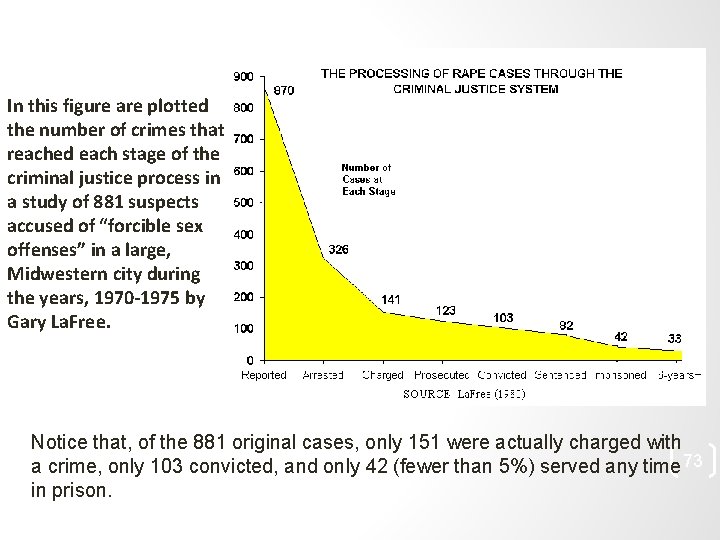
9/26/2020 In this figure are plotted the number of crimes that reached each stage of the criminal justice process in a study of 881 suspects accused of “forcible sex offenses” in a large, Midwestern city during the years, 1970 -1975 by Gary La. Free. Notice that, of the 881 original cases, only 151 were actually charged with a crime, only 103 convicted, and only 42 (fewer than 5%) served any time 73 in prison.
• Imprisonment is a common punishment for crimes in the United States. However, the use of imprisonment is receiving increased scrutiny as the number of prisoners continues to increase dramatically and its effectiveness is debated. 9/26/2020 Punishing Criminality: Imprisonment • Imprisonment itself can be a very alienating, humiliating, and difficult experience for the imprisoned. 74
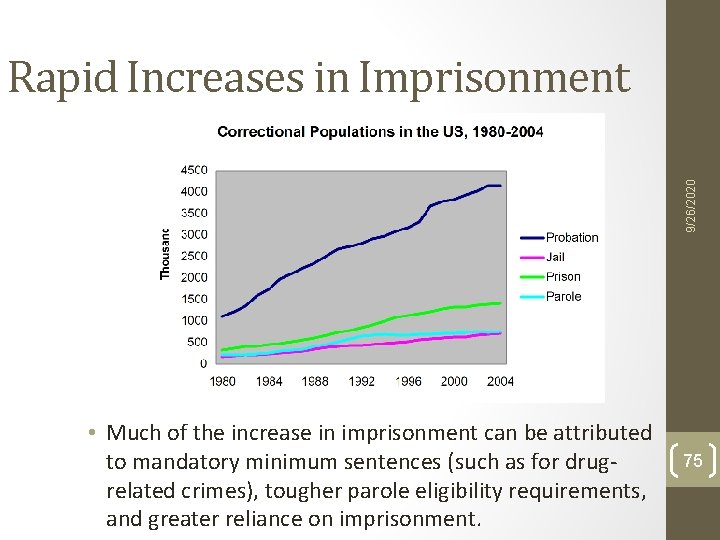
9/26/2020 Rapid Increases in Imprisonment • Much of the increase in imprisonment can be attributed to mandatory minimum sentences (such as for drugrelated crimes), tougher parole eligibility requirements, and greater reliance on imprisonment. 75
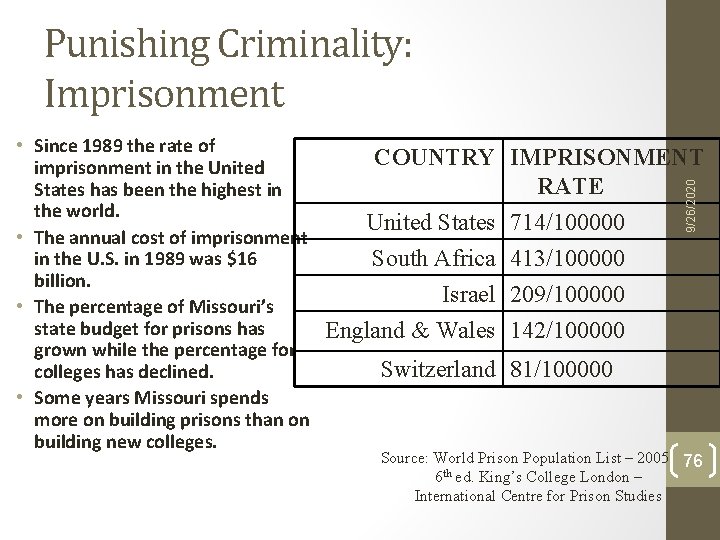
Punishing Criminality: Imprisonment IMPRISONMENT RATE 714/100000 413/100000 209/100000 142/100000 9/26/2020 • Since 1989 the rate of COUNTRY imprisonment in the United States has been the highest in the world. United States • The annual cost of imprisonment in the U. S. in 1989 was $16 South Africa billion. Israel • The percentage of Missouri’s state budget for prisons has England & Wales grown while the percentage for Switzerland colleges has declined. • Some years Missouri spends more on building prisons than on building new colleges. 81/100000 Source: World Prison Population List – 2005 76 6 th ed. King’s College London – International Centre for Prison Studies
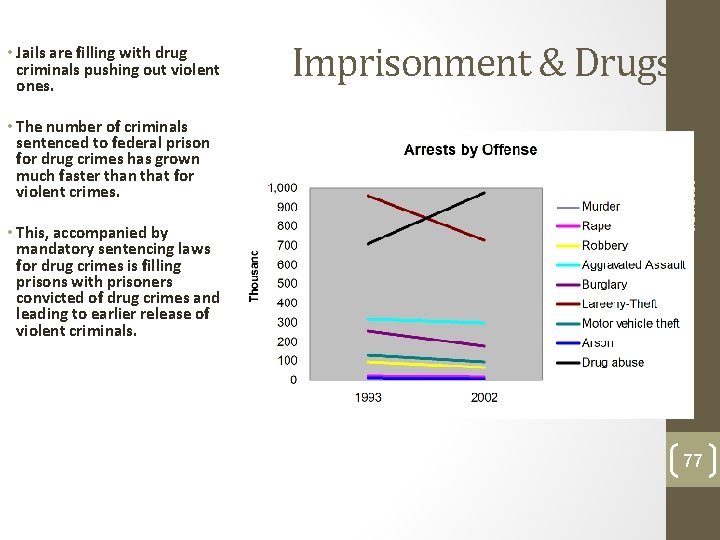
• The number of criminals sentenced to federal prison for drug crimes has grown much faster than that for violent crimes. • This, accompanied by mandatory sentencing laws for drug crimes is filling prisons with prisoners convicted of drug crimes and leading to earlier release of violent criminals. Imprisonment & Drugs 9/26/2020 • Jails are filling with drug criminals pushing out violent ones. 77
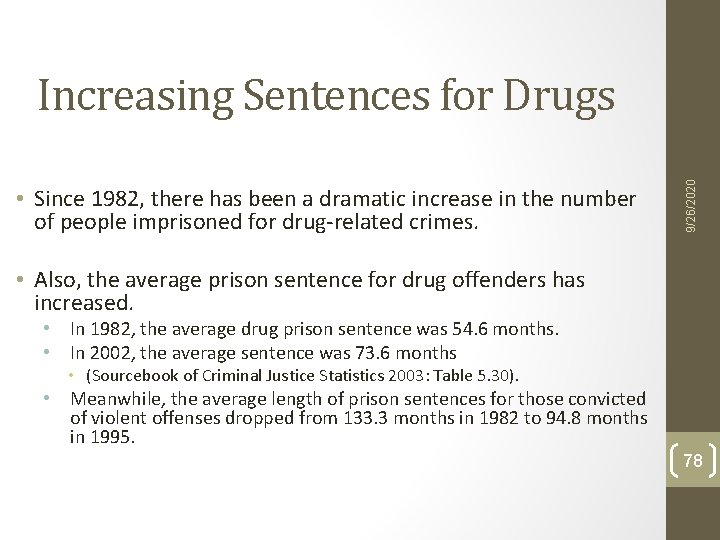
• Since 1982, there has been a dramatic increase in the number of people imprisoned for drug-related crimes. 9/26/2020 Increasing Sentences for Drugs • Also, the average prison sentence for drug offenders has increased. • In 1982, the average drug prison sentence was 54. 6 months. • In 2002, the average sentence was 73. 6 months • (Sourcebook of Criminal Justice Statistics 2003: Table 5. 30). • Meanwhile, the average length of prison sentences for those convicted of violent offenses dropped from 133. 3 months in 1982 to 94. 8 months in 1995. 78
9/26/2020 THEORETICAL VIEWS OF DEVIANCE 79
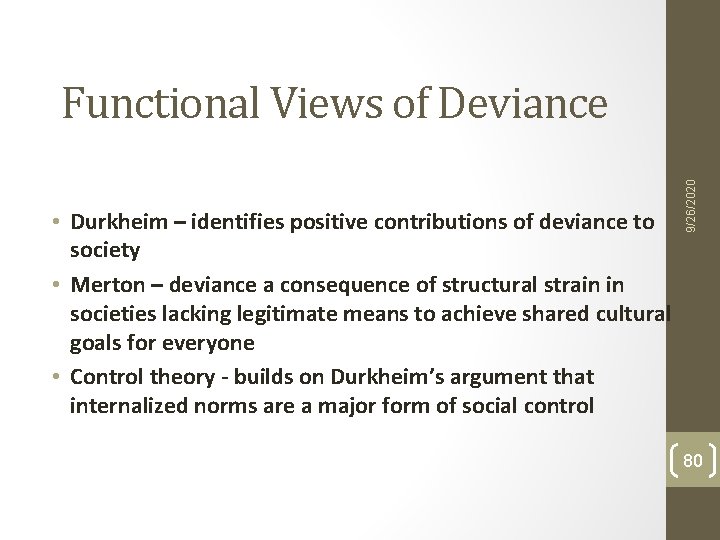
• Durkheim – identifies positive contributions of deviance to society • Merton – deviance a consequence of structural strain in societies lacking legitimate means to achieve shared cultural goals for everyone • Control theory - builds on Durkheim’s argument that internalized norms are a major form of social control 9/26/2020 Functional Views of Deviance 80
• Sociologist, Emile Durkheim viewed deviance and crime from a structural-functional perspective. 9/26/2020 How Crime Defines Society: The Functionalist Perspective • Durkheim argued crime is a natural part of society having important positive functions. 81
• Durkheim argues crime reflects both a society’s highest goals and its darkest fears. 9/26/2020 How Crime Defines Society: The Functionalist Perspective • Crime clarifies moral boundaries by reminding others of the limits of acceptable behavior. • Newspaper stories about embezzlers remind us that behavior is unacceptable • Crime contributes to social cohesion and promotes social unity by our shared reaction to crime. • E. g. , collective horror at acts of terrorism 82
• Crime affirms cultural values and norms. We cannot have good without bad, virtue without vice. 9/26/2020 How Crime Defines Society: The Functionalist Perspective • Crimes are necessary to generate and sustain a sense of morality, a sense of what is good. • In a nation of saints, he argued, we would still need to find and identify bad acts—even actions so minor as to be largely ignored in more imperfect societies—in order to reaffirm the difference between good and evil. 83
• Kai Erikson (1966) analyzed historical data describing the early Puritans in Massachusetts Bay. • This is a society of conscientious religious persons who, by our standards would be viewed as having virtually no crime. • Yet, just as Durkheim had predicted, every year a consistent proportion of their members were declared to be deviant. • This consistent level of deviance, he argued, supports Durkheim’s reasoning that deviants help mark the moral boundaries of a society. • The Puritans experienced several different “crime waves” over the years. By singling out particular individuals for censure, the Puritans helped establish different boundaries on the kinds of behavior that were permissible. 9/26/2020 In a Nation of Saints…. Crime Waves Among the Puritans 84
• Another positive function of crime is that it can promote necessary social change. 9/26/2020 Crime Can Promote Necessary Social Change • Crime may be “an anticipation of future morality” (Durkheim, 1938). • Acts which may be viewed as a crime at one time, may be viewed as morally acceptable, even morally required behavior in the future. • Socrates’ independent thinking which was a crime by Athenian law, but entirely acceptable behavior today. • acts of civil disobedience to protest racism in the 1960 s now 85 commended rather than condemned.
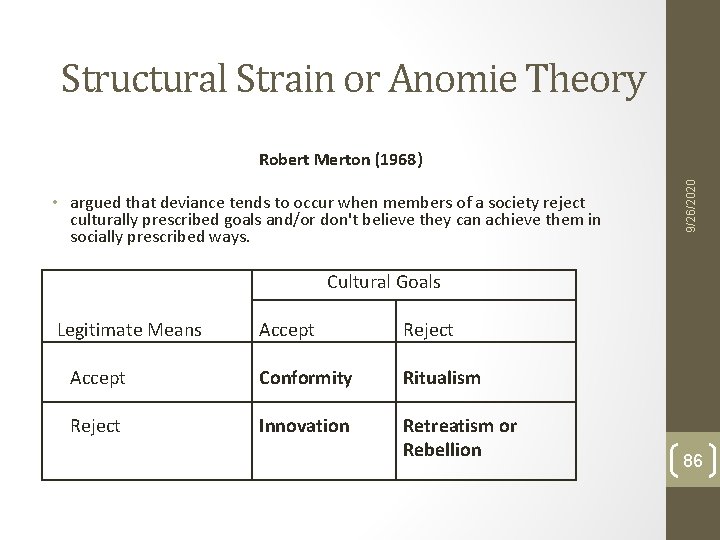
Structural Strain or Anomie Theory • argued that deviance tends to occur when members of a society reject culturally prescribed goals and/or don't believe they can achieve them in socially prescribed ways. 9/26/2020 Robert Merton (1968) Cultural Goals Legitimate Means Accept Reject Accept Conformity Ritualism Reject Innovation Retreatism or Rebellion 86
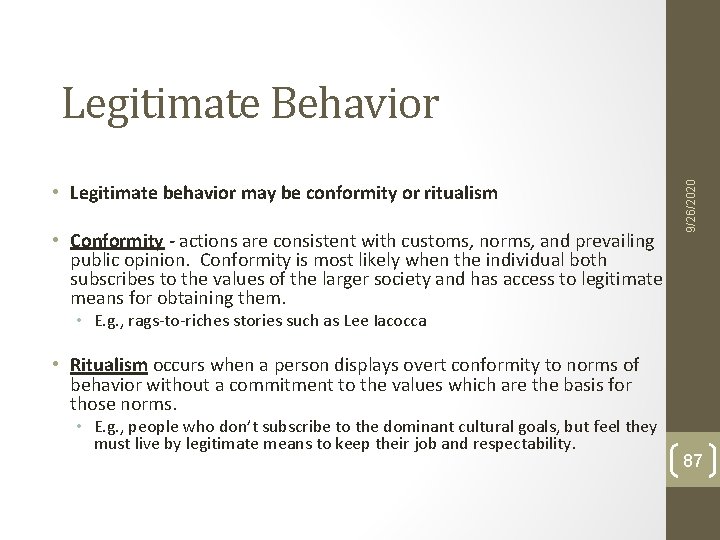
• Legitimate behavior may be conformity or ritualism • Conformity - actions are consistent with customs, norms, and prevailing public opinion. Conformity is most likely when the individual both subscribes to the values of the larger society and has access to legitimate means for obtaining them. 9/26/2020 Legitimate Behavior • E. g. , rags-to-riches stories such as Lee Iacocca • Ritualism occurs when a person displays overt conformity to norms of behavior without a commitment to the values which are the basis for those norms. • E. g. , people who don’t subscribe to the dominant cultural goals, but feel they must live by legitimate means to keep their job and respectability. 87
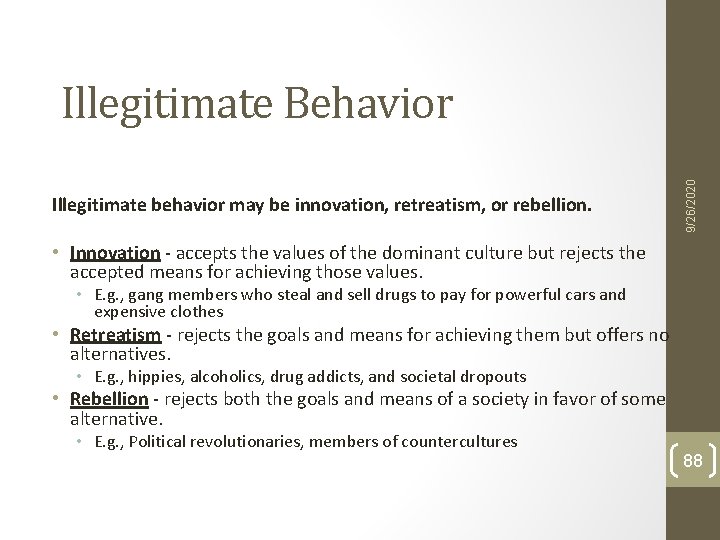
Illegitimate behavior may be innovation, retreatism, or rebellion. 9/26/2020 Illegitimate Behavior • Innovation - accepts the values of the dominant culture but rejects the accepted means for achieving those values. • E. g. , gang members who steal and sell drugs to pay for powerful cars and expensive clothes • Retreatism - rejects the goals and means for achieving them but offers no alternatives. • E. g. , hippies, alcoholics, drug addicts, and societal dropouts • Rebellion - rejects both the goals and means of a society in favor of some alternative. • E. g. , Political revolutionaries, members of countercultures 88
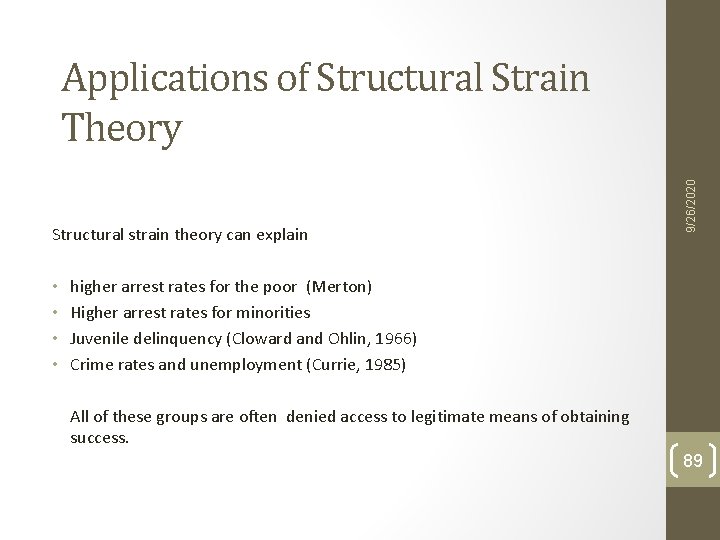
Structural strain theory can explain • • 9/26/2020 Applications of Structural Strain Theory higher arrest rates for the poor (Merton) Higher arrest rates for minorities Juvenile delinquency (Cloward and Ohlin, 1966) Crime rates and unemployment (Currie, 1985) All of these groups are often denied access to legitimate means of obtaining success. 89
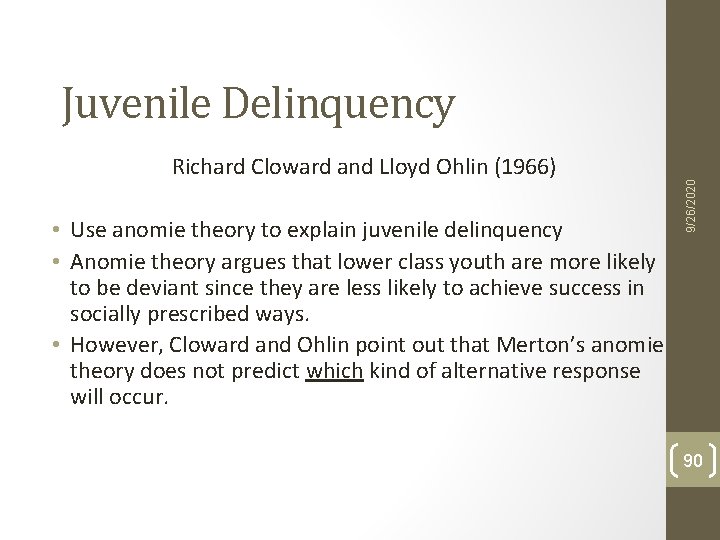
Richard Cloward and Lloyd Ohlin (1966) • Use anomie theory to explain juvenile delinquency • Anomie theory argues that lower class youth are more likely to be deviant since they are less likely to achieve success in socially prescribed ways. • However, Cloward and Ohlin point out that Merton’s anomie theory does not predict which kind of alternative response will occur. 9/26/2020 Juvenile Delinquency 90
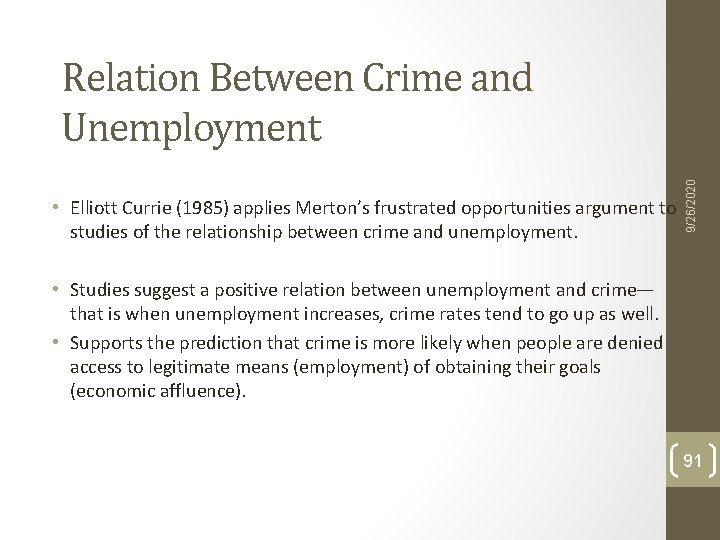
• Elliott Currie (1985) applies Merton’s frustrated opportunities argument to studies of the relationship between crime and unemployment. 9/26/2020 Relation Between Crime and Unemployment • Studies suggest a positive relation between unemployment and crime— that is when unemployment increases, crime rates tend to go up as well. • Supports the prediction that crime is more likely when people are denied access to legitimate means (employment) of obtaining their goals (economic affluence). 91
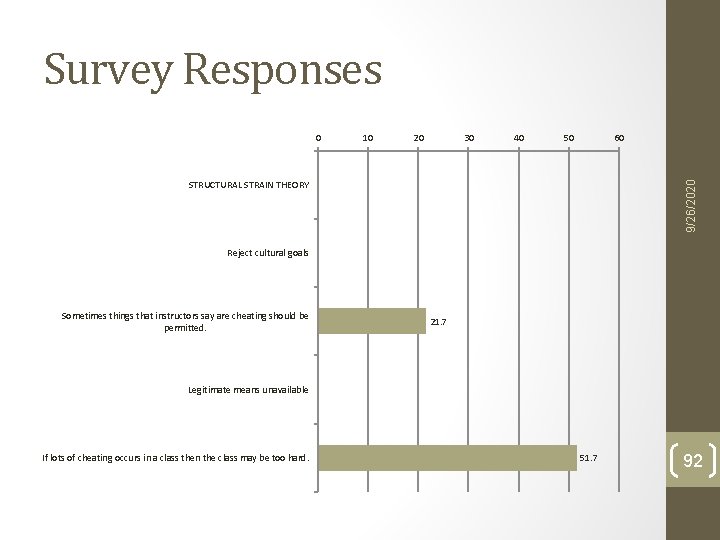
Survey Responses 0 10 20 30 40 50 60 9/26/2020 STRUCTURAL STRAIN THEORY Reject cultural goals Sometimes things that instructors say are cheating should be permitted. 21. 7 Legitimate means unavailable If lots of cheating occurs in a class then the class may be too hard. 51. 7 92
• Advantages • emphasizes social structure rather than individuals • has been effectively applied to juvenile delinquency • Disadvantages • assumes a societal consensus on goals and values consistent with the functionalist perspective--a consensus that may not be present. • Does not explain which kind of deviance people will choose • offers no insight into mental illness, drug abuse or deviance such as the hippies in the 1960's • cannot explain some kinds of crimes, such as rape 9/26/2020 Structural Strain or Anomie Theory 93
Hirschi (1969) and Reckless (1973) • Reckless (1973) argues that everyone is tempted by opportunities for deviant behavior, but deviant acts are less likely when the individual’s bonds to society are strong. • stronger bonds more likely to resist temptation. 9/26/2020 Control Theory View of Deviance • E. g. , They don’t want to lose a job or be condemned by family & friends • Fewer bonds less likely to resist temptation • E. g. , Those with no job, family, friends are more likely to commit deviance since they have less to lose. 94
• Hirschi (1969) argues people have an • inner control system —an individual's capacity to resist temptation including conscience, internalized morality, religious principles, fear of punishment, sense of integrity, and desire to be “good. • Controls are more effective when people are bonded to society through • commitments (a stake, such as family, home, job) • involvements (investment of energy and time in approved activities) • attachments (having respect or affection for others) • shared beliefs (opinions about what is right and wrong) 9/26/2020 Control Theory View of Deviance 95
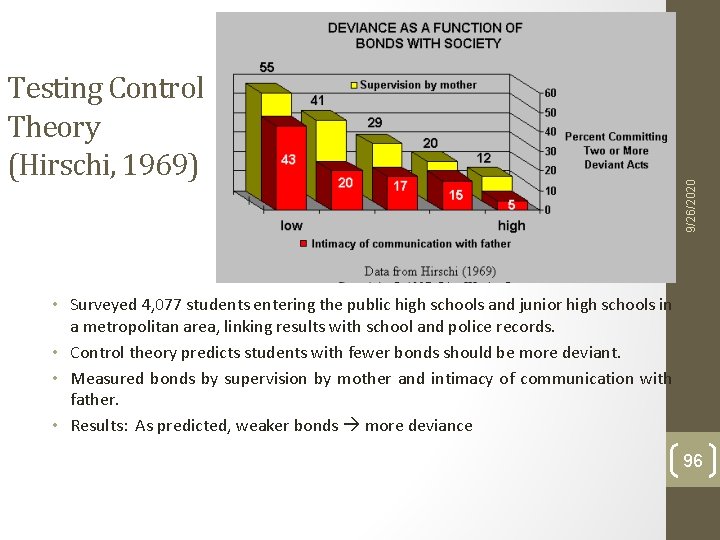
9/26/2020 Testing Control Theory (Hirschi, 1969) • Surveyed 4, 077 students entering the public high schools and junior high schools in a metropolitan area, linking results with school and police records. • Control theory predicts students with fewer bonds should be more deviant. • Measured bonds by supervision by mother and intimacy of communication with father. • Results: As predicted, weaker bonds more deviance 96
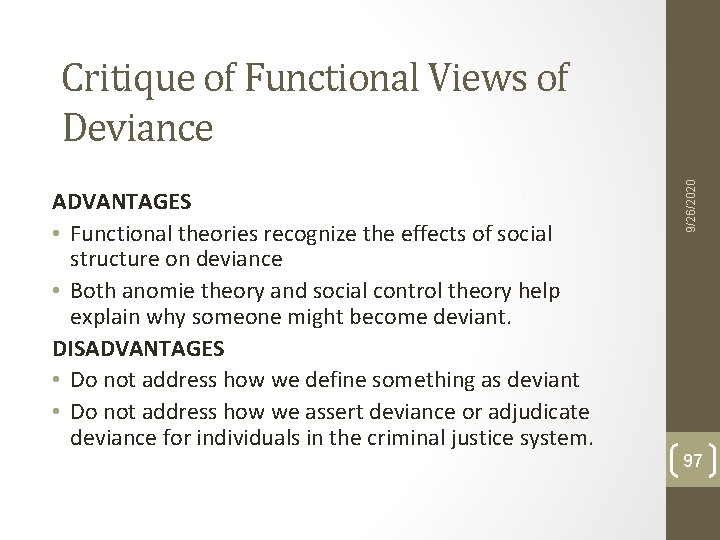
ADVANTAGES • Functional theories recognize the effects of social structure on deviance • Both anomie theory and social control theory help explain why someone might become deviant. DISADVANTAGES • Do not address how we define something as deviant • Do not address how we assert deviance or adjudicate deviance for individuals in the criminal justice system. 9/26/2020 Critique of Functional Views of Deviance 97
• The Conflict perspective argues that it is the rich and powerful who largely determine what is deviant and to what extent deviants should be punished. • Proponents of this view include Quinney, (1977); Chambliss and Seidman, (1982); and Archer (1985). 9/26/2020 What is Deviance? The Conflict View 98
In Support of Capitalism 9/26/2020 Steven Spitzer argues law and culture support capitalist interests in many ways. • socialists seen as deviants because they challenge capitalism • Those who threaten private property are seen as deviants • Those who won't work are seen as deviants because work is required for capitalism. • Those who challenge authority such as union agitators or nonviolent demonstrators are seen as deviant because formal organizations require hierarchy. • Activities supportive of the economic system such as sports are encouraged because they promote competition 99
• At every stage in the criminal justice process, people from higher social classes are more able to influence the outcome in their favor. • Affluent people 9/26/2020 At Every Stage Class Matters • are less likely to be perceived as criminals, • can afford to make bail, • can afford competent lawyers who can reduce their chances of coming to trial or being convicted, • can often reduce their sentence, and • are more likely to receive probation punishment. • As Richard Quinney put it, “Capitalist justice is by the capitalist class, for the capitalist class, and against the working 100 class. ”
• White-collar crimes are less likely to be defined as crimes • are often regarded as less serious than other crimes • in general are tolerated more than other crimes. Perhaps this is because • they seldom involve violence • they tend to be primary deviance (deviance by people not generally thought of as deviants) 9/26/2020 White Collar Crime 101
• 3 X costs of the four other major categories of property crimes • $400+ billion annually • 18 X the costs of street crime - United States Department of Justice - Reiman, 1990 9/26/2020 Costs of White Collar Crime 102
• Deaths due to Illegal working environments account for • 1/3 of work-related deaths in U. S. • 5 X the murder rate in the streets 9/26/2020 Deaths Due to White Collar Crime • Simon and Eitzen, 1982; Hagan and Palloni, 1986 1987 • • 19, 257 murders 61, 700 deaths due to occupational hazards and disease 20, 000 deaths due to inadequate emergency medical care 12, 000 deaths from unnecessary or incompetent surgeries. - Reiman, 1990 103
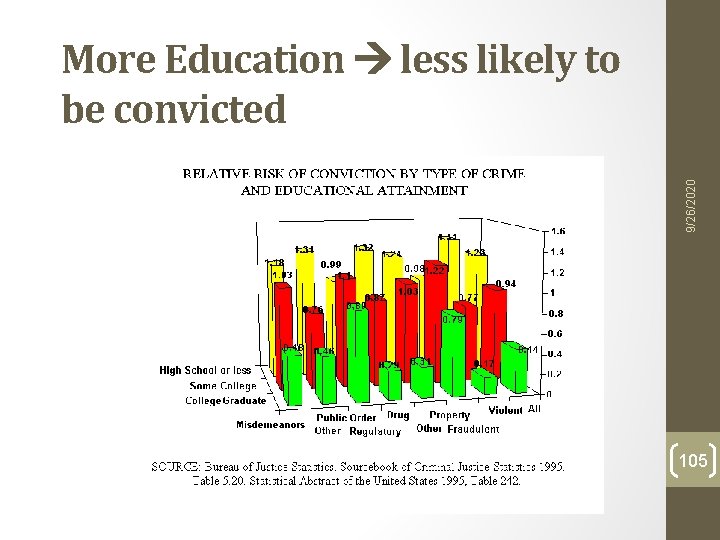
• People with higher socioeconomic status are usually given more favorable treatment by the criminal justice system. • They are less likely to be arrested, charged, convicted and imprisoned than people with of lower socioeconomic status. • Next screen plots relative risks of being convicted for various types of crimes as a function of education. • >1 more likely than people in general • <1 less likely than people in general 9/26/2020 Criminal Justice Outcomes by Socioeconomic Status (SES) 104
9/26/2020 More Education less likely to be convicted 105
• Blacks 25% more likely to be victimized 9/26/2020 Victimization by Race • When Blacks are the victims of crimes, the criminal justice system tends to be more lenient on the offenders. • The death penalty is only rarely applied when the person killed is black whites (Bedau, 1996). 106
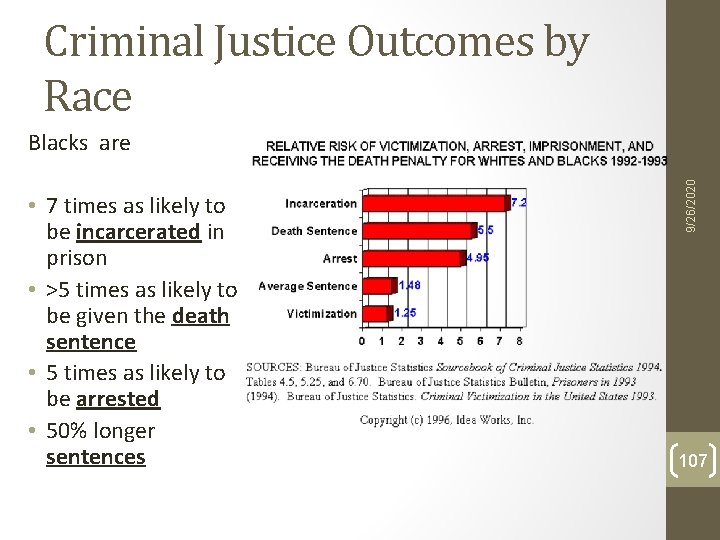
Criminal Justice Outcomes by Race • 7 times as likely to be incarcerated in prison • >5 times as likely to be given the death sentence • 5 times as likely to be arrested • 50% longer sentences 9/26/2020 Blacks are 107
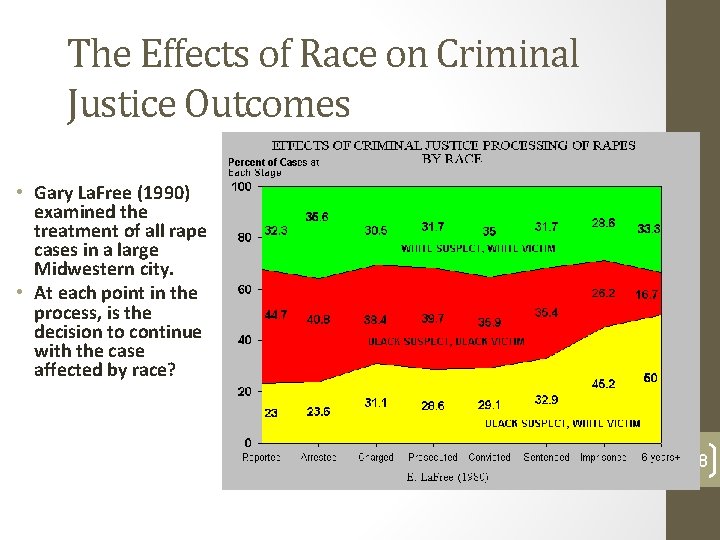
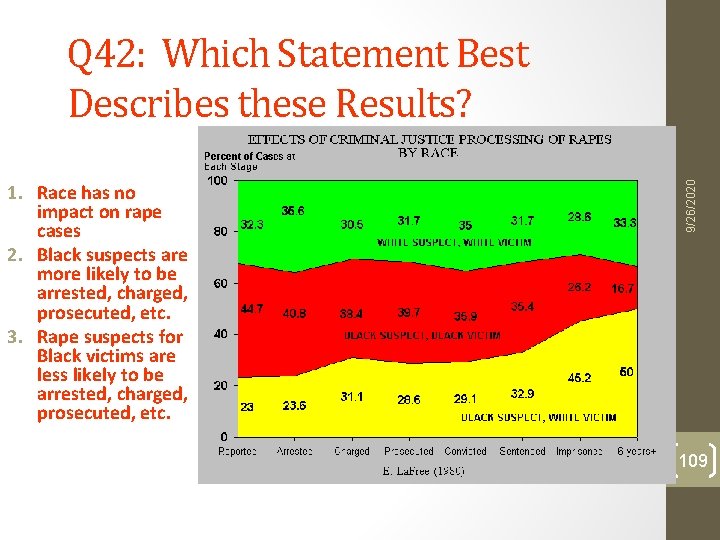
• Gary La. Free (1990) examined the treatment of all rape cases in a large Midwestern city. • At each point in the process, is the decision to continue with the case affected by race? 9/26/2020 The Effects of Race on Criminal Justice Outcomes 108
1. Race has no impact on rape cases 2. Black suspects are more likely to be arrested, charged, prosecuted, etc. 3. Rape suspects for Black victims are less likely to be arrested, charged, prosecuted, etc. 9/26/2020 Q 42: Which Statement Best Describes these Results? 109
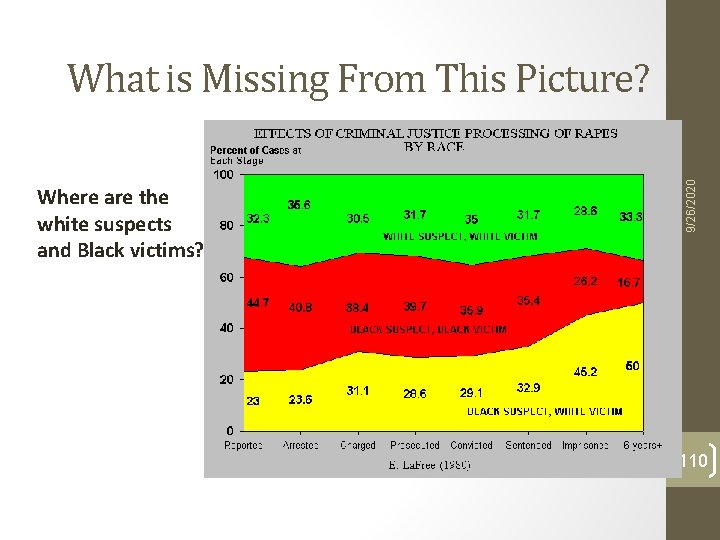
Where are the white suspects and Black victims? 9/26/2020 What is Missing From This Picture? 110
• In La. Free’s study, there were too few cases reported of white men sexually assaulting black victims (11) to analyze, so they were not included in the study. • Were they less likely to occur? Or less likely to be reported? • Would you report being raped with those odds? 9/26/2020 Race Matters • Clearly, Blacks have a very different subjective experience of the criminal justice system than whites. 111
• Labeling theory - any act becomes deviant only when labeled as deviant by others • Labeling someone a deviant can cause embarrassment and stigma • Deviance is relative, socially constructed by the labelers 9/26/2020 Labeling Deviants: An Interactionist View • Stigma - distinctive social characteristic identifying its owner as disgraced • “spoiled identity” limiting their ability to manage impressions (Goffman, 1963) • E. g. • people with eating disorders (Mc. Lorg and Taub, 1987) • people with AIDS (Weitz, 1991; Sandstrom, 19 ). 112
Labeling and Employment • Posed as representatives of an employment agency and asked 100 potential employers their interest in hiring four fictitious cases, each a 32 year old single male with a high school education and a succession of short-term laborer jobs. • There were four experimental conditions • • 9/26/2020 Richard Schwartz and Jerome Skolnick (1962) no criminal record, tried for assault but acquitted tried and acquitted with a supportive letter from the judge convicted and sentenced • What do you think were the results? 113
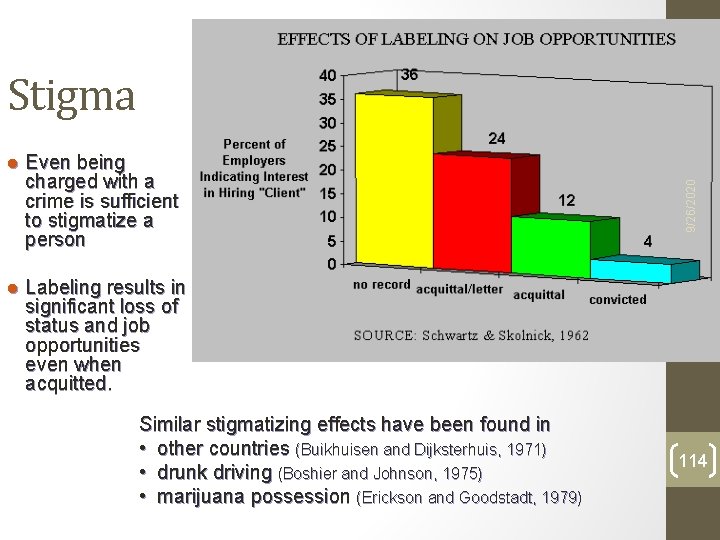
l Even being charged with a crime is sufficient to stigmatize a person l Labeling results in significant loss of status and job opportunities even when acquitted. Similar stigmatizing effects have been found in • other countries (Buikhuisen and Dijksterhuis, 1971) • drunk driving (Boshier and Johnson, 1975) • marijuana possession (Erickson and Goodstadt, 1979) 9/26/2020 Stigma 114
A white male with a criminal record has a better chance at getting a job than a black male without a criminal record. Source: Pager (2007) 9/26/2020 Labeling and Employment 115
Becoming Deviant: The Deviance Career 9/26/2020 Primary Deviance –labeling Secondary Deviance • Primary deviance - occasional deviance which does not affect an individual's performance of roles or self-image. • most people have committed illegal acts, but were not caught and don't regard themselves as deviants. • They successfully resist being labeled deviants • Secondary deviance - deliberate deviance where the person committing the act also recognizes it as deviance. The deviant role becomes the organizing role for the person. • A process of self-labeling, assisted by powerful labels such as “whore, ” “queer, ” “pervert, ” or “nut” • Eventually they come to see themselves as deviants 116
Sykes and Matza (1957), Scott and Lyman (1968) People resist labels using techniques of neutralization • denying responsibility for the act • denying that anyone was seriously harmed • denying that one person is more a victim than another • condemning the condemners 9/26/2020 Resisting Labels: Techniques of Neutralization • “they’re a bunch of hypocrites” • appealing to higher loyalties • “I had to help my friend” 117
STRENGTHS • Views deviance as relative and socially constructed • identifies the key process by which actions become defined as deviant and people become labeled as deviants. • Explains acquisition of a deviant self-concept by the deviance career. • Has been applied to many types of deviance—not just criminal acts • drug dealing, Homosexuality, mental illness, prostitution 9/26/2020 Strengths of Labeling Theory 126
LIMITATIONS • Deviance cannot be defined solely by labeling • “a mugging by any other name hurts just as much” Nettler, 1974: 210 • May give the impression that those who label a crime as deviance are to blame for it (the reverse of “blaming the victim” may be “blaming the labeler”) • Labeling theory can't explain primary deviance • May appear too sympathetic to deviants, emphasizing external factors over the individual’s own actions 9/26/2020 Weaknesses of Labeling Theory 127
Cultural transmission theory • • deviance is transmitted through socialization Chicago School of Sociology in the 1920 s & 30 s Differential association theory • • 9/26/2020 The Culture of Deviance: Cultural Transmission Theory Variant of cultural transmission theory (Edwin Sutherland Donald Cressey, 1978) argues people are more likely to be deviant to the extent they are exposed to deviants In this view, people are more likely to be deviant if significant others are deviant, if more of their associates are deviant, and if they are exposed to deviance early in their lives. 128
• Cultural transmission theory - deviance is transmitted through socialization. • associated with the Chicago School of Sociology during the 1920 s & 30 s 9/26/2020 The Culture of Deviance: Cultural Transmission Theory • Shaw and Mc. Kay (1929) • found - in certain neighborhoods in Chicago, the crime rate remained high over 20 years even though many ethnic groups passed through the neighborhoods during that time. • Concluded • deviance was not related to ethnicity • recent arrivals learned deviance from people already there • A variant of this perspective is differential association theory • (Edwin Sutherland Donald Cressey, 1978) • argues people are more likely to be deviant to the extent they are exposed to deviants • In this view, people are more likely to be deviant if significant others are deviant, if more of their associates are deviant, and if they are exposed to deviance early in their lives. 130
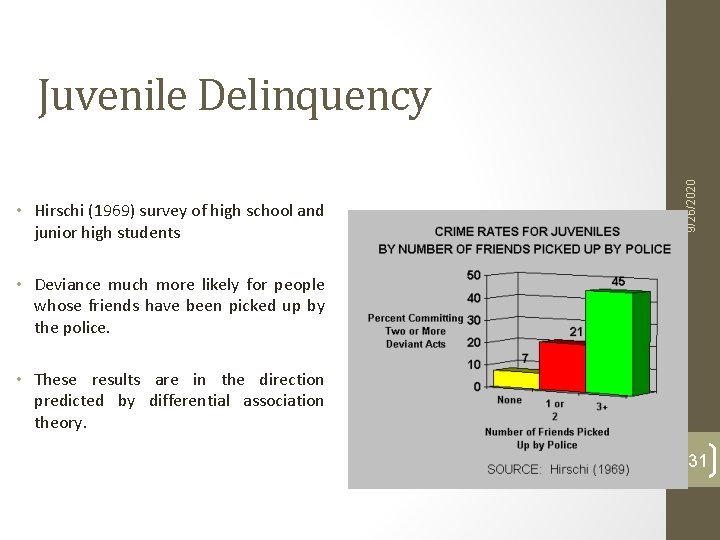
• Hirschi (1969) survey of high school and junior high students 9/26/2020 Juvenile Delinquency • Deviance much more likely for people whose friends have been picked up by the police. • These results are in the direction predicted by differential association theory. 131
Becoming a Marijuana Smoker • Used participant observation to study the process of learning to be a marijuana smoker in the 1950 s 9/26/2020 Howard Becker • Found people usually learned by smoking with friends that • smoking could be fun • they wouldn’t become slaves to the drug (as claimed at the time) • getting caught was unlikely • how to hide being high if necessary • He pointed to the importance of learning, observation, and imitation for a person to learn the proper way to smoke and how to enjoy its effects. 132
• Card hustlers learn deviance informally through “hanging around” or in after-thefact coaching (Prus and Sharper, 1977). • Relatively formal procedures for instructing newcomers were found in studies of 9/26/2020 More Socialization for Deviance • Professional thieves (Maurer, 1964) • professional prostitutes (Heyl, 1979) • Some forms of deviance, such as police corruption (Sherman, 1974) even have a “career, ” a commonly followed sequence of actions leading to deeper and deeper involvement in the deviance. 133
ADVANTAGES: Cultural transmission theory explains • how deviance is learned • how conformity in one setting may be deviance in another • how people sent to prison may become more deviant because they are exposed almost exclusively to criminals in prison • Why there are high recidivism rates for ex-prisoners (because ex-convicts return to socialize with significant others from whom they learned deviance) DISADVANTAGES: Cultural transmisison theory cannot explain • how some people become deviant without exposure to many deviants 9/26/2020 Strengths and Weaknesses of Cultural Transmission Theory • middle-class delinquents • how some people in high-crime environments don't become deviants • deviance that is not regarded as a crime • how specific behaviors become defined as deviant 134
9/26/2020 THE END 135