Deviance Crime and Social Control Introduction to Sociology

- Slides: 24
Deviance, Crime, and Social Control Introduction to Sociology
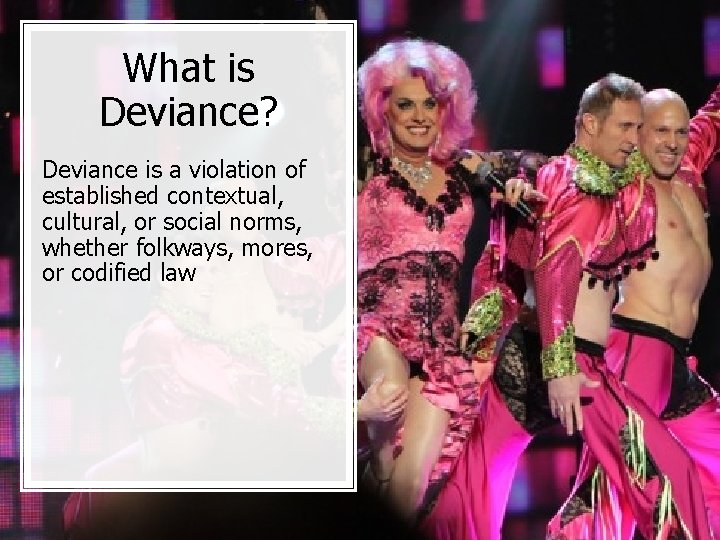
What is Deviance? Deviance is a violation of established contextual, cultural, or social norms, whether folkways, mores, or codified law
Social Control • All societies practice social control, the regulation and enforcement of norms • The goal of social control is to maintain social order, an arrangement of practices and behaviors on which society’s members base their daily lives • Societies enforce rules using sanctions: • Positive sanctions are rewards given for conforming to norms • Negative sanctions are punishments for violating norms
Informal and Formal Sanctions Formal and informal sanctions may be positive or negative. Informal sanctions arise in social interactions, whereas formal sanctions officially enforce norms. The table below gives a few examples: Informal Formal Positive An expression of thanks A promotion at work Negative An angry comment A parking fine
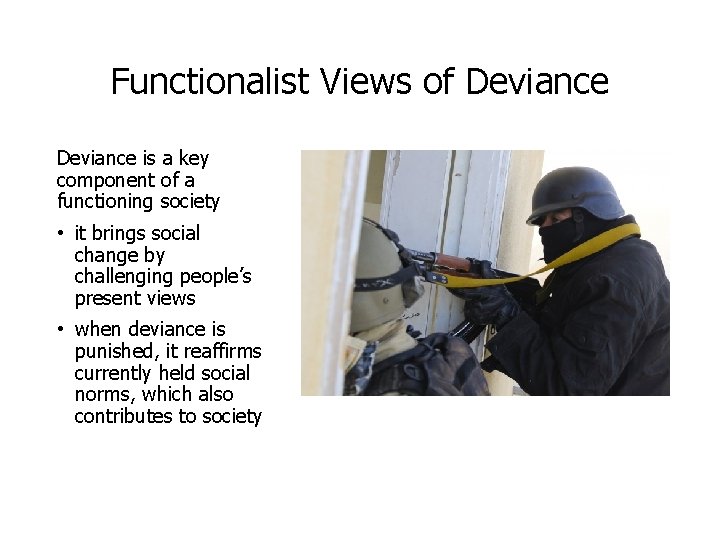
Functionalist Views of Deviance is a key component of a functioning society • it brings social change by challenging people’s present views • when deviance is punished, it reaffirms currently held social norms, which also contributes to society
Strain Theory Merton defined five ways people respond to this gap between having a socially accepted goal and having no socially accepted way to pursue it: • Conformity: Those who conform pursue their goals through socially accepted means as much as they can • Innovation: Those who innovate pursue goals they cannot reach through legitimate means by instead using criminal or deviant means • Ritualism: People who ritualize lower their goals until they can reach them through socially acceptable ways. These members of society focus on conformity rather than attaining a distant dream • Retreatism: Others withdraw and reject society’s goals and means • Rebellion: A handful of people rebel and look to overthrow a society’s goals through socially unacceptable means.
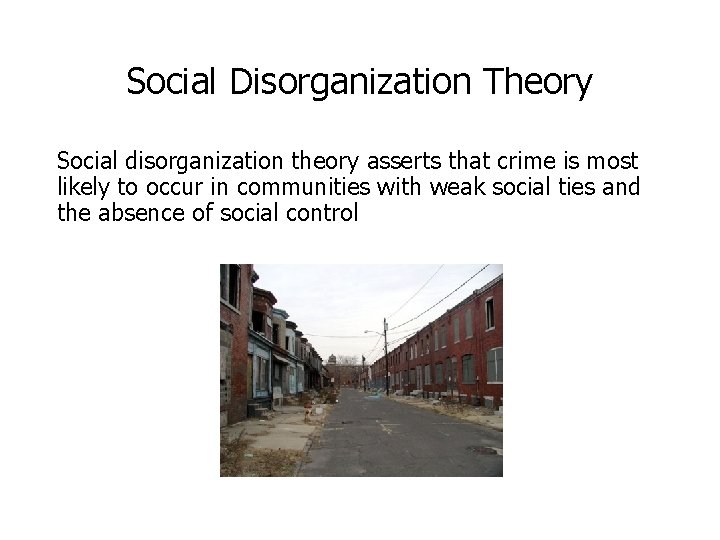
Social Disorganization Theory Social disorganization theory asserts that crime is most likely to occur in communities with weak social ties and the absence of social control
Cultural Deviance Theory Cultural deviance theory suggests that conformity to the prevailing cultural norms of lower-class society causes crime
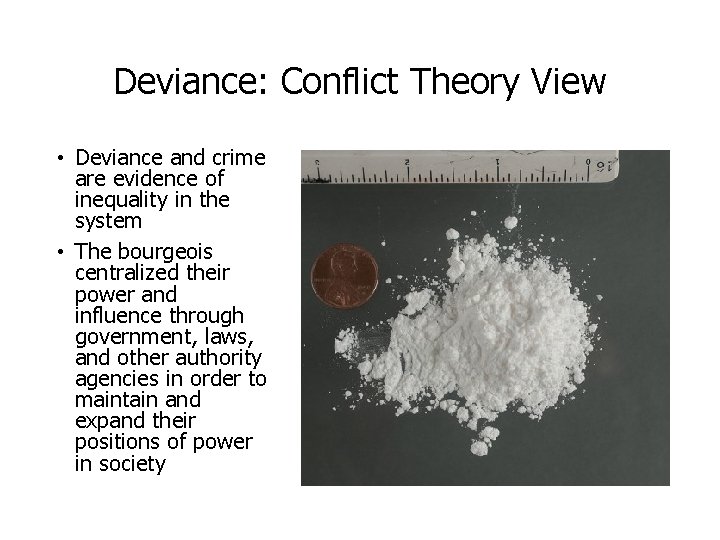
Deviance: Conflict Theory View • Deviance and crime are evidence of inequality in the system • The bourgeois centralized their power and influence through government, laws, and other authority agencies in order to maintain and expand their positions of power in society
The Power Elite • The power elite, a small group of wealthy and influential people at the top of society, hold the power and resources • the rules of society are stacked in favor of a privileged few who manipulate them to stay on top • While crime is often associated with the underprivileged, crimes committed by the wealthy and powerful remain an under-punished and costly problem within society
Feminist Theory and Deviance • Feminist analysis focuses on the way gender inequality influences the opportunities to commit crime and the definition, detection, and prosecution of crime. In part the gender difference revolves around patriarchal attitudes toward women and the disregard for matters considered to be of a private or domestic nature • Deviant women considered doubly deviant: they have broken the laws and gender norms about appropriate female behavior • tendency to medicalize women’s deviance, to see it as the product of physiological or psychiatric pathology
Sexual Assault and Spousal Assault • Sexual assault is an act of violence, not a sexual act • Secondary victimization occurs when the women’s own sexual history and her willingness to consent are questioned in the process of laying charges and reaching a conviction, which as feminists pointed out, increased victims’ reluctance to press charges • Partner violence was hidden in the household and largely regarded as a private, domestic matter in which police were reluctant to get involved • Both remain under-reported crimes
Twin Myths of Rape Feminists challenged the twin myths of rape that were often the subtext of criminal justice proceedings presided over largely by men: • Women are untrustworthy and tend to lie about assault out of malice toward men, as a way of getting back at them for personal grievances • Women will say “no” to sexual relations when they really mean “yes. ”
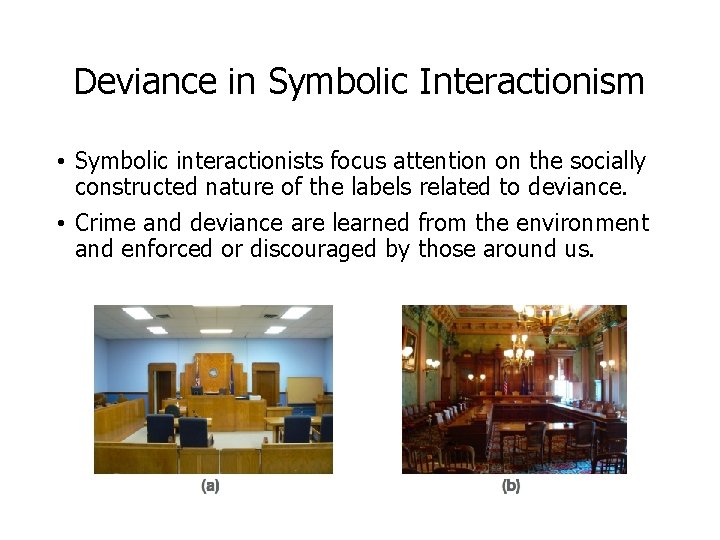
Deviance in Symbolic Interactionism • Symbolic interactionists focus attention on the socially constructed nature of the labels related to deviance. • Crime and deviance are learned from the environment and enforced or discouraged by those around us.
Labeling Theory • What is considered deviant is determined by the reactions of others • Primary deviance is a violation of norms that does not result in any long-term effects on the individual’s selfimage or interactions with others • Secondary deviance occurs when a person’s selfconcept and behavior begin to change after his or her actions are labeled as deviant by members of society • A master status is a label that describes the chief characteristic of an individual
Differential Association Theory Differential association theory suggests that individuals learn deviant behavior from those close to them who provide models of and opportunities for deviance
Control Theory Control theory states that social control is directly affected by the strength of social bonds and that deviance results from a feeling of disconnection from society. Individuals who believe they are a part of society are less likely to commit crimes against it. Travis Hirschi identified four types of social bonds that connect people to society: • Attachment measures our connections to others. • Commitment refers to the investments we make in the community • Involvement, or participation in socially legitimate activities, lessen a person’s likelihood of deviance • Belief, is an agreement on common values in society
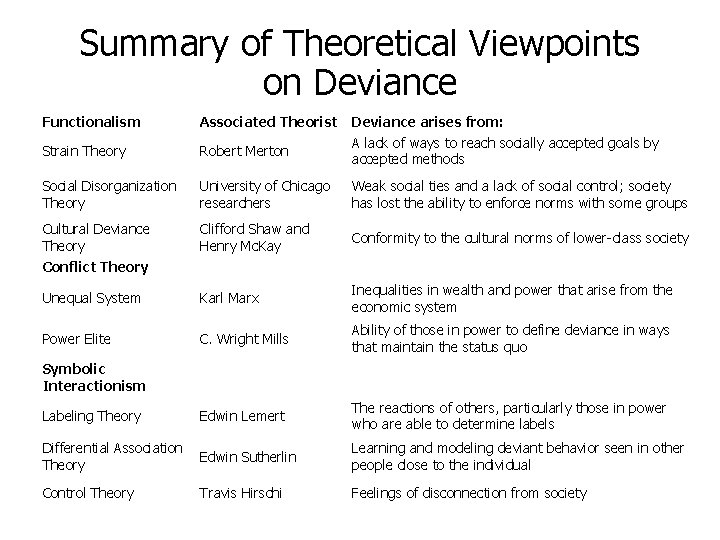
Summary of Theoretical Viewpoints on Deviance Functionalism Associated Theorist Deviance arises from: A lack of ways to reach socially accepted goals by accepted methods Strain Theory Robert Merton Social Disorganization Theory University of Chicago researchers Weak social ties and a lack of social control; society has lost the ability to enforce norms with some groups Cultural Deviance Theory Conflict Theory Clifford Shaw and Henry Mc. Kay Conformity to the cultural norms of lower-class society Unequal System Karl Marx Inequalities in wealth and power that arise from the economic system Power Elite C. Wright Mills Ability of those in power to define deviance in ways that maintain the status quo Labeling Theory Edwin Lemert The reactions of others, particularly those in power who are able to determine labels Differential Association Theory Edwin Sutherlin Learning and modeling deviant behavior seen in other people close to the individual Control Theory Travis Hirschi Feelings of disconnection from society Symbolic Interactionism
US Criminal Justice System A criminal justice system is an organization that exists to enforce a legal code. There are three branches of the U. S. criminal justice system: • The police are a civil force in charge of enforcing laws and public order at a federal, state, or community level • Courts have the authority to make decisions based on law • The corrections system supervises individuals who have been arrested, convicted, and sentenced for a criminal offense
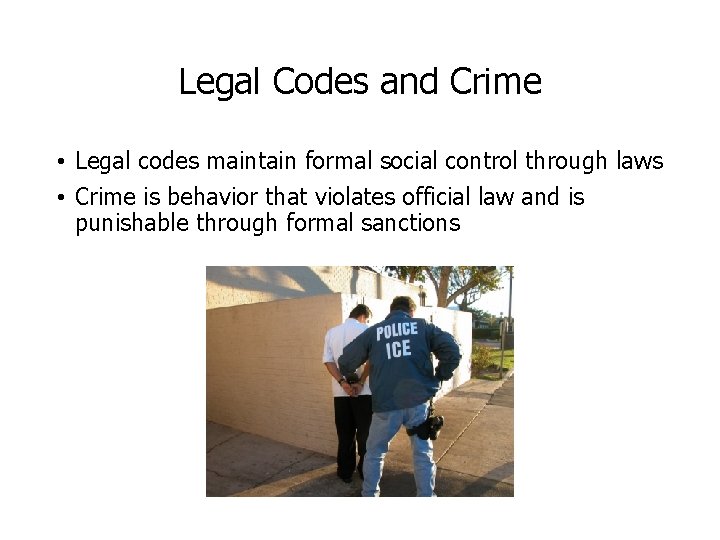
Legal Codes and Crime • Legal codes maintain formal social control through laws • Crime is behavior that violates official law and is punishable through formal sanctions
Types of Crimes • corporate crime: crime committed by white-collar workers in a business environment • hate crimes: attacks based on a person’s race, religion, or other characteristics • nonviolent crimes: crimes that involve the destruction or theft of property, but do not use force or the threat of force • street crime: crime committed by average people against other people or organizations, usually in public spaces • victimless crime: activities against the law, but that do not result in injury to any individual other than the person who engages in them • violent crimes: crimes based on the use of force or the threat of force
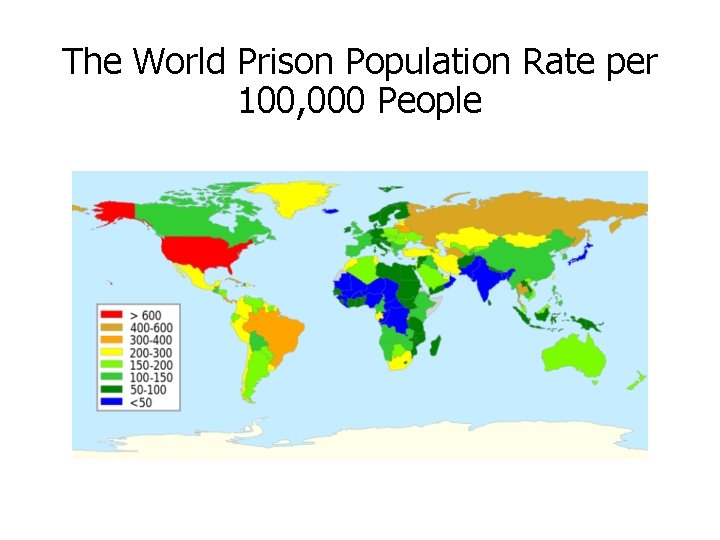
The World Prison Population Rate per 100, 000 People
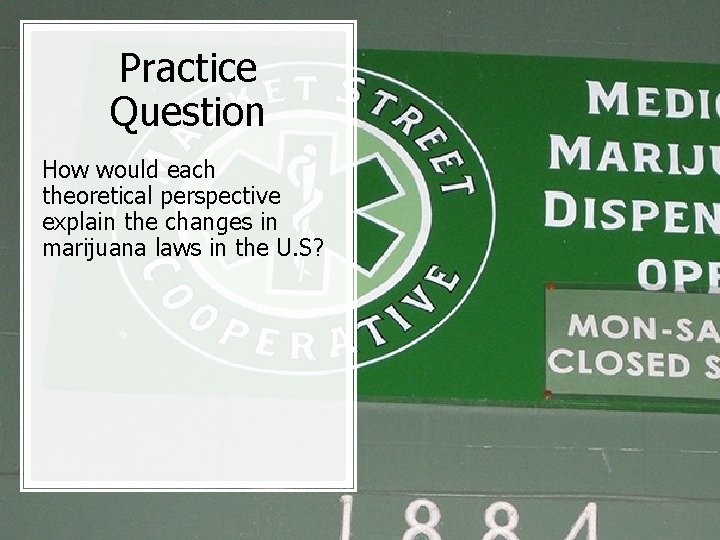
Practice Question How would each theoretical perspective explain the changes in marijuana laws in the U. S?
Quick Review • What are deviance and methods of social control? • How are three main theoretical perspectives on deviance different from one another? • What are the parts of the criminal justice system? • What are different types of crimes?