CH 7 DEVIANCE AND SOCIAL CONTROL LESSON 1










- Slides: 24
CH. 7: DEVIANCE AND SOCIAL CONTROL
LESSON 1: DEVIANCE AND SOCIAL CONTROL IS THIS DEVIANT?
• Is this deviant?
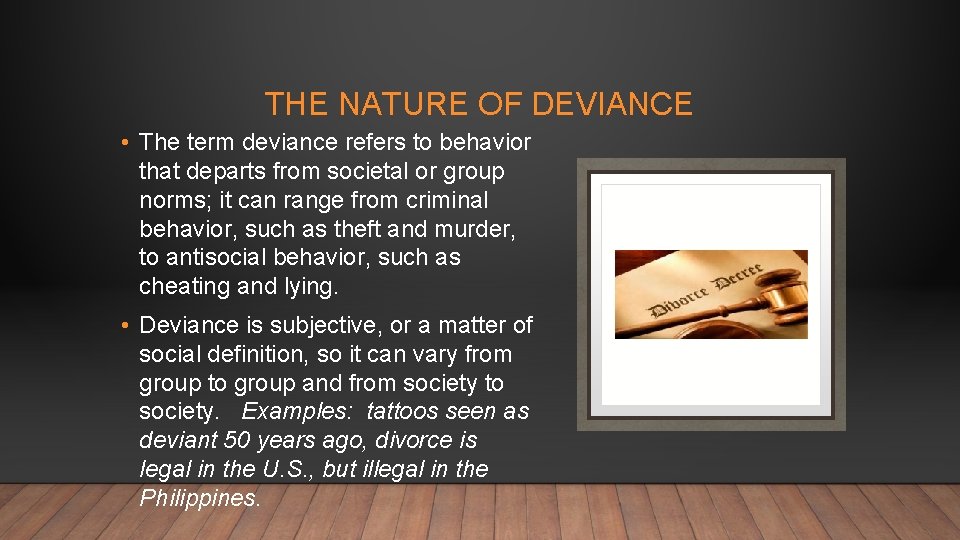
THE NATURE OF DEVIANCE • The term deviance refers to behavior that departs from societal or group norms; it can range from criminal behavior, such as theft and murder, to antisocial behavior, such as cheating and lying. • Deviance is subjective, or a matter of social definition, so it can vary from group to group and from society to society. Examples: tattoos seen as deviant 50 years ago, divorce is legal in the U. S. , but illegal in the Philippines.
THE NATURE OF DEVIANCE CONT. • Negative deviance involves behavior that fails to meet accepted norms. • Positive deviance involves over-conformity to norms, which leads to imbalance and extremes of perfectionism. Example: someone starves themselves in order to look like a super model.
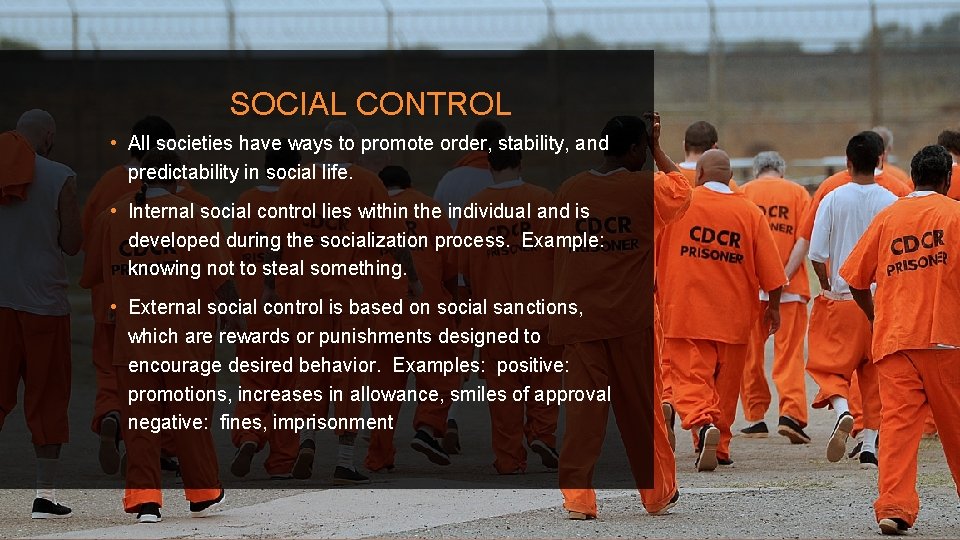
SOCIAL CONTROL • All societies have ways to promote order, stability, and predictability in social life. • Internal social control lies within the individual and is developed during the socialization process. Example: knowing not to steal something. • External social control is based on social sanctions, which are rewards or punishments designed to encourage desired behavior. Examples: positive: promotions, increases in allowance, smiles of approval negative: fines, imprisonment
LESSON 2: FUNCTIONALISM AND DEVIANCE
REMEMBER FUNCTIONALIST PERSPECTIVE? • Basically it emphasizes social stability and they way different parts of society contribute to the whole.
COSTS AND BENEFITS OF DEVIANCE • Functionalists believe that some deviance may benefit society; deviance has both positive and negative consequences. • Deviance erodes trust and can cause nonconforming behavior in others. It can also be costly regarding time and money. • Émile Durkheim observed that deviance clarifies norms by causing society to exercise social control to defend its values and to define and adjust norms. Example: when parents are taken to court or lost their children due neglect.
STRAIN THEORY • In times of anomie—a social condition in which norms are weak, conflicting, or absent—individuals are uncertain about how they should think and act and societies become disorganized. • According to the strain theory, deviance is most likely to occur when there is a gap between culturally desirable goals, such as money and prestige, and a legitimate way of obtaining them. • Deviant responses to strain are innovation, ritualism, retreatism, and rebellion.
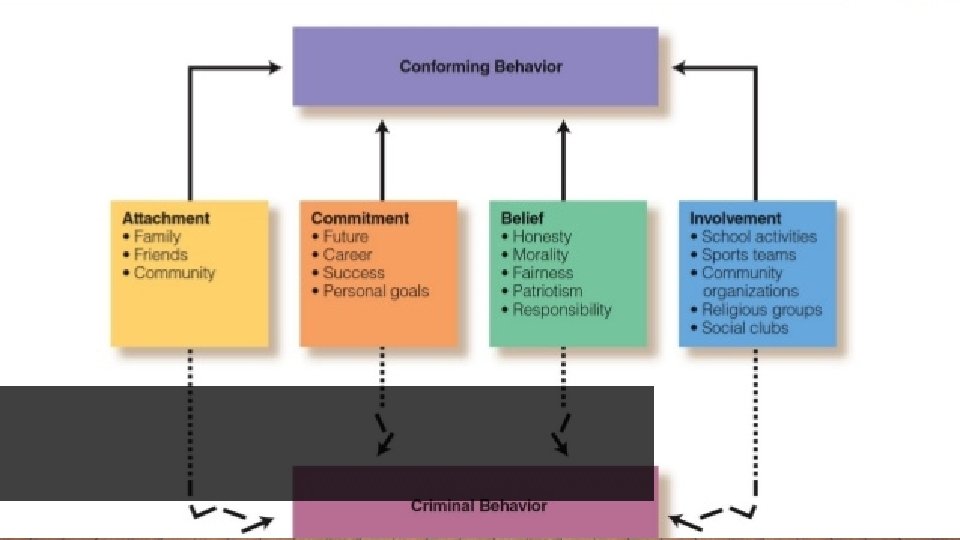
CONTROL THEORY • According to control theory, conformity to social norms depends on the presence of strong bonds between individuals and society. • Social bonds control behavior and, if those bonds are weakened by anomie, deviance occurs. • The four basic components of social bonds are attachment, commitment, involvement, and belief.
LESSON 3: SYMBOLIC INTERACTIONISM AND DEVIANCE
DIFFERENTIAL ASSOCIATION THEORY • According to symbolic interactionism, deviance is transmitted through socialization in the same way that conformity is learned. • First, a person who knows mostly deviants is more likely to learn deviant behavior.
DIFFERENTIAL ASSOCIATION THEORY (CONT. ) • Second, a person is more likely to copy deviant behavior from someone significant to him or her. • Third, younger children learn deviant behavior more quickly than older children. • Read “Connecting Sociology to History: Crime and Punishment. ”
LABELING THEORY • Rather than explaining why deviance occurs, labeling theory explains why deviance is relative, not only to the society or social group, but also to the individual. Example: unmarried, pregnant, teenage girls are more negatively sanctioned than the biological, teenage fathers. • According to labeling theory, deviant behaviors are always a matter of social definition. • Primary deviance, a person engages only in isolated acts of deviance. • Secondary deviance person embraces deviance as a lifestyle.
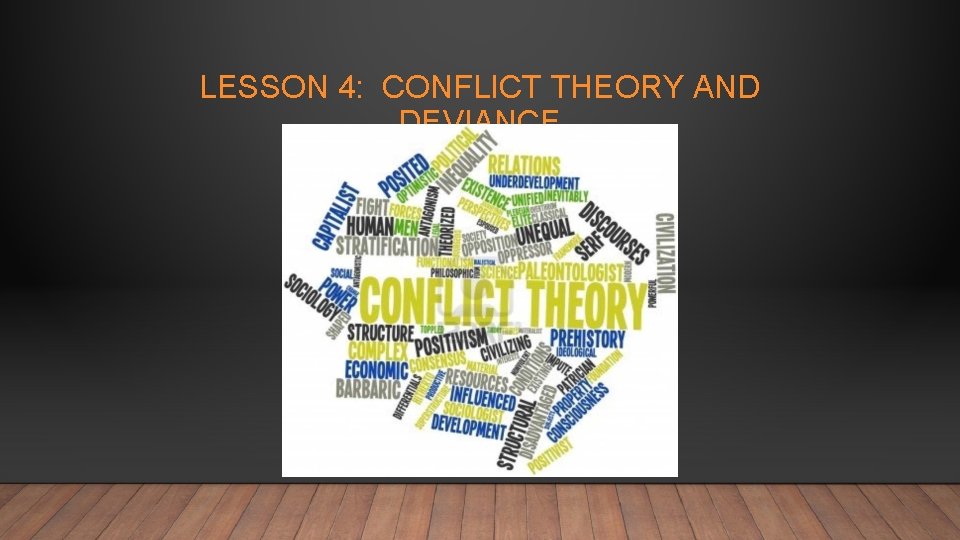
LESSON 4: CONFLICT THEORY AND DEVIANCE
DEVIANCE IN INDUSTRIAL SOCIETY • From the perspective of conflict theory, deviance in an industrial society is behavior that those in control of that society see as threatening to their interests. • Sociologist Steven Spitzer has proposed that the culture of an industrial society defends itself against deviants by classifying as deviants critics of the society, those who will not work, and those who threaten private property. • In addition, people who show a lack of respect for authority are treated as deviants.
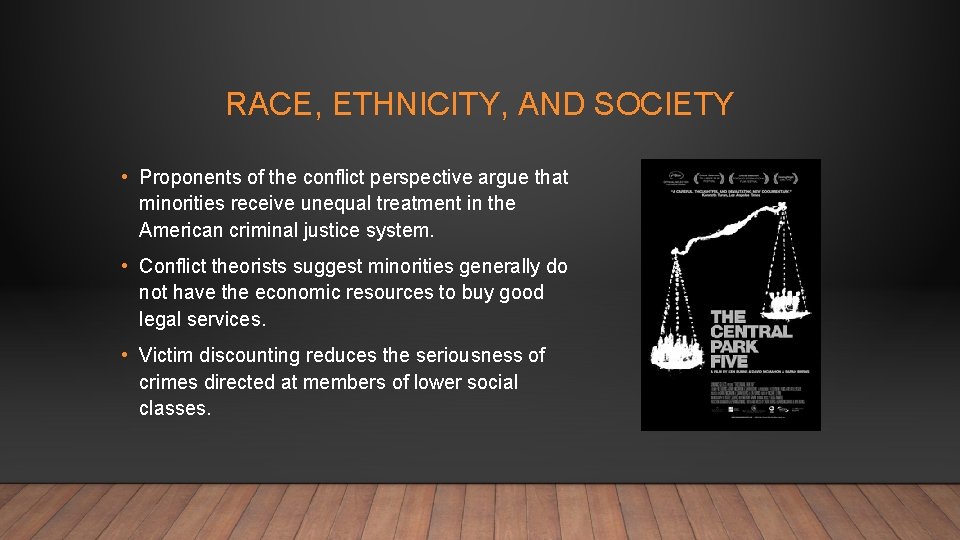
RACE, ETHNICITY, AND SOCIETY • Proponents of the conflict perspective argue that minorities receive unequal treatment in the American criminal justice system. • Conflict theorists suggest minorities generally do not have the economic resources to buy good legal services. • Victim discounting reduces the seriousness of crimes directed at members of lower social classes.
WHITE-COLLAR CRIME • White-collar crime is any crime committed by respectable and high-status people in the course of their occupations. • Price fixing, insider trading, fraud, embezzlement, manufacture of hazardous products, and tax evasion. • The people who commit these crimes are often treated more leniently than other criminals.
LESSON 5: CRIME AND PUNISHMENT
MEASUREMENT OF CRIME • U. S. crime statistics are found in the Federal Bureau of Investigation’s Uniform Crime Reports (UCR). • Submitted by local law-enforcement agencies, these statistics track these crimes: murder, forcible rape, robbery, aggravated assault, burglary, larcenytheft, motor vehicle theft, arson, and hate crimes. • It is estimated that about two-thirds of U. S. crimes are not reported at all.
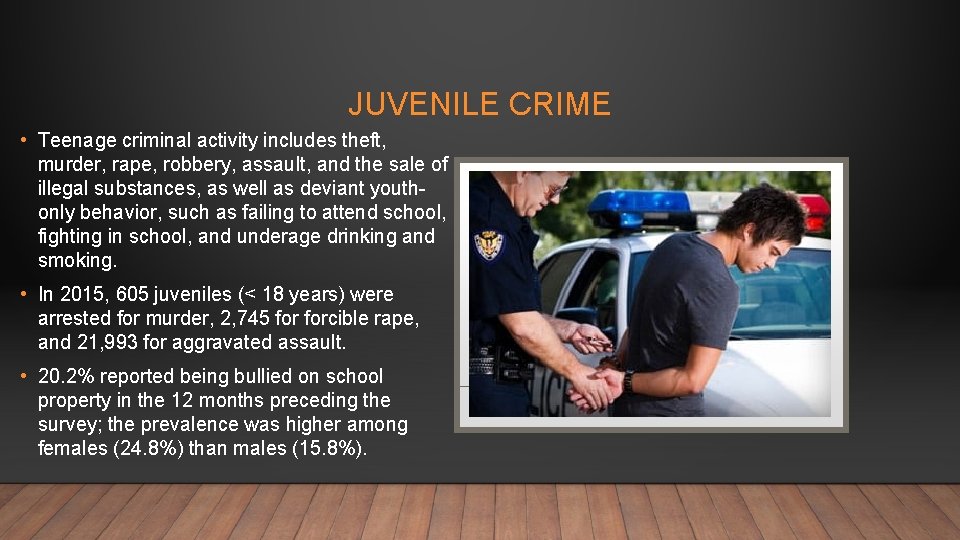
JUVENILE CRIME • Teenage criminal activity includes theft, murder, rape, robbery, assault, and the sale of illegal substances, as well as deviant youthonly behavior, such as failing to attend school, fighting in school, and underage drinking and smoking. • In 2015, 605 juveniles (< 18 years) were arrested for murder, 2, 745 forcible rape, and 21, 993 for aggravated assault. • 20. 2% reported being bullied on school property in the 12 months preceding the survey; the prevalence was higher among females (24. 8%) than males (15. 8%).
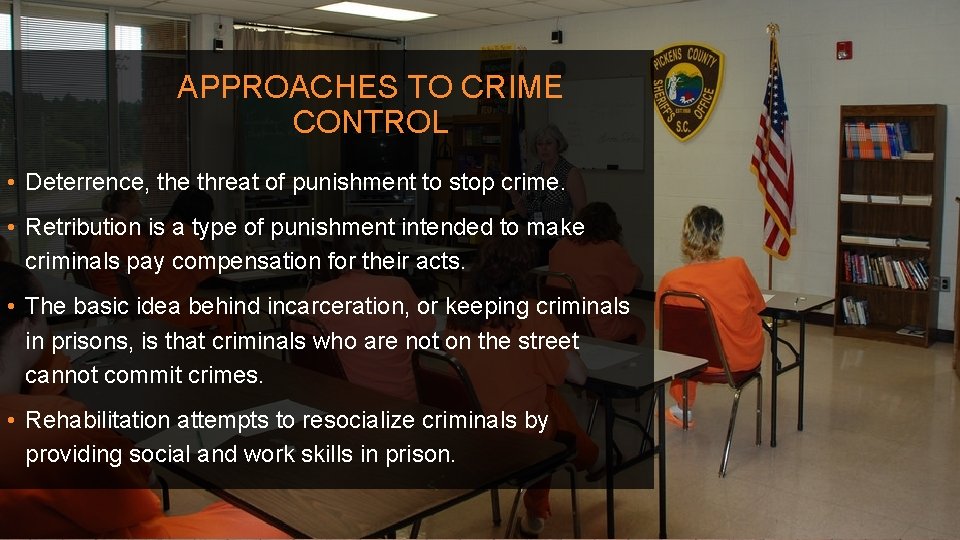
APPROACHES TO CRIME CONTROL • Deterrence, the threat of punishment to stop crime. • Retribution is a type of punishment intended to make criminals pay compensation for their acts. • The basic idea behind incarceration, or keeping criminals in prisons, is that criminals who are not on the street cannot commit crimes. • Rehabilitation attempts to resocialize criminals by providing social and work skills in prison.