3 Communication Skills 1 Define important words in


- Slides: 92
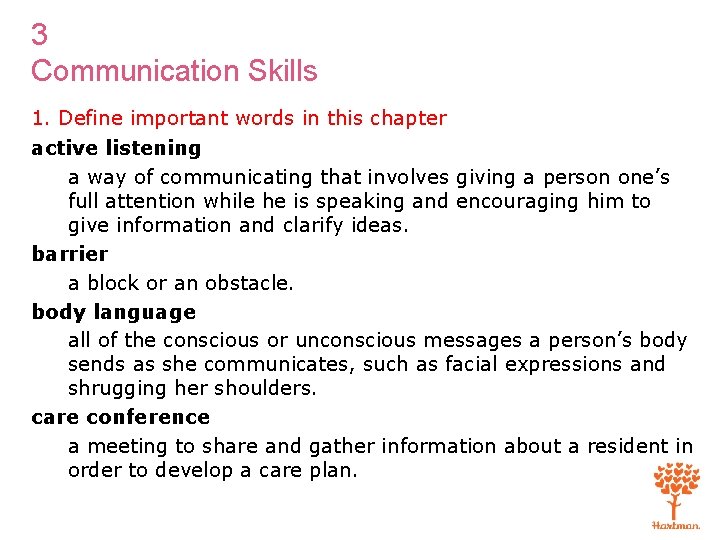
3 Communication Skills 1. Define important words in this chapter active listening a way of communicating that involves giving a person one’s full attention while he is speaking and encouraging him to give information and clarify ideas. barrier a block or an obstacle. body language all of the conscious or unconscious messages a person’s body sends as she communicates, such as facial expressions and shrugging her shoulders. care conference a meeting to share and gather information about a resident in order to develop a care plan.
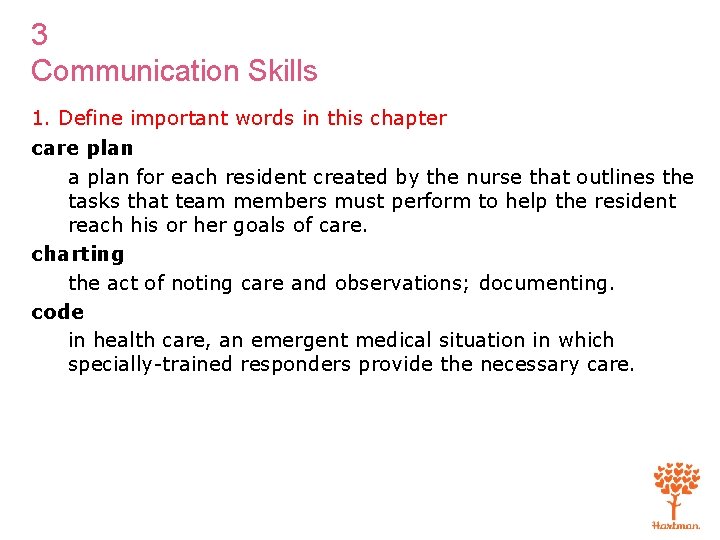
3 Communication Skills 1. Define important words in this chapter care plan a plan for each resident created by the nurse that outlines the tasks that team members must perform to help the resident reach his or her goals of care. charting the act of noting care and observations; documenting. code in health care, an emergent medical situation in which specially-trained responders provide the necessary care.
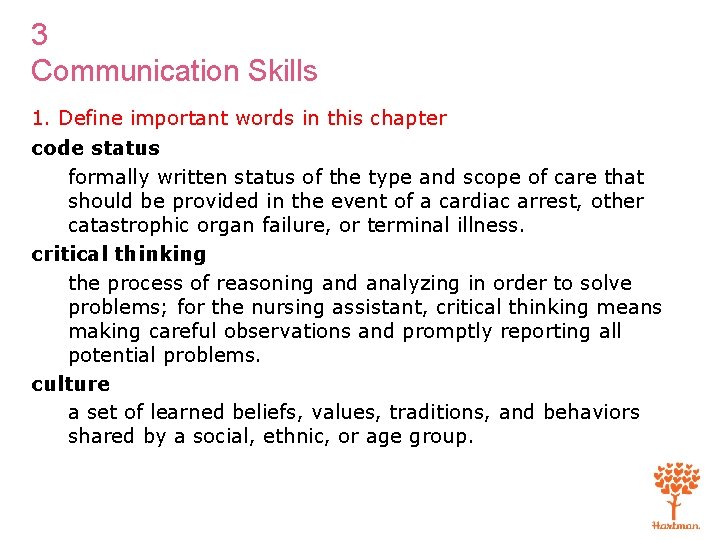
3 Communication Skills 1. Define important words in this chapter code status formally written status of the type and scope of care that should be provided in the event of a cardiac arrest, other catastrophic organ failure, or terminal illness. critical thinking the process of reasoning and analyzing in order to solve problems; for the nursing assistant, critical thinking means making careful observations and promptly reporting all potential problems. culture a set of learned beliefs, values, traditions, and behaviors shared by a social, ethnic, or age group.
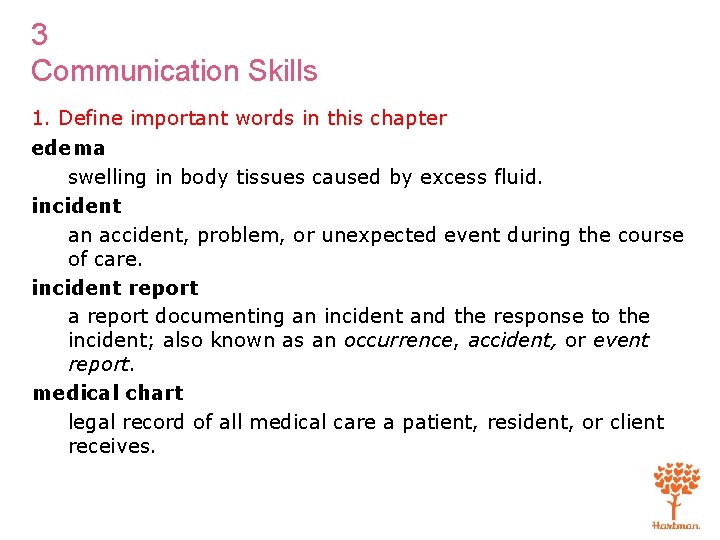
3 Communication Skills 1. Define important words in this chapter edema swelling in body tissues caused by excess fluid. incident an accident, problem, or unexpected event during the course of care. incident report a report documenting an incident and the response to the incident; also known as an occurrence, accident, or event report. medical chart legal record of all medical care a patient, resident, or client receives.
3 Communication Skills 1. Define important words in this chapter Minimum Data Set (MDS) a detailed form with guidelines for assessing residents in long -term care facilities; also details what to do if resident problems are identified. nonverbal communication without using words, such as through gestures and facial expressions. nursing process an organized method used by nurses to determine residents’ needs, plan the appropriate care to meet those needs, and evaluate how well the plan of care is working; five steps are assessment, diagnosis, planning, implementation, and evaluation.
3 Communication Skills 1. Define important words in this chapter objective information factual information collected using the senses of sight, hearing, smell, and touch; also called signs. orientation a person’s awareness of person, place, and time. prefix a word part added to the beginning of a root to create a new meaning. prioritize to place things in order of importance.
3 Communication Skills 1. Define important words in this chapter root the main part of a word that gives it meaning. rounds physical movement of staff from room to discuss each resident and his or her care plan. sentinel event an unexpected occurrence involving death or serious physical or psychological injury. subjective information collected from residents, their family members and friends; information may or may not be true but is what the person reported; also called symptoms.
3 Communication Skills 1. Define important words in this chapter suffix a word part added to the end of a root or a prefix to create a new meaning. verbal communication involving the use of spoken or written words or sounds. vital signs measurements—temperature, pulse, respirations, blood pressure, pain level—that monitor the functioning of the vital organs of the body.
3 Communication Skills 2. Explain types of communication Define the following terms: verbal communication involving the use of spoken or written words or sounds. nonverbal communication without using words, such as through gestures and facial expressions.
3 Communication Skills 2. Explain types of communication Define the following terms: body language all of the conscious or unconscious messages a person’s body sends as she communicates, such as facial expressions and shrugging her shoulders. active listening a way of communicating that involves giving a person one’s full attention while he is speaking and encouraging him to give information and clarify ideas.
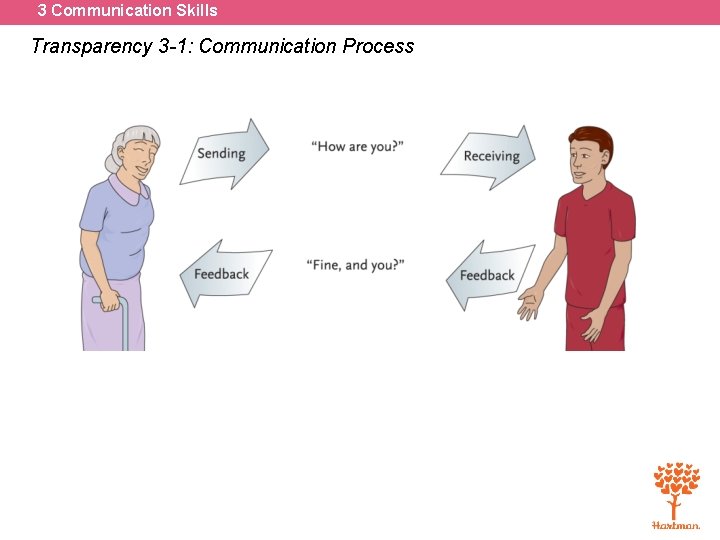
3 Communication Skills 2. Explain types of communication REMEMBER: Communication is the exchange of information with others, which involves sending and receiving messages. People have different roles during communication. For example, a person can be the sender or the receiver. The person who communicates first is the sender. The person who receives the message is the receiver.
3 Communication Skills Transparency 3 -1: Communication Process
3 Communication Skills 2. Explain types of communication REMBEMBER: How the voice sounds when someone speaks is as important as the words he uses.
3 Communication Skills 2. Explain types of communication Think about these questions: How do you feel when a teacher or supervisor sounds irritated when answering a question you have asked? How might a resident feel when a nursing assistant sounds irritated when providing care?
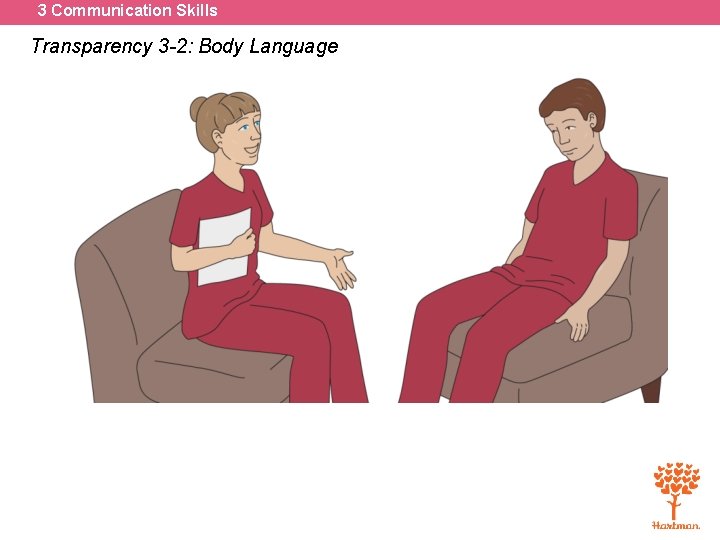
3 Communication Skills 2. Explain types of communication REMEMBER: Body language has to do with all of the conscious or unconscious messages your body sends as you communicate. It includes posture, body movements, facial expressions, and gestures. It can be positive or negative.
3 Communication Skills Transparency 3 -2: Body Language
3 Communication Skills 2. Explain types of communication Body language can be positive or negative. Examples of positive nonverbal communication include the following: • Smiling in a friendly manner • Leaning forward to listen • Nodding while a person is speaking • With permission, putting your hand over a resident’s hand
3 Communication Skills 2. Explain types of communication Examples of negative nonverbal communication include the following: • Rolling eyes • Crossing arms in front of the body • Tapping feet • Pointing at someone while speaking
3 Communication Skills 2. Explain types of communication Think about this question: Can you think of other examples of either positive or negative nonverbal communication?
3 Communication Skills 2. Explain types of communication Remember these guidelines for proper communication: • Use appropriate words. • Be aware of your body language. • Use a friendly and professional tone of voice. • Wait for responses and let pauses happen. • Practice active listening. • Use mostly facts when communicating.
3 Communication Skills 2. Explain types of communication Think about this question: How might you use verbal or nonverbal communication to reach a specific goal?
3 Communication Skills 3. Explain barriers to communication Define the following term: barrier a block or an obstacle.
3 Communication Skills 3. Explain barriers to communication REMEMBER: Nursing assistants often encounter various barriers to communication with residents. It is important to be aware of these barriers and to know ways to avoid them.
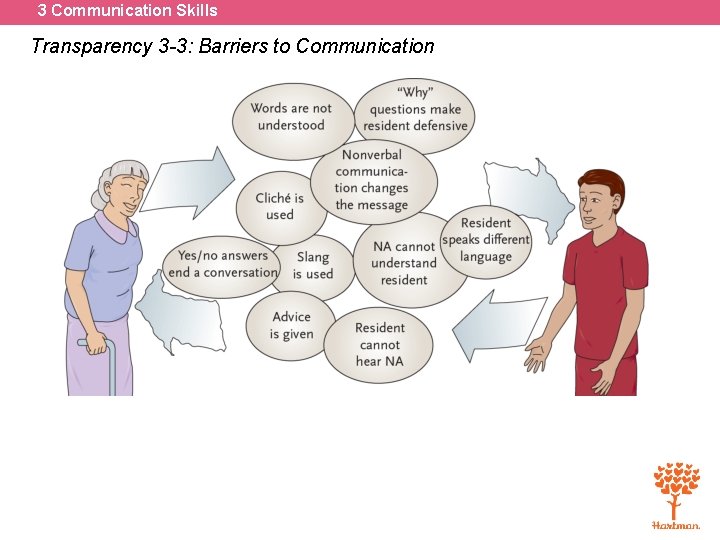
3 Communication Skills Transparency 3 -3: Barriers to Communication
3 Communication Skills 3. Explain barriers to communication Barriers to communication include the following: • Resident does not hear, does not hear correctly, or does not understand. • Resident is difficult to understand. • NA, resident, or others use words that are not understood. • NA uses slang or profanity. • NA uses clichés.
3 Communication Skills 3. Explain barriers to communication Barriers to communication (cont'd): • NA responds with “Why? ” • NA gives advice. • NA asks questions that only require yes/no answers. • Resident speaks a different language. • NA or resident uses nonverbal communication.
3 Communication Skills 3. Explain barriers to communication Think about these questions: Imagine a day – or a lifetime – without communication. How would that feel? Can you think of a situation in which you wasted time and effort because of miscommunication? Could it have been avoided? Can you think of a situation in which effective communication resulted in a positive outcome?
3 Communication Skills 4. List ways that cultures impact communication Define the following term: culture a set of learned beliefs, values, traditions, and behaviors shared by a social, ethnic, or age group.
3 Communication Skills 4. List ways that cultures impact communication The following aspects of communication are influenced by culture and are important to understand when caring for residents: • Eye contact • Touch • Language Touch is an important way to communicate, and there are differences among cultures and among individual personalities regarding a person’s comfort level with touch.
3 Communication Skills 4. List ways that cultures impact communication Examples of acceptable touch include the following: • Giving residents respectful personal care, such as bathing, dressing, feeding, and shaving • Hugging, if the resident permits or asks for it • Holding a resident’s hand when asked
3 Communication Skills 4. List ways that cultures impact communication Examples of unacceptable touch include the following: • Sitting on a resident’s lap or asking a resident to sit on your lap • Kissing a resident • Hugging a resident who pulls away • Inappropriately touching or rubbing against a resident or staff member
3 Communication Skills 4. List ways that cultures impact communication Think about this question: Can you think of other examples of acceptable and unacceptable touch?
3 Communication Skills 4. List ways that cultures impact communication Think about these questions: How does your culture influence your communication and use of touch? Can you think of any other cultural considerations which could be useful when working with residents from different cultures than your own?
3 Communication Skills 5. Identify the people a nursing assistant communicates with in a facility There are many different people a nursing assistant communicates with on the job. This is another reason why understanding communication and communicating clearly are so important. Remember that a nursing assistant communicates with the following while on the job: • Doctors, nurses, supervisors, and other staff members • Other departments • Residents • Families and visitors • The community
3 Communication Skills 6. Understand basic medical terminology and abbreviations Define the following terms: edema swelling in body tissues caused by excess fluid. root the main part of a word that gives it meaning. prefix a word part added to the beginning of a root to create a new meaning. suffix a word part added to the end of a root or a prefix to create a new meaning.
3 Communication Skills 6. Understand basic medical terminology and abbreviations In order to communicate well with other members of the care team, nursing assistants need to learn medical language. NAs use medical terms for specific conditions. Medical terms are made up of these word parts: • Roots • Prefixes • Suffixes
3 Communication Skills 6. Understand basic medical terminology and abbreviations A root is the main part of the word that gives it meaning. A prefix comes at the front of the word. It works with a word root to make a new term. For example, the root scope means an instrument to look inside. The prefix oto means ear. An otoscope is an instrument used to examine the ear.
3 Communication Skills 6. Understand basic medical terminology and abbreviations A suffix is found at the end of a word. When you add a prefix or a root, the suffix turns it into a working medical term. For example, the suffix meter means measuring instrument. The prefix thermo means heat. A thermometer is an instrument that measures body temperature.
3 Communication Skills 6. Understand basic medical terminology and abbreviations REMEMBER: Abbreviations help healthcare workers communicate more efficiently, and many abbreviations are used in healthcare. Two examples of a common medical abbreviations are BP for blood pressure and temp for temperature.
3 Communication Skills 6. Understand basic medical terminology and abbreviations Think about this question: In what ways would it be more difficult for healthcare workers (doctors, nurses, nursing assistants, etc. ) to communicate if there were no medical terminology or abbreviations?
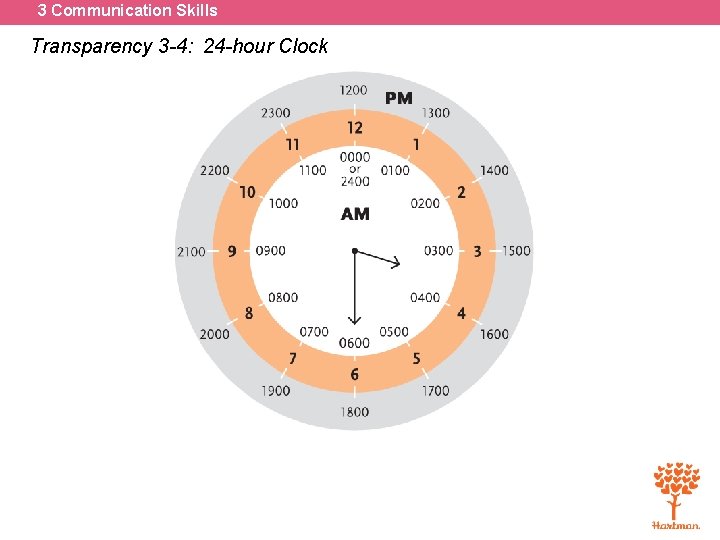
3 Communication Skills 7. Explain how to convert regular time to military time Facilities may use the 24 -hour clock, or military time, to document information. Regular time uses numbers 1 through 12. In military time, the hours are numbered from 00 to 23. • To change the regular hours between 1: 00 p. m. to 11: 59 p. m. to military time, add 12 to the regular time. • To change from military time to regular time, subtract 12. • Minutes and seconds do not change. • Midnight may be written as 0000 or 2400; follow facility policy.
3 Communication Skills Transparency 3 -4: 24 -hour Clock
3 Communication Skills 8. Describe a standard resident chart Define the following terms: medical chart legal record of all medical care a patient, resident, or client receives. charting the act of noting care and observations; documenting.
3 Communication Skills 8. Describe a standard resident chart REMEMBER: A nursing assistant’s responsibility with a resident’s medical chart is to gather information and report it to the nurse. NAs write down their observations and record the care they give. This is called charting. Some facilities allow nursing assistants to chart in a medical record. Others limit nursing assistants’ charting to certain forms.
3 Communication Skills 8. Describe a standard resident chart REMEMBER: A resident’s chart is the legal record of a resident’s care. What is written on the chart is considered to be what actually happened.
3 Communication Skills 8. Describe a standard resident chart Information found on a resident’s chart includes the following: • Admission forms • Resident’s history and results of exams • Care plans • Doctor’s orders and progress notes • Nursing assessments • Notes from nurses and other specialists
3 Communication Skills 8. Describe a standard resident chart Information found on a resident’s chart (cont'd): • Flow sheets • Graphic record • Intake and output record • Consent forms • Lab and test results • Surgery reports • Advance directives
3 Communication Skills 8. Describe a standard resident chart REMEMBER: All information in a resident’s chart is confidential.
3 Communication Skills 9. Explain guidelines for documentation REMEMBER: Nursing assistants chart, or document, all resident care that they provide. They also document their observations. It is very important to document accurately because documentation is a legal record of all resident care.
3 Communication Skills 9. Explain guidelines for documentation Remember these guidelines for accurate documentation: • Keep all information confidential. • Document care immediately after it is given. Never document care before it is given. • Use black ink when documenting by hand. • Sign each note you make.
3 Communication Skills 9. Explain guidelines for documentation Guidelines for accurate documentation (cont'd): • Use only facts when documenting. • If an error is made, draw one line through it and initial it and write the date. Write the correct information. • Use only your facility’s accepted abbreviations and terms. • Use comparisons to describe size.
3 Communication Skills 10. Describe the use of computers in documentation Some care require that computers be used to document information. Computers can easily store information that can be retrieved when it is needed. Remember these general rules for computer use: • Do not share your password or log-in ID with anyone. • Do not access personal e-mail or inappropriate websites from work. • Log off and/or exit the web browser when done with charting or using the computer. • Be careful about who can see PHI on the screen, as HIPAA guidelines apply to computer use.
3 Communication Skills 11. Explain the Minimum Data Set (MDS) Define the following term: Minimum Data Set (MDS) a detailed form with guidelines for assessing residents in long -term care facilities; also details what to do if resident problems are identified.
3 Communication Skills 11. Explain the Minimum Data Set (MDS) The Minimum Data Set (MDS) manual is an assessment tool developed by the federal government. It gives long-term care facilities a structured, standardized approach to care. Here are some facts about the MDS: • Assessment tool developed by the federal government • Detailed form for assessing residents • Details what to do if problems are identified • Completed for each resident within 14 days of admission and again each year • Must be reviewed every 3 months • New MDS is completed when there is any major change in resident’s condition
3 Communication Skills 11. Explain the Minimum Data Set (MDS) REMEMBER: Nursing assistants’ reports on changes in the condition of residents in their care very valuable. These reports may trigger needed assessments.
3 Communication Skills 12. Describe how to observe and report accurately Define the following terms: care plan a plan for each resident created by the nurse that outlines the tasks that team members must perform to help the resident reach his or her goals of care. objective information factual information collected using the senses of sight, hearing, smell, and touch; also called signs. subjective information collected from residents, their family members and friends; information may or may not be true but is what the person reported; also called symptoms.
3 Communication Skills 12. Describe how to observe and report accurately Define the following terms: orientation a person’s awareness of person, place, and time. vital signs measurements—temperature, pulse, respirations, blood pressure, pain level—that monitor the functioning of the vital organs of the body. critical thinking the process of reasoning and analyzing in order to solve problems; for the nursing assistant, critical thinking means making careful observations and promptly reporting all potential problems.
3 Communication Skills 12. Describe how to observe and report accurately REMEMBER: Nursing assistants spend more time with residents than any other care team members do. Because they spend the most time with residents, they are in the best position to observe changes in residents. The care plan that nurses create for residents is based on information observed and reported by nursing assistants and other staff members.
3 Communication Skills 12. Describe how to observe and report accurately Think about this question: What could happen if a nursing assistant reported incorrect or inaccurate information about a resident?
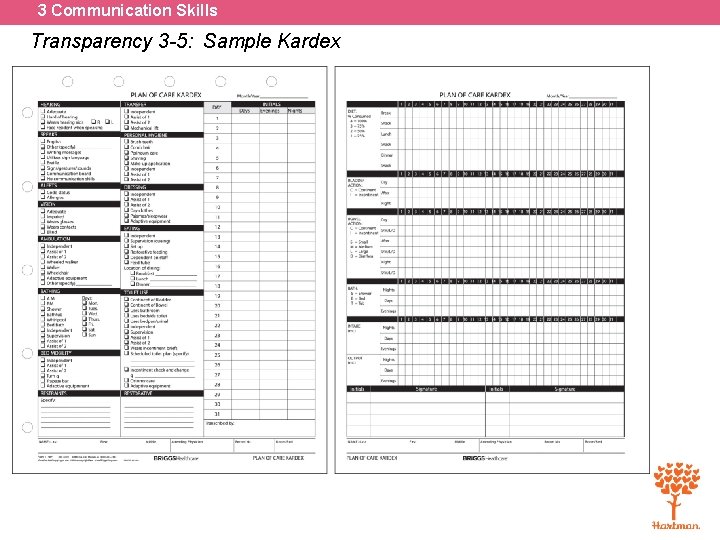
3 Communication Skills Transparency 3 -5: Sample Kardex
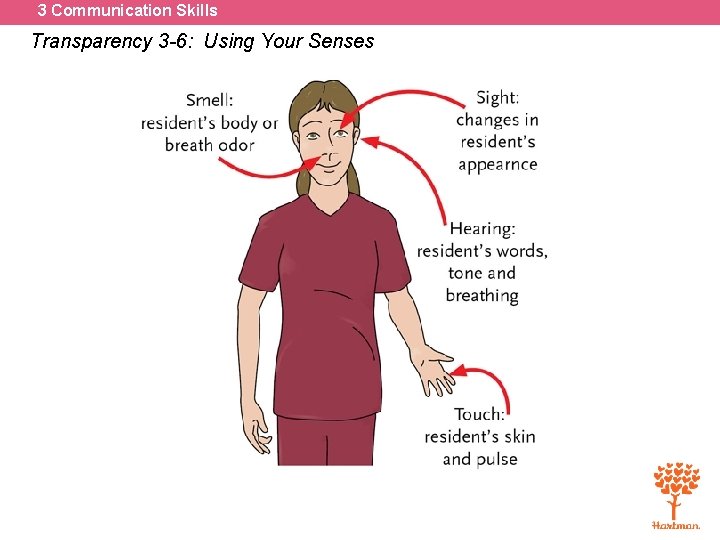
3 Communication Skills Transparency 3 -6: Using Your Senses
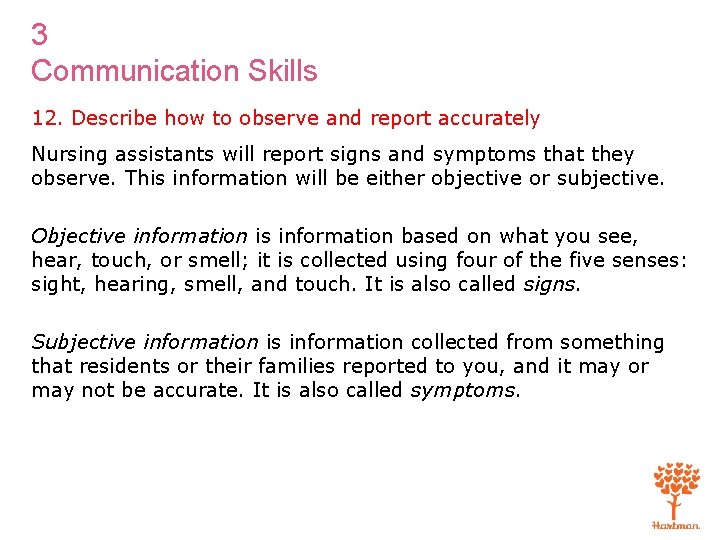
3 Communication Skills 12. Describe how to observe and report accurately Nursing assistants will report signs and symptoms that they observe. This information will be either objective or subjective. Objective information is information based on what you see, hear, touch, or smell; it is collected using four of the five senses: sight, hearing, smell, and touch. It is also called signs. Subjective information is information collected from something that residents or their families reported to you, and it may or may not be accurate. It is also called symptoms.
3 Communication Skills 12. Describe how to observe and report accurately Other ways to observe residents accurately: • Note changes in orientation. • Check vital signs. • Report any changes in ability. • Report other important changes, such as appetite, ability to go to the bathroom, and mood.
3 Communication Skills 12. Describe how to observe and report accurately REMEMBER: Critical thinking for nursing assistants involves making careful observations, evaluating resident information, and immediately reporting all potential problems.
3 Communication Skills 12. Describe how to observe and report accurately Remember that these signs and symptoms should be reported right away: • Falls • Wheezing • Difficulty breathing • Chest pain and pressure • Pain in calf of leg • Blurred vision • Slurred speech
3 Communication Skills 12. Describe how to observe and report accurately Signs and symptoms that should be reported right away (cont'd): • Vomiting • Sudden limp or change in ability to walk • Numbness or loss of feeling in one side of body or in arms or legs • Abdominal pain • Change in vital signs • Severe headache
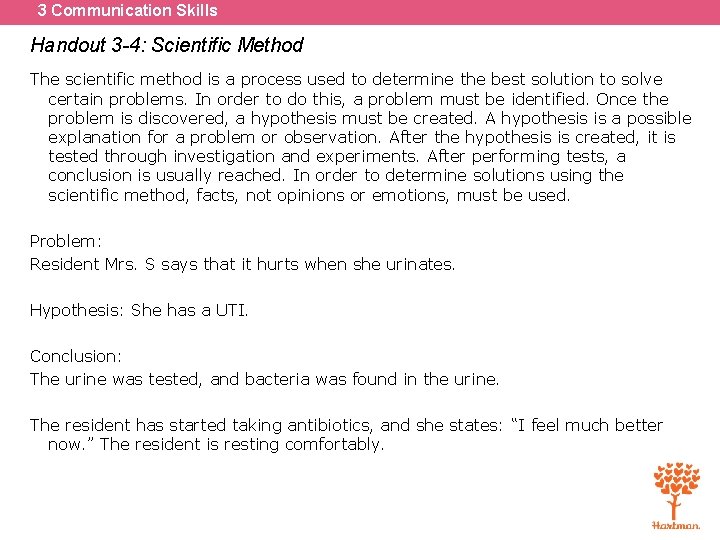
3 Communication Skills Handout 3 -4: Scientific Method The scientific method is a process used to determine the best solution to solve certain problems. In order to do this, a problem must be identified. Once the problem is discovered, a hypothesis must be created. A hypothesis is a possible explanation for a problem or observation. After the hypothesis is created, it is tested through investigation and experiments. After performing tests, a conclusion is usually reached. In order to determine solutions using the scientific method, facts, not opinions or emotions, must be used. Problem: Resident Mrs. S says that it hurts when she urinates. Hypothesis: She has a UTI. Conclusion: The urine was tested, and bacteria was found in the urine. The resident has started taking antibiotics, and she states: “I feel much better now. ” The resident is resting comfortably.
3 Communication Skills 13. Explain the nursing process Define the following term: nursing process an organized method used by nurses to determine residents’ needs, plan the appropriate care to meet those needs, and evaluate how well the plan of care is working; five steps are assessment, diagnosis, planning, implementation, and evaluation.
3 Communication Skills 13. Explain the nursing process The nursing process has five steps: • Assessment • Diagnosis • Planning • Implementation • Evaluation
3 Communication Skills 14. Discuss the nursing assistant’s role in care planning and at care conferences Define the following term: care conference a meeting to share and gather information about a resident in order to develop a care plan.
3 Communication Skills 14. Discuss the nursing assistant’s role in care planning and at care conferences REMEMBER: Nursing assistants have an important role in care planning. Care plans are prepared from the observations of staff caring for the resident. At care planning meetings, NAs should not be afraid to share their observations. If an NA is unsure about what information to share, he should talk to the nurse before the meeting.
3 Communication Skills 14. Discuss the nursing assistant’s role in care planning and at care conferences REMEMBER: HIPAA privacy guidelines apply to care plans. Team members should not share a resident’s information with anyone not directly involved with the resident’s care.
3 Communication Skills 15. Describe incident reporting and recording Define the following terms: incident an accident, problem, or unexpected event during the course of care. sentinel event an unexpected occurrence involving death or serious physical or psychological injury. incident report a report documenting an incident and the response to the incident; also known as an occurrence, accident, or event report.
3 Communication Skills 15. Describe incident reporting and recording Incident reports are vital to the safety of the staff and residents. The following are events in the facility that are considered incidents: • An accident or problem during the course of care • An error in care • A fall or injury to a resident or staff member • An accusation against staff members
3 Communication Skills 15. Describe incident reporting and recording REMEMBER: An incident report must be filled out if a nursing assistant is injured on the job in any way, even if it seems minor.
3 Communication Skills 15. Describe incident reporting and recording When completing an incident report, the NA should • Include exactly what she saw • State the time and the mental and physical condition of the person • Describe the person’s reaction to the incident • State the facts; the NA should not give her opinion • Not include “Incident report filed” in the resident’s medical record • Not make any photocopies of the incident report
3 Communication Skills 16. Explain proper telephone etiquette REMEMBER: When nursing assistants use the telephone during their shift, they are representing their facility to the community. Following the rules for proper telephone etiquette is important.
3 Communication Skills 16. Explain proper telephone etiquette Remember these rules for telephone etiquette: • Cheerfully greet callers. • Identify your facility, yourself, and your position. • Listen closely to the caller’s request and write down any messages. • Get a telephone number if needed. • Thank the caller and say “Goodbye. ”
3 Communication Skills 16. Explain proper telephone etiquette Remember these rules for general telephone use: • Do not give out staff or resident information over the phone. • Ask before placing a caller on hold. • Ask for training to transfer calls. • Follow facility policy regarding personal phone calls and cell phone use.
3 Communication Skills 16. Explain proper telephone etiquette Think about this question: What could happen if an NA gave out confidential information about residents or staff over the phone?
3 Communication Skills 17. Describe the resident call system Residents signal staff that they need them by using the call system. Other terms for this system are signal light, or call light. This system allows residents to call for help when needed.
3 Communication Skills 17. Describe the resident call system REMEMBER: The call light is the residents’ lifeline and must always be answered immediately. Ignoring a call light is abuse. A call light must always be left within the resident’s reach before an NA leaves the room.
3 Communication Skills 18. Describe the nursing assistant’s role in change-of-shift reports and rounds Define the following term: rounds physical movement of staff from room to discuss each resident and his or her care plan.
3 Communication Skills 18. Describe the nursing assistant’s role in change-of-shift reports and rounds Remember these guidelines for start-of-shift reports: • Arrive on time. • Listen for your assignment and for information about all residents in your area. • Listen carefully to information from the prior shift. • Ask any questions you have about your residents.
3 Communication Skills 18. Describe the nursing assistant’s role in change-of-shift reports and rounds REMEMBER: The nursing assistant’s role in end-of-shift reports is to report information gathered about residents during the shift so that the staff members on the next shift can provide good care.
3 Communication Skills 19. List the information found on an assignment sheet Define the following terms: code status formally written status of the type and scope of care that should be provided in the event of a cardiac arrest, other catastrophic organ failure, or terminal illness. code in health care, an emergent medical situation in which specially-trained responders provide the necessary care.
3 Communication Skills 19. List the information found on an assignment sheet An assignment sheet lists residents and all of the tasks that must be done for them. The following information is typically found on an assignment sheet: • Residents’ names and room numbers • Medical diagnosis • Code status • Activity level • Range of motion (ROM) exercises • Bathing information
3 Communication Skills 19. List the information found on an assignment sheet Information typically found on an assignment sheet (cont'd): • Diet orders • Fluid orders • Bowel and bladder information • How often to measure vital signs • Treatments to be performed • Tests and procedures to be performed
3 Communication Skills 20. Discuss how to organize your work and manage time Define the following term: prioritize to place things in order of importance.
3 Communication Skills 20. Discuss how to organize your work and manage time Remember these tips for organization and time management: • Plan ahead. • Prioritize. • Make a schedule. • Combine activities. • Get help when needed.
3 Communication Skills 20. Discuss how to organize your work and manage time REMEMBER: Do not be afraid to ask for help. If you cannot complete an assignment for any reason, notify the nurse. Nursing assistants who are not afraid to ask for help provide the best care to their residents.
3 Communication Skills 20. Discuss how to organize your work and manage time Think about these questions: How strong are your organization and time management skills? In what ways can you improve them?