Mastering Team Skills and Interpersonal Communication Copyright 2011

- Slides: 32
Mastering Team Skills and Interpersonal Communication Copyright © 2011 Pearson Education, Inc. publishing as Prentice Hall 1
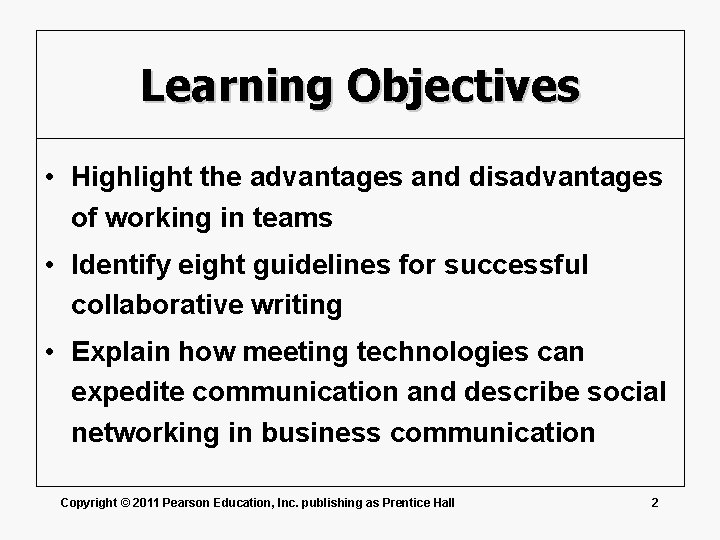
Learning Objectives • Highlight the advantages and disadvantages of working in teams • Identify eight guidelines for successful collaborative writing • Explain how meeting technologies can expedite communication and describe social networking in business communication Copyright © 2011 Pearson Education, Inc. publishing as Prentice Hall 2
Learning Objectives • Describe the listening process and how good listeners overcome barriers at each stage of the process • Clarify the importance of nonverbal communication and describe six categories of nonverbal expression • Review the importance of business etiquette Copyright © 2011 Pearson Education, Inc. publishing as Prentice Hall 3
Communicating in Teams • Problem-solving • Task forces • Committees Copyright © 2011 Pearson Education, Inc. publishing as Prentice Hall 4
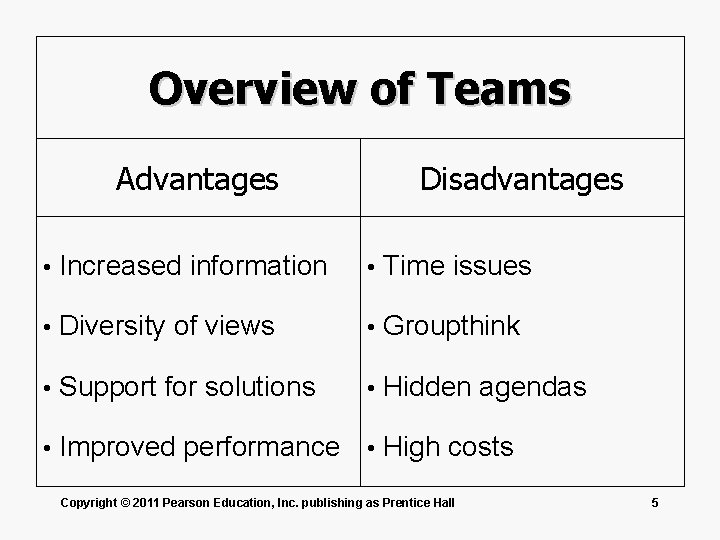
Overview of Teams Advantages Disadvantages • Increased information • Time issues • Diversity of views • Groupthink • Support for solutions • Hidden agendas • Improved performance • High costs Copyright © 2011 Pearson Education, Inc. publishing as Prentice Hall 5
Effective Teams • Have a clear objective • Share a sense of purpose • Communicate openly and honestly • Reach decisions by consensus • Think in creative ways • Know how to resolve conflict Copyright © 2011 Pearson Education, Inc. publishing as Prentice Hall 6
Ineffective Teams • Communication issues, suspicion, and lack of trust – Waste time and money – Generate low-quality work – Breed frustration Copyright © 2011 Pearson Education, Inc. publishing as Prentice Hall 7
Collaborative Writing Select collaborators Clarify processes Agree on goals Avoid group writing Take time to bond Ensure compatibility Clarify responsibilities Check progress often Copyright © 2011 Pearson Education, Inc. publishing as Prentice Hall 8
Writing Technologies • Content management systems • Wiki sites • Groupware • Shared workspaces Copyright © 2011 Pearson Education, Inc. publishing as Prentice Hall 9
Group Dynamics • Team roles • Team development • Conflict • Resistance Copyright © 2011 Pearson Education, Inc. publishing as Prentice Hall 10
Assuming Team Roles • Self-oriented • Team-maintenance • Task-oriented Copyright © 2011 Pearson Education, Inc. publishing as Prentice Hall 11
Phases of Team Evolution • General framework 1. Orientation 2. Conflict 3. Brainstorming 4. Emergence 5. Reinforcement Copyright © 2011 Pearson Education, Inc. publishing as Prentice Hall 12
Types of Team Conflict • Constructive (Win-Win) • Destructive (Win-Lose or Lose-Lose) Copyright © 2011 Pearson Education, Inc. publishing as Prentice Hall 13
Resolving Team Conflict • Seven methods – Proaction – Communication – Openness – Research – Flexibility – Fair play – Alliance Copyright © 2011 Pearson Education, Inc. publishing as Prentice Hall 14
Overcoming Resistance • Express understanding • Make people aware of their resistance • Evaluate others’ objections fairly • Withhold arguments until the other person is ready for them Copyright © 2011 Pearson Education, Inc. publishing as Prentice Hall 15
Networking Technologies • Social networks • Virtual communities Copyright © 2011 Pearson Education, Inc. publishing as Prentice Hall 16
Productive Meetings • Preparation • Efficiency • Technology Copyright © 2011 Pearson Education, Inc. publishing as Prentice Hall 17
Meeting Preparation • Identify your purpose • Select participants • Choose the time and place • Set the agenda Copyright © 2011 Pearson Education, Inc. publishing as Prentice Hall 18
Efficient Meetings • Stay on track • Follow the rules • Invite participation • Participate actively • Close effectively Copyright © 2011 Pearson Education, Inc. publishing as Prentice Hall 19
Meeting Technologies • Virtual teams • Virtual meetings • Teleconferences • Videoconferences • Web-based systems Copyright © 2011 Pearson Education, Inc. publishing as Prentice Hall 20
Effective Listening Skills • Build relationships • Enhance product deliveries • Capture opportunities • Manage diversity Copyright © 2011 Pearson Education, Inc. publishing as Prentice Hall 21
Types of Listening • Content listening • Critical listening • Empathic listening • Active listening Copyright © 2011 Pearson Education, Inc. publishing as Prentice Hall 22
The Listening Process • Receiving • Decoding • Remembering • Evaluating • Responding Copyright © 2011 Pearson Education, Inc. publishing as Prentice Hall 23
Overcoming Barriers • Selective listening • Selective perception • Memory problems Copyright © 2011 Pearson Education, Inc. publishing as Prentice Hall 24
Nonverbal Communication • Intentional and unintentional effects – Support words – Weaken words – Replace words Copyright © 2011 Pearson Education, Inc. publishing as Prentice Hall 25
Categories of Nonverbal Communication • Facial expressions • Gestures and posture • Vocal characteristics • Personal appearance • Touching behavior • Time and space Copyright © 2011 Pearson Education, Inc. publishing as Prentice Hall 26
Using Nonverbal Communication Effectively • When talking • When not talking • When listening Copyright © 2011 Pearson Education, Inc. publishing as Prentice Hall 27
Business Etiquette • In the workplace • Social settings • Online communication Copyright © 2011 Pearson Education, Inc. publishing as Prentice Hall 28
Etiquette in the Workplace • Personal appearance • Personal grooming • Personal demeanor • Telephone skills Copyright © 2011 Pearson Education, Inc. publishing as Prentice Hall 29
Etiquette in Social Settings • Appearance and actions • Personal introductions • Business meals • Mobile phones • Inappropriate topics Copyright © 2011 Pearson Education, Inc. publishing as Prentice Hall 30
Business Etiquette Online • Learn the basics of online etiquette • Avoid personal attacks • Stay focused on the original topic • Do not present opinions as facts • Follow grammar and spelling rules • Use virus protection Copyright © 2011 Pearson Education, Inc. publishing as Prentice Hall 31
Business Etiquette Online • Ask permission before IM chatting • Control language and emotions • Avoid multitasking and IM • Never assume privacy • Avoid “reply all” in e-mail • Do not waste other people’s time Copyright © 2011 Pearson Education, Inc. publishing as Prentice Hall 32