www spp org 1 Cost Allocation Les Dillahunty



- Slides: 67
www. spp. org 1
Cost Allocation Les Dillahunty Presentation for APSC June 3, 2010 www. spp. org 2
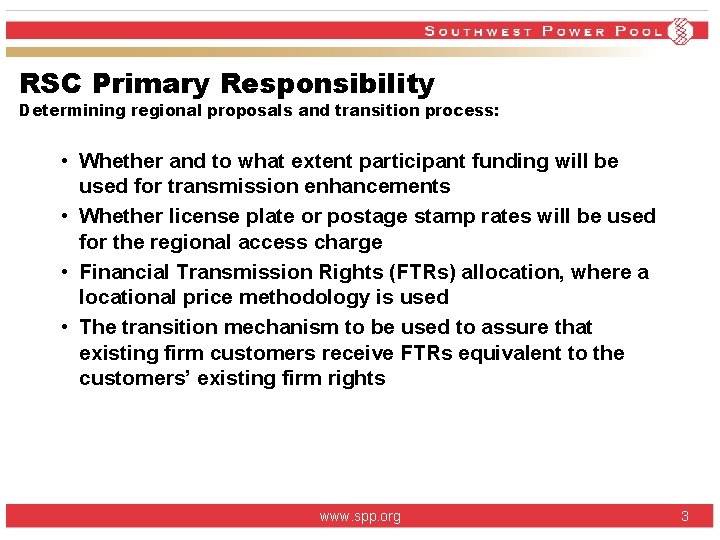
RSC Primary Responsibility Determining regional proposals and transition process: • Whether and to what extent participant funding will be used for transmission enhancements • Whether license plate or postage stamp rates will be used for the regional access charge • Financial Transmission Rights (FTRs) allocation, where a locational price methodology is used • The transition mechanism to be used to assure that existing firm customers receive FTRs equivalent to the customers’ existing firm rights www. spp. org 3
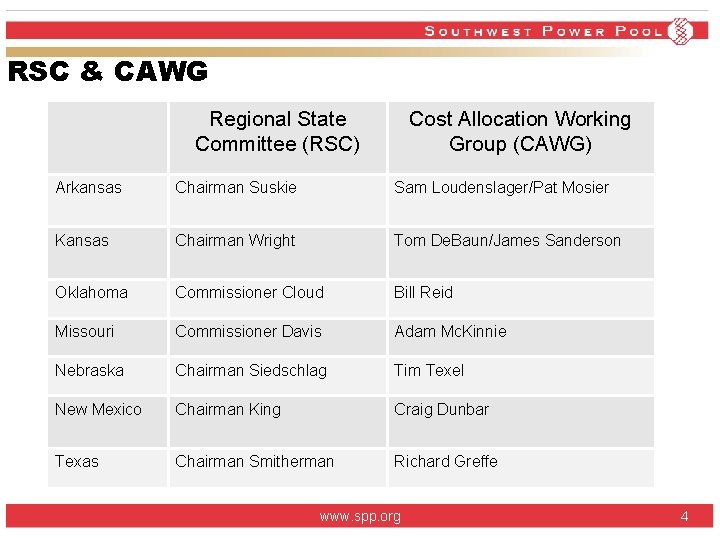
RSC & CAWG Regional State Committee (RSC) Cost Allocation Working Group (CAWG) Arkansas Chairman Suskie Sam Loudenslager/Pat Mosier Kansas Chairman Wright Tom De. Baun/James Sanderson Oklahoma Commissioner Cloud Bill Reid Missouri Commissioner Davis Adam Mc. Kinnie Nebraska Chairman Siedschlag Tim Texel New Mexico Chairman King Craig Dunbar Texas Chairman Smitherman Richard Greffe www. spp. org 4
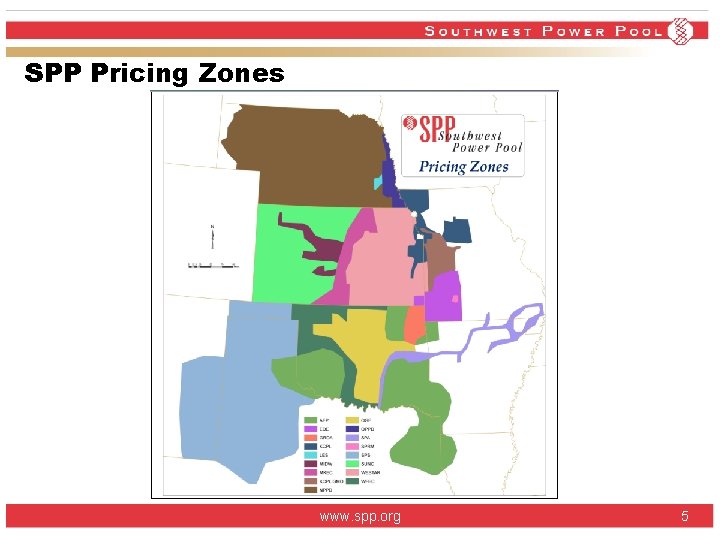
SPP Pricing Zones www. spp. org 5
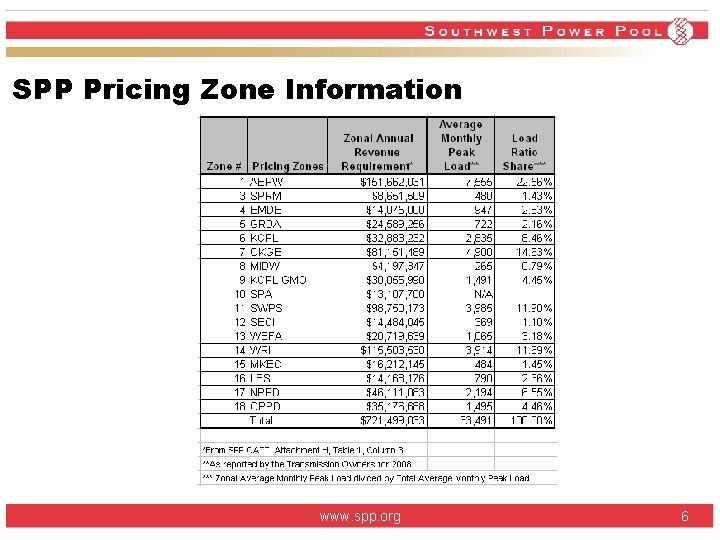
SPP Pricing Zone Information www. spp. org 6
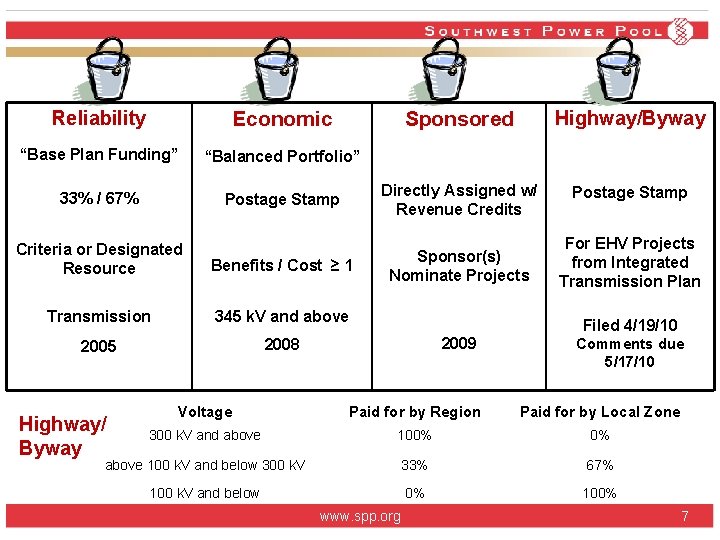
Reliability Economic Sponsored Highway/Byway “Base Plan Funding” “Balanced Portfolio” 33% / 67% Postage Stamp Directly Assigned w/ Revenue Credits Postage Stamp Criteria or Designated Resource Benefits / Cost ≥ 1 Sponsor(s) Nominate Projects For EHV Projects from Integrated Transmission Plan Transmission 345 k. V and above 2005 2008 Filed 4/19/10 2009 Comments due 5/17/10 Voltage Paid for by Region Paid for by Local Zone 300 k. V and above 100% 0% above 100 k. V and below 300 k. V 33% 67% 100 k. V and below 0% 100% Highway/ Byway www. spp. org 7
Les Dillahunty Senior Vice President, Engineering & Regulatory Policy 501. 614. 3215 ldillahunty@spp. org www. spp. org 8
Priority Projects and Integrated Transmission Planning Bruce Rew Presentation for APSC June 3, 2010 www. spp. org 9
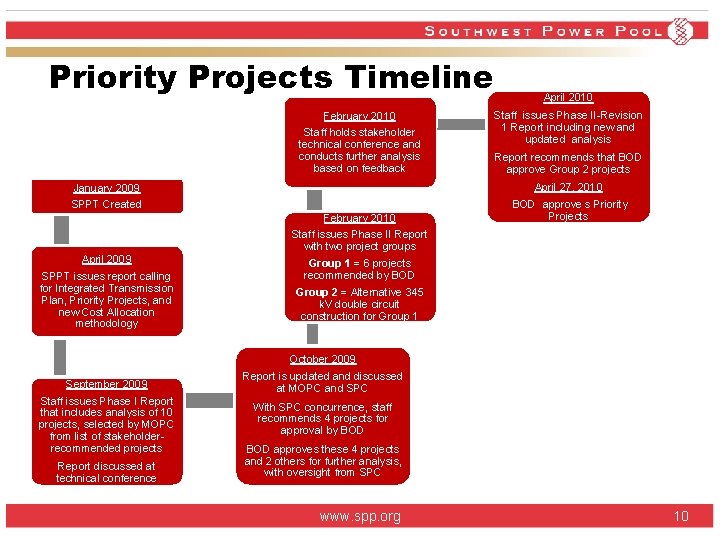
Priority Projects Timeline February 2010 Staff holds stakeholder technical conference and conducts further analysis based on feedback February 2010 Staff issues Phase II Report with two project groups SPPT issues report calling for Integrated Transmission Plan, Priority Projects, and new Cost Allocation methodology Staff issues Phase II-Revision 1 Report including new and updated analysis Report recommends that BOD approve Group 2 projects April 27, 2010 January 2009 SPPT Created April 2009 April 2010 BOD approve s Priority Projects Group 1 = 6 projects recommended by BOD Group 2 = Alternative 345 k. V double circuit construction for Group 1 October 2009 September 2009 Staff issues Phase I Report that includes analysis of 10 projects, selected by MOPC from list of stakeholderrecommended projects Report discussed at technical conference Report is updated and discussed at MOPC and SPC With SPC concurrence, staff recommends 4 projects for approval by BOD approves these 4 projects and 2 others for further analysis, with oversight from SPC www. spp. org 10
www. spp. org 11 11
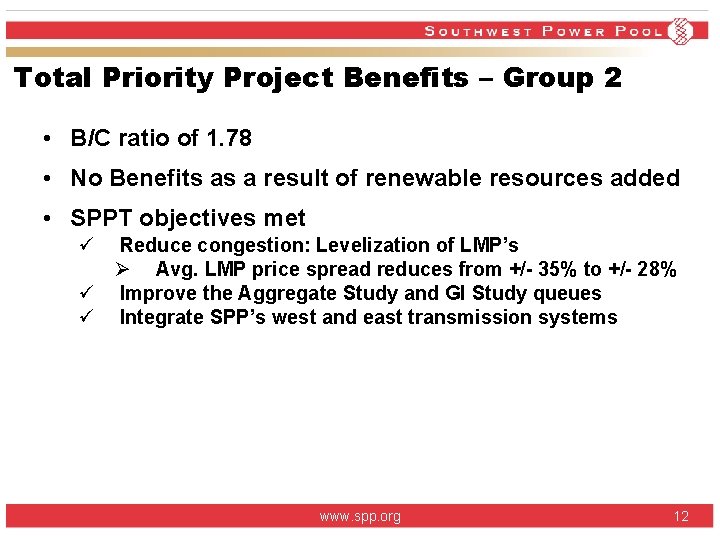
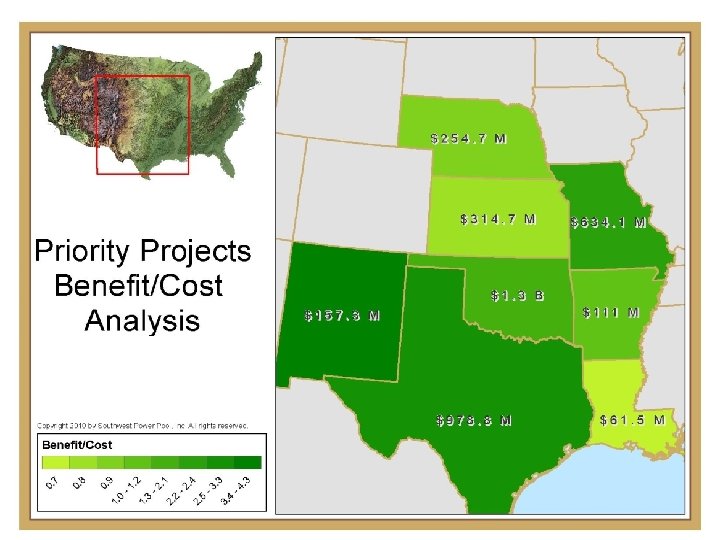
Total Priority Project Benefits – Group 2 • B/C ratio of 1. 78 • No Benefits as a result of renewable resources added • SPPT objectives met ü Reduce congestion: Levelization of LMP’s Ø Avg. LMP price spread reduces from +/- 35% to +/- 28% ü Improve the Aggregate Study and GI Study queues ü Integrate SPP’s west and east transmission systems www. spp. org 12
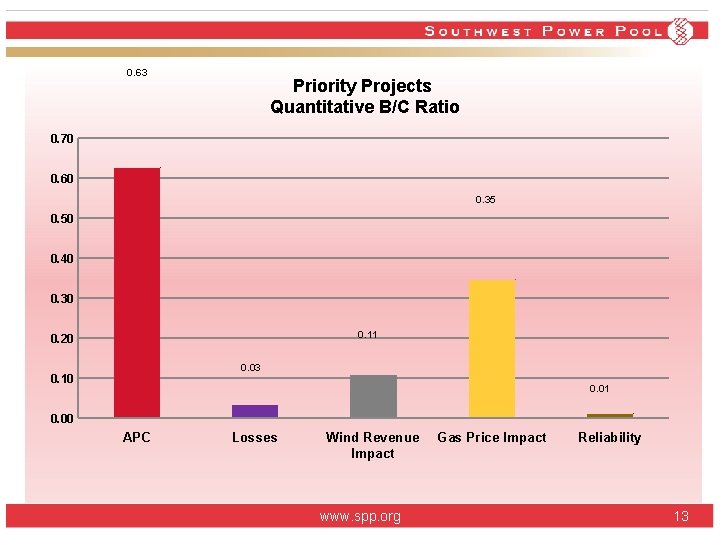
0. 63 Priority Projects Quantitative B/C Ratio 0. 70 0. 60 0. 35 0. 50 0. 40 0. 30 0. 11 0. 20 0. 03 0. 10 0. 01 0. 00 APC Losses Wind Revenue Impact www. spp. org Gas Price Impact Reliability 13
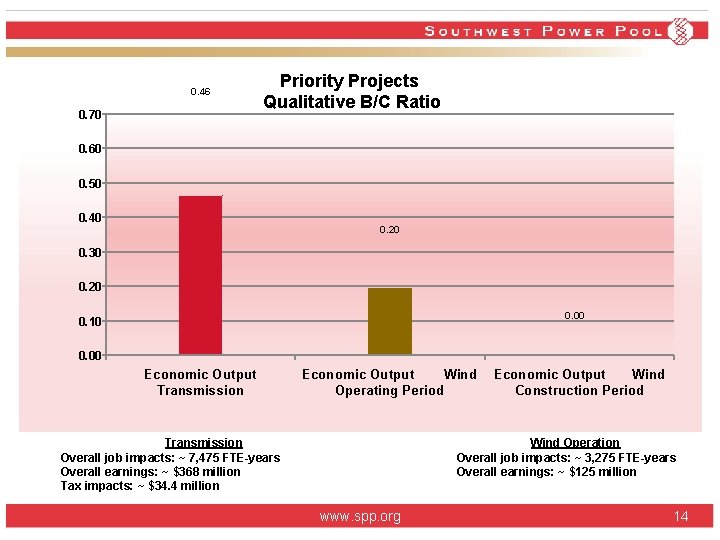
0. 46 0. 70 Priority Projects Qualitative B/C Ratio 0. 60 0. 50 0. 40 0. 20 0. 30 0. 20 0. 00 0. 10 0. 00 Economic Output Transmission Economic Output Wind Operating Period Construction Period Transmission Overall job impacts: ~ 7, 475 FTE-years Overall earnings: ~ $368 million Tax impacts: ~ $34. 4 million Wind Operation Overall job impacts: ~ 3, 275 FTE-years Overall earnings: ~ $125 million www. spp. org 14
www. spp. org 15
Integrated Transmission Planning www. spp. org 16
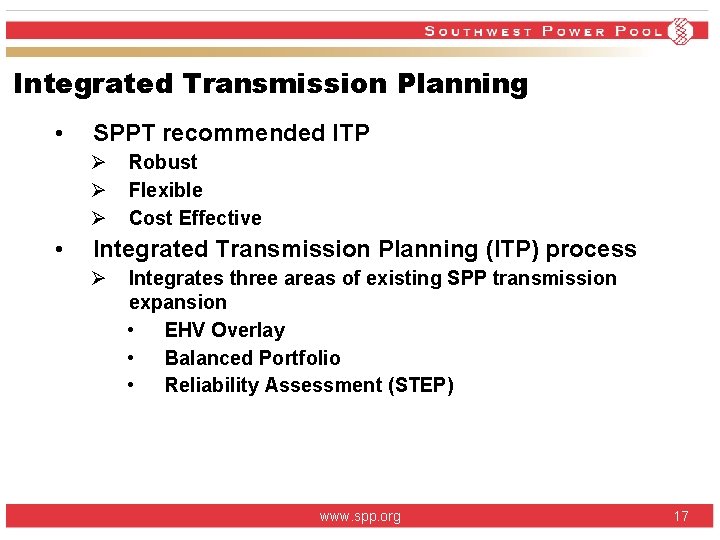
Integrated Transmission Planning • SPPT recommended ITP Ø Ø Ø • Robust Flexible Cost Effective Integrated Transmission Planning (ITP) process Ø Integrates three areas of existing SPP transmission expansion • EHV Overlay • Balanced Portfolio • Reliability Assessment (STEP) www. spp. org 17
Integrated Transmission Planning • Major Objective: Design transmission backbone to connect load centers to low-cost generation • Other Objectives: • Integrate SPP’s east and west regions • Make transmission an enabler rather than constraint • Strengthen ties to Eastern and Western Interconnections www. spp. org 18
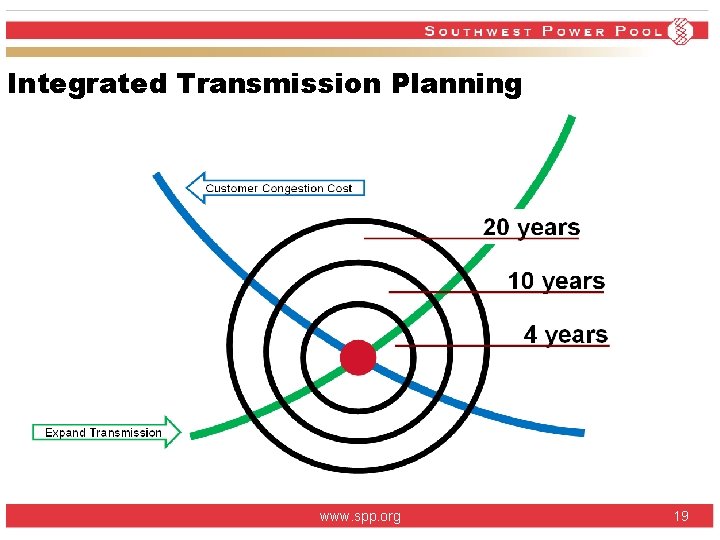
Integrated Transmission Planning www. spp. org 19
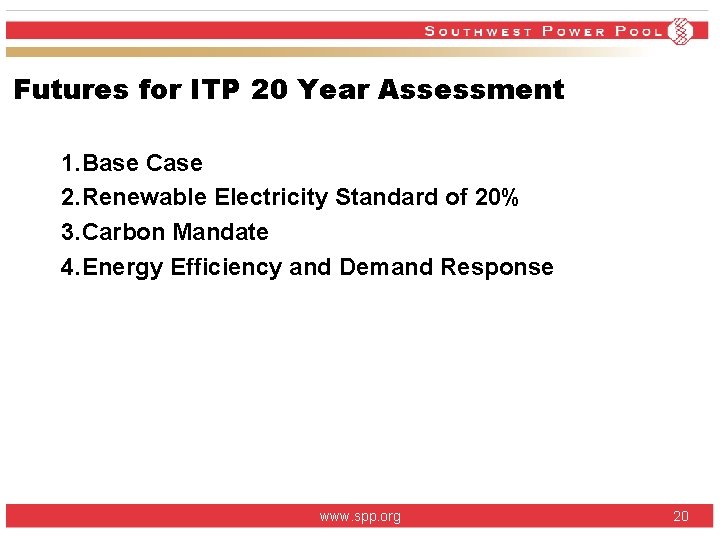
Futures for ITP 20 Year Assessment 1. Base Case 2. Renewable Electricity Standard of 20% 3. Carbon Mandate 4. Energy Efficiency and Demand Response www. spp. org 20
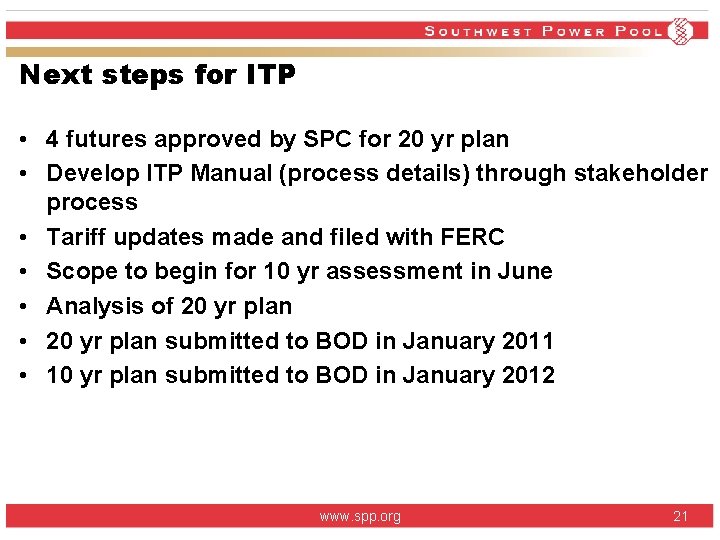
Next steps for ITP • 4 futures approved by SPC for 20 yr plan • Develop ITP Manual (process details) through stakeholder process • Tariff updates made and filed with FERC • Scope to begin for 10 yr assessment in June • Analysis of 20 yr plan • 20 yr plan submitted to BOD in January 2011 • 10 yr plan submitted to BOD in January 2012 www. spp. org 21
Bruce Rew Vice President, Engineering 501 -614 -3214 brew@spp. org www. spp. org 22
Status of SPP Activities Relating to FERC Order 719 Heather Starnes Presentation for APSC June 3, 2010 www. spp. org
Order No. 719 and 719 -A Activities www. spp. org 24
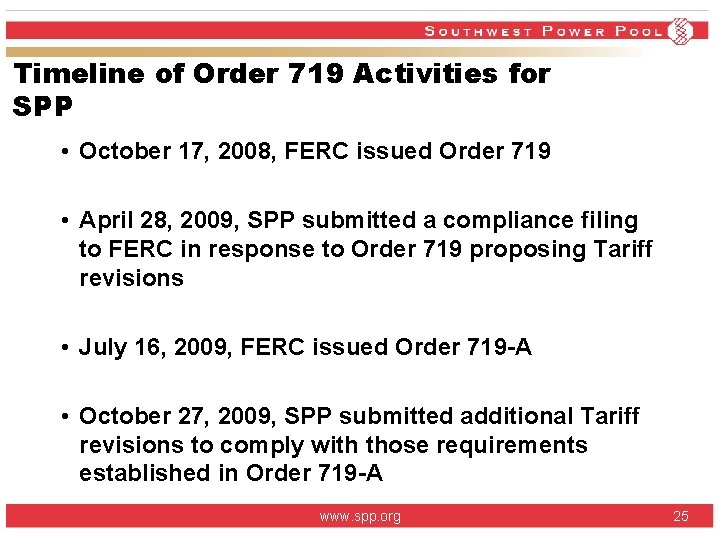
Timeline of Order 719 Activities for SPP • October 17, 2008, FERC issued Order 719 • April 28, 2009, SPP submitted a compliance filing to FERC in response to Order 719 proposing Tariff revisions • July 16, 2009, FERC issued Order 719 -A • October 27, 2009, SPP submitted additional Tariff revisions to comply with those requirements established in Order 719 -A www. spp. org 25
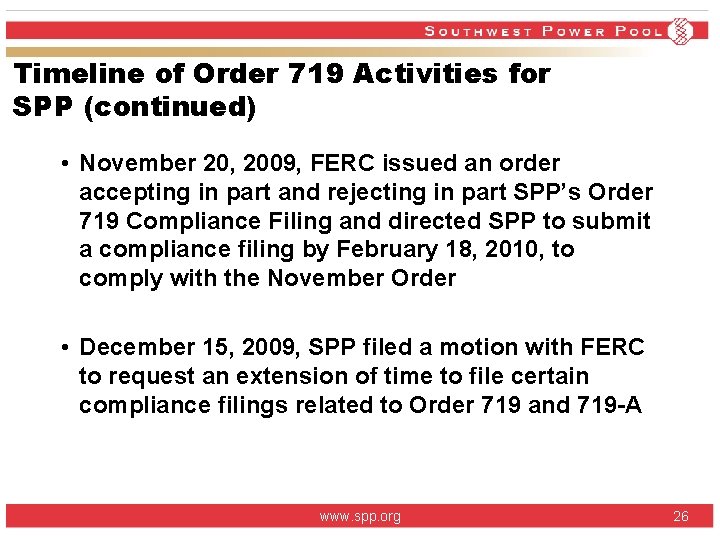
Timeline of Order 719 Activities for SPP (continued) • November 20, 2009, FERC issued an order accepting in part and rejecting in part SPP’s Order 719 Compliance Filing and directed SPP to submit a compliance filing by February 18, 2010, to comply with the November Order • December 15, 2009, SPP filed a motion with FERC to request an extension of time to file certain compliance filings related to Order 719 and 719 -A www. spp. org 26
Timeline of Order 719 Activities for SPP (continued) • December 23, 2009, FERC granted SPP an extension of time up to and including May 19, 2010, to comply with the demand response requirements set forth in section III. B. 1 of the November 20 Order and the demand response requirements ordered in Order 719 -A and further directed that SPP submit its demand response reports on May 20, 2009, as required by the November 20 Order. www. spp. org 27
Timeline of Order 719 Activities for SPP (continued) • February 18, 2010 and May 19, 2010, SPP submitted compliance filings at FERC in response to the November 20 Order • May 20, 2010, SPP filed with FERC its Report on Remaining Barriers to Demand Response for the SPP RTO and SPP Market Monitoring Unit • As of May 26, 2010, FERC has not issued an order addressing SPP’s compliance filings for Order 719 -A and the November 20 Order www. spp. org 28
State Dockets Open For Order 719 • 09 -090 -U - Arkansas Public Service Commission • 10 -GIME-215 -GIE – Kansas Corporation Commission • EW-2010 -0187 – Missouri Public Service Commission • PUD 201000043 – Oklahoma Corporation Commission www. spp. org 29
Demand Response Activities www. spp. org 30
Major components of the May 19 th Demand Response Compliance Filing as required by the November 20 th Order • Establishment of a customer baseline methodology and alternative methodology for demand response resources (“DRR”) • Incorporation of bidding parameters for DRRs that are currently found in the SPP Market Protocols • Elimination of requirement for ARCs to provide a “declaration” from its regulatory body that it can offer DRR into the SPP wholesale market www. spp. org 31
Current Demand Response in SPP • Real-time energy imbalance is currently the only SPP market • DRRs are recognized as generators, dispatchable every five minutes • Current amount of Demand Response is in excess of 1500 MW • Majority of the Demand Response is “behind-themeter” and co-generation • Load reduction accounts for approximately 50 MWh www. spp. org 32
Aggregators of Retail Customers (“ARC”) in SPP • ARCs are treated as any other Market Participant • ARCs are able to represent demand response as any other resources that are responsive to dispatch instructions • ARCs must register as any other Market Participant and certify to SPP that the relevant retail regulator does not prohibit participation www. spp. org 33
Issues/Concerns with Demand Response and ARCs • The ability of retail providers to invoice a ratepayer for unmetered consumption (amount of DR) for load reduction DRR • Without resolution, ratepayer may “double dip” or collect from the wholesale market for performance and not be billed for the retail consumption that would have occurred • For ARCs, measurement and validation becomes more difficult as a single interconnection point is divided among many Market Participants since SPP’s Market is settled nodally www. spp. org 34
Summary of Demand Response Activities in SPP • SPP Market supports Demand Response and currently 1500 MW participates • Additional Tariff revisions were filed on May 19 in compliance with the November 20 Order on demand response and ARCs and are pending approval at FERC • Demand response is being incorporated into the Future Market Design in compliance with Order 719 requirements www. spp. org 35
Heather Starnes Manager, Regulatory Policy 501 -614 -3380 hstarnes@spp. org www. spp. org
Entergy – SPP Seams Agreement Update Carl Monroe Presentation for APSC June 3, 2010 www. spp. org 37
SPP Footprints • Regional Entity • SPP members as defined in the SPP Membership Agreement plus SPA via contract • 16 BAs • Reliability Coordinator • 26 BAs - all BAs in SPP RE plus 7 BAs in SERC and 3 BAs in MRO • Reserve Sharing Group • 29 BAs - all BAs with load in the SPP RC footprint plus AECI, EES, SMEPA, and WAPA • Regional Tariff • TOs participating in the SPP OATT • 13 BAs • EIS Market • TOs participating in the SPP OATT with the exception of CUS • Includes all generation and load connected to those TOs • 15 BAs www. spp. org 38
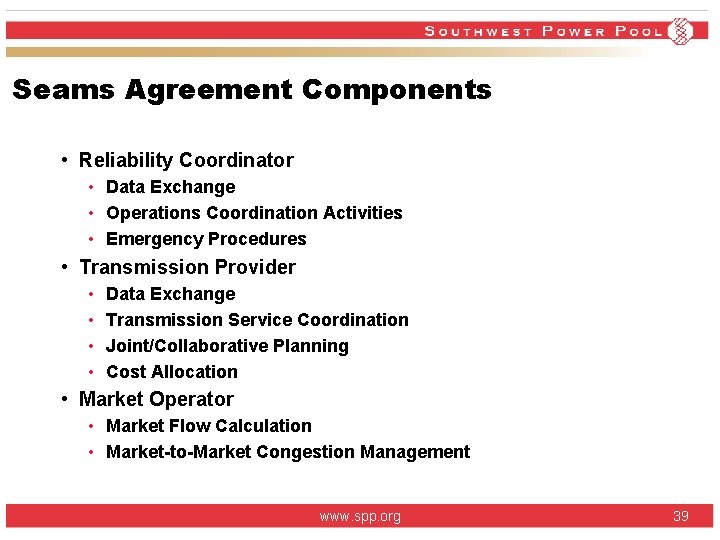
Seams Agreement Components • Reliability Coordinator • Data Exchange • Operations Coordination Activities • Emergency Procedures • Transmission Provider • • Data Exchange Transmission Service Coordination Joint/Collaborative Planning Cost Allocation • Market Operator • Market Flow Calculation • Market-to-Market Congestion Management www. spp. org 39
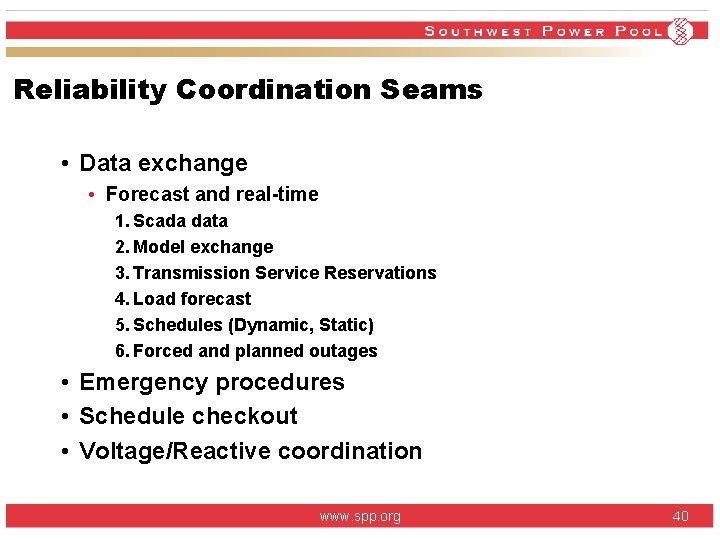
Reliability Coordination Seams • Data exchange • Forecast and real-time 1. Scada data 2. Model exchange 3. Transmission Service Reservations 4. Load forecast 5. Schedules (Dynamic, Static) 6. Forced and planned outages • Emergency procedures • Schedule checkout • Voltage/Reactive coordination www. spp. org 40
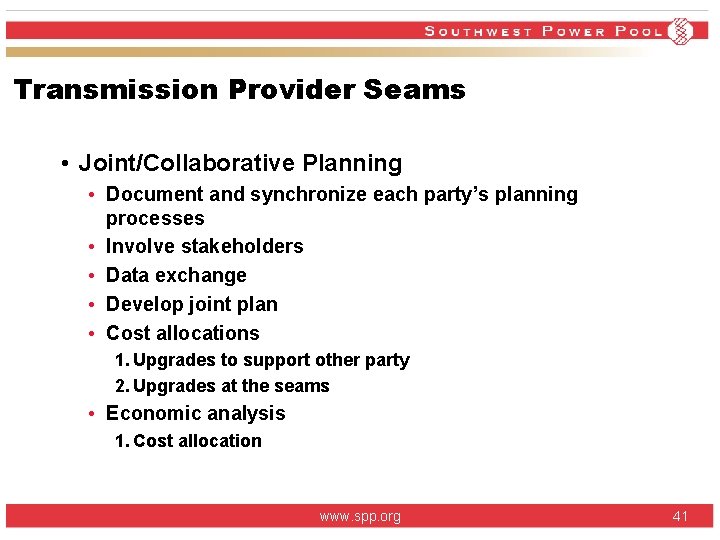
Transmission Provider Seams • Joint/Collaborative Planning • Document and synchronize each party’s planning processes • Involve stakeholders • Data exchange • Develop joint plan • Cost allocations 1. Upgrades to support other party 2. Upgrades at the seams • Economic analysis 1. Cost allocation www. spp. org 41
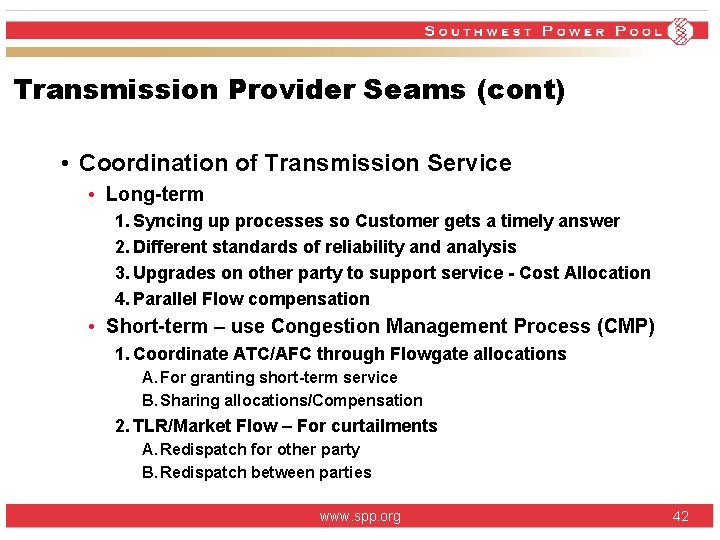
Transmission Provider Seams (cont) • Coordination of Transmission Service • Long-term 1. Syncing up processes so Customer gets a timely answer 2. Different standards of reliability and analysis 3. Upgrades on other party to support service - Cost Allocation 4. Parallel Flow compensation • Short-term – use Congestion Management Process (CMP) 1. Coordinate ATC/AFC through Flowgate allocations A. For granting short-term service B. Sharing allocations/Compensation 2. TLR/Market Flow – For curtailments A. Redispatch for other party B. Redispatch between parties www. spp. org 42
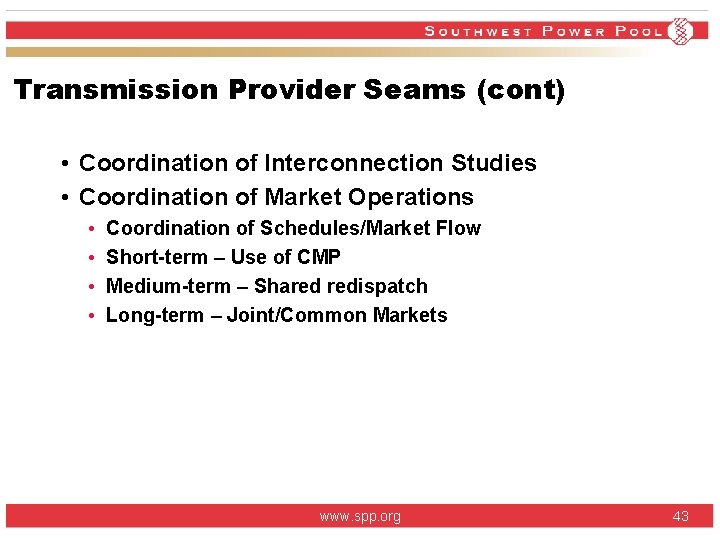
Transmission Provider Seams (cont) • Coordination of Interconnection Studies • Coordination of Market Operations • • Coordination of Schedules/Market Flow Short-term – Use of CMP Medium-term – Shared redispatch Long-term – Joint/Common Markets www. spp. org 43
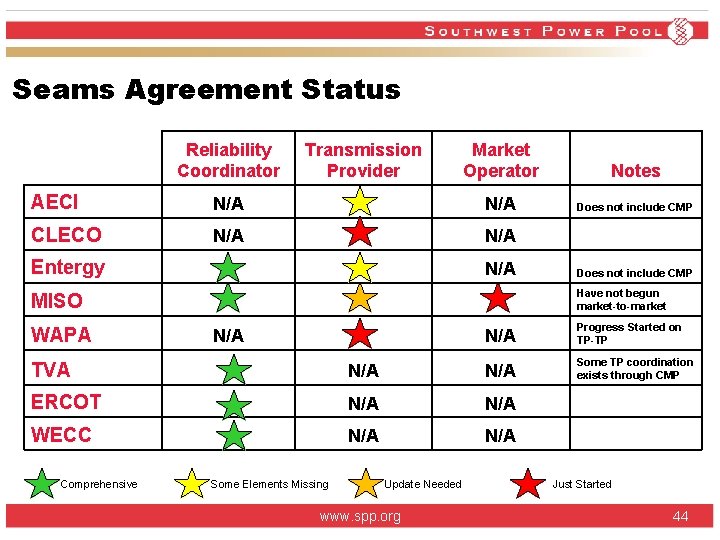
Seams Agreement Status Reliability Coordinator AECI N/A CLECO N/A Transmission Provider Market Operator Notes N/A Does not include CMP N/A Entergy N/A Have not begun market-to-market MISO WAPA N/A Progress Started on TP-TP Some TP coordination exists through CMP TVA N/A ERCOT N/A WECC N/A Comprehensive Does not include CMP Some Elements Missing Update Needed www. spp. org Just Started 44
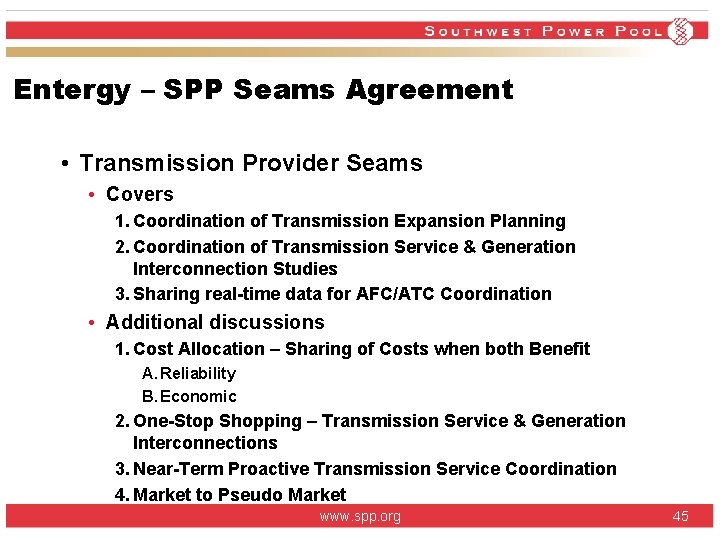
Entergy – SPP Seams Agreement • Transmission Provider Seams • Covers 1. Coordination of Transmission Expansion Planning 2. Coordination of Transmission Service & Generation Interconnection Studies 3. Sharing real-time data for AFC/ATC Coordination • Additional discussions 1. Cost Allocation – Sharing of Costs when both Benefit A. Reliability B. Economic 2. One-Stop Shopping – Transmission Service & Generation Interconnections 3. Near-Term Proactive Transmission Service Coordination 4. Market to Pseudo Market www. spp. org 45
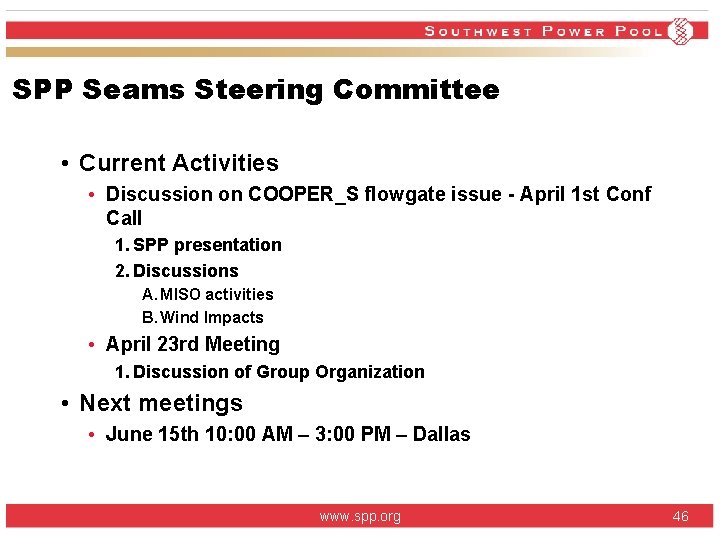
SPP Seams Steering Committee • Current Activities • Discussion on COOPER_S flowgate issue - April 1 st Conf Call 1. SPP presentation 2. Discussions A. MISO activities B. Wind Impacts • April 23 rd Meeting 1. Discussion of Group Organization • Next meetings • June 15 th 10: 00 AM – 3: 00 PM – Dallas www. spp. org 46
Carl A. Monroe Executive Vice President & COO 501 -614 -3218 cmonroe@spp. org www. spp. org
SPP Future Markets Update Debbie James Presentation for APSC June 3, 2010 www. spp. org 48
Agenda • Overview of Future Markets • Future Markets Updates • Next Steps www. spp. org 49
Overview of Future Markets www. spp. org 50
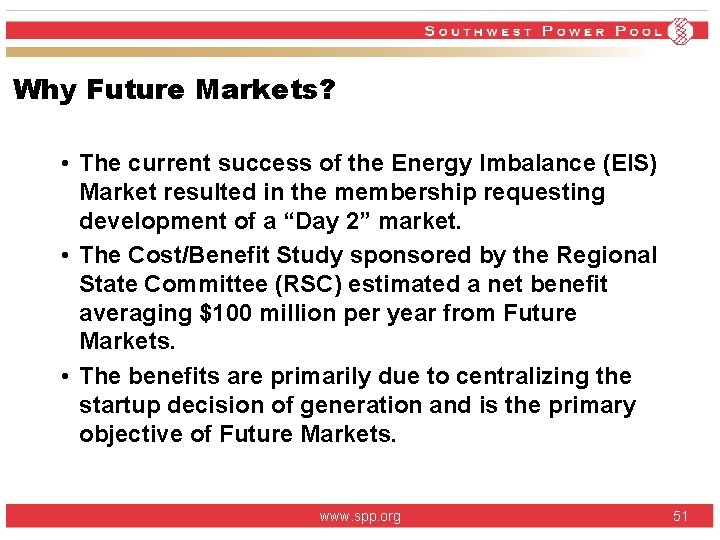
Why Future Markets? • The current success of the Energy Imbalance (EIS) Market resulted in the membership requesting development of a “Day 2” market. • The Cost/Benefit Study sponsored by the Regional State Committee (RSC) estimated a net benefit averaging $100 million per year from Future Markets. • The benefits are primarily due to centralizing the startup decision of generation and is the primary objective of Future Markets. www. spp. org 51
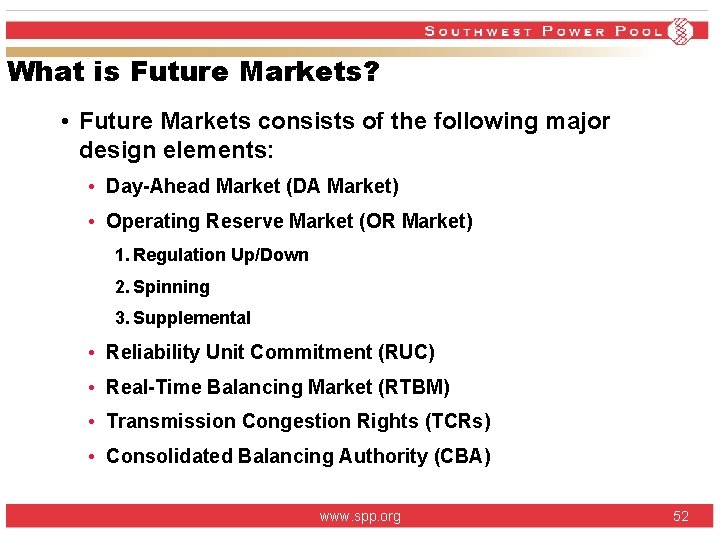
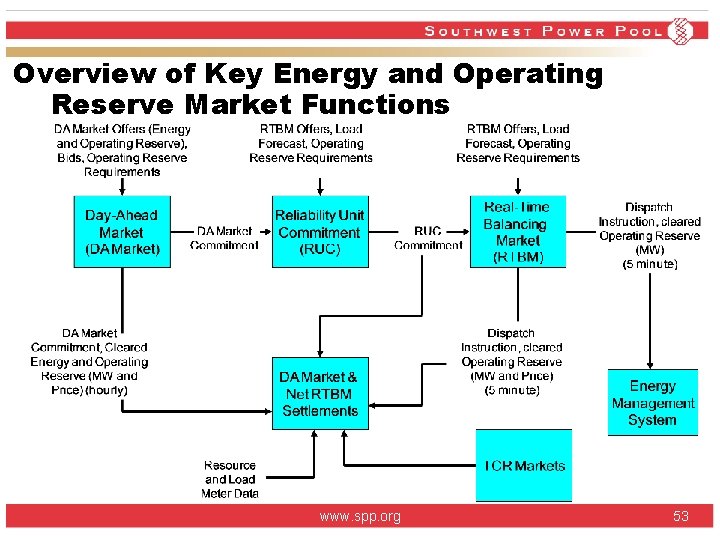
What is Future Markets? • Future Markets consists of the following major design elements: • Day-Ahead Market (DA Market) • Operating Reserve Market (OR Market) 1. Regulation Up/Down 2. Spinning 3. Supplemental • Reliability Unit Commitment (RUC) • Real-Time Balancing Market (RTBM) • Transmission Congestion Rights (TCRs) • Consolidated Balancing Authority (CBA) www. spp. org 52
Overview of Key Energy and Operating Reserve Market Functions www. spp. org 53
Overview of TCR Markets Structure www. spp. org 54
Future Markets Updates www. spp. org 55
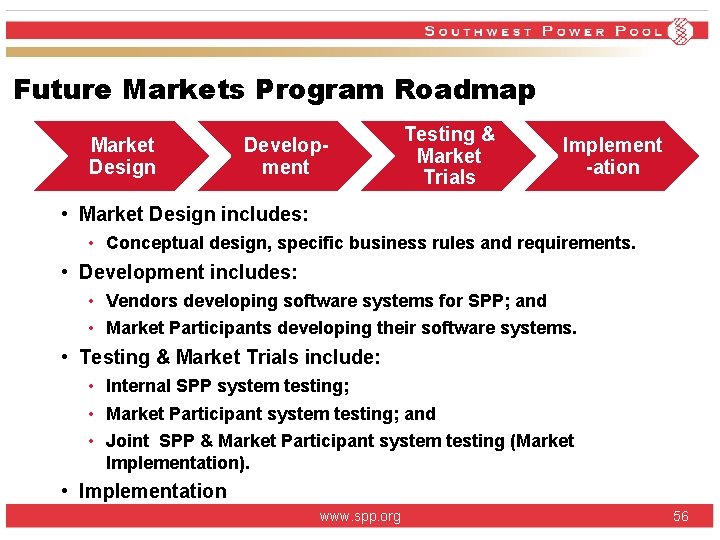
Future Markets Program Roadmap Market Design Development Testing & Market Trials Implement -ation • Market Design includes: • Conceptual design, specific business rules and requirements. • Development includes: • Vendors developing software systems for SPP; and • Market Participants developing their software systems. • Testing & Market Trials include: • Internal SPP system testing; • Market Participant system testing; and • Joint SPP & Market Participant system testing (Market Implementation). • Implementation www. spp. org 56
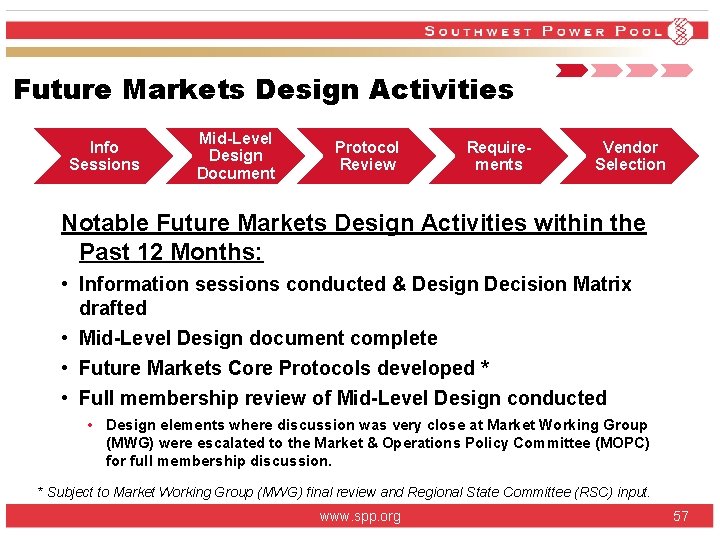
Future Markets Design Activities Info Sessions Mid-Level Design Document Protocol Review Requirements Vendor Selection Notable Future Markets Design Activities within the Past 12 Months: • Information sessions conducted & Design Decision Matrix drafted • Mid-Level Design document complete • Future Markets Core Protocols developed * • Full membership review of Mid-Level Design conducted • Design elements where discussion was very close at Market Working Group (MWG) were escalated to the Market & Operations Policy Committee (MOPC) for full membership discussion. * Subject to Market Working Group (MWG) final review and Regional State Committee (RSC) input. www. spp. org 57
Mid-Level Design Items Escalated for MOPC Guidance 1. Marginal vs. Average Losses 2. Voluntary Offers vs. “Must Offer” Requirement in the DA Market 3. Third-Party Participation vs. Transmission Customers Only in the TCR Auction 4. 5 -Minute vs. Hourly Settlements 5. Zonal vs. Average Cost Allocation for Operating Reserves www. spp. org 58
Mid-Level Design Items Escalated for MOPC Guidance 6. After-The-Fact Single Settlement of Reserve Obligation vs. Demand Bid based Operating Reserve Market 7. Revenue Neutrality Uplift vs. Cost Causation Allocation 8. “No Carve-Out” vs. “Carve-Out” of Grandfathered Agreements www. spp. org 59
Recap of the MOPC Decisions • After discussion by the entire membership of the MOPC, none of the original MWG Future Markets design positions were changed. • The MOPC approved the Future Markets design decided by the MWG unless definitive direction given by the MOPC. www. spp. org 60
Recap of February 2010 CAWG Meeting • In February 2010, Richard Dillon presented an educational session to the Cost Allocation Working Group (CAWG) on TCRs and the responsibilities of the RSC. • Specifically, this included the following topics: • • Design of Transmission Congestion Rights (TCR) Overview of the TCR Process Allocation of TCRs Regional State Committee (RSC) and TCRs www. spp. org 61
Recap of March 2010 CAWG Meeting • In March 2010, Richard Dillon presented the following to the CAWG: • Education on counterflow and why it is necessary. 1. Although counterflow TCRs result in a charge to the holder, choosing to not take them reduces the credits that can be issued. • Discussion on the equivalency of TCRs to the current EIS market congestion hedging mechanism. • Discussion on the obligation to confirm Long-Term Firm Transmission Rights (LTFTRs). 1. LTFTRs are required under the Energy Policy Act of 2005. 2. These will be offered eventually, but current intentions are to implement after Future Markets. www. spp. org 62
Next Steps www. spp. org 63
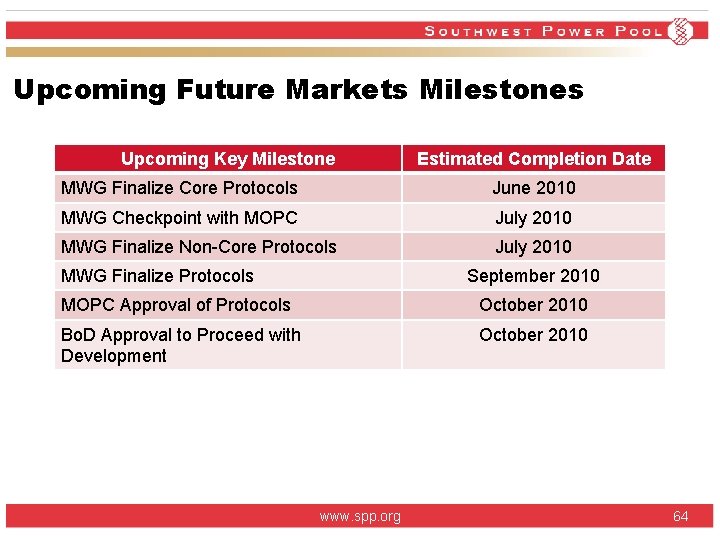
Upcoming Future Markets Milestones Upcoming Key Milestone Estimated Completion Date MWG Finalize Core Protocols June 2010 MWG Checkpoint with MOPC July 2010 MWG Finalize Non-Core Protocols July 2010 MWG Finalize Protocols September 2010 MOPC Approval of Protocols October 2010 Bo. D Approval to Proceed with Development October 2010 www. spp. org 64
Debbie James Manager, Market Development 501 -614 -3577 djames@spp. org www. spp. org 65
Additional Information Les Dillahunty Presentation for APSC June 3, 2010 www. spp. org 66
Additional Issues • • • DR & EE Variable Resources Cost Effective Transmission Solutions EIPC SPP’s Commitment to Arkansas and Little Rock www. spp. org 67