Writing for Ph D Candidates Clarity Concision Precision



- Slides: 45
Writing for Ph. D Candidates: Clarity, Concision, Precision 1
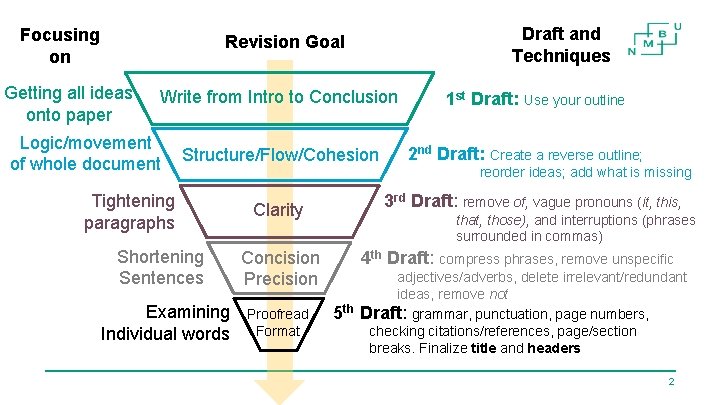
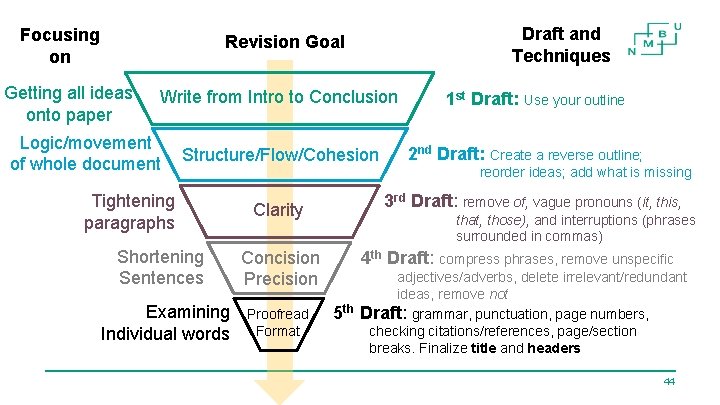
Focusing on Draft and Techniques Revision Goal Getting all ideas onto paper Write from Intro to Conclusion Logic/movement of whole document Structure/Flow/Cohesion Tightening paragraphs Shortening Sentences Examining Individual words Clarity Concision Precision Proofread Format 1 st Draft: Use your outline 2 nd Draft: Create a reverse outline; reorder ideas; add what is missing 3 rd Draft: remove of, vague pronouns (it, this, that, those), and interruptions (phrases surrounded in commas) 4 th Draft: compress phrases, remove unspecific adjectives/adverbs, delete irrelevant/redundant ideas, remove not 5 th Draft: grammar, punctuation, page numbers, checking citations/references, page/section breaks. Finalize title and headers 2
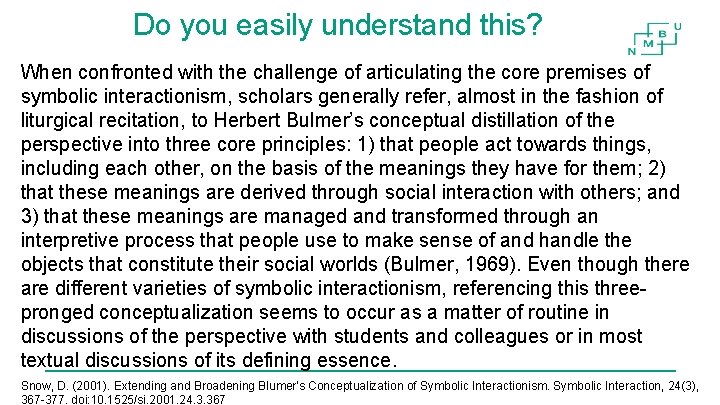
Do you easily understand this? When confronted with the challenge of articulating the core premises of symbolic interactionism, scholars generally refer, almost in the fashion of liturgical recitation, to Herbert Bulmer’s conceptual distillation of the perspective into three core principles: 1) that people act towards things, including each other, on the basis of the meanings they have for them; 2) that these meanings are derived through social interaction with others; and 3) that these meanings are managed and transformed through an interpretive process that people use to make sense of and handle the objects that constitute their social worlds (Bulmer, 1969). Even though there are different varieties of symbolic interactionism, referencing this threepronged conceptualization seems to occur as a matter of routine in discussions of the perspective with students and colleagues or in most textual discussions of its defining essence. Snow, D. (2001). Extending and Broadening Blumer's Conceptualization of Symbolic Interactionism. Symbolic Interaction, 24(3), 367 -377. doi: 10. 1525/si. 2001. 24. 3. 367
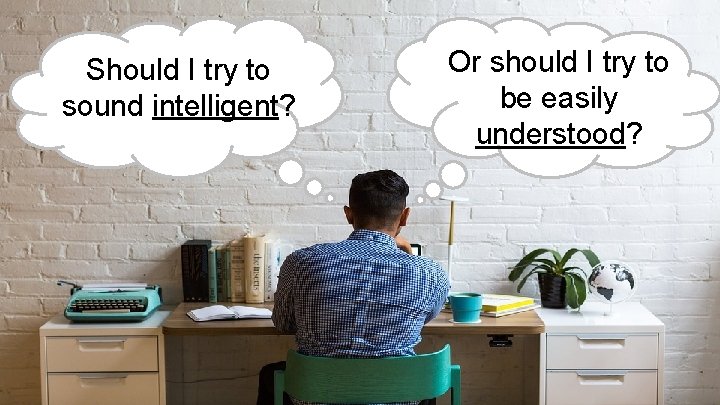
Should I try to sound intelligent? Or should I try to be easily understood?
Avoid writing for yourself. Think about the reader. Write clearly for the reader’s understanding.
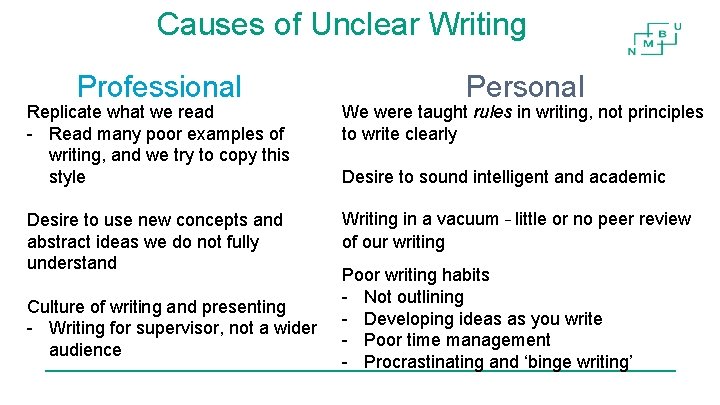
Causes of Unclear Writing Professional Personal Replicate what we read - Read many poor examples of writing, and we try to copy this style We were taught rules in writing, not principles to write clearly Desire to use new concepts and abstract ideas we do not fully understand Writing in a vacuum – little or no peer review of our writing Culture of writing and presenting - Writing for supervisor, not a wider audience Desire to sound intelligent and academic Poor writing habits - Not outlining - Developing ideas as you write - Poor time management - Procrastinating and ‘binge writing’
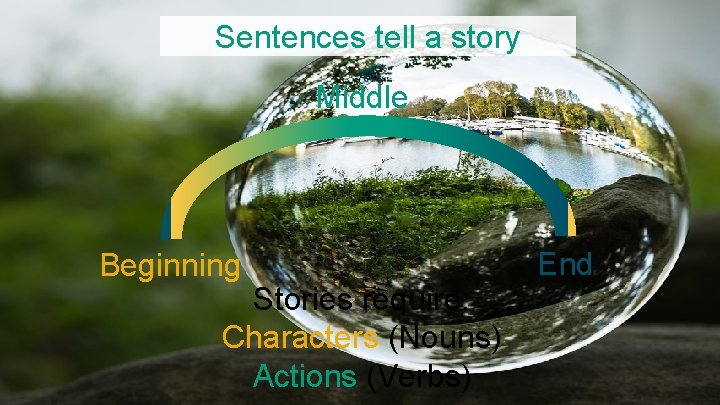
Sentences tell a story Middle Beginning Stories require: Characters (Nouns) Actions (Verbs) End
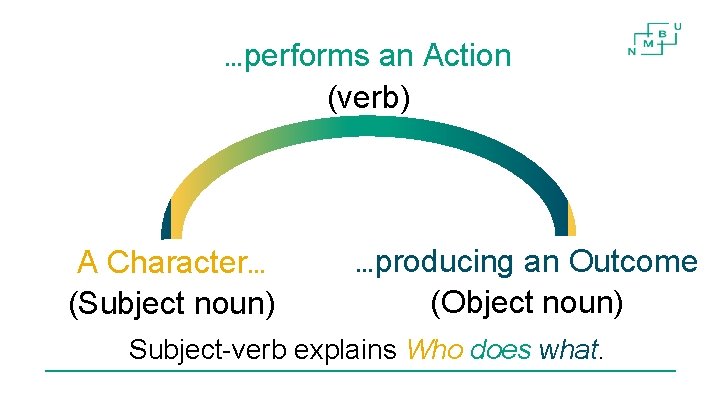
…performs an Action (verb) A Character… (Subject noun) …producing an Outcome (Object noun) Subject-verb explains Who does what.
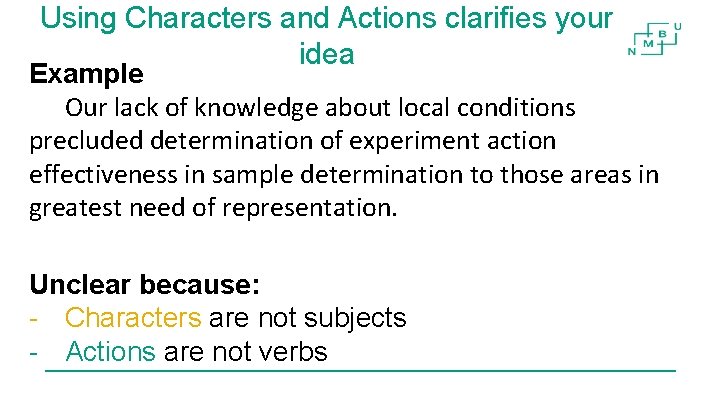
Using Characters and Actions clarifies your idea Example Our lack of knowledge about local conditions precluded determination of experiment action effectiveness in sample determination to those areas in greatest need of representation. Unclear because: - Characters are not subjects - Actions are not verbs
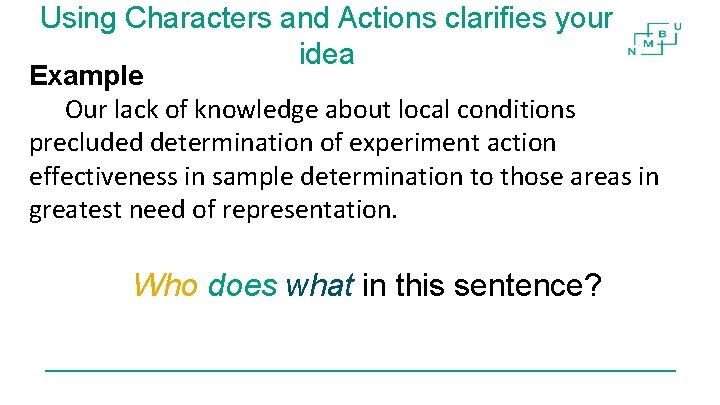
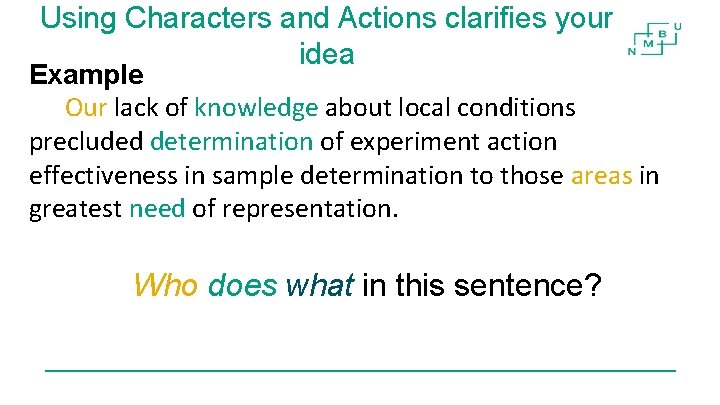
Using Characters and Actions clarifies your idea Example Our lack of knowledge about local conditions precluded determination of experiment action effectiveness in sample determination to those areas in greatest need of representation. Who does what in this sentence?
Using Characters and Actions clarifies your idea Example Our lack of knowledge about local conditions precluded determination of experiment action effectiveness in sample determination to those areas in greatest need of representation. Who does what in this sentence?
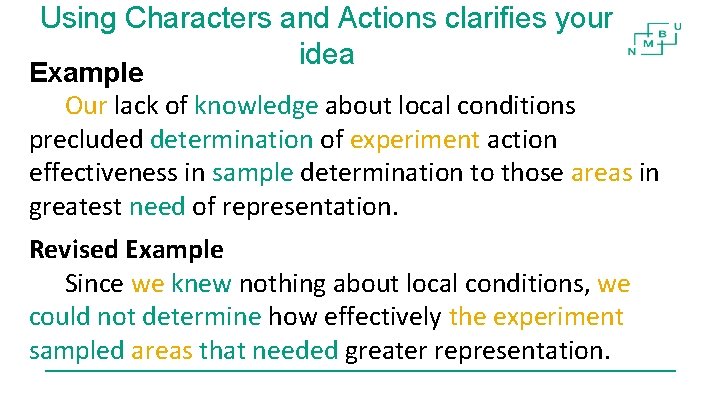
Using Characters and Actions clarifies your idea Example Our lack of knowledge about local conditions precluded determination of experiment action effectiveness in sample determination to those areas in greatest need of representation. Revised Example Since we knew nothing about local conditions, we could not determine how effectively the experiment sampled areas that needed greater representation.
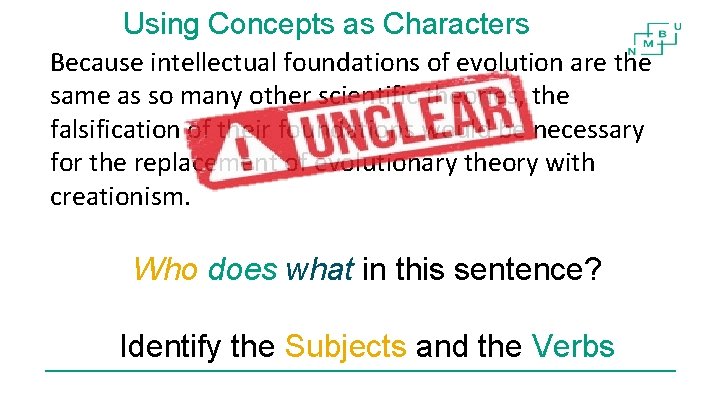
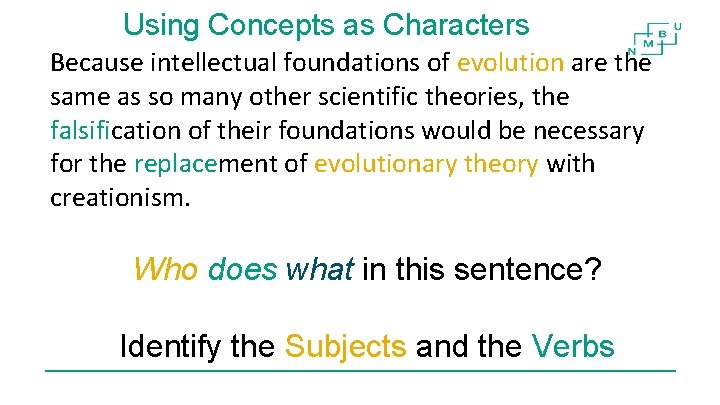
Using Concepts as Characters Because intellectual foundations of evolution are the same as so many other scientific theories, the falsification of their foundations would be necessary for the replacement of evolutionary theory with creationism. Who does what in this sentence? Identify the Subjects and the Verbs
Using Concepts as Characters Because intellectual foundations of evolution are the same as so many other scientific theories, the falsification of their foundations would be necessary for the replacement of evolutionary theory with creationism. Who does what in this sentence? Identify the Subjects and the Verbs
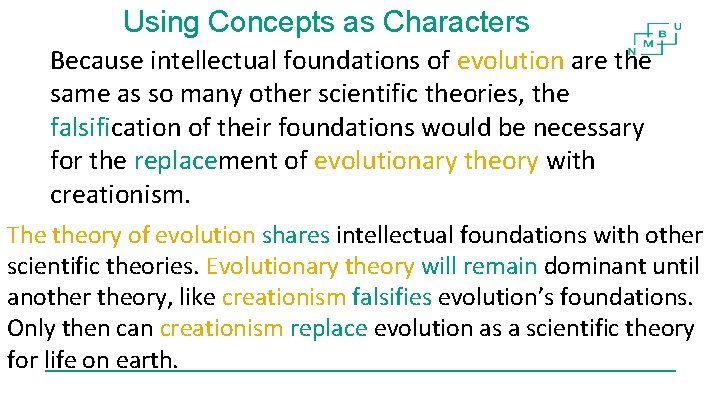
Using Concepts as Characters Because intellectual foundations of evolution are the same as so many other scientific theories, the falsification of their foundations would be necessary for the replacement of evolutionary theory with creationism. The theory of evolution shares intellectual foundations with other scientific theories. Evolutionary theory will remain dominant until another theory, like creationism falsifies evolution’s foundations. Only then can creationism replace evolution as a scientific theory for life on earth.
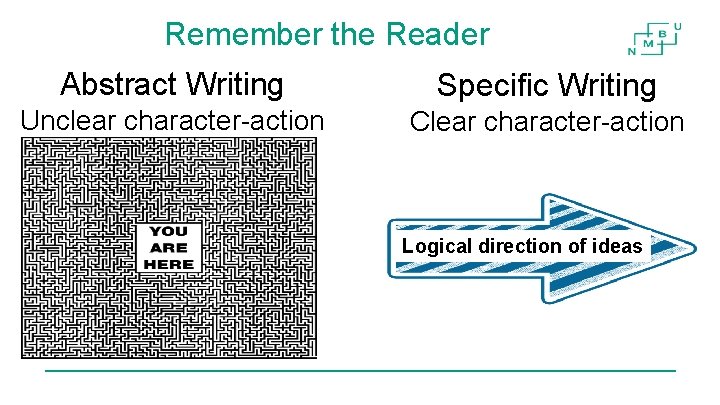
Remember the Reader Abstract Writing Specific Writing Unclear character-action Clear character-action Logical direction of ideas
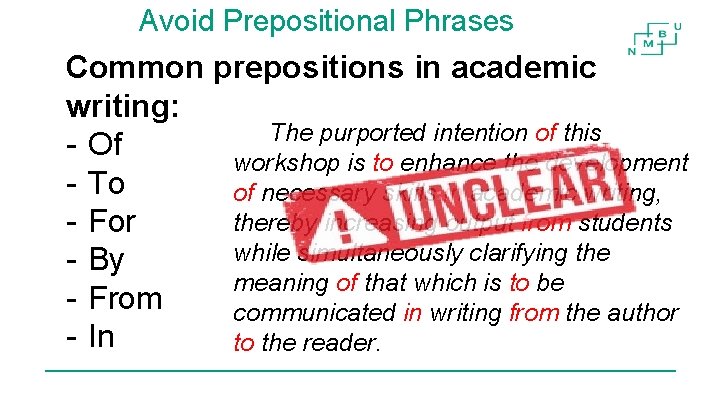
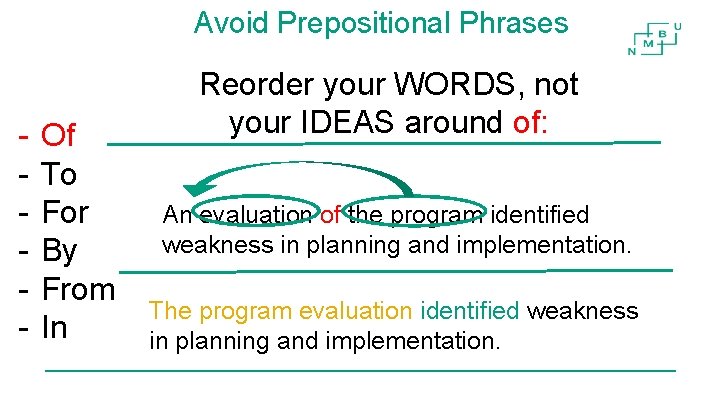
Avoid Prepositional Phrases Common prepositions in academic writing: The purported intention of this - Of workshop is to enhance the development - To of necessary skills in academic writing, thereby increasing output from students - For while simultaneously clarifying the - By meaning of that which is to be - From communicated in writing from the author - In to the reader.
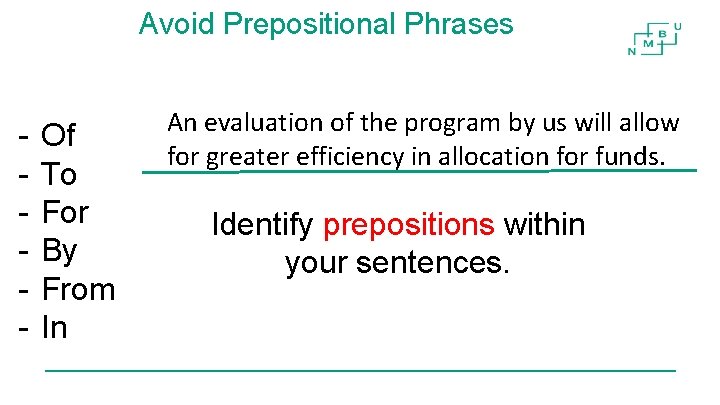
Avoid Prepositional Phrases - Of To For By From In An evaluation of the program by us will allow for greater efficiency in allocation for funds. Identify prepositions within your sentences.
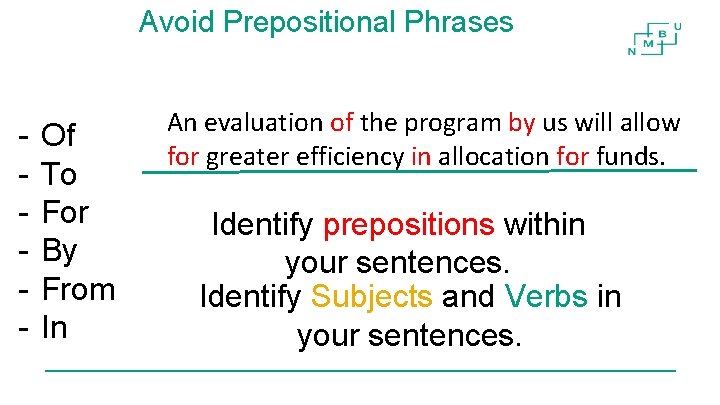
Avoid Prepositional Phrases - Of To For By From In An evaluation of the program by us will allow for greater efficiency in allocation for funds. Identify prepositions within your sentences. Identify Subjects and Verbs in your sentences.
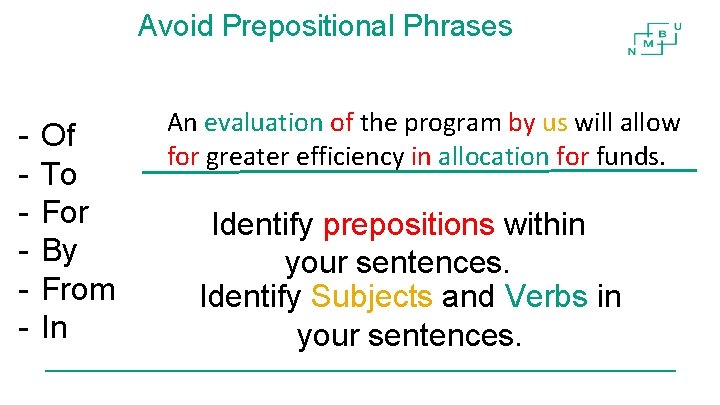
Avoid Prepositional Phrases - Of To For By From In An evaluation of the program by us will allow for greater efficiency in allocation for funds. Identify prepositions within your sentences. Identify Subjects and Verbs in your sentences.
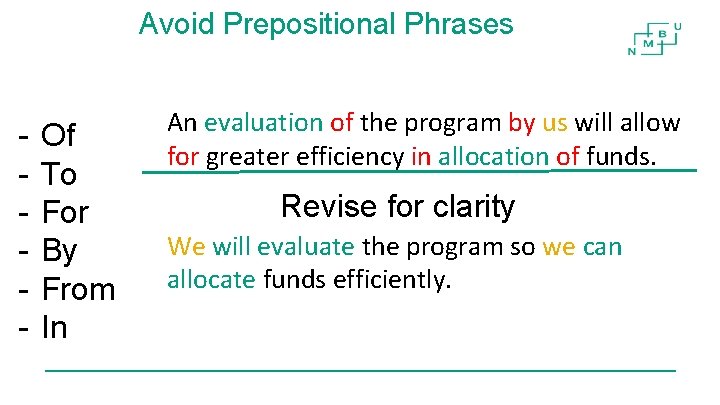
Avoid Prepositional Phrases - Of To For By From In An evaluation of the program by us will allow for greater efficiency in allocation of funds. Revise for clarity We will evaluate the program so we can allocate funds efficiently.
Avoid Prepositional Phrases - Of To For By From In Reorder your WORDS, not your IDEAS around of: An evaluation of the program identified weakness in planning and implementation. The program evaluation identified weakness in planning and implementation.
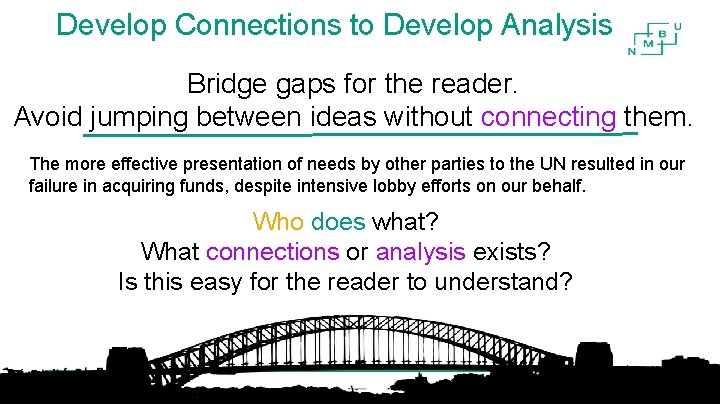
Develop Connections to Develop Analysis Bridge gaps for the reader. Avoid jumping between ideas without connecting them. The more effective presentation of needs by other parties to the UN resulted in our failure in acquiring funds, despite intensive lobby efforts on our behalf. Who does what? What connections or analysis exists? Is this easy for the reader to understand?
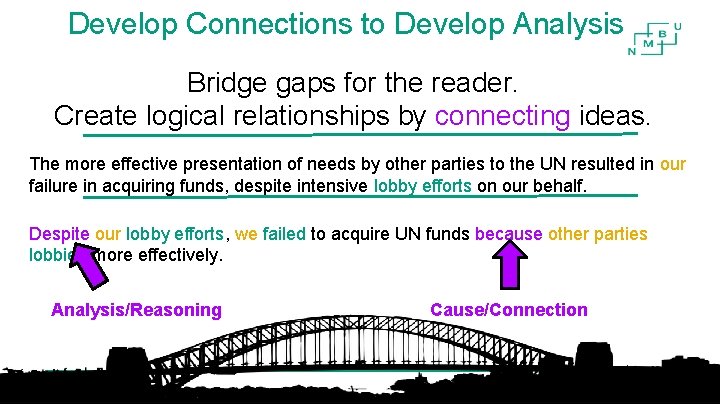
Develop Connections to Develop Analysis Bridge gaps for the reader. Create logical relationships by connecting ideas. The more effective presentation of needs by other parties to the UN resulted in our failure in acquiring funds, despite intensive lobby efforts on our behalf. Despite our lobby efforts, we failed to acquire UN funds because other parties lobbied more effectively. Analysis/Reasoning Cause/Connection
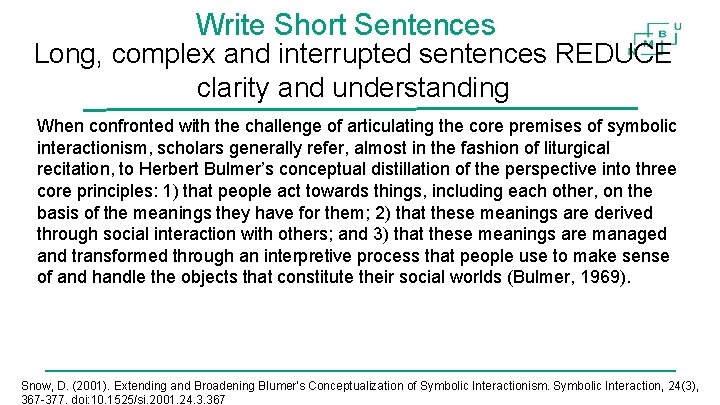
Write Short Sentences Long, complex and interrupted sentences REDUCE clarity and understanding When confronted with the challenge of articulating the core premises of symbolic interactionism, scholars generally refer, almost in the fashion of liturgical recitation, to Herbert Bulmer’s conceptual distillation of the perspective into three core principles: 1) that people act towards things, including each other, on the basis of the meanings they have for them; 2) that these meanings are derived through social interaction with others; and 3) that these meanings are managed and transformed through an interpretive process that people use to make sense of and handle the objects that constitute their social worlds (Bulmer, 1969). Snow, D. (2001). Extending and Broadening Blumer's Conceptualization of Symbolic Interactionism. Symbolic Interaction, 24(3), 367 -377. doi: 10. 1525/si. 2001. 24. 3. 367
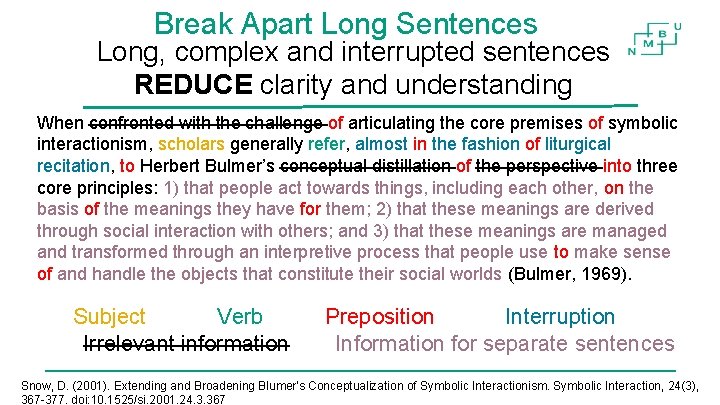
Break Apart Long Sentences Long, complex and interrupted sentences REDUCE clarity and understanding When confronted with the challenge of articulating the core premises of symbolic interactionism, scholars generally refer, almost in the fashion of liturgical recitation, to Herbert Bulmer’s conceptual distillation of the perspective into three core principles: 1) that people act towards things, including each other, on the basis of the meanings they have for them; 2) that these meanings are derived through social interaction with others; and 3) that these meanings are managed and transformed through an interpretive process that people use to make sense of and handle the objects that constitute their social worlds (Bulmer, 1969). Subject Verb Irrelevant information Preposition Interruption Information for separate sentences Snow, D. (2001). Extending and Broadening Blumer's Conceptualization of Symbolic Interactionism. Symbolic Interaction, 24(3), 367 -377. doi: 10. 1525/si. 2001. 24. 3. 367
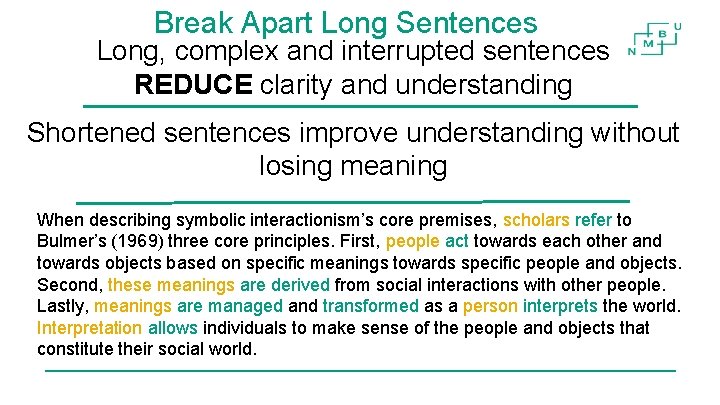
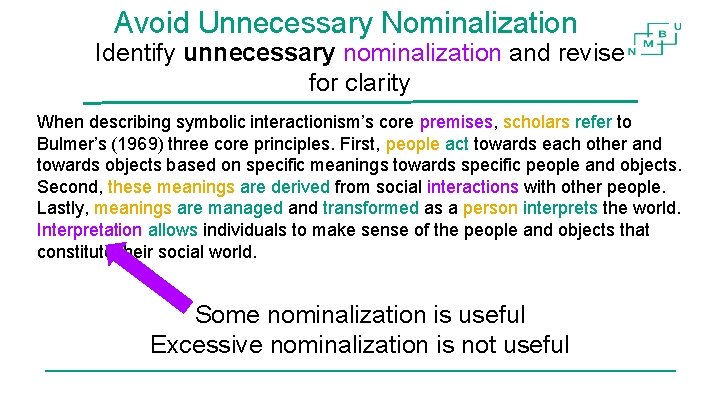
Break Apart Long Sentences Long, complex and interrupted sentences REDUCE clarity and understanding Shortened sentences improve understanding without losing meaning When describing symbolic interactionism’s core premises, scholars refer to Bulmer’s (1969) three core principles. First, people act towards each other and towards objects based on specific meanings towards specific people and objects. Second, these meanings are derived from social interactions with other people. Lastly, meanings are managed and transformed as a person interprets the world. Interpretation allows individuals to make sense of the people and objects that constitute their social world.
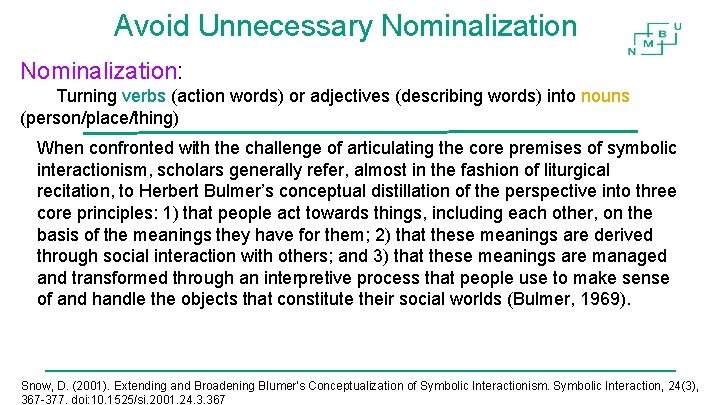
Avoid Unnecessary Nominalization: Turning verbs (action words) or adjectives (describing words) into nouns (person/place/thing) When confronted with the challenge of articulating the core premises of symbolic interactionism, scholars generally refer, almost in the fashion of liturgical recitation, to Herbert Bulmer’s conceptual distillation of the perspective into three core principles: 1) that people act towards things, including each other, on the basis of the meanings they have for them; 2) that these meanings are derived through social interaction with others; and 3) that these meanings are managed and transformed through an interpretive process that people use to make sense of and handle the objects that constitute their social worlds (Bulmer, 1969). Snow, D. (2001). Extending and Broadening Blumer's Conceptualization of Symbolic Interactionism. Symbolic Interaction, 24(3), 367 -377. doi: 10. 1525/si. 2001. 24. 3. 367
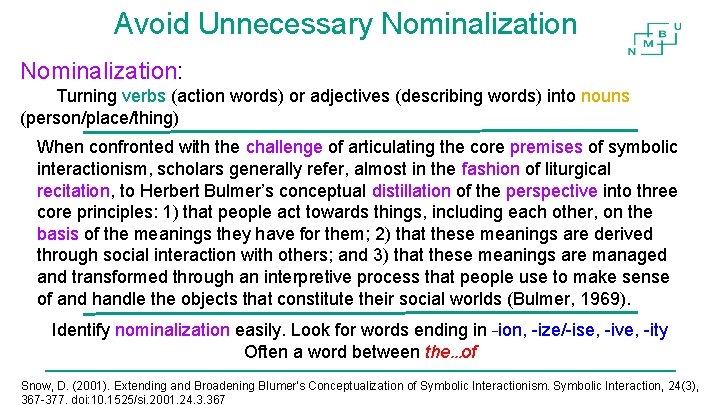
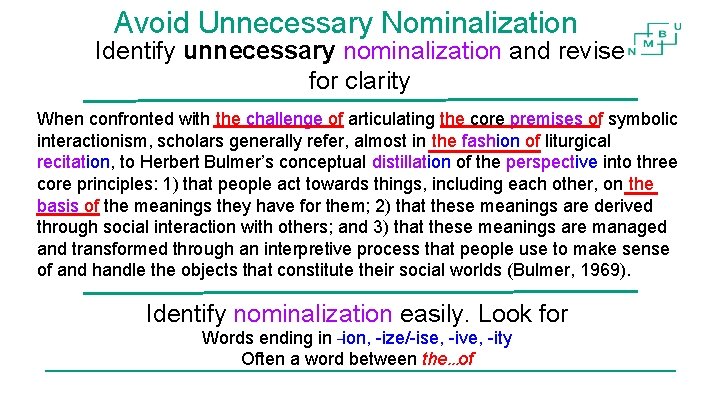
Avoid Unnecessary Nominalization: Turning verbs (action words) or adjectives (describing words) into nouns (person/place/thing) When confronted with the challenge of articulating the core premises of symbolic interactionism, scholars generally refer, almost in the fashion of liturgical recitation, to Herbert Bulmer’s conceptual distillation of the perspective into three core principles: 1) that people act towards things, including each other, on the basis of the meanings they have for them; 2) that these meanings are derived through social interaction with others; and 3) that these meanings are managed and transformed through an interpretive process that people use to make sense of and handle the objects that constitute their social worlds (Bulmer, 1969). Identify nominalization easily. Look for words ending in –ion, -ize/-ise, -ive, -ity Often a word between the…of Snow, D. (2001). Extending and Broadening Blumer's Conceptualization of Symbolic Interactionism. Symbolic Interaction, 24(3), 367 -377. doi: 10. 1525/si. 2001. 24. 3. 367
Avoid Unnecessary Nominalization Identify unnecessary nominalization and revise for clarity When confronted with the challenge of articulating the core premises of symbolic interactionism, scholars generally refer, almost in the fashion of liturgical recitation, to Herbert Bulmer’s conceptual distillation of the perspective into three core principles: 1) that people act towards things, including each other, on the basis of the meanings they have for them; 2) that these meanings are derived through social interaction with others; and 3) that these meanings are managed and transformed through an interpretive process that people use to make sense of and handle the objects that constitute their social worlds (Bulmer, 1969). Identify nominalization easily. Look for Words ending in –ion, -ize/-ise, -ive, -ity Often a word between the…of
Avoid Unnecessary Nominalization Identify unnecessary nominalization and revise for clarity When describing symbolic interactionism’s core premises, scholars refer to Bulmer’s (1969) three core principles. First, people act towards each other and towards objects based on specific meanings towards specific people and objects. Second, these meanings are derived from social interactions with other people. Lastly, meanings are managed and transformed as a person interprets the world. Interpretation allows individuals to make sense of the people and objects that constitute their social world. Some nominalization is useful Excessive nominalization is not useful
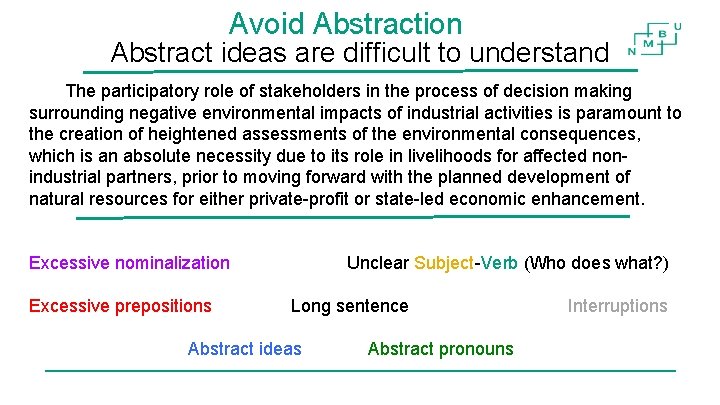
Avoid Abstraction Abstract ideas are difficult to understand The participatory role of stakeholders in the process of decision making surrounding negative environmental impacts of industrial activities is paramount to the creation of heightened assessments of the environmental consequences, which is an absolute necessity due to its role in livelihoods for affected nonindustrial partners, prior to moving forward with the planned development of natural resources for either private-profit or state-led economic enhancement. Excessive nominalization Excessive prepositions Unclear Subject-Verb (Who does what? ) Long sentence Abstract ideas Abstract pronouns Interruptions
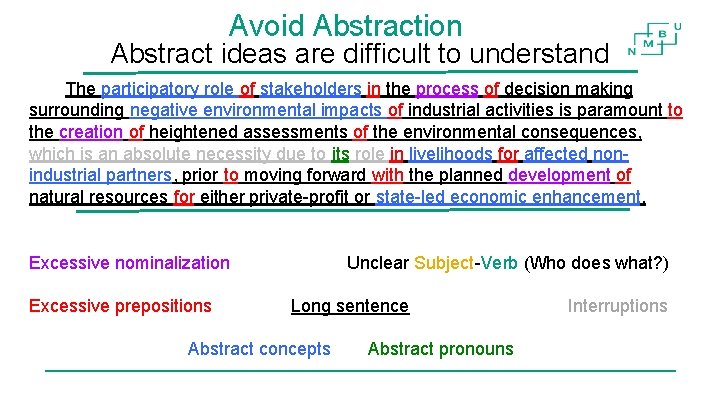
Avoid Abstraction Abstract ideas are difficult to understand The participatory role of stakeholders in the process of decision making surrounding negative environmental impacts of industrial activities is paramount to the creation of heightened assessments of the environmental consequences, which is an absolute necessity due to its role in livelihoods for affected nonindustrial partners, prior to moving forward with the planned development of natural resources for either private-profit or state-led economic enhancement. Excessive nominalization Excessive prepositions Unclear Subject-Verb (Who does what? ) Long sentence Abstract concepts Abstract pronouns Interruptions
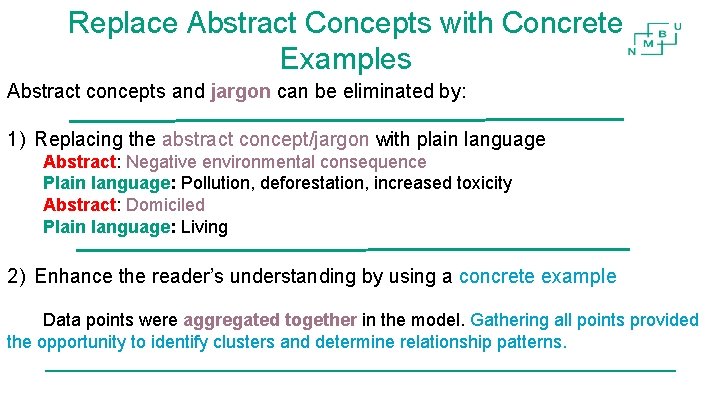
Replace Abstract Concepts with Concrete Examples Abstract concepts and jargon can be eliminated by: 1) Replacing the abstract concept/jargon with plain language Abstract: Negative environmental consequence Plain language: Pollution, deforestation, increased toxicity Abstract: Domiciled Plain language: Living 2) Enhance the reader’s understanding by using a concrete example Data points were aggregated together in the model. Gathering all points provided the opportunity to identify clusters and determine relationship patterns.
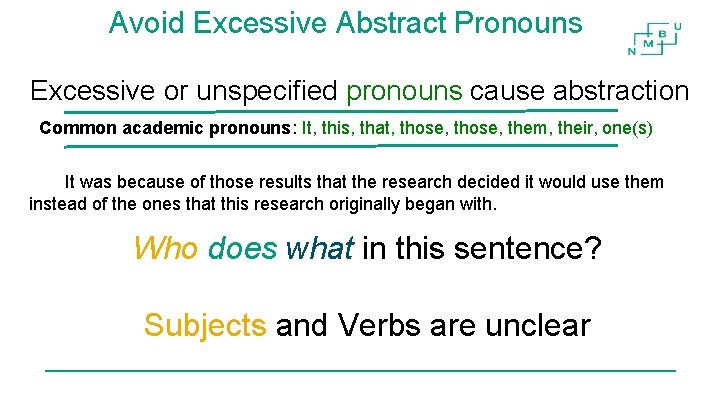
Avoid Excessive Abstract Pronouns Excessive or unspecified pronouns cause abstraction Common academic pronouns: It, this, that, those, them, their, one(s) It was because of those results that the research decided it would use them instead of the ones that this research originally began with. Who does what in this sentence? Subjects and Verbs are unclear
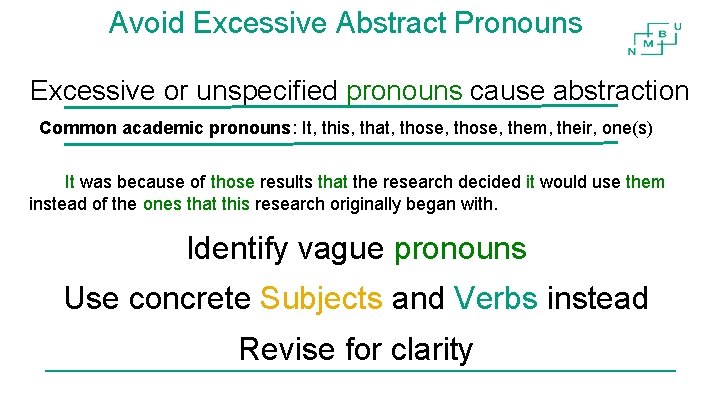
Avoid Excessive Abstract Pronouns Excessive or unspecified pronouns cause abstraction Common academic pronouns: It, this, that, those, them, their, one(s) It was because of those results that the research decided it would use them instead of the ones that this research originally began with. Identify vague pronouns Use concrete Subjects and Verbs instead Revise for clarity
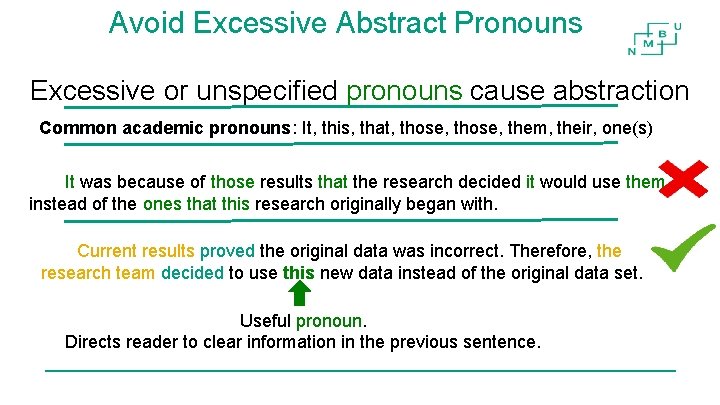
Avoid Excessive Abstract Pronouns Excessive or unspecified pronouns cause abstraction Common academic pronouns: It, this, that, those, them, their, one(s) It was because of those results that the research decided it would use them instead of the ones that this research originally began with. Current results proved the original data was incorrect. Therefore, the research team decided to use this new data instead of the original data set. Useful pronoun. Directs reader to clear information in the previous sentence.
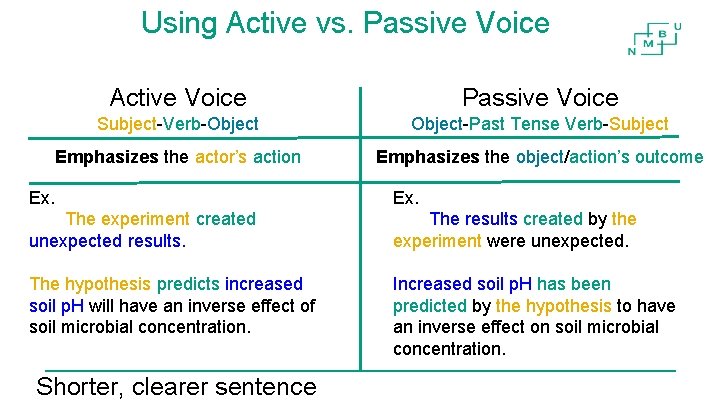
Using Active vs. Passive Voice Active Voice Passive Voice Subject-Verb-Object-Past Tense Verb-Subject Emphasizes the actor’s action Emphasizes the object/action’s outcome Ex. The experiment created unexpected results. The results created by the experiment were unexpected. The hypothesis predicts increased soil p. H will have an inverse effect of soil microbial concentration. Increased soil p. H has been predicted by the hypothesis to have an inverse effect on soil microbial concentration. Shorter, clearer sentence
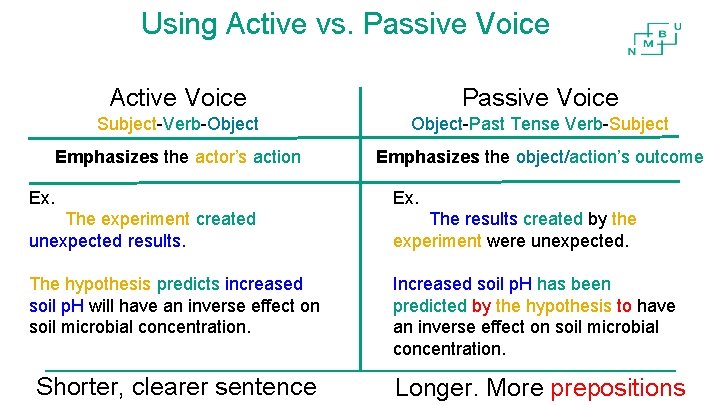
Using Active vs. Passive Voice Active Voice Passive Voice Subject-Verb-Object-Past Tense Verb-Subject Emphasizes the actor’s action Emphasizes the object/action’s outcome Ex. The experiment created unexpected results. The results created by the experiment were unexpected. The hypothesis predicts increased soil p. H will have an inverse effect on soil microbial concentration. Increased soil p. H has been predicted by the hypothesis to have an inverse effect on soil microbial concentration. Shorter, clearer sentence Longer. More prepositions
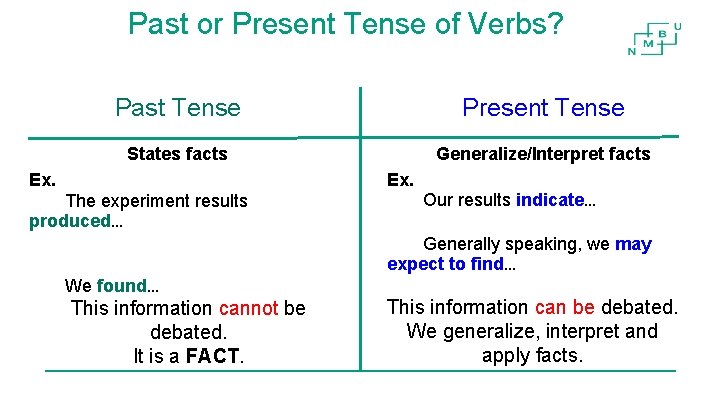
Past or Present Tense of Verbs? Past Tense Present Tense States facts Generalize/Interpret facts Ex. The experiment results produced… Our results indicate… Generally speaking, we may expect to find… We found… This information cannot be debated. It is a FACT. This information can be debated. We generalize, interpret and apply facts.
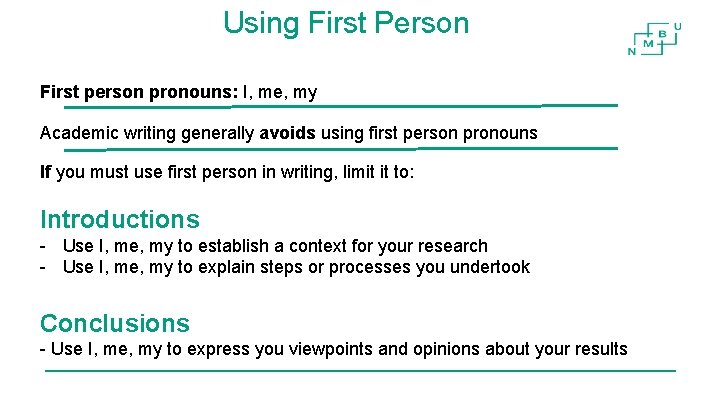
Using First Person First person pronouns: I, me, my Academic writing generally avoids using first person pronouns If you must use first person in writing, limit it to: Introductions - Use I, me, my to establish a context for your research - Use I, me, my to explain steps or processes you undertook Conclusions - Use I, me, my to express you viewpoints and opinions about your results
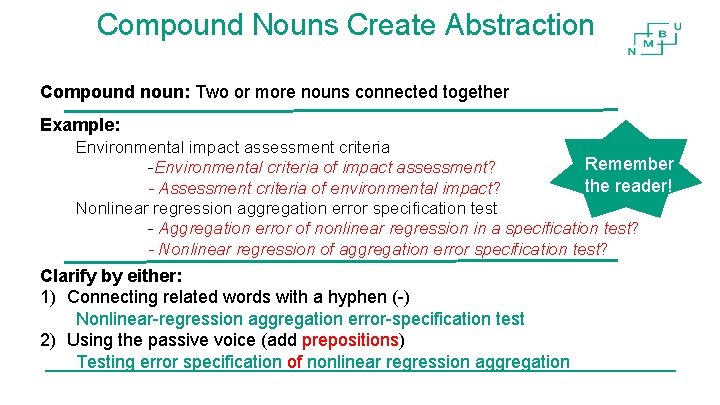
Compound Nouns Create Abstraction Compound noun: Two or more nouns connected together Example: Environmental impact assessment criteria Remember -Environmental criteria of impact assessment? the reader! - Assessment criteria of environmental impact? Nonlinear regression aggregation error specification test - Aggregation error of nonlinear regression in a specification test? - Nonlinear regression of aggregation error specification test? Clarify by either: 1) Connecting related words with a hyphen (-) Nonlinear-regression aggregation error-specification test 2) Using the passive voice (add prepositions) Testing error specification of nonlinear regression aggregation
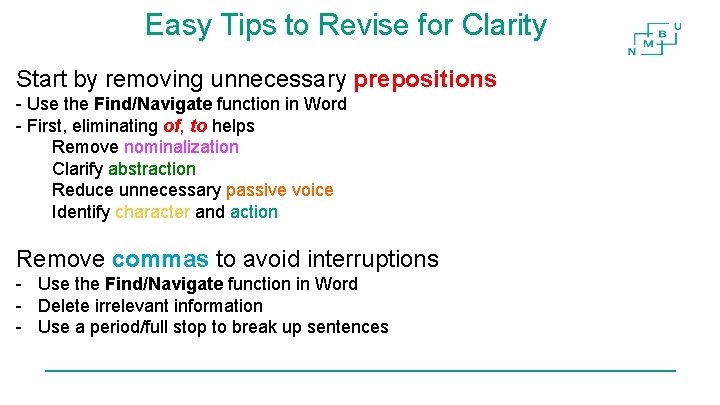
Easy Tips to Revise for Clarity Start by removing unnecessary prepositions - Use the Find/Navigate function in Word - First, eliminating of, to helps Remove nominalization Clarify abstraction Reduce unnecessary passive voice Identify character and action Remove commas to avoid interruptions - Use the Find/Navigate function in Word - Delete irrelevant information - Use a period/full stop to break up sentences
Focusing on Draft and Techniques Revision Goal Getting all ideas onto paper Write from Intro to Conclusion Logic/movement of whole document Structure/Flow/Cohesion Tightening paragraphs Shortening Sentences Examining Individual words Clarity Concision Precision Proofread Format 1 st Draft: Use your outline 2 nd Draft: Create a reverse outline; reorder ideas; add what is missing 3 rd Draft: remove of, vague pronouns (it, this, that, those), and interruptions (phrases surrounded in commas) 4 th Draft: compress phrases, remove unspecific adjectives/adverbs, delete irrelevant/redundant ideas, remove not 5 th Draft: grammar, punctuation, page numbers, checking citations/references, page/section breaks. Finalize title and headers 44