Unit 4 Cracking the Chemists Code The Periodic
- Slides: 28
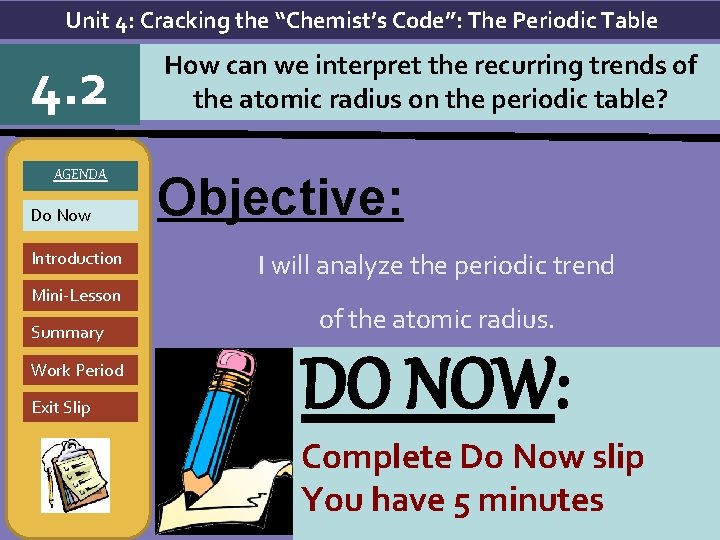
Unit 4: Cracking the “Chemist’s Code”: The Periodic Table 4. 2 AGENDA Do Now Introduction Mini-Lesson Summary Work Period Exit Slip How can we interpret the recurring trends of the atomic radius on the periodic table? Objective: I will analyze the periodic trend of the atomic radius. DO NOW: Complete Do Now slip You have 5 minutes
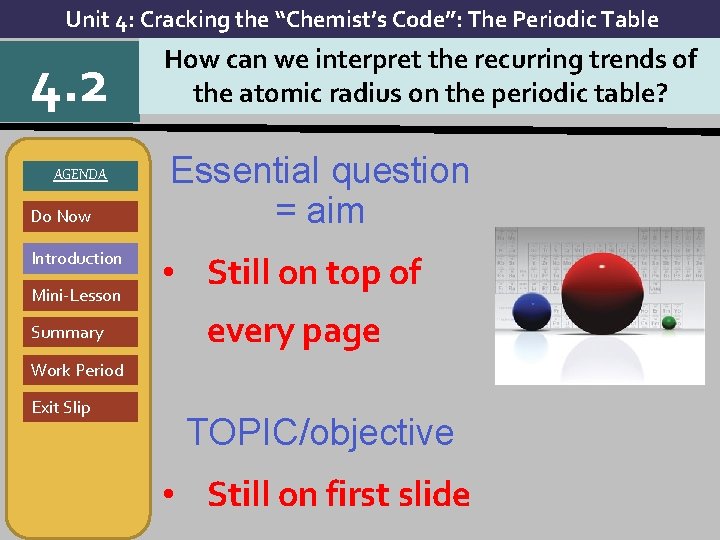
Unit 4: Cracking the “Chemist’s Code”: The Periodic Table 4. 2 AGENDA Do Now Introduction Mini-Lesson Summary How can we interpret the recurring trends of the atomic radius on the periodic table? Essential question = aim • Still on top of every page Work Period Exit Slip TOPIC/objective • Still on first slide
Unit 5: Cracking the “Chemist’s Code”: The Periodic Table 5. 2 analyze the How. I will can we interpret the recurring trends of periodic trend of the atomic radius on the periodic table? How. AGENDA can we interpret the recurring trends of the atomic radius on the periodic table? Do Now Introduction Mini-Lesson Summary Work Period Exit Slip
Unit 4: Cracking the “Chemist’s Code”: The Periodic Table 4. 2 AGENDA How can we interpret the recurring trends of the atomic radius on the periodic table? ANNOUNCEMENTS Do Now Introduction • Exam tracker due tomorrow Mini-Lesson Summary Work Period Exit Slip • Every day for HW: Create a summary, 2 questions, and classwork
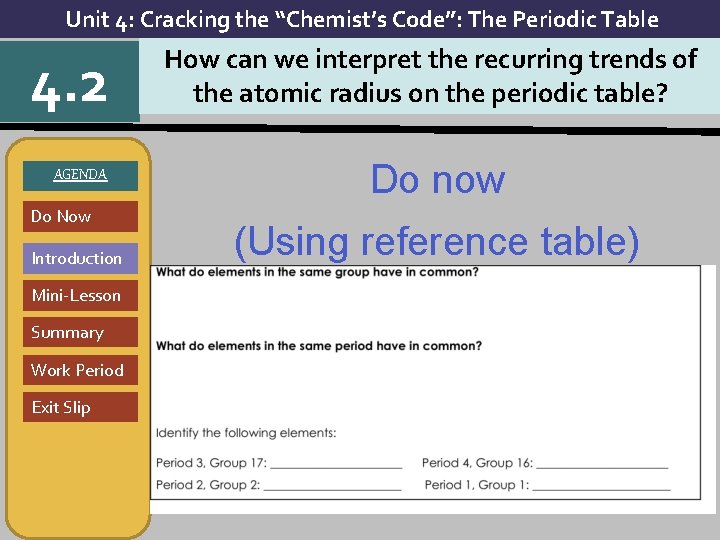
Unit 4: Cracking the “Chemist’s Code”: The Periodic Table 4. 2 AGENDA Do Now Introduction Mini-Lesson Summary Work Period Exit Slip How can we interpret the recurring trends of the atomic radius on the periodic table? Do now (Using reference table)
Unit 4: Cracking the “Chemist’s Code”: The Periodic Table 4. 2 How can we interpret the recurring trends of the atomic radius on the periodic table? Let’s share out our Group Share Out summaries from yesterday! Summaries should answer the essential question: How is the periodic table organized? Do Now Introduction Mini-Lesson Summary Work Period Exit Slip
Unit 4: Cracking the “Chemist’s Code”: The Periodic Table 4. 2 How can we interpret the recurring trends of the atomic radius on the periodic table? Group Share Out Summaries should answer the essential Summary question: How is the periodic table organized? Do Now Introduction Mini-Lesson Summary Work Period Exit Slip
Unit 4: Cracking the “Chemist’s Code”: The Periodic Table 4. 2 How can we interpret the recurring trends of the atomic radius on the periodic table? Group Share Out Questions What were questions you created about yesterday’s lesson? Do Now Introduction Mini-Lesson Summary Work Period Exit Slip
Unit 4: Cracking the “Chemist’s Code”: The Periodic Table 4. 2 How can we interpret the recurring trends of the atomic radius on the periodic table? STOP AND JOT IN Questions Answer in notes • What is a trend? • Examples of trends? • Why do we care? Do Now Introduction Mini-Lesson Summary Work Period Exit Slip
Unit 4: Cracking the “Chemist’s Code”: The Periodic Table 4. 2 How can we interpret the recurring trends of the atomic radius on the periodic table? THINK INK-PAIRE SHARE Question: How do you think trends may relate to the periodic table? Notes: 1. Answer the question in 2 minutes ( I think…) 2. Share with your partner. Write down what your partner stated on your paper. (My partner thinks…) Do Now Introduction Mini-Lesson Summary Work Period Exit Slip
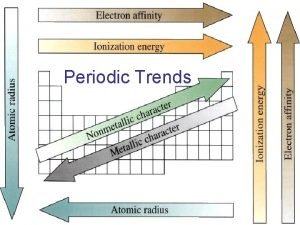
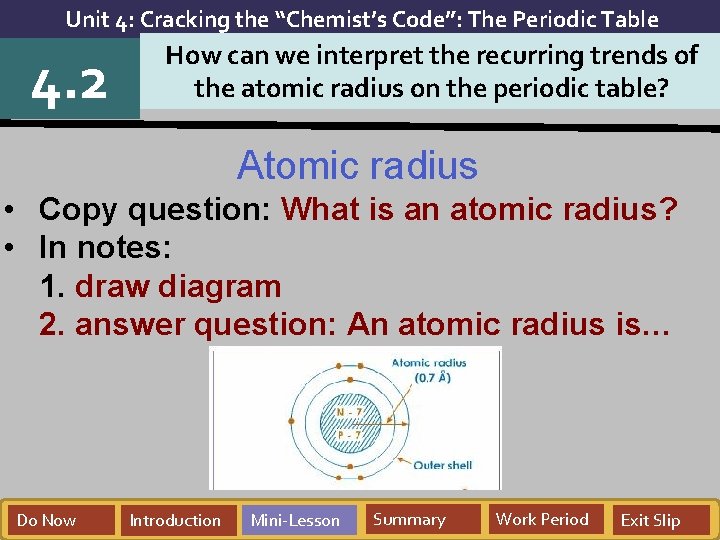
Unit 4: Cracking the “Chemist’s Code”: The Periodic Table 4. 2 How can we interpret the recurring trends of the atomic radius on the periodic table? Atomic radius • Copy question: What is an atomic radius? • In notes: 1. draw diagram 2. answer question: An atomic radius is… Do Now Introduction Mini-Lesson Summary Work Period Exit Slip
Unit 4: Cracking the “Chemist’s Code”: The Periodic Table 4. 2 How can we interpret the recurring trends of the atomic radius on the periodic table? Group Share Out Let’s share out our answers! How do you know? Do Now Introduction Mini-Lesson Summary Work Period Exit Slip
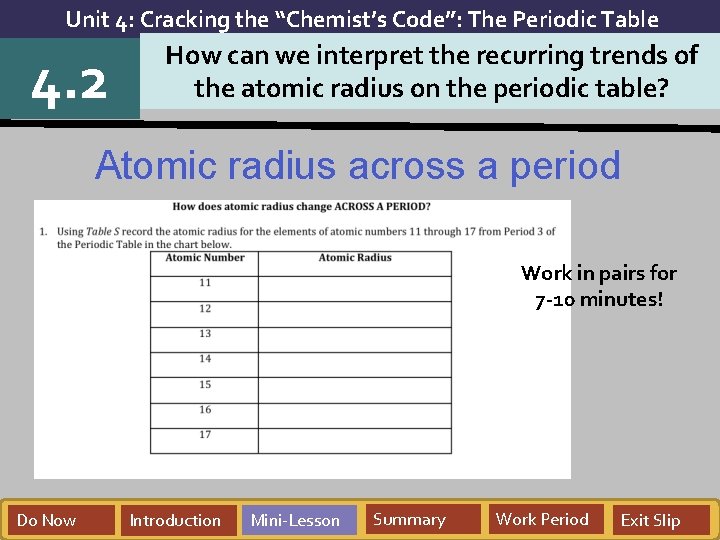
Unit 4: Cracking the “Chemist’s Code”: The Periodic Table 4. 2 How can we interpret the recurring trends of the atomic radius on the periodic table? Atomic radius across a period Work in pairs for 7 -10 minutes! Do Now Introduction Mini-Lesson Summary Work Period Exit Slip
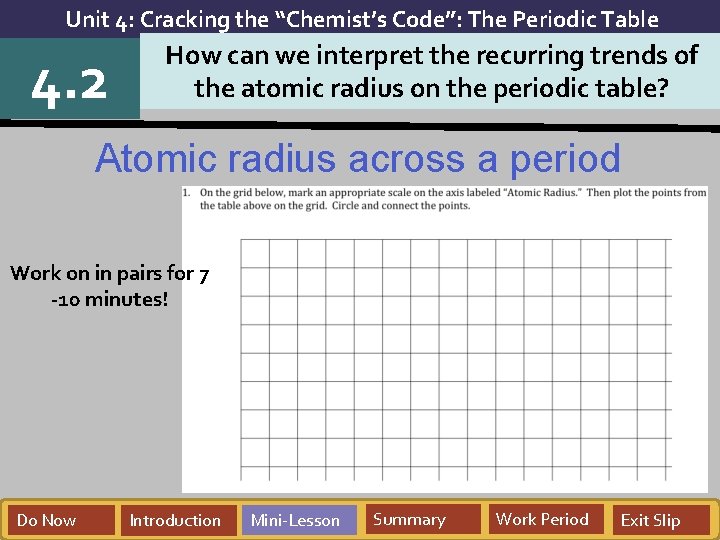
Unit 4: Cracking the “Chemist’s Code”: The Periodic Table 4. 2 How can we interpret the recurring trends of the atomic radius on the periodic table? Atomic radius across a period Work on in pairs for 7 -10 minutes! Do Now Introduction Mini-Lesson Summary Work Period Exit Slip
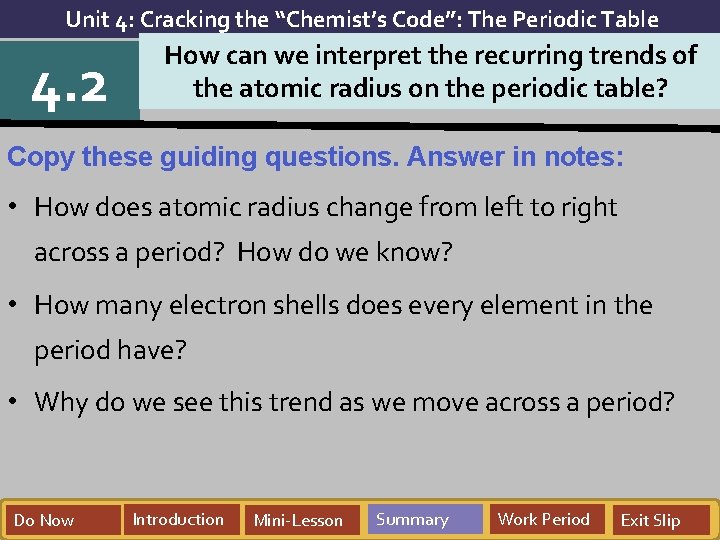
Unit 4: Cracking the “Chemist’s Code”: The Periodic Table 4. 2 How can we interpret the recurring trends of the atomic radius on the periodic table? Copy these guiding questions. Answer in notes: • How does atomic radius change from left to right across a period? How do we know? • How many electron shells does every element in the period have? • Why do we see this trend as we move across a period? Do Now Introduction Mini-Lesson Summary Work Period Exit Slip
Unit 4: Cracking the “Chemist’s Code”: The Periodic Table 4. 2 How can we interpret the recurring trends of the atomic radius on the periodic table? Group Share Out Let’s share out our answers! Do Now Introduction Mini-Lesson Summary Work Period Exit Slip
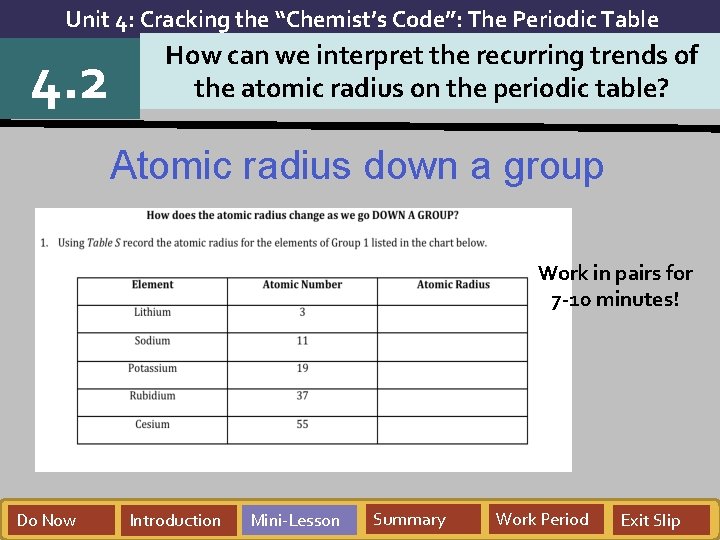
Unit 4: Cracking the “Chemist’s Code”: The Periodic Table 4. 2 How can we interpret the recurring trends of the atomic radius on the periodic table? Atomic radius down a group Work in pairs for 7 -10 minutes! Do Now Introduction Mini-Lesson Summary Work Period Exit Slip
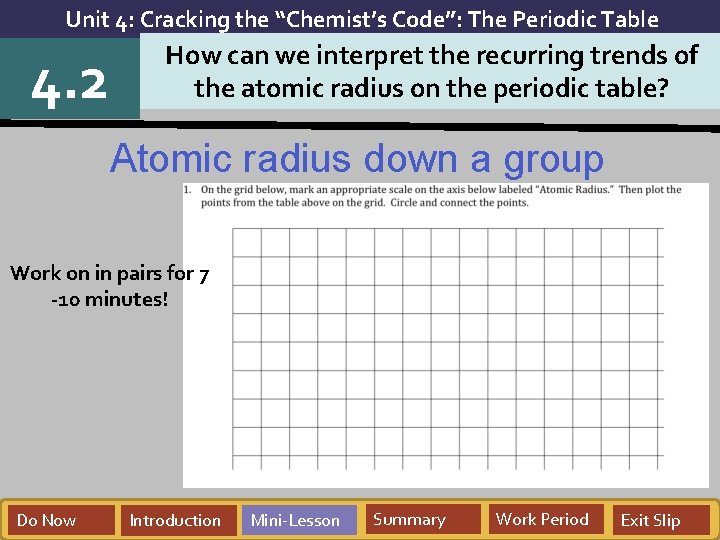
Unit 4: Cracking the “Chemist’s Code”: The Periodic Table 4. 2 How can we interpret the recurring trends of the atomic radius on the periodic table? Atomic radius down a group Work on in pairs for 7 -10 minutes! Do Now Introduction Mini-Lesson Summary Work Period Exit Slip
Unit 4: Cracking the “Chemist’s Code”: The Periodic Table 4. 2 How can we interpret the recurring trends of the atomic radius on the periodic table? Copy these guiding questions. Answer in notes: • How does atomic radius change from top to bottom down a group? How do we know? • How does the number of electron shells change for elements as we go down the group? How do we know? • Why do we see this trend as we go down a group? Explain in terms of electron shells. Do Now Introduction Mini-Lesson Summary Work Period Exit Slip
Unit 4: Cracking the “Chemist’s Code”: The Periodic Table 4. 2 How can we interpret the recurring trends of the atomic radius on the periodic table? Group Share Out Let’s share out our answers! Do Now Introduction Mini-Lesson Summary Work Period Exit Slip
Unit 4: Cracking the “Chemist’s Code”: The Periodic Table How can we interpret the recurring trends of the atomic radius on the periodic table? 4. 2 HOMEWORK: • Create 2 questions • Write a summary answering essential question • Complete classwork Do Now Introduction Mini-Lesson Summary Work Period Exit Slip
Unit 4: Cracking the “Chemist’s Code”: The Periodic Table 4. 2 How can we interpret the recurring trends of the atomic radius on the periodic table? summary How can we interpret the recurring trends of the atomic radius on the periodic table? Take 2 minutes to read from your notes and write a quick summary. Do Now Introduction Mini-Lesson Summary Work Period Exit Slip
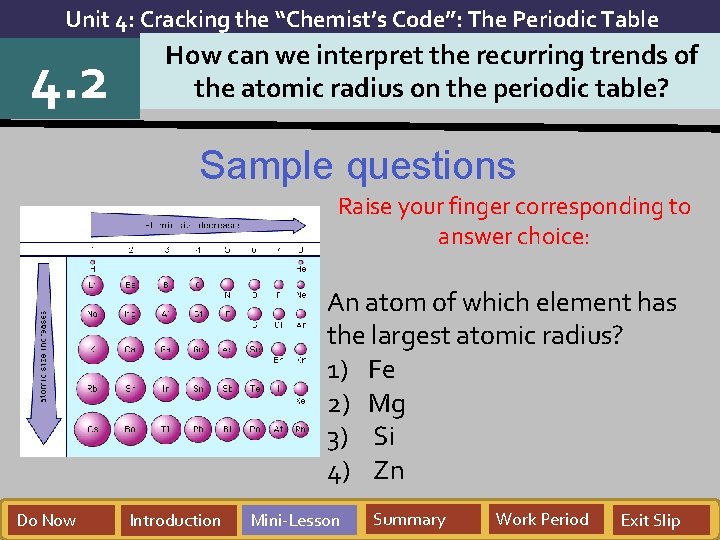
Unit 4: Cracking the “Chemist’s Code”: The Periodic Table 4. 2 How can we interpret the recurring trends of the atomic radius on the periodic table? Sample questions Raise your finger corresponding to answer choice: An atom of which element has the largest atomic radius? 1) Fe 2) Mg 3) Si 4) Zn Do Now Introduction Mini-Lesson Summary Work Period Exit Slip
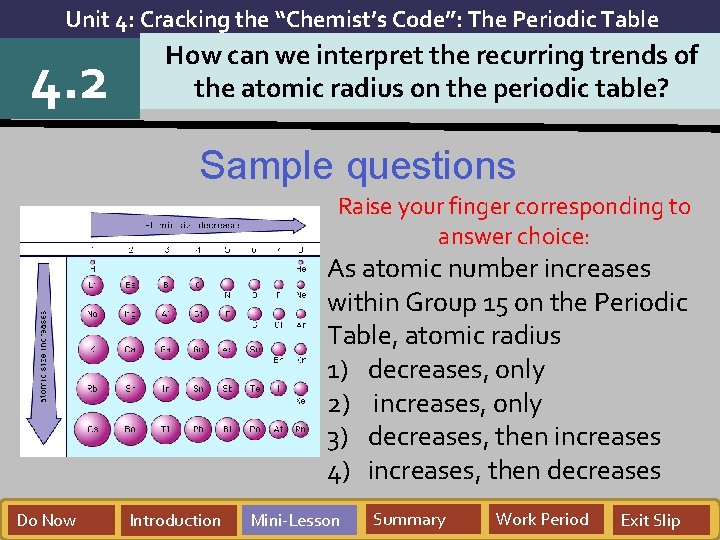
Unit 4: Cracking the “Chemist’s Code”: The Periodic Table 4. 2 How can we interpret the recurring trends of the atomic radius on the periodic table? Sample questions Raise your finger corresponding to answer choice: As atomic number increases within Group 15 on the Periodic Table, atomic radius 1) decreases, only 2) increases, only 3) decreases, then increases 4) increases, then decreases Do Now Introduction Mini-Lesson Summary Work Period Exit Slip
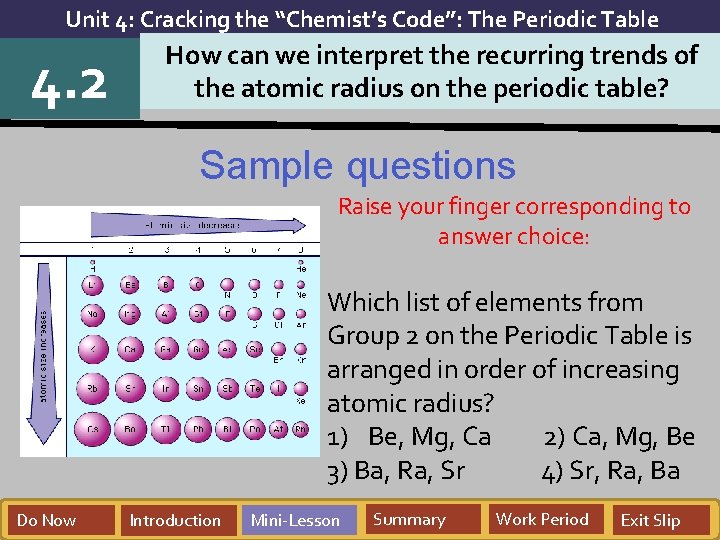
Unit 4: Cracking the “Chemist’s Code”: The Periodic Table 4. 2 How can we interpret the recurring trends of the atomic radius on the periodic table? Sample questions Raise your finger corresponding to answer choice: Which list of elements from Group 2 on the Periodic Table is arranged in order of increasing atomic radius? 1) Be, Mg, Ca 2) Ca, Mg, Be 3) Ba, Ra, Sr 4) Sr, Ra, Ba Do Now Introduction Mini-Lesson Summary Work Period Exit Slip
Unit 4: Cracking the “Chemist’s Code”: The Periodic Table 4. 2 How can we interpret the recurring trends of the atomic radius on the periodic table? Let’s look at this: In a TIEDC paragraph, explain, in terms of atomic structure, why the atomic radius of iodine is greater than the atomic radius of fluorine. Do Now Introduction Mini-Lesson Summary Work Period Exit Slip
Unit 4: Cracking the “Chemist’s Code”: The Periodic Table 4. 2 How can we interpret the recurring trends of the atomic radius on the periodic table? HOMEWORK: Complete rest of 4. 2 in the packet for homework Do Now Introduction Mini-Lesson Summary Work Period Exit Slip
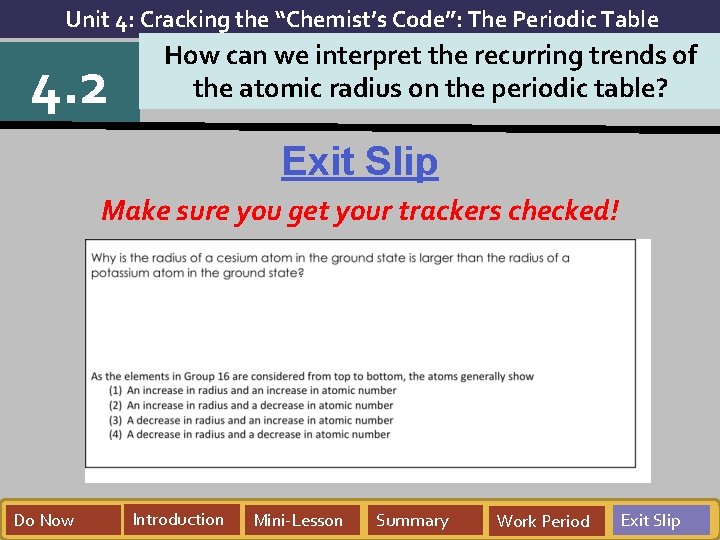
Unit 4: Cracking the “Chemist’s Code”: The Periodic Table 4. 2 How can we interpret the recurring trends of the atomic radius on the periodic table? Exit Slip Make sure you get your trackers checked! Do Now Introduction Mini-Lesson Summary Work Period Exit Slip