The RSR From The Idea To Sources OMG

- Slides: 40
The RSR – From The Idea To Sources OMG Sophie How do I start my RSR? !!!
Some General Observations* * Based on helping my LC and IB students You feel swamped – you don’t know where to start. The RSR is put on ‘The Long Finger’. Its competing for time with other subjects You take a long time to settle on a general area eg European history or Medieval history and you may need to be ‘shoved’ to get this far. You find it difficult to narrow your focus to a more specific topic area and to develop a research question You are reluctant to discuss your ideas with teachers and the school librarian. You struggle on alone when you don’t have to You don’t know how/where to find the information you need You find extracting ideas/themes/arguments from your reading difficult
The Research Process Majority of Irish students are NOT taught how to use a library nor how to write a research essay Students don’t realise that there is a methodology that they can follow 1. 2. 3. 4. 5. 6. 7. 8. 9. Find topic area Do background (initial) reading Develop Research Question (RQ) and thesis statement with History Teacher Decide which sources are needed Research Read Evaluate Write first draft Recognise what is wrong/missing/should be emphasised/deleted from 1 st draft. Have you answered your RQ? 10. Revise draft(s) This could be covered in a TY Module Why don’t you suggest it to the TY Co-Ordinator at your school? ?
Topic Choice & Research Question
Your Topic Choice and RQ is Important Choose something that interests you Is worthy of research ie don’t choose a frivolous topic – 4 criteria will be discussed. Surprisingly Kim Kardashian doesn’t count as ‘worthy’!!! Your RQ will determine the resources you will need for your essay Do your background reading in general reference sources (eg encyclopedia) to confirm your interest in the topic Become familiar with the historical context surrounding your topic (social, political, cultural, economic etc. ) Take on the role of the investigator - what is the significance of the topic you are researching? If you cannot answer this then why are you working on the topic? ? ? Once settled on your general topic area narrow it into your RQ
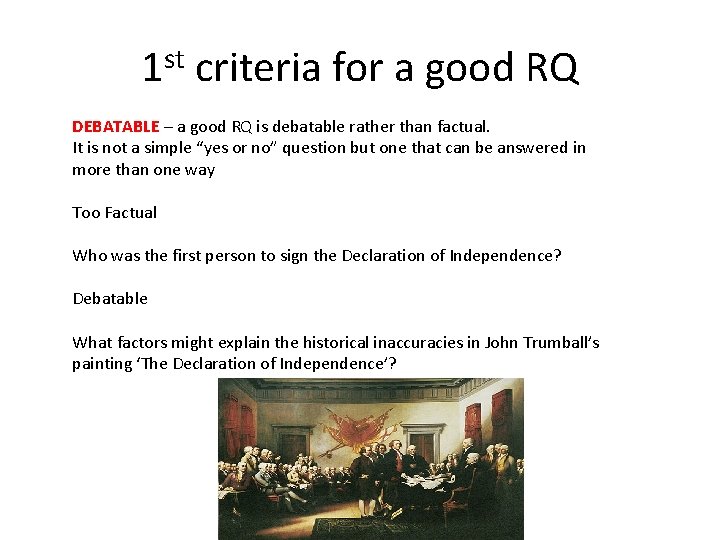
1 st criteria for a good RQ DEBATABLE – a good RQ is debatable rather than factual. It is not a simple “yes or no” question but one that can be answered in more than one way Too Factual Who was the first person to sign the Declaration of Independence? Debatable What factors might explain the historical inaccuracies in John Trumball’s painting ‘The Declaration of Independence’?
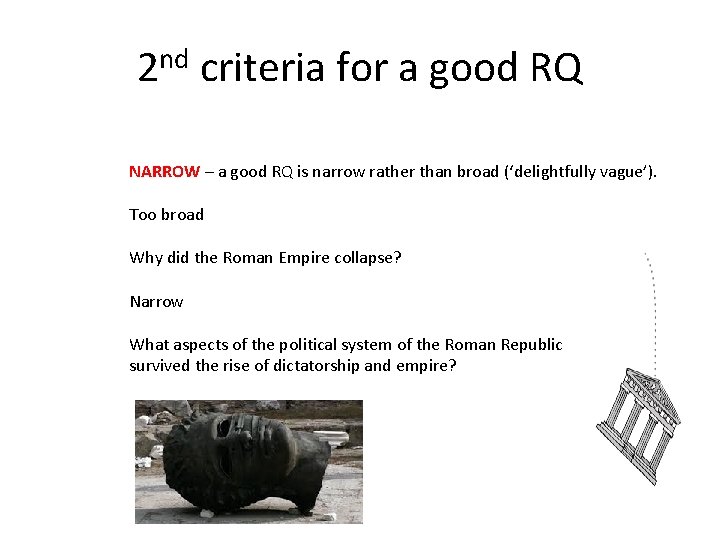
2 nd criteria for a good RQ NARROW – a good RQ is narrow rather than broad (‘delightfully vague’). Too broad Why did the Roman Empire collapse? Narrow What aspects of the political system of the Roman Republic survived the rise of dictatorship and empire?
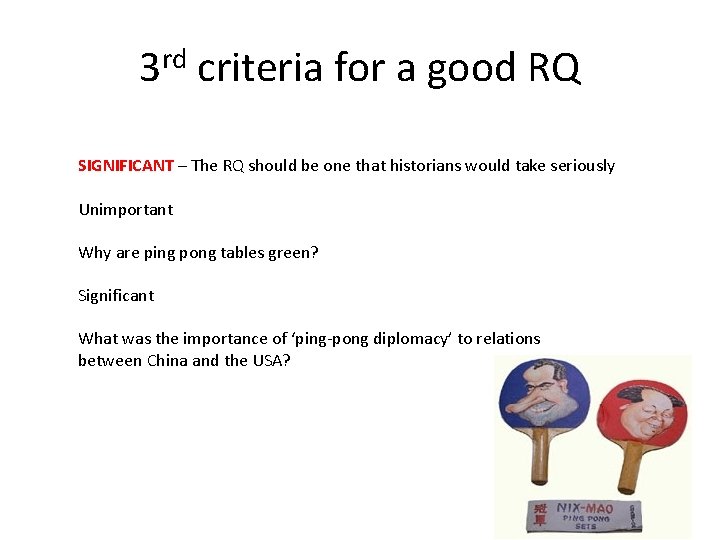
3 rd criteria for a good RQ SIGNIFICANT – The RQ should be one that historians would take seriously Unimportant Why are ping pong tables green? Significant What was the importance of ‘ping-pong diplomacy’ to relations between China and the USA?
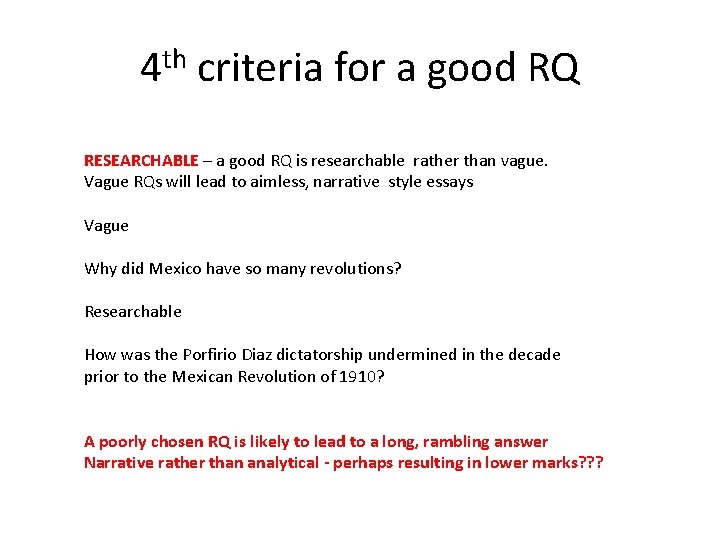
4 th criteria for a good RQ RESEARCHABLE – a good RQ is researchable rather than vague. Vague RQs will lead to aimless, narrative style essays Vague Why did Mexico have so many revolutions? Researchable How was the Porfirio Diaz dictatorship undermined in the decade prior to the Mexican Revolution of 1910? A poorly chosen RQ is likely to lead to a long, rambling answer Narrative rather than analytical - perhaps resulting in lower marks? ? ?
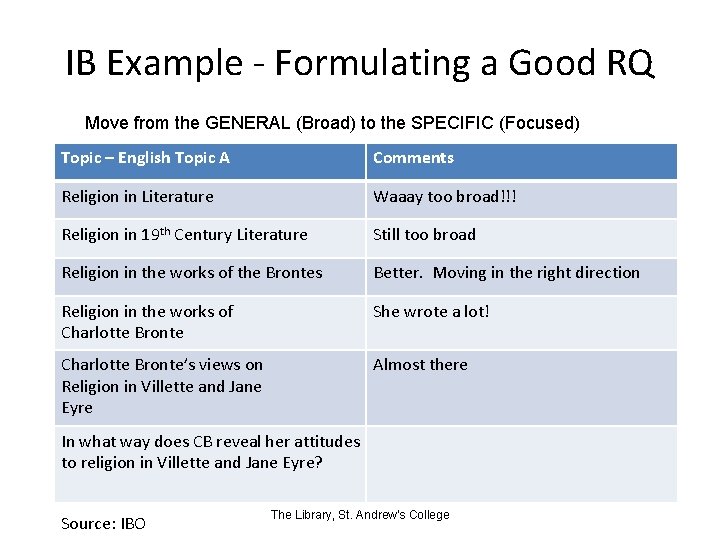
IB Example - Formulating a Good RQ Move from the GENERAL (Broad) to the SPECIFIC (Focused) Topic – English Topic A Comments Religion in Literature Waaay too broad!!! Religion in 19 th Century Literature Still too broad Religion in the works of the Brontes Better. Moving in the right direction Religion in the works of Charlotte Bronte She wrote a lot! Charlotte Bronte’s views on Religion in Villette and Jane Eyre Almost there In what way does CB reveal her attitudes to religion in Villette and Jane Eyre? Source: IBO The Library, St. Andrew's College
Sources
Caveat Assuming - you don’t have a school library - you know how to search the internet - you are a member of your local public library and know how to use a library catalogue So, …
Sources - Types You only have to evaluate 3 sources of information in your RSR Here’s where you’ll find help 1. Almanacs/Statistical Sources 2. Atlases (Historical) 3. Books & Ebooks 4. Databases 5. Dictionaries 6. Encyclopedia 7. Internet – Irish Sites and Linked Sites 8. Magazines 9. Newspapers 10. People – Interviews, Associations, Museums and Archives 11. Radio and TV
Warning DANGER!! • This is NOT a comprehensive listing of sources. It gives a flavour of what is available
Sources used at the start Useful at the beginning stages of research Dictionaries Encyclopedia Atlases (Historical)
Dictionaries Useful to define an historical term – used to briefly describe the origin and general historical context of the term you intend to use eg neo-liberalism They do not contain detailed analysis/interpretation of historical subjects. Macmillan Concise Dictionary of World History Dictionary of Irish History Since 1800 – Hickey and Doherty (eds) Dictionary of Ancient History (OUP) Dictionary of American History Dictionary of the History of Ideas According to The Dictionary of the History of Ideas “neo-liberalism is ……
Encyclopedias Researching a subject about which you have very little background information? ? ? READ AN ENCYCLOPEDIA ARTICLE ON YOUR TOPIC as you are not yet in a position to corroborate what you will be reading with other sources World Book Online Encyclopedia/Encyclopedia Britannica – fee based on web Women’s Studies Encyclopedia: History, Philosophy and Religion (1999) New Encyclopedia of Islam (2001) International Encyclopedia of the Social Sciences – useful for politics Encyclopedia of Medical History Encyclopedia of Military History: From 3500 BC to the Present (Harper & Row)
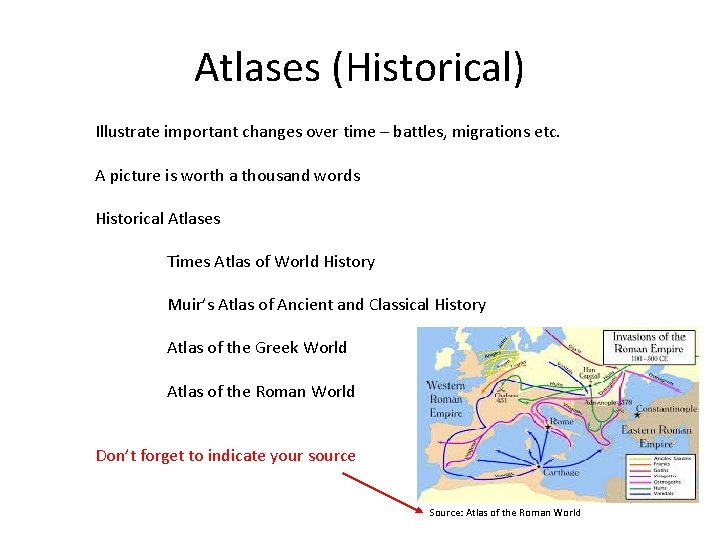
Atlases (Historical) Illustrate important changes over time – battles, migrations etc. A picture is worth a thousand words Historical Atlases Times Atlas of World History Muir’s Atlas of Ancient and Classical History Atlas of the Greek World Atlas of the Roman World Don’t forget to indicate your source Source: Atlas of the Roman World
Sources Used Later In The Research Process
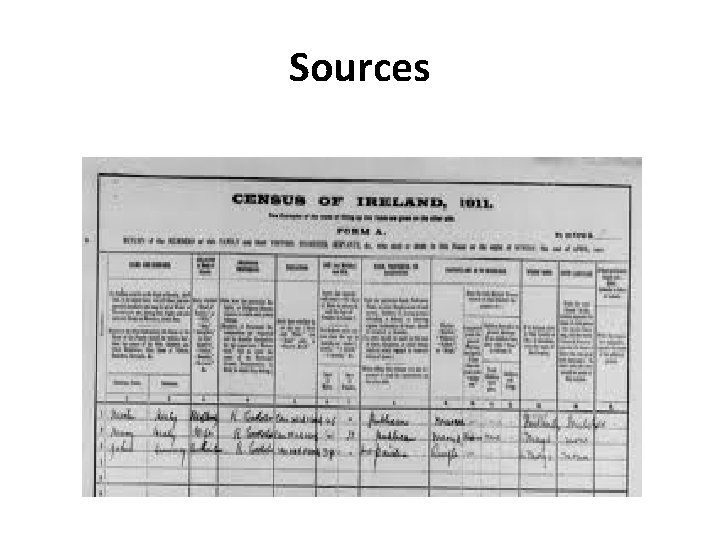
Almanacs/Statistics An almanac is a book of facts/statistics usually in a tabulated format. Statistics in an almanac refer to the previous years figures or even earlier! Use statistics to strengthen your argument CSO – Central Statistics Office ESRI- Economic and Social Research Institute Irish Census data – 1911 Census World Almanac and Book of Facts UN - Statistical Yearbook, United Nations Statistical Office European Political Facts, 1918 -1990 Historical Tables, 58 BC-AD 1900 International Historical Statistics: Europe, 1750 -2005, 6 th ed.
Books Very useful to the novice researcher for their broad and deep coverage of a topic. Peer reviewed Use the index – you may not have to read the entire book Bibliography - use it to find other resources on your topic area Too many to list or comment upon individually – use the ‘classic’ author in the subject eg Laurence Rees on Nazis. Use your Local public library – search their catalogue online, if the item not in stock ask for an Inter Library Loan – small cost? ? ? Book Reviews – useful for analysis/criticism Help for students on how to evaluate print sources of information on my Blog
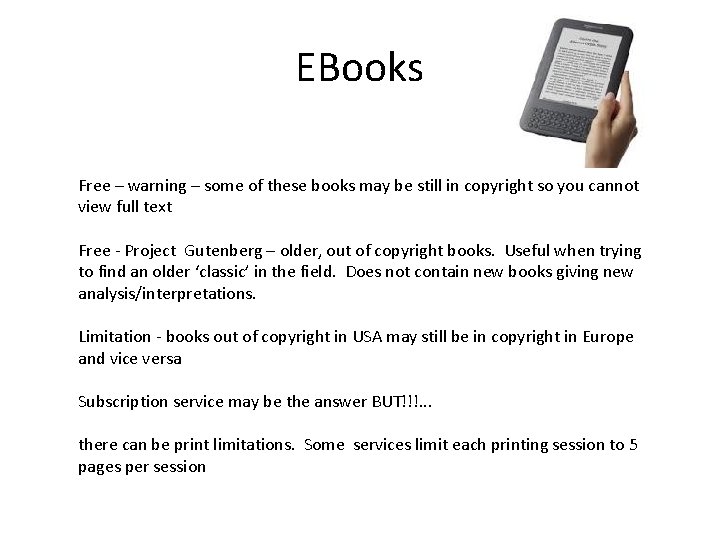
EBooks Free – warning – some of these books may be still in copyright so you cannot view full text Free - Project Gutenberg – older, out of copyright books. Useful when trying to find an older ‘classic’ in the field. Does not contain new books giving new analysis/interpretations. Limitation - books out of copyright in USA may still be in copyright in Europe and vice versa Subscription service may be the answer BUT!!!. . . there can be print limitations. Some services limit each printing session to 5 pages per session
Databases Useful for full text articles and book reviews EBSCO – History Reference Centre JSTOR – collection of journals from a wide range of disciplines. Fee based and require a password Are they available at a local library/university? ? ? Save time – read the abstract – summarises what the work is about
Internet – A Few Caveats Beware of Wikipedia – open architecture - use cautiously Every class will have its ‘Wiki Wallies’ Bibliography at end of article may be useful for resources Use Google Scholar? Do you know about suffixes eg. edu (educational). com (commercial organisation) Invisible or Deep Web – Do you know how to search it? ? ? Date accessed – essential to quote this in your bibliography Go to my Blog for help on how to evaluate a website http: //librarysac. wordpress. com
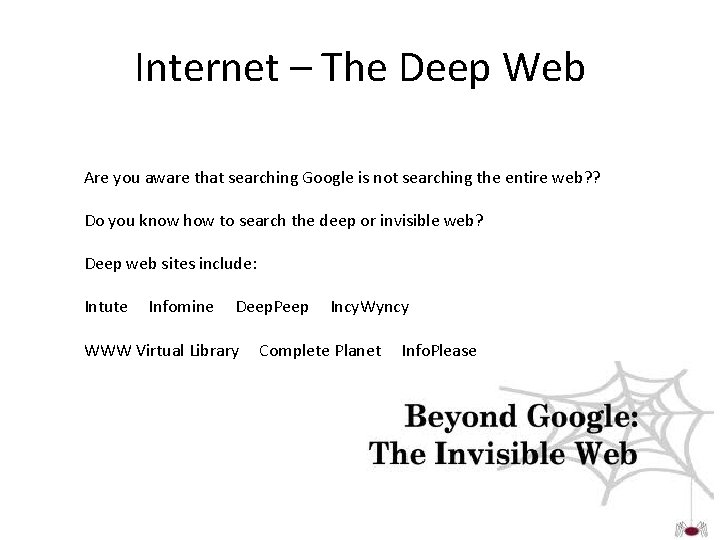
Internet – The Deep Web Are you aware that searching Google is not searching the entire web? ? Do you know how to search the deep or invisible web? Deep web sites include: Intute Infomine Deep. Peep WWW Virtual Library Incy. Wyncy Complete Planet Info. Please
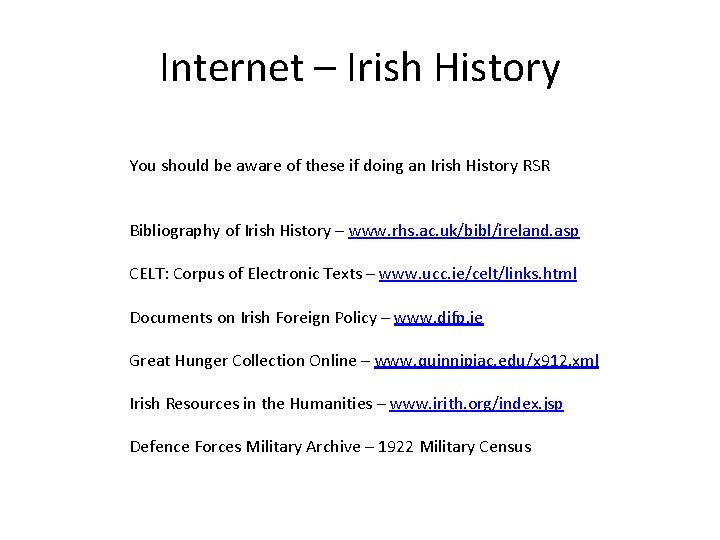
Internet – Irish History You should be aware of these if doing an Irish History RSR Bibliography of Irish History – www. rhs. ac. uk/bibl/ireland. asp CELT: Corpus of Electronic Texts – www. ucc. ie/celt/links. html Documents on Irish Foreign Policy – www. difp. ie Great Hunger Collection Online – www. quinnipiac. edu/x 912. xml Irish Resources in the Humanities – www. irith. org/index. jsp Defence Forces Military Archive – 1922 Military Census
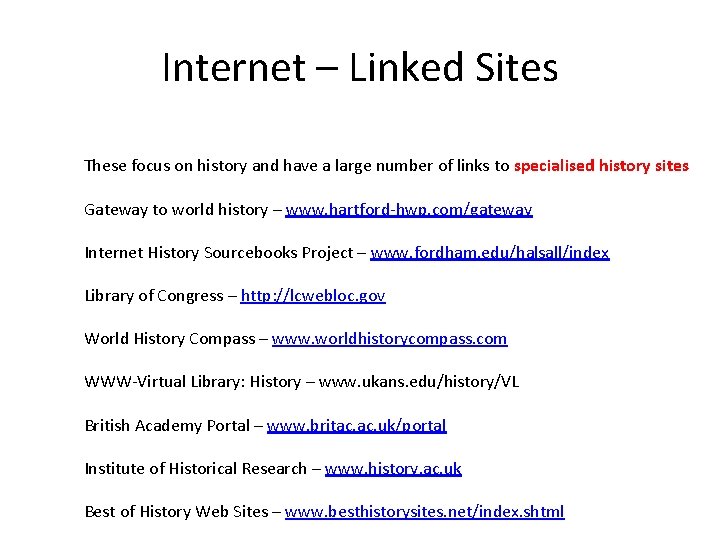
Internet – Linked Sites These focus on history and have a large number of links to specialised history sites Gateway to world history – www. hartford-hwp. com/gateway Internet History Sourcebooks Project – www. fordham. edu/halsall/index Library of Congress – http: //lcwebloc. gov World History Compass – www. worldhistorycompass. com WWW-Virtual Library: History – www. ukans. edu/history/VL British Academy Portal – www. britac. uk/portal Institute of Historical Research – www. history. ac. uk Best of History Web Sites – www. besthistorysites. net/index. shtml
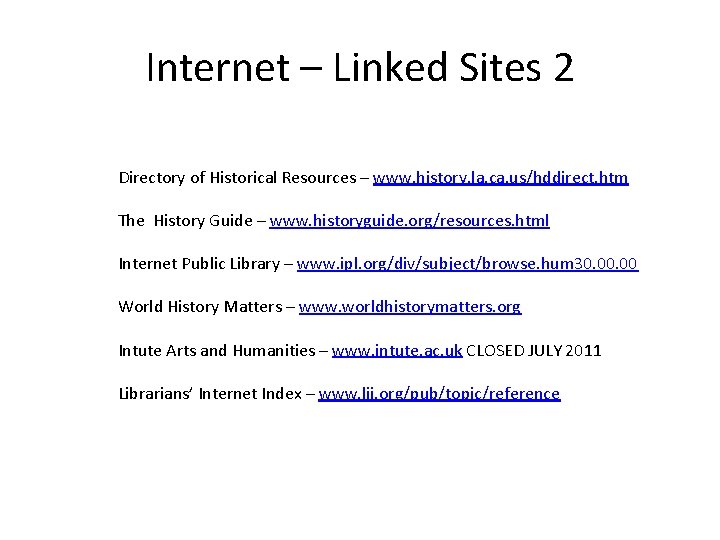
Internet – Linked Sites 2 Directory of Historical Resources – www. history. la. ca. us/hddirect. htm The History Guide – www. historyguide. org/resources. html Internet Public Library – www. ipl. org/div/subject/browse. hum 30. 00 World History Matters – www. worldhistorymatters. org Intute Arts and Humanities – www. intute. ac. uk CLOSED JULY 2011 Librarians’ Internet Index – www. lii. org/pub/topic/reference
Internet – Document Archives On these sites, specific historical texts (books, articles, primary docs) are available. Online access to them is free, but you may have to pay to download information Eurodocs (primary historical documents) – http: //library. byu. edu/~rdh/eurodocs World War One Document Archive – www. lib. byu. edu/~rdh/wwi
Interviews Primary source which may lead to interesting essay – they stand out as being original Before the interview you should: Explain the scope of your research Prepare a list of questions for your subject – make them open ended Get your history teacher to REVIEW it! Write and make an appointment and allow sufficient time for the subject to give a considered reply Probe further if you get an answer that leads in the direction of important material Let your subject know how your research progressed and thank them NB – you MUST get your subject’s consent to record your interview
Local History Societies Archives/Associations/Museums Great resource staffed with knowledgeable and enthusiastic historians who are more than willing to help you What is the name of your local History Society? eg Maynooth Local History; Cork Historical & Archaeological Society; County Tipperary Historical Society The National Archive is at Bishop St. , Dublin; The Military Archive, is at Cathal Brugha Barracks, Dublin; Linen Hall Library is in Belfast; National Photographic Archive; archives held at universities – are you aware of any archive near you? Local Museum eg Famine Museum in Roscommon ; Museum of Country Life in Mayo; Irish Jewish Museum in Dublin
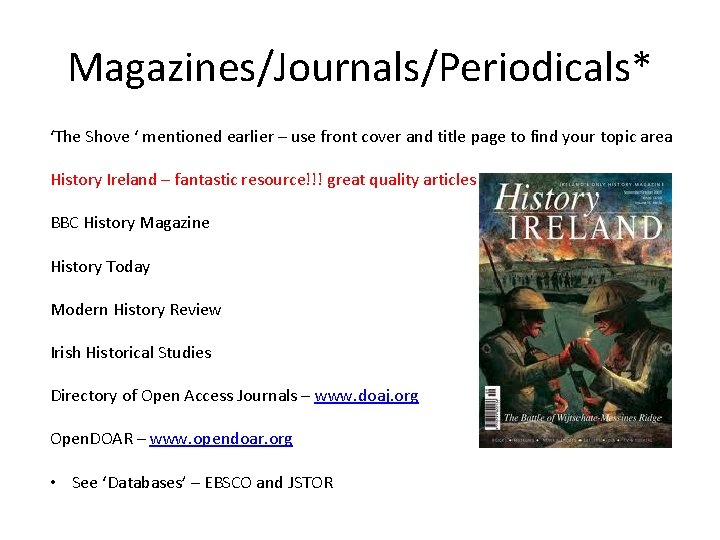
Magazines/Journals/Periodicals* ‘The Shove ‘ mentioned earlier – use front cover and title page to find your topic area History Ireland – fantastic resource!!! great quality articles BBC History Magazine History Today Modern History Review Irish Historical Studies Directory of Open Access Journals – www. doaj. org Open. DOAR – www. opendoar. org • See ‘Databases’ – EBSCO and JSTOR
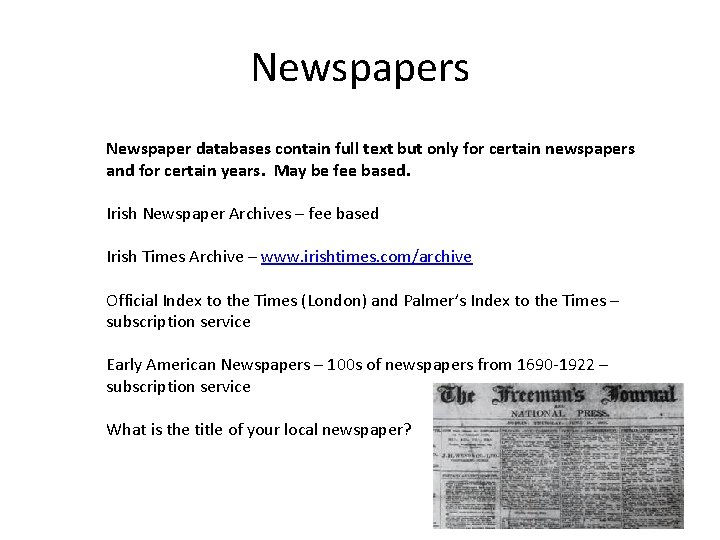
Newspapers Newspaper databases contain full text but only for certain newspapers and for certain years. May be fee based. Irish Newspaper Archives – fee based Irish Times Archive – www. irishtimes. com/archive Official Index to the Times (London) and Palmer’s Index to the Times – subscription service Early American Newspapers – 100 s of newspapers from 1690 -1922 – subscription service What is the title of your local newspaper?
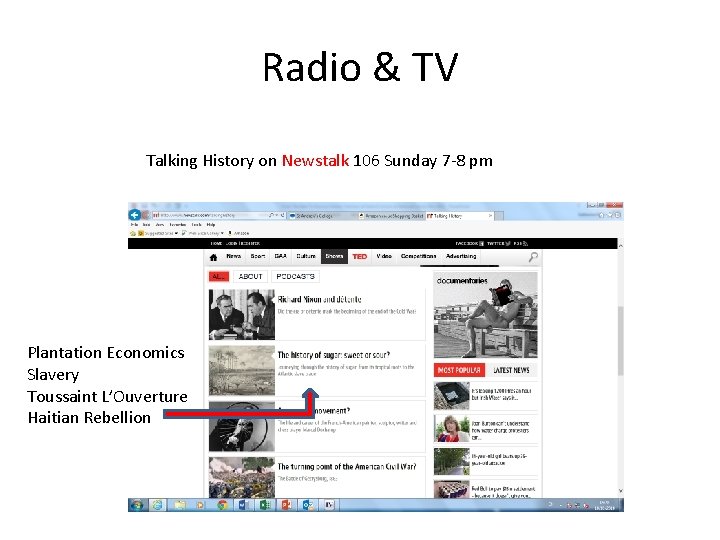
Radio & TV Talking History on Newstalk 106 Sunday 7 -8 pm Plantation Economics Slavery Toussaint L’Ouverture Haitian Rebellion
Remember …. The sources previously listed are just a snapshot of what is available to you No one source is ‘better’ than the other Source selected should be appropriate to the RQ you wish to answer
How To Read For Argument Observation – students read passively Read purposefully - what answers are you seeking from your reading/research? Make efficient use of your time – skim/scan. Where’s the main idea? What’s really relevant to your research? Use the index. Be ruthless!! Evaluate and be critical of the arguments presented in the texts you read – what are they? List them - are they consistent or contradictory? - are they relevant (even if you don’t agree with them)? - is there bias (political, religious, ideological)? - are the underlying assumptions valid? - are conclusions supported by evidence eg statistics Again, look at my blog http: //librarysac. wordpress. com
Use Your Evidence (Sources) “Remember your purpose is to convince the reader (Examiner) that the conclusions you draw regarding the research question are well founded and are supported by the evidence you have gathered and presented. So clearly, research question, data, evidence and/or information must be linked in a convincing way to the conclusion”. You must do the “linking” and not leave it up to the examiner to “see” the connections or relevance of what you have written” Source: O’Farrell, Finbar. Extended Essay p 59
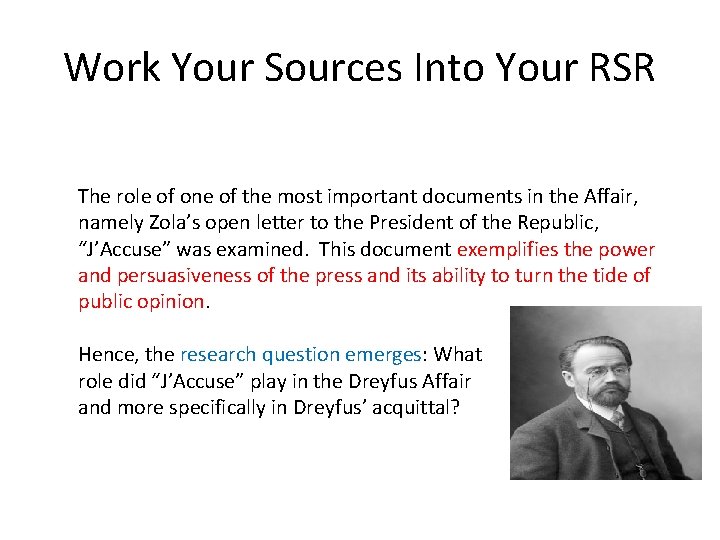
Work Your Sources Into Your RSR The role of one of the most important documents in the Affair, namely Zola’s open letter to the President of the Republic, “J’Accuse” was examined. This document exemplifies the power and persuasiveness of the press and its ability to turn the tide of public opinion. Hence, the research question emerges: What role did “J’Accuse” play in the Dreyfus Affair and more specifically in Dreyfus’ acquittal?
SAC Library Blog http: //librarysac. wordpress. com History Page How To Research page Evaluation of Websites Reading Should Have A Purpose Research help
kryan@st-Andrews. ie