The Geo Histo Gram Introduction The Geo Histo


- Slides: 30
The Geo. Histo. Gram Introduction The Geo. Histo. Gram shows both time (chronology) and place (region)) 1
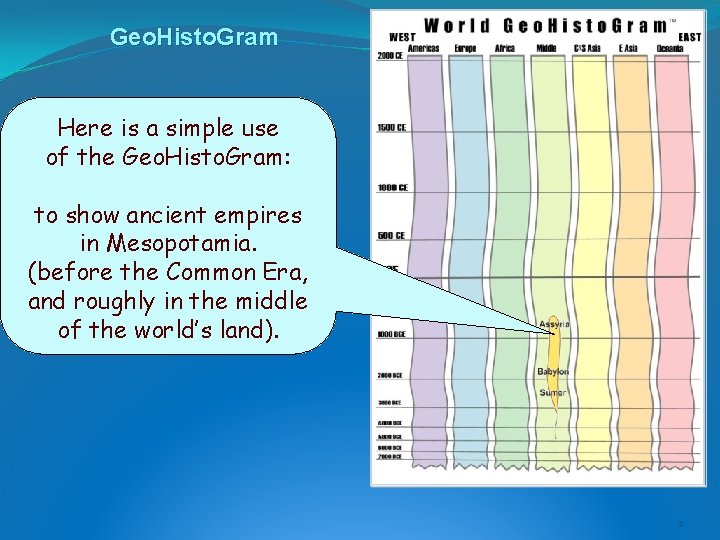
Geo. Histo. Gram Here is a simple use of the Geo. Histo. Gram: to show ancient empires in Mesopotamia. (before the Common Era, and roughly in the middle of the world’s land). 2
Geo. Histo. Gram By varying the width of the empire “blob”, you can show its power expanded at different times. 3
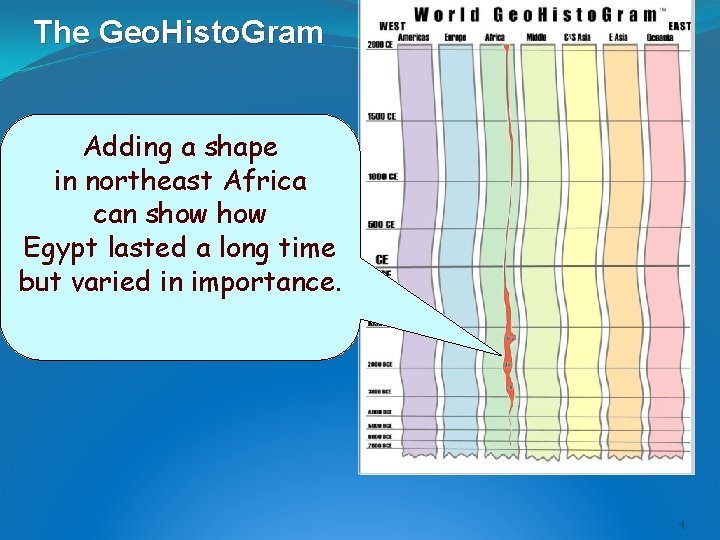
The Geo. Histo. Gram Adding a shape in northeast Africa can show Egypt lasted a long time but varied in importance. 4
Activity 2: The Geo. Histo. Gram Era* Activity *Era: a period of time 5
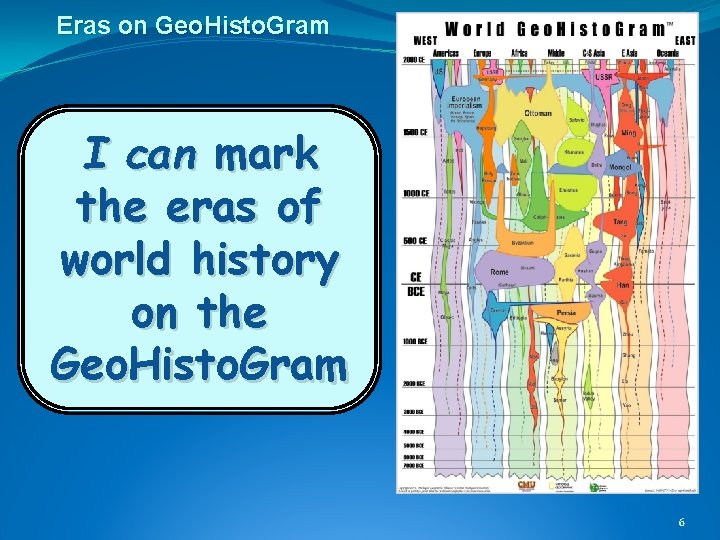
Eras on Geo. Histo. Gram I can mark the eras of world history on the Geo. Histo. Gram 6
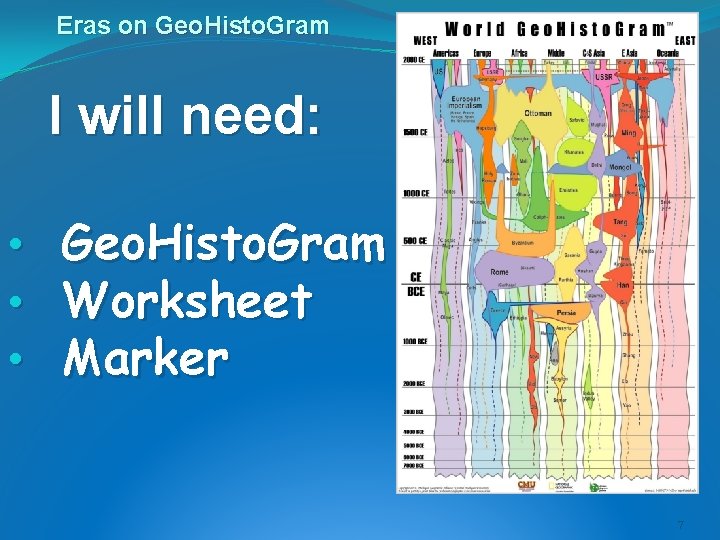
Eras on Geo. Histo. Gram I will need: • • • Geo. Histo. Gram Worksheet Marker 7
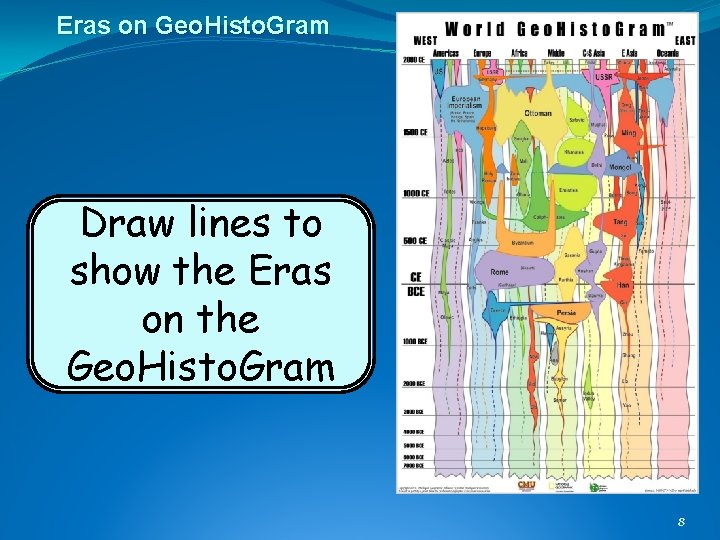
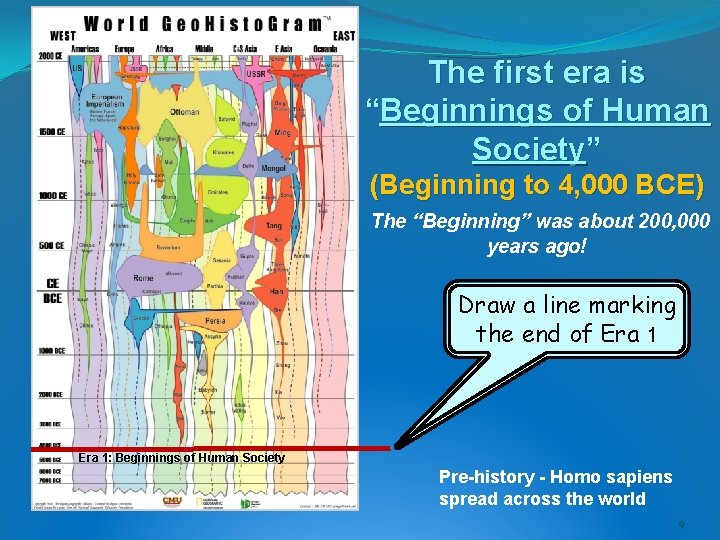
Eras on Geo. Histo. Gram Draw lines to show the Eras on the Geo. Histo. Gram 8
The first era is “Beginnings of Human Society” (Beginning to 4, 000 BCE) The “Beginning” was about 200, 000 years ago! Draw a line marking the end of Era 1: Beginnings of Human Society Pre-history - Homo sapiens spread across the world 9
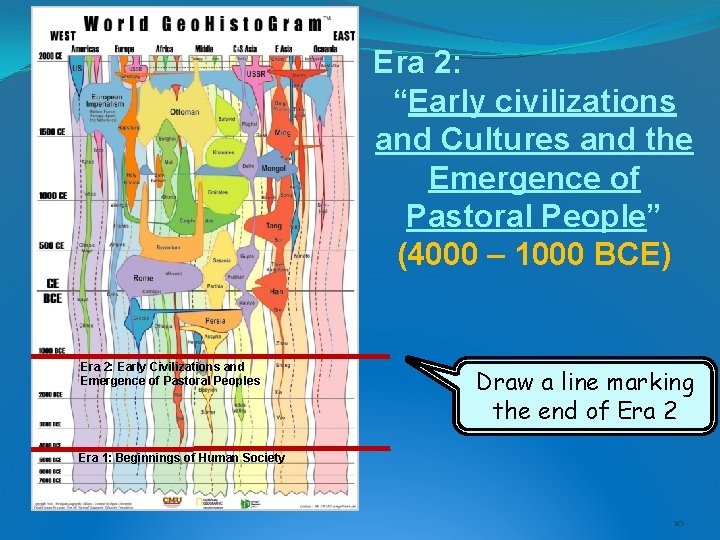
Era 2: “Early civilizations and Cultures and the Emergence of Pastoral People” (4000 – 1000 BCE) Era 2: Early Civilizations and Emergence of Pastoral Peoples Draw a line marking the end of Era 2 Era 1: Beginnings of Human Society 10
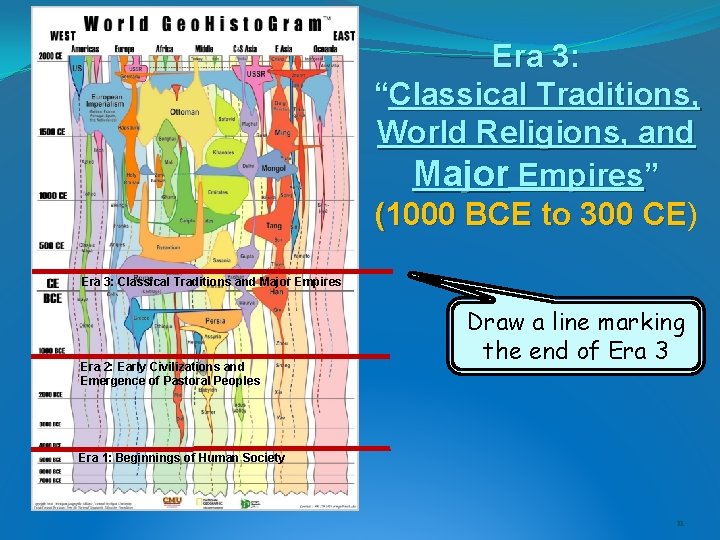
Era 3: “Classical Traditions, World Religions, and Major Empires” (1000 BCE to 300 CE) CE Era 3: Classical Traditions and Major Empires Era 2: Early Civilizations and Emergence of Pastoral Peoples Draw a line marking the end of Era 3 Era 1: Beginnings of Human Society 11
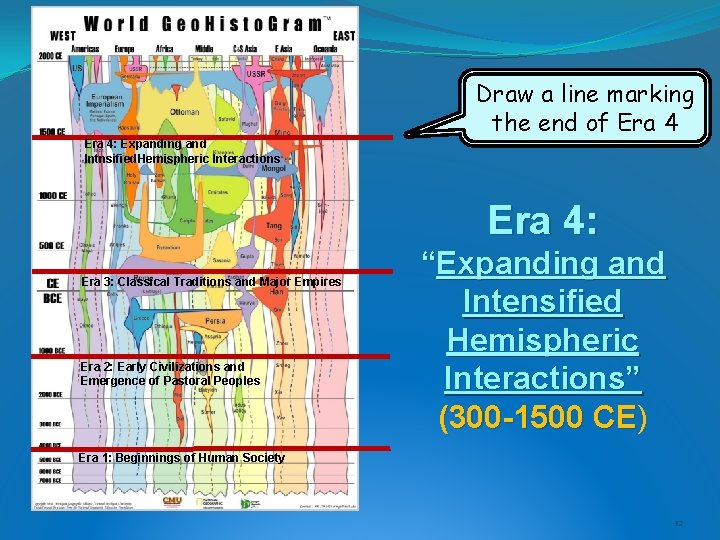
Era 4: Expanding and Intnsified. Hemispheric Interactions Draw a line marking the end of Era 4: Era 3: Classical Traditions and Major Empires Era 2: Early Civilizations and Emergence of Pastoral Peoples “Expanding and Intensified Hemispheric Interactions” (300 -1500 CE) CE Era 1: Beginnings of Human Society 12
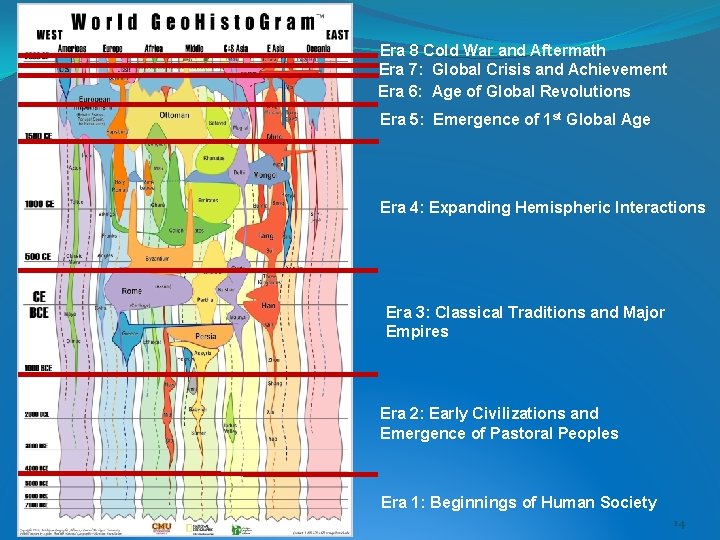
Geo. Histo. Gram Activities Marking the rest of the eras will give you an overview of world history. 13
Era 8 Cold War and Aftermath Era 7: Global Crisis and Achievement Era 6: Age of Global Revolutions Era 5: Emergence of 1 st Global Age Era 4: Expanding Hemispheric Interactions Era 3: Classical Traditions and Major Empires Era 2: Early Civilizations and Emergence of Pastoral Peoples Era 1: Beginnings of Human Society 14
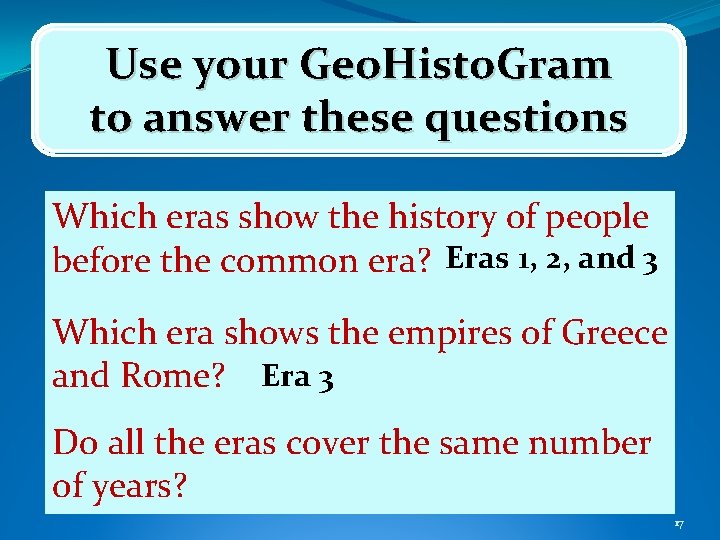
Use your Geo. Histo. Gram to answer these questions Which eras show the history of people before the common era? Which era shows the empires of Greece and Rome? Do all the eras cover the same number of years? 15
Use your Geo. Histo. Gram to answer these questions Which eras show the history of people before the common era? Eras 1, 2, and 3 Which era shows the empires of Greece and Rome? Do all the eras cover the same number of years? 16
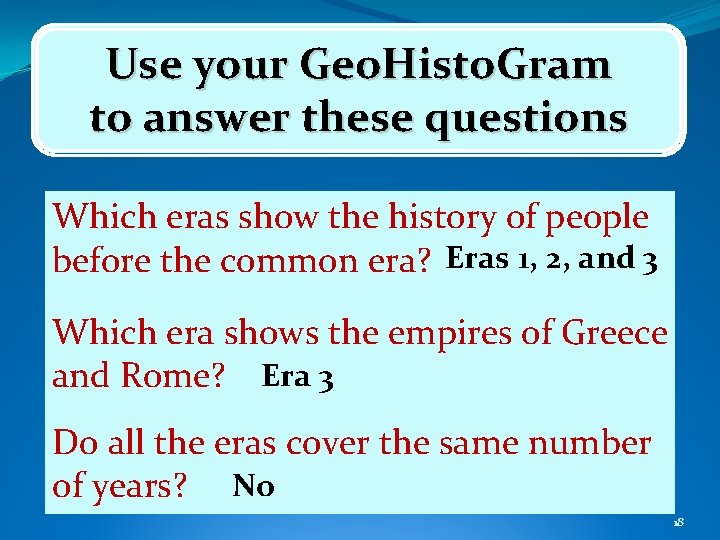
Use your Geo. Histo. Gram to answer these questions Which eras show the history of people before the common era? Eras 1, 2, and 3 Which era shows the empires of Greece and Rome? Era 3 Do all the eras cover the same number of years? 17
Use your Geo. Histo. Gram to answer these questions Which eras show the history of people before the common era? Eras 1, 2, and 3 Which era shows the empires of Greece and Rome? Era 3 Do all the eras cover the same number of years? No 18
Post Activity Discussion After completing the worksheet for Eras in World History, (start at the bottom of the page) use your answers to discuss these questions. 19
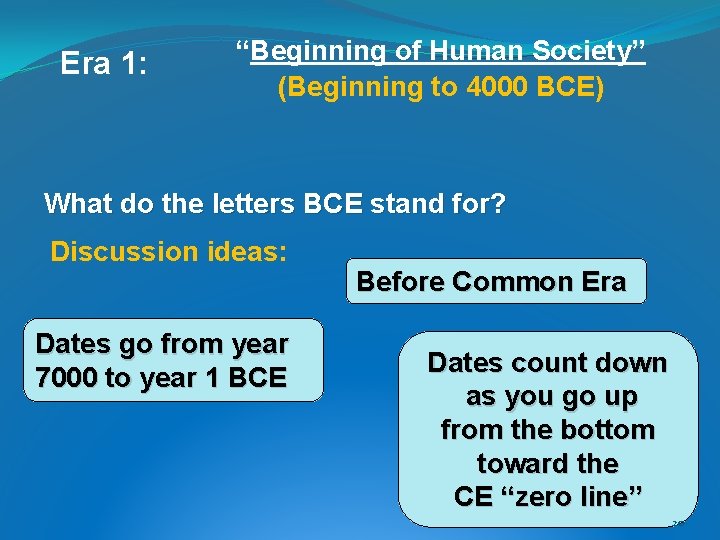
Era 1: “Beginning of Human Society” (Beginning to 4000 BCE) What do the letters BCE stand for? Discussion ideas: Dates go from year 7000 to year 1 BCE Before Common Era Dates count down as you go up from the bottom toward the CE “zero line” 20
Era 1: “Beginning of Human Society” (Beginning to 4000 BCE) Why do you think the Geo. Histo. Gram starts with the year 7000 BCE? Discussion ideas: Few settlements before that time. There is not much written evidence about people before that time. 21
Era 2: “Earlycivilizations and Cultures and the Emergence of Pastoral People” (4000 to 1000 BCE) In what regions did early civilizations begin during this era? East Africa Discussion ideas: (old, mid, late) South Asia (Indus Valley) Middle (Sumer, Babylon, Hittite) 22
Era 2: “Earlycivilizations and Cultures and the Emergence of Pastoral People” (4000 to 1000 BCE) Why are the numbers on the Geo. Histo. Gram getting smaller during these first eras? ? Discussion ideas: Early history is recorded as the number of years before the common era (year 1). For example, the ‘mid’ civilization in what is now Egypt expanded about 2000 years before the year 1 in today’s calendar. 23
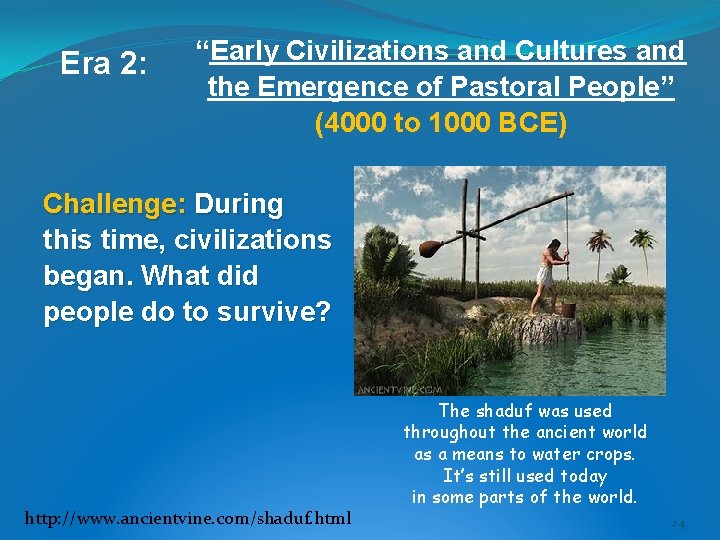
Era 2: “Early Civilizations and Cultures and the Emergence of Pastoral People” (4000 to 1000 BCE) Challenge: During this time, civilizations began. What did people do to survive? http: //www. ancientvine. com/shaduf. html The shaduf was used throughout the ancient world as a means to water crops. It’s still used today in some parts of the world. 24
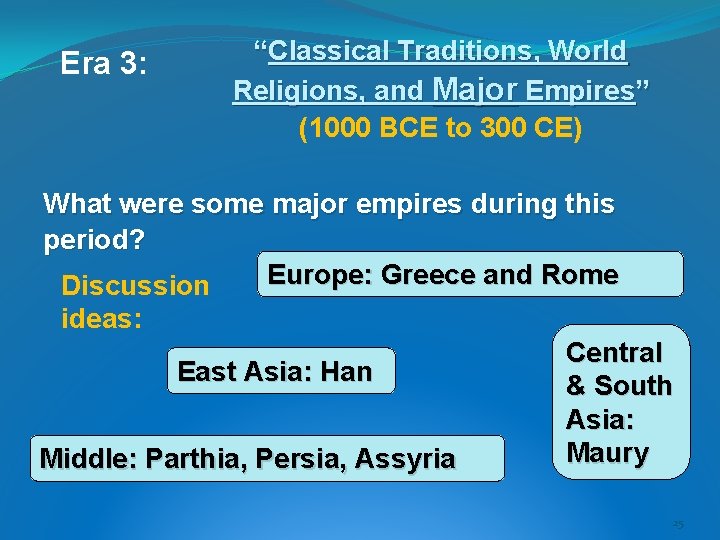
Era 3: “Classical Traditions, World Religions, and Major Empires” (1000 BCE to 300 CE) What were some major empires during this period? Europe: Greece and Rome Discussion ideas: East Asia: Han Middle: Parthia, Persia, Assyria Central & South Asia: Maury 25
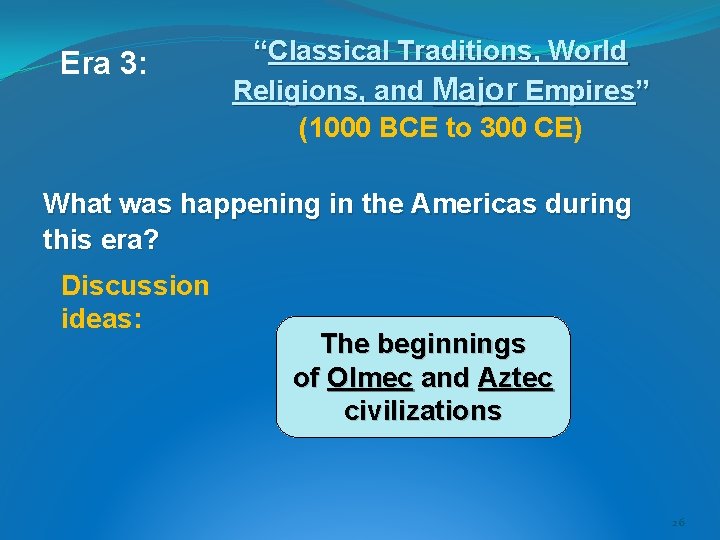
Era 3: “Classical Traditions, World Religions, and Major Empires” (1000 BCE to 300 CE) What was happening in the Americas during this era? Discussion ideas: The beginnings of Olmec and Aztec civilizations 26
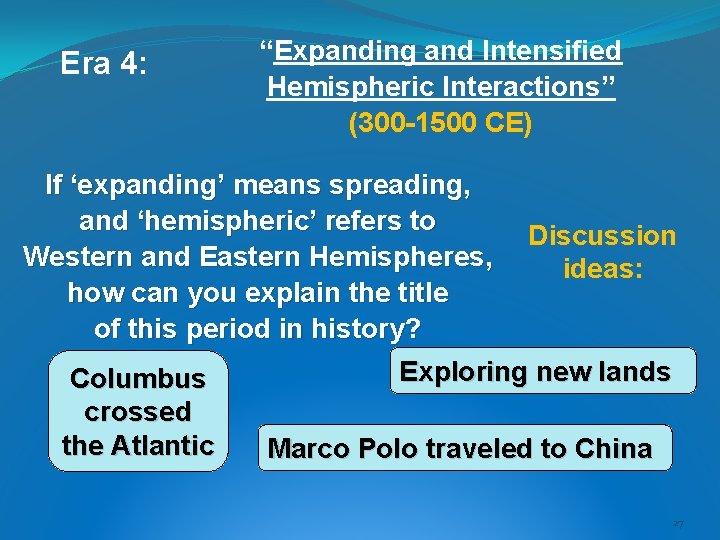
Era 4: “Expanding and Intensified Hemispheric Interactions” (300 -1500 CE) If ‘expanding’ means spreading, and ‘hemispheric’ refers to Discussion Western and Eastern Hemispheres, ideas: how can you explain the title of this period in history? Exploring new lands Columbus crossed the Atlantic Marco Polo traveled to China 27
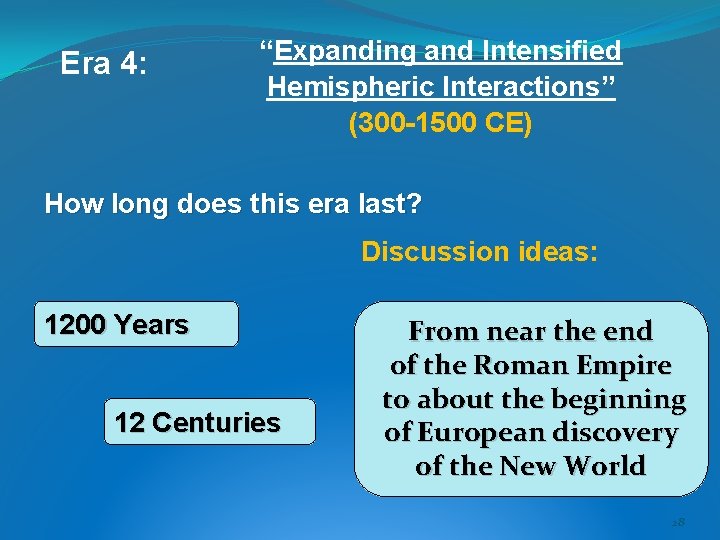
Era 4: “Expanding and Intensified Hemispheric Interactions” (300 -1500 CE) How long does this era last? Discussion ideas: 1200 Years 12 Centuries From near the end of the Roman Empire to about the beginning of European discovery of the New World 28
Era 4: “Expanding and Intensified Hemispheric Interactions” (300 -1500 CE) Why do you think there was less expansion in the Americas and Oceana? Discussion ideas: Fewer People Later migrations 29
Copyright 2017, Michigan Geographic Alliance Teachers who download this presentation from our internet site have permission to make a copy on their own computers for these purposes: 1. to show the presentation in their own classrooms or to colleagues or at teacher conferences (with attribution). 2. to modify it or use individual frames (with attribution) in their own class or conference presentations. For permission for any other use, including posting frames on a personal blog or uploading to any network or website, contact mga@cmich. edu 30