Socrates Goes to the Woods Including Philosophy and


- Slides: 31
Socrates Goes to the Woods: Including Philosophy and Ethics in the Fisheries and Wildlife Curriculum Kelly F. Millenbah 1 and Michael P. Nelson 1, 2, 3 1 Department of Fisheries and Wildlife 2 Lyman Briggs College 3 Department of Philosophy MICHIGAN STATE UNIVERSITY
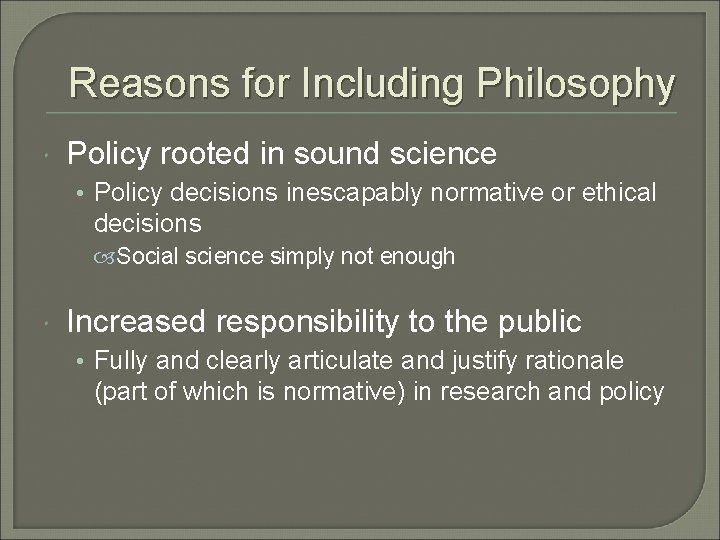
Reasons for Including Philosophy Policy rooted in sound science • Policy decisions inescapably normative or ethical decisions Social science simply not enough Increased responsibility to the public • Fully and clearly articulate and justify rationale (part of which is normative) in research and policy
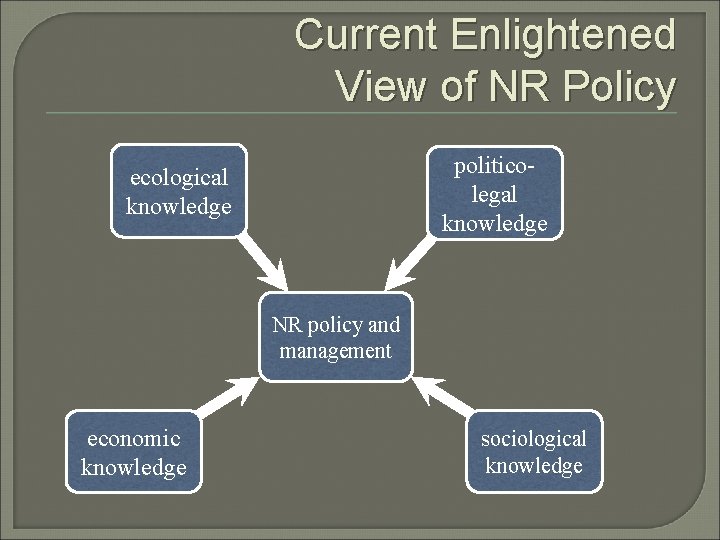
Current Enlightened View of NR Policy politicolegal knowledge ecological knowledge NR policy and management economic knowledge sociological knowledge
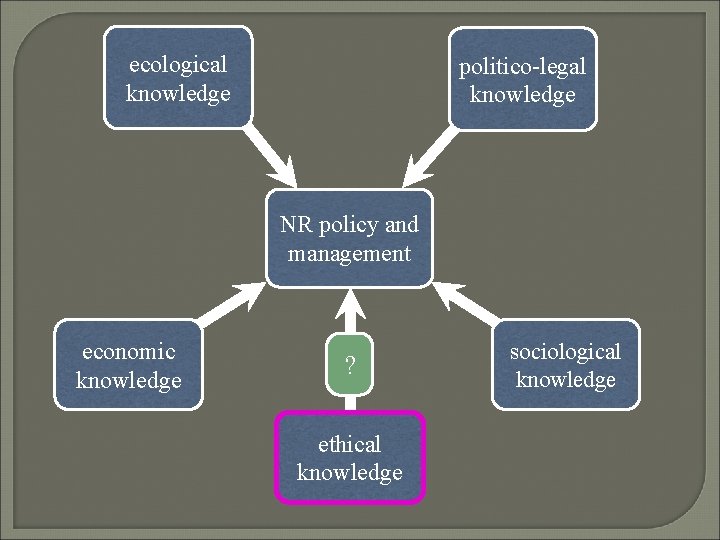
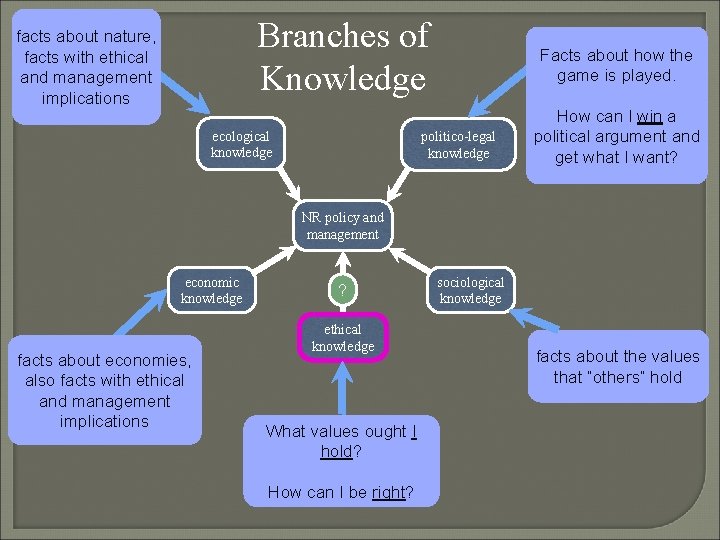
ecological knowledge politico-legal knowledge NR policy and management economic knowledge ? ethical knowledge sociological knowledge
Branches of Knowledge facts about nature, facts with ethical and management implications ecological knowledge Facts about how the game is played. politico-legal knowledge How can I win a political argument and get what I want? NR policy and management economic knowledge facts about economies, also facts with ethical and management implications ? ethical knowledge What values ought I hold? How can I be right? sociological knowledge facts about the values that “others” hold
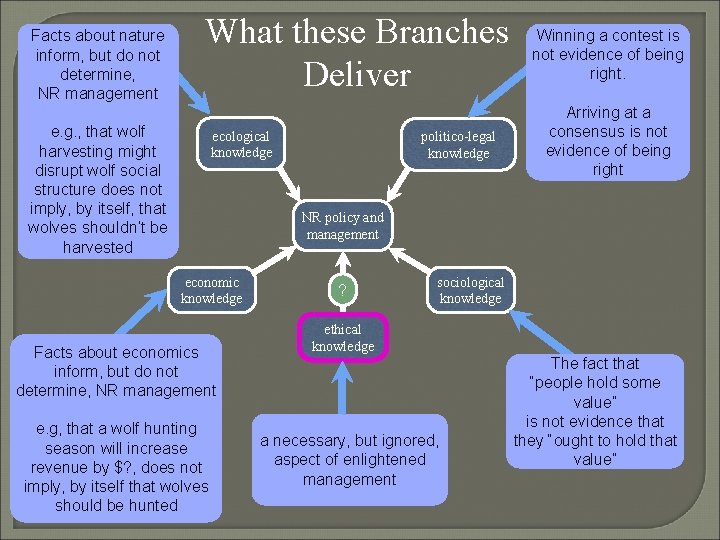
Facts about nature inform, but do not determine, NR management What these Branches Deliver e. g. , that wolf harvesting might disrupt wolf social structure does not imply, by itself, that wolves shouldn’t be harvested ecological knowledge politico-legal knowledge Winning a contest is not evidence of being right. Arriving at a consensus is not evidence of being right NR policy and management economic knowledge Facts about economics inform, but do not determine, NR management e. g, that a wolf hunting season will increase revenue by $? , does not imply, by itself that wolves should be hunted ? sociological knowledge ethical knowledge a necessary, but ignored, aspect of enlightened management The fact that “people hold some value” is not evidence that they “ought to hold that value”
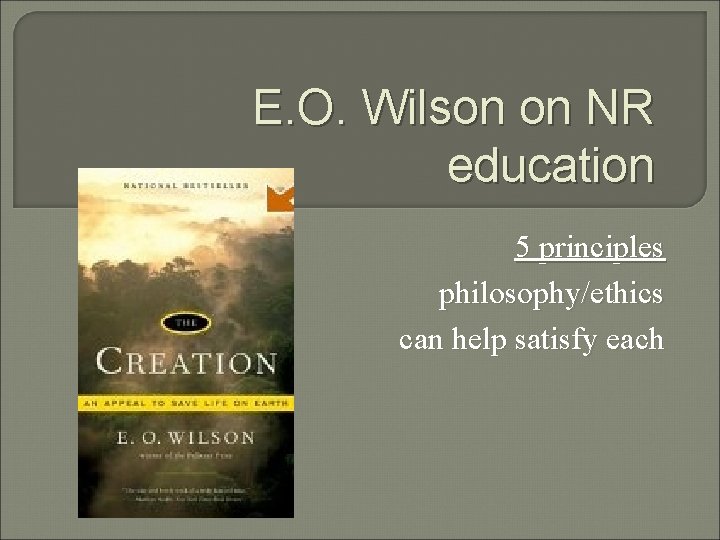
E. O. Wilson on NR education 5 principles philosophy/ethics can help satisfy each
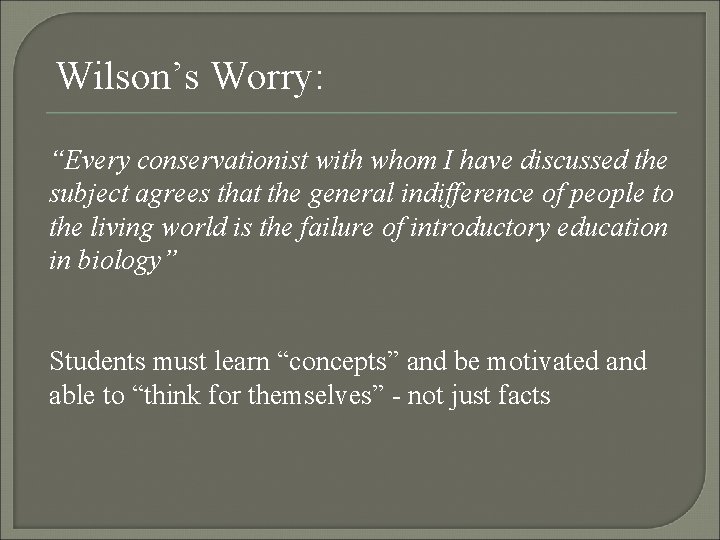
Wilson’s Worry: “Every conservationist with whom I have discussed the subject agrees that the general indifference of people to the living world is the failure of introductory education in biology” Students must learn “concepts” and be motivated and able to “think for themselves” - not just facts
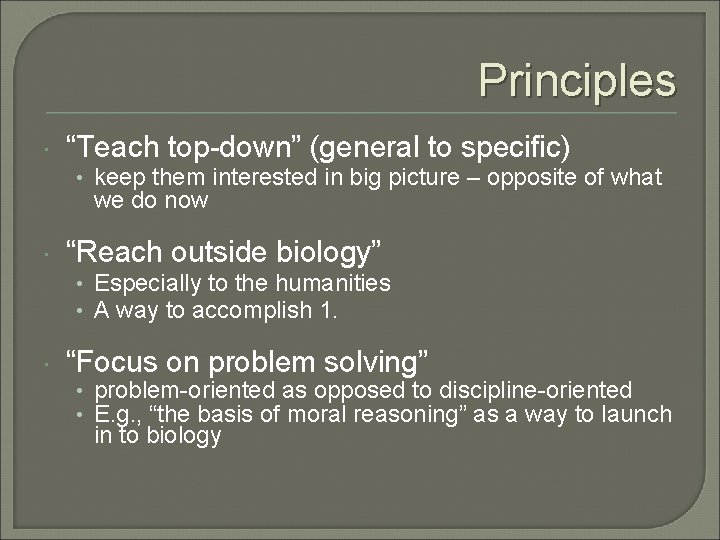
Principles “Teach top-down” (general to specific) • keep them interested in big picture – opposite of what we do now “Reach outside biology” • Especially to the humanities • A way to accomplish 1. “Focus on problem solving” • problem-oriented as opposed to discipline-oriented • E. g. , “the basis of moral reasoning” as a way to launch in to biology
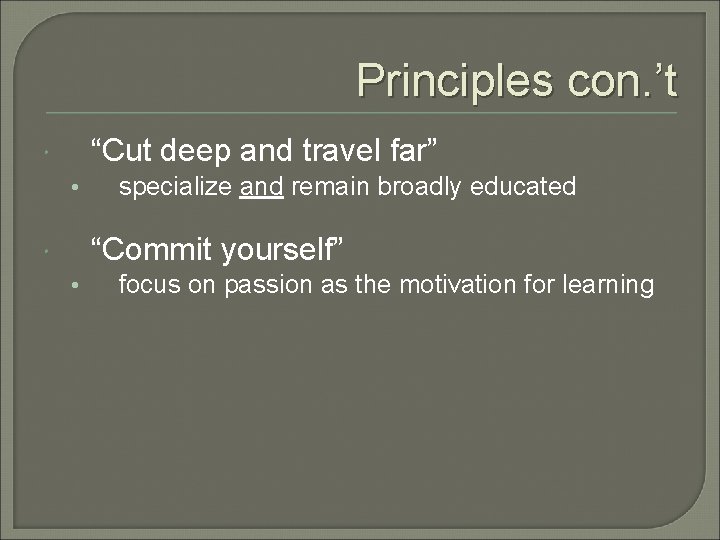
Principles con. ’t “Cut deep and travel far” • specialize and remain broadly educated “Commit yourself” • focus on passion as the motivation for learning
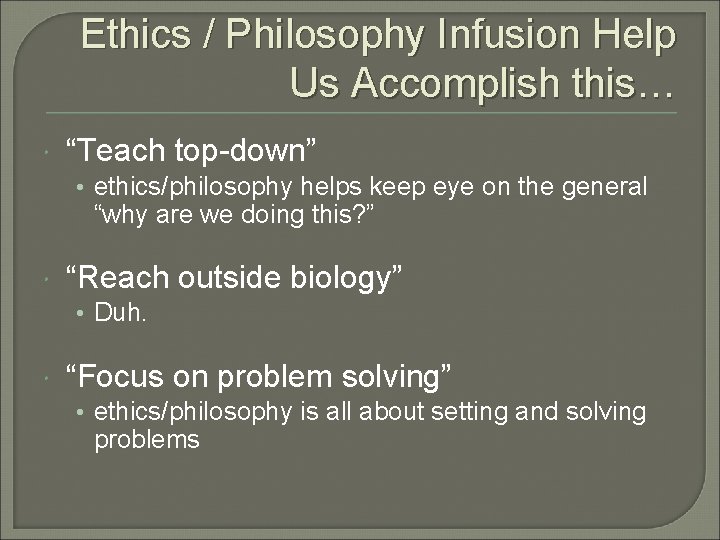
Ethics / Philosophy Infusion Help Us Accomplish this… “Teach top-down” • ethics/philosophy helps keep eye on the general “why are we doing this? ” “Reach outside biology” • Duh. “Focus on problem solving” • ethics/philosophy is all about setting and solving problems
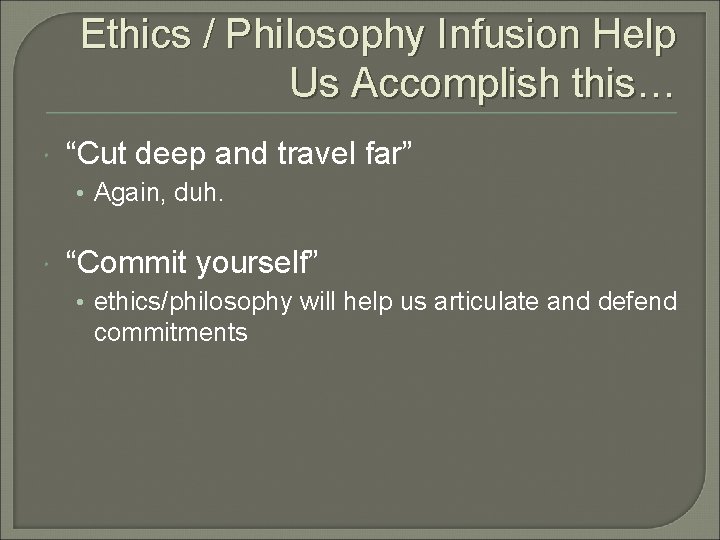
Ethics / Philosophy Infusion Help Us Accomplish this… “Cut deep and travel far” • Again, duh. “Commit yourself” • ethics/philosophy will help us articulate and defend commitments
Great idea, but how do you get it into a curriculum? A typical Curriculum meeting! You revise your current curriculum!!!
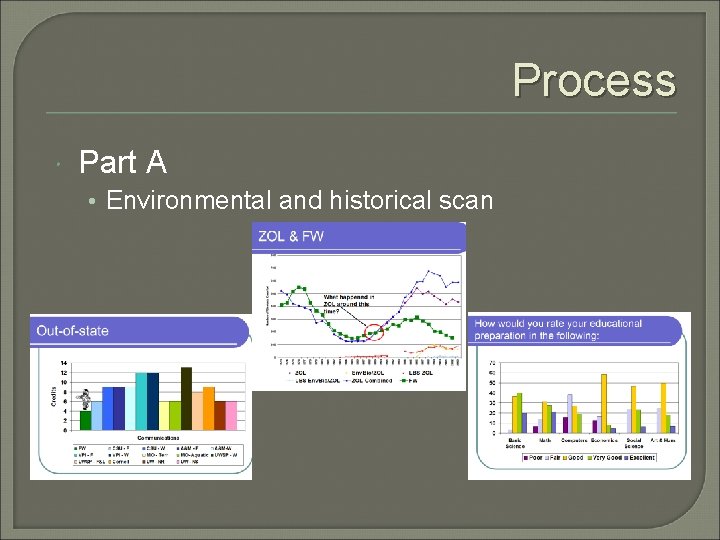
Process Part A • Environmental and historical scan
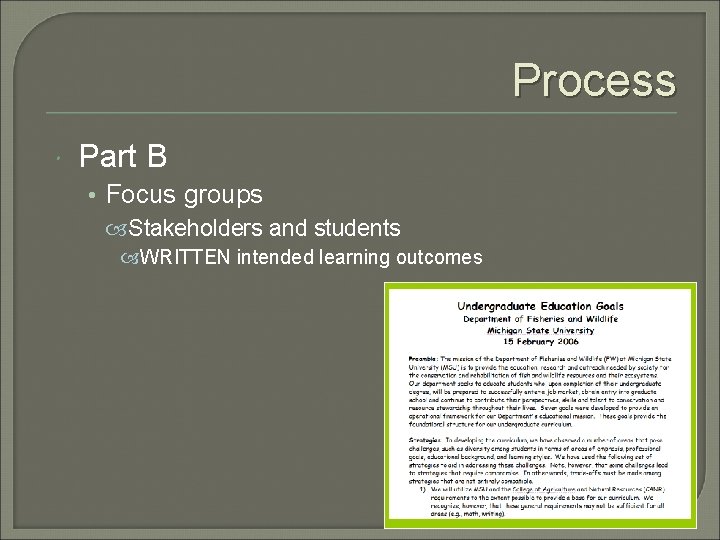
Process Part B • Focus groups Stakeholders and students WRITTEN intended learning outcomes
Guiding Principles Apply knowledge of complex socio-ecological systems Communicate with a diversity of audiences Understand the range of social values and philosophies that can be applied to natural resource management Value science as a basis for problem solving Think quantitatively and apply quantitative tools Understand a suite of field, laboratory, and computer-based techniques
Goal 2 Students will understand the range of social values and philosophies that can be applied to natural resource management and possess a professional perspective that recognizes and integrates this range of philosophies into a science-based approach to management.
Next Slide has a lot of text …don’t worry!
Rationale Our pluralistic society presents a complex of values and philosophies that can be applied to natural resource management at different levels; often these applications conflict. For example, animal welfare and rights philosophies that are applied to the organismal level often conflict with conservation and even preservation philosophies of population or ecosystem management. The strong traditional role of utilitarian values in the conservation philosophy of our professions often conflicts with preservation philosophy, even though the potential exists to effectively integrate them in many instances. Our students should understand conservationist and preservationist philosophies and be motivated to implement a balanced resource management approach when appropriate. They must be knowledgeable of animal welfare and animal rights philosophies and the difficulties in applying such philosophies to wildlife populations versus individual animals. Students should understand these and other philosophies and accommodate them where they do not interfere with the priority to manage ecological systems.
Outcomes - Cognitive Meaning and distribution of a range of philosophies that have implications for natural resource management for scales ranging from local to global. Range of values that are applied to natural resources through a variety of wildlife-based recreation methods. Emergence and roles of a utilitarian-based conservation philosophy and preservation philosophy in American society as they relate to the fisheries and wildlife profession. Important differences in the nature of animal welfare and animal rights views and associated values, and the implications of each in fisheries and wildlife management issues. Ways in which the student’s own natural resource values, use and management influence his/her natural resource management style. Their own philosophy of natural resource values, use and management.
Outcomes - Skills Ability to analyze natural resource issues and accurately identify the role played by key values and philosophies in those issues. Ability to express and defend their philosophy of natural resource values, use and management. Ability to find evidence of and track trends regarding the development of key values and philosophies in society that will have implications on their own resource management efforts.
Outcomes - Affective Students will understand appreciate the full range of philosophies and values (e. g. , utilitarian, preservationist, animal welfare, animal rights) and be motivated to implement a balanced natural resource management approach. Students will understand have an appreciation for nature-based recreation.
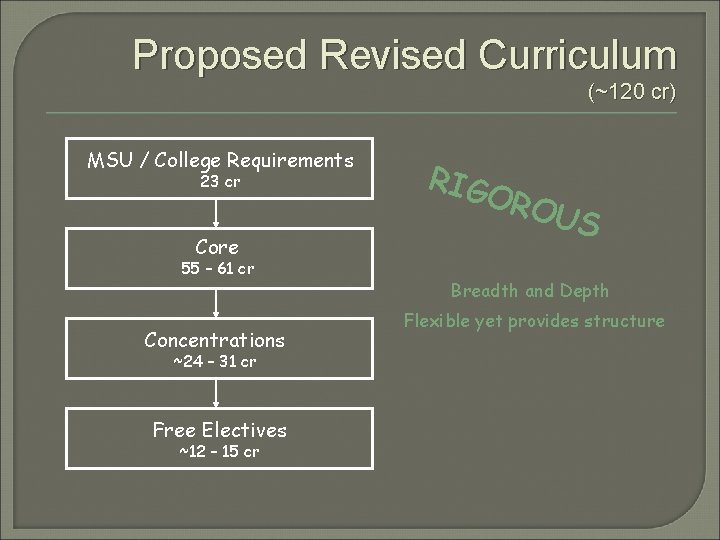
Proposed Revised Curriculum (~120 cr) MSU / College Requirements 23 cr Core 55 – 61 cr Concentrations ~24 – 31 cr Free Electives ~12 – 15 cr RIG ORO U S Breadth and Depth Flexible yet provides structure
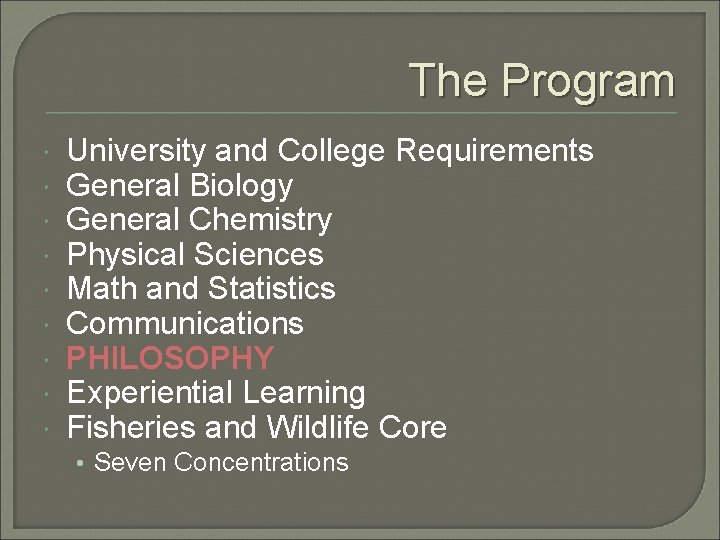
The Program University and College Requirements General Biology General Chemistry Physical Sciences Math and Statistics Communications PHILOSOPHY Experiential Learning Fisheries and Wildlife Core • Seven Concentrations
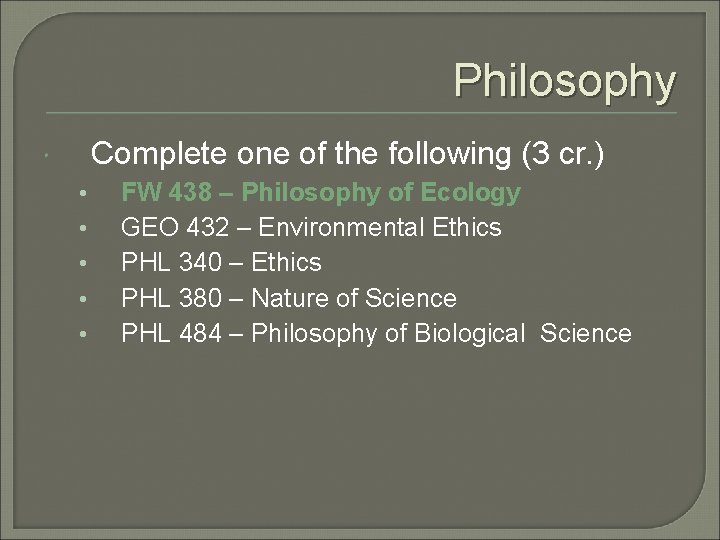
Philosophy Complete one of the following (3 cr. ) • • • FW 438 – Philosophy of Ecology GEO 432 – Environmental Ethics PHL 340 – Ethics PHL 380 – Nature of Science PHL 484 – Philosophy of Biological Science
Things we have learned since… Application to policy!!! FW P OLI CY
But there was something missing Who would teach? Creating a job description • Cross listed with two science based units
Challenges Who would come into science and teach and “do” research on philosophy? Internal conflicts with “this kind of person” Are we really speaking the same language here?
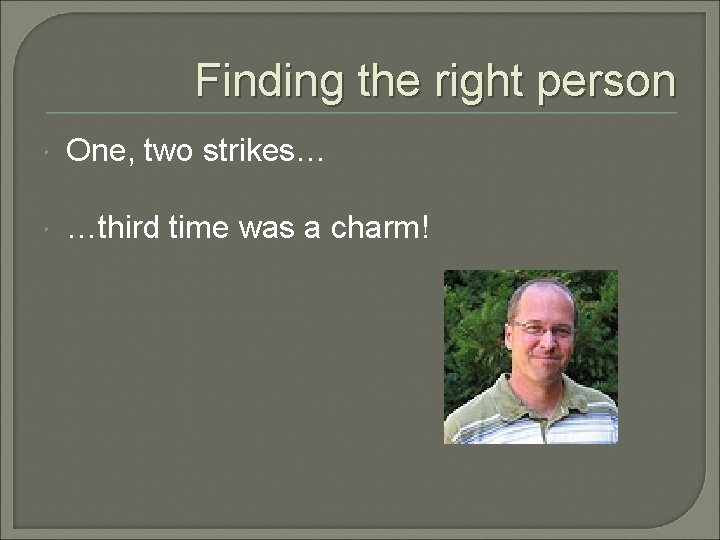
Finding the right person One, two strikes… …third time was a charm!
The pendulum is swinging! Possible new directions for ethics and philosophy in FW • Working to infuse philosophy/ethics into other parts of the curriculum • Facilitating double-majors that will deliver philosophy/ethics, policy • Working to create and fund projects (and graduate students) between the traditional FW faculty and areas and the new philosophy/ethics faculty
Possible new directions for ethics and philosophy in FW • Allowing/encouraging graduate students to include an ethics section in their thesis/diss. • Encouraging graduate students to work on philosophy/ethics topics within FW • Include philosophy/ethics topics in colloquia