Social Cognition and Moral Development 2015 Cengage Learning


- Slides: 55
Social Cognition and Moral Development © 2015. Cengage Learning. All rights reserved.
13. 1 Social Cognition • Learning Objectives – Define social cognition and explain the meaning and significance of having a theory of mind – Summarize key steps in the development of a theory of mind and the contributions of nature and nurture to this development – Describe developments in trait perception and perspective taking and explain why social cognitive skills hold up well in later life © 2015. Cengage Learning. All rights reserved.
Social Cognition • Social cognition – Thinking about the perceptions, thoughts, emotions, motives, and behaviors of self, other people, groups, and even whole social systems – Ability to understand human psychology, describe other people, and adopt other people’s perspectives © 2015. Cengage Learning. All rights reserved.
Developing a Theory of Mind • A false belief task assesses the understanding that: – People can hold incorrect beliefs – These beliefs, even though incorrect, can influence their behavior • Theory of mind – Understanding that people have mental states such as desires, beliefs, and intentions and that these mental states guide their behavior © 2015. Cengage Learning. All rights reserved.
Developing a Theory of Mind • Eighty-five percent of 4 -year-olds passed the false belief task • Eighty percent of the children with autism failed • Children with autism may display social deficits because they lack a theory of mind – Have “mind blindness” © 2015. Cengage Learning. All rights reserved.
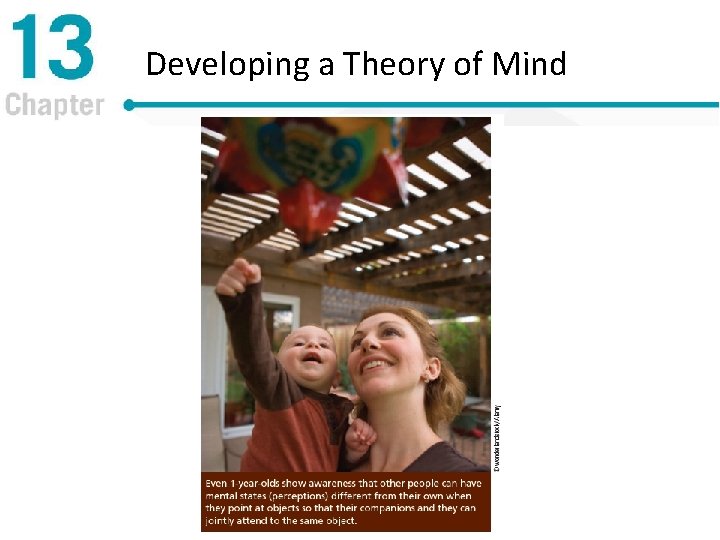
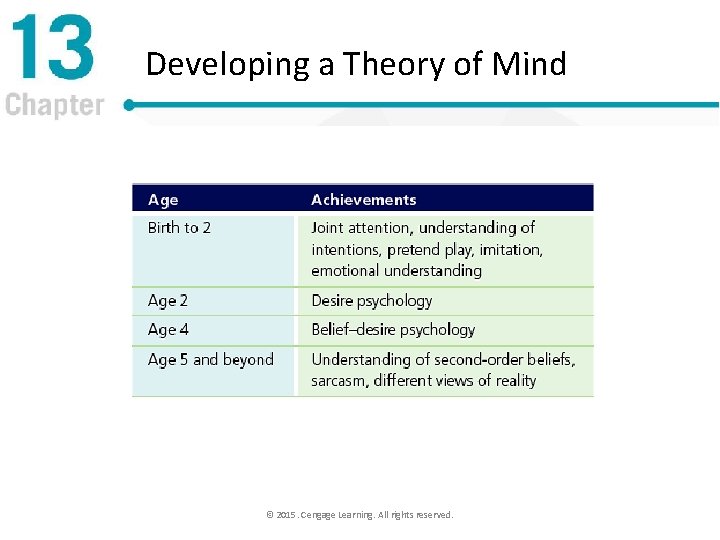
Developing a Theory of Mind • Abilities considered important early steps in developing a theory of mind – Joint attention – Understanding intentions – Pretend play – Imitation – Emotional understanding © 2015. Cengage Learning. All rights reserved.
Developing a Theory of Mind © 2015. Cengage Learning. All rights reserved.
Developing a Theory of Mind • Wellman proposed children’s theory of mind develops in two phases – Desire psychology – Belief-desire psychology • Late elementary school – Children grasp that different minds construct different views of reality – Their interpretations of events are influenced by these views © 2015. Cengage Learning. All rights reserved.
Developing a Theory of Mind • Chimpanzees, gorillas, and other great apes share with humans some basic theory-of-mind skills • Developing a theory of mind requires a certain level of neurological and cognitive maturation • Mirror neurons involved in theory of mind – Neurons that are activated both when we perform an action and when we observe someone else perform the same action © 2015. Cengage Learning. All rights reserved.
Developing a Theory of Mind © 2015. Cengage Learning. All rights reserved.
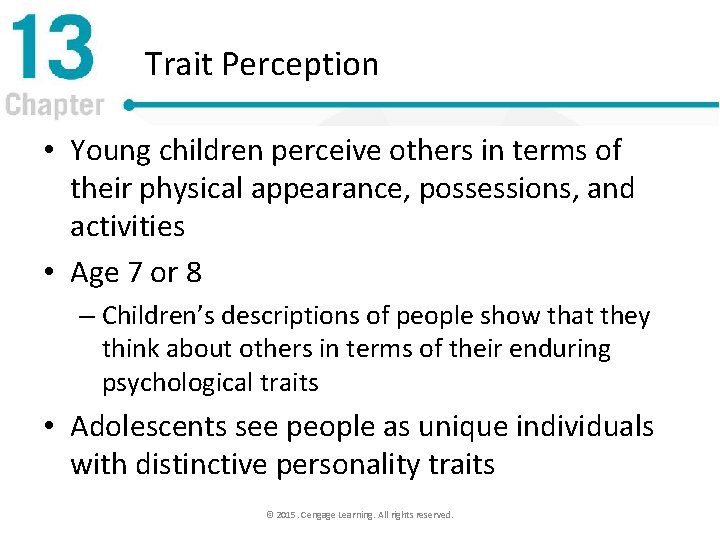
Trait Perception • Young children perceive others in terms of their physical appearance, possessions, and activities • Age 7 or 8 – Children’s descriptions of people show that they think about others in terms of their enduring psychological traits • Adolescents see people as unique individuals with distinctive personality traits © 2015. Cengage Learning. All rights reserved.
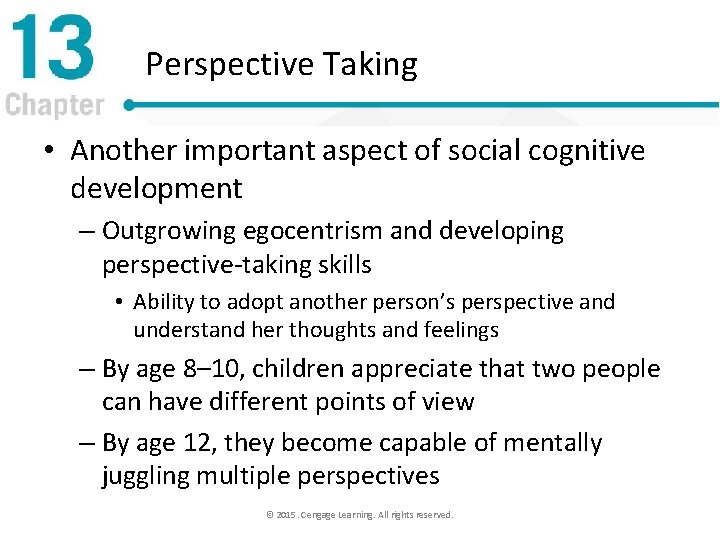
Perspective Taking • Another important aspect of social cognitive development – Outgrowing egocentrism and developing perspective-taking skills • Ability to adopt another person’s perspective and understand her thoughts and feelings – By age 8– 10, children appreciate that two people can have different points of view – By age 12, they become capable of mentally juggling multiple perspectives © 2015. Cengage Learning. All rights reserved.
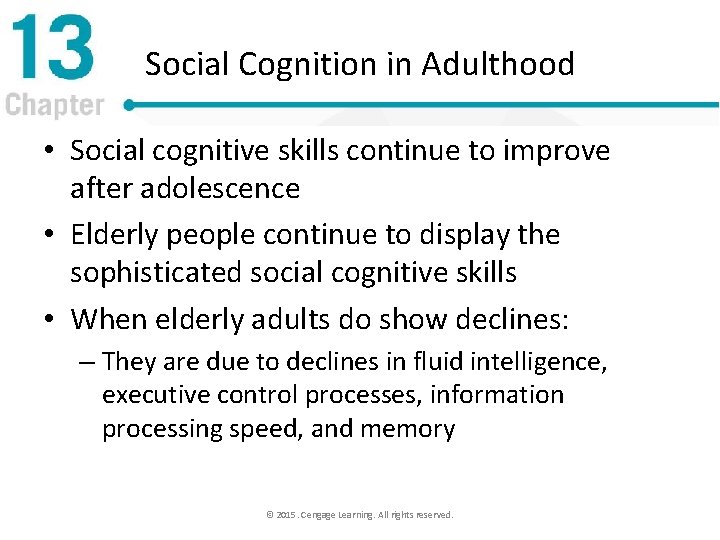
Social Cognition in Adulthood • Social cognitive skills continue to improve after adolescence • Elderly people continue to display the sophisticated social cognitive skills • When elderly adults do show declines: – They are due to declines in fluid intelligence, executive control processes, information processing speed, and memory © 2015. Cengage Learning. All rights reserved.
Social Cognition in Adulthood • Social cognitive skills hold up better than other nonsocial cognitive skills – Areas of the cortex that support social cognition and emotional understanding age more slowly – People use these abilities each day • They do not need to use mentally taxing cognitive processes © 2015. Cengage Learning. All rights reserved.
13. 2 Perspectives on Moral Development • Learning Objectives – Define and illustrate three main components of morality – Compare and contrast the main messages about moral development of psychoanalytic, cognitivedevelopmental, social learning, and evolutionary theorists – Distinguish between Kohlberg’s preconventional, and postconventional levels of moral reasoning © 2015. Cengage Learning. All rights reserved.
Perspectives on Moral Development • Three basic components of morality – Emotional component • Feelings regarding right or wrong actions that motivate moral thoughts – Cognitive component • How we think about right and wrong and make decisions about how to behave – Behavioral component • How we behave when we experience the temptation to cheat or are called upon to help a needy person © 2015. Cengage Learning. All rights reserved.
Moral Emotion: Psychoanalytic Theory and Beyond • Empathy – Vicarious experiencing of another person’s feelings – Important for moral development – Can motivate prosocial behavior • Positive social acts – Keep us from engaging in antisocial behavior © 2015. Cengage Learning. All rights reserved.
Moral Emotion: Psychoanalytic Theory and Beyond • Moral emotions motivate moral behavior • Early relationships with parents to moral development • Children must internalize moral standards to behave morally even when no authority figure is present © 2015. Cengage Learning. All rights reserved.
Moral Reasoning: Cognitive. Developmental Theory • Cognitive-developmental theorists study morality via development of moral reasoning – Thinking process is involved in deciding whether an act is right or wrong – Moral development is assumed to depend on social cognitive development – Moral reasoning is said to progress through universal stages © 2015. Cengage Learning. All rights reserved.
Moral Reasoning: Cognitive. Developmental Theory • Kohlberg’s stages of moral reasoning – Moral growth progresses through three broad moral levels • Preconventional morality: rules are external to the self rather than internalized • Conventional morality: individual has internalized many moral values • Postconventional morality: individual defines what is right in terms of broad principles of justice © 2015. Cengage Learning. All rights reserved.
Moral Behavior: Social Learning Theory • Social learning theorists interested in behavioral component of morality – Moral behavior learned through observational learning and reinforcement and punishment principles – Moral behavior influenced by situational factors © 2015. Cengage Learning. All rights reserved.
Moral Behavior: Social Learning Theory • Moral cognition is linked to moral action through self-regulatory mechanisms – Involve monitoring and evaluating our own actions • Moral disengagement – Allows us to avoid condemning ourselves when we engage in immoral behavior, even though we know the difference between right and wrong © 2015. Cengage Learning. All rights reserved.
The Functions of Morality: Evolutionary Theory • Evolutionary theorists focus on: – How moral emotion, thought, and behavior may have helped humans adapt to their environments over the course of evolution – Our genetic self-interest to act altruistically toward kin • Pass on our genes © 2015. Cengage Learning. All rights reserved.
13. 3 The Infant • Learning Objectives – Summarize evidence that infants are capable of empathy and prosocial behavior – Describe antisocial behavior in infancy and how it differs from that of older children – Explain how parents can help their infants develop a conscience © 2015. Cengage Learning. All rights reserved.
Empathy and Prosocial Behavior • Newborns display a primitive form of empathy – Distressed by other infant’s cries • By age 1 to 2 – Become capable of truer form of empathy • By age 2 – Ability to take the perspective of the friend © 2015. Cengage Learning. All rights reserved.
Empathy and Prosocial Behavior • Research has found prosocial acts by toddlers – Helping • Fourteen-month-old infants spontaneously help adults – Cooperation • Fourteen-month-old infants participate in cooperative games – Altruistic rather than selfish motivations • Before age 2, show greater happiness when they give treats to appreciative puppet © 2015. Cengage Learning. All rights reserved.
Antisocial Behavior • Richard Tremblay proposes that humans: – Do not need to learn to be aggressive – Need to learn how not to be aggressive • Frequency of aggression normally rises from infancy to a peak around age 4 or 5 and then decreases © 2015. Cengage Learning. All rights reserved.
Early Moral Training • Kochanska has studied development of conscience involves mastering two components: – Moral emotions • Associating negative emotions with violating rules and learning to empathize with people who are in distress – Self-control • Being able to inhibit one’s impulses when tempted to violate internalized rules © 2015. Cengage Learning. All rights reserved.
Early Moral Training • How can parents help children develop a strong conscience? – By forming a secure parent–infant attachment – By establishing a mutually responsive orientation for caregiver and child • Close, emotionally positive, and cooperative relationship in which child and caregiver care about each other © 2015. Cengage Learning. All rights reserved.
13. 4 The Child • Learning Objectives – Discuss ways in which children are morally sophisticated than Piaget and Kohlberg believed – Summarize an optimal approach to socializing morality in childhood © 2015. Cengage Learning. All rights reserved.
Moral Understandings • Piaget and Kohlberg believed that: – Young children were primarily focused on the consequences of acts • Even three-year-olds can take both intentions and consequences into account • By age four: – Children’s moral thinking becomes more sophisticated – They have the basics of a theory of mind © 2015. Cengage Learning. All rights reserved.
Moral Understandings • Children who pass theory-of-mind tasks are: – More forgiving when a wrong is committed accidentally – Better able to distinguish between lying and having one’s facts wrong – More attuned to other people’s feelings and welfare © 2015. Cengage Learning. All rights reserved.
Moral Understandings • Children distinguish between different kinds of rules – Moral rules: • Standards that focus on the welfare and basic rights of individuals • Only moral rules as absolute, sacred, and unchangeable – Social-conventional rules: • Standards determined by social consensus that tell us what is appropriate in particular social settings © 2015. Cengage Learning. All rights reserved.
Moral Socialization • Approaches to discipline – Love withdrawal – Power assertion – Induction • More often positively associated with children’s moral maturity • Invokes empathy © 2015. Cengage Learning. All rights reserved.
Moral Socialization • Kochanska’s research shows that children are likely to be easiest to socialize if they are: – By temperament fearful or inhibited • Likely to experience guilt when they do wrong • Avoid distress in the future – Capable of effortful control • Are able to inhibit their urges to engage in wrongdoing © 2015. Cengage Learning. All rights reserved.
13. 5 The Adolescent • Learning Objectives – Describe how moral reasoning changes during adolescence and the significance of developing a moral identity – Compare how Kenneth Dodge and Gerald Patterson account for the behavior of aggressive youth – Explain the roles of nature and nurture in aggression and the approaches that have been used to prevent it © 2015. Cengage Learning. All rights reserved.
Moral Identity • Adolescents who develop a sense of moral identity tend to be: – More capable of advanced moral reasoning – Able to translate moral values into moral action • Development of moral identity: – Can be fostered by parents • Induction and occasional disappointment – Fostered via involvement in community service © 2015. Cengage Learning. All rights reserved.
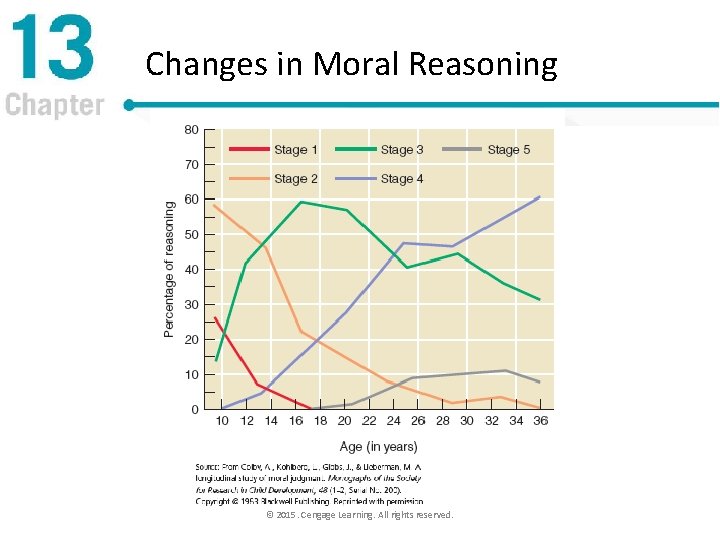
Changes in Moral Reasoning • Ten year olds – Preconventional reasoning • Teen years – Conventional reasoning dominant mode of moral thinking • Adulthood – Postconventional reasoning, if it emerges at all © 2015. Cengage Learning. All rights reserved.
Changes in Moral Reasoning © 2015. Cengage Learning. All rights reserved.
Antisocial Behavior • Juvenile delinquency – Law breaking by a minor • Some diagnosed with conduct disorder – Persistent pattern of violating the rights of others or age-appropriate societal norms • Fighting • Bullying • Cruelty © 2015. Cengage Learning. All rights reserved.
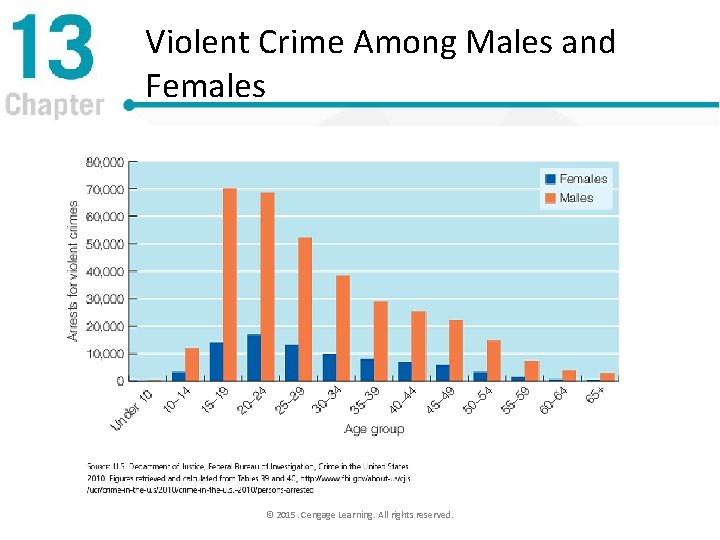
Antisocial Behavior • Two subgroups of antisocial youths – Early-onset, seriously disturbed group that is recognizable in childhood • Hurting others and/or animals • Persistently antisocial across lifespan – Later-onset, less seriously antisocial group that behaves more antisocially during adolescence • Outgrows behavior by early adulthood © 2015. Cengage Learning. All rights reserved.
Violent Crime Among Males and Females © 2015. Cengage Learning. All rights reserved.
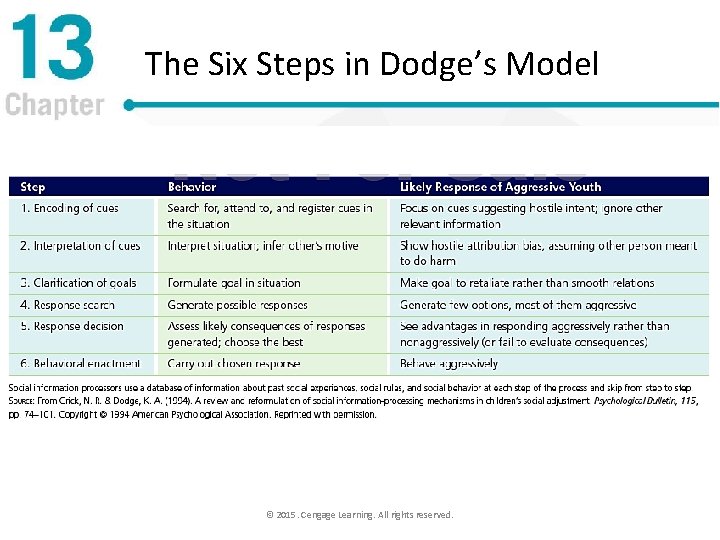
Antisocial Behavior • Dodge’s social information-processing model – Our reactions to frustration, anger, or provocation depend on the ways in which we process and interpret cues in situations – Aggressive youth develop a hostile attribution bias © 2015. Cengage Learning. All rights reserved.
The Six Steps in Dodge’s Model © 2015. Cengage Learning. All rights reserved.
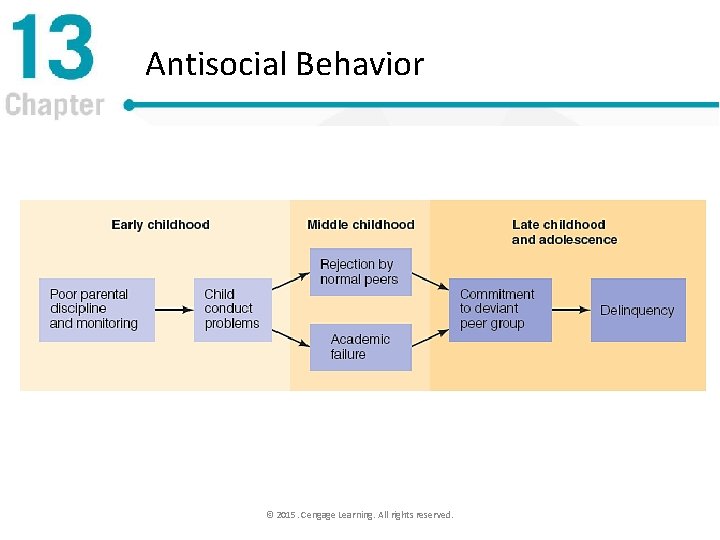
Antisocial Behavior • Patterson’s coercive family environments – Highly antisocial children and adolescents: • Often grow up in coercive family environments • Family members are locked in power struggles • Trying to control the others through negative, coercive tactics © 2015. Cengage Learning. All rights reserved.
Antisocial Behavior © 2015. Cengage Learning. All rights reserved.
13. 6 The Adult • Learning Objectives – Summarize changes in moral reasoning over the adult years – Analyze the limitations of Kohlberg’s theory of moral development with reference to cultural differences in moral thinking and dual-process models of moral decision making – Distinguish between religiousness and spirituality and discuss their development and relationships to adjustment © 2015. Cengage Learning. All rights reserved.
Changes in Moral Reasoning • Most studies find no major age differences in complexity of moral reasoning • Kohlberg’s theory – Children think about hypothetical moral dilemmas primarily in a preconventional manner – Adolescents adopt a conventional mode of moral reasoning – Minority of adults shift to a postconventional perspective © 2015. Cengage Learning. All rights reserved.
Culture and Morality • Results in cross-cultural studies – Postconventional moral reasoning emerges in Western democracies – People in collectivistic cultures: • Stage 3 conventional moral thinkers • Sophisticated concepts of justice that focus on the individual’s duty to the group © 2015. Cengage Learning. All rights reserved.
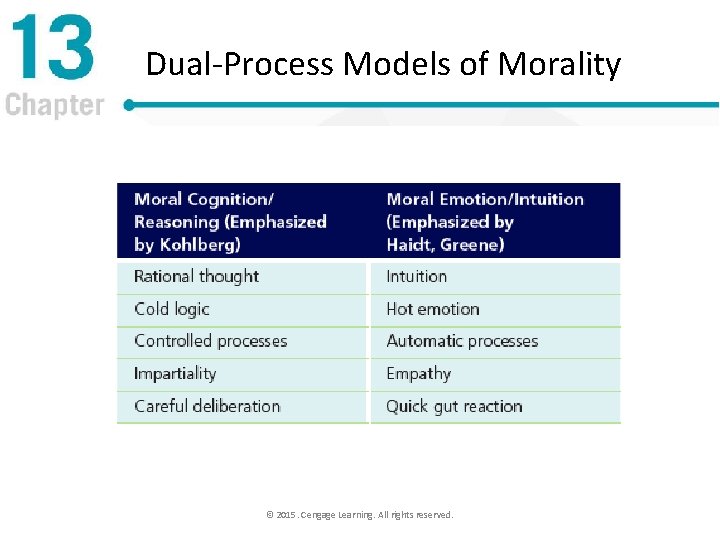
Moral Intuition and Emotion • Greene has proposed the dual-process model of morality – Both deliberate thought and intuition/emotion play distinct roles • Explain why we sometimes make judgments based on quick, emotion-based intuitions • Other times make judgments using more deliberative cognitive processes – Use different parts of the brain to make intuitive and deliberative moral decisions © 2015. Cengage Learning. All rights reserved.
Dual-Process Models of Morality © 2015. Cengage Learning. All rights reserved.
Predicting Moral Action • Kohlberg’s stage theory – Underestimates children’s moral sophistication – Fails to recognize cultural differences in thinking about morality – Neglects intuition/emotion – Says too little about the many influences besides moral reasoning on moral behavior © 2015. Cengage Learning. All rights reserved.
Religion and Spirituality • Religiousness – Sharing the beliefs and participating in the practices of an organized religion • Spirituality – Involves a quest for ultimate meaning and for a connection with something greater than oneself • Both are positively associated with health, mental health, and well-being © 2015. Cengage Learning. All rights reserved.
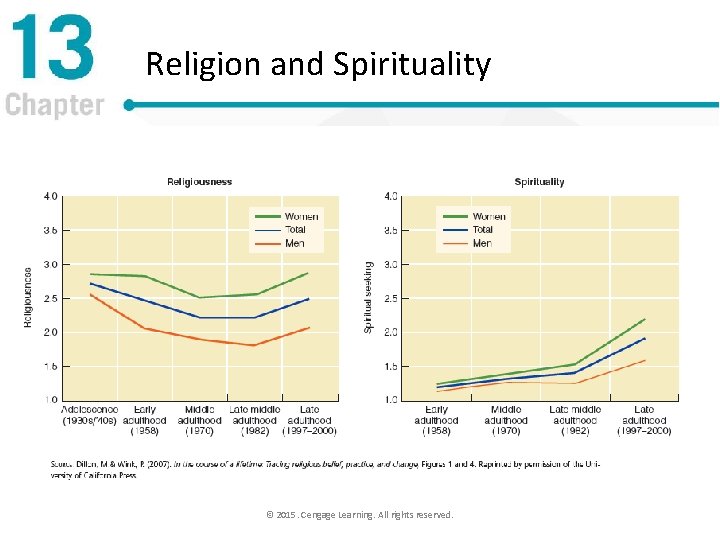
Religion and Spirituality © 2015. Cengage Learning. All rights reserved.
Religion and Spirituality • Religiousness and spirituality may be especially beneficial in late adulthood – Linked to having a sense of meaning and purpose in life – Provides participation in a caring community – Important in certain racial and ethnic groups • Both African American and Caribbean Blacks age 55 and older report more religious participation © 2015. Cengage Learning. All rights reserved.