
EMOTION AND COGNITION IB Psychology LAJM TASK Give
EMOTION AND COGNITION IB Psychology LAJM
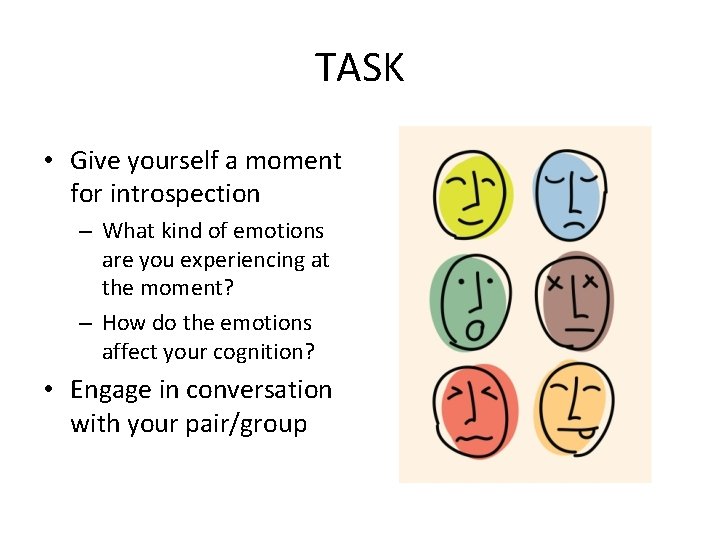
TASK • Give yourself a moment for introspection – What kind of emotions are you experiencing at the moment? – How do the emotions affect your cognition? • Engage in conversation with your pair/group
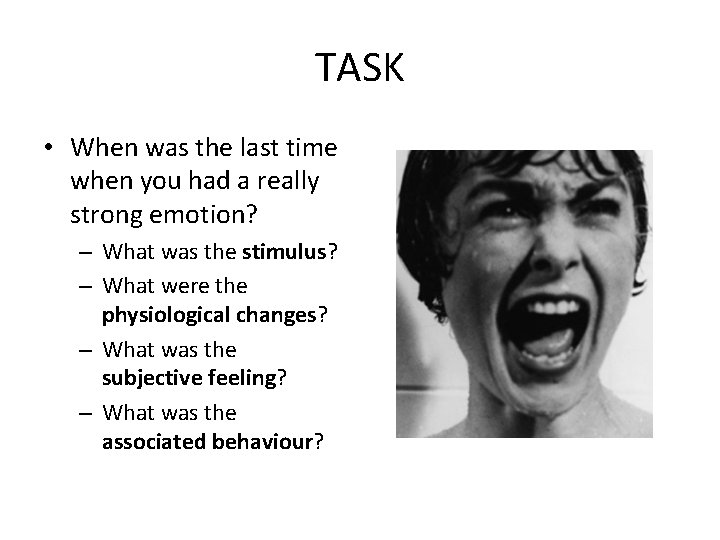
TASK • When was the last time when you had a really strong emotion? – What was the stimulus? – What were the physiological changes? – What was the subjective feeling? – What was the associated behaviour?
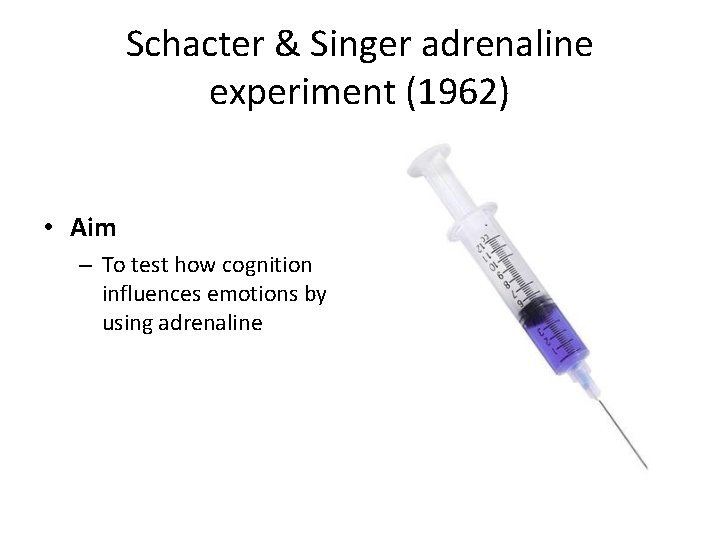
Schacter & Singer adrenaline experiment (1962) • Aim – To test how cognition influences emotions by using adrenaline
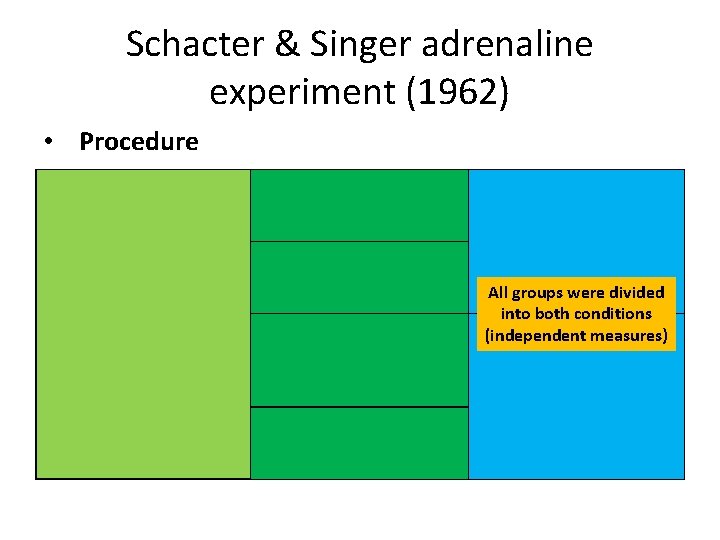
Schacter & Singer adrenaline experiment (1962) • Procedure 184 male college students were divided into four groups. All were participants were told that they were going to be given a vitamin injection Suproxin. In reality, they were given an adrenaline injection (except for the placebo group). Informed group were told that Suproxin might cause adrenaline like effects Ignorant group were given no information on the effects of Suproxin Misinformed group were told that Suproxin might cause effect other than adrenaline Placebo group were given an injection with no effect and no information In euphoria condition the confederates tried to amuse the participants All groups were divided into both conditions (independent measures) In anger condition confederates tried to annoy the participants
Schacter & Singer adrenaline experiment (1962) • Results – Based on observation and questionnaires – Informed group showed minimal changes in emotion – Ignorant and misinformed groups showed significant changes in emotion – Placebo group showed no changes in emotion
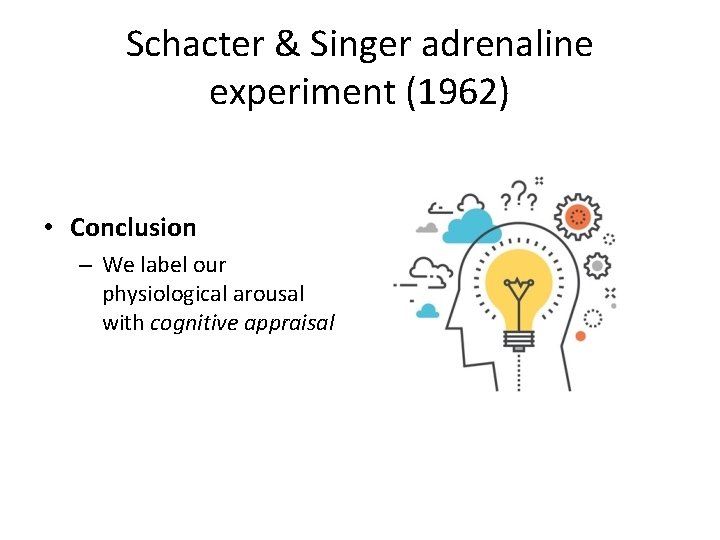
Schacter & Singer adrenaline experiment (1962) • Conclusion – We label our physiological arousal with cognitive appraisal
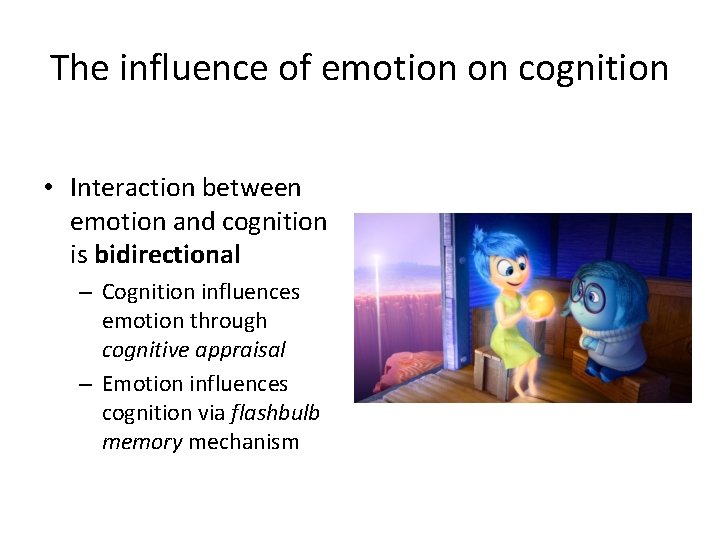
The influence of emotion on cognition • Interaction between emotion and cognition is bidirectional – Cognition influences emotion through cognitive appraisal – Emotion influences cognition via flashbulb memory mechanism
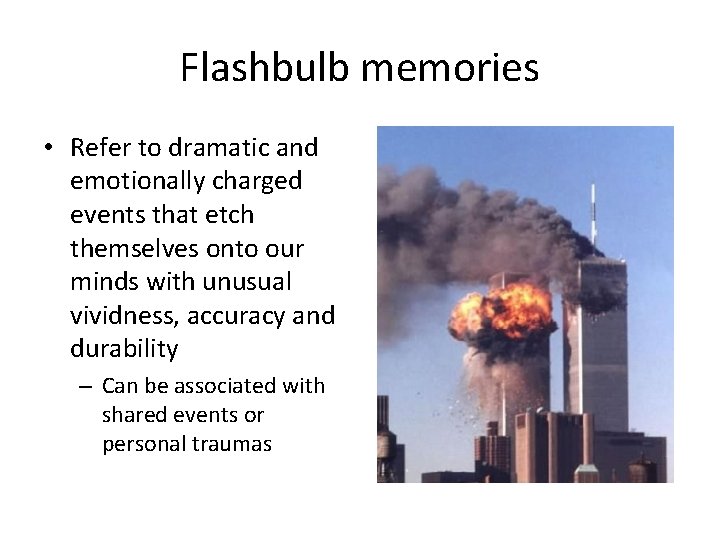
Flashbulb memories • Refer to dramatic and emotionally charged events that etch themselves onto our minds with unusual vividness, accuracy and durability – Can be associated with shared events or personal traumas
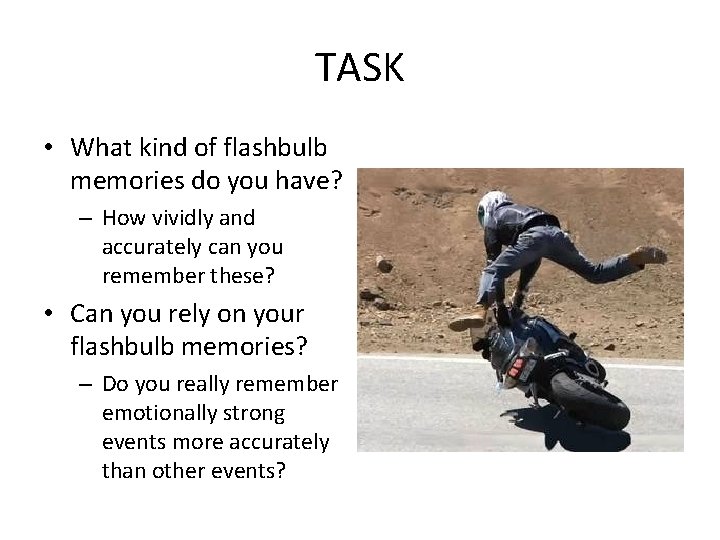
TASK • What kind of flashbulb memories do you have? – How vividly and accurately can you remember these? • Can you rely on your flashbulb memories? – Do you really remember emotionally strong events more accurately than other events?
TASK • Answer the following questions based on your previously acquired psychological knowledge: – How flashbulb memories could be formed? What could be the psychological mechanisms? – What could be the neural mechanism of flashbulb memories? – Are flashbulb memories accurate and reliable?
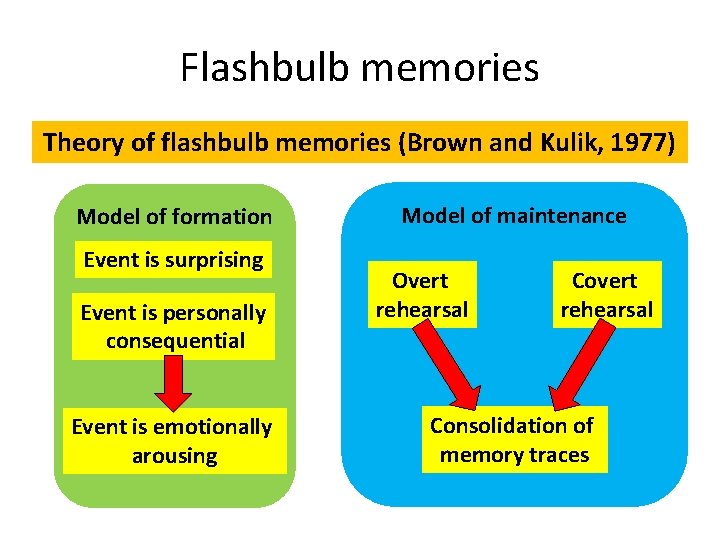
Flashbulb memories Theory of flashbulb memories (Brown and Kulik, 1977) Model of formation Event is surprising Event is personally consequential Event is emotionally arousing Model of maintenance Overt rehearsal Consolidation of memory traces
TASK • Read pages 183– 186 and find the aim, procedure and results of the following studies – Brown and Kulik (1977): Psychological mechanisms of flashbulb memories – Sharot et al. (2007): Neural basis of flashbulb memories – Neisser et al. (1996): Encoding vs. rehearsal in forming flashbulb memories – Neisser and Harsch (1992): Accuracy and reliability of flashbulb memories
TASK • Critical thinking hub: – Do TEACUP analysis of theory of flashbulb memory – Do MAGEC/GRENADE analysis of each study related to theory of flashbulb memory – Aim for holistic approach
TASK • Read the sample responses to the question “Discuss the effect of emotion in one cognitive process” • After reading the responses, pay attention to the examiner’s comments • How could the response be improved? – Make amendments
Picture sources • • • Emotional faces <https: //datascience. berkeley. edu/sentiment-analysis-symposium-adventuresemotion-recognition/> Accessed 12 th of January 2015. Psycho <http: //io 9. gizmodo. com/5808083/ten-fear-responses-that-make-no-sense-and-why-wehave-them> Accessed 12 th of January 2015. Happy sunset <http: //www. rgbstock. com/bigphoto/n 4 gg 6 u. G/happy+at+sunset> Accessed 14 th of January 2015. Painted face <http: //www. bemotion. fi/#!mielen-salatut-voimat-workshop-1 -3/c 1 t 6 p> Accessed 14 th of January 2015. Adrenaline syringe <https: //www. dreamviews. com/blogs/hyu/adrenaline-59342/> Accessed 5 th of March 2018. Head <http: //hosen-shituf. gov. il/he/news> Accessed 5 th of March 2018. Joy and sadness <https: //choice. npr. org/index. html? origin=https: //www. npr. org/sections/healthshots/2015/06/13/413980258/science-of-sadness-and-joy-inside-out-gets-childhood-emotionsright> Accessed 10 th of February 2019. 9/11 <http: //www. blucoreshootingcenter. com/blog/tag/911/> Accessed 10 th of March 2016. Motorcycle accident <http: //www. break. com/article/motorcycle-accidents-two-wheels-to-thehospital-2806353> Accessed 10 th of March 2016. Critical thinking puzzle <https: //www. chronicle. com/article/Beyond-Critical-Thinking/63288> Accessed 10 th of February 2019.
- Slides: 16