Roger Rusack The University of Minnesota A HIGH




- Slides: 26
Roger Rusack – The University of Minnesota A HIGH GRANULARITY CALORIMETER FOR CMS. rusack@physics. umn. edu 3/19/14 1
Contributing Institutions Athens, Beijing, CERN, Demokritos, Imperial College, Iowa, LLR, Minnesota, SINP (Kolkata) & UC Santa Barbara I will report on the work of many people from these institutions this list is growing and we welcome new members. rusack@physics. umn. edu 3/19/14 2
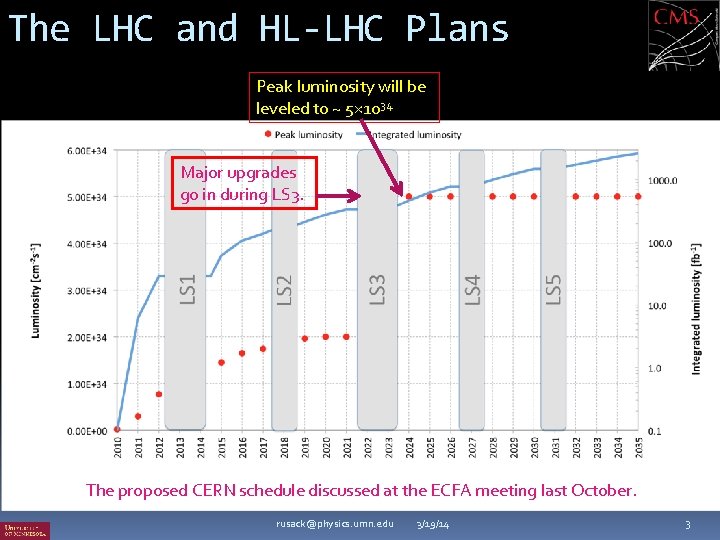
The LHC and HL-LHC Plans Peak luminosity will be leveled to ~ 5× 1034 Major upgrades go in during LS 3. The proposed CERN schedule discussed at the ECFA meeting last October. rusack@physics. umn. edu 3/19/14 3
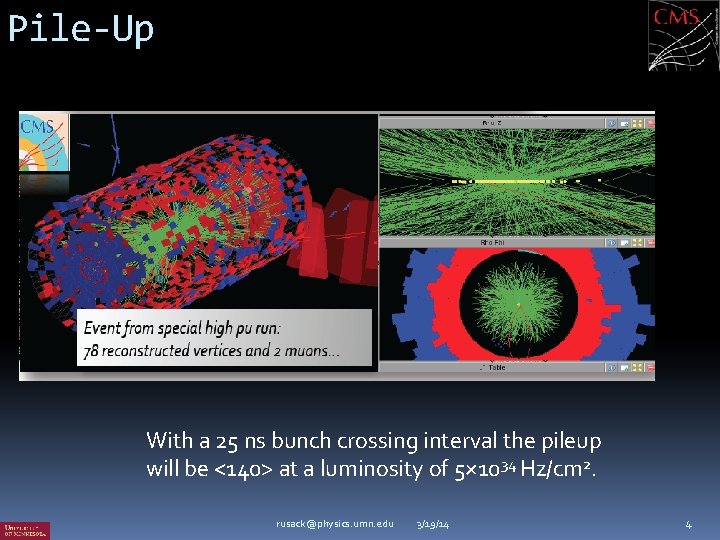
Pile-Up With a 25 ns bunch crossing interval the pileup will be <140> at a luminosity of 5× 1034 Hz/cm 2. rusack@physics. umn. edu 3/19/14 4
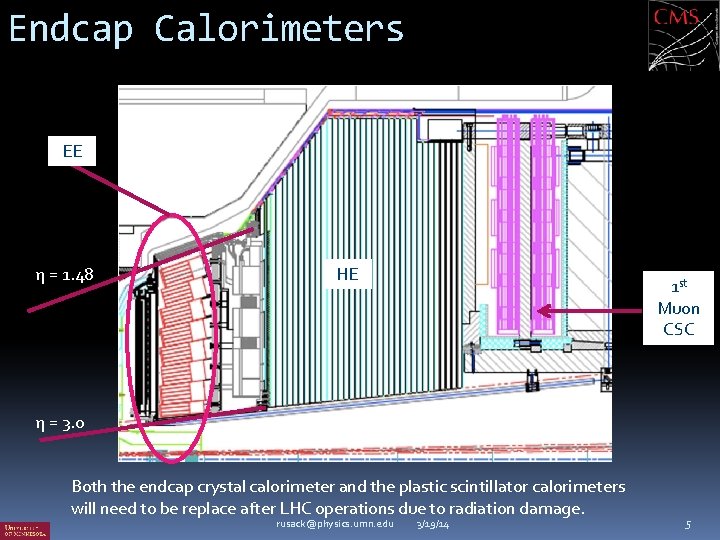
Endcap Calorimeters EE η = 1. 48 HE 1 st Muon CSC η = 3. 0 Both the endcap crystal calorimeter and the plastic scintillator calorimeters will need to be replace after LHC operations due to radiation damage. rusack@physics. umn. edu 3/19/14 5
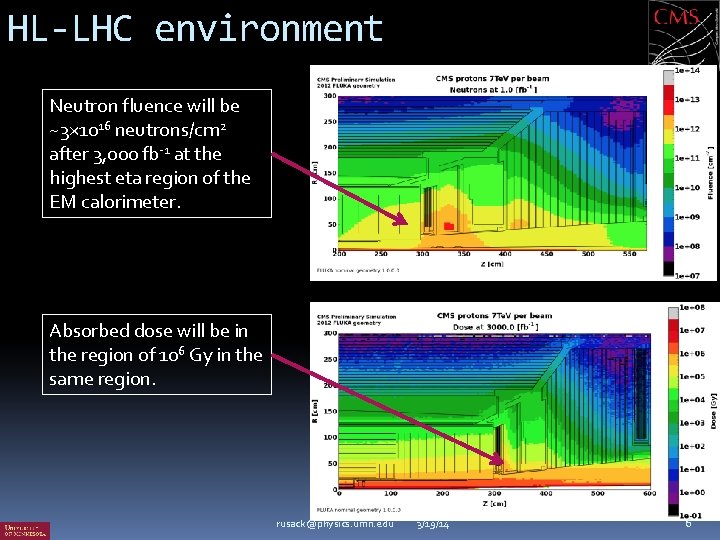
HL-LHC environment Neutron fluence will be ~3× 10¹⁶ neutrons/cm 2 after 3, 000 fb-1 at the highest eta region of the EM calorimeter. Absorbed dose will be in the region of 106 Gy in the same region. rusack@physics. umn. edu 3/19/14 6
Challenges The HL-LHC is a machine to look for rare processes and to make precision measurements. Capture as many of the VBF forward jets as possible in a single “crackless” calorimeter. This requires moving to higher eta the current boundary between the endcap and forward calorimeters. Good energy em and hadronic energy resolution. “Good” means at least as good as our current detector. Enable a powerful and flexible trigger rusack@physics. umn. edu 3/19/14 7
rusack@physics. umn. edu 3/19/14 8
Endcap Calorimeter We are investigating in detail the possibility of using a high granularity calorimeter with ~2. 5 M channels of silicon pads (5 M total). We expect that with such detailed information from the calorimeter, coupled with a precision silicon tracker, we will be able to measure physics objects with high precision. rusack@physics. umn. edu 3/19/14 9
Current Detector rusack@physics. umn. edu 3/19/14 10
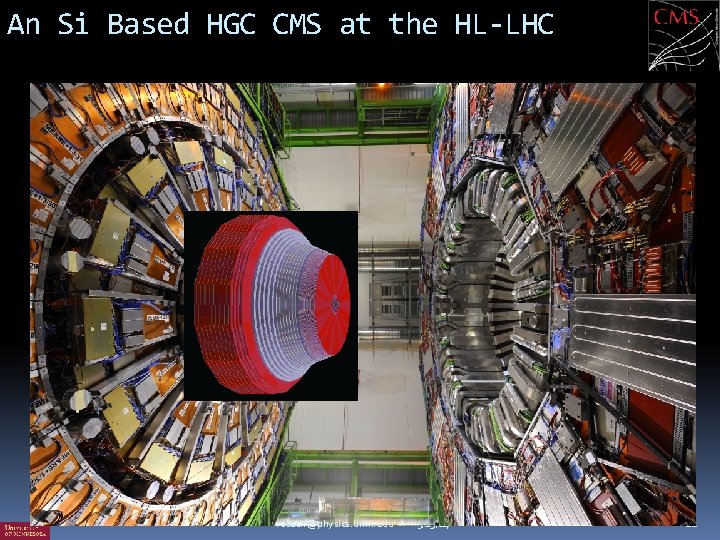
An Si Based HGC CMS at the HL-LHC rusack@physics. umn. edu 3/19/14 11
rusack@physics. umn. edu 3/19/14 12
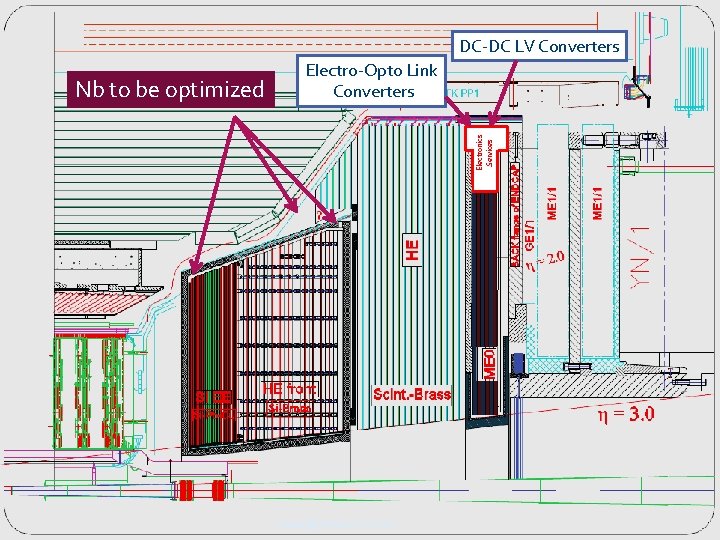
DC-DC LV Converters Electronics Services Nb to be optimized Electro-Opto Link Converters rusack@physics. umn. edu 3/19/14 13
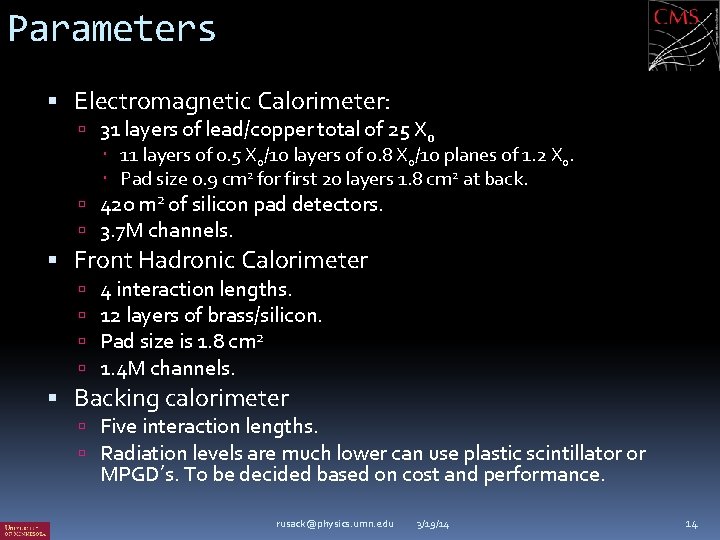
Parameters Electromagnetic Calorimeter: 31 layers of lead/copper total of 25 Xo 11 layers of 0. 5 Xo/10 layers of 0. 8 Xo/10 planes of 1. 2 Xo. Pad size 0. 9 cm 2 for first 20 layers 1. 8 cm 2 at back. 420 m 2 of silicon pad detectors. 3. 7 M channels. Front Hadronic Calorimeter 4 interaction lengths. 12 layers of brass/silicon. Pad size is 1. 8 cm 2 1. 4 M channels. Backing calorimeter Five interaction lengths. Radiation levels are much lower can use plastic scintillator or MPGD’s. To be decided based on cost and performance. rusack@physics. umn. edu 3/19/14 14
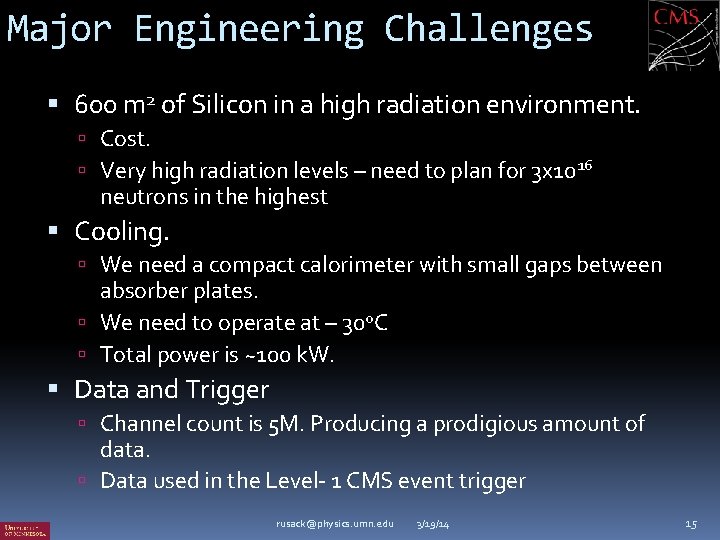
Major Engineering Challenges 600 m 2 of Silicon in a high radiation environment. Cost. Very high radiation levels – need to plan for 3 x 10¹⁶ neutrons in the highest Cooling. We need a compact calorimeter with small gaps between absorber plates. We need to operate at – 30 o. C Total power is ~100 k. W. Data and Trigger Channel count is 5 M. Producing a prodigious amount of data. Data used in the Level- 1 CMS event trigger rusack@physics. umn. edu 3/19/14 15
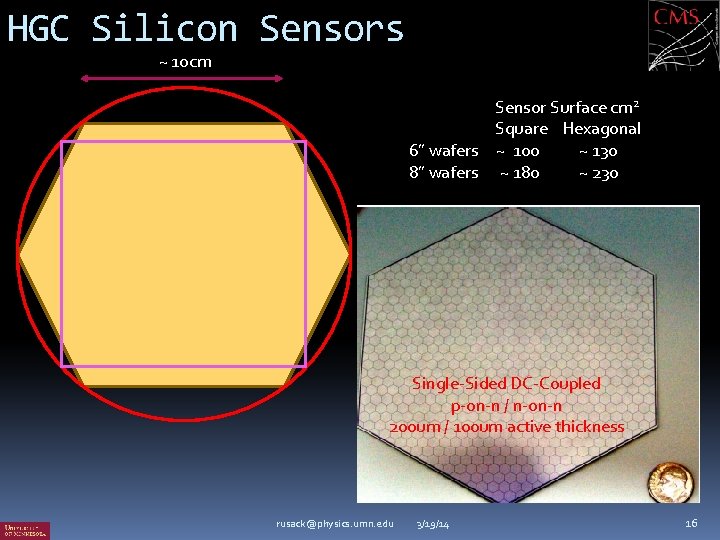
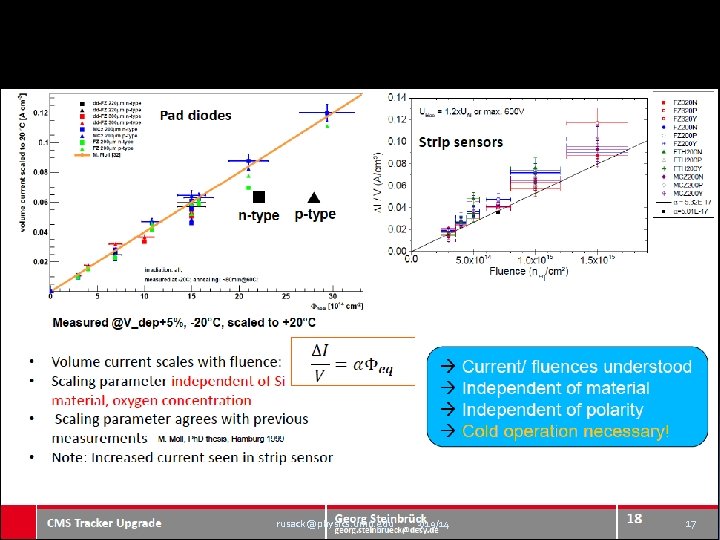
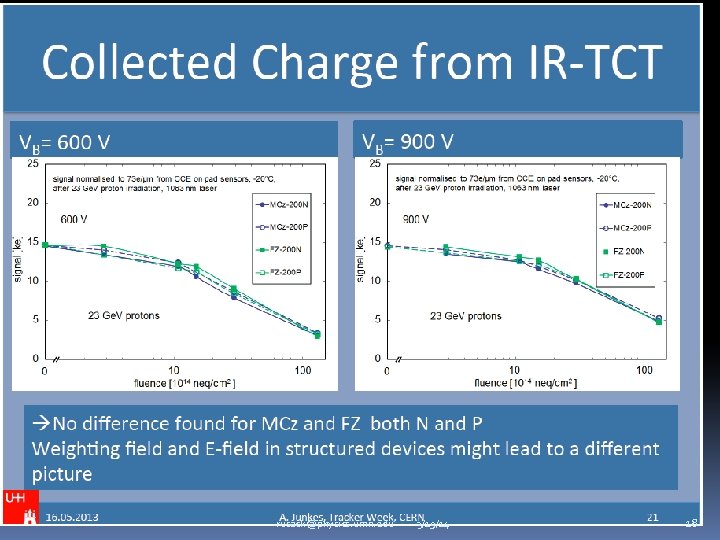
HGC Silicon Sensors ~ 10 cm Sensor Surface cm 2 Square Hexagonal 6” wafers ~ 100 ~ 130 8” wafers ~ 180 ~ 230 Single-Sided DC-Coupled p-on-n / n-on-n 200 um / 100 um active thickness rusack@physics. umn. edu 3/19/14 16
rusack@physics. umn. edu 3/19/14 17
rusack@physics. umn. edu 3/19/14 18
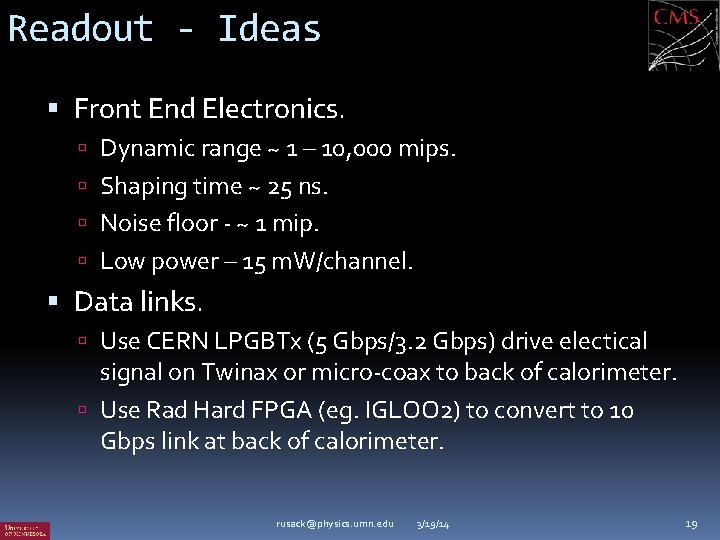
Readout - Ideas Front End Electronics. Dynamic range ~ 1 – 10, 000 mips. Shaping time ~ 25 ns. Noise floor - ~ 1 mip. Low power – 15 m. W/channel. Data links. Use CERN LPGBTx (5 Gbps/3. 2 Gbps) drive electical signal on Twinax or micro-coax to back of calorimeter. Use Rad Hard FPGA (eg. IGLOO 2) to convert to 10 Gbps link at back of calorimeter. rusack@physics. umn. edu 3/19/14 19
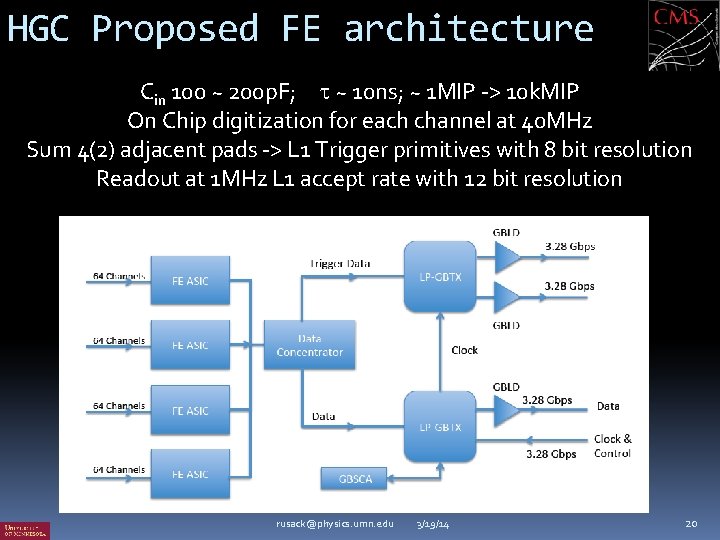
HGC Proposed FE architecture Cin 100 ~ 200 p. F; t ~ 10 ns; ~ 1 MIP -> 10 k. MIP On Chip digitization for each channel at 40 MHz Sum 4(2) adjacent pads -> L 1 Trigger primitives with 8 bit resolution Readout at 1 MHz L 1 accept rate with 12 bit resolution rusack@physics. umn. edu 3/19/14 20
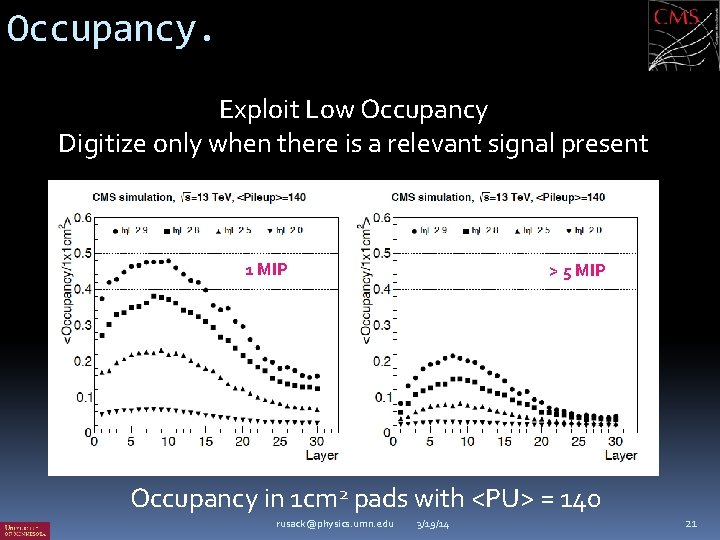
Occupancy. Exploit Low Occupancy Digitize only when there is a relevant signal present 1 MIP > 5 MIP Occupancy in 1 cm 2 pads with <PU> = 140 rusack@physics. umn. edu 3/19/14 21
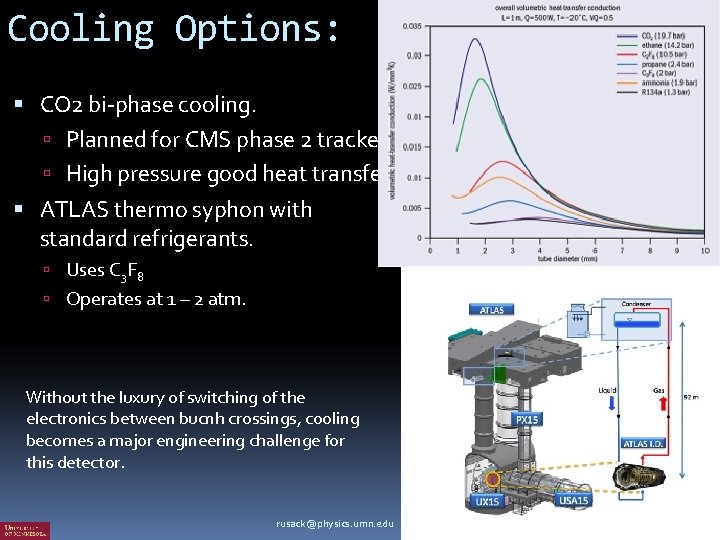
Cooling Options: CO 2 bi-phase cooling. Planned for CMS phase 2 tracker. High pressure good heat transfer. ATLAS thermo syphon with standard refrigerants. Uses C 3 F 8 Operates at 1 – 2 atm. Without the luxury of switching of the electronics between bucnh crossings, cooling becomes a major engineering challenge for this detector. rusack@physics. umn. edu 3/19/14 22
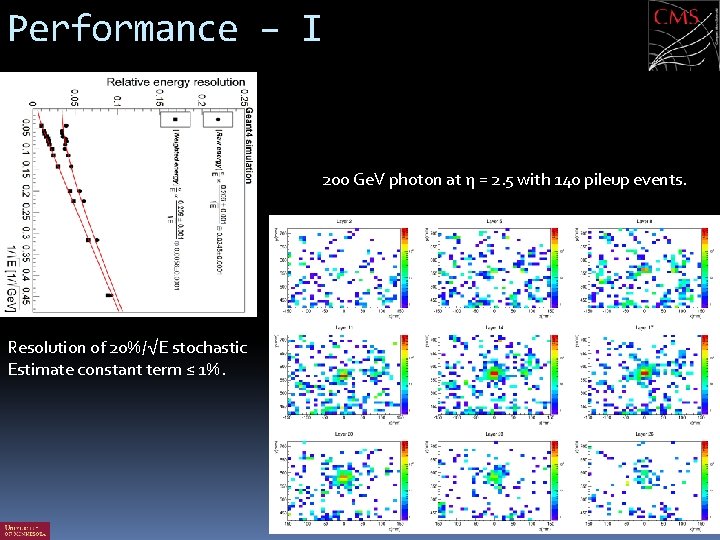
Performance – I 200 Ge. V photon at η = 2. 5 with 140 pileup events. Resolution of 20%/√E stochastic Estimate constant term ≤ 1%. rusack@physics. umn. edu 3/19/14 23
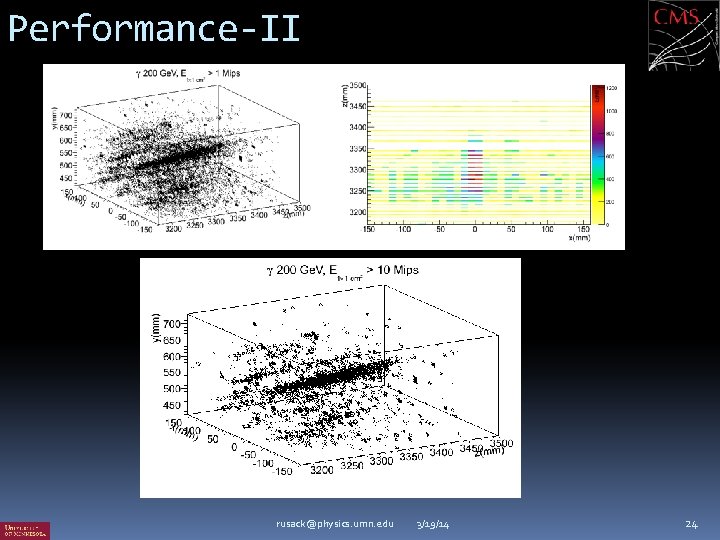
Performance-II rusack@physics. umn. edu 3/19/14 24
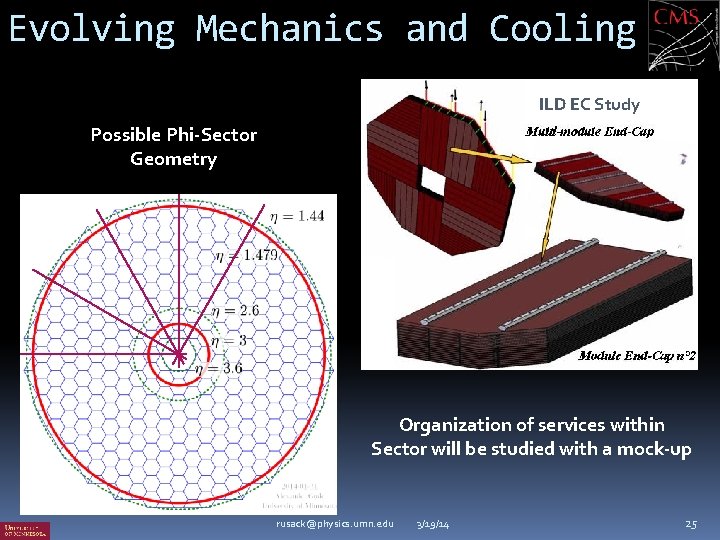
Evolving Mechanics and Cooling ILD EC Study Possible Phi-Sector Geometry Organization of services within Sector will be studied with a mock-up rusack@physics. umn. edu 3/19/14 25
Summary CMS is investigating building a silicon-based calorimeter for the forward region of CMS. There are many engineering challenges. We are benefitting from the work of CALICE/CLIC communities. There is a much work ahead and we welcome new collaborators. rusack@physics. umn. edu 3/19/14 26