ECAL and the SLHC Roger Rusack The University
- Slides: 9
ECAL and the SLHC Roger Rusack The University of Minnesota With input from F. Nessi-Tedaldi.
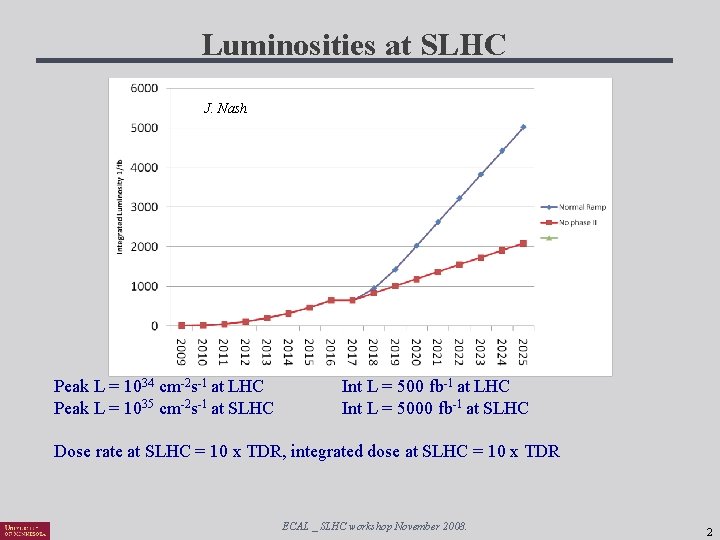
Luminosities at SLHC J. Nash Peak L = 1034 cm-2 s-1 at LHC Peak L = 1035 cm-2 s-1 at SLHC Int L = 500 fb-1 at LHC Int L = 5000 fb-1 at SLHC Dose rate at SLHC = 10 x TDR, integrated dose at SLHC = 10 x TDR ECAL _ SLHC workshop November 2008. 2
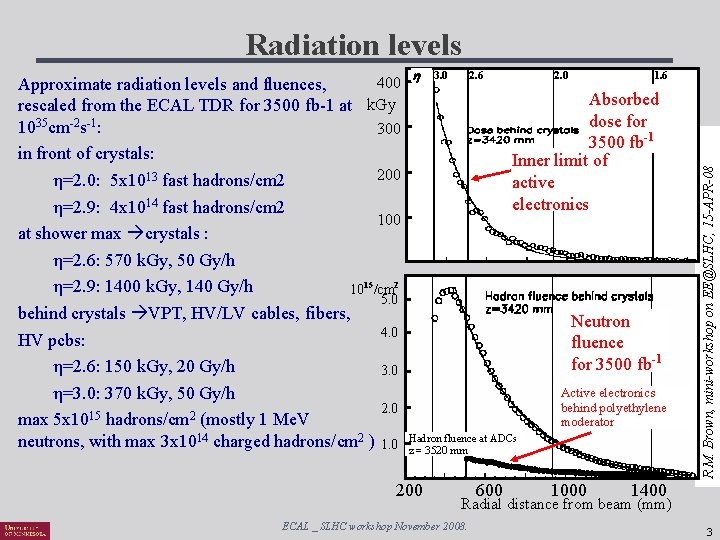
Radiation levels h 3. 0 2. 6 2. 0 1. 6 Absorbed dose for 3500 fb-1 Inner limit of active electronics Neutron fluence for 3500 fb-1 Active electronics behind polyethylene moderator Hadron fluence at ADCs z = 3520 mm 200 600 1000 R. M. Brown, mini-workshop on EE@SLHC, 15 -APR-08 400 Approximate radiation levels and fluences, rescaled from the ECAL TDR for 3500 fb-1 at k. Gy 1035 cm-2 s-1: 300 in front of crystals: 200 η=2. 0: 5 x 10¹³ fast hadrons/cm 2 η=2. 9: 4 x 10¹⁴ fast hadrons/cm 2 100 at shower max crystals : η=2. 6: 570 k. Gy, 50 Gy/h η=2. 9: 1400 k. Gy, 140 Gy/h 1015/cm 2 5. 0 behind crystals VPT, HV/LV cables, fibers, 4. 0 HV pcbs: η=2. 6: 150 k. Gy, 20 Gy/h 3. 0 η=3. 0: 370 k. Gy, 50 Gy/h 2. 0 max 5 x 1015 hadrons/cm 2 (mostly 1 Me. V neutrons, with max 3 x 10¹⁴ charged hadrons/cm 2 ) 1. 0 1400 Radial distance from beam (mm) ECAL _ SLHC workshop November 2008. 3
Changes in Pb. WO 4 Due to Radiation and particle fluxes change the crystals light output and light output uniformity. The reduction in light output is due to the variations in the transmission The scintillation mechanism is not changed by radiation. Reduced Light Output effect on Energy-resolution stochastic term and increases the effect of the electronic noise. Change in Uniformity effect on Energy-resolution constant term, especially in the front half of the crystals (Front-Non-Uni. Formity, FNUF) Activation This significantly limits what can be done to and around components in the endcaps. ECAL _ SLHC workshop November 2008. 4
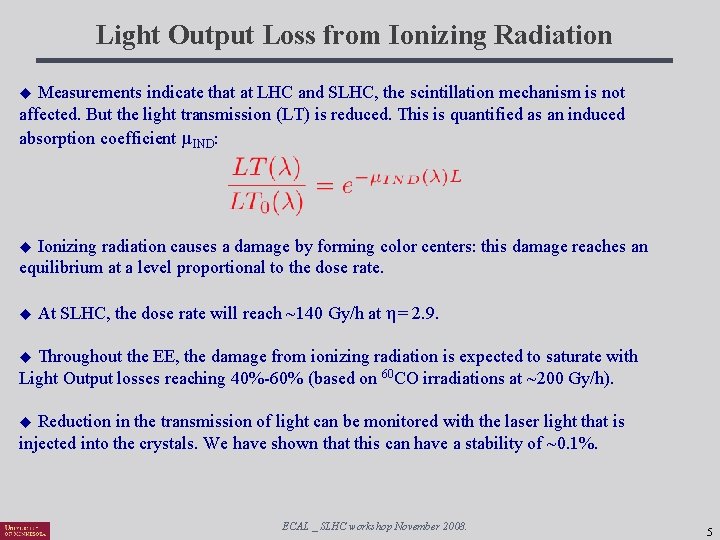
Light Output Loss from Ionizing Radiation Measurements indicate that at LHC and SLHC, the scintillation mechanism is not affected. But the light transmission (LT) is reduced. This is quantified as an induced absorption coefficient μ IND: Ionizing radiation causes a damage by forming color centers: this damage reaches an equilibrium at a level proportional to the dose rate. At SLHC, the dose rate will reach ~140 Gy/h at η = 2. 9. Throughout the EE, the damage from ionizing radiation is expected to saturate with Light Output losses reaching 40%-60% (based on 60 CO irradiations at ~200 Gy/h). Reduction in the transmission of light can be monitored with the laser light that is injected into the crystals. We have shown that this can have a stability of ~0. 1%. ECAL _ SLHC workshop November 2008. 5
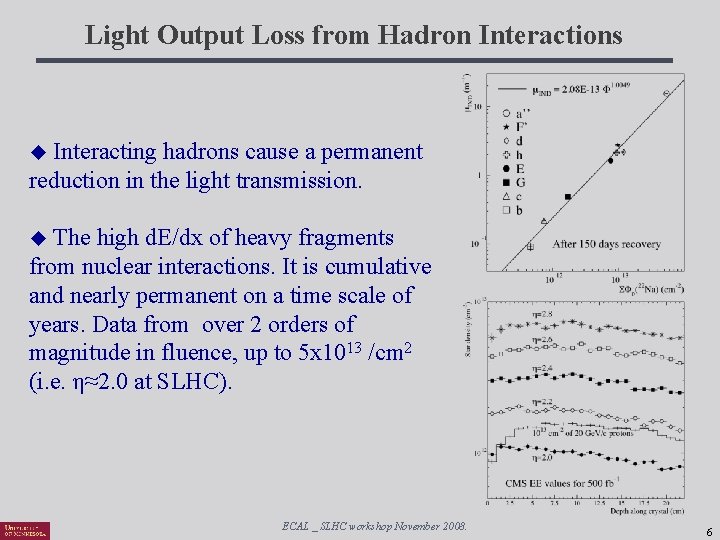
Light Output Loss from Hadron Interactions Interacting hadrons cause a permanent reduction in the light transmission. The high d. E/dx of heavy fragments from nuclear interactions. It is cumulative and nearly permanent on a time scale of years. Data from over 2 orders of magnitude in fluence, up to 5 x 10¹³ /cm 2 (i. e. η≈2. 0 at SLHC). ECAL _ SLHC workshop November 2008. 6
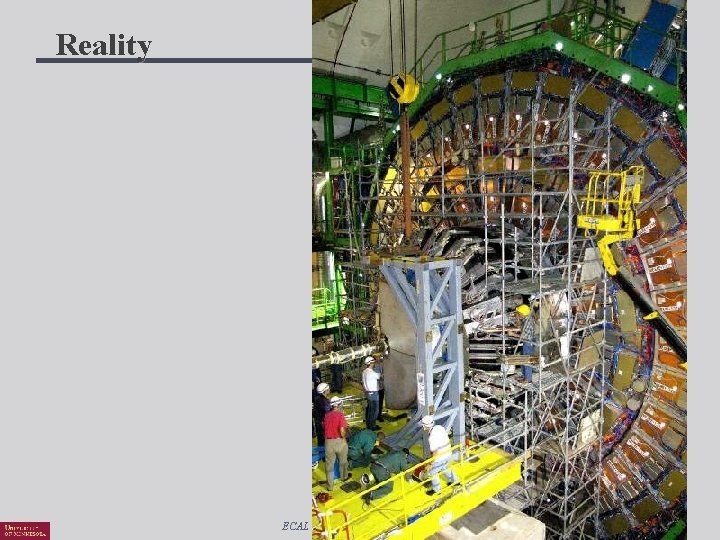
Reality ECAL _ SLHC workshop November 2008.
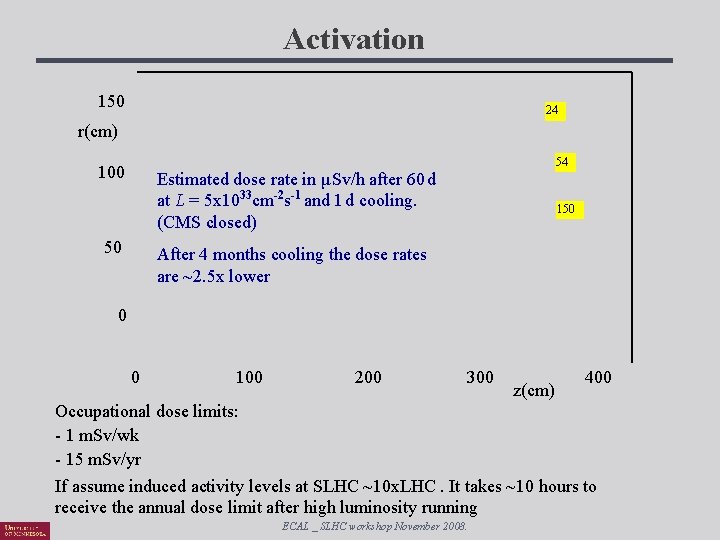
Activation 150 24 r(cm) 54 100 Estimated dose rate in μSv/h after 60 d at L = 5 x 1033 cm-2 s-1 and 1 d cooling. (CMS closed) 50 150 After 4 months cooling the dose rates are ~2. 5 x lower 0 0 100 200 300 z(cm) 400 Occupational dose limits: - 1 m. Sv/wk - 15 m. Sv/yr If assume induced activity levels at SLHC ~10 x. LHC. It takes ~10 hours to receive the annual dose limit after high luminosity running ECAL _ SLHC workshop November 2008.
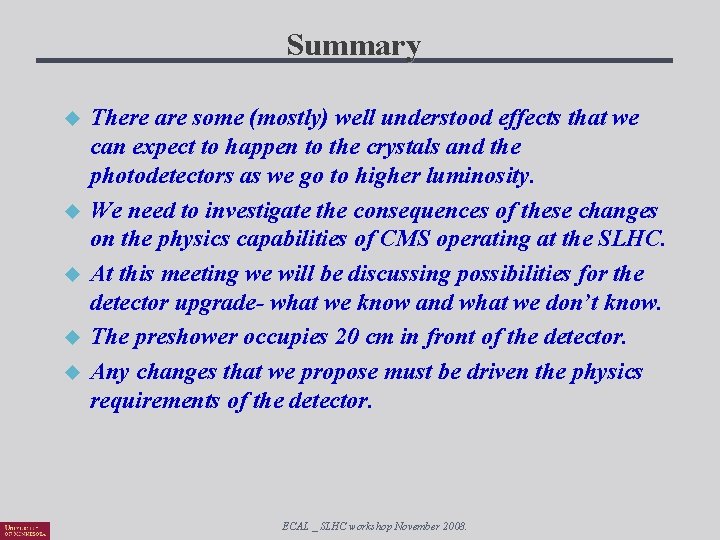
Summary There are some (mostly) well understood effects that we can expect to happen to the crystals and the photodetectors as we go to higher luminosity. We need to investigate the consequences of these changes on the physics capabilities of CMS operating at the SLHC. At this meeting we will be discussing possibilities for the detector upgrade- what we know and what we don’t know. The preshower occupies 20 cm in front of the detector. Any changes that we propose must be driven the physics requirements of the detector. ECAL _ SLHC workshop November 2008.