PROTOZOA Instructor Almonther I Alhamedi The Islamic University




- Slides: 61
PROTOZOA Instructor: Almonther I. Alhamedi The Islamic University of Gaza Department of Biology E-mail : mhamedi@iugaza. edu. ps Web page : http: //site. iugaza. edu. ps/mhamedi
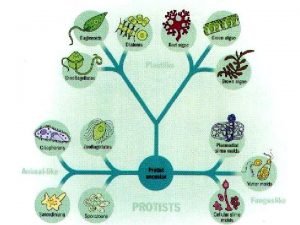
PHYLUM- PROTOZOA GR. . PROTOS=FIRST, ZOON=ANIMAL General characters 1. These are microscopic, animal, few are visible to the unaided eyes. 2. Spherical , amoeboid , ovoid , spindle, cup shaped. 3. Body is a cellular. 4. Protoplasm, differentiated into ectoplasm, endoplasm. 5. Nutrition may be holozoic (animal like), halophytic(plant like), saprophytic. 6. Locomotion by: pseudopodia(rhizopoda), flagella(mastigophora), cilia(ciliata). 8. protozoans two type of nuclei(macronucleus)and micro nucleus.
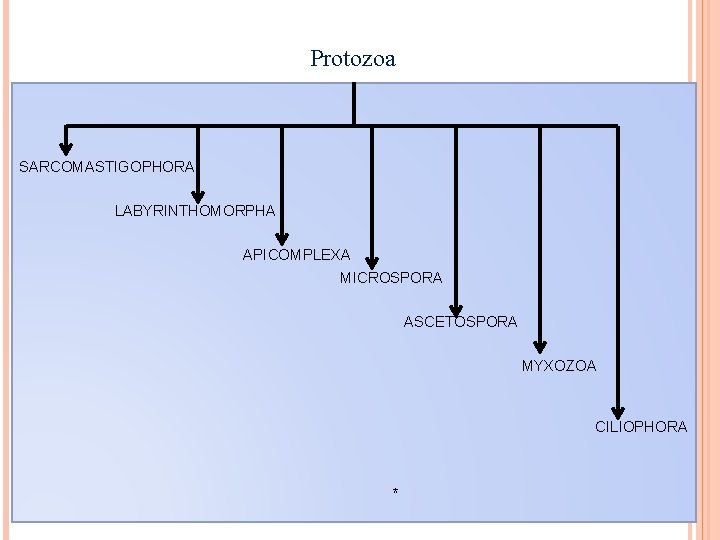
Protozoa SARCOMASTIGOPHORA LABYRINTHOMORPHA APICOMPLEXA MICROSPORA ASCETOSPORA MYXOZOA CILIOPHORA *
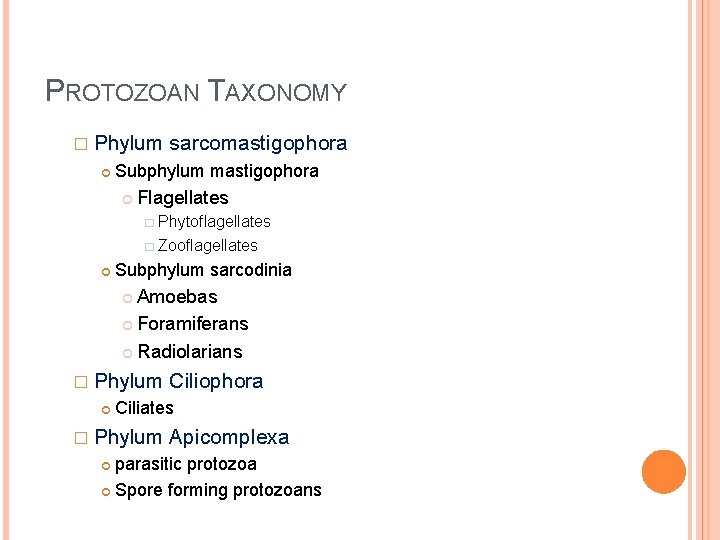
PROTOZOAN TAXONOMY � Phylum sarcomastigophora Subphylum mastigophora Flagellates � Phytoflagellates � Zooflagellates Subphylum sarcodinia Amoebas Foramiferans Radiolarians � Phylum Ciliophora Ciliates � Phylum Apicomplexa parasitic protozoa Spore forming protozoans
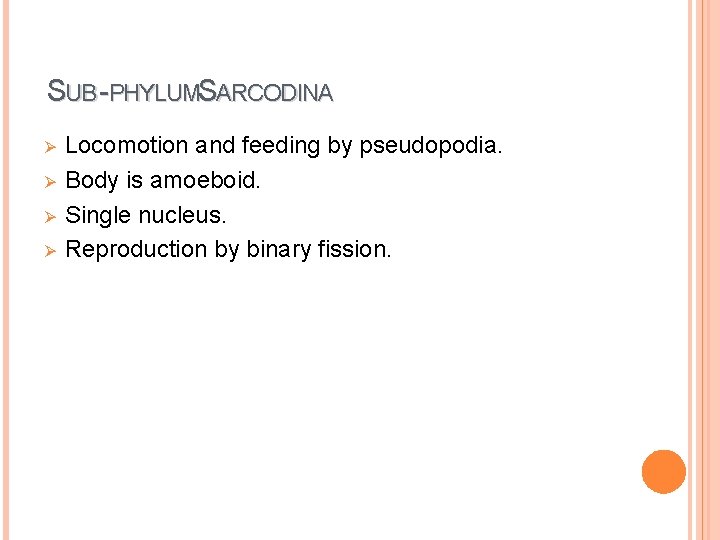
SUB -PHYLUMS ARCODINA Ø Ø Locomotion and feeding by pseudopodia. Body is amoeboid. Single nucleus. Reproduction by binary fission.
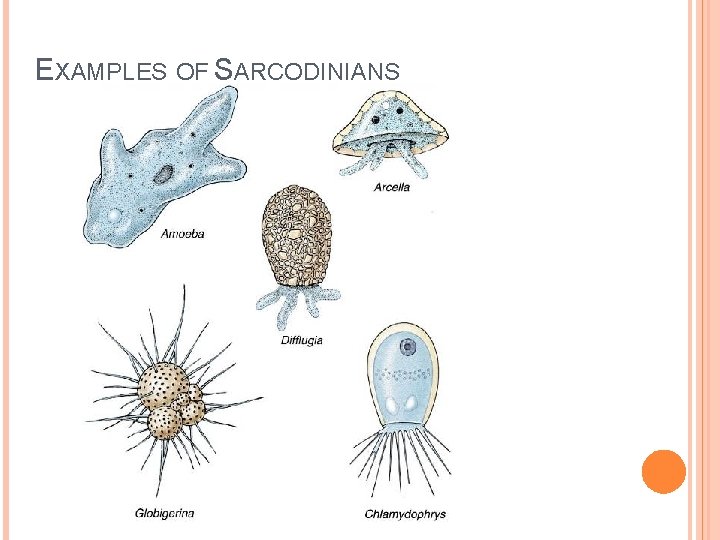
EXAMPLES OF SARCODINIANS
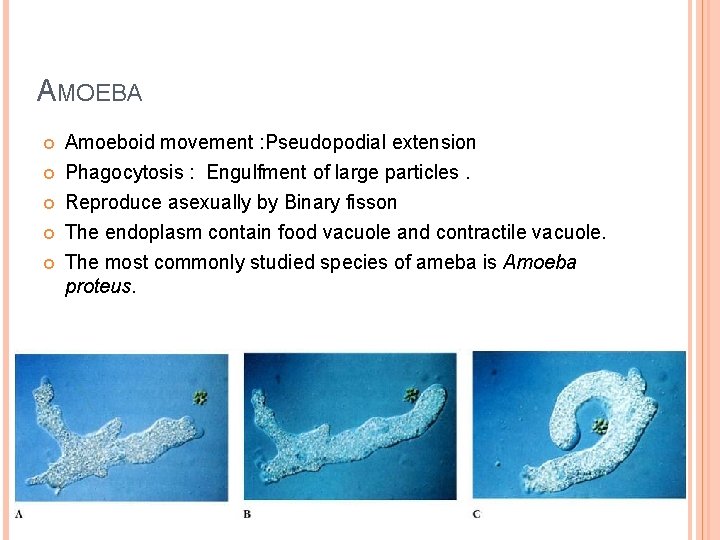
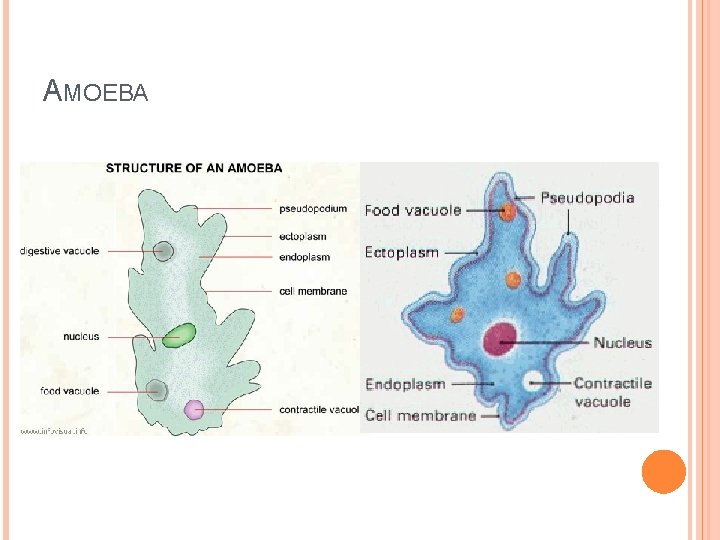
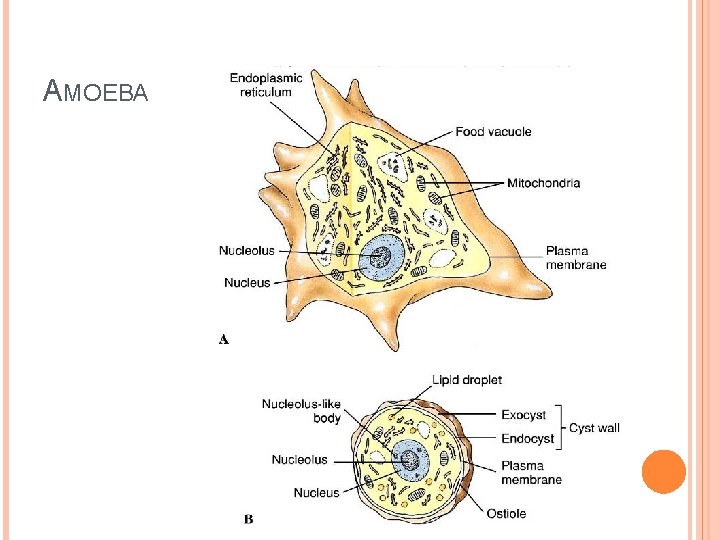
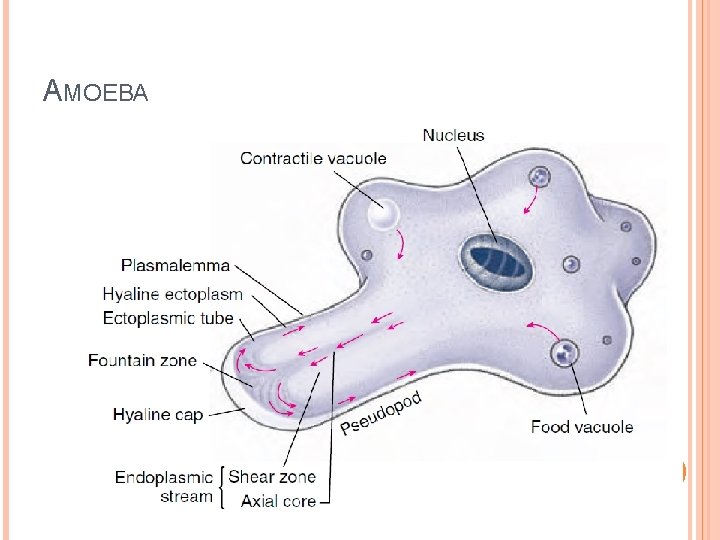
AMOEBA Amoeboid movement : Pseudopodial extension Phagocytosis : Engulfment of large particles. Reproduce asexually by Binary fisson The endoplasm contain food vacuole and contractile vacuole. The most commonly studied species of ameba is Amoeba proteus.
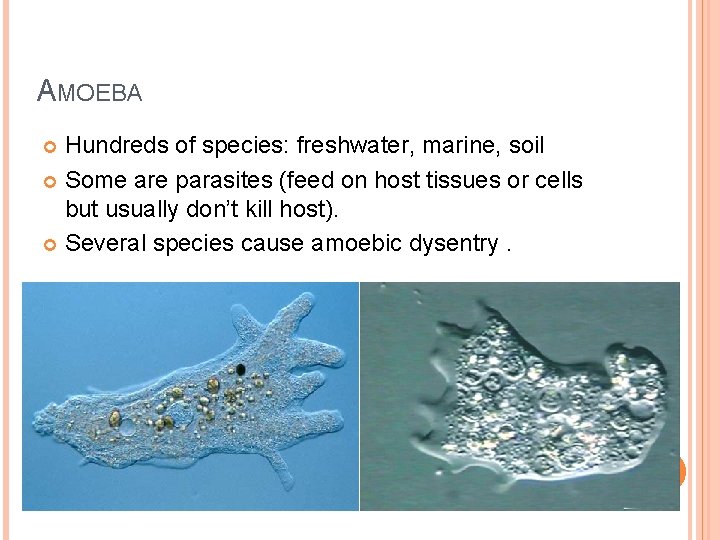
AMOEBA Hundreds of species: freshwater, marine, soil Some are parasites (feed on host tissues or cells but usually don’t kill host). Several species cause amoebic dysentry.
AMOEBA
AMOEBA
AMOEBA
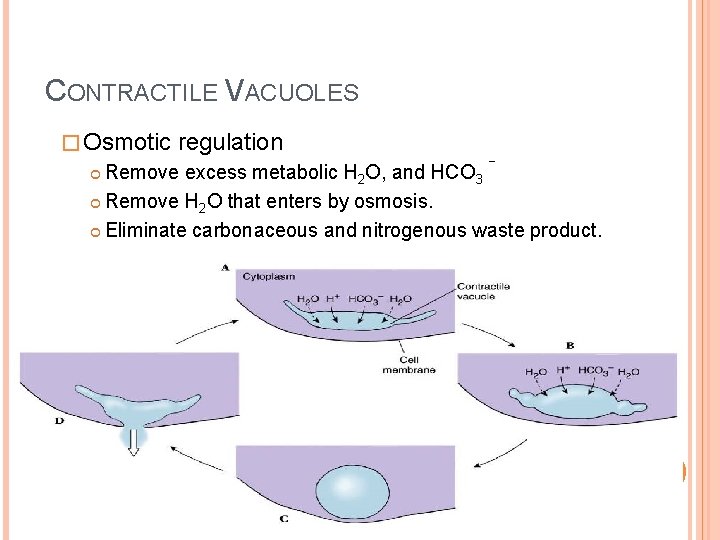
CONTRACTILE VACUOLES � Osmotic regulation Remove excess metabolic H 2 O, and HCO 3 Remove H 2 O that enters by osmosis. Eliminate carbonaceous and nitrogenous waste product.
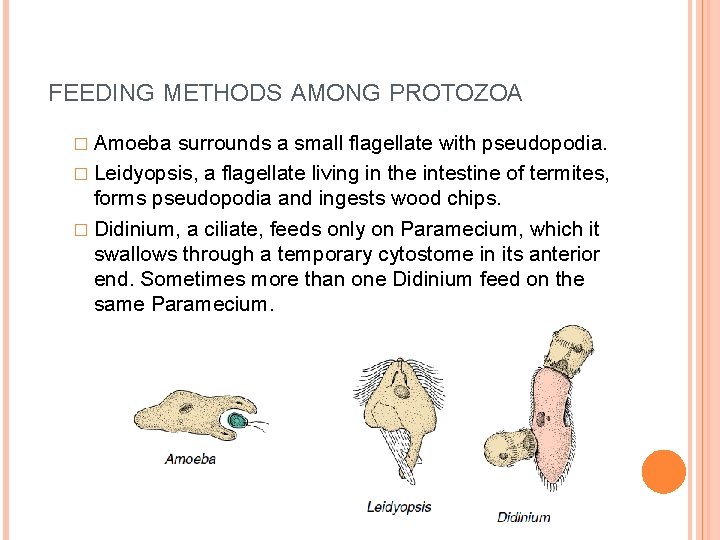
FEEDING METHODS AMONG PROTOZOA � Amoeba surrounds a small flagellate with pseudopodia. � Leidyopsis, a flagellate living in the intestine of termites, forms pseudopodia and ingests wood chips. � Didinium, a ciliate, feeds only on Paramecium, which it swallows through a temporary cytostome in its anterior end. Sometimes more than one Didinium feed on the same Paramecium.
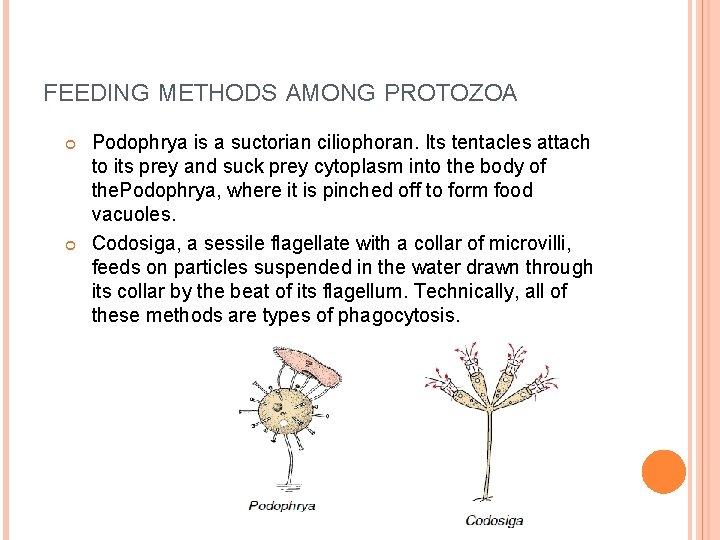
FEEDING METHODS AMONG PROTOZOA Podophrya is a suctorian ciliophoran. Its tentacles attach to its prey and suck prey cytoplasm into the body of the. Podophrya, where it is pinched off to form food vacuoles. Codosiga, a sessile flagellate with a collar of microvilli, feeds on particles suspended in the water drawn through its collar by the beat of its flagellum. Technically, all of these methods are types of phagocytosis.
NUTRITION IN AMOEBA Amoeba obtains its nutrition in a heterotrophic mode. Both the anabolic and catabolic functions are carried out in the same cell. Amoeba feeds on plankton and diatoms present in water. It can form arm- like structures called pseudopodia, extending from any part of its body as it is shapeless. When it senses food in its surroundings it extends its pseudopodia in that direction and moves towards it. Then it engulfs the food with its pseudopodia. When the food enters its body the amoeba forms a food vacuole around it which contains certain enzymes to digest the food. When the food is digested the unwanted waste is released through its body surface.
AMOEBIC CYSTS In environments that are potentially lethal to the cell, an amoeba may become dormant by forming itself into a ball and secreting a protective membrane to become a microbial cyst. The cell remains in this state until it encounters more favourable conditions. While in cyst form the amoeba will not replicate and may die if unable to emerge for a lengthy period of time.
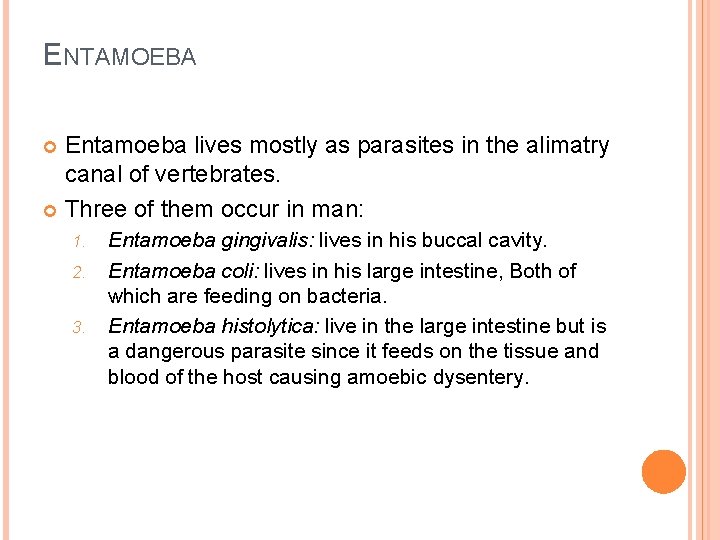
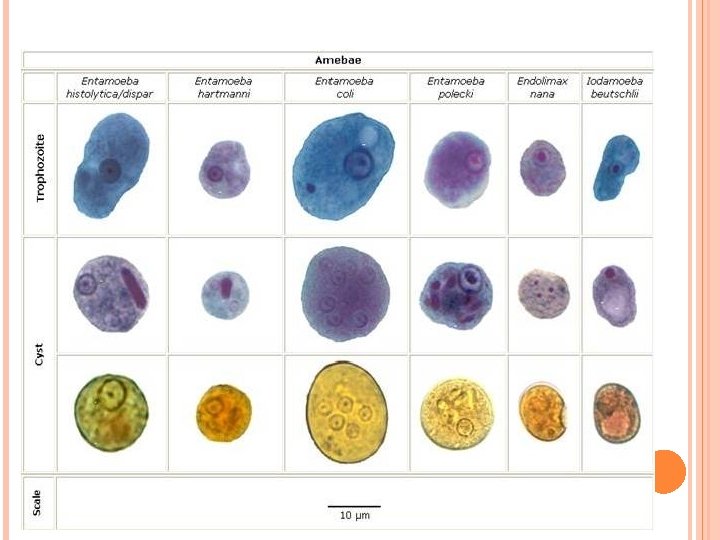
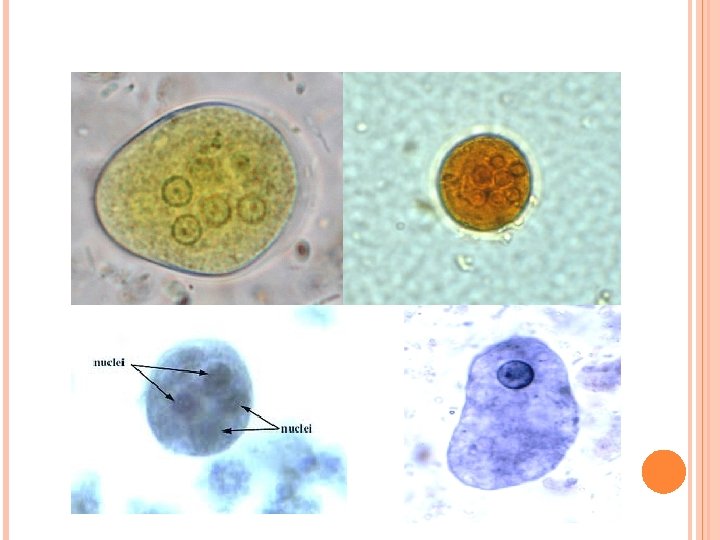
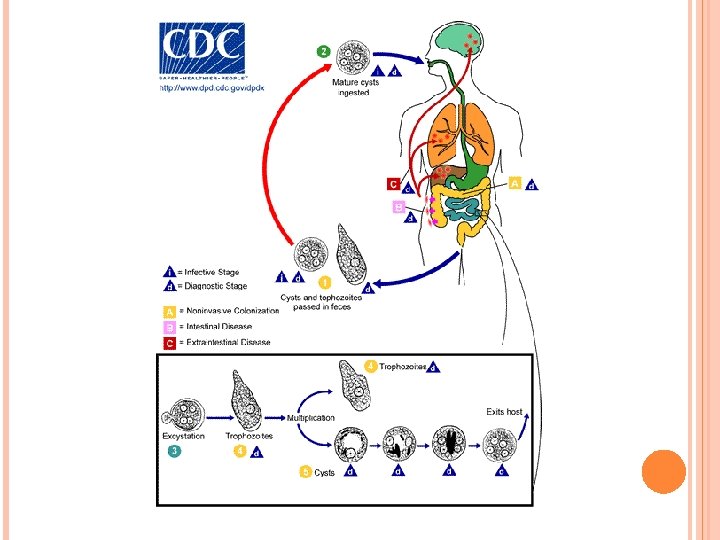
ENTAMOEBA Entamoeba lives mostly as parasites in the alimatry canal of vertebrates. Three of them occur in man: 1. 2. 3. Entamoeba gingivalis: lives in his buccal cavity. Entamoeba coli: lives in his large intestine, Both of which are feeding on bacteria. Entamoeba histolytica: live in the large intestine but is a dangerous parasite since it feeds on the tissue and blood of the host causing amoebic dysentery.
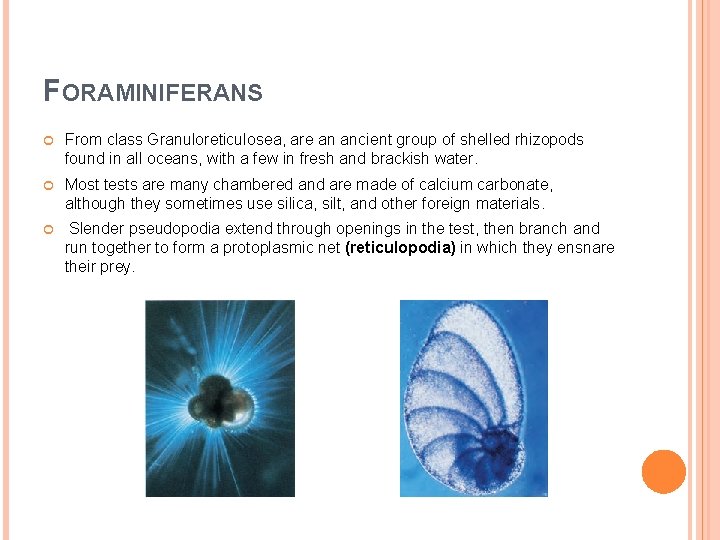
FORAMINIFERANS From class Granuloreticulosea, are an ancient group of shelled rhizopods found in all oceans, with a few in fresh and brackish water. Most tests are many chambered and are made of calcium carbonate, although they sometimes use silica, silt, and other foreign materials. Slender pseudopodia extend through openings in the test, then branch and run together to form a protoplasmic net (reticulopodia) in which they ensnare their prey.
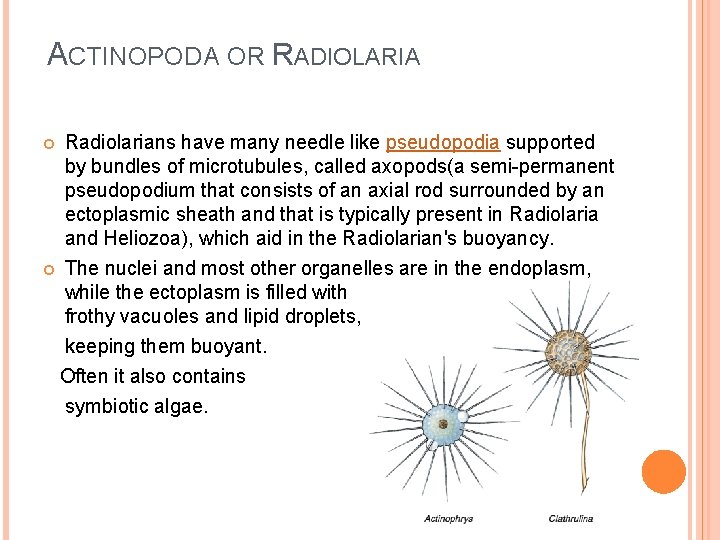
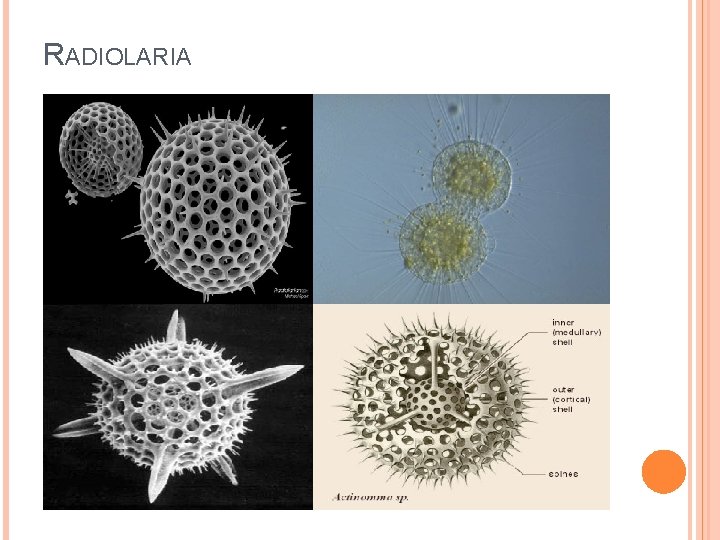
ACTINOPODA OR RADIOLARIA Radiolarians have many needle like pseudopodia supported by bundles of microtubules, called axopods(a semi-permanent pseudopodium that consists of an axial rod surrounded by an ectoplasmic sheath and that is typically present in Radiolaria and Heliozoa), which aid in the Radiolarian's buoyancy. The nuclei and most other organelles are in the endoplasm, while the ectoplasm is filled with frothy vacuoles and lipid droplets, keeping them buoyant. Often it also contains symbiotic algae.
RADIOLARIA
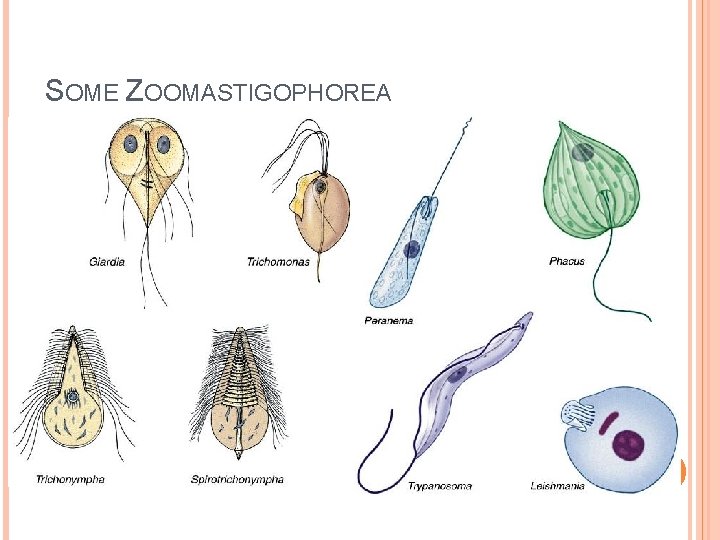
SUBPHYLUM MASTIGOPHORA, FLAGELLATES Move by one or more whip-like flagella. Some parasitic flagellates have up to eight flagella. Most are spindle shaped with flagella projecting from anterior end. Outer membrane is a tough pellicle. Food is ingested through an oral groove or cytosotome. In zoomastigophora, Reproduction through binary fission.
SOME ZOOMASTIGOPHOREA
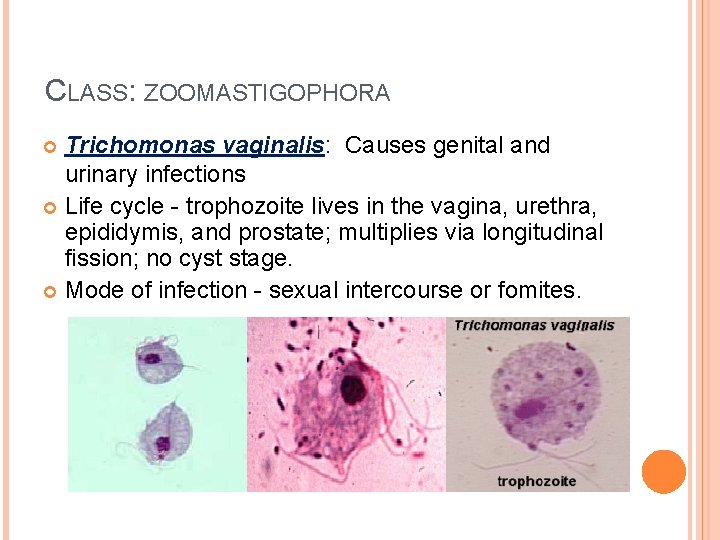
CLASS: ZOOMASTIGOPHORA Trichomonas vaginalis: Causes genital and urinary infections Life cycle - trophozoite lives in the vagina, urethra, epididymis, and prostate; multiplies via longitudinal fission; no cyst stage. Mode of infection - sexual intercourse or fomites.
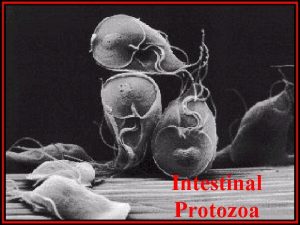
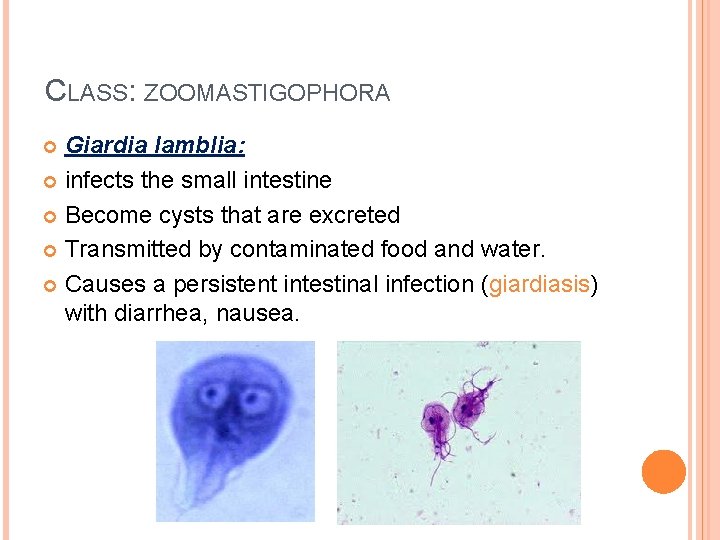
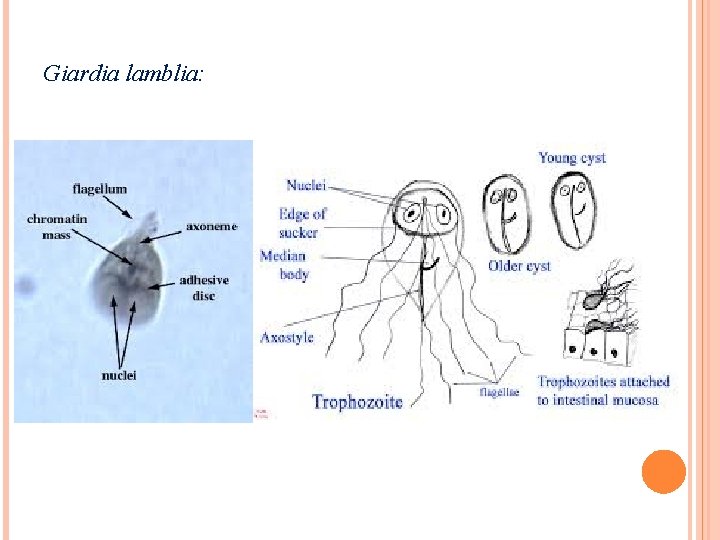
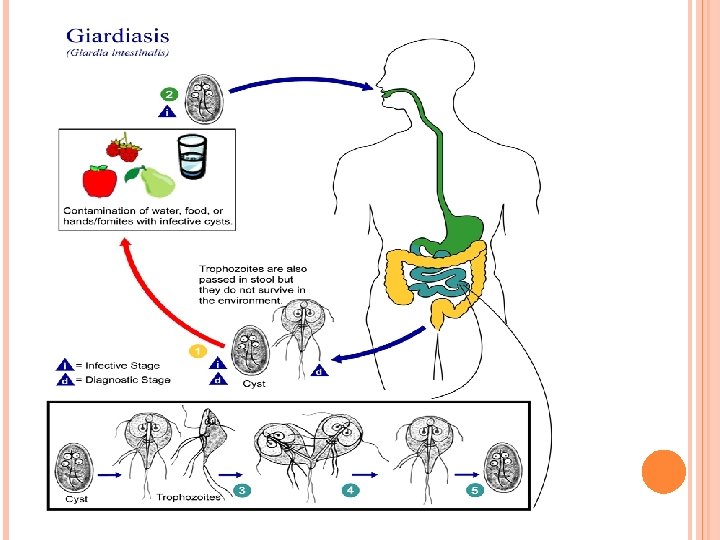
CLASS: ZOOMASTIGOPHORA Giardia lamblia: infects the small intestine Become cysts that are excreted Transmitted by contaminated food and water. Causes a persistent intestinal infection (giardiasis) with diarrhea, nausea.
Giardia lamblia:
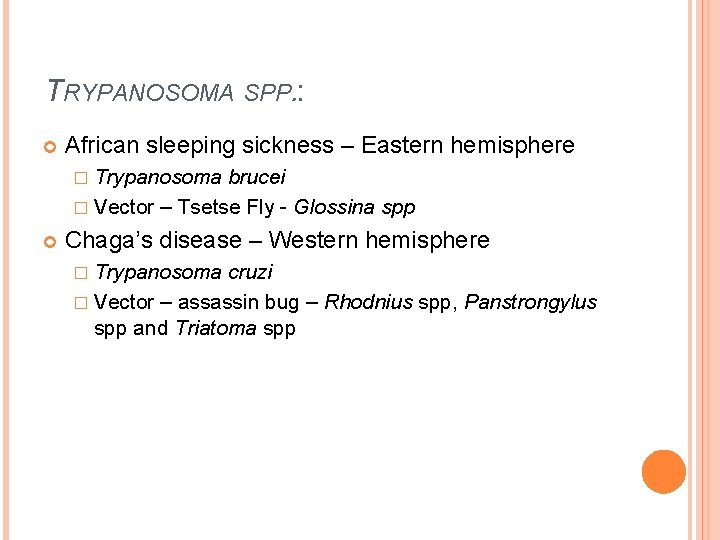
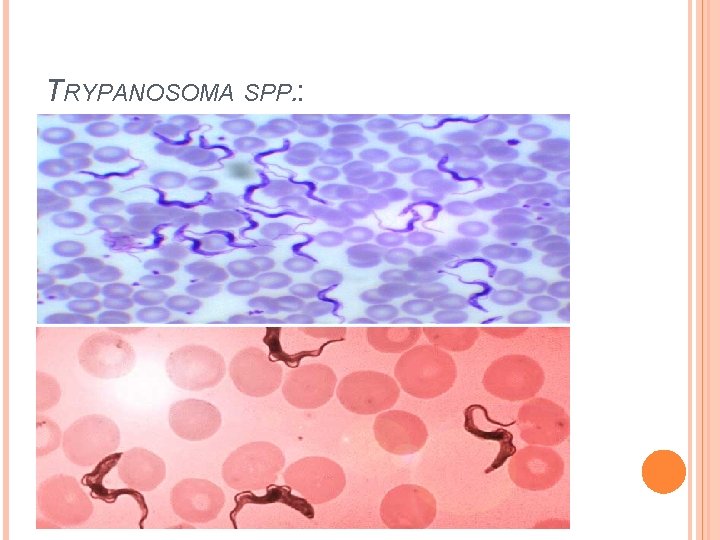
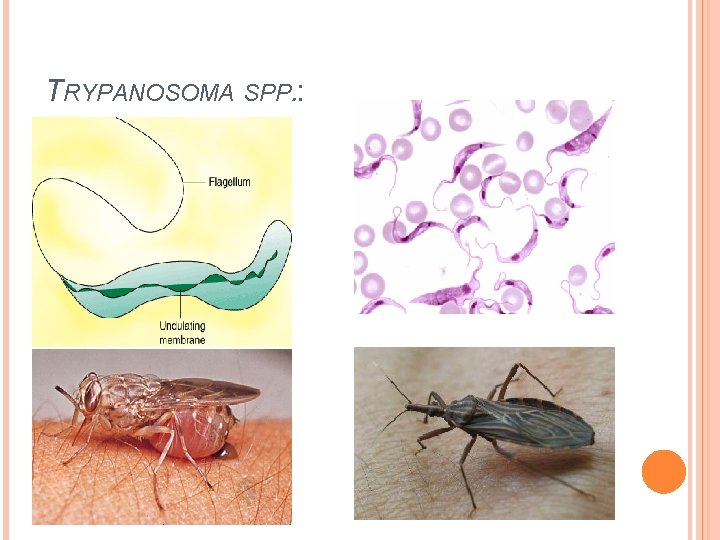
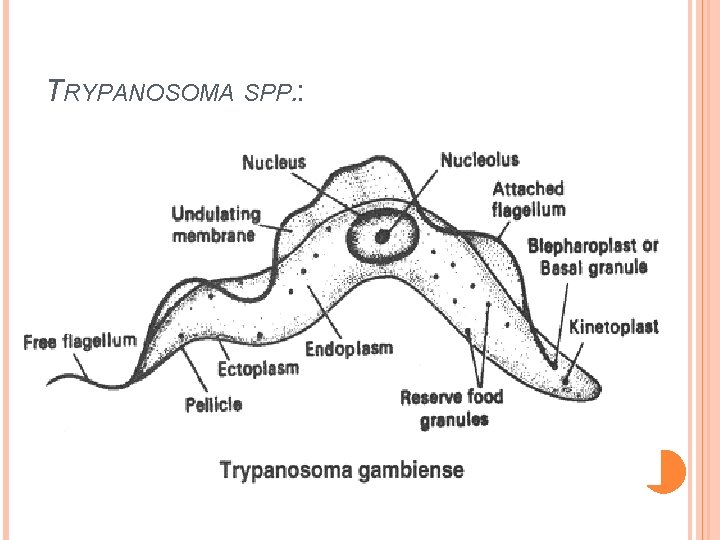
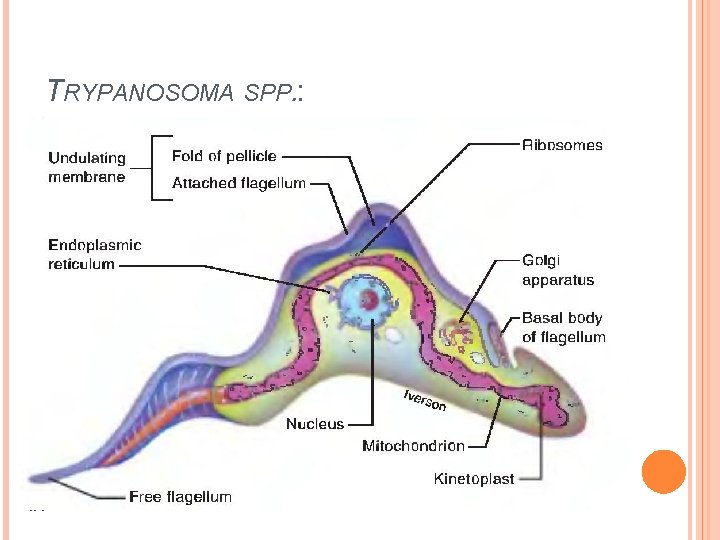
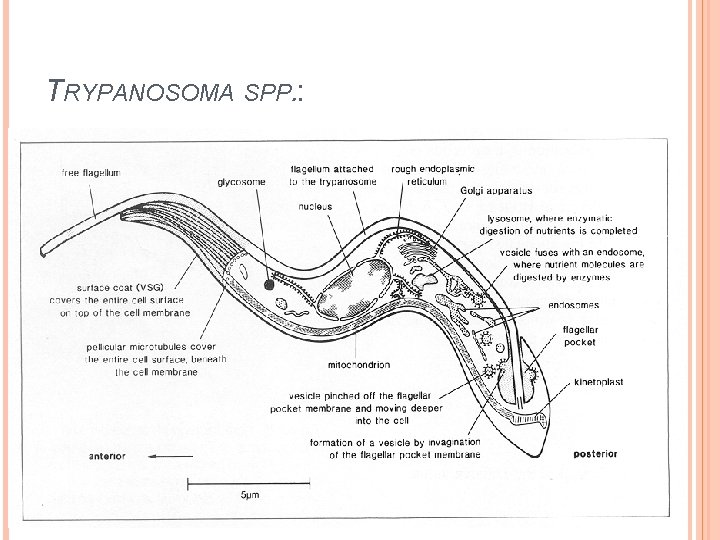
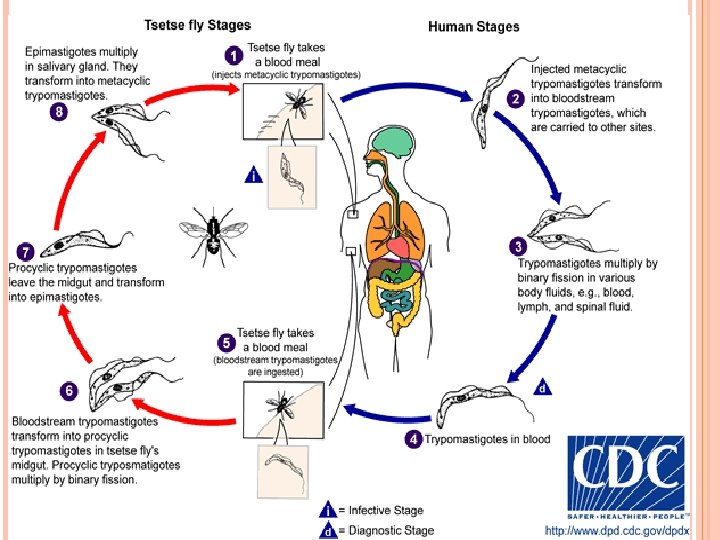
TRYPANOSOMA SPP. : African sleeping sickness – Eastern hemisphere � Trypanosoma brucei � Vector – Tsetse Fly - Glossina spp Chaga’s disease – Western hemisphere � Trypanosoma cruzi � Vector – assassin bug – Rhodnius spp, Panstrongylus spp and Triatoma spp
TRYPANOSOMA SPP. :
TRYPANOSOMA SPP. :
TRYPANOSOMA SPP. :
TRYPANOSOMA SPP. :
TRYPANOSOMA SPP. :
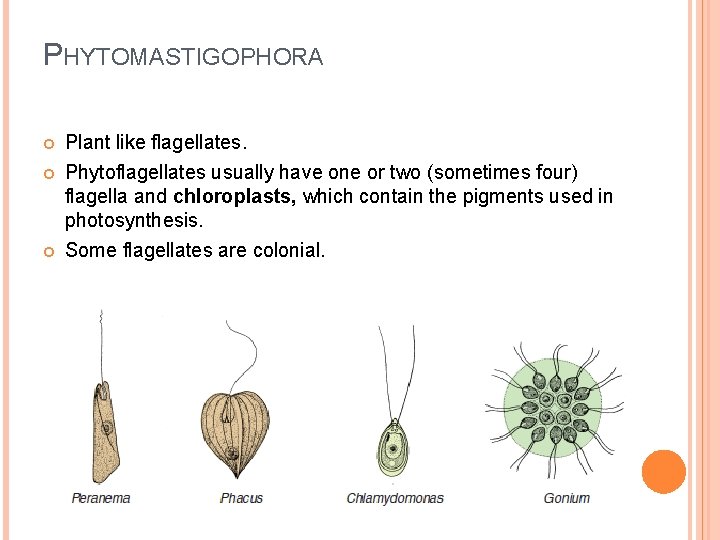
PHYTOMASTIGOPHORA Plant like flagellates. Phytoflagellates usually have one or two (sometimes four) flagella and chloroplasts, which contain the pigments used in photosynthesis. Some flagellates are colonial.
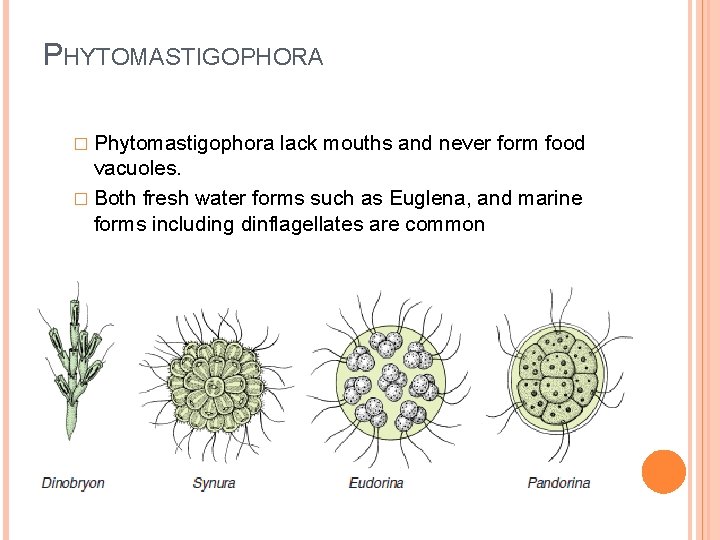
PHYTOMASTIGOPHORA � Phytomastigophora lack mouths and never form food vacuoles. � Both fresh water forms such as Euglena, and marine forms including dinflagellates are common
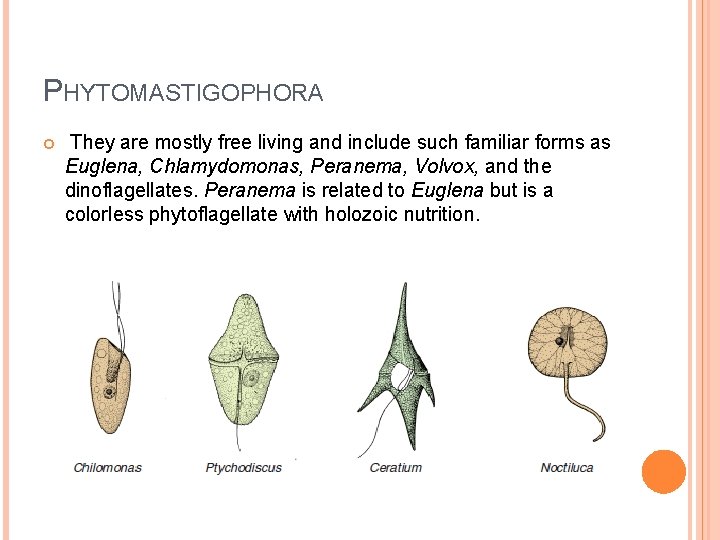
PHYTOMASTIGOPHORA They are mostly free living and include such familiar forms as Euglena, Chlamydomonas, Peranema, Volvox, and the dinoflagellates. Peranema is related to Euglena but is a colorless phytoflagellate with holozoic nutrition.
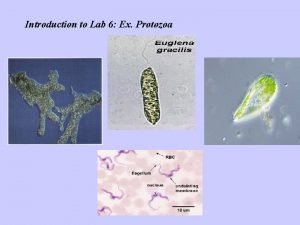
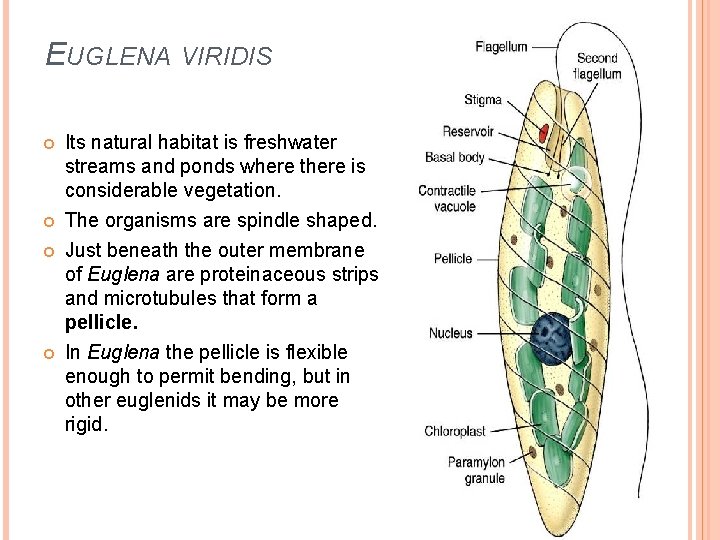
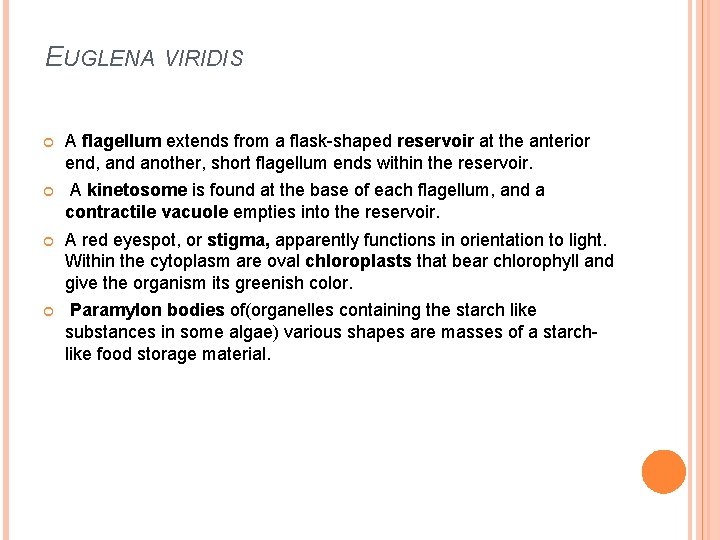
EUGLENA VIRIDIS Its natural habitat is freshwater streams and ponds where there is considerable vegetation. The organisms are spindle shaped. Just beneath the outer membrane of Euglena are proteinaceous strips and microtubules that form a pellicle. In Euglena the pellicle is flexible enough to permit bending, but in other euglenids it may be more rigid.
EUGLENA VIRIDIS
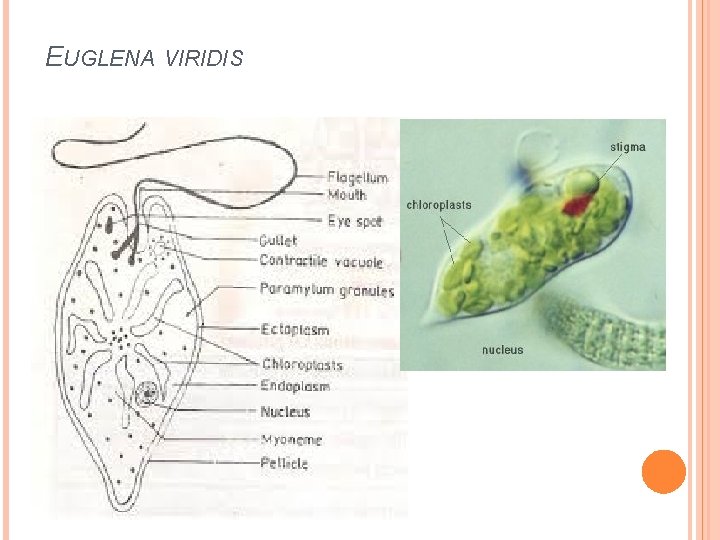
EUGLENA VIRIDIS A flagellum extends from a flask-shaped reservoir at the anterior end, and another, short flagellum ends within the reservoir. A kinetosome is found at the base of each flagellum, and a contractile vacuole empties into the reservoir. A red eyespot, or stigma, apparently functions in orientation to light. Within the cytoplasm are oval chloroplasts that bear chlorophyll and give the organism its greenish color. Paramylon bodies of(organelles containing the starch like substances in some algae) various shapes are masses of a starchlike food storage material.
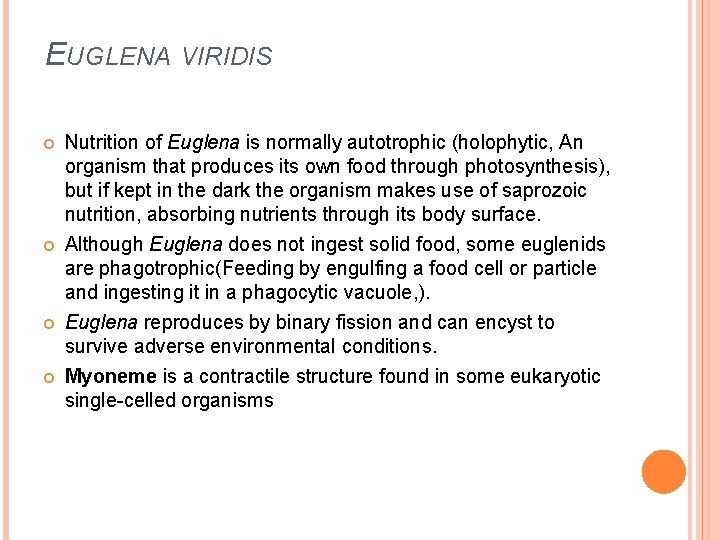
EUGLENA VIRIDIS Nutrition of Euglena is normally autotrophic (holophytic, An organism that produces its own food through photosynthesis), but if kept in the dark the organism makes use of saprozoic nutrition, absorbing nutrients through its body surface. Although Euglena does not ingest solid food, some euglenids are phagotrophic(Feeding by engulfing a food cell or particle and ingesting it in a phagocytic vacuole, ). Euglena reproduces by binary fission and can encyst to survive adverse environmental conditions. Myoneme is a contractile structure found in some eukaryotic single-celled organisms
EUGLENA VIRIDIS
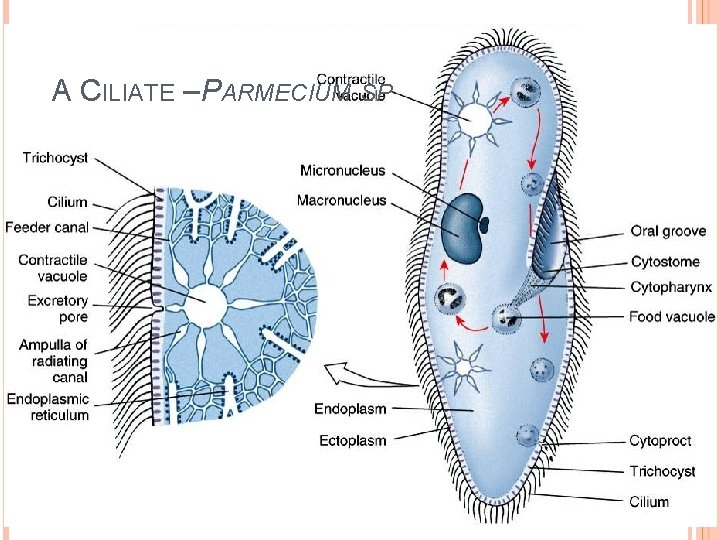
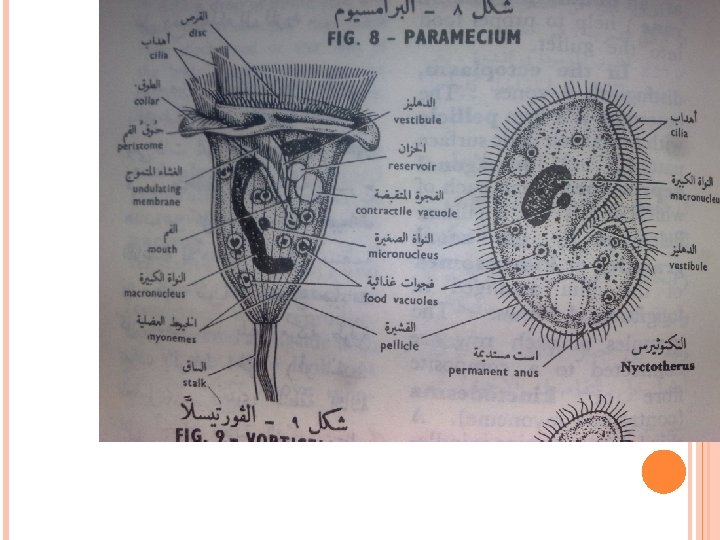
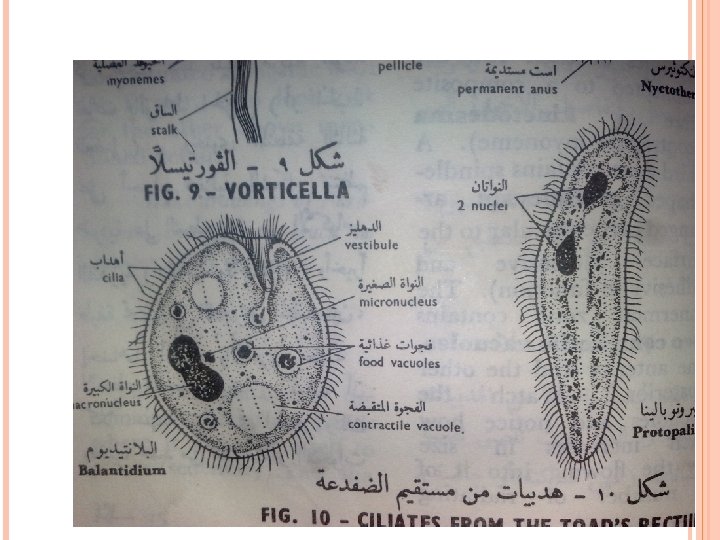
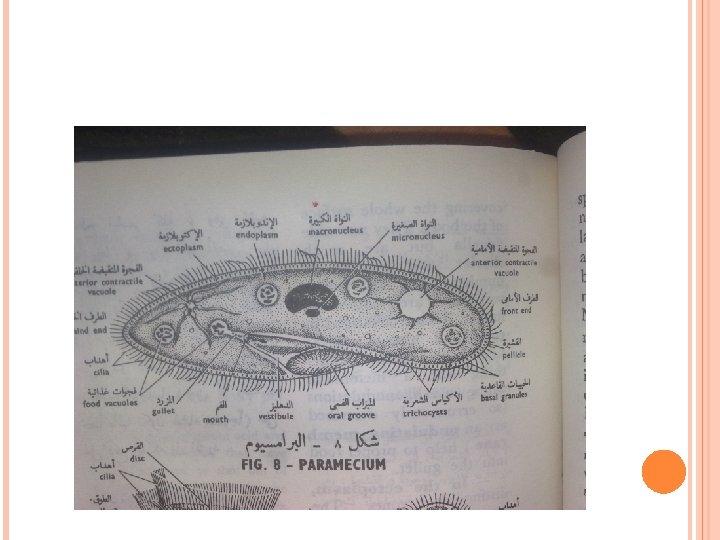
A CILIATE – PARMECIUM SP
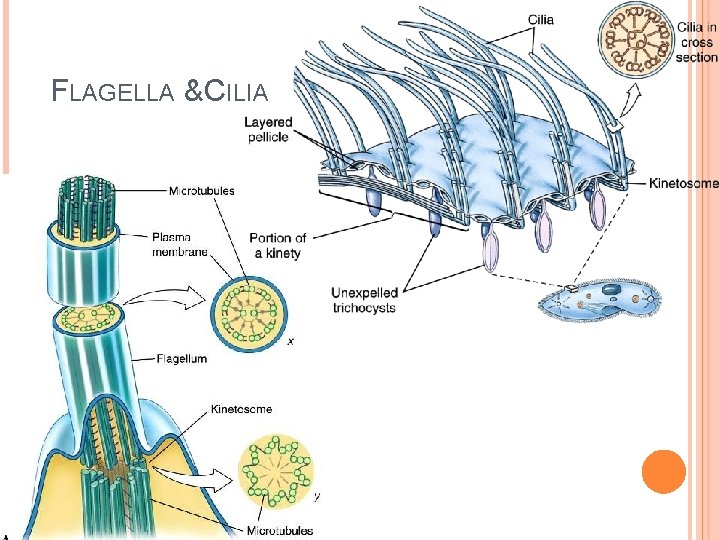
FLAGELLA & CILIA
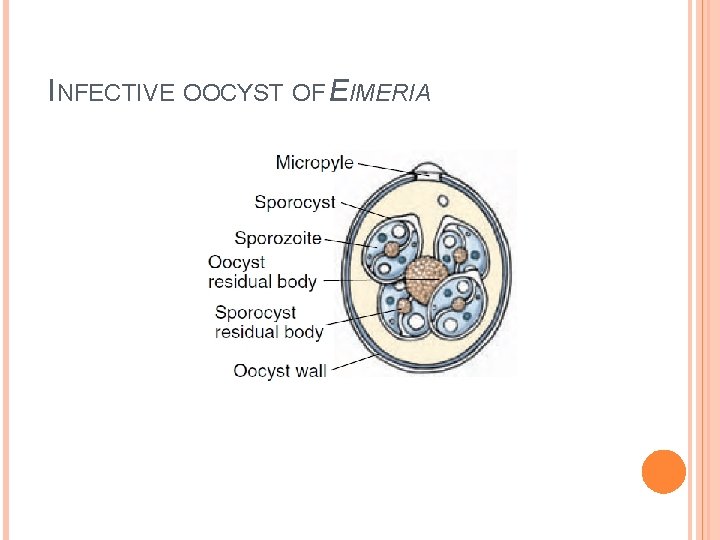
INFECTIVE OOCYST OF EIMERIA
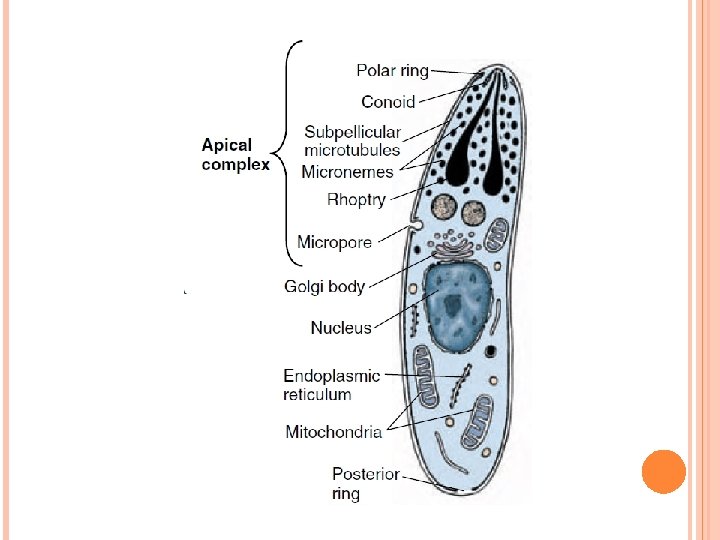
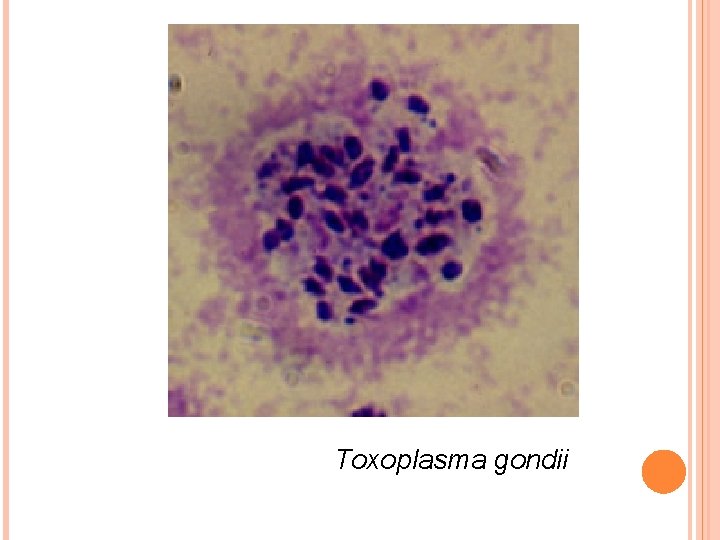
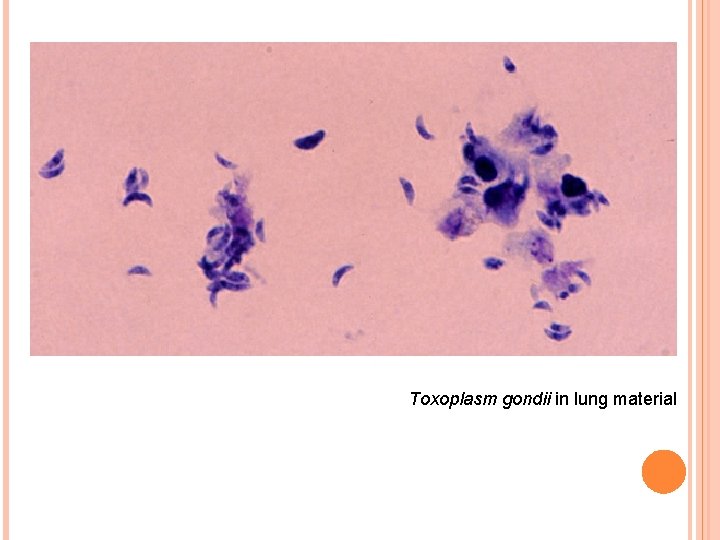
u Medically Important Protozoa (Continued) u 2. Apicomplexans (Phylum Apicomplexa) Important pathogens: u � Toxoplasma gondii: Causes toxoplasmosis in humans. Causes blindness and lymphatic infections in adults. Dangerous to pregnant women, causes severe neurological defects in unborn children. Cats are part of life cycle, oocysts excreted in feces. Contact with infected feces or meat are means of transmission. � Cryptosporidium: Causes respiratory and gallbladder infections in immunosuppressed individuals. Found in intestines of mammals and water. Major cause of death in AIDS patients. � Cyclospora cayetensis: New parasite (1996) caused diarrhea associated with raspberries.
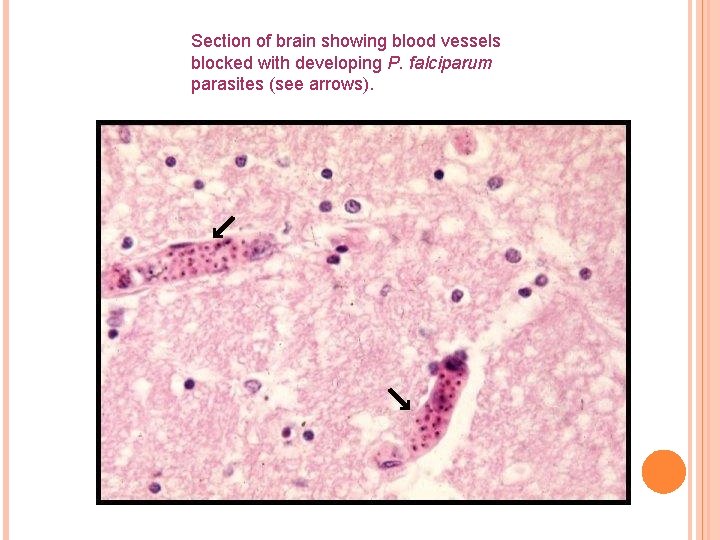
Section of brain showing blood vessels blocked with developing P. falciparum parasites (see arrows).
Toxoplasma gondii
Toxoplasm gondii in lung material