
Balantidiasis Subkingdom Protozoa Phylum Phylum Sarcomastigophor Ciliophora Balantidium

Balantidiasis

Subkingdom: Protozoa Phylum: Phylum : Sarcomastigophor Ciliophora Balantidium ØSubphylum: Sarcodina Amoebas: Entamoeba histolytica Phylum : Apicomplexa • Cryptosporidium • Isospora belli • Plasmodium • Toxoplasma Ø Subphylum: Mastigophora= Flagellates: Giardia lamblia, Trichomonas Leishmania , Trypanosoma
Ciliates v. Belong to the Phylum: Ciliophora. v. They possess simple cilia or compound ciliary organelles, v 2 types of nuclei vlarge contractile vacuole. The only member of the ciliate family to cause human disease is Balantidium coli
Balantidium coli (disease: balantidiasis, balantidial dysentery or ciliary dysentery)
Balantidium coli Widely distributed in warmer climates, which is where human infections most commonly occur. The organisms inhabit the large intestine, caecum and terminal ileum. They feed on bacteria. The most common hosts being humans, pigs and rodents. Human infection is usually from pigs and is rare.
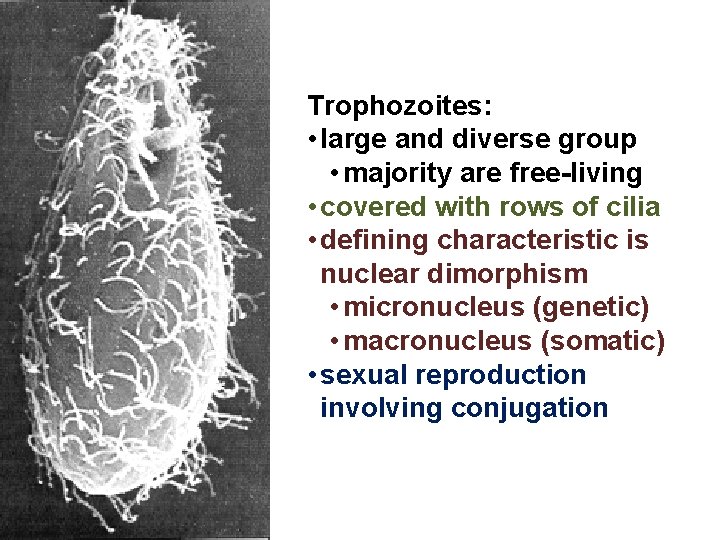
Trophozoites: • large and diverse group • majority are free-living • covered with rows of cilia • defining characteristic is nuclear dimorphism • micronucleus (genetic) • macronucleus (somatic) • sexual reproduction involving conjugation

• Largest protozoa of man, 50100µm X 40 -70 µm. • Movement rigorous, even in dense fecal suspension. • Anterior end conical, posterior end rounded. • Have anterior cytostome and posterior cytopage. • 2 contractile vacuoles • inhabit the large intestine, caecum and terminal ileum • they feed on bacteria
Cyst: Spherical, 50 µm in diameter. Cilia lost on encapsulation. Transmission by ingestion of cyst from feces contaminating food or water.
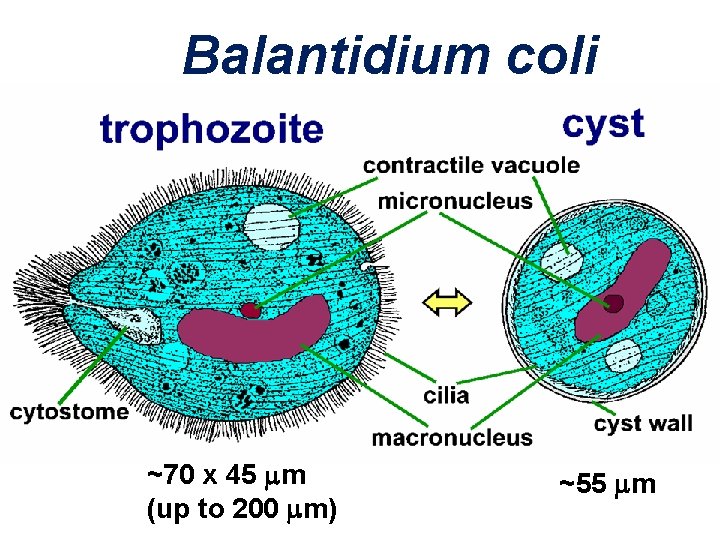
Balantidium coli ~70 x 45 m (up to 200 m) ~55 m
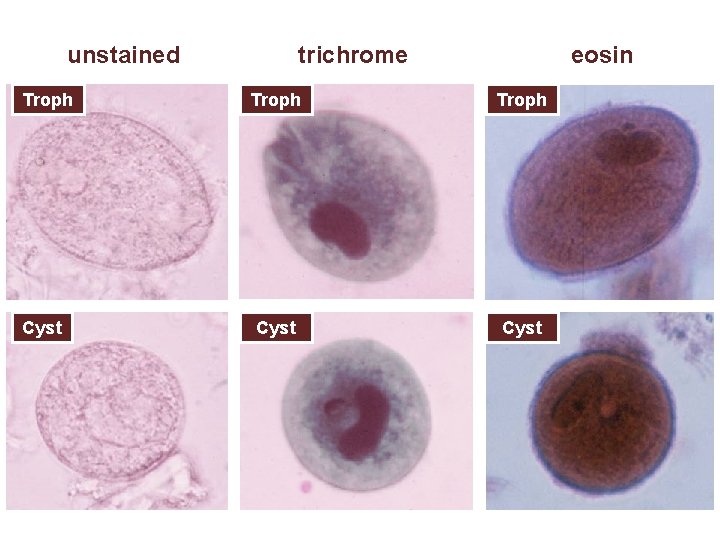
unstained Troph Cyst trichrome eosin Troph Cyst

Ciliate Reproduction Binary fission Conjugation

Pathogenesis: q. Most cases are asymptomatic. q. Severe B. coli infections may resemble amoebiasis i. e. dysentery. q. Symptoms include diarrhoea (dysenteric diarrhea), nausea, vomiting and anorexia. q. The diarrhoea may persist for long periods of time resulting in acute fluid loss.
q. Balantidium coli also have the potential to penetrate the mucosa resulting in ulceration just as those of Entamoeba histolytica, but perforation is more common. q. Metastatic lesions do not occur. q. Extra-intestinal disease has also been reported, but is rare.
Epidemiology: ØFeco-orally transmitted infection with worldwide distribution. ØThe infection present where personal and group hygiene poor. ØBecause pigs are an animal reservoir, human infections occur more frequently in areas where pigs are raised. ØOther potential animal reservoirs include rodents and nonhuman primates.
Diagnosis: detection of trophozoites and cyst in stool specimens or in tissue collected during endoscopy. Cysts and trophozoites are easier to identify in direct fecal smear. Treatment: The drug of choice is tetracycline with metronidazole. Control: Improving personal and group hygiene.
- Slides: 16