
Rumen Microbiology References Church 125 142 153 161
Rumen Microbiology • References – – – Church 125 -142, 153 -161 Sjersen: 19 -46 http: //www. rowett. ac. uk/ercule/html/rumen_protozoa. html Infection and Immunity (2005) 73: 4668 -4675 Livestock Production Science (2004) 85: 81 -97
• Types of microorganisms in the rumen – – – Bacteria Archea Protozoa Fungi Mycoplasma Bacteriophages • Considerable diversity in the population – Traditional culturing techniques • Bacteria: 22 Genera and 68 species • Protozoa: 6 Genera and 15 spcies • Fungi: 3 Genera and species – Molecular techniques • ? ? ?
• Reasons for the diverse population – Wide range of substrates – Rapid environmental changes • • Types and concentrations of nutrients Frequency of feeding p. H Presence of O 2 – Range of environments and microenvironments • • • Digesta particles Liquid Villi Laminae of omassum Surfaces or inside of other organisms – In terms of microbial growth, a group of microorganisms is more efficient than any single microorganism • Maximum biochemical work
• Properties of a true rumen microorganism – Anerobic or facultative anerobic – Produce endproducts found in the rumen or that are utilized by other microorganisms – Numbers needed • Bacterial species – >106/ml
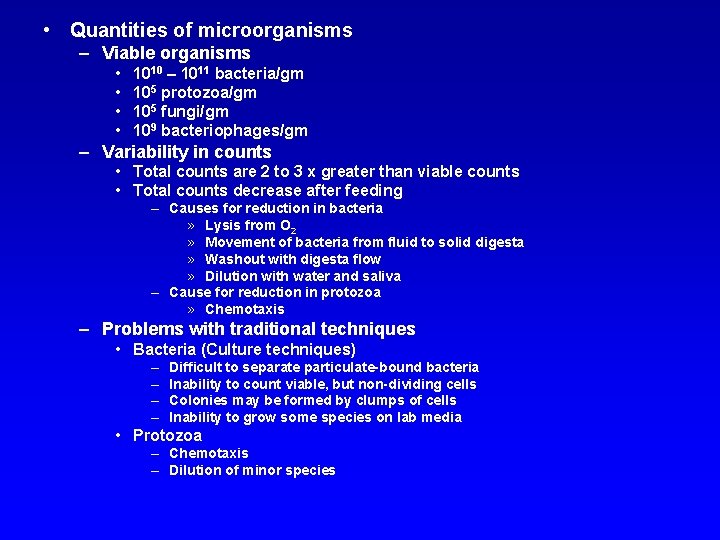
• Quantities of microorganisms – Viable organisms • • 1010 – 1011 bacteria/gm 105 protozoa/gm 105 fungi/gm 109 bacteriophages/gm – Variability in counts • Total counts are 2 to 3 x greater than viable counts • Total counts decrease after feeding – Causes for reduction in bacteria » Lysis from O 2 » Movement of bacteria from fluid to solid digesta » Washout with digesta flow » Dilution with water and saliva – Cause for reduction in protozoa » Chemotaxis – Problems with traditional techniques • Bacteria (Culture techniques) – – Difficult to separate particulate-bound bacteria Inability to count viable, but non-dividing cells Colonies may be formed by clumps of cells Inability to grow some species on lab media • Protozoa – Chemotaxis – Dilution of minor species
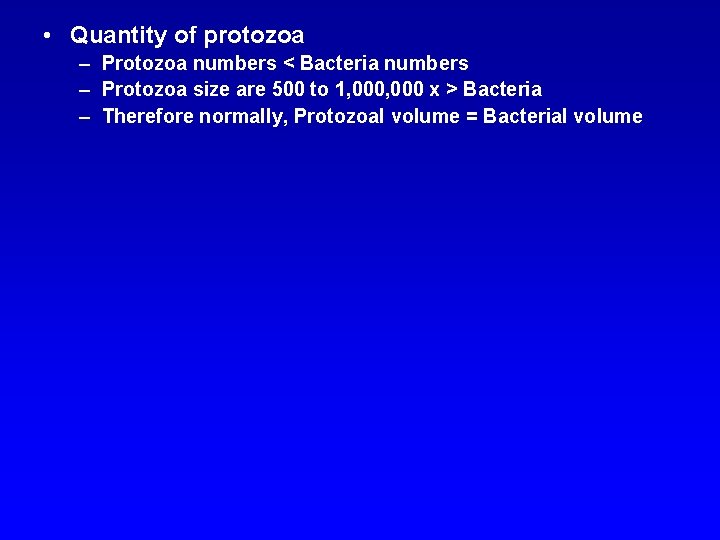
• Quantity of protozoa – Protozoa numbers < Bacteria numbers – Protozoa size are 500 to 1, 000 x > Bacteria – Therefore normally, Protozoal volume = Bacterial volume
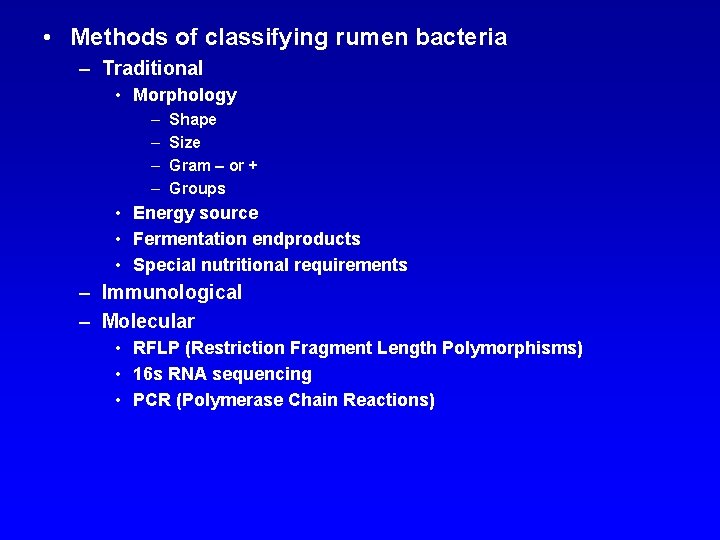
• Methods of classifying rumen bacteria – Traditional • Morphology – – Shape Size Gram – or + Groups • Energy source • Fermentation endproducts • Special nutritional requirements – Immunological – Molecular • RFLP (Restriction Fragment Length Polymorphisms) • 16 s RNA sequencing • PCR (Polymerase Chain Reactions)

• Classifying rumen bacteria by energy source – Relationships • Few species specialize in metabolizing a single substrate, but many prefer certain substrates • Substrate concentration is important in controlling growth of specific species – General relationship u = umax / (1+ Ks/[S]) where u = growth rate umax = theoretical maximum growth rate Ks = Affinity coefficient for a substrate (Lower = more affinity) [S] = Substrate concentration Therefore, if the substrate concentration is very high relative to the affinity, the closer the growth rate will be to the maximum.
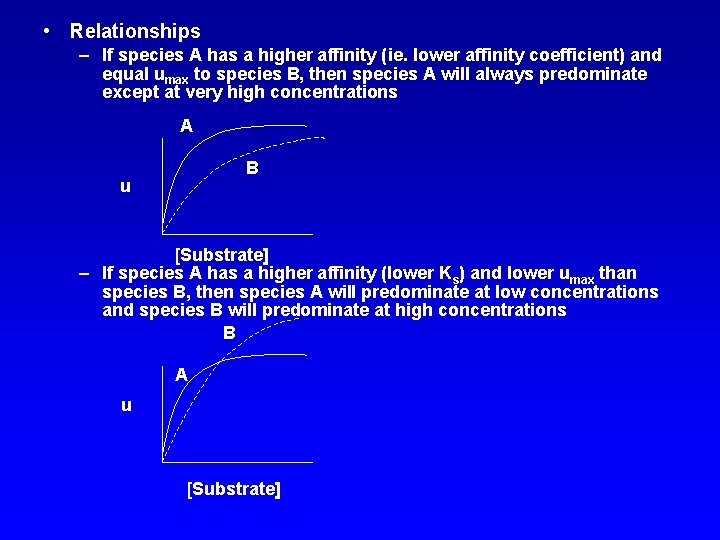
• Relationships – If species A has a higher affinity (ie. lower affinity coefficient) and equal umax to species B, then species A will always predominate except at very high concentrations A B u [Substrate] – If species A has a higher affinity (lower Ks) and lower umax than species B, then species A will predominate at low concentrations and species B will predominate at high concentrations B A u [Substrate]

• Classifying rumen bacteria by energy source – Cellulolytic bacteria • Cellulose – – Primary constituent of plant cell walls A chain of glucose units bound by beta-1, 4 -linkages Can only be digested by microorganisms Digestibility determined by lignification • Common cellulolytic bacteria – – – Ruminococcus flavefaciens Ruminococcus albus Fibrobacter succinogenes Butyrvibrio fibrisolvens Clostridium lochheadii
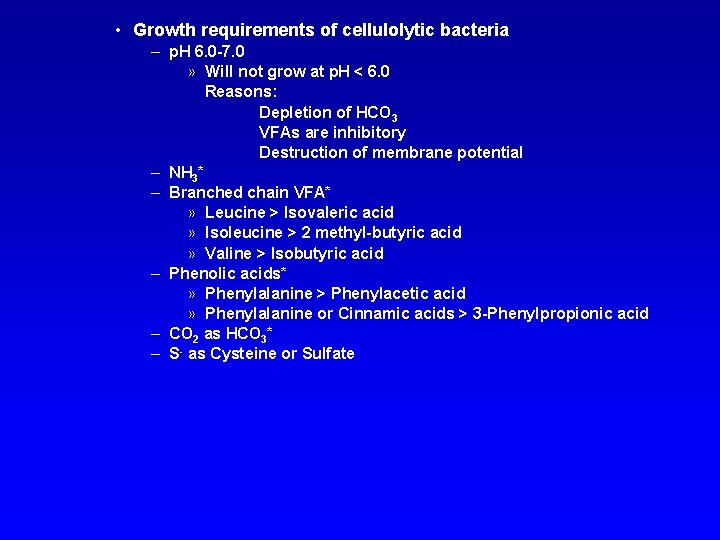
• Growth requirements of cellulolytic bacteria – p. H 6. 0 -7. 0 » Will not grow at p. H < 6. 0 Reasons: Depletion of HCO 3 VFAs are inhibitory Destruction of membrane potential – NH 3* – Branched chain VFA* » Leucine > Isovaleric acid » Isoleucine > 2 methyl-butyric acid » Valine > Isobutyric acid – Phenolic acids* » Phenylalanine > Phenylacetic acid » Phenylalanine or Cinnamic acids > 3 -Phenylpropionic acid – CO 2 as HCO 3* – S- as Cysteine or Sulfate
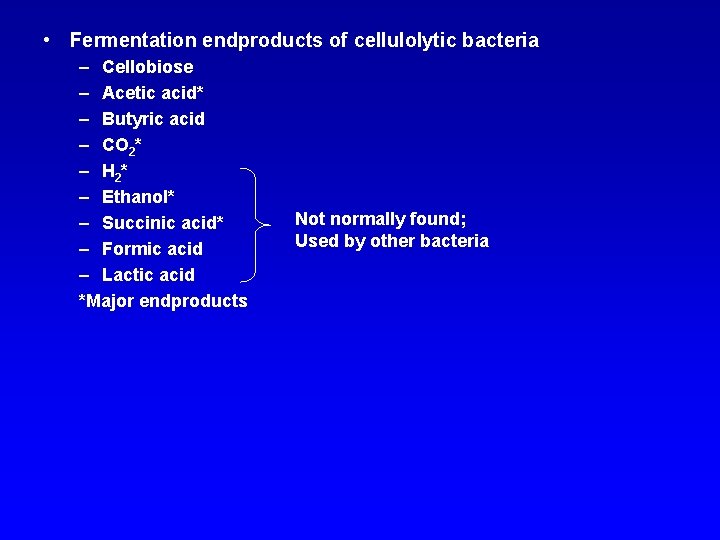
• Fermentation endproducts of cellulolytic bacteria – Cellobiose – Acetic acid* – Butyric acid – CO 2* – H 2 * – Ethanol* – Succinic acid* – Formic acid – Lactic acid *Major endproducts Not normally found; Used by other bacteria
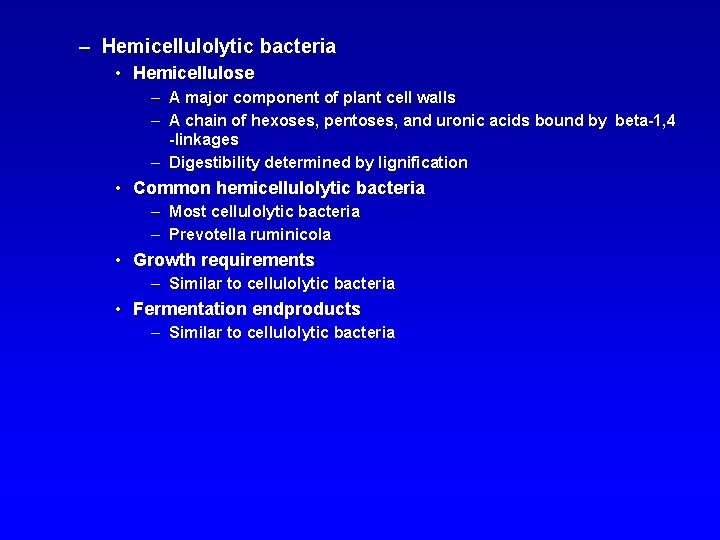
– Hemicellulolytic bacteria • Hemicellulose – A major component of plant cell walls – A chain of hexoses, pentoses, and uronic acids bound by beta-1, 4 -linkages – Digestibility determined by lignification • Common hemicellulolytic bacteria – Most cellulolytic bacteria – Prevotella ruminicola • Growth requirements – Similar to cellulolytic bacteria • Fermentation endproducts – Similar to cellulolytic bacteria
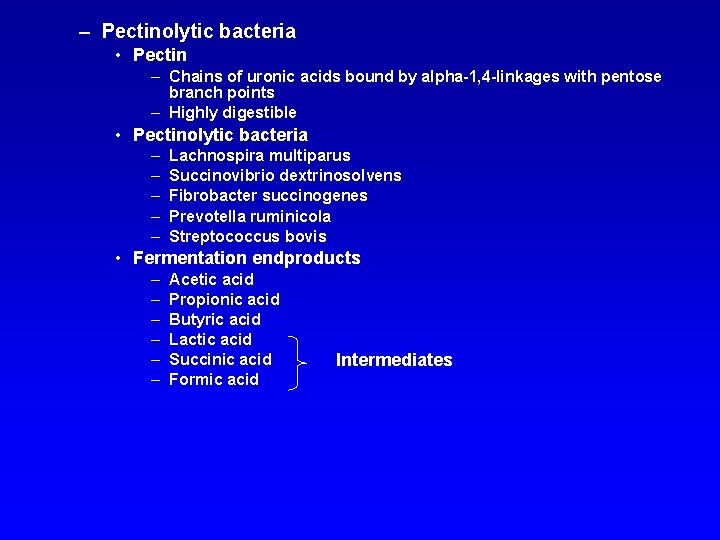
– Pectinolytic bacteria • Pectin – Chains of uronic acids bound by alpha-1, 4 -linkages with pentose branch points – Highly digestible • Pectinolytic bacteria – – – Lachnospira multiparus Succinovibrio dextrinosolvens Fibrobacter succinogenes Prevotella ruminicola Streptococcus bovis • Fermentation endproducts – – – Acetic acid Propionic acid Butyric acid Lactic acid Succinic acid Formic acid Intermediates
– Amylolytic bacteria • Starch – Polymer of glucose units bound by alpha-1, 4 -linkages with varying numbers of alpha-1, 6 -branch points – Primary carbohydrate in grains • Amylolytic bacteria – Streptococcus bovis » Normally present in low numbers in cattle either fed forages or adapted to grain diets » Very high numbers in unadapted cattle that engorge on grain Reasons for increase High concentrations of glucose in rumen Low division time Loss of protozoa » Fermentation 85% of starch is fermented to lactic acid » Causes lactic acidosis
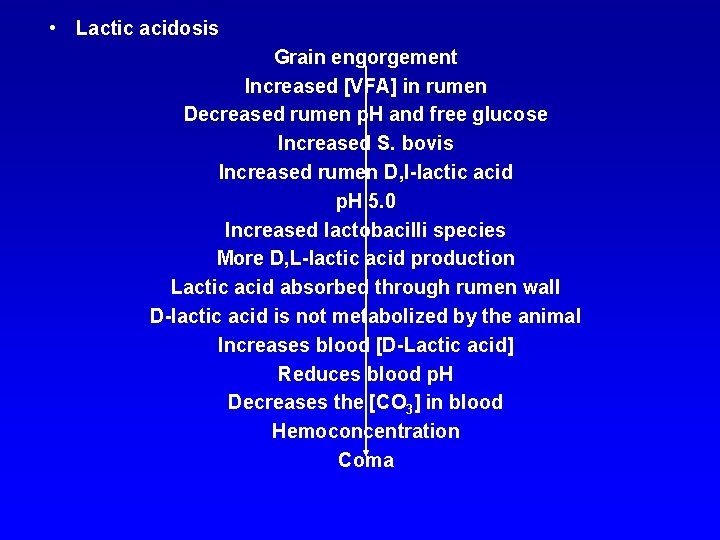
• Lactic acidosis Grain engorgement Increased [VFA] in rumen Decreased rumen p. H and free glucose Increased S. bovis Increased rumen D, l-lactic acid p. H 5. 0 Increased lactobacilli species More D, L-lactic acid production Lactic acid absorbed through rumen wall D-lactic acid is not metabolized by the animal Increases blood [D-Lactic acid] Reduces blood p. H Decreases the [CO 3] in blood Hemoconcentration Coma
– More amylolytic bacterial species • • Ruminobacter amylophilus Prevotella ruminicola Succinomonas amylolytica Succinovibrio dextrinosolvens – Growth requirements • • p. H 5. 0 -6. 0 CO 2 NH 3 Peptides – Fermentation endproducts • • Oligosaccharides (Intermediate) Acetic acid* Propionic acid* Butyric acid CO 2 Lactic acid Succinic acid Intermediates Formic acid
– Sugar fermenters • Free sugars rarely found in rumen • Few sugar utilizers – Streptococcus bovis – Lactobacillus species • Cellulodextrin utilizers – Treponema bryantii » Grows in co-culture with F. succinogenes
– Acid-utilizing bacteria • Acids that are usually intermediate metabolites – Lactic acid – Succinic acid – Formic acid • Acid-utilizing bacteria – Lactate utilizers » Megasphaera elsdenii » Veillonella alcalescens » Prevotella ruminicola » Fermentation endproducts Acetic acid Propionic acid* Valeric acid Caproic acid – Succinate utilizers » Selenomonas ruminantium » Veillonella alcalescens » Anerovibrio lipolytica » Fermentation endproducts Propionic acid* CO 2 – Formate utilizer » Methanobrevibacter ruminantium
– Proteolytic bacteria • Few bacteria only use protein as their sole energy source • 38% of isolates are proteolytic • Most active proteolytic bacteria – Prevotella ruminicola – Ruminobacter amylophilus – Lipolytic bacteria • Hydrolyze triglycerides and phospholipids – Anerovibrio lipolytica • Hydrolyze galactolipids, phospholipids, and sulfolipids – Butyrvibrio fibrisolvens
– Methanogenic archea • Classes – Free-living » Methanomicrobiales sp. » Methanosarcinales sp. – Associated with protozoa » Methanobrevibacter sp. » Methanococcales sp. • Methane production mechanisms – Acetate or methanol > CH 4 + CO 2 – CO 2 + 4 H 2 > CH 4 + H 2 O – Formic acid + 3 H 2 > CH 4 + 2 H 2 O • Effects – Energy waste (5 -6% of GE) – Greenhouse gas – Requirement to increase ATP and microbial growth
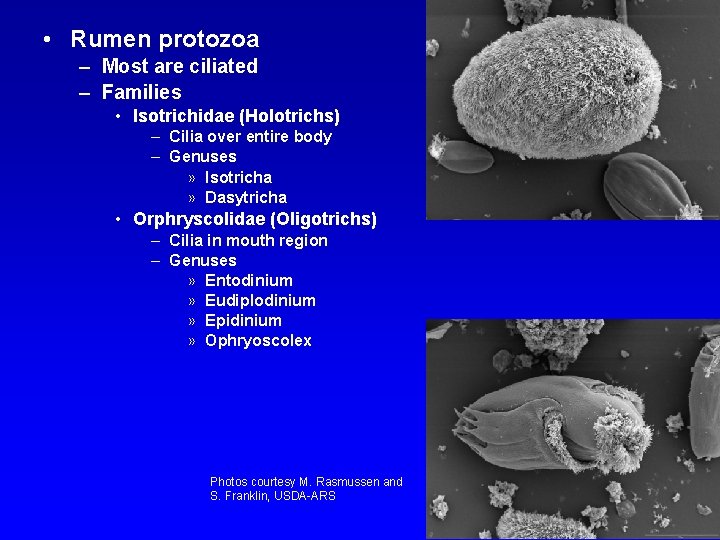
• Rumen protozoa – Most are ciliated – Families • Isotrichidae (Holotrichs) – Cilia over entire body – Genuses » Isotricha » Dasytricha • Orphryscolidae (Oligotrichs) – Cilia in mouth region – Genuses » Entodinium » Eudiplodinium » Epidinium » Ophryoscolex Photos courtesy M. Rasmussen and S. Franklin, USDA-ARS
– Additional properties of protozoa • • Much larger than bacteria Count is normally 105 Slow generation time Closely associated with feed particles – Holotrichs exhibit chemotaxis moving to the back of the rumen when animals are eating before settling in ventral and cranial sacs – Do not readily pass from the rumen • Holotrichs near the rumen wall scavenge O 2 • All protozoa store soluble carbohydrates as an amylopectinlike storage polysaccharide – Carbohydrate specificity » Holotrichs store sugars » Oligotrichs store starch – Benefits » To protozoa, it maintains a constant energy source » To animal, it stabilizes fermentation • Protozoa engulf and lyse bacteria – Contributes to rumen protein turnover reducing efficiency of protein use – Bacteria that resist lysing in the protozoa may have genes activated that result in resistant, more virulent pathogens • Protozoa have close relationships with methanogens
– Fermentation endproducts of protozoa • Holotrichs – – Acetic acid Butyric acid Lactic acid H 2 • Oligotrichs – – CO 2 H 2 Acetic acid Butryric acid – N requirements of protozoa • Do not use NH 3 • Actively proteolytic
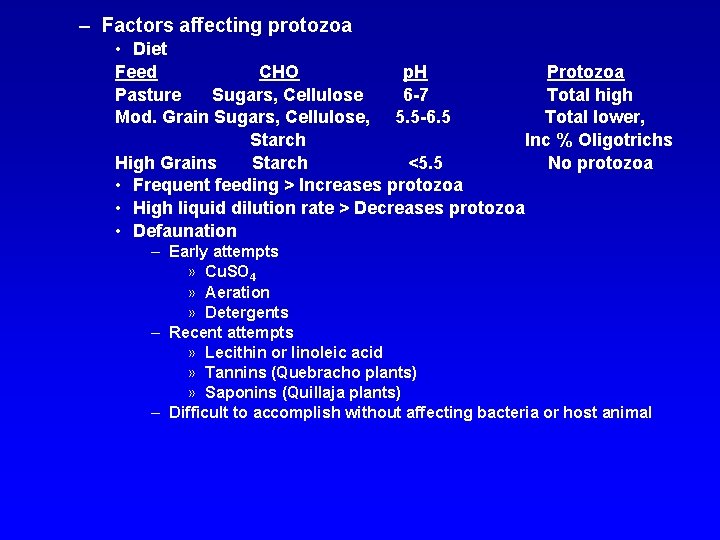
– Factors affecting protozoa • Diet Feed CHO p. H Protozoa Pasture Sugars, Cellulose 6 -7 Total high Mod. Grain Sugars, Cellulose, 5. 5 -6. 5 Total lower, Starch Inc % Oligotrichs High Grains Starch <5. 5 No protozoa • Frequent feeding > Increases protozoa • High liquid dilution rate > Decreases protozoa • Defaunation – Early attempts » Cu. SO 4 » Aeration » Detergents – Recent attempts » Lecithin or linoleic acid » Tannins (Quebracho plants) » Saponins (Quillaja plants) – Difficult to accomplish without affecting bacteria or host animal
The need for protozoa in the rumen Protozoa are not necessary for the animal (Commensalism) • Advantages of protozoa – Increased cellulose digestion • 25 – 33% of total cellulose digestion • Mechanisms – More active than bacteria? – Provide NH 3 to bacteria – Remove O 2 – Slower fermentation of starch and sugars – Greater VFA production – Increased transport on conjugated linoleic acid (CLA) and trans-11 (18: 1) fatty acid to duodenum and meat and milk • Disadvantages of protozoa – Increased rumen protein turnover • Reduced efficiency of protein use – Increased CH 4 production – Development of more virulent strains of pathogenic bacteria
• Net effects of defaunation – – – Increased daily gains Improved feed efficiency Decreased OM and cellulose digestion Increased total and microbial protein flow to the duodenum Increased p. H on high concentrate diets, but decreased p. H on high forage diets – Increased production of propionic acid and decreased production of butyric acid – Increased rumen volume and liquid outflow rate
• Rumen fungi – Species • Neocallismatix frontalis • Sphaeromonas communis • Piromonas communis – Occurrence • • Appear 8 – 10 days after birth More prevalent on grasses than legumes May be related to sulfur supplementation Function – Fiber digestion
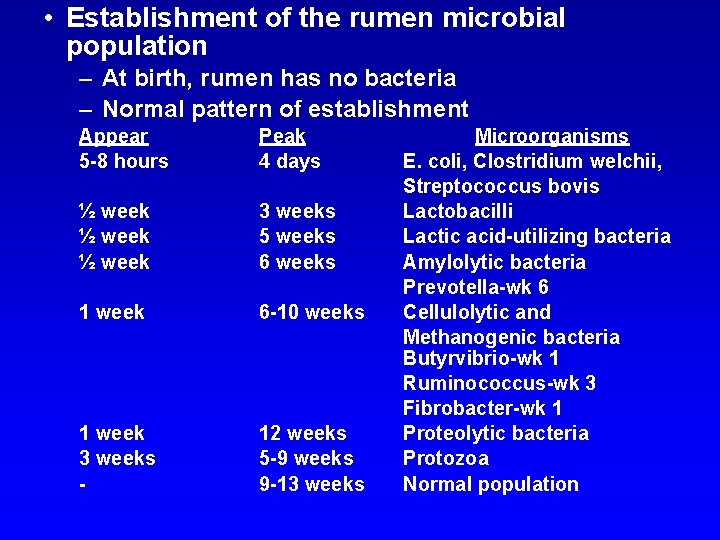
• Establishment of the rumen microbial population – At birth, rumen has no bacteria – Normal pattern of establishment Appear 5 -8 hours Peak 4 days ½ week 3 weeks 5 weeks 6 weeks 1 week 6 -10 weeks 1 week 3 weeks - 12 weeks 5 -9 weeks 9 -13 weeks Microorganisms E. coli, Clostridium welchii, Streptococcus bovis Lactobacilli Lactic acid-utilizing bacteria Amylolytic bacteria Prevotella-wk 6 Cellulolytic and Methanogenic bacteria Butyrvibrio-wk 1 Ruminococcus-wk 3 Fibrobacter-wk 1 Proteolytic bacteria Protozoa Normal population
• Factors affecting establishment of population – Presence of organisms • Normally population is established through animal-toanimal contact • Bacteria may establish without contact with mature ruminants – Establishment of protozoa requires contact with mature ruminants – Favorable environment • Substrates and intermediates • Increased rumen p. H • Digesta turnover
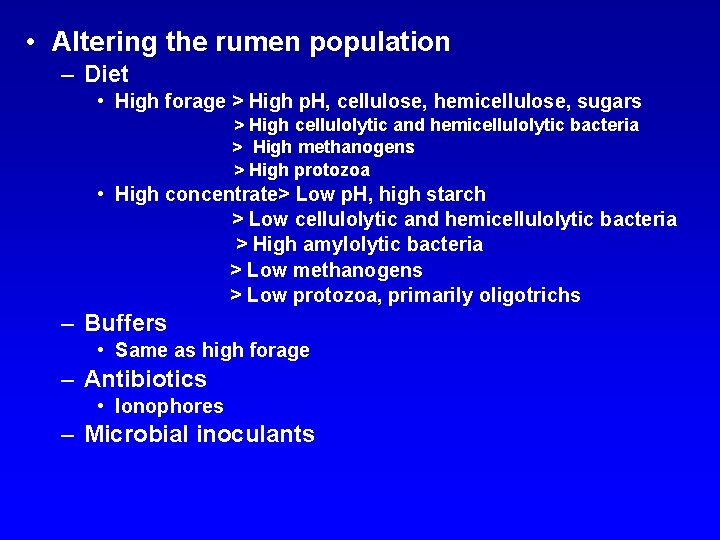
• Altering the rumen population – Diet • High forage > High p. H, cellulose, hemicellulose, sugars > High cellulolytic and hemicellulolytic bacteria > High methanogens > High protozoa • High concentrate> Low p. H, high starch > Low cellulolytic and hemicellulolytic bacteria > High amylolytic bacteria > Low methanogens > Low protozoa, primarily oligotrichs – Buffers • Same as high forage – Antibiotics • Ionophores – Microbial inoculants
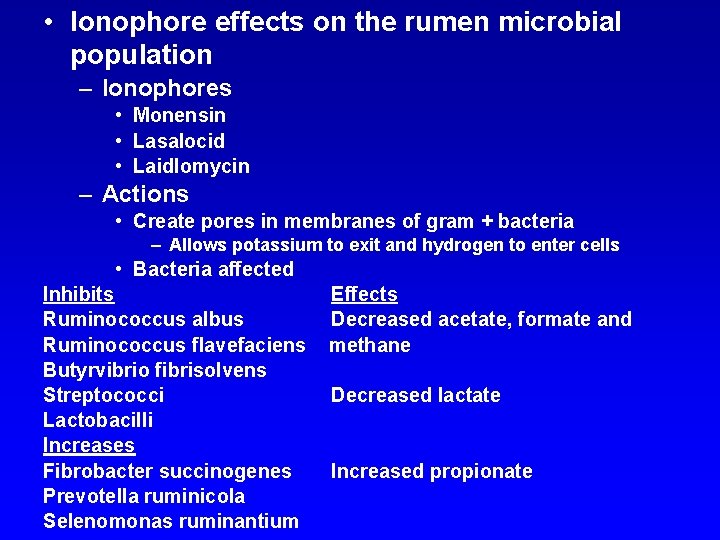
• Ionophore effects on the rumen microbial population – Ionophores • Monensin • Lasalocid • Laidlomycin – Actions • Create pores in membranes of gram + bacteria – Allows potassium to exit and hydrogen to enter cells • Bacteria affected Inhibits Ruminococcus albus Ruminococcus flavefaciens Butyrvibrio fibrisolvens Streptococci Lactobacilli Increases Fibrobacter succinogenes Prevotella ruminicola Selenomonas ruminantium Effects Decreased acetate, formate and methane Decreased lactate Increased propionate
– Net results of feeding ionophores • • • Increased propionate Reduced protein degradation Reduced deamination Reduced methane production Reduced lactate production
• Use of microbial inoculants – Dosing with lactate-utilizing bacteria can reduce lactic acid build up in rumen – Difficult to do long-term • Antagonistic environment • Difficult to get enough organisms • Considerable gene exchange – Mechanisms » Tranformation » Conjugation » Tranduction – Favorable conditions for gene transfer » High population » Intimate cell-to-cell contact » Supply of phages » Extrachromosal plasmid DNA » Transient non-rumen bacteria
- Slides: 34